Review: Tobago
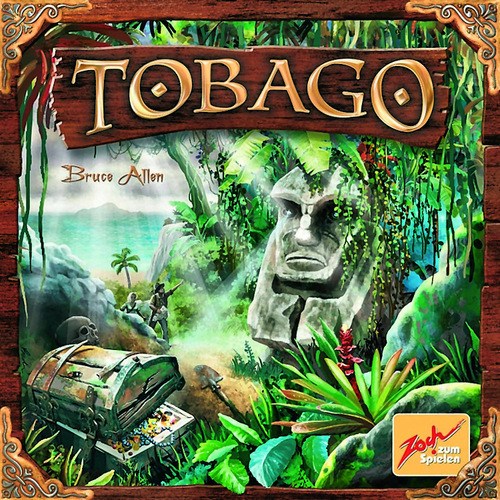 From Rio Grande Games, Tobago is a deduction game for 2 to 4 players. Each player is an adventurous explorer driving around a remote tropical island seeking to dig up buried treasure, while mysterious statues rotate and give clues to mystical amulets that can help with your task. At any time there are four potential buried treasures offering a random number of gold pieces. Once the deck of treasure cards is exhausted, each player totals their treasure and the player with the highest number wins.
Players have two options during their turn. They can move their piece around board segmented in hexes and terrain types, and try to dig up treasure, or play a clue card from their hand. Movement is very easy. A player has 3 ‘legs’ or movement actions. Switching to a different type of terrain is one movement action, while moving to a specific hex (while in the same terrain type) is also a movement action.
Clue cards give hints where treasure might be hidden. Players will have a hand of cards indicating what type of terrain it’s buried in, where it can’t be found, or possibly in the largest terrain area of that type. Aside from being on beaches, rivers, lakes, forests, mountains, or grassland, they might also be closer to other terrain landmarks. There are palm trees, huts, and the large stone statues. So treasure might be close to these other landmarks, or be well away from particular ones.
Each of the 4 treasures have several colored cubes. As a few clues are placed, the cubes will indicate where the treasure might be buried. The only rules for playing clue cards are that they can’t invalidate other clues and must limit the potential hexes where treasure is hidden. As you play a clue card you also put one of your markers on a card. Once there is one cube indicating the only possible location where the treasure is buried, then it’s a race to dig it up.
For each clue card, treasure cards are randomly distributed. Each player will get to see treasure cards equal to the number of clues they contributed. Treasure can vary from 1 to 6 coins. The treasure cards are returned, shuffled, and one extra treasure card is thrown into the pile. Then the first treasure card is flipped over. Starting with the player that dug it up, followed by each player in reverse order of the clues placed, they have a choice of taking that treasure card, or opting to pass and get another one. If no player takes the treasure card then it is discarded. If they choose to pick that treasure card, their clue card is taken out of the line. This continues until all the players have a chance to pick up a treasure card from the pile.
This becomes an interesting push your luck game. You might know there are high value treasure cards in the pile. Do you continue to pass or jump on a lower value card? If you wait too long, you might get stuck with a single coin card. In addition to this are two cursed treasure cards. If those are drawn the rest of the treasure cards in the pile are discarded. On top of that, all players that have clues in play must discard their highest value treasure they have scored.
Fortunately amulet tokens can be discarded to avoid having to give up any treasure you found. Amulets also allow for extra movement, playing additional clues, and even removing possible locations where treasure might be buried. As treasure is dug up, more tokens are randomly added to the map. You’ll find as you play gathering a few amulets along with some judicious use will be a key strategy.
The Good – The board design is very clever being three pieces and double sided, adding variety to how the board sets up. Landmark pieces can also be placed in different locations expanding the layout variation tremendously. The game is engaging and the side-game of the treasure auction also adds to the experience. The rulebook is well written and it includes an easy to understand setup guide as well as a clue icon summary. The components are wonderful with solid terrain pieces, especially the stone(!) statues.
The Bad – The cursed treasure might be a gotcha for some players, and can potentially really hurt your point total. This can also allow another player to slip ahead and steamroll towards a win. There is a little bit of a learning curve with interpreting some of the clue card icons (but this is mitigated due to the handy player aid included in the game).
The Verdict – Tobago is a fantastic deduction game. You have to cleverly plan out moves and play clues that can allow you to maneuver close to its final location if wanting the lion’s share of a treasure. The player has some interesting choices of either focusing on one or two treasures, or spreading yourself out to get a little of each pile, not to mention deciding whether to delay a move to pick up handy amulets.
I also like the treasure distribution minigame. It has some strategy in the clue order, rewarding players that really help narrow down the potential locations, but also allow any player to get a share by adding a clue card. The hidden information and deciding when to scoop up a treasure card, or pass for potentially a more rewarding share of coins, is a fun part of the game.
All in all, It’s a tremendous game and the components really help evoke that exploration theme despite using abstract mechanisms. Tobago seems to also be a great family game. If you can track it down, it’s a nice addition if looking for a light, deduction game for your collection.
 Geek Ken