Category: 15mm
Top places for miniature wargame supplies in Seoul
While board games and CCGs have a lot of popularity in Korea, miniature wargames seem quite the niche hobby here. A while back during holiday at home I scooped up some of my 15mm Russians for Flames of War. I figured during the winter months I could enjoy some weekend mornings doing a bit of painting and finally get through that pile of unpainted metal I had stored away. When I really started looking around I found it exceptionally difficult getting the typical supplies I wanted for painting and modeling. So I thought I’d share some of my efforts to any expats.
As a first caveat to this, my Korean is abysmal. I am certain if I had a better command of the language the process would be easier tracking down materials. Korea is very much an online shopping country. There are likely places I’ve missed that have a larger online presence than a walk in store mainly due to my ignorance with the local language.
However miniature wargaming also just doesn’t seem that popular of a pastime. There is an immense pressure on kids to study and private academies are all the rage. Free time is limited for kids and parents want them studying more. So pastimes that leave a smaller footprint around the house are likely more popular. It’s far easier for kids to carry around a CCG or sneak off to a PC bang (internet cafe for gaming) rather than lug around a painting bench and throw down a wargame table. It does seem for the folks that wargame, it’s much more popular for college students than for kids in high school.
Stationery and Art Supply Stores – Odd enough, stationery stores may very well carry some modeling and painting supplies. Give them a look and you might pleasantly be surprised. Foamcore board can typically be found as well as colored felt cloth. I’ve snagged packs for Woodland Scenics flock, plastic sheets from Plastruct, balsa wood, and other modeling material too. So you can pick up a few things to help in construction of terrain for your games from these places.
As painting supplies go, you can find a fair amount of brushes and can even get down to 10O sizes for model painting. I’ve even been able to snag some Apple Barrel craft paints. While I don’t use them for mini painting, they make great paints for terrain. So hobby and craft supplies can be picked up at these stationery stores. It just takes a bit of digging.
Neighbor Hobby – This is a fantastic place if military models are your thing as there is a great selection of kits. Unfortunately for fans of Bolt Action, they carry only Tamiya 1/48 models, but they seem to have a full selection from that line. As 1/72 and 1/76 scale kits go though, they have a great selection of tanks, soldiers, and terrain. They also have several 1/72 scale buildings too.
What does this place for me though is the paint selection. There is a wide selection of paints from Testors, Tamiya, AK Interactive, MIG, as well as my go to for miniature painting, Vallejo. It’s a wonderful selection for both brush and airbrush painters. They also carry a complete selection of Testors and Tamiya sprays. They also have brushes and other modelling supplies. Well worth checking out and they do online orders as well.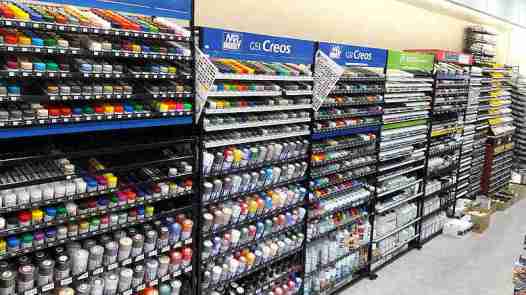
To get there isn’t too difficult. Take subway line 2 to Hongik University and get off exit number 3. You need to cross the street and footpath park, and then take a side street. Once it ends, then go right and you will hit a main street. From there go left and it will be in an office building on your left.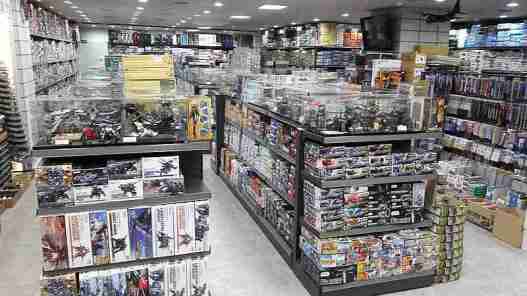
Orc Town – Likely the most popular wargame store in Seoul, Orc Town is one that is Games Workshop-centric. They also dabble in other game systems like Infinity, Flames of War, Bolt Action, Firestorm Armada, and Dust. What is particularly nice about this store is they carry Citadel paints and supplies, especially matte spray and primer (for typical costs). My biggest complaint is that for some products the prices are horrendously expensive and well above retail (seems to include shipping costs). Because of that, I’ve had a hard time justifying purchasing particular model and rulebooks here compared to buying from an international distributor. Still, having a shop where you can walk in and buy some paints is nice. Having one where you can get a bit of table space for gaming is even nicer.
Tamiya Models – On the first floor of the shopping center at the Yongsan train station is an official Tamiya Model store. For a military wargamer this is a fair place to pick up paints and hobby supplies. They have full stocks of enamel and water-based acrylic paint sets. They also have brushes, cement, and other modeling supplies (plastic styrene sheets and other model building material). I find the prices reasonable for Tamiya model kits and for plastic cement and other modeling tools (which can be a bear to find anywhere locally) it’s a great place to shop.
As the gaming figures go, if you are a Bolt Action fan they have a decent selection of 1/48 scale armor and vehicles along with some figure sets. 1/72 scale options are lacking save for planes and 1/35 is the other popular scale for military models. Additionally scenic materials are also lacking. But if you want to track down a particular 1/48 vehicle or historically accurate paints, the Tamiya store is not a bad choice. 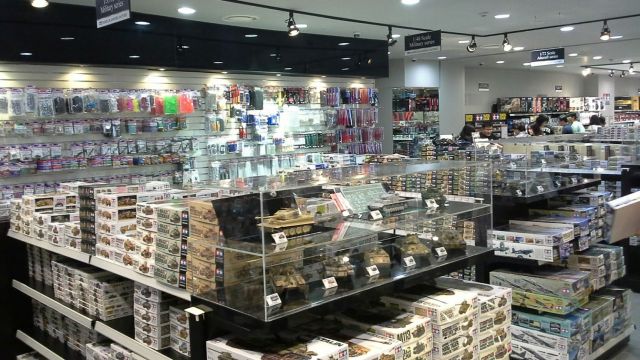
International distributors – Lastly you can always order online and pony up for international shipping. I have had spray paints sent overseas and worked with many stores over the years. It can be done, but expect some costs for shipping. I’ve always gone the route of making a large ($150-250) order to offset the shipping costs. Getting a few paints is exceedingly expensive. It’s best to wrap more goodies into that shipping charge. Because of this, you want to look around for stores that sell other types of games. While you might save a few dollars from one online store selling just paints, using another that lets you also include board games and RPG books into your order is a better choice.
There is a very small wargaming community in Korea but we exist. Hope those into the hobby can find some of this useful for picking up models and supplies for their bench top.
Bolt Gun Action: a sci-fi themed version of Bolt Action WWII rules
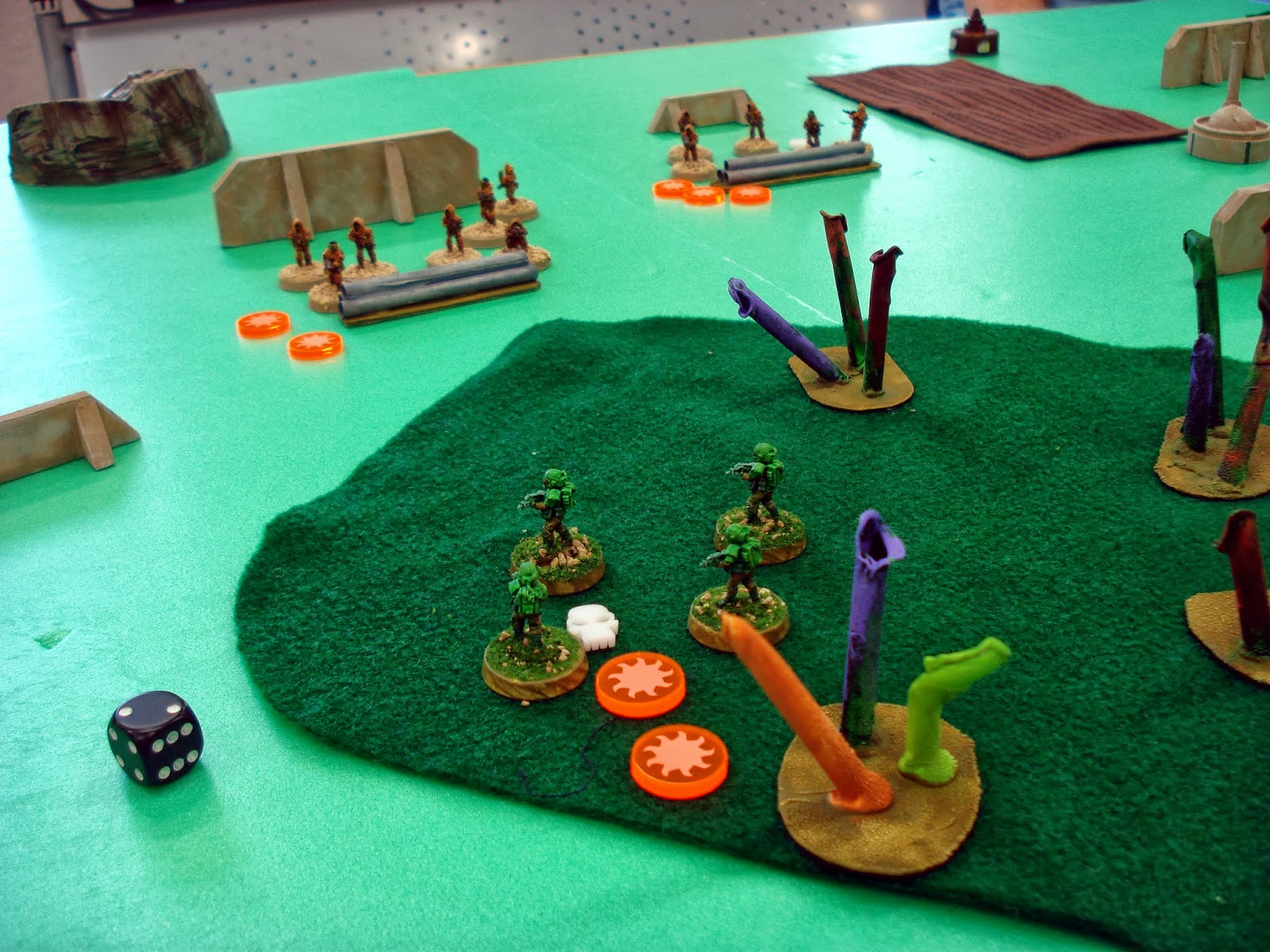
I’ve gushed quite a bit about Bolt Action and how it seems to scratch my itch for WWII skirmish gaming. The game can be well…. very gamey in handling combat. It isn’t a simulation rule set and it handles a lot of situations in an abstract way, not to mention a lot of wild mechanics. Also some can slip into min-max armies when crafting their force lists. Still it captures platoon-based action pretty well and also plays fairly quick without getting bogged down. It hits more high notes than flat ones, making it an enjoyable set of rules.
I’ve taken to it so much, it’s really spoiled me compared to other rules. I just haven’t found something that combines random dice order activation with a pinning mechanic quite like Bolt Action. So I figured why not just slap a sci-fi theme onto Bolt Action and see what comes out of it. The result is Bolt Gun Action. This isn’t a complete re-writing of the rules. Instead it’s pretty much the very same WWII game with some very small tweaks.

Rather than trying to get an entire point list together of new troops, I’ve defaulted to using a single army list as a baseline for points. Rifles are the normalized small arms. Basically it’s the game right out of the book with a smattering of new troops and added HQ options. I’ve also whipped up a quick reference sheet with the added rules included.
It’s pretty fun. Just your regular Bolt Action game with a few changes. I’ll likely give the rules another pass in a few months, but for now feel free to pilfer the links and I hope folks get some enjoyment out of these rules.
FoW: Russian scout platoon

I’ve been (very) slowly chipping away at my Russian Strelkovy division. Originally I had a company of infantry to support my Russian armor force. Having a ton of painted infantry stands made me want to work on an infantry army too but I figured I’d take that as a long ongoing project.
I had some leftovers of tankodesantniki figs set aside (just PPSh-41 armed Old Glory and Flames of War minis). Instead of plopping them on my tanks, I was planning on modeling a few on a thin base in single file so I could have them accompany my tanks and still give them some visual representation they were part of the platoon. Even with a few stands made up I still had a ton of figures so was sort of lost on what to do with them. Looking over the FoW lists, I decided to form them together as a Russian scout platoon for my infantry army.
One approach I was going to try with these minis was a single wash of ink. Before for a lot of my other minis I’d do separate washes, especially a flesh wash just for hands and faces. I figure for this group I’d try to speed that up a bit with one uniform wash for the entire stand. Another point I had was just saying no to having 4-5 models per stand. I opted to keep it to 3 or 4 tops instead. It’s just a crap ton of figures and keeping it 3-4 models per stand really made it easier to stretch out the models I had and cut down the work needed to fill out my infantry companies.
Of course it wouldn’t be my typical painting project without a hiccup. Living in Korea it’s immensely difficult getting my hands on proper DIY materials. And despite looking for a long time, spray primer seems non-existent (I just don’t think most folks bother using it for home improvement). So I spend some cash and bought some Army Painter primer online.
Some warning signs for this can should have came with the Firestorm Armada resin minis I originality primed with it. The primer flaked off and simply did not stick to the miniatures. Although I had washed and brushed the minis, I figured I still had some sort of residue on the models that prevented the primer from taking. Working with the same can I primed the metal minis pictured and was not too pleased with the results. The primer sprayed very unevenly, and seemed to leave clumps of primer flecking on the surface of the figures. Using the spray primer I did the recommended procedures, warmed up the can, gave a good minute plus of shaking, waited for a day of no humidity, and still got crappy results.
I’m not going to completely blast Army Painter. Fortunately, I ran out of primer and used another can of Army Painter primer for some 15 mm sci-fi minis. This new can gave a very even coat of primer. So I suspect I just happened to get a bum can. Might still have to chalk Army Painter up into the ‘questionable’ column (I have used their matte varnish and the results seem okay).

Looking over the Russian scout figures, I was going to go with an initial black wash to ease with detailing the miniatures. As the primer job was sort of botched, I opted instead to use thinned down Vallejo surface black primer. I’ve used similar waterbased primer for my FA ships with good results. It did seem to get into the cracks like I wanted, but the figures still had a bit of a ‘fuzzy’ look due to the primer. I powered on and went to using a few coats of base coats that evened out the surface a bit.
As I mentioned I have taken the route of different washes for the same figure before with my other 15 mm forces. However looking at the literal pile of figures I need to paint for my Russian infantry division, I needed a more rapid way of getting through the minis. So for these figures I went ahead and gave a single ink wash for the entire figure.
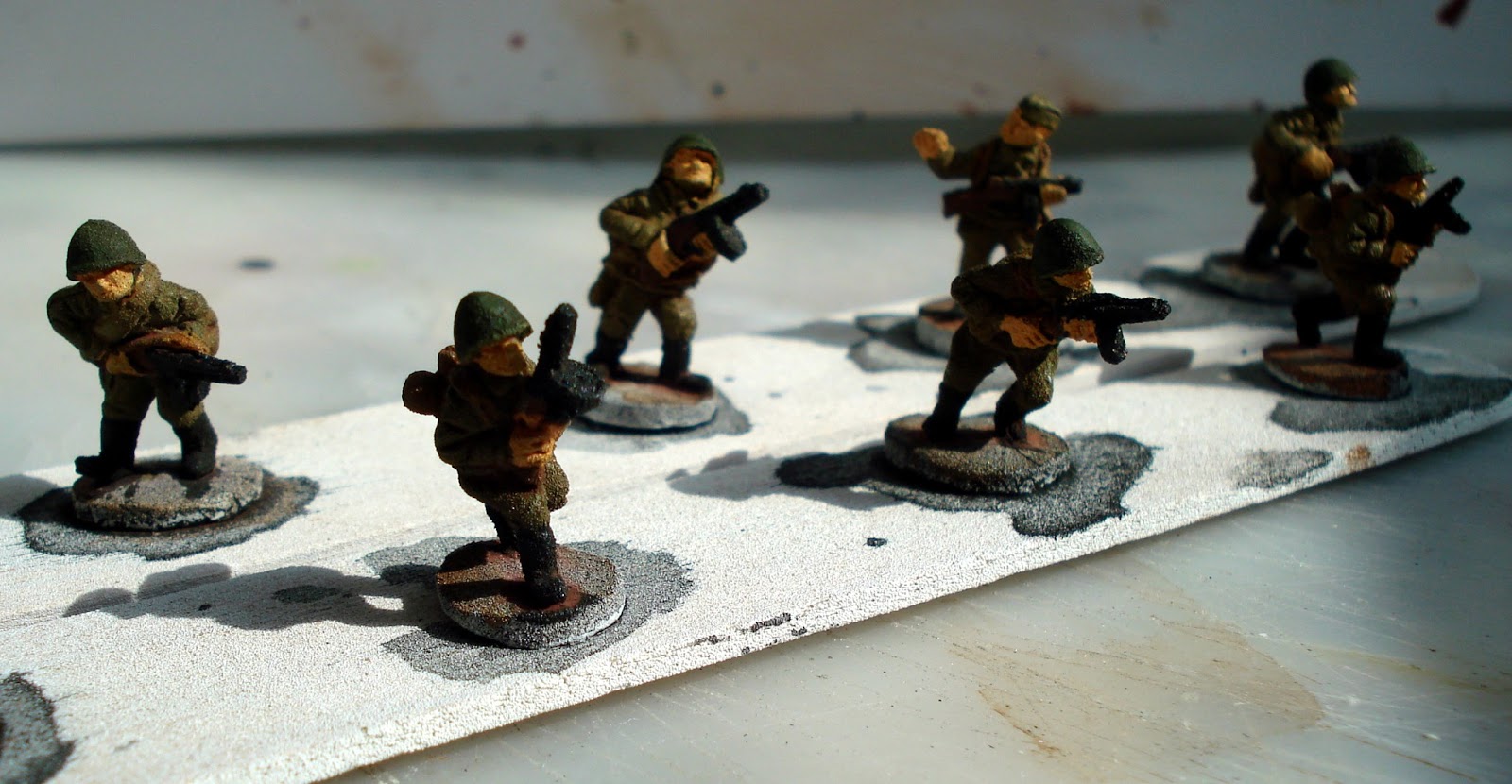
Getting them glued onto bases and flocked, overall I’m pretty satisfied with the results. I will likely give other miniatures a dry brush treatment to bring out the details. These are a bit subdued however I think with the uneven surface primer, it might bring out a weird texture look on the stands if I drybrushed these troops. As I mentioned, using another can of Army Painter primer gave me much better results for other figs. I expect I’d just gotten a bum can of primer. Fortunately, these scouts turned out pretty decent. I think having 3 or 4 to a base will also make the project more manageable. Now to get cracking on more stands.
Review: Tomorrow’s War
From Ambush Alley Games and Osprey Publishing, Tomorrow’s War is a sfi-fi skirmish ruleset detailing infantry warfare in the future. The system is designed for 15mm but could easily be bumped up to 28mm. As a squad-based force game, the scale is man to model and allows for the incorporation of individual armor units like tanks, APCs, and such ideal for platoon-sized engagements.
The setting of the game is rather concretely set with future nations extending conflicts both on Earth and on other colonized planets. So it is very much in the theater of mankind extending the battlefield along with imperialistic endeavors, further continuing warfare for resources and territory on a larger front of different planets. Corporations are also represented in the background, allowing for some flexibility in campaign themes. This is somewhat an interesting take on the game background, as there is room to explore non-symmetrical scenarios such as including untrained colonists, or poorly equipped but highly motivated insurgents.

The game revolves around a universal mechanic of rolling different polyhedral dice and trying to get a 4+. If rolling off against an opponent not only do you need to get a 4+, but also roll higher than the other person. Different troop and tech types use varying dice that range from d6 to d12. This makes for an interesting mechanic as everything is based around a static number (4+) with discrepancies in technologies, training, and troop morale using different dice. Additionally, some game conditions can temporarily alter the effectiveness of dice being used (such as one side being able to hack into the information network of an opponent).
Play revolves around one side gaining initiative for the turn through rolling off dice. They activate any of their units, and then the opposing player may activate units which were not utilized in a reaction. For every unit activated within LOS of the opponent, they have an opportunity to react to this activation. This can be a round of fire, to movement. All it takes is a troop quality test, trying to beat the rolled score of the opposing player.
Additionally, as long as the unit keeps passing reaction tests, it can can continually react to other units taking actions within their LOS. The catch is each activation reduces the firepower and movement of the reacting unit. You end up with these potentially large chains of events, where a unit moves, another reacts and moves out of LOS, only to stumble into sight of another unit, etc. It can get hectic, but there is a set order to resolving these actions.
What further compounds the chaotic feel of these actions and reaction fire is that there is no effective range for any weapons. Units can see and shoot over the entire board. LOS is blocked by terrain and other units. One particular aspect I like about the game is that models are in a relative position. Cover and units, while represented by individual models, are entirely based on where the majority of the models are. If more than half the models are in cover,the unit has its benefits. If most of the unit is behind a building, then the unit is out of sight. I appreciate the simplicity of this and getting away from relying too much on every single model in an entire squad needing to be in cover or behind a hill.
Another optional but random facet of play are the fog of war cards. Players continually draw and play special cards that introduce all sorts of random events to the game. Most are allow for a temporary condition to the battlefield or troops, while others might allow for a reroll or additional dice being added to a roll.
Combat is based entirely around rolling firepower dice verses defense dice. Get more successes than your target and you potentially inflict casualties. At first glance it looks very streamlined, however digging further you begin to see lots of different modifiers that can either add or remove dice from this pool. This is one refreshing approach to resolving tasks and fire. Rather than continually adding modifiers to an ever shifting target number, you just throw in (or remove) an extra die or two. Potential casualties are determined by rolling on a chart to see if the figure is simply wounded or out of the fight.
While the game is for infantry engagements, there are plenty of rules for armor also. I’ll say one plus for the game is the sheer amount of varying rules available for the game. From expected artillery and air support, to more futuristic information warfare superiority via a network grid. There are rules for drones, automatons, and other types of futuristic technology. As units have a variety of troop and technology characteristics, aliens can also be easily created with a detailed example of one within the rulebook. Even though units can adopt a variety of characteristics, it is not based on a point structure. However there are several troop and army types listed within the book.
The game has several basic scenarios scattered throughout the book and also has a campaign mode with a listing of various potential engagements. It’s an interesting ruleset as the initial impression is that it’s one of a very conventional theme, but there are additional rules to allow for more futuristic engagements adding on layers of technology.
The Good – I really appreciate the universal mechanic for resolving tasks. Keeping a static number and rolling different types of dice is a nifty idea. I also appreciate the breadth of ideas for futuristic engagements. There are a lot of interesting ideas and rules for different types of potential scenarios aside from the regular ‘wipe out the other person’s forces.’ The book itself is high production with colorful art, nice thick pages, all in a well bound hardback book.
The Bad – The layout of the rules is not ideal. While there are plenty of text examples, relying on photographs for some of the cover and LOS situations is a poor choice (wish they went with a cleaner graphic instead). There are too many charts spread out. Even worse, there is no quick summary sheet. Such critical information for playing the game and it’s scattered throughout the book.
For all the simplicity of the universal die mechanic, the game still gets bogged down with lots of book keeping. It’s small things that keep adding up, glutting the flow of the game. Like units taking multiple reaction tests which have to continually reduce their firepower and movement for future reactions.
The Verdict – This is not a ruleset I can recommend. While resolution of actions appears streamlined, in practice it’s ungainly. For contests, not only do you roll over the target number, but also have to roll higher than your opponent. This means a bucket of dice rolled in an attack have to be set aside and individually paired off as the defender rolls another bucket of dice.
For all the abstract positioning and LOS issues being based on an entire unit, you still get mired down in individual models needing various conditions being tracked. Models that are broken and surrender have to be under the watch of a lone opposing model and marched off the board. It seems that the game struggles with trying to have some quick, simple mechanics, but gets wrapped up in all of these other situational rules making it more like a simulation.
There is too much information in the rulebook, and it is poorly presented. There are a lot of examples, but critical charts are scattered throughout the book. It seems there is a good game buried in between the pages of the book, hidden away. Maybe if the game strove for a core set of mechanics, with layers of optional advanced rules it might work. Definitely having a better presentation and organization of critical rules and charts, including a good summary would help. Maybe if it had these things, this game would have some potential. As it is now, Tomorrow’s War has too many scattered ideas, too many situational rules, and needing too much effort to wade through the book to be a solid game.
Review: Gruntz
A long while ago I sort of sworn off any squad based rules and for a few years I jumped into larger, mixed forces WWII games. The smaller tactical stuff just didn’t keep my interest any more. However lately I’ve been having an itch to get back into squad-based infantry stuff. I’ve done the whole 40K bit before and had no desire to go that route, so I dipped my toe into the 15 mm sci-fi range and was looking for a few rule sets to try out.
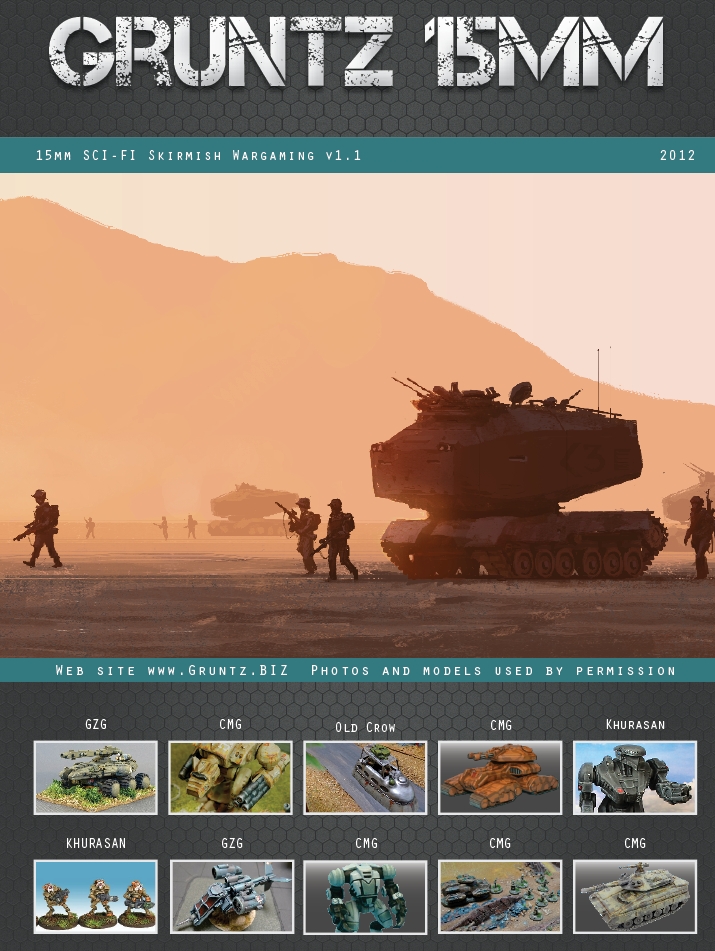
Enter Gruntz, a 15 mm, man to model, skirmish game that can easily handle a platoon or more of minis. The game is a points based system where players try to field equivalent forces of an agreed value, see who can tackle a scenario, and come out the winner. Gruntz is a pretty simple system, with several layers of advanced rules to alter the play. At first glance the system is very pedestrian but by incorporating the advanced rules, there is enough there to give seasoned wargame fans a fun time.
The base rules revolve around a player activating their entire force, with the opponent doing the same for their troops (simple IGOUGO). Each unit can perform two actions, typically being move then fire, fire twice, or assault. Players roll 2d6, adding their unit’s skill, and try to roll equal to or higher than a target number to hit, followed by rolling 2d6 against another target number to damage a unit. Casualties inflicted give units suppression markers which reduce the number of actions they can do on following turns.
There is a nice gradation of attribute stats, as units can have different relative levels of training, morale, and equipment to alter these values. So units could mimic very stealthy units that can’t take a hit, to slower, easier to hit targets that are tough as nails. Vehicles also operate very similarly, but have a few more options when shooting and usually can take much more damage (as typical infantry can only suffer one wound).
There are some wrinkles to play. A unit has a few options with shooting to either concentrate fire, or lay down suppressive fire into an area. And units can also place themselves on overwatch to interrupt opponent’s actions if needed. However for the most part the game uses very familiar and simplistic mechanics to resolve fire and morale situations.
The advanced rules here are a nice touch. They primarily cover alternate ways to activate units, using random initiative via a deck of playing cards, to even alternate activation between opponents. Rules for actions that the player can take can also be mixed up, to give some more flexibility in the 2 different actions a unit does. While the game is set up for single based figures, there are even rules to cover multiple figures per base. These rules certainly give the game some needed complexity while not overburdening the player with an overly complicated set of simulationist rules.
The point system for building units is a pretty strong aspect of the game. There is a lot of room to give units not only varying attributes, but also special abilities. Also the system seems flexible enough to work up statistics for a variety of vehicle models, from copters, tanks, and APCs, to walking mechanized units. What is nice is that you could easily work up different flavors for troops and equipment to give forces a completely different feel, making aliens have differing play styles.
The game has several basic scenarios which usually revolve around with attacking and defending forces and give the players concrete goals and objectives. A nice break from the simple objective of ‘kill the enemy army’ you might see in other sci-fi games.
The Good – You have a fun little set of rules, with just the right complexity to make for an enjoyable game. The point system for unit creation allows for a makeup of different forces, allowing for mixing in air and armor pretty easy. You have enough variation in unit abilities and the base attributes to give forces a different feel for the same point value, adding a lot of variation in the force makeup from game to game.
The Bad – While simplicity has it’s charm, sometimes the mechanics can be a little rigid. Infantry forces are required to cluster around a unit leader, and elements that split off from a squad have very limited options. There are some variety of options with unit activation, however it does slip into that territory of IGOUGO with a single unit’s activation. There is some room for reaction fire, especially with charges, but these options are limited. For smaller scale games, I’d like more flexibility in target reaction. Also, while the point system does allow for variation in unit makeup, that problem of the min/max lists can crop up.
The Verdict – I have the newest V1.1 and was happy to see not much changed compared to the original Gruntz. At its core is a very approachable skirmish-scale wargame that allows players to field a variety of forces. While infantry are what your troops are built around, it’s nice to have some other options in the force makeup.
The execution of the game may not be ideal for everyone. You very much have a unit undergoing different actions, without any response from the opponent. Infantry unit cohesion is also a little tight (3”) and inflexible (however with 6 man squad sizes very understandable). There are a lack of campaign rules, and options for setting up the board revolve around mutual player agreement.
Still the game sets out to give a basic ruleset for sci-fi infantry skirmishes and delivers. Where you can argue the unit activation and resolution of tasks is very simplistic, at the same time you can say they are streamlined and get the players involved. You throw buckets of dice and have quick, easy, resolutions to combat which is enjoyable. While there is a bit of bookkeeping required for managing troops in the manner of unit cards, the rules themselves are easy to remember.
It’s a fun ruleset. For squad-based infantry games folks might want something a bit more fluid and dynamic. However if you want a game that has a good set of basic mechanics, that is tactically challenging and enjoyable, with enough room to allow players to explore different force makeups for their troops, Gruntz is a great entry point into the 15 mm sci-fi wargaming realm.
 Geek Ken