Category: 28mm
Frostgrave in winter: establishing the campaign
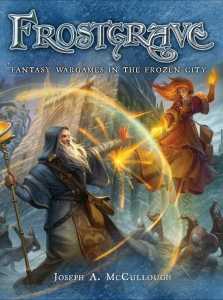 So after a small local gaming event (Alleycon 2016) folks I played with were keen to get a short campaign running. Nothing major, just 5 or so games to see how a longer, continuous game with wizard advancement would work for us. So much of the game is geared to having out-of-game spells, which have a role more in maintaining and supporting your warband over raw power on the table. I am eager to see how these type of spells impact the larger game, if you will.
As much as I enjoy Frostgrave and appreciate the approach of a fast and loose wargame, I felt we needed some better ground rules. There is some stuff open to abuse and I’ve got a crafty gaming group. If they see an advantage that they can game, they’ll pounce on it. So I thought it better to try and lay a groundwork for the campaign that we’d all agree with.
Modified campaign rules – Frostgrave seems to have a Mordheim problem with warband advancement. After a few losses, you are likely going to fall behind and never catch up as the rich just get richer. So I worked with some community stuff out there and whipped up a version we’ll be using for our game. One particular thing I like about the rules people have thrown together is that the campaign management actions are limited. You can’t buy just anything and have to carefully choose to spend your time preparing for the next battle. I dig that.
There are a couple of changes I made to my older version of the campaign rules, one was the game length. Now instead of likely 5 turns there is a 50% chance of having a turn 6. After that there is a 10% chance of the game getting further turns. I like this as there is certainly a time limit and you have to push to get things done, but if you need to squeeze out another turn of movement, you have a decent chance of getting one.
Rules for placing treasure – Some campaign changes revolve around rules for placing treasure. First off placing treasure can be abused. Models carrying treasure can exit any board edge and the official rules state you can place treasure at least 9″ from your table edge. To curb any abuse plopping treasure a couple of inches from the side edge, treasure also must be at least 6″ from a neutral table edge. This means that players are going to need at least 2 turns to get treasure off the table. Another change is that at least one treasure out of the three must be 12″ from the player’s table edge.
Choosing sides for deployment – A last change to ensure a more fair game is that players both set up the terrain and treasure first, then roll to determine deployment zones. Both roll off and the player that rolled the highest can decide to either go first, or decide which table edge they want to deploy from. So this makes for a fun choice. They can choose to get the initiative on the first turn, or instead opt for the side that they think gives them the best terrain layout. And since no one knows what option is available, they will try to set up terrain and treasure so that no one has a distinct advantage (unless they want to gamble on winning win the first roll).
Winning the campaign – This likely isn’t a perfect system but we are working along keeping a running advancement total. This is determined by the sell value of treasure, gold crowns, and XP of the wizard, with base improvements (as per listed costs) also being added in. The player with the most advancement points wins. So it’s all about cash and XP basically. The tough choice was to include improving the warband, but I decided against it. Folks can hoard their cash if they want to, as spending crowns to get soldiers won’t help their advancement total. But having more bodies means you can likely get treasure off the board, so in a roundabout way, the advancement points lost (as spent gold) buying a thief likely pays in spades if you get more treasure during a game. We’ll see how that works out.
Select scenarios – Mostly this is due to available terrain, but I also wanted us to have the same number and types of scenarios we would all play. The first and last games would be regular battles without any special rules or terrain. The three games in the middle of the campaign would be three specific scenarios that could be played in any order. The Living Museum, the Well of Dreams and Sorrows, and the Complex Temple were selected as they don’t require much of a special table layout (like the Library or Silent Tower) and something we could work with given our available models.
I’m looking forward to our winter campaign. I am hoping to get some battle reports written up but likely they will be simple recaps. I usually get so wrapped up while gaming I forget to take pictures. However I hope this will end up being a fun little series of posts to put up and document how my warband fares through the campaign.
Review: Bolt Action Second Edition
I am a long time fan of Bolt Action and enjoy the game immensely. It’s a bit Hollywood but for skirmish WW2 gaming it gets a lot right. Another bonus for me is that it’s small enough in scale to offer some narrative potential with scenarios.
I’m not going to go much into the mechanisms of the game as my first review pretty much carries the same opinions as before. You instead for the most part have some refinement with the rules with the new edition. The game still has some parts that are a tad gamey, but some of the more glaring rules and wonky tactics that were in the first edition are curbed some.
This won’t be an exhaustive list but I thought I’d highlight a few changes focusing on some of the more notable ones. Likely the biggest change regards officers. Leaders now can potentially have multiple units to activate under their command. Most allow for 1-2 units within 6”, but higher ranking officers increase this to 12” and up to 4 different units.
If an officer successfully passes their order test (note the Down order is exempt from this), they can pull and assign extra order dice. The assigned units still have to pass their orders, but you can get quite a few units getting that extra boost to act while in the presence of an officer. This is a really great rule. Before the benefits of officers were minor unless working with a lot of inexperienced troops. Plus there was not much incentive to take higher ranked officers. This rule completely changes that and makes leadership have a greater impact on the game.
 Some other notable changes to orders were also made. Rally now is not subject to pin modifiers to see if the order is passed, but the unit still only removes D6+1 pin markers. There is a small change to Ambush. If at the end of a turn you want to return a unit’s order die, on a 4+ the unit can immediately execute a Fire order before doing so. Just a little way to get something out of taking a unit off Ambush, if nothing ever presented itself during a turn to trigger it.
Another big change is that the Down order provides at -2 penalty to shooting at infantry and artillery units. This is a pretty hefty defensive bonus. Likely this will make the option of just hitting the dirt due to excessive fire more enticing for units and a solid tactical option. Not to mention those pesky air and artillery observers being able to evade fire.
Assaults no longer take off pins automatically for units fighting in hand to hand. Also target units can return fire automatically if they have not been given an order. Veteran units still have a heavy advantage in assaults, but at least it emphasizes Rally orders for removing pins. Another change is that assault weapons (like pistols and SMGs) get one additional attack if they successfully inflict a casualty, not automatically double the number of attacks. This lowers the effectiveness of these weapons in assaults (units that are Tough Fighters get this too), trimming down their ability to tear through units as before.
As weapons go, there are a few key changes. I always felt LMGs were lacking in the game and it seems that Warlord has listened to the community. Both LMGs and MMGs now throw an extra die when shooting. Another tweak for fixed weapons is that they can make a special Assault move, rotating in place towards any facing, and still be able to fire (with a -1 penalty to hit). These slight changes now make units like MMG teams a little more fearsome.
Flamethrowers were always a bit of a divisive weapon, especially vehicle flamethrowers. Now they don’t automatically hit and instead hit on a basic 3+ ignoring any modifiers for cover or units that are Down. Vehicle flamethrowers now only inflict D6+1 hits instead of 2D6. The plus side is that all flamethrowers now only run out of fuel on a 1 (instead of a 1-2 for man-packed flamethrowers).
Likely the biggest weapon change is in regards to HE as templates are used to determine the number of hits. I’m on the fence some with this. One aspect I cringe about is that the game now can get a little finicky with a player maneuvering templates around. The basic rules are that a player must always try and place a template to hit as many enemy models as possible, and they cannot also target friendly troops.
This limits the number of potential hits, especially for light mortars but it does add some consistency with the number of possible casualties. The plus is that across the board all HE weapons can potentially inflict more pins. Also there were some weird instances in the first edition where you might target a small weapons team and only be able to hit that unit, despite it being positioned close to other enemy troops. This certainly adds some tactical value to spreading different squads out to avoid being hit by large HE rounds.
There are a couple of notable changes to vehicles too. Empty transport vehicles can now fire one weapon. I love this change as it encourages armored transports to be used and having more importance on the battlefield other than just carting troops around. Mind you, the same rule for empty transports being destroyed if ending a turn closer to enemy units is still a thing.
Another change is that a player decides to fire either a main weapon or the co-axial MG, not both. This really cuts down the firepower of tanks. There is also a pretty big change with recce vehicles. They can only make an escape move if they have not been given an order die. It certainly makes using these vehicles for scouting more difficult, but also reduces the abuse some players had with these vehicles taking pop shots and scooting behind buildings to avoid return fire.
Additionally if opting to fire pintle-mounted weapons the tank is considered open topped. This is a small change to differentiate them from tanks with just co-axial weapons. However likely the pintle mounted guns are also flak weapons, and that now has some greater use on the table.
Certain weapons can now provide flak support. When a plane comes in due to an air observer, each flak unit can try to attack it, rolling to hit on a 5+. If scored total hits are 3 or more the plane is either shot down or sent away. I love this rule. It makes using air support a bit trickier to use (and possibly encourages the more expensive artillery observers instead). Lastly, it gives a greater role to flak weapons and encourages a player to add a few as a potential counter to air attacks.
There are some more small bits and tinkered rules (dense terrain, reduced assault rifle ranges, changes to sniper teams, etc.). Overall they are pretty much a refinement and incorporation of a lot of popular community house rules. Some of them shift away from truisms of the past editions. Now you have a reason to take a higher ranking officer. Now full infantry squads can re-roll failed order tests until they suffer a casualty, meaning investing in a large squad can get some tangible benefit other than just being able to suck up a lot of hits (which works especially well with inexperienced troops).
The book has a total of 12 new scenarios. Six of which are more meeting engagements, where the other 6 have clear attackers and defenders. Unfortunately, three of the scenarios are still a Maximum Attrition type of game, where you just have to kill as much of the enemy as possible. But the wrinkles in setup and some scenario specific rules shake them up some.
Much like the previous book, a truncated army force list is provided for each major nation. This time Japan is also included. Fans of a particular nation will eventually want to pick up the army books, but the lists in the book are serviceable and provide options to field a robust platoon. Lastly there are some other supplemental rules for night fighting, rules to incorporate more players, larger forces with multiple activations, and even multi-national forces.
The Good – The second edition is more an assembling of tweaks and house rules than a full blown rework of the game. For the most part this is great news. Some of the changes likely will mean players have to adjust their tactics (leaders with multiple activations, and units no longer automatically removing pins in assaults are a few). There is still that random order activation. Pinning units to degrade morale and effectiveness is still there. In short it’s still Bolt Action.
I like that more scenarios are presented. I’m especially glad to see them mine other games for some fun scenarios (like a classic 40K cleanse mission).The sprinkling of scenario specific rules also helps reinforce that Bolt Action can be very much a narrative historical game, and also an enjoyable tourney game.
The artwork and layout is pleasant, with each section having a nice heading on the outer edges of the page. There are more examples and more diagrams. And typical of Osprey books, lots of great art and pictures including a concise timeline of key historical campaigns and engagements to spur on ideas for possible battles in different theaters of the war.
The Bad – This isn’t a simulation game. There is still some abstract mechanics and you are going to get some pretty shifty tactics from players. With the addition of officers being able to allow multiple activations, some might feel the random initiative is simply too chaotic for their tastes over an IGOUGO system. And lastly, it’s still point based. You are going to get those guys making cheese platoons and trying to game as much out of the force lists as possible.
Another minor quibble is that the background of the pages have this stressed border graphic that appears like flock. All the pages on the right have what appears to be a smudge of gunk. While for a page with a sparse layout of figures and pictures, it doesn’t stand out. But for me it gets a little distracting having it among paragraphs of text.
The Verdict – I love Bolt Action and the 2nd Edition is certainly an improvement of the former rules. There are a lot of small changes and enough so that I would consider picking up the new edition. However if you only play the game once in awhile, likely you could get away with just sticking with the old rules and try to scoop up a new QRS/player aid.
It’s still a great, robust set of rules. It doesn’t lend itself too much towards being a staunch historical game. There are plenty of opportunities to play out those ‘what if’ games, and a few of the mechanics might be too abstract for die hard WW2 wargamers. Not to mention some platoon force lists that will likely make someone well versed in historical TOEs tear out their hair. But it gets so much right.
Bolt Action is chaotic and the concept of throwing a lot of fire at a threat to force it to hit the dirt, so your troops can maneuver, is still there. It’s just such a fun set of skirmish rules. And I particularly enjoy how the game encourages players to dig into historical books and fish out odd units. If you want to field a platoon of Moroccan Goumiers that fought in the Italian campaign, you can do that. That to me demonstrates how pliable the rules can be.
So like with my original review, Bolt Action is still a fun, WW2 skirmish game. And if a die hard fan or a new player interested in getting into historical gaming, the second edition is very much a great book to pick up.
Paint scheme reference cards
 This week just a small tip for folks delving into miniature painting. If you are like me you might have a lot of different game systems and army projects going (sometimes several simultaneously). Once an army is done, going back to add a few troops or units is always an option. However it can be a tad difficult to remember what paints were used before for that force.
Another issue is that occasionally your miniatures will get some dings and dents. You may find needing to touch up a miniature or two. So trying to think back what paints you originally used for a base coat along with the proper wash might be a problem. It’s compounded if you’ve been painting a slew of other stuff since then too.
To get around this I use note cards. I write down the paints used for base coats, washes, and highlights. Additionally I pair this information up with the appropriate parts of the models. Along with the name of the paint, I also place a small dab of the paint color on the card.
This way I know exactly what colors I used for say, the webbing on my US Marines, along with the colors used for the drybrush highlight too. The color reference is also there in case I have problems tracking down a specific paint. I then have a hue to compare to if seeking a replacement paint from a different manufacturer. Another plus is I can take the card with me into the shop to directly compare.
They are very handy. I’ve got a slew of unfinished 15mm Russians I’ve been sitting on for a couple of years now. At least with the paint reference cards I have some confidence I can revisit them again using the same color scheme as I had done in the past, ensuring that my army will have a uniform look. So consider keeping track of the paints you use on your minis. While I find note cards handy, but even a notebook is helpful. After all you never know when you might have to touch up a couple of minis (or add another squad to your force).
Wargames Factory Saxon Thegns
As I mentioned awhile back I’ve been dragging my feet some painting up my SAGA warbands. I wanted to have some flexibility with my models and opted to pick up a few more sets of figures to build both Anglo-Saxon and Anglo-Dane warbands. Further a lot of battle board abilities for Anglo-Saxons revolve around 10 man units. Having a lot of warriors seems the way to go, so I wanted quite a few models to explore these abilities more.
Wargames Factory’s Saxon Thegns come 32 figures per box. There are plenty of head, shield, and weapon options. A few standards and horns are provided. While not specific for SAGA you also get a lot of bows which are great for other game systems (cough…Frostgrave…cough) and if looking to combine this with other plastic unarmored Saxon sets, a good way to have plenty of bows for your levies. There are also hefty 2 handed Dane axes allowing you to deck out some hearthguard if wanted. My one complaint with the weapons would be that the spears look a little anemic.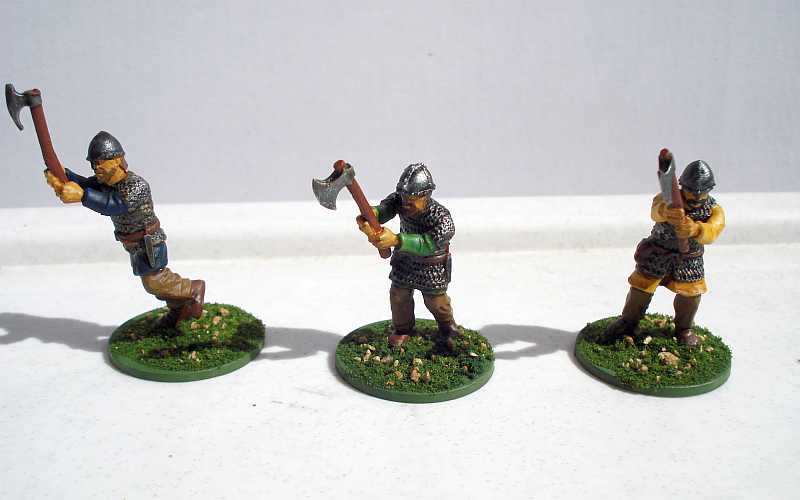
My other complaint would be the necks of the models. The manufacturer suggests cutting down the neck some before assembly. This is a bit of a pain and can be difficult to get just right. Fortunately the models are plastic and with the right amount of glue and pressure, you can get them assembled in due order. I would recommend going for a more viscous plastic cement. The figures fit well together, but you might want to fill the gaps in some for the arms.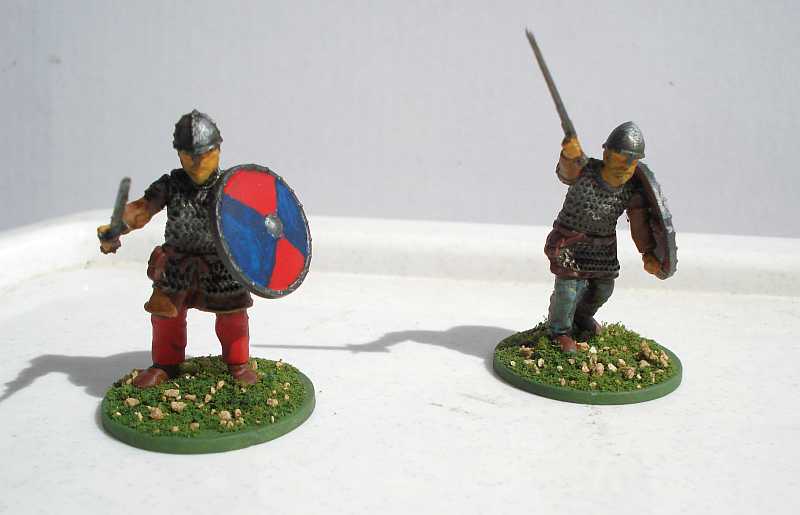
The hands are modeled open to allow different arms to be placed in. The thumbs look a bit odd sticking out but once you’ve got weapons set in the hands, they don’t stand out. Overall the models assemble pretty easy aside from the slight hiccup with the heads. The detail on the figures are not bad. Some of the body and arm details are muted, but overall they look good.
You basically have 4 bodies for the set. Yet with the options for heads and arms, along with different angles you can assemble them, the end result is enough different poses to make up for the lack of body types. One more ding to the set is that no bases are provided. So expect to buy some bases along with the box.
Another manufacturer out there for medieval plastic sets is Gripping Beast. Likely people will want to know how well the 2 figure lines compare. The pic below is from each company for Saxon Thegns. The one on the left is from Wargames Factory and the one on the right is from Gripping Beast. I think they are very comparable for scale and can mix and match them freely. If anything the Gripping Beast figures seem a little more stocky in the arms and shoulders. Yet once painted up and based, they don’t really stand apart from each other.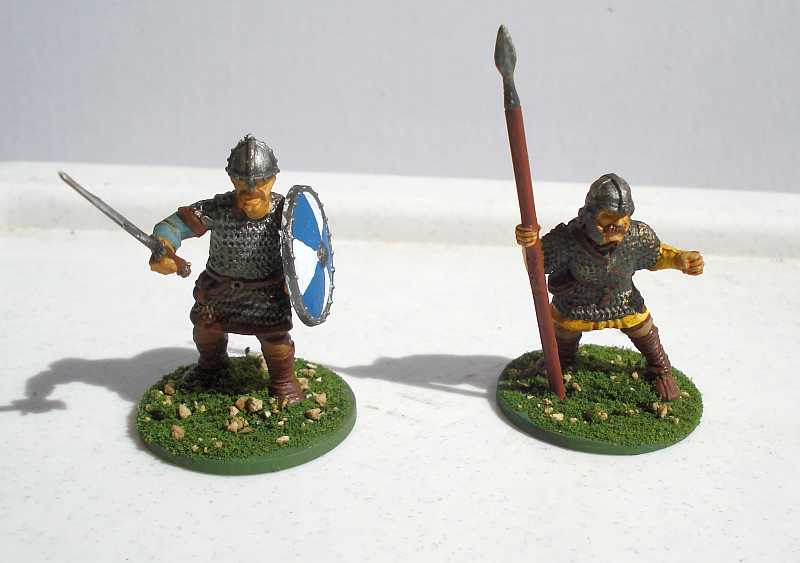
There are a lot of positives for the minis in this box. The Wargames Factory kit does have a lot of different weapon and shield options. The head choices aren’t bad (though are a chore some to glue onto the bodies). The price is also reasonable for what you get and I’m glad to have picked them up. However, I’m on the fence about recommending these Thegns. They aren’t bad figures. It’s just that for armored plastic Saxons I think there are better options out there.
Red Army – Wargames Factory
 For a long while now I’ve been pretty much sticking with 20mm for my Bolt Action platoons. I’ve accumulated quite a few different nations dabbling both in the Pacific and European theaters. Usually when I jump into a wargame I end up picking up enough models to fill out a couple of armies. It’s just so much easier for me to spark someone’s interest in playing when I’ve already got an army for them to try out. So for Bolt Action, going 20mm was not a problem at all for me.
However I realize that if I was dumped into a gaming scene where I’d be typically playing against folks with their own armies, well, I guess they might frown a little on me pushing around 1/72 scale troops and tanks. So I wanted to work on another nation army that would be a ‘proper’ 28mm scale and settled on fielding a Russian force. One aspect of my choice was that I’d be able to dig up some 1/48 scale armor and vehicles. I could have chosen some other smaller nation, but rounding that out would likely be difficult. The downside of course would be that I’d have to whip up a lot of models. Russian armies work with having lots of bodies so I certainly wanted to look into plastic kits.
There are a few options out there but in the end I decided to make the bulk of my troops from using the Red Army box sets from Wargames Factory. These are pretty nice sets of around 30 figures with a variety of small arms. Most weapon options are for Mosin Nagant rifles and PPSh-41 smgs, but there are quite a few DP-28 lmgs and various sniper rifles also. My complaint would be that I wish there were more rifles. You can get about 15 figures with rifles from a box set. From my 2 sets, I wanted to squeeze out a 3rd rifle squad but it looks like I might have to stick with making that a smg scout squad instead (was able to get a free 12 man rifle squad though for a total of 3 rifle heavy units).
The figures are pretty well sculpted with a fair amount of detail. It’s hard plastic that is a snap to assemble with cement and they don’t appear to have excessive mold lines (although there are some and you can see from the photos I still need to trim more). Another small bit I love about the box is that lipped bases are also provided. There are a couple of prone figures that don’t get any benefit from the bases, but it’s a nice touch.

There are a variety of heads but most are with helmets with a smaller proportion having caps. There are a some officer caps and a few female soldier heads also. As a nice touch, you have the option of making a couple of female troops which is cool. Something historically accurate and adds a little variety to how your force looks on the table. I made one of my sniper teams women and working on converting my field medic to be female.

As pistols and other accessories go, the sprues are a little lacking. They are present but in a limited number. However there are tons of ammo pouches and field kits. So certainly you can deck out your troops to have some additional details. I will grumble some that the entrenching tool and canteen are modeled as a single piece which somewhat limits options for attaching them.
Arms are modeled individually and at first I sort of groaned looking at this, worried how much of a chore it’d be to piece them together properly. However each arm is paired by letter along with a matching body figure making it a much easier process. Still, you’ve got individual arms, heads, and other gear kit bits to glue. Expect your assembly of troops to take a while.

Nonetheless the end product is fairly good. They are digital sculpts but they look like they can handle some detail rather well. I’ll complain about wanting more rifles, but there are enough different weapons between smgs, sniper rifles, and lmgs to provide lots of options. While most of the bodies are single sculpts, with movable arms and heads you can get enough dynamic poses to give the models variety. Adding more kit options and about 5 body figure types, you end up with enough to make your force look engaging with plenty of differences in poses. Hands down, the quality and price for these kits are hard to beat and are an exceptional value for wargaming. Well worth looking into to bulk up your Russian force.
Building ruins for Frostgrave
I find Frostgrave fun especially with its low model count and small table space. However as it takes place in a ruined city, you certainly need a lot of terrain pieces. It does demand having a pretty cluttered layout too, so that was something I had to assemble for my games.
Over the years I’ve gotten a little lazy with terrain. I just don’t feel the need to put tons of time into building and painting it. I just need something serviceable and looking decent enough. I’d rather put more time into painting miniatures over building an awesome house. So I was looking for a quick and dirty way to whip up some building ruins.
I settled on hacking apart some old styrofoam I had horded from packaging material. Cut apart into sections and assembled with PVA glue and toothpicks as simple dowels, I got a few sections of walls put together. I also went ahead and got a few flat pieces with some odd chunks added to create some crumbled wall sections which would offer a little cover from ranged shots, yet not impede movement much.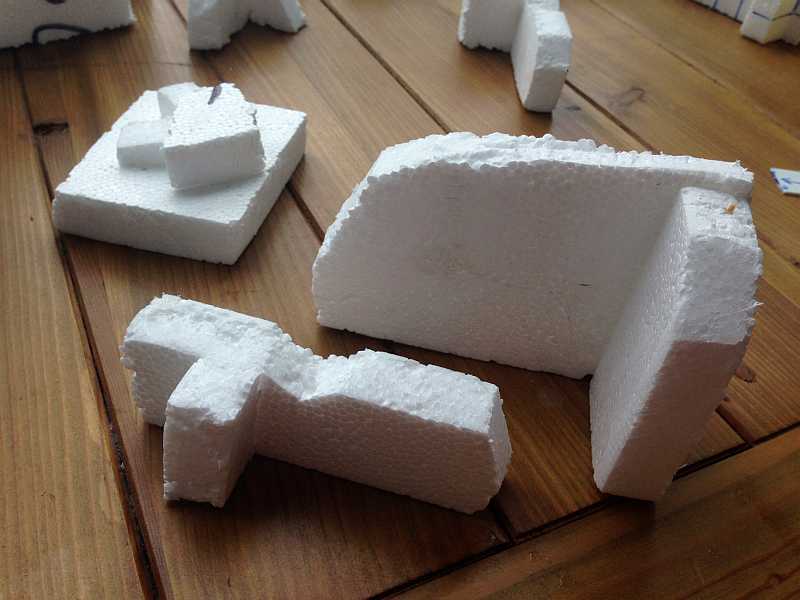
I had to try and work on adding some texture to the walls some. I decided I didn’t need to make an intricate pattern, just some large stones etched into the walls. As a super quick way of doing that I figured I’d need some guide lines. Using a small piece of plasticard about the width of the bricks I wanted, I quickly placed tick marks on as layers of bricks.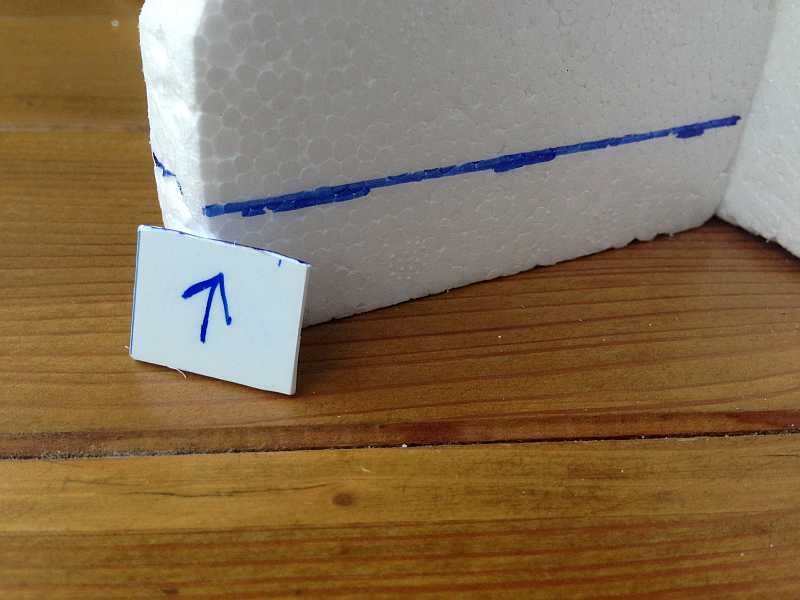
Then I connected everything using a straightedge and a marker to form horizontal lines. One key tip would be to make sure you had all the lines even around the corners. I would then go back and rather unevenly draw in vertical lines to make the brick pattern.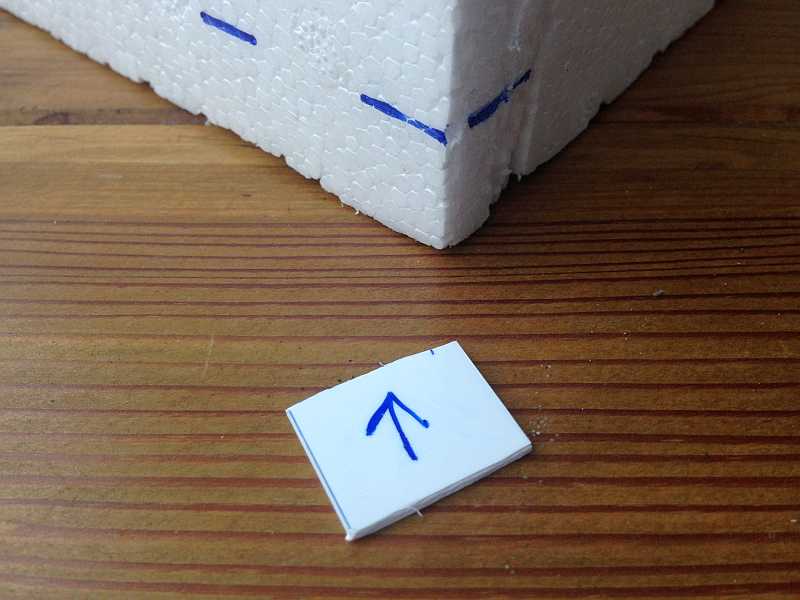
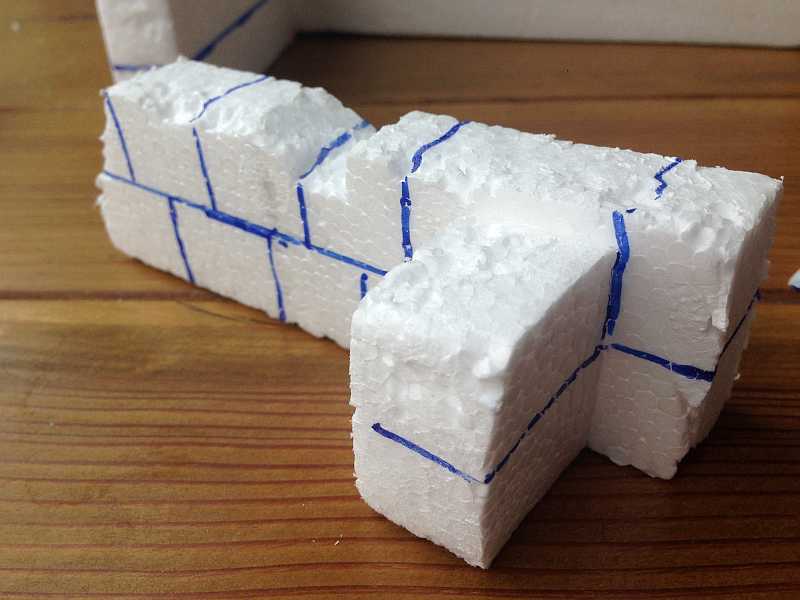 I needed some way to form some texture in the surface though. I could then go over each line with a knife, but figured that would take a lot of time. Not to mention I might end up gouging out larger chunks of styrofoam if the knife caught up on the material. Instead I used a soldering tool which would melt the styrofoam. Mind you this was tricky as you could easily go too deep into the material. Also, I would do this in an exceedingly well ventilated area (I also had a fan behind me blowing air away from me) as the fumes are pretty toxic. However the end result was pretty nice.
All of this worked fine and dandy for low walls but I also wanted to get some elevated pieces together. I had some second level wall corners made that used a chunk of foamcore board as the floor section. This looked okay but I also wanted to give the floor some texture. I ended up cutting out thin sections of cardboard and gluing them in as flagstones. I didn’t need to do the entire surface, just enough to give the appearance of a few stone pieces. With a wash and a bit of drybrushing, they really add some texture to what would look like a flat piece of foam board.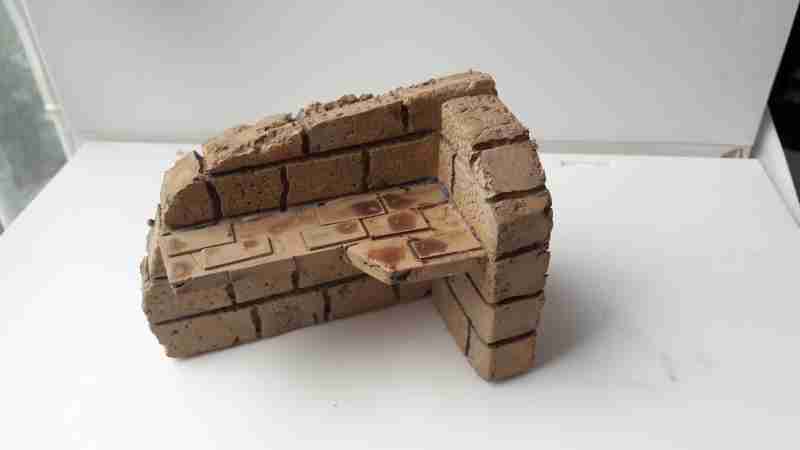
I’m pretty happy how they turned out. They look decent and are certainly cheap assemble and paint. Lastly, I was able to get a nice amount of terrain to put together for my Frostgrave games. Give it a try if you need a quick and dirty way to make a bunch of ruins. I’m doing a bit of a different setting for my games to match up with using current models, but these would look just fine on a snow battle mat.
Drones and Probes for Gates of Antares
I haven’t taken the plunge yet for getting an army together for Gates of Antares. Instead I’ve been using a lot of my 15mm sci-fi stuff as proxy forces and have been having quite a bit of fun. Maybe later I’ll consider eventually getting a batrep done. Seems 15mm is a great way to jump into the game if on the fence wanting to give the rules a test drive.
I’m liking the Algoryns and might work on that faction. However Warlord Games is still trying to expand that model range for them. And sadly the choices for that force are only in metal. While I dig the heft of metal figures, the cost compared to plastic kits is pretty hard to swallow. Might have to clear my bench some of stuff to paint before I consider jumping into another range of models.
Nonetheless one thing I’ve been missing with my proxy forces is a way to represent drones and probes. GoA uses gobs of em. I really dig having some small bonus abilities represented by models on the table. However I wanted to actually get a figure down that I could push around over just using tokens or painted bases.
I picked up some cheap plastic beads I felt would fit the bill for using as probe models. The cost for a huge gross is dirt cheap. Just head to a craft store and check out the craft jewelry section. Being about 7-9mm across, they are perfect for drones.
I wanted to have them floating about though and was considering using some wire, but then I stumbled on some clear plastic tubing for modelling. The material is acrylic and the stuff I got was in 3mm diameter. Perfect for mounting a floating drone onto a base.
The pickle I had however was that the tubing was pretty large so I had to drill and file a larger hole into the plastic bead. Fortunately the beads have a hole already in them (for stringing wire and string through). So I could easily use those as a guide hole when using a larger drill bit. Drilling and filing a portion out of some 20mm slot bases, I was able to use a bit of instant bonding cement to assemble the entire thing.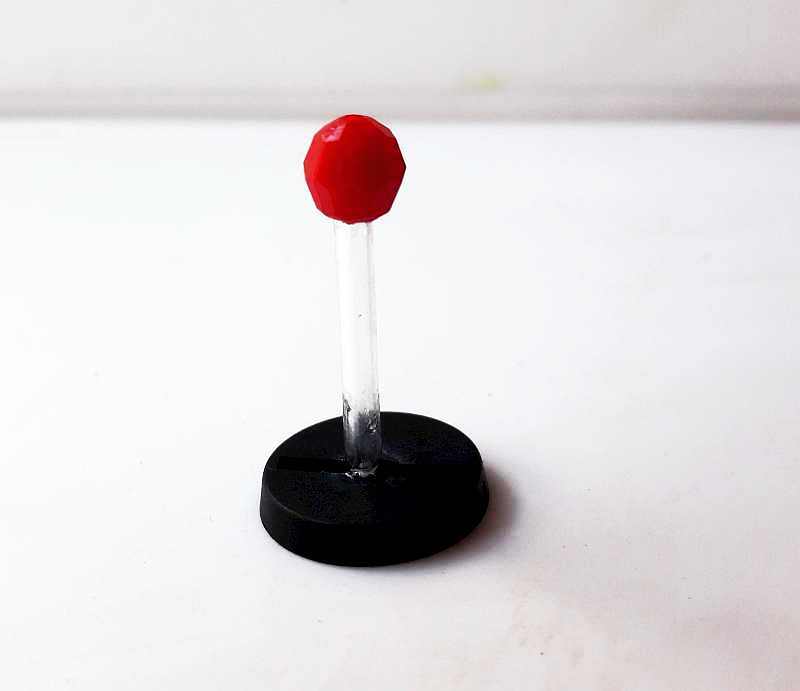
The downside of using beads is that there is a small hole drilled into the top of my probes. So I had to use a bit of green stuff to fill it it. I also used green stuff to fill in the gaps for the slot base.

A bit of paint, drybrush a tad, some flock for the base, and bam…there’s a spotter drone. One thing I like about the model is I can use a variety of colors to indicate different types of drones and probes. The downside is that the beads have a particular pattern on the surface making my painting schemes a limited some. This was a quick prototype and I didn’t quite get the pattern and look to what I’d like, but I can touch it up later.
Hope folks find this helpful. It was super easy to do and pretty cheap. Considering you can end up with a lot of spotter drones for your units, along with support choices, I think you’ll end up needing quite a few drones for your typical GoA force. This isn’t a bad way to get a lot of models assembled for your force quickly (and cheaply).
Hotz Mats felt fields
A long while back I mentioned that I picked up some battemats from Hotz Mats and wasn’t that impressed with them. At the same time I made my order, I decided to pick up some flocked felt field sets from the same company. Despite me not being keen on the treated felt mats, I gotta say that I do like the flocked fields they offer.
I bought 2 sets of the 20-30mm range felt fields. The fields vary in sizes and colors that look pretty good for that scale. Seems they offer smaller scale mats for 6-15mm. The pics I have here are of 1/72 scale Germans. It does seem that smaller models would look a little off with the larger scale mats.

The felt fields are durable though and the flock is tightly adhered to the material. Mind you I keep them stored relatively flat tucked in a box of other terrain, so if tightly rolled up I’m not sure how they would hold up. But I have to say they’ve been through some heat and humidity and still look nice. Through normal gaming wear and tear you’d likely have some fields that would last for years.

The felt fields range in size having one large section, 2 smaller fields (a little over 6″ long), and a mid-sized field. A good mix for a set which looks nice. Throw in some small stone walls or bocage and you’d have a nice bit of rough terrain or light cover for your table. If looking to get some rural terrain and not too keen on modeling your own, they are a good option and worth picking up a set or two.

Jungle terrain using plastic plants
I’ve been slowly working on some more Pacific-themed terrain for Bolt Action. One stickler for me was getting some appropriate woods for a table together. I’ve got some decent trees that could work for deciduous forest, but really nothing that would work for jungle terrain.
Cruising through a small pet store I stumbled on some inspiration finding fish breeding bedding for aquariums. This lead me to also hitting up a local arts and crafts store to buy some plastic floral arrangements.
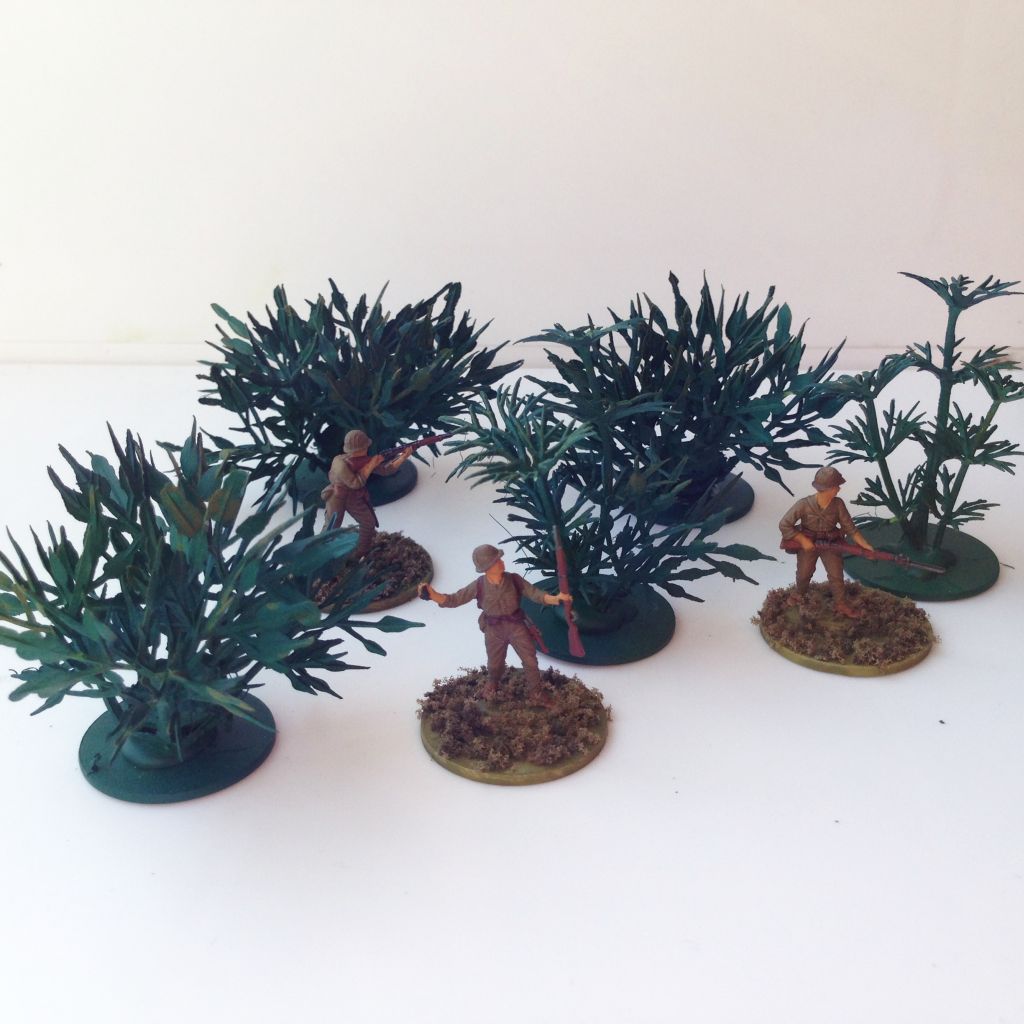
With a craft knife and a hot glue gun, I was able to remove sections of plastic plants and mount them on metal washers. A coat of plastic primer and flat green paint, along with a simple drybrush of a lighter green and I was able to whip up quite a few stands of jungle trees and overgrowth. I cut many sections at varying heights and mixed and matched them to provide a little more realistic look.
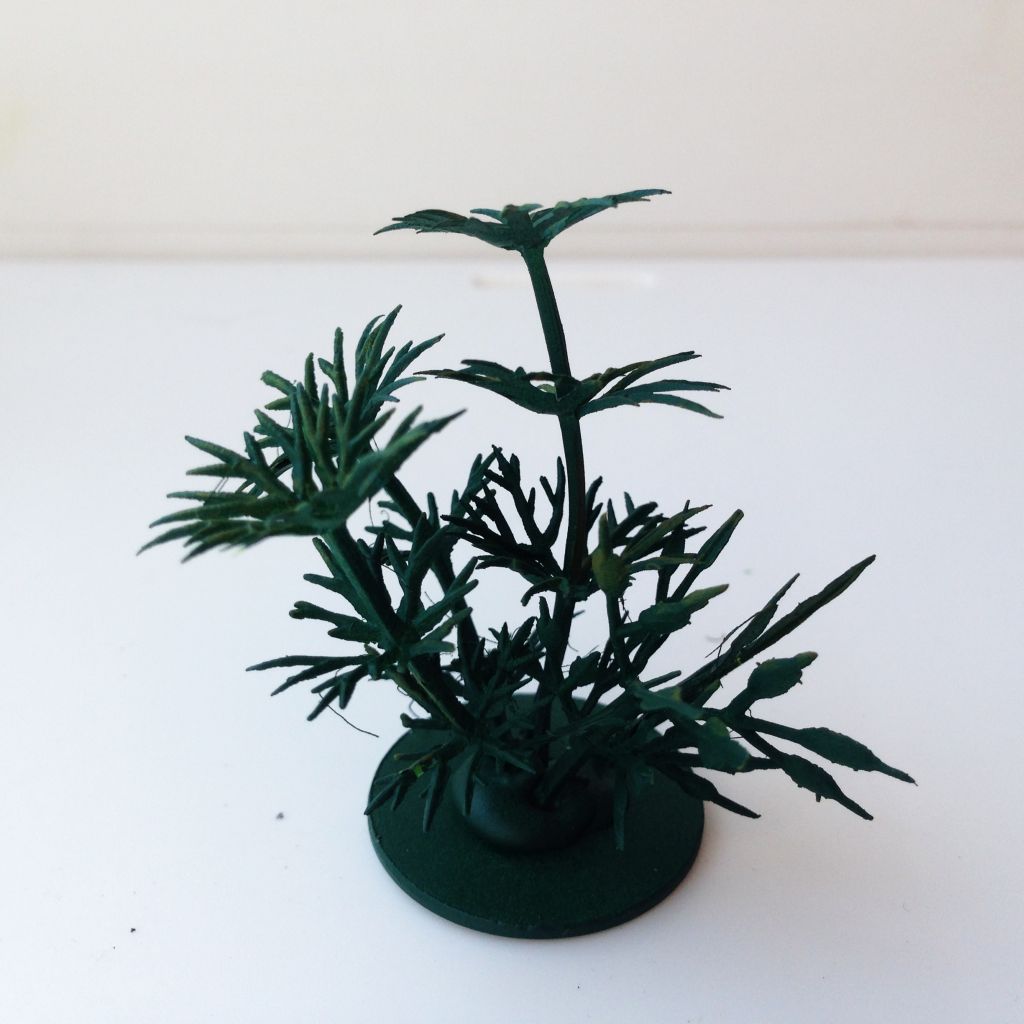
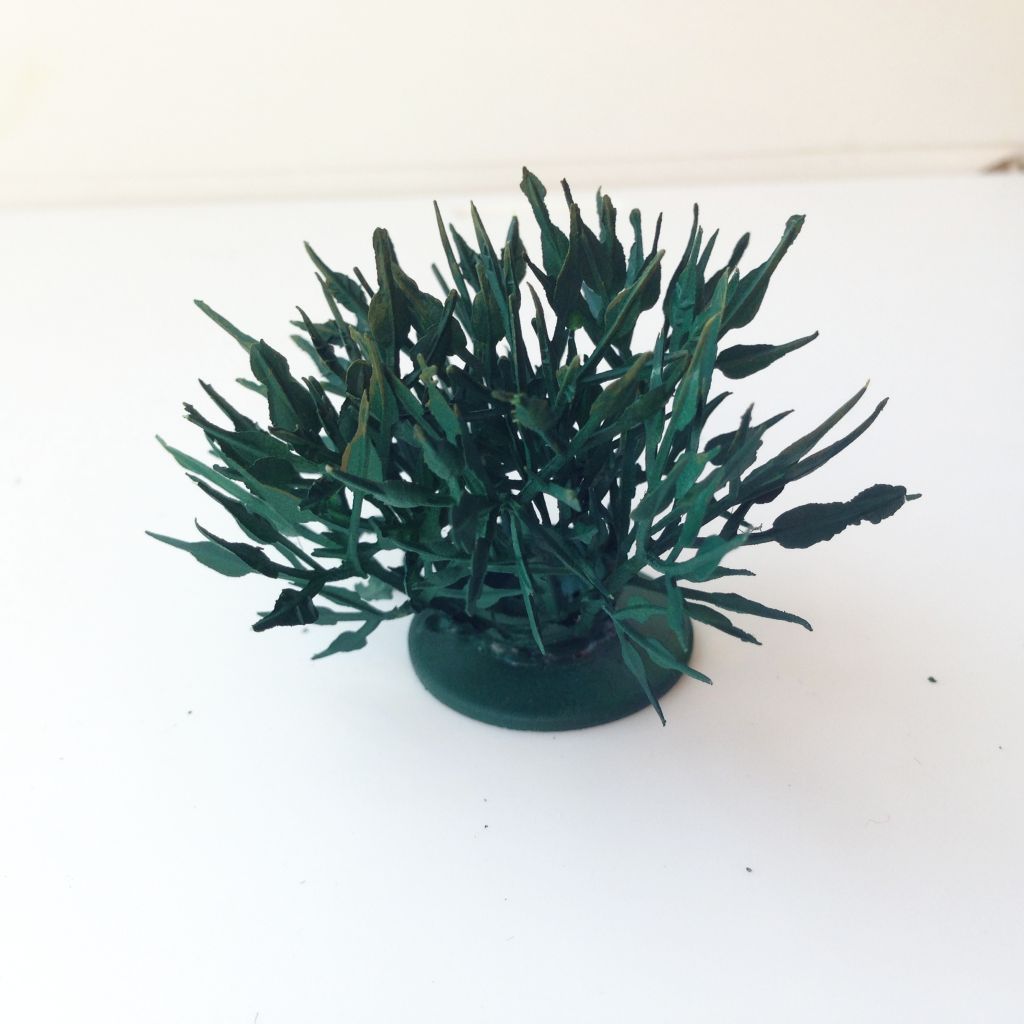
They really look pretty well and being on separate bases, I can move them around to accommodate larger teams and vehicles. Next to some 20mm Japanese troops I painted up, they’ve got an appropriate height and occupy a good chunk of area to offer cover. They were also a snap to get together. Certainly one of my more easier terrain projects to complete. Making trees and jungle terrain this way is easy and offer some decent terrain for your Pacific theater games.
Gripping Beast Saxon Thegns
While I enjoy SAGA I need to admit Frostgrave has sort of taken over my painting drive. I assembled my SAGA warbands a long while back but actually giving them a coat of paint has been a chore. I’ve really been dragging my feet on them. Love the game but my spark for painting the figures consistently seems to flare up for only a few days and then die down to a smoldering ember for months.
But I’ve managed to get some troops painted up. One big draw for me getting into SAGA was the relatively low model count and cheap options for figures. I decided to pick up a few sets of Saxon Thegns from different manufacturers as I wanted to build both Anglo-Saxon and Anglo-Dane warbands. That way I could switch around some of the hearthguard and warlord models, but keep much of the core force of warrior models the same.
I opted for one box of Gripping Beast Saxon Thegns. They are a nice set of plastic figures for a decent price. You get a whopping 44 minis, including a sprue to make a standard bearer, horn blower, and some details like a cloak to deck out one model making it your warlord. For Anglo Saxons a lot of battle board abilities revolve around 10 man units. I’ve puttered around with a few hearthguard but I’m now leaning towards using more warrior units to take advantage of the 10 man abilities. So having a lot of extra figures is welcome.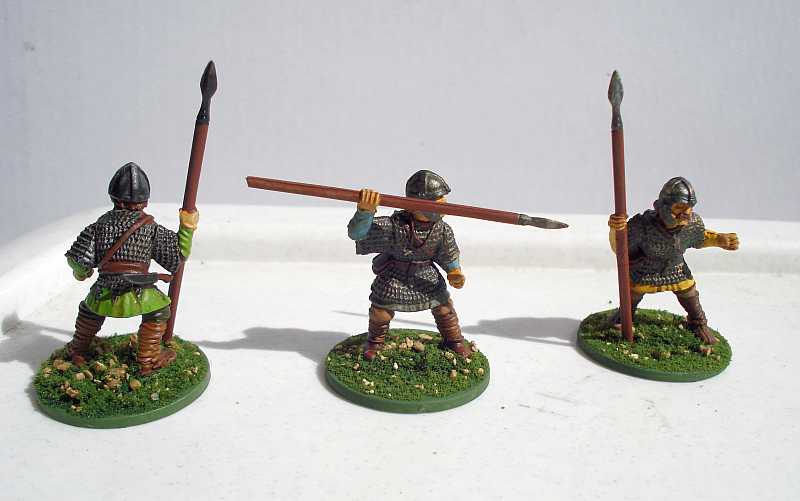
The plastic figures are well detailed with some nice armament options. You get 5 bodies per sprue with a few extra to make up the command elements. They assemble well and are pretty easy to glue together. Square bases also come with the set including some larger bases for single ranks. I’m using round bases instead but it’s nice to have some included in the box. I’m no expert but the gear and figures seem historically accurate and it’s nice to see a ton of spears in the set also.
I’m slacking on the historical accuracy some though. To keep things clean with WYSIWYG with the warrior units in SAGA, I’m keeping them in mail armor and dropping the shields. This is passable with the figures I’ve got, but I’ll admit the right arms are sculpted to accommodate shields. I decided to base them without shields, saving those for the hearthguard.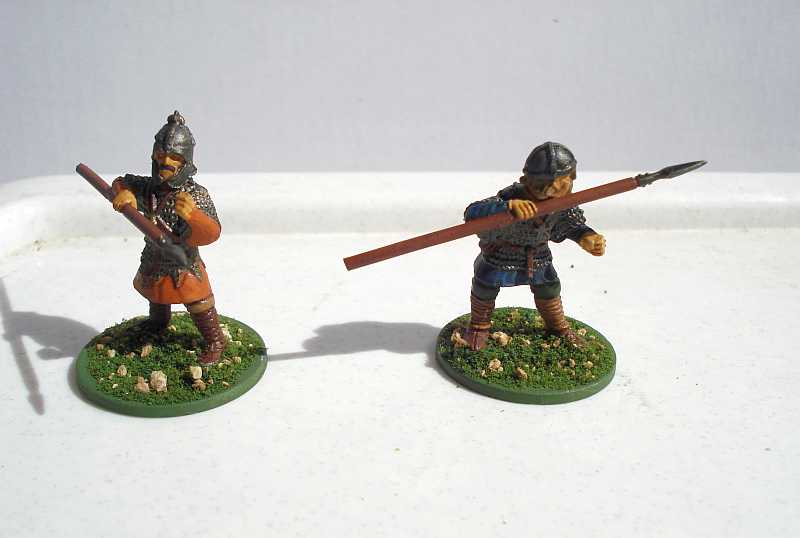
Now another manufacturer floating around with nice medieval plastic sets is Wargames Factory. I imagine a lot of folks would like to know how they stack up and could you mix and match them. The pic below is of two Saxon Thegn figures from each company. The one on the left is from Wargames Factory and the one on the right is from Gripping Beast. I think they are very comparable for scale. The Gripping Beast figures seem a little more stocky in the shoulders and arms, but painted up they don’t really stand apart from each other.
Overall if I was pressed to stick with one set over another, I’d go with Gripping Beast figures. The minis have a little more detail. There are some nice small bits that stand out (like necklace crucifixes) with the Gripping Beast Saxons. They really are fine minis for a good price and work great for getting up a core force of rank and file figures for your SAGA warband.
 Geek Ken