Category: 4e DnD
What MMOs have taken from D&D – Adventure
As I posted a bit earlier, I thought I’d list off a few things I think MMOs have taken from D&D. I think when you look at it from this perspective, you really see how the typical MMO game characteristics are very close to what you find in your typical D&D game.
A key point of most MMOs is something that D&D simply oozes from its books, adventure. Most MMOs just don’t have you act as a farmer. You’re not playing a medieval simulator where you work as a peon. You don’t sit around and make pottery all day. You are an adventurer. A hero. You’re exploring dank crypts and deep forests, fighting monsters. You’re a hero saving the world (or at least filling your pockets with treasure).
Granted some of these more mundane aspects have creeped into MMOs (something I’ll touch on later in another post). But the bread and butter of your game experience is fighting things. Combat is a huge part of the game play.
D&D is also all about fighting stuff. Kill monsters, do quests, earn XP and gain treasure. It’s a basic formula and I dare say most campaigns out there, even those with a strong story, still have a component of adventure and exciting melee. It’s something that D&D does very well.
You can have a campaign of political intrigue, where players talk their way through everything. But I think these games sort of show the flaws of D&D. It really does not sport a robust social conflict system, where you are able to fight out ideas and debates through words. I think skill challenges have provided a DM with a way of adding some game structure to non-combat actions, but it might not be as robust as other games.
Some folks might chide D&D for being a simplistic RPG because it doesn’t have these types of systems. I’ll give them a nod for having a point, but D&D does these types of RP situations poorly because it has an emphasis about adventure. And one facet of that adventure is fighting monsters. D&D does combat pretty darn well, and I think with 4E the tactical options for melees have raised a few notches making combats even more engaging.
Because this is such an integral part of game play, MMOs dedicated to fantasy games have followed suit. They’ve managed to latch on to that fun concept of the classic dungeon crawl. They’ve discovered the sheer glee of wading through a pile of monsters, hacking away, and emerging victorious.
Sure, you could be a MMO player that enjoys wandering around a city, crafting endless amounts of virtual junk, never stepping outside the city gates. But I can guarantee that if that was the only play aspect of an MMO, it would fail. People crave for excitement and adventure. The ability to jump into a world as a powerful wizard or a stalwart warrior has a strong pull. Something that MMOs have latched onto, and quite simply most folks that have played D&D found out a long time ago.
So MMOs have taken a page from D&D, and provided people with a way to find adventure. D&D laid the foundation of having people adopt a fantastic persona, and helm that character to have adventure. Something that obviously hit a resonance with many folks out there, as MMOs and video games have built on that idea and made it a staple of game play. More to come…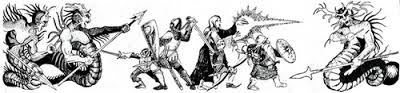
What MMOs have taken from D&D…
 One comment some 4E haters say is that it plays like WoW. That the idea of having abilities based on a unit of time independent of the game day and more on a single fight is a lot like an MMO, with powers and cool downs. The concept of character roles, and the tactical feel of combat is closer to a video game, rather than the AD&D of old. I’m not going to fan up flames of an edition war, but I think folks need to look over that MMO impression of 4E a bit.
Seems a lot of folks will cry that World of Warcraft is the end all, be all of MMOs. Yeah, there was Ultima Online, and text-based MUDs beforehand, but let’s not completely forget about Everquest. Everquest pretty much ruled the fantasy MMOs being the first ‘3D’ world and was a huge success.
So I wouldn’t say that WoW was the most innovative MMO ever. It took a lot of game play ideas from it’s competitor at the time, Everquest, and pretty much improved on it 10-fold (not to mention the significant graphic boost WoW provided). Already you had a group of people grinding away in Everquest. Once WoW hit, folks took the jump and never looked back, with WoW being the fantasy MMO that has become the industry juggernaut it is today.
Looking at WoW and other MMOs out there, clearly they’ve tapped the pulse of a lot of people that like to play games. But is the game play that innovative? Were these video games a culmination of such unique ideas they were never used before? Of course not, and I’d push that many game design qualities of MMOs today are taken right from Dungeons and Dragons.
I think there are four common characteristics of most MMOs. These game design ideas are straight out of what made D&D unique as a role playing game. So over the next week or so, I’d like to talk about some key features of MMOs, and what they’ve taken from D&D. In the end I think we tend to forget the impact D&D had on the video gaming scene, and if anything, most MMOs are pale mimics of RPGs, not the other way around.
WotC shuts down Masterplan… for now.
I first found out about this news at Greywulf’s Lair where I ranted a bit. The skinny is that a wonderful tool for 4E encounter building has had a cease and desist order placed against it by WotC. Details can be found here by the guy that runs Masterplan.
Masterplan is something I’ve raved about before and it really is a fantastic program. What really put it way up on my list of tools was the ability to import just about every sourcebook from your DDI subscription for monsters, traps, and treasure. It was (and I’d still say is) an immensely powerful program for planning and running your games.
It seems that feature was something that got everyone up in arms over at WotC. I guess having an offline tool that could create a database of all the material was too much a threat to their DDI subscription model. I guess that someone saw how a person could get a short term subscription to DDI, be able to get the entire library of WotC monsters and treasure downloaded, and just let the subscription lapse.
What gets me into a twist is that if WotC got off their ass and provided us with something remotely useful to planning our sessions like Masterplan, most folks would likely keep up their DDI subscription. We are getting close to 2 years post release for 4E, and still nothing as helpful like Masterplan is available by WotC.
Instead you’ve got third parties making programs that offer a suite of functional tools for the DM, all for no profit, and all as a little project they likely do in their free time. Masterplan offers a way to plan out your game sessions, create handouts for players, map out a dungeon using tiles, and even tools to run a combat encounter. WotC should be ashamed that they have not gotten something similar out. They should take a hard look at the teams building the software tools now and consider making personnel changes, hopefully with a few layoffs.
Or maybe they need to face up to the fact that the entire DDI bit is a half baked idea. They’ve not put the financial (and labor) resources behind making it an attractive feature for a customer. I’ve been using it to access the Dungeon and Dragon magazines only. I’m not rolling up characters every 3 weeks to justify keeping the character builder loaded on my machine. The monster builder is a nice tool, but again, that is something I use so infrequently I haven’t run it in about 3 months.
Where is a map builder program, that can let you drag and drop dungeon tiles, and print out battle maps? Where is a decent encounter builder that can link up to others, have notes for tactics and terrain features, with sections for read aloud text? How about a decent combat encounter manager? Or a simple initiative tracker? How about a random treasure parcel generator that can let me pick what types of armor, weapons and such to selected as potential items?
All of these programs can be found online. Developed by people that love the game, and are putting them without a profit. How the hell can WotC not have something equivalent out now? Sadly, they likely have not done so since they can’t figure out how to get it working as an online-only tool. Something that requires you to be logged into your DDI subscription to use.
Do us all a favor. Drop the idea WotC. Get us tools now. Allow people with a subscription to have access to the most recent database and just let the whole ‘online with subscription’ model go. Get something out like the functionality of the character builder. An offline program, with the most recent databases available to active subscribers.
There is a reason why people use programs like Masterplan. And that is because you guys have dropped the ball on providing a decent alternative. If you want people to maintain a DDI subscription, then start getting tools out there to make it worth having.
Dumping coins and awarding chests for treasure
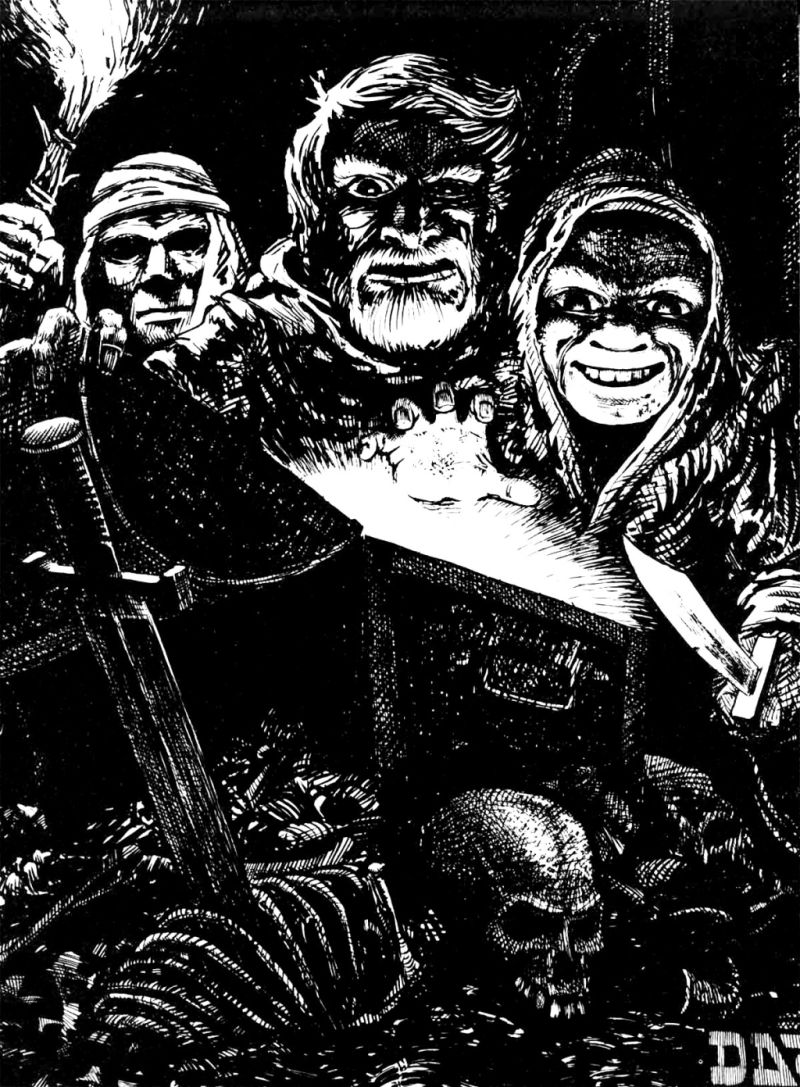
I always stood by handing out coin as treasure. Be it gems, pieces of art, or some other type of precious item, I’ve always been a fan of awarding monetary treasure to groups. 4E uses a pretty regimented structure for treasure rewards. For the most part I like it. It’s a pretty good guideline how much a DM should be awarding for each level. You can switch this around, add a little more (or be a little light) and have an idea where a party would be compared to a ‘typical’ group of the same level.
Lately though, I’ve been tinkering around with dropping the idea of coin/gem parcels completely. I’ve found I haven’t been really keeping track of the mundane stuff my group buys. I’ve been hand waving coin spent on supplies, arrows, food and ale. It is only the odd items like potions or magical weapons that I’ve stepped up with a formal price. Maybe a fairly large ticket item like a new set of armor or a horse might dip a little deeper into the PC’s pockets, but for the most part I just let the mundane stuff slide.
So I started using a more abstract way to keep track of wealth. I started to refer to coin treasure parcels as chests, bags, or piles of coin. When my group gets a coin parcel, I just say that they found a substantial amount of coin and precious gems (or art) that is equal to one chest of treasure.
I’ve completely substituted coin treasure parcels with 2, 1, or 1/2 chests of treasure. I let the group figure out how to split them up, but I tell them to keep things at the minimum of 1/2 share. A breakdown of the parcel rewards can be found here. I keep the magic items similar to the tables in the DM manual and just replace the coin parcels with the appropriate amount of chests.
The big trick of course is to figure out what the treasure chests are worth if a character wants to spend them. I set the value of a chest equal to treasure parcel 7 at the player’s current level. So a lvl 4 player is thinking about cashing in his chests and wants to figure out how much coin he has. He has 2 1/2 chests, looking at parcel 7 for a lvl 4 group, I tell him he has a total of 700 gp (280 gp + 280 gp + 140 gp).
This makes it a pretty easy way to figure out the value for any magical item. Simply take the value in gold, divide it by the gold coin value for treasure parcel 7 at the group’s level, and round up to 1/2 a parcel if needed. It works and it scales pretty well as the characters advance.
It does break down with potions though. I stick by keeping the minimum unit of treasure chests at 1/2, and for consumables, this does get a little inflated at the higher levels. So if possible I try to make sure that a player buy potions that can make up at least 1/2 a parcel. As an example, 1/2 a chest of a lvl 4 parcel would be 140 gp. If a player wanted to buy a single healing potion, I’d say for amount of treasure a player could buy 2 potions (rather than stick him with the loss).
I’d also stand by either swapping out the appropriate amount potions for treasure chests, or just be sure to award 2-3 potions over an entire level. I try not to be tight with handing out potions, and at level 5 or greater, their effect really diminishes compared to a character’s normal healing surge.
So where did I pull out all these values? If you total up the treasure gained during a level and divide it by the number of coin treasure parcels (6), you get an average that is roughly equal to treasure parcels 7 or 8. Also, if you take the gold value of a magic item and divide it by 3, you also roughly get the equivalent coin chest value at that level (PHB pg. 223). It scales pretty well. If a level 1 player wanted to buy a level 5 magic item, it would take roughly 8 1/2 chests of treasure (a lvl 1 chest being 120 gp). But the same item being bought by a lvl 5 player would only be 3 chests.
This is an abstract way of handling wealth. I’m trying to straddle a simple way of handling coin and gems as treasure, but still keep it in line with the ‘gold = magic item of level X’ formula in the rules. So far it has worked out, but as my group advances I’ll be interested in seeing how well it holds up. So if you’ve done other means of handling treasure, what have you used?
4E resource blog roll
Lately I’ve been checking out a few blogs and sites with some nifty 4E stuff. I thought I’d pass along some of their links and hope people take a bit of time to check them out.
First off is Ready an Action which offers a downloadable encounter just about every week. It provides a general map, stats on creatures, tactics for running the encounter, and even offers a battle map if needed. I really dig the idea of providing a single encounter that DMs can use. I’m sure in a few months you’ll have a nice library at your fingertips.
Many of these encounters can also be found indexed at another site over at Sarah Darkmagic’s blog. She has put together the tools for a wonderful searchable index of published and submitted adventures. NewbieDM had floated the idea of hosting 4E delves and found out about Sarah’s site. I hope folks that want to put out their own free content keep this site in mind. I think it would be great to have one site be the resource for 4E adventures and delves on the net, and this site is shaping up to be it.
Stuffer Shack is another 4E-centric blog that has recently popped up. While it has a few general blog posts on RP topics, it also wants to serve as a resource for DMs. The mantra of the site is for people to freely pilfer adventures and ideas at the site. I expect over the next few months to host a lot of DM resources, and currently it offers a pretty good set of links to some handy stuff all ready out on the net.
Hope folks find these sites a good resource, be sure to check them out.
One shot adventures as a first session
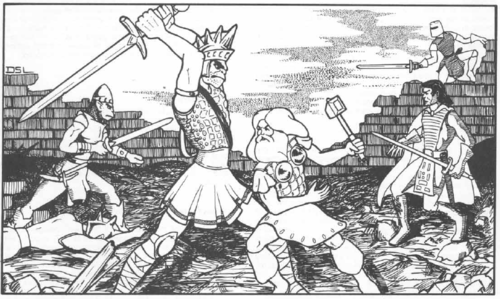
I’m a big fan of having all the PCs know each other before starting a campaign. It helps get over the typical meet and greet that takes up most of the first session as everyone gets acquainted. But even with that, I still think there are a few kinks to work out.
Players have new characters and need to get a feel for their powers and abilities. Also I think folks need to get into the mindset of their character and how they all interact with each other. Pretty tall order to jump into at first, if they are supposedly a group of adventurers that have been together for a while.
So I’m a big fan of the one shot adventure for that first session. Just something simple and quick. An easy quest that doesn’t have much impact over the entire campaign. A few forgettable NPCs and a relatively easy quest to get done in a night. I like to give the chance for players to get a feel for their characters and establish their relationships with each other before jumping too deep into a campaign story.
I also make sure there is one combat encounter that first session. I think 4E combat definitely is a team game with a lot subtle tactics with characters working together. While things might look good on paper, you need a combat or two to get a feel for how they actually work.
If your group has a background that they’ve been together for a while, a decent way to work this in is through a flashback adventure. The group is playing out a past adventure or quest well before actual campaign events. This is also a good way to start a group out at a higher level. Play the first session with them at level one, an initial session being in their ‘past’, and have the remainder be at a later point in their adventuring careers. It’s a decent way to give players a way to learn about their characters, and then be able to skip a few levels jumping into the main campaign.
That’s my little trick. So do folks jump into the main story usually with their first session? How do other folks like running that first game of the campaign?
Expeditions of Amazing Adventure: The arbor temples of Adryia
Halfling folk are the most common denizens of Adryia, with its rolling green hills and pockets of thick woods. Many of the population adhere to the sprawling network of rivers that dissect Adryia into its various provinces. Because of river trade and their wanderlust, many halfings in this region worship Avandra.
It is the halflings to the west however that holds a greater reverence towards the deep woods and hears the spirits within the great oaks. These smaller sects of halfings revere Melora, and share her love of the primal forests. They construct housing of lumber sparingly, and are sure to keep the oldest of the trees standing if clearing an area.
Many temples and community buildings are built around such old trees. It is said that the spirits deep beneath their old bark are alive and whisper to those that are clever enough to hear them. The spirits give council on extreme weather and sudden changes of the seasons. Many farmers have been known to seek a priest at these temples to gain divination on the upcoming planting season, and which types of crop would likely yield a bountiful harvest.

Come deep fall, every five years, this region plays host to the oddest of visitors. It is common for elves to frequent these communities and trade among the little folk. Even the reclusive shifter nomads can been seen among halfings, trading thick furs and smoked meats for stacks of fillbread and the plethora of roots locals harvest.
It is rumored that a great council meets within one temple. Here woodland druids and priests of Melora put aside their differences and seek council of the great trees housed within the temple walls. Dire talk of the possible encroachment of chaotic elementals and twisted humanoids is a topic of frequent discussion. As much as each party views the other worshiping false gods, each strive to aid each other against the common enemies of the woods and natural order. Because of this, many long days and nights are spent planning to counter any incursion of these foul creatures on their respective lands, and at times tense diplomacy is overseen by the halflings.
Some claim that it is only the halflings that could host such diverse guests successfully. It is their good humor, love of hearty food and drink, and generous hospitality that put many at ease. The sincere love that the halfings hold towards the forests is also a strong point.
Legends tell of dark orc armies which have tried to crush the halflings of Adryia. These stout-hearted people have always been able to repulse such attacks, with the oddest of allies always emerging from the woods to offer aid whenever threatened. This legend serves as a dire warning to those that seek to harm these good-natured people of this region.
Deck of many things for 4E
This month’s Dungeon has finally put out rules for a classic magic item, the Deck of Many Things. Overall I like it. I think it somewhat captures the spirit of the previous editions, but definitely tones it down some.
At the heart of this 22 card deck, is that it serves as an amazing Paragon tier artifact in its own right. The deck is treated like a magical tome artifact granting some neat powers forcing rerolls of opponents or allies as encounter/daily powers, with a hefty implement bonus thrown in. Concordance is gained by leveling and doing somewhat risky behavior such as having your HP dropped to zero, or slaying monsters above your level.
One big difference with the previous versions is that you may only get a single card from the deck. The more attuned you are to the artifact, the more cards you can draw being able to choose which one you will retain. In effect, making the odds better you will get something you want. But once you draw a card, poof… the deck is gone.
The card effects vary from the 22 card deck as a good mix of boons and pitfalls. Most of the boons are tangible awards like gems or magic items. Some are simple 1 shot boons such as consultation with an oracle. The more dangerous cards are pretty good but there is usually some way to rectify them. Some may be cured by a remove affliction, but others might require a major quest to undertake (which can lead to some interesting adventure possibilities).
One big plus I have with the article is that you can print out color versions of the cards to make a physical deck. Something a lot more enticing over rolling a couple of dice and checking on a table. However, since the deck is essentially a one shot deal, I wonder if it is almost too much work to go into making a physical prop you would only use once.
Still, I’m glad they got something up that was compatible with the new edition. It can lead to some pretty wild results if a character draws from it, but I have to say overall the results are a bit tame. No complaint with that however. Some might like the idea of drawing a card and having your character instantly vaporized. I like the idea that most trials that come about from using the cards can be overcome somehow (even if it is rather costly). I’d be interested in what other people think of the new version of this magic item.
I am indeed a nerd…an online dice quiz has told me so.
This quiz at dicepool.com seems to be a bit of the rage among the RPG blogs. So here is my result:
 You are a d10: You are analytical, rational, and logical. You see the world around you as a succession of problems that can only be navigated via insightful and elegant solutions. You insist on precision are often forced to waste valuable time correcting others. Your attention to detail is extraordinary, and will sometimes focus all your attention on details that others consider unimportant. You are not so interested in doing the right thing, as you are in finding the best way to do it. In other words, you’re a complete nerd.
I’d be interested in seeing the distribution of results among the RPG bloggers. Maybe I’ll work on compiling that…
DIY 3D terrain from Worldworks Games
I stumbled on a link for Worldworks Games and was blown away by their products. What they offer is definitely for the do it yourself gamer and it appears that printing (or pasting to) cardstock is the way to go with their stuff. They’ve got a few tutorials up on how to work with their kits. Including a tutorial of their assembled product. It might be a little fragile, but I think on cardstock very serviceable and able to stand up to your typical tabletop RPG session.
They have a lot of different fantasy sets. Most of which have a gothic feel, but none the less they do look amazing…
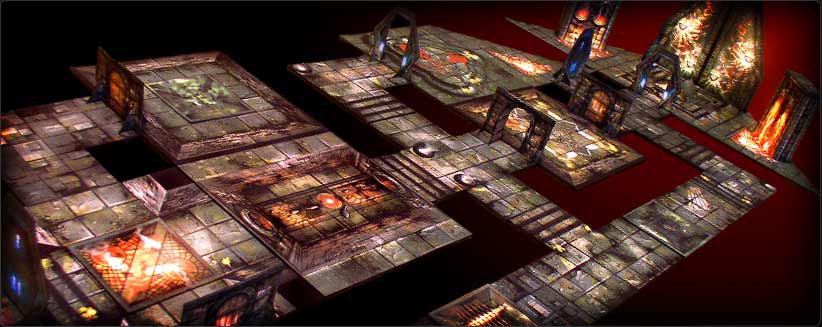
It also looks like they have a lot of other themes available. I think this would be a great set for modern or post apocalypse games too. Might be a good buy if you wanted to jump into the updated Gamma World coming out at the end of this year. Drool… if I only had the time.
 Geek Ken