Category: 4e DnD
A video profile of a few real life DMs
WotC has just put up a short film looking at a few DMs. It covers a pretty broad spectrum of DMs and the types of games they run. I have to admit in the third part does tout 4E a lot which might make folks think it’s more an advertisement for the new edition (though I agree with a lot of the positive comments made about 4E). Still it is an interesting snapshot of the D&D community.
I like how it gives a glimpse on the variety of ways people prepare and run their games. From using home brew rules to lots of self-made conditional markers, I liked seeing how folks adapted their game to their own group. A really big portion is dedicated to how people actually got together to meet up and run their games. I’d really wished they managed to get some folks together that ran an online campaign. There are some tools out there to do so, and interviewing a group that had a remote campaign going would have been an interesting profile.
Still, I liked this. I think it realistically captures a lot of folks that play D&D. I like how it gives a quick view with how different a lot of DMs run their games and the little tricks they use. Be sure to check it out.
Expeditions of Amazing Adventure: The titan footsteps of the tundra wastes
The barren tundra of Kormerria is a harsh land with brutal cold winds that chill the bone. Few can traverse these expansive wilds and not succumb to the freezing climate. Somehow, roaming clans of humans and half-orcs can scratch out a meager living but only barely. It is the thorough knowledge of the lands, passed on by generation to generation that has allowed these races to live there. One such guarded secrets are the titan footsteps.
Scattered among the plains and at bases of the infrequent mountain ranges are magical locations, serving as an oasis to the surrounding brutal cold. These locales are remnants of a fairer time. A window into the past world where the lands grew wild with lush vegetation. These locations are a paler image of that time, but their power still pulses through the earth.
These oval areas are, at most, 100 yards across and hold land barren of snow and ice. Some even have small crops of grasses scattered among the rocky soil. Within these small regions, the wind and cold temperatures are lifted, and a gentle warmth can be felt as if from an invisible sun. These scattered pockets of land serve as a reprieve from the harsh tundra. Crossing the wintry terrain is an arduous task, but the journey can be slightly improved if one can rest within these locations.

Local inhabitants revere these areas as holy land. These sparse locations serve not only as a means for clans to roam the tundra plains hunting game, but also as final resting places for tribal elders. Their corpses are bound and buried upright, with small columns of rocks serving as a rudimentary tombstone. Tales from elders claim that long ago titans had walked the world, leaving footsteps in their wake. These footsteps still echo of primal magic, creating small reprieves in these cold lands.
Some alchemists say the stones from these areas are magical, and can be used to make powerful elixirs of protection. Although few prominent alchemists are willing to fund an expedition to retrieve such stones, they will gladly pay a hefty price for a pouch full.
More thieving adventurers might consider robbing the graves of clan elders that lay buried in many of the locations. It is known that fine jewels of obsidian and opals adorn the headdresses of many Kormerrian elders, as are ceremonial daggers and armor of great chieftains. Local tradition of Kormerrians dictate such prizes be buried with their kin. These tombs within a magical oasis might be a tempting find if seeking treasure.
Many local barbarian tribes see the disruption of such lands as blasphemous, and will inflict a quick death to the offender. Those that seek rest in the titan footsteps must be wary of any nomads they encounter. Despite good intentions of only using these lands for a night’s proper rest, prejudice against outsiders likely mean encounters with such barbarians will end in violence.
Congrats to NewbieDM.com
WotC has a new community spotlight interview up. It’s on one of my favorite blogs particularly for its focus on new DMs and 4E, newbiedm.com. He’s done a lot I think for the community. He started up a new DM group on the WotC community boards. I also think he has a great blog.
In particular he tackles a lot of things someone new to DMing would likely encounter. He also has a ton of useful tutorials and guides including for some practical tips on running your game, from creating custom battle maps, to making your own miniature tokens. I also think as his group has matured and leveled up, he’s gone beyond the heroic tier and begun to tackle some issues a DM may face in the paragon/epic tier. Just great stuff on his site.
Yeah, I’ve been gushing a lot lately on other blogs. I should be posting more stuff here. But kudos to newbieDM.com in getting some hobby recognition for your blog. You’ve got a great site that offers a lot to the D&D community. And if you haven’t checked his site out yet, give it a look!
DM Tip: Reduce lighting in encounters
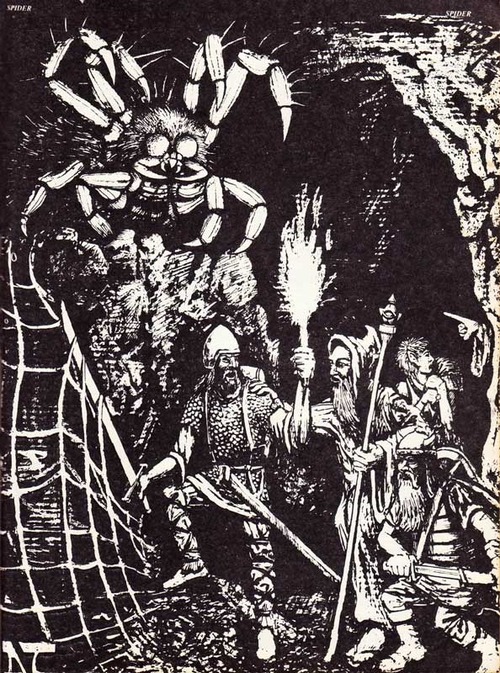 The next time you are trying to add some flavor to an encounter, consider toying with the area lighting. Certain PCs may have difficulty discerning targets off in the distance under dim light conditions (PHB 262), granting those monsters a slight advantage (-2 penalty for attack rolls). Having the complete absence of light can really make an encounter difficult as the penalty for total concealment bumps up to -5 (PHB 281). Keep in mind though that area of effect and close attacks don’t grant a penalty under these conditions.
Counter this with monsters that have darkvision. There are a surprising number of those that do, even at the heroic tier such as undead-types. If you throw in some manner of an environmental hazard that simply reduces (or removes) the player’s light source against some creatures with darkvision, you suddenly have a very challenging encounter.
Having a fight in an open underground chasm, with a constant wind reducing open torches to dim light can make things interesting. Consider having magical effects also. A zone-like effect that nullifies light to utter blackness might make a fight against undead a memorable one.
I’d use something like this sparingly, as it might make certain players upset about being unfairly put at a disadvantage. At the same time however, it might make a few players shine by employing non-combat oriented skills and abilities (say the wizard casting a simple light cantrip).
Some blogs for inspiration
I’ve been cruising some of the D&D message boards and blogs. Quite a few folks have been discussing how to keep coming up with ideas. I agree sometimes it can be a challenge to pull something new out of the DM hat. I always need to get recharged and find something that sparks some creative idea. There are a few blogs I enjoy that usually do the trick.
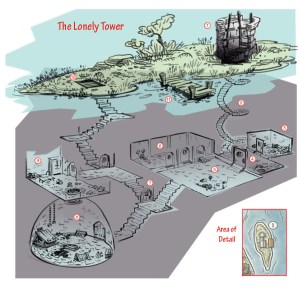
D&D Doodle has quite a few pics I’ve posted in the past. I find a lot of his stuff just great idea fodder. Looking at his rendering of the lonely tower in Fallcrest, how can you not get an idea for a quick dungeon delve?
Personally I can’t wait for the final rendering of Hammerfast. All ready I’ve got tons of ideas rolling around for some city adventures.

Even the smaller surface communities like his Dwarf Town has my creative juices going.
And this inn? Maybe it could also serve as a barracks for a mercenary company, a local for an urban adventure, or how about a mystery set in a deserted roadside inn?


Speaking of inns, another site I love is Fame and Fortune for his series on inns and taverns. Just about every month this guy puts up an interesting inn or tavern. He laces it with eloquent descriptions of the locale, the fare that would be served, the clientele that frequent it, and some broad strokes describing the proprietors. It is solid stuff and has been my go to site if I need to think of an inn or tavern for an adventure. Some of the stuff has got me brimming with ideas. I’ll likely consider plopping the Barrel in my group’s next jaunt to a dwarven town, and for the Wooden Sword I have one word… pit fighting. Yeah, my players will be doing a fight tournament soon.
Another site is a new comer that I have absolutely fell in love with. Year of the Dungeon has a simple premise, post a new dungeon sketch every 3-4 days. It outlines a basic map with a few simple details. But the blogger here also scatters a few descriptors for items and trappings you can use to dress up your adventure. I love the idea and the stuff here is a great source for sparking an idea of that next grand adventure for your group.
So these have been a few sites I’ve enjoyed, by far this is not an inclusive list. If you’ve been stumped on thinking up a new adventure.
Mapping your game for the tabletop?
I’m curious what people have been using to depict environments during their encounters. I typically have my players mapping things out as a general sketch on notepaper. Once things get into combat, I transplant everything to a white board, map out the room, place minis and run the encounter.
It works pretty well. Players can quickly move through environments, jotting down notes to rooms they think are important. I only have players pull out the minis for rooms that have something going on (like combats or traps).
Sometimes things get a little clunky. I usually get everyone excited about busting into a room full of baddies. Only to slow things down while I frantically map out the room, sketch out hazards and notable terrain, fiddle with placing the creatures about, etc. It sort of kills the flow.
I’m thinking about trying something different. So I’m curious if other folks have run into similar situations, and what folks are using in their games.
The bare essentials for 4E?
So during my holiday I ran into a person that was interested in 4E, but was put off by the number of books available. I can totally understand. If you browse the available books there is a ton of material from WotC, and it looks like things will keep being released well through 2010, some being relatively core-related (like MM3 and PHB3). There is a lot out there, so if folks were on a budget and interested in taking the plunge into 4E, where would they start?
Core essential buys – No surprise saying the Player’s Handbook, Dungeon Master’s Guide, and Monster Manual would be a solid first buy. Along with some dice you have just about everything you need to play. I’d even consider fudging the whole battle map and just run a game with token minis on a table.
Solid buys – I’d add the PHB2 to the list on the next book to buy. I think with those 4 books, players have a ton of options to make up characters. I feel the PHB is a little limited in choices and sorely needed a few more races and classes to choose from (something I can agree with 4E naysayers).
The Adventurer’s Vault is another book I’d consider picking up. In those pages are more equipment, rules on vehicles and mounts, and tons of new magic items. It also provides rules for alchemical items. I think potions and such were something sorely missing in the core rules. AV has a lot of options for a DM, and also can serve as plenty of examples if a DM wanted to home-brew an item (much more so that the limited selection in the PHB).
Good things to pick up later – Monster Manual 2 is something I’d look into buying next. It’s great to have more bad guys at the DM’s fingertips. I think between those 2 books, a DM can have a lot of material on hand to craft up some fun dungeons. Not necessary, but a good buy.
I’d add the DMG2 to that list also. Again, it’s not necessary, but there is a lot of good information in the book that just about every DM can gleam something from. I’d consider this a low priority buy, but worthwhile if the cash was available.
I’d put AV2 also in this stack. Again, the second Adventurer’s Vault is just a reference for more magic items. I think if you had a group of players helming characters from PHB2, they might appreciate some of the new magic items in this book. By all means I think this is a very optional buy, but a good one to pick up sometime.
Stuff not to bother with – Everything else. Yup, I think just about all the other books are optional or so campaign specific, there is no real need to pick up any of them. I can see the power source books (Martial Power, Divine Power, Arcane Power, etc.) as fair buys if you had players totally bored with the options in the PBH(s). Everything else I see as fluff material or campaign specific books.
Granted if you really enjoyed Eberron, you’d likely want to pick up the books. But if your group is not running that campaign there is no real sense in buying them. The same could be said for the Manual of the Planes. I think Open Grave and the Dragonomicon are also very campaign specific. Yeah, it might be useful to buy if your campaign was dealing heavily in these topics, but for the most part I would not bother.
So those are my choices. Four to five books I think could hold you over for your entire D&D career. Maybe you’d want to pick up 1 or 2 more. And if you really wanted to jump into a campaign setting, possibly 1-2 additional books. I think trying out 4E is a lot less daunting than what is currently available. I’d be interested to see what else folks would consider necessary buys (or things to drop all together).
Splitting treasure parcel 8 and rewarding parcel 10
I could talk a lot about the treasure parcel system for 4E (and likely will do just that in later posts). For the most part, I like the idea of the parcel system. I like that DMs are given a general yardstick every level on how much treasure a party should get.
Somethings fall a little flat. I really miss having random treasure tables. There is a random treasure generator for 4ED, I’ve used in the past that is pretty nifty. It’s too bad that WotC has not provided something similar with DDI, I certainly hope so.
Another problem I have is that the treasure parcel system is a little too structured at times. You’ve got 10 little piles of loot to spread out over a series of adventures. Recommendations are given to combine a few, and leave a few encounters with nothing at all. Not bad suggestions, but I’d like the flexibility of handing out some treasure when I want too, without worrying about dipping too far into the remaining parcels. All the while, I don’t want to be throwing too much coin my player’s way (or short-changing them). So there are some quick and dirty rules I’ve used with treasure parcels.
Rewarding parcel 10 – I see parcel 10 as optional. I like to use that parcel as a guideline for any monetary quest rewards. Depending on the adventure, if I think my group need a little more economic incentive for tackling a quest, I throw in some gold pieces equivalent to parcel 10.
Usually, I drop this parcel from encounters if the group is handling an adventure that would have this as a reward. Typically, I’m giving a little extra coin throughout a series of adventures on route to that next level. As long as each ‘reward’ is up to the gold value of parcel 10, I don’t worry about handing a few extra out. WotC recommends freely using parcels as quest rewards, but I typically like having the big stuff for the players to find directly.
Splitting up parcel 8 – I also like to split parcel 8 up three ways as additional treasure parcels (8A, 8B, and 8C). I use these parcels for small booty rewards. If I ever run a small random encounter where I think a little coin would be appropriate, I use one of these parcels. Say the group runs across some gnoll slavers. I would expect that they would carry some treasure, but likely not be hauling around some fantastic magical weapon. In that case, I’d add some coin from one of my newly split parcel 8s.
As things progress towards the end of the level, if I’m a little short on opportunities to hand out the remaining parcels, I tack on the remaining hordes from parcel 8. I really like doing this as I can give out a bit gold coin if I want to, and still keep within the guidelines of the parcel system.
So treasure parcels. Love em? Hate em? What tweaking have you done in using them?
The short (and lengthy) campaign
This is a second part on some thoughts about running long and short campaigns. I enjoy longer campaigns, but sometimes it can be difficult to run. I’d like to continue with some things I like, and dislike, with DMing shorter campaigns.
The short campaign – I think the biggest advantage about this type of campaign is you can have a tight, focused, set of adventures that can tell a concise story. I think players can enjoy this as there is a definitive end to the arc. Also, there is less pressure for jumping into a game, as they know in 2-4 months it will be over (perfect for those folks off on summer holidays).
Another big advantage of having a short campaign is the ability to keep things fresh. Players have opportunities to play a myriad of different characters. DMs can experiment with wild settings and lessen the chance of running out of ideas. You can have a lot of variety, and even switch off playing other RPGs. I really think this diversity can keep the interest of players engaged and elevated.
I also think it can open up a lot of unique roleplaying situations. DMs can introduce elements of inter-party conflict, with players having secret agendas and possibly have alignment switches. With the right players, having a person suddenly turn on the group, can make for a memorable campaign. Since everything is short term, this allows players to go all out with these types of dilemmas. In a long campaign, with a great degree of continuity, something like this is nearly impossible to run (unless you have people dropping out of the group).
The counter to short campaigns is that players may not be personally invested in their character. They might have a more flippant attitude towards quests and adventures, as they know in a few weeks, things will effectively reboot. I also think that most players create a character that won’t change much throughout the campaign. Yes, they can gain equipment, treasure, and powers through advancement, but their drive and motivations will likely not change much. At the end of the campaign that one paragraph bio might get a sentence or two more added to it, but that is about it. There isn’t much room for development beyond that.
Also, the adventures you run might drift into mundane quests. Instead of having an epic tale where the very world is threatened, you might be typically running games through a series of dungeon delves. I think the possibility is there to run an engaging story in a short campaign, but the scale will likely pale on comparison to a longer campaign. Additionally, you are effectively on a deadline. You have to wrap things up in a few months, so players might feel they are running through hoops, traveling from one scene to another. It depends on the group, but some might want time to explore and wander a little more in the world, rather than head off to the ‘next quest’ of the campaign arc.
I’m torn a little about what I’ll do in a few months. I’m enjoying a longer campaign (as is my group), but I’m feeling the draw to running something more concise and shorter. I’d love to heard what most folks run and their experiences with past campaigns.
The lengthy (and short) campaign
I’ve been running my campaign for a few months now. I’ve always been a big fan of the long, epic campaign. However the reality of life encroaches a lot in my group. Being in Korea, most people I know having some interest in D&D are here temporarily. Usually after a year, they are off somewhere else as they change jobs.
I’ve been lucky having a few people staying around for a while, but already I’ve had some attrition in my group due to people moving on. This makes running a lengthy campaign, even if just for 6-8 months, problematic. I’ve toyed with wrapping things up and trying to get smaller arcs run, but the group I currently have really is enjoying the longer storyline.
Still, I’m considering pushing for a conclusion in a few sessions, and might try to run future campaigns with a definitive end that can be reached in a few months. I recently also managed to play in a 3.5 campaign that was enjoyable, but it petered out after a few months and never wrapped up in any form of conclusion. I’m hoping I can avoid this. I guess time will tell depending on the group’s wishes.
With that conundrum, I think each type of campaign provides some advantages and solid points. However, I am still on the fence as to how I’ll keep my campaign running.
The long campaign – One big draw to this type of campaign is that it can be truly epic. You have the time and breadth to allow characters to grow and change. As a DM, you can craft a huge, involved storyline. Even with a string of shorter stories, taken together it leaves an intricate tale in its wake. I think many players look back on these experiences fondly, as they can say they were part of a huge story.
An interesting point with these types of campaigns is the shift away from the initial background defining a character, and more their experiences as they play the game which molds what they are. Sure you might have some central idea of your character’s past, but it eventually gets pushed to the backseat in a long campaign. It’s the actions and events of the game that becomes the largest influence on a character.
The downsides of a long campaign are many. I think the biggest problem is player/DM burnout. Keeping things fresh and exciting is a challenge. Folks may very well get a little bored and want to try something different. All of which makes for a campaign that never really ends, and just sort of crawls to a stop, leaving a lot of dangling plot lines.
Keeping the group together is also another major hurdle. Real life can intervene for some people and cause them to drop out. Sometimes this can work, as 1-2 people taking a break from the game with a decent sized group is not much of a loss. As the game is still running, they can always jump back in after a few months. However, getting players back into the groove of the current party lineup (and caught up with all the drama of past events) can be a problem within itself.
Still running an epic storyline can be enticing. I think players can have dynamic experiences allowing their characters to grow and flesh out organically. These types of campaigns allow for convoluted arcs and tons of interesting encounters, NPCs, and events that can make for memorable sessions.
I’ll be sure to post some good (and bad) points about shorter campaigns in a bit.
 Geek Ken