Category: 4e DnD
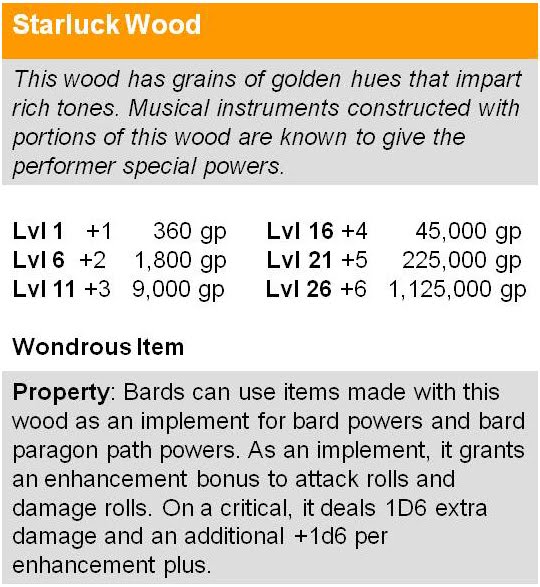
Magical bard implements
I really feel bards get a little shafted with musical implements. The big problem for me is that many bard rituals require a focus of a particular GP value. However the choices are rather limited. As I noted before talking about AV2, additional magical instruments were lacking. There are a few weapons that can act as implements, but some different instruments and/or wondrous items would have been nice in that book.
So I started mulling over some ideas to expand the number of items that could also serve as a focus for bard rituals. Rather than create a specific item, I thought about having magical properties in the components which an instrument is constructed from. Drums, lutes, lyres, even horns could have portions of the instrument made of magical wood, or special bone inlayed keys, all of which that impart some magical property. So players have some flexibility in obtaining a magical instrument of their choice (with a DM is willing to drop it in an appropriate treasure parcel) rather than having to work with the limited choices in PHB2.
So I below I have a few components that could be used to make magical instruments of a player’s choice. They might not even be provided as an actual instrument, but a portion of arcane wood that could be used by a craftsman to create one (which could be RPed out in a special session or a reward for a short quest). I hope some folks get some mileage out of these items.


Planning sessions with Masterplan
I’m a luddite. I’ve tried using a lot of online resources while playing my game. I’ve tried having initiative trackers, pulling things up on the compendium and other applications all to no avail. I just can’t seem to shake old habits, but I’ve tried to change. Running my games, I just like having things at my fingertips and being able to scribble little notes on my session plans when I need to. Planning my games is different however and I really embrace using a lot of online tools.
I’ve been tinkering a little with Masterplan and been enjoying it quite a lot. They’ve incorporated some new features and I really think I’m going to have to invest a little more time in this program. It’s amazing.
Masterplan is a program that helps with session planning. It allows you to sketch out plots as a flow chart, annotated with notes and text. It includes options to create encounters and skill challenges. It even allows annotating maps (or building maps with tile sets). I’ve yet to really dig into the nuts and bolts of the program but I’ve enjoyed what I’ve seen so far.

One particular feature I really like is the encounter builder. Just fiddle with the drop down fields for your experience budget, and you can draw up a list of potential baddies to create your encounter. The most recent version allows users to import creatures and items from the DDI compendium. In previous versions, you have to export selected items from the compendium yourself. This was a little tedious before (but useful once your library was created). Now importing things directly to your Masterplan library is a snap.
Want to create a map on the fly? Plenty of tools for drag and dropping tiles to make a custom map. There is even a yahoo group where you can export sets of tiles to fill out your library. I’ve dabbled with this a little and the initial prognosis is awesome.
Hopefully over the upcoming holidays I’ll have more time to play with this. I really want to push, pull, and prod this program to see what it can do. Offhand, this looks like a neat tool to make things up on the fly. I’m hoping I can get comfortable enough with this program, so that if my players go off the map, I can completely improvise a few encounters. Just ask them to take a 10 minute break while I whip up 3-4 encounters, complete with a map, traps and treasure. I completely see this as a possibility with this application.
If folks have delved deep into this program, I’d love to hear your thoughts.
EDIT: Oh, and if you want a brief walk through of Masterplan, there’s a YouTube video of some of the features in action.
Random initiative using cards
So with the greater tactical encounters my players are fighting, one thing that has been creeping in is the locked turn order. Everybody goes in the same order, round after round. At worse, if you blow a roll, you’re stuck going last the entire combat. Granted, for some groups, they might want this for tactical planning with their teammates (shifting for combat advantage or maneuvering targets for a blast spell). But my players wanted something a little more chaotic, so I thought of some alternatives.
We could roll initiative each round, but I dumped that idea as it would slow down combats. An alternative would be to have everyone roll 3-4 initiatives all at once. Each player calls out an initiative they want to use from their list. Every 3 rounds, I ask for a new turn order and write down what initiative the players call out. A little more paperwork, but it does throw in some randomization.
Still I was not too happy with that idea. I wanted something that was:
- Easy to run – It didn’t require a lot of record keeping and could keep things moving. Plus if I needed to hold up the action to work out some mechanic, I could jump right back into the turn order without a hitch.
- Simple to explain – If I needed another set of clunky rules to run the initiative, no sense in bothering.
- Reward high initiatives – If a player got a high roll, or invested into feats and powers to gain a higher than normal initiative, they should get some benefit.
- Random – I wanted a turn order that would be mixed up from turn to turn.
I settled on using initiate cards. Each of my players are assigned a card from one suit. I do the same for the monsters they fight (using another suit). Typically each type of creature gets a card, but I’ve broken larger minion groups up into 2 if needed. The key point is to have at least 1-2 monster cards less than the player cards.
I have players roll initiative, and do the same for my creatures. If players, or monsters, roll a 20 or higher (25 or higher for paragon tier, and 30 or higher for epic tier), I make a note regarding their card.
After shuffling the deck, I set aside the top half. Going through the bottom half, I note any player cards that rolled a high initiative (greater than 20). If so, I move it up one card in the deck order.
I then do the same for any monsters, with one exception. If a player card is on top of the lower part of the deck, it remains there (players trump monsters in turn order for this case).
I return the top half to the top of the deck, turn over a card and play out the turn. Next turn, shuffle, and repeat the process.
Things are random from turn to turn. If a player rolls a high initiative, there is no guarantee they will go first. However they can guarantee they will not go last (and likely be in the middle of the group for that turn).
My players have been loving this do far. I’m still thinking of tweaking the rules a bit. Say giving a player with a phenomenally good initiative one opportunity to jump to the top of the deck once per encounter. Or if players hold an action, move them down one card order the next turn (to impose a small penalty for going out of order).
On that last point I’ll say one thing my players have done a lot. I’ve been seeing players hold actions and waiting to run coordinated attacks, far more than with my regular games. It’s far from perfect, but my group has gotten a lot of enjoyment out of shaking up the typical encounter initiative. So if people have been adding a little randomized initiative in their games, what have you folks been doing?
Expeditions of Amazing Adventure: The cavernous archives of the Coreldor arcane library
One of the marvels of the great city Coreldor is that it hosts the largest collection of books and documents of the western Empire. Operated by the mighty arcane guild within Coreldor, this huge stone building lies atop a bluff overlooking the city. The library hosts not only arcane books and ancient rituals, but also various historical documents and maps. It serves as a vast repository of knowledge, whether being map fragments of the lost Alondarra continent, a listing of intricate clan relations of the Kormerrian barbarians, to the unusual customs of Istrian Pict tribes.
Strict rules govern use of the library holdings and the arcane guild holds control with a tight fist. Automated constructs not only wander the rows of books to aid visitors, but larger automatons can occasionally be seen precariously clambering up spiral staircases, patrolling the various floors of the library for thieves. Magical wards also protect books from being removed from the library grounds.

Knowledge from the library holdings can be freely transcribed, but at a hefty price. The guild offers a staff of scribes which can transcribe magical texts into rituals. Membership to the guild will offer a substantial discount, and even an opportunity to study select texts within private tower laboratories on the library grounds. Yet entrance into the guild is a difficult procedure that is costly both in time and expense.
The arcane guild is very proactive in expanding its holdings. The library is well known for paying a fair price for historical texts and arcane tomes. They have even been willing to fund expeditions to ancient ruins to obtain literary treasures, or to produce accurate depictions and maps of lost civilizations. Many companies of adventurers have been known to contact the guild seeking employment for such expeditions.
Rival arcane guilds, even powerful lone wizards, are envious of the Coreldor arcane guild. They hold such a powerful resource of information within their folds. Stealthy attempts have been made to obtain a particular text, or secretly transcribe pages of documents. These thefts have always been stopped, but that has not dissuaded some brash rogues from trying.
There are whispers of a secret chamber within the library. Texts of immense power, some which describe the summoning of demons, or hold within their pages descriptions of great evil, are rumored to be kept there. Only the most trusted members of the arcane guild have entry to such a chamber. To obtain such books, scribe a few pages, or even read the contents of such documents would be a prize for any wizard. An adventurer that was steely enough to find this rumored chamber would likely have a fortune at their fingertips once inside.
The ‘bleah’ standard healing potion
I think healing potions are lackluster as is. The DMG encourages folks to regularly dispense them in treasure parcels. As is out of the PHB, players spend a healing surge and gain 10 hp instead of their regular healing surge value. This is all fine and good until you hit about level 4, then the 10 HP boost is almost up to par with your normal healing surge value. As per DMG suggestions, you should keep shelling out healing potions up to level 9. By level 11 you should be switching to the higher tiered potions of vitality.
Maybe I am doing my math wrong, but I see severe diminishing returns from these potions well before players reach the next tier. Okay at level 1 or 2, healing potions are pretty spiffy. Past that however, their value really becomes minor (even negligible) compared to a player’s typical healing surge value.
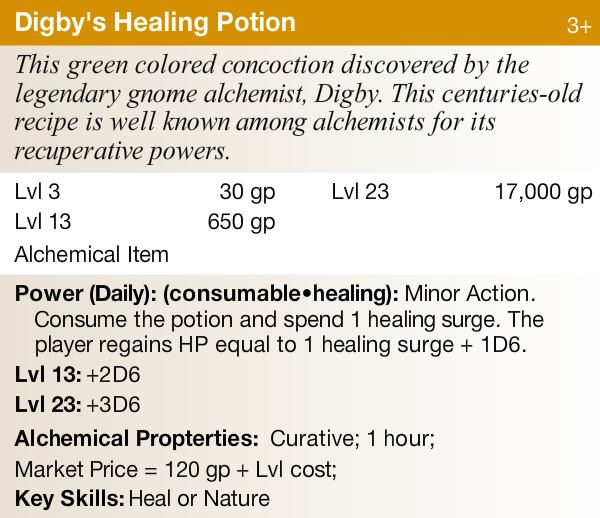
So I dumped healing potions in my game. I’ve instead ripped off an alchemical item from the Eberron’s players guide. I modified my healing potions to add a specific value in addition to what a player would gain spending a healing surge. They’ve been working fairly well. I think I’ll still have a problem when my group is teetering between heroic and paragon levels, but so far they are working tons better than the out-of-the-book varieties.
To mix it up, I do throw out the higher level healing potions occasionally. I don’t associate a price value with them, but in a pinch I would drop the price by half if a player were to purchase one. Standard healing potions are a great value for a few levels, but quickly drop off in worth once a player gets well within the heroic/paragon tier. So I present below Digby’s Healing Potion:
Digby’s Healing Potion
Level: 3
Category: Curative
Time: 1 Hour
Component Cost: See below
Market Price: 120 gp
Key Skill: Heal or Nature (no check)
This green colored concoction discovered by the legendary gnome alchemist, Digby. This centuries-old recipe is well known among alchemists for its recuperative powers.
I hope folks find this a useful item in their games. Anyone else finding the ‘official’ healing potions lackluster? If so, has anyone been using homebrew items?
4E Campaign podcasts
As I mentioned before, when starting off a campaign I think DM’s should freely loot what they can from other material. There are a lot of campaign primers you can pick up online, including from WoTC, that are free. There are two campaigns I want to bring up, mainly because they each include podcasts of players during actual game sessions.
The first is from Roleplaying Public Radio and their new world campaign setting. It is an intriguing setup as the players are part of a new group of colonists in a new land. Things are very fluid politically and there are a lot of moral quandaries and political factions for the players to get stuck in. The new world does have some indigenous tribes on its shores. How much effort should the players make to work with these groups?
One major obstacle is the need for massive labor. Labor is hard to come by so slavery might be an option for the colony. Should the players support such a thing? Also a goblin hulk is sitting off the waters of the colony. Goblins would be willing to do the bulk of labor on the cheap, but at what price in the future?
All of this has a backdrop of a larger story, where ruins of an ancient civilization are abound. Some players will be drawn towards these ruins through visions and dreams. Deep within those ruins lies the trigger for creating a new age, or will it bring the end of the world? Fun stuff abound here.
The podcasts are entertaining (if you are willing to put up with some NSFW junior high locker humor). While it is tailored to a particular group, just sitting through some of the player discussions regarding some of the sticker moral arguments is worthwhile. I think a DM could pick up a lot of ideas on what would work, and what would need some refining, when running their sessions.
Another minus for me in the podcast (aside from some of the coarse table-talk) is the painful recording of every fight. Playing out a combat is fun. Listening to people play is not. I typically find myself skipping much of the combats during the podcasts.
Still with its flaws, I think this is a great setting. Having the podcasts of actual sessions is also a huge plus as it serves as a reservoir for ideas. It can also highlight parts that can work (or need to be dropped/modified) for a session. Plus the setting is so open, I think a group would have a lot of fun tackling some of the political and moral elements of the campaign, all the while having the excitement of exploring a new land.
The other campaign podcast is Return to Northmoor which I’ve enjoyed a lot. The campaign is much more structured like a WoTC’s scales of war. It has info on encounters and thoroughly providing notes for running a game session.
One particularly interesting concept of the campaign is the relationships the players have with each other. Additionally, much of their background has a tremendous impact on the main story. The players begin at the periphery of a large kingdom making their final run on a cargo raft to a remote outpost. They stumble into an arcane mystery which leads them to an ancient civilization related to each of their pasts.
I really enjoy these podcasts. They are broken down into two types. One is a thorough discussion on tips and pointers for running the material provided. The second is actual recordings of the play sessions. What I particularly like is that the play sessions are edited. Some of the more exciting elements of combat are left in, but most of it is truncated or skipped over, with emphasis made on group roleplaying. I think it is a great format, and something to emulate more (are you listening WoTC?).
Those are two I’ve been following as of late. Anyone else found some fun 4E campaign podcasts?
The Paragraph Bio
So there are a lot of things I like to use for my players when they bring a character into the campaign. I’m a huge fan of the 9 character questions, but that can be a little daunting. I also like having players know each other, and sometimes have a little dirt on each other’s past.
Yet, sometimes I get a new player in that just hasn’t thought out much of a background (other than what race and class they want to play). Or I’ve got a player that wants to jump into an existing group, and he is suddenly the new guy that doesn’t really know the other players (so that past history is a little sparse). I do put my foot down that the player has to give me something to work with. I think character backgrounds and bios are important. They are really a great source for thinking up future sessions and tailoring adventure hooks.
I ask players to give me a one paragraph bio. Just 3-5 sentences on where their character came from, and how he sees himself in the world. I always tag on one more question that they also have to answer, “Why are you an adventurer and not X like your kind?” This last question is very important and I throw in a little information in with it.
The ‘X’ varies, depending on the race of the player. I usually put some description of what I think most people of that race are in my campaign with the question. Some examples:
Goliaths – Why are you an adventurer and not hunting the plains with simple nomadic clans like your kind?
Tieflings – Why are you an adventurer and not enslaved by the evil Lord of Gorran like your kind?
Eladrin – Why are you an adventurer and not at war with the firbolg in the fey like your kind?
Now, I let players put whatever they want into their background. If they are from an educated family of Goliaths that love to read and are experts at arcane magic. Or the player is an Eladrin that longs for peace and the quiet solitude of the woods with his kin. I let them run with it. At the same time players know that most other people of that race are like something else.
Likely he might stand apart from his kind even more given the background he puts down. But at least the player has a better idea how his character fits in with the world, and possibly can serve as a motivation to broaden his character. Maybe that Tiefling suddenly thinks he should strive to free his kin (or he is fearful he will be recaptured). It’s a small detail, but can add a lot to such a simple paragraph.
This is a pretty stress-free way for a player to write up a bio. I like using it, especially for new players. So what do folks use for bios in their games?
Interactive Virtual D&D Tabletop
I’ve seen clips on these types of screens before. However, using one to run a D&D game is something completely different.
Enjoy, drool, and be ready to geek out…
Starting that big campaign
I think it’s always a challenge when first sitting down and thinking about that first session to kick off your campaign. I usually have a ton of ideas going through my head, and trying to get something cohesive out of that jumble can be a challenge. For a new DM, I think the task can be a little overwhelming. Sure that first small adventure is easy enough to run, but what then? Here are a few bits of advice I hope new DMs find helpful:
Talk to your players – Bounce a few ideas off them. If you want a convoluted campaign of political intrigue against the backdrop of high fantasy. Yet, your players want a gritty, sword and sorcery game. You have problems. Be flexible. Work out a campaign environment and theme that most of your group will be happy with.
Steal stuff – For your first few campaigns, don’t bother drawing out that huge world map, filling in every detail. A unique homebrew campaign does not necessarily equate to a fun campaign for your players. There are tons of existing campaign worlds and maps. Take from those works. You’d be surprised how much material is available that can add some sparkle to simple campaign beginnings. Take Winterhaven as an example. A pretty generic place, but some renderings really give it some life, like those at D&D Doodle.
Make it your own – Don’t feel hampered by adhering strictly to a published setting. Modify the stuff you pilfer to make it fit your game. This is where you can let your creativity go. Take that published setting and mix it up.
How about making the use of undead servants (zombies and skeletons) commonplace? Select a few PC races and state they are commonly used as slaves. Take that neighboring city and make it an evil necropolis. As long as these changes are consistent throughout your world, making changes to existing works is an easy way to make your campaign unique.
Start small – There is a temptation to get players into a grand epic adventure right from the start. Slow down the pace. You’re working with an imaginary world, most players need a little time to get a feel for it. Once players become familiar with their surroundings (recognizing an NPC innkeeper and such), then consider moving on.
Starting small keeps things flexible and allows your campaign to grow. You might find your players bored with a main villain, but really interested in tracking down that kobold gang. If you have too much planned out, you risk pushing your characters along the storyline rail. Keeping things small with a few open plot lines, gives the players a chance to slightly direct their future paths to adventure.
That’s it for now. And while you are sketching out your next big campaign, don’t forget FreeMind. It’s a great tool to keep your grand plans for future sessions organized.
Spreading out the story
Some discussion has popped up in the WoTC boards with a group I am part of. One poster was really excited about starting up his own campaign and wanted a little advice. A lot of people dispensed their words of wisdom, and I had my own advice. Mulling over what I posted, I thought there were some points I should expand on a bit.
One campaign technique I am a huge fan of is spreading out the story. The basic idea is planning out the main story elements of your campaign in small steps. Instead of running your sessions with each plot point being sequential (A, B, C, D), spread out the story shuffling smaller, one-shot adventures in between each element (A, 1, B, 2, C, 3, D). Gnome Stew had a post which is a great example of this. Something I’ll quote a bit here:
“…After some brainstorming the main outline looks like this:
- The Cult attempts to kidnap the Captain of the Watch
- The Cult infiltrates the Thieves Guild
- The Cult smuggles a set of religious artifacts into the city by ship
- The Cult kidnaps the Princess
- The Cult attempts to open a portal to their deity using the artifacts and the Princess in a ritual
…Now, Using dilution, we can lengthen the story arc with some individual stories:
- The Cult attempts to kidnap the Captain of the Watch
- The Heroes rescue some merchants who have been attacked by bugbears
- The Heroes help an older mage collect some dangerous spell components
- The Cult infiltrates the Thieves Guild
- The Heroes go on a quest to find a friend who has gone missing
- The Cult smuggles a set of religious artifacts into the city by ship
- The Heroes find a lost wizards tower
- The Cult kidnaps the Princess
- The Cult attempts to open a portal to their deity using the artifacts and the Princess in a ritual…”
This is a fantastic way of building up your campaign to something truly epic. There are a lot of ways to add small adventures to your campaign. Dungeon Delves and Side treks (out of the Dungeon mag) are great resources for this. Whipping up a small sidequest using encounter templates, even using a random dungeon can work.
The key to using these adventures in spreading out your main story, is to work for small, concise adventures that can be completed in 1-2 sessions. These smaller sessions revolve around a simple objective or quest. You don’t need an intricate background story to run these. After all, they are just filler adventures for your main arc.
Once you get the hang of running these type of sessions, you can expand your story and weave other main arcs into the campaign. You can end up having 2-3 main storylines going on simultaneously. But be careful having too much going on at once, or spreading out your main arc too thin. You’ll end up having to spend 15 minutes recapping each session with highlights from the past. And likely have your players forgetting pertinent details from something that happened 5 sessions ago.
A cannot stress enough using this technique for running your campaigns. It adds some intricacy to your plot and helps give your game breadth. There are some great points by stretching out your story:
Makes good ideas last – Week after week, planning for your next sessions, you are going to hit a creative roadblock. By introducing smaller adventures, you have more time to pick up another idea and flesh it out. If you are doing things right, you’ll have interesting villains and NPCs dotting an exciting adventure. The constant pressure of keeping things fresh and new can lead to creative burnout. Spreading out the story gives you some breathing room to think of your next big arc, and utilize those story elements as long as possible.
Provides an expansive story – On paper it may not look like much, but through your player’s eyes, they will feel like they’ve saved the world 10 times over. Once the arc is completed, they can really savor the victory because of all the things they went through getting there. They won’t necessarily feel like they’ve been lead along step by step, and have had the opportunity to explore other options. They can get the experience that they’ve really grown and explored a world, rather than doggedly running after the footsteps of a villain.
Dispenses small victories – You might have a main story where the players fail again and again, only to be redeemed at the last session. Yeah, that makes for a great campaign, but sometimes players need little victories. Having small adventures where heroes can do some good, and accomplish a small goal keeps them in the game. Players need to feel like heroes once in a while. If your main arc can’t accommodate that, then you have an alternative. Okay, so in the big story, they suffer setbacks continually. After a while the players may feel disillusioned and struggle with why they are even bothering trying to stop your baddies. Little victories can help keep up the group morale, and the spiritual fortitude to keep after the main bad guys.
Fodder for future stories – Once you are nearing the end of your main arc, you now have a ton of material to draw from for your next big story. You can expand on past adventures and revisit old NPCs. Best of all, your characters have already crossed paths with certain locales, NPCs, and villains, to make moving on the next arc a lot easier.
As you can tell, I’m a big fan of spreading out the story. It is a simple, effective way to get a lot of sessions out of your main story idea. Give it a try and I’d be interested to hear folks experiences if they’ve done something similar.
 Geek Ken