Category: 4e DnD
Expeditions of Amazing Adventure: The Secluded Sanctum
As something of a fun series of posts, I’ll try to periodically throw out some (hopefully) adventure inspiring locales. Lately between wandering the Korean countryside and enjoying the League of Extraordinary Gentlemen (sigh… my geekness never ends…yes, I enjoy comics too), I’ve been motivated to try this creative exercise. So every two weeks or so, I hope to produce some interesting fantasy location, ripe with a few ideas for adventure.

The main temple lies in the shadow of a large mountain face. A small path precariously winds upwards towards its summit. Nestled in a slight recess is an image of an unknown god of old. Many of the commoners revere this idol, despite the wishes of the religious leaders in the temple.
Small depressions are scattered around the idol. These hollows in the mountain face are used to hold offerings. Copper coins are commonly placed there. But it is not uncommon for some to leave something of greater value if a strong blessing is particularly desired.

It is rumored that coins are taken up by the old god, a belief reinforced by the continual presence of a few empty holes. Do some villagers secretly pilfer the offerings made by others?
The continual reverence, and more importantly the offer of coin, chafes the religious leaders of the temple. They have avoided any decree towards the villagers stopping their practice. Quite possibly a group of adventurers could covertly deface the idol (and get a suitable reward from the temple)?
What does the idol represent? Is it a primordial god worshiped primarily by animal humanoids? Is this really a revered god found by a nomadic tribe of shifters? Such the presence of a temple below the idol would likely be an affront to their god. The shifter tribe may seek to remove such a temple by force if necessary.
Working with Extended Rests
Like just about everyone running a D&D game, I like to tweak the rules a little. I think the 4ED rest and recovery rules work. It keeps players in the action and taking an extended rest effectively replenishes all their resources including HP. But I wanted to put a brake on players using all their healing surges, drop severely low on HP, and just take an extended rest to do the same thing next day. I just feel continually taking extended rests could easily be abused.
To get around this I modified the extended rest rules a little having the player recover healing surges differently, and it being largely dependent on their condition before they hit the sack for 6 hours. I feel that daily powers and HP have to be replenished to their full amount, no matter what condition the player was in before the extended rest. Dragging out HP recovery over days just seemed to hurt the player. Besides, if you buy that HP are more about endurance and will power, rather than just tick marks for vitality, it doesn’t make sense hampering HP recovery.
So after an extended rest, the player regains their maximum HP and regains all their daily powers. However, recovery of healing surges depends on the following conditions before they take an extended rest:
Is the player at less than full HP? – If the player has less than full HP before they rest, they gain their full healing surges (HS) -3. If the player is bloodied, they gain full HS -4 (4 less healing surges from their maximum).
If the player is at full HP, how many HS have been currently used? – If the player used 4 or more healing surges, they regain full HS -2. If they used 3 or less, they are at full healing surges after an extended rest.
Players should be encouraged to burn through their healing surges, and possibly use them in combination with encounter powers, to be at maximum HP before they rest. The player recovers less healing surges if they have any damage at all (even being one point under their maximum). So it is worth using up all those surges to get back to max HP before resting.
In addition, if players take a comfortable rest they gain back one more healing surge (a bloodied player resting in an inn would be at full HS -3 after an extended rest, not full HS -4). A comfortable rest means the players are in a sheltered location (not exposed to the elements), eating a prepared meal that is not trail rations, and are in a relatively secure location (not taking guard shifts).
This encourages players to seek out civilization and crash at an inn, rather than being cheap gold misers sleeping in the woods all the time. Granted some players might feel their character is more at home in the wild, but taking the time to get a campsite together, rustle up some food and water, and sleep hoping nothing stumbles on them in the night, will likely make the player not be at 100% the next day.
I’ve been a little lenient applying the comfortable rest bonus to characters using specific rituals. Create campsite ritual (PHB2) is a great example. Using traveler’s feast combined with eye of alarm (or magic mouth at an entrance to a small cave) would also work, especially if the players packed a few tents. I think rituals seemed to be glossed over in 4ED and with a little tweaking, they can add a lot to the game.
That’s it for now. Another example of using healing surges instead of HP to hamper, or reward, the players.
It’s not the game. It’s you.
There has been some pretty juicy discussion on troublesome players over at the Chatty DM and Dungeon Mastering. Something I felt about handling such players, is that it can be very tricky if the jerk player in question is your friend, or a friend to one of the players. If the person is simply an acquaintance that you happen to run the game with, then I’d have no problem throwing down the ultimatum of ‘shape up or get out’. Yet, this point really got me thinking about fun with games, and more importantly, our fond memories of past sessions and campaigns.
I’m convinced that with RPGs, people derive fun less from the game design and mechanics, and more with the people around the table. It is the social interaction that drives these games. I really think what clouds our fond memories of playing past games, is not the actual love for a system or rule set, but really with the people you were playing with at the time.
I’ve heard something which I’ll paraphrase here, “You can’t relive that past experience of your high school D&D game.” I believe it. And I truly think these memories of good times are mainly derived from remembering the time you spent with your friends, sharing an experience playing a game.
That is the key point with RPGs (that make them stand apart from other games), social interaction with other players is so integral to having fun. If you have a jerk player, that social interaction is troublesome and stressful, making the fun factor an all time low. If people are backstabbing each other and doing spiteful things, that might just be fine in some groups but a death knell with others. And I think the key difference is that in one group, people are solid friends and their relationships recognize such antagonistic behavior as non-threatening. In other groups, although they may be good friends, such behavior is seen in a poor light, making the experience unpleasant.
I think fondly back to my college days playing Illuminati. It’s a goofy board game, where players actively seek to grasp power by making under-the-table deals that can be broken on a whim. Tons of backstabbing and trash talk were abound in those games. When I look back at it, I really think it had practically nothing to do with the game (I wouldn’t consider it a great board game). I think all my real fun had to do with socializing with my friends around the game table.
So is that really the big issue a troublesome player? It’s that our socializing is hampered, not the actual game, which leads to us not having fun? Something to ponder over I guess.
Preview: the Psion Class
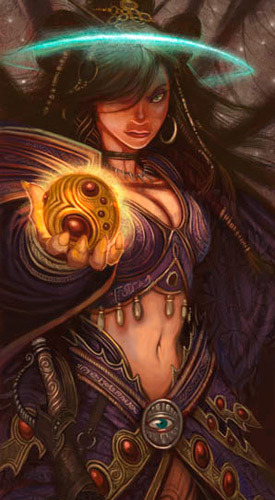 Content for the new Dragon magazine is now up detailing the Psion class. Personally I was never a fan of the psionics character, but in some campaigns I could see them working. I just never quite liked the fluff of having players manipulate things with their minds. I guess I am just an old-timer with my magic and spells (‘You dagnabbit psionic kids. Get off my lawn!’)
Still it looks like an interesting class. What I particularly like is how the implementation of power abilities are slightly tweaked. Players slowly expand primarily with their at will powers and get daily and utility powers as normal. They gain no encounter powers. Rather they obtain power points (starting with 2) that they spend to augment their at will powers. Most at will powers can be augmented twice, effectively having 3 ‘levels’ of effects. After a short rest, they regain those points back. They’ll end up with the same number encounter powers as other players, just some differences in the game mechanics for using them.
I foresee this becoming popular in a lot of knock off systems (and likely has already been implemented elsewhere). You have a few key signature powers or moves, with a pool of points to tap additional effects to them. You end up having a few options, deciding how much to buff up a certain attack. I like it, and it screams for being used in certain genres (pulp-action or superheroes).
As for 4ED though, I can see more bookkeeping for the player. It’s a neat idea, and I expect for many veterans they will like the free-wheeling power use of this character class. I’d be hesitant dumping it on a new player. Yet, the play style of being able to selectively bump up abilities, rather than picking from a predefined set is intriguing. An alternate magic system in the works maybe?
Putting the Story on Rails
I sometimes stumble over this when running a game. I’ve sketched out the events for a session. I have the plans laid out with specific decision points. I have consequences and issues that come up based on which path the players choose. Then I run the game and the players just go all over the place. It’s fine and that is one of the joys of playing D&D. Players should be keeping the DM on his (or her) toes.
But sometimes I still push the story on a rail. I construct a situation that nudges (sometimes seemingly like a linebacker pounding a tackle dummy) the players in a direction that I want them to go. It’s bad DMing and it bums me out when I do it.
Typically it is because I’m thrown for a loop with some of the decisions that players make. Where I envision outcome A or B from a RP encounter, the players come up with something that needs an outcome C (or even sometimes outcomes D, E, and F). At times I just run dry on improvised ideas.
I’m a huge fan of the ‘say Yes’ DMing style. If players are thinking of creative ideas to tackle a problem, I want to reward them. I want to encourage unusual solutions if the players are thinking. While it may not work, or be incredibly difficult to pull off, I like giving them a chance to try. But sometimes I just say, “No, that isn’t going to fly”, and then I push the players along the story rail.
As a quick example, the players are on an errand. They don’t really know their employer much, but are taking the job because it pays well. They get the item of unknown function. Returning to their employer, they are intercepted by a NPC group that wants the item. No way in Hades are they going to let the players take it back to the employer, and are ready to take it by force if needed.
So the players have a choice. Hand over the item or fight them. The guys that intercepted them definitely seem shady, but they really don’t know the motivation of their employer either. It is a simple dilemma and I’ve thought out story lines for either decision they make. Then the players come up with a plan C.
They are willing to have a representative of the party go with the NPC group, speak with head boss of the NPCs, and they won’t hand over the item to their employer just yet till they hear more on their offer. I hem and haw a little and say the offer is not acceptable. The players want to negotiate this deal a bit more. Finally, I tell them to roll initiative as the NPC group has done enough talking and ready to take the item by force from the players.
I hated doing it. Given a little time I could have gotten a side adventure together. The players read the NPCs right. They are bad guys. I could have had one player out of the action, being held hostage. Had the rest of the party try and do a bold rescue and escape. In short, try to run a grand adventure, but the reality of completely winging it settled in.
It was early in the session and the story was way off what direction I expected it to go. I needed more time to fill out some details and think about how the events could unfold. I simply was not up to par with running the game enough to pull off that much improvisation. It’s a shame too as 4ED really has a lot of tools and rules to cover those weird actions that players come up with. Making encounters really is a breeze. I’m going to have to work at designing more monsters and especially NPCs. Plus I need to give the ‘Additional Rules’ section in the DM another few reads to familiarize myself with it. I need to improve how I DM a game.
Putting the story on rails isn’t fun for the players. If folks have some tips to keep from that happening, feel free to add something.
Review: Dungeon Delve
I’ll likely limit my WOTC product reviews. Typically I’ll be getting much of the new release stuff a month or more after most people have had a chance to wander down to their local game store (damn snail-paced international mail). But the recent ‘save my game’ article from this month’s Dungeon got me thinking a little about the Dungeon Delve book.
The Good – It is a slew of adventures that can be easily run in a night. As the Dungeon article pointed out, it’s a great resource if you have to plan out a quick adventure. I’m more partial to using it as a quick encounter resource. Tag a few encounters in the book and use them if you need to make something up on the fly.
There is a lot of material here that could be applicable to every level campaign (or portions that could be regularly pilfered). I think this product is a good investment if just starting a low level campaign. Plus if you wanted to just make a quick one shot adventure for a nightly game (or a run to introduce new players), this would fit the bill nicely.
Additionally, this could be a good way to give players, and you as a DM, a snapshot of the paragon or epic tier. Just as a break from the regular campaign, tell players to roll up a lvl 25 character, sprinkle in a few magic items as equipment, pull out an appropriate delve, and have a run at it. This experience might help them rethink what feats and powers they’ll pick up as they advance. Maybe after playing a certain paragon class for an encounter or two, they realize it doesn’t quite fit their play style, and rethink the direction they’ll focus on for future levels.
The Bad – Some of the encounters seem a little uninspired. There is a definite repetitive theme of a 3 encounter dungeon crawl. They do give some ideas for expanding delves. Straight out of the book however, I’d be more inclined to add a few more rooms and an encounter or two. Overall, I think many of the delves would need to be fleshed out a bit more before running them in a regular game.
Another big negative for me is the reliance on Dungeon Tiles. Yes, I get that WOTC is a business and they need to promote their products. But as the number of tile sets are so limited, overall I think many of the layouts are constrained. I’m certain this will be a trend that continues for other books. I’m hoping they release another 3-4 sets before coming out with another Dungeon Delve book. I’d warrant even completely remapping your own dungeon layout, and just drop the encounters into rooms of your own creation. As long as some of the major terrain features are there, I think it’ll be just fine to plug and play encounters from the book.
The Verdict – Is this an indispensable D&D book to add to your collection? No. Could this serve as a useful tool for running your games? Sure. If your group is the meat and potatoes, dungeon crawling crowd, they’ll likely love it. However, I think most of the delves will need some retrofitting to work with your typical group. If you have the cash, I’d consider it a reasonable buy to add to your library.
Playing with Miniatures
I’m a fan of miniature war games. I love painting and collecting minis. I did the whole GW Warhammer Fantasy/40K in the past. As minis go nowadays, I’m deep into WWII 15 mm stuff and more small unit skirmish games (more on that later). Long ago I used miniatures in my D&D game also. So with 4ED, I latched onto that aspect pretty easily.
Quite honestly, it is pretty difficult to run 4ED combat without some type of miniature system. I’ve heard people that do it. They rely more on the descriptive text of powers, and fudge with the 1 square = 5 foot scale to do a lot of hand-waving during combats. Yet, I think folks are really missing out on the tactical element of the game if they do not use minis.
I can see some trepidation folks have playing D&D with miniatures. One big factor is cost. Another is space (storage and during play). At least pre-painted minis are available on the market, so you can get away from painting the things if needed. There is one sticking point I have with miniatures though, I think you get stuck having to either buy a ton of miniatures, or play with a lot of proxies that look like a Pokemon explosion on the table. It sounds silly when you use miniatures, but it’s easy for players to get into the WYSIWYG* mentality. So much so that they’ll have a hard time remembering those 3 additional orcs on the table are really goblins. * What You See Is What You Get
So while I am a huge fan of miniatures, and I’m a fan of using 1” scale maps for rooms and such. I’m not a big fan of using actual miniatures while playing. I like using tokens and paper minis. Newbiedm.com posted a great tutorial on making your own custom counters. I especially like the dual sided tokens he uses. As for me, I really like using paper miniatures and there are quite a few that are commercially available (I like the line disposable heroes line).
I like using PDFs of paper minis for the following reasons:
Cost – You can get a lot on the cheap, as it is simply a matter of printing out what you need. I place the printed minis between two self-adhesive laminar sheets to add some life to their use, and it gives them some sturdiness.
Flexible – If you really need to make multiple copies of a figure, it’s a simple matter of cutting, pasting, and duplicating with another program. Also, you can scale up (or down) figures. Need a few giants for your game? Not a problem. This works great with an A-frame style for mounting the figures, as the base can be made to take up a few squares. I also work using the base into monster types, where bases of certain colors match with the monster role (minions, lurkers, etc.). If using paper clip binders, you can usually pick up a bunch from office supply stores of various colors.
Replaceable – Anyone that has every played 40K knows what I am talking about. Eventually you get that accident resulting in a broken/chipped figure. Paper miniatures can be whipped up in a flash. No need to retouch any paint jobs. I think the pre-painted figures available from WOTC are a little more durable, but I’m not sure how well it will hold up if your pet takes to making it a chew toy.
So I like miniatures in 4ED, but I’m less of a fan using actual figures. I think paper miniatures and tokens are a great way to go. They offer enough to allow players to envision the action, but at the same time allow enough imagination to make proxies work. Figures look great, but almost too good. I think WYSIWYG tends to creep into their use, so when you are forced to use proxy figs it’s a bit clunky.

Suggestions for Small Groups
Being in the Asian hemisphere, I find that RPGs are not that popular here. Still I managed to get a few folks together that wanted to play D&D. The incredibly fun part of the group is that they are all relative newbies, not having a lot of baggage from previous editions (also, I could regularly flub the rules and not get caught on it too much).
Having new players is loads of fun. Yet the immediate pressing problem I had was a two-player group. D&D is completely playable with less than a group of 5, but 2 players can really hinder the type of encounters I could throw at them. They decided to play a rogue and a paladin so at least they were covering some different roles in the ‘Leader/Striker/Defender/Controller’ party makeup scheme. But I think with just 2 people, the game could get stale fast. Typically they would be pairing off against a soldier, or brute-type and a swath of minions. The exp budget I would have for encounters would just be too low to have a lot of different creature types out at once.
I added an NPC character to the party, Torr, a shifter druid. I figured a controller that was a ritual caster (and could provide a little healing to back up the paladin) a good choice. So far it has worked out exceedingly well, and it has added some interesting dynamics to RPing for the game.
I’m not constantly at odds with the players. Face it, typically the DM is playing the opposition, and usually we are at just as conniving, manipulative, and self-serving with our verbal actions as the players are. Granted, it’s all part of making the game interesting for the players, still at times I feel I’m working against them. Maybe my players are metagaming when they throw out, ‘So, what do you think, Torr?’ Yet, it gives me an opportunity to subtlety nudge the party in a certain direction. I have a chance to drop hints or suggestions to the players without being too obtuse. Having an NPC in the party is allowing me to smooth over those sticky RP situations and keep the story moving.
The only problem I have is when combat rolls around. Effectively, I’m helming another monster, trying to work out what attacks and maneuvers I should make to work with the party. I’ve been toying with the idea of letting the players take over the NPC party member in combat. Rotating who controls the NPC, switching off every round, will likely prevent one guy from completely monopolizing its actions. I’ll have to take that for a spin, but my players may not like having to think out the actions for another character. They seem content with being the master of their own persona.
I might try another alternative and truly have an NPC type with less powers, but I think something like that works well in a striker/defender roll. I think leader and controller types really need a lot of options to keep viable. Something else I think I’ll have to try out.
Another huge problem is blown encounter and daily powers. Having such a small group, I’m finding a missed attack or power can lead to some serious consequences. I’ve worked around that allowing player to have additional uses for action points.
For parties of 3 or less players, I’m allowing players to burn action points to recharge missed encounter powers as a standard action. Additionally, I’m allowing players to use an action point during an extended rest to get back a daily power if it missed during the encounter. Now my players are really striving to use those dailies. If they miss, they know they can get it again (provided they live though the encounter). Plus that failure to use a cool attack is lessened for the encounter powers. All of it adds to the survivability of the party, and allows them to have more fun.
The Handy Healing Surge
 Healing surges are great. I found playing 3.5 how absolutely crippled our group was without a cleric-type. Running my 4ED game, my players don’t have a cleric in the party (more on that later). At times it can make things a little hairy, but if they can get through that fight, a few minutes rest they can jump right back into the action. It is an awesome mechanic. I also love how clerics supplement the healing capacity a player all ready has, they don’t completely replace it. Finally a cleric can spend some time fighting rather than just playing band aid to the party spamming healing spells.
Some thoughts I have about healing surges in general…
Hit points are not just a record for physical damage – I tell my players that about 1/3 of their HP total actually represents what physical punishment their body can take. The rest of the HP represents resolve, will, and endurance. The longer you swing that sword, the more energy reserves you use in the fight, the more likely you’ll leave yourself open to a well-timed attack that REALLY does some physical damage. In that context healing surges work.
Likewise, I started leaving the bloody descriptors for damage to once…well…the character is bloodied. Till then, 5 points damage with a sword is a bash to the jaw with its pommel. A 6 point hit with an arrow becomes a nasty bruise after the leather armor absorbs the strike. 10 damage from a fall results in a sprained ankle. Sure the player can keep pushing on, but all those bruises, nicks, strains, and pains means the player will have to take some serious rest in the near future.
Healing surges are not just simply magical healing – A second wind is literally another rush of adrenaline to keep pressing on. And that 5 minute rest truly means you are slowly gasping for breath, wiping the sweat from your brow, and working up the courage to keep going. Once your players drop the old DnD concept that HP = physical damage, you can start to play around with awarding (and removing) healing surges since they explain that extra desire the character has to keep on his feet. As for recovering from being bloodied, picture a little self-first aid during the break along with spending all those healing surges (think quick needlework from Rambo on his arm in First Blood as a more graphic example).
Losing healing surges is a great way to hamper the player – After an extended trek through a desert, or an arduous mountain climb, you don’t need to hit the player with damage. Wipe off a few healing surges instead. Want to sap the player’s vitality with an evil artifact, but keep him on his feet for a few encounters? An excellent way to represent necrotic energy is by removing healing surges. Had a hex placed on a player from an evil shaman? Take off a few healing surges (with the ability not to recover them fully after an extended rest). The effect is a little more subtle than straight HP damage, but it forces the player to recognize he can’t keep pushing at 100% efficiency and something is hampering him.
Gaining healing surges works too – Want to add a little more benefit from resting in a sacred chapel? Give the player an extra healing surge after an extended rest. Allowing the players to regain a few surges through some special artifact mid-dungeon is a great way to boost the characters, especially if a particular encounter was a little too tough (flubbed daily attacks anyone?). Throwing the players an extra surge once in a while can really help in reinforcing the idea that a particular environment, effect, or power improves their resolve and fills them with confidence to step further down those dank, dark corridors.
So how do other folks envision healing surges and have you found other nifty uses for them?
Regarding Rituals
 I like the direction that 4ED went with rituals. Give the players a bunch of cool spells that just about everyone could cast (if they picked up the feat). I like that they were displayed as a different set from other powers, allowing the player to cast them without having to bother memorizing them for the day. In that aspect I always thought the wizard got the shaft in previous editions.
Why bother memorizing all the wild utility spells if it took up a slot for something more important (like fireball)? I guess most folks liked the logistical challenge of trying to figure out what spells would be pertinent for the adventure. Typically I found everyone just taking an 8 hour rest to memorize the spells they needed (like identify 4 times), and then re-memorize the typical layout later (or they end up making a stack of wands and scrolls). Yeah, I like a player being able to cast the neat stuff without having to take up a slot from their bread and butter spells.
However, rituals aren’t quite perfect. Aside from casting times, I tend to think the component costs are pretty outlandish. The casting time I can sort of understand. If it was a quick cast, players would be casting knock on every door and teleporting everywhere. But combined with the unusually high components, I can see players sort of bypassing rituals.
It’s a shame as I think rituals allow the players to do the really cool RP things. They really can help push the story forward, and clever players are going to find unusual uses for them. From my post on extended rests, folks can see I like to encourage casting rituals. So I decided to give the player a little incentive doing so.
I reduced the component cost for casting rituals. For heroic rituals (1-10) components cost 50% less, for paragon rituals (11-20) the cost is reduced 25%, and epic rituals have no reduction in component cost. For some specific rituals that required a particular focus (Leomund’s secret chest, enchant magic item, etc.) the costs for these focus items are not reduced. Also raise dead has the same listed component cost, as I consider the game effects to be too large to discount.
I also started to freely throw around ritual components to supplement treasure parcels. It’s really easy to add a few odd bits here and there, especially as different rituals require a variety of components. Its another way to add a little variety to those listed treasure parcels.
I still have not delved too deeply into awarding rituals that can be copied. I usually drop the one-shot, scroll rituals as they can really give the party a much needed clue to keep them on track (hand of fate, anyone?). But given the cost for obtaining a ritual, I see the opportunity to pick up one completing a quest, even on behalf of an arcane benefactor, a possible incentive for a few of the players in a party. This can definitely can add a little drama to party dynamics if the group is happy completing a quest and ready to head topside, while the wizard wants to push a little further on for the potential of obtaining another ritual.
So rituals…hate em? Love em? And any tips how you folks use them in your campaigns?
 Geek Ken