Category: 4e DnD
Bring back the WotC D&D playcasts
I’ve enjoyed many of the videos and podcasts from WotC showcasing 4E. The Penny Arcade podcasts were very enjoyable. I expect with the next version of D&D rolling out there will be an entirely new set of play sessions released. Quite a few folks have used them to introduce the game to new players. However more effort should be put into a special series to introduce the game, especially for new DMs.
One format I have loved talking about adventure design is Return to Northmoore. Typically you have one podcast talking about the adventure in detail, then another session of the actual playthrough. What I particularly enjoyed was the DM commentary.
So let’s fast forward another year or so from now, with DnDNext out on the shelves. WotC, get a simple dungeon delve adventure up on the web. Something like a lighter version of Kobold Hall. Just use stock monsters out of the book. Don’t worry about any stats. Have a simple map up of the dungeon. Add a branch in the layout and avoid the linear room to room exploration (more on that later). Make sure to throw in a room that has a trap and possibly some puzzle element. Don’t forget to have a few stock level one characters too. Have that as a nice PDF file a fledgling DM can page through. Then get the podcasts up.
Podcast 1: The Adventure prep and dungeon design. Have the show DM talk about the dungeon a bit. Give out the nuts and bolts of the design philosophy. Talk about why the rooms and encounters progress the way they do. Give some DM tips on preparing an adventure, how to address some potential problems. Finally, give at least a good 10 minutes talking about the story of this dungeon and why the players are exploring it. Describe different adventure hooks for it.
Podcast 2: The party introduction. Describe the basic mechanics of the game and go through a quick rundown of abilities, AC, and HP. Have each player introduce themselves. Have them give a little background on their character. More importantly, insert some DM commentary on a few bullet points about key abilities as each party member is introduced.
Finally, the show DM should lay out the situation and cast a few adventure hooks, getting the players on board. Make sure to encourage that roleplaying. Get them lined up to explore the dungeon and as they enter the first room…
Podcast 3: The first combat. Give a complete overview of the fight. Present every die roll, every HP marked off, allow for plenty of questions and answers. In short, just like almost every existing WotC podcast for 4E.
Podcast 4+: Now for the other fights, have the lead up to the fight. Maybe play out the first round and then skip to the end. A blow by blow account is boring. You don’t have to focus on each die roll and listen in as each PC ponders their turn. Instead, focus in on presenting particular situations that come up with commentary by the show DM. Something like the following…
Show DM: The party is pretty much in the thick of it by now with the wizard suffering from poison by a giant spider bite. Let’s listen in on Fizzlelot’s turn.
DM: Okay, Fizzlelot. It’s your turn. You are poisoned. So you immediately take 5 points of poison damage.
Show DM: Ongoing damage is taken at the beginning of the player’s turn. They might have temporary hit points or some regenerative effect that can counter this. However if they drop to zero HP, they are down for the fight. Players can be pretty excited to do something on their turn and can forget any ongoing damage, so be sure to remember any ongoing effects.
Fizzlelot: Five points? Ouch. Okay, I’m down to 12 HP. I’m going to try something different and swing my staff at the creature.
DM: All right, make a basic attack rolling a d20.
Fizzlelot: Ack.. rolled a 4.
DM: Sorry not enough to hit it. That was your standard action. You have a minor and a move action.
Fizzlelot: This is pretty dicey right now where I am at. So I’ll use my move action to shift away from the giant spider. That’s about it. I’ll use my minor action to say some choice words to the beasty!
DM: Heh. Okay your turn is over. You get to make a saving throw to shake off the poison. Use a d20 roll and roll high.
Show DM: At the end of the player’s turn, they can attempt to make a saving throw for any effects that have a ‘save end’. The poison attack from giant spiders have such a condition. All the PC has to do is roll a 10 or more and they can shake off the effect.
Fizzlelot: Jeez. An 8. Can I get a break here?
DM: That’s too bad. You are still poisoned. Let’s move on to Sir Slays-Stuff.
Show DM: Since the wizard rolled less than a 10, he is still poisoned and will continue to take ongoing damage the next turn. As a tip you might want to curb the use of too many monsters that inflict ongoing damage with low level parties. Players can get into some bad die streaks and the cumulative damage can add up. Not to mention they don’t quite have the magical items to help out. So be sure to use these type of monsters sparingly in your adventures.
Now here is the important bit. Skim through the remaining fights. Possibly key in on a few important rolls. For the final boss fight, give a general overview of the situation and play out that last turn. Streamline the podcast to cover high points of the fights. For roleplaying however, you want to play every minute of dialog.
That is why it’s important to have a branching path (and be sure to have some clues telegraphing what might be in each direction). Have that room with only a trap and a puzzle. Give opportunities for the players to talk about the situation and cover all those exploration discussions. That is the stuff you want to cover in its entirety. While combat is a part of the game, it’s a better sell to capture the table chatter and excitement of exploration.
Final Podcast: The wrap up. Have the DM lay out a foundation for another adventure and tie up any loose story bits. Finally, go around the table and get feedback from the players. Throw in some final DM commentary and advice about how to seed further adventure ideas and the importance of talking with your players, and most importantly, just having fun.
I hope more effort is put into getting a short series of podcasts out that help explain the game and give some guidance to new DMs. I tend to think there are so many existing fans of the game now, we tend to forget about trying to get stuff out there to help the newer players. A short series of podcasts like these can be a great step in helping newer players learn about, and grow to love, D&D.
Using monster templates and themes
I’ve taken a stab at using the DDI monster builder and found it a little clunky but serviceable. However I still was looking for offline tools that would allow me to tinker with making custom monsters. Another resource out there, straight out of the DMG, were monster templates and themes.
I tend to think monster templates and themes never really got any ground with DMs. It’s a clever idea. You’ve got a few key characteristic powers and traits you can slap on just about any monster and end up with a custom creature. The DMG2 expanded on this and gave some more general powers based on the role of the monster. Even an article or two in Dungeon magazine had a few templates (#190). One hiccup however with using templates (or themes) was that some of the earlier ones didn’t scale too well in level.
There was a workaround to this as the math for setting damage, defenses, and to hit bonuses were readily available. So with a little work, you could tweak the powers to make a level appropriate creature. This is one great thing about 4E, a lot of the numbers behind the scenes in the design were freely accessible, allowing for tinkering that made it difficult to break the game.
Enter the DM Cheat Sheet over at Sly Flourish, offering the most handy table any DM would ever need. This breaks down all the bonuses and average damage for any monster, level by level. Granted you could figure all of these values out, but looking it up on a chart makes the process tons easier. Not to mention the chart has been adjusted to the ‘new math’ for monsters, making them more on par with the PCs.
What is really great about this chart is that it makes some of the monster templates more flexible (especially many in the DMG2). The listed damage in these templates can be altered to reflect something more appropriate for that monster level. This also works wonders for creatures in the monster manuals. I can switch out the attack bonuses and damage with expected values for that monster level, and create a creature that can provide a sufficient challenge to the group.
Now, I’ve got a handy means to make some unique monsters on the fly. If I need to create some ice demon cultist group, I can switch out a few keywords and swap particular defences, HP, and damage output, making something that I am more confident will not TPK my players (or be a complete pushover).
Take Lolth’s Chosen from the DMG2 for this imaginary ice demon cultist group. You could drop out the poison keyword for many of the powers and use cold instead (imagine a biting, icy, cold spreading across the player’s body when they are hit). The cloud of darkness power could be described as a blast of hurling snow, which blinds the players. Scuttling escape could mean the ground is suddenly covered with a sheen of thin ice that the monsters could freely shift through. Not all the powers in the theme match, but with a little wrangling you could give your monsters a few custom powers making them stand out.
It’s too bad this hasn’t been explored more as articles in Dungeon. Having a greater variety of templates and themes offering different powers, particularly for certain monster roles and minions, would be a nice set of tools for that DM looking to spice up their game. Still, altering customizing monsters is a little less nebulous with 4E and a snap to do using themes and templates. I encourage folks to try it for their game.
Hoping healing surges stick around
I’ve got a bit of a rant with the latest Legends and Lore up on WotC’s site about saving throws, but I’m going to stew on that a bit. However a portion of the article throws out the idea of tagging effects based on hit point status. It’s something that could work, but I wonder if healing surges might be more appropriate as a gauge of relative fitness. And the failure of mentioning them makes me wonder if healing surges might make the cut for DnDNext. If not, that is sort of a shame.
I love healing surges, something I’ve gushed about before. They offer a way to rethink about what hit points represent. They also reinforce the idea that HP loss can mean more than just physical damage drawing blood.
From just healing potential, I can see curbing the number of healing surges characters have. The more defender types can be brought to death’s door twice before having to worry if a healer is available, and that isn’t even counting the bonus healing from leader powers. So trimming the total number by 2-3 surges likely could give some fights a bit more threat. I’d even go to say that first fight or two in an adventure is primarily there to whittle away healing surges and give more threat to later fights by drying up those potential healing resources.
However I’d offer an alternative to trimming down the number of healing surges by expanding their effects. They offer a unique form of currency for game resources. I would approach healing surges more as the PC’s will, endurance, vitality, and desire to push on against adverse conditions. In that light, the role of healing surges might be expanded to other enhance other abilities besides just granting HP.
They could be used to supplement attacks. Rather than encounter powers, allow a PC to double their damage spending a healing surge. It could be possible to allow particular feats to expand the area of effect for spells, or improve healing output, all at the cost of a healing surge. The player is drawing on reserves to give that certain attack or spell their all. Most importantly, there is a hard limit to what they can possibly do each day before they have to rest and recharge. It also gives PCs an interesting choice, do they burn through healing surges to enhance abilities? Or do they try to keep some in reserve for restoring lost HP?
Another great characteristic about healing surges is that it gives more flexibility to the DM when dealing damage, and also for rewards. Think instead of having a level drain effect, healing surges are drained (and if healing surges have a role with abilities and powers this could definitely hinder the player).
I’d be lax in failing to mention Fourthcore too.Those folks have worked in some particularly nasty monster powers targeting healing surges for PCs, rather than simply docking chunks of HP. Having a kill encounter power that will drain a specified number of healing surges (and if the PC doesn’t they die outright) can be particularly vicious.
I hope healing surges are in DnDNext. They provide a lot of flexibility for the DM when considering ways to damage players over just whittling down HP. They could also provide a unique game resource if the functionality of surges expand beyond just granting HP. It’s a neat idea from 4E that could definitely be tweaked, but hopefully won’t be eliminated in the next edition.
The high level game and world barriers
Something hinted at from one of the more recent Legends and Lore series talks about high level games, how they sort of break down, and what should be your typical experience at paragon tier and higher. One idea touched on was that maybe certain places in the game world might be better suited for high level play. If you are facing combat with a deity or traveling different planes, that’s something more aligned for high level tier groups.
It’s not a bad thought. I think higher level characters need something larger in scale to be an appropriate adventure for them. However at the same time, I like the flexibility 4E has given DMs for potential worlds to explore. I loved seeing lower level demons, elementals, and aberrant creatures pop up in MM2. While the majority of monsters that would frequent these different planes are for high level PCs, having a handful of heroic level creatures was a nice option.
Pushing this idea of flexible locations for heroes of all levels is inspiring. I tended to get stuck in the mindset that the planes were for higher level characters only. Having more heroic tier monsters available opened up that idea of allowing lower level PCs to step into other regions, especially the Feywild and the Shadowfell.
Even the scales of war adventure path had level 5 characters crossing over into the Shadowfell. Something that helped reinforce new DMs to think about having adventures in other lands. With folks that had run through a few heroic campaigns, having another place to kick off a campaign outside your typical run of dungeons against kobolds and goblins was a boon. Granted I could see the majority of the planes of elemental chaos something with incredibly difficult monsters and hazards, something only the most seasoned of adventurers would attempt to tackle. However at the same time, there could be this periphery on that plane that was more stable, with less powerful creatures, that heroic PCs could explore.
It makes me a bit nervous when I hear thoughts that certain places might be cordoned off to higher level tiers. I much prefer the direction taken in 4E where the DM was given tools to build encounters that could challenge a low level group (and at the same time not completely overwhelm them). It didn’t have to be enough to make out an entire series of adventures (or a whole campaign), but being able to slip over into the Feywild or pass into another planar region would be a pretty cool break from the typical game most folks run. And if anything, it could provide some ground story work to give an incentive for the players to visit those planes again.
The biggest difficulty for many DMs may not be designing encounters for high tier play (which can be an issue) but more along having problems with appropriate challenges and tasks that would appeal to higher levels. I hope a fair chunk of pages in the next DMG iteration of DnDNext tries to address this. I want to see a random table of 50 ideas for paragon and epic play. Give us some abstract rules for resolving large scale battles (something out of Savage Worlds Deluxe would be peachy), obtaining strongholds, and maintaining followers.
This seems to be the biggest roadblock to higher level play, thinking of an appropriate story that would grab the attention of high level PCs. To address this effectively is no easy task. For quite a few DMs with a lot of experience, this probably is not a problem, but relatively new DMs would likely appreciate advice. I’m hoping that is something that is given more attention for DnDNext. Don’t saddle the players with more complex mechanics and especially don’t consider things like segmenting off the planes for paragon level only. Keep planar travel and adventures flexible for adventure ideas. Spend more effort in helping DMs craft a campaign story that is worthy of high level play.
Expeditions of Amazing Adventure: The sorcerous silt of Olsaan
The far western reaches are wild lands. Olsaan is the most civilized region bordering the great kingdoms, likely simply due to its proximity to many trade routes rather than from the people that call these primitive woods home. The many elves, halflings, and even the sparsely numbered humans that live there all seek to try and make a claim within the wilderness. They form a diffuse network of small, fiercely independent, villages and communities among the dense woodlands.
The deep soil of Olsaan is said to have been blessed by the gods for fertility. A claim supported by the bountiful yields of crops from those able to plow through the solid rock. However, few fields can be completely cleared of heavy stones that litter such plots. Those stalwart enough in farming to do so find the ever encroaching woods not worth the effort to maintain large tracts of farmland. Instead generations have learned that smaller plots are more manageable and has become the typical custom for those few that farm within Olsaan.

The many rivers and streams however have been able to cut deep into the bedrock, disgorging the deep soil hidden below. These streams are of a rich muddy color, with the dark earth forming a fine silty bottom in streambed pools. The silt from these rivers and streams is greatly prized. It forms a reagent base for many magical pigments and can be used in the inks of arcane texts. Some have even claimed that the ingestion of this dried mud will infuse the spellcaster with even more powerful magics, although such a boon is temporary.
Exploitation of this natural resource is difficult however. Bullywugs are notoriously known for infesting the many streams and rivers with foul, makeshift camps. They seem to be a constant presence along the rivers and have been known to harass local villages if they feel their aquatic territory is being encroached on.
Others will claim that deeper into the wilds, more primitive forces move about the rivers. After several pints around community fires, tales speak of the very mud itself rising from the bottom of turbid waters, forming hulking, primitive man-like forms. These great primal elementals of earth and mud wield tree trunks as clubs and savagely fight any that they encounter. Likely a story told just to keep children from wandering too deep into the woods, and to keep those less adventurous types from seeking to secure some silt from the deep rivers. Such silt, when dried and placed in a clay urn, would likely bring a small fortune to those willing to brave the wilds and strange creatures of Olsaan.
Ditching the damage die roll
A common complaint about 4E is the length of fights. There are a lot of suggestions to curb combat length, but something I often see neglected is the variation in damage that PCs do. To me it has always been an odd mechanic that how well you hit has no effect on the damage inflicted. You can just barely hit a creature and max out damage, or get a solid hit (just below a critical) and flub your damage roll with a 1.
How minions deal damage has a nifty idea there. Minions do a steady amount of damage per hit. No die rolling. Perfect for the 1 hit creatures they are, but that concept of a steady state of damage output with less overhead in running them has some appeal when streamlining combats.
Another game comes to mind where damage output was less random is Star Fleet Battles. This was a tactical space combat game set in the Star Trek universe that first came out in the late 70s and hit its stride in the early 80s. What was interesting about the game was that many weapon systems had a flat damage rate, it just depended on whether you hit based on a D6 roll. Other systems (like phasers) had effectively no ‘to hit’ roll at all, they just did a random amount of damage. However the closer you were the less random the damage output was, effectively shifting a damage roll from 1-4 at long distance to 5-6 at broadside range.
What I particularly liked was that certain ranges had a sweet spot where the variation in damage output was minimized, and got better as you closed the distance. It was very predictable. Risky long range shots sniping at a target across the map was exactly that, risky and did little damage. Closer in, you could predict how much damage you could inflict (and take yourself). The game came down to pre-planning moves, maneuvering, and efficient energy allocation.
So with D&D I found it odd there is this huge disconnect with damage and to hit rolls. They are completely independant from each other. On top of that a series of rolls is needed with each effective strike. It’s a lot of manhandling of dice and steps to resolve combat. So why not consider dropping the idea of random damage altogether if fights are dragging?
Write down 4 typical damage rolls beforehand – Take the normal die roll a player would make and replace it with an average damage, or a simple mean of the potential die outcomes. Additionally make a limited damage value being 25% of the potential damage from the same die, and an improved damage value calculated as 75% of the potential damage. Don’t forget to include the max damage roll from critical hits too.
With those 4 values, add the bonuses to damage due to feats, enhancements, ability scores, etc. and you’ve got a simple list of damage numbers a PC does with each attack. If extra bonuses come in from other player’s powers they can quickly add it to those totals.
Average damage is the default – Any powers or abilities that do multiple weapon hits are just multiplied by this number, just follow up and add the various bonuses to damage from feats, etc. This is the bread and butter output from attacks.
Critical hits work as before – Roll a 20 and you max out damage. Nothing changes.
Limited Damage on an even hit – If a player scores a hit roll that evenly matchs a creature’s defense, he uses the limited damage value. Just a little variation to the damage. You barely get a hit and in turn do less than average damage.
Improved Damage at one less from a critical hit – Typically on a 19 (but may be different for some characters that can expand the range of successful critical hits), but this is a hit that would do a bit more damage from normal yet still not quite the max damage from a natural 20.
With a little prep time, the players have their turn streamlined a little. Additionally, there is a small amount of variation in their damage output. The big, and less than optimal, hits are there. More importantly, they are tied to how well you roll to hit. Also, different damage output is tied to some simple conditions (i.e. score an even hit roll with a monster’s defense and you do less damage). If anything, I think this could work out well on the DM side of the screen for handling monster damage.
I’ve yet to to try this out with my group. I expect most players will balk at the idea of dropping an opportunity to roll a damage die. I think most will still want to roll that 1D12 rather than agreeing to constantly hit at 6 damage (plus all the bonuses). Still, if combats are dragging this might be something for groups to explore.
Rules are PC insurance from a bad DM
A topic being passed around with all the hubbub of DnDnext is what role do rules play in the game. How far should rules reach? What should be the breadth and scope of them? Should they be simulationist or should they lean more towards letting a DM make the call?
I believe in having a system of rules. You are playing a game. There should be some structure to that with a framework of rules. Otherwise you are just playing pretend and doing an exercise in make believe. The catch however is how far should those rules go and how much they should encroach on determining the outcome of player actions.
Fearless DM put up some of his thoughts on the recent DDXP held earlier in 2012. A bit further into the post he laments about the state of organized play. I do think he has a solid point that such a structured game environment is not working well with promoting D&D. I feel stuff like the lair assault clicks well. After all that is a very straight forward, hack and slash, beat the monster type of event. D&D encounters and LFR however seem to be a bit of a mess. The focus on fights really hamper what 4E can be as a game, and in the end give people a limited view of how D&D plays. So how did we get here?
With a more open system, you are reliant on having a fair referee that governs the action of the game and makes sure everyone has fun. If you’ve got a good DM, this kind of game can sing. You will have a fun time at the table and really stretch the abilities and resources your party can utilize to overcome obstacles. If you’ve got a DM that shuts you down, is not impartial, and derives more fun in hampering the PCs rather than letting them accomplish key tasks, you’ve got a bad DM. Even worse, you are stuck with a system that allows the DM to do what they want and leave the players powerless. AD&D can fall into this camp. With a good DM you have a fantastic game. With a poor DM, it can be disastrous.
Of all the events in D&D, combat is likely the most needed for having a framework of rules. Lessen DM adjudication and you end up with a very structured way of resolving fights. The more regimented it is in the mechanics, the easier it becomes to predict how certain actions will resolve. If anything, players can call out a DM if they are fudging numbers and breaking the rules. In effect, these rules hamper the ability for a bad DM to throw a fight.
I see this all the time in miniature wargaming. You want a rule system that dictates clear resolution of events. As a fall back, you’ll always see players pull out the rule book and determine if something can be done (or have guys roll off to resolve it, play on, and check it later after the game). The key point is that everyone follows the rules and are not pulling stuff out of their butt simply because they want to pull off a maneuver, make an attack, or avoid having something bad happen to their units. D&D has set up such a structured set of rules in combat to do the same thing. Have a uniform list of possible actions, simply to make sure everyone (both the DM and PCs) play fairly and actions are resolved without bias.
With a good DM this isn’t an issue. The guy (or gal) is there to give a challenge, but make the game fun. With a bad DM, having such elaborate combat rules can curb that. The players have a fall back position within the rules to make sure combats are fair. Without such structure, you can end up with a frustrating experience.
I’ve seen folks call for giving the DM more power to resolve things and how 4E has removed that. I am truly baffled by that statement. I really wish folks would sit down and read the 4E DM guide. It has some fantastic advice for a new DM. Take a gander at pg. 28 and the philosophy of saying ‘yes’, look over troubleshooting and the advice for encounters being too hard or too easy (pg. 30-31). And lastly pg. 42, where right in the text it talks about how to resolve any action that can’t be readily found as a rule. It’s all there in the book. With great guidelines to how to fairly adjudicate any situation and keep the story moving.
If WotC could reprint the book, I’d make pg. 42 almost the first point discussed about DMing. Emphasize a fair, structured, means to resolve events in the game, roll with it, and move the game along. I’d have example after example how a DM can employ pg. 42 to make their game better, and even talk about when you might want to just throw out the rules and let the players run with it. Breaking the rules for story is in the 4E DMG, I’d just make sure that was front and center so it didn’t get buried in all the other advice.
Somehow this idea got lost in the implementation of 4E with published adventures. Somehow they became more worried about making sure players couldn’t suffer at the hands of a bad DM, rather than advising how a good DM can handle tricky situations. There is a solid framework of rules here with 4E, I’m hoping more emphasis with DnDnext is to show DMs how these tools can help them run a fun, and fair, game.
Happy New Year!
It’s lunar new years so I’ll be busy stuffing my face with relatives and not likely be posting much new stuff for a bit.
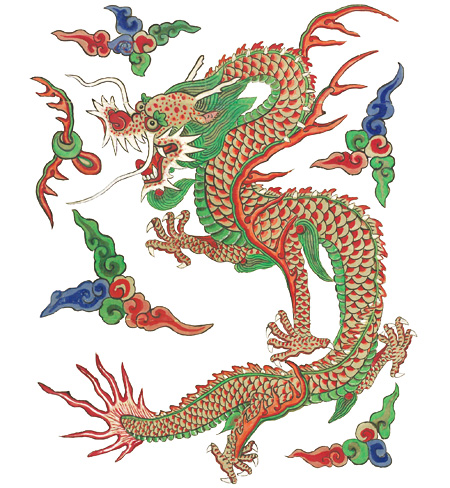
I’ve always found Asian mythology pretty interesting. Their dragons have a different legend associated with them. Dragons in Asian cultures are typically more benevolent and tied with prosperity compared to the horrible beasts of Europe. The Korean dragon is different as it is more of a chimera of animal characteristics, with the eyes, teeth, ears, and such from particular animals.
I haven’t really tried out an Asian-themed D&D campaign. I might try doing that sometime. It might make for a very different break from the typical medieval structure of most fantasy games. Demons are particularly common as well as evil spirits, so that might be a nice focus for an evil villain group aside from the regular orcs and goblins.
True Asian dragons might be difficult though. But I’ve been thinking their alignment might be towards particular races or even the fey. Korean dragons commonly have strong roots with agricultural spirits. So while they are not evil, they might be a problem for players serving as a powerful ally for other races. I’ll have to think about that and maybe dip my toe into an Asian-themed campaign in the future.
Expeditions of Amazing Adventure: The silent spirits of Solemoore Woods
North, skirting the borders of the icy tundra plains, are vast tracks of woods. The eastern region of the many forests is known as Solemoore. A handful of villages are nestled about the edges of this grand wood, many filled with adept ice fishermen and trappers. Lumber is another major source as a trade good for these communities, where stout men carefully remove aged timbers from the forest and send cut logs down the lone frigid river that snakes through Solemoore.
Well over a century and a half ago, the dark cleric, Nergahar, had been a scourge to the land. Driven by a frenzied, forgotten god of old, he committed all manners of atrocities as dark rituals. His sole purpose was to open a rift into the Nether and draw out an aspect of his foul god, a nameless creature of ancient evil from the Astral wastes. His mad intention was to bring such an aberrant force of destruction into the world in order to lay waste to mankind.
Some claim that he succeeded in his dark task, but it was himself that become fodder to the evil creature that spilled forth and receded back into the Nether. Others claim that the Nether opened for an instant, utterly destroying the mind of Nergahar, and he wandered the woods as a gibbering hermit until his death. Some even claim that the very ritual that destroyed Nergahar, was altered and refined by the necromancer, Al’Khameed, and this wielder of the black arts inflicted this foul magic onto the lands of Kymoria.

None really know what was the cause of the curse within Solemoore Woods, save that the bleak forest is now pocked with spirits of the dead. Silent apparitions can sometimes been seen drifting among the thick trees. No birds fly through the woods and the pines do not whisper with gentle swaying of branches when cold winds blow. There is an unearthly stillness in the forest. A continual gloom of thick clouds carpet the still landscape, with a reprieve of clear skies only coming once or twice a month.
Few woodland creatures can be found in Solemoore now and most seem stricken with the toll of constant fear. Most deer and other game have patches of grey fur and the very young are an infrequent sight. Moving through the woods at times can be maddening, as if everything in the wood had become muted and ever silent. Sound seems to dampen off into nothingness. A fine mist covers the forest, making navigation through the woods a treacherous task, with even the most seasoned trackers known to lose their bearings.
It is these unusual characteristics that have also made Solemoore woods a haven for bandits. Those with enough bravado and iron nerve have been known to keep camps deep within the woods. They are able to strike at passing caravans and raid villages with some impunity, as they know efforts to track them will be hampered by the silent woods. Such groups of bandits do occasionally vanish though, swallowed up by the tomb-like quiet of the woods. Only a lone member might be seen, stumbling from the woods with hair white as snow and eyes wide with a look of utter terror. They incoherently mumble of lost spirits calling their companions into the black maw.
Despite this occasional dark fate of bandit gangs, their continual presence can be difficult for some communities in Solemoore. Many a village mayor has offered substantial rewards to an adventuring company willing to track down bandit camps within the woods. Even odder recruitment efforts have come from wizards seeking to know more of the woods and the secrets within.
It is not uncommon that some young wizard, emboldened with a scrap of information taken from an ancient tome, to seek employment of adventurers to join in an exploration of some rumored lost ruin within the silent woods. Typically such expeditions become exercises in frustration as navigation through Solemoore woods is difficult. Many of an adventuring party have stumbled out of the bleak forest after a week, recounting days of traveling in circles and bewildering attempts at orienteering (with many rangers too embarrassed to talk further of the matter).
However, some never return, seemingly swallowed up by the woods. Villagers when pressed will whisper that a scant few parties of brave warriors have entered the woods only to have a lone member drift aimlessly out months later stricken with a form of madness, muttering about the hunger of the forest, the consumption of life, and a dark maw within the woods. The rest of their companions never to be seen again.
WotC rolling out a new edition
I expect various blogs will explode this week with news of a new edition of D&D rolling out sometime next year. Having a larger group of playtesters and getting more feedback from folks I imagine is a solid step in getting an edition out that people will like, I still think there is such a division over 4E and non-4E mechanics it’ll be tough to seal it up.
Pathfinder had to have struck a nerve with suits at Hasbro. Here is this game effectively a version of D&D and selling well enough to either take a major chunk out of 4E sales, or compete with it neck in neck. Somebody had to have been thinking about trying to woo that group back into the WotC fold. I guess a new edition would be a vehicle for that.
Thing is, if 4E rolled out and was like Pathfinder I’d be disappointed. Patherfinder seems like a fun game. I just think it’s just a step too close to 3.5, tweaked a bit but nothing really innovative. I’m certain for many that is just fine, however I think a more dramatic change to certain mechanics was a step in the right direction.
There are a lot of good things about 4E and a fair amount of problems. I don’t want to bring out a laundry list right now. As many folks might clamor about how awful 4E is, and are eager to bring D&D back to earlier editions, however you still have people that like 4E. I just wonder how a new edition is going to get these different camps under the same tent. I expect a very modular rule system that is light and heavily arbitrated by the DM by default, with increasing rules and complexity as optional rules.
One thing I do expect, a game that isn’t so dependant on a battlegrid (or a least rules that can drop it more easily). While I like the tactical play of combats, I do think it’s a limitation for getting people into the game. You really need a lot of ‘stuff’ on hand to run a game. Again, while folks can wing it and play without miniatures having some more concrete rules would help tons with new players. So I expect miniatures and a grid will still be around, but either be an option or less tabletop intensive alternate rules will be available.
If anything, at least I’ll have plenty to blog about over the next year.
 Geek Ken