Category: 4e DnD
The long campaign
I’ve looked over my adventure log and realized that our homebrew campaign of Terrene has gone on for over a year now. Most of my campaigns have gone on for 4-6 months. Granted I think when I was younger I could get a near weekly game in. Right now I try to run our D&D game every other week, and a handful of times we’ve only managed to get something going once a month.
Still it has been a long time. The group is currently level 5. I think I dragged out the leveling curve a bit when it all started. Most were new to the game (or new to 4ED), so I wanted players to have a bit of time to understand the mechanics of the game and their potential. Since then I’ve noticed the group is really getting some synergy in combats, and all of their characters have grown a lot, fleshing out their motivations and backgrounds more.
To be fair I’ve also run a sandbox game of sorts. There is an overarching story, but at the beginning I always gave the players an option B. So at a potential plot crossroads they could always stick to the main story and tackle the next objective, or run off and do the second option. Granted I do drop in some small elements to build on the main campaign plot, but most of the time it was a designed as a diversion for the main story. I think the players like this, as they have some direction but still have some opportunities to explore the world. The downside is that it can drag things out a bit for the main story of the campaign.
As things have gone on, I think the group is ready to try something different. As for myself, I’ve found Terrene is losing its luster. I’m ready for a change of scenery and want to run a different campaign. I’ve been chomping at the bit to run a Dark Sun campaign, but I think my group is leaning towards Eberron. I’ve stolen a lot of ideas from that setting for the current game, but I might explore the idea of subterfuge among the dragonmarked houses.
No mater what I’ve decided I’m going to stick to a shorter campaign run. I’m also considering throwing off the idea of a major story arc all together. I’m thinking instead of running a sandbox type of game, with the main objective of the group being to raise their status within one of the houses (or at least raise the status of their chosen patrons). I think I want to try and narrow down the scale and work on the PCs backgrounds also.
I really want to explore the concept of making the player’s backstories fodder for adventures. I’m sort of going down this road now, and I think it’ll help add some closure to the campaign if some of these issues are resolved. When starting this new campaign, I think I’ll require something meaty from every player.
So I am curious do folks run a longer game? If so what has make you wrap it up? Or are shorter campaigns of 4-6 months something more people like?
Obsidian Portal – An essential campaign tool
I’ve gushed about Obsidian Portal before. It is a fantastic tool to keep your campaign organized and share information with your players. I particularly like that I can parse out information that is public and have other parts that are for the DM only. I have to say that there is a lot of functionality for free accounts too. There are definite advantages to subscribing to Obsidian Portal, but I like that the folks operating it haven’t hamstrung a lot of features for free users too.
Since I’ve been using it a while I thought I’d pass on a few basic tips for maintaining your campaign:
Start small – Don’t get carried away when you begin your campaign write up. Keep your topics and links down to 3-4 sentences. It’s a tool mostly for you as a DM, so use it as such. Initially having pages and pages of history, and page long descriptions of every location might sound cool, but in the end you are making a lot of work for yourself. Keep it a framework and slowly add the details you need.
Keep an adventure log – One of the best features Obsidian Portal, it’s a great tool to keep track of your campaign. Just get into the habit and update it regularly 1-2 days after your latest game session. You don’t need to write down every nuanced NPC conversation or detail every combat. Just try to cover the highlights of the session.
The adventure log is a really wonderful tool. It helps chronicle major events in the campaign. Best of all, players can access it to refresh their memories which is ideal if some players have dropped out of being a regular at the table. You can email a link of the last session before your game night, and then players can easily get a recap of the past session. Best of all, you don’t have to saddle 1-2 players in keeping a log book of all the important NPCs and locations, everything can be accessed in the adventure log.
Note the important stuff – Don’t get bogged down with every NPC the players come across. Don’t write out a description of every location the group went to. Just note the bare bones and let the campaign grow. Likely you give a lot of detail and description while you are running your game. It works giving the captain of the guard, the shady bartender, and the cankerous priest names during your game. But don’t think those details have to ever need to see the light of day in campaign writeup.
Another important point is once you’ve committed to putting it in the campaign log, you’ve made it part of your world. Keeping things to just the important bits helps prevent you from having problems with continuity. It also helps in making things flexible in your world. Just having the highlights of a particular region allows you to fill in details later if needed, and allows you to switch out characteristics if the story leads that way.
Don’t be afraid to metagame – Especially for the adventure log, there is nothing wrong with listing the exp and treasure gained after a session. Not everything being written needs to be a narrative tale of events. The DM section of pages is also a great use for this. Don’t be afraid to put in those notes to help you with organizing and planning future sessions.
Use a map – I’ve found it immensely useful to give the players a map so they get a better grasp of the world they are running through. If anything, it can spark their imagination and lure them into traveling to some far off location. Obsidian Portal also has a feature to allow you to link webpages to your campaign map. If the players want to know the significance to the Keep of the Eastern Pass, they can click on the map link and be taken right to the proper page. It’s a great tool.
Get your players involved – This is a great way to have your players contribute to the campaign world. Get your players to add some detail about certain regions or historical topics. Another great thing to get their input in is with the adventure log. Rotate the duty and have each player be responsible for providing a chronicle of the past session. Don’t hesitate to allow your players to add to the campaign world.
Use it as a reference – Sometimes it’s hard to keep all the details straight of past events, or try and remember the highlights of a historical timeline. Obsidian Portal is great for a reference to your campaign world. However, try to try to keep it streamlined. I fell into the trap of having a bit too much detail when I started it up. As I kept up on my campaign, I began to keep simpler details and recognize it was there to help me with keeping particular ‘facts’ of the game world straight, but it didn’t have to be some encyclopedic tome of the land.
Don’t expect the players to read it – In the end, Obsidian Portal is a tool to keep your campaign organized. Don’t expect your players to use it much. Approach it more as a tool to help you as a DM for your game. Some of my players love the campaign site. They like being able to understand certain political factions and found the adventure log especially helpful. Others really could not care less about it. Don’t get into a tiff if your players don’t read what you put up. Concentrate more on making Obsidian Portal work for you and help organize the game you DM.
Randomizing the threat for attacks of opportunity
I like the idea of attacks of opportunity. It encourages players to position themselves in support of each other, and form up ranks to protect more fragile party members. However, I’ve been seeing in our games it’s becoming sort of a drag on combat.
I’ve noticed at times my players agonize a bit whether to move a particular route due to the threat of attacks of opportunity. This also drags the group’s sorcerer and bow-wielding rogue into action paralysis, as they struggle over deciding to fire off an attack or suffer the wrath of that orc standing toe to toe with them. I really want to encourage movement over the battlefield. 4E seems to really thrive on that. Yet, I’m finding the threat of attacks of opportunity starting to impede the maneuvering of the PCs.
I decided I needed to throw in a random chance if an attack would happen. Overall it would cut down the probability a player would get hurt, and still be a possible threat. This way, there was a chance a player could get hit running across the room, but not saddle them down with having to decide some precise dance of moving square to square in order to avoid a single attack. I work out my house rule as follows:
Roll a D4 – A player provokes a possible attack of opportunity as per the rules. Instead of it automatically happening I roll a 4-sided die. On a roll of 1-2 the player suffers an attack of opportunity and I make a basic attack rolling to hit verses their AC as normal. Otherwise, they don’t provoke an attack of opportunity and get to continue on with their action.
Chance of attacks increase – Each time a player potentially provokes an attack during their action, I increase the chance by 1 and this is cumulative. So if a player charges by two gnolls (possibly provoking an attack from each) the first roll is a 1-2 on a D4, the second would be a 1-3 on a D4.
Third chance and you’re attacked – If the player manages to provoke another attack of opportunity a 3rd time during a turn, I don’t bother rolling to see if it happens. The PC provokes an attack of opportunity as normal.
This works for the baddies too – This also goes for monsters, so everyone is using the same rules. Any time an attack of opportunity might happen, I have the players roll to see if they’ve got a chance to make a swing. I’m still playing around with this. I like the idea of balance (what is good for the players is good for the monsters too), but it can also put a wrench in the player’s tactics.
Some builds and powers take advantage of attacks of opportunity. Having that now a random chance might not go over well with some groups. Also while it will make fights more dynamic with movement, taking away that that edge of potential attacks for the players might mean fights drag out (less attacks of opportunity mean the monsters stay on their feet longer).
So far though this has worked great with my group. Assuming a normal melee attack vs AC would hit half the time, throwing this random chance of an opportunity attack means a player actually taking damage from a hit would be about 25%. This scales up slightly if the player keeps provoking attacks of opportunity, until the point the turn plays out as per the rules.
This means a player can take a gamble and possibly tempt an attack doing a desperate action. If they rush headlong into danger however, the odds stack up against them. Also there is still a fair chance an attack of opportunity will occur, it doesn’t eliminate it. So shifting is still a tactical option.
As I mentioned my players have been enjoying this tweak. It’s just enough to allow them a little breathing room if they provoke a single attack. In turn they’ve begun to make bolder actions in combat, something I want to encourage. I’d be interested if folks have changed how they run attacks of opportunity in their game.
Thoughts: Neverwinter Campaign Setting
I managed to pick up the new campaign setting out from WotC while on holiday and I think I will echo what many have said, this is an amazing book. It’s chock full of story hooks and adventure ideas all squeezed into a pretty small landscape within the Forgotten Realms. There is a lot going on here in the book and I think WotC has really set the bar high for other campaign books to follow.
Themes – Aside from the nuts and bolts of the setting and locales, I really like the inclusion of character themes. Immediately players have an option to include something in their background that can align them with particular factions in Neverwinter, and give them some motivation or goals. For the DM, they immediately can have some hooks and adventure ideas to reel in the players. I could easily see the first session being folks just rolling up their characters, seeing what themes they might pick up, brainstorming their background a bit, and giving the DM a checklist of ideas to take the campaign off in a certain direction. It really has the potential to effortlessly mesh the main adventure story with the characters.
Heroic Tier – Looks like WotC has been digging through the character builder a bit and come to realize that people like the heroic tier. Some might consider it limiting, but I think it was a great decision to put a cap on the expected levels for the region. I think it gives the DM a broad assortment of villains, movers, and shakers in Neverwinter and allow for a lot of possibilities right from the start. Honestly I like heroic tier. I’ve yet to dabble much in the paragon tier (and haven’t even tried epic). It just seems that the high end of PC levels makes for a very different type of D&D game, with truly epic threats becoming a bit too large in scale for me. Clawing up through the heroic tier seems more manageable and engaging.
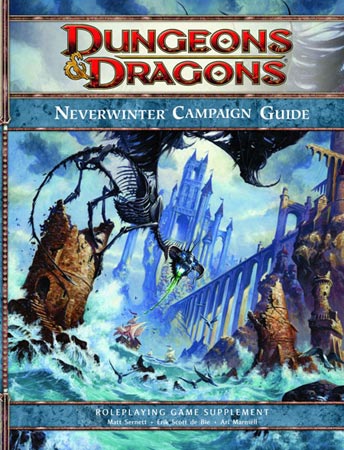
Lots of Tidbit Info – Much of the book is scattered with sidebars giving more detail and ideas to the DM. It breaks up the main text well and is a great way to disperse some story ideas without overwhelming the DM. Clearly outlying the goals of a particular villain is a given, but having that additional sidebar on the same page giving suggestions and ideas for adventures is a huge plus.
Politics and Factions – There are a lot of different groups vying for power in Neverwinter and the book does a pretty decent job of laying out the different relationships each has with other groups. There are a lot of options with the potential of enemies becoming allies for PCs (and vice versa). It’s a shame something like this wasn’t done with the other campaign settings. It really gives the DM a foothold in the politics of the region and allows options for that kind of game. Of course all of this could be skipped if you wanted a traditional hack and slash campaign, but it’s nice to have this type accessible.
Another thing I enjoy is that much of Neverwinter is dynamic. There are guidelines for the DM if certain groups take control (or if particular villains get defeated), so the landscape of power can change. There are also a ton of different groups in the region. So much so, you could run 2-3 different campaigns focused on different factions, and still have a lot of territory to explore. I could easily see a dual campaign going with different groups running simultaneously in Neverwinter. Paths might cross and outcomes could have an effect on the story for other groups, but you could also have such intersections a rare event. Things are that broad with the factions in the region and it allows for a lot of replay.
Embracing Wild Fantasy The underdark, demons, abysmal creatures, and the Shadowfell, it’s all here. You can have that gritty explore the ruins and tame the wilds kind of campaign, but it also allows for some pretty unusual locales. I especially enjoy the inclusion of Evernight, effectively a shadow version of Neverwinter, which throws down the framework for a planar campaign. Pretty fun stuff here and I’m glad that the book gives out a ton of ideas breaking away from the more traditional fantasy themes of past books.
Revisiting Forgotten Realms – I think Forgotten Realms as a 4E campaign setting sort of got a bad rap. Granted a lot of the canon of previous editions was thrown under the bus, but I got what WotC was going for with the new Forgotten Realms. They really wanted to push the points of light theme and it works.
Still, it seemed that each additional campaign setting that came out got better and better in presentation and material. Forgotten Realms seemed to have been kicked to the curb. That’s really a shame as there’s a lot of flavor with the underdark, spellplague, and constant demon incursions. As a high fantasy setting, it invokes a lot of imagination and seems to pull the right strings for making a ‘classic’ D&D campaign. I’m happy to see WotC hasn’t abandoned this setting completely. Hopefully they’ll look at sketching out more regions and groups through DDI content and other books.
To wrap up, I think the Neverwinter Campaign Setting is a great book, especially if you are looking at delving into a Forgotten Realms campaign. There is a lot here, and a DM should expect not to try and digest the whole thing from the start. Rather, I feel it is better to work with small pieces of the game world and run with it. There are so many options and ideas, you can easily revisit Neverwinter and run a different campaign all together the second time around. A good buy if you are looking for some inspiration in your game too.
The long and winding road of 4E skill checks
Since 4E has been released there has been quite a few changes with target values of skill difficulty classes (DC). This is something I’ve complained about before and I’m surprised that such a fundamental aspect of the game has changed so much since its release. I realize a lot will say this doesn’t affect how a group plays, that the DM can just adjudicate things and run the game they want. All true.
However having a standard, or ‘official’, set of rules for skill checks and skill challenges is important. It gives a lot of insight into what is expected as a reasonable challenge, and what should be a good yardstick for a DM to use in their own games. More importantly, if gives a lot of guidance to new DMs that might not have a lot of experience or knowledge of other RPG systems to draw from.
Lastly, I feel most players appreciate a system that has rules and is predictable. While good players realize at times a DM might need to herd the story in a direction, meaning some attempts at a skill would always fail. If things are too fluid and appear simply at the DM’s whim, players can get frustrated as they feel have no real influence on feats of skill.
Looking at 4E skill difficulty classes when it was released, easy, moderate, and difficult checks were set at values of 10, 15, and 20, respectively. These increased with the player’s level, but in effect relatively stayed the same as 4E introduced the idea of a constant modifier of +½ a characters level for just about everything from defences, attack rolls, and also for skill checks. Interestingly, there was an additional +5 modifier to all skill check DCs (DMG pg. 42), but was dropped in an errata.
When the DMG2 rolled around the DC values were dropped significantly to 5, 10, and 15, for an easy, moderate, or difficult check, respectively. This was a big change and really opened up how effective skill training (along ability modifiers) could be in skill challenges. Likely it was too lenient a bar as the latest iteration of the rules and skill DCs are now higher, almost to what they were with the initial release of the 4E rules.
Now for a level 1 character the DC values for easy to difficult check range from 8, 12, and 19. Further, where the older versions of the rules increased DCs every three levels, this new version increased with every level. Also, the easy DC values scale up a little less compared to moderate and difficult DCs.
These changes give some important ideas on how skill checks should be implemented and what a DM might consider when working with skill challenges.
Failure is always a possibility – Right off an 8 is needed to pass and easy DC check. Even with the appropriate skill training, a character can fail. Add in ability scores, typically with a standard array this would be a +2 or +3 bonus (although +4 is a possibility), and you can usually eek out a success for an easy check. This is an important philosophy with the game. There are no sure things, and PCs should expect to fail if making a check under duress.
Training is not enough – That +5 bonus helps a lot. But if PCs want to really improve their chances, they should expect to tag that training to ability modifiers. This is one aspect I am not too keen on, as it means there is no amount of training a player can undertake to make up for a similar character with innate bonuses from ability scores. However there is a work around of sorts with the last point…
Taking 10 can be the best option at times – Given that characters can fail, and that simply training in a skill alone will not guarantee a success, PCs really need to consider just taking 10. In fact, I’d push that a DM should offer this up as the default for any skill check made by PCs trained in a particular skill. If that streetwise rouge botches a simple check, I’d seriously consider that they came away with a little knowledge of the local comings and goings. I expect that taking 10 is not something a lot of players do. A DM should encourage it, as those non-skill challenge, non-threatening situations, mean that the players can accomplish quite a bit taking this route.
This leads me to an interesting observation with skill DC values, although they are scaled to take in account the player’s level, they really don’t break down more than just being an easy, moderate, or difficult check. Something overlooked (especially when considering making a challenge more difficult) is the level for DCs. I think this is something being explored with ideas floating around of ‘novice’, ‘journeyman’, and ‘master’ levels of knowledge. I expect this might lead to additional modifiers a DM can thrown into skill challenges. If anything, they’d give a DM a better gauge to figure what would be an appropriate challenge in certain situations.
What does this mean for my game? I’m looking at the idea of altering DCs for certain skill challenges taking level into account. As a general idea with combat encounter building, if I run a +4 level encounter I can expect a tough fight. Likewise, if I bump up the DC ‘level’ of a skill challenge by 5, I can expect a tough challenge even if it the complexity is simple.
It’s something to play with, quite possibly expanding the normal -/+ 2 modifier a DM uses to even greater values of -/+ 4 (which is in effect just bumping up skill DC levels). So that lock on the door of a high level mage might not just be a typical difficult DC check, but would bump up even higher taking the NPC’s level into account. I’ll have to tool around with it, but I think incorporating relative level in with DC values might give a more dynamic range of DCs needed for skill checks.
Expeditions of Amazing Adventure: the enigmatic arcane endurium of Estalycia
Far to the north east along the icy coasts of the north sea is Estalycia. A small city that carved itself out of the frigid barren rock long ago. The city is encircled by a windswept tundra and further isolated by the Whitepeak mountains.
For centuries this settlement was known for its fishermen and stoneworkers, a minor trade partner to the nearby dwarven cities nestled deep within the surrounding mountain range. The city managed to maintain a lifeline to other regions outside through their adept command of the seas, and merchants from this far off city have been known in the past to aggressively purchase wares from other ports to the south.
However, Estalycia’s role in the world has changed in the past two decades. Out in the tundra, adventurous prospectors came across a large field of strange ore. The dull green metal was malleable and oddly light. After extensive study, several wizards found that the metal could be enchanted and would retain simple magical energies for years. Fragments of this rare element could be infused to provide ever-burning lamps. Other small pieces could be infused with other ritual energies to give off searing heat, or numbing cold.
The craftsmen of this rare mineral called it, Endurium, named for its astounding ability to retain energy. Such amazing properties of this metal have allowed Estalycia to transport fresh catches of seafoods even further to other cities. Lampworks were created overnight, with the demand of their ever-burning lights being a prize possession for nobility and other citizens of status outside Estalycia.

Another wondrous property of endurium is that fist-sized chunks of this strange ore serves as a means to store vast amounts of motion energy. Such energies have served as perpetual engines, operating great lifts and ever-turning wheels that could drive large ships, or wheeled cart caravans. This advancement has even rivaled the ingenious dwarves and their clockwork automatons.
No one is sure how this metal came about. Some claim an ancient star must have struck the world. Others claim it is a patch of earth that was saturated in the blood of titans and demons during some long forgotten war. Nonetheless, this small etch of mineral has been a boon to Estalycia.
The city now has streets lined with smokeless lamps. The normally frigid homes have become comfortable residences with warmed floors heated by enduruim laced water pipes. The precarious coastal stone quarries hold several automated lifts, and its navy has begun to outfit many vessels with waterwheels that can continually churn the salty waters without the need of sails.
It is the inhospitable location and the natural barriers of the Whitepeak mountains that have allowed Estalycia to maintain their hold on the nearby endurium mines. Other more accessible cities would have likely been invaded by neighboring kingdoms. To this day, many whisper that the great dwarven clans would have taken these mines by force if they were not continually harassed by orcs and goblins. Although many more learned tacticians of war would claim the long trek across the icy tundra would be a difficult task for any army, even the stout dwarves.
As the prominence of Estalycia has grown over the decades, the city inhabitants have become even more cosmopolitan. It has become a very popular region for arcane practitioners to settle and conduct their mysterious research. The increase of endurium powered carts and ships have meant more trade, and now it is several merchants from far off regions that seek to enter the broadening markets of Estalycia. Many seek to obtain simple arcane infused goods, energized by fragments of the strange metal. Yet the most coveted good is endurium itself. The sale of the raw metal is severely restricted, and well over a king’s ransom for a large piece.
However many aspiring thieves have tried their mettle in obtaining samples of the enigmatic ore through dishonest means. More brutal ruffians have sought to strike out at the mines themselves. It is a near constant effort that one can usually find employment by local merchants and Estalycian military to stave off any attempts to steal endurium. Likewise, one could likely find a more dishonest benefactor to fund an attempt to gain a large hold of the metal.
A few more reserved opinions with an ear for politics claim that the great dwarven clans of the region seek to control all the sources of endurium. It is a matter of time before a clan attempts to take these fields of strange metal by force. However it is unlikely that one clan alone could do this, and such a prize would make other clans greatly envious. As this arcane element is so rare, there is no possible way all the neighboring clans could benefit from a small group possessing the mines. Hence many well versed in the dwarven kingdoms claim that several noblemen spend many of a long night, drinking ale, thoughtfully pulling on their long beards, pouring over maps and plans to determine how they could obtain this treasure of Estalycia, and still be able to retain it from opposing dwarven clans.
The problem with using virtual tabletops for D&D
I’m certain that WotC’s virtual table top will be getting released in the near future. I’m also certain you’ll get some interesting products for RPGs on the horizon as certain technologies becomes more attainable for the public. With more people getting regular access to wi-fi and smaller, more portable, computing devices, you’ll likely be seeing a demand for RPGs to work in a digital format. I expect that future incarnations of D&D will be going in that direction.
However my last game session made me realize there is a kink in this future digital format of D&D. As the pic shows, you’ve seen this slow expansion of tokens, cards, and other paraphernalia at the table (not to mention the ever present dice). Long ago I adopted using cards for player powers and magic items. I also started using tokens for action points and a means to mark combat conditions.

I think there has been a general shift in the gaming hobby from having very spartan and abstract way of handling player resources, to utilizing tokens, markers, and other items represented by physical objects. This is seen in other RPGs like the use of bennies in Savage Worlds, or fate points and I’m not surprised that has D&D followed suit.
While you can certainly keep track of everything on a sheet of paper, I think there is a stronger impulse to have some type of physical marker. There is something about having that visual and tactile representation of a game resource that seems more pleasing to players. It’s like a way of reminding the player, ‘Hey, don’t forget about me. You’ve got this handy tool to help out with this obstacle.’ Likewise, for D&D it can be a reminder that something bad is currently happening to your player that you need to shake off. You can record all of this on your character sheet, but I think we prefer having some other way to keeping track of this stuff.
This is something that the board game industry has definitely picked up over the years and have implemented in their game design. I expect that improvement and reduction of costs in manufacturing of plastics, distribution, and online marketing has a lot to do with it. However, I’ve noticed a trend in many games getting more physical bits and pieces in games. Sure you could keep track of victory points on a sheet of paper, however I’ve noticed a trend that most games implement some kind of marker or token instead. While I think years ago this might have been a feature for board games, it seems that now this is something that is required. I really feel that customers have grown to expect something like this when they purchase a game.
Where does that leave this with digital versions of RPGs? I dare say that is going to be a problem. Virtual tabletop RPGs are going to need to include features that allows players to manipulate some type of tokens. While you won’t be physically handling a bloodied marker, I can see a DM pulling a bloodied marker out of a menu and dragging it to a PC’s icon. In turn that player might see a new ‘token’ on their character sheet in their iPad. Removing the bloodied condition might mean the character passes that token icon back to the DM, simply dragging it off their sheet. Likewise, I can see player powers and abilities working like virtual cards, that ‘flip’ when used.
There is an alternative to this. That is to simply keep everything automated with minimal record keeping. A player might just click on their virtual miniature and see the range in squares they can move. Click on a power, click on a monster to attack, hit a button and all the damage and status effects are kept track of automatically. The new facebook game Heroes of Neverwinter looks like it might be going that route.

However, managing some game mechanics manually is needed to help reinforce that interaction around the table (subtracting hit points might be the exception). Otherwise I think games will slip into being too passive. I feel you’ll likely end up with people shutting down during fights, slipping into some automated mode where you click a few menu options and crank through combat.
So I believe that will be the challenge for D&D as it becomes a virtual product. Programmers and game designers likely will have to figure a way out to keep resource management that is handled through some type of ‘tokens’ that pass between players. Sure you could bypass it all and keep track of everything automatically, but you risk making the play experience too much of a passive experience, or at the very least reducing that interaction you get sitting around the table.
July Blog Roll
So every once in a while I like to share some of the blogs I’ve been looking at over the past few months. While not all of them are about 4E, they’ve got something to offer your game.
Points of Light – While some of the writers use some adult language I think isn’t necessary, I’ve enjoyed this blog for several years now. They offer a very 4E-centric blog that keeps up on a lot of the new WotC content. Now that I’ve let my DDI subscription lapse, I’ve been definitely frequenting this blog more. I’ve enjoyed their analysis of new character options that roll out in Dragon.
The Id DM – A relative newcomer to the D&D blogging scene that has gathered a large following pretty quickly. The Id DM offers some really interesting analysis and thoughts on the dynamics of groups and the game in general. I particularly liked his breakdown of the Penny Arcade/PvP D&D podcasts, that provided a solid look at how much time combats take and how that time is spent.
A Character For Every Game – While not a 4E-centric blog, this guy does cover a lot of ground for the fantasy RPG. He offers some interesting articles on RPGs in general but lately I’ve been cruising his blog more for map posts. This guy offers some maps of really neat dungeons that have certainly sparked my DM imagination. Well worth checking out.
I hope folks enjoy the links. Please do give them a gander.
Get out and game, and buy something too.
Newbie DM has recently lamented about local bookstores becoming a thing of the past. Sadly, I think we are at a huge transition with the written media. When kindle and book readers came out in the market, I really didn’t think they reached that great of an audience. Now with the advent of tablets and the iPad, I think that customer base for digital books has exploded. I really feel in another 5 years, you are going to see most kids coming out of high school with a preference for books in a digital format. It is simply something they are used to working with and familiar. It’s going to happen.
What does this say about games? I’ve got some thoughts on that to fold into another post. However there is something I’ve touched on before and I think worth mentioning again. If you have a local gaming store, and they offer a means to get folks together and play games, throw them some business. Occasionally step up and actually buy something from their shelves.
Years ago I was at a small bookstore/game shop participating in a 40K demo (way back with 3rd edition). I along with a few other guys were fans of the game and were offering to a public play event in the store and help get some folks excited about playing. As far as I was concerned, the shop got business, and we got some new blood stepping into the local play scene. It was win-win for me.
There was a new person that gotten a great interest in playing. He started asking about how to get started and what should he pick up. Quietly one of the guys running the demo took him aside and said he should pick up his stuff online from website X. They offered discount deals below retail that you could get at the local store.
Now this is a hobby, and I can understand trying to get the best deal you can sometimes (GW stuff can be an expensive hobby to pick up), however I was rather floored by this. Okay maybe the bulk of your army get someplace else, but at least suggest getting the rules and a squad or two (not to mention paints and other supplies) right off the shelves in the store. Nope, he was adamant that the guy get stuff online at a cheaper price.
Mr. Cheapo failed to realize that without us playing in the store, we’d likely never have gotten this guy interested in 40K in the first place. Here was a person ready to jump into the hobby. In a month or so, we could have been seeing a new face around every few Saturday afternoons, with a new army in tow, anxious to play. A new guy to play and a new customer for the store, win-win. Mr. Cheapo just didn’t see the big picture here.
So don’t be that guy. If you frequent a game shop and they offer a friendly place for the local game community to hang out, give them some business. I get saving money and making your gaming purchases frugal. But once in a while, stop by that local game shop and buy something. Without them you’ll likely find it a tough time meeting new gamers.
Oh and after a few years, that bookstore dumped it’s gaming stock. Just wasn’t profitable to dedicate space for merchandise that wasn’t selling.
4E combat isn’t a melee, it’s an event
When I started DMing 4E, it took me a little time to work out thinking up combat encounters. Some worked out well, while others dragged on, or others just weren’t that exciting. Technically, I could sit there and get an encounter together with the proper XP budget. However at times things were a little off.
I typically planned out too many fights, and would fail to realize that while some combats looked brief on paper, might drag out in real play. Other times, I’d forget the context of an encounter in relation with others designing a dungeon. While I would think the fight might be challenging, the PCs managed to bypass certain encounters and traps, having a lot more in-game resources to throw at that baddie for the final epic fight. In turn, the players sometimes just rolled over the opposition for something I thought might be a climatic battle (no harm as I think once in a while it’s great when PCs totally kickass in a fight).
It dawned on me that I was still planning out combats like I used to when I was DMing AD&D. Players would hack through a fight in 15-30 minutes, do a little exploration, and roll into another battle. Fights were in general vicious bouts of die-rolling that ended in a brutal, quick fashion. I tended to think about adventures as the PCs hitting group A (logically placed as initial ‘guards’), then on to group B (that would be lounging away in some kind of ‘barracks’), followed by group C (more guards for some important area), etc.
I initially failed to realize that small change in 4E game philosophy. I would sit down and plan something like, ‘Okay, the players tear through this group of gang dockworkers. They beat them all, then find a clue through interrogation (or some other means) about the underworld chief that is running the docks.’ In previous editions this could be a very throwaway fight. But if I sat down and made a level appropriate encounter for 4E, it could potentially mushroom into a larger event around the game table.
What clicked in my head was that 4E fights worked well when they were these grand, cinematic, action-packed scenes. Duking it out on open ground just made for a boring fight. The monsters were made for trading blows with the PCs. If I wanted a quick, knock-down brawl, I had to be ready for a combat to take more time.
So I had to readjust how I planned out my fights. I found I should have less fights in 4E and concentrate more on making them engaging and exciting. I could still have that simple fight, but I needed to think of other ways to run it aside from planning out a typical encounter as per the DMG. So some quick points I’ve used are:
Make fights memorable – If the group is going to fight, make it important and interesting. Consider using hazardous terrain, split levels, and think about the opposition you place down. Heading off against 5 soldier types of the same monster will make for an uninteresting fight. Try to mix it up with some minions and another role (just try not to go overboard and be sure to run a mix you are comfortable DMing with).
Consider the fluff also. Having players fight along the edge of a huge chasm can be a lot more evocative than having them duke it out in another nameless dungeon room. List off some trappings in the area and be ready to roll with it if a player wants to utilize something for combat. If you are describing a dingy barracks with piles of fur and refuse scattered around a large cauldron with some foul stew simmering in it, be ready for that one player wanting to knock over the cauldron towards some baddies. Allow that wizard to maybe get one additional square of area covered if they put up a wall of fire near the piles of furs on the floor. In short, provide some details and let the PCs play with them if needed.
I think another key point is to help create movement in your battles. You really need to encourage players to move around. Either through traps and hazards, or forcing the players to move up and engage certain targets. Oddly, while sticking together in a group within a hallway might be an excellent way to deal with a melee combat might make for an excellent tactic in a real world situation, it makes for a very boring fight in 4E. D&D is a game of heroic fantasy, push the players to move around and have a dynamic fight.
40 minute fight time – If the fight is not a critical story element (such as a final epic battle against the main villain), make 40 minutes your goal time for the encounter. At the the half hour mark, I start wrapping up the combat. Either I make the monsters flee, surrender, or secretly crit (or double) all PC damage. A great indicator for you as a DM is to look at the powers your players are using. If most have used their encounter powers and are continually using at will attacks, likely it is time to wrap up the combat.
If your players are familiar with their powers and roles, typically I find that 40 minutes becomes the make or break time for keeping their interest. By that time, they have pretty much done all the cool things they can do, maneuvered around a bit, gotten the tactics of the fight. Usually at the tail end of a combat, things are pretty much on autopilot as much of the encounter powers and daily powers have been used. If they get into a rut of doing the same actions repeatedly, it is time to move on.
Consider abstract combats – If it is appropriate storywise that the players fight a series of engagements, I’d consider using some other way narrating combats. One thing I’ve liked is having monsters make a basic attack against all the players, taking a healing surge if they hit. If I want to make this more engaging, I have the players all make an attack of their choice to set the bonus and targeted defense (at will, encounter, or daily). If less than half the players hit, the monsters get 2 rounds to roll attacks, otherwise they only get one.
The result is that the players get a healing surge knocked off (or possibly two). I can narrate their progress, and get through a few ‘battles’ if needed. Sometimes this makes sense, like the PCs storming a guarded tower. They likely have a few groups of guards to go through. I might play out the first fight making it very easy (just so they have some experience fighting the typical monsters in the place), and narrate any other remaining fights. I save that last big battle for the main bad guy at the end where you want to pull out the map and have a huge combat.
Use, and retool, the minion – Use minions, use them a lot, and don’t shy off using them exclusively for quick battles. If you really want them to give a little lasting power, consider giving them a death save (an idea stolen from someone else). If a player hits, roll a D20 with a 10 or more meaning the creature is still on his feet. If the same minion passes 2-3 saves, consider just dropping it on the next hit. Some folks use 2 hit minions also. Just don’t be afraid to place down minions for a quick fight and be willing to tweak them a bit if you want a more engaging combat. They do a great job allowing the players to quickly run through a fight, and still keep the story rolling.
Out of the box, 4E combat is designed to be engaging and exciting. It’s made to be part of the story, allowing a sweeping battle to be played out with the players making critical decisions on their actions each turn. When you don’t approach fights that way, you end up with a boring melee. Either it turns into a slugfest, with players moving around in a simple area, or it tends to drag on with misses and high monster HP totals. While a simple random encounter in older editions might make for a fun quick battle, it can become a boring, slog of a fight in 4E (especially if not having any interesting terrain).
I think it is interesting that 4E combats by the rules aren’t that dynamic in their implementation. A DM really has to approach them as important events. Conversely, in older editions I think you could make fights either these epic combats or a simple ‘monster crashes out of the underbrush’ type of encounter. 4E just doesn’t seem that flexible, I think you have to tweak the encounter design process to make things more applicable to different game situations. I’d be curious if others found this idea similar in their game, and how they found ways to incorporate simpler fights around the game table.
 Geek Ken