Category: 4e DnD
Working with a hardcopy of WotC errata
I think it is a double edged sword for D&D and the errata that is out there. On one hand, I like that WotC is taking feedback from folks, and continually evaluating some abilities and powers to limit the cheese-factor. On the other hand, at times I get miffed I’ve got books that have been practically gutted with rule changes that have occurred over the years (I’m looking at you PHB). Still, I think WotC has to be commended for trying to address issues with 4E. In a way it puts the burden on the players and whether they want to keep up with the rules. If a DM decides to let things slide, they can. If the DM wants the most up to date incarnation of every build, treasure, and monster, that is an option also.
I’ve spoke before how 4E errata are not that overwhelming but I might have to retract that now. I think for many core player classes there has been a huge change with how many powers and abilities work. If you were running straight out of the original 4E core books, you’d have to give many things a look to make sure they weren’t changed too drastically. Even with the new essentials books, it looks like some things are modified a bit.
I’ve been doing this a while, but I keep everything in a notebook with page protectors. I keep everything sectioned with sticky tabs as dividers. So I can have all the errata for the PHB, PHB2, and PHB3 split for easy reference. Fortunately WotC allows this to be done with printed PDFs as everything is split into major sections depending on the sourcebook, and individual changes are listed page-wise for each book.
I turn around and go back to my original books and highlight any sections or key points in the text to reflect rule updates. So if something in my rule book is highlighted, I can then open my errata notebook, flip to the relevant section, and find the page number entry with the specific rule change. Since a lot of changes deal with character powers and abilities, I typically only need to keep this in mind when PCs are made or when they level up. So it is pretty manageable.
I chide WotC a lot, but I will admit that it is nice they offer errata to folks that don’t have a current DDI subscription. Granted with the compendium and character builder, it has to have these features (I’d be really upset if they weren’t regularly updated). However, it’s nice to give people an offline, hardcopy means of keeping their books updated, even without having access to DDI.
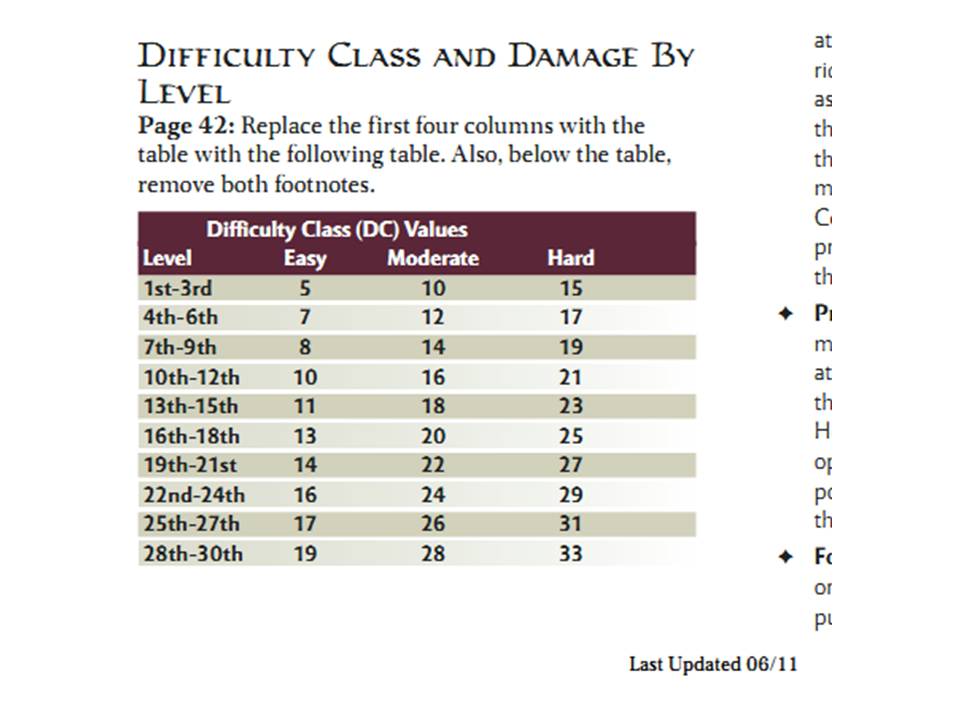
(Oh and WotC, can you please update your errata for skill check values to reflect the new target numbers in the essentials rule book? I think they are still listed as the DMG2 values. kthnxbai…)
Expeditions of Amazing Adventure: The powerful molten metal of the Voc-Khal peaks
Far to the south, past the great deserts, lay the vast mountain ranges the dwarves claim as their homeland. The highest reaches of these ranges are the Voc-Khal peaks. The great heights of these mountains are constantly battered with cold winds, and their stoic caps are frequently covered with snow.
However these inhospitable mountains are also dotted with several volcanos. These turbulent cracks in the surface of the world disgorge molten earth in a constant flow. Legend speaks of the great demon war. Envious of the grand world created by the gods for man, demons broke through the underworld, clawing their way to the surface. They emerged from the planes of beyond though these pocks of lava and fire.
The dwarves claim that to this day, the metal forged from these molten rivers still carry magic of demons and the outer worlds. The blades carry the keenest edge and armor possess the greatest resiliency. They covet the rich veins that border the steams and rivers of flowing lava. Hence, many noble families try to gain greater stature and establish a stronghold within the Vok-Khal peaks.

Such grand endeavors rarely last however. The fiery lands are rife with elemental creatures, twisted forms infused with the mystical energies that flow through the magma streams. They make infrequent raids on any keeps the industrious dwarves carve out of the mountains. It is as if they are driven by an impulse to crush any form of civilization in the peaks, and tear down any erected walls.
It is not only elemental creatures that prowl the Vok-Khal peaks, but also the cruel duergar. They are known to invade and retain holds created by dwarves. Many a dwarven family have sought to reclaim lost keeps from their evil distant kin. However, some dwarves claim that further in the depths of the fiery peaks are vast duergar cities. They had scavenged the cavernous ruins created by the old demons and made them home, further refining the rough hewn tunnels to crafted halls and deviously ingenious forges.
Although dwarven families will rarely admit this due to pride, their numbers are declining. Some still are driven to reclaim lost family holds, and reclaim past glories. This is such a strong desire, they reluctantly will hire out adventurers willing to join them in expeditions to claim lost houses. More more unscrupulous merchants are willing to aid in these risky ventures offering mercenaries. All done in hopes to secure the rights to transport any fine metalworks the dwarves create in these reclaimed holds and forges.
Others state that duergar strongholds deep within the mountains are not just rumors. These wickedly crafty humanoids have established grand forges and intricate fortresses. They covet the mystical ore as much as the dwarves, and create fine metalworks that rival their distant cousins (a claim best spoken out of earshot of any dwarf if one seeks to retain all their teeth). Such rumors are more than enough to inspire those adventurers brave enough to make the treacherous journey to the distant Voc-Khal peaks.
Power2ool – a great 4E tool for DMs and players alike
So I stumbled onto Power2ool that seems to be a wonderful program for 4E. Conceptually, you have a giant cork board where you can place and remove note cards. In addition, these notes come in different formats as blank cards, powers, magic items, and monsters. All the virtual note cards can be edited and the entire workspace is saved under your login id.
The program can also be synced with the DDI compendium. So folks with an active account can port over powers and monster stat blocks. Best of all, you can edit them. So a player could keep all their powers, edit their own ability and enhancement modifiers and have it saved. You level up or gain a new magic weapon? No problem as you can go back and individually change the powers needed. No bothering with going back to the character creator again. Not to mention, you can print out all the items in a section. It’s a snap to get all your powers printed out on a sheet of paper.
Want to keep track of everything digitally? No worries, as you can double click a power and it will gray out indicating it was used. I can see players keeping a simple stat block of their defenses and HP with all their powers organized the way they want to for combats. Best of all, they have different ‘cork boards’ for keeping different characters. How about the built in dice roller function? Very nice indeed.
For DMs I see this as a great tool. They can split up their entire work area under different encounters. Just a single click and they could get all the monster stats, with a few more virtual note cards to add any tactics, descriptions, rewards, or other notes. Move on to the next room and just open up another section of your workspace. Did I mention you can print all this stuff out?
Don’t have a DDI subscription? You can still create custom power cards (or copy down the ones from a book). Want to make up a monster on the fly? Power2ool also has an option to create a level specific generic monster. All the fields will be filled out with the appropriate bonuses to hit, defences, and damage, and every thing can be edited the way you want. For folks that want to create homebrew items and monsters, or get something together for distribution at a con or gaming event, this program is a great resource.
You can browse through a series of video tutorials and demos of its functionality online. It seems very intuitive and pretty easy to manipulate and edit stuff. I have not had a chance to delve too deeply into this, but I think the learning curve for is almost nonexistent. I particularly like the fact that it is server based. No need to have anything loaded on a PC/Mac meaning you could run over to someone’s house and run a game (provided you can jump onto their wifi). Be sure to check this out as it seems to be a great tool for 4E games.
Reconsidering combat fumbles
I never really liked having fumbles in combat. I know some DMs like to have players drop weapons, potentially hit other players, fall down, and all sorts of unfortunate things happen when PCs roll a 1 on their attack. I just don’t like it. It’s sort of kicking a player when they are down. Worse of all, it’s not because of a bad choice or poor decision, they just bumbled a die roll.
I think as a game philosophy, 4E has moved away from this idea. I like that the save or die concept has been dropped. Players have a few chances to turn things around. So the idea of having fumbles in combat seems to go against the grain of 4E.
I do like the idea of critical failures for skill checks. Even with a PC that has spectacular diplomacy training, you could have some noble zoning out and thinking about what wine they should drink with the evening meal, completely ignoring the pleas from that character. I don’t mind that players completely blow skill checks. I usually set them up with a -4 penalty to their following check (and conversely give them bonus if they roll a 20).
I avoid fumbles in combat though. You get a lot of dice being thrown around. Get a group of 5 folks rolling D20s, after a few rounds you can expect that one of them will roll a 1. Another reason I never liked it is that you tend to penalize the player that has multiple attacks. That chance of having a single fumble for the wizard that plops down a burst hitting 4 monsters is going to find it mushrooming from 1 in 20 to nearly 20%.
Still I’m wrestling with doing something with fumbles in combat. It does add a small aspect of chaos in how a combat develops and makes things a little more unpredictable for players. I don’t want some major mishap like a player falling prone, but I am wondering about having some small penalty.
So I’ve settled on taking a cue from the DMG. If a player rolls a natural 1 on their attack, they complete their turn as normal but grant combat advantage until the beginning of their next turn. If a player makes multiple attacks, only the attack roll for the first target is subject to being a fumble, with the rest of the attack rolls ignored if a 1 is rolled (just counts as a miss). That way there is a slight chance a player can get a fumble and it is the same regardless of how many attacks you make.
I see this as a player overswinging, losing their footing, or something else happening that makes them distracted and not able to effectively keep their guard up. Possibly that wizard had a surge of energy that landed a bit too close, distracting them, or they summoned too much energy temporarily making them a bit dizzy.
I’m going to try this out a bit and see how my players feel about it. I think they might welcome a little more randomness in fights, and hopefully not get too worked up about granting combat advantage. So if you have critical fumbles in combat, how do you work them out?
Pathfinder – Inner Sea world guide as a 4E resource
I’ve gone round and round with pathfinder but I think I’m still in the camp for passing on it. At the heart of it is that I’ve got my 3.5 D&D books. I see pathfinder as a refinement of those rules. I think 4E really made changes to how D&D plays and I liked what WotC did. I just don’t see me going back to previous editions and I feel pathfinder goes in that direction.
For a lot of folks, I think pathfinder is a perfect fit for their D&D game. It tweaks and retools the stuff some might have found lacking in earlier D&D editions. I can completely understand the things they love about pathfinder and why it is their D&D game of choice nowadays. It’s just not my thing.
I will however step up and say that Paizo has some wonderful products in the pathfinder line. And I think for people that enjoy fantasy RPGs, you will be doing a disservice to your group if you don’t give some of them a try at your game table. I also feel that a lot of the material (with a little elbow grease) can work for your 4E game. One such product is the pathfinder campaign setting, the Inner Sea world guide (ISWG).
This is the default campaign setting for pathfinder. Don’t let that put you off. If you play any edition of D&D, you simply need to buy this book. It’s a wonderful setting and fleshed out world that is rife with inspiration for a high fantasy campaign.
The book is a meaty tome that gives details on 40+ countries and locations that make up one of the many continents within the world of Golarion. What I particularly like is the digest-size write up of each region. About 3-4 pages are provided listing a brief history, government and politics, along with some details on the major settlements and noteworthy locations in that region. It’s enough to give a DM a grasp of the country along with enough ideas to write up an adventure, without saddling you with pages and pages of fluff, background, and other ‘facts’ that can trip up your story.

The key element I enjoy about ISWG is the variety of the lands given. Humans are the most common and are of a variety of ethnicities and cultures. You have different governments and political ideologies. Some countries are stable, others constantly at war (both civil and external), while others are in a constant cycle of violent revolution with their ruling class. Add to this regions with heavy undead and demon influence, wasted lands devoid of magic, while others seem to be warped with bizarre creatures from a wizard’s imagination, you’ve got a lot on your plate as a DM to choose from.
The sheer variety of campaigns you could run in the ISWG is staggering. Obviously you could have the typical high fantasy world. However if you want a bit of steampunk, a Ravenloft-like setting, fighting in demon lands, or even a touch of Gamma World (one land having a mysterious ‘meteor’ crashing into it’s borders), there are options here for the DM. I think this alone makes for a wonderful product, as you could start your campaign in different regions of the same game world and get very different types of settings.
Making the transition from a pathfinder source book to 4E is not too difficult. Much of the core races are there (halfings, dwarves, gnomes, elves, etc.). I think the pathfinder elves are a bit closer to the 4E eladrin than your typical 4E elf, but I think you have enough room to encompass just about any 4E race into this world. Tieflings could obviously come about from the many demon controlled kingdoms, with goliaths being an easy shoe-in for the northern lands, and drow are all ready within the ISWG lore.
There is a full pantheon listed of the many gods and faiths within the Inner Seas that I think can be tooled around with if needed (particularly with the alignments). The ISWG has information listed in the traditional D&D 9 step alignments but aren’t that difficult to craft into the reduced alignments of 4E. While there is a simple creature bestiary listed, they are primarily based off stock entries in the pathfinder bestiary. Something a 4E DM should adopt, and simply re-skin the many creatures currently in the monster manuals if needed.
The campaign setting specific class options in the ISWG bring about exciting possibilities, especially with WotC’s new heroes of shadow book out. I can envision the Red Mantis easily as an assassin character option, as well as the Hellknights being a step away from a blackguard. I particularly like how the book details certain factions based on a philosophy that encompass more than those just driven by a nationalist agenda.
There is a lot of stuff in this book. It is well organized and I particularly like the sections that help detail normal life of most people within the world, covering mundane aspects of trade, state of current technological achievements, to the role of magic in the world. This book covers a lot, and best of all manages to distill things down to bite-sized chunks of information that can be easily processed.
You don’t need to have a complete grasp of the entire world geo-political layout to play. You can simply pick a land, skim through the neighboring regions, and have a complete historical and political handle (not to mention the major factions) on what is happening in that part of the campaign world. It’s a fantastic 4E resource, gorgeously presented in color with great art, not to mention a nice poster map of the entire place.
Do your group a favor and pick up this book. Even if you aren’t set on running a game in the Inner Seas, you’ll definitely find some ideas for your game.
Will other old WotC RPGs ever get the 4E treatment?
With the complete release of Gamma World wrapped up now, I’ve been wondering if some of the older WotC properties inherited from TSR would get a new edition makeover. I also wonder how well they would mesh with 4E mechanics. Given how 4E has changed since its release and the tweaks made with Gamma World, I think some elements would work really well with a re-skinned version of these older RPGs.

Power Points and Augments – This is a neat mechanic. A base set of powers that can be altered to boost its effect. You don’t need a laundry list of powers for different classes. Having characters with different training could work into the amount of power points they have, or what abilities they could boost. Every character might be able to do a basic attack, but that spy with military training might be able to augment the attack with a couple of power points. With a few power selections, you get a lot of flexibility simply based on the power points used to augment them. Pretty nifty stuff.
A variant to this can be seen in Gamma World with the ability to boost alpha mutations. Again this might be another approach, with a failure being no special effect (rather than something unfortunate for the player), while having the appropriate background skill/training allows a player to get a bonus on altering the power effect. It’s a little more random than power points, but could still make for a fun mechanic.
Equipment Cards – Having a special equipment deck similar to omega tech cards in Gamma World is something I could totally see in Top Secret. Each mission a player draws 1-2 cards from a Q deck. You end up with some nifty gear that can get you out of a tight spot. It’s all cutting edge, prototype equipment, so you likely can’t depend on steady access to the same items. Something like this would be perfect for an espionage game.
Skill Challenges – I still think this is something that is more of a framework, rather than a hard rule set for 4E. But having an element in the game where a DM (or would that be administrator?) has guidelines to work out a non-combat challenge that still awards xp is a nice toolset. I think structured right, an entire adventure could be an extended skill challenge, where incremental successes and failures could be represented by a series of small engagements (or advantages) the players go through. It’s a neat idea that can be tinkered with and I think would work well with other RPGs.
Backgrounds and Themes – Gamma World got away without having any classes. I think Dark Sun showed how well over-arching character themes could work with D&D classes. You don’t need a bounty hunter or prospector class for a Boot Hill reboot, these would work better as character themes. I think this is an idea that definitely would work well, allowing players to get that additional flexibility in character generation without getting saddled with long lists of separate abilities and powers.

DDI Subscription Content – Who said that Boot Hill has to be released as a complete RPG? Maybe it would be better as a series of articles in Dragon? Having some exclusive content via DDI might help keep those subscriptions active. Best of all, WotC could get some feedback on the popularity of the content (based on downloads and forum response), including a bit of play testing. If enough interest is there, maybe you’d eventually see a printed product. Actually having the games as just downloadable content would be a solid approach, as you’re eliminating the costs for printing, warehousing, and distributing a boxed game entirely.
I wonder over the next year if WotC will take a look at other RPGs and give them a 4E reboot. It seems that the D&D brand is spreading out over different products, from board games to comics. It would be nice to see other older games get revisited. Until then, I guess you might have to stick with fan-made content, some of which I think is quite good (like the re-skinning of Star Frontiers over at This is my Game).
New article submission process for Dragon and Dungeon
WotC has announced a new process for submitting articles for publication in Dragon and Dungeon. The skinny of it is that twice a year they are opening up 2 month windows to allow new articles and adventures to be sent in. I like the idea. I think it will allow for a more even flow of content from the magazines. As they stated, it’ll give them a more structured means to get some feedback. I think this will also allow the company to plan out personnel resources and lay out upcoming projects more effectively (I expect you’ll be seeing a few interns at local colleges pulling a semester at WotC to help out with those rejection letters).
I’ve lamented a bit about the lack of content for other WotC games in Dragon and Dungeon, particularly Gamma World. Maybe with this new submission system you can see more stuff geared towards non-D&D games coming out. I do think if Dragon and Dungeon somewhat expanded their coverage to an occasional article or adventure/scenario for Gamma World (or their other board games), there’d be more of an incentive to keep up a DDI subscription.
I’ve heard on podcasts and some blogs some grumbling with how the current system is sort of non-responsive. It’s a given you are rejected unless noted otherwise. You send something in and basically will never get any response until you eventually get an acceptance letter. It is a little wonky. So I’m hoping this new submission process can provide better feedback to folks sending stuff in. I also hope it helps WotC crank out better, and more varied, content for their digital mags.
A new dev studio for Neverwinter Online?
News has leaked out that Atari is looking to sell of Cryptic Studios, the main dev studio for some MMOs (Champions Online and Star Trek Online) and the upcoming 4E version of the D&D Neverwinter series. This makes the fate of the online game a little questionable. In their earnings report, Atari’s business plan seems to be releasing less but more polished games, including moving into the mobile market. However they’re also determined to hang onto their signature licensed stuff including Dungeons and Dragons.
So what is the future for Neverwinter Online? If Cryptic is sold off, will they still be outsourced to develop the game? I wonder if another studio might be the ones to step up and finish off the project. I was mildly interested in the Neverwinter game. It sounded not quite like a full blown open MMO, but a more persistent instanced-based coop game. I have to admit I really would like to see video game treatment of 4E D&D. But it looks a little questionable how Neverwinter will proceed now.
City chase skill challenge using a flow chart
I wanted to try an extended chase skill challenge for my group. I wanted to try and mimic an extended chase scene in a city with city guards in hot pursuit of the players. It would be something based on skill checks, and avoid a protracted fight but still offer some danger. I looked over the traditional framework for skill challenges and found it lacking.
I ended up using a sort of flow chart. Each player would occupy a spot on the flow chart, with each section being set environments that required different skill checks. Each spot would offer a few choices on avenues to run to next. If they succeeded they would gain some distance from their pursuers. If they failed, they would lose ground with their attackers closing in.
Each turn if the players were a certain distance they would be attacked with either a ranged or melee strike. If hit, they would lose a healing surge. Additionally, every few turns I would require an endurance check. Again, with a failure they would lose a healing surge. When they lose all their healing surges, they were considered caught by their pursuers. If they managed to gain enough distance, they would escape.
It worked pretty well, but I had a few tweaks to make and I’ll offer some tips:
Three groups at most – Originally I had planned each party member to run off in their own direction. I soon found that 2-3 groups work best. I would have each group of players move through enough locations until they made their endurance check. Then I would move on to the other group to keep things moving. You can have each player run in their own direction, but I found things tended to drag for the other players while they waited for their turn.
Have one player make a check – If breaking the party up, have them work as a group. One player makes the check with others assisting. Failure affects them all. As potential attacks are resolved individually (I made a single attack and compared it to each of their AC defenses), they would each suffer healing surge hits separately any ways.
Keep 6 distance markers the goal – Originally 8 distance makers was my minimum, but after some play I found things going on a bit too long to get to that goal. Even with 6 distance markers, it can be a challenge. You may want to keep it closer to 5 or 6 if needed.
Keep needed DCs and skills hidden – When players move into an area, describe the location and let them offer a solution to how they’re going to navigate that section of the city. I tended to offer a few general suggestions if needed, but typically I let the players tell me what they wanted to do. If you just tell them the types of checks they need to make, it really becomes a less interactive challenge.
Be descriptive – I tried to give some different descriptions to the areas they were in and the potential routes available. I found my players came up with some interesting ideas as they made their way through the challenge. If you simply read off each area as a list of skill check options, you will get a boring challenge.
So my bustling room would be comes a dank crowded tavern, with several strong peasants taking a draught of ale after working the fields. When one of the players decided to throw a handful of silver in the air and yell out, ‘Grab some coin if you want another tankard!’, the resulting chaos made was something I’d definitely consider a diplomacy check. Without that ample description I’d likely never hear the player try something like that.
Use lots of modifiers – If players come up with some interesting ideas, offer to give them bonuses to their checks. I ended up liberally throwing around +2 to skill rolls when my players came up with interesting ideas. Don’t stick to the listed DCs either. If you describe a situation and a player comes up with something that would make it trivial, alter the DC.
Be flexible – The most important part is to keep things flexible and alter the flow if needed. Sometimes players will come up with some very good ideas. Sometimes they will fall into a pattern on the chart. So feel free to shake things up and cut off choices, or allow them to go against the chart flow and take different routes. Keep this in mind for skill checks too. If they come up with a skill use that would be more appropriate, then let them make the check with that skill.
One of my players was having difficulty continually making endurance checks. For one bustling room, I described a narrow shop filled with silks and a few noblewomen browsing the wares. A set of stairs led up to a second floor. Immediately my player thought up an idea to tell the shopkeeper and the noblewomen she was to be sent away from her family in an arranged marriage. She decided to run and her would-be husband’s men were following her. She pleaded to the shopkeeper to let her go up to the upper floor and get a moment’s rest before she fled elsewhere.
I allowed her a bluff check (with a bonus for a great idea). She was successful and I then said she could get bonus on her next endurance check, as her ruse allowed her some time to catch her breath. This was something completely off the track for an endurance check, but I liked her thinking and wanted to reward it. So keep things flexible and allow your players to be creative.
Not everyone has to make it – Actually it can end with some players getting caught and others getting away. Be prepared for this. I actually found it an opportunity to plan out a small side adventure where the escaped players would have to try and release their captured friends.
It’s also possible that captured players could get a final chance at escaping by playing out a small encounter in a narrow alleyway. If they are victorious in the combat, they make their escape (catching up to the other party members that slipped away). So don’t be afraid to let some of the players fail the challenge. It’ll lay the foundation for another exciting adventure.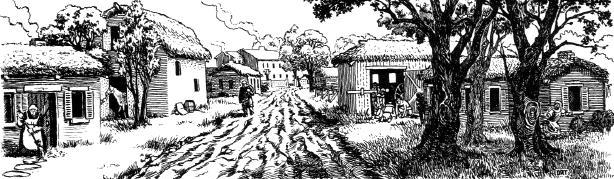
Expeditions of Amazing Adventure: the clinging mists of Kymoria
Beyond the vast mountains to the east lie many mysterious and relatively unexplored lands. To the south east of the great continent is likely one of the most enigmatic, and tragic, of locales. Kymoria was once known for its fine horsemen and open plains. Infrequent caravans that managed to traverse the great mountains would bring forth pungent spices and fine silks as part of the exotic wares commonly found in this land.
Well over a century the dreaded necromancer, Al’Khameed, rose to power in this nation. Kymoria was always a loose confederacy of princes and Al’Khameed was rumored to have easily twisted the minds of some princes to his will. The remainder that were willing to fight him brought the country to its knees in a bloody civil war.
Tales say that it was at this time Al’Khameed had discovered a long lost ritual. A ritual of such immense power he was able to bring life back to the bodies of the dead. The ritual sapped life from the very land itself and soon he commanded a massive army of walking corpses. So great was his power, so foul were the magics he wielded, that the very ground wilted and died.
Ulaam of the One Eye saw the threat of Al’Khameed and offered his great arcane skills to the neighboring kingdoms that were threatened by the ever growing undead armies at their borders. While some sing of his praises, other more learned historians claim that Ulaam acted simply out of desire to obtain such a powerful ritual himself. Regardless of his motives, Ulaam of the One Eye accompanied a large force of horsemen to strike deep within the dead land.

None lived to tell the tale of that great battle that erupted as the two armies met. Great booming thunderclaps were heard and arcs of lightning and fire erupted from the horizon. What followed was a creeping mist that blotted out the very sun over Kymoria. A wet mist so unnatural, that to this day it still keeps the blackened land shrouded from sunlight.
Ulaam of the One Eye limped out from the damp veil of mist, claiming that Al’Khameed was defeated. Further legends speak of Al’Khameed fleeing further south to the desert wastes, his great army reduced to a meager war band. His every step was hounded by men-at-arms from wronged noblehouses, pursued like a wounded animal from kingdom to kingdom. It was only in the desert wastes he could find a final refuge, where the harsh dunes provided him respite from pursuit.
Kymoria itself withered under the relentless mists that clouded its once fair hills and rolling grass plains. Although the great armies of undead were destroyed, it is said that the land is still infused with necromatic magic. Occasionally scattered lowly undead will shamble from the edges of the mist to terrorize neighboring villages. Undead animals are also not an uncommon sight.
There are still some small fiefdoms within the mists of Kymoria. They are a shadow of their former glory as some stout-hearted folk still try and carve a life from this veiled place. Some whisper even darker tales of lords actually being vampires, as ever-clouded skies give them respite from the sun. The villagers and peasants are simply slaves to their malevolent overlords.
This does not daunt some merchants willing to travel to remote towns within the deep mists, ever trying to discover some prosperous trade route. Such caravans are always seeking men of the sword willing to guard such tenuous ventures.
There are also a wealth of ruins to pillage and explore. Some of the greater cities have been abandoned, or at best only a sliver of the former population still call these doomed places home. Many adventurers have been willing to brave these dark lands and explore the crumbling remains of towns and cities within Kymoria.
 Geek Ken
