Category: 4e DnD
Second Printing of 4E Core Books?
So essentials has been out for a while now. I think all the excitement of the new stuff has worn off and players are dividing into the ‘everything goes’, ‘essentials only’, and ‘no essentials’ campaigns about now. This really makes me wonder for the new player what they should pick up and what direction they should go for getting new material.
I’ve come to think that everything in 4E now is a bit of a mess. I loved the concept of the red box. Get people into D&D through baby steps, and introduce them to the other products. What has come from that though is this idea of a streamlined character build from the essentials books, verses the modular-too-many-choices build in the old PHB.
And let’s face it, the core books are out of date. The monster math is all off. The treasure parcel system has been dumped for a random system and the skill check values retooled. The stealth system was entirely reworked and put out in PHB2. There is a bit of errata out there for the classes. A new group could likely ignore the entire rule errata, but any effort to get into organized play or buying up the new material will likely make them want to run with the current updates on the rules.
So will a second printing come out for the core 4E books? Could we see an updated version of the PHB that takes up material from the PHB2? I could easily see a new Dungeon Master’s Guide that takes material from both the original book and the DMG2 also. Not to mention an expanded monster manual that has stuff not covered in the monster vault, but updates other creatures from both MM1 and MM2. Yeah, a few folks might be willing to pick up a complete new set of books that are errata free. However, the problem out there is the essentials books.
Some of that updated material is out now in the essentials line (monster vault as an example). And I think more material will be released that focuses in on the essentials type of campaign. Should development go towards new builds and entirely new power sets for the older 4E crowd? Would it be easier in development (read less time and money) to branch that out in new theme options? Dark Sun seems to have brought up character themes that is an idea the developers have clung to.
Face it, themes work wonders for essential characters. It’s just enough power flexibility to allow a player to customize their character, but at the same time not offer an entire grocery list of powers and options like the older 4E classes. Not to mention, a theme works for just about every class. No longer do you have to work up a new product that is arcane only, or martial only. Now with a themes book, you’ve got something every player will want to buy and use. Themes might just be a selling point to get a new version of a PHB out there too. The big question is will WotC take that route.
I could see a second printing on the horizon for 4E. The question is will WotC make that effort, or will they push on in the direction of supporting an essentials style of classes? There are some subtle differences in encounter powers and which classes get access to daily powers. Having a second printing for the core books might be a good way for WotC to have a ‘do over’ and just merge these different mechanics under one design. I guess it’ll depend on whether they feel it’s worth supporting those older books, or just focus in on the people running with essentials only from now on.
WTF is up with 4E Complexity?
There is a new article up on WotC’s site which has me dumbfounded at the poll they put up. I’ve heard folks bounce around opinions on blogs and tweets about 4E combat taking up a lot of time. I also understand some folks feel overwhelmed about the character generation with all the potential options out there over all the sourcebooks, PHBs, and Dragon articles. But then I see this poll trying to garner options on the complexity of past editions and I’m wondering WTF is this all about now?
A while back I pondered if essentials would end up diverging the 4E crowd. I understand the idea of offering a trimmed down character progression with limited options and making it a full blown class. That way you could get both the brand spanking new player and the person that has been playing 4E since release behind a new product. Yet I wasn’t sure how well it would gel and felt you might end up fragmenting 4E players even further into camps of ‘essentials’ and ‘no essentials’ (something I still stand behind).
What I am wondering now is how well essentials has been holding up. I’m certain a ton of folks picked up the red box like hot cakes. But several month’s after the release, I’m curious how many people have kept up with their essentials campaign. I’m certain the monster vault and rules compendium have also sold well (they are great products and a wonderful compact set of rules to DM-on-the-go). Yet I’m curious if the player books were moving as well as the other products. I get some 4E fans grumbling that essentials builds just aren’t that engaging in a fight with repetitive attacks. However I guess there are also those brand new players (or the AD&D fellows) that are simply loving it.
Which takes me back to this poll. It makes me very nervous what’s the next big jump for WotC and D&D. I’ve got my suspicions, but I do wonder if they are at a crux with what direction to take the game. On one hand I think you have a ton of folks that like the current system (I’m one of them). On the other hand, you’ve got the huge Pathfinder crowd. Maybe WotC is looking the pushing out a more streamlined, back to basics, type of game, and essentials might just be the stepping stone in that direction. Then again, maybe this is a way for WotC to show folks that despite how much they pine away at the nostalgia of older editions, it just won’t keep their big gamer brains engaged. I guess we’ll have to see once they post the results next week.
Images of Women in 4E D&D Art
So in the past few weeks a lot of the blogs and podcasts I frequent have exploded with the topic of sexism in RPG art and how they really don’t depict women in an ideal manner. I think it is an issue. I think with some entertainment industries (especially video games) folks could have a legitimate argument that they represent women in a sexist manner. However I want to take a look at D&D. In particular the art for the newest edition. More importantly I think there is a trend in the art that shows a far more empowering image of women despite the amount of clothing they are wearing.
Big disclaimer. I have not had any semblance of advance education in women’s studies, modern feminism, psychology or sociology. What you are getting here is an completely ignorant, uneducated, rambling of some random guy-on-the-street opinion. Despise what I say? Just rack it up to me being a big idiot (a more accurate descriptor would be a big fat idiot). I’m no expert. I’m not pretending to be. The following is an internet jackass opinion.
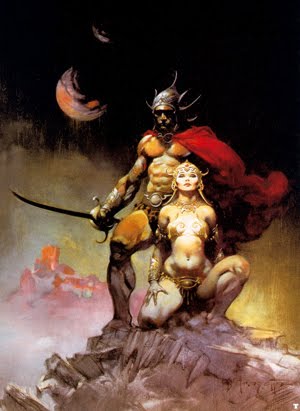


Above are some beautiful works from Frank Frazetta and Boris Vallejo. I’d say they are some classic depictions of fantasy art with women and men as both the subjects of the paintings. Now you can go back and forth about what the women are wearing, and if it would be considered sexist wearing such skimpy clothing. You might go off on how the women are curvy, maybe a few even a little top heavy. The deal is folks could go back and forth about this and I think neither side could really claim any ground.
As much as some women will say the outfits (or lack of) are a sexist depiction, I think you could say the same for the men. And then you get into the entire argument whether nudity is sexism. Still, I expect some women would find the above paintings objectionable based on the lack of attire the females are wearing, that it is demeaning and disgraceful. I’m certain there are some men that would claim the same thing and state it would be far better if they were wearing a full length burqa. I don’t think you can get a lot of mileage with some people on the lack of clothing being an indicator of sexism.
But let’s look at these images again. What does it say about men? Let’s look at the stances they depict. Powerful? Martial prowess? Fit? Strong? Protective? You could say they are fairly positive attributes. Now what does these paintings say about women?
Submissive? Incapable? Fragile? Weak? Dare we even say maybe as an object? See a lot of guys can completely wave off the lack of clothing bit. You can stand behind the opinion it is simply showing people’s bodies in their glory and natural beauty. There is nothing shameful about it. Yet, when you look harder at their stances. How the women are in relation to the men in the paintings. You really can’t say it depicts men and women equally.
Let’s take a peek at some of the art from the 4E PHB. The first book that came out with all the 4E goodness of D&D (okay, you grognards bite your tongue on the ‘goodness’ bit and just agree this is the recent stuff from WotC).
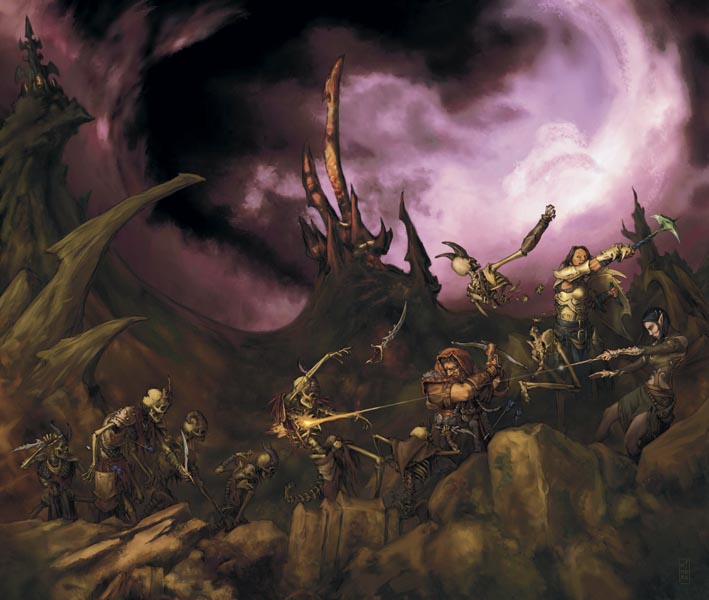
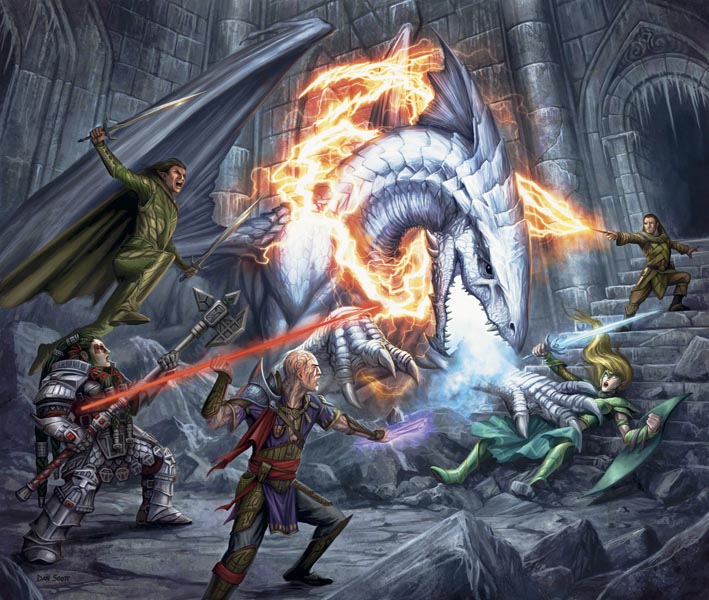
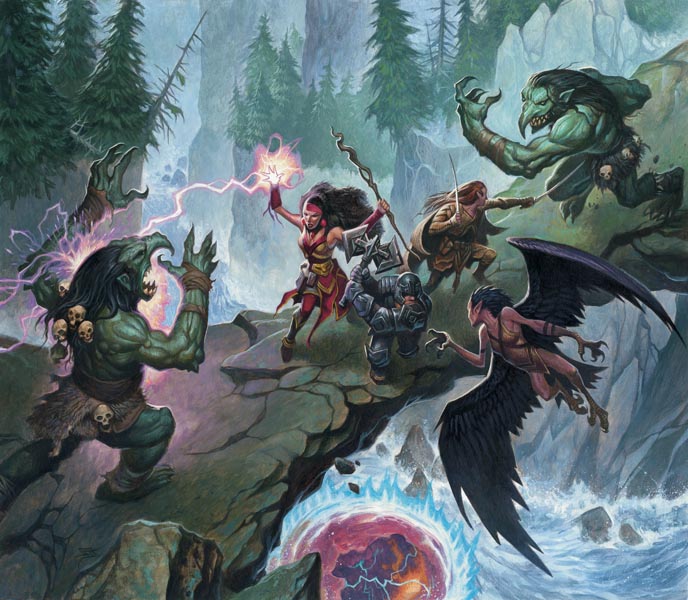

You don’t see women cowering behind men. I guess you might quibble about the eladrin getting stomped on by a white dragon (although I think you’ve got a woman warrior to the left ready to deal out some whoop ass). Still as a grab bag of dynamic action scenes, you see the women in these images engaging, competent, and on equal footing with the men.
Let’s look at some of the lone depictions of women….

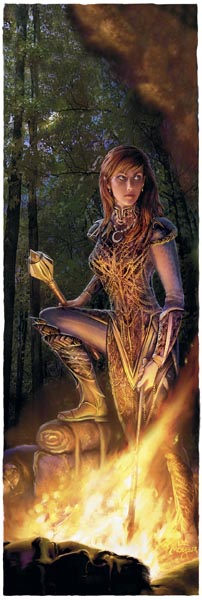
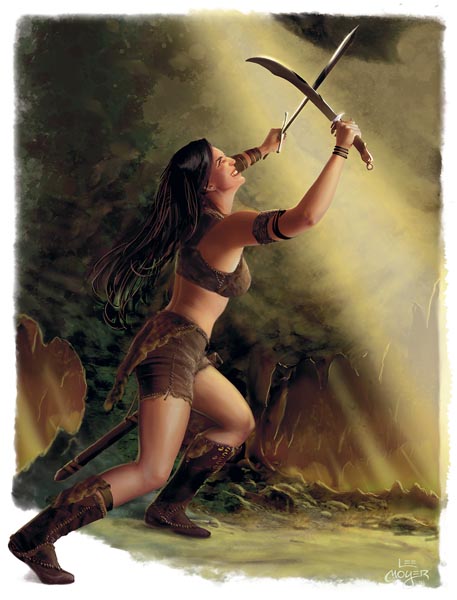

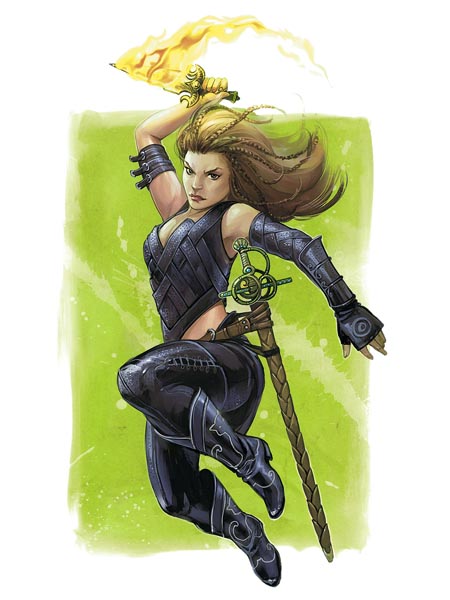
I think even the leather bikini babe is taking an engaging and proactive stance. They are not cowering in some submissive pose. They are striking, imposing figures, or having a watchful stance. They are not quivering on their knees waiting to be saved by someone. I think at least for WotC and the art now in D&D, you’ve got a lot more positive images of women.
This does get murky. Google Lara Croft or Bayonetta and I’m certain you’ll get an eyeful. While they are strong, capable women, they are still depicted in an overly sexualized way. However, I think that aspect is the most important. The characters are empowered. They are effective, strong, proactive, and most importantly aren’t crying for men to save them.
For D&D right now, I think it does a lot to push that image of women in their game art. Women are not fragile, submissive objects. They are standing right alongside the men, ready for adventure. I think that is the most important part. Something I feel is wonderful about this game and especially for little girls. You can be a hero. You can be strong, smart, and powerful. And most importantly, you can be just as good (or even better) than the boys.
(Note: I picked out some of the more objectified images of women from Frank Frazetta and Boris Vallejo’s works. Each have produced works of art with women in far more stronger stances than what I used here. I freely admit taking some of the more controversial images to make a point about classic fantasy art.)
The DDI beast and the appetite for new D&D content by fans.
So a slew of announcements has come out from WotC and quite a few have caused a stir with folks. To quickly give a summary WotC is pulling full support for the painted miniatures and going with smaller, special figures as limited runs. The content for Dragon and Dungeon are no longer be compiled as a single PDF, rather they will be provided piecemeal as individual articles. And lastly a few books are being pulled from the release schedule completely, and quite possibly will be reintroduced in some other format.
For the miniatures, I’m no surprised. I always thought it was cost prohibitive for most new players to get into. The deal with minis is you really need a lot, and a variety, to add to someones game. Yeah, you can heavily use proxies and make those 8 goblins you have represent nearly any other creature the players fight, but that gets old. It always blew my mind that WotC never pushed into making token sets like what other companies had put out. With the essentials line it looks like the feedback has been overwhelmingly positive. I do think tokens are a great product for WotC to dip their toes in. Too bad the miniature line had to be completely dumped in the process.
As for the lack of a single PDF file for Dragon and Dungeon I can understand. I believe you sometimes had different versions, as the magazine issues were the ‘clarified’ and ‘errata’ versions of earlier articles. Slimming that process down to a single article I’m sure saved some money somewhere.
However I think with the announcement of the pulled books, it’s clear to me that focus for profits is with people keeping up DDI subscriptions and I think the hardback book format might be falling from favor. Until the DDI can provide a suite of tools for the D&D player, I think they are dependant on getting out content as articles and adventures. I think until the virtual tabletop comes out, WotC is under a lot of pressure to keep people justifying their DDI subscription. Folks are rabid for new content, to keep the DDI beast going you’ve got to feed the fans a constant stream of material.
Shuffling some materials planned for books into digital content is a decent strategy. Why release a book on magical items? Why not make it a new monthly feature for Dragon magazine instead? Same material, just presented in a different format. It helps keep folks maintaining a more profitable subscription, not to mention it is material that can easily be integrated into other online tools.
I think that is one reason also for the new format. I’m certain that WotC is really looking at the digital format not to just replace books, but as a way to integrate into other tools for the game. I can easily see them indexing digital content into an adventure builder. Want to make an appropriate encounter for Dark Sun including the fluff? Just click the appropriate filters for-an-unnamed-furture-release-DDI-exclusive-adventure-builder. BAM! You now have a list of magical items, monsters, map tiles, the works, and all can be used for that campaign setting.
Clearly having people gaining access to material based on a long term subscription is more profitable than having people make a one time purchase for books. Also, the more fragmented content you have, the less inclined you’ll be to maintain your own digital copy. Folks might be willing to keep 24 pdfs a year saved some place. Individually download and index 240 items though (figure 10 articles a month for Dragon and Dungeon)? Well now you’ve got something downright unwieldy to use.
I don’t blame WotC. They are a company. They are seeing a clear profit model in the DDI subscription. I do think as tablet devices and smart phones get more integrated into online use by the general public, there is a market there to be tapped for RPGs. I think WotC sees this as something to get into. Who knows what is on the horizon as technology progresses (surface scapes anyone?). I guess time will tell.
Me? In this interconnected online world of RPGs, I’ll miss my books, dice, and pushing little plastic men around.
Handling Errata
So WotC seems to have a never ending stream of errata that comes out. I get a bit torn about this. One part of me feels it is such a pain to try and keep up on the changes for powers and items, and wishing WotC took a bit more time to playtest new material. Yet another part of me is happy that WotC tries to address powers and abilities that are too powerful, or even better, get some of the older powers up to snuff with new options available to players.
Trying to incorporate this stuff into your existing books is a bit of a pain though. When the first errata started to trickle out, I diligently printed, cut, and taped the text into my books. As more and more piled up I realized it would be a huge endeavor to try and update the books and keep them current.
Instead, I have all the errata printed out and put into sleeve protectors. I indexed them with color tabs and have a notebook with all the errata broken down for each WotC book. I then took the books and highlighted the name of powers that had some errata (sometimes put brackets in the margin if it was a chunk of text). Then if I was looking in a book, I would know I should pick up the errata notebook to make sure a power was working correctly.
So it is still a little tedious, but a lot easier than making individual changes to each book. Plus I can easily add to any future errata that comes out. I still think if I were a new DM I’d freak out about all the changes and corrections floating out there. So I’ll offer some advice on the matter.
Check the stealth rules – Make sure you’ve got the updated stealth rules (PBH 188) and how to target things you can’t see handy (PHB 281).
Make changes to the DC levels – Go through the skill DC levels and adjust them (DMG 42). Make sure to keep these values in mind for skill checks. Almost every other skill check in the game, from the disease tracks to traps, are altered due to these changes. You can readjust most checks on the fly if you’ve got this errata change handy.
Mind failures for skill challenges – Update the skill challenge complexity (DMG 72) so that each is not a success once 3 failed checks are made. It’s a big change and helps keep skill challenges a little exciting.
Don’t sweat the other stuff – Honestly most of the other changes are minor tweaks and corrections. If anything, they are specific to a certain player class. I’d definitely make an effort to go through the errata once a player picks a power, but don’t get too freaked out if you miss something.
A few powers and abilities are broke. As a DM you’ll usually find out about this (and might have to make changes later), but for the most part you could likely play your game with your pals and never bother making changes to Delver Armor, or even the ‘new and improved’ magic missile.
In fact the worst part about being dismissive with errata is that you are hurting your players. I suggest putting the work on their shoulders. If they find an errata to a power, let them tell you about it. Have them keep that printed page handy when you all play. You’ll be surprised that if a player can get a boon to a power due to changes or corrections, they’ll be sure to scour the errata to find it. It’s a great way to delegate the responsibility for keeping all the characters up to date.
So these are my little tidbits on errata. How do other DM’s handle game changes to the rule books?
Expeditions of Amazing Adventure: The mischievous monoliths of Miandriss
The open plains of Miandriss are dotted with deep lakes that are fed by a myriad of small rivers and streams. This land is known for its fine farmland and rolling plains of grain. But one cannot fail to mention the great mysterious stone statues that also lie about the many farming communities of this land.
Most are level to a man’s chest and hold the visage of some simple humanoid face. The gray stone on many are so worn, barely any detail can be found on their face. It is unknown the purpose of the stone markers, or what race was responsible for creating them.
Many people look upon the statues that grace their fields and homes as good fortune. Most farmers would agree, that to deface or move such stoic rock figures would be tempting foul luck. Even older traditions of more primal beliefs still hold sway over many communities.

Each long fall before the main harvest, huge bonfires light the night sky. Families with homes near the stone figures will leave pints of dark ale, sharp cheese, and hearty loaves of bread. Most folk will spend the evening around the fires drinking merrily and filling the air with laughter and song. All done to appease the spirits buried deep within the quiet stone faces of the statues that dot their community.
Villagers claim as the night drags on, the fires fall to embers, and the folk weary with sleep and drink retire to their homes, that the rock figures come alive. Sure enough, many farmers will find some of their wheat baled, or fruit from thick orchards in bushels. And pity the miser farmer that did not leave a meal for their stone neighbors. He might wake to find his livestock scattered or a small vegetable patch rooted up. Usually, such a slight is rewarded with some mischievous deed. Yet few whisper of more darker deeds, one of children gone missing in long past seasons.
One thing is for certain, every statue has moved by the dawn of the following day. Even the great imperial arcane guild has documented this phenomenon without any explanation. Attempts to do so have always resulted in some mishap. Whether a young apprentice seems to fall asleep during the observation, or a group of wizards is run off by some irritated beast, no one has actually seen the statues move.
They only know that by the next sunrise these simple figures of man have managed to uproot themselves and move. Be it a mere 10 feet or hundreds of yards, it seems that each season the stone statues of Miandriss begin a migration, quite possibly a great jest from some ancient trickster god.
Review: Counter Collection Heroic Set
As I mentioned before I’m a big fan of using using some type of miniatures when playing D&D. I stumbled on Fiery Dragon which has some pretty neat RPG stuff. In particular I came across their counter collection series and picked up the heroic level monster set.

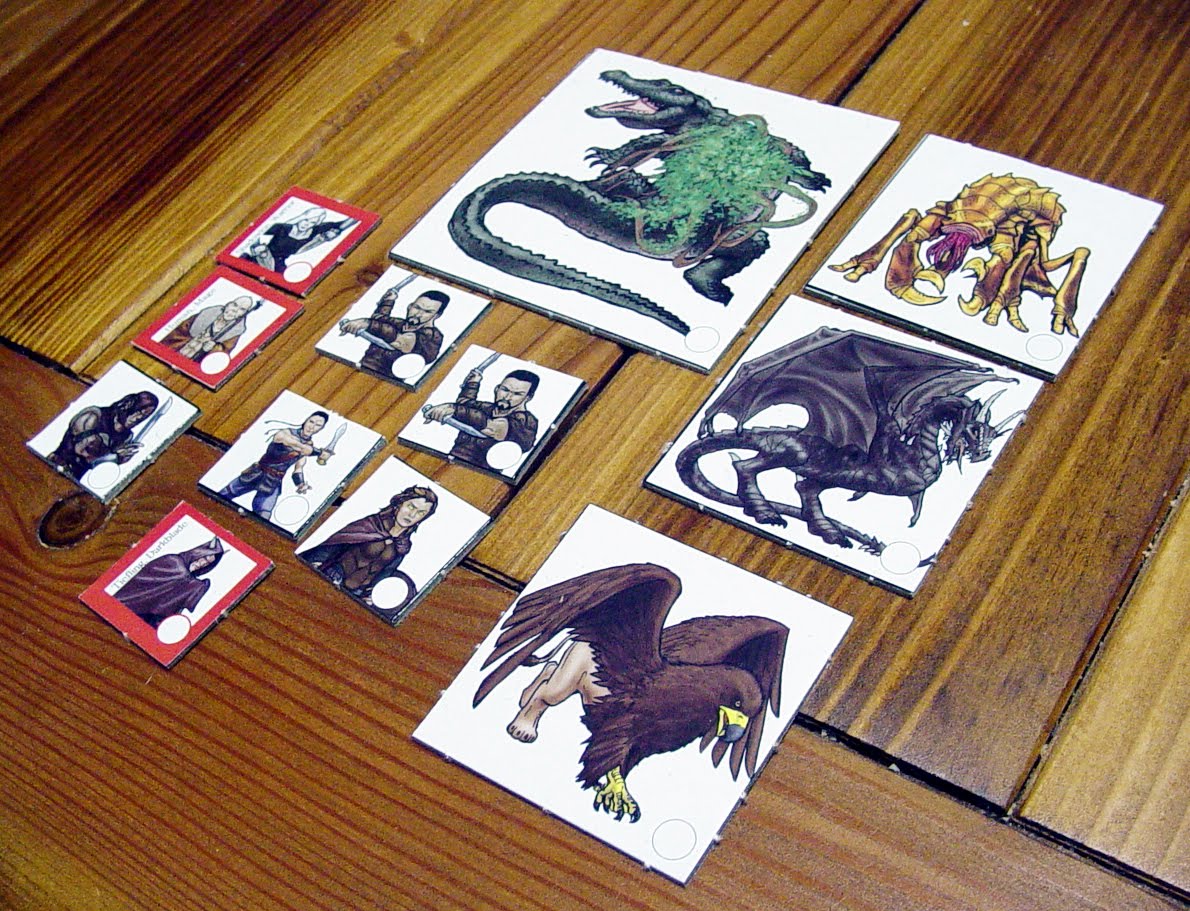
The set had sheets of cut counters with every creature in the 4E monster manual for the heroic level. Inside was quite a haul, hundreds of counters printed on thick card stock. Each was printed in color, most depicting a monster from the torso up. On the flip side was the same image with a red border, indicating it was bloodied.
There were several duplicates of each creature. Most were in sets of 3-4, with minion types up to 8 in number. Also each counter had a small white circle you could write on to give each counter a number, letter, or some color designation to set it apart from the others. Additionally, in small text was the name of the creature on the bloodied side. A nice feature to keep you from guessing what they should be, but still not be so obtrusive you couldn’t use them for a proxy for some other creature type.
The counters were cut to an appropriate base, 1 inch being for most of them. The stirges were the one exception where I had to trim them with a pair of scissors to their 1/4 inch size. Some of the largest creatures were a beefier 2″ x 2″ counter.

The artwork was rather nice, and offered a fairly good representation of what’s between the pages in the MM. They offer a pretty realistic image of the creatures (i.e. not your anime big eyes, small mouth monster).While the counters are duplicated, each creature type has different artwork. So that decrepit skeleton has a different image from a normal skeleton or a bone shard skeleton.
The Good – A nice selection of counters that are easy to pop out and use. Very utilitarian, especially the flip side of each counter being a bloodied version. They are properly based and, while being printed on cardboard, nice thick durable material. The artwork is rather good and seriously done. Best of all, for the set you have a haul of creature types, with enough to use as proxies for other monster types.
The Bad – While each creature type does have a different image, many are simply different profiles with some additional weapon, armor, or color type. You do get 8 goblin cutters, all of the same image. Having a few different poses might have been nice (but then again, might add to some confusion on what they represented). Also, while the card stock is nice, it is still card stock. A spilled drink might mean you have to put several tokens up for the night while they dry out.
The Verdict – An exceptionally good buy. You get a ton of monsters for a reasonable price. Punching them out of the sheets was easy to do, and required no printing or cutting (save for the stirges) unlike most PDF products. I think WotC will be offering something similar in future products from their essentials line. However I feel with the counter collection from Fiery Dragon out there, they’ll have to step up the production value as this one is pretty hard to beat.
DM Tip: Skill challenges should be say, then roll.
 I like skill challenges. Once it got pounded into my head that WotC ‘rules’ for them were more frameworks and guidelines, rather than cut and dried rules, I totally got into the groove of running them. People still have a lot of ire for them and some lament how skill challenges are too much a game mechanic that interrupts good roleplaying. To be honest, it totally depends on how you run your challenges.
I’m not talking about the set up, goals, and deciding the DC values. The Fearless DM has given pretty good rundown of how he runs skill challenges. I find it interesting how in one point I run my challenges similar.
If you have some skill challenge, say the group is seeking a written pass into a city, and you approach the challenge as a series of diplomacy checks. Well that is exactly what you are going to get. I can see the conversation at the table now…
DM – ‘Okay, um… make a diplomacy check.’
Player A – ’19’
Player B – ‘8, ouch!’
Player C – ‘A 23 here.’
DM – ‘You guys get two successes and one failure. So, you still need to talk to the guard some. Make another round of checks.’
Yeah, I think with that type of challenge just about any group would think them a big snooze fest. And in this light I can totally see how 4E detractors think of skill challenges as a very mechanical process without any roleplaying.
I’m going to bypass talking about setting up skill challenges and working out DCs and appropriate skills to use. That’ll likely come as a few individual posts. Instead I’d like to offer a few suggestions on how I run a skill challenge from round to round.
Describe your action – I have my players describe what they want to do and avoid the simple skill check. Don’t tell me you want to make a diplomacy check, tell me what your character is doing or saying. I think this is a key point to running skill challenges. Get your players into the habit of describing there actions first, worry about what to roll later.
Everyone participates – I go from character to character getting a feel for what they are doing. And everyone is in the action. Doing nothing is not an option. People get wrapped up in not wanting to make checks that lead to a failure. I don’t accept inaction as an option, my players are going to be doing something.
See, there is this little skill option called assist other. A player makes a moderate skill check and if successful, can give a bonus to another character’s skill check. If a player is really worried about tanking a check, they can always use this option. So yeah, I make everyone do something, even if they are just trying to help out one of their teammates.
Work out the skills needed and roll – Once I find out what everyone wants to do, I assign skills and have everyone roll. This is a key point. Have the players tell you what they want to do. You as the DM then figure out the appropriate skill. Finally, then have the players make their skill checks.
You have to be flexible with this. If a player offers a clever idea and can make a convincing argument for using a particular skill, then the DM should roll with it. If you really think the skill use is a stretch, or not applicable, assign a penalty or bump up the DC for the check (or do both) and let the player make the check. Once they say what they want to do, find the appropriate skill and work with the players, not against them.
Describe the results and repeat – Don’t just tally up the results and spit out the number of successes and failures. Be descriptive with the results and give degrees of failure and success. This is a great way to give subtle cues that a player is using an appropriate skill for the challenge (‘You find the duke receptive to many of your points. You think with a bit more persuasive conversation, you might sway him to your cause’).
This is also a great way to give out a little information or some simple rewards in the face of failing the challenge. Maybe the group doesn’t find the entrance to the thieve’s guild, but at least they know it’s in the port district. This helps players from feeling some challenges are a total loss if they fail. That at least they managed to gleam some information or make a little headway to finding a solution, rather than their efforts being a complete failure (and failing one should never stop things dead).
Overall, I find these points help make skill challenges a lot more of an organic RP experience, rather than some mechanical round of skill checks. I hope some folks find them useful and would love to hear any tips other DMs have to offer when running their skill challenges.
Lack of fluff in 4E and MM3
Some folks have complained about the lack of fluff in many of the 4E books. For the most part I would have to agree. The 4E player’s handbook and DMG were a little sparse with flavor about WotC’s ‘world’ of D&D. However I can understand WotC’s stance on not dispensing out this material. You had a audience of rabid fans that ate and breathed just about every book. If WotC wanted to change the direction of a certain race, god, or monster, likely people would revolt (at least on the internet). Likewise, as a new DM or player, you would have all this additional material. What do you do with it? Is this canon? If I envision my orcs to act differently, am I playing wrong?
So I totally get WotC being a little sparse on the fluff and flavor. I think they took the attitude to just let people play the way they want. Offer a little background and some ideas, but ensure that nothing written was law. People should make this stuff fit their world. Having less fluff helped in that.

Now Monster Manual 3 has come out. I’ll pass on the official review bit. Just about every blog out there has done so. I’ll sum up my thoughts as a big thumbs up. It is a good book and I would recommend it.
Just about everyone has gushed over the monster stat blocks. WotC has updated them to make them easier to glance through based on the monsters actions and abilities. I like the new design and echo what many have said. However there is another tweak to the book which I think makes the material between the covers much stronger.
In past editions, you had a very simple list of suggested encounters for each entry. The idea was that a DM could lift this list out of the book, plop it down in their dungeon, and you would have an appropriate encounter with the normal allies of said monster. Very efficient, utilitarian, and I think a nice feature for new DMs.
MM3 has done completely away with that format. Instead they provide a short paragraph on the motivations of the creature. What are its goals. Who are its allies? How would a monster of this type typically be in the D&D world. I think it is a wonderful change in previous editions and glad WotC decided to add this bit of fluff to the book. What you end up with is a bit more detail on each creature that leads to a few more plot and encounter ideas.
They also adopted this for the tactics of each monster. Now ‘tactics’ is replaced with ‘in combat.’ Granted, a handful of entities follow the MM format of stating a monster would use ability X and power Y. However most entries are a much more general in terms and give a narration of how a monster acts in combat, over a simple list of powers they should use. Another small change with a little more fluff that makes the book better.
I think WotC finally gets it. See all that fluff and flavor adds a little more to the D&D world. For the new DM, it’s a nice tool for helping them run their game and think up new ideas. The veteran DMs either all ready have a firm grasp of the game fluff, or perfectly willing to change what they need. MM3 is a book that finally eeks out a little more fluff and I think is a stronger 4E book over the past editions because of it.
Is D&D essentials going to drive a fissure between players?
WotC has put up some information on the new D&D essentials line. I’m all for a simplified edition to roll out for new players. Currently I think the game is very overwhelming for new players. I posted a while back what I considered the bare bones 4E books someone needed to play. So I get WotC’s decision on releasing what would be a new and improved red box basic Dungeons and Dragons.
But something has irked me with their new announcement. I get the trimmed down list of races and characters. I get the slimmed lists of monsters. I get the tweaked game mechanics in dropping daily powers (scroll down to the bottom of the original link). What I don’t get is including material for leveling up characters from 1 to 30.
I think this is a bad idea. I really hoped that the essentials line would carry players up to the heroic tier. Want to progress further? Then jump on over to game edition that everyone else is playing. I think this is very intuitive and fits in well with the product philosophy of previous editions. Offer a slimmed down version with enough options and rules to progress a character up to a certain point. When your group is ready, you have all these other products you can pick up to play.
I especially don’t get the new essentials player’s books especially in relation to the 320 page rules compendium. Maybe new folks should just buy the rules compendium, with the new player’s books related to new and old players alike?
Given the mechanics change now, with a level cap of 30, and the apparent push for experienced players to pick up the essentials player books now I’m not too keen on the essentials version. I’m seeing potentially a line being drawn with the folks that play original 4E and the people playing D&D essentials. I am all for a ‘graduation’ of sorts to the original 4E. But if they are tweaking the player mechanics, I’m seeing a lack of meshing with folks playing an ‘essentials compatible’ wizard in with a 4E campaign.
Maybe I am reading too much into this. I was thinking that D&D essentials was a bare bones way to introduce players into playing 4E. But something smacks of a complete new edition rolled out with the essential line that looks like it might be dividing people that play D&D further, rather than bringing them together.
 Geek Ken