Category: Board Games
Video game sales verses movie box office numbers and implications for geek gaming.
This is an interesting bit of news that has been circulating around the video game sites. According to an article in Business Management video games have been giving more traditional entertainment industries a run for their money with sales. Comparing the box office numbers of Avatar vs Call of Duty: Modern Warfare (see graphic below), each has taken in over 1 billion world wide in sales.
Even modest returns have gotten some notice with the movie industry. Batman: Arkham Asylum took in unit sales nearly 2 million within the first month (average $45 USD/unit = lots of cash). Warner Bros. decided to get in on the action and take a role in pushing out the sequel, dropping Eidos (the company that developed the game) as the middleman developer.

I notice in this splash page that little blurb on World of Warcraft. Nearly 100 million every month in sales. Everyone that has played D&D knows the inspiration for a lot of fantasy MMOs. Levels, classes, forming groups to battle monsters to gain treasure and magic items, at the core of a lot of these games you can see D&D’s fingerprints all over them. I’m certain there is a chunk of MMO players that cut their teeth on pen and paper RPGs, and moved to MMOs. At the same time, I am absolutely certain there are a young generation of folks that have experienced fantasy worlds solely through video games.
I think the big challenge for the RPG industry is to try and tap into this younger generation and, in a way, ‘take back’ the influence and inspiration D&D and many other RPGs have on MMOs. The incorporation of digital tools is a pretty good step. I’m hoping that that expands even further as improvement in technology allows for more interactive computers. However, I still think some efforts have to be made at an even younger age.
One of the strongest elements about D&D is the social aspect, and that everyone is gathered around the table top interacting with each other. Kid RPGs might be a good step. I think children find role playing a natural extension to a lot of normal play. But I think that boardgames are also a good introduction.
Something physical with miniatures to move around and colorful boards can spark imagination. Also, boardgames have a structured style where there is a winner and an end. It’s a concept that is a little easier to pick up over a continual story like most RPGs. Something that kids can sit down, play for an hour, and move on to something else would fit the bill nicely. I think some companies have picked up on this theme, and even WotC has jumped onto the bandwagon, which I think is a solid move.
I see entertainment growing from a passive form to something more interactive. I think the next big generation will be drawn to forms of entertainment where they are more involved in a story rather than just being an audience member. There is big money here too. So you can bet that industry types will be looking at getting into this market. I think the challenge to RPGs as an industry is to try and reclaim a bit of the very thing they helped create. I think without D&D, you would have never had an Everquest or World of Warcraft. The challenge will be to capture a younger generation that never knew about D&D, and reintroduce them to the world of pen and paper (likely a computer too) RPGs.
Board Game Review: Mall of Horror
Given that Halloween is just around the corner, I’m in the mood to post about things scary, spooky, and well… backstabbing, cut-throat board games.
The setup for Mall of Horror is classic George Romero zombie apocalypse. Various groups have headed off to the mall to hole up, and hope they can survive long enough before they are rescued. They are surrounded by the living dead and it is only a matter of time before zombies burst through flimsy barricades to eat one of the survivors.

The game is pretty simple. You have a certain number of pieces on your team, each with special abilities, and worth a set amount of points. You simply want to survive long enough (i.e. be one of the last few eaten) until the survivors are rescued. The person with the most points wins.
There are several rounds to the game. Players chose a member of their group to run through the mall and hide in a certain location, the only problem is each location can only hold a certain number of survivors. If you can’t get into the destination you want, you have to hide somewhere else.
Also some destinations have special abilities. The security station can allow one player to look through the security cameras (and find out where the zombies are moving). The parking lot holds a supply truck where players can pick up various tools to barricade locations, or weapons to take out zombies. After the survivors settle in, the zombies move according to a random die roll. If you are lucky, you’ll have few zombies at your location. If you are unlucky, the zombies burst into a section of the mall and then the real fun starts.
The zombies will feast on one player. Afterwards they are sated for a bit and wander off, leaving the remaining survivors. Who gets eaten is decided by a vote from the players at that location. This is a particularly gruesome aspect of this game. Want to man the security cameras? Want to loot the truck? Want the other guy to be thrown to the zombies? No random die rolls, everything in the game is decided by vote.
Each player is given a voting wheel that has all the player teams. To vote, they just secretly rotate their wheel to the team they want. Each survivor at a specific location gives the player a number of votes (some, like the ‘guy with the gun’ are worth 2 votes). Have enough votes on your side, and you get things your way.
What results are rounds of vicious deal making and backstabbing. Need some help raiding that truck? Sure. But you gotta help me vote that other guy gets thrown to zombies at the grocery. Get ready for some under-the-table deals and be ready to up your negotiation skills.
Granted a player can be eliminated, but that doesn’t mean they get to sit out waiting for a winner. Each round they get to add another zombie to the mall (likely busting through a location, resulting a survivor being zombie food). Also for each tie, they get to decide the winner.
The Good – A relatively rules light game. With very nice components and nice art work. Quite a bit of randomness is in where the zombies move, so there is a lot of replayability. Plus the game is all about interaction with each other. The only solid strategy is being good at negotiation.
The Bad – The player pieces are a bit lack luster (basically stickers on wooden wheels). Too bad they do not match the quality of the zombie pieces. Also, given the kill-or-be-killed mentality, some people may not like the game.
The Verdict – This is a game not for the thin skinned, nor the easily bruised ego. I think it is a game best played with friends. I would not drop this down at a dinner party full of strangers and expect a fun evening. However, having your pals over for some beer and pizza, all the while cheering as someone has a member of their group eaten by zombies, well… it’s just a lot of fun.
Board Game Review: Zertz

Zertz (pardon not using the accented e, damn simple text editor) is an engaging 2 player strategy game. This is from Belgium, but an english version put out by the folks at Rio Grande Games is available. The board is a series of disks placed in a hexagonal pattern. Different sets of colored balls are kept aside in a common pool for each player. As the game progresses, players capture these balls. The first player that obtains one of the varying sets of balls wins the game.
Each turn a player has two choices:
They can capture a ball. This is done by placing a ball next to one on the board and ‘jumping’ the ball into an unoccupied space. The ball hopped over is captured. They can make repeated captures with the same placed ball if its new position allows it.
They can place a ball on the board. Taking a ball from the common pool, it can be placed on any unoccupied space. However when placing a ball, they have to remove one disk from the board. The removed disk must come from an edge and cannot ‘disturb’ other board pieces (i.e. you must be able to freely slide the piece away without moving its neighbors).
There are three colors of balls of varying numbers. A player wins by capturing either 4 white, 5 gray, 6 black, or 3 balls of every color. Simple rules.
It is an incredibly challenging and fun game to play. The aspect of removing pieces of the board means you are continually being forced to make more and more limited choices. Many times you have to give your opponent a capture, in order to score one for yourself, as victory conditions are dependant on the color of the balls captured to make a winning set.

The Good – The game has simple rules, but is a challenging strategic game. Additional disks are provided to expand the board if players are up for a more abstract challenge. The pieces are sturdy and elegant. I have to say this is a game with a wonderful look. It really captures the attention of a lot of people passing by.
The Bad – The game can be a little too cerebral. Everything is based on strategy, so veterans will likely have a huge leg up on new players. The game is also for two people (but playing up to 4 using partners with alternating turns could work).
The Verdict – This is a wonderful strategy game for two people. It is quick, easy to pick up, and very deep for such a simple, elegant game. The extra board pieces can add some replayability. I’d highly recommend this game if you want a fun, light strategy game.
Get out and game.
Newbie DM posted a small plea for the industry a while ago and made some good points. I agree that companies really need to push out material, or support 3rd party efforts, to make running games easier.
Personally, I think interactive face-to-face gaming is slowly being eroded. It seems the younger generation’s primary experience with games is through computers and video games. We are becoming more interconnected every day, but that connection is through proxies. I feel direct social interaction with people is slowly being lost, as tabletop or RPGs are becoming archaic forms of entertainment. So I implore people, start playing games in public.
Take time out to hit the local game store. Take some time to meet other people that game. Once in a while break off from your regular gaming crowd and play with some complete strangers at a shop. And more importantly, give that store some business.
Sadly I think online shopping is killing the neighborhood game store. You don’t necessarily have to make a store your exclusive source of games, but make sure to throw a little money their way when you can. Game stores are more than a business that sells goods, they also act as social hubs to meet new players and be exposed to new games.
Play in libraries or other public places. I used to play with a group of historical miniature buffs back in College Station, Texas. They were a great group of guys. Playing in the local library on a Saturday afternoon, typically we would get a few kids interested in what were doing. Lots of kids came by to see us and usually had a lot of questions. Most of them never heard of miniature wargaming.
Exposure to the hobby is important. You would be surprised how many people have no idea about gaming as a hobby, or worse, have a completely negative view of it. Show people what the hobby is all about. Play in public run events. Hit conventions. Participate in RPG day or other industry launch parties by hitting your local retailer and playing in public.
And if you get some kids that come by, take a little time out to answer their questions. Encourage kids to play board games. Get them playing hero clix or mageknight. Get them playing card games like dragon ball Z. Get them playing with other kids where they are actually sitting across the table facing another person having fun.
Show younger kids there is this entire hobby that World of Warcraft came from. Tell them about role playing games. Get them interested in playing with people directly, not simply through a voice box and virtual avatar. They are the future of this hobby. Show them.
Get out and game.
Games I Will Play With My Kids
I remember playing board games as a kid. I had a slew of Parker Brothers games (Monopoly, Clue, Sorry, etc.) that I played regularly. Looking back at those classic family games, I realize now how horrible some of them were playing together as a family. Something I will not be repeating with my kids.
One thing that stands out in Monopoly and Risk (two old past favorites of mine) is that each game revolves around the elimination of other players to win. Now I am simply boggled by the game concept where the losers are dropped sequentially and forced to wait around until the winner is decided. As a family game, I just don’t see this as fun. Winning and losing is part of playing a game. I’m all for teaching that idea to kids, but dragging out the process forcing them to become spectators while the winner is slowly decided is not fun. Now that I’m older and thinking of playing games with my kids, I’ll be making sure these four games are regulars in my lineup:
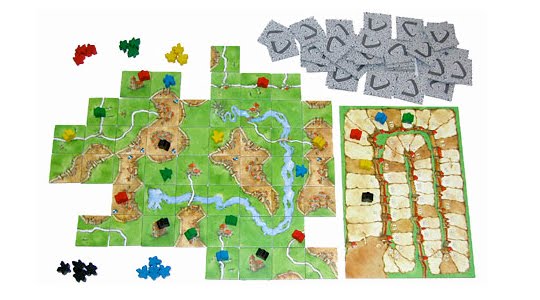
Carcassonne – You place tiles to slowly expand cities and roads, filling up the country side. All the while you place followers (or meeples) to score points on completed features. It’s fun, has simple rules, and is surprisingly strategic. My niece loves this game, and the adults I’ve played with have really enjoyed it too. Play is fast and definitely has that draw to play ‘just one more game’ to it.
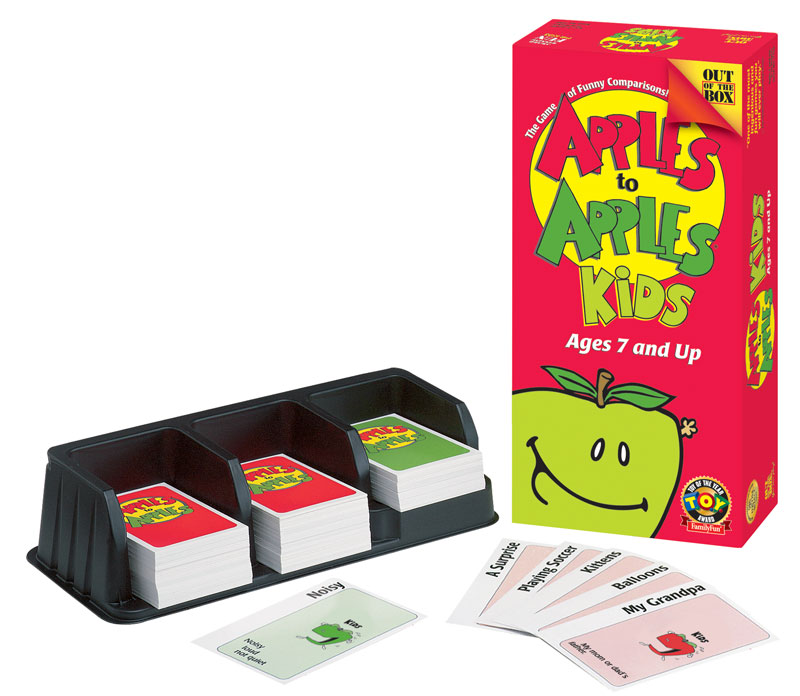
Apples to Apples Kids – The adult version is a hoot and an excellent party game, but I got tired of trying to describe who Maryln Monroe or Dr. Jack Kevorkian was. The Kid edition is a great fit. Players try to secretly match adjective cards in their hand with a specific noun. Rotating as a judge, a player will pick which one seems to be the best fit. If your card is picked you score a point. Another simple game that is fast moving. The only downside is you need at least 3 players, with more definitely making a better game.

Settlers of Catan – This will be my replacement for monopoly. Plenty of info can be found on this game. As a quick description, you play a settler on a new island and must engage in barter and trade to further build settlements. The first player that builds the most wins. It is a resource management game that requires interaction with other players. And more importantly as a family game, everybody is in until the end. The hexagonal board pieces also make for a different game each time.

Risk 2210 – What better game to seed my children with thoughts of world domination. A fun light war game. The combat mechanics are very similar to that of risk. There is a small economy portion. Plenty of luck with the addition of power cards. Lots of different territories to control, defend, and attack (water, land, and the moon). Three territories are randomly removed from the start for each game, effectively becoming natural barriers, thwarting a wrench in specific map strategies (like turtling up in Australia).
Two important points I love about this as a family game. There is a 5 turn limit. You have to get moving quickly as there is limited time to set plans in motion. Say goodbye to the all-nighter risk game. Also, there is no bonus for eliminating a player. Yes, you can wipe out a fellow player from the game but there is no incentive for doing so. In the original game of risk, it is a main strategy to eliminate players in order to get their territory cards. Fortunately this rule is removed from 2210.
This is a short list of games I think are a bit more family oriented and will be playing with my kids. What are your favorites?
 Geek Ken