Category: Board Games
Review: Above and Below
 From Red Raven Games, Above and Below is a worker placement, resource management game, with a dollop of storytelling. For 2 to 4 players, each oversees the expansion of a village, slowly recruiting new villagers, and constructing new buildings to make your community flourish. However the location you established your new home is over a series of inhibited caverns which beckon to be explored further.
The game is played over a series of rounds. Each round a player activates a worker and conducts a specific action. This can be to harvest resources and gain coins, or to use coins to purchase new villagers and buildings. The worker you select is moved from a ready section on your individual play board to the exhausted section, indicating the villager have been used for the round. Play continues until every player has passed. There are a few free actions that can be taken which don’t require the use of a villager, such as selling and buying goods from other players.
At the start of each round, villagers move from the exhausted section on your player board to the ready area. However you are limited by the number of bed icons in your village. If you have only 3 beds and 4 villagers are tuckered out from working, you will have one of those villagers still too pooped to do anything the following round. There is a way around this using a special cider resource that acts as a temporary bed (spending the cider resource in the process). Note also that not all villagers can do the same actions. Some actions like constructing buildings, or training new villagers require a one with the appropriate icon on them (indicating their specialty).
In addition to readying your villagers, you also gain coins depending on the variety of goods you possess. Your outposts and buildings can produce goods, but it takes an action to harvest them. The value of the goods moves along a track in set increments. It does not matter the number or specific type of good, only the variety of goods matter. However the trick is that some goods are either rare, uncommon, or common.
Interestingly, you likely want to harvest rare goods first, as they are difficult to attain. It’s the common goods that you want to stack up and harvest later. Not only will they be worth more coins but they also offer more victory points (which I’ll explain in a moment). Note that if a player gains more goods similar to those already harvested, they stack up on spots already occupied on the player’s board and not in a new position on the goods track.
At the end of the game, a player will gain victory points based on the value of constructed buildings in their village. Certain buildings also have special end game goals. Some goals award bonus points for having the most villagers or the most buildings. Some may award extra points for certain types of goods, etc.
In addition to this you have victory points awarded for the goods harvested. You get points for each good you have, however their value depends on what spot occupied on the goods track. So a great strategy is to try and get uncommon and rare goods first to occupy the lower victory point spaces, as you won’t accumulate as many of them. Instead you want to wait on harvesting the really common goods as you can gain a lot of them easily, hopefully being worth more points individually at the end of the game.
All of which I described is your basic worker placement, resource management, engine building game. You get workers and buildings to produce certain goods and try to work out some special combo that will award you bonus points, giving you a goal to work towards earning as many victory points as possible. The twist however is the explore action.
As mentioned before, your blossoming village sits over a series of caves. As an action, you can send villagers down to explore the underground caverns. Almost every villager is capable of exploring, however their skill in doing so varies. You must first select at least 2 villagers to try and explore. You then draw a special cavern tile and roll a die with the result indicating what passage to read from an included book. The passage will present a situation and a choice for the player, along with the number of successes (lanterns) needed. The player states what choice they will make and rolls some dice.
The number of dice and chance of success is indicated by the icons on each villager. Some villagers are very able to explore and will award a single lantern on a 2 or better. Others may be more difficult to obtain lanterns but can potentially award more of them at a single go, while some, well, are just plain awful at exploring. If you obtain enough lanterns (successes), you are awarded a special reward along with the cave card that functions like another building. Fail and you get nothing. However you do open up a slot under your village, meaning you can later construct an outpost to occupy the caverns you tried to explore.
Some decent rewards can be obtained while exploring, not to mention effectively getting a free building. Even if you aren’t successful, you can still open up a slot to purchase unique cave outposts for your village. Also many rare goods can only be found exploring the caves. However some of the challenges while exploring can be dangerous. You might have a villager injured. Being injured is effectively a further exhausted step on the player board. At the end of the round they can be moved up to the exhausted slot using a bed, but will still be out of commission for the following round.
The Good – It’s an enjoyable little worker placement, resource management game. You have limited options and are under a short time frame to do them. There is so much you want to do during your turn, but the opportunities for doing so are limited. Meaning you have to strive and make the best choices possible. As with a lot of worker placement games, you are also in a race with other players. Take too much time getting enough coins accumulated and you might find that building you wanted scooped up by another player.
There are opportunities to do a little trading. Some resources are only for manipulating the status of workers. But as you have so few workers which recover only through having enough beds for them to rest in your village, you begin to explore other options to get villagers ready for the next round. So while cider and potions might not offer any coins or victory points, they can allow you to recover more workers for future turns.
The icons and design of the cards and tiles are well done and easy to read. The art is also interesting with a simple, muted, fantasy look. The components are well made and are of thick stock. The explore book is spiral bound, but is of good quality pagestock.
The Bad – I sometimes find the game could go just one or two more turns to really get your engine built. You can occasionally get stuck with some poor building and villager choices. There are ways to clear out buildings and get new ones, but it costs precious coins. While you can always get something out of the villagers or buildings, you might be wanting to work towards a specific goal and can’t quite snatch up the perfect villager and/or building to make your engine. So the randomness can be irksome. There is also a little bit of a learning curve as icons on the cards could be a little cryptic at times.
The exploring of the caverns is also a mixed bag. In reality, the number of villagers and lanterns you obtain rarely have much impact on the outcome. You can get lucky and snatch up a great reward, or you could be immensely successful and just have been stuck with getting a challenge awarding you only a measly common good. Despite the original feel of engaging choices through exploring, you begin to see a common thread in the types of choices you have. The explore portion of the game can be wildly unpredictable. So much so that it can feel the rewards are not worth the villager resources needed to commit to doing it.
The Verdict – At first glance this is your typical worker placement game which is not too innovative. However what sets Above and Below apart from other similar games is the cavern exploration. Yes, you get a certain vibe from the explore situations and they can be a little predictable. Be heroic and you’ll likely gain more reputation and likely more rewards. Act like a jerk or run like a coward and you’ll take a hit to your reputation (losing victory points) not to mention walk away with nothing. However I find this part of the game central to its charm.
You end up with this storytelling feel from the game as you play. Sure you can dump the theme and just go through the motions expanding your village, robotically gaining workers, and erecting constructions. And you can take a similar approach to the exploration portion as just a mechanical exercise. But if you embrace the narrative aspect of it, the exploration action can be a fun part of the game. And that opens up the experience such that you aren’t just building an economy engine, instead you’re recruiting people to slowly expand your village from a simple hut to a thriving community, with a vast number of cavern outposts to match the bustling structures you have above ground.
Above and Below is too light and likely too random for those wanting a deep, heavy, resource management game. However it has enough meat in the mechanics to make for interesting choices, which in turn results in the village engine you create though the accumulated buildings, outposts, and villagers satisfying. Wrapped up with this is the storytelling experience while exploring the caverns below, offering a choose-your-adventure style of play. It’s an enjoyable game. A worker placement game with a twist and worth picking up.
Custom foamcore box insert for Arkham Horror: the Card Game
For a couple of games I have, especially card games, I’ve taken to making box inserts. With the right materials for construction it’s actually pretty easy to do and cost a fraction of commercial products. One thing that stood out for me regarding the Arkham Horror LCG box though was its reduced box height. My Netrunner box was a snap to whip up, mostly as I just had to match the height of the box. It was already large enough to store cards on their side. The Arkham Horror box is much thinner, making it a little more of a challenge to get assembled.
I ended up creating a square box frame that would keep cards stored in two main compartments laying on their side. I cut the sides so that it was about 4mm wider than a sleeved card. Keep that in mind as some sleeves can be significantly larger than the dimensions of the cards, so you want to take that account in any measurements. You don’t want to accidentally make the frame too small, crimping and bending up your sleeved cards. Another point, don’t bother with putting a base section for your insert. With enough center support sections you can create a frame that will hold up fine in the box and as an added bonus have more space to work with. My frame slipped snugly into the box.

To support the box frame more, I separated each main card compartment into two using a single piece of foam board. I then carefully measured the two parallel, center boards and added another pair of sections so that each could hold a small number of cards, perpendicular in orientation to the cards in the main chambers. This center compartment was also kept hollow to store any odd little bits (more on that later). I ended up with a very sturdy foam insert with a well supported center to keep the box from buckling.

A couple of points on construction, you want to use foamcore board that is about 2-3 mm in thickness. You can use thicker pieces of foamboard however I find that after lining up the sides and multiple sheets used to make compartments, you end up losing a lot of space in the box, so thinner is better. I also used a hot glue gun to assemble the pieces together initially. It will pretty much set immediately and give you a pretty strong bond. I can then go back and add PVA (i.e. white, or Elmer’s) glue to all of the joints and set it aside to dry overnight. To add even more strength with thicker foamcore, you can use sections of toothpicks as dowels along with PVA glue.
For ease of getting cards in and out, I cut a notch into the foamcore supports used to separate the compartment sections. This was so I could easily get a finger in to pull out cards, yet didn’t remove too much material to weaken the section of the card. You could try cutting a round notch but practice a few trial cuts before you do. I found cutting round edges a little difficult to do with foamcore board over straight edges.
As to the actual dividers for different cards I used sections of foamcore cut shorter than the width of the cards. I also kept them loose and didn’t secure them to the walls of the insert. Right now I am unsure how many expansions I will be getting and how the card types will expand, so I wanted to maintain some flexibility. However I certainly wanted lots of sections to properly divide many of the cards, especially the encounter card sets. Cut with a tight fit in the box they actually have enough resistance to stand up by themselves (although over time the edges will get worn). Once I get a feel for how I want to separate my cards, I can secure them using a little PVA glue.


The center compartments I have for pre-made player decks. Currently I am using one to hold the encounter deck of the first scenario. Also you can make out the center section. I trimmed a few thin sections of foamboard and placed them in here. Some other scenarios can have many locations, so these thin sections can provide a better visual representation how locations are linked to each other. In the end I have a pretty nice little foam insert, with enough room to keep my tokens, investigator cards, and other bits secured in ziplock bags.

By not using a single sheet as a base (and instead just relying on the box itself) I was also able to reduce the overall profile of the box allowing the lid to sit securely on it. My rules and campaign books lay on top of the insert and the cross design gives it plenty of support. The box is certainly thicker but not so thick that the lid won’t keep secure.
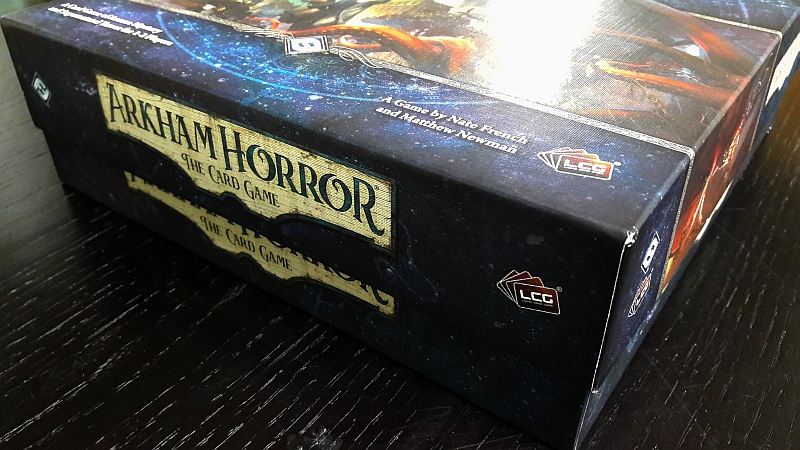
You can certainly buy frame inserts that are great quality and reasonably priced. However with a little effort (I cranked mine out in an evening), you can make a similar insert at a fraction of the cost and be just as functional. Don’t be put off trying your own hand at making foamcore inserts. They actually are a pretty easy project to do.
Review: Terminal Directive
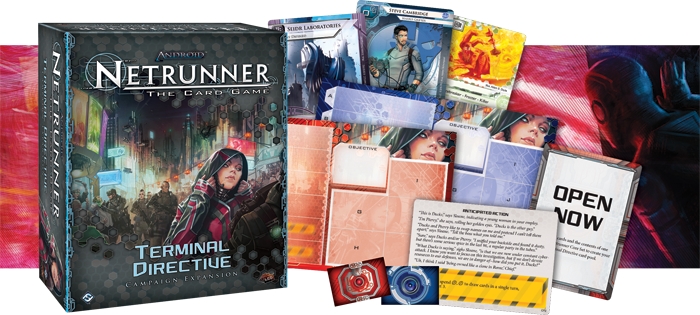 Terminal Directive, the new expansion for Fantasy Flight’s Netrunner LCG takes a different approach from past big box sets. It presents itself as a small, mini legacy campaign. For 2 players, each side takes control of either a mega-corporation or a cyber-hacking runner trying to unravel a mystery. Not to give too much away from the story, in this near future mankind has colonized the moon and other planets. Labor is mostly done by either genetically engineered clones or androids operated by sophisticated AI. Androids are particularly ubiquitous in the Netrunner world and adhere to something similar to Asimov’s Three Laws of Robotics, they can’t kill a human….or so everyone thinks. Because that is just what Terminal Directive revolves around, an incident where an android has apparently murdered several humans.
The game incorporates a legacy element. Each player accesses a particular set of cards detailing the story. They are offered a choice between two major paths, a proactive stance taking the ‘predator ethos’, or a more reactive, defensive position as a ‘protector ethos’. These choices dictate what special cards might be added to the player’s deck. In addition special tasks and abilities are added to an individual playerboard. As the player completes certain actions during the game, they mark off their progress and eventually may attain permanent abilities and effects.
Some actions might be related to trashing a certain number of corp cards, or giving a player a certain number of tags. Some are conditions that the player wants to avoid (eg. the corp player cannot spend a click to draw a 2nd card during their turn). If they break these conditions they get some cards that are detrimental to their deck, hindering their actions during future games until they can remove them by completing certain in-game events.
As you play through the campaign, more story is revealed. Additionally as you achieve certain game conditions, you get new abilities, new cards, and an ever expanding number of ethos choices. Much of the game is hardwired in choices to try and allow the opponent to catch up some initially. This is either done by introducing handicaps to the other player, or allowing the player lagging behind access to more powerful cards. Eventually though after 9 or so games, you will come to the end of the campaign with a final winner.
You are free to use what is available in your card pool for your deck. Also in between games you can freely change the composition of your deck (aside from your ID). However I feel the game is really centered on working with just cards from the core set. If you throw in access to a bunch of cards from different expansions, you might get some wonky play from the legacy campaign.
Terminal Directive is an interesting take on the past expansions for Netrunner. Because in addition to the campaign specific cards, stickers, playmats, and legacy elements are 163 cards split between 4 factions. HB, Weyland, Criminal, and Shaper all get new cards and IDs, including some faction-specific agendas and a few neutral cards. Unlike the campaign specific cards, these are all tournament legal. The breakaway from the past focus on 2 specific runner/corp factions of past expansions is a pleasant addition to the game. You will want to add these cards too. This set has some solid cards that will supplement just about any faction deck.
The Good – It’s a departure from past Netrunner expansions that offers a minigame with a narrative mystery story. The legacy format and progressive decisions help make for a different experience from your typical Netrunner game. As the cards go, it is a solid expansion adding a lot more options to the core set. The components are typical for your Fantasy Flight card game offering quality cardstock and art.
The Bad – The legacy game is clunky. There are a lot of small conditions to keep track of. Overall the game does a decent effort of trying to rein in an early runaway victory, but momentum of several wins are hard to break, especially if your opponent fails to stave off their initial caution task (adding more hindering cards to their deck). Even for an experienced player, you need to slow down your gameplay making sure that each action doesn’t trigger any game conditions.
The legacy game also has points where you need to access specific cards and objectives once their conditions are met. While cards are added to your deck between games, you have to immediately update your PAD playerboard, breaking up the flow of the game. The narrative of the story is also clunky. It would be so much better having options of the story based on the ID you selected. Instead you get a story based on some unseen third persona that feels tagged on. Overall the story is rather underwhelming.
In addition, I wish more was also put into the packaging. You get a clump of cards broken up by being either corp or runner, rather than individual packs for each section of the story. Lastly there is a ton of empty box space. So much so that the actual contents are deceiving given the huge empty box.
The Verdict – The legacy game within the expansion is underwhelming. You do get a different player experience going through it and I dig FFG trying to explore different play styles with Netrunner. Some parts of the legacy game work but others don’t. The biggest damning flaw is that the story progresses independently from the Terminal Directive IDs you choose. For such a supposed emphasis on the choices and evolving narration it’s sort of a let down that you have no real control over the major players of the plot. Nonetheless it’s a departure from the common Netrunner game and while it’s a mixed bag, overall I appreciate the different experience it provides.
However you can’t ignore that it is an expansion for people currently playing Netrunner. In that light it is a solid purchase. If you just have the core set and wondering what to get next, Terminal Directive is a good expansion to buy. For the money spent you get solid cards that build on 4 different factions and also has a small legacy game to mess around with. Long time players are also going to enjoy the card selection and as it’s considered a big box expansion, the set is exempt from rotation. If looking to delve more into the world of Netrunner or currently a rabid player, this is a great purchase.
[TIP: If you want to stretch out the life of TD, scan all the stickers instead. You can cut and paste them onto a copy of the playboard. I also scanned copies of cards with updated text and kept them aside as a reference during play. If you read the story cards to yourself and work with copies of the provided stickers, you can play through both sides of the campaign with one box avoiding the legacy elements of ripping up cards and adding permanent abilities to the PAD sheet.]
Netrunner Counter Trackers
A while back I made some simple credit and click trackers for Netrunner. They weren’t going to win over anyone with how they looked but the cards were functional. I seem able to stretch my collection and get a few people playing but couldn’t say the same with tokens from one core set. I also wanted something a little more portable than lugging a bunch of cardboard counters around all the time.
One thing about netrunner is it uses a lot of tokens. I like keeping track of information using counters, but you can get an explosion of markers and tokens on the table with some decks. Because of this I wanted to expand the card trackers I made to try and also handle other card conditions.
I ended up making a universal counter tracker. You could use it for virus counters, tags, even advance tokens if needed. It is limited to being only able to track 12 counters however. Another smaller tracker I made was for recurring credits. Just a small card to slip under another indicating between 0 and 2 credits, helping keep track of what is spent during a turn.
The look and design are clunky, likely enough to make any serious graphic designer gag. However they are functional. You can find them in the downloads section. Hope folks get something out of them for their games.
Review: Sushi Go!
 Gamewright offers Sushi Go! which is a simple drafting game for 2-5 people. Players pretend to be sitting at a restaurant quickly snatching up tasty sushi from a conveyor belt. At the end, the hope is to have assembled the most delicious combination of dishes for an epic sushi meal.
Play is rather simple. A set number of cards are dealt out. Each player selects and plays one card, and then passes the remainder of their hand to the person next to them. This is repeated until all the cards are played. Cards are scored and then discarded. A new hand is dealt and this is repeated for another round. At the end of 3 rounds the player with the most points wins the game.
A few cards offer a flat amount of points, but most cards work in sets. Some require another card or two to be worth points. While other cards offer points for having the most of that type, and some even offer points having the second or third most number of cards. A few cards even can multiply the score of other types. Lastly you have the pudding dessert cards.
Unlike the other cards, puddings aren’t put into the discard pile at the round end. Instead they remain face up and continue to be added to as a set. They offer no points at the end of each round. Instead at the end of the game the player with the most pudding dessert cards gains 6 points, while the player with the least cards loses 6 points (if you have no puddings you are safe). As you continue to play cards until all of the dealt cards are exhausted, it’s quite possible to get stuck with a pudding card.
The Good – Sushi Go! is an enjoyable drafting card game. The cards are decent stock with colorful, cute art. Not to mention that as it primarily deals with numbers after a few plays you could almost say it’s a language neutral game. It’s simple setup and efficient packaging makes it a great travel game too (but mind you’ll still need some paper and a pen to keep score).
The Bad – While it’s a light game that plays quickly, it can get a little repetitive. There is some strategy to choosing what card to play, however there is also a lot of luck. This is especially true of the first few plays each round as you really have no idea what cards are being circulated around. One bad pass near the end and you can get sunk with having to play a card worth little to no points (or be stuck with a single pudding dessert tanking your point total for the game). If only plays up to 5 people, just squeaking it out of that player number range of being a good party game.
The Verdict – This is a wonderful drafting game. While it can’t seat the numbers to quite make it a good party game, it certainly is a great family game. The bright adorable art, fast play, and simple set matching make it something younger children can pick up easily after a few games. But the simple play is a little deceptive.
This isn’t a meaty drafting game like 7 Wonders or Among the Stars but there certainly is some strategy here. You have to be mindful of what other players are selecting and figure out what they might keep and what they’d be willing to pass. Do you gamble and work on a 3 card set for a chunk of points, maybe you play a worthless card to ruin another player’s chance of doing the same, hoping to get something good on the next pass. These can be enjoyable decisions and something that makes for a fun, light family game while also having enough engaging game play to keep adults entertained. A lovely little card drafting game that’s well worth picking up if looking for something to serve as a light filler for an evening.
Review: Perfect fit sleeve roundup
I vary some with sleeving my cards for games. Usually I don’t but some games where you handle cards a lot or need to shuffle in select sets of cards like deckbuilder games, I usually sleeve them. When I got into Netrunner I decided it a solid idea to sleeve my cards and went the route of at least using perfect fit sleeves for them. For a lot of my gaming I am super casual, so no need to have opaque sleeves, but I figure if I ever hit up a tourney I’d have an easier time if I used snug fitting clear sleeves. So I set about getting some that turned out to be a bit of a mixed bag.
Mayday green – Stated dimensions of 63.5 x 88 mm, these at first blush these looked a winner. They were reasonably priced, and interestingly had some overhang at the top but it was minimal. However of the three packs I got, I ended up regretting my purchase. Seems one of the packs might have been stored under something as many of the individual sleeves and sleeve pockets were stuck together needing to be peeled apart.
Separating them didn’t help. Despite vigorous cleaning of the sleeve surfaces, I ended up having cards that always got stuck together. It was horrible. I would have cards that clumped up when shuffling or I’d end up picking up multiple cards when I drew. I even would be struggling to find copies of cards to only find out they were stuck to the backs of other cards. You can see a photo of how bad some cards stuck together (note there are 4 cards I’m holding).

KMC perfect fit – With dimensions of 64 x 89 mm, another big name brand was KMC, a japanese product of perfect fit cards. These were the real deal. A snug fit with no overhang compared to the Mayday cards and best of all, no problems of sticking together. A touch more expensive but worth it. The downside was they could be hard to track down, so I looked at some other alternatives.

Ultrapro Pro fit – Dimensions at 64 x 89 mm, I heard some horror stories for certain card types these were too tight and could bend the cards they were sleeved in. Maybe a few years ago this was the case but whatever manufacturer glitches they had, they must have worked them out. These are a snug fit without bending the cards. Best of all they didn’t clump up or stick together like the Mayday sleeves. A good choice if I couldn’t pick up KMC sleeves. They also matched up well enough in size if I had the two sleeve types mixed together, as I couldn’t notice a difference between the two.

I won’t say the Mayday sleeves ended up a complete wash. I think for the right kind of game, they work well enough. For my Combat Commander: Europe cards, they work great. Those cards are a bit larger than my Netrunner cards and are of thicker stock. So sticking isn’t much of an issue. I also used Mayday sleeves with my Race for the Galaxy and Dominion games. You don’t really need to shuffle those much and at least with Dominion, you are working with 30 cards or so which doesn’t seem to be that hard to mash a few cards together if they clump up a little.
However for my Netrunner decks, I’ll certainly be going with KMC or Ultrapro clear sleeves from now on. They fit snug and simply didn’t suffer from the sticking I saw with Mayday.
Review: Arkham Horror – The Card Game
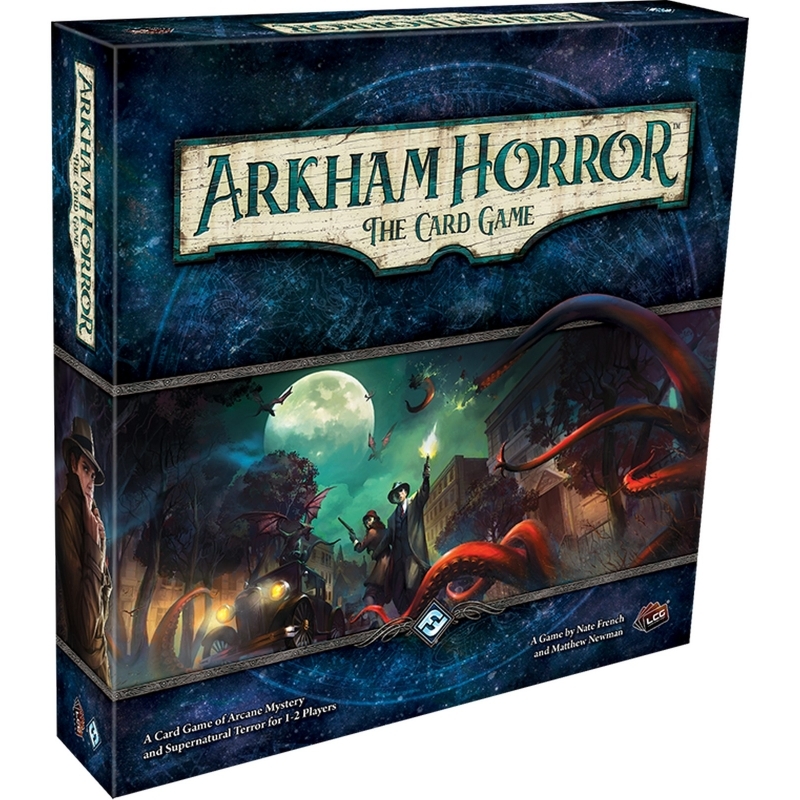 Fantasy Flight has a lot of games with the Lovecraft theme and decided to jump into the Living Card Game (LCG) pool with a card version of sorts of their old traditional board game sharing a similar title, Arkham Horror: The Card Game. It’s a cooperative, 1-4 player LCG deck builder. Players are investigators that discover there are terrifying things that go bump in the night but being the heroes they are, fight to ensure the safety of mankind. Sadly they’ll likely lose their lives or sanity in the process. The game is designed to play specific scenarios which can be just a one off session. However it really is designed from the ground up to form a longer linked campaign.
In the box you’ll find lots of cards which are split between those used by the player, and those for a 3 scenario campaign story. The cards for the campaign are generally divided into locations and story events for a specific scenario, and other cards which form the encounter deck. The encounter deck represents different obstacles, challenges, and creatures the players run into during the game. Each story has its own set of locations and different pools of cards that are used to create the encounter deck. As it doesn’t have a static composition for the entire campaign, you will find some scenarios have unique challenges and monsters.
In broad terms each turn is split up into different phases. The first is the mythos phase, where a doom token is added to a scenario (agenda) card. Whenever the number of tokens match the value on the card, something horrible happens and the next agenda card for the scenario is put into play. Then continuing the mythos phase, each player in turn draws a card from the encounter deck. This encounter deck will be adding more monsters and unfortunate events for the players. In short, something terrible always happens to every player and they are in a frantic countdown before even more bad things happen as the agenda deck advances.
Afterwards the players have their turns. Each player has 3 actions which can be used to play cards, move to different locations, or do a core activity in the game, carry out an investigation. While each turn there is a slow addition of doom tokens, the players are rushing from location to location to try and accumulate clue tokens through investigation. If they gather enough clues, they get to advance a different set of scenario cards (act cards) commonly resulting in something to their benefit.
This is really the heart of the game. The players have to slowly collect enough clues through investigation to discover what is happening in the scenario and finally learn the major objective needed in order to advance the campaign (destroy a monster, gather enough clues in an area, succeed enough times with a particular skill, etc.). All the while the evil agenda cards are accumulating doom tokens and reaching story milestones that ratchet up the difficulty. Commonly for most of the scenarios there isn’t a hard failure, just punishing effects that wear down the investigators forcing them to capitulate the scenario. At least until the end of the campaign when players learn they either emerge victorious or gibbering madly from being driven insane (or a turned into a pile of bloody goo).
Players will continually be making skill tests. Each investigator has varying levels of 4 select skills measuring their reflexes, physical prowess, mental will, and how clever they are. If this value is equal or higher than a target number, they succeed at their check. Players can play cards to bolster these values. Every card will have some skill icons. For each one that matches the test being taken, they add to the player’s total skill value. It’s not so cut and dried though. For each check a player pulls a random token which modifies their skill total (and the tokens are immediately returned to the pool). Most of the tokens offer a penalty roughly 75% of the time, with some even making the check fail automatically. Essentially this is like rolling dice but with an uneven distribution of results.
As mentioned, cards can be discarded from a player’s hand to boost the skill value of an investigator, and other players at the same location can also contribute to checks. This offers a feeling of working together for key challenges. While a handful of card types are only related to skill checks or one time events, most provide a static bonus or abilities as permanent assets. Players pay resources to put asset cards in play with some being limited to available equipment slots for an investigator. An investigator can only carry up to two assets in their hands for example. Meaning if they had a flashlight and a knife, they’d have to get rid of one of them if they wanted to equip a pistol. Some assets are followers and can provide exceedingly useful abilities (as well as be a buffer for physical and mental damage), but a player may only have one follower in play at a time.
While assets offer static bonuses and reusable abilities, the cards can also be used to boost skill checks. This makes for a fun choice during play. Do you discard an asset to help with a critical skill check? Or do you push your luck hoping to make a successful token draw, so you can put that asset into play as a resource for other actions in the future? While cards that are discarded can eventually return to the draw deck (once a player’s deck is exhausted the discard pile is shuffled and made into a new draw deck), commonly players will not get a chance to see that card again for the game. It certainly has that push your luck factor and can be an agonizing choice sometimes.
Players can play investigators of 5 general class types from bookish seekers, to rough and burly guardians, to mythos sensitive mystics. Each class also dabbles in another investigator class type. These restrictions mean that there will be investigator cards that the player cannot use (being of a different class type) which encourages having another different investigator in tow to tackle a scenario. For a solo player, they have the option of playing one investigator as a true solo experience, or instead have a second investigator in play.
In addition to challenges being thrown at the players from the encounter deck, they can also can run into horrible monsters and fiendish human villains. These enemies will do damage to health and/or sanity. If a player ever reaches zero they are out of the game (but not necessarily out of the campaign). Players find they can either attack an enemy directly to inflict enough damage to kill it, or evade it by essentially stunning it for a round. Evading a creature can be critical. If a monster is ready and engaged with a player, any time the investigator takes an action that isn’t to fight or evade, the enemy gets to attack. This can be brutal as a player trying to move, draw cards, or play cards from their hand will always be having an engaged monster attack them. If they can evade the creature, they can then act without risking an attack of opportunity.
Another kink in the player’s plans are weakness cards. Every investigator has one card that is specific to them which provides some impediment. In addition, one additional random weakness card is added to a player’s deck. Out of 30 or so cards then, 2 of them will be some type of hindrance to the player. Every turn a player must draw a card from their deck, and they can also use actions to draw. While a player is putting assets into play and using cards from their hand to help with skill checks, they will quickly be going through their deck. Yet every time they draw, they are getting closer and closer to drawing a weakness card.
This is an exceedingly clever mechanism. Most cooperative card games depend on the card draw flood. You want to be drawing as many cards as you can to have multiple options during your turn. This curbs that strategy. Some investigator weaknesses can be crippling if a player is unprepared. The player will find the flow of the game changes where they are at a point of wanting a lot of cards and looking to draw that weakness card early in the game (where they have more resources to handle it effectively), compared to getting it later in the game during a critical time when every action and card counts.
While you can get wrapped up in how Arkham Horror is a board game, you can’t neglect that it is a LCG deckbuilder. There are strict rules for constructing a player’s deck. Aside from class card composition, players can only have 2 copies of each named card. As players go through a campaign they can earn experience which is used to purchase more powerful cards (or replace existing ones with more efficient versions). You are limited to decks of a particular size, so you will be continually throwing out cards to make a place for new ones. While the rules recommend starting with some pre-constructed decks, players will eventually want to dabble in making their own.
The Good – It’s an enjoyable implementation of the original board game that has a narrative, choose-your-adventure style of play. Many scenarios will end with multiple options and the decisions, successes, and failures from one scenario have an impact on future games. Cards have enough keywords and varying game elements to allow for some interesting card combinations. While you can certainly go the brute force route of dumping cards for bonuses into skill checks, there are some nuances to explore.
This also comes about from the enemies and challenges that the players face. Aside from hard numbers for wounds, damage, and combat skill values, some creature cards can also have abilities making them play a little differently from other monster types. Combined with limited resources, actions per turn, and the clever implementation of weakness cards, players will have lots of engaging choices during play.
The random tokens for task resolution is also a great idea. You can tailor the pool of tokens to make for an easier or more difficult game. With 5 investigators out of the box, you can get a fair amount of replay from the base game. The solo option is also enjoyable which doesn’t stray too much from the play experience you get with an additional person at the table.
The cards are standard playing size and of good quality with wonderful art. The tokens are of nice card stock and are an excellent means of keeping track of damage and resources maintaining that tactile feel.
The Bad – The token draw for skill checks will likely drive some players crazy. You can typically count on it being a bad modifier, meaning you always have to try and get your skill value +1 or +2 over the base number. This can be for naught as there is a 1/16 chance (if using the normal difficulty) of failing automatically. I like it, but I can see some might find it mechanically jarring, heavy handed, and too luck dependent.
The other criticism isn’t too easy to dismiss. You have a short campaign out of the box of three, linked scenarios. You can get a few replays out of the campaign, but some of the scenarios are going to be repetitive. The mystery of exploring different locations and advancing the scenario story will seep away and you’ll be shifting to a purely mechanical play mode. This is compounded due to it being a cooperative game with automated enemy actions.
Lastly due to the limited card pool and rigid deck construction rules, you really can’t get a deep deck building experience with the base game. This has been addressed some with a new, revised core set, but you likely will want to get an expansion eventually to really explore deck construction.
The Verdict – Arkham Horror is a fantastic game. There is a revised core set that has completely changed the original composition of the old core set, making all my previous criticisms no longer relevant (see Update 2 below). So onto some small nitpicks with the game…
I really enjoy that it takes a narrative structure but there are limitations in how replayable the core campaign is. Eventually that shine of new choices and exploring locations will dull and repetition will arise, switching the feel of the game to more one of a mechanical exercise than that of experiencing a story. The limitation of card variety for the investigators from the old core set fortunately is addressed. You have a fair amount of deckbuilding potential out of the box, but expect to broaden that more by picking up further expansions.
The repetition of the campaign can and likely will be tinkered with. The use of cards for advancing the story is a great idea. If you add a few variations of cards for locations and outcomes for the agenda and act cards, you will suddenly see that scenario which was so repetitive before become much more varied and enjoyable to replay. Something similar was used with another card game, Space Hulk: Death Angel and I will not be surprised if by the end of the year we see a special add-on pack that expands the core box campaign to include variant cards.
For the original core set, it chafed me some. The notion of getting another core set was really promoted by the community and was absolutely wasteful. Almost half the cards were just set aside and never used. All the additional scenario and encounter cards were redundant (not to mention the tokens and rules). But it seems Fantasy Flight Games took this to heart and not only provided a revised core set (Update 2 below) but also released investigator deck packs to help you expand that player card pool easily.
Keen in mind, Arkham Horror is very much a LCG. It is immensely enjoyable. It captures some of the encroaching dread and doom in a horror-themed game (but after repeated play of the same content that will ease some). There is enough variety of card types and abilities to allow for interesting choices during play and also with deck construction. But it is solidly in that LCG camp of buying more cards to expand that card pool.
You can get a ton of game play out of the core set, with plenty of deckbuilding being part of that. However eventually you will want to dip your toe into getting a full expansion. Not only do they provide more cards to get a deeper deck construction experience, but also offers a full campaign story which will be a little more of an epic tale.

UPDATE: Years and several expansions later, I wanted to revisit my review. Is it a good game? That is a resounding yes. It’s wonderful news that the revised core set will have more deckbuilding potential. However with so many expansions and scenario packs available, you have quite a lot of options to build up your card pool. FFG also released a new product that is perfect for your initial expansions to the game. A set of starter investigator decks have a complete player deck along with additional cards that can be added by paying experience as a campaign progresses.
A long standing complaint was that with a single original core set there just wasn’t enough cards to dabble in deckbuilding, and additionally you were stuck with buying at least another base expansion box to get 3-4 players around the table. Now you can pick up one of these decks that not only a fully playable investigator, but additional cards to build your collection. This is something that provides a great means to expand deck construction and reduce the redundancy of a second original core set (which had encounter and scenario cards that were literally chaff). Yes, you might not get a really deep deck construction experience with a single core set. But if the bug bites deep, you have a lot of options to delve deeper into Arkham Horror: The Card Game.
UPDATE 2: Well I am astounded. It seems FFG has taken the issue of a limited core set to heart and is releasing a revised core set which looks amazing. You now have 2 copies of each investigator card and additional neutral cards. Even better, they are packaged as a complete deck for each investigator. Simply choose who you want to play and the deck is already made. Even better, there are additional options for upgraded investigator cards. These are cards that have been already released in previous expansions, but out of the box it will give players more options for deckbuilding as they progress through the campaign.
Throw in additional tokens and upgraded card art, seems you’ve got a fantastic product. Arkham Horror: The Card Game is wonderful and the revised core set makes this hands down, a fantastic game to add to your collection.
Netrunner has a new player problem
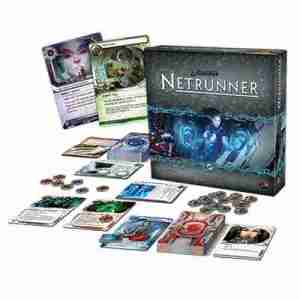 I enjoy Netrunner and have been teaching a slew of players for a while now. There is something that seems to hinder getting players into the game though. A key point is that despite it having a decent core set, it’s just not that approachable to new players. What is looming in the background is this wall of cards that almost seems insurmountable to decipher and break through. There is so much and the pool of cards so vast, it becomes a deterrent to trying to learn. Compounded with this perception is the requirement of having to purchase a big box set of cards to get into the game.
I like the base game. The core set gives a nice spread of different card factions and best of all, certain cards are still staples in competitive decks today. Also compared to Magic and other CCGs, Netrunner is a complete bargain to get into. But oddly Magic seems to have a smaller hump to get into the game.
It’s the draft events. For Magic, booster drafts are highly popular. Players throw in some cash to buy a few booster packs and then draft a deck from a combined set of cards. Some additional support is needed by having several basic land cards for players to add to their deck. However, for new players it’s a way to walk away from a tournament with a set of cards that comprise a playable deck. These are pretty newbie friendly tournaments that don’t require a large initial investment.
Netrunner could use something similar. There are some draft packs that are available, but the drafting environment isn’t that newbie friendly. Fantasy Flight also has dabbled with offering the 2015 Championship Decks. These are corp and runner decks that are pre-assembled. Offhand I think it’s a great product to get people into playing Netrunner but there are some hiccups. One is that the corp deck isn’t currently tournament legal. Secondly, (aside from an apparent misprint for the card cost) the runner deck offers an odd milling strategy. However the idea is pretty solid and leads into a concept of offering Core Deck packs.
Essentially these core deck packs are teaching decks focused on a single corp or runner faction. Ideally the agendas would be all in faction. New players could buy a pack and have everything they need to play. The deck might dabble some into the other factions and have a small spread of neutral cards (more on that later). The key would be to not stack 3 of a specific card type. Instead have two at the most. With cards bleeding over into other factions, the decks could serve as an incentive to pick up other starter packs aligned with that faction, or possibly get a core set. And if a new core set was available, even better.
The pickle of course would be the tokens. You might go the route of having 2-3 mini sheets of tokens for tags, brain damage, a few virus counters, 8 or so 1 credit makers, and another sheet of just 5 credit tokens. But an alternative might be to offer cards with slot trackers on them to keep track of tags, and credits, encouraging players to use coins, beads, and other tokens to push around on these cards to handle their resources. This leads into another point though of enticing new players to finally jump in for a Core Set 2.0.
Cards in the current core set are subject to errata, while some decks are simply illegal (and not just by tourney play). Combined with the encroaching rotation, it would be a great time to consider a new core set. Not everything needs to be changed. Just a sprinkling of some new cards possibly introducing ones with similar abilities to those being rotated out with the first two data pack cycles. This is something die hard Netrunner fans would be interested in picking up to round out decks. And if a player has nibbled by buying in though core deck packs, they can finally get a full set of tokens and expand their pool of cards. Having their hands on neutral agendas in the core set might also be an especially great draw.
Another plus is that they’ve got some redundant cards to allow for more people to play out of the box along with previously purchased decks packs. Along with these core decks, now you could easily have 4 to 6 people to jump into a new core box and play for a night. Mind that this is something you can’t really do now with the current box set.
There are some obstacles to these core deck packs, especially the hump of having a full set of rules and enough tokens to play. However it’s worth expanding on the idea of ready-to-play decks and offering alternatives to buying into Netrunner rather than just snagging a core set. Something to keep in mind, these core decks don’t have to be super competitive to the tournament scene in general, just competitive to other core deck packs.
You could have events where players just have to buy a runner and corp deck of their choice and still be able to play right off the bat. If wanting to participate in other similar events, they could pick up a deck or two of other factions to switch things up some if wanted. This would also allow them to lessen the initial learning curve with a smaller card pool, as they don’t have to jump into the game with a core box of 7 different factions. In the end something like this might make getting into Netrunner a little less formidable, and potentially more approachable to new players.
Netrunner Click-Credit Trackers
I dig Netrunner. While I have reservations recommending it to folks, I certainly enjoy it. Lately I’ve lamented some on how much it has dominated my free time gaming. I find I’ve fallen down the rabbit hole of deckbuilding and picking up cards for the LCG.
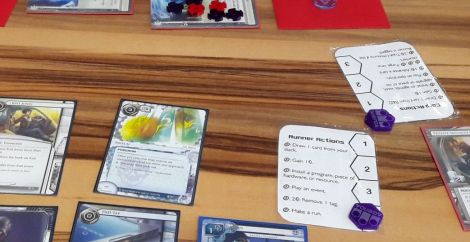
Even though Netrunner is rather portable, it does require a lot of tokens and markers. I also end up teaching players a lot and while I like the play aids that come with the game, I thought it could be better designed to incorporate both a click tracker and a reminder of player actions on one card.
In addition to that, I thought about using cards to also track credits. Splitting them up into single and 5 credit values on two different cards seemed acceptable. So I went to work and whipped some up on a single sheet.
They are ugly, amatuer designed aids, but functional. The trackers also don’t completely solve the token issue. You’ll still need tokens for bad publicity, tags, recurring credits, virus counters, and advancement markers. But with a little creativity and some different denominations of coins, you could likely cut down on the number of markers you need to lug around using the trackers.
You can print them up on cardstock, or use paper and laminate them if wanting something to take a bit more wear and tear (or just sleeve them like I did). I think they work pretty well. You can find them in the downloads section and I hope folks find a use for them around the table.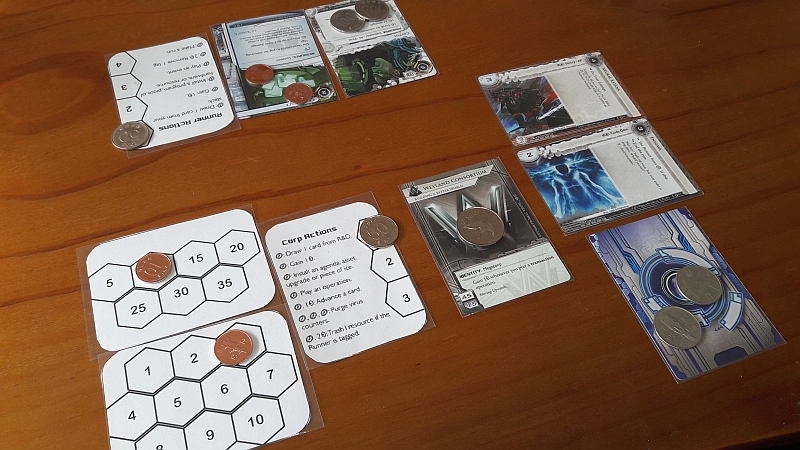

Review: Android – Netrunner
 In the mid 90s Richard Garfield put out a CCG than embraced the cyberpunk theme called Netrunner which petered out. Almost 15 years later Fantasy Flight picked up the rights and converted it to encompass their futuristic universe, hence the name, Android: Netrunner. It’s a dystopian future where megacorporations truly hold control over every aspect of human lives.
Colonization of the moon and Mars has begun, along with the development of sophisticated AI, androids, and human clones which serve as slave labor and are essentially products bought and sold. Beneath all of this are human beings that go about their daily lives, scraping by, and essentially are at most drones and corporate slaves to their employers just like the clones and androids they encounter regularly. A few choose to explore cyberspace instead fighting for either ideals or profit against the megacorporations as runners, hackers that steal data from corporate assets.
Android: Netrunner (or just Netrunner) is a two player, living card game. Fortunately FFG dumped the collectible aspect. Instead they opted to crank out expansions with fixed numbers of cards. Want to expand your card pool? No random booster packs. Just pick up a small set of cards and you’ve got everything in that expansion. The gotcha of course is through the constant roll out of expansions, you get that lure of the Pokemon gotta-catch-em-all urge to keep buying into the game. Combined with a healthy competitive tournament scene enticing players to keep up with their gaming opponent Joneses, there is definitely a draw to buy new sets as soon as they are released.
I avoided the siren’s call of Netrunner for a long time. But I was in the mood to pick up a new deck builder game and the theme and aspect of a LCG was attractive. I did Magic and was not keen trying to get back into that game. The collectible aspect of Magic just wasn’t something attractive to me any more. So I jumped into Netrunner feet first and now regret that decision immensely. It’s not that the game is bad. Far from it.
The basic rundown of Netrunner is that the corp player has agenda cards in their deck up to a specific total. Each card will commonly be worth between 1 and 3 points. To score them the corp player has to play them and spend actions (clicks) and money (credits) to advance them to a specific sum. Once they do so, they can immediately score it for points. The runner however just needs to access it. The runner isn’t limited to accessing agendas in play. They can also access agendas in the corp player’s hand, deck, and discard pile. To prevent that from happening, the corp player will lay out defensive ice cards to sap resources or stop the runner. The runner in turn slowly builds up a suite of equipment and resources to bypass ice and access those agenda cards. The first player to 7 points wins.
It’s actually a pretty easy game to learn. However once you begin to play, especially as the corp player, you begin to see the route of winning isn’t so easy. The corp player only has 3 actions per turn (or clicks). To play an agenda is one action and to advance it each time also takes an action. Most agendas take must be advanced 3 to 5 times to score. That means it will usually take at least 2 turns to score. All the while, you have to hope that your defensive ice is enough to ward off the runner trying to pick up that agenda. And to make matters worse, the runner has 4 actions during their turn. So they have plenty of opportunities to bolster up their resources and programs to make a successful run.
Now mind you, it’s not just agendas in play, but also agendas you have in your hand or possibly the top card laying in your draw deck. Forced to discard a lot of cards in your deck? Those juicy agendas might now be in your discard pile, just waiting for the runner to scoop them up. And that’s the kicker. While the corp player has to spend cash and actions, slowly and painfully advancing agendas for points, the runner just has to slip past that ice and steal them.
It’s not all roses for the runner though. Some ice is tough and can be one of four different kinds. If the runner doesn’t have an icebreaker program installed, actions on the ice card will execute if the runner bumps into them during a run. Most simply end the run action but some ice can destroy those icebreakers installed by the runner, or force them to discard cards from their hand. This leads into another way the corp player can win. If the runner player ever has to discard more cards than what they have in their hand, they lose immediately. Given each player can only have 5 cards in their hand at the end of their turn, the prospect of hitting horrible defensive ice or a trap card in the corp’s play area becomes a huge threat.
To add to this tension is a simple aspect of hidden information. The runner puts cards into play face up spending an action and paying cash up front. Pretty much everything they do is open to the corp player’s knowledge (save the cards they are holding in their hand). The corp player installs their cards face down simply by spending an action. They can rez (or activate) their cards later, spending the cash when they want to do so. Granted a runner might expect that card gathering up advance tokens is an agenda, but not always so. Sometimes it can be a trap to wipe out the runner’s installed cards (or even worse, force them to discard almost their entire hand). All those defensive ice are also installed face down. While the corp player still has to pay cash to activate them, the runner has no idea if that face down card protecting the corp’s draw pile is huge wall, effectively stopping them until they can install the right icebreaker, or something pretty easy they can bypass.
It’s the hidden information and aspects of bluffing that make the game enjoyable. Add to that the limited actions each player can take per turn, combined with constraints of available resources (credits), and you have a fun game with high player interaction. Layered onto this are the various factions for both the corp and runners. You end up with a game that has a lot of variety in gameplay which is engaging and entertaining.
The factions and aspects of deck building are also a huge draw. You are limited to 3 cards of one type and decks which must have a minimum number of cards affiliated with a particular runner or corp faction. Along with this are rules for influence when building your deck. Each card is worth between 0 to 5 influence points. If you want to dip into another faction you are welcome to do so, but that subtracts from your influence total. There are some powerful cards which can provide great combinations with other factions, but they dig into your influence pool meaning you can only tinker some with another faction. Fortunately there are also neutral cards for both the runner and corp that allow the player to freely add to their deck and don’t cost any influence points (save for a few exceptions)
I think one notable problem with Netrunner is that it can consume your free time so easily. It’s said people live Netrunner, and I can see that. I fear I might end up ditching time to play other games so I can explore Netrunner further. It’s made me keen to keep tinkering with decks and work up wicked combinations, with the added excitement of picking up another expansion, opening up more and varied card options.
The Good– Netrunner is immensely enjoyable, engaging, with lots of variety in play, and plenty of cards to expand the game further. Thrown into this is the asymmetrical play experience and win conditions. It truly is a wonderful 2 player card game. Not to mention a game plays pretty quick (where a longish match might be 30 minutes at the most). Add to this a bevy of lovely card art and you’ve got a great game.
The Bad – There is a huge game knowledge curve. Learning the game is actually pretty easy. However gaining understanding of all the nuances of play is not, and Netrunner can be brutally unforgiving with mistakes. There is a huge divide between dabblers and folks that play a lot. It’s a combination of both knowledge and cards.
If you play a lot, you know the combinations of cards out there. You are better informed, more prepared, and in turn likely able to construct a deck that is fluid enough to tackle whatever your opponent throws at you. Netrunner has a lot of trump cards and hard counters for them. If you don’t read what your opponent is telegraphing with how (and what) they are playing, you will get smashed. Lastly, it’s a two player game and the core set can’t effectively create decks that more people can mine from if you wanted to do a four player dust up for an evening.
The Verdict – My opinions are in this odd juxtaposition for reviewing Netrunner. If you want to dabble, get a core set and a few choice expansions or data packs. You will find so much to explore and get a thoroughly engaging game that will last you a long time. Add to this a plethora of existing card expansions and you can squeeze years of gaming out of your purchase.
But to jump into the competitive scene it will take effort. So much so it might not be worth doing. You will end up seeing this game divide between casual players that have a lot of fun, and experienced players that go for the deep, engaging, play experience. And if constantly teaching new players, fans of Netrunner will always seem to be struggling to keep within these two camps.
Even as a relative casual player, eventually you’ll be armed with a wealth of knowledge of card types and set strategies. You’ll be able to quickly recognize if an opponent is potentially laying out an agenda to score, or setting up a devious trap. For a brand new player, it’ll take a substantial amount of time to get on a similar level of play, and they might not feel it worth the effort to do so.
It is a niche game. If you have 2 or 3 friends that are adept at CCGs you can get some mileage out of Netrunner. Spend another $30-50 to buy 2-3 select data pack expansions and you’ll have a robust pool of cards to make a variety of decks, more than enough to keep a few casual players occupied for a really long time. But throw a knowledgeable player into the mix and even hobbled with a handicap deck, those experienced players are going to tough to beat. That chasm with familiarity of the cards can be that deep.
To me that’s the problem with Netrunner and something that keeps me from recommending it to all but a few select gamers. To get the most out of it and willing to encompass the larger player base, you need to be committed. If you have the time and players, that might be worth it. Otherwise you will end up just playing once in a while casually. In the end that enjoyment might not go that far, as there are too many other games out there that offer immersive play with less of a learning commitment.
UPDATE: Netrunner will be getting a new core set in Q4 of 2017. By then rotation will have hit (removing the first 2 expansion cycles from the game). More importantly, this new core set retires some card standards. It will have a big impact and already has shook up a lot of the conventional wisdom of the game. So much so I think new players will be on much more even footing as long time veterans. It’s still a deep game. There still needs to be that commitment to learn (and buy a few of) cards in the expansion cycles. However for a new player I consider it a great time to get into Netrunner at essentially the ground floor of a game reboot.
March 2021 UPDATE: Netrunner sadly went the way of the gaming dodo and is no longer in print. However Project NESEI, a fan collaboration, has been busy introducing a new set of cards to get people playing, System Gateway. It’s a slimmed down, 2 deck pack to allow folks to learn the game, matched with another small set to expand their card collection. Along with this is an existing expansion released a few years ago, and another set which re-released old classic Netrunner cards to broaden deck building potential even more.
With excellent card printing services out there, you can accumulate a good set of cards for a reasonable price. Plus it appears Project NESEI will release a small expansion every year and tweak the official card pool even more. It looks like a bright future for Netrunner (as much as it can be for a game officially out of print). If keen to give it a try, now’s a wonderful time to try the game out.
 Geek Ken