Category: Board Games
Being a completionist with board game reviews
 I don’t have a huge board game collection. It’s pretty modest. And over the years I thought it better to put up reviews for smaller titles or ones that seemed more the new hotness within the gaming circle buzz I hear. I didn’t feel a need to put up my thoughts for all the board games I own.
However I’ve sort of had a change of heart recently. Looking back, I realize there’s a reason why I’ve picked up certain games. Seems there is more than just being a fun game, but that they have mechanisms that satisfy a type gaming experience I want. They fit within my collection and fill in particular gaps with the types of games I own.
In that aspect I think there is something more to talk about with the games I have. So to that end, I’ll likely start going through my collection and begin to compile my opinions on them. Expect to see a few more board game reviews in the future.
Review: Space Hulk: Death Angel
 Space Hulk was always a favorite Ameritrash board game of mine. While it eventually got bloated with a lot of different expansions, the core game was a fun asymmetrical romp as one group were armored marines with big guns and the other a stealthy group of terrifying aliens seeking to surround and eventually overrun their opponent in hand to hand (or more aptly fangs and claws). It went out of print long ago but occasionally GW reintroduces it for a limited print run. It’s a fun game but not something I think worth picking up again especially as there are other options out there which are better games and just as fun (cough… Level 7: Omega Protocol… cough).
Nonetheless, Space Hulk has that draw and interestingly was something mined for a co-op strategy card game via Fantasy Flight Games. Space Hulk: Death Angel is a cooperative 1-5 player game, where players are teams of 40K space marines exploring a derelict spacecraft, seeking to purge it from genestealers during a salvage operation. They will either succeed in establishing the win condition at a final location (usually by eliminating all the genestealers), or die trying.
Players select a pair of combat teams, commonly one ‘regular Joe’ space marine and the other a special marine. They also get a specific deck of action cards that either allow the space marine team to move and activate a terrain card, support another marine, or attack. The special marine sometimes has different weaponry but will also have a particular ability associated with one of the action cards. So they might be able to do a cool attack with the attack action card, or shift around genestealers with a movement action card, etc.
After players select their combat teams, they line up in a random order in a straight line. The top group in the line facing one direction with the lower half facing the opposite direction. The players have to go through a series of locations represented by a deck. Depending on the number of players, there will always be a specific start location. However for the remaining deck, it will be randomly constructed from three possible cards for each location.
Players have to get through all four location cards and complete the end task on the final card (this doesn’t include the initial starting location for a total of 5 different areas). As a location card is revealed, additional terrain cards are placed in the line of marines representing doors, tight corners, or ventilation shafts. These terrain locations indicate potential spawn points for genestealers.
Players go through action cards in their hand and select one which both marines in their combat team will take for the turn. Each action card has a sequential number and turn order for actions occur based on them. After all the marines have completed their action, remaining genestealers in the area attack the space marines.
Finally, a random event is drawn to end out the turn. Sometimes it’s a boon for players but typically it is some added difficulty like genestealers shifting attack positions, or a marine’s weapon jamming up. The event cards also indicate where more genestealers will spill into the current area by drawing cards from specific piles. Lastly, some groups of aliens might also shift around based on having symbols that match with the drawn event card (more on that later).
Each marine has a range with their weapon showing the number of cards on either side in the formation line which they can shoot. They also have to be facing the direction of aliens they attack, rolling a d6 with special icons. The die has numbers ranging from 0 to 5, and half the faces have a skull icon. If the player rolls a skull icon they remove one genestealer card from the area (so a 50% chance).
When marines are attacked, they have to roll greater than the number of genestealer cards attacking them. So if they are facing five or more cards, they are dead. If a player loses both marines under their control, they are out of the game. Players can get around this by spending support tokens. They allow them to reroll either attack or defense rolls. However this can only be used on groups of genestealers that they are facing. If attacked from behind, they can’t get any rerolls.
Once a turn is over, players cannot use that action card for the next turn (and keep track using special tokens). Instead they have to choose one of the other two options in their hand. This restriction of actions, importance of orientation, and constant random shifting of genestealers means the limits of choices in marine actions lead to tough choices. You will be constantly wrangling your reduced options with other combat teams, trying to attack when you can, maneuver to offer support in future rounds, and pass off support tokens to other teams if needed.
Each location has a limited number of genestealer spawns. As cards are removed from their piles and added to the area (or are eliminated), the piles become exhausted and this becomes a condition to draw another location card. The marines essentially move deeper into the space hulk with new genestealer blip (spawn) piles created and new terrain cards added. The kicker is that all the genestealers from the previous location shift along in the same positions as the previous location. With more creatures constantly being added to the area, the threat of being overwhelmed ramps up. So the players are under constant pressure to keep destroying genestealers.
Not being able to freely select all your actions each turn is where Death Angel shines. Sometimes it can be agonizing to decide what to do and occasionally you have to sacrifice a marine so that others can fight on. It can be heroic and frustratingly challenging.
The Good – It’s a fun engaging game with some difficult choices. Despite being just a card game, it does manage to capture that feel of a group of marines exploring as you overturn new location cards, ever building up the tension as the hordes of genestealers keep coming, all the while ones from previous areas spill over into new sections of the ship.
The combat is brutally simple, but the positioning and management of limited actions adds to it. There is a small variety of location cards adding some replay value. Given that some locations have special abilities (like a means to teleport all creatures in play into space, or doors to cut off routes for the genestealers), this also adds some other key tasks for the players to focus on instead of just shooting genestealers. The cards are nice stock with the great, classic, gothic sci-fi artwork that you’d expect from the 40K universe. The designs and icons on the cards are also well done once you decipher what the particular symbols represent.
The Bad – Although it is a co-op game, there is still player elimination. Given that combat is so unforgiving, you can potentially see a team get eliminated early which sort of sucks for that player. While there are only 3 cards of each location type, given you have a total of 4 locations to go through, there is a decent variety in the box. The same however can’t be said for the space marines. After a few plays you’ll likely slip into using favorite teams with some having abilities that are more applicable in multiple situations compared to others (hence, you might consider them ‘better’ choices).
The game has a large amount of luck. Particularly with the position shifting of genestealer hordes at the end of each phase. You can have a great setup and support tokens to mitigate bad die rolls some, only to have it all fall apart as a horde of aliens have suddenly merged into another group and flanked a key marine. Along with this are some downright painful event cards (like some that can eliminate a marine instantly), all of which contributes to a game that might be too chaotic for some. While I like the randomness, you can indeed manage to get a series of bad draws of event cards that can pretty much tank your game.
The Verdict – I enjoy Space Hulk: Death Angel. It’s an enjoyable co-op strategy game that is light enough to get into quickly but still offers difficult choices. It has enough randomness in the setup and play to add replay which will break away from repeatedly using the same game to game strategies. The only stickler is that I wish there were a few more options for combat teams, or a variety of ability cards for existing marines.
This isn’t the same tactical experience of the original board game. However it’s still pretty fun and even in its abstract form of cards and piles of genestealers shifting around, you still get that experience a little of tense exploration, never quite knowing what the next section of the ship will hold. I think the limited action choice from turn to turn encourages you to talk with other players and try to get some synergy with tactics. Also, it provides a demanding solo play experience too. Given the small box and price, there is a lot of fun to be had inside. If wanting an abstract, tactical game with a sci-fi twist, this isn’t a bad choice.
[UPDATE: Some big news came out a few weeks ago regarding the licensing of GW IP and Fantasy Flight. Appears FF will not be continuing GW games. So it’ll be interesting to see if Death Angel gets picked up by someone else.]
Boardgaming in Korea: First Alleyway
Over the years I’ve covered a lot of board game shops and board game cafes in Seoul but I’d be remiss to not mention my hometown, Gwangju. For several years now there has been a local haunt for tabletop folks at an eatery, The First Alleyway. This isn’t a place that sells any games or gaming supplies. It’s a full up restaurant. However you’ll find it’s a place open to folks playing games at the establishment.
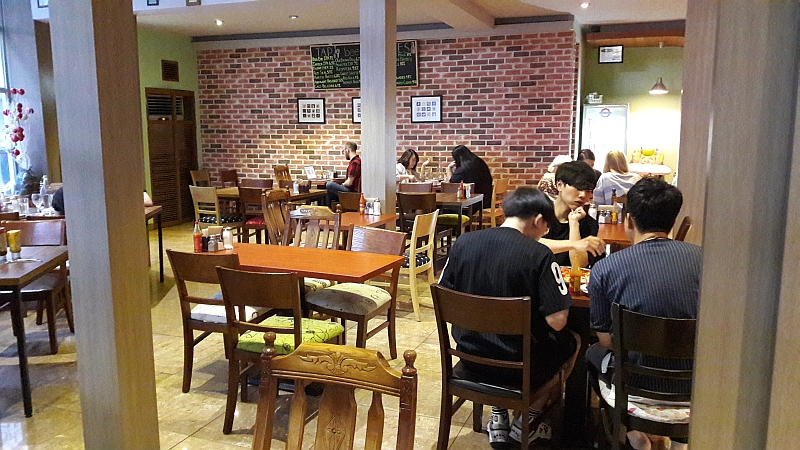
The place is well lit with several tables that can handle 4 people spaciously, or smaller tables for couples that can be shifted around to accommodate larger groups. While it doesn’t sell board games, there is a decent selection of games on hand. The choices lean towards lighter fare like King of Tokyo, Smallworld, Settlers of Catan, and Ticket to Ride, but a few meaty games like Dominion can be found too.
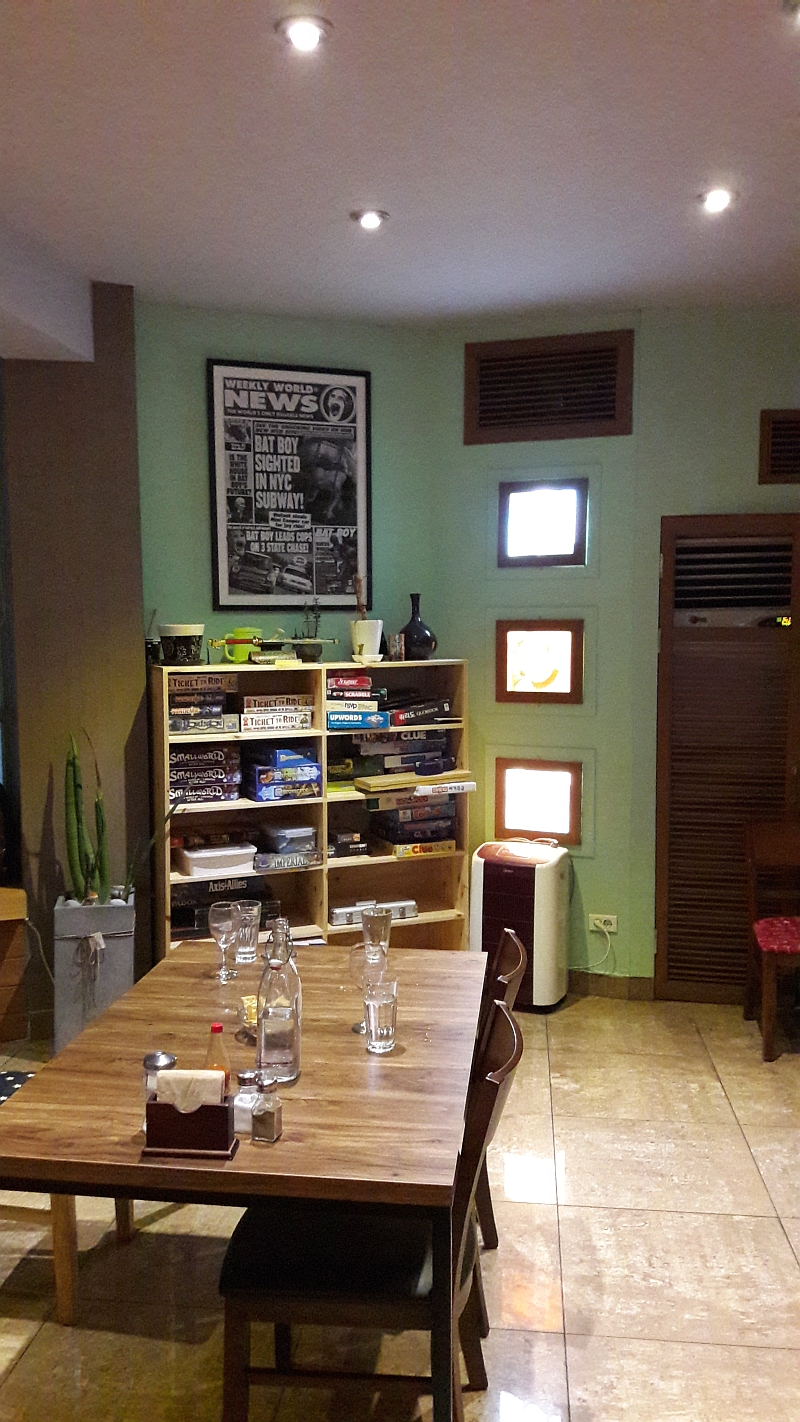
Just one of the various game shelves throughout the place.
The policy of the place for playing games is relaxed. As long as people are buying food and drinks, the owner is open to people playing games at the tables. However on some packed nights during the early evening rush, they might gently ask some folks to move over to tables by the bar if people are more inclined to be just drinking coffee and water.
The interesting news for the place is that the second floor of the building will be open soon exclusively for gaming. A handful of tables will be set up, along with a more extensive game library including RPGs and classic hex and counter wargames (the owner has a soft spot for ASL). There is also a larger table set up for miniature wargaming along with another room that will be host for workbenches if people need some dedicated space for painting.
Now I’ve focused on the gaming potential of First Alleyway which is possible here, but understand you are playing at a public restaurant, so expect all the limitations and issues that come with that. But there are also some major plusses in the manner of craft beers and great western food. A staple selection of hamburgers, (real) pizza, sandwiches, and salads can be found on the menu. Not to mention a variety of offerings for the classic Canadian comfort food, poutine. The place also has a full bar with staff more learned in the art of pouring cocktails than some other places in the city. And their selection of beer is top notch.

Its location and more info can be found on their facebook page. Gwangju is known for its Korean food. If you ever visit Korea, you are doing a disservice to yourself not to eat local. Yet if spending some time in Korea you might eventually have a hankering for something a little closer to home, and this restaurant certainly fits the bill. However if you are keen on checking out the local gaming scene, the First Alleyway is a must stop. A great place to play board games and at the very least have a drink or two.
Review: Harbour
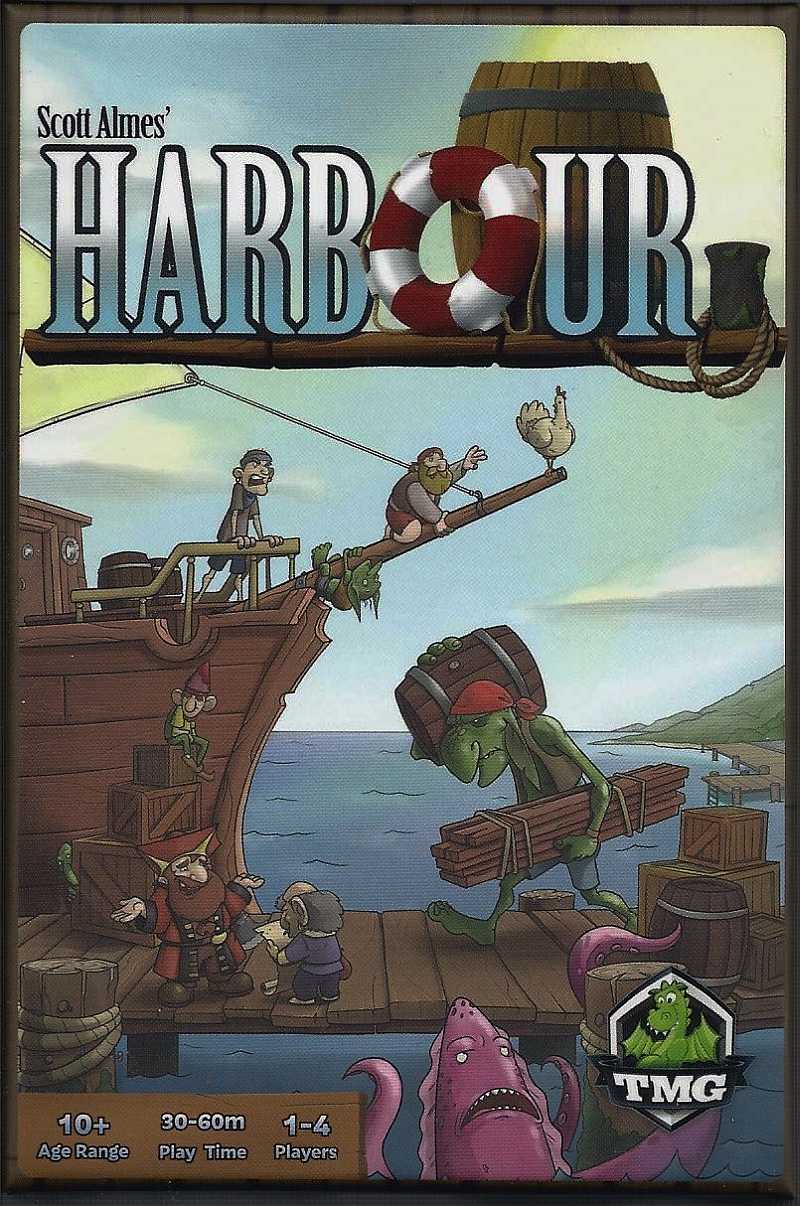
From Tasty Minstrel Games, Harbour is a 1-4 player game where players are competing trade brokers in a fantasy harbour. It is a compact game that will play in about 45 minutes or so, easily allowing you to get in a few games in one sitting. It revolves primarily around selling and producing goods, all the while trying to buy up special buildings for additional options during your turn and victory points. Once a player has a total of 5 buildings (including their starting warehouse building), the game ends.
Turns run pretty simple. A player moves their meeple to an unoccupied building, and then takes the action on the building to the best of their ability. If goods are sold, the market is adjusted to reflect new prices and the next player takes their turn. Simple.
Each player has an initial warehouse building which tracks the number of different goods that they hold. There are four types of goods (fish, stone, wood, and cattle) and the price of these goods range from $2-5 dollars. Paired with these prices is a required minimum number of goods for that particular type which must be in your warehouse if wanting to sell. As a mental cheat sheet, the price of a resource equals the minimum number of stored goods (so if stone was $3, you’d need at least 3 stone in your warehouse).
The catch to this is once you sell a good, you sell everything, regardless of the actual price of the goods. So if you’ve got 5 wood stored away and decide to sell it for a measly $2, you have to unload all of it. None of it can be saved for later sales (although certain building types allow you to bypass this restriction).
Added to this is a very fluctuating selling market. It’s hard to describe effectively without diagrams, but essentially goods that are sold move down a track and reenter the market at the lowest value. All unsold goods move up in cost (and the required number of stored goods needed to sell). Depending on the value of the good sold, you can really shake up the market. Low value resources won’t change the market much, but selling higher value goods can really alter the prices of everything else. What compounds this is that most buildings are $6-8 so you are always selling 2 or more resources to get the cash needed to purchase them.
Aside from a winning condition, owning buildings means that other players have to pay a good to use it. Buildings themselves have different abilities which typically allow for the gain of goods coupled with losing some others that are owned, or the shifting of the market. Some buildings also have other properties that allows for storage of more resources, cheaper building prices, or allowing a player to use an opponent’s building for free.
Players can purchase a limited choice of buildings out of a deck of 36 different kinds. Most abilities for buildings are shifting the loss of a few goods to get a small gain in another, or just adding one or two goods to your warehouse. There are a few buildings that allow for gaining of more resources depending on owning particular building icons. However these are few and far between.
Another layer of variation is that the game comes with different player abilities and starting buildings. You have the option of starting out with everyone having a generic player mat. But you can also choose from 14 different player mats with different abilities and matching building types. So out of the box there is quite a lot of variety making room for a different play experience from game to game. You also can play the game solo playing against an AI opponent, so you can stretch the game play even further
The Good – Harbour is a fun little game of worker placement and resource selling. There is a surprising amount of variation in building and player types that give the game a lot of replay. It plays pretty fast and the manipulation of market prices and gaining of select goods is engaging. It’s not overly complicated but certainly will make you think some in how to tangle out what goods to work on and the opportune time to sell and purchase buildings. The artwork is light and whimsical capturing a fun fantasy theme of a fictitious harbor. You get nice, thick, card stock building cards and chunky, wooden resource tokens too.
The Bad – While the market moves prices in an interesting way, it practice it becomes exceedingly difficult to predict. It’s almost too volatile in a 3-4 player game and certainly favors the player that can jump into selling goods early. While there is some room for having a combination of buildings to gain a lot of resources, typically you are only having a net gain of 1 to 2 goods a turn.
This leads into my major gripe with the game. It just seems to end too quickly. You really can’t construct an engine with owned buildings before the game ends. It also creeps into a snowball effect for the few players in the lead. Once they have an advantage of a building or two, it’s almost impossible to catch up.
The Verdict – Harbour is an okay game. Hands down for the price you are paying (less than $20) it’s an immense value. The small box offers a lot of replay and can even offer an engaging solo game. However, while there is room to explore different strategies there never seems enough time to fully develop them.
You’re in a frantic race to gain the right goods at the right time and if you miss out, you can really fall behind. If an opponent is in the lead and can capitalize on another market opportunity, you’ll find yourself in a deep hole that’s too hard to get out of for a victory. So you have to usually jump into buying what buildings you can afford right now, over planning a turn or two to try and pick up other buildings that could offer a deeper ability interaction with others you own.
In the end, I don’t find Harbour a bad game. For such a small package, there is a lot of enjoyable game in the box. But it’s not an amazing game. While the play is engaging and you have some interesting choices, the market is so volatile and the building types so limited in function, it doesn’t allow for a lot of strategic maneuvering. It’s an enjoyable game. But oddly for how much it allows for some careful planning and thoughtful choices during play, other bits like the constant market price swings just make that decision process squandered some.
I think the most saving grace is the price, box size, and card variety. It leaves a small footprint on your shelf and doesn’t sink deep into your wallet. If looking for a relatively light worker placement game with some market interaction, Harbour isn’t a horrible buy and you can squeeze a large amount of play out of it without it getting repetitive.
[House Rule: Players only get to use another player’s building for free if they own more top hat buildings than their opponent. Getting top hat buildings is pretty easy to do. This tweak allows for an advantage if a player delves into owning multiple top hat buildings allowing for a potential strategy. As RAW, it’s a little too to easy to counter by simply gaining one top hat building.]
Review: Cthulhu Realms
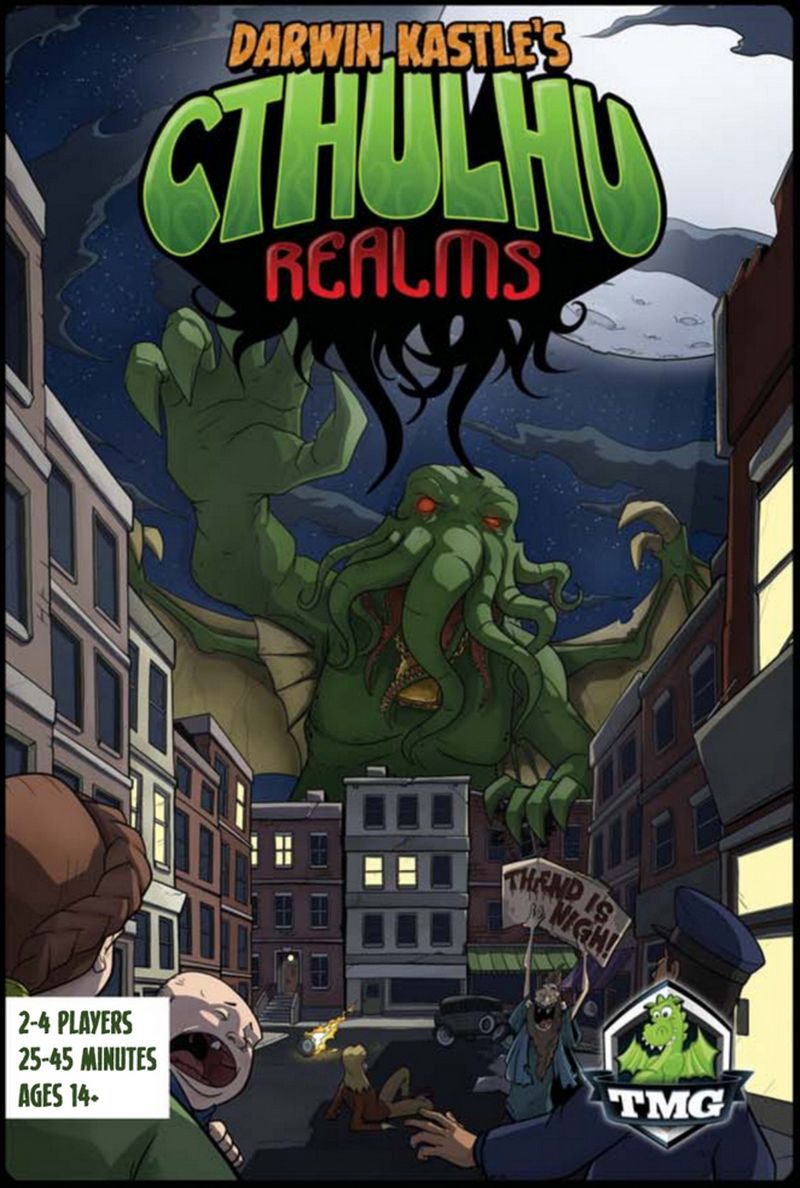 Tasty Minstrel Games offers Cthulhu Realms, a small deck building game for 2-4 players. This is a nod and a wink to Star Realms, which is another small deck builder game from a different company. Players are nefarious followers of Cthulhu trying to drive their opponents mad, inflicting damage to their sanity. It’s a game of player elimination where players try to reduce each of their opponent’s point total (sanity) to zero being the last cultist standing.
As mentioned it’s a deck building game. All players start with a standard deck of 10 cards and have common card supplies which are shared with other players. During their turn, a player will play as many cards as possible from their hand. Cards have a variety of powers which can be activated in any order (including switching back and forth between played cards). Generally cards offer conjuring power used to buy cards, gain/reduce sanity, or draw/discard cards. After playing cards, everything is discarded including their hand, 5 cards are drawn from their deck, and their turn ends.
An exception to removing all cards are locations, and these become important as they always remain in play. Further, many cards require a certain color type in play. So locations become great focal points to use in card combos. They can be removed and thrown into a player’s discard pile by being attacked directly (where sanity loss is applied to a particular location instead of a player). Additionally, some locations have a characteristic that forces their opponents to remove that location first, before attacks can be made against a player. Thrown into this is another location type that must be targeted and destroyed before other locations can be attacked. You’ll find out quickly adding locations to your deck a key strategy during play.
There are three types of cards (followers, locations, and artifacts) along with 3 color types of cards. Many card powers require combinations with other cards to utilize all of their abilities successfully. Another key ability of some cards is abjure, essentially a discard ability removing cards from the game entirely. This is a good way to thin out your deck or potentially get rid of a juicy card your opponent would likely pick up.
In a 2 player game, a supply pool of 5 cards is available for each to purchase. In a multiplayer game, between each player is a separate pool of three cards forming a pinwheel of sorts. For a 4 player game this becomes interesting as sanity loss can only be directed towards opponents to your left and right (ones you share card supplies with). There will be a 4th player essentially untouchable. This won’t last long though as sanity loss hits both your left and right opponents simultaneously. So no hemming and hawing about choosing who loses a few sanity points.
The Good – This is an enjoyable, light, deck building game. It moves pretty fast with some interesting card combinations to explore. There are a variety of approaches in play, either focusing heavily on one color of cards, or trying to spread the field and work up a deck of several card types. I enjoy the multiplayer setup making it a little structured in card supply pools rather than everyone using one card supply. The player point totals use a nifty card and counter system to easily track sanity (victory points) which also doubles as a card ability reference. The card artwork is whimsical and of thick stock. Fans of H.P. Lovecraft will likely get many of the inside jokes on the Cthulhu mythos.
The Bad – Not all the card icons are easily digested and deciphered. Expect a bit of a learning curve and having the rules handy to interpret some of them. While the rulebook is a tight document, the layout is a bit of a hassle as it’s spread out on a single, folded sheet of paper. The card artwork is cartoony and just might not work for some. Lastly there are a good number of card types, yet after several plays you might see some card combinations being to recur.
Once a card is purchased, another is immediately added to replace it. This can lead to buyer’s remorse if a powerful card is suddenly added to the supply pool. As there are some especially strong card combinations, it can be simply a matter of players scooping up the right cards first (and these combos can be difficult to break up if not in possession of the right card types). Another quibble is there are multiple powers on many of the cards, and as you can can switch back and forth between other cards in play during your turn, keeping track of used powers and conditions met for other abilities can sometimes be a chore (using pennies or glass beads covering up used powers helps).
The Verdict – I like Cthulhu Realms. It’s a fun, quick, deck builder game. The theme is light and certainly not serious, so I can give a pass on the card art style. It’s not meant to be a somber horror game despite dealing with the Cthulhu mythos. There is just enough variation in the cards and multiplayer layout to add a fair amount of replay. It’s a player elimination game, however it doesn’t quite drag out the process of players dropping out once massive sanity points are being lost left and right.
In the end, you have a compact 2-4 player game in a small box. It’s a surprisingly effective package that delivers a great little deck builder with a low price tag. If you can embrace the playful theme, you’ll find a pleasant gem in Cthulhu Realms.
Review: Zombicide – Toxic City Mall
Zombicide has gotten quite a few different expansions out since it was first released, with many of them sufficient to work as a base game. I had a lot of reservations with Zombicide. While the quality of the components were great, aspects of the game play were lacking. Some parts were downright broken and needed house rules to fix (side note, totally feel vindicated on altering the shooting rules as an upcoming medieval version has something similar). However I have to grudgingly admit for a crazy zombie destroying experience akin to the video game, Left4Dead, Zombicide can be a lot of fun.
Toxic City Mall is another expansion to the game and closer to a true expansion unlike Prison Outbreak and Rue Morgue (which were stand-alone games). There are only 4 survivors and a pittance of special zombies in Toxic City Mall. It is more designed to work with the base Zombicide game, however there are a few missions in the rules that integrate with Prison Outbreak. While you can mix and match zombies, equipment, and map tiles with Rue Morgue, I don’t believe there are official scenarios in the rules of either book.
Toxic City Mall introduces a few interesting elements to the base game. The most notable are toxic zombies. These are special zombies that spray toxic goo onto their attackers. If killed in the same zone as their attacker, they essentially get a free zombie attack and can inflict a wound onto a survivor. They get higher priority for shooting compared to zombies of a similar type (i.e. toxic runners will get eliminated before regular runner zombies). Toxic zombies come in all types, even a toxic abomination. Toxic abominations have a special rule that convert regular zombies into toxic ones, making them a priority to tackle as they can end up converting a horde of zombies into more lethal versions.
The game also introduces some other small board effects like barricades and rubble. Rubble essentially are piles of debris that block line of sight and movement, allowing you to tinker with board layouts creating choke points and cutting off avenues of movement. Barricades are only used in select scenarios. Barricades require a whopping total of 6 actions to build. The plus is that all players involved in building one get 5 experience.
Barricades are interesting as they don’t block line of sight or shooting, only movement. Lastly, they will stay up until a zombie in an adjacent zone gets an extra activation (either due to splitting or specific spawn cards). They can be a very effective means to corral zombies and allow you to pick them off from shooting. However if a horde builds up and you are unlucky to get an extra activation, you could see that barricade crumble and a mob of zombies piling into survivors.
The likely biggest change to the game however is the addition of zombivors, zombiefied slain survivors that have resurrected as newly undead. Oddly they are still good guys and are allies to other survivors. Slain survivors are simply removed. The next turn their survivor character card is flipped over, carrying over any remaining equipment and experience their living version had, and finally switching out model figures. Toxic City Mall has player cards and zombie version of figures for the original Zombicide included.
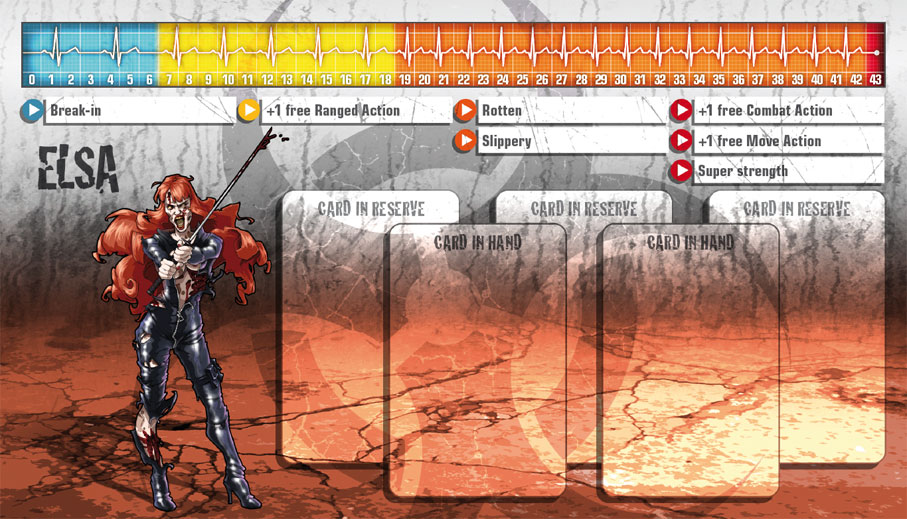
A zombie version of one of the new survivors.
The zombie versions have similar skills, except they lose the general extra action at the yellow level and instead gain a bonus specific action. Further, they are much tougher and require 5 wounds to be eliminated. I really love this about the expansion and it addresses one issue I had with the base game. It’s much more forgiving allowing a player to essentially get a do over if their survivor character becomes the main course in a zombie feast.
There are more goodies and equipment cards like assault rifles and hollow point rounds. Toxic City Mall also introduces an extra level red mode. Essentially your character just keeps leveling up gaining more skills by restarting the experience track. This also allows them to equip some special, vicious weapons if they are lucky to find them. It’s a minor addition but something some people might like in making their zombicide games ‘go up to eleven.’
The Good – The toxic zombie types are a good addition to the mix. They shake up the tactics some emphasizing ranged attacks in order to take them out. Adding barricades and rubble to regular maps is also something that can add a little variation to most scenarios. The zombie versions of survivors is likely the strongest addition and something I feel helps address the flaws in the original game.
The Bad – There is some excitement you might get picking up the expansion on the prospect of adding mall tiles, until you realize they pretty much are just additional buildings and special road sections. While there are a few tweaks with the toxic zombies in game effects, they don’t add much else to the game play and sadly abominations are still just huge bullet sponges.
Abominations lead into gear a bit. A fair number of cards are unusable for much of the game. Ultra red cards are only good if a player is in the red level (although they can be discarded for 5 experience). Also quite a bit of equipment comes down to combining it with other existing weapons to make them more effective, rather than just adding to players’ arsenal directly. Search actions are so limited, it can become a chore trying to find decent gear. This is compounded as some missions require creating molotovs, and being able to get all the correct combination of gear cards to make one can be frustrating.
The scenarios are alright but nothing stands out as tremendously innovative. You are still searching for certain gear or going after particular objectives in a set sequence. About a third of the ten missions require having the Prison Outbreak set (and bummer for you if that is your base set for the game). Missions are bigger and longer, however I do wish an additional 1-2 scenarios were provided that were smaller in scale and a little easier to tackle.
The Verdict – Toxic City Mall is a good expansion for Zombicide. The silly shooting rule is still an issue, but allowing players to pop right back into the game again as tougher versions is a great addition. The toxic zombies are a nice way to add some challenge and variation to the zombie horde without adding too much complexity. Plus it’s very modular. You can easily add more equipment and toxic zombies to the regular base game and breath some new life into old scenarios.
The same can be said for rubble and barricades. A difficult mission can be altered in layout to make it a little easier. At the same time, tried and true strategies can be shaken up some (like throwing a large chunk of rubble down in Y-Zone to make it a long gauntlet to run). Again, some small bits and pieces to add to your regular game.
There are more missions to play, different gear to equip, and weapons to tear into zombies with. I’d say if you wanted one expansion to buy for your Zombicide game, this is the one to pick up. There’s a lot here to really supplement the base set and breathe some new life into your frantic games of zombie destruction.
Review: Machi Koro
 From IDW games, in Machi Koro players are small village mayors trying to expand their community into a blossoming city. For 2-4 people, it plays in about 20-40 minutes. The goal of the game is to be the first to build all 4 key landmarks within their town, indicating they are the most prosperous community.
Turns of play are rather simple. Players roll a die (or 2 if they build a special location) and collect any income matching the die roll with any establishments they have. They then can build one location. This can be an establishment from a common supply of cards, or one of their 4 special landmarks.
As a twist, some locations will function during other player’s turns. Additionally, some locations force the player rolling the die to fork over cash, or potentially they’ll collect money from other players. Some establishments have a higher payout depending on other locations within your town. Lastly, bonuses and income for the cards are additive, so having multiple copies of the same location is beneficial.
There are a limited number of cards for each type of location. There are also some location types that can only have one copy per community. So when trying to work on income combinations, this can lead to a race to acquire desirable cards.
You end up with an interesting dynamic of trying to cover a decent spread of different die outcomes, all the while trying to minimize your opponent’s income. There are locations out there that can benefit everyone provided the right die roll is made. This adds a giddy gambling feel making it a pleasant, light engine building game with a bit of luck thrown in.
The Good – This is a filler type of game. Something light that doesn’t require a ton of explanation yet still has a smudge of strategy. You can opt for low cost cards that work on a single die, or spend more cash for establishments that give better payouts on two dice. Or you can try to dabble a bit in both and work the angle of getting income from just about any die roll. What works for the game is that players can collect income if anyone rolls a number that matches key establishments they own. It really keeps everyone engaged.
The design of the cards is well done, matching types of income conditions based on the card color, as well as through text. The icons are simple and the design of the cards has a cute cartoon feel which is colorful.
The Bad – There is a lot of luck here which might turn people off. Also, sadly the game can creep into having a repetitive nature. Setup and the available cards are always the same so you aren’t going to get the breadth of options in play. Players can easily find themselves slipping into set strategies.
The Verdict – I like Machi Koro. It’s a fun family game that’s light with enough choices to make it interesting. I think the major aspect of the game which makes it so much fun is how income can be earned. It’s not always based on what you roll during your turn. You can also get income on other player’s turns, and with the right combination of establishments you can get a huge payout. It allows you to grasp that gambling feel by the tail and revel in it, which does adds a sort of interaction at the table.
A big detraction however is the similar game setup and lack of card diversity. There are expansions floating around which would seem to alleviate this some. I’ve taken to using a modified setup, splitting the location cards into separate decks based on the die roll number needed to induce their effect. By limiting the pool of available cards to pick up and play to only 10 types of cards, you end up with just enough limits to make for hard choices, but not completely slow down the game.
However I guess I can forgive Machi Koro for being light. It doesn’t wallow in that pretentiousness of being anything more than a filler game. The mechanics are not groundbreaking but the idea of allowing resources to be gained on other player die rolls works wonders. It helps slip the game from a ho hum, engine building, resource acquisition game to something more exciting. The theme is light, matching the art on the cards and it works. Machi Koro isn’t a deep experience. It needs a little tweak to the game setup to add some variety after several plays. However it’s also something that provides great fun, especially if looking for a family game.
[EDIT: Figure I’d add my tweak to the base game from the Harbor expansion which introduces using a single deck for locations. Cards are drawn from the deck until there are 10 types available. Similar cards stack up in piles, and if a type is exhausted a new card is drawn and either added to existing piles or placed in the supply as a new location. So 10 different locations are always available and may be of varying numbers.
For my games, I split location cards into 3 decks. One deck is for locations of 1-5 , one deck for unique landmark locations (purple 6 cards that is made as per the rules. i.e. 1 card of each type for each player), and a third deck for the 7-12 locations. Four cards each are drawn from both the 1-5 and 7-12 location decks, while only 2 are drawn from the 6 location deck. As per the Harbor expansion, there must be 10 total different locations available and multiple copies are just added to existing draw piles.
You’ll end up with 10 different location cards that are always available (4-2-4). This adds just a little more challenge and using random (but limited) available locations allows for some different play strategies.]
Review: Splendor
 Splendor is a card game for 2-4 players. You purchase development point cards with gained resources and the first player to 15 points wins. During a player’s turn they have the option of picking up a limited number of gem tokens and on future turns, spend those tokens in certain combinations to pick up development cards in the center. Players can only pick up 3 tokens of different types, or 2 of a similar gem type with some restrictions. Alternately, players can pick up a gold token which works as a wild card gem.
Development cards come from 3 separate decks, each with increasing costs of needed gems, but offering more and more points. As an option, a player can pick up a development card and keep it in their hand (maximum of 3) so that no one else can scoop it up.
Players will spend gem tokens to match what is displayed on the development card. Further, purchased development cards can act as a single gem type which can be used to buy other development cards. So players can try to purchase cheap development cards that offer no points, yet they allow you to amass more gem types which can be used to spend on more expensive cards later. Also, unlike the gem tokens which are discarded back into the supply, development cards you obtain always stay with you.
In addition to the development cards there is also a random number of noble cards. Each noble offers points if players get particular combinations of development cards. While they aren’t a lot of points, they can offer a means to score with the low cost development cards (provided the developments are of the needed sets).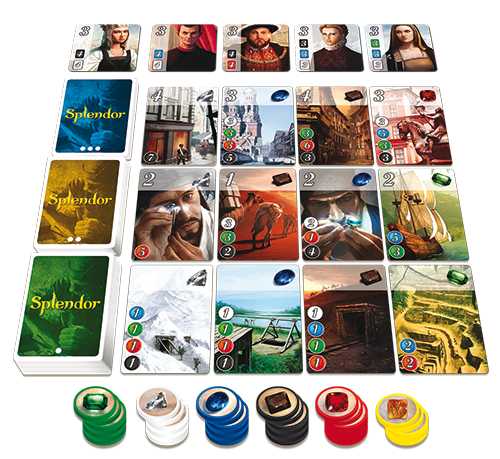
The Good – It’s an immensely enjoyable, light strategy card game. It’s a snap to learn yet offers just enough challenge in play. The collection of gem tokens from a limited supply and holding of key development cards adds a small facet of player interaction. The components are nice with cards of nice stock and hearty gem tokens. The artwork is tasteful and offers a colorful, classical look of the 15-16th century.
The Bad – Once a player lags behind, it can be hard to catch up. Some might also argue that the card strategy isn’t too deep either with a few considering it too light for their tastes. The box is rather roomy for the actual amount of components inside.
The Verdict – Splendor is an immensely enjoyable game. The 15 point total is just long enough to allow a player to amass enough developments to get that feel of a decent game engine going, while not lingering too long to make the play tiresome. There really aren’t any glaring faults to this game. It’s fast, simple, and engaging. It’s not pretentious. It’s just simple fun. Splendor is a wonderful family game and well worth picking up.
Board game stores in Seoul: Red Dice
 I’ve been continuing my trek to catch a few other board game stores in Seoul. Red Dice is a store located in Hyehwa and just a stop away from Dongdaemun, a popular shopping stop in central Seoul. The store is a bit out of the way tucked up on the third floor of a commercial building.
The store is really catered towards Korean board game versions. There are a handful of English versions but the pickings are few. So as an expat and wanting to pick up non-Korean versions of games, you are pretty much out of luck if visiting Red Dice.
Red Dice does shine for a place to play games however. There is a large section of the store set aside with plenty of tables and chairs. From what I’ve gathered it’s a popular venue for board game meetups. As the store offers coffee and snacks, likely they’d welcome people meeting and playing (as long as they made sure to get a few drinks in during the evening).
I visited in some off hours though and I expect it’s a hopping place on the weekend evenings. Red Dice seems to cater to the CCG crowd and given the number of tables, chairs, and wall of lockers people can rent out, playing games in the store is part of its business plan.
A rumor I’ve heard was that this was one half of Dive Dice. It’s sister store split off to be it’s own gaming presence, Rolling Dice. However from an expat’s perspective, BoardM is a better shopping stop though. Red Dice looks to cater more to the locals and the CCG crowd. I do think it’d be a great place to play however and would be fine to visit if there are any meetups scheduled there. However Dice Latte is still my top place to play board games.

For general directions, take subway line 4 to Hyehwa and get out at exit 4. Take an immediate left and walk straight down the street. Eventually it’ll hit an intersection where it feeds into a main road. Cross the road and follow the side street some. Eventually it’ll be on your right. Look for a store sign on the third floor of a small commercial building (note the outside sign might read as Dive Dice).
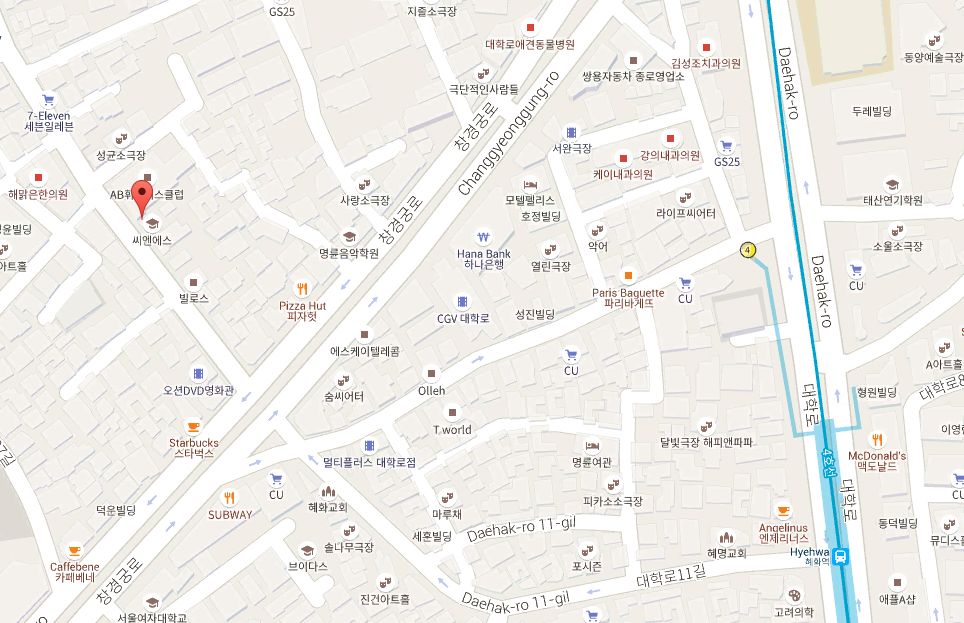
UPDATE: Red Dice has moved location and is now a few blocks from where the previous store was. The above pic is good for the general location but the pic below has the new location.

Alleycon 2015 is coming…
I’ve been pretty fortunate over the past few years to get into a circle of local gamers. There seems to be a decent community behind a lot of them too. Alleycon will be running next month and what started out as an afternoon of gaming at a local expat restaurant has slowly morphed into a full fledged con. This year it’ll be 2 full days of gaming and geekery September 19 and 20, with a local meetup the night before for beer and trivia.
So if you are in Korea and keen to play some games, do some cosplay, or rub elbows with fellow geeks, be sure to check it out. From what they’ve got listed as events there’s lots to do (or plenty of space to run your own thing). Online registration is open now. Scoop up tickets before they sell out!

 Geek Ken