Category: Board Games
Board game shops in Seoul: The Dice Latte
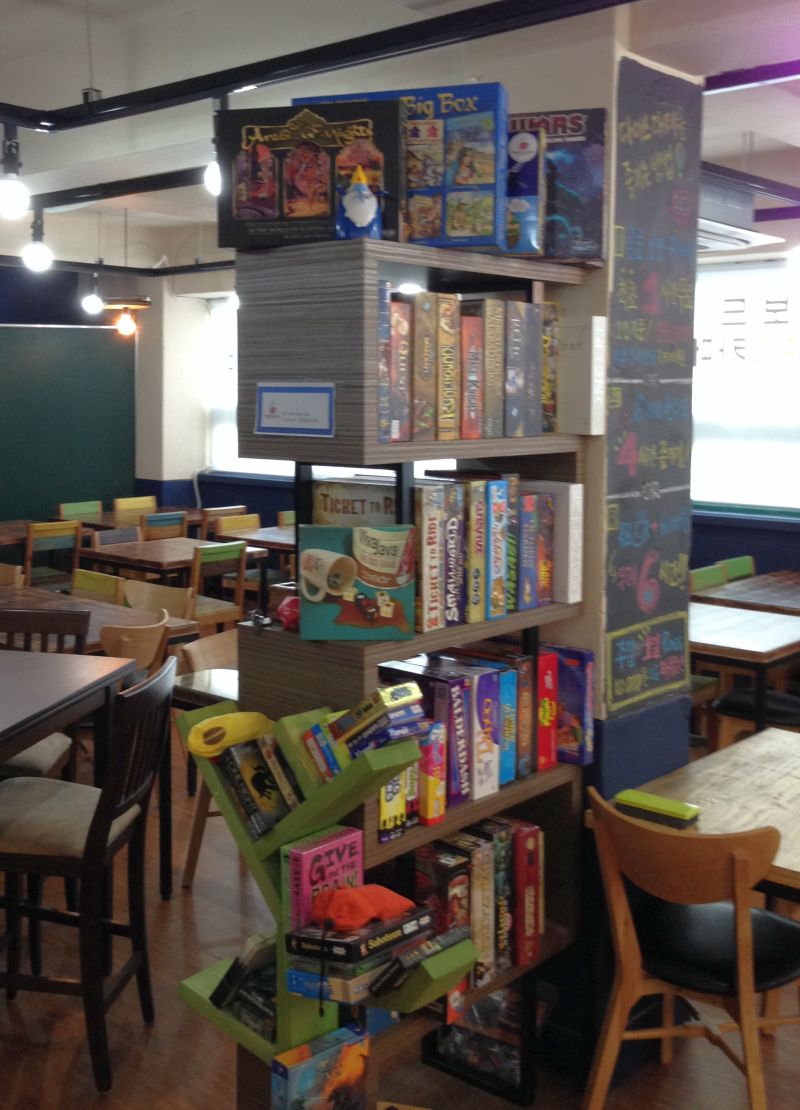
 Ever on the prowl for board game shops in Seoul, I stumbled across the Dice Latte and was pleasantly surprised. This is mostly a game cafe and I seemed to have caught it about a week after it opened. So unfortunately the stock of games for sale was rather limited but after chatting with the owner, selling games is something certainly in the works.
What stands out for the Dice Latte over other game cafes however is that it also caters towards the RPG crowd. Not only are there a great selection of board games to try, but also a shelf full of RPG books for people to read or pick up for running games on the premises.
The place is pretty spacious with nice tables and is well lit with plenty of windows for natural lighting. The menu and prices are geared towards your typical coffee shop fare. There is a tiny kitchen with muffins, cookies, and other baked sweets available. A simple sandwich set is also offered if looking for something more filling.
Paid game time in the shop seems to be pretty liberal. A cup of coffee will get you an hour, but longer play times will require a bit more cash. While there are hourly fee options, cheaper pricing falls into larger chunks of time at 4 hours on up. It’s is a decent option. You can either load up on a few coffees for a few hours, or simply buy a cup and pay a little extra for an afternoon (or evening) of gaming.
The stock of games was rather impressive for a newly opened shop with several classics as well as plenty of new Board Game Geek hotness. The RPG selection was very nice also between classics like AD&D up to 5E and even more smaller publisher fare like Dungeon World and Fiasco. What was a pleasant treat was there were a few Korean RPGs also, including translated versions of western RPGs. My understanding are there are a few Korean RPG groups that are regulars of the shop.

I noticed a smaller room in the back and after chatting with the owner, came to understand that it will be a special room for reservations. If people are wanting a regular place to play that is a bit more quiet from the open room, it’ll be available. Best of all it can be locked. So if folks wanted to step out for a beer and chicken break in the middle of an all night session, they could leave the room as is and not worry about anyone else messing with their things.

What immediately jumped to my mind when I heard that the cafe was seeking to expand it’s offerings to include selling some games was would any RPG dice be available. A constant point I seem to find in the expat crowd is how difficult it is to get a set of polyhedral dice in Korea. Seems that the Dice Latte will have that covered as they’ll be a Korean distributor for Chessex dice shortly.

The staff appeared friendly and willing to engage me when I came in which is always a plus. Something else stood out for me. Granted it was an early Saturday afternoon and the cafe was in a tad of a lull, but a table of folks noticed me walking around alone looking over the shelves of games. One of the chaps offered me a seat at their table as they were going to jump into a board game. I think that reflects a bit of the friendly vibe there.
To get to the cafe, take subway line 1 to Hoegi. Take exit 1 from the subway and hang a left. Walk a bit until the street you are on runs into a main road. The shop will be catty corner on the third floor at the intersection. I noticed a big tree appears to cover much of the cafe’s sign front, but you can make out the RPG shop lettering that borders the third floor of the commercial building.

All in all the Dice Latte seems like a great place to play board games and is very expat friendly. I’d certainly check it out and if you are in Seoul hankering for a place to play or meet up with other RPG players, the Dice Latte looks to be the spot to visit.
(EDIT: Things have moved along for the store swimmingly it seems. Not only are they a distributor for Chessex dice but also for Mayday Games card sleeves. RPG fanatics and pristine board game fans should take note.)

Review: The Agents
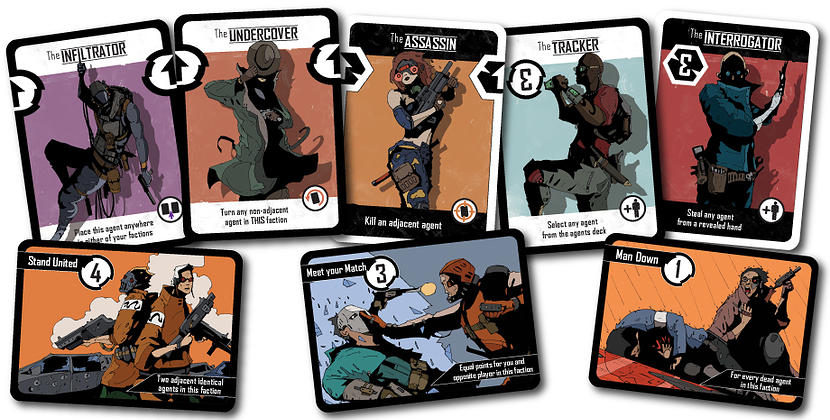
 The Agents is a card game where players represent a group of operatives that have gone rogue once their respective espionage agencies have disbanded. The game plays 2-5 players in about 30 minutes, with the game ending when a player earns 50 points. Players earn victory points (IP) by playing agent cards in specific directions that award points to either themselves, or their opponents. Additionally, players earn points by achieving specific layouts in their play area by assigning mission cards.
What’s rather clever about the game is that the orientation of agent cards either can award you points, or provide an action. Choose to gain points and your opponent now has access to that agent’s ability (or vice versa). To gain points you need to have a pair of agents lined up to link two halves of an IP icon shaped as an arrow. Additionally these half arrow icons are either black or white. If the colors match you gain 2 points, and if they are mixed the player earns 1 point.
A player has only two options when playing agent cards in their area. They either form up in one group (faction) to the player on their left, or the player on their right. Additionally each faction can be comprised of only 5 agent cards (7 in a two player game). You can only play cards on factions you share with other players. The agent actions allow cards to be rotated, shifted to other factions, pulled out of a faction (either into your hand or discarded) and manipulating these commands on the agent cards becomes a key part of the gameplay.
Players can also assign up to 2 mission cards per faction. These provide additional points if certain conditions are met in a faction. Once a player has done all their actions victory points (IP) are awarded based on the number and type of arrow icons facing them, and any additional points from assigned missions are also earned.
Playing agent cards becomes a tricky process though. Not only do other players score points on their turn for any pairs of IP icons that are facing them, they also have the option of using an agent command on their turn. If you get a nice layout of IP icons awarding you points each turn, expect your opponents to start activating agents that you set out to muck up the orientation of your shared agents.
Now a while back I gave a shout out for the original kickstarter campaign. After repeated plays I found there were some rough edges to it. So while the Agents was pretty fun, it just wasn’t something that I found to be a homerun at my gaming table. Since then the rules got a revamp and another kickstarter campaign was rolled out. The ‘Mark 2’ rules really make the Agents a much more enjoyable game.
The game now ends when a player reaches 50 points. No longer does it continue until all players get the same number of turns after a player reaches 40 points and this removes a finicky end game condition. In practice I found you actually had to plan on having more than 40 points, as inevitability other players would be able to maximize their layout in that last mad dash during their final turn. You also have much more flexible options for removing agents and missions from your factions, and picking up missions are cheaper. I appreciate the relaxed options for altering your agents and missions and it’s a welcome change from the more rigid turn actions of the first edition.
Likely the biggest change however is that players are no longer required to use an agent’s command action when it’s first played. Now players have the option of not activating the card powers when an agent is added to a faction. It does remove some bite to the game, as before you could really force a player to restructure their faction when you first placed an agent. However I also found this would inadvertently drag out the game as your opponents would sometime agonize how they would apply the command of an agent. With the new rules they have the option to just utilize it as an action later.
This change also bleeds over into special agents. Special agents are the only cards that can be played on other players that are not aligned with your 2 factions. Before it was a chore sometimes figuring out how to apply a command when they were played. Now, the IP points are still awarded immediately the turn they’re played. However the card is not discarded until the command on the agent is activated. This means that other players can keep those command actions for play in a future turn. This small change really adds to the value and decision process of special agents. Do you score the points now and risk an opponent trashing your built up factions on a later turn? Likewise having those special agent powers available may set up a nice mission condition, allowing you to work towards a specific strategy.
The Good – It’s an enjoyable strategy card game with an interesting mechanism for play based on the orientation of your cards. It has a good flow and offers interesting choices of spending victory points to try and get resources in order to score more points on future turns. There are a fair number of expansions out to provide alternate missions, free agents, and other small twists to the game. However even right out of the box there seems to be enough variation in the cards to offer plenty of replay.
The design of the cards is well done. The artwork captures an almost sci-fi feel, and some sweeping action poses that look more out of a comic book rather than what you’d expect for a game revolving around espionage. I like it and the art and design seems to capture that tone of a tug-of-war game where agents are flipping allegiances back and forth.
The Bad – There are a lot of improvements with the second edition rules, however the new rulebook will still have you getting some head scratching questions regarding agent abilities. The game can also depend on a fair bit of luck. If a player gets a good scoring combination set up, they only have to worry about their immediate neighbors mucking it up. If your opponents get a few poor draws with agents that can’t shake up your layout, well you can run away with the victory points making it very hard to catch up. It can be a little frustrating not being able to get a setup that will earn you points, especially as your opponent can trash your layout using agent abilities (or the alternate, not being able to break up an opponent’s efficient faction). While there is certainly an element of strategy to create these layouts, it can also rely on lucky card draws.
The Verdict – The Agents is an enjoyable game. It’s heavy enough to offer challenging choices, with some variety in the cards and play to provide replayability. But not so much that it gets mired down in lengthy turns with lots of intricate working parts that you might see in other board games. The game seems to run just long enough and teeters over that edge of being just a filler game. With fast play and some enjoyable bits of strategy, you’ll certainly want to play a few hands filling up an evening of gaming.
There are rough spots to the game. Some of the actions on the agents and how they resolve can be clunky at times. You can get stuck with poor draws for a few turns which can make catching up all the more difficult. But the faction layouts are very fragile and can be rapidly altered, making that ideal faction placement difficult to set up (and harder to maintain). This facet of play really captures the give and take of agent loyalties which allows for some interesting play.
I don’t feel the Agents is an absolute must have for a collection. However the point-or-action choice of card placement is different and makes it stand out compared to other games. The new version of the rules allow for a more flexible turn options and is a significant improvement over the original version. Additionally the point of entry for the game is low with enough card options that you don’t need to pick up expansions, but they are available if wanted. The player count and play length is just right too. So I would certainly recommend it if looking for a light, strategy card game.
Board game stores in Seoul: Boardpia
So I’ve been on the hunt as of late to check out a few other board game stores in Seoul. Boardpia is a pretty small store located in Mapo which is central Seoul and conveniently just a few stops from the Yongsan KTX train station. From what I could see it looks as it also functions as an online store.
The store stock is pretty split between Korean and English versions of games with a limited collection. They certainly do cater to the cult of the new however. When I visited I noticed a nice selection of what would be considered the new hotness on Board Game Geek. The store also seems to gravitate towards board games and less so of collectible card games.
There also are a few tables for play. The staff of the store were friendly and I felt they genuinely enjoyed board games. I’m still more keen on Board M for their selection, however Boardpia is pretty easy to track down and not too out of the way from more central subway stops. If I were looking to track down a recent game, this is a store to put on the checklist for visiting.
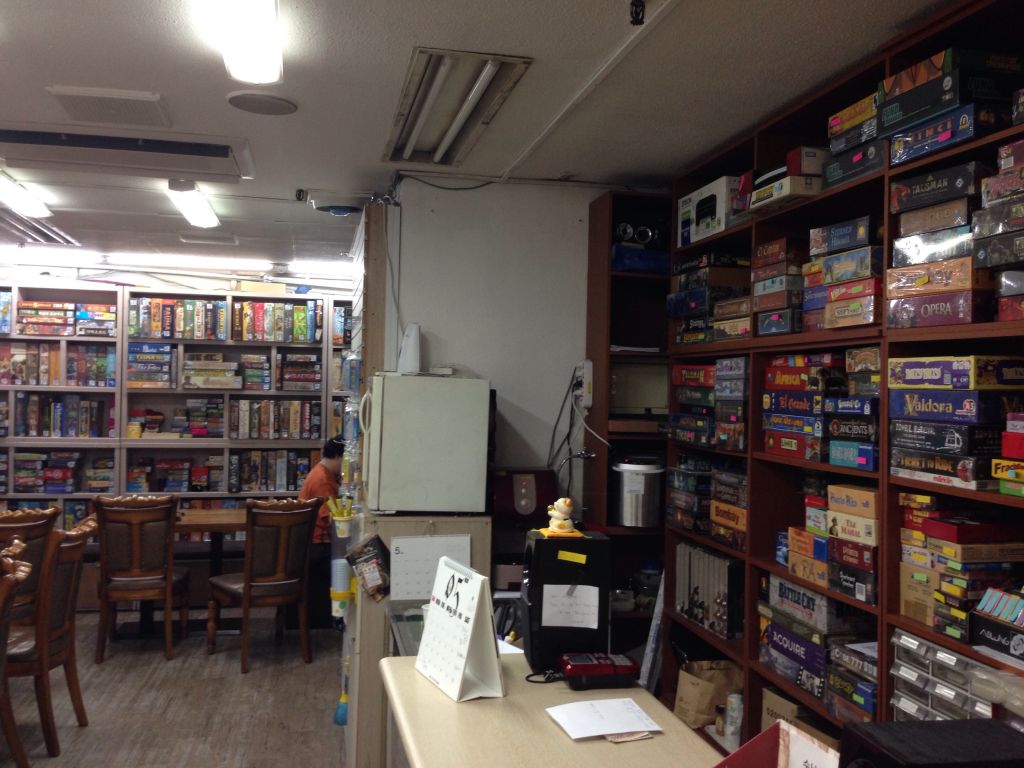
The store is in the 1st basement level of the Hansin Building. Take subway line 5 to Mapo and get out at exit 4. Walk straight down the street and you will run into the Hansin Building. Take a flight of stairs down into the basement and you’ll find it tucked away among a few other store fronts and offices.


Review: Airlines Europe
I wanted to pick up a route economy game. Looking around, I saw one based on the expansion of airlines in Europe during the 30s and 40s and found the theme a bit different from your typical railroad expansion game. Airlines Europe is a 2-5 player game from Rio Grande Games. You are an investor seeking to help young airline companies blossom as they slowly expand their routes across Europe. Hopefully you’ll see your investment in certain companies come to fruition, picking up stocks and strengthening your portfolio in key airlines.
Players try to get as many points as possible. During the game, 3 scoring tiles are placed into a stock supply deck. When they will turn over is not known exactly. Instead players know about 1/3 and 2/3’s into the the stock deck a scoring opportunity will pop up, with the final scoring being randomly mixed in with the last 10 stock tiles of the deck.

As airlines are invested in, establishing new routes, they increase in value constantly moving up a victory point tracker. At set increments, they will be worth a certain amount of points. The player with the most stocks of a particular airline in their public portfolio earns the most points. If players have at least some stock in a company, they will earn some points, but it pays to own the majority of stock for a particular airline.
The game has a varying number of airlines which start in certain cities. Players have the option of taking one action during their turn. They can invest cash into expanding a route between cities for a certain airline. This in turn allows them to pick up a stock from a limited pile (or take one unseen draw from the deck). They can take accumulated stocks in their hand and place it into their portfolio as another action (which also allows you to get cash from the bank). In essence they publicly declare what airlines they are investing in. Instead, as an action they can get money from the bank (which they’ll turn around use for investing in airline routes). Or lastly, they can turn in stocks they possess to pick up stocks for a special airline that is rapidly expanding worldwide.
Picking routes becomes a tricky business. There is a limited number of routes between cities, planes of each airline, and their stocks too. Once you claim a route, you cannot get a similar airline on the same one. Additionally, you always buy the cheapest route. Once you establish a route, the value of that airline goes up in the point tracker. Picking up routes early allows you to expand an airline rather cheap. It also can force other airlines that want to expand, having to buy the same route at a more expensive price. So there is a chance you can cut off opponents (or limit their level of investment) by judicious establishment of routes.
Another key part of the games is setting up your portfolio. The stocks you have in hand are not used for scoring. You have to put those into play, showing all the other players what airlines are in your portfolio. This becomes a bit of a bluffing game. Building up an airline takes a lot of cash. Having other players help is ideal. However you want to be sure you have the majority of stock in a company. If players see they are a minority stockholder, they will get points for an airline, but not as much so they might decide to invest in other airlines. Or worse, they race for gaining more shares to snatch away the majority. This really becomes a large part of the game, deciding what airlines to invest in, what stocks to pick up, and when to publicly declare what airlines you are investing in.
This last bit is another huge part of the game. You only have 3 scoring opportunities. Further, only stocks that are in your public portfolio are used to determine scoring. Stocks hidden in your hand don’t count. As you have one one action for your turn, you have to decide when to ‘go public’ and when to keep that information hidden.
Maybe you want to string along an opponent and help them build an airline. Maybe you want to be sure no one else is getting stocks for an airline you are interested in. Once you add those stocks to your portfolio the word is out on your interests, but if you hold onto those stocks for too long, you might miss an opportunity to get victory points. It can be a challenging decision and is an immensely enjoyable part of the game.
The Good – This is a fun route building game. Although the routes and number of airlines are static, the initial stocks you hold and what are available in the stock market are random and limited. You really don’t know what airline to invest in until you see your hand. Additionally, there is a special airline where players gain their stock by exchanging ones they hold. This airline can be worth a lot of points at the end of the game. Making it a valid goal trying to gain a majority with this special airline. All of this makes for a variety of strategies, making each game a little different.
The components are very nice, with a colorful board, plenty of plastic airline markers, and thick tokens for the stocks and victory points. The rule book is well written with plenty of examples.
The Bad – The random stock assignment and market might put off some people. You are trying to make the best of what’s available and wanted key stocks might simply not come up when needed. So some players might be put off by the random distribution of the market. This is especially true for the scoring. You will not exactly know exactly when scoring will take place. Some might find this frustrating if they managed to miss out on a scoring opportunity, and it can be very difficult to make up for a missed scoring turn.
While the components are pretty nice, the game does have paper money. That isn’t a huge ding, but having tokens or other markers might have been better. Paper money always seems to get a lot more wear and tear through multiple plays.
The Verdict – Airlines Europe is an enjoyable game. It plays just the right amount of time (clocking in just a bit over an hour) and keeps everyone engaged throughout the game. The random stock assignment means you have to be flexible with your initial strategies. The hidden accumulation of stocks, along with the public declaration of your stock portfolio (and what companies you have a majority in), makes for a great bluffing game. Shrewd planning and investment of routes, coupled with grabbing up cheap routes and stocks to curtail an opponent’s expansion evokes that feeling you are an investor slowly helping expand airline service across Europe.
This really is a fun route economy game which veers away from your typical railroad theme. It also works very well as a family game too. There is a small twist to a 2 player game where discarded stocks are thrown into a dummy hand. This can shake up the shareholder leaders for certain airlines that adds some unknown factors to victory conditions for 2 players. All in all, it scales well with many players. I highly recommend Airlines Europe.
Waygeek, a Korea-centric gaming blog is breathing again.
 A long while back Waygeek was a new blog set about trying to cover the gaming scene in Korea. It’s name was a playful take on the Korean word for foreigner (waegukin) and geekery. It petered out as a lot of blogs do. The original site shut down and it pretty much faded away.
That’s changed though and it appears a lot of the old content has migrated into a brand new site. Seems a group of folks have now committed to making it the gaming and geek central site for Korea. Dabbling in RPGs, board games, cosplay, shows, and other bits of geek culture, looks like they cover a lot of topics. If you are an expat looking for fellow gamers, shops, and getting the gaming pulse on this peninsula, you’d be remiss not to check them out regularly.
Review: Among the Stars
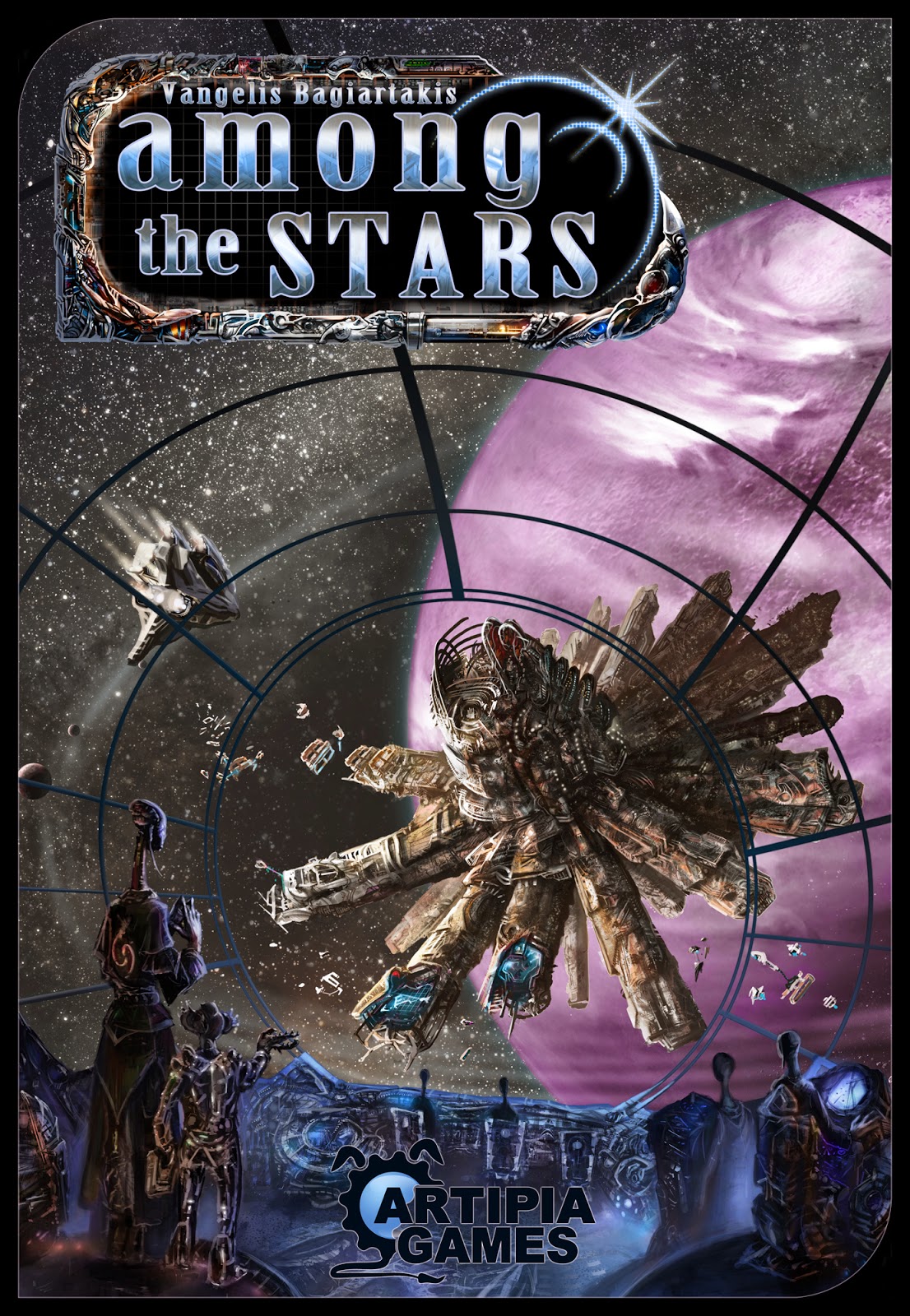 From Artipia Games (and also distributed by Stronghold Games) Among the Stars is a 2-4 player game. The players represent different alien races trying to build the most impressive space station, garnering intergalactic influence at the end of 4 years. As they build onto their space station, added locations award more victory points and the player at the end of 4 years with the most points win.
Among the Stars is a drafting game. Players get an initial hand of 6 cards. They select one and pass the remaining to either the player to the right or left (each game year the direction shifts). Then they play the card, adding it to their space station.
Cards must be placed orthogonally to existing locations (i.e. not diagonally) and are only considered adjacent to those cards. Players must pay for location cards with credits. Additionally some locations require power. So there must be a power plant within two locations and can provide enough energy to build that new section. Each card represents one of six location types (diplomatic, recreation, administration, etc.).
Once built the location typically awards victory points. Some cards have further victory point bonuses if certain conditions are met at the end of the game, such as extra points for each similar card in the station, additional points for being near other location types, the furthest away from the main reactor, etc. This provides interesting play having to account for the spatial layout of your station as you try to get the most points.
Every year you gain credits, however as an action you can discard a card and gain credits instead of adding it to their station. Or if wanting another power reactor, they discard their selected card, paying for a power reactor and placing it within their station.
The reactors themselves provide a limited resource of power. Each reactor has 2 energy cubes. These cubes are discarded when certain locations are added to the station. Further, they can only power locations that are up to two adjacent spots away (remember, a diagonal direction does not count). As many cards that require energy usually provide a good amount of points, it can be a challenge figuring out the optimal layout to provide enough power for expanding your station.
 Players continue selecting and playing one card, while passing the rest, until all the cards in players’ hands are played (or discarded for credits or power stations). Then a new year begins and the process is repeated until 4 years are completed.
Among the Stars at its core is a fun game. However there are other game elements which add a lot to the gameplay. Players can randomly select a starting race. Each race has a unique power, providing some special ability they can use during the game. There are also random objective cards equal to the number of players which provide bonus victory points if completed. Being placed face up during setup, each player can look them over and decide if they want to focus on a particular goal to earn those objective cards during the game.
Lastly, there are optional conflict cards which provide an additional type of player turn action. These cards typically award victory points if you have more particular location types within your station compared to another player. At the same time your opponent will also lose points equal to those that you gain. It’s a little way to add some back and forth tension mucking up another player’s victory point totals.
In all, it’s an enjoyable game. The slight hiccup is the two player version which requires dummy hands, but it manages to capture that feel of potentially having key cards drafted from other players. This point is what makes the game. You likely will only be able to get one additional card from the hand you are first dealt. Deciding which is the best draw can be a challenge. You really don’t get a feel for the other cards out there until about halfway into the round, making that decision to focus on a particular location type for your space station early in the game risky (but can be immensely rewarding).
The Good – Among the Stars comes with a lot of parts to the base game. The different player races and objectives offer a some variety, in addition to the location cards. This provides a little randomization in the game that goes beyond the deck of location cards, giving some differing play for each game. There aren’t a lot of rules to burden new players, but it certainly provides a lot opportunities to explore different strategies.
The components are done well with cards having a nice, thick backing. The counters are good cardstock and the energy markers represented as clear cubes are a nice touch. The design of the cards can be a little cluttered when figuring out setup (certain cards are added or dropped depending on the number of players), however for actual play they are easy to read and decipher. The artwork is pleasant and certainly helps capture the theme of adding sections onto a space station.
The Bad – It’s a drafting game and by design it will be difficult to plan too far ahead for future turns, which can be a little frustrating. You start each year with a 6 card deck, so you can only expect to use one other card by the end of that year. You only have 2-3 turns to potentially see what cards you might end up with later. In effect, it’s somewhat of a puzzle game where you simply make the best play you can with a new hand each turn.
Also even though some cards are labeled as conflict cards, you really don’t have much player interaction other than using (or discarding) a card that another player might have wanted. So you can slip into this mindset of just building up your station and ignore everyone else. Put simply, this might not be the most enjoyable game if you are looking for more a back-and-forth play experience.
The two player version is a little lackluster also, relying on dummy hands with your opponent likely discarding cards you’d want to use. If players alternated placing a single card for a dummy station using some simple automatic placement rules, it might be more enjoyable. That way you have to try to also beat a third point total and worry about another station layout, other than just your opponent.
Card resolution is done simultaneously and sometimes this can put a kink in the flow of the game for certain cards. Although there are rules to determine a player order in these cases, it can be a little clunky to resolve.
The Verdict – Among the Stars is solid. As a drafting mechanism type game, it’s especially enjoyable. The play is very streamlined and easy to grasp. Yet there are challenging choices you have to make. While scoring points is paramount, you also have to keep an eye on what your opponents are doing. Sometimes it might mean forgoing adding a juicy location and simply discarding a location for credits, as that same card would bring a ton of points to your opponent.
Another key thing that stands out is the variety of game options. You have the option of playing with and without races, objectives, or conflict cards. You can choose to keep a limit on station size layout and even another small variant for the 2 player game is offered. Along with this you get 8 different races and objectives. And on top of everything are the differing station locations and types, with a plethora of card combos that you can explore. All of these aspects contribute to giving the game some legs with play longevity.
Among the Stars is a great game. The drafting mechanic offers a slight tweak to the myriad of deck building games out there. And it also really captures the theme well of slowly constructing a sprawling space station. With nice components, a low entry bar to learning the rules, and solid gameplay, it’s certainly one to add to your game collection.
Litko game tokens as holiday gifts
Say you want a stocking stuffer for your nerdy, significant other, or want to give a small gift to a gamer pal. Litko makes quality plastic acrylic game tokens and other miscellaneous game items, offering a great gift for them. A long while back I made no bones about my preference using tokens and markers around the table. Having a tactile marker to represent a condition, bonus, or temporary status is great over just using pen and paper. So I’ve had a long affair of enjoying Litko products for years now. They’ve got wonderful stuff for just about any gamer you’d like to get a gift for.
The wargamer – They offer tons of sets and individual packs for tokens. From command and casualty markers, to range band and blast templates, Litko offers some fantastic tokens and markers.

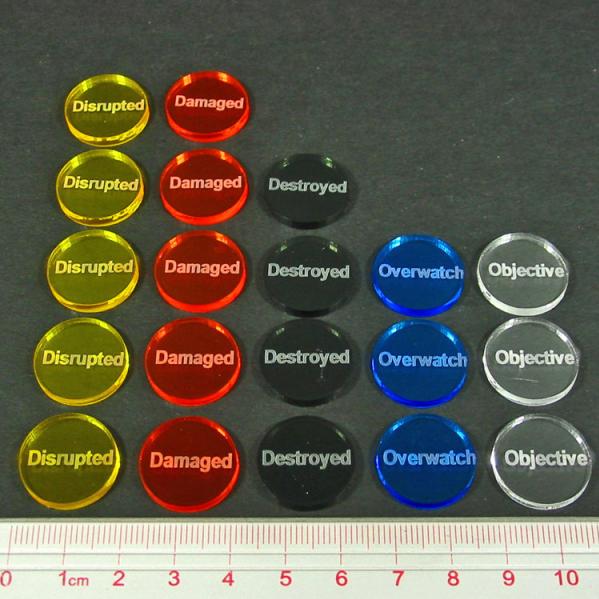
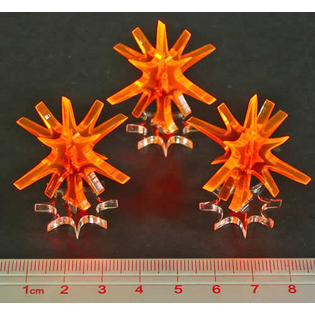
The board game fan – Litko has branched out and now provides game token sets for popular board games too. Imagine spicing up your Pandemic game with these tokens…

Not to mention some really wonderful X-Wing token and marker sets…


And I’m certain Netrunner players would enjoy having these on the table…

The RPG player – Litko also offers a lot of sets and tokens for RPG games also. You can find lots of tokens to mark temporary conditions….
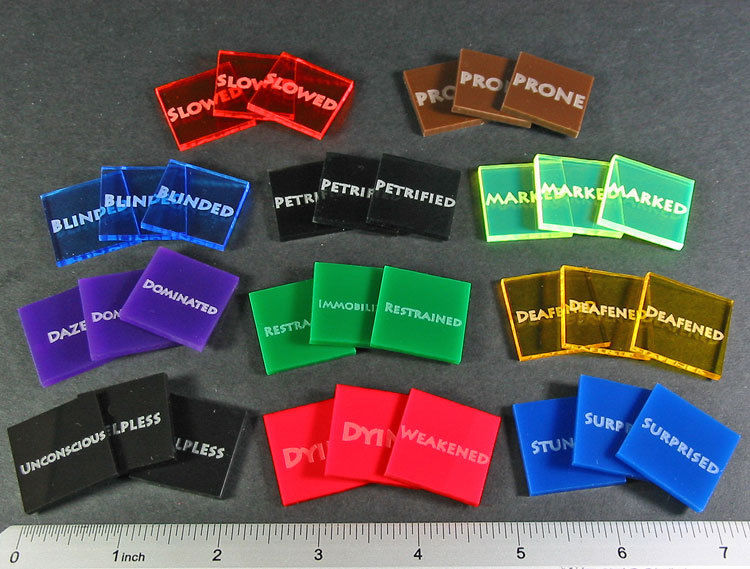
and complete sets are also available like this one for Savage Worlds.

They offer some more interesting items like paper figure miniature stands…
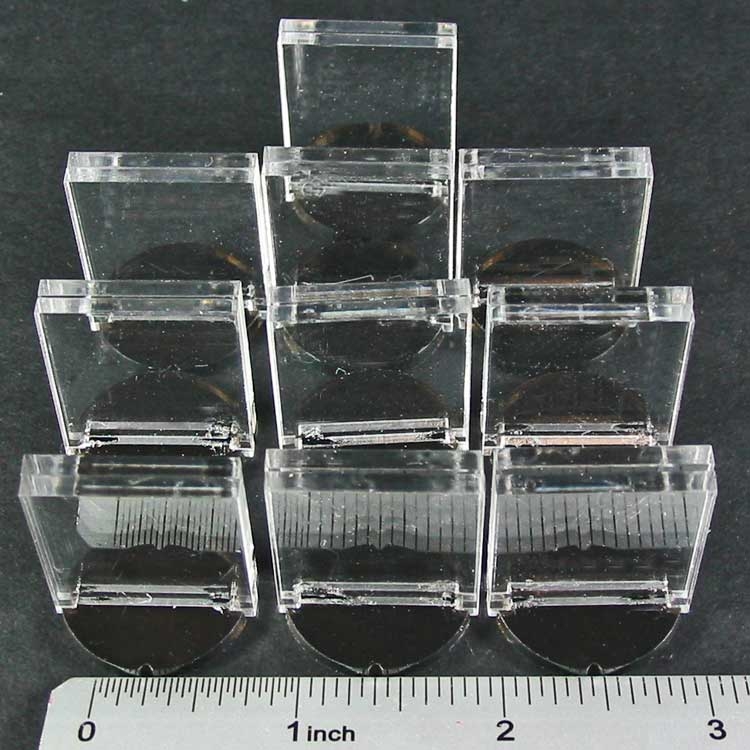
or markers for indicating which character miniature is holding a torch…
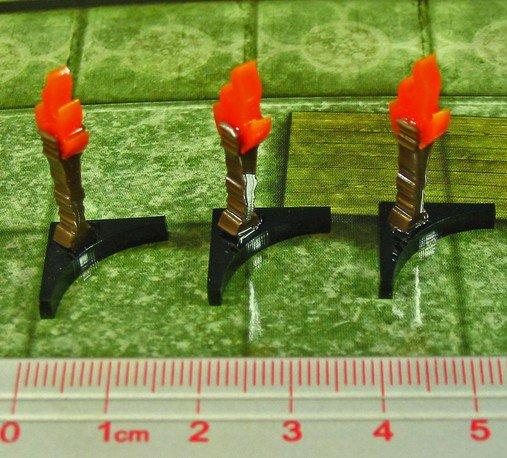
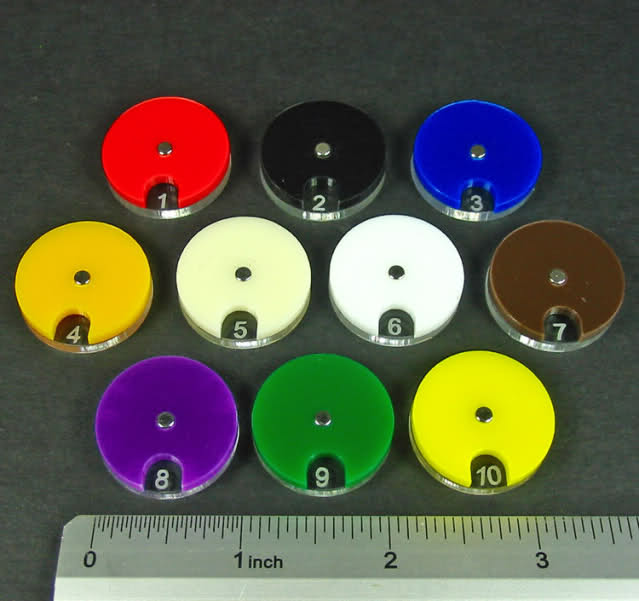
And other bits for gamers – Litko also makes a variety of bases for miniatures and other really clever items like counter dials….
and a variety of portable dice towers which can be taken apart and thrown in a zip lock bag. Perfect for those gaming tourneys.

So I encourage folks to give them a look. Several online retailers also carry their products. And if you aren’t sure about what they’d really like, well just give them a gift certificate instead. Hope folks enjoy the holidays with family and friends (and get some games in too).
Outrider Kickstarter wrapping up.
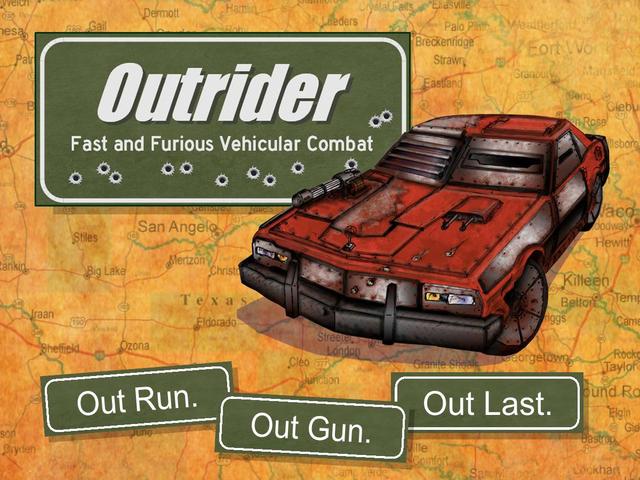
Outrider from Dice Fist Games has a successful Kickstarter that is ending soon. Set in an apocalyptic setting after a severe food shortage, players are car driving, mercenaries for hire assigned to protect truck shipments of food that pass through the the wastelands of Texas. It’s billed some as a board game but really is a miniature wargame using cards for cars. With souped up engines, welded armor plates, and machine guns strapped to the hood, players duke it out seeing who will be the king of the roads.
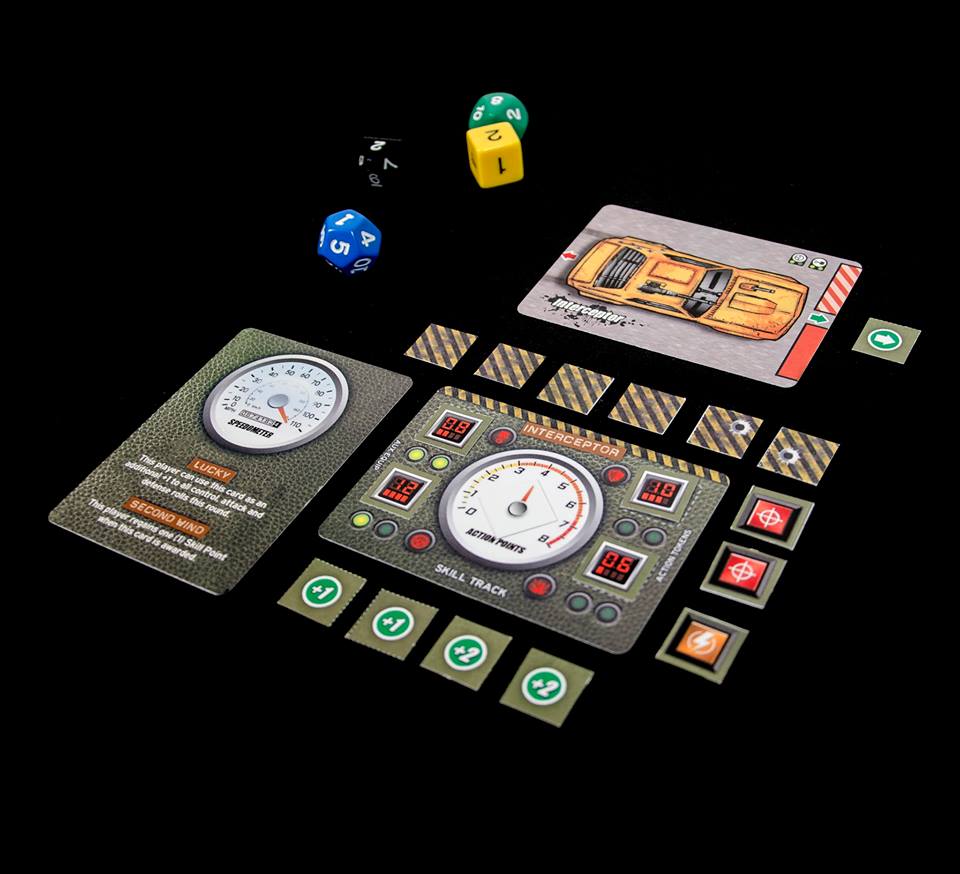
The game uses a clever system of assigning die types to various car characteristics to represent engine power, defense, driver skill, and weaponry. Players distribute a single D6-D12 for each of the car attributes with a higher die type translating into a more effective stat. Each car type also has base stat bonuses which add to the die type value, allowing players to rely on base car characteristics plus a lower assigned die type if seeking to tweak out a different attribute more.
Players resolve their turn one at a time, using a special maneuver deck. Players program the movement for their turn and then flip through the cards one at a time on their turn to move. It’s a rather simple, elegant system over relying on movement using a measuring tape. As each card is turned over, some may require maneuver tests. If successful the car continues, otherwise some mishap could happen.

During each maneuver card placement, there is an opportunity to fire weapons at opponents. Again, rather than using a ruler to measure out ranges and arcs of fire, a special set of cards is used. If the target is within the boundaries (or corridor of fire) of these cards, it’s hit. Then it is a matter of rolling the weaponry attack value versus the target’s armor. As with all the rolls and checks you have to equal or better a target number, with damage tokens used to record how much a beating your car can take before it’s a bullet-ridden wreck.
There are several Kickstarter add ons from additional cars to varying types of weapons, drivers, and equipment. It has a smattering of feel along the lines of X-Wing and Wings of War, but I totally dig the theme of the game. It’s successfully funded too, but will wrap up in a matter of days.
As the Kickstarter goes, I am a bit torn on the final product. While the quality of the cards and dashboards look top notch, I am disappointed with the various counters. It seems they’ve stuck with the concept of a better print and play version. The counters scream being printed on thick cardboard counters. The dashboard would really shine if a plastic dial was used instead of a separate counter. Instead you have double printed tokens on cardstock, which sort of makes the components fall flat. I totally understand the guy needs to make sure they can deliver and all those extra bits would likely mean the base cost of the boxed game would creep up more. But man, I’m hoping another publisher picks this up and gives the component quality some love.
Nonetheless, it looks like a fun game that straddles the mini wargame and board game camps pretty well. The box version seems they will have nice cards printed on good stock. At the very least, I am going in for the print and play version. If looking for a sleek version of Car Wars, or a more road warrior themed version of Wings of War/X-Wing, Outrider looks like it’s right up your alley.
Standing mountain counters for Runewars
I was in the mood to pick up an epic wargame and decided to get Runewars. The 1st edition had these special map tiles with slots in them, so you could place these cardboard inserts that represented mountain ranges through the tiles. From the looks of pics I’ve seen it gave the board a neat 3D look. The 2nd edition that I picked up didn’t have these inserts which wasn’t a big deal.
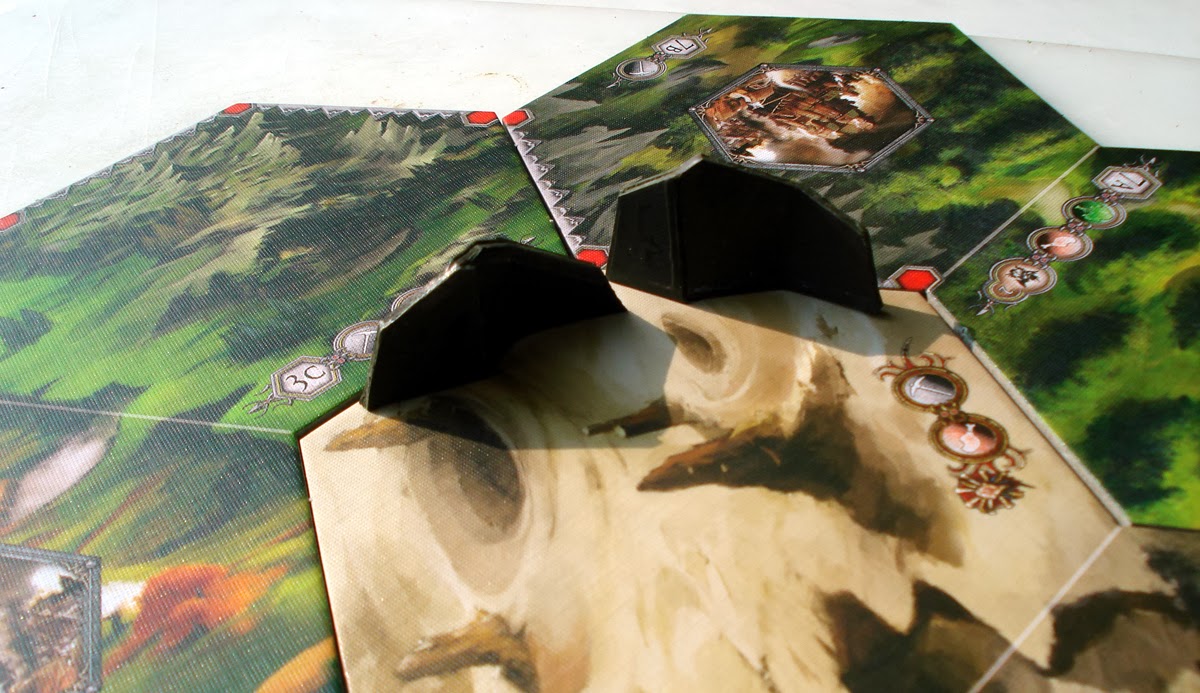
Looking over the board though, I realized although the borders for mountains are just marked with red symbols. Things can get a little cluttered in each map hex. It might be cool to use some kind of marker or token to make the mountains stand out more. After punching out all the game tokens and tiles, I sorta got an idea. See the cardboard stock for the counters and map tiles are pretty thick. You get a lot of leftover material from the game. So why not put them to use?
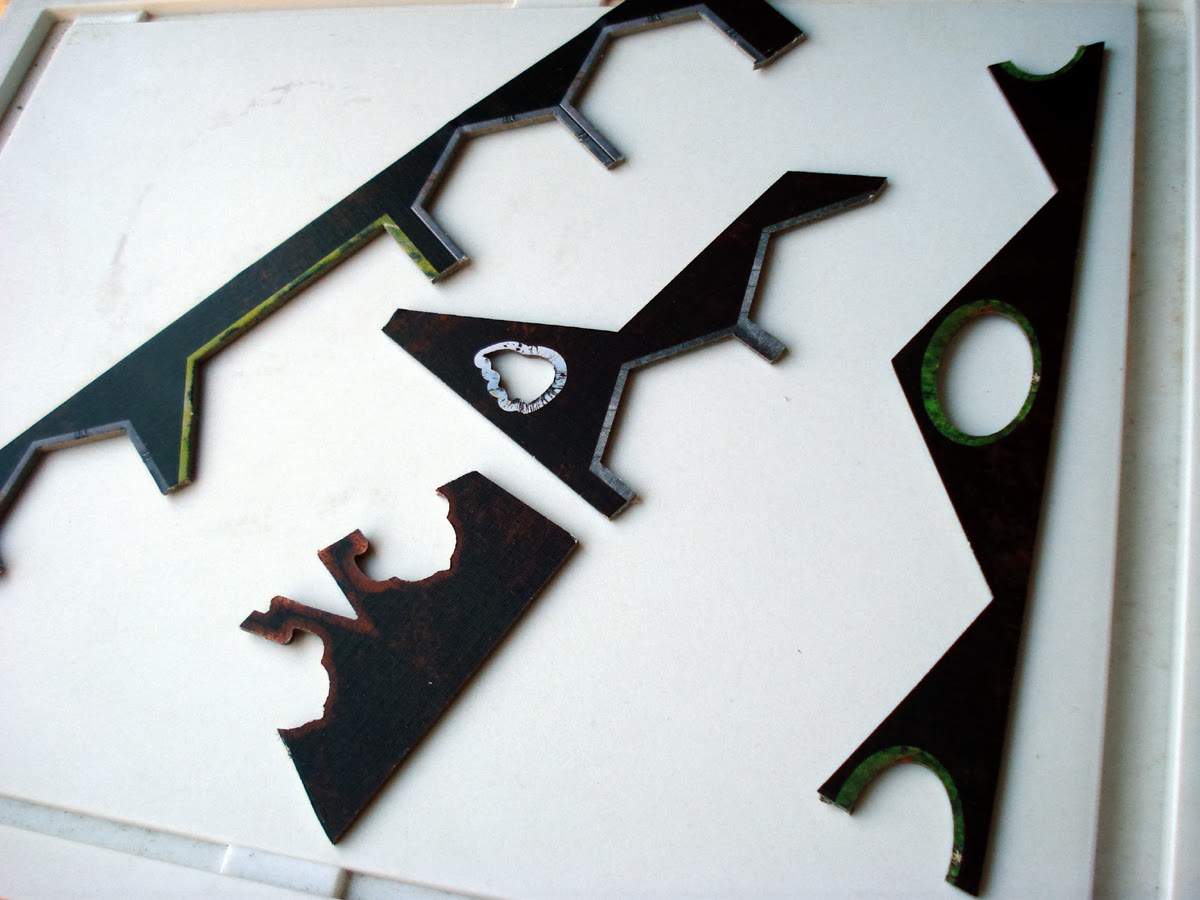
I cut out sections about the size of the tile edges. The problem was to consider how I could make them stand up. The most ideal solution would be to cut slots in each piece and glue smaller parts of cardboard to provide support for the long flat edge. Instead I took the lazy way and scored one side of the cardboard, and then folding it some on the opposite side. After making another fold (scoring the opposite side and folding in the other direction), I made the straight edge now sort of zigzag which is enough for the pieces to stand on their own.
The edges and cut sections were a lighter color. So I went ahead and gave a quick dab of dark paint. I also did this to any of the cardboard sections that had some portions with lighter colors from grassland and water sections of the map tiles. Also, I used PVA glue to seal up the scored folds in the cardboard and repair any splitting ends.
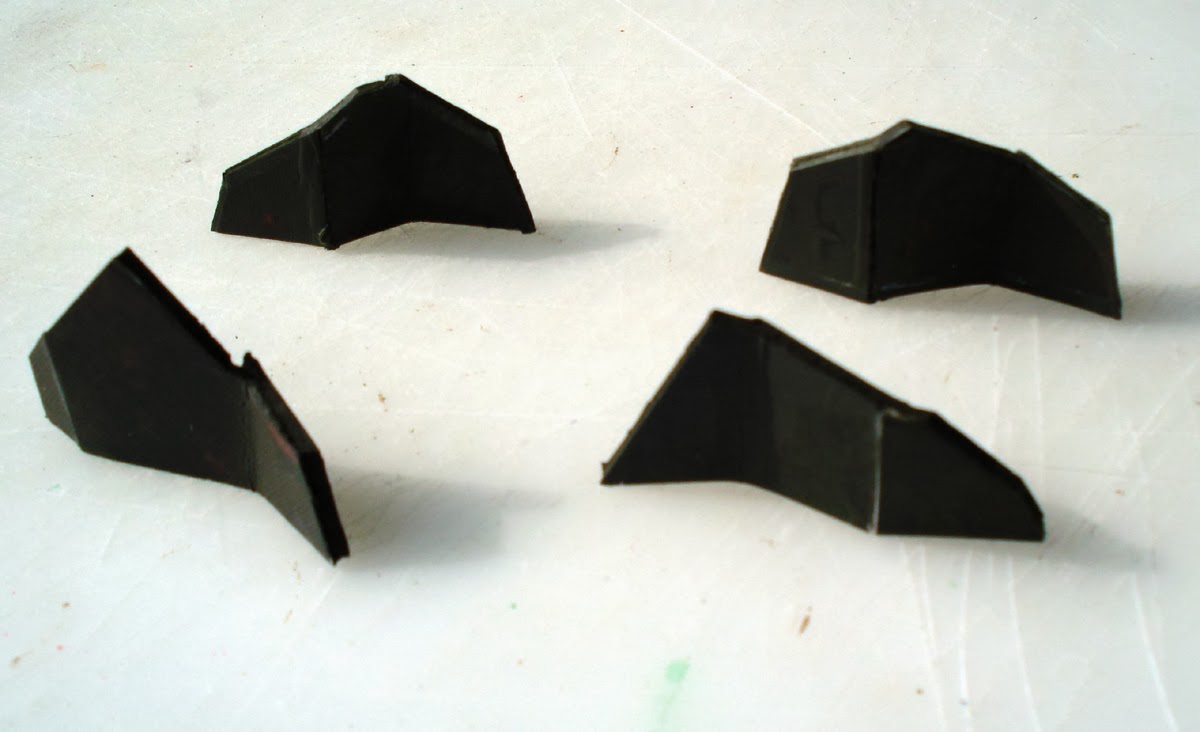
Overall I’m happy with the results. Obviously I could have gone to town painting them, but I wanted a simple marker for the mountain ranges that weren’t too distracting of a color. A nice thing about the shapes is that they easily slip into a small zip lock bag and don’t take up too much box space. Hope folks find this a useful tip.
Review: A Touch of Evil
 To get into the spirit of Halloween I’ve been wanting a horror-themed board game for a while now, something that would capture that feeling of investigation some and have monsters to face off against. I’m a fan of the Lovecraft mythos but the games I’ve seen and played never really captured that feeling well. And face it, trying to get the essence of a person losing their sanity facing incomprehensible horrors isn’t really something that translates into a game mechanism easily.
Digging around I decided to pick up A Touch of Evil from Flying Frog. It’s a game that can handle up to 8 players with a variety of play modes from a winner take all, working in teams, cooperative, to even a solo game. Overall it’a something that seems to scratch the itch of a horror game for me.
Players are monster hunters in the 18th century, trying to rid a colonial town of a terrible supernatural threat. They can choose 1 of 8 characters each with varying characteristics among cunning, spirit, and combat abilities. Additionally, each has a special ability that allows them to bend the rules some. Checks and combat are a simple matter of rolling a number of dice and counting 5 and 6s as successes.
The players face off against one of four creatures, being either a werewolf, vampire, a locust-summoning scarecrow, or a spectral (headless) horseman. Each monster has unique minions and other game effects that can hamper the heroes. Some are rather interesting like the werewolf that can pass on its curse to other players or the spectral horseman that runs to town attacking all in his way, to more basic abilities that just increase their combat proficiency.
The player’s turn is broken down into 2 steps. They roll a die and move that number of spaces. If there is a monster in a space, they must fight to defeat it (or run away if they survive the initial attack). Afterwards the player has several options from investigating an area to hopefully find a powerful artifact, gather up clues, heal, or attempt to gain equipment within the village proper. All currency in the game is based off of investigation tokens. Players gain them by traveling around the woods outside the town or by beating villain minions. As a nice rule, if a player flubs and rolls a 1 for movement, they gain an events card to offset the low roll.
When players have enough allies and items, they can try and beat the monster in a showdown. They attempt to track the creature down to its lair and begin an epic fight trying to whittle down the creature’s wounds and survive. If they fail they are knocked out, returning to the center of town next turn minus some resources.
After each player has a turn, the monster gets to play a mystery card. This may initiate an event like adding one of its minions to the board, or it will undertake a special attack. Additionally the monster may be able to move the shadow track. This is a countdown of sorts. When it reaches zero everyone loses. Additionally the shadow track dictates the investigation cost to find the creature’s lair. Earlier in the game, it’s more expensive while the cost to investigate the lair decreases as the shadow track approaches 0.
 For the most part, that is the game. Players try to move around the board and successfully employ their skills with tests of cunning and spirit, or fighting lesser monsters at certain locations. They slowly accumulate special items, or buy equipment in town, gathering up allies until they feel they are powerful enough to fight the main villain. The tweak to this is the village elders.
The game starts with 6 village elders. Players can enlist up to 2 of them to help in the final battle with the monster. Most are immensely helpful, improving the combat abilities of the hero. More importantly, they can also soak up hits. The player has to be careful though as if the village elder is killed, the shadow track will move down. This isn’t as clear cut a choice selecting the village elders however. Each elder has a randomly assigned secret, some are beneficial or don’t significantly alter their abilities, however about a third of the secrets hides that the elders are actually evil. Pick the wrong one and you can suddenly find the monster has another minion in the fight.
To ensure you aren’t selecting an evil village elder, players can pay investigation to see where their heart lies. This information is useful, as opposing players can call out evil village elders during a showdown, allowing them to join the monster in the final battle. This entire portion of the game really makes it for me. You want to spend the time investigating the town elders to seek out potential allies, or find out which ones are best to turn on other player’s if needed.
The Good – What stands out are the variety of play modes for the game. You can play it as a coop (or solo), working as teams, or everyone out for themselves and this variety adds a lot of replay value to the game. It’s a fun experience gathering up resources to fight the monster. Additionally the shadow track an effective clock on ending the game which helps ramp up the tension. When village elders die, not only are the players potentially losing an ally but the shadow track drops down, ever closer to zero. This helps capture that feeling impending doom for the players and pushes them to act quickly.
The components are top notch. The cards are thick and coated in plastic. The counters are made of nice cardstock. There are several well sculpted plastic figures to represent the hero pawns, even an audio track CD is included in the game. The board has an antique map look to the layout of the village and surrounding areas. The card art is done rather differently using actual photographs of costumed characters. There are more hits than misses with the depicted photos and it portrays the gothic horror theme fair enough.
The Bad – The game is roll and move. Even with the event card bonus rule added for rolls of 1, it can be frustrating at times not getting to the location needed due to poor die rolls. The combat and task resolution is a little simplistic, where you simply want to roll as many dice as possible to get more successes. Games with high number of players when not working as teams can drag sometimes. And while there are plenty of heroes to try out, there are a limited number of villains which may not provide enough variety in how they interact with the rest of the game. Additionally the art overall is alright, yet some might find particular cards lackluster as the photographs can be a little campy.
The Verdict – A Touch of Evil is an enjoyable game. What really stands out are the variety of play styles, from a standard coop to a free-for-all where everyone tries to be the hero and take down the monster themselves. I feel what works best for the game is the competitive team mode. For me it captures that feeling of an old 60s-70s Hammer film in a colonial setting. The potentially twisted village elders, the snooping around particular locations, the slow accumulation of equipment and allies until you can have the final big fight against the creature, it all works well as a horror game and is great fun. If you’re looking for a horror board game that isn’t quite stuck in the Cthulhu-theme rut, this is a great one to pick up.
 Geek Ken