Category: Board Games
Review: Saboteur

For 3-10 players, Saboteur is a light card game that is part deception and part strategy. Players are dwarves seeking to mine a path to gold treasure. Unknown among the players is that some of them might actually be saboteurs, seeking to thwart the entire operation and keep the gold for themselves.
The game goes through 3 rounds, with the player having the most gold at the end being declared the winner. At the beginning of each round every player receives a role card indicating if they are a simple dwarven miner or a saboteur. An entrance card is put in play a defined distance from three face down goal cards which are randomly placed. Two of the goal cards lead to a lump of worthless ore, while one card is the gold treasure.
During a player’s turn they have the option of placing a card connecting the current paths, discarding a card, or to play an action card. Afterwards they draw one card. The action cards either hinder another player like breaking a mine cart or smashing a pick, or they repair that specific item. If a player has broken equipment cards in front of them, they can’t play any cards (except action cards to repair any broken cards on them). There are even map cards which allow the player to secretly see which of the 3 end goal cards is actually the treasure.
When a path leads to the treasure, special treasure cards equal to the number of players are drawn from a deck. Starting with the player that reached the treasure, they get their choice of treasure cards which have a varying number of gold nuggets. It’s entirely possible that some players will get more treasure cards than other fellow mining dwarves. If all the cards are exhausted and/or a legal path cannot be made to the treasure, each saboteur gets a set number of gold nuggets as treasure while the miners getting nothing. The role cards are shuffled and new cards are dealt to each player for the next round.

The game becomes a fun game of deception. You try to see which opponent might be throwing a wrench into the miner’s plans. If they feel someone is a saboteur, they can try to lock them out breaking their equipment. As a saboteur, you want to try and be subtle with subverting the path away from the treasure.
Not everything is a cooperative effort for the miners though. The player that reaches the treasure first gets their first choice of gold cards. The cards are an unequal distribution of 1 to 3 gold nuggets. Also if any players are saboteurs, the miner that gets to the treasure first will get an extra gold nugget card. So there is a big incentive to try and get to the treasure first (as you’ll likely get more victory points). This might even mean trying to stop other miners so you are the one successfully establishing a path on your turn.
The Good – This is a fun light game with a fair amount of strategy. The rules are very simple and easy to pick up. The game also plays rather quickly taking only 20-30 minutes. The cards are of sturdy stock and the illustrations are pleasant, colorful, playful depictions of dwarves and their mining equipment.
The Bad – While it’s simplicity has some charm, it can be somewhat of a repetitive game. You can get an very bad streak of drawn cards where it’s practically impossible to remove broken equipment played on you. This can be somewhat frustrating. If you are the lone saboteur (which is possible in a lower player count game) and are figured the likely traitor early in the game, it can be disheartening as everyone else keeps dumping broken equipment cards on you preventing you from doing anything.
The Verdict – Saboteur is an enjoyable light game, also a few things really add to the play experience. The role cards used will have one extra card over the total number of players. It’s entirely possible in a lower player count game to have no saboteurs, yet no one will know this until the end of the round. Also, having 3 rounds with new role cards given out at the beginning of each one means a player might not be stuck in a particular role for the entire game.
One really nice twist is that even though all the miners share the glory when a path reaches the treasure goal, the cards are not distributed equally and have different values. So while you do want to be sure and get to the gold with your fellow miners, you certainly don’t share the rewards evenly. This little twist adds some complexity in determining who the saboteurs are. If a player prevents another from reaching the treasure, are they a traitor or are they just a greedy miner trying to reach the gold first?
With a small box, light rules, and being able to accommodate up to 10 people, Saboteur makes for a fun evening. It’s a great filler game and a wonderful way to cap off a night of heavy board games, or make for an enjoyable hour or so by itself.
[Note: There is a slight variation I like using when there are potentially more than one saboteur (5-10 people). Like the Resistance, I add one extra step after the role cards are given out. Everyone closes their eyes and one person announces that the saboteurs open their eyes and find out who else might be a saboteur for that round. Everyone is then instructed to close their eyes again and open them all at once, with the game starting as normal. It can be difficult for the saboteurs to win a round unless they can somewhat work together. This little extra step allows for the saboteurs to strengthen their position when they bluff to the other miner players.]
Alleycon 2014 – A local gaming/fandom con in Gwangju

Last year a small geek fandom con dubbed, Alleycon, was run at a local eatery in Gwangju, Korea. This Sept. 27 it’ll be hosted in a larger venue at the Gwangju Women’s University. Last year the event was pretty fun and it looks like it’ll be bigger this year with some more guests and organized events.
Pre-registration I believe is closed, but seems there is still quite a few passes left so registration at the door shouldn’t be an issue. Not certain about the costs, but all day passes should run between 20,000-30,000 kwon. Best of all many con events will have proceeds going to a local orphanage. So you can spend some cash picking up (and playing) some geek-centric items and ease that guilt a little knowing you are doing some good at the same time.
There’ll be a cosplay contest, video games, some Q&A sessions via skype with some sci-fi authors, and a bevy of tabletop gaming. Along with set events, there will also be a room with open tables. So if you are itching to throw down and try out a game in your collection, this might be a great chance to try it out with a few like minded folks.
I’ll be running a Bolt Action demo game and also a Savage Worlds WWII game. Last year I did something similar and had a good time running events as most of my players had not tried RPGs or miniature wargames before. So it’s always a treat to give folks a chance to see what the hubub of gaming is all about.
More Than a Game – Board gaming in Bangkok
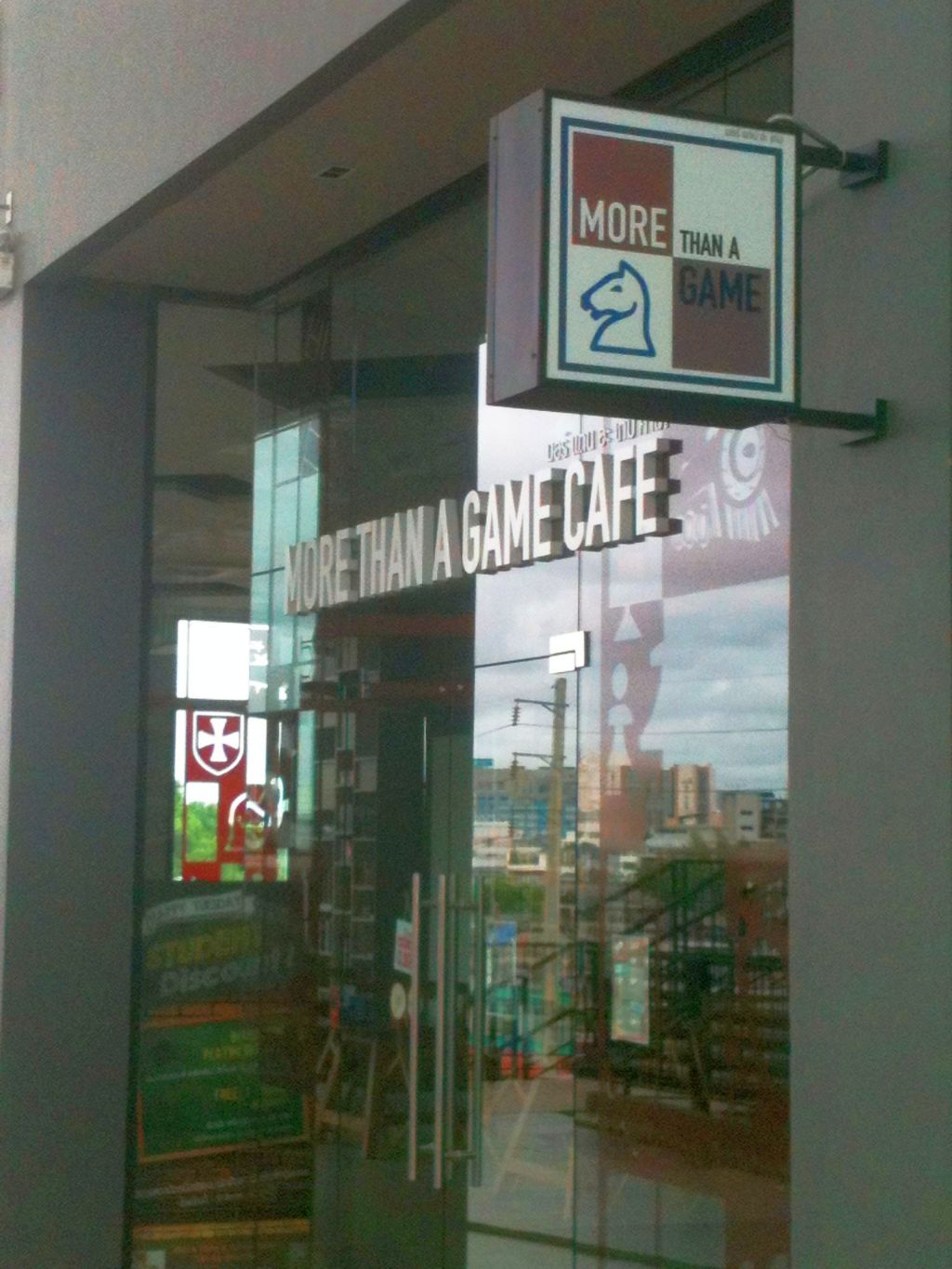
Occasionally I get to do some international travel. While I don’t actively track down game stores, I certainly will jump at the chance of checking one out if I stumble across it. The last time I visited Bangkok, I was pleasantly surprised to find a local board game cafe at a mall near my hotel.
The cafe does not cater to the late hour gamer, closing at 9 PM during the week and at 10 PM on the weekends. However they do open a bit earlier ready for the lunch crowd every day. The place is well lit, with several tables in a nice open area.
There is a decent selection of games for sale and another full shelf of games for playing in the store. The cafe has a membership which allows regulars to spend time in the establishment playing games. However if purchasing a few drinks, you can also get a 3 hour chunk of time to play games which seems more than enough.
 You’ll certainly want to entertain getting something to drink and eat too. Coffee in the typical variety of serving choices are available as well as other non-alcoholic drinks. There are some nice desserts and a few key sandwich choices too. I have to say the waffle desserts are especially tasty. The staff was very friendly and eager to engage me when I came in. Given that they were willing to chat to a foreigner in English was a plus.
From my understanding one of the co-owners is an expat and wanted to try their hand at introducing board game cafes in Thailand. The staff explained that these type of game cafes are slowly becoming popular. And I’d say it seems like they are running a place with some great potential. If you get an opportunity to travel to Bangkok and are close to Chulalongkorn University, More than a Game is certainly a pleasant way to spend an afternoon over some coffee and board games.
 |
| Roomy tables. |
 |
| Well lit tables at night. |
 |
| Games for sale. |
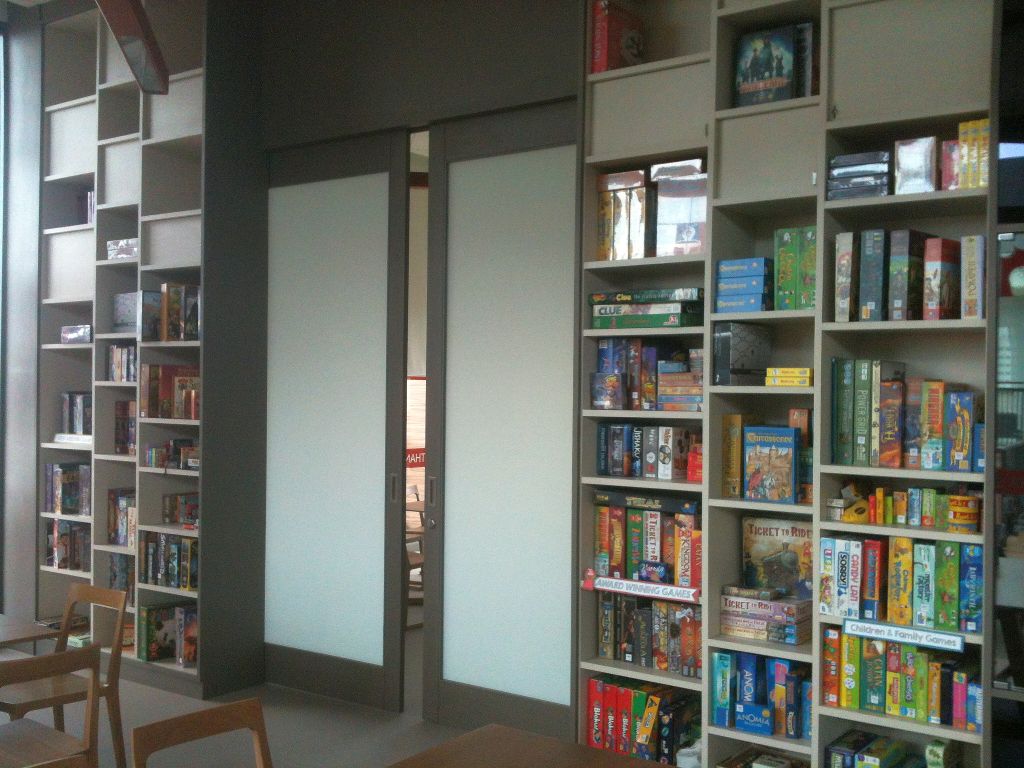 |
| And games for playing. |
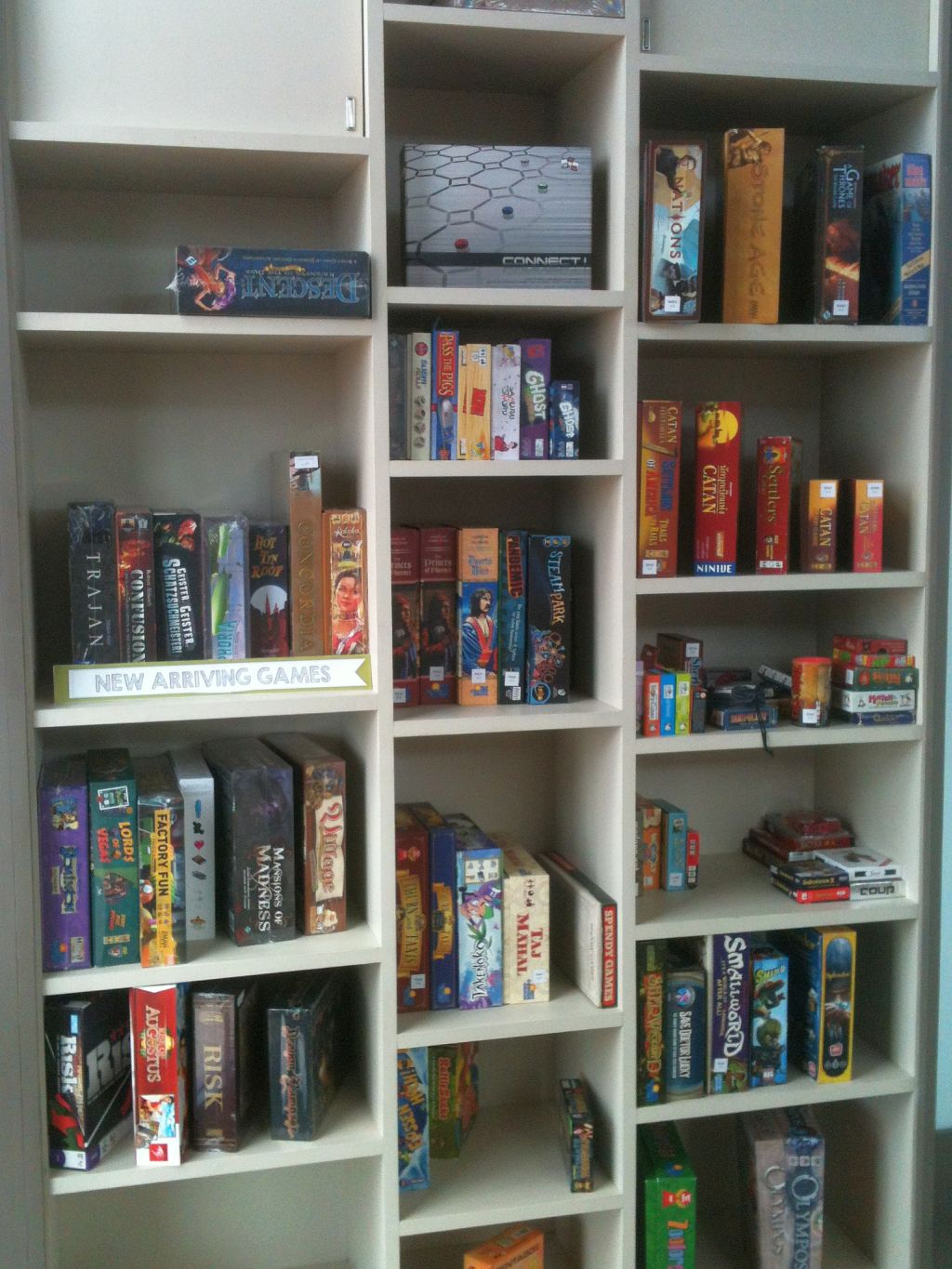 |
| A closer look at the games you can play. |
Rolling Dice – Board Game Store in Seoul

A while back I talked about some places to pick up war game supplies in Seoul. Fortunately for board games, you’ve got a better selection. Board gaming is a relatively popular hobby in Korea, with the CCG scene being particularly popular with younger kids. One of my favorites is Rolling Dice. Now, it’s really a sister store to Dive Dice which also operates an online store. In fact the map I have in the post directs to that name, but the storefront in Hongdaejeom is Rolling Dice.
The store is fairly large, with a pretty nice selection of board games. What I failed to take a pic of is another wall of Magic and X-Wing miniatures, along with another full shelf of Korean Board games. Yup, the pic you have here are just some of the selection of games in English.

The place is pretty hopping the weekends I’ve visited. It looks like Magic has a fairly fervent following with several tables filled with players. With a small shelf of snacks and a bathroom on the facilities, you can say they take gaming in store pretty seriously. Unfortunately for non-Koreans, it seems regional language is the norm for the decks I saw, but there were a few ex-pats having some games (and I expect with the right app, you could get a language translation of cards if needed in a pinch).
 To get there, take subway line 2 to Hongik university. Get out at exit 2 and head off for a street parallel to the main avenue. You can see the pin marker on the map pic below for the storefront. Look for it on the 3rd floor of a commercial building. The store hours are a bit wonky and more for the late night crowd. They typically open after 3PM and will stay open Fridays and Saturdays till 12PM. So be sure to swing by the place late afternoon/early evening.
Rolling Dice offers typical retail prices. I’ve gotten quite a few games from overseas distributors and have to say having a local source in Korea will save you tons in shipping, even if you’re playing retail costs. For an expat board gamer, this is a great store to check out. Be sure to give them a look if you are ever in Seoul.

Review: Castle Panic
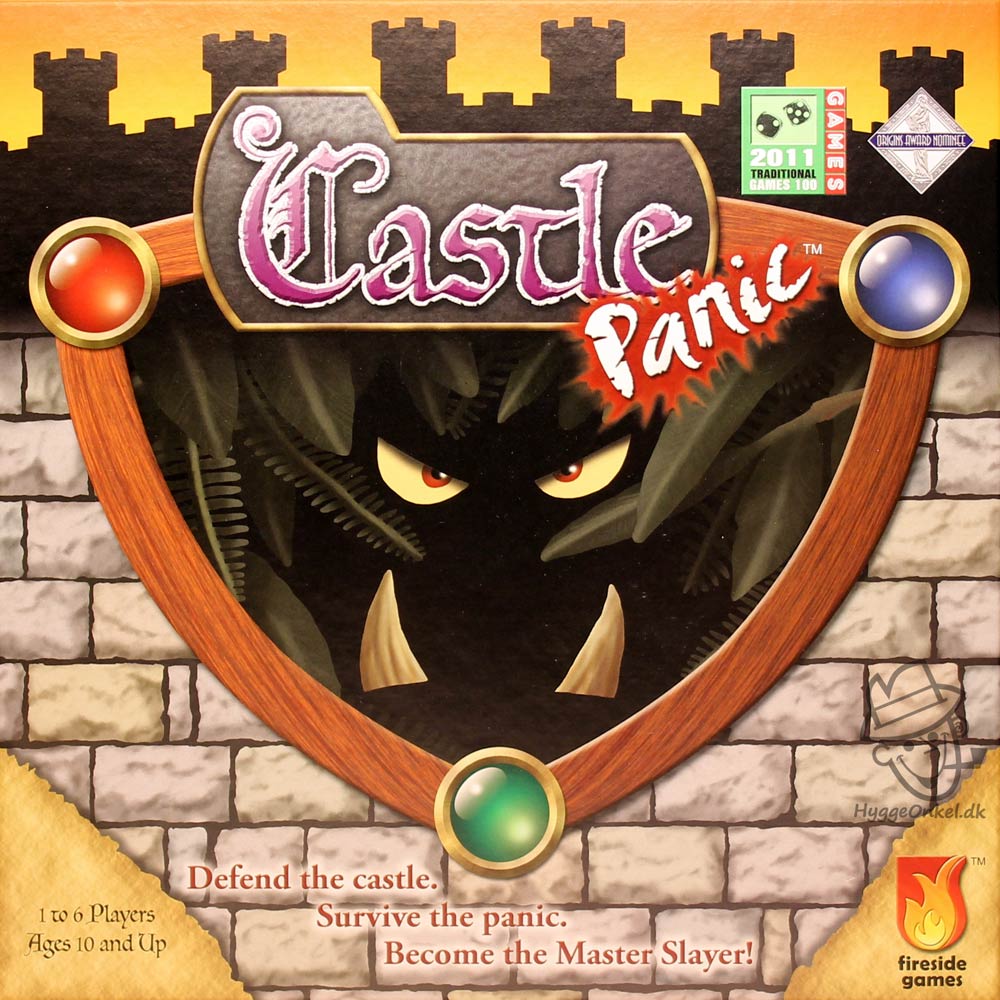
Castle Panic is a semi-cooperative game from Fireside Games for 1 to 6 players (yup, it can be played solo). You each play stalwart defenders of a castle trying to organize your defenses as goblins, trolls, and rampaging orcs lay siege to it.
Play revolves around a person drawing and trading cards, attacking monsters on the board, and then randomly adding additional monsters. The game ends in a victory with the players killing all the monsters, while a group loss results if all the inner tower sections are destroyed.
The game board has a series of concentric rings representing different range bands for specific cards (archers attack in the furthest, knights in the middle, and swordsmen in the innermost circle). Additionally the board is split into three different color sections. So a red archer can only attack the outer ring in the red section. Got a pesky goblin in the green section? Tough luck.
After drawing and trading a player attempts to destroy as many monsters as possible. Each card played will do one damage to a creature. While goblins are easily dispatched with one hit, orcs and trolls take a few more attacks to drop. If a monster is destroyed, it’s taken by the player that killed it.
After a player makes all their attacks, monsters on the board move closer by one space. Hitting an outer wall of the castle inflicts damage to the monster, but also removes that wall. If monsters are inside the castle courtyard, they destroy a tower section instead. If monsters remain alive inside the courtyard and are required to move, they move clockwise one section, destroying another tower section.
Players have very few options to destroy monsters once they reach the courtyard, relying solely on rare heroic cards that can dispatch these beasts. This makes for a frantic time as all the players are trying to wipe out as many as creatures as can and try to predict where monsters will be on future turns. Every player turn, monsters move closer in and more are added to the board. Throw in special monsters that heal creatures, ones that allow current baddies on the board a free move, to tokens that rotate each monster one section over, you end up with a frantic race against an ever encroaching horde of creatures.
As I mentioned the game is semi-cooperative. Players keep the monsters they killed. If they survive the onslaught, the player with the most monsters slain wins the game. This is a nifty aspect of the game as you are trying to ensure the survival of the tower so everyone doesn’t lose, all the while judiciously handing out cards to make sure you are slay the biggest creatures awarding the most points. It’s a very optional part of the game, but one I found enjoyable allowing for a little competition in what could also be a very cooperative game.
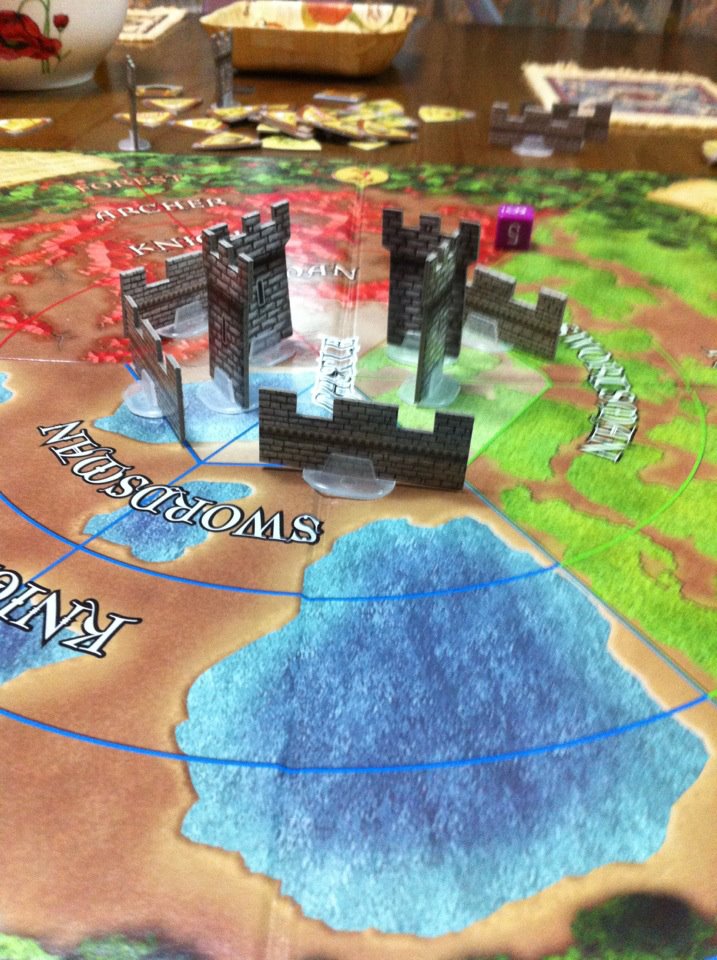
The Good –This is a fun and engaging game. There is plenty of player interaction as you are constantly bartering for cards. The mechanics are simple and easy to grasp, but still has an interesting puzzle aspect as you are continually seeing the optimal cards to play and trade as you tackle certain monsters and try to predict where others will be on later turns. The added individual victory condition of killing the most monsters is also a nice touch (which can be easily dropped if looking for a true cooperative game).
The components are colorful and the castle being represented by actual standing cardboard sections is a nice touch. The monster tokens are thick cardstock and the entire means of recording damage by simply rotating the triangular token is a great idea. All of this adds to a tactile experience playing the game, and allows for easy bookkeeping.
The Bad – The game can be very unforgiving if you get a bad turn and poor luck can be an issue. While there is strategy and a need to plan for future turns, there are enough wildcards in the game to throw everything into a chaotic mess. You can lose this game through bad luck which can rub some people the wrong way.
Also while the tokens and board were very sturdy, I found the card stock of the cards lacking. An accidental spill on the table for me resulted in some cards almost disintegrating. So the component quality is a bit of a mixed bag.
The Verdict – Castle Panic is great and doubles as a wonderful family game. It provides a frantic play experience as you continually go through a roller coaster where you think everyone has a handle on the incoming monsters, only to experience sheer panic as things suddenly spiral out of control. The rules provide some different variations to make the game easier or harder, including an option of pitting one player as an evil overlord fighting against everyone else.
It can accommodate quite a few players, and also be run as a light solo game. The turns move rather quickly and trading also helps in reducing downtime between turns, keeping everyone engaged in the game. It’s a light, family friendly game which can be challenging for adults. Definitely one to add to your collection and a keeper if you have kids (or plenty of pals in the mood for a beer and pretzel game).
Review: Eminent Domain

From Tasty Minstrel Games, Eminent Domain is a game of galactic expansion where you play fledgling space-faring races striving to expand your empire and become the most influential race in the galaxy. For 2-4 players this strategy game usually runs under 60 minutes. As players colonize planets, research technology, and produce and trade goods, they gain influence. The game ends when the supply of influence tokens runs out, or when two supply decks of action/role cards are exhausted. The player with the most influence at the end of the game wins.
Play is centered on choosing cards representing defined actions. Each player starts off with a deck of cards comprised of each action/role card. As they play the game, they will choose a role taking one from the central supply to add to their deck. So as the game progresses, you are slowly accumulating cards for certain actions (which results in your deck having a focus of specific cards). It’s a slight nod towards deck building, however the choices you have a somewhat limited and not quite the plethora of options in something like Dominion or Thunderstone.
When a player selects a role card, they have the option of taking that action as a leader or following it as a role. The leader option is usually a limited action. The follow role allows them to ‘boost’ or add to the action based on similar cards in their hand. So if a player chose to colonize a planet, they’d pick up a colonize card from the central supply and place it under one of their planets. Then they could add more colonize cards from their hand to that planet, boosting the effect of the role card they selected.
What is particularly enjoyable about role selection is that once a player chooses and resolves a particular card, each player in turn has the option to also take that role action (or they can decline and draw a card from their deck). This is an interesting play mechanic as one of the end game conditions is when two of the central supply decks are exhausted (or one with a 2 player game). So while you and an opponent might be focused on a similar action strategy, if you each keep drawing cards from that supply you are quickly advancing the game to end. You might instead want to hold off and try to follow that role when your opponent selects it, and choose a different role on your turn.
This makes for an interesting choice of either selecting the role you want to play, or possibly branch out in hopes one of your opponents takes a similar role that you can follow on their turn. You’ll find yourself looking at the number of cards they are holding, and the state of the planets in their respective empire. If a player has an uncontrolled planet with a large fleet, they likely will choose a warfare role on their turn. If they have lots of resources produced on their planets, they likely will choose to trade those resources in. Do you opt to follow their role choices, or just pick a similar action on your turn? It makes for some fun play around the table.
Another layer to this is the research technologies. Most are an improvement of the basic actions that players can choose. However some advanced technologies allow for very different strategies. The more advanced technologies not only require more research cards to obtain, but also require controlled planets of a certain type. This means you have to make an investment of several turns to build up towards a higher tier technology, and this can be a rewarding experience when a particular combination of cards plays out, making an efficient influence-gaining engine in your empire.
Another facet of the game is the inter-dependency of different roles. While you may want to focus on settling or attacking planets, you also need to survey planets to add undiscovered ones to your region. If you want to dive deep into research, you have to have certain planet types under control in your empire. You need to focus on a particular role and then be able to switch to another once that foundation is set. As you are adding more and more cards to your deck, you have to determine when is the best time to alter your focus (and possibly think about removing cards that don’t fit your overall strategy). To add another wrinkle in decisions, deciding when to jump onto a role chosen by another player is an engaging aspect of play. All of this accumulates to a fun, interactive player experience.

The Good – You have a fun strategy deck building game that has enough meat for interesting choices and a variety of strategies to try out. The interaction initially looks limited but in play, being able to benefit from another player’s choice leads to a lot of back and forth during turns.
The iconography and design of the cards are well done. The tokens and ships are nice pieces of cardboard and chunky plastic. The central game mat is a pleasantly thick board and not a flimsy paper. While the artwork for some cards might clock in as a bit cartoonish for some it highlights the theme well (having a light touch of humor with some).
The Bad – The game turn revolves around selecting role cards. As the exhaustion of role cards is an end game condition, your engine can take some time to build and only a few turns to utilize once it’s in place before the game ends. I’d also say that card combinations not as deep as other games like Race for the Galaxy. While you have some interesting technologies to incorporate in your deck, the unique ones are somewhat limited. Players might also tend to slip into set strategies depending on the starting homeworlds they draw (which are limited).
Also, direct player interaction is not part of the game. It’s all through a sort of proxy with the selection of role cards. While your opponent can take advantage of roles you select, you can’t really do anything about it. Some looking for a 4X type of game where direct warfare against other players as an option will be disappointed.
Lastly, while the components are good overall I did have some dings in some of the cards and cardboard pieces from the player summaries and starting planets. Nothing huge, but certainly expect to sleeve those cards.
The Verdict – I enjoy Eminent Domain immensely. While it may have what initially seem as flaws with the game, through practice you realize they aren’t really much as a major detraction. The initial feeling is one might find the game repetitive. However you realize much of your overall strategy depends on the first few initial planets you control which actually are quite varied.
Additionally, you really have to be fluid with your plans. If your 3 other opponents are going a heavy warfare route you are just adding to the ending the game faster jumping on the bandwagon (by exhausting the supply of warfare cards). It might be more prudent to shift into another strategic role that’s less focused on by others. At the same time, you really want to be able to jump in on the action of other players’ choices for roles. This all goes on under the backdrop of a deck building game, where you want to also try and keep a tightly refined deck of cards. Dabble into too many different things and you’ll have a hard time getting the right cards you need.
This has sort of become my space empire card game choice as of late, replacing Race for the Galaxy. RftG is a fantastic game and one of my favorites. However the learning curve for RftG is so high, I just can’t seem to justify getting it out to the table as much. Eminent Domain is much easier to teach, yet still has some surprising depth and a little more player interaction than RftG.
Eminent Domain is a good game that combines role selection with deck building elements. It’s got enough player interaction and strategy to make for a fun game. And keeping the game to just about an hour means you can easily get a few games in a single evening. It’s a great buy for an approachable, yet strategic, card game.

Zombicide house rules
I enjoy Zombicide. I don’t feel it’s a fantastic game but it’s enjoyable. There are a few fiddly bits with the game that I don’t care for. One huge issue is the shooting. Mechanically it’s too unforgiving with the targeting priority. While I do think survivors should be at a risk in getting hit, the automatic hits applied to them is too much.
Another thing I don’t like is that with every player using a single survivor, it’s possible they can get eliminated and have to sit out the entire game. Zombicide almost works better with 3-4 people playing instead of 6, as you’ve got some survivors to pass off to another player if one of them becomes zombie chow.
So I made up some house rules. One big change is the shooting. Players are not automatically hit. Instead missed dice from shooting attacks are passed to the survivor in the target zone. On a 1-2 they are hit. I like this as there is less of a chance a fellow player will be hit, but the threat is still there. For weapons that roll a lot of dice (like submachine guns), this can be especially deadly. While a single shot weapon like a pistol are less likely to hit another player.
I also have a rule for players getting a chance to get their last survivor back on the table. It seems the new expansion for Zombicide circumvents this with a zombie version of the players. I think that was certainly something good to add to the game. For as light as a game this is it’s no fun sitting out a game, especially when Zombicide can run a little long. So I have something similar you can also use in the base game.

Review: Expansions for Kingsburg and Race for the Galaxy
This month I thought I’d post a short review of a few expansions for some of the games I’ve reviewed. Normally I’m not keen on expansions. I’d rather put the money towards a new game. However occasionally I do make the effort to pick up one.
‘Kingsburg: To Forge a Realm’ is from Fantasy Flight and expands on the base game. What I particularly liked is this is a set of mini-expansions rather than one product, allowing you to pick and choose options to add to the game. A while back I reviewed Kingsburg and found it an excellent worker placement game. However one nagging bit with me after several plays with two people was that you could slip into familiar strategies with buildings. The game seemed to thrive more with at least a third person, where you had to be a little more flexible in your overall strategy due to spots on the king’s court being scooped up from other players.

This expansion throws that nagging bit out the window. KB:To Forge a Realm adds new playmats with two additional building rows. Another option is a set of random building rows that throw in small variations over existing ones. When playing with this mini-expansion, you have the option of taking 1, 2, or none, with these building rows entirely replacing ones on your player mat. Between the expanded player mats and the random building rows, you get a lot of variation with the core game.
This variety in play is further expanded with the governor and destiny cards. Players randomly draw a single governor card at the beginning of the game which provide a unique power. Like the random building roles, there are options to allow players to choose a governor (or building rows) by a draft system where victory points are offered as a penalty to their final score. The destiny cards are a new event that takes place every year, which can be a boon or a bane to everyone. These cards are the least enjoyable mini-expansion for me, but definitely adds some randomness to the game.
The last mini-expansion in the box are soldier tokens. All players are awarded 6 tokens with values ranging from 0 to 4 in an unequal distribution. Instead of rolling for reinforcements provided by the king, each player secretly chooses a token representing the reinforcements they get that year. Each player ends the game with one token left over and gets victory points based on its number value.
I have mixed views on this. I like it as it makes for some strategic planning. I can either try to build up my own military and not rely on reinforcements from the king, or push for resources in a few seasons to get victory points (hoping my choices of reinforcements are enough for the coming monsters). It can be a little tense as each player shows what reinforcement tokens they’ve picked (and likely what their victory point bonus will be at the end). However, some people I’ve played with really enjoy the swingy results from the die roll instead. While you always know you can count on at least one set of troops with the die roll, everyone might get a ton, adding some spice in deciding who has the largest standing army at the end of the year.
The Verdict – KB:To Forge a Realm is a tad pricey as an expansion. However it adds a lot and helps expand the variation of gameplay tremendously. The expanded building mats along with random building rows will likely be your new standard for the game. The other expansion parts also add some game variety. What I like is that each part is entirely optional and you can pick and choose which ones to play with. Further, many also allow for a drafting procedure, so that your choices can be even more strategic if you don’t like relying on random draws.
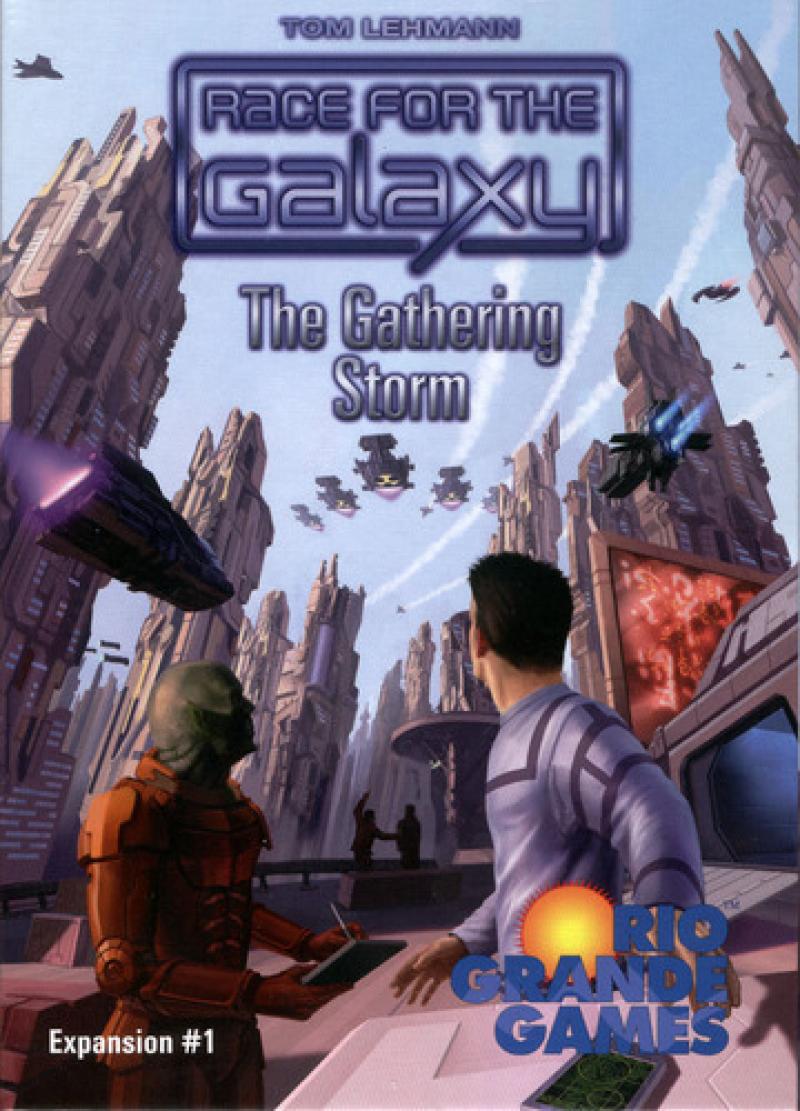
The second expansion I’ll talk about is ‘The Gathering Storm,’ an expansion for Race for the Galaxy from Rio Grande Games. RftG is a a favorite of mine however I felt at times having a limit of just 4 players could put a kink in my gaming plans on some evenings.
This is the primary reason why I picked this up, as it has action cards for a 5th player. However there are some other goodies in the expansion to add a few wrinkles to your typical game. There are new starting homeworlds with a few introducing some interesting properties, and handful of new development and planet cards. In this sense, the expansion is a tad lacking. While the new cards provide some different options and strategies, it’s not quite a mother load of new cards you’d expect in an expansion.
The other optional part of the expansion introduces special victory point conditions. Players randomly draw two 5 victory point tiles and four 3 victory point tiles. The 5 VP tiles are for players that have the ‘most’ for different game conditions (such as players with the greatest military, or the most developments). The other 3 VP tiles are for the first player that achieves that condition (like the first to get 5 VP, or build the first 6 point development). There are a few extra tiles, each being unique conditions, so there is a decent amount of variability with the point tiles where you aren’t always seeing the same bonus VP conditions. However the number of included tiles is not huge (6 of the 5 VP ones and 8 of the 3 VP ones) so you can expect to see similar tiles crop up with repeated play.
I see this part of the mini-expansion as mixed bag. Some might enjoy it while others may think it takes too much away from the core game mechanics. I like the victory point tokens, especially with 4-5 players. You can get a little muddled with your initial plans. As so many cards can get drawn and discarded by other players, you might find that specific card needed for a combo quickly lost in the discard pile. Having other smaller goals out there to give a boost to VP is a nice option. Even better, I like the ‘first player tiles’ as they can provide an incentive to quickly chose a direction for developments and planets to scoop them up. While the VP bonus is small, it does add up and can help repair a sagging 6 point development that isn’t getting the optimal synergies of other cards in your play space.
The last part of the expansion is likely the best reason to buy Gathering Storm, solitaire rules. I will admit the rules are a bit rough to wrap your head around as there are additional icons to decipher and the mechanics are not very intuitive. I had tried a few times and continually threw in the towel as I felt the mat icons and turn procedure could not be readily understood. Fortunately I stumbled upon this wonderful tutorial that really helped me grasp the concepts of the solitaire rules.

You pair off against an automated system where the ‘opponent’ chooses actions based on rolling special dice. You choose your actions and play normally, and the artificial opponent will play out its turn using specified actions based on a special playmat. Like the original game, you each have a tableau and starting homeworld. What is interesting is that based on the homeworld chosen, particular action options are altered to improve the play of the artificial opponent.
You get this semi-reactive play going. Where you settle a planet or place a development, and the artificial opponent likely does the same. As you are producing and consuming goods, the artificial opponent also racks up VP. You are in this constant race to maximize your actions as the clock to end the game is constantly ticking. The only complaint I have is that action selection is not as nuanced as in a regular game. While particular options are more likely to be selected by the artificial opponent, and some results will even mimic your choices, essentially it’s choosing its actions based on a die roll. Nonetheless, I found the solitaire rules very enjoyable and challenging.
The Verdict – I cannot recommend this expansion as a must have. The additional cards and homeworlds are nice (especially the new homeworlds which almost double the options in the base game). I like the VP tiles, but it’s very optional and does alter the theme of the core play somewhat. If you found yourself really needing a set of cards for adding a 5th player, this might nudge the expansion a bit more into the must buy column. This is nowhere near the value of KB: To Forge a Realm where I simply cannot see playing the base game without it. The Gathering Storm is very much a take it or leave it expansion.
Stack and Attack Kickstarter Preview

Currently on Kickstarter Stack and Attack is a small deck-building game from Egra Games. For 2-4 players, this game has the players as cavemen from the past trying to appease their primal gods by stacking the highest pile of rocks possible. Each tribe is trying to gain the favor over other tribes. So rather than just focusing on building the largest shrine, why not hurl a few rocks and knock theirs down instead? What results is an all out war of hurling rocks while trying to frantically build up your own tribe’s shrine.
Players each start out with a similar deck of cards representing rocks of different sizes and shapes. During their turn they have up to 4 action ‘points’ to spend on either stacking cards from their hand onto their pile, adding cards from a common pool into their deck, or attacking another opponent’s pile of rocks. Each task requires a number of actions with larger rock cards requiring more points. Each rock type has different defense and attack values. Further, rocks of a certain size can only be placed so high in the stack. The further you get your pile up, the less chance you can put the larger, more sturdy, rocks into your pile.
When attacking, a player picks a rock out from their hand and targets a specific rock in their opponent’s pile. The players then have the option to draw additional cards from their decks to add to attack or defense values. The player with the highest total (attack vs defense) wins the round. The defender not only counts the defense value of their targeted rock, but also all the rocks stacked on top of it. So as a player gets their rock pile stacked up, the base of their rock tower is much sturdier.
If the attack is successful, the thrown card and the targeted card are discarded from the game. That precarious pile of rocks above the targeted rock? Well they go tumbling down back into the defender’s deck. However, if the attack is not successful the attacker passes their thrown rock over and the defender gets to add it to their deck.
Aside from throwing rocks, about a quarter of the deck are various effect cards. They do relatively simple bonuses like add to attack/defense values, or allow more actions to be taken during a round, to even boomerang rocks that return to the player’s discard pile (regardless of the outcome of the attack). It’s a nice addition to give some variation to the basic rock types. At the end of the player’s turn, they shuffle their hand into their deck and draw a new hand of 3 cards, allowing them to pick up any rock cards they bought from the common pool for use on their future turn.
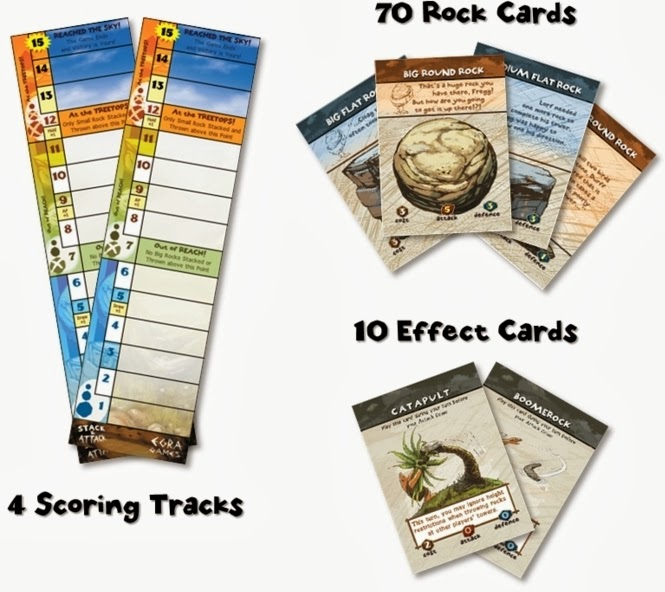
At the heart of the game is a choice of either attacking your opponent, or trying to build up your pile. As you pile up rocks, not only are you increasing your victory point score, but you also get bonuses action points and can have a larger hand. Heavier, more potent throwing rocks, can’t reach higher stacked rocks in a pile. Also as a player not only takes into account the defense of their targeted rock, but all the rocks stacked on top of it, you might very well get a foundation of immovable rocks. So each player is in a race to get their stack as high as possible and as quickly as possible.
Due to the stacked defense bonus, it can be exceedingly difficult to knock over a key rock in an opponent’s pile. To prevent that you might have to attack a certain rock in your opponent’s stack before it gets too big. All the while, you might end up with cards you can’t use (some big rocks cannot be thrown or stacked within a pile at a certain point). So you might have to try and either attack while you can, or even pick up needed rocks from the common pool. In the end, it’s pretty interesting management of actions during your turn.
When cards are purchased from a common pool, they are immediately replenished from the game supply. As rocks are being thrown about, they are discarded from the game. So eventually you will be running out of cards due to crushed rocks lost in attacks. When that happens the game ends. The player with the highest stack of rocks on their scoring track wins the game.
It seems a fun, light strategy game with a cute theme. There is a decent variety of cards, where not only are they small, medium, and big rocks, but also being either flat or round offering different attack and defensive values. It’s made their target funding for the game with a few weeks more until the campaign is over. You might want to check it out if looking for an enjoyable card game.
The Agents: a Card Game on Kickstarter

I’m sometimes on the prowl for new games through Kickstarter and a recent campaign really got my interest. The Agents is a turn-based card game that has a great theme and looks to be an interesting take on card-based mechanics.
Developed by Saar Shai, players take the role of independent intelligence groups controlling recently disenfranchised agents. Without clear instructions, these agents try to navigate a new world where they go to the highest bidder in a world of secrets, deception, and treachery.
As a player in the game, you are trying to accrue a set number of points employing a group of agents that is shared among your opponents. A really neat feature of the game is that the orientation of the card dictates how it plays for both you and your opponent. Most agent cards have abilities tied in with a particular role. If you want to use that ability, you are offering your opponent points. If you choose instead to gather points, the ability of that agent is now under direction of your opponent.
Not only are points needed to win the game, but they are also used as a currency to buy more agents and missions. With constant swapping, removal, and addition of agents, you get this constant ebb and flow of points. It seems to have some interesting ideas and looks like a lot of fun.
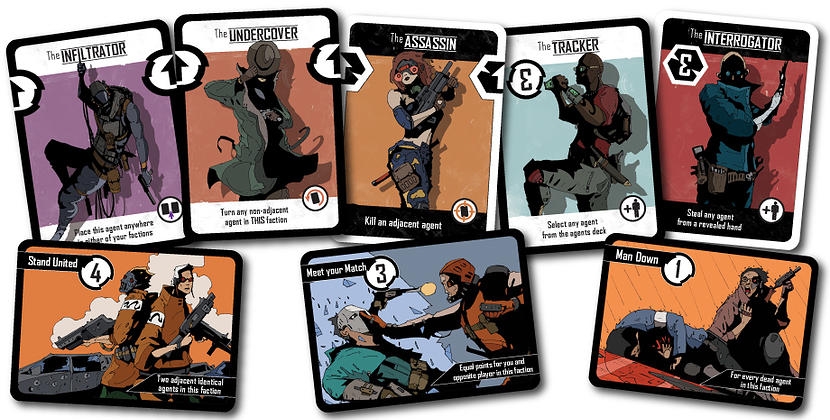
I’d be remiss to mention the artwork from Danny Morison. It captures a gritty look with a touch of sci-fi, almost giving the game a near-future dystopian feel. The game rules and a print and play version are available. The Kickstarter campaign has a few weeks to go however they have already secured project funding. It might be a great time to pick up the game and maybe get a few additional stretch goal goodies. At $18 for the base game, it seems a nice deal for an engaging card game with a great theme.
[EDIT: So the kickstarter was successful and I picked it up. Elsewhere you can get my thoughts on the game.]
 Geek Ken