Category: Board Games
Review: Lords of Waterdeep
Lately I’ve been on a kick with worker placement games, especially with my reviews. I finally managed to snag a copy of Lords of Waterdeep and have gotten enough games under my belt to do a write up on it.
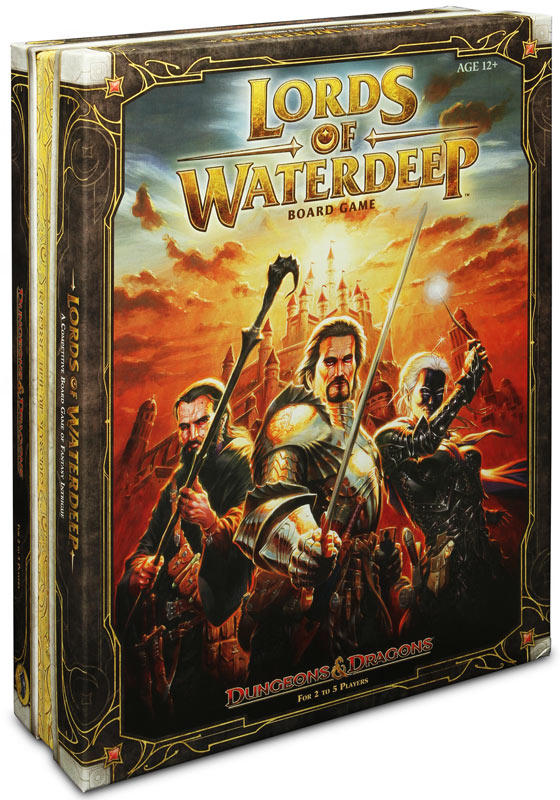
Lords of Waterdeep has 2-5 players acting as leaders of the many factions within this Forgotten Realms D&D city. Each player is seeking to gain influence and prominence within the city while undercutting their competitors. The goal is simple, gain the most victory points at the end of eight rounds.
Players gain victory points primarily through completing quests. Throughout a round they are constantly trying to gain different quests, and obtain the adventurers and gold needed to complete them. This is done by taking an agent from your pool and placing them at a key location within the city.
There are a variety of locations, and more buildings can be constructed to open up more areas in the city. Each location however can typically house only one agent. So players are constantly jockeying for the most ideal spot to gain gold and the right type of adventurers for completing quests.
A nice wrinkle to this are the constructed buildings. Each building constructed by a player is under their ownership. If another player assigns an agent to a building you own, you also get a small bonus. This sometimes makes for a difficult choice. Do they select to influence a building under control of another player? While they get the resources needed for a quest, they also are giving their opponent some reward too.
So far what I’ve explained is your typical worker placement game, where you try to squeeze out as many resources as possible and implement area denial for your opponent’s agents. A nice twist is the intrigue cards. These are cards that allow you to gain extra resources, or potentially force your opponent to complete a minor quest. This effectively bleeds off heroes recruited to tackle more profitable quests, messing with their plans. It’s a nice addition that introduces more direct player interaction.
There is one last change up to the game play. Each player at the beginning of the game secretly selects a lord they represent. These lords get bonus victory points for particular quests that are completed. At the end of the game, it’s quite possible for a player to get a huge bonus by completing a pile of specific quests. It can be a challenge to figure out what type of heroes are continually being sought, the types of quests slowly being accumulated, and deduce what lord your opponents are secretly playing.

The Good – It’s a very fun worker placement game. It’s just the right length, forcing players to try and get as much done as soon as possible. There is a fair amount of player interaction also using the intrigue cards. The artwork is well done and enough flavor text to give a bit of immersion to the game. It has great components with a nice linen finish on the cards, plenty of wooden pieces, and thick cardstock for building tiles and coins.
The Bad – While the secret lords are an interesting facet, for the most part it adds a ‘gotcha’ aspect of the game. It can allow for a truly huge endgame surge to a player’s victory point total. The assignment of the lords are secret and random with bonuses applied to two different quest types. Completed quests are stacked up in a pile (effectively being hidden), and can all make it more a guessing game to figure out what types of quests your opponents are working toward.
The theme is different and has that fantasy touch, but in reality you are collecting different colored cubes to complete work orders for points. The artwork and fluff text could be given a sci-fi theme and you’d have the same play experience. It just doesn’t capture that feeling of recruiting adventurers and undergoing heroic quests. It really could easily be some generic abstract economy worker placement game.
I’ll also quibble about the box. At first I thought the box insert was well designed, but after some use I drastically changed my mind. It’s just too finicky to put the pieces back in, needing to be ‘just so’ and worse of all, the box has to remain flat. If the box is propped up on it’s side, expect parts to fall out of the insert and shuffle around inside. I quickly threw my insert out and put everything into baggies.
The Verdict – Lords of Waterdeep is a great game. It’s the right game length and complexity to make it very approachable to a variety of gamers. There are a lot of subtle working parts to the game, especially acquiring and using the different buildings and their powers. It also has that interaction from intrigue cards that goes beyond your typical ‘grab a space before your opponent’ seen in most worker placement games. Like Kingsburg it has that depth of different building strategies and a little twist in game play to make it stand out.
To be honest, I shied away from LoW when I first heard about it. I just don’t get into WotC board games much. But the buzz around this was humming and I took the plunge to buy it. I was pleasantly surprised. I’ll also add you don’t need to have any knowledge of Dungeons and Dragons to enjoy this game, anyone can easily jump in and have a grand time. It’s a great, fun game and likely one of the better worker placement games out there.
Review: Zombicide
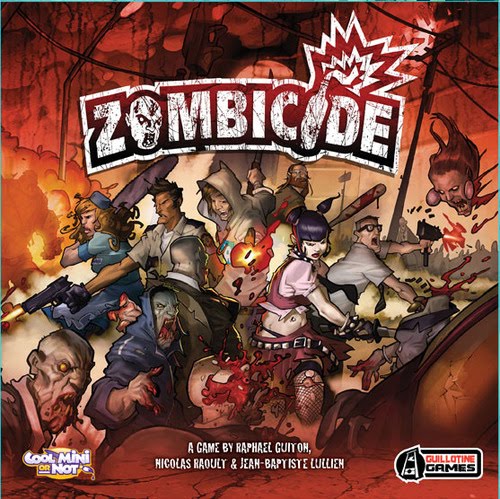
Likely one of the bigger splashes in the zombie board game craze came out the latter part of 2012, Zombicide, from Guillotine Games. It’s a 1-6 cooperative player game (yes, you can play it solo), where folks are survivors trying to keep alive in a zombie apocalypse.
The game itself revolves around 10 different scenarios (not including a simple tutorial) using different layouts and some variety in victory conditions. For the most part winning a scenario typically involves gaining specific objective tokens and/or getting to a specific location. However there are a few that mix it up, such as just getting one player to survive an escalated zombie danger level. Players can pick one of the 6 different survivors, that each have various starting abilities, and get access to different ones as they gain experience killing zombies.
The play is divided in turns. All players get a specified number of actions for their survivor. Then the zombies take their actions with more spawning at the end of the turn. A neat little part of the turn order is that a first player token continually passes to the left at the end of each full turn, meaning the person that went first will go last on the next turn (and could take a while before being able to act first again in a 6 player game). This structured turn order can hamper the player’s plans, as you might want to move a player out of an area first before another player can shoot up zombies. However with the locked turn order, this might not be possible making some hard choices.
Combat against zombies is a simple affair. Roll a certain number of dice trying to roll over a particular value. Players are dependent on finding weapons and can’t attack with their fists. So typically each turn, they will be searching areas for better gear. Different gear can modify some weapons, and particular weapons can be dual-wielded (allowing for more attacks in a single action). There is also a smattering of non-weapon gear to help (like a handy flashlight). Players can always opt to move out of an area with zombies, but each zombie present requires an additional action. Too many zombies means the player is stuck huddled among the walking dead.
Another factor to consider when using a weapon is the noise it makes, with some being silent. Smash open a door with a fireaxe instead of a stealthy crowbar and you produce excessive noise. These noise tokens can have a huge impact on the game during the zombie turn causing them to migrate to areas with a lot of noise. As such, players can even spend actions making excess noise if needed.
Lastly, the game is very unforgiving with ranged attacks. If using a firearm in an area that has both survivors and zombies, hits are always taken against the survivors first. While it might be tempting to unload those dual submachine guns into a pack of zombies surrounding your buddy, you can pretty much guarantee wiping that survivor out (along with the zombies). Players also have access to cars that are fantastic zombie-killing machines, but are also very indiscriminate with taking out fellow players. This severe limitation on ranged combat means you either position yourself carefully, or just accept friendly fire is part of the natural order in a zombie apocalypse.
When the zombie turn rolls around, everything is done as a list of steps. Zombies attack players in their current area. If there are no players to attack, they shuffle off towards players they can see. If no players are present, they move towards the areas with the most noise. At the end of the turn, more zombies spawn and all the current noise tokens are picked up.
Zombie attacks are particularly vicious. Each attack will automatically cause a wound and force a player to lose a piece of equipment. Suffer 2 wounds and it’s zombie chow time with the unfortunate player being eliminated. That means if a player is stuck in an area with at least 2 zombies, they are toast. Compound that with particular runner zombies that take 2 actions instead of one (move and attack, move twice, or attack twice), and you’ve got some situations that are very deadly for survivors.
As zombies shuffle towards survivors, different paths may be possible of equal distance. When these situations arise, if the group can split evenly they do so. If not, more zombies are added to the mix to evenly divide the groups. This constant spawning of additional zombies means survivors are trying to prioritize a single route for the zombie horde.
Spawning of additional zombies are also done randomly using a deck of cards. If there are not enough zombies to bring on the board, each zombie of that type takes an additional action. This can create absolute havoc in the game. A player that might have had enough actions next turn to slip away from a group, could suddenly be zombie lunch due to that extra action, or switch from being a safe distance from a horde of walking dead, to being surrounded with no clear way out.
A cool aspect of the game is the various levels of danger for spawning zombies. As players kill zombies and complete objectives, they gain more experience. On the plus side, they gain more abilities and actions to take during their turn. The huge minus is that the danger level increases, adding more zombies to spawn areas. An important rule to this is that zombie danger levels are totally dependent on the player with the highest experience. Say the group has been cautious and trying to use stealth keeping everything in the blue level. It just takes that one crazed player with a submachine gun, quickly dispatching a horde of zombies, to suddenly ramp up the difficulty.
This creates a very powerful draw to the game. You can only hide and be stealthy for so long. As there is a limit to the different number of zombies, when there are not enough to put on the board that extra zombie action can rear its head. This can suddenly snowball with a survivor being overwhelmed, to players being forced to wipe out a horde. Have 2 players cut through a group, they’ve bumped up the danger level. While those 2 might be zombie-killing machines, the other survivors without many kills (and less experience) will be less able to handle the increased zombie spawns. Things build, and build, until it becomes this chaotic mess of crawling undead with players frantically trying to figure out what to do on their turn.

The Good – It’s a very fun zombie game where players find a decent balance of trying to be stealthy and hacking into zombies when needed. There is a fair number of scenarios in the book to give the game some replay. The rulebook explains the nuts and bolts of the game pretty well with lots of diagrams, examples, and there is a great, single sheet, quick overview of the rules included. I particularly like that everyone is working together and the zombies are handled without needing a player.
I’ll take a moment to also talk about the components. They are fantastic. The boards are double sided and, like the tokens, made of nice, thick cardstock. The cards are just the right size and seem thick enough to be handled without worrying about nicks and marks. The artwork in the rules, cards, and board pieces are very well done and evoke that feeling of being thrown into a zombie horror game, without being overly gory and avoids being too cartoony at the same time.
The game pieces are also amazing. Nice single plastic pieces with great detail and variety. Each of the survivor pieces are a different color, which is a nice touch (I’m looking at you Descent). The figures are also packed in plastic eggshell trays, meaning if you take the time to paint them up, you don’t have to fret about figuring out how to store them in the box. The sculptures of the figures are great and really capture the zombie theme with the survivor minis having a lot of character.
The Bad – Sadly, there are a fair amount of flaws with the game. It can be brutally unforgiving with how zombie combat, and player ranged combat, resolves. I think of the two, the ranged combat and friendly fire is particularly aggravating. The game also does not scale well with different number of players. Granted some scenarios state that they are best with a certain number, most still seem very difficult with less than 6 players
While the zombie turn is pretty well explained, as it is a step-wise automated turn, some odd situations can arise. This is compounded with the players having different abilities and gear. This can lead to some head scratching while flipping through the rules (expect to also print out the FAQ on the game). Not to mention one scenario being completely broke to the point of allowing survivors to cruise to an easy win (again, a revised version of the scenario is available online).
This last point sticks in my craw a bit, likely because some of the funding for the game was so public. Zombicide was an enormously successful Kickstarter project. You figure with all that money there was enough playtesting to make sure all the scenarios worked well. Or how about another 4 printed pages to further explain the rules and provide a few more explanations?
Player elimination can also be an issue. It’s possible with a bad draw and positioning to get a player eliminated early in the game. Some of the games can get a bit longish, especially if several objectives are to be picked up and survivors need to reach an exit. While the game can handle 6 players, I’ve found having less more ideal (with players handling multiple survivors), as that extra survivor can be shuffled off to a different player if needed.
The Verdict – I cannot recommend buying this game. There are many pluses, tremendous pluses, to this game. It is fun. It does capture that feeling of things slipping into absolute chaos being overwhelmed by zombies. There are meaningful choices and strategies players need to tackle in the game. The components and figures are fantastic. However out of the box, along with the $70+ price tag, I would hesitate recommending it. There are a limited number of survivors to play and with a set number of scenarios. I think a feeling of sameness can creep into the game.
The game has rule quirks, forcing players to slip into set tactics and strategies. You have to try and level everyone up equally. When a door is opened to a building, you have to resolve spawns of further zones first and work towards the doorway (otherwise if forced to take extra actions due to not having enough zombies, you can be overwhelmed instantly). The friendly fire from guns is particularly damning (we’ve opted to ignore it, instead all misses are rolled and a 1-2 hits a friendly).
Granted, Guillotine Games has done a lot to address these negatives. They have additional scenarios online. Not to mention a decent FAQ and reprinting of some rulebook scenarios fixing the broken victory conditions. There are additional survivors that can be printed out, allowing for some variation in player choices.
At the heart of it though, I think Zombicide slips into the same problems as Super Dungeon Explore. There is a great game at the core which is saddled down having too much of the price tag going towards the components, rather than the rules. The minis in Zombicide are great. They absolutely scream to be painted up. But I keep wondering if most of the zombies were cardboard tokens instead. If the price was dropped down to about $40 and a tad more tweaking with the rules (say an ‘easier’ variant regarding gun combat, and a ‘hardcore’ option as per the rules). Maybe another 2-3 more scenarios or survivor cards to boot. Would that bump this game from being a decent board game to being a must have? I think it would.
Zombicide is a fun board game. If you have a group that loves the idea of fighting off hordes of zombies, it is very much worth getting to the table. However if you are a group of players that want a game out of the box that doesn’t require a bit of house ruling, and are not particularly endeared to the walking dead, I would pass on this one. I am a miniature fanatic. I love to paint minis. However as a strict board games fan, Zombicide is a tad lacking, and likely the miniature components bump up the price to just nudge it into that category of a no buy.
Review: Descent – 2nd Edition
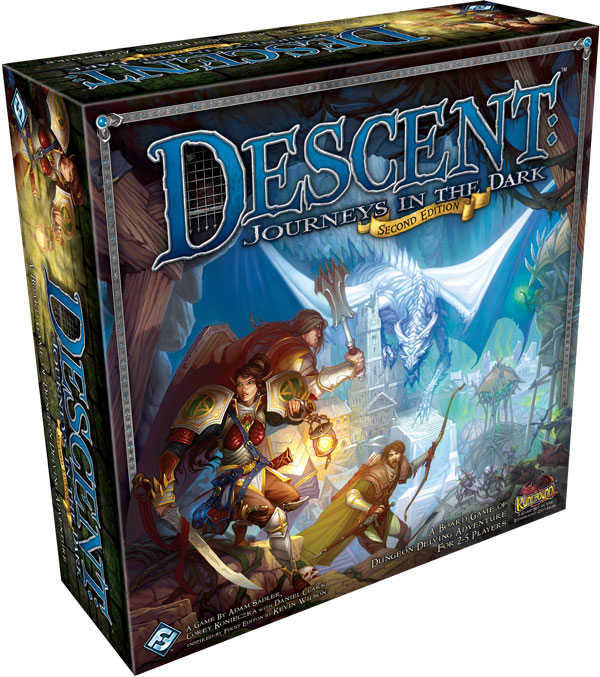
Fantasy Flight games has finally released the 2nd edition of Descent, their classic dungeon exploration board game. Players form a group of heroes to face off against a single player that acts as the evil Overlord. While it might pitch itself as an adventure game, in reality you have a pretty tactical skirmish game that captures that feeling of a fantasy dungeon crawl for up to 5 people.
The game revolves around several specific scenarios. Many of them form a two part quest, with the outcome of the first quest having some bearing on the second part. The heroes are helmed by up to 4 players. Each player has a choice of 8 heroes. Further, each hero can then select one of 2 different class types representing different starting equipment and abilities. The player in the Overlord role plays the opposition, running the various monsters that the other players will fight against.
Play moves around turns, with all the heroes taking two actions for their turn, followed by the Overlord taking two actions for the different monsters. Actions include opening/closing doors, moving, attacking, recovering fallen heroes, to even searching for treasure. All actions for the heroes can be repeated (allowing for 2 attacks if needed). While the Overlord has a similar turn structure with some limits (each monster can attack only once).
If players want to move further, they can gaining additional fatigue represented by counters. Many special abilities also utilize fatigue. This makes for a game currency that allows the player more flexibility during their turn. They might search a treasure chest gaining a healing potion, but be stuck not being able to use it on a fallen hero. Using fatigue, the player can now move those additional squares needed to get to a fallen comrade, and use their second action to offer that newly gained healing potion.
While the Overlord player cannot use fatigue, they have access to a deck which allows them temporary boons to the monsters, or other cards they can play during the heroes turn to hamper them. This gives the Overlord a chance to pull out a trick or twist to the usual predictive monster turn, and possibly muck up the heroes.
Combat is a simple affair rolling custom D6s pairing damage against defense dice of the target, with the attacker inflicting damage if exceeding the rolled defense score. Ranged attacks also require a certain number to be rolled depending on the distance. Meaning not only does enough squares in range need to be rolled, but also enough damage to overcome defense rolls of their opponent. What stands out is that one die has an ‘X’ on one face, indicating a miss regardless of the other dice. So attacks always have a slight chance of missing.
A small twist to the dice rolls is special surge icons. These can be spent to add small bonuses to damage or range. They are entirely dependent on the different equipment and powers wielded by the hero. Additionally the monsters have surge abilities too, including some special characteristics depending on the monster type.
What results is a nice mix of tactical play with just the right amount of luck. Players have a lot of meaningful choices, like deciding to gain those 2-3 counters of fatigue to get a bit closer to an enemy, almost ensuring an attack is in range. As with the Overlord player, heroes have a limited number of actions, so there is a fair amount of thinking and decision-making to optimize their actions from turn to turn.
Combined with the surge abilities and static powers (with both the monsters and heroes), combat is a fast and fun affair. Defeated heroes always have the opportunity to pop back up on their feet later, and the Overlord can continually respawn most minion-type creatures (or gain reinforcements), meaning everyone always has something to do on their turn. Also the different D6 dice have a disproportional number of pips for damage and defense. Some dice are more ideal than others for attacks or defense, and scrambles the probability a tad more than your usual 2D6 array of standard dice.
I have not played the first version of Descent. However I’ve heard chatter the game could slip towards the longish side and that heroes could either be completely overwhelmed, or once enough treasure was gained, completely roll over the Overlord player. This isn’t something I see much with the new version.
What I particularly like about the 2nd edition is that each scenario has specific endgame and victory conditions. It’s broken down into small chunks of gameplay that can be easily tackled during a night. Also my impression from a few games is that for the most part scenarios seem balanced, and I haven’t had the inclination to pull any punches as an Overlord. Also while the victory conditions and layout are set, the Overlord does have some wiggleroom for deciding some of the monster opposition the heroes will face off against.
One nice feature is that it can be played as a bunch of one-off scenarios, however the game also incorporates a campaign mode. There are 16 stand alone scenarios, and up to 20 missions for the campaign. Heroes and the Overlord both gain experience each mission, allowing for additional powers (or additional cards for the Overlord deck). Even gold can be earned searching for treasure that can be used to pick up more advanced armor and weapons for the heroes back in town. What I particularly like is that the outcome of each scenario has some impact on the following campaign missions, which can alter the path the heroes take towards completing the campaign arc.

The Good – Descent is a fun fantasy dungeon crawl. It has the right complexity to make it a challenge and still have enough streamlined play to get in a few sessions during a game night. The rulebook is well written with plenty of examples. There are a lot of different class combinations and the Overlord has some choices for their forces for a quest too. So even with the scenario limit, there is a lot of room for replay. The game scales very well with different number of players, allowing smaller groups of heroes to experience a challenge.
The components are gorgeous. Map tiles and counters are made of thick cardstock and colorful artwork that is very evocative of the theme. The figures that come with the game are very detailed and made out of stiff plastic, giving a very visual element to the gameplay (and simply cries out to be painted up).There is a plethora of cards for abilities, equipment, treasure and combat conditions. Allowing for bookkeeping at the table to be handled with the components alone and not require a pencil and paper.
The Bad – While the rules are well written, there are some times where you might need to look over the FAQ to clear up some muddied points. Additionally, this isn’t a simulationist game. It’s very much a board game and the rules ‘as written’ might occasionally hinder that player wanting to do something more heroic.
Also, the game is very much a gang up on a single player. You have that one person managing a lot of monsters as the Overlord, and the lopsided team might not sit well for everyone. A workaround however can easily be attained, as there are lots of different monsters to field for each quest and the Overlord role could be split between 2 players if desired.
The layout and opposition are fully realized for each quest, along with the victory conditions, meaning it doesn’t quite capture that feeling of dungeon exploration. Also while there are a lot of potential combinations for class abilities, equipment, and Overlord monsters, there is a limit to what is in the box. Eventually you may have that slight feeling of ‘sameness’ that creeps into the game.
There is a lot that comes in the box. While I applaud having bits to keep track of the game without the need for paper and pencil, at the same time you will have to make an effort to organize the game components. Plastic baggies are a must for the game, and card protectors wouldn’t hurt either.
The Verdict – The second edition of ‘Descent: Journeys into the the Dark’ is a great game. While you can easily pick it up and play out a single quest for the night, it cries out for more frequent play and the campaign format. There is a good chunk of variety in the class abilities and room for progression for both the Overlord and heroes, which gives the game some legs for replay. The quest victory conditions are varied, and usually have both players trying to achieve some objective. This means that each side has to be proactive and can’t just sit back in static attack or defense roles.
I would garner to say that Descent might be also an excellent entry point for non-RPG players into the hobby. At the core, there is that tactical combat relying on teamwork and character progression that gives a nod towards traditional fantasy RPGs. For someone completely unfamiliar with RPGs, this might be a decent stepping stone to getting them acquainted with the hobby.
For the rest of us, you have a deeply enjoyable dungeon delve board game. It hits on just about all cylinders, capturing the theme and feel of your typical fantasy adventure very well with lots of monsters to fight, treasure to find, and powerful abilities to acquire. The components and play are well thought out and all the moving pieces of game play work great. I highly recommend picking it up if you are itching for a dungeon crawl type of game.
Review: Stone Age

Stone Age is a worker placement game for 2-4 players from Rio Grande Games. It has an interesting theme as you are a chief during prehistoric times, trying to ensure your tribe’s survival and success over other neighboring groups within an expansive valley.
Players try to complete buildings and accumulate civilization cards, scoring points as they do so. When the supply of building or civilization cards is exhausted, the game ends with the player having the highest point total being the winner.
Play rotates with each player assigning various members of their tribe to different areas within the valley. It’s a worker placement game with limited open spots for each area and is competitive. Once all the spots are claimed, no one else can put workers in that area.
Some areas produce resources, some gain civilization or building cards (for victory points), and others allow you to gain extra workers. Some are open to having a few different tribes working an area, however most are painfully restricted to just a few workers from a single tribe. While each area can hold a finite number, the only exception is the hunting grounds where all excess tribe members can go hunt (at least allowing some potential food resources to be earned).
Resources are primarily gained by dice rolls, with the total divided by a specific number that varies depending on the goods being produced (the lower the number, the easier it is to produce). Players roll dice equivalent to the number of assigned workers, so the more people in an area, the more likely goods will be produced. The dice total is rounded down with excess numbers being ‘lost’.
The workaround for this is having a supply of tools. Tools can be used to add to the dice total, allowing for an extra good to be produced. Tools themselves need to be produced by assigning workers (which in turn take them away from producing goods, erecting buildings, or gathering food).
At the end of each turn, players must feed their tribe. Hopefully, between gaining civilization/building tiles, actively hunting, or by some farming there is enough food on hand to feed everyone. If not, resources are given up in place of food, and if that is not enough players are docked victory points. You must feed your people every turn and increases in population mean more food is required.
Farming is a slow process, and you are not guaranteed a spot to assign workers each turn to increase your food production. Hunting can earn food fairly easily, but that means you are diverting workers from other resource gathering tasks. Players soon find themselves in a balancing act trying to gain resources and points, all the while ensuring they have enough food from turn to turn.

The Good – It’s an entertaining worker placement game with a different theme. There are some hard choices to be made and players will always find themselves with not enough people to do what they want. The added wrinkle is that other players can easily lock out other players from prime tasks for a turn. All the while, food stocks are slowly being used up, creating another pressure of having enough food for everyone each turn.
The components are very nice, with thick card stock tiles and nice resource components. The artwork is colorful and captures the theme quite well. The overall design of many of the civilization and building cards are well done, with the use of symbols being a prominent feature over text.
The Bad – At the heart of Stone Ages is it can be worker placement game at it’s worst. Players can lock down locations or building/civilization cards without the resources needed to claim them (and no penalty if doing so), effectively cutting off other players just because they can.
My biggest complaint are the civilization cards. These are used for massive point scoring at the end of the game and need to be collected in sets. While I don’t mind the huge bonus victory points that can be earned during the endgame, the scoring conditions can be cryptic at times. Each civilization card has a lot of symbols and it can be difficult to easily decipher them. As they are so critical to scoring points, it can be frustrating for new players to figure them out.
The Verdict – A few years ago I would highly recommend this game. It’s challenging, requires a fair amount of planning, and has a different theme from most of the other worker placement games out there. However there have been quite a few releases over the years that are a bit more streamlined in play.
The ding in rating this game for me are the civilization cards. I don’t play this game frequently enough, and it is always a slight learning curve to work out the sets and determine how many victory points are awarded. As this can make or break your game, you really need to plan out what civilization card sets to work on early in the game. Since it is so important, it seems that it’s glossed over a bit in the rules. I really wish that Rio Grande bit the bullet and printed out a single color page, detailing how to score these cards more.
Despite this, Stone Age is a fun and challenging game. If you haven’t delved too deeply into worker placement games, it’s a nice buy and a great family game. However, if you have a few worker placement games in your collection, I would be hard pressed to suggest picking this up. It doesn’t have much that stands out from other games as most of it is about locking out other players and working on sets of cards for scoring. I think there are some other similar-mechanic games that do it a bit better and are more entertaining (Kingsburg as an example). Stone Age is a fun game, but think twice if you’ve got a few worker placement games on your shelf.
Review: King of Tokyo
Who doesn’t want to play a giant monster rampaging through a city, duking it out to be the King of Tokyo, and Iello games allows you to do just that.
A competitive game for 2-6 players, each person plays a giant monster laying waste to either the city before them or each other to claim victory. Play centers around a Yahtzee mechanic, where players spend their turn rolling a pool of dice, selecting those to keep and which to reroll. After three rolls players either score points, inflict damage to other monsters, heal themselves, or gain energy which they can spend on special abilities. The first to 20 victory points (or the last monster standing) wins the game.

Smashing other monsters requires a player to step up and become King of Tokyo. The lone monster inside Tokyo gains victory points for each turn they remain there. They cannot heal themselves, and all attacks from other players are directed towards them. On the flip side, all damage caused by the King of Tokyo monster is inflicted on all the other players.
The game plays out like a variant of king of the hill. It’s very tough to remain the King of Tokyo for long. However the constant earning of victory points and ability to do tons of damage to other players encourages people to push their luck, and try to stick it out for just one more turn. On the flipside, you become everyone’s beating post and can only heal up if you step down from Tokyo, lick your wounds, and try to take the spotlight again on a later turn.
Players can (and will) be eliminated. It’s a classic beatdown on the leader until a new monster steps up to take over. And each turn a player will typically juggle with either trying to eek out a few victory points, or smash the King of Tokyo (or other players if you are the current King). What works for this game is the extra twist of special abilities and the small economy mechanic of spending energy.
Players can also focus on gaining energy when they roll their dice. This allows them to buy special powers from a pool of face up cards which are either one shot powers, or permanent bonuses. They do a variety of abilities, from being able to heal while in Tokyo, to inflicting more damage, to even earning additional victory points. It’s this small addition of the power cards that gives the game an additional push from being a simplistic elimination game to allowing for room of some strategic choices.
The Good – It’s a fun, light-hearted, competitive game with simple rules. Surprisingly players have a lot of choices during their turn, with a lot of direct interaction and the ability to snag up particular power cards before their opponent. There are a variety of paths to victory. Allowing a player to focus on victory points, smashing other players to bits, or a little of each. The components are nice and bulky, and the artwork is colorful and whimsical.
The Bad – This is not a heavy strategy game. It’s a push your luck game that can be heavily influenced by good (or bad) dice rolls. While it has an interesting theme, it’s not too heavily draped in it with the mechanics. You aren’t really smashing through a section of the city and everything is represented as very abstract points earned through dice rolling. So it may not quite have that ‘Rampage’ feel that some might expect. While you can play with 2 players, the game can be lackluster with so few people.
The Verdict – King of Tokyo is a light, monster smash game that is short enough with just the right amount of complexity. You aren’t going to have a complete game night revolving around this game. You will however easily have 2-3 quick bouts to see who is the toughest monster on the block as you gleefully tear into each other, picking up special powers, and laying waste to the city of Tokyo.
It’s a great, light, filler game, that is quick and enjoyable. While some might be put off by the elimination aspect of the game, it’s has just the right game length to not make it an issue. The simplistic rules are also a plus. Highlighting the fun, quirky theme of the game, with surprisingly enough choices and interaction to make the game worthwhile playing. A great game to add to anyone’s collection and a decent family game to boot.
Board Game Review: Kingsburg
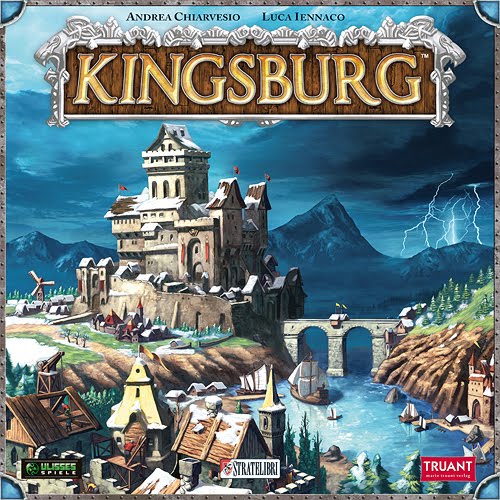
For the game night blog carnival this month I’ll be reviewing Kingsburg from Fantasy Flight games. It’s a 2-5 player worker placement game, with enough twists to set it apart from other games with a similar themed mechanic. It’s been seeing quite a bit on my table recently, mostly due to the engaging play and how it handles worker placement.
Players are governors for various towns under the command of a king. Their goal is to be the most prosperous governor, outshining the others after 5 years. This is typically done by completing the construction of different buildings within their respective towns.
Each turn players roll 3 dice and place them on various sections of the board, representing the king’s court. Once a section is claimed, that player has the ear of a specific advisor, and no one else that round can ask for favors from that member of the king’s court. Each member of the king’s court offers resources (or other bonuses like troops and victory points) that can be used to construct buildings.
Players take turns assigning their dice until either all available spots are claimed, or they have no dice left. This can make for some very cut throat play where you choose to shut out one player, and use your last die for a lower member of the king’s court. The conundrum is the higher die totals will yield more aid from the royal court. But this can mean you are allowing other players to get resources from lower ranking court members. So the player is constantly thinking whether to use all their influence for a single advisor, or try to block out other players. It’s a fun way to handle worker placement.
Resources gained (wood, stone, and gold) can be spent to build one construction for the town. Each type of building is on a progressive track, where previous buildings must be made first. All the town buildings have some special function and earn victory points. There are definitely some interesting combinations between them, and as players progress up the building tracks, more and more powerful abilities become available.
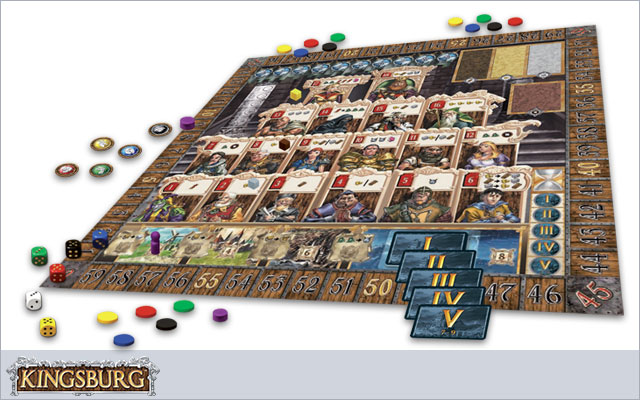
One particular element I like about Kingsburg is there are plenty of opportunities to catch up if you lag behind during a certain year. Small consolidations are given to the player with the least amount of resources and buildings. The player with the lowest number of buildings always gets to influence the court first. During the middle of the year, they can also get an opportunity to construct 2 buildings, or gain favor from a court advisor that has already been influenced from another player. Not to mention every member of the royal court can offer something useful to the player, even the lower ranking ones (just that higher numbered court advisors are more powerful). It’s a nice way to keep everyone in the game.
Now, what I’ve described is a pretty standard worker placement/building type game. It’s pretty fun, but ho hum as you’d expect this from just about a dozen other games. Fortunately Kingsburg has a twist to the game play. Monsters.
Each year, you have a random monster threatening to rampage through the realm. And every year the threats become more powerful. As governors for various towns, not only are you scrambling to construct more efficient buildings, you also have to worry about the town defense. While fortifications might help with defending the town, they don’t offer the larger game bonuses of other non-military buildings.
Players that soundly defeat the monsters, and have large standing militias at the end of the year do get victory points. But that is fleeting as those militia forces disperse at the year’s end and have to be recruited again. Doing nothing likely means the loss of resources, or the destruction of buildings. So that monster threat can’t be ignored completely.
Another tweak is you have a rough idea of the monster strength coming at the end of the year, but won’t know the exact amount or the type of threat until they attack. Some fortifications are ideal against certain monsters (like a palisade against goblins, or a chapel against zombies), while not offering much protection against others. There is a way to gain some divination and see the approaching threat, but that usually means diverting needed influence for resources towards a court member that offers less rewards/resources. Without that knowledge you’ll likely over defend yourself, further diverting needed resources from construction (or worse, not be able to muster enough defense against the rampaging creatures).
The Good – It’s a light, approachable worker placement game that has enough strategy to making it engaging. You have to balance a lot of things during the game year. You have to try and develop your town, at the same time making sure you have enough forces to defend it at the end of the year. And all of this makes for interesting choices on which royal court members you will influence. At the same time, other players are doing the same thing and may prevent you from gaining that ear of a particular court member. The components are nice with beefy counters and nice wooden blocks. The artwork is whimsical and captures the fun medieval theme well.
The Bad – With repeated play, I can see some set strategies creep in. This is especially prevalent with 2 players. It becomes a bit easier to work towards a winning town building combination. The random monster threat helps counter this a bit. However I think the game really shines with at least 3 players, as you really feel the bite of not being able to court the royal advisor you want. As the 2 player game does this by randomly removing particular advisors each season, it still doesn’t beat having a 3rd or 4th player actively selecting advisors.
While there are stopgaps in the game to prevent a player from falling too far behind, this can happen (especially with the victory points). It’s more of a problem mid-game. If a player gets hit by a monster, they can lose a lot. Combined with poor dice rolls for a few seasons, they can really fall behind and not be able to climb back up. It can be a bit of a downer of having the game effectively end for them in the middle of play.
I’ll also add that while I enjoy all the choices and strategic possibilities, this can lead to some serious analysis paralysis. Be prepared to offer lots of advice to players to keep the game moving.
The Verdict – Kingsburg is great and one of my favorite worker placement games. It avoids a lot of the fiddly, worker drone shuffling of other games, replacing it with a simple dice roll. You have that feeling of progression as you slowly build up your town. The interaction with other players is there, as your choices (and theirs) have a direct impact on the play from turn to turn. All of this construction is under the shadow of a looming threat that will come at the end of every year, with each creature being randomly chosen from a small set of cards (adding some game-to-game variation).
I highly recommend this game. It’s approachable for relatively new gamers and has enough meat in the rules and play to keep a more seasoned board gamer interested. It handles a broad number of players well, with the 2 player game being as much fun as a 5 player one. This is a great game to have in your collection.
Keeping a manageable board game collection
 This month I’m not putting up a board game review, rather I’d like to talk about how I manage my board game collection. No numbers to back this up, but I’d wager that board games and game companies have exploded over the past 10 years. As geek culture goes, board games seemed to have become a popular pastime with gaming groups and at the very least, become an alternate for a lot of RPG folks to dabble in periodically. So with a large number of games being released every year, you can get overwhelmed with choices. It can be easy to slip into a habit of buying far more than you can realistically play, so I’ll pass on some criteria I’ve used in maintaining my board game collection.
I think what immediately what comes to mind is the Jone’s theory for board game collections which is likely a popular guideline. To paraphrase the theory, it is assumed that you have limited time and space for your collection. In order to maximize the types of games to play, you should remove titles that are redundant. It’s best to just keep one game of a particular theme or mechanic, facilitating the opportunity to play a larger variety of games.
This by far is a really good rule to adhere to with your game library. Between game mechanisms and theme, I would put more emphasis on game mechanisms for deciding what games to keep. Games with very similar mechanics are likely ones I will cull (or shy away) from my collection. It can lead to some hard choices, but I am a firm believer of keeping the number of games in your library manageable. The Jone’s theory is a good initial rule to apply to deciding what games to keep and what to let go. However I have a few others.
Realistic Gaming Habits – This is the big first step. You should sit down and critically think about your available free time for gaming. What opportunities do you have to get a huge group together? Are you playing every week or once every 2-3 months? When you play, do you have a full evening you can set aside, or are you limited to about 2 hours or so. Answering such questions honestly will provide an initial guideline for what kinds of games you should pick up for your collection
Number of Players – When you play, how many people can you get around the table? Are you usually limited to games for 2 people? If you have a crowd that stops by, could you handle a game for 6-8 players? I’ve shied away from a lot of games that require at least 3 players. Although I have a few regulars at my table, I want a game I can pick up and play at any time. Usually this means grabbing something I can play with my wife. Having a sizable portion of games that need at least 3 players means I’ve got more games just sitting on the shelf.
At the same time, you do want to be flexible. Having one or two games that can handle a larger group can work. That way if you have that occasional situation with lots of people over, you can pull out a fun game. I’ve also made an effort to get games that can have up to 5 or 6 people. With my current social circle of married couples, having lots of games that can handle only 4 people isn’t ideal. However, a key point is to make sure the bulk of your games can accommodate the typical number of people you get around the table on a regular basis.
Types of Players – My wife is not a huge strategy player, and war games are not something she enjoys. I’d say the same for a fair mix of our friends when we play games. Yeah, I can invite the guys over once in a while for a game of Risk 2210 or Battletech, but it’s not a regular occurrence. Something like Smallworld is about as much of a war strategy game our friends as couples would like (war games just aren’t their style). So if I have a few of those games already on my shelf, should I really pick up something else like Axis and Allies? Likely not.
At the same time, I do like having a flexible collection. Party games have a place for me. We do entertain, and by far playing something more approachable for people like Incan Gold and Apples to Apples are popular titles for me. I’ve got a core group of players that can handle a bit ‘heavier’ games, but having party games accessible is a good option. So when considering the breakdown of your game library, be frank with yourself about what your friends like to play. Dabbling a bit in different types is fine, but put some thought into new purchases. If the bulk of your players enjoy lighter games, would something like Power Grid really get enough play at your table?
Space – Honestly I think folks tend to forget about this. For me, apartment living means I need to consider the amount of space a stack of games takes up. Even if you’ve got the space it’s easy to quickly have that single shelf mushroom into an entire wall. Having a huge bulky box can give me pause at times. Conversely, it has also encouraged me to pick up some other games. Saboteur and the Resistance have some limits on how many players I can realistically get at my table. However the boxes for the games are tiny and compact. If they were full size boxes like something for Settlers of Catan, I would likely rethink picking them up. But the small boxes meant less space, and something I’d be more inclined to have, even if it isn’t something I’d get to the table frequently.
Time – I would love to get some marathon games in once in a while. However I’ve come to realize that it’s simply not the type of games my friends like to play. Something upwards of 2 hours is likely tops that I could realistically play. So I tend to gravitate to ones that can be played in 45 minutes to that occasional hour and a half game. Honestly I don’t even think I could sit down for something like that any more. I could possibly stretch a longer game out over a few nights if I really wanted too, but then I’d run into the problem of having the table space to keep it up over a few days. Look critically at what the time you can expect to set aside for games. Consider too, would your friends be happier playing 2 different games for an evening (or giving a game another go) compared to a lengthy session with just one game?
Price Tag – Something I think we all dread to talk about and admit truthfully. Gaming is our hobby and we likely are far willing to spend a bit more cash on games than we care to admit. Yet, it’s something that you should consider. There are a ton of new releases that come out every year. Continually buying that newly released $60+ game can build up over the years. Are you really going to have the time and opportunity to play that game on a regular basis?
At the same time, this also can be a deciding point to pick up games that might be redundant in your collection. I was thrown off slightly with buying the Resistance. It needs a lot of players. But it was a great party game, a small box size, and pretty darn cheap. The same could also be said for Eaten by Zombies. I have a few deck building games already, however the theme, compact box, and very reasonable price made me more inclined to pick it up.
The Jone’s theory is a great judging system for deciding how to keep your game collection manageable. Still, there are a few other characteristics I use to see if a game is worth becoming part of my collection. It does keep me from picking up a lot of great games. I would love to get Twilight Imperium 3rd edition. I love the theme, components, and think a deep strategy game would be tons of fun to play. However once I consider the time needed to play, the audience of players I’d need around the table that would actually enjoy it, the need for at least 3 players, not to mention the bulky box, I’d have to reconsider picking it up (especially given its price tag). Yeah that is something I could keep for years in my collection, but how frequently would I play it? Maybe it would be better to leave that slot open for a game or two that I’d get to the table more.
Review: The Resistance
From Indie Boards and Cards, I would consider the Resistance as a somewhat heavier party game and a more structured version of Werewolf. 5-10 Players are members of an underground rebel group in some distopian future. Among them are several spies that are informers for the very government they are trying to topple. The object of the resistance is to successfully complete a series of missions, while the spies within the group are trying to stop them. The side with the most successes (in the spies case, failed missions) after 5 turns wins the game.
Each turn is split into 2 segments. The first is an open vote to determine which members will form a team to attempt a mission selected by a group leader. As a straight up majority vote, all players decide if it is a good team or not. If not, the next player acts as group leader suggesting a different team composition. This process keeps going until a team is decided.
After the team is selected, each team member secretly selects a mission outcome card. Resistance members must select a mission success, while spies have the choice to select either a success or failure. If at least one card is a failure, then the entire mission fails. The following turns, this procedure continues five more times.
What comes about each round is a rather tense situation. Spies are determined randomly and in secret before the game starts. Like in Werewolf, the spies have an opportunity to see who else are spies for the game (a simple manner of all players closing their eyes and only the spies opening them). None the less, if multiple spies are chosen for a mission, they don’t have an opportunity to coordinate how they will vote. If 2 spies for a 3 player mission team both vote for it to fail, they’ve tipped their hand.
The end result is constant accusations and negotiations to decide who will make up the team, and which members are likely spies. No one will know who the spies are until the end of the game. The spy players are constantly in the game and actively influencing decisions for mission team members. However, they are the minority. So if the resistance members are confident they have identified the spies, they can effectively shut them out for participating on future missions.

The spy players however can help sow dissent among members, voting down mission teams. As a nuanced rule to the game, if there is so much distrust that a consensus can never be reached to decide a mission team, the spy players immediately win. It’s highly unlikely, but the spy players might be able to repeatedly swing other players into voting down proposed mission teams. This puts some pressure on the group to eventually give in and select a mission team, allowing the spies an opportunity to corrupt the team with a spy or two for that mission.
Aside from the basic game, there are also expansion cards. These cards allow players to do extra abilities and give the game a slight twist. Typically they either telegraph voting choices, or allow the player to secretly look at either voting or player cards (seeing if they are indeed spies or not).
The Good – It’s an enjoyable party game. It moves and scales well for larger groups. There is a lot of open negotiation and deception, with players not knowing who to trust until the end of the game giving each round a lot of fun tension. The game scales well and can accommodate several people (up to 10). The box is compact, allowing you to easily throw it in a backpack making for a great convention downtime game. The components and artwork are very pleasing too.
The Bad – With larger groups, and repeated plays, it may be difficult to remember who was on past mission teams. The game can get somewhat repetitive also, however the expansion cards that come with the game really add enough variety to change up play some. Also the number of players needed is a little steep at 5.
The Verdict – This is one of my favorite party games. While the play is a bit structured, and there can be some confusion on what cards are for what votes, after a single turn everyone gets it. This has been very successful for me with groups of non-gamers, and they have all had a lot of fun. The expansion cards add a nice twist to the game play to give it a bit more life. It occupies a small section of the game shelf and is a very reasonably priced game for the fun you get out of it. Definitely pick this one up for your collection.
From WotC: Geek Ken, no board games for you
Folks have been gushing about Lords of Waterdeep. Stone Age just hasn’t been getting that much play time on my table, so I’ve considered investing into another worker placement game. It looks like there are some neat twists with Lords of Waterdeep, and the player interaction is a bit more complex than shutting out players from certain locations. Stone Age is a fun game. It has some minuses, but overall an enjoyable game with a neat theme. I just haven’t been playing it as much and Lords of Waterdeep is all sparkly.
So I eagerly placed an order from a fantastic board game store that ships internationally. I live in Asia. I’ve used this store for years. They are the cat’s pajamas for an online source of board games. Not going to name them as I don’t want any fallout with the email correspondence. I’ll call them ‘Awesome Board Game Store’ for this post. I eagerly placed an order for Lords of Waterdeep and a few other games. A couple of days later I get this…
Hi Geek Ken,
Unfortunately we are unable to send Wizards of the Coast products outside the United States so we’ll be unable to send Lords of Waterdeep on your order. I’m happy to replace it with another game, or just cancel it off the order all together. Please let me know what you’d like to do. Thanks.
— Awesome Board Game Store
Bummer. Now it kills me to do this, as I was really looking forward to having a bundle of board games. Taking one out makes the shipping expense a little harder to justify. I really hadn’t thought too much on getting an alternate. So I bite the bullet and cancel my order. My reply:
I have recently logged into my Awesome Board Game Store account and cancelled my order. My apologies for cancelling. If possible, could you please indicate why the board game could not be shipped internationally? I am curious as there are very few local retailers within [ASIAN COUNTRY] that handle Hasbro/WotC products exclusively.
Regards,
GK
I was curious why the sudden change in policy. I think I ordered Gamma World from this Awesome Board Game Store, along with dungeon tiles. This was sort of new for me. So I had prodded further to find out why. I get an interesting reply.
Hi Geek Ken,
We (and all US retailers) are unable to send any WotC items outside of the US as a condition for doing business with WotC. As they are a fairly large company they want to let their “local” businesses service their markets. I think most of this has to do with Magic but it’s a blanket condition. WotC is not very forgiving for businesses who break that agreement.
— Awesome Board Game Store

I sort of understand the policy for trying to bolster the brick and mortar store. But as international customers go, I’d bet most folks use these online stores as they are the only source for WotC products. I’m also figuring that it is to support Magic sales from local retailers, instead of people buying them in bulk from some online source. Maybe board games got lumped into this also.
Yet I get a bit worried. Is this for ‘all’ WotC products? What about the reprint editions for AD&D? Granted I could see WotC keeping huge book retailers like Amazon out of the loop, but I was counting on using places like Awesome Board Game Store to pick them up. I live in Asia. English is not the country’s native language. There really isn’t much demand for role playing games, especially enough for local retailers to spring forth. It’s just not in the culture. So being a bit worried, I prod further…
Completely understand. I am curious, does this include rulebooks from WotC? I am curious as some products such as the AD&D 1st Edition: Player’s Handbook is only available through smaller independent retailers as yourself (can’t order these books through Amazon or Barnes and Noble). If this is the case, please contact the sales representative you work through for WotC and express how restrictive their policy is. There are some customers (such as myself living as an expat in Asia) that have no other option but to purchase their products from international distributors like that of your store.
Regards,
GK
I get a response and I am floored by this.
Hi Geek Ken,
Yes it does. The rules apply to all WotC products including their out of print stuff, as we’ve specifically asked about that before.
Trust me we’d love nothing more than to sell WotC items to you, as you’re not the only non-US customer we’ve had to disappoint but their policy remains unchanged.
We can’t ship to any address outside the US.
— Awesome Board Game Store
WotC/Hasbro, you have a sliver of international customers that rely on online retailers for your products. Having this policy means I can’t buy any of your stuff set aside for local retailers, ever. Stuff like the new AD&D reprints, Mordenkainen’s Magnificent Emporium, all of it is a no go for me. There simply are no local retailers here interested in carrying these products (foreign country, with its own language, means stuff printed in english is a low priority).
However, I guess customers like me simply are not part of the business model your company executes. Sucktastic.
[EDIT: For full transparency, I’ve removed the names of the people on these emails and truncated the last email where the representative from the Awesome Board Game Store offered a solution by shipping the products to an address in the United States, where that private individual could then send it as a parcel to me. As I said, they are an Awesome Board Game Store.]
Board Game Review: Terra Prime
I’ve been on a bit of a kick of older games as of late. Terra Prime is a space exploration game for 2-5 players from Tasty Minstrel Games. Sadly it is out of print but you can still snag a copy from online retailers.
In Terra Prime you are a ship captain in a race to explore and colonize the galaxy from your home space station. Before you are a series of unexplored sectors that hide numerous systems ripe for colonization. As you get further away from Terra Prime the more dangerous uncharted space gets, with random encounters with hostile aliens and potential collisions of asteroids being threats. As you establish colonies, explore, and trade goods, you earn victory points. The player with the most victory points wins.
Each player will have a starship that can be retrofitted with different modules. Some allow for more cargo, shields, or weapons, while other modules allow you to make additional moves on your turn. In addition there are technologies that can also be added to your ship to improve its performance.
During a player’s turn they have 3 actions to decide on either moving, colonizing a system, transporting cargo, to fighting aliens (or bribing them with goods). Everything is limited by the capacity of your ship. You have space for only so much cargo, and only certain bays can hold certain goods. Haul around a colony module? It takes up precious cargo space. Cargo is very important as that is the primary means to earn credits needed for upgrading your ship, as well as potentially competing demands for goods by Terra Prime, earning you victory points.
Making cargo runs is one way of earning victory points, but players earn much more establishing colonies or exploring space. Typically the further you explore, the greater the points. Additionally, subduing aliens and colonizing sectors of space can also give you bonus random rewards. So heading out to explore a new sector might also score you an additional cargo module or goods if you can pacify any alien resistance.
Goods are produced from a player’s colony every turn. There is a nice twist too as players can pick up goods from an opponent’s colony. Doing so means the colony owner gets a victory point, however a particular good might be needed to meet the demands of Terra Prime (earning additional victory points once turned in). All of this makes for some fun choices as players shuttle back and forth between colonies, trying to complete demands before other players.
Fighting aliens is a simple affair, rolling six-sided dice and defeating an alien on a 4+. However aliens get several opportunities to attack. A player really needs to invest in ship technology and modules to defend itself, and possibly beef up the number of guns it can carry. Each hit beyond a ship’s shields means installed modules are destroyed, making for a potentially painful experience. This can make for a particularly tense moment as a player slips into an uncharted system, and possibly run smack into a large hostile alien force. As fights can be costly, it might be more worthwhile to offer up cargo goods instead, pacifying hostile aliens for victory points and rewards.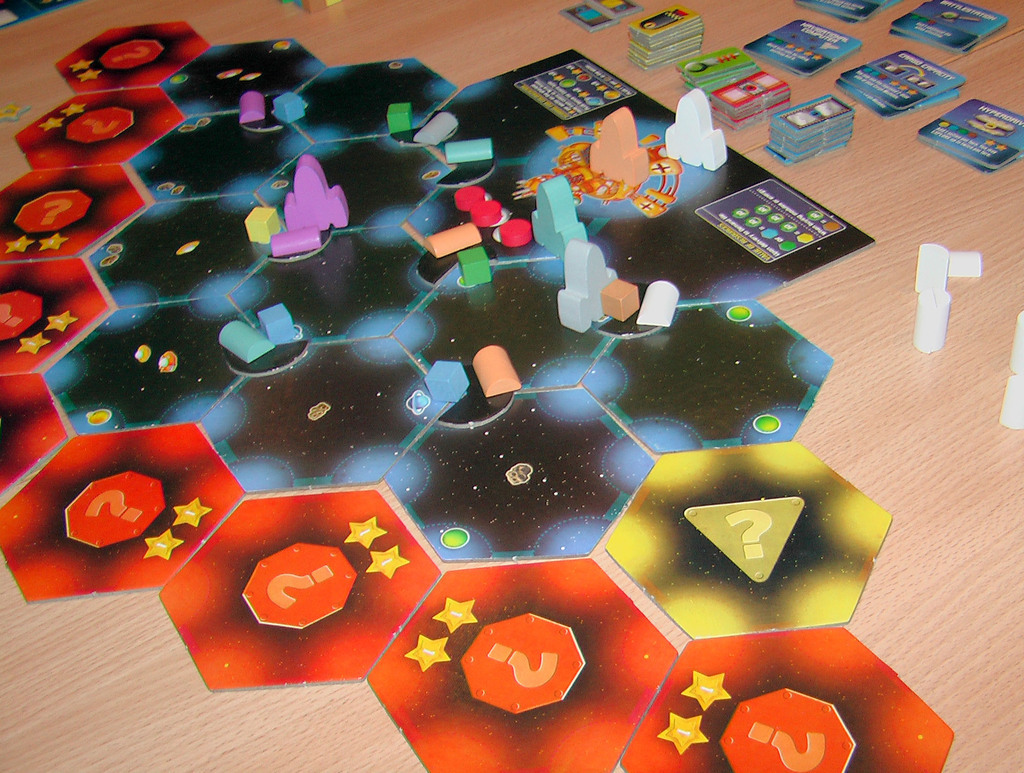
Asteroids can also inflict a fair amount of damage on a ship, making travel through them disastrous. As players explore, they can decide how to arrange the various planets and systems on the hex (with some limitations). So placing a field of asteroids in the path of an opponent’s route to one of their colonies can make for some hampering of ideal trade routes, effectively making players take longer routes.
The game ends under varying conditions. As players colonize sectors or defeat/pacify aliens, they gain rewards. Once a certain amount of rewards are earned the game ends. Alternately, there are different demand tiles for goods. As players complete these demands, further tiles are drawn. Once this supply ends, the game is over.
What I like about this is that there are two forms of a time clock ticking to end the game. One is based on establishing colonies and exploring (fighting aliens), while another is on transporting goods to complete the demand tiles from Terra Prime. Coupled with choices for how you customize your starship, you have a variety of paths to take to victory. All the while, you are in a race with other players to gain the most points. There are a lot of choices, with a bit of a random setup, really capturing that feeling of excitement (and potential dread) in exploring unknown sectors of space.
The Good – There are a lot of beefy components to the game and enough shuffling of board tiles and rewards to add game-to-game variation. It really captures that feeling of tense excitement exploring space. Players have to carefully think out routes and make decisions where and when to place colonies, and the choices for upgrading ships with different modules and technologies are fun. There are different paths to victory which players may have to alter depending on the actions of other players.
The Bad – There are a lot of components. While I like the hexagon boards, it can get a little fiddly trying to cover other uncolonized sector planets, such that you have to use a special board section chit just to do so. The ship cards are somewhat lackluster and some of the cuts of the board pieces are a tad non-uniform.
Some of the play can get a little clunky. You explore a new sector of space, and potentially run into a one-shot asteroid field, which in turn has to be covered up with another component bit. Not to mention the idea that the perimeter of the board pieces are where a player travels and colonizes, with the interior of the hexagon being empty space. All of which can make the graphic design somewhat non-intuitive for new players. I’ll also add between turn downtime can be an issue when other players are taking a long time to resolve their turn (especially with a large group of players).
The Verdict – I really enjoy this game. It fits the theme of space exploration, development, and trading just right. It’s not a deep strategy game, and has relatively simple mechanics for combat, production, and transport of goods. However that light theme works wonders making the game much more approachable for new players over something like Twilight Imperium.
There are a lot of meaningful choices, as players can scoop up goods, complete rewards, and explore sectors of space before their opponents. I particularly enjoy that there are multiple paths to victory. A captain can refit their ship to combat aliens and explore, work on trying to colonize explored sectors of space, haul cargo goods to complete resource demands, or do a bit of all three. There is a surprising amount to do and all of it runs on fairly light mechanics doing so. It’s a shame the game is out of print. Hopefully it’ll see a second print run sometime in the future.
 Geek Ken