Category: Board Games
Board Game Review: Blue Moon City
[2020 UPDATE: Cool Mini or Not has released a reprint! Looks like a lovely version of this classic. Nice to see it back in print.]
Blue Moon City is a release from Fantasy Flight Games which is still available from retailers despite being out of print. This is a fantasy game where players represent different factions attempting to rebuild the famed city of Blue Moon after a civil war. Players race from building to building, attempting to contribute the most repairs in order to gain resources that are offered to a central obelisk. Offer the most to the obelisk and your faction will gain the most favor from the city dragons, ensuring your prominence once the city is completely rebuilt.

Play revolves around a player moving from building to building. There they can attempt to make repairs, using sets of specific cards in their hands. Most buildings will take several turns to repair, and each player has a chance to contribute. Everyone that contributed to repairing a building gets a reward, but the player that contributed the most will gain the greatest share. Rewards are offered as crystals or dragon scales.
While players primarily are rebuilding the city to gain crystals, it is all in order to offer the most resources to the city’s central obelisk. A player must return to the central city and offer up a number of crystals. Successfully doing so means they get to add one of their markers to the obelisk. Like restoring the buildings, the earlier spaces require less resources and ramp up in costs as the obelisk slowly fills.
On the board are also several dragons. When a player makes a contribution to repairing a building in the presence of a dragon they gain a scale. There are a limited number of scales available. When the last scale is obtained, the player that has the most scales gains additional crystals. Players that tie get less, but an equal share. And the poor player that has only 1-2 scales gets nothing. The scales are set aside and the process is repeated until the city is completely rebuilt. Players will find that being able to complete buildings gets increasingly difficult. So shrewdly planning on making select repairs in the presence of dragons to gain the most scales, and in turn, be able to gain the most crystals for offerings, becomes a solid strategy.

When repairing buildings, players typically need a specific value of cards of a particular color. The cards have different suits of colors and values. Each color suit also has varying abilities. Some allow the movement of dragons, while others allow cards to change color or act as wildcards (being any possible color). This is a fun part of the game, where players try to figure out possible combinations of cards in their hand to maximize the amount of contributions they can make to repair buildings.
Players also have some interaction, as they can try to capitalize on others repairing different buildings, or by manipulating where dragons fly, not to mention picking up the last few scales to ensure they get the lion’s share of crystals. All the while though, players cannot forget that the object of the game is to make the most contributions to the obelisk. While they gain crystals needed for offerings by reconstructing buildings, they also have to balance taking time to visit the obelisk. If they delay doing this, they may find it increasingly difficult to offer crystals as other players have taken up easier slots on the obelisk.
The Good: The tiles around the periphery of the city layout are randomly placed, giving the game a bit of a random setup from game to game. The artwork is thematic and well done, with nice components. The game moves rather well and most games will take an hour at most.
The Bad: Interaction is primarily based on denial of access. It may not be everyone’s taste if they are looking for more direct interaction like the trading of cards. The theme is somewhat enigmatic, as it is based on the fantasy mythos of the two player game, Blue Moon.
The Verdict: Blue Moon City is a great game. There are enough choices requiring some strategy in planning your moves, and working out the varying card sets in your hand to obtain the right amount of resources is fun. Manipulating the dragons and being able to make the proper contribution at the right time and place is enjoyable. There is just enough interaction where players can try to capitalize on efforts made by other players, or try to limit their opponent’s options by acting first. It’s a great buy with enough strategy to be engaging and still act as a ‘light’ board game. It has mechanics and a theme that is just different enough from the other games out there to make it stand out.
Review: Eaten by Zombies
This month I’ve got a fairly new entry into the deck-building themed games, Eaten by Zombies. Players are regular Joes and Janes trying to survive in a zombie apocalypse periodically running out of their safe house to scavenge supplies, all the while either avoiding or fighting their undead neighbors. What results is a fairly competitive, cutthroat card game with a slight cooperative twist.
Play is rather simple beginning by turning over a card from the zombie deck. At that point a player can decide to either fight or flee from the zombie horde in front of them. Their hand will comprise of swag cards that help them run, fight, or draw cards to potentially add to their fight/flee ability. To beat off the zombie horde, or valiantly run away, they simply must match the values on the zombie cards for fighting or fleeing. Players will find that very tough zombies are easier to run away from, while zombies easy to kill are harder to run away from.
If they successfully kill all the zombies, or run away from the horde, players can then gather up swag (cards from a common pool) equal to value of the cards played. Note that this means that players can play far more cards needed to kill off a lone zombie, simply to increase their played card value so they can pick up that expensive shotgun as swag. These swag cards are immediately placed in the player’s hand. This is a very subtle mechanic. Players will begin to see that they can tailor their hand to plan out their actions for the following turn, focusing on gaining flee or fight cards. Killed zombies are added to the players discard pile (ending up in the player’s draw deck on future turns).
If players fail to fight off or run away from the horde, they can lose a lot of cards. These cards must be from their hand, or their draw deck. When fighting zombies, fortunately you can always take out a few, reducing the number of cards needed to discard. All of the swag cards discarded this way are returned to the common pool to be picked up by everyone on later turns. Players cannot discard zombies in their hand, but can discard them from their draw deck (if they are lucky enough to draw them off the top).
Even when players successfully run away, they must discard some cards. However they also have the option of losing cards from their discard deck (except those pesky zombie cards). Again, this becomes a subtle mechanic where players might select weak swag cards to gain in their hand, only to use those newly gained cards as a discard (or even replace cards lost running from the horde).
If a player is ever required to discard more cards than the combined total in their hand or draw deck (including cards in their discard pile), they lose the game. It will also be increasingly difficult to get rid of zombies cards that the player kills, so if they ever draw a hand with all six cards being zombies, they also lose the game.

Zombie cards are fairly tough to get rid of, but they can be played to increase the size of a horde that other players face. This is something that will usually throw a wrench into their opponent’s plans, as they realize the lone zombie they could have easily run away from now has become a huge group. Again, another subtle mechanic is that players cannot draw up to their full hand of 6 cards until the end of their turn. While they might gleefully throw zombies into fights for other players, they’ll be faced with a limited hand size on their own turn. It makes for an interesting choice during play.
Lastly, if a player is eliminated, it doesn’t mean they are out of the game. They instead become a zombie player. They gain a smaller hand solely of zombie cards which they use to turn other players into zombies (by forcing opponents to hold 6 zombie cards). This is exceedingly difficult to pull off, but possible. Avoiding complete elimination and including another means of winning the game is a nice touch.
Of course not everything has to be so cutthroat. All the players could also pull off a cooperative win, by killing all the zombies in the game. Like the zombie win condition, this is difficult to pull off, but might be enticing enough to encourage a few players to work together near the end of the game.
Surprisingly even with the amount of control due to building up your hand prior to your next turn, things can be deceptive as the zombies you face could mushroom to a huge group due to other players. Additionally, on later turns, more and more zombies are revealed each time the zombie deck runs out and is reshuffled. As there are varying toughness and speeds of zombies, it can become increasingly difficult to predict if you have enough cards to successfully fight or flee.
The game has an interesting flow. Things progress fairly slowly as players build up their hands and deck. But with a twist of fate it all can come crashing down as players might have to discard a third of their deck or more. When things go bad, they usually go really bad, and it can be almost impossible to crawl away from a dust up with a growing zombie horde. It captures this impending dread of being overwhelmed by the undead rather well.
The Good – The mechanics for a deck-building game are rather tight. You focus on building up your hand primarily, and adding to your deck as a secondary goal. This allows you to focus on the immediate game, rather than tuning your deck of cards in hopes of good draws in future turns. I also like how everyone stays in the game, even if they get devoured (although being able to win as a zombie is difficult). Also, interaction with other players becomes a key part of the game as people begin to kill off zombies.
The artwork is rather good and the overall design of the cards is sharp. The game comes with a series of dividers with additional clarifications of their effects which is a nice touch. I like how you can get a random assortment of different swag cards before each game, adding to the replayability.
The Bad – Even with a solid hand, you can get a raw deal with the zombies you are faced with. A game can quickly degenerate down to ‘let’s pick on the little guy’ with folks just piling on a player to wipe them out quickly. Getting crushed in one deal, losing half your deck, is difficult to come back from. So the vicious game play can rub some people the wrong way. Be prepared to be brutal playing this game.
I like the overall card design, but the color scheme can be a bit of an eyesore. I get the idea of using different backgrounds to represent weapons from other items, but a more subtle color pallet would have been nice.
The Verdict – Eaten by Zombies is an odd game. On one hand you have these nifty hand building elements, allowing to hone your cards and plan out your next turn. When you successfully kill a zombie or deftly flee, you craftily pick up or discard the cards needed for your next turn. This is an elegant mechanic for deck building games. Only it’s saddled with random zombie card draws, and with players being able to unexpectedly pile on more zombies. The outcome of a fight (or flee) gone bad can be particularly harsh, where a player can suddenly find themselves crippled for the game.
And this is what makes Eaten by Zombies hard to pin down. You’ve got this portion that has a solid strategy element, only it seems marred by this huge random part of the game. Even worse, a completely unexpected draw of cards can wipe a player out for the remainder (mind you I am not talking about elimination, but not having any options such that it becomes impossible to have any other outcome than being a zombie on later turns). It’s odd that for something that has so much strategic play, you have this wildly unpredictable aspect.
In the end it is a strange mix. You’ve got a game having this potential to unfold crazy events due to other players (throwing an army of zombies at an opponent). If it kept that theme throughout, I think folks would enjoy it more. No one complains about Munchkin as the theme of the game is telegraphed to everyone at the start. Munchkin is about screwing your friends over. However Eaten by Zombies has this other strategic aspect to the game and in the end I feel it gives very mixed messages to the player. Even with playing smart and planning out your moves, you can still get wiped out, so why bother? Why have this portion of a player’s turn dedicated to thoughtful decisions, if it can be countered so easily by a random draw of the zombie deck.
As a cheap game, for those that love zombie themes, I can see some enjoying this. It really does seem to capture that hopelessness of being surrounded by zombies. It is not a bad game and with the right crowd of friends that enjoy thwarting the plans of their buddies, this is something they will get a kick out of. However is this game fun with a variety of player styles? Would it be worth picking up on a limited budget (or trying to keep a limited game library)? I’d say in that case folks might want to pass on this. I like Eaten by Zombies, but I can’t rave about this game being a must have.
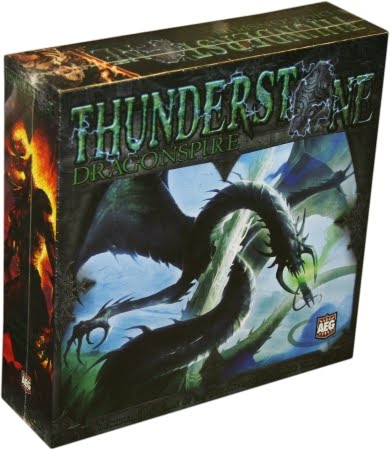
Review: Thunderstone – Dragonspire
This month I’ll be reviewing the fantasy card game, Thunderstone: Dragonspire from AEG games. This is a stand-alone expansion that can be added to the basic set of the game, but also has enough cards to play as a game on it’s own. The 2-5 player game falls into the deck building theme, where players try to pick up cards to fill out their hand. I’m approaching this review as a game, and avoiding talking about it as an expansion, as I haven’t had a chance to pick up the original game.
In a nutshell, the object is to secure as many victory points before a thunderstone relic card enters the last area of play (or ‘rank’) on the table, or gets picked up by a player. Each player represents a party, trying to head into a dungeon and defeat monsters for victory points, obtain treasure, or at the least gain experience to hone their combat skills. As a theme, it plays out very much like a basic hack and slash D&D game, low on story and high on action and hording loot.
Players all begin with the same cards and have the option during their turn to pick up new equipment or improve their heroes, discard their hand for a new one, or try their luck defeating a monster. Each player has their own deck and discard pile, so they will find themselves occasionally throwing in their current hand and drawing a new one if needed. A key point of the game is to try and pick up cards that will give them some fighting advantage to consistently enter the dungeon and win battles against monsters.
There are a couple of wrinkles to the game play. One that there is a limited number of resources. Once a pile of heroes or equipment is gone, that’s it for the rest of the game. So each player is typically in a race to pick up the best cards before they are gone. The second interesting portion of game play is that many special abilities and card functions require it to be destroyed. This can even happen if a hero is crippled in battle. Usually most cards are placed in the discard pile, which can be shuffled into a new deck that players continually draw from. However, destroyed cards are pulled from the game entirely. Combined with limited resources and heroes, this can make for some interesting game choices during a player’s turn.
Combat itself is pretty simple. Players add up their attack bonus and try to equal or beat the monster defense score. Additional card effects on the monsters, heroes, or weapons the heroes employ usually give modifiers. Monsters also line up in a queue, with increasing attack penalties for those deeper in the dungeon. This adds some tension to the game, as players that opt not to fight might find themselves up against even tougher foes if the other players manage to defeat that creature on their turn.
Another neat feature is that only a few types of cards for equipment, heroes, and monsters are used out of the entire game set. A special set of cards are used representing one of each card type. After shuffling, you then draw a particular number (4 heroes, 4 monsters, 8 village cards, etc.), ending up with a pretty decent way to make each game a bit random. As a nod to the other sets and expansions, these ‘randomizer’ cards have a different back to help distinguish them from other normal cards. Dragonspire has randomizer cards from all the previous sets so they all can be used interchangeably. It’s a nice touch and gives a new player an idea of what cards are in the other sets.
As gameplay goes, it is a bit low on direct interaction. Interestingly your actions typically limit your opponents as you might fight easier monsters, or pick up the last card of some spell or weapon. The game does feel like a bit of a race though to pick up the best heroes, fight the most monsters, and gain the most treasure. Slip behind and it can be a little difficult to catch up. Also, in some situations you might end up with a slew full of tough monsters, without the resources to take them on effectively. Having to opt out and redraw your hand in such cases can be a bit of a downer while other players forge ahead.
The Good – It’s a fun game that seems to capture feel a little bit of that classic, hack and slash, dungeon crawl. A fair amount of random setup allows for a slightly different game to reduce repetitiveness and there is a decent variety of cards out of the box. The artwork is nice and the card quality is good. I have to say the box is spacious enough to also accommodate cards from other sets which is a nice organizational touch.
The Bad – Direct player interaction is pretty much non-existent. At times a player might get a bad draw of cards against monsters in play, resulting in not much else to do but clear out their hand. With a lot of people downtime can creep in a tad. Even with the different cards, repeated play might start to encroach on the familiar. Something that likely would be alleviated picking up other expansions or the base Thunderstone game.
The Verdict – Thunderstone: Dragonspire is a fun game that has that feel of progression with a group of adventurers (through buying equipment and leveling up) fairly well. It is an abstract game and to say it captures that feeling of exploration and adventure in a dungeon crawl can be a bit of a stretch. The gameplay is pretty much a race to pick up the most effective heroes and equipment, all in the name of slaying the most vile and toughest monsters. While direct player interaction is low, your actions do have an effect on other players, and the mechanic of destroying and obtaining limited cards does put an interesting twist on this deck building game.
I found the game entertaining. It is a light, fantasy card game that revolves around killing monsters and looting stuff. Much of the strategy is trying to work out decent combinations with different heroes and equipment to become effective in combats, and in that sense, fits into the deck-building niche of games pretty snugly. While Thunderstone: Dragonspire is slated as an expansion, I would consider it a great buy if you wanted to initially get into Thunderstone. Be sure to pick it up if you’d like a fantasy-themed card game.
Review: Super Dungeon Explore
Soda Pop Miniatures are responsible for the adorable dungeon crawl board game, Super Dungeon Explore (SDE). This is a game for 2-6 players with a relatively odd theme. Despite the trappings of a fantasy game at first glance, it really is themed more like an over the top video game. It’s an odd choice, but if you jump into the game approaching it like an anime-themed version of Gauntlet rather than a serious dungeon exploration game, there is a lot of fun to be found.
Players form up into a team of heroes to face off against a single player (or Console) that runs the baddies. The goal for the heroes is to wipe out the final boss monster, while the Console tries to eliminate the heroes. There are 8 heroes to choose from, while the Console gets a choice of 2 enemy types to field and one epic boss, or up to 2 minor bosses. The progression of the number of heroes is a bit odd, being either 2, 3, or 5 heroes against the single Console player. But you can have players field more than one hero, giving some flexibility to the number of players. I’d even consider allowing 2 players to play the Console, splitting the number of models to control or take alternate turns controlling the final boss.

Each side activates a hero, or a set number of monsters, and play alternates back and forth until every model on the board gets an action, ending the turn. Each model has a number of action points that allow them to do things like move, attack, or open chests, in any combination. The Console gets to spawn monsters at specific points. The heroes can attempt to destroy these points to reduce the number of creatures that pop in each turn.
As heroes inflict wounds, there is a special loot track that moves along and resets once the turn is over. At set intervals, heroes can obtain special loot to help them out. Another track records the damage from all models (both heroes and monsters) that continually progresses over the game. As this damage meter moves on, more powerful monsters can be spawned. So those 8 bit monsters can be replaced by 16 bit baddies (I’m not kidding about the video game theme).
If the damage track progresses too far, a boss gets to spawn. This also happens when the heroes manage to destroy all the spawn points. This becomes a neat factor with game play as heroes easily can use more powerful items to equip their characters, gleefully killing anything in their path. However with each monster they drop not only does the loot meter move up, but also the damage meter, increasing the likelihood of more powerful monsters being able to spawn in later turns.
Combat is a relatively simple affair rolling certain colored dice, with the opponent doing the same. If the attacker scores more hits (indicated on the dice) compared to their opponent, they inflict a wound. Most monsters have a single wound so this removes them from play (allowing them to be respawned later). Inflict enough wounds and a hero can also be wiped out, only to be able to respawn if a fortunate relic or treasure is found.
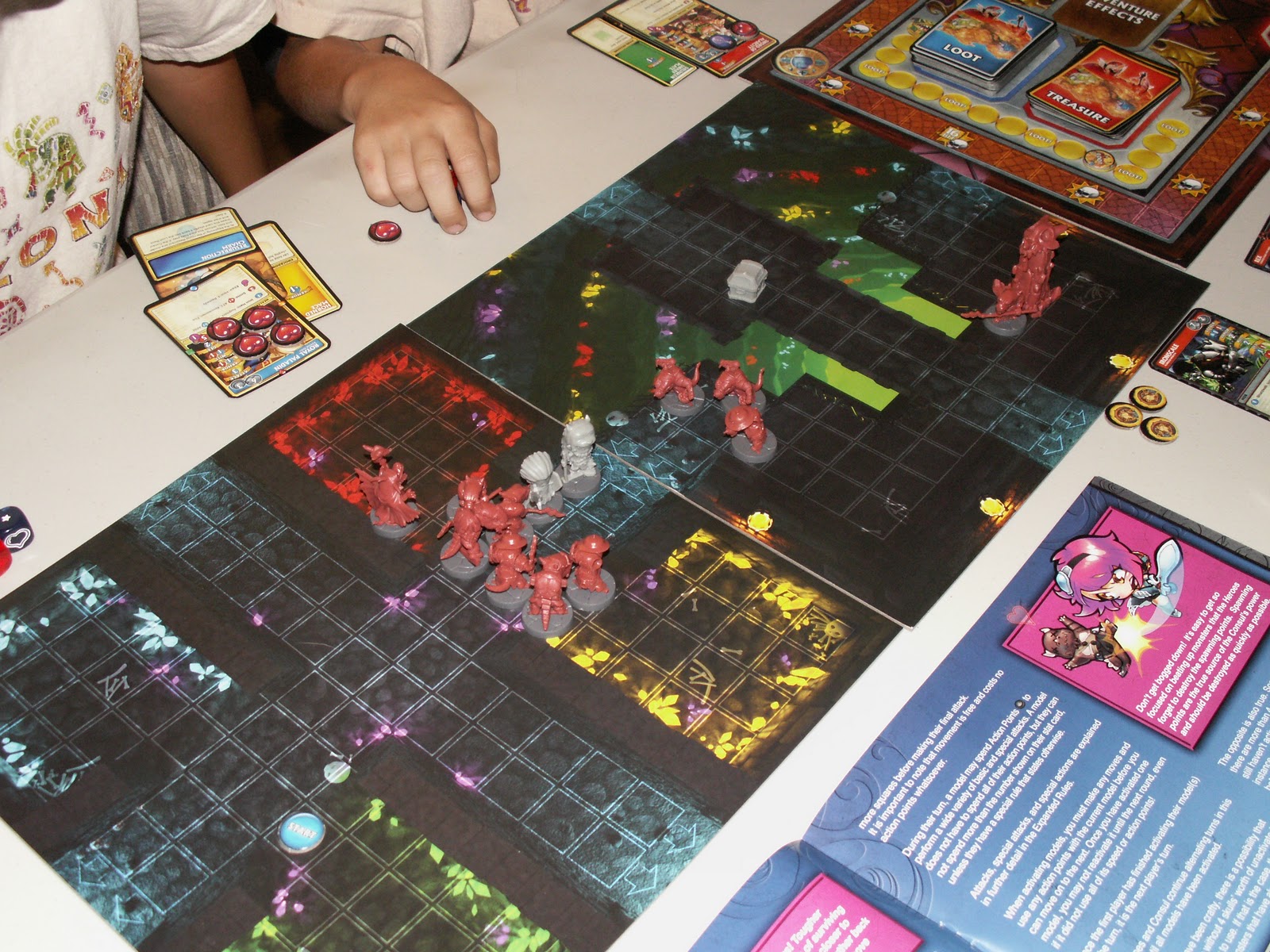
Monsters and heroes are not only represented by models, but also have a special card describing all their abilities and powers. There is quite a bunch too, from special moves, to different attacks. Additionally certain powers key off of certain abilities, that in turn may target particular defences. What you end up with is a surprisingly tactical game, with the heroes trying to maximize their actions during a turn to reduce the enemies on the board and what might pop back in later.
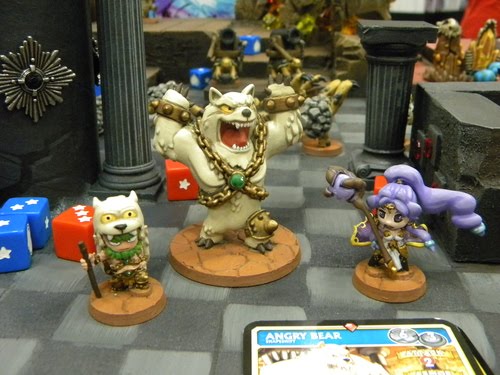
As the general artwork goes, it is very colorful and playful. The design of the loot cards is pretty neat, as they line up in particular orientations to the hero cards. The counters are also bright with several types indicating different status conditions. The figures are resin and surprisingly detailed. They assemble well, but expect to take some time gluing them together. I got mine done in a night, but I’d expect to take an afternoon or two to get them completed if working at a leisurely pace.
The models are quite a bit of pieces and fortunately there is a guide sheet you can now download to give you an idea how to assemble them. Most of the figures have wide slots and scored pegs that fit snugly into the main figure. Just about everything fit together without a hitch. Still, expect to fill some gaps with squadron putty and trim off a bit of flash. The only exception was the dragon boss model. That was a bit of a pain to assemble and I’d recommend tackling that first as it is easily the most frustrating to put together. After that, all the other pieces will be considered cake.
Sadly there are some negatives with the game. While the cards are pleasant to look at and colorful, they are printed on pretty flimsy stock. I opted to put mine in plastic sleeves, especially as they get handled so much. I seriously doubt they would stand up to typical wear and tear very well. Additionally the box is very cheap being corrugated cardboard. Expect to tape up the edges of that box also to reinforce it.
The rulebook does fairly satisfactory job explaining things, but I still ran into some hiccups determining how particular powers resolved. Also while there is a quick summary chart at the end of the rulebook, a play sheet or two would have been a welcome edition. Given the amount in the box, with color board sections, cards, and miniatures, I’m surprised they didn’t bother with a few sheets giving a quick summary of play and a short description of different status effects.
The game screams expansion, especially with the Console monsters. This leads to another detraction with the game, repetitiveness. While there are quite a few hero options, the Console is limited to two choices of monster factions. Even worse, there is one epic boss and limited mini-bosses. After a few plays, you are going to get the feeling of sameness, fighting through hordes of creatures to face the same end boss that has the same powers and the same game effects. I’m certain more content is in the pipe, it’s just a shame that different power cards for bosses weren’t initially included.
The Good – The models are nice and painted up I think would be gorgeous. The theme is light and playful. I think the mechanics move well and the game captures that feel of a frantic battle game, with hordes of minions being cut through until everyone has to gang up on the final boss creature. All the while, there are nuances to most of the models (both hero and monsters) with enough abilities and powers to keep things interesting. It also feels pretty balanced, so each player can give it their all and no one side has to pull any punches.
The Bad – Surprisingly the cards and game box are pretty flimsy. While there are enough heroes to mix things up and keep them fresh (8 out of the box), the Console forces are a bit limited. The greatest offender is the single epic boss monster. I can see keeping it limited based on the models, but no reason a few different cards could be introduced to give it different abilities. That is the biggest slight with the game and I think repeated play will have that feeling of ‘sameness’ creep in.
The Verdict – I’m a bit torn. As a miniature wargamer this is a good buy if the theme appeals to you. You get a pleasant little skirmish game with a ton of models that will be fun to paint up. The game is light and is a refreshing take on the typical dungeon crawl of other more serious games like Descent, or the recent WotC adventure board games.
However as a board game enthusiast I would tell folks to pass on this. I think the investment (both money and time assembling the figures) is simply not worth the asking price. You will end up with a game that will start to feel a little repetitive with frequent playthroughs although I’m certain more models and expansions are in the works.
In a way, I fall into the same bit of advice I give to folks that are interested in getting into Warhammer Fantasy or 40K, don’t buy it for the game unless you are planning on enjoying the modelling and painting aspect. That is the greatest flaw with Super Dungeon Explore. It seems more of a vehicle to sell miniatures than to sell a game. For folks that love miniature games and the painting hobby, you’ll get a lot of mileage out of the SDE. If you are a straight up board game fanatic, it will be much less so.
I’ll end this with a plea to Soda Pop Miniatures. Late next year when SDE has been out a while and hopefully you’ve rolled out an expansion or two, revisit the basic game. Rework the components and release a ‘game console’ version. Bump up the box and card quality. Throw in some summary play sheets. Add maybe another map board. Dump the miniatures and include all the heroes and monsters as cardboard counters. Throw in another monster faction, or at the least a few epic bosses and mini bosses. At a reduced price (say around $35 USD) I’m certain folks would pick this up. SDE is a fun game. It’s a good game. I think the inclusion of miniatures meant cutting some corners, not to mention bumping up the price, which ends up being factors that keep it from being a great board game.
Board Game Review: Jump Gate
Jump Gate is a sci-fi themed, 2-6 player game. From Matt Worden Games it revolves around space exploration and gathering of resources. I managed to pick it up from Fun Again Games which released their own version of the game with a bound color rulebook and a larger box for all the components.
The objective of the game is to claim resource cards in various sets. As players explore and claim cards, some resource cards are linked with a black hole. When these cards are claimed, a player drops one of his tokens onto the black hole tile. When a total of nine tokens are collected on the black hole tile the game ends.
It can also end when all the planets are claimed and the only unclaimed resource cards have black hole icons on them. Having a low amount of tokens on the black hole tile is important, as the player with the highest amount of chips there gets a large penalty to their final score. This adds an interesting twist to the game, as players might have to balance out picking up a specific resource to fill out a set, potentially getting a lot of points, while at the same time contributing to ending the game and possibly having too many markers on the black hole tile.
Players travel around different planets moving around in a circle in either direction. Additionally they have a set of navcomp cards. These cards do a lot of game functions. They allow a player to utilize the jump gate and travel to a planet of their choosing. They also allow a player to scan and claim a planet, all of which is done by matching up the symbols and numbers on the planet with the proper navcomp cards. Additionally, many navcomp cards can also allow the player to have special actions (basically allowing them to conduct game actions without paying required navcomp cards).
Each planet starts with most resource cards hidden. As players travel around the planets, they can scan them, adding a player token to the planet tile. When the planet is finally claimed, each scanning token allows them a choice of the revealed resource cards. This becomes an important strategy as players race around the table trying to scan planets, allowing them to gain resources later in the game. Bonus points are also awarded to players that scan or claim planets.
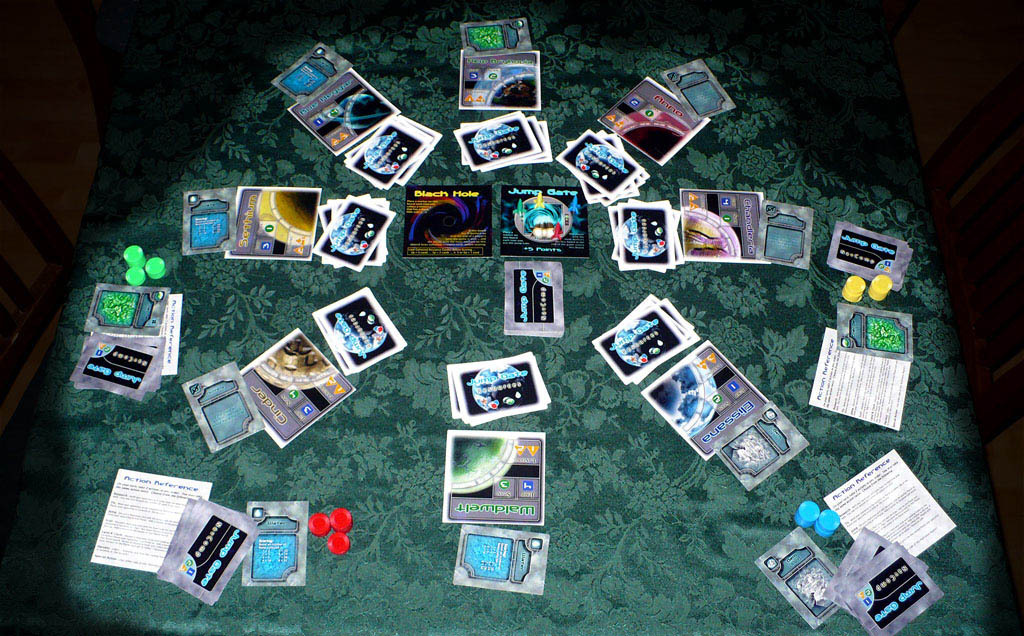 Once a planet is claimed (and after others that scanned the planet have claimed their choice of resources) the remaining resources are up for grabs. Anyone that orbits the planet has a chance to pick up a card with no restrictions. Again this adds an interesting choice for players. Discarding specific navcomp cards, if a player scans a planet they can ‘stake a claim’ on future resources and gain extra points, however to get these resources someone must also later claim the planet. At the same time, once the planet is claimed then anyone can swoop in to take up the remaining resources freely without having to use navcomp cards.
At the end of the game players score points for claiming and scanning planets. Also the player that has the most tokens on the jump gate tile get a bonus. However, most of the victory points are earned for collecting recourse cards in various sets. The meat and potatoes of these points are from gem resources. Not only do you want to claim a lot gem resource cards, but also try and focus on having one color to make up your total. Additionally many other resource cards offer more points making a pair (dark and white energy) or forming up a large set (water), while others just offer a high point bonus. As all this is being tallied, the player with the most tokens on the black hole tile gets a penalty to their score.
This scoring can make for some interesting gameplay. To get a lot of points you need to focus on specific card sets. Meanwhile you want to claim resource cards to prevent your opponents from doing the same. This sort of makes for some cut throat play as players race from planet to planet scanning and carefully picking up select resources, all the while watching your opponents and trying to see what resources they are trying to collect. If players are going for the same resource, this can be a a little hectic trying to pick up the right cards that will offer a large point bonus at the end of the game.
Recently Jump Gate has been picked up by a larger publisher and will be released as Space Mission. The German release offers much nicer components and the rules have been worked over a bit for more streamlined play. There is no black hole tile in the German Version, and play ends when a certain number of special resource cards are discovered. Another tweak is with the scanning action. In Space Mission, players can look through resource cards and actually ‘claim’ a resource that will be picked up later once the planet is developed. It’ll be interesting to see how folks enjoy the different games. I might even consider trying out the Space Mission rules with my version of Jump Gate (it’ll require modifying the resource cards though).
The Good – Jump Gate is a pretty fun set building game. It captures the theme pretty well as players try an race around the board scanning and claiming planets at the right time. There isn’t much direct interaction with other players, but picking up certain resources and claiming planets can impact other players. Additionally there are more planet tiles than what is used to play, allowing for a slightly random layout of worlds each game.
The Bad – There seems to be a scoring dump when the game ends. You have to parse out a lot of resource cards into various sets, and it can be a little difficult to know exactly how many points you have as you are playing (unless you take the time to re-tally your score each turn by yourself). Also as strategy goes, it really seems that players need to rush in and scan as many planets as possible initially. Even though there are other options, it seems to push players onto one strategy track if they want to score a lot of points. Also I will say the components are a bit spartan and simple, even with my boxed edition that is supposed to be the more ‘upscale’ version. However, it’s hard to knock the game for that given it is from a smaller publisher.
The Verdict – Overall I enjoy Jump Gate and found it much more engaging with more than 2 players. While direct player interaction is limited, you do get a feel that you are at times in a frantic exploration race with other players. Getting to scan worlds before your opponents allows an opportunity to get choice resources when it is claimed later, and also allows you to plan out what resources to collect. While this at times seems to be the best strategy, having other players in the mix can muck up things quite a bit, so you have to be flexible with your plans.
I feel adding up victory points at the very end can be a little convoluted to tally. This also means it’s somewhat nebulous to gauge how well certain players are doing during the game. The components are a tad simplistic and low quality, but I bought my copy for about $15 USD and consider it a bargain for the game inside. I think Jump Gate captures that feel of space exploration well enough and makes for a fun game.
Board Game Review: Race for the Galaxy
Race for the Galaxy is a sci-fi themed resource card game for 2-4 people from Rio Grande Games,. The game portrays the player as a budding space-faring civilization attempting to expand its reach throughout space. On the whole I really enjoy the game, but there are a few reservations I’d have for certain gaming groups.
The object of the game is to gain the most victory points from a limited pool. The game ends when the victory points run out, or players have put 12 cards in play. Overall I like the effective time limits with the game. It really pushes players to try and make the most of each turn, as sitting back and biding your time won’t work. You have to be constantly trying to produce and sell goods, or continually make developments and claim planets. Players earn victory points primarily through building developments and colonizing planets. Another key means of earning victory points is through the selling of goods.
The cards are used for everything in the game (save for victory point chits). The cards themselves represent planets and developments (resources to allow the player to do special actions). However not only are they different cards what you actually play on the table, but they are also are used as a currency and as goods to produce and sell for victory points. As there is a hand size limit, it makes for some interesting choices to decide what cards you discard in order to ‘pay’ for colonizing a planet or building developments. Additionally, many cards have a synergy in effects so this discard choice can sometimes be a bit of a conundrum for players (as there are some really neat combinations you can make).
I actually like this idea. While it’s true that at times I enjoy having lots of components in games (ex. Terraforming Mars or Puerto Rico), it is refreshing to have a game that is a little more utilitarian with how goods and currencies are represented in game.

Each turn a player selects one action they like to take. Actions range from exploring (going through the deck and selecting a card to add to their hand), to placing developments and planets in their area, to producing goods to sell or gain victory points. If the player selects this action, typically there is a small bonus (say, paying one less resource to build a development). The twist is that all the other players also get to do the same action. So if you want to colonize a planet, everyone else around the table gets to do the same thing, save that small advantage you would get for selecting that action during your turn. It’s an interesting process. While you are rewarded with some bonus for taking a typical course of action, everyone else gets an opportunity to undertake the same activity.
There are some events that take a turn to two to develop, so it is not uncommon to try and produce and sell goods while other players have no resources available. So you are continually looking at the cards other people have in play, and trying to undertake actions that won’t be extremely beneficial to them. There is also a bit of gambling involved. As the bonus for selecting an action is not tremendous, sometimes you might opt to select another. All in hopes that the other player selects something that would help you, while you direct your limited choices to some other important action. Sometimes this works, and sometimes everyone focuses in on a particular course of action for the turn.
It plays rather well and moves at a fairly good pace. The only complaint I have (and it is a big one) is that there is a steep learning curve to the card symbols. While the game mechanics themselves aren’t too hard to grasp, each card has several icons on them relaying different characteristics and uses for the card. I find you really need about 2 games or so under your belt to recognize all the symbols and icons. This is further compounded with particular names and icons having nothing to do with the game, rather they relate to other expansions. Despite having large color icon cheat sheets in the game, it can still take a while for a new player to get up to speed.
As another quibble, I don’t think this might be everyone’s cup of tea as a strategy game. There is a lot of randomness with the initial draw of home planets and cards in your hand. Typically it takes a turn or three before you can cement a strategy. I like this aspect of the game, as it keeps your planning fluid and changes from game to game. I’d liken it to being a ‘puzzle’ game. You at first are unsure what route you need to take in setting up your empire. As things unfold, you get a clearer picture as you figure out a particular strategy. This might drive some players bonkers, as they want to sit down and try a particular strategy right from the start. In Race for the Galaxy you really can’t do this.
The Good – This is a fun strategy game. It’s random and deep enough to allow a player to explore a lot of strategies. While there are some really nice individual planets and developments, just about all the cards mesh with other particular cards, making for some interesting synergies in play. I also like the mechanic that has players select their turn actions that affect everyone. While it’s not quite involved as other games with trading of cards and such, it still requires you to take a look around at what other people are doing and think about your plan of action for the turn. You can play with 2 people which is always a plus.
The Bad – The learning curve is a bit steep on this one. As I stated, mechanics-wise it is not much however there are a ton of symbols, icons, and colors a player needs to process. It can be daunting at first and you really need to expect a new player to get a few games under thier belt to be able to grasp everything. Also, theme-wise there are a lot of neat little titles of cards with some fun artwork, but on the whole you could swap out just about any other symbols and names to mimic just about any other genre. So while it does has a sci-fi theme, the rules and actions are simply an abstract mechanic that don’t really seem to capture the feel of a space exploration and expansion game. Also, out of the box you can only play up to four people. I still like having a game that seat a few more around the table.
The Verdict – I really enjoy this game. I find it’s meaty enough with options and combinations to make for a fun strategy game, and just enough player interaction to make it interesting. There are several expansions for it, most of which add additional players (up to 6) and also add additional combinations and other variants to alter game play a little. I have found some of the expansions hit or miss, but I do appreciate allowing me to have additional players. Still, right out of the box you will find a great strategy game. I highly recommend having this on your game shelf.
Get out and game, and buy something too.
Newbie DM has recently lamented about local bookstores becoming a thing of the past. Sadly, I think we are at a huge transition with the written media. When kindle and book readers came out in the market, I really didn’t think they reached that great of an audience. Now with the advent of tablets and the iPad, I think that customer base for digital books has exploded. I really feel in another 5 years, you are going to see most kids coming out of high school with a preference for books in a digital format. It is simply something they are used to working with and familiar. It’s going to happen.
What does this say about games? I’ve got some thoughts on that to fold into another post. However there is something I’ve touched on before and I think worth mentioning again. If you have a local gaming store, and they offer a means to get folks together and play games, throw them some business. Occasionally step up and actually buy something from their shelves.
Years ago I was at a small bookstore/game shop participating in a 40K demo (way back with 3rd edition). I along with a few other guys were fans of the game and were offering to a public play event in the store and help get some folks excited about playing. As far as I was concerned, the shop got business, and we got some new blood stepping into the local play scene. It was win-win for me.
There was a new person that gotten a great interest in playing. He started asking about how to get started and what should he pick up. Quietly one of the guys running the demo took him aside and said he should pick up his stuff online from website X. They offered discount deals below retail that you could get at the local store.
Now this is a hobby, and I can understand trying to get the best deal you can sometimes (GW stuff can be an expensive hobby to pick up), however I was rather floored by this. Okay maybe the bulk of your army get someplace else, but at least suggest getting the rules and a squad or two (not to mention paints and other supplies) right off the shelves in the store. Nope, he was adamant that the guy get stuff online at a cheaper price.
Mr. Cheapo failed to realize that without us playing in the store, we’d likely never have gotten this guy interested in 40K in the first place. Here was a person ready to jump into the hobby. In a month or so, we could have been seeing a new face around every few Saturday afternoons, with a new army in tow, anxious to play. A new guy to play and a new customer for the store, win-win. Mr. Cheapo just didn’t see the big picture here.
So don’t be that guy. If you frequent a game shop and they offer a friendly place for the local game community to hang out, give them some business. I get saving money and making your gaming purchases frugal. But once in a while, stop by that local game shop and buy something. Without them you’ll likely find it a tough time meeting new gamers.
Oh and after a few years, that bookstore dumped it’s gaming stock. Just wasn’t profitable to dedicate space for merchandise that wasn’t selling.
Two years…
As of this month it has been 2 years I’ve been running this blog. Been a little off and on over that time as I had slowed down posts here to focus on This is My Game for a while (and still regularly contribute there). I will likely take a few of those posts and port em over here just for the sake of completeness (like to have all the expiditions of amazing adventure posts collected together sometime).
It’s been fun and I’ve managed to correspond a bit with other folks on games and blogging in general. I’ve learned a lot and think the whole process has kept my love for RPGs going. So there is definitely more rambling posts to come, and hopefully a few more years of blogging in the future.
Board game review: Forbidden Island
Normally I would pass on something like Forbidden Island if I saw it in a store. This is from Gamewright, a publisher of kid friendly games, and I think the packaging definitely echoes that feel. I’m glad that I went ahead with my purchase though as I would have missed out on a very fun cooperative game.
The game is for 2-4 players, each playing a specific team member on an expedition to a mysterious island. The island is sinking, and the players have a limited amount of time to explore the island, retrieve treasures, and get back to the awaiting helicopter to escape before the island is submerged for good.
This is all represented by tiles that are randomly placed at the beginning of the game. On a player’s turn they can take a number of actions. They then draw from an action card deck which could be treasure cards, special bonus actions, or a limited number of water rising cards. A player completes their turn playing flood cards. There is a tracker that represents the amount of flood cards that are drawn each turn. As each tile card is drawn, they flip that tile over to represent it flooding. If a flooded location is drawn again, that tile section of the island sinks and is removed from the game along with any players that happen to be stuck on it (and if this happens everybody loses).
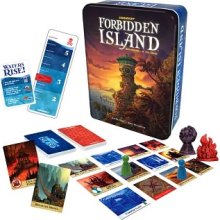
The objective is to obtain sets of cards for specific treasures and turn in those sets on the appropriate tile. After all 4 treasures are collected, the players have to return to the helicopter landing pad to escape safely. Each turn a player will find themselves trying to manage being on the right tile to trade away cards with other players, or shoring up key tile locations to keep them from sinking, all the while making sure they don’t end up on a location that will sink completely.
As the game plays players will draw water rising cards, increasing the number of cards drawn each turn as the tracker is moved up a notch. In addition the flood cards all ready drawn are shuffled back into the deck, increasing the likelihood that section of land will be subject to future flooding. This can make for some tense decisions as players balance making a run to get a treasure (or pass off cards to allow another to get it), while still keeping certain tiles from sinking.
This isn’t a deep strategy game. However it is fairly challenging and I like how it is an ‘everyone wins, or we all lose’ type of scenario. Everyone has to work together and most will find their turns being a bit of discussion with other players about the best plan of action. I like that each player gets a random team role that gives them a unique ability (effectively breaking some of the rules). As each player can do a special action, this adds a little difference to each game and gives players more options on their turn.
I also like that you can begin the game with a higher flood level. This in turn, ramps up the difficulty as you have less time and really have to plan out your turns efficiently. Combined with a fairly random island layout, and playing 1 of 5 different team roles, you can get a lot of replay out of the game.
The Good – Random layout, and different random player roles adds some variety to the game. Additionally, you can tailor the game to make it a bit easier or more difficult, allowing different groups to play and have fun. This is something refreshing when trying to play the same game with children or just adults. The components are very nice, with thick stock tiles, and solid-backed cards. The plastic treasure and player tokens are also beefy and can be handled easily (no little token bits here). The colored artwork is nice and plays to the theme well. The rules are well written and easy to follow.
The Bad – It is a random game. You won’t be able to plan out a grand strategy here. Basically your turn is a puzzle as you try to be the most efficient with your limited actions. Some of the player roles are situational and not all may be as useful as others (I’m looking at you Mr. Diver). While you can ramp up the difficulty, I’m sure with the right cards and groups that can quickly analyze and predict future sinking tiles, the game can be pretty easy to play. Additionally, it is a cooperative game. Some players might have more fun with griefing other players than with trying to contribute and win the game.
The Verdict – Forbidden Island is a fun, light strategy game. It captures the right amount of tension and player interaction. I think it would work with young children and still be a challenge to adults. It is packaged well with handsome components. Not to mention the price is just right for a game like this, being about $10-$15 USD. It is a fun cooperative game. Something I think would resonate very well with folks wanting to play games with their kids.
A very family friendly game, priced very reasonable. I’d say pick it up and look forward to exploring this mysterious island. Just don’t forget to ‘Get To Da Choppa!’
Board game review: Pandemic
Pandemic is a 2 to 4 player cooperative board game by the folks at Z-man games. Players are CDC-types frantically attempting to keep several epidemics under control as various diseases spread throughout different nations, all the while trying to avoid a massive pandemic. It’s a fun game where everyone teams up to try and beat out the clock of different game resources and conditions.
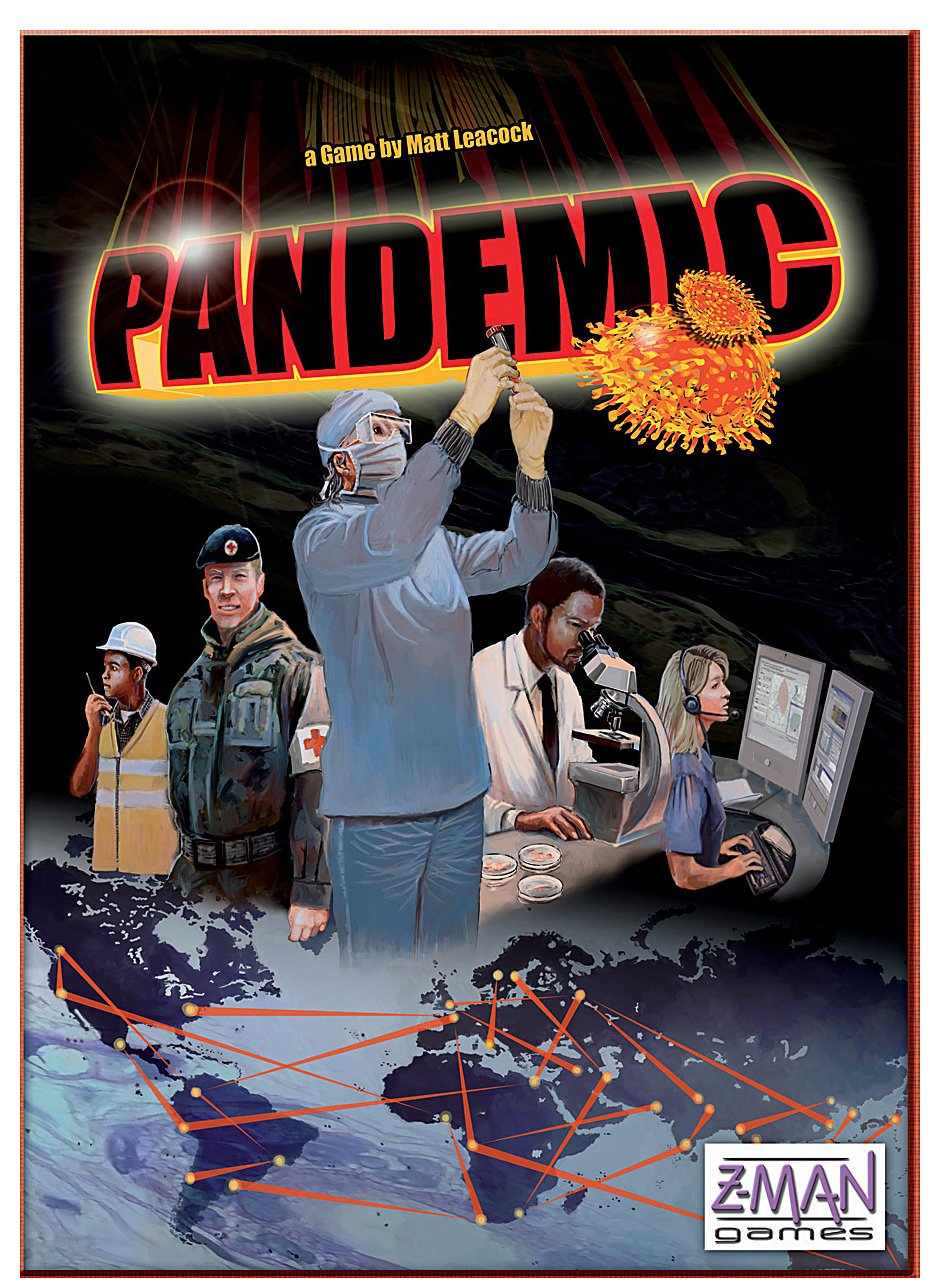
The players must find ‘cures’ to 4 different diseases (essentially turn in a color set of cards at specific locations on the board) before the game ends. There are several conditions ending the game, including exhausting player action cards and disease cube markers. If a player has to draw cards or place these markers and none are available, the game ends. Another more, trickier end game condition to predict is the outbreak track.
A single location can have a maximum of 3 disease cubes of a single color. If you add a 4th, you get a chain reaction spreading additional cubes to adjacent locations. Each time this happens, the epidemic track moves up. Reach the end and the game ends. At the conclusion of a player’s turn, disease cubes are randomly added to the board by drawing cards from a disease deck. Each world location is a unique card, so it is fairly predictable and players can try to work on controlling a potential outbreak.
However, a set number of cards are inserted into the player deck to represent epidemics. When drawn, this creates a burst of disease cubes added to a few locations. Also discards of the disease deck are shuffled and placed on back on top of the deck. This essentially increases the chance of adding more disease cubes to heavily infected areas and the likelyhood of another outbreak, continually moving a marker up the outbreak track to end the game.
So players during their turn are always trying to move to specific locations, remove disease cubes, and make trades to grant a single player enough cards to find a cure. Like the disease deck, player cards are all unique locations. Players have to be in the same location as a card being traded. You can jump across the globe, but that requires discarding the destination card (removing a potential card that could be used for finding a cure). It’s a difficult choice thinking which cards to discard and which cards to keep and players continually coordinate their efforts to work with each other before the game ends.
Each player also gets a specific role determined randomly at the beginning of the game out of 5 possibilities. Each role grants a special ability that ‘breaks’ the rules that other players adhere to. So one player might be able to remove all disease cubes from a location instead of one, or one player can just turn in 4 cards to cure a disease rather than 5. It’s a nice twist to add a little variety in how the game plays for each player.

The Good – It is a fun cooperative game with enough re-playability to keep things interesting. Additionally, the game can be scaled in difficulty by the number of epidemic cards being added to the player deck. An easier game can be obtained using 4 cards, while a challenging game can be played using 6. The epidemic cards really add a curveball to how the game plays, making a rather predictable game become suddenly a very hectic experience. The components are nice and well presented, especially the meaty tactile feel of disease cubes.
The game is also very interactive. Players will find themselves talking to each other, offering advice, and helping coordinate each other’s actions. So even if it is not their turn, they are engaged and looking at their hand, trying to see how they can help in trading cards and moving around the board of other players. Also, as it is a cooperative game with everyone working together, it makes for a fun family game.
The Bad – It’s a cooperative game. This might not be everyone’s cup of tea as some might be more in the mindset of being the sole ‘winner’ of a game. Also as a cooperative game with a lot of player interaction, I’m surprised the game is limited to 4 players. I think games like this really need the ability to play with 5-6 people. The game mechanics are pretty random also, which might not please some people that want a more structured experience, as a bad streak of drawing poor cards can leave a sour taste.
I do know that a new expansion is available for Pandemic which does add another player, and also provides some options of gameplay where everyone plays against a single opponent. I’m a little on the fence about picking that up though.
The Verdict – Pandemic is a wonderful buy. I think the small bit of random roles and randomized spread of diseases, coupled with the high amount of player interaction makes this a great game to play. The presentation and components are nice. I also think the cooperative game experience is also something a little different from your typical game, and it works well. Pandemic is a nice addition to any game collection.
 Geek Ken