Category: Campaign Planning
Starting that big campaign
I think it’s always a challenge when first sitting down and thinking about that first session to kick off your campaign. I usually have a ton of ideas going through my head, and trying to get something cohesive out of that jumble can be a challenge. For a new DM, I think the task can be a little overwhelming. Sure that first small adventure is easy enough to run, but what then? Here are a few bits of advice I hope new DMs find helpful:
Talk to your players – Bounce a few ideas off them. If you want a convoluted campaign of political intrigue against the backdrop of high fantasy. Yet, your players want a gritty, sword and sorcery game. You have problems. Be flexible. Work out a campaign environment and theme that most of your group will be happy with.
Steal stuff – For your first few campaigns, don’t bother drawing out that huge world map, filling in every detail. A unique homebrew campaign does not necessarily equate to a fun campaign for your players. There are tons of existing campaign worlds and maps. Take from those works. You’d be surprised how much material is available that can add some sparkle to simple campaign beginnings. Take Winterhaven as an example. A pretty generic place, but some renderings really give it some life, like those at D&D Doodle.
Make it your own – Don’t feel hampered by adhering strictly to a published setting. Modify the stuff you pilfer to make it fit your game. This is where you can let your creativity go. Take that published setting and mix it up.
How about making the use of undead servants (zombies and skeletons) commonplace? Select a few PC races and state they are commonly used as slaves. Take that neighboring city and make it an evil necropolis. As long as these changes are consistent throughout your world, making changes to existing works is an easy way to make your campaign unique.
Start small – There is a temptation to get players into a grand epic adventure right from the start. Slow down the pace. You’re working with an imaginary world, most players need a little time to get a feel for it. Once players become familiar with their surroundings (recognizing an NPC innkeeper and such), then consider moving on.
Starting small keeps things flexible and allows your campaign to grow. You might find your players bored with a main villain, but really interested in tracking down that kobold gang. If you have too much planned out, you risk pushing your characters along the storyline rail. Keeping things small with a few open plot lines, gives the players a chance to slightly direct their future paths to adventure.
That’s it for now. And while you are sketching out your next big campaign, don’t forget FreeMind. It’s a great tool to keep your grand plans for future sessions organized.
Spreading out the story
Some discussion has popped up in the WoTC boards with a group I am part of. One poster was really excited about starting up his own campaign and wanted a little advice. A lot of people dispensed their words of wisdom, and I had my own advice. Mulling over what I posted, I thought there were some points I should expand on a bit.
One campaign technique I am a huge fan of is spreading out the story. The basic idea is planning out the main story elements of your campaign in small steps. Instead of running your sessions with each plot point being sequential (A, B, C, D), spread out the story shuffling smaller, one-shot adventures in between each element (A, 1, B, 2, C, 3, D). Gnome Stew had a post which is a great example of this. Something I’ll quote a bit here:
“…After some brainstorming the main outline looks like this:
- The Cult attempts to kidnap the Captain of the Watch
- The Cult infiltrates the Thieves Guild
- The Cult smuggles a set of religious artifacts into the city by ship
- The Cult kidnaps the Princess
- The Cult attempts to open a portal to their deity using the artifacts and the Princess in a ritual
…Now, Using dilution, we can lengthen the story arc with some individual stories:
- The Cult attempts to kidnap the Captain of the Watch
- The Heroes rescue some merchants who have been attacked by bugbears
- The Heroes help an older mage collect some dangerous spell components
- The Cult infiltrates the Thieves Guild
- The Heroes go on a quest to find a friend who has gone missing
- The Cult smuggles a set of religious artifacts into the city by ship
- The Heroes find a lost wizards tower
- The Cult kidnaps the Princess
- The Cult attempts to open a portal to their deity using the artifacts and the Princess in a ritual…”
This is a fantastic way of building up your campaign to something truly epic. There are a lot of ways to add small adventures to your campaign. Dungeon Delves and Side treks (out of the Dungeon mag) are great resources for this. Whipping up a small sidequest using encounter templates, even using a random dungeon can work.
The key to using these adventures in spreading out your main story, is to work for small, concise adventures that can be completed in 1-2 sessions. These smaller sessions revolve around a simple objective or quest. You don’t need an intricate background story to run these. After all, they are just filler adventures for your main arc.
Once you get the hang of running these type of sessions, you can expand your story and weave other main arcs into the campaign. You can end up having 2-3 main storylines going on simultaneously. But be careful having too much going on at once, or spreading out your main arc too thin. You’ll end up having to spend 15 minutes recapping each session with highlights from the past. And likely have your players forgetting pertinent details from something that happened 5 sessions ago.
A cannot stress enough using this technique for running your campaigns. It adds some intricacy to your plot and helps give your game breadth. There are some great points by stretching out your story:
Makes good ideas last – Week after week, planning for your next sessions, you are going to hit a creative roadblock. By introducing smaller adventures, you have more time to pick up another idea and flesh it out. If you are doing things right, you’ll have interesting villains and NPCs dotting an exciting adventure. The constant pressure of keeping things fresh and new can lead to creative burnout. Spreading out the story gives you some breathing room to think of your next big arc, and utilize those story elements as long as possible.
Provides an expansive story – On paper it may not look like much, but through your player’s eyes, they will feel like they’ve saved the world 10 times over. Once the arc is completed, they can really savor the victory because of all the things they went through getting there. They won’t necessarily feel like they’ve been lead along step by step, and have had the opportunity to explore other options. They can get the experience that they’ve really grown and explored a world, rather than doggedly running after the footsteps of a villain.
Dispenses small victories – You might have a main story where the players fail again and again, only to be redeemed at the last session. Yeah, that makes for a great campaign, but sometimes players need little victories. Having small adventures where heroes can do some good, and accomplish a small goal keeps them in the game. Players need to feel like heroes once in a while. If your main arc can’t accommodate that, then you have an alternative. Okay, so in the big story, they suffer setbacks continually. After a while the players may feel disillusioned and struggle with why they are even bothering trying to stop your baddies. Little victories can help keep up the group morale, and the spiritual fortitude to keep after the main bad guys.
Fodder for future stories – Once you are nearing the end of your main arc, you now have a ton of material to draw from for your next big story. You can expand on past adventures and revisit old NPCs. Best of all, your characters have already crossed paths with certain locales, NPCs, and villains, to make moving on the next arc a lot easier.
As you can tell, I’m a big fan of spreading out the story. It is a simple, effective way to get a lot of sessions out of your main story idea. Give it a try and I’d be interested to hear folks experiences if they’ve done something similar.
Is there a reason you have a second-guessing player?
So a few sites have brought up a topic just about every DM has had, a player that is second-guessing how you run a game. Both newbie.dm and the musings of a chatty dm have offered their own takes on what causes this how to handle it.
My comment on one of the blogs got me thinking, and I felt more needed to be said about this.
You know the situation. You have that one player pulling out information from the top of his head, metagaming to the extreme and pointing out flaws in your session. He’ll be the one challenging your record keeping skills when a particular nasty solo monster has not dropped (or dropped too soon). He’ll be the one demanding to know why his skill check didn’t pass, when it’s obviously a DC 23, as listed in the DMG, pg 142 (and willing to show you the page). He’ll be the one challenging you why the main villain escaped an encounter, when it clearly has a speed of 4 in heavy armor, and that his character can easily catch up with it before the turn’s end.
You’ve got a player sucking the life out of your game. He is reducing the game to its most mechanical elements. And worse, demonstrating you are either not competent, or breaking the rules for your own purposes.
Before you decide to have some divine intervention incinerate him with a bolt of lightning, or conveniently flip him into a pit of lava. Take a step back. Think for a moment and ask yourself why is the player doing this?
Maybe he is being a metagaming jerk. That’s just the way he plays. He knows the rules. He is right and you are wrong. With a player like that I don’t even worry about it. I put my foot down. I tell those players flat out that, while they are correct by the rules, I’m running a game here to have fun. If they don’t like it, they can take a hike. I have no qualms about having one less player in a group if that person is ruining the fun for all.
But what if his second-guessing is justified? Maybe you deserve someone challenging how you run your game. Ask yourself a few questions:
- Are you being fair and impartial? Are you favoring certain players? Does this guy feel you are ‘out to get him’? If you are bending the rules, is it to benefit one player while punishing others (like him)?
- Do you have an engaging story where they are the main players? Or are the player’s extras to your awesome NPCs? Are events unfolding around your players that make them shine and feel heroic? Or are they constantly being beaten down and put though an emotional meat grinder, with no chance to improve their situation?
- Do you have your players on the storyline rail? Or are they actively making decisions? Do your players feel that their choices matter and have an impact on their fate?
- Are you providing players with enough chances to succeed? Every campaign should have its emotional highs and lows, where sometimes they fail. But if you think the group always make ‘stupid’ and ‘wrong’ decisions, think about the situations you are placing them in? Are they constantly choosing between the lesser of two evils? Are they always making choices that break their personal code of ethics? Maybe you need to provide some guidance or a clear cut ‘right’ decision once in a while.
If you constantly have the group feeling weak and powerless against opposition, don’t expect them to keep lining up for another string of failures. Constantly clashing against the superevil cult and never winning a victory gets tiring. Eventually the group will do the worse thing ever, stop caring about their characters and the game. Victories are important.
- Is your campaign universe stable? If you have a verisimilar story, and suddenly pull some wacky, earth shattering phenomenon out, better have a reason why. Maybe your group is perfectly fine with a chance of pace. But if aliens suddenly landed and started shooting knights with particle guns, expect your group to take pause and possibly not like the new direction of the campaign.
- Are you running a fun game for most of the players? Maybe that one guy is bored out of his mind. That’s okay, you can’t keep everyone happy. But if half the group is not having fun you’ve got a problem. Are you spending a little time after each session to talk about how things are running? Are you giving the group a chance to give some feedback?
Maybe that one bad call really got a player worked up. Each time you flub a rule, it’s adding to his aggravation. Giving them the opportunity to talk about it, just to get it out and clear the air, all can do wonders with diffusing tension. Your players should be having fun. Take the time to ask them if they are.
If a player is second-guessing you as a DM, take a long hard look and see if there is a reason why. Sometimes it’s just the player, but sometimes it might be the way you run your game. I’m looking forward to folks providing their own experiences and thoughts.
One page dungeon goodness with a helping of a module template
Currently I’ve been using two tools to help get my adventure ideas ready for a session. The first is a module template from the guy at Key Our Cars blog. I have heavily modified my own template, but I like the layout and it follows pretty close to WoTC adventure formats.
I like having the overall theme and behind the scenes plans of the villains laid out. I list out a few hooks with major and minor quests. I put together an opening scene and sketch out any interval situations (including planned skill challenges). I’ve been leaning away having a detailed encounter write ups. However, if there is a lot going on in the manner of environmental effects, traps, or hazards, all which might require some additional tactical notes, I do give a general write up of specific encounters.
One of the nicest features about this template is that I can cut and paste monsters from the DDI compendium directly into it. So at the end of my adventure write up, I have every monster or trap listed out. While I run the game I have all my notes neatly organized, and have every baddie my group runs across right at my fingertips. It’s a nice template, check it out.
The second tool I’ve been using is the one page dungeon. This was originally an idea proposed by Sham’s Grog and Blog. The concept is simple and its elegance is noteworthy. Get your entire dungeon together on one page. Fill in each room with a slim list of details and monsters. Then just run your game. Don’t bother with a detailed description of each room, just sketch out the details and improvise when you need to. All the meat for the session is planned out and summarized nicely on one page.
I’ve not completely transcended into the zen-like state of the 1 page dungeon for my entire preparation. As I said, I still fall back to having more details prepared for specific encounters. I also like having my major plot lines written up beforehand. So I fall back to the module template from Key Our Cars quite a bit. Still, using both I am able to get a lot down efficiently with limited prep-time.
I’ve been dabbling in using another tool. It seems to be a nifty program but I need a little time to work with it. Expect another post in a few weeks after I get a chance to plan a few sessions using it. Still, it looks pretty awesome.
Until then, I’ll leave a link to a recent contest that Chatty DM had hosted. They compiled all the 1 page dungeons that were submitted. Be sure to browse through them. There are some absolute gems there and tons of neat ideas for your own game. Good stuff.
So what other little tools have folks been using to prep their own games?
When players don’t take the hook.
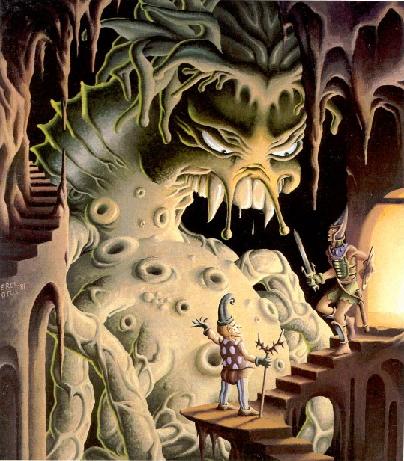 So you’ve got a grand adventure planned out. Set up the initial scenario to draw the players in with the appropriate hooks. And none of them are willing to bite. Nope, they just rather head off to somewhere else and forget about what you’ve planned for the night.
Something similar popped up with the new D&D podcast. The DM laid out a notable quest, resulting in interest with some of the players, while others in the group were adamant about not getting involved. There are a few things to get around this. But laying out some quality bits of information and/or situations can help a lot in drawing the players in.
I’ve got a secret – I love this method. I really like parsing out small rumors or background information a few players beforehand. Typically I contact my group via email before the session to make sure everything is ready to go. If needed I’ll drop some info on one player. It can be a rumor, or just some background on a particular NPC or organization. Usually having one player armed with a bit more knowledge can smooth over party distrust to new NPCs. If Lord Fancypants wants the group to look into the Pirates of Black Death. When one player has heard about how rotten those pirates are, they can really help getting the other players get over that hump of trusting information from Lord Fancypants.
Make it personal – Take some information from a player’s background and use that to lure them towards a quest. That evil warlord that crushed your family? Yeah, he is across town running a group of mercenaries for merchants now. Expect one player to be chomping at the bit to make a beeline for those mercenaries and take them on, This ties a lot into the above point, but having a player have a personal stake in a quest can really work. This can load a lot of personal drama into the group dynamics, depending on how far apart views are from the party on which direction they should go. Still it is an effective tool in getting a group motivated to take on a quest.
Give the phat lewt! – Having a desirable item, large amounts of treasure, or at least the rumor of such a reward, is also a fair way to spark interest. There is typically at least one player with a more financial perspective on accepting quest in a group. They are likely the first to be asking what a job pays and what are the rewards. Dropping a juicy rumor of a large haul can sometimes be enough to get that player on the side of taking a quest. Don’t be afraid to fall back on greed of a player to get them interested.
Drag them kicking and screaming – Sometimes you can leave choice out of the matter. Put the players between a rock and a hard place, forcing them to move towards the adventure. Have them falsely accused, pursued by forces, or presented with a situation where they are compelled to act. It’s one thing to hear that the Pirates of Black Death are bad guys. It’s another thing to have the group see women and children being slaughtered before them by the hands of these pirates. I use this trick pretty sparingly. It definitely can cross into the territory of railroading the group. But it can be an effective means to push a group into tackling a greater danger because of the danger hot on their heels.
So have you had your characters just flat out refuse to follow a hook?
(Side note: I’ve been listening toe the Penny Arcade/PvP podcasts for a while now. I’ve noticed this one by far has more RPing from the group than previous episodes. It’s interesting to see how a group of new players are getting more involved with their characters. The new series is a hoot so far, I recommend giving them a listen.)
You all start in a tavern…
I’ve started many campaigns with players bumping into each other over a tankard of ale at the local tavern. Almost too many I think. It became a long standing joke back in my old AD&D days with my players. It is not a horrible way to start a campaign, but it takes a bit of time getting everyone introduced and willing to work with each other.
I find players are usually a forgiving lot on this point. They may all have their individual desires and motivations, but at the same time they all metagame. They all know they are sitting around a table and wanting to play D&D. So already they know they have to at least try to work together, especially for that first session.
Return to Northmoor is a great D&D podcast I listen to. It handled the initial session in an interesting way. Their 1st session the players sketched out their relations with key NPCs, each other, and their own reasons for why they were there. In effect they all were associated with each other, and all had a similar impetus to strike out on an adventure if the opportunity arises. It’s a great idea. Plus for a DM they can spend more time planning an adventure, rather than wracking their brains trying to come up with a plausible reason why a rag tag group of heroes would want to group in the first place.
Establishing a campaign where the players already have a relationship with each other is a great way to start. You don’t need to spend an excessive amount of time and planning to get a group formed up. They are set from the start, and can head off to explore. I’ve been trying a few things with new campaigns and it has made those initial sessions a bit more focused on a dventure, rather than a meet-and-greet at the local tavern.
You all know each other – It can be a precursory meeting in the past, or a long standing friendship. This point is solid though, all the players have had some interaction with each other in the past. This helps bury group distrust among characters from the start. Why would a fighter trudge along after some unknown wizard and rogue, to investigate an old crypt in the first place? If they’ve initially known each other, this becomes an easier scenario to imagine.
Your secret impression of 2 other players – Each player has some secret thoughts on other players. Maybe they think the paladin is a blowhard, pompous do-gooder. Maybe they have a crush on the Deva. This is material the DM can use to push and pull the players in certain directions as the game unfolds. The usefulness of this can vary (especially if all the players secretly respect each other), but sometimes as a DM players will surprise how far they take this.
2 secrets about yourself that you want no one to know – Again, more fodder for future story arcs and adventure. This can have a very dynamic effect combined with the previous situation. Maybe that holier-than-thou paladin had a hedonistic past? Maybe the Deva, subject to a player’s crush, in turn loved their grandmother (/insert soap opera music here). This is an excellent source for molding the dynamics of the group after a few sessions.
The DM assigns 1 of these secrets to be known by another player – This is optional, but can be a real doozy for a group. Take one of those 2 deep, dark, hidden secrets that each player has opened up to the DM, and quietly pass that information on to another in the group. Now you have a party that really knows a lot more about each other. Where they take it depends a little on the DM, and a lot on each other.
I like using these tools. From the start you have a group of people that have quickly established relationships with each other. More importantly the DM has a good sketch of the personal dynamics of the party. They can find material there to have plenty of hooks for other adventures. Also they have some tools to predict how players will react in certain situations.
That is it for about now, what do other folks use to get their group together?
The group ends victorious! Now how did they get there?
Dave Chalker over at Critical Hits has his 5X5 method to flesh out a campaign, and it is a pretty neat idea. The skinny on it is taking 5 major quests, then assigning 5 steps (mini-quests) to complete each major quest. You end up having enough quests out there with players running all over the world doing different things. All at the same time however, the group is ‘on the map’ of the DM storyline, despite the possibility of them being all over the place geographically with various plots and quests. Pretty neat stuff.
That got me thinking of ways to sketch out a campaign. Usually it is easy enough for me to get the big idea of a campaign, identifying the main villains as the ‘Who’ and their nefarious plans as the ‘What’. I typically then fill in the ‘How’ with a series of quests and tasks the villains are set to complete as different branches converge. The PCs then are led into certain encounters to thwart them at those steps. Sometimes the group succeeds, and sometimes they fail (leading to further branches in the story arc). Those results then morph the overall plans of the villains until things boil to some conclusion ending the campaign (or at least that major arc).
Now for a lot of fun, I try to keep 2-3 major milestones of the villains going at once. So that continually, players have a few choices to make. I try to set things up so they have opportunities to foil all the different villain’s plans, but sometimes give a hard choice of an either/or situation. It works pretty well, but it makes it a little harder to recover if they really go off the track and in a completely different direction. Things can get a little convoluted.
Another big problem I tend to have is getting a tidy ending to the story. Things are sketched out, but the details are usually lacking. I sort of like this as the campaign has an organic feel to it, constantly growing and adapting to the characters actions as they progress. Overall there is a general theme and a main plot, but it is more of an outline rather than a strict doctrine.
Granted if you have a lot of time to run your campaign, it can be fun. However, if you know you are running a game for a set amount of time (say over summer break, or for 6 months), you might want that strict outline for a campaign. In that case, you may want to lay out exactly where the characters should be after X amount of sessions in the campaign.
Another way to think about plotting a campaign is assume the players have won at each step. Rather than think what the villains are planning to do, approach the story that the characters have all ready been successful foiling them at the campaign end. Now it is just a matter of working backwards to see how they got there, and figure out at what other previous steps were they successful.
So the group has defeated the huge villain and lived happily ever after. They arrived at that point by stopping the villain from casting ritual Z. They found out about the ritual from exploring dungeon Y. They found out about the dungeon as they had managed to foil the villain from obtaining artifact X, etc.
This leads to a very linear story, but if the players get off track it is easy to jump back on. You simply work on a few side quests to move them onto the next plot point. Failure is always an option, but you have a good guideline where the players can slide into the main storyline (and still keep everything on track). The biggest challenge is just figuring out a new way to give them an opportunity to succeed at the next plot in the campaign. For a campaign on a tight timeline, I might have to give this a whirl.
I am a Luddite, but I’m Trying to Change…
WOTC has released a beta of their new monster builder on their website a few days ago. I do have a subscription to D&D Insider and find it a pretty useful service. For the most part however still was running many of my games away from the PC. I cut my teeth on gaming when PCs were not in every household and everything was done with pencil, paper and at best, a calculator.
I’m trying to break away from that though. I’m starting to use an excel sheet to track initiative, HP and such. I’m starting to write up my adventures as word docs and using maps I’ve scanned in. But I am not quite there yet. I still keep many of my NPCs on index cards. I still use markers to indicate status effects. I still roll dice myself (I tend to make my rolls out in the open for players to see). I’m trying to change but 30+ years of gaming has settled me into habits that are hard to break.
There are a lot of useful tools out there too, especially for adventure prep. Dungeon Mastering has a lot of tools for building encounters, monsters, traps and the like. They require a signup to access but it is free. They also have quite a few links to other useful sites.
Asmore.com still has a monster and encounter builder at their site, but with limited support as WOTC have released their own versions. Still I found their monster builder pretty useful and liked their encounter builder if I needed something in a pinch.
Obsidian Portal is something else I am using as a handy campaign reference and planning tool. I’ve found I’m starting to use that for tracking my NPCs and key campaign plots. Likely I’ll post more on that later as it has a lot of uses.
There are a lot of computer resources available now for running games. I’ve been limiting my use of them and concentrating more on the adventure prep tools. I’m still a fan of having monster profiles printed out and handy for me to scrawl over with a pencil. I like adding a few post-it notes to my written adventures as I plod along during a game. I still do not like clicking a mouse when rolling 3d6.
I’m a little hesitant to go completely digital. Somehow I find it rather sad to see a circle of people playing D&D, all huddled around their different laptops. I like the open interaction of players facing each other, rolling dice, and moving their figures around a battlefield with a character sheet sitting at the wayside.
I’m trying to embrace new technology. I really am. I just have old habits and prejudices I can’t seem to shake when playing D&D.
Putting the Story on Rails
I sometimes stumble over this when running a game. I’ve sketched out the events for a session. I have the plans laid out with specific decision points. I have consequences and issues that come up based on which path the players choose. Then I run the game and the players just go all over the place. It’s fine and that is one of the joys of playing D&D. Players should be keeping the DM on his (or her) toes.
But sometimes I still push the story on a rail. I construct a situation that nudges (sometimes seemingly like a linebacker pounding a tackle dummy) the players in a direction that I want them to go. It’s bad DMing and it bums me out when I do it.
Typically it is because I’m thrown for a loop with some of the decisions that players make. Where I envision outcome A or B from a RP encounter, the players come up with something that needs an outcome C (or even sometimes outcomes D, E, and F). At times I just run dry on improvised ideas.
I’m a huge fan of the ‘say Yes’ DMing style. If players are thinking of creative ideas to tackle a problem, I want to reward them. I want to encourage unusual solutions if the players are thinking. While it may not work, or be incredibly difficult to pull off, I like giving them a chance to try. But sometimes I just say, “No, that isn’t going to fly”, and then I push the players along the story rail.
As a quick example, the players are on an errand. They don’t really know their employer much, but are taking the job because it pays well. They get the item of unknown function. Returning to their employer, they are intercepted by a NPC group that wants the item. No way in Hades are they going to let the players take it back to the employer, and are ready to take it by force if needed.
So the players have a choice. Hand over the item or fight them. The guys that intercepted them definitely seem shady, but they really don’t know the motivation of their employer either. It is a simple dilemma and I’ve thought out story lines for either decision they make. Then the players come up with a plan C.
They are willing to have a representative of the party go with the NPC group, speak with head boss of the NPCs, and they won’t hand over the item to their employer just yet till they hear more on their offer. I hem and haw a little and say the offer is not acceptable. The players want to negotiate this deal a bit more. Finally, I tell them to roll initiative as the NPC group has done enough talking and ready to take the item by force from the players.
I hated doing it. Given a little time I could have gotten a side adventure together. The players read the NPCs right. They are bad guys. I could have had one player out of the action, being held hostage. Had the rest of the party try and do a bold rescue and escape. In short, try to run a grand adventure, but the reality of completely winging it settled in.
It was early in the session and the story was way off what direction I expected it to go. I needed more time to fill out some details and think about how the events could unfold. I simply was not up to par with running the game enough to pull off that much improvisation. It’s a shame too as 4ED really has a lot of tools and rules to cover those weird actions that players come up with. Making encounters really is a breeze. I’m going to have to work at designing more monsters and especially NPCs. Plus I need to give the ‘Additional Rules’ section in the DM another few reads to familiarize myself with it. I need to improve how I DM a game.
Putting the story on rails isn’t fun for the players. If folks have some tips to keep from that happening, feel free to add something.
Organizing Your Campaign with Freemind
I like a convoluted campaign. I like having 2-4 subplots running with hints and lures dropped along the way and as the players run through the game, more and more is revealed. Occasionally they complete an arc and have that ‘eureka’ moment when I leave a little clue about something else. It’s great fun and I think they enjoy the non-linear storyline. Giving the group a choice of A or B (and sometimes C) works as they don’t necessarily feel they are forced into plodding along one direction, plus either choice works for me as I’m typically somewhat prepared for each decision (although sometimes I fall short on that).
One tool I’ve picked up for that is Freemind. It is a great freeware program that allows you to construct mind maps. You can save it in a variety of formats, add links and comments, and have a lot of small features to help organize your mind map. Freemind allows you to incorporate all those odd plot lines and keep them organized so your main story can keep on track. More importantly, you can keep all the NPCs aligned to the right arcs.
I use a lot of symbols and color schemes to keep things organized. Bad guys for certain arcs have a matching color to the deeds they are responsible for. I also throw good NPCs into the mix to pair off against villains all tagged with a different color. When I add players into the mix, I also give them small icons that I can tag with particular adventures and NPCs.
The icons allow me to tailor various villains or storylines to a particular player for some more depth in a certain adventure (say an old villain from a character backstory, or a 1 shot solo adventure I ran a player through). Very quickly I can manage a lot of simultaneous arcs, and keep all the story threads neatly arranged. It also is pretty easy to edit, so I can add branches to ideas if new things roll into an arc by the player’s actions.
Give Freemind a whirl. It is a great tool to help congeal those nifty campaign ideas into something organized and readable.
 Geek Ken