Category: DM Tips
Tweaking 4E: Beefing up the basic attack
I’m still throwing the idea around of at least doing a one-shot of 4E once in a while. Maybe do another campaign if I can get some interested in giving it a go. So far they’ve been enjoying another setting and another game. One thing that I want to do is bring back the idea of using a basic attack or at the very least have it in place of an at-will.
Face it, a lot of at-will attacks have that generic option of a single target attack that simply uses a high ability score aligned with a certain class. As I mentioned way back in an old post, there is even a PHB2 feat that does something similar. So why not make a go of it and go full out? I think this actually might open up some classes to being able to focus on other abilities and not lag too behind other builds. Now I could have that CON-based fighter which could still be able to reliably roll out the basic attack damage. So here are my thoughts for a different basic attack-like ability.
All players at level 1 gain a trained basic attack. The player must select one option for this power at character generation, and cannot be re-trained.
A) The player picks a weapon group they are proficient with (ex. axes, bows, light blades, etc.). The player can use one ability score of their choice to be applied to that weapon group. If this ability replaces the default strength (melee) or dexterity/strength (ranged/heavy thrown) modifiers for that weapon, then the chosen ability score bonus is applied to both to hit and damage rolls. The power retains the martial keyword and weapon keyword. At 21st level, the power gains [2W] damage (plus appropriate bonuses).
B) The player gains a ranged basic attack that can target 1 creature. The power has a range and damage equivalent to a level 1 At-Will power of choice from their class. The power gains a damage keyword equivalent to the power source of the class (i.e. arcane, divine, primal, etc.) and the implement keyword. The power gains a bonus to hit and damage rolls based on an ability score of choice. At 21st level, the power gains one additional damage die, plus the appropriate bonuses (example, if the trained basic attack power does 1d8 + modifiers, at 21st level it will to 2d8 + modifiers).
Regular basic attacks are still in the game, but the player can have this listed first as their bread-and-butter attack. It’s the go to attack when they aren’t sure to pull out an encounter or daily power. A fall back choice for an attack and be comforted that they aren’t crippling themselves. I’ll have to tweak this some more, but looking forward to trying this in game.
No more +1s
So the gang is back together after an extended holiday and we’re discussing what to play next for our campaign. 4E is something still being considered. Think running with Savage Worlds will be the most popular choice, but 4E is still on the table. At the very least, it might be an occasional break from our regular game as a one-shot once in a while.
I’ve got some plans however to do some serious tweaking to the game. I’ve been thinking of some things to do for streamlining combat and speeding things up. I plan on still having a map, but throw out the grid. Also considering on really altering the number of powers players have in play and thinking of tinkering with the whole magic item power bit. More on that later.
One thing for certain, I want to get rid of the minor temporary bonuses that float around in the game. I want something with bigger effects. Static bonuses aren’t much of an issue, but all those little +1 bonuses seem rather fiddly. I’m thinking of a couple of options.
Make it all +2 – Not a groundbreaking change, but I’m liking the idea of making each bonus or penalty a +/- 2 and rounding things up. So that combat advantage with some temporary power boost might translate into a larger bonus to hit. That’s okay with me. I want the PCs to make those big rolls, the monsters are going to get the same thing.
Advantage/Disadvantage – The other idea I’ve had is using the advantage mechanic from DnDnext. Basically use simple color markers to indicate either a bonus or penalty to hitting a target. The marker with the highest total would grant either a disadvantage or an advantage.
This will likely make for some very chaotic combats, and I entirely expect my players to pummel the stuff I throw at them. However this might also put some hurt on them (given the proper circumstances), as I’ve just been able to double the chances of me critting my players. This might just make combats too wild and unpredictable, but of the two options I am leaning towards this more.
It’ll take a bit of playtesting. Fortunately I’ve got a patient group while I pull out the crazy houserule stuff. Honestly they haven’t been too keen on doing another fantasy campaign, but I might be able to get a one shot session in sometime. Certainly looking forward to trying this idea out.
Tips for teaching and playing Fiasco
 I’ve gotten a few games under my belt for Fiasco. It’s a fun game but I think it can be a little daunting for newcomers. Likewise, there is a structure to the game and folks wanting a pure story-telling experience might be taken back somewhat with the dice mechanics. It’s a different game from your typical RPG, but with a few pointers you can easily teach and run a game without any major speed bumps.
Start with the aftermath… – When teaching the game, I’ve found it best to start with how the aftermath works. While story is king, at the same time you want to guide yourself to one color or the other. It can be counterintuitive that you can make a ton of bad decisions, earning a ton of black dice, and still come out on top. So having that guideline of working towards a single color helps.
At the same time, I reinforce that you want to push other players into bad decisions. You want to hand out dice that will give them a low score, drifting towards an even mix of white and black dice. All of it feeds into the aftermath, and understanding how the endgame works sinks in this concept of awarding a mix of dice.
…and work backwards – Of course how do the players get dice? It leads naturally into the different acts and establishing or resolving scenes. When describing this I emphasize that act two works just as taught (example, if a player is resolving a scene, they pick the outcome die). Act one is similar, but you give away the dice earned, leading back to the concept how the aftermath plays out. You want to be sure that the people whom you want to manipulate are in a bad situation. They need to be holding a good mix of white and black dice after act one, so be sure to push them using the dice.
Gloss over describing the tilt – Honestly, once players get through the setup and relationships, getting the concept of the tilt is pretty easy. Additionally, only two players will be deciding what tilt results come into play. It’s enough just to say that a few random events will come about after act one, and leave it at that. Once you are ready to determine the tilt elements, you can spend a little time explaining how they work for the game.
Have a clear agenda for a scene – A player should know (or say) what they want out of the scene and what they expect the other person should be agreeing to. This helps gives some direction and allows a better way to determine how good or bad a scene goes for them. There is not a lot of face time for each player. While some character scenes can work, its better to have players being proactive with the story and continually working towards character goals.
Say, “Yes, but…” A staple of improv that also works for DMing is the concept of ‘say yes and…’ For Fiasco I tell the players to “Say yes, but…” Players at odds with the active player should avoid shutting them down. Instead think how they can one up the other player. So instead of flat out refusing to hold a stash of coke at their home, how about counter with a request to burn down a lagging business? In effect that conflict becomes a you-scratch-my-back, I-scratch-yours arrangement. This opens a lot more story opportunities, allows that active player to get what they want, but still have an undesirable outcome (by giving up or agreeing to more than what they wanted to).
Award (or take) scene outcome dice earlier, rather than later – The natural inclination is to wait for a scene to conclude before you hand out dice. I think it gives better direction to players involved in the scene if the dice are awarded earlier. It helps avoid that long, drawn out conversation where each player dances around with what they want, and what they are willing to give up. At the worst, you end up with this contest of wills where the scene doesn’t go anywhere (which shouldn’t be an issue if they are using ‘Say yes, but…’).
Handing out dice earlier gives each of the players involved a huge heads up on how the scene should end. It’s a great way to indicate that one side needs to concede, agree with the plan, and move on. This gets trickier when a player is resolving a scene, but if they think they’ve made a solid argument, or will likely manipulate the other player, it’s a good way to herd the developing conversation towards that desired conclusion.
Stick to an approachable playset – A slasher horror, wild west, or post-apocalypse setting sounds fun, but new players might struggle with ideas. As much as folks may claim to have an active imagination, drawing ideas from everyday life can sometimes be easier. This is especially true if all the players can easily latch onto unfolding plot elements. Not everyone may have the same idea what life on a space station is like. For new players it’s best to work with the familiar.
One person picks the type of relationship (or element), the other picks the detail – I really like using this method. Sometimes this might mean having to skip a player during the setup, but it allows for both players to establish relationships, elements, or needs that define it. I may have a hankering to have a romantic relationship, or attach some weapon object to my partner in crime, but it’s the other player that would get to fill in the details. It forces both sides to compromise and allows each player to have some say in the story of the relationship.
Don’t be a slave to story elements – As everything unfolds and plans are made, you might find a certain location or object just isn’t part of the main stage and becomes more of a minor prop. Don’t try and force it back in. If you’ve got this wacky idea of something completely new, don’t fret too much about making it part of the game. The selected objects and locations are there as idea fodder. They don’t have to be central elements and you can use something else entirely if it just flows into the game.
Forcing selected elements to be part of the story can be problematic. I made this mistake trying to bring up a chosen object late in a game, where the plot had moved completely away from it being a more prominent element. Establishing a scene to drag it back in made the entire exchange fall flat. It would have been better to had just let it go and run with the other new ideas that cropped up as we played.
Don’t ignore story elements either – While you don’t want the chosen story elements to strangle the game, you also don’t want to bust open the fence of ideas and scatter the herd all over the place. Before you start throwing those free-form ideas around the table, take a look over the elements picked in the setup. Think again about trying to weave them into the narration. These elements have input from several players and making them part the story is a game in itself.
Be flexible – Be adaptable. If you’ve nailed down your character in the first scene, take a step back and reconsider their goals and motivation. Listen to what is happening around the table and think how you can weave your story into theirs. Sometimes this might mean altering what you envision your character as. Let things ferment a bit at least until the tilt. Remember it’s a collaborative effort, don’t adhere strictly to ‘what my character would do’, instead be flexible and work with other players to make the game fun.
Hope folks find these tips useful for teaching the game. Have some downloads that might be useful for running your game too (including a new playset). I’d be reminisce to forget Wil Wheaton’s Tabletop episode on Fiasco. It’s an informative and entertaining way to learn about the game.
EDIT: Some kind folks have pointed out that Bully Pulpit Games have their own tip sheet for running Fiasco. A nice resource to have handy when teaching the game.
DMing a solo player party – Part 2
So for a while I tried DMing a single person and found you could run a fun 4E game. However changes are needed to how you typically run it. Last time I talked about the general ideas of DMing a single person for a D&D game. This time I’d like to get into some tips to make the game work mechanically.
Three is the magic number – Coming up with interesting encounters was a challenge, until I just decided to round out the party with a few NPCs. I originally used PC types with a limited power selection of one at-will, encounter, and daily power. After the DMG2 came out, using companion characters was another option. However, I found with a smaller group the use of a daily power was really needed over having a utility companion power.
With a trimmed down list of power choices, having the player helm another NPC in fights wasn’t a difficult task. I ended up running the other NPC in combats. Having 3 combatants gave me enough of an XP budget to provide interesting opposition for fights. I could field a fair mix of monsters with even some traps/hazards thrown in.
Spread the skills around – One critical thing was making sure the NPCs in the party complimented the player. I think with a larger group, you can have a lot of repetition with character roles. However with a smaller group you really need to cover a lot of different roles in the group. It gives the player enough resources with the abilities of the NPCs to help them get through fights, recover after them, and keep the action moving.
So I would really try to make sure different class roles are covered. My player was running a rogue, so I complimented them with a fighter (to maximize the player’s ability to get sneak attacks), and an artificer for a little healing and some controller abilities. If any class is needed, you should really try to make sure there is a leader-type with the group. Even if it is a secondary role, such as a paladin or druid, having that little bit of healing utility really helps out.
The player is still the star – Even with a few companion character/NPC types around to make fights more interesting, I kept the player the center of the action. The character is the leader of the party. The NPCs in the ‘group’ defer to his/her judgment and listen to the boss. Occasionally I’d feed the player some information via a group companion character, but very rarely. Once I kept this up the player realized that they were in charge and decided the plan of action. They never bothered to metagame and prod the party NPCs for info. I’d reply they had no idea and defer back to the player.
For skill challenges, the player was the one making the checks. I kept NPC skill checks to a minimum and made sure that the player was the one actively doing things in challenges. I would frequently limit the NPCs to just making aid another checks for skill challenges. It was a nice way to give a little help to the player, but not have NPCs dominate skill checks. I also made sure I made all the skill rolls for the NPCs, to reinforce the idea that the companion characters were there to support them and help out. They were simply a resource for the player, but not the ones driving the action.
Using these tips I kept things interesting for the player, with fun fights and just enough resources to allow them to have some heroic adventures. Even with the other NPCs, the player felt in charge of the action and was the center of the story. Having some companion NPCs also allowed me to slightly push the story a certain direction if needed. However they really added to the player’s game, rather than dominating their influence on the story.
To wrap things up, you can run a 4E D&D game with a single player as the party. It takes a little work and a willingness to have a few NPCs tag along. Yet in the end the player has enough resources and abilities at their disposal to strive for some exciting challenges. All the while they are the center of the story and can make for some engaging and interesting adventures.
DMing a solo player party – Part 1
 Two years ago I had a few players drop from my group. It’s typical given where I live. Many westerners that come through Korea are here temporarily, so it is difficult to keep a lot of players for more than a year. So I was at the position of having just one player and ready to wrap up my 4E D&D game until some other time when we could get more around the table.
Thing is the other person did not want to stop. They really enjoyed the game and were perfectly willing to do so as a solo player. I agreed and sat down to try and see if I could make it work. So we played for several months. At the end I can say with confidence that, yes, you can play 4E D&D with a single player party. However you definitely have to alter things to make it work.
Limit options – Here’s a thing about roleplaying major conflicts for players, typically most of it has little to do with the DM. Sure you get some of it as players face off against you through an NPC, but the bulk of the real choices players grapple with around the table has little to do with you. It’s all about the interaction with the other players.
I mean it. Folks don’t want to admit it, but the DM usually just sets the stage. They give the group that quandary to solve. It is the party going back and forth with each other that makes the bulk of your typical engaging RP in D&D. Do you go left or right? Do you go after the crazy wizard or warn the villagers about the goblin horde coming their way? When a group is noodling through a solution in character that is where you get a lot of meaningful RP.
With a single player that is thrown out the window. That person is in charge of where the game goes. Having a ton of options and possible choices might make up for an interesting session in a large group. With a solo player it can become daunting as they get saddled down with so many quests and potential adventures they get lost, or even worse, they feel choices they make have no impact on the world. This leads to a second point…
The story railroad ain’t so bad – Sometimes it isn’t too awful to pull out the story railroad. With a group, having players ride along from point A, to point B, to point C, can all get very tedious quickly. I think it’s a huge sin to have players get on the rails of a story. However with a single player this can be forgiven as the lack of clear direction on what to do next can be a little frustrating. It’s not something I would do all the time, but it is an option to fall back on when running a solo player game. Sometimes you really need to give the player a little direction and focus. Having sequential goals clearly lined up for a few adventures is not a bad way to DM (something I’d typically avoid with a full group).
There are no ‘bad’ choices – When that player makes a choice it is the DM’s responsibility to make sure it pushes the story forward. Setbacks are always an avenue for new opportunities (and quite possibly a chance to redeem the character in then end). In a group, the DM can really put them through the wringer if they go a poor route, primarily as the group made a collective decision to go that way. Making a bad decision with a solo party is amplified 10-fold.
Things can get extremely adversarial with a single player if every choice is considered a bonehead idea in the DM’s eyes. A DM has to let that go and run with it. Granted if a player continually pulls out a ‘I jump in the lava’ plan of action, you might have to throw in the towel and just kill the guy off (but if you are at that point, you’ve got bigger problems with your game). However, you have to put yourself in the player’s shoes. They have no one to bounce ideas off of. They are going completely on intuition what they feel is the right course of action. You have to adjust your play style to accommodate them and make sure that they feel the choices made aren’t ‘bad’ ones, just ones that lead to interesting consequences.
The player is the story – With a group sometimes the DM can get away with having a player or two not have a developed background. You can also allow those relationships with the NPCs ferment a little, to the point the player’s have a greater interest in helping them out when needed. Right from the get go with a single player you need to engage them. Just about everything needs to relate back to them somehow either drawing from old acquaintances to events from their past. They have to be the center point.
In a way, it helps move the action along. The DM has an easy time pulling the strings of the player. They know the people near and dear to the PC’s heart. The DM can find it an easy task to get the player moving in the direction needed. It can be a little self indulgent for the player having all this attention, however they have to be the focal point. If the player sees themselves as the driving force for the story, that their actions (or inaction) have consequences for future events, then you’ve got something that keeps the player engaged and having fun.
Next post I’ll go into some more practical advice along the lines of game mechanics for the single player party.
Big combats in 4E
For my game I wanted to try and have a pitched battle and struggled a bit to think about how I could run something like that on the tabletop. Some ideas were a combination of a skill challenge in tandem with a few fights. Successful (or failed) rounds for the skill challenge would result in advantages (or disadvantages) in the following fights of the battle. Although it still was a bit longer than I wanted, and I didn’t want to get bogged down in a massive combat with tons of participants on each side.
A long while back I touched on handling fights through an abstract way. Another past post of mine looked at randomizing attacks of opportunity. So looking at these ideas I whipped up some quick and dirty rules how I would handle a mass combat.
Players fight the leaders – Recreating a massive battle where players hacked through nameless throngs of minions would be boring. I wanted the PCs trading blows with the main villain as something heroic. The goal was simple, either they kill the lead baddies, or end up worm food themselves, or potentially so beaten and battered they surrendered and end up as captives.
In my game I had the players fighting against a wizard that had a huge golem in toe. These guys were the big threat. If the group took them out, the remaining forces would likely break and run. I think that is key to having this kind of engagement. Don’t just throw bodies at the players, give them a few personalities on the field. Maybe a general and a few commanders scattered about. If the players drop enough of them, morale for the opposing army will wane and eventually make them rout.
All sides suffer attacks of opportunity – I figured out the appropriate bonus for attack and typical minion damage for the player’s level and used this as a battle attack of opportunity. Then each turn, including for the villain NPC’s I employed the following rules:
1. At the beginning of the turn, they provoked a battle attack of opportunity.
2. If the players (or creatures) moved up to ½ their speed, each square of movement, ignoring shifts, would provoke a battle attack of opportunity on a 1 in 8 (using a d8).
3. If they moved greater than ½ their speed, they provoke a battle attack of opportunity for each square of movement on a 1 in 4 (using a d4).
4. Players make their move as normal, and then the battle attacks of opportunity are resolved.
All sides can suffer combat advantage – At the end of their turn players (or monsters) may be in a poor tactical position. On a 1 in 4 all opponents have combat advantage against them. If they moved less than half their speed (including shifts), they suffer combat advantage on a 1 in 8. Players offer combat advantage until the beginning of their turn.
Narration, Narration, Narration – The most important part of the fight is describing the scene. Players are going to see very few tokens and monsters on the map. Effectively, they are going to pair off against a handful of monsters at most representing the main villains and command elements of the enemy army. However it’s important to stress that there are others all around them. Every one of them are in a pitched battle, parrying attacks and making several attacks themselves, but all of these actions are never rolled.
It’s important to paint a picture that the players have fellow soldiers flanking them, and if they are lucky, find their opponents distracted by unnamed foot soldier giving them an opportunity to effectively land a powerful attack. Be graphic and try to paint a scene. If a player runs across the battlefield to engage an orc commander, quickly count the squares, roll all the dice and describe the action.
If a player gets suffers a few attacks and takes a bit of damage, describing how a brutish orc hurled a spear at them, catching them in the side as they bolted across the ground to face the orc leader, is engaging. Just telling the player they opened up three attacks of opportunity, with two hitting for 12 points of damage just doesn’t cut it. Frequently remind the players they are darting and weaving, parrying attacks and aiding fellow comrades, even if there is nothing on the map to show these other participants in the battle.
What comes out of this is that players are under constant threat of attack. It’s assumed that surrounding them are allies and enemies alike. If they are moving slowly, they maintain some form of rank with allies and suffer less attacks of opportunity. If they break ranks and whirl around the battlefield, they have less companions watching their back.
Finally, throughout the battle they could be dodging missile fire, or having their attention split among several attackers. The greater the movement their turn, the more likely they will allow opponents to have combat advantage against them. If they stand firm, or move little during their turn, it’s less likely that someone can flank them.
For my group it worked well. Constantly having an attack against them, right at the start of their turn, having the potential of offering combat advantage, all the while trying to take out the main villains made for an exciting fight. It takes a lot of handwaving and describing the action, but in the end I think my players had a memorable fight of a large battle that worked using a few additional rules and a lot of narrative action.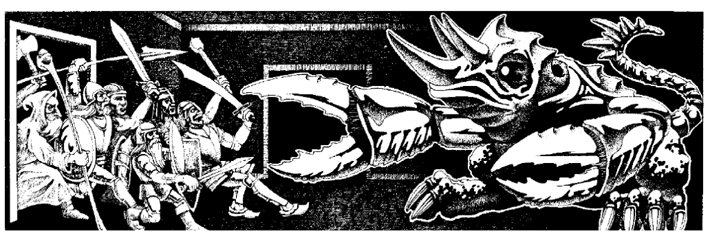
Fallcrest – where a new 4E DM should start
Cruising the WotC boards a while back I came across a new DM struggling with the notion of all the work they’d need creating a starting town for their players. Thinking up locations, inns, and NPCs all seemed like a daunting task. I was happy to point out however of a fantastic starting town right in the DMG, Fallcrest.
First off you have a decent starting delve to get the players going that is high on action and low on plot, Kobold Hall. There are a lot of resources online to help with running that adventure including a great starter kit from Newbie Dm. It’s a decent one shot adventure to allow the players to get a feel for their characters, gain a little wealth and notoriety around town, and give the DM a little time to formulate a more intricate campaign story.
But after they clear out Kobold Hall, what’s next? They won’t have to travel much out of Fallcrest to find excitement. The town has a ton of potential ideas and possible avenues for adventure right within the town walls.
Barstomun Strongbeard and Kelson – Both are unsavory guys with their hands in the underworld. Barstomun has the porter guild under his control. Kelson has his criminal gang in the lower quays. It’s only a matter of time before they butt heads. Clearly the elimination of one group is highly advantageous for the other (not to mention merchants that would be happy to see both go). Or maybe some sort of negotiation needs to be brokered between them before a gang war spirals out of control leading to open murder in the streets? A great opportunity to get your players into a gritty criminal underworld adventure for certain.
Armos Kamroth – Jerk noble? Check. Secret cult leader of Tiamat? Check. Guy for the players to handle? Absolutely.
What makes this guy work wonders as an NPC is that he stays within the law and his suspicious activity is secret. This could easily be played as a noble with the political connections, wealth, and decent reputation in town to be a difficult adversary. A tough reputation to smear publicly, so the ‘he said/players said’ game can easily shift in Armos’s favor. A decent villain for the characters to face off with for sure. And where would his secret cult meet? Why in…
The Catacombs – Yup. A network of old tunnels running right under the bluff. Just what a DM needs for a little dungeon action. How else could the River Rat gang transport stolen goods through the city? Not to mention a few secret areas where some evil cultists could meet (and move some poor sacrificial peasant to a ritual chamber). Clearly some sections would be unexplored. Sealed off sections with secret passageways leading to unknown horrors and wealth. Fun stuff indeed.
Tombwood Cavern – A nice wooded location in the middle of town with a series of old crypts and entrances to Moonstone Caverns. Most have been explored, but there are rumors of some tunnels that lead to the caves. Who knows what lurks in there or what treasures might be found? Tombwood is a fair size (about 200 x 300 ft across) so you could easily have a decent dungeon jaunt right within the woods exploring a few old crypts or a network of caves.
The Tower of Waiting – Still not enough dungeon ideas for you? How about an old abandoned tower (spoiler alert at link). How about a cool looking map to serve as more inspiration. Yeah, another spooky abandoned place for the players to dig around in. This place might be haunted by ghosts. Or maybe the players could be employed to investigate and find some clues to a secret dark past of Lord Markelhay’s family. After all there is that dubious guy hanging out in the Nentir Inn…
Serim Selduzar – Maybe the tower of waiting might hold some evidence that the father of Lord Markelhay was really not quite that nice ruler everyone remembers. Evidence of torture and human remains locked away behind a secret wall might do a lot of damage to the public reputation of Lord Markelhay, something Selduzar would love to take advantage of. Could the players end up being duped into helping this evil tiefling? (insert soap opera music here)
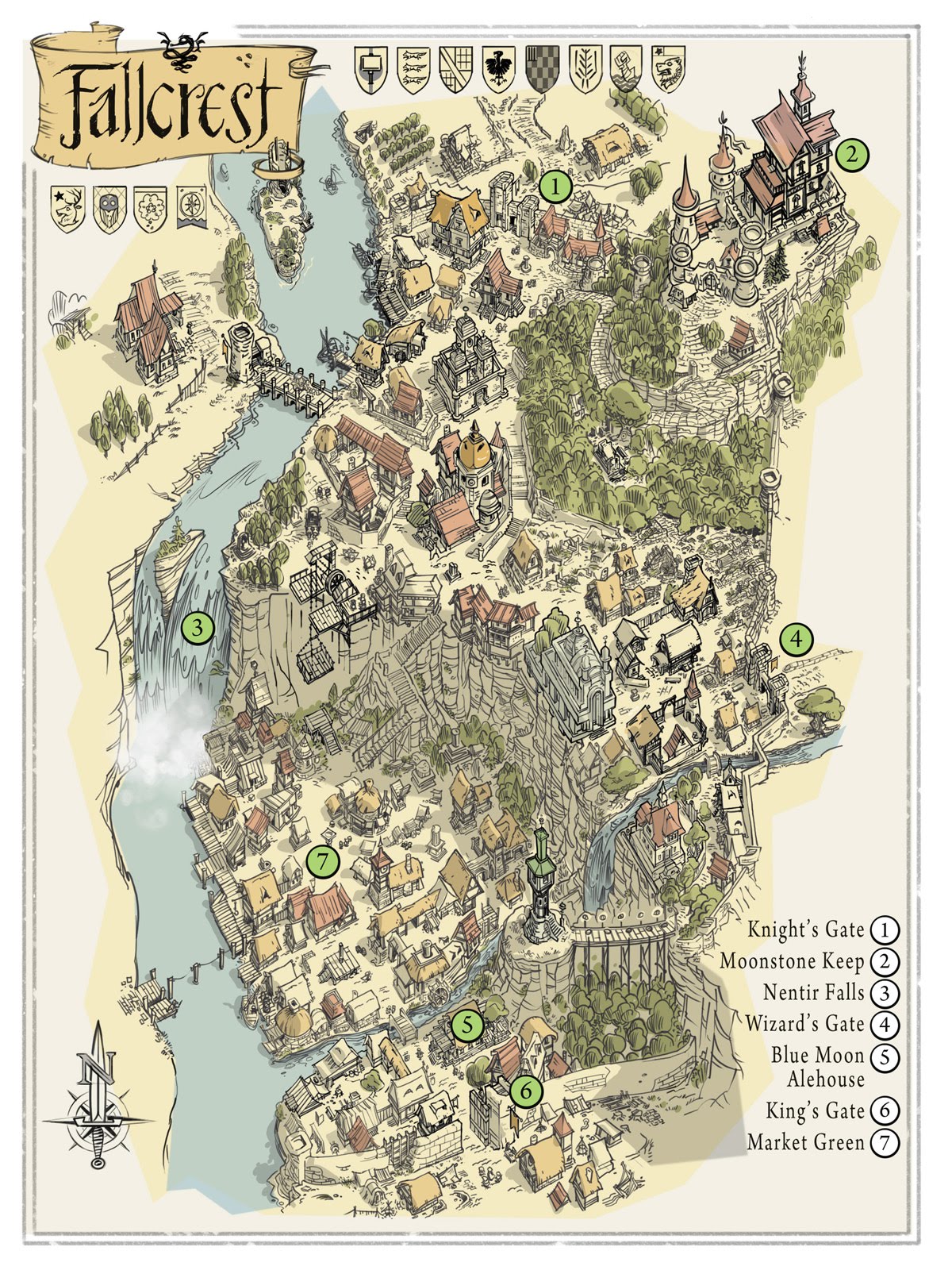
Yeah, Fallcrest has a lot of neat NPCs, locations, and potential stories right within its walls. Not to mention if you dig around you can find a ton of material out there like this wonderful map I lifted from D&D Doodle. Did I mention he even has a DM friendly version?
Nentir Vale was going to get some support from WotC, but long ago that official campaign setting was dropped from the upcoming products listing. Still with the published adventures already available, not to mention the free Keep on the Shadowfell, there is a lot of potential for a long campaign in the area. With some wonderful maps of the area and specific regions over at D&D Doodle, you won’t be short on sources for inspiration.
All of this can be kicked off with a group spending a little time in Fallcrest, building up their chops at being local heroes. If you’re a new DM struggling to think of a place to start. Don’t turn your nose up at this great location right in the DMG.
Using monster templates and themes
I’ve taken a stab at using the DDI monster builder and found it a little clunky but serviceable. However I still was looking for offline tools that would allow me to tinker with making custom monsters. Another resource out there, straight out of the DMG, were monster templates and themes.
I tend to think monster templates and themes never really got any ground with DMs. It’s a clever idea. You’ve got a few key characteristic powers and traits you can slap on just about any monster and end up with a custom creature. The DMG2 expanded on this and gave some more general powers based on the role of the monster. Even an article or two in Dungeon magazine had a few templates (#190). One hiccup however with using templates (or themes) was that some of the earlier ones didn’t scale too well in level.
There was a workaround to this as the math for setting damage, defenses, and to hit bonuses were readily available. So with a little work, you could tweak the powers to make a level appropriate creature. This is one great thing about 4E, a lot of the numbers behind the scenes in the design were freely accessible, allowing for tinkering that made it difficult to break the game.
Enter the DM Cheat Sheet over at Sly Flourish, offering the most handy table any DM would ever need. This breaks down all the bonuses and average damage for any monster, level by level. Granted you could figure all of these values out, but looking it up on a chart makes the process tons easier. Not to mention the chart has been adjusted to the ‘new math’ for monsters, making them more on par with the PCs.
What is really great about this chart is that it makes some of the monster templates more flexible (especially many in the DMG2). The listed damage in these templates can be altered to reflect something more appropriate for that monster level. This also works wonders for creatures in the monster manuals. I can switch out the attack bonuses and damage with expected values for that monster level, and create a creature that can provide a sufficient challenge to the group.
Now, I’ve got a handy means to make some unique monsters on the fly. If I need to create some ice demon cultist group, I can switch out a few keywords and swap particular defences, HP, and damage output, making something that I am more confident will not TPK my players (or be a complete pushover).
Take Lolth’s Chosen from the DMG2 for this imaginary ice demon cultist group. You could drop out the poison keyword for many of the powers and use cold instead (imagine a biting, icy, cold spreading across the player’s body when they are hit). The cloud of darkness power could be described as a blast of hurling snow, which blinds the players. Scuttling escape could mean the ground is suddenly covered with a sheen of thin ice that the monsters could freely shift through. Not all the powers in the theme match, but with a little wrangling you could give your monsters a few custom powers making them stand out.
It’s too bad this hasn’t been explored more as articles in Dungeon. Having a greater variety of templates and themes offering different powers, particularly for certain monster roles and minions, would be a nice set of tools for that DM looking to spice up their game. Still, altering customizing monsters is a little less nebulous with 4E and a snap to do using themes and templates. I encourage folks to try it for their game.
Ditching the damage die roll
A common complaint about 4E is the length of fights. There are a lot of suggestions to curb combat length, but something I often see neglected is the variation in damage that PCs do. To me it has always been an odd mechanic that how well you hit has no effect on the damage inflicted. You can just barely hit a creature and max out damage, or get a solid hit (just below a critical) and flub your damage roll with a 1.
How minions deal damage has a nifty idea there. Minions do a steady amount of damage per hit. No die rolling. Perfect for the 1 hit creatures they are, but that concept of a steady state of damage output with less overhead in running them has some appeal when streamlining combats.
Another game comes to mind where damage output was less random is Star Fleet Battles. This was a tactical space combat game set in the Star Trek universe that first came out in the late 70s and hit its stride in the early 80s. What was interesting about the game was that many weapon systems had a flat damage rate, it just depended on whether you hit based on a D6 roll. Other systems (like phasers) had effectively no ‘to hit’ roll at all, they just did a random amount of damage. However the closer you were the less random the damage output was, effectively shifting a damage roll from 1-4 at long distance to 5-6 at broadside range.
What I particularly liked was that certain ranges had a sweet spot where the variation in damage output was minimized, and got better as you closed the distance. It was very predictable. Risky long range shots sniping at a target across the map was exactly that, risky and did little damage. Closer in, you could predict how much damage you could inflict (and take yourself). The game came down to pre-planning moves, maneuvering, and efficient energy allocation.
So with D&D I found it odd there is this huge disconnect with damage and to hit rolls. They are completely independant from each other. On top of that a series of rolls is needed with each effective strike. It’s a lot of manhandling of dice and steps to resolve combat. So why not consider dropping the idea of random damage altogether if fights are dragging?
Write down 4 typical damage rolls beforehand – Take the normal die roll a player would make and replace it with an average damage, or a simple mean of the potential die outcomes. Additionally make a limited damage value being 25% of the potential damage from the same die, and an improved damage value calculated as 75% of the potential damage. Don’t forget to include the max damage roll from critical hits too.
With those 4 values, add the bonuses to damage due to feats, enhancements, ability scores, etc. and you’ve got a simple list of damage numbers a PC does with each attack. If extra bonuses come in from other player’s powers they can quickly add it to those totals.
Average damage is the default – Any powers or abilities that do multiple weapon hits are just multiplied by this number, just follow up and add the various bonuses to damage from feats, etc. This is the bread and butter output from attacks.
Critical hits work as before – Roll a 20 and you max out damage. Nothing changes.
Limited Damage on an even hit – If a player scores a hit roll that evenly matchs a creature’s defense, he uses the limited damage value. Just a little variation to the damage. You barely get a hit and in turn do less than average damage.
Improved Damage at one less from a critical hit – Typically on a 19 (but may be different for some characters that can expand the range of successful critical hits), but this is a hit that would do a bit more damage from normal yet still not quite the max damage from a natural 20.
With a little prep time, the players have their turn streamlined a little. Additionally, there is a small amount of variation in their damage output. The big, and less than optimal, hits are there. More importantly, they are tied to how well you roll to hit. Also, different damage output is tied to some simple conditions (i.e. score an even hit roll with a monster’s defense and you do less damage). If anything, I think this could work out well on the DM side of the screen for handling monster damage.
I’ve yet to to try this out with my group. I expect most players will balk at the idea of dropping an opportunity to roll a damage die. I think most will still want to roll that 1D12 rather than agreeing to constantly hit at 6 damage (plus all the bonuses). Still, if combats are dragging this might be something for groups to explore.
Rules are PC insurance from a bad DM
A topic being passed around with all the hubbub of DnDnext is what role do rules play in the game. How far should rules reach? What should be the breadth and scope of them? Should they be simulationist or should they lean more towards letting a DM make the call?
I believe in having a system of rules. You are playing a game. There should be some structure to that with a framework of rules. Otherwise you are just playing pretend and doing an exercise in make believe. The catch however is how far should those rules go and how much they should encroach on determining the outcome of player actions.
Fearless DM put up some of his thoughts on the recent DDXP held earlier in 2012. A bit further into the post he laments about the state of organized play. I do think he has a solid point that such a structured game environment is not working well with promoting D&D. I feel stuff like the lair assault clicks well. After all that is a very straight forward, hack and slash, beat the monster type of event. D&D encounters and LFR however seem to be a bit of a mess. The focus on fights really hamper what 4E can be as a game, and in the end give people a limited view of how D&D plays. So how did we get here?
With a more open system, you are reliant on having a fair referee that governs the action of the game and makes sure everyone has fun. If you’ve got a good DM, this kind of game can sing. You will have a fun time at the table and really stretch the abilities and resources your party can utilize to overcome obstacles. If you’ve got a DM that shuts you down, is not impartial, and derives more fun in hampering the PCs rather than letting them accomplish key tasks, you’ve got a bad DM. Even worse, you are stuck with a system that allows the DM to do what they want and leave the players powerless. AD&D can fall into this camp. With a good DM you have a fantastic game. With a poor DM, it can be disastrous.
Of all the events in D&D, combat is likely the most needed for having a framework of rules. Lessen DM adjudication and you end up with a very structured way of resolving fights. The more regimented it is in the mechanics, the easier it becomes to predict how certain actions will resolve. If anything, players can call out a DM if they are fudging numbers and breaking the rules. In effect, these rules hamper the ability for a bad DM to throw a fight.
I see this all the time in miniature wargaming. You want a rule system that dictates clear resolution of events. As a fall back, you’ll always see players pull out the rule book and determine if something can be done (or have guys roll off to resolve it, play on, and check it later after the game). The key point is that everyone follows the rules and are not pulling stuff out of their butt simply because they want to pull off a maneuver, make an attack, or avoid having something bad happen to their units. D&D has set up such a structured set of rules in combat to do the same thing. Have a uniform list of possible actions, simply to make sure everyone (both the DM and PCs) play fairly and actions are resolved without bias.
With a good DM this isn’t an issue. The guy (or gal) is there to give a challenge, but make the game fun. With a bad DM, having such elaborate combat rules can curb that. The players have a fall back position within the rules to make sure combats are fair. Without such structure, you can end up with a frustrating experience.
I’ve seen folks call for giving the DM more power to resolve things and how 4E has removed that. I am truly baffled by that statement. I really wish folks would sit down and read the 4E DM guide. It has some fantastic advice for a new DM. Take a gander at pg. 28 and the philosophy of saying ‘yes’, look over troubleshooting and the advice for encounters being too hard or too easy (pg. 30-31). And lastly pg. 42, where right in the text it talks about how to resolve any action that can’t be readily found as a rule. It’s all there in the book. With great guidelines to how to fairly adjudicate any situation and keep the story moving.
If WotC could reprint the book, I’d make pg. 42 almost the first point discussed about DMing. Emphasize a fair, structured, means to resolve events in the game, roll with it, and move the game along. I’d have example after example how a DM can employ pg. 42 to make their game better, and even talk about when you might want to just throw out the rules and let the players run with it. Breaking the rules for story is in the 4E DMG, I’d just make sure that was front and center so it didn’t get buried in all the other advice.
Somehow this idea got lost in the implementation of 4E with published adventures. Somehow they became more worried about making sure players couldn’t suffer at the hands of a bad DM, rather than advising how a good DM can handle tricky situations. There is a solid framework of rules here with 4E, I’m hoping more emphasis with DnDnext is to show DMs how these tools can help them run a fun, and fair, game.
 Geek Ken