Category: DM Tips
Basic attacks or just hack it with your sword
Having my campaign filled with new players, I will admit that sometimes options can be a little daunting during their combat turn. Between the at wills, encounter powers, and class abilities, it can be a bit of information to process when they step up to the melee plate. There is this general idea among the group that each player should try to maximize their actions during their turn. Sometimes they pull off coordinated maneuvers getting a lot of synergy from their respective abilities which is really cool. But sometimes, things can slow down as they are unsure what would be the best course of action.
That’s when I pipe in, ‘Just make a basic attack.’
At will powers seem to be the bread an butter for most player combat attacks. They should be. They are often focused on key ability scores that translate into substantial bonuses for damage and to hit rolls. However at times I do find that they can curb options for players, where basic attacks open up a more free form of potential actions. Can’t quite make the distance to get into melee? Charge in and just make a basic attack. Still a bit too far even with a double move and all your powers are melee attacks? Throw that hand axe and make a basic attack. I tend to see new players so focused on their powers, they begin to ignore the option of just using the lowly basic attack.
Movement effects are optional – There is something a lot of new players forget about with powers that have movement effects, you can ignore them completely (PHB pg. 57). I’ve had players get into an optimal tactical situation and fret a little about using some power which employs a shift, or some other forced movement. That movement is completely optional. So if a player wants to just crank out the hurt and not bother dancing around, remind them that all that forced movement on a power means they can do it if they want to, and not that they are forced to.
Weapon proficiency is your friend – Making attacks using key ability score powers helps tons in getting past a monster’s defence. However weapon proficiency bonuses are worth noting too. At times I’ve found my ranged-heavy PCs cornered or surrounded, so that making ranged attacks is difficult. I try to remind them of that option of making a basic attack with a melee weapon. While it may not be the most optimal attack, they do get some form of a bonus to their to hit rolls.
Melee Training feat – There is a little gem of a heroic feat locked away in the PHB2 (pg. 187). Melee training allows a player to select any ability score other than strength with melee weapons they are proficient with. For melee basic attacks, they get a full bonus for that ability score with to hit rolls and ½ the ability score for damage (been hit with errata). Now non-strength characters have another option in place of other powers. That wizard might not be to hesitant to hit something with their staff if backed into a corner knowing they can use their intelligence modifier as a bonus (and don’t forget the weapon proficiency bonus to boot).
I am seriously considering giving this feat away as a freebie my next campaign, but just limit it to one proficient weapon type of their choice. I might even consider keeping this limitation in and house rule a similar feat for ranged weapons also.
Heavy thrown weapons – Fortunately there are weapon types that give a little flexibility for ranged attacks using strength instead of dexterity. Suggest that fighter to think about picking up a javelin or a throwing hammer. It gives them just a little bit of tactical flexibility if their mobility is hindered during a fight, and still allow them to make some kind of attack.
I’ve found once I started suggesting making basic attacks as an option, my players have begun to think beyond the stack of cards in front of them. The ranged rogue in the group has picked up an enchanted sword as a backup weapon. The warlord now opens up combat hurling a javelin before making a charge into the fray. I’m getting players doing bull rushes, kicking over braziers, throwing chairs, making all sorts of improvised attacks. Even the group sorcerer has stepped up and hacked away at a lowly minion with their dagger, rather than sacrifice a move action to get some distance for a ranged attack.
So I implore DMs out there if your players get locked into turn indecision, encourage that basic attack. Push PCs into realizing there are other things they can do in fights outside that list of powers. More importantly, those options are not horrible actions for PCs to take. After some time don’t be surprised if your players start coming up with some creative attacks and trying to use the environment in fights too.
Obsidian Portal – An essential campaign tool
I’ve gushed about Obsidian Portal before. It is a fantastic tool to keep your campaign organized and share information with your players. I particularly like that I can parse out information that is public and have other parts that are for the DM only. I have to say that there is a lot of functionality for free accounts too. There are definite advantages to subscribing to Obsidian Portal, but I like that the folks operating it haven’t hamstrung a lot of features for free users too.
Since I’ve been using it a while I thought I’d pass on a few basic tips for maintaining your campaign:
Start small – Don’t get carried away when you begin your campaign write up. Keep your topics and links down to 3-4 sentences. It’s a tool mostly for you as a DM, so use it as such. Initially having pages and pages of history, and page long descriptions of every location might sound cool, but in the end you are making a lot of work for yourself. Keep it a framework and slowly add the details you need.
Keep an adventure log – One of the best features Obsidian Portal, it’s a great tool to keep track of your campaign. Just get into the habit and update it regularly 1-2 days after your latest game session. You don’t need to write down every nuanced NPC conversation or detail every combat. Just try to cover the highlights of the session.
The adventure log is a really wonderful tool. It helps chronicle major events in the campaign. Best of all, players can access it to refresh their memories which is ideal if some players have dropped out of being a regular at the table. You can email a link of the last session before your game night, and then players can easily get a recap of the past session. Best of all, you don’t have to saddle 1-2 players in keeping a log book of all the important NPCs and locations, everything can be accessed in the adventure log.
Note the important stuff – Don’t get bogged down with every NPC the players come across. Don’t write out a description of every location the group went to. Just note the bare bones and let the campaign grow. Likely you give a lot of detail and description while you are running your game. It works giving the captain of the guard, the shady bartender, and the cankerous priest names during your game. But don’t think those details have to ever need to see the light of day in campaign writeup.
Another important point is once you’ve committed to putting it in the campaign log, you’ve made it part of your world. Keeping things to just the important bits helps prevent you from having problems with continuity. It also helps in making things flexible in your world. Just having the highlights of a particular region allows you to fill in details later if needed, and allows you to switch out characteristics if the story leads that way.
Don’t be afraid to metagame – Especially for the adventure log, there is nothing wrong with listing the exp and treasure gained after a session. Not everything being written needs to be a narrative tale of events. The DM section of pages is also a great use for this. Don’t be afraid to put in those notes to help you with organizing and planning future sessions.
Use a map – I’ve found it immensely useful to give the players a map so they get a better grasp of the world they are running through. If anything, it can spark their imagination and lure them into traveling to some far off location. Obsidian Portal also has a feature to allow you to link webpages to your campaign map. If the players want to know the significance to the Keep of the Eastern Pass, they can click on the map link and be taken right to the proper page. It’s a great tool.
Get your players involved – This is a great way to have your players contribute to the campaign world. Get your players to add some detail about certain regions or historical topics. Another great thing to get their input in is with the adventure log. Rotate the duty and have each player be responsible for providing a chronicle of the past session. Don’t hesitate to allow your players to add to the campaign world.
Use it as a reference – Sometimes it’s hard to keep all the details straight of past events, or try and remember the highlights of a historical timeline. Obsidian Portal is great for a reference to your campaign world. However, try to try to keep it streamlined. I fell into the trap of having a bit too much detail when I started it up. As I kept up on my campaign, I began to keep simpler details and recognize it was there to help me with keeping particular ‘facts’ of the game world straight, but it didn’t have to be some encyclopedic tome of the land.
Don’t expect the players to read it – In the end, Obsidian Portal is a tool to keep your campaign organized. Don’t expect your players to use it much. Approach it more as a tool to help you as a DM for your game. Some of my players love the campaign site. They like being able to understand certain political factions and found the adventure log especially helpful. Others really could not care less about it. Don’t get into a tiff if your players don’t read what you put up. Concentrate more on making Obsidian Portal work for you and help organize the game you DM.
The long and winding road of 4E skill checks
Since 4E has been released there has been quite a few changes with target values of skill difficulty classes (DC). This is something I’ve complained about before and I’m surprised that such a fundamental aspect of the game has changed so much since its release. I realize a lot will say this doesn’t affect how a group plays, that the DM can just adjudicate things and run the game they want. All true.
However having a standard, or ‘official’, set of rules for skill checks and skill challenges is important. It gives a lot of insight into what is expected as a reasonable challenge, and what should be a good yardstick for a DM to use in their own games. More importantly, if gives a lot of guidance to new DMs that might not have a lot of experience or knowledge of other RPG systems to draw from.
Lastly, I feel most players appreciate a system that has rules and is predictable. While good players realize at times a DM might need to herd the story in a direction, meaning some attempts at a skill would always fail. If things are too fluid and appear simply at the DM’s whim, players can get frustrated as they feel have no real influence on feats of skill.
Looking at 4E skill difficulty classes when it was released, easy, moderate, and difficult checks were set at values of 10, 15, and 20, respectively. These increased with the player’s level, but in effect relatively stayed the same as 4E introduced the idea of a constant modifier of +½ a characters level for just about everything from defences, attack rolls, and also for skill checks. Interestingly, there was an additional +5 modifier to all skill check DCs (DMG pg. 42), but was dropped in an errata.
When the DMG2 rolled around the DC values were dropped significantly to 5, 10, and 15, for an easy, moderate, or difficult check, respectively. This was a big change and really opened up how effective skill training (along ability modifiers) could be in skill challenges. Likely it was too lenient a bar as the latest iteration of the rules and skill DCs are now higher, almost to what they were with the initial release of the 4E rules.
Now for a level 1 character the DC values for easy to difficult check range from 8, 12, and 19. Further, where the older versions of the rules increased DCs every three levels, this new version increased with every level. Also, the easy DC values scale up a little less compared to moderate and difficult DCs.
These changes give some important ideas on how skill checks should be implemented and what a DM might consider when working with skill challenges.
Failure is always a possibility – Right off an 8 is needed to pass and easy DC check. Even with the appropriate skill training, a character can fail. Add in ability scores, typically with a standard array this would be a +2 or +3 bonus (although +4 is a possibility), and you can usually eek out a success for an easy check. This is an important philosophy with the game. There are no sure things, and PCs should expect to fail if making a check under duress.
Training is not enough – That +5 bonus helps a lot. But if PCs want to really improve their chances, they should expect to tag that training to ability modifiers. This is one aspect I am not too keen on, as it means there is no amount of training a player can undertake to make up for a similar character with innate bonuses from ability scores. However there is a work around of sorts with the last point…
Taking 10 can be the best option at times – Given that characters can fail, and that simply training in a skill alone will not guarantee a success, PCs really need to consider just taking 10. In fact, I’d push that a DM should offer this up as the default for any skill check made by PCs trained in a particular skill. If that streetwise rouge botches a simple check, I’d seriously consider that they came away with a little knowledge of the local comings and goings. I expect that taking 10 is not something a lot of players do. A DM should encourage it, as those non-skill challenge, non-threatening situations, mean that the players can accomplish quite a bit taking this route.
This leads me to an interesting observation with skill DC values, although they are scaled to take in account the player’s level, they really don’t break down more than just being an easy, moderate, or difficult check. Something overlooked (especially when considering making a challenge more difficult) is the level for DCs. I think this is something being explored with ideas floating around of ‘novice’, ‘journeyman’, and ‘master’ levels of knowledge. I expect this might lead to additional modifiers a DM can thrown into skill challenges. If anything, they’d give a DM a better gauge to figure what would be an appropriate challenge in certain situations.
What does this mean for my game? I’m looking at the idea of altering DCs for certain skill challenges taking level into account. As a general idea with combat encounter building, if I run a +4 level encounter I can expect a tough fight. Likewise, if I bump up the DC ‘level’ of a skill challenge by 5, I can expect a tough challenge even if it the complexity is simple.
It’s something to play with, quite possibly expanding the normal -/+ 2 modifier a DM uses to even greater values of -/+ 4 (which is in effect just bumping up skill DC levels). So that lock on the door of a high level mage might not just be a typical difficult DC check, but would bump up even higher taking the NPC’s level into account. I’ll have to tool around with it, but I think incorporating relative level in with DC values might give a more dynamic range of DCs needed for skill checks.
4E combat isn’t a melee, it’s an event
When I started DMing 4E, it took me a little time to work out thinking up combat encounters. Some worked out well, while others dragged on, or others just weren’t that exciting. Technically, I could sit there and get an encounter together with the proper XP budget. However at times things were a little off.
I typically planned out too many fights, and would fail to realize that while some combats looked brief on paper, might drag out in real play. Other times, I’d forget the context of an encounter in relation with others designing a dungeon. While I would think the fight might be challenging, the PCs managed to bypass certain encounters and traps, having a lot more in-game resources to throw at that baddie for the final epic fight. In turn, the players sometimes just rolled over the opposition for something I thought might be a climatic battle (no harm as I think once in a while it’s great when PCs totally kickass in a fight).
It dawned on me that I was still planning out combats like I used to when I was DMing AD&D. Players would hack through a fight in 15-30 minutes, do a little exploration, and roll into another battle. Fights were in general vicious bouts of die-rolling that ended in a brutal, quick fashion. I tended to think about adventures as the PCs hitting group A (logically placed as initial ‘guards’), then on to group B (that would be lounging away in some kind of ‘barracks’), followed by group C (more guards for some important area), etc.
I initially failed to realize that small change in 4E game philosophy. I would sit down and plan something like, ‘Okay, the players tear through this group of gang dockworkers. They beat them all, then find a clue through interrogation (or some other means) about the underworld chief that is running the docks.’ In previous editions this could be a very throwaway fight. But if I sat down and made a level appropriate encounter for 4E, it could potentially mushroom into a larger event around the game table.
What clicked in my head was that 4E fights worked well when they were these grand, cinematic, action-packed scenes. Duking it out on open ground just made for a boring fight. The monsters were made for trading blows with the PCs. If I wanted a quick, knock-down brawl, I had to be ready for a combat to take more time.
So I had to readjust how I planned out my fights. I found I should have less fights in 4E and concentrate more on making them engaging and exciting. I could still have that simple fight, but I needed to think of other ways to run it aside from planning out a typical encounter as per the DMG. So some quick points I’ve used are:
Make fights memorable – If the group is going to fight, make it important and interesting. Consider using hazardous terrain, split levels, and think about the opposition you place down. Heading off against 5 soldier types of the same monster will make for an uninteresting fight. Try to mix it up with some minions and another role (just try not to go overboard and be sure to run a mix you are comfortable DMing with).
Consider the fluff also. Having players fight along the edge of a huge chasm can be a lot more evocative than having them duke it out in another nameless dungeon room. List off some trappings in the area and be ready to roll with it if a player wants to utilize something for combat. If you are describing a dingy barracks with piles of fur and refuse scattered around a large cauldron with some foul stew simmering in it, be ready for that one player wanting to knock over the cauldron towards some baddies. Allow that wizard to maybe get one additional square of area covered if they put up a wall of fire near the piles of furs on the floor. In short, provide some details and let the PCs play with them if needed.
I think another key point is to help create movement in your battles. You really need to encourage players to move around. Either through traps and hazards, or forcing the players to move up and engage certain targets. Oddly, while sticking together in a group within a hallway might be an excellent way to deal with a melee combat might make for an excellent tactic in a real world situation, it makes for a very boring fight in 4E. D&D is a game of heroic fantasy, push the players to move around and have a dynamic fight.
40 minute fight time – If the fight is not a critical story element (such as a final epic battle against the main villain), make 40 minutes your goal time for the encounter. At the the half hour mark, I start wrapping up the combat. Either I make the monsters flee, surrender, or secretly crit (or double) all PC damage. A great indicator for you as a DM is to look at the powers your players are using. If most have used their encounter powers and are continually using at will attacks, likely it is time to wrap up the combat.
If your players are familiar with their powers and roles, typically I find that 40 minutes becomes the make or break time for keeping their interest. By that time, they have pretty much done all the cool things they can do, maneuvered around a bit, gotten the tactics of the fight. Usually at the tail end of a combat, things are pretty much on autopilot as much of the encounter powers and daily powers have been used. If they get into a rut of doing the same actions repeatedly, it is time to move on.
Consider abstract combats – If it is appropriate storywise that the players fight a series of engagements, I’d consider using some other way narrating combats. One thing I’ve liked is having monsters make a basic attack against all the players, taking a healing surge if they hit. If I want to make this more engaging, I have the players all make an attack of their choice to set the bonus and targeted defense (at will, encounter, or daily). If less than half the players hit, the monsters get 2 rounds to roll attacks, otherwise they only get one.
The result is that the players get a healing surge knocked off (or possibly two). I can narrate their progress, and get through a few ‘battles’ if needed. Sometimes this makes sense, like the PCs storming a guarded tower. They likely have a few groups of guards to go through. I might play out the first fight making it very easy (just so they have some experience fighting the typical monsters in the place), and narrate any other remaining fights. I save that last big battle for the main bad guy at the end where you want to pull out the map and have a huge combat.
Use, and retool, the minion – Use minions, use them a lot, and don’t shy off using them exclusively for quick battles. If you really want them to give a little lasting power, consider giving them a death save (an idea stolen from someone else). If a player hits, roll a D20 with a 10 or more meaning the creature is still on his feet. If the same minion passes 2-3 saves, consider just dropping it on the next hit. Some folks use 2 hit minions also. Just don’t be afraid to place down minions for a quick fight and be willing to tweak them a bit if you want a more engaging combat. They do a great job allowing the players to quickly run through a fight, and still keep the story rolling.
Out of the box, 4E combat is designed to be engaging and exciting. It’s made to be part of the story, allowing a sweeping battle to be played out with the players making critical decisions on their actions each turn. When you don’t approach fights that way, you end up with a boring melee. Either it turns into a slugfest, with players moving around in a simple area, or it tends to drag on with misses and high monster HP totals. While a simple random encounter in older editions might make for a fun quick battle, it can become a boring, slog of a fight in 4E (especially if not having any interesting terrain).
I think it is interesting that 4E combats by the rules aren’t that dynamic in their implementation. A DM really has to approach them as important events. Conversely, in older editions I think you could make fights either these epic combats or a simple ‘monster crashes out of the underbrush’ type of encounter. 4E just doesn’t seem that flexible, I think you have to tweak the encounter design process to make things more applicable to different game situations. I’d be curious if others found this idea similar in their game, and how they found ways to incorporate simpler fights around the game table.
Working with a hardcopy of WotC errata
I think it is a double edged sword for D&D and the errata that is out there. On one hand, I like that WotC is taking feedback from folks, and continually evaluating some abilities and powers to limit the cheese-factor. On the other hand, at times I get miffed I’ve got books that have been practically gutted with rule changes that have occurred over the years (I’m looking at you PHB). Still, I think WotC has to be commended for trying to address issues with 4E. In a way it puts the burden on the players and whether they want to keep up with the rules. If a DM decides to let things slide, they can. If the DM wants the most up to date incarnation of every build, treasure, and monster, that is an option also.
I’ve spoke before how 4E errata are not that overwhelming but I might have to retract that now. I think for many core player classes there has been a huge change with how many powers and abilities work. If you were running straight out of the original 4E core books, you’d have to give many things a look to make sure they weren’t changed too drastically. Even with the new essentials books, it looks like some things are modified a bit.
I’ve been doing this a while, but I keep everything in a notebook with page protectors. I keep everything sectioned with sticky tabs as dividers. So I can have all the errata for the PHB, PHB2, and PHB3 split for easy reference. Fortunately WotC allows this to be done with printed PDFs as everything is split into major sections depending on the sourcebook, and individual changes are listed page-wise for each book.
I turn around and go back to my original books and highlight any sections or key points in the text to reflect rule updates. So if something in my rule book is highlighted, I can then open my errata notebook, flip to the relevant section, and find the page number entry with the specific rule change. Since a lot of changes deal with character powers and abilities, I typically only need to keep this in mind when PCs are made or when they level up. So it is pretty manageable.
I chide WotC a lot, but I will admit that it is nice they offer errata to folks that don’t have a current DDI subscription. Granted with the compendium and character builder, it has to have these features (I’d be really upset if they weren’t regularly updated). However, it’s nice to give people an offline, hardcopy means of keeping their books updated, even without having access to DDI.
(Oh and WotC, can you please update your errata for skill check values to reflect the new target numbers in the essentials rule book? I think they are still listed as the DMG2 values. kthnxbai…)
Handling Errata
So WotC seems to have a never ending stream of errata that comes out. I get a bit torn about this. One part of me feels it is such a pain to try and keep up on the changes for powers and items, and wishing WotC took a bit more time to playtest new material. Yet another part of me is happy that WotC tries to address powers and abilities that are too powerful, or even better, get some of the older powers up to snuff with new options available to players.
Trying to incorporate this stuff into your existing books is a bit of a pain though. When the first errata started to trickle out, I diligently printed, cut, and taped the text into my books. As more and more piled up I realized it would be a huge endeavor to try and update the books and keep them current.
Instead, I have all the errata printed out and put into sleeve protectors. I indexed them with color tabs and have a notebook with all the errata broken down for each WotC book. I then took the books and highlighted the name of powers that had some errata (sometimes put brackets in the margin if it was a chunk of text). Then if I was looking in a book, I would know I should pick up the errata notebook to make sure a power was working correctly.
So it is still a little tedious, but a lot easier than making individual changes to each book. Plus I can easily add to any future errata that comes out. I still think if I were a new DM I’d freak out about all the changes and corrections floating out there. So I’ll offer some advice on the matter.
Check the stealth rules – Make sure you’ve got the updated stealth rules (PBH 188) and how to target things you can’t see handy (PHB 281).
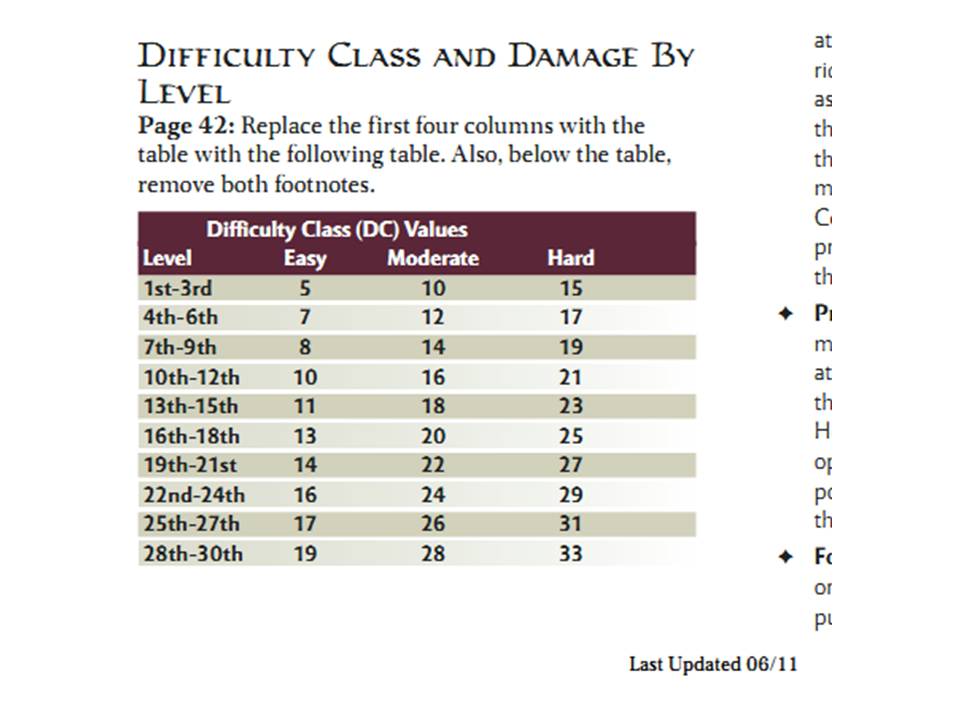
Make changes to the DC levels – Go through the skill DC levels and adjust them (DMG 42). Make sure to keep these values in mind for skill checks. Almost every other skill check in the game, from the disease tracks to traps, are altered due to these changes. You can readjust most checks on the fly if you’ve got this errata change handy.
Mind failures for skill challenges – Update the skill challenge complexity (DMG 72) so that each is not a success once 3 failed checks are made. It’s a big change and helps keep skill challenges a little exciting.
Don’t sweat the other stuff – Honestly most of the other changes are minor tweaks and corrections. If anything, they are specific to a certain player class. I’d definitely make an effort to go through the errata once a player picks a power, but don’t get too freaked out if you miss something.
A few powers and abilities are broke. As a DM you’ll usually find out about this (and might have to make changes later), but for the most part you could likely play your game with your pals and never bother making changes to Delver Armor, or even the ‘new and improved’ magic missile.
In fact the worst part about being dismissive with errata is that you are hurting your players. I suggest putting the work on their shoulders. If they find an errata to a power, let them tell you about it. Have them keep that printed page handy when you all play. You’ll be surprised that if a player can get a boon to a power due to changes or corrections, they’ll be sure to scour the errata to find it. It’s a great way to delegate the responsibility for keeping all the characters up to date.
So these are my little tidbits on errata. How do other DM’s handle game changes to the rule books?
DM Tip: Skill challenges should be say, then roll.
 I like skill challenges. Once it got pounded into my head that WotC ‘rules’ for them were more frameworks and guidelines, rather than cut and dried rules, I totally got into the groove of running them. People still have a lot of ire for them and some lament how skill challenges are too much a game mechanic that interrupts good roleplaying. To be honest, it totally depends on how you run your challenges.
I’m not talking about the set up, goals, and deciding the DC values. The Fearless DM has given pretty good rundown of how he runs skill challenges. I find it interesting how in one point I run my challenges similar.
If you have some skill challenge, say the group is seeking a written pass into a city, and you approach the challenge as a series of diplomacy checks. Well that is exactly what you are going to get. I can see the conversation at the table now…
DM – ‘Okay, um… make a diplomacy check.’
Player A – ’19’
Player B – ‘8, ouch!’
Player C – ‘A 23 here.’
DM – ‘You guys get two successes and one failure. So, you still need to talk to the guard some. Make another round of checks.’
Yeah, I think with that type of challenge just about any group would think them a big snooze fest. And in this light I can totally see how 4E detractors think of skill challenges as a very mechanical process without any roleplaying.
I’m going to bypass talking about setting up skill challenges and working out DCs and appropriate skills to use. That’ll likely come as a few individual posts. Instead I’d like to offer a few suggestions on how I run a skill challenge from round to round.
Describe your action – I have my players describe what they want to do and avoid the simple skill check. Don’t tell me you want to make a diplomacy check, tell me what your character is doing or saying. I think this is a key point to running skill challenges. Get your players into the habit of describing there actions first, worry about what to roll later.
Everyone participates – I go from character to character getting a feel for what they are doing. And everyone is in the action. Doing nothing is not an option. People get wrapped up in not wanting to make checks that lead to a failure. I don’t accept inaction as an option, my players are going to be doing something.
See, there is this little skill option called assist other. A player makes a moderate skill check and if successful, can give a bonus to another character’s skill check. If a player is really worried about tanking a check, they can always use this option. So yeah, I make everyone do something, even if they are just trying to help out one of their teammates.
Work out the skills needed and roll – Once I find out what everyone wants to do, I assign skills and have everyone roll. This is a key point. Have the players tell you what they want to do. You as the DM then figure out the appropriate skill. Finally, then have the players make their skill checks.
You have to be flexible with this. If a player offers a clever idea and can make a convincing argument for using a particular skill, then the DM should roll with it. If you really think the skill use is a stretch, or not applicable, assign a penalty or bump up the DC for the check (or do both) and let the player make the check. Once they say what they want to do, find the appropriate skill and work with the players, not against them.
Describe the results and repeat – Don’t just tally up the results and spit out the number of successes and failures. Be descriptive with the results and give degrees of failure and success. This is a great way to give subtle cues that a player is using an appropriate skill for the challenge (‘You find the duke receptive to many of your points. You think with a bit more persuasive conversation, you might sway him to your cause’).
This is also a great way to give out a little information or some simple rewards in the face of failing the challenge. Maybe the group doesn’t find the entrance to the thieve’s guild, but at least they know it’s in the port district. This helps players from feeling some challenges are a total loss if they fail. That at least they managed to gleam some information or make a little headway to finding a solution, rather than their efforts being a complete failure (and failing one should never stop things dead).
Overall, I find these points help make skill challenges a lot more of an organic RP experience, rather than some mechanical round of skill checks. I hope some folks find them useful and would love to hear any tips other DMs have to offer when running their skill challenges.
One shot adventures as a first session
I’m a big fan of having all the PCs know each other before starting a campaign. It helps get over the typical meet and greet that takes up most of the first session as everyone gets acquainted. But even with that, I still think there are a few kinks to work out.
Players have new characters and need to get a feel for their powers and abilities. Also I think folks need to get into the mindset of their character and how they all interact with each other. Pretty tall order to jump into at first, if they are supposedly a group of adventurers that have been together for a while.
So I’m a big fan of the one shot adventure for that first session. Just something simple and quick. An easy quest that doesn’t have much impact over the entire campaign. A few forgettable NPCs and a relatively easy quest to get done in a night. I like to give the chance for players to get a feel for their characters and establish their relationships with each other before jumping too deep into a campaign story.
I also make sure there is one combat encounter that first session. I think 4E combat definitely is a team game with a lot subtle tactics with characters working together. While things might look good on paper, you need a combat or two to get a feel for how they actually work.
If your group has a background that they’ve been together for a while, a decent way to work this in is through a flashback adventure. The group is playing out a past adventure or quest well before actual campaign events. This is also a good way to start a group out at a higher level. Play the first session with them at level one, an initial session being in their ‘past’, and have the remainder be at a later point in their adventuring careers. It’s a decent way to give players a way to learn about their characters, and then be able to skip a few levels jumping into the main campaign.
That’s my little trick. So do folks jump into the main story usually with their first session? How do other folks like running that first game of the campaign?
Minion tactics and tips
When I was first reading through the 4E monster manual I had to do a double take at the minion entries. What the heck was a 1 HP monster? It took me a while to wrap my AD&D mind around having low HP monsters that were literally fodder. Slowly I began to get an understanding the role of minions. It wasn’t necessarily a new idea. I particularly always thought Mutants and Masterminds had a clever idea using mooks (basically one shot minions) for their superhero D20 game.
For a while though, I struggled to use them. They were very squishy and seemed to drop too fast. I had some difficulty using them as an effective screen for other important creature types in fights. I could never get any reasonable positioning with them around the PCs. In short, I never felt my group had a challenge when I used a fair amount of minions so I started to shy away from commonly using them in encounters (just a filler of 2-3 to round out the XP budget). After a while though, my perspective changed.
I use minions quite frequently now. They are a perfect way to add a lot of bodies in a room, and not completely overwhelm the characters. Yes, they do drop like flies. However, that does go well with my group. I think the players enjoy getting to feel powerful hacking through 4 to 8 guys before getting that evil wizard. Minions do work, but I found I needed to rethink how I used them.
Use their role – Check the DMG (pg. 54-55) and read up on monster roles. Starting with MM2, WotC has now started including this information in their monster stats. When you are thinking about setting up and running encounters, take this information into consideration. Most minions fall within the skirmisher role followed by brutes, but a few fall into other roles. This does have a small impact on how you run them, so keep it in mind. Also be sure to use your minions to support the other monster types in a fight. Positioning is important not to mention the following point…
Use Aid Another and Combat Advantage – Most PCs forget about aid another (PHB pg. 287), a DM shouldn’t. Get 3 minions adjacent to a player. Have 2 make a melee basic attack at AC 10. Odds are with combat advantage that 3rd minion that can now add a whopping +6 to his attack roll. Aid another is a great way to add some teeth to a minion’s bite. And if you’ve got your minions supporting a brute in combat, watch out. With aid another that brute will likely get a big bonus to his heavy-hitting attacks.
Use a lot of them – The 4 minions per standard creature in the heroic tier is a great yardstick, but I don’t consider it a hard rule. I usually will add another 1-2 to the entire encounter if I’m using minions. The group will make short work of them (and they should!) but you can hamper the group’s movement with a threat of attacks of opportunity, and generally providing a shield of bodies to the more important monster types. When using minions, be sure to not quibble with their numbers.
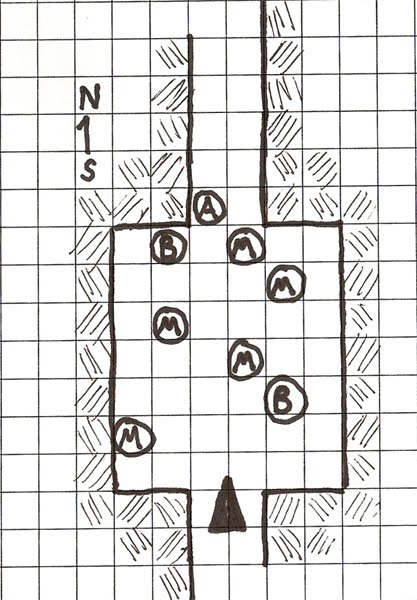
Throw waves of minions at the players – I used to have just about all my monsters out on the map the start of a fight. Sure I would have terrain and cover strewn about, but the players ended up having a good grasp of the battlefield right at the start. A simplistic view could be seen right depicting a smaller room. The group enters the south part of the room with a mix of monsters like artillery, brutes, and minions (M) ready to face off against them. In this situation, the players see all the opposition and can quickly plan out maneuvers and coordinated attacks. A worse case scenario, the group’s controller aces a initiative roll and splatters most the minions in one shot (note the room is a bit smaller than what I would use for a standard 5 player group).
I stopped doing this when I have a fair amount of minions in the mix. I now usually keep a least half in reserve for the first turn. I get the players out into the room and see the general position of everyone, then I commit the rest of the baddies. One thing I have really strived for now however is to have multiple pathways to the same room (illustrated below). Here the player’s have to worry about additional creatures coming in from different directions. I can push the minions to pile through one entrance, or spill into the room from 2 directions. Even if the players turtle up down in the south west corner (in the below example), they are cluttered together for effective blasting by the artillery/controller types.
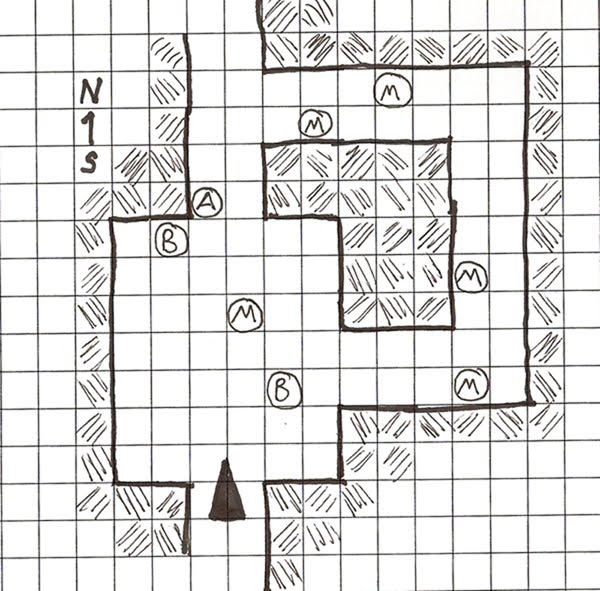
This really keeps my group on thinking on their feet. Definitely start to consider using your minions in waves. Avoid committing everything at the first initiative roll (lurkers work well keeping them back also). I also heartily suggest creating encounters where the players have to worry about multiple routes of attack. If the players have to face off to other directions, it ramps up the excitement and makes the combat more dynamic.
These are a few tips I have for using minions. I’d love to hear other tricks on how DMs have been using them.
How to be a better GM.
To jump on the bandwagon from a Questing GM, he is graciously hosting this month’s RPG Blog Carnival Question, ‘How to be a better GM.’ There is a lot of thoughts I could add to this. I’ll bring up 2 things I think are the key though.
Communicate and listen – At the end of each session I say, ‘So what do you all think? Are you having fun?’ So many folks will point out that reading your players, knowing your group, understanding what your players want, all are important for being a good DM. Maybe you are a master at poker and can read your group’s enthusiasm well. Do yourself a favor and make sure your impressions are right. Give them all an opportunity to talk about the game with you, and do it frequently. Most importantly, be sure to listen to them.
Guess what? You are going to make bad calls. You are going to find some players bring interesting characters, while others are sort of dull, and this might make yourself slip towards favoring one player over another. You are going to make both game and personal mistakes. Give your players a chance to tell you about it.
Don’t let a player sit and stew about it for weeks on end. Eventually bad things are going to come to a head and things will blow up. Get people comfortable talking about the game. Don’t get defensive. Don’t get upset. Find out how they feel. Did I mention you should listen to the group?
If you are doing a good job, your players will realize that yes, you made a bad call. You flubbed understanding a power or whatever, but you are all there to have fun. It’s a game. The DM is not out to torture or punish anyone, just trying to make things challenging. Sometimes it works, sometimes not. But reinforcing the idea that everyone should be having fun, and more importantly, communicating that idea to the group helps smooth things out immensely.
You will learn things. Maybe they absolutely loved that stupid NPC you quickly made up. Maybe they felt the combat wading through lava was too tough and simply frustrating. The combat on an airship was cool. The fight on the ice sheet against trolls was tough, but they enjoyed the challenge. You will learn the things your players like and dislike, all giving you ideas to make future sessions better. Again, make sure you listen to your group.
Play games – First off, you should spend a little time in the player’s seat. You should get a chance to see how other people DM. You should find out new tips and tricks. You should experience someone making things engaging and exciting. Or experience a heavy handed jerk, making your group suffer (and learn it is not fun). You will get better ideas how, or how not, to run a game. I cringe when I hear some guy cackle that he has never played D&D as a character, has always been the DM, and has absolutely no interest in ever being a player. That guy is missing a big part of understanding D&D.
Play different games. – Lots of them. You will learn by exposing yourself to different game designs how they work. What things are engaging and fun. What things are tedious and boring. You can port these aspects to your game, and doing so you’ll learn how to be a better DM.
Maybe you’ll find that intricate paperwork keeping track of game effects is serviceable, but having simple tokens makes book keeping interesting. Maybe you’ll realize that having events every other turn is predictable and boring, while making it somewhat random is more interesting. Maybe you realize penalties that make you sit out the game for several turns is frustrating, and that having some other mechanism to keep the player engaged is more rewarding.
Play lots of different games. Communicate and listen to your players frequently. These are two things (in my simple mind) that will make you a better GM.
 Geek Ken