Category: DM Tools
Initiative combat cards
I’ve sort have gone full circle with tools to keep track of combat. I toyed around with some different programs and found a few I liked. But of late I’ve sort have gone back to keeping track of stuff with paper and pencil. Maybe if I pick up a tablet I’ll try out combat manager programs again, but I’ve found that a laptop on the table sort of adds another divider between myself and the action.

I’ve whipped up a combat sheet and like using that. But I thought I might try using something a little more visual in keeping track of initiative order. So I made up some initiative cards that would also have some info on the PCs and monsters.
I made them to fit on an index card for some added bulk. I ended up placing self-laminating sheets over my cards. That way I could use a dry erase marker and get a little more mileage out of each individual card. I also included a format so that the card could fold in half. They can be used as stand up tents or be slipped over a DM screen. This might be more useful if you want to allow PCs to keep track of the order (the other side is blank so it can be freely written on).
One big drawback is that they do take up a bit of space on the table. However I like that I have just about all the important stuff right on the cards. I can also split the HP box into sections of 2-3 columns so I can use one card for a few monsters.
The big plus is I can turn cards sideways as I go through the initiative order indicating they’ve had their turn. Players can see where they fall in line with the turn order and know when they are on deck. Plus if I have to shift things around, it is just a matter of switching the card order (for delayed actions and such). I hope folks find them useful for their game.
Obsidian Portal – An essential campaign tool
I’ve gushed about Obsidian Portal before. It is a fantastic tool to keep your campaign organized and share information with your players. I particularly like that I can parse out information that is public and have other parts that are for the DM only. I have to say that there is a lot of functionality for free accounts too. There are definite advantages to subscribing to Obsidian Portal, but I like that the folks operating it haven’t hamstrung a lot of features for free users too.
Since I’ve been using it a while I thought I’d pass on a few basic tips for maintaining your campaign:
Start small – Don’t get carried away when you begin your campaign write up. Keep your topics and links down to 3-4 sentences. It’s a tool mostly for you as a DM, so use it as such. Initially having pages and pages of history, and page long descriptions of every location might sound cool, but in the end you are making a lot of work for yourself. Keep it a framework and slowly add the details you need.
Keep an adventure log – One of the best features Obsidian Portal, it’s a great tool to keep track of your campaign. Just get into the habit and update it regularly 1-2 days after your latest game session. You don’t need to write down every nuanced NPC conversation or detail every combat. Just try to cover the highlights of the session.
The adventure log is a really wonderful tool. It helps chronicle major events in the campaign. Best of all, players can access it to refresh their memories which is ideal if some players have dropped out of being a regular at the table. You can email a link of the last session before your game night, and then players can easily get a recap of the past session. Best of all, you don’t have to saddle 1-2 players in keeping a log book of all the important NPCs and locations, everything can be accessed in the adventure log.
Note the important stuff – Don’t get bogged down with every NPC the players come across. Don’t write out a description of every location the group went to. Just note the bare bones and let the campaign grow. Likely you give a lot of detail and description while you are running your game. It works giving the captain of the guard, the shady bartender, and the cankerous priest names during your game. But don’t think those details have to ever need to see the light of day in campaign writeup.
Another important point is once you’ve committed to putting it in the campaign log, you’ve made it part of your world. Keeping things to just the important bits helps prevent you from having problems with continuity. It also helps in making things flexible in your world. Just having the highlights of a particular region allows you to fill in details later if needed, and allows you to switch out characteristics if the story leads that way.
Don’t be afraid to metagame – Especially for the adventure log, there is nothing wrong with listing the exp and treasure gained after a session. Not everything being written needs to be a narrative tale of events. The DM section of pages is also a great use for this. Don’t be afraid to put in those notes to help you with organizing and planning future sessions.
Use a map – I’ve found it immensely useful to give the players a map so they get a better grasp of the world they are running through. If anything, it can spark their imagination and lure them into traveling to some far off location. Obsidian Portal also has a feature to allow you to link webpages to your campaign map. If the players want to know the significance to the Keep of the Eastern Pass, they can click on the map link and be taken right to the proper page. It’s a great tool.
Get your players involved – This is a great way to have your players contribute to the campaign world. Get your players to add some detail about certain regions or historical topics. Another great thing to get their input in is with the adventure log. Rotate the duty and have each player be responsible for providing a chronicle of the past session. Don’t hesitate to allow your players to add to the campaign world.
Use it as a reference – Sometimes it’s hard to keep all the details straight of past events, or try and remember the highlights of a historical timeline. Obsidian Portal is great for a reference to your campaign world. However, try to try to keep it streamlined. I fell into the trap of having a bit too much detail when I started it up. As I kept up on my campaign, I began to keep simpler details and recognize it was there to help me with keeping particular ‘facts’ of the game world straight, but it didn’t have to be some encyclopedic tome of the land.
Don’t expect the players to read it – In the end, Obsidian Portal is a tool to keep your campaign organized. Don’t expect your players to use it much. Approach it more as a tool to help you as a DM for your game. Some of my players love the campaign site. They like being able to understand certain political factions and found the adventure log especially helpful. Others really could not care less about it. Don’t get into a tiff if your players don’t read what you put up. Concentrate more on making Obsidian Portal work for you and help organize the game you DM.
July Blog Roll
So every once in a while I like to share some of the blogs I’ve been looking at over the past few months. While not all of them are about 4E, they’ve got something to offer your game.
Points of Light – While some of the writers use some adult language I think isn’t necessary, I’ve enjoyed this blog for several years now. They offer a very 4E-centric blog that keeps up on a lot of the new WotC content. Now that I’ve let my DDI subscription lapse, I’ve been definitely frequenting this blog more. I’ve enjoyed their analysis of new character options that roll out in Dragon.
The Id DM – A relative newcomer to the D&D blogging scene that has gathered a large following pretty quickly. The Id DM offers some really interesting analysis and thoughts on the dynamics of groups and the game in general. I particularly liked his breakdown of the Penny Arcade/PvP D&D podcasts, that provided a solid look at how much time combats take and how that time is spent.
A Character For Every Game – While not a 4E-centric blog, this guy does cover a lot of ground for the fantasy RPG. He offers some interesting articles on RPGs in general but lately I’ve been cruising his blog more for map posts. This guy offers some maps of really neat dungeons that have certainly sparked my DM imagination. Well worth checking out.
I hope folks enjoy the links. Please do give them a gander.
Power2ool – a great 4E tool for DMs and players alike
So I stumbled onto Power2ool that seems to be a wonderful program for 4E. Conceptually, you have a giant cork board where you can place and remove note cards. In addition, these notes come in different formats as blank cards, powers, magic items, and monsters. All the virtual note cards can be edited and the entire workspace is saved under your login id.
The program can also be synced with the DDI compendium. So folks with an active account can port over powers and monster stat blocks. Best of all, you can edit them. So a player could keep all their powers, edit their own ability and enhancement modifiers and have it saved. You level up or gain a new magic weapon? No problem as you can go back and individually change the powers needed. No bothering with going back to the character creator again. Not to mention, you can print out all the items in a section. It’s a snap to get all your powers printed out on a sheet of paper.
Want to keep track of everything digitally? No worries, as you can double click a power and it will gray out indicating it was used. I can see players keeping a simple stat block of their defenses and HP with all their powers organized the way they want to for combats. Best of all, they have different ‘cork boards’ for keeping different characters. How about the built in dice roller function? Very nice indeed.
For DMs I see this as a great tool. They can split up their entire work area under different encounters. Just a single click and they could get all the monster stats, with a few more virtual note cards to add any tactics, descriptions, rewards, or other notes. Move on to the next room and just open up another section of your workspace. Did I mention you can print all this stuff out?
Don’t have a DDI subscription? You can still create custom power cards (or copy down the ones from a book). Want to make up a monster on the fly? Power2ool also has an option to create a level specific generic monster. All the fields will be filled out with the appropriate bonuses to hit, defences, and damage, and every thing can be edited the way you want. For folks that want to create homebrew items and monsters, or get something together for distribution at a con or gaming event, this program is a great resource.
You can browse through a series of video tutorials and demos of its functionality online. It seems very intuitive and pretty easy to manipulate and edit stuff. I have not had a chance to delve too deeply into this, but I think the learning curve for is almost nonexistent. I particularly like the fact that it is server based. No need to have anything loaded on a PC/Mac meaning you could run over to someone’s house and run a game (provided you can jump onto their wifi). Be sure to check this out as it seems to be a great tool for 4E games.
Pathfinder – Inner Sea world guide as a 4E resource
I’ve gone round and round with pathfinder but I think I’m still in the camp for passing on it. At the heart of it is that I’ve got my 3.5 D&D books. I see pathfinder as a refinement of those rules. I think 4E really made changes to how D&D plays and I liked what WotC did. I just don’t see me going back to previous editions and I feel pathfinder goes in that direction.
For a lot of folks, I think pathfinder is a perfect fit for their D&D game. It tweaks and retools the stuff some might have found lacking in earlier D&D editions. I can completely understand the things they love about pathfinder and why it is their D&D game of choice nowadays. It’s just not my thing.
I will however step up and say that Paizo has some wonderful products in the pathfinder line. And I think for people that enjoy fantasy RPGs, you will be doing a disservice to your group if you don’t give some of them a try at your game table. I also feel that a lot of the material (with a little elbow grease) can work for your 4E game. One such product is the pathfinder campaign setting, the Inner Sea world guide (ISWG).
This is the default campaign setting for pathfinder. Don’t let that put you off. If you play any edition of D&D, you simply need to buy this book. It’s a wonderful setting and fleshed out world that is rife with inspiration for a high fantasy campaign.
The book is a meaty tome that gives details on 40+ countries and locations that make up one of the many continents within the world of Golarion. What I particularly like is the digest-size write up of each region. About 3-4 pages are provided listing a brief history, government and politics, along with some details on the major settlements and noteworthy locations in that region. It’s enough to give a DM a grasp of the country along with enough ideas to write up an adventure, without saddling you with pages and pages of fluff, background, and other ‘facts’ that can trip up your story.

The key element I enjoy about ISWG is the variety of the lands given. Humans are the most common and are of a variety of ethnicities and cultures. You have different governments and political ideologies. Some countries are stable, others constantly at war (both civil and external), while others are in a constant cycle of violent revolution with their ruling class. Add to this regions with heavy undead and demon influence, wasted lands devoid of magic, while others seem to be warped with bizarre creatures from a wizard’s imagination, you’ve got a lot on your plate as a DM to choose from.
The sheer variety of campaigns you could run in the ISWG is staggering. Obviously you could have the typical high fantasy world. However if you want a bit of steampunk, a Ravenloft-like setting, fighting in demon lands, or even a touch of Gamma World (one land having a mysterious ‘meteor’ crashing into it’s borders), there are options here for the DM. I think this alone makes for a wonderful product, as you could start your campaign in different regions of the same game world and get very different types of settings.
Making the transition from a pathfinder source book to 4E is not too difficult. Much of the core races are there (halfings, dwarves, gnomes, elves, etc.). I think the pathfinder elves are a bit closer to the 4E eladrin than your typical 4E elf, but I think you have enough room to encompass just about any 4E race into this world. Tieflings could obviously come about from the many demon controlled kingdoms, with goliaths being an easy shoe-in for the northern lands, and drow are all ready within the ISWG lore.
There is a full pantheon listed of the many gods and faiths within the Inner Seas that I think can be tooled around with if needed (particularly with the alignments). The ISWG has information listed in the traditional D&D 9 step alignments but aren’t that difficult to craft into the reduced alignments of 4E. While there is a simple creature bestiary listed, they are primarily based off stock entries in the pathfinder bestiary. Something a 4E DM should adopt, and simply re-skin the many creatures currently in the monster manuals if needed.
The campaign setting specific class options in the ISWG bring about exciting possibilities, especially with WotC’s new heroes of shadow book out. I can envision the Red Mantis easily as an assassin character option, as well as the Hellknights being a step away from a blackguard. I particularly like how the book details certain factions based on a philosophy that encompass more than those just driven by a nationalist agenda.
There is a lot of stuff in this book. It is well organized and I particularly like the sections that help detail normal life of most people within the world, covering mundane aspects of trade, state of current technological achievements, to the role of magic in the world. This book covers a lot, and best of all manages to distill things down to bite-sized chunks of information that can be easily processed.
You don’t need to have a complete grasp of the entire world geo-political layout to play. You can simply pick a land, skim through the neighboring regions, and have a complete historical and political handle (not to mention the major factions) on what is happening in that part of the campaign world. It’s a fantastic 4E resource, gorgeously presented in color with great art, not to mention a nice poster map of the entire place.
Do your group a favor and pick up this book. Even if you aren’t set on running a game in the Inner Seas, you’ll definitely find some ideas for your game.
City chase skill challenge using a flow chart
I wanted to try an extended chase skill challenge for my group. I wanted to try and mimic an extended chase scene in a city with city guards in hot pursuit of the players. It would be something based on skill checks, and avoid a protracted fight but still offer some danger. I looked over the traditional framework for skill challenges and found it lacking.
I ended up using a sort of flow chart. Each player would occupy a spot on the flow chart, with each section being set environments that required different skill checks. Each spot would offer a few choices on avenues to run to next. If they succeeded they would gain some distance from their pursuers. If they failed, they would lose ground with their attackers closing in.
Each turn if the players were a certain distance they would be attacked with either a ranged or melee strike. If hit, they would lose a healing surge. Additionally, every few turns I would require an endurance check. Again, with a failure they would lose a healing surge. When they lose all their healing surges, they were considered caught by their pursuers. If they managed to gain enough distance, they would escape.
It worked pretty well, but I had a few tweaks to make and I’ll offer some tips:
Three groups at most – Originally I had planned each party member to run off in their own direction. I soon found that 2-3 groups work best. I would have each group of players move through enough locations until they made their endurance check. Then I would move on to the other group to keep things moving. You can have each player run in their own direction, but I found things tended to drag for the other players while they waited for their turn.
Have one player make a check – If breaking the party up, have them work as a group. One player makes the check with others assisting. Failure affects them all. As potential attacks are resolved individually (I made a single attack and compared it to each of their AC defenses), they would each suffer healing surge hits separately any ways.
Keep 6 distance markers the goal – Originally 8 distance makers was my minimum, but after some play I found things going on a bit too long to get to that goal. Even with 6 distance markers, it can be a challenge. You may want to keep it closer to 5 or 6 if needed.
Keep needed DCs and skills hidden – When players move into an area, describe the location and let them offer a solution to how they’re going to navigate that section of the city. I tended to offer a few general suggestions if needed, but typically I let the players tell me what they wanted to do. If you just tell them the types of checks they need to make, it really becomes a less interactive challenge.
Be descriptive – I tried to give some different descriptions to the areas they were in and the potential routes available. I found my players came up with some interesting ideas as they made their way through the challenge. If you simply read off each area as a list of skill check options, you will get a boring challenge.
So my bustling room would be comes a dank crowded tavern, with several strong peasants taking a draught of ale after working the fields. When one of the players decided to throw a handful of silver in the air and yell out, ‘Grab some coin if you want another tankard!’, the resulting chaos made was something I’d definitely consider a diplomacy check. Without that ample description I’d likely never hear the player try something like that.
Use lots of modifiers – If players come up with some interesting ideas, offer to give them bonuses to their checks. I ended up liberally throwing around +2 to skill rolls when my players came up with interesting ideas. Don’t stick to the listed DCs either. If you describe a situation and a player comes up with something that would make it trivial, alter the DC.
Be flexible – The most important part is to keep things flexible and alter the flow if needed. Sometimes players will come up with some very good ideas. Sometimes they will fall into a pattern on the chart. So feel free to shake things up and cut off choices, or allow them to go against the chart flow and take different routes. Keep this in mind for skill checks too. If they come up with a skill use that would be more appropriate, then let them make the check with that skill.
One of my players was having difficulty continually making endurance checks. For one bustling room, I described a narrow shop filled with silks and a few noblewomen browsing the wares. A set of stairs led up to a second floor. Immediately my player thought up an idea to tell the shopkeeper and the noblewomen she was to be sent away from her family in an arranged marriage. She decided to run and her would-be husband’s men were following her. She pleaded to the shopkeeper to let her go up to the upper floor and get a moment’s rest before she fled elsewhere.
I allowed her a bluff check (with a bonus for a great idea). She was successful and I then said she could get bonus on her next endurance check, as her ruse allowed her some time to catch her breath. This was something completely off the track for an endurance check, but I liked her thinking and wanted to reward it. So keep things flexible and allow your players to be creative.
Not everyone has to make it – Actually it can end with some players getting caught and others getting away. Be prepared for this. I actually found it an opportunity to plan out a small side adventure where the escaped players would have to try and release their captured friends.
It’s also possible that captured players could get a final chance at escaping by playing out a small encounter in a narrow alleyway. If they are victorious in the combat, they make their escape (catching up to the other party members that slipped away). So don’t be afraid to let some of the players fail the challenge. It’ll lay the foundation for another exciting adventure.
4E Condition Cards, get em while they’re hot

I’ve been meaning for a while to post about one site I enjoyed peeking at occasionally that is linked on my sidebar, Lastlands. I loved how they had a whole section dedicated to fantasy art. Some great inspirational landscapes and characters were indexed there from various artists. Additionally they had some neat downloads. Now the site is split into two, Lastlands being dedicated to a D&D campaign, and the Weem as a 4E Resource site.
One thing I loved was that the guy whipped up some wonderful condition cards which are still available there. I’m not sure how long he will keep them up though. I like them as you can give them to a player and he knows exactly what is happening with his character. When he makes his save, he can just pass the card back to the DM. I used some self adhesive laminating sheets on mine to keep them extra durable.
I’m going to miss all the neat artwork he had indexed as Lastlands. I hope he can keep his other site active for a while. There are some nifty tutorials for making maps in Photoshop and I liked this truncated combat sheet also (great little tool for new players). Be sure to poke around and check his stuff out.
Amazing D&D sessions from Penny Arcade
So in my daily ritual of scrolling through various web sites I do frequent the web comic Penny Arcade. Sadly I don’t play console games, so a decent third of the strips I don’t quite get. Staple on being out of the American pop culture loop completely by living in Korea, and there is another chunk of strips I’m clueless on. The rest however are a hoot. So much so that I do enjoy perusing their site regularly.
One of to comic creators, Mike Krahulik, has taken up the mantle of being a DM for his group. From my understanding, he is new to the whole RPG bit and completely inexperienced to being a DM. I think this adds a little more weight to the statement that he runs some absolutely amazing encounters for D&D.
I suspect that his group is well into the upper echelons of the paragon tier, or maybe even higher. Because his latest post describes an epic encounter in the elemental chaos between worlds. His posts there are astounding. You’ve got a wonderful visual representation of the game, and a decent set of mechanics to make the encounter work. So set pieces not only look cool, they are functional as well (as this pic below will show).

He has described some pretty cool encounters and shown how he pulled them off in the past. From a free fall combat against a dragon, to a light and mirror puzzle dungeon crawl, Mike has assembled some amazing encounters. And I cannot stress this enough, everything he does has a game function. It isn’t just a prop. The pieces work with the session they are running.
He has congregated his past posts of different D&D sessions. I highly recommend giving them a look. I’ll notch it up to being a professional artist, but the creativity he expresses in his game makes me envious. I urge folks to take a look at his D&D posts. There are some great inspirational stuff there, and enough details on the mechanics to port into your game. And while your at it take a peek at their comic too. Fun stuff indeed.
Using a dice tower at the table
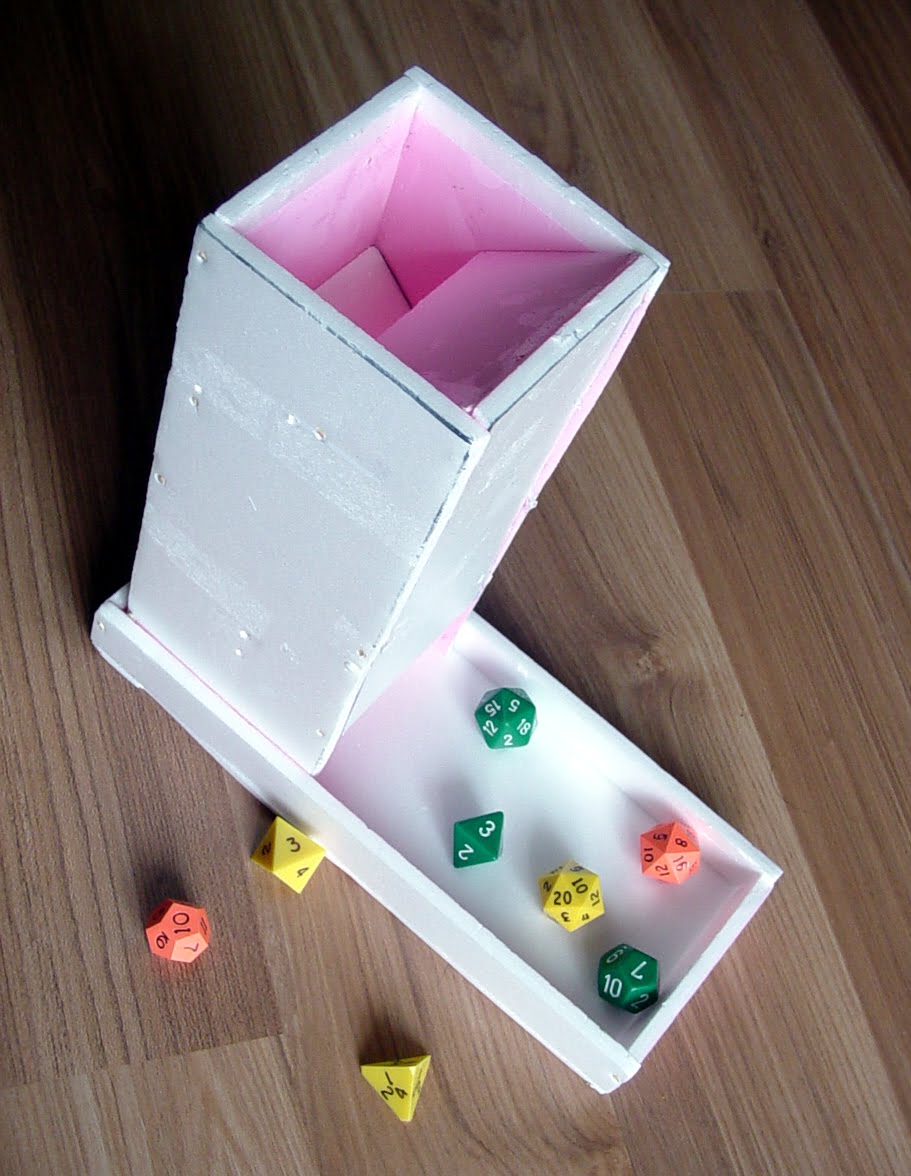
As always, I’m fiddling with things to help improve running my game. Lately a bug has bitten me about using a dice tower for those rolls behind the screen. For the uninformed, a dice tower is a simple contraption that is an open ended box filled with a series of angled slats. You drop dice in one end, they fall out the other, tumbling over the various slats in between. Some are very nice like the ones available at geek chic.

As a DM, I’ve grown to love using a dice tower for several reasons.
Limited space – Between my notes, maps, and books, space behind my screen is limited. I like that I can get a good roll out of the dice, and not have them going everywhere. Typically I’ve got a fair amount of combatants in a fight. I’m rolling for 4-6 minions at a single go. It’s nice to not have to track down dice that scatter all over when I roll a handful.
Less dice mishaps – If using an open ended tower, I’d have it roll up against a screen. For mine, I have a small tray the dice roll into. But in either case, you are going to limit the number of dice that roll off the table, or get a cocked result. I hate having to reroll dice, especially on a cocked die that likely missed only to reroll a 20.
Impressions of impartiality and randomness – You dump in the dice and it comes out the other end. Simple. When I’m rolling for 3+ monsters, I might get a flat roll. Especially with D4s that don’t tumble too well. I hate rolling a few dice and get that one die that flips once or twice. Everyone around the table are friends, but I dislike it when I flub a decent throw and end up having a die result that hurts the player. And face it, as a DM you are rolling a lot of dice. I like that I can go through the mechanical process of rolling dice with some uniformity. Using a dice tower aids in that.
The tower also acts as a great cushion between you and the players when rolling. Psychologically players can take their ire out on the dice tower when the DM rolls a series of critical hits. You can get this a bit using a computer program for rolling dice. I’ve always liked having dice on the table though. This leads me into the last point…
It reminds people you’re playing a game – A dice tower is a toy. It helps remind folks not to take things too seriously. It reinforces that things aren’t personal, the DM is just dumping dice through a contraption. I’ve found at times the tower becomes part of the game. Occasionally I’ve gotten players wanting to use it. When they failed a save twice, I don’t find it unusual to have them throwing the next one via the dice tower. Using a dice tower has helped reinforce that we’re all having goofy fun, using something that at times is inordinately convoluted for something as simple as rolling a single D20.
Dice towers are easy to make. I made mine out of foam board, assembled with white glue and toothpicks as dowels for a bit of support. I also have a detachable tray that fits over the entire box for easy storage. You can pick up the stuff at your local hobby craft store.
Over at Board Game Geek you can find a decent set of plans that fits on just one page. If you don’t want to bother printing on cardstock, an easy way to construct this is with cardboard (just print and paste onto the material). You can also bypass cutting slots for the tabs and just fold them instead, securing with a bit of tape. I encourage people to take a stab at making their own dice tower and use it in your game. It’s a fun thing to have at the table.
DM Battlescreen combat manager
I’ve been using the DM Battlescreen for a while. This is a nice 4E combat manager whipped up by Dzmitry Khimaroda (aka Phantom Palmer on WotC boards). I’ve used a few others before and likely might do a round up review. But so far this has been my favorite.
One feature I like is that you can prepare a slew of battles independently of running them. You can keep a list of characters and monsters in a repository, and draw from that pool in the future. So if you choose to enter in a full monster stat line, you can access it repeatedly. You can also directly export monsters from WotC’s monster builder and online character generator. I’ve been pretty lazy and just entering the HP and defenses of monsters, but being able to continually have access to the same monster entries is pretty nice. So once the work is done, you can whip up a combat encounter in a snap.
You can group creatures by initiative, another nice feature. I also like that I can take a large group of similar monsters and split them into 2-3 initiative groups if needed. I can also put monsters in a pool to take them out later. Pretty handy if I want to introduce monsters in waves. Another really nice feature is that I can color code monsters. You automatically have a number associated with creatures, but having an additional color code helps tons in identifying which monster on the tabletop matches those in the program.
You have a lot of flexibility to heal, and add conditions to monsters. I also like that you can easily delay a combatant and jump it right back into the fray with a click. As you tab through the combat, any conditions that are in effect will pop up for the current combatant. I also like the format that you can see the order of combat, so if someone wants to know when another acts, you can pass that information along. Additionally the entire system can run diceless, and the program can handle a variety of rolls and modifiers.
As with all these types of programs, there is a little bit of a learning curve. For the most part I find things pretty intuitive. If a combatant attacks an opponent, you click on the opponent and apply (or heal) the damage. It is a little clunky if you have a monster that is slain and pops back up, but the program can handle it with a little fiddling.
Overall though I’ve really liked this program. It is fairly robust and has some nice features. It is a bit clunky adding monsters into the program from the monster builder, but that is mostly the chore of running WotC’s program and saving creatures individually. I’m still a bit old school though, as I primarily want just to keep track of HP and defenses using the program, keeping the abilities and powers handy on a printed sheet. However, the functionality of DM Battlescreen is pretty robust, I likely have to think about utilizing the program to its fullest.
If you’ve used this program, or have another personal favorite, feel free to chime in with your thoughts.
 Geek Ken
