Category: DM Tools
The encounter grind
I’m playing with a smaller group with 3 characters right now. Despite the ‘ideal’ D&D party being 5 players. I suspect having a group that big really leads to the encounter grind. This seems to creep up in the game where a combat stops being an exciting tactical challenge and slowly grinds to a halt over long, arduous combats. I’ve seen a lot of people blog or post about solutions to the grind. But overall I think a big problem is that speedy, efficient combat flies in the face of larger parties.
4ED combat really has a lot going on. All monsters have special abilities and attacks. WOTC seems to implore DMs start throwing in neat environments and hazards to spice up combat encounters. More importantly, players now have a ton of tactical options at their fingertips. They really have to spend a little more time planning out their actions for a turn. Because there are so many decisions and so much going on, I really think smaller parties have a better time at it.
3 people is doable, but I feel the true ‘ideal’ party is 4 players. Have each one take a different role and you have a solid combat unit. The 3-4 character party allows for just enough XP to budget an encounter with interesting monsters, while keeping things small enough to get combats over in a reasonable time. Adding more folks sounds great, but in reality I think it just help make fights drag to a crawl. And keeping everyone engaged with what is happening becomes a challenge.
There are a few things I’ve been tweaking with though. I’ve been tinkering with removing 25% of the HP off of the monster totals, especially with brutes and solos. For non-elite/non-brute types, I’ll typically make sure bonus damage for their standard attacks is at least 1/2 their level. This means fights end a bit faster, while keeping the teeth in a monster’s attack.
Another key point is designing encounters with a mix of roles and trying to incorporate minions when I can. I try to avoid a lot of fights with solo monsters. And if running with a brute, I’ll try to throw in artillery types rather than melee skirmishers or soldiers (although a few lurkers with a brute can work well if you want a meaty melee fight). I tend to mix in more artillery types than controllers, as I think controllers usually drag the fights out a little. Yet, I think controllers work wonders with lowly minions and can make for an interesting combat, while doing the same controller combo with soldiers or skirmishers can make things a tad bit of a grind.
One last thing I do when making encounters is using creatures that are as close to the level as the PCs as much as possible. When you throw that +7 lvl monster out as a solo encounter expect a long, drag out fight, even if the exp budget works out. Keeping the monsters closer to the group’s level means the abilities and defenses scale up a little better. If players face a chunk of HP and a high AC to boot, you are going not get an exciting battle, but a multiple-round dicefest of ‘miss, miss, hit, miss’ that will slow the action to a crawl.
A way to get around that is just mix it up and throw a few other creatures into the encounter. Don’t be tempted to just plop down a single monster and call the encounter a solo fight. Get something a little closer to the party level and throw in some lowbie creatures to fill out the budget. Then you have your big baddie, plus a few smaller minion-types fluttering around in the background to harass the players. It’ll make things more engaging and avoid the slugfest of the entire party just repeatedly hacking away at the lone monster in the middle of the room.
Are you getting the combat grind in your games?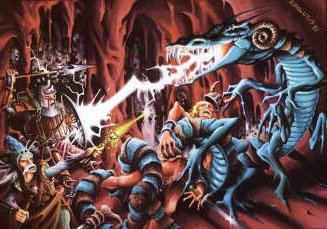
WOTC reworking skill challenges?
Double post day (WOOT!), but I wanted to quickly get something out before this becomes old news.
Dungeon has a new article up on designing skill challenges. I’m glad they put stuff out like this. I like the concept of skill challenges, but it is clear that the system originally put out in the core 4E books needed a little refining. A lot of posts, blogs, and general buzzing on the internet covers this topic a lot.
The folks at WOTC have made some suggestions working skill challenges. I do like the general idea of breaking up epic tasks into small skill challenges. I also like the idea of the article that failures and successes can effect further checks. It gives the DM a lot of solid ideas for designing and running wilderness skill challenges themselves.
I’m a fan of variants on the 4E system, but a small part of the article threw me a bit:
‘Each time the characters make a check as part of the skill challenge, roll a d20. If the DM’s d20 result exceeds the player’s d20 roll for the skill check, the characters encounter something in the forest. Remember to compare only the die rolls; ignore all modifiers.
You can roll a d6 to determine the encounter, or you can pick one from the list below.’
Okay, again I can see putting this out there. It is a small tweak to how skill challenges run. What bothers me is how completely tacked on it seems. As put forth in the article, the players either succeed getting to their destination, or they end up outside the forest. So it becomes and binary result (successfully navigate the woods or lost outside).
What is then suggested, from the quote above, is throwing a wrench into the whole challenge by having other random encounters. What I don’t get is why not have these encounters part of the overall challenge? How about for every failure the players get during the challenge, a potential encounter can happen. Or if the players barely meet the conditions to win the challenge, they run into an encounter. If they exceeded the number of successes, they would have bypassed it.
I’m all for variants and suggestions for modifying skill challenges. But I really wish WOTC would make an effort to show us how skill challenges can work, without having to bring forth all these kinks and changes. By doing so I think it reinforces the notion that skill challenges, as written in the DMG, are clunky and need to be reworked. When I see stuff like this, it gives an indication the mechanics need a little more tweaking.
I guess with the release of the DMG2, we can expect a lot more on skill challenges. So if you have been trying to run skill challenges straight out of the DMG, and having some difficulty. If, by following suggestions in the DMG, you just can’t quite get a challenge designed to work the way you want. Or you receive a lackluster response from your players while running one. Don’t fret. It’s clear to me WOTC doesn’t seem happy with how skill challenges are presented either.
You all start in a tavern…
I’ve started many campaigns with players bumping into each other over a tankard of ale at the local tavern. Almost too many I think. It became a long standing joke back in my old AD&D days with my players. It is not a horrible way to start a campaign, but it takes a bit of time getting everyone introduced and willing to work with each other.
I find players are usually a forgiving lot on this point. They may all have their individual desires and motivations, but at the same time they all metagame. They all know they are sitting around a table and wanting to play D&D. So already they know they have to at least try to work together, especially for that first session.
Return to Northmoor is a great D&D podcast I listen to. It handled the initial session in an interesting way. Their 1st session the players sketched out their relations with key NPCs, each other, and their own reasons for why they were there. In effect they all were associated with each other, and all had a similar impetus to strike out on an adventure if the opportunity arises. It’s a great idea. Plus for a DM they can spend more time planning an adventure, rather than wracking their brains trying to come up with a plausible reason why a rag tag group of heroes would want to group in the first place.
Establishing a campaign where the players already have a relationship with each other is a great way to start. You don’t need to spend an excessive amount of time and planning to get a group formed up. They are set from the start, and can head off to explore. I’ve been trying a few things with new campaigns and it has made those initial sessions a bit more focused on a dventure, rather than a meet-and-greet at the local tavern.
You all know each other – It can be a precursory meeting in the past, or a long standing friendship. This point is solid though, all the players have had some interaction with each other in the past. This helps bury group distrust among characters from the start. Why would a fighter trudge along after some unknown wizard and rogue, to investigate an old crypt in the first place? If they’ve initially known each other, this becomes an easier scenario to imagine.
Your secret impression of 2 other players – Each player has some secret thoughts on other players. Maybe they think the paladin is a blowhard, pompous do-gooder. Maybe they have a crush on the Deva. This is material the DM can use to push and pull the players in certain directions as the game unfolds. The usefulness of this can vary (especially if all the players secretly respect each other), but sometimes as a DM players will surprise how far they take this.
2 secrets about yourself that you want no one to know – Again, more fodder for future story arcs and adventure. This can have a very dynamic effect combined with the previous situation. Maybe that holier-than-thou paladin had a hedonistic past? Maybe the Deva, subject to a player’s crush, in turn loved their grandmother (/insert soap opera music here). This is an excellent source for molding the dynamics of the group after a few sessions.
The DM assigns 1 of these secrets to be known by another player – This is optional, but can be a real doozy for a group. Take one of those 2 deep, dark, hidden secrets that each player has opened up to the DM, and quietly pass that information on to another in the group. Now you have a party that really knows a lot more about each other. Where they take it depends a little on the DM, and a lot on each other.
I like using these tools. From the start you have a group of people that have quickly established relationships with each other. More importantly the DM has a good sketch of the personal dynamics of the party. They can find material there to have plenty of hooks for other adventures. Also they have some tools to predict how players will react in certain situations.
That is it for about now, what do other folks use to get their group together?
I am a Luddite, but I’m Trying to Change…
WOTC has released a beta of their new monster builder on their website a few days ago. I do have a subscription to D&D Insider and find it a pretty useful service. For the most part however still was running many of my games away from the PC. I cut my teeth on gaming when PCs were not in every household and everything was done with pencil, paper and at best, a calculator.
I’m trying to break away from that though. I’m starting to use an excel sheet to track initiative, HP and such. I’m starting to write up my adventures as word docs and using maps I’ve scanned in. But I am not quite there yet. I still keep many of my NPCs on index cards. I still use markers to indicate status effects. I still roll dice myself (I tend to make my rolls out in the open for players to see). I’m trying to change but 30+ years of gaming has settled me into habits that are hard to break.
There are a lot of useful tools out there too, especially for adventure prep. Dungeon Mastering has a lot of tools for building encounters, monsters, traps and the like. They require a signup to access but it is free. They also have quite a few links to other useful sites.
Asmore.com still has a monster and encounter builder at their site, but with limited support as WOTC have released their own versions. Still I found their monster builder pretty useful and liked their encounter builder if I needed something in a pinch.
Obsidian Portal is something else I am using as a handy campaign reference and planning tool. I’ve found I’m starting to use that for tracking my NPCs and key campaign plots. Likely I’ll post more on that later as it has a lot of uses.
There are a lot of computer resources available now for running games. I’ve been limiting my use of them and concentrating more on the adventure prep tools. I’m still a fan of having monster profiles printed out and handy for me to scrawl over with a pencil. I like adding a few post-it notes to my written adventures as I plod along during a game. I still do not like clicking a mouse when rolling 3d6.
I’m a little hesitant to go completely digital. Somehow I find it rather sad to see a circle of people playing D&D, all huddled around their different laptops. I like the open interaction of players facing each other, rolling dice, and moving their figures around a battlefield with a character sheet sitting at the wayside.
I’m trying to embrace new technology. I really am. I just have old habits and prejudices I can’t seem to shake when playing D&D.
Running with New Players
I’ve had the great fortune in my current game of having some players completely new to RPGs. It has been a great feeling getting new people exposed to D&D and roleplaying in general. At the same time, things can get a little rocky. Its easy to overwhelm a new player with rules, tactics, options and choices. If you are in the situation of having a new player fold into an established group of veterans however, this can be even more daunting to the new player. I try to do a few things to make it easier.
Get them plenty of tools to learn the game – I get a copy of the quickstart rules to new players well before game night. Sending them a link via email or handing out a hard copy is a huge help to new players allowing a chance to get some of the mechanics down beforehand. During the game consider giving them a cheat sheet, especially something covering the basics of combat.
I’ve also become a huge fan of power cards. There are a lot of resources on the web. I’m a big fan of one site in particular as I can save and upload pages of cards I’ve already made. I print the cards, slap them between two self laminar sheets, cut them out, and you have a helpful play aid for a new player. I found it really helps having something physical in their hands (aside from a character sheet) to describe potential actions their character has during combat. Plus bookkeeping is minimal, as they simply hand over encounter and daily cards to the DM once they use them.
Simplify character creation – You have to be prepared to really spend some time on character creation with them, especially with the release of PHB2. There are tons of options and likely a new player is going to get overwhelmed quickly. I found a great way to approach generating a character is describing the 4 roles (defender, leader, striker, and controller) and have the player decide what role would fit thematically. Then I would give give a general description of the classes and races. Don’t bog down in stat bonuses and ditch the concept of min-maxing builds from the start. Priority should be something they enjoy playing, not that their racial bonuses are ‘THE AWESOME’ for a particular class.
I also keep several pre-gen characters on hand. If a character wants to play a dwarf cleric and I don’t have one prepared, I grab some other pre-gen cleric, scratch out any obvious racial abilities, and have the player run with it for the first session. Letting the player get a session under his belt allows him to get a feel for the game, well before making any long-lasting decisions with his character. He can then go back, shuffle around the stats, skills, and powers to fit his character a bit better.
Have a flexible first level – 4ED already allows you to retrain a particular power or feat each level. I make it a house rule that players can completely reshuffle their powers, feats, and skills after the first level. I also don’t have the players pick any perks for a background until they reach 2nd level. Sometimes they need to get a better feel for how their character works in combat. Maybe that idea of having an intimidating meathead did not work out, and they rather be a little more diplomatic fighter. I also like holding off the background bonuses to give them some time to figure out who they are after having a few RP sessions.
In game mechanic terms, maybe they realize they need to pick up another skill. Character-wise, they might realize a different motivation for their character and want to utilize a background that fits that concept better. As much as initial concepts might sound good, you really get a better idea on a character by playing it. I like being accommodating initially to allow characters to work out any kinks.
Hold off on the epic storyline for the 1st adventure (or 2) – A solo adventure is a great way to start. It is even better if the new player can run though a short session with 1-2 other players. Having a smaller group will keep the new player more actively engaged. If you shuffle him into a large group and just run with the regular campaign, likely he is going to be lost in the crowd for a few sessions. That small group for a first session will really allow the player to focus on their abilities and powers, with just enough help to figure out how they mesh in a group for future game nights.
Also, if you already have a relatively high level group. Playing a 1st level character, with a few of the veteran party members handling pre-gens, is a great way to get the new player up to speed with how game mechanics work. They can learn basic tactics, skill checks, how healing surges work, and the types of actions they can use during their round, all without getting overwhelmed by running a high level character. Consider the session as a ‘flashback’ to when the player was a relatively inexperienced adventurer. This also screams for the DM to introduce villains and other NPCs that are notable to the current campaign, and given the new guy has gotten a few lumps with similar past experiences means he can mesh a little better with the existing group in the gaming present.
That is about it for now. What other tips would folks impart about getting new players comfortable playing D&D?
Review: Dungeon Delve
I’ll likely limit my WOTC product reviews. Typically I’ll be getting much of the new release stuff a month or more after most people have had a chance to wander down to their local game store (damn snail-paced international mail). But the recent ‘save my game’ article from this month’s Dungeon got me thinking a little about the Dungeon Delve book.
The Good – It is a slew of adventures that can be easily run in a night. As the Dungeon article pointed out, it’s a great resource if you have to plan out a quick adventure. I’m more partial to using it as a quick encounter resource. Tag a few encounters in the book and use them if you need to make something up on the fly.
There is a lot of material here that could be applicable to every level campaign (or portions that could be regularly pilfered). I think this product is a good investment if just starting a low level campaign. Plus if you wanted to just make a quick one shot adventure for a nightly game (or a run to introduce new players), this would fit the bill nicely.
Additionally, this could be a good way to give players, and you as a DM, a snapshot of the paragon or epic tier. Just as a break from the regular campaign, tell players to roll up a lvl 25 character, sprinkle in a few magic items as equipment, pull out an appropriate delve, and have a run at it. This experience might help them rethink what feats and powers they’ll pick up as they advance. Maybe after playing a certain paragon class for an encounter or two, they realize it doesn’t quite fit their play style, and rethink the direction they’ll focus on for future levels.
The Bad – Some of the encounters seem a little uninspired. There is a definite repetitive theme of a 3 encounter dungeon crawl. They do give some ideas for expanding delves. Straight out of the book however, I’d be more inclined to add a few more rooms and an encounter or two. Overall, I think many of the delves would need to be fleshed out a bit more before running them in a regular game.
Another big negative for me is the reliance on Dungeon Tiles. Yes, I get that WOTC is a business and they need to promote their products. But as the number of tile sets are so limited, overall I think many of the layouts are constrained. I’m certain this will be a trend that continues for other books. I’m hoping they release another 3-4 sets before coming out with another Dungeon Delve book. I’d warrant even completely remapping your own dungeon layout, and just drop the encounters into rooms of your own creation. As long as some of the major terrain features are there, I think it’ll be just fine to plug and play encounters from the book.
The Verdict – Is this an indispensable D&D book to add to your collection? No. Could this serve as a useful tool for running your games? Sure. If your group is the meat and potatoes, dungeon crawling crowd, they’ll likely love it. However, I think most of the delves will need some retrofitting to work with your typical group. If you have the cash, I’d consider it a reasonable buy to add to your library.
Playing with Miniatures
I’m a fan of miniature war games. I love painting and collecting minis. I did the whole GW Warhammer Fantasy/40K in the past. As minis go nowadays, I’m deep into WWII 15 mm stuff and more small unit skirmish games (more on that later). Long ago I used miniatures in my D&D game also. So with 4ED, I latched onto that aspect pretty easily.
Quite honestly, it is pretty difficult to run 4ED combat without some type of miniature system. I’ve heard people that do it. They rely more on the descriptive text of powers, and fudge with the 1 square = 5 foot scale to do a lot of hand-waving during combats. Yet, I think folks are really missing out on the tactical element of the game if they do not use minis.
I can see some trepidation folks have playing D&D with miniatures. One big factor is cost. Another is space (storage and during play). At least pre-painted minis are available on the market, so you can get away from painting the things if needed. There is one sticking point I have with miniatures though, I think you get stuck having to either buy a ton of miniatures, or play with a lot of proxies that look like a Pokemon explosion on the table. It sounds silly when you use miniatures, but it’s easy for players to get into the WYSIWYG* mentality. So much so that they’ll have a hard time remembering those 3 additional orcs on the table are really goblins. * What You See Is What You Get
So while I am a huge fan of miniatures, and I’m a fan of using 1” scale maps for rooms and such. I’m not a big fan of using actual miniatures while playing. I like using tokens and paper minis. Newbiedm.com posted a great tutorial on making your own custom counters. I especially like the dual sided tokens he uses. As for me, I really like using paper miniatures and there are quite a few that are commercially available (I like the line disposable heroes line).
I like using PDFs of paper minis for the following reasons:
Cost – You can get a lot on the cheap, as it is simply a matter of printing out what you need. I place the printed minis between two self-adhesive laminar sheets to add some life to their use, and it gives them some sturdiness.
Flexible – If you really need to make multiple copies of a figure, it’s a simple matter of cutting, pasting, and duplicating with another program. Also, you can scale up (or down) figures. Need a few giants for your game? Not a problem. This works great with an A-frame style for mounting the figures, as the base can be made to take up a few squares. I also work using the base into monster types, where bases of certain colors match with the monster role (minions, lurkers, etc.). If using paper clip binders, you can usually pick up a bunch from office supply stores of various colors.
Replaceable – Anyone that has every played 40K knows what I am talking about. Eventually you get that accident resulting in a broken/chipped figure. Paper miniatures can be whipped up in a flash. No need to retouch any paint jobs. I think the pre-painted figures available from WOTC are a little more durable, but I’m not sure how well it will hold up if your pet takes to making it a chew toy.
So I like miniatures in 4ED, but I’m less of a fan using actual figures. I think paper miniatures and tokens are a great way to go. They offer enough to allow players to envision the action, but at the same time allow enough imagination to make proxies work. Figures look great, but almost too good. I think WYSIWYG tends to creep into their use, so when you are forced to use proxy figs it’s a bit clunky.

Organizing Your Campaign with Freemind
I like a convoluted campaign. I like having 2-4 subplots running with hints and lures dropped along the way and as the players run through the game, more and more is revealed. Occasionally they complete an arc and have that ‘eureka’ moment when I leave a little clue about something else. It’s great fun and I think they enjoy the non-linear storyline. Giving the group a choice of A or B (and sometimes C) works as they don’t necessarily feel they are forced into plodding along one direction, plus either choice works for me as I’m typically somewhat prepared for each decision (although sometimes I fall short on that).
One tool I’ve picked up for that is Freemind. It is a great freeware program that allows you to construct mind maps. You can save it in a variety of formats, add links and comments, and have a lot of small features to help organize your mind map. Freemind allows you to incorporate all those odd plot lines and keep them organized so your main story can keep on track. More importantly, you can keep all the NPCs aligned to the right arcs.
I use a lot of symbols and color schemes to keep things organized. Bad guys for certain arcs have a matching color to the deeds they are responsible for. I also throw good NPCs into the mix to pair off against villains all tagged with a different color. When I add players into the mix, I also give them small icons that I can tag with particular adventures and NPCs.
The icons allow me to tailor various villains or storylines to a particular player for some more depth in a certain adventure (say an old villain from a character backstory, or a 1 shot solo adventure I ran a player through). Very quickly I can manage a lot of simultaneous arcs, and keep all the story threads neatly arranged. It also is pretty easy to edit, so I can add branches to ideas if new things roll into an arc by the player’s actions.
Give Freemind a whirl. It is a great tool to help congeal those nifty campaign ideas into something organized and readable.
 Geek Ken