Category: DnDNext
Is Save or Die even needed?
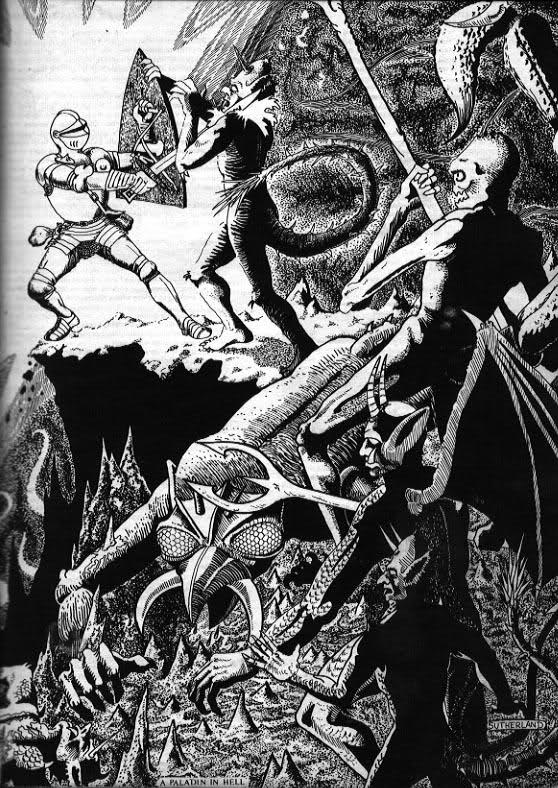 Posted last month, WotC’s Legends and Lore column mused a bit about the Save or Die mechanic throwing a few ideas about how they were part of the older game, and if they had a role in the newest edition. I’m not a fan of save or die, and was glad to see it go in 4E. However given the poll results that were provided the following week, it looks like I am in a minority.
I never got how some people felt 4E lacked the sense of danger of previous editions. Things were too balanced and players had too easy of a time. This got me because the DM always had the option to crank things up when making up an adventure. Throw a few trolls at that level 1 party and voila, you have a dangerous encounter where the PCs should have to run.
I’ll concede one point however. Heroic level games seemed to run just fine, but paragon and epic tier things likely would get a little wonky. Especially at higher level play, where out of the book battles could become a cakewalk with a fully rested party. Yet, even that could be overcome with some some tweaks and employing a different design philosophy that Fourthcore has explored.
Another point I’ll agree with is having a saving throw does engage a player a bit more. 4E effect mechanics were very streamlined and uniform, but did lack the interaction of previous editions. Rolling to hit against defence for spells are great when players were attacking, but being the target of these effects could become dull as all the action was in the DM’s hands. With saving throws, at least the PC could have some action in trying to counter a spell, rather than depending on a passive stat. However having something like that for everything could drag down the game, meaning you might have one way of resolving effects for players and another against monsters. In the end, with different systems to resolve spells and effects it could be a headache.
I’m just not a fan of wildly chaotic play that save or die encourages. It becomes harder to help maintain that story. With lots of checks built in 4E, I knew if I threw a high level encounter at the party, they would have a tough time and possibly a few might not make it. All of us could then craft the story around those big, momentous combats that telegraphed the idea that the players might have to make the ultimate sacrifice for the rest of the group.
Another problem I have with save or die is that with most adventures, the DM has control over everything. They are the ones that decide what the PCs will go up against. Having a random lethal outcome be layered on what I decide to throw at the players makes my job harder in trying to make a fun fight. If you were running a module that had been playtested extensively, this would be less of an issue. But most DMs are making their own game. It can be difficult to judge how much of a challenge fights will be using monsters with severe penalties if players don’t make their saving throw. Having one PC drop dead might make for an interesting side quest or push for roleplay, frequent TPKs however don’t seem to make for a fun time.
I don’t want save or die part of the core rules for DnDNext. I do however, want a little section in the next DMG to give advice on how they can ‘turn their game up to eleven.’ Having some suggestions on some stock abilities, or methods for putting save or die mechanics into your game would be great. So if a DM wanted to increase the lethality and danger of their games, they have some tried and true methods to do so.
An example might be to suggest encounter powers for creatures rely on saving throws instead of to hit rolls, and do max damage or ½ damage whether the player makes their appropriate save. For a more 4E-centric mechanic, how about a suggested disease track for level drain, and also add a condition that permanently removes 1 healing surge from a PC’s total? Fourthcore introduced the idea of a new power keyword, Kill. If a player did not have a particular amount of healing surges available, they’d die outright. Having a good 5-10 methods and suggestions for introducing save or die into the game, with some additional pointers on appropriate use would likely be a great addition to a new DM’s arsenal of information.
Someone like me? Likely I’d never use it in my game. Yet other DMs out there would have solid, play-tested means to add save or die aspects to their game. I want it out of the game, but as an optional rule, this could have a place in folk’s games. I’m hopeful, as a core mechanic, save or die simply stays dead.
Upcoming DnDNext playtest
I think the internet and twitter likely exploded among RPG fanatics last week with the announcement that Monte Cook left the DnDNext project. At first I was spouting off maybe he left due to differences in what direction the newest D&D would be going. Then the other shoe dropped and the public playtest of DnDNext would be coming out late May. After that I’m falling in the camp that maybe there was a division on how ready the ruleset was for public input between some of the designers and Hasbro/WotC.
All in all it’s sort of giving me a sinking feeling about the next version of DnDNext. At times I even wonder if it’s to get that chunk of 3E/Pathfinder consumers. I could have seen some fictitious conversation months ago like this:
Hasbro Suit: Hey, I was taking my kid to Barne’s and Nobles to spend this gift certificate. He bought this Pathfinder book. You’ve seen this thing?
WotC Designer: Yes.
Hasbro Suit: You have? Man, we gotta get our attorneys on this. I looked through this thing. It’s got wizards, sword guys, dwarves, it’s just like D&D. Those guys stole our IP!
WotC Designer: Actually, it’s closer to our older editions, published under OGL.
Hasbro Suit: OGL material? God don’t bring up that mistake again. So all this stuff in the book is under that massive screw up. Okay, no lawyers. What are we doing about getting these geeks back to our product?
WotC Designer: Well, a lot of people enjoy the older editions of D&D. Pathfinder sort of built on that rules-wise. Fourth edition has gone in a slightly different design direction. I mean it’s pretty much the same game, just utilizing some unique game mechanics.
Hasbro Suit: What do you mean different? There are wizards, spells, dragons, friggin’ orcs. This Pathfinder and our product are the same thing. They’re both Dungeons and Dragons. So why aren’t they playing our product?
WotC Designer: Again, they are fairly similar. However 4E has some interest-
Hasbro Suit: You aren’t listening to me. Why aren’t they playing our product? Fix it. Get these mama’s basement dwellers playing our game. And for God’s sake don’t put that OGL anywhere near it.
Okay, I’m actually sure something like that never really even came up but I’m certain folks have been looking over at the Pathfinder camp and wondering how they could get players back to ‘official’ D&D. I like the concept. Get just about everyone under the banner of D&D. I just don’t think it is going to happen.
First off you have the OGL of 3E/Pathfinder. Even with a newer edition out there that can incorporate older editions, I don’t expect for a minute it will have an open licensing scheme. I’m going to be massively unpopular stating this, DnDNext shouldn’t have an OGL. They should however, be very open to licensing the game. Whether it’s cash up front or an agreement to split profits, other publishers should be able to put out D&D products with an agreement that encourages this. I think that was one reason why support for 3/3.5 sort of evaporated. If WotC supported that edition it’d give it legs, and meant other companies could use that as a sign to keep putting out stuff WotC would never get a dime off of.
Lastly I think the community is split. Folks have set up tents in respective camps and are unwilling to get behind another product. In a way, I don’t blame them. If they love AD&D or Pathfinder is their edition, they have the rules they want to play. Why try something ‘new’ that is drawing them away from games they already enjoy? This point I think should give WotC pause about how much effort should go into calling back lovers of past editions. Which audience is really the future of D&D?
I’m hopeful they can pull it off. That they can make something with enough working parts to get everyone behind. But I’m unsure if players of older editions (including 4E) will be willing to make that jump. Just because the game worked one way in an earlier edition doesn’t mean it was better or ‘more true’ to D&D now. If something might not fly with new player expectations, but is some classic ruleframe from an older edition, new players should get the rule shift every time. The focus should be getting new players into playing the game. Getting lovers of the older editions, the fans of existing rules, may not be the best in the long run. Instead I’d be trying to make a game that future generations would want to play.
Bring back the WotC D&D playcasts
I’ve enjoyed many of the videos and podcasts from WotC showcasing 4E. The Penny Arcade podcasts were very enjoyable. I expect with the next version of D&D rolling out there will be an entirely new set of play sessions released. Quite a few folks have used them to introduce the game to new players. However more effort should be put into a special series to introduce the game, especially for new DMs.
One format I have loved talking about adventure design is Return to Northmoore. Typically you have one podcast talking about the adventure in detail, then another session of the actual playthrough. What I particularly enjoyed was the DM commentary.
So let’s fast forward another year or so from now, with DnDNext out on the shelves. WotC, get a simple dungeon delve adventure up on the web. Something like a lighter version of Kobold Hall. Just use stock monsters out of the book. Don’t worry about any stats. Have a simple map up of the dungeon. Add a branch in the layout and avoid the linear room to room exploration (more on that later). Make sure to throw in a room that has a trap and possibly some puzzle element. Don’t forget to have a few stock level one characters too. Have that as a nice PDF file a fledgling DM can page through. Then get the podcasts up.
Podcast 1: The Adventure prep and dungeon design. Have the show DM talk about the dungeon a bit. Give out the nuts and bolts of the design philosophy. Talk about why the rooms and encounters progress the way they do. Give some DM tips on preparing an adventure, how to address some potential problems. Finally, give at least a good 10 minutes talking about the story of this dungeon and why the players are exploring it. Describe different adventure hooks for it.
Podcast 2: The party introduction. Describe the basic mechanics of the game and go through a quick rundown of abilities, AC, and HP. Have each player introduce themselves. Have them give a little background on their character. More importantly, insert some DM commentary on a few bullet points about key abilities as each party member is introduced.
Finally, the show DM should lay out the situation and cast a few adventure hooks, getting the players on board. Make sure to encourage that roleplaying. Get them lined up to explore the dungeon and as they enter the first room…
Podcast 3: The first combat. Give a complete overview of the fight. Present every die roll, every HP marked off, allow for plenty of questions and answers. In short, just like almost every existing WotC podcast for 4E.
Podcast 4+: Now for the other fights, have the lead up to the fight. Maybe play out the first round and then skip to the end. A blow by blow account is boring. You don’t have to focus on each die roll and listen in as each PC ponders their turn. Instead, focus in on presenting particular situations that come up with commentary by the show DM. Something like the following…
Show DM: The party is pretty much in the thick of it by now with the wizard suffering from poison by a giant spider bite. Let’s listen in on Fizzlelot’s turn.
DM: Okay, Fizzlelot. It’s your turn. You are poisoned. So you immediately take 5 points of poison damage.
Show DM: Ongoing damage is taken at the beginning of the player’s turn. They might have temporary hit points or some regenerative effect that can counter this. However if they drop to zero HP, they are down for the fight. Players can be pretty excited to do something on their turn and can forget any ongoing damage, so be sure to remember any ongoing effects.
Fizzlelot: Five points? Ouch. Okay, I’m down to 12 HP. I’m going to try something different and swing my staff at the creature.
DM: All right, make a basic attack rolling a d20.
Fizzlelot: Ack.. rolled a 4.
DM: Sorry not enough to hit it. That was your standard action. You have a minor and a move action.
Fizzlelot: This is pretty dicey right now where I am at. So I’ll use my move action to shift away from the giant spider. That’s about it. I’ll use my minor action to say some choice words to the beasty!
DM: Heh. Okay your turn is over. You get to make a saving throw to shake off the poison. Use a d20 roll and roll high.
Show DM: At the end of the player’s turn, they can attempt to make a saving throw for any effects that have a ‘save end’. The poison attack from giant spiders have such a condition. All the PC has to do is roll a 10 or more and they can shake off the effect.
Fizzlelot: Jeez. An 8. Can I get a break here?
DM: That’s too bad. You are still poisoned. Let’s move on to Sir Slays-Stuff.
Show DM: Since the wizard rolled less than a 10, he is still poisoned and will continue to take ongoing damage the next turn. As a tip you might want to curb the use of too many monsters that inflict ongoing damage with low level parties. Players can get into some bad die streaks and the cumulative damage can add up. Not to mention they don’t quite have the magical items to help out. So be sure to use these type of monsters sparingly in your adventures.
Now here is the important bit. Skim through the remaining fights. Possibly key in on a few important rolls. For the final boss fight, give a general overview of the situation and play out that last turn. Streamline the podcast to cover high points of the fights. For roleplaying however, you want to play every minute of dialog.
That is why it’s important to have a branching path (and be sure to have some clues telegraphing what might be in each direction). Have that room with only a trap and a puzzle. Give opportunities for the players to talk about the situation and cover all those exploration discussions. That is the stuff you want to cover in its entirety. While combat is a part of the game, it’s a better sell to capture the table chatter and excitement of exploration.
Final Podcast: The wrap up. Have the DM lay out a foundation for another adventure and tie up any loose story bits. Finally, go around the table and get feedback from the players. Throw in some final DM commentary and advice about how to seed further adventure ideas and the importance of talking with your players, and most importantly, just having fun.
I hope more effort is put into getting a short series of podcasts out that help explain the game and give some guidance to new DMs. I tend to think there are so many existing fans of the game now, we tend to forget about trying to get stuff out there to help the newer players. A short series of podcasts like these can be a great step in helping newer players learn about, and grow to love, D&D.
Hoping healing surges stick around
I’ve got a bit of a rant with the latest Legends and Lore up on WotC’s site about saving throws, but I’m going to stew on that a bit. However a portion of the article throws out the idea of tagging effects based on hit point status. It’s something that could work, but I wonder if healing surges might be more appropriate as a gauge of relative fitness. And the failure of mentioning them makes me wonder if healing surges might make the cut for DnDNext. If not, that is sort of a shame.
I love healing surges, something I’ve gushed about before. They offer a way to rethink about what hit points represent. They also reinforce the idea that HP loss can mean more than just physical damage drawing blood.
From just healing potential, I can see curbing the number of healing surges characters have. The more defender types can be brought to death’s door twice before having to worry if a healer is available, and that isn’t even counting the bonus healing from leader powers. So trimming the total number by 2-3 surges likely could give some fights a bit more threat. I’d even go to say that first fight or two in an adventure is primarily there to whittle away healing surges and give more threat to later fights by drying up those potential healing resources.
However I’d offer an alternative to trimming down the number of healing surges by expanding their effects. They offer a unique form of currency for game resources. I would approach healing surges more as the PC’s will, endurance, vitality, and desire to push on against adverse conditions. In that light, the role of healing surges might be expanded to other enhance other abilities besides just granting HP.
They could be used to supplement attacks. Rather than encounter powers, allow a PC to double their damage spending a healing surge. It could be possible to allow particular feats to expand the area of effect for spells, or improve healing output, all at the cost of a healing surge. The player is drawing on reserves to give that certain attack or spell their all. Most importantly, there is a hard limit to what they can possibly do each day before they have to rest and recharge. It also gives PCs an interesting choice, do they burn through healing surges to enhance abilities? Or do they try to keep some in reserve for restoring lost HP?
Another great characteristic about healing surges is that it gives more flexibility to the DM when dealing damage, and also for rewards. Think instead of having a level drain effect, healing surges are drained (and if healing surges have a role with abilities and powers this could definitely hinder the player).
I’d be lax in failing to mention Fourthcore too.Those folks have worked in some particularly nasty monster powers targeting healing surges for PCs, rather than simply docking chunks of HP. Having a kill encounter power that will drain a specified number of healing surges (and if the PC doesn’t they die outright) can be particularly vicious.
I hope healing surges are in DnDNext. They provide a lot of flexibility for the DM when considering ways to damage players over just whittling down HP. They could also provide a unique game resource if the functionality of surges expand beyond just granting HP. It’s a neat idea from 4E that could definitely be tweaked, but hopefully won’t be eliminated in the next edition.
The high level game and world barriers
Something hinted at from one of the more recent Legends and Lore series talks about high level games, how they sort of break down, and what should be your typical experience at paragon tier and higher. One idea touched on was that maybe certain places in the game world might be better suited for high level play. If you are facing combat with a deity or traveling different planes, that’s something more aligned for high level tier groups.
It’s not a bad thought. I think higher level characters need something larger in scale to be an appropriate adventure for them. However at the same time, I like the flexibility 4E has given DMs for potential worlds to explore. I loved seeing lower level demons, elementals, and aberrant creatures pop up in MM2. While the majority of monsters that would frequent these different planes are for high level PCs, having a handful of heroic level creatures was a nice option.
Pushing this idea of flexible locations for heroes of all levels is inspiring. I tended to get stuck in the mindset that the planes were for higher level characters only. Having more heroic tier monsters available opened up that idea of allowing lower level PCs to step into other regions, especially the Feywild and the Shadowfell.
Even the scales of war adventure path had level 5 characters crossing over into the Shadowfell. Something that helped reinforce new DMs to think about having adventures in other lands. With folks that had run through a few heroic campaigns, having another place to kick off a campaign outside your typical run of dungeons against kobolds and goblins was a boon. Granted I could see the majority of the planes of elemental chaos something with incredibly difficult monsters and hazards, something only the most seasoned of adventurers would attempt to tackle. However at the same time, there could be this periphery on that plane that was more stable, with less powerful creatures, that heroic PCs could explore.
It makes me a bit nervous when I hear thoughts that certain places might be cordoned off to higher level tiers. I much prefer the direction taken in 4E where the DM was given tools to build encounters that could challenge a low level group (and at the same time not completely overwhelm them). It didn’t have to be enough to make out an entire series of adventures (or a whole campaign), but being able to slip over into the Feywild or pass into another planar region would be a pretty cool break from the typical game most folks run. And if anything, it could provide some ground story work to give an incentive for the players to visit those planes again.
The biggest difficulty for many DMs may not be designing encounters for high tier play (which can be an issue) but more along having problems with appropriate challenges and tasks that would appeal to higher levels. I hope a fair chunk of pages in the next DMG iteration of DnDNext tries to address this. I want to see a random table of 50 ideas for paragon and epic play. Give us some abstract rules for resolving large scale battles (something out of Savage Worlds Deluxe would be peachy), obtaining strongholds, and maintaining followers.
This seems to be the biggest roadblock to higher level play, thinking of an appropriate story that would grab the attention of high level PCs. To address this effectively is no easy task. For quite a few DMs with a lot of experience, this probably is not a problem, but relatively new DMs would likely appreciate advice. I’m hoping that is something that is given more attention for DnDNext. Don’t saddle the players with more complex mechanics and especially don’t consider things like segmenting off the planes for paragon level only. Keep planar travel and adventures flexible for adventure ideas. Spend more effort in helping DMs craft a campaign story that is worthy of high level play.
WotC rolling out a new edition
I expect various blogs will explode this week with news of a new edition of D&D rolling out sometime next year. Having a larger group of playtesters and getting more feedback from folks I imagine is a solid step in getting an edition out that people will like, I still think there is such a division over 4E and non-4E mechanics it’ll be tough to seal it up.
Pathfinder had to have struck a nerve with suits at Hasbro. Here is this game effectively a version of D&D and selling well enough to either take a major chunk out of 4E sales, or compete with it neck in neck. Somebody had to have been thinking about trying to woo that group back into the WotC fold. I guess a new edition would be a vehicle for that.
Thing is, if 4E rolled out and was like Pathfinder I’d be disappointed. Patherfinder seems like a fun game. I just think it’s just a step too close to 3.5, tweaked a bit but nothing really innovative. I’m certain for many that is just fine, however I think a more dramatic change to certain mechanics was a step in the right direction.
There are a lot of good things about 4E and a fair amount of problems. I don’t want to bring out a laundry list right now. As many folks might clamor about how awful 4E is, and are eager to bring D&D back to earlier editions, however you still have people that like 4E. I just wonder how a new edition is going to get these different camps under the same tent. I expect a very modular rule system that is light and heavily arbitrated by the DM by default, with increasing rules and complexity as optional rules.
One thing I do expect, a game that isn’t so dependant on a battlegrid (or a least rules that can drop it more easily). While I like the tactical play of combats, I do think it’s a limitation for getting people into the game. You really need a lot of ‘stuff’ on hand to run a game. Again, while folks can wing it and play without miniatures having some more concrete rules would help tons with new players. So I expect miniatures and a grid will still be around, but either be an option or less tabletop intensive alternate rules will be available.
If anything, at least I’ll have plenty to blog about over the next year.
 Geek Ken