Category: Family Games
Board Game Review: Kingsburg
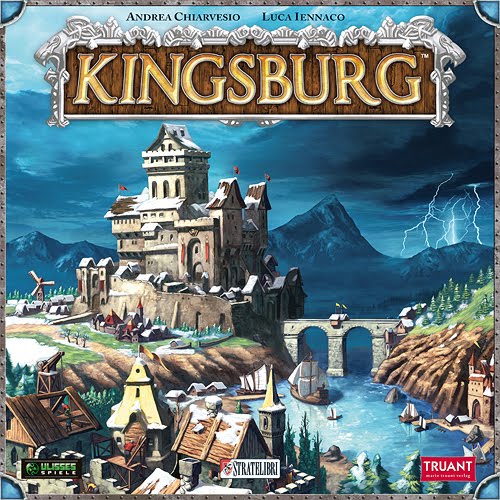
For the game night blog carnival this month I’ll be reviewing Kingsburg from Fantasy Flight games. It’s a 2-5 player worker placement game, with enough twists to set it apart from other games with a similar themed mechanic. It’s been seeing quite a bit on my table recently, mostly due to the engaging play and how it handles worker placement.
Players are governors for various towns under the command of a king. Their goal is to be the most prosperous governor, outshining the others after 5 years. This is typically done by completing the construction of different buildings within their respective towns.
Each turn players roll 3 dice and place them on various sections of the board, representing the king’s court. Once a section is claimed, that player has the ear of a specific advisor, and no one else that round can ask for favors from that member of the king’s court. Each member of the king’s court offers resources (or other bonuses like troops and victory points) that can be used to construct buildings.
Players take turns assigning their dice until either all available spots are claimed, or they have no dice left. This can make for some very cut throat play where you choose to shut out one player, and use your last die for a lower member of the king’s court. The conundrum is the higher die totals will yield more aid from the royal court. But this can mean you are allowing other players to get resources from lower ranking court members. So the player is constantly thinking whether to use all their influence for a single advisor, or try to block out other players. It’s a fun way to handle worker placement.
Resources gained (wood, stone, and gold) can be spent to build one construction for the town. Each type of building is on a progressive track, where previous buildings must be made first. All the town buildings have some special function and earn victory points. There are definitely some interesting combinations between them, and as players progress up the building tracks, more and more powerful abilities become available.
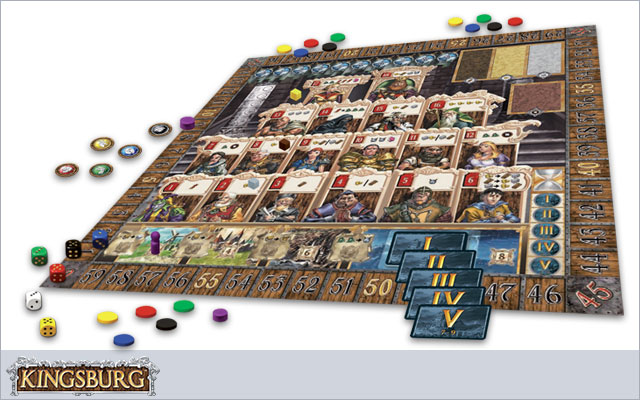
One particular element I like about Kingsburg is there are plenty of opportunities to catch up if you lag behind during a certain year. Small consolidations are given to the player with the least amount of resources and buildings. The player with the lowest number of buildings always gets to influence the court first. During the middle of the year, they can also get an opportunity to construct 2 buildings, or gain favor from a court advisor that has already been influenced from another player. Not to mention every member of the royal court can offer something useful to the player, even the lower ranking ones (just that higher numbered court advisors are more powerful). It’s a nice way to keep everyone in the game.
Now, what I’ve described is a pretty standard worker placement/building type game. It’s pretty fun, but ho hum as you’d expect this from just about a dozen other games. Fortunately Kingsburg has a twist to the game play. Monsters.
Each year, you have a random monster threatening to rampage through the realm. And every year the threats become more powerful. As governors for various towns, not only are you scrambling to construct more efficient buildings, you also have to worry about the town defense. While fortifications might help with defending the town, they don’t offer the larger game bonuses of other non-military buildings.
Players that soundly defeat the monsters, and have large standing militias at the end of the year do get victory points. But that is fleeting as those militia forces disperse at the year’s end and have to be recruited again. Doing nothing likely means the loss of resources, or the destruction of buildings. So that monster threat can’t be ignored completely.
Another tweak is you have a rough idea of the monster strength coming at the end of the year, but won’t know the exact amount or the type of threat until they attack. Some fortifications are ideal against certain monsters (like a palisade against goblins, or a chapel against zombies), while not offering much protection against others. There is a way to gain some divination and see the approaching threat, but that usually means diverting needed influence for resources towards a court member that offers less rewards/resources. Without that knowledge you’ll likely over defend yourself, further diverting needed resources from construction (or worse, not be able to muster enough defense against the rampaging creatures).
The Good – It’s a light, approachable worker placement game that has enough strategy to making it engaging. You have to balance a lot of things during the game year. You have to try and develop your town, at the same time making sure you have enough forces to defend it at the end of the year. And all of this makes for interesting choices on which royal court members you will influence. At the same time, other players are doing the same thing and may prevent you from gaining that ear of a particular court member. The components are nice with beefy counters and nice wooden blocks. The artwork is whimsical and captures the fun medieval theme well.
The Bad – With repeated play, I can see some set strategies creep in. This is especially prevalent with 2 players. It becomes a bit easier to work towards a winning town building combination. The random monster threat helps counter this a bit. However I think the game really shines with at least 3 players, as you really feel the bite of not being able to court the royal advisor you want. As the 2 player game does this by randomly removing particular advisors each season, it still doesn’t beat having a 3rd or 4th player actively selecting advisors.
While there are stopgaps in the game to prevent a player from falling too far behind, this can happen (especially with the victory points). It’s more of a problem mid-game. If a player gets hit by a monster, they can lose a lot. Combined with poor dice rolls for a few seasons, they can really fall behind and not be able to climb back up. It can be a bit of a downer of having the game effectively end for them in the middle of play.
I’ll also add that while I enjoy all the choices and strategic possibilities, this can lead to some serious analysis paralysis. Be prepared to offer lots of advice to players to keep the game moving.
The Verdict – Kingsburg is great and one of my favorite worker placement games. It avoids a lot of the fiddly, worker drone shuffling of other games, replacing it with a simple dice roll. You have that feeling of progression as you slowly build up your town. The interaction with other players is there, as your choices (and theirs) have a direct impact on the play from turn to turn. All of this construction is under the shadow of a looming threat that will come at the end of every year, with each creature being randomly chosen from a small set of cards (adding some game-to-game variation).
I highly recommend this game. It’s approachable for relatively new gamers and has enough meat in the rules and play to keep a more seasoned board gamer interested. It handles a broad number of players well, with the 2 player game being as much fun as a 5 player one. This is a great game to have in your collection.
Board game review: Forbidden Island
Normally I would pass on something like Forbidden Island if I saw it in a store. This is from Gamewright, a publisher of kid friendly games, and I think the packaging definitely echoes that feel. I’m glad that I went ahead with my purchase though as I would have missed out on a very fun cooperative game.
The game is for 2-4 players, each playing a specific team member on an expedition to a mysterious island. The island is sinking, and the players have a limited amount of time to explore the island, retrieve treasures, and get back to the awaiting helicopter to escape before the island is submerged for good.
This is all represented by tiles that are randomly placed at the beginning of the game. On a player’s turn they can take a number of actions. They then draw from an action card deck which could be treasure cards, special bonus actions, or a limited number of water rising cards. A player completes their turn playing flood cards. There is a tracker that represents the amount of flood cards that are drawn each turn. As each tile card is drawn, they flip that tile over to represent it flooding. If a flooded location is drawn again, that tile section of the island sinks and is removed from the game along with any players that happen to be stuck on it (and if this happens everybody loses).
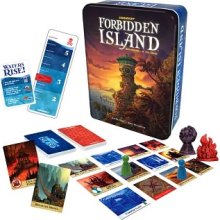
The objective is to obtain sets of cards for specific treasures and turn in those sets on the appropriate tile. After all 4 treasures are collected, the players have to return to the helicopter landing pad to escape safely. Each turn a player will find themselves trying to manage being on the right tile to trade away cards with other players, or shoring up key tile locations to keep them from sinking, all the while making sure they don’t end up on a location that will sink completely.
As the game plays players will draw water rising cards, increasing the number of cards drawn each turn as the tracker is moved up a notch. In addition the flood cards all ready drawn are shuffled back into the deck, increasing the likelihood that section of land will be subject to future flooding. This can make for some tense decisions as players balance making a run to get a treasure (or pass off cards to allow another to get it), while still keeping certain tiles from sinking.
This isn’t a deep strategy game. However it is fairly challenging and I like how it is an ‘everyone wins, or we all lose’ type of scenario. Everyone has to work together and most will find their turns being a bit of discussion with other players about the best plan of action. I like that each player gets a random team role that gives them a unique ability (effectively breaking some of the rules). As each player can do a special action, this adds a little difference to each game and gives players more options on their turn.
I also like that you can begin the game with a higher flood level. This in turn, ramps up the difficulty as you have less time and really have to plan out your turns efficiently. Combined with a fairly random island layout, and playing 1 of 5 different team roles, you can get a lot of replay out of the game.
The Good – Random layout, and different random player roles adds some variety to the game. Additionally, you can tailor the game to make it a bit easier or more difficult, allowing different groups to play and have fun. This is something refreshing when trying to play the same game with children or just adults. The components are very nice, with thick stock tiles, and solid-backed cards. The plastic treasure and player tokens are also beefy and can be handled easily (no little token bits here). The colored artwork is nice and plays to the theme well. The rules are well written and easy to follow.
The Bad – It is a random game. You won’t be able to plan out a grand strategy here. Basically your turn is a puzzle as you try to be the most efficient with your limited actions. Some of the player roles are situational and not all may be as useful as others (I’m looking at you Mr. Diver). While you can ramp up the difficulty, I’m sure with the right cards and groups that can quickly analyze and predict future sinking tiles, the game can be pretty easy to play. Additionally, it is a cooperative game. Some players might have more fun with griefing other players than with trying to contribute and win the game.
The Verdict – Forbidden Island is a fun, light strategy game. It captures the right amount of tension and player interaction. I think it would work with young children and still be a challenge to adults. It is packaged well with handsome components. Not to mention the price is just right for a game like this, being about $10-$15 USD. It is a fun cooperative game. Something I think would resonate very well with folks wanting to play games with their kids.
A very family friendly game, priced very reasonable. I’d say pick it up and look forward to exploring this mysterious island. Just don’t forget to ‘Get To Da Choppa!’
Games I Will Play With My Kids
I remember playing board games as a kid. I had a slew of Parker Brothers games (Monopoly, Clue, Sorry, etc.) that I played regularly. Looking back at those classic family games, I realize now how horrible some of them were playing together as a family. Something I will not be repeating with my kids.
One thing that stands out in Monopoly and Risk (two old past favorites of mine) is that each game revolves around the elimination of other players to win. Now I am simply boggled by the game concept where the losers are dropped sequentially and forced to wait around until the winner is decided. As a family game, I just don’t see this as fun. Winning and losing is part of playing a game. I’m all for teaching that idea to kids, but dragging out the process forcing them to become spectators while the winner is slowly decided is not fun. Now that I’m older and thinking of playing games with my kids, I’ll be making sure these four games are regulars in my lineup:
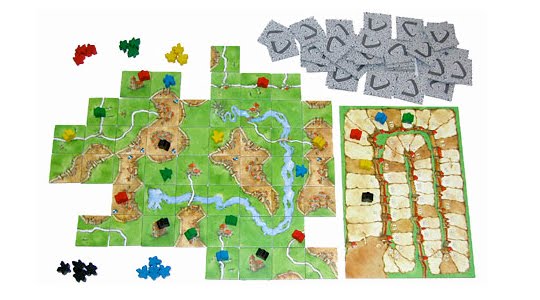
Carcassonne – You place tiles to slowly expand cities and roads, filling up the country side. All the while you place followers (or meeples) to score points on completed features. It’s fun, has simple rules, and is surprisingly strategic. My niece loves this game, and the adults I’ve played with have really enjoyed it too. Play is fast and definitely has that draw to play ‘just one more game’ to it.
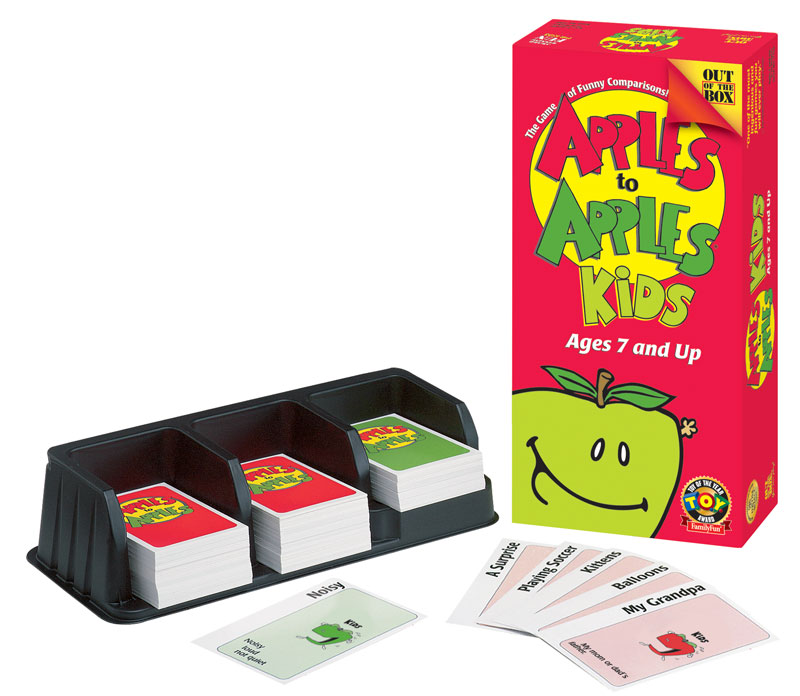
Apples to Apples Kids – The adult version is a hoot and an excellent party game, but I got tired of trying to describe who Maryln Monroe or Dr. Jack Kevorkian was. The Kid edition is a great fit. Players try to secretly match adjective cards in their hand with a specific noun. Rotating as a judge, a player will pick which one seems to be the best fit. If your card is picked you score a point. Another simple game that is fast moving. The only downside is you need at least 3 players, with more definitely making a better game.

Settlers of Catan – This will be my replacement for monopoly. Plenty of info can be found on this game. As a quick description, you play a settler on a new island and must engage in barter and trade to further build settlements. The first player that builds the most wins. It is a resource management game that requires interaction with other players. And more importantly as a family game, everybody is in until the end. The hexagonal board pieces also make for a different game each time.

Risk 2210 – What better game to seed my children with thoughts of world domination. A fun light war game. The combat mechanics are very similar to that of risk. There is a small economy portion. Plenty of luck with the addition of power cards. Lots of different territories to control, defend, and attack (water, land, and the moon). Three territories are randomly removed from the start for each game, effectively becoming natural barriers, thwarting a wrench in specific map strategies (like turtling up in Australia).
Two important points I love about this as a family game. There is a 5 turn limit. You have to get moving quickly as there is limited time to set plans in motion. Say goodbye to the all-nighter risk game. Also, there is no bonus for eliminating a player. Yes, you can wipe out a fellow player from the game but there is no incentive for doing so. In the original game of risk, it is a main strategy to eliminate players in order to get their territory cards. Fortunately this rule is removed from 2210.
This is a short list of games I think are a bit more family oriented and will be playing with my kids. What are your favorites?
 Geek Ken