Category: House Rules
Magical bard implements
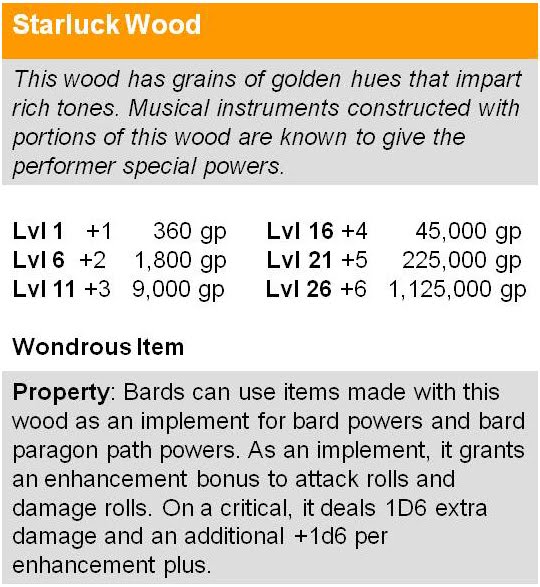
I really feel bards get a little shafted with musical implements. The big problem for me is that many bard rituals require a focus of a particular GP value. However the choices are rather limited. As I noted before talking about AV2, additional magical instruments were lacking. There are a few weapons that can act as implements, but some different instruments and/or wondrous items would have been nice in that book.
So I started mulling over some ideas to expand the number of items that could also serve as a focus for bard rituals. Rather than create a specific item, I thought about having magical properties in the components which an instrument is constructed from. Drums, lutes, lyres, even horns could have portions of the instrument made of magical wood, or special bone inlayed keys, all of which that impart some magical property. So players have some flexibility in obtaining a magical instrument of their choice (with a DM is willing to drop it in an appropriate treasure parcel) rather than having to work with the limited choices in PHB2.
So I below I have a few components that could be used to make magical instruments of a player’s choice. They might not even be provided as an actual instrument, but a portion of arcane wood that could be used by a craftsman to create one (which could be RPed out in a special session or a reward for a short quest). I hope some folks get some mileage out of these items.


Random initiative using cards
So with the greater tactical encounters my players are fighting, one thing that has been creeping in is the locked turn order. Everybody goes in the same order, round after round. At worse, if you blow a roll, you’re stuck going last the entire combat. Granted, for some groups, they might want this for tactical planning with their teammates (shifting for combat advantage or maneuvering targets for a blast spell). But my players wanted something a little more chaotic, so I thought of some alternatives.
We could roll initiative each round, but I dumped that idea as it would slow down combats. An alternative would be to have everyone roll 3-4 initiatives all at once. Each player calls out an initiative they want to use from their list. Every 3 rounds, I ask for a new turn order and write down what initiative the players call out. A little more paperwork, but it does throw in some randomization.
Still I was not too happy with that idea. I wanted something that was:
- Easy to run – It didn’t require a lot of record keeping and could keep things moving. Plus if I needed to hold up the action to work out some mechanic, I could jump right back into the turn order without a hitch.
- Simple to explain – If I needed another set of clunky rules to run the initiative, no sense in bothering.
- Reward high initiatives – If a player got a high roll, or invested into feats and powers to gain a higher than normal initiative, they should get some benefit.
- Random – I wanted a turn order that would be mixed up from turn to turn.
I settled on using initiate cards. Each of my players are assigned a card from one suit. I do the same for the monsters they fight (using another suit). Typically each type of creature gets a card, but I’ve broken larger minion groups up into 2 if needed. The key point is to have at least 1-2 monster cards less than the player cards.
I have players roll initiative, and do the same for my creatures. If players, or monsters, roll a 20 or higher (25 or higher for paragon tier, and 30 or higher for epic tier), I make a note regarding their card.
After shuffling the deck, I set aside the top half. Going through the bottom half, I note any player cards that rolled a high initiative (greater than 20). If so, I move it up one card in the deck order.
I then do the same for any monsters, with one exception. If a player card is on top of the lower part of the deck, it remains there (players trump monsters in turn order for this case).
I return the top half to the top of the deck, turn over a card and play out the turn. Next turn, shuffle, and repeat the process.
Things are random from turn to turn. If a player rolls a high initiative, there is no guarantee they will go first. However they can guarantee they will not go last (and likely be in the middle of the group for that turn).
My players have been loving this do far. I’m still thinking of tweaking the rules a bit. Say giving a player with a phenomenally good initiative one opportunity to jump to the top of the deck once per encounter. Or if players hold an action, move them down one card order the next turn (to impose a small penalty for going out of order).
On that last point I’ll say one thing my players have done a lot. I’ve been seeing players hold actions and waiting to run coordinated attacks, far more than with my regular games. It’s far from perfect, but my group has gotten a lot of enjoyment out of shaking up the typical encounter initiative. So if people have been adding a little randomized initiative in their games, what have you folks been doing?
The ‘bleah’ standard healing potion
I think healing potions are lackluster as is. The DMG encourages folks to regularly dispense them in treasure parcels. As is out of the PHB, players spend a healing surge and gain 10 hp instead of their regular healing surge value. This is all fine and good until you hit about level 4, then the 10 HP boost is almost up to par with your normal healing surge value. As per DMG suggestions, you should keep shelling out healing potions up to level 9. By level 11 you should be switching to the higher tiered potions of vitality.
Maybe I am doing my math wrong, but I see severe diminishing returns from these potions well before players reach the next tier. Okay at level 1 or 2, healing potions are pretty spiffy. Past that however, their value really becomes minor (even negligible) compared to a player’s typical healing surge value.
So I dumped healing potions in my game. I’ve instead ripped off an alchemical item from the Eberron’s players guide. I modified my healing potions to add a specific value in addition to what a player would gain spending a healing surge. They’ve been working fairly well. I think I’ll still have a problem when my group is teetering between heroic and paragon levels, but so far they are working tons better than the out-of-the-book varieties.
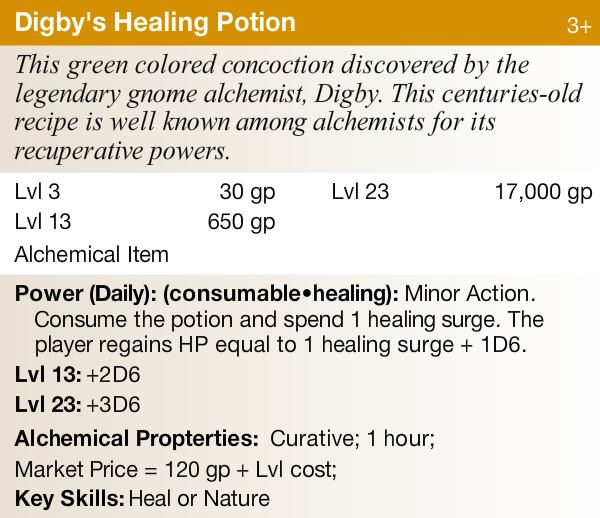
To mix it up, I do throw out the higher level healing potions occasionally. I don’t associate a price value with them, but in a pinch I would drop the price by half if a player were to purchase one. Standard healing potions are a great value for a few levels, but quickly drop off in worth once a player gets well within the heroic/paragon tier. So I present below Digby’s Healing Potion:
Digby’s Healing Potion
Level: 3
Category: Curative
Time: 1 Hour
Component Cost: See below
Market Price: 120 gp
Key Skill: Heal or Nature (no check)
This green colored concoction discovered by the legendary gnome alchemist, Digby. This centuries-old recipe is well known among alchemists for its recuperative powers.
I hope folks find this a useful item in their games. Anyone else finding the ‘official’ healing potions lackluster? If so, has anyone been using homebrew items?
Skill challenge scenarios: Discover the river pirate lair (part 2)
Last post was the set up for my group to find a pirate camp. After describing the situation they deliberated a bit on what to do next.
The rogue thought she’d keep a diligent eye out to see if there was any evidence of the pirates landing their boats (passed perception check). Seeing no obvious breaks in the vegetation, they likely were still on the river. The artificer of the group decided to provide another set of eyes and see if he could discern any trail (passed perception check). He also could not make any obvious trail along either shoreline, so thought it prudent to remain on the river. The warrior of the group felt he could help in finding the trail, looking ahead (failed perception check). However he found he was unable to see anything noteworthly in the surroundings.
Turn one tally: 2 successes and 1 failure
After nearly half an hour the party found themselves at a branch in the river. One appeared to flow into low hills, while the other appeared to be drawn into a canyon, having one shoreline becoming flanked by a sharp cliff. The rogue again felt it prudent to see if she could pick up a trail (passed perception check). The artificer wondered if he could find a way to determine which branch in the river the pirates took. A nature check seemed appropriate. Passing the check the dwarf determined that the river that moved along the cliff would likely offer more defensible positions if the camp was near the shore.
The fighter decided his skills for hunting down a trail on the river would be poor. Possibly a higher vantage point might be helpful? He convinced the group to beach the boat and see if they could pick up a trail on land. I let him make a difficult athletics check. Passing with flying colors, I said he was able to scale a cliff face and get a good lay of the countryside. He was able to notice several cave entrances further down the river.
Turn two tally: 3 successes for a partial success (earning half the XP)
It was well within the night now. The group crept along the river, noticing a minute flicker of light further up. As they carefully approached, they saw a large cave entrance in the face of a cliff, with the river’s water flowing deep inside. A campfire roared deep inside, and the players felt they had finally found the pirate camp.
That’s it for now!
Skill challenge scenarios: Discover the river pirate lair (part 1)
As part of a continuing series, I’ll be posting a few of the skill challenges I’ve run in my games. After describing the challenge goals and the mechanics of the outcomes, I’ll follow up on what the group did and how it played out.
Skill challenge goal: Find river pirate’s camp along the river.
The Setup – The river boat the group was guarding was attacked by pirates. After fending off the attack, the surviving pirates fled down a river branch on small boats. Using one of the crafts the attackers left, the group set off to pursue them, and hopefully find their base of operation. As they chased the pirates, they lodged their boat on a sandbar. Frantically trying to get the skiff dislodged, they saw their quarry round a river bend and out of sight. Several minutes later the group continued, only to lose track of the pirates. Did they pull off and head out by land? Or did they continue down river? The sun was setting and they had to move quickly to take advantage of what little light they had left.
I all ready set my mind that the players would eventually discover the pirate lair. What I wanted to determine in the skill challenge was how easy would they find it, and if they could approach the lair at an opportune time of their liking. The camp is a series of caves under a cliff that can only be approached by water. Also, I noted to the players that the surrounding countryside was dangerous and likely resting through the night would mean being attacked by some creature (3 in 4 chance of a random encounter). So taking their leisurely time to track down the pirate camp would be unwise.
Skill challenge rating: 2, moderate DC (encounter worth 2 monsters of the group’s level)
- Complete Success (6 successes) – Players manage to track down the pirate camp efficiently. They stumble across a narrow crevasse in one of the canyon walls. It would be an ideal place to rest up for the night (1 in 10 chance of a random encounter) if the group chose to. Continuing on, they discover the pirate lair in the early evening. They could move in quietly now, or rest through the night and try to attack the camp later the next day.
As they deliberate on a course of action, they see a boat creep out of the lair. Two pirates are paddling upstream to scout around. Players could dispatch them, capture and interrogate them, or let them go. Either way, the entrance encounter will be easier as some of the guards have left the camp.
- Partial Success (4-5 successes) – Players approach the pirate camp late in the evening. They have spent their reserves trying to make ground and are tired (losing 1 healing surge). Resting however, would be a dangerous option as all around them they hear the howls of beasts. They may be able to surprise the pirates, but unlikely at this late hour
- Failure (4 failures before either condition above is reached) – Players eventually come across the pirate lair early the next morning. The push through the night was tiring. Also they were harassed by particularly nasty river crayfish. While not a serious threat, some of the group suffered some nasty bruises from their powerful claws. Each player has lost 2 healing surges.Also they find the entrance to the lair guarded by a lone pirate. The element of surprise will be very difficult, and likely any pirates they find in the caves will be ready for them.
Primary Skills: Nature (+1 to rolls), as the ability to read the land and find likely locations that could hold the lair would be based on this skill. Additionally this skill can be assisted by other players.
Secondary Skills: Perception (+1 to rolls, cannot be assisted), simply being each party member carefully scanning their surroundings. As each player is busy looking for signs individually, players cannot assist each other when making this check.
That is the setup. Next post will be how it ran with my group.
Solo monsters and the ho-hum single turn
 A while back Mike’s Mind posted an idea of giving solo monsters more actions. I like the idea.
I find that typically the solo fights end up a tad boring. The excitement winds down as it becomes a slugfest to get rid of that last sliver of HP. Sometimes a well prepared party with plenty of tactics can chew through one. It just doesn’t make for memorable fights.
Quite a few people have posted similar problems. Usually most fights tend to drag on, and it becomes more of a matter of endurance than an exciting fight of maneuvering and cool attacks. The general consensus seems to be reducing the HP, and beefing up the damage by 1/2 a level for most brute-like creatures a good way to keep fights shorter and still remain a bit dangerous.
However adding a few extra actions outside the typical single initiative turn is something that would definitely shake up a solo combat. Yet, I still think having a ton of full extra turns might be a little overkill. I decided to tinker with the concept a bit.
I break down solo monsters to having a regular turn, and a bonus turn. At the start of the combat you roll multiple initiatives for the creature, one for each type of turn the monster gets. A regular turn is just that. The creature gets a standard action, a move action, and a minor action. A bonus turn can be either 1 standard action, 1 move action and a minor action, or 2 minor actions.
Depending on the level range of the solo monster, it will have varying bonus turns. A heroic solo gets 1, a paragon monster gets 2, and an epic creature gets 3. These are tacked on in addition to the regular turn each solo monster gets.
In the end you get a creature that is a lot more mobile and can dish out a few more attacks per round. Don’t discount the extra mobility, as it can likely lead to extra opportunity attacks against the group. The maneuvering and positioning is a big part of 4E. I think allowing that big bad solo monster a few extra actions during the turn something that’ll add a little excitement to a fight.
4E without miniatures?
So one of my players had hurt their foot and I was considering moving our game to their apartment for that session. The big problem was the place was a little small with no real room to plop down a whiteboard for minis (a typical apartment for most single people in Korea). Fortunately we didn’t have to change venues so I could host our regular game, but the situation got me thinking about playing 4E without miniatures.
As I’ve stated before I’m a big big fan of miniatures for playing D&D. I also think the way 4E is presented, going without a gridded map and minis would be a challenge. So if I were to run a game without miniatures and, more importantly, without a mapgrid how would I do it?
I would break down and still use some manner of tokens for play. It really helps visualize the action of who is where and whacking on what. Even if it were coins spread out on a coffee table, I think it would be difficult not having as least some kind of positional marker.
I would end up saying ‘yes’ a lot to players wanting to do cool things. If they wanted to charge across the room, yeah I’d likely let it slide and ignore any quibbles of actual distances. If they wanted to hurl out blast attacks and turn swathes of undead, yeah I’d likely just say yes a lot.
Sometimes though I’d want to throw a wrench in to see if a player could get into a flanking position, or if running by a monster might mean they get close enough for an attack of opportunity. I’d consider area attacks likely would hit 2 baddies with no problem, but I might roll a d8 for that third one. So a small chance that the monster is just out of reach, or the fireball didn’t quite get all 7 minions, all of those type of situations likely would require a roll of the die. Anything but a 1, and the player gets his desired result.
I’d use a 1d8 for typical resolution of player actions (with a bad result on a 1). I’d shift to a 1d4 or a 1d12, depending on how difficult the task, or actions of the player. Say a player needs to run by a monster in melee with another character, and wants to avoid an attack of opportunity. I’d normally pull out a d8, but the player says he is making a beeline to cross the room as quickly as possible, I might pull out a d4 to determine if he gets close enough for an attack (since he really isn’t worrying about getting swung at). However, if the player says he is trying to skirt around the fight as much as possible, I’d use a d12 (or just say he avoided the fight completely).
Using dice is a great way to randomly determine if someone springs a trap too. I’d use a 1D12 as a base (say a typical 8 x 8 room with 5 squares being trapped), and shift to other dice depending on the group’s actions (rushing through a hall rather than walking carefully). This is something I’ll likely start using in my regular game, even with using minis.
Typically my players map out a dungeon on paper, and switch to a map board once we get to a room that has an encounter. It sort of telegraphs the entire trap scenario when I suddenly need to have them place their figures out on the table. Using the die method, I can check each player to determine if they hit a trap first, then move the group to a grid board to resolve a trap encounter.
Why not a D6 and D10? I totally could use that. In fact a d20 is a good way if you need to resolve something at 5% to 10% increments (+/- 1 or 2). However, I like the simple idea of quickly shifting to different dice. It’s easy. More importantly when I roll in front of my players, I don’t have to twist around why this d20 rolled failed, while another d20 didn’t because of these ‘hidden’ modifiers and arbitrary DCs. They would know what happens when I roll a 1 on a d4, or with a d12.
I also like using a D4, D8, and D12 as the progression bumps up well with groups. Additive probability can be an issue with large groups. So that 1 in four chance of stepping on a trap trigger becomes almost a certainty in a party of 5. The same group would have an approximately 63% chance with D8, and 42% chance with D12. It scales pretty nicely.
I think 4E could totally be done without a gridded map. Less so without some kind of tokens (but I’d say the same with previous editions). I think quickly using a die roll would be a simple resolution to questions about ranges and distances. If you’ve been doing 4E without maps or minis, what tricks have you been using?
Lightening the coin load.
Being the nosey DM I am, I recently looked over the cash my characters were hauling around. So far they have not had a chance to spend a lot of the booty they recently earned, but I was surprised to see most had over 500 coins each (silver and gold combined). Even with the weight being pretty low, that is a lot of coins to lug around. As a US comparison in volume, imagine hauling around approx. 13 rolls of quarters on your person (not to mention a quarter weighs less than a standard D&D coin. Hold a dime and a quarter in your hand and you have about the right weight).
For portable wealth there are limited options for characters. Usually they are hauling around what they have. After a while, you get characters with an ungodly amount of coins. A DM could just forget about it and wave off worrying about encumbrance, or maybe seep a little realism into the monty haul players are lugging around. For me I usually don’t bother with encumbrance much. But once I get players carrying around 1,000+ coins, I begin to suggest looking into changing out some coins for more portable wealth. Here are some of the options I have in my game:
Spend it – I’m not a big fan of buying magic items, but I am warming up to the enchant item/transfer enchantment ritual. Visiting a local wizard to infuse an item with some enchantment is solid fantasy for me. I’m thinking of having a magic bazaar in one of the large cities my players will be visiting soon, and likely there will be more of an open market for some odd magical items.
I always push players to buy potions and other alchemical items though. And scoring a ritual scroll is always an option too. These are pretty useful items players can spend coin on. Given that they are one-shot deals, you don’t have to worry about having a player wield a potential unbalancing magic item.
Vaults – I don’t encourage this, but I keep the option open for players. I typically charge a 5% fee for depositing coins. Players get a note, and the satisfaction their money is in a secure location. But the problem is their cash is stuck in one place. They can’t get access to those funds in another city. I don’t consider vaults as a network of institutions where people easily transfer wealth (I’d tag on another 5% withdrawal fee if I did). They are vaults. Just a place where players can store items for long term in a relatively safe location.
Money Changers – This is something I use a lot. Simply an establishment that exchanges coins for other currency (or items of value) for a fee. I charge a 2% fee or 1 silver (whichever is higher) to exchange coins. I bump it up to a 5% fee for coins to gems (as precious stones are a bit less circulated). This is a quick easy fix to for the party that manages to get stuck with a lot of coin.
Magic – Consider having a wondrous magic item in your next parcel to tackle this. A bag of holding is a standard, but there are a few items that can do the trick. The Pouch of Platinum (AVault) is a handy item that not only converts gems to coins, but can also convert gold to platinum.
Rework Treasure Parcels – Consider giving out more gems. Expand on providing ornate artwork as treasure rather than coin. Sometimes it can be a chore, but having a few descriptive valuables in a pile of coins adds a simple touch to an otherwise boring haul. Also the players have a few less coins to lug back to the next town.
I figure most DMs don’t bother with the number of coins their players drag around. I usually don’t myself. But when it gets to a certain point, I like players to lighten the load with something more portable. What else have folks used in their games?
Skill challenge scenarios: Find the wizard, Nightshade (part 2)
So with part 1 of the challenge I set up my conditions for players finding the residence of an unpopular local wizard, Nightshade. This is how it played out…
Our rogue quickly went off to work her magic of interacting with people, very quickly she was able to track down someone that knew of Nightshade. He did indeed live overlooking Fallon Square, and finding the market should be a fairly trivial task (passed streetwise check). The druid decided to also try his hand at finding Fallon Square with some moderate luck (passed his streetwise check). The paladin of the group decided to wrangle up a local street urchin to act as a guide with the promise of a few copper pieces, but had no luck (failed his diplomacy check abysmally).
1st round tally: 2 successes and 1 failure
The group had spent the last hour making their way through the city and approaching the quarter that housed Fallon Square. The rogue again managed to work what contacts she could find to get to Fallon Square the quickest way, with the druid in tow, likely aiding by providing a menacing presence to more tougher-looking characters (passed streetwise check with the druid successfully making an assist check). The paladin decided to drop some serious coin with the promise of 5 silver to any that could guide them to the residence of Nightshade, and was able to get an urchin that knew of the odd wizard (passed a diplomacy with a +2 modifier due to spending some silver).
2nd round tally: 4 successes and 1 failure, leading to a partial victory (and 1/2 the exp from completing the challenge)
I asked the rogue of the party to make a perception check which she passed with flying colors. The group managed to wind themselves through several streets, and after nearly 30 minutes, came to the Fallon Square market. They noticed a wizard slowly beckoning them from a balcony. He motioned to a door below and entered a simple residence.
As the players moved towards the door, the rogue noticed a man skulking near an alleyway. She is certain the man had been following them since they entered the city quarter. They decided to enter the wizard’s residence, as time has slipped into mid-afternoon. But they were on their guard and agreed that once they obtained the potion, they should be ready for a fight.
I’ll be sure to post more of these as I run through challenges in my game. I’d be interested on other’s recounting of how their skill challenges worked.
Skill challenge scenarios: Find the wizard, Nightshade (part 1)
A few comments from my last post on skill challenges got me agreeing that more examples for challenges are helpful. And more importantly, actual examples of resolving them would really capture how skill challenges can work. So on that theme, I thought I’d post a few examples of skill challenges that I run in my games.
First off, I have my own house rules for skill challenges. The big change is introducing a partial success. this is a step below the number of rolls needed for a complete success, and usually mean the players just barely complete the challenge. I also have a few tweaks on assisting others, critical successes and failures, but for the most part I run them pretty close to what is in the DMG. So, onto the challenge.
Skill challenge goal: Find the wizard, Nightshade
The Setup – The group are new arrivals to a city and are approached by a merchant. He requests they make an errand for him. Time is of the essence and being well recognized, he fears being seen entering the residence of Nightshade might lower public opinion of him. A ragtag group of adventurers that just arrived to the city however, would likely not draw too much attention.
Nightshade has concocted a potion for him, and is expecting someone to arrive today to pick it up. However, Nightshade is not very popular with the commoners. They all fear him and think he is mad. Being a recluse within the city doesn’t help Nightshade’s reputation either.
The merchant states Nightshade’s residence overlooks the Fallon Square market on the other side of the city. They should meet him later in the early evening at a local tavern. Half a payment to secure their services for the errand now, and the remaining once they return with the potion. They pay itself is rather good, especially for such a quick task. But they should remember time is of the essence and he needs the potion by nightfall. Before the characters can ask any more questions, the merchant waves them off and heads elsewhere for other business.
Nightshade is indeed waiting for them and has the potion as the merchant said. What is unknown to the players is that a rival merchant does not want this transaction to occur. He has employed thugs to intercept the players once they leave the wizard’s residence. The thieves themselves have had one of their gang assigned to tail the players and determine if they were successful in obtaining the package.
Skill challenge rating: 2, moderate DC (encounter worth 2 monsters of equivalent level)
- Complete Success (6 successes) – Players find the residence after an hour. On a passive perception check (DC 15) they notice being tailed by a thug. If they intercept the thug, they will learn of the planned ambush after retrieving the potion. Also they will have plenty of time to explore the residence of Nightshade (a mini-dungeon in itself).
- Partial Success (4-5 successes) – The players get turned around a bit, and harried with poor reception of many commoners when asked about Nightshade. The trek takes a bit longer than expected. Have the player with the highest skill make an active perception check (DC 25). If they succeed they notice the tail as above. Also due to the time, likely the players will not have much time to explore Nightshade’s residence (and the DM should continually remind the players about the limited time while inside).
- Failure (4 failures before either condition above is reached) – Players find the residence much later than anticipated. They will likely have no time to explore Nightshade’s residence. They will also fail to notice being tailed by the thugs and not anticipate the resulting ambush once they leave.
Primary Skills: Streetwise, Diplomacy (Nightshade is not well liked and players will likely need a soft hand in getting directions from people) Secondary Skills: History (The layout of the city may be similar to others in the region, and Fallon Square is known as a popular marketplace)
That is the setup. Next post will be how it ran with my group.
 Geek Ken