Category: House Rules
The encounter grind
I’m playing with a smaller group with 3 characters right now. Despite the ‘ideal’ D&D party being 5 players. I suspect having a group that big really leads to the encounter grind. This seems to creep up in the game where a combat stops being an exciting tactical challenge and slowly grinds to a halt over long, arduous combats. I’ve seen a lot of people blog or post about solutions to the grind. But overall I think a big problem is that speedy, efficient combat flies in the face of larger parties.
4ED combat really has a lot going on. All monsters have special abilities and attacks. WOTC seems to implore DMs start throwing in neat environments and hazards to spice up combat encounters. More importantly, players now have a ton of tactical options at their fingertips. They really have to spend a little more time planning out their actions for a turn. Because there are so many decisions and so much going on, I really think smaller parties have a better time at it.
3 people is doable, but I feel the true ‘ideal’ party is 4 players. Have each one take a different role and you have a solid combat unit. The 3-4 character party allows for just enough XP to budget an encounter with interesting monsters, while keeping things small enough to get combats over in a reasonable time. Adding more folks sounds great, but in reality I think it just help make fights drag to a crawl. And keeping everyone engaged with what is happening becomes a challenge.
There are a few things I’ve been tweaking with though. I’ve been tinkering with removing 25% of the HP off of the monster totals, especially with brutes and solos. For non-elite/non-brute types, I’ll typically make sure bonus damage for their standard attacks is at least 1/2 their level. This means fights end a bit faster, while keeping the teeth in a monster’s attack.
Another key point is designing encounters with a mix of roles and trying to incorporate minions when I can. I try to avoid a lot of fights with solo monsters. And if running with a brute, I’ll try to throw in artillery types rather than melee skirmishers or soldiers (although a few lurkers with a brute can work well if you want a meaty melee fight). I tend to mix in more artillery types than controllers, as I think controllers usually drag the fights out a little. Yet, I think controllers work wonders with lowly minions and can make for an interesting combat, while doing the same controller combo with soldiers or skirmishers can make things a tad bit of a grind.
One last thing I do when making encounters is using creatures that are as close to the level as the PCs as much as possible. When you throw that +7 lvl monster out as a solo encounter expect a long, drag out fight, even if the exp budget works out. Keeping the monsters closer to the group’s level means the abilities and defenses scale up a little better. If players face a chunk of HP and a high AC to boot, you are going not get an exciting battle, but a multiple-round dicefest of ‘miss, miss, hit, miss’ that will slow the action to a crawl.
A way to get around that is just mix it up and throw a few other creatures into the encounter. Don’t be tempted to just plop down a single monster and call the encounter a solo fight. Get something a little closer to the party level and throw in some lowbie creatures to fill out the budget. Then you have your big baddie, plus a few smaller minion-types fluttering around in the background to harass the players. It’ll make things more engaging and avoid the slugfest of the entire party just repeatedly hacking away at the lone monster in the middle of the room.
Are you getting the combat grind in your games?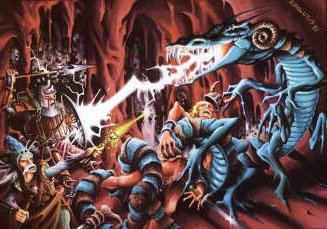
Running with New Players
I’ve had the great fortune in my current game of having some players completely new to RPGs. It has been a great feeling getting new people exposed to D&D and roleplaying in general. At the same time, things can get a little rocky. Its easy to overwhelm a new player with rules, tactics, options and choices. If you are in the situation of having a new player fold into an established group of veterans however, this can be even more daunting to the new player. I try to do a few things to make it easier.
Get them plenty of tools to learn the game – I get a copy of the quickstart rules to new players well before game night. Sending them a link via email or handing out a hard copy is a huge help to new players allowing a chance to get some of the mechanics down beforehand. During the game consider giving them a cheat sheet, especially something covering the basics of combat.
I’ve also become a huge fan of power cards. There are a lot of resources on the web. I’m a big fan of one site in particular as I can save and upload pages of cards I’ve already made. I print the cards, slap them between two self laminar sheets, cut them out, and you have a helpful play aid for a new player. I found it really helps having something physical in their hands (aside from a character sheet) to describe potential actions their character has during combat. Plus bookkeeping is minimal, as they simply hand over encounter and daily cards to the DM once they use them.
Simplify character creation – You have to be prepared to really spend some time on character creation with them, especially with the release of PHB2. There are tons of options and likely a new player is going to get overwhelmed quickly. I found a great way to approach generating a character is describing the 4 roles (defender, leader, striker, and controller) and have the player decide what role would fit thematically. Then I would give give a general description of the classes and races. Don’t bog down in stat bonuses and ditch the concept of min-maxing builds from the start. Priority should be something they enjoy playing, not that their racial bonuses are ‘THE AWESOME’ for a particular class.
I also keep several pre-gen characters on hand. If a character wants to play a dwarf cleric and I don’t have one prepared, I grab some other pre-gen cleric, scratch out any obvious racial abilities, and have the player run with it for the first session. Letting the player get a session under his belt allows him to get a feel for the game, well before making any long-lasting decisions with his character. He can then go back, shuffle around the stats, skills, and powers to fit his character a bit better.
Have a flexible first level – 4ED already allows you to retrain a particular power or feat each level. I make it a house rule that players can completely reshuffle their powers, feats, and skills after the first level. I also don’t have the players pick any perks for a background until they reach 2nd level. Sometimes they need to get a better feel for how their character works in combat. Maybe that idea of having an intimidating meathead did not work out, and they rather be a little more diplomatic fighter. I also like holding off the background bonuses to give them some time to figure out who they are after having a few RP sessions.
In game mechanic terms, maybe they realize they need to pick up another skill. Character-wise, they might realize a different motivation for their character and want to utilize a background that fits that concept better. As much as initial concepts might sound good, you really get a better idea on a character by playing it. I like being accommodating initially to allow characters to work out any kinks.
Hold off on the epic storyline for the 1st adventure (or 2) – A solo adventure is a great way to start. It is even better if the new player can run though a short session with 1-2 other players. Having a smaller group will keep the new player more actively engaged. If you shuffle him into a large group and just run with the regular campaign, likely he is going to be lost in the crowd for a few sessions. That small group for a first session will really allow the player to focus on their abilities and powers, with just enough help to figure out how they mesh in a group for future game nights.
Also, if you already have a relatively high level group. Playing a 1st level character, with a few of the veteran party members handling pre-gens, is a great way to get the new player up to speed with how game mechanics work. They can learn basic tactics, skill checks, how healing surges work, and the types of actions they can use during their round, all without getting overwhelmed by running a high level character. Consider the session as a ‘flashback’ to when the player was a relatively inexperienced adventurer. This also screams for the DM to introduce villains and other NPCs that are notable to the current campaign, and given the new guy has gotten a few lumps with similar past experiences means he can mesh a little better with the existing group in the gaming present.
That is about it for now. What other tips would folks impart about getting new players comfortable playing D&D?
Fiddling with Skill Challenges: Part 2
To continue on with my tweaks to skill challenges, I’ll add a few more points on aiding others and detail the effects of critical failures and successes.
Each skill challenge I write up has a set of primary skills and secondary skills. I try to list off skills that would provide a direct solution to a challenge as the primary skills. Skills that might have an application I consider secondary skills. If players use skills from either of these sets, they gain a +1 bonus to their checks. The main difference between primary and secondary skills is that players can only assist characters making checks with primary skills.
I further tweak cooperation checks also. If players fail their roll to assist another character, they actually give the target character a -2 penalty to the current check. So players assisting another can either hinder, or help, their party members. This keeps them involved and helping towards the group passing the challenge if they don’t want to risk earning failures, but adds a small element of risk to it.
Keep in mind with everyone assisting 1-2 players, you will likely get a partial success before a complete success. Yes, this makes it easier for players to pass the challenge but typically they just barely fulfill the conditions for doing so (and get half the XP).
I use elements of critical failures and successes for rolls of a natural 1 and 20. A natural 1 automatically grants a -4 penalty to the current check, and for the next roll on the following turn. So if the current total including all modifiers (including the -4 penalty) beats the target DC, a natural 1 one can still be a success. On a natural 20, the check is automatically a success and the following turn the player can add a +4 bonus to their roll.
A quick summary for how I run my skill challenges:
• Each challenge has 3 possible results: complete success, partial success, or failure. A partial success is typically 2 less the passed checks needed for a complete success. For a trivial challenge, a partial success is 1 less (4 for a complete success, 3 for a partial success, all before getting 2 failures). A partial success is worth ½ the XP a complete success would grant.
• Challenges have 1-2 skills assigned as either primary or secondary skills. If players use these skills, they gain a +1 bonus to their check. Only players making checks with the primary skills can be assisted by other players.
• If players successfully assist a player, they grant a +2 bonus to the current check. If they fail, they grant a -2 penalty to the current check.
• A natural 1 incurs a -4 penalty to the current check, and to any rolls made the next turn. A roll of 1 may still result in a success.
• A natural 20 is an automatic success and gives a +4 bonus to a roll for the following turn.
• All the players describe their actions. The DM and players determine the likely skill used. Players then all make rolls and check their results against the target DC (modifiers from players assisting other characters are also applied). Results are tallied and then used to determine if the challenge is passed. This is repeated until a complete success, partial success, or failure is reached. Remember that all players are contributing every turn (either by assisting or making skill check attempts).
I like having layers of results for skill challenges. A key point to this is making sure that partial successes mean the players ‘just squeeze by’ claiming a victory. Typically I’d be willing not only to give an advantage for earning a complete success, but also be willing to incur some penalty for obtaining a partial success. Earning action points and taking away (or granting) healing surges work great for discriminating between a complete and partial success.
I hope a few try this out, and more importantly, give a little feedback. Later I’ll likely offer up a few key examples of this skill challenge variant in action.
Fiddling with Skill Challenges: Part 1
I like skill challenges. I like the idea they can serve as a structured framework for outlining milestones during a RP session, and more importantly, offer a set way for awarding experience. I love the idea that RPing an encounter can be rewarded with XP, similarly to cutting through a swath of kobolds. Skill challenges are a neat addition to 4ED.
Running skill challenges however is a bit clunky. I’m expecting the Dungeon Master’s Guide II having a larger section on skill challenges, including a lot of rule variations. Combined with the cooperation rule (PHB pg. 179), players can easily take a challenge that is supposed to be engaging roleplay to new heights of drudgery, rolling dice simply to give that one character with skill training the ability to trivialize any skill challenge the DM throws their way. I felt skill challenges could be tweaked a little.
There are a lot of alternate rules out there for running skill challenges. One alternate set of rules I found particularly interesting was the Obsidian system for skill challenges. But I did not want to wander too far away from the 4ED rules. I liked the ones laid out in the DM manual, but I just wanted to tweak them a little. So I took one concept from the Obsidian system and put another result in skill challenges, a Partial Success.
A partial success is a result 1-2 less from the total needed to complete a normal skill challenge. So complexity 3 skill challenges would require 8 success results for a complete success, 6-7 successful results for a partial success, and either must occur before the players tallied 4 failures (failing the challenge entirely). The exception for this would be a trivial challenge, where a partial success is simply 1 less from the total needed for a complete success (4 for a complete success, 3 for a partial success, all before getting 2 failures).
So what does a partial success mean? At its core, the players complete the challenge. They successfully negotiate a price, obtain a ritual, or make it across the desert. A complete success rewards the same thing, but they have some advantage by winning the challenge, such as getting an even better negotiated price, obtain the ritual along with components to cast it, or make it across the desert without losing any healing surges. Using a two-tiered success results allows me to give varying rewards instead of a ‘pass/fail’ result. As for experience with a partial success, I reward ½ the XP players would normally get from completing a normal skill challenge.
There is a trick to running these though. Everyone states what they are doing. The DM and players wrangle over what skills would be appropriate. Then each player rolls a D20 and checks against the challenge DC. All players roll during each round, and every roll is tallied during each turn. A success always trumps a failure after the totals are summed each turn (something that could happen with large groups even with simple challenges). I allow players to aid another player also, but I’ll put a few more details on that in the second part.
Overall, it does make skill challenges a little easier for the players. But if they really want an advantage and serious rewards, they have to push their luck making active skill checks. With a partial victory the skill challenge is a success, however they just barely fulfill the conditions for doing so (and get half the XP).
This isn’t the complete set of rules I use for skill challenges. I have a little more on primary and secondary skills needed for a challenge, plus critical failures and successes on those 20s and 1s, but I’ve outlined the framework here. Adding another tier to the challenge allows me to tinker with the rewards and outcomes. Much better than the simple ‘pass/fail’ results of the typical 4ED challenge. I hope some folks are willing to give this a spin and give their feedback.
Working with Extended Rests
Like just about everyone running a D&D game, I like to tweak the rules a little. I think the 4ED rest and recovery rules work. It keeps players in the action and taking an extended rest effectively replenishes all their resources including HP. But I wanted to put a brake on players using all their healing surges, drop severely low on HP, and just take an extended rest to do the same thing next day. I just feel continually taking extended rests could easily be abused.
To get around this I modified the extended rest rules a little having the player recover healing surges differently, and it being largely dependent on their condition before they hit the sack for 6 hours. I feel that daily powers and HP have to be replenished to their full amount, no matter what condition the player was in before the extended rest. Dragging out HP recovery over days just seemed to hurt the player. Besides, if you buy that HP are more about endurance and will power, rather than just tick marks for vitality, it doesn’t make sense hampering HP recovery.
So after an extended rest, the player regains their maximum HP and regains all their daily powers. However, recovery of healing surges depends on the following conditions before they take an extended rest:
Is the player at less than full HP? – If the player has less than full HP before they rest, they gain their full healing surges (HS) -3. If the player is bloodied, they gain full HS -4 (4 less healing surges from their maximum).
If the player is at full HP, how many HS have been currently used? – If the player used 4 or more healing surges, they regain full HS -2. If they used 3 or less, they are at full healing surges after an extended rest.
Players should be encouraged to burn through their healing surges, and possibly use them in combination with encounter powers, to be at maximum HP before they rest. The player recovers less healing surges if they have any damage at all (even being one point under their maximum). So it is worth using up all those surges to get back to max HP before resting.
In addition, if players take a comfortable rest they gain back one more healing surge (a bloodied player resting in an inn would be at full HS -3 after an extended rest, not full HS -4). A comfortable rest means the players are in a sheltered location (not exposed to the elements), eating a prepared meal that is not trail rations, and are in a relatively secure location (not taking guard shifts).
This encourages players to seek out civilization and crash at an inn, rather than being cheap gold misers sleeping in the woods all the time. Granted some players might feel their character is more at home in the wild, but taking the time to get a campsite together, rustle up some food and water, and sleep hoping nothing stumbles on them in the night, will likely make the player not be at 100% the next day.
I’ve been a little lenient applying the comfortable rest bonus to characters using specific rituals. Create campsite ritual (PHB2) is a great example. Using traveler’s feast combined with eye of alarm (or magic mouth at an entrance to a small cave) would also work, especially if the players packed a few tents. I think rituals seemed to be glossed over in 4ED and with a little tweaking, they can add a lot to the game.
That’s it for now. Another example of using healing surges instead of HP to hamper, or reward, the players.
Suggestions for Small Groups
Being in the Asian hemisphere, I find that RPGs are not that popular here. Still I managed to get a few folks together that wanted to play D&D. The incredibly fun part of the group is that they are all relative newbies, not having a lot of baggage from previous editions (also, I could regularly flub the rules and not get caught on it too much).
Having new players is loads of fun. Yet the immediate pressing problem I had was a two-player group. D&D is completely playable with less than a group of 5, but 2 players can really hinder the type of encounters I could throw at them. They decided to play a rogue and a paladin so at least they were covering some different roles in the ‘Leader/Striker/Defender/Controller’ party makeup scheme. But I think with just 2 people, the game could get stale fast. Typically they would be pairing off against a soldier, or brute-type and a swath of minions. The exp budget I would have for encounters would just be too low to have a lot of different creature types out at once.
I added an NPC character to the party, Torr, a shifter druid. I figured a controller that was a ritual caster (and could provide a little healing to back up the paladin) a good choice. So far it has worked out exceedingly well, and it has added some interesting dynamics to RPing for the game.
I’m not constantly at odds with the players. Face it, typically the DM is playing the opposition, and usually we are at just as conniving, manipulative, and self-serving with our verbal actions as the players are. Granted, it’s all part of making the game interesting for the players, still at times I feel I’m working against them. Maybe my players are metagaming when they throw out, ‘So, what do you think, Torr?’ Yet, it gives me an opportunity to subtlety nudge the party in a certain direction. I have a chance to drop hints or suggestions to the players without being too obtuse. Having an NPC in the party is allowing me to smooth over those sticky RP situations and keep the story moving.
The only problem I have is when combat rolls around. Effectively, I’m helming another monster, trying to work out what attacks and maneuvers I should make to work with the party. I’ve been toying with the idea of letting the players take over the NPC party member in combat. Rotating who controls the NPC, switching off every round, will likely prevent one guy from completely monopolizing its actions. I’ll have to take that for a spin, but my players may not like having to think out the actions for another character. They seem content with being the master of their own persona.
I might try another alternative and truly have an NPC type with less powers, but I think something like that works well in a striker/defender roll. I think leader and controller types really need a lot of options to keep viable. Something else I think I’ll have to try out.
Another huge problem is blown encounter and daily powers. Having such a small group, I’m finding a missed attack or power can lead to some serious consequences. I’ve worked around that allowing player to have additional uses for action points.
For parties of 3 or less players, I’m allowing players to burn action points to recharge missed encounter powers as a standard action. Additionally, I’m allowing players to use an action point during an extended rest to get back a daily power if it missed during the encounter. Now my players are really striving to use those dailies. If they miss, they know they can get it again (provided they live though the encounter). Plus that failure to use a cool attack is lessened for the encounter powers. All of it adds to the survivability of the party, and allows them to have more fun.
Regarding Rituals
 I like the direction that 4ED went with rituals. Give the players a bunch of cool spells that just about everyone could cast (if they picked up the feat). I like that they were displayed as a different set from other powers, allowing the player to cast them without having to bother memorizing them for the day. In that aspect I always thought the wizard got the shaft in previous editions.
Why bother memorizing all the wild utility spells if it took up a slot for something more important (like fireball)? I guess most folks liked the logistical challenge of trying to figure out what spells would be pertinent for the adventure. Typically I found everyone just taking an 8 hour rest to memorize the spells they needed (like identify 4 times), and then re-memorize the typical layout later (or they end up making a stack of wands and scrolls). Yeah, I like a player being able to cast the neat stuff without having to take up a slot from their bread and butter spells.
However, rituals aren’t quite perfect. Aside from casting times, I tend to think the component costs are pretty outlandish. The casting time I can sort of understand. If it was a quick cast, players would be casting knock on every door and teleporting everywhere. But combined with the unusually high components, I can see players sort of bypassing rituals.
It’s a shame as I think rituals allow the players to do the really cool RP things. They really can help push the story forward, and clever players are going to find unusual uses for them. From my post on extended rests, folks can see I like to encourage casting rituals. So I decided to give the player a little incentive doing so.
I reduced the component cost for casting rituals. For heroic rituals (1-10) components cost 50% less, for paragon rituals (11-20) the cost is reduced 25%, and epic rituals have no reduction in component cost. For some specific rituals that required a particular focus (Leomund’s secret chest, enchant magic item, etc.) the costs for these focus items are not reduced. Also raise dead has the same listed component cost, as I consider the game effects to be too large to discount.
I also started to freely throw around ritual components to supplement treasure parcels. It’s really easy to add a few odd bits here and there, especially as different rituals require a variety of components. Its another way to add a little variety to those listed treasure parcels.
I still have not delved too deeply into awarding rituals that can be copied. I usually drop the one-shot, scroll rituals as they can really give the party a much needed clue to keep them on track (hand of fate, anyone?). But given the cost for obtaining a ritual, I see the opportunity to pick up one completing a quest, even on behalf of an arcane benefactor, a possible incentive for a few of the players in a party. This can definitely can add a little drama to party dynamics if the group is happy completing a quest and ready to head topside, while the wizard wants to push a little further on for the potential of obtaining another ritual.
So rituals…hate em? Love em? And any tips how you folks use them in your campaigns?
 Geek Ken