Category: Miniatures
Plastic Soldier Co. German infantry
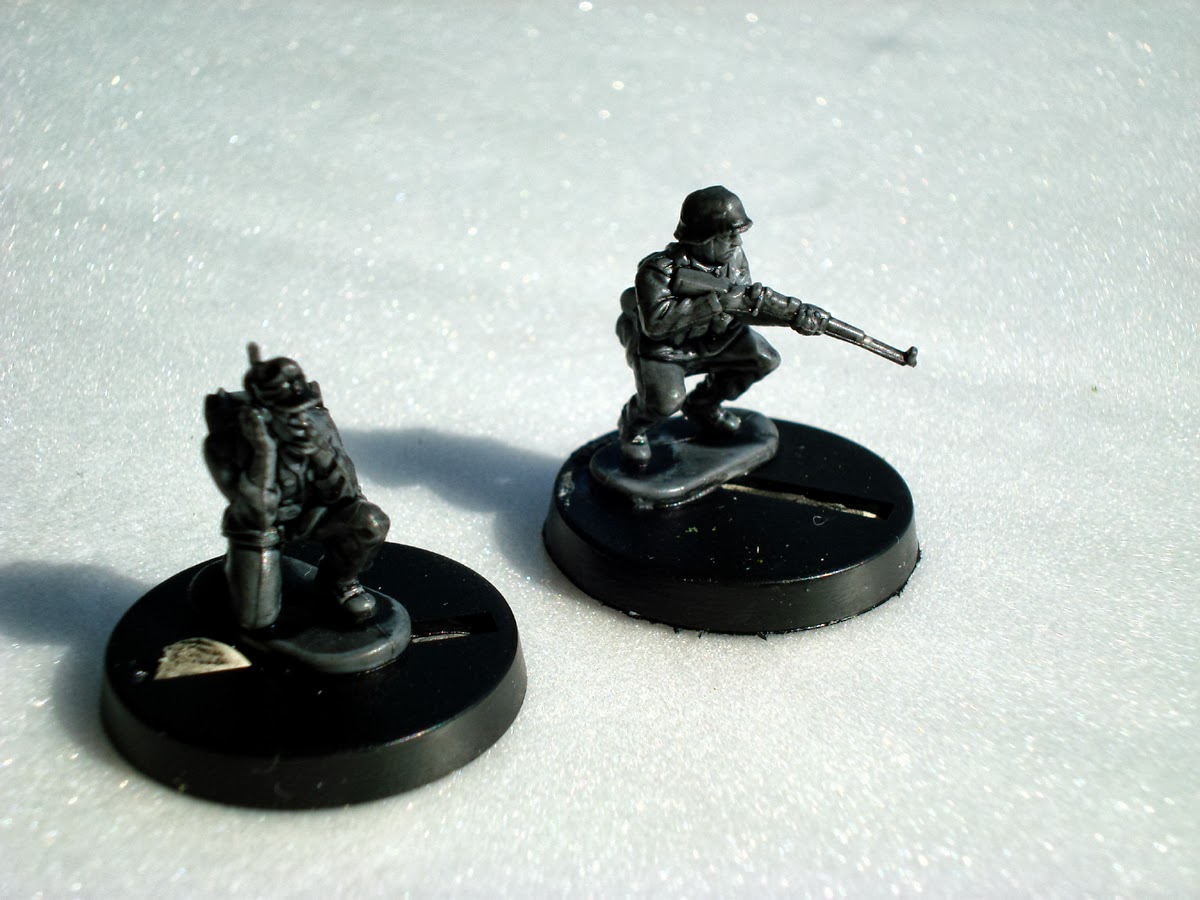
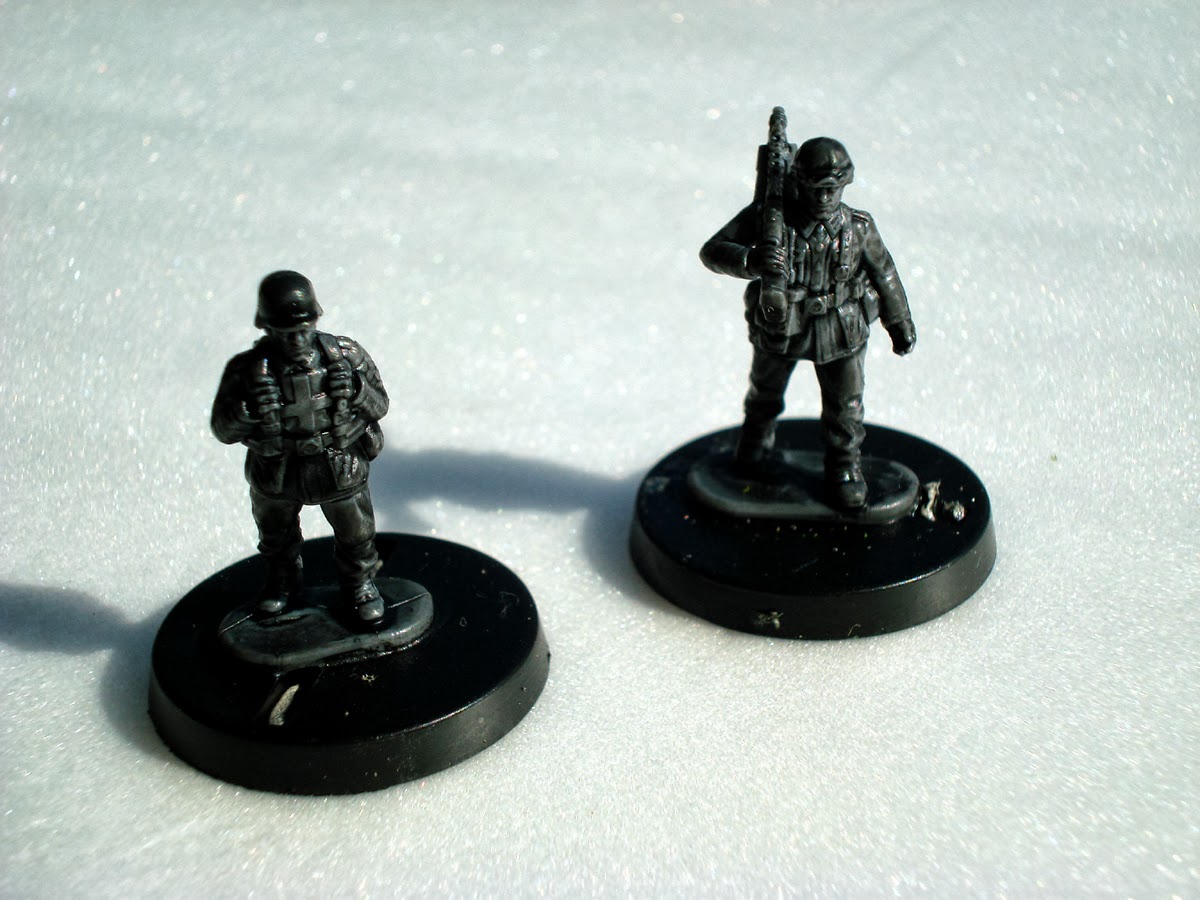
A while back I posted on some British troops I had picked up from Plastic Soldier Company. I usually end up getting two armies when I jump into a game system. So while I was happily working away on my British, I also decided to get some 1/72 scale German infantry from Plastic Soldier Co.
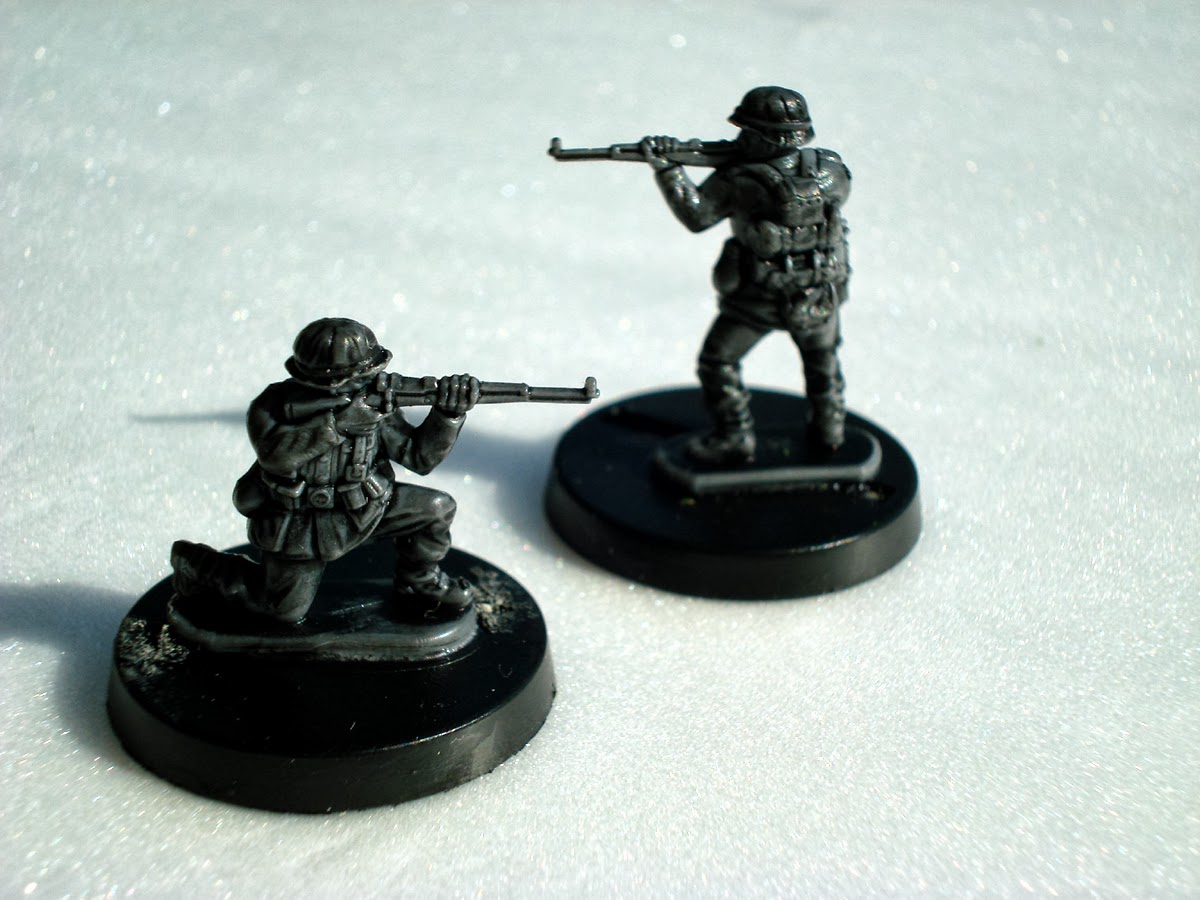
While I complained some on the detail of the British troops, I cannot say the same with the German figures. They all have very nice detail on the packs and other parts of the figures. I really hope the company considers dabbling more in the 28mm scale. These miniatures would be a great alternate to the official Warlord products out there.
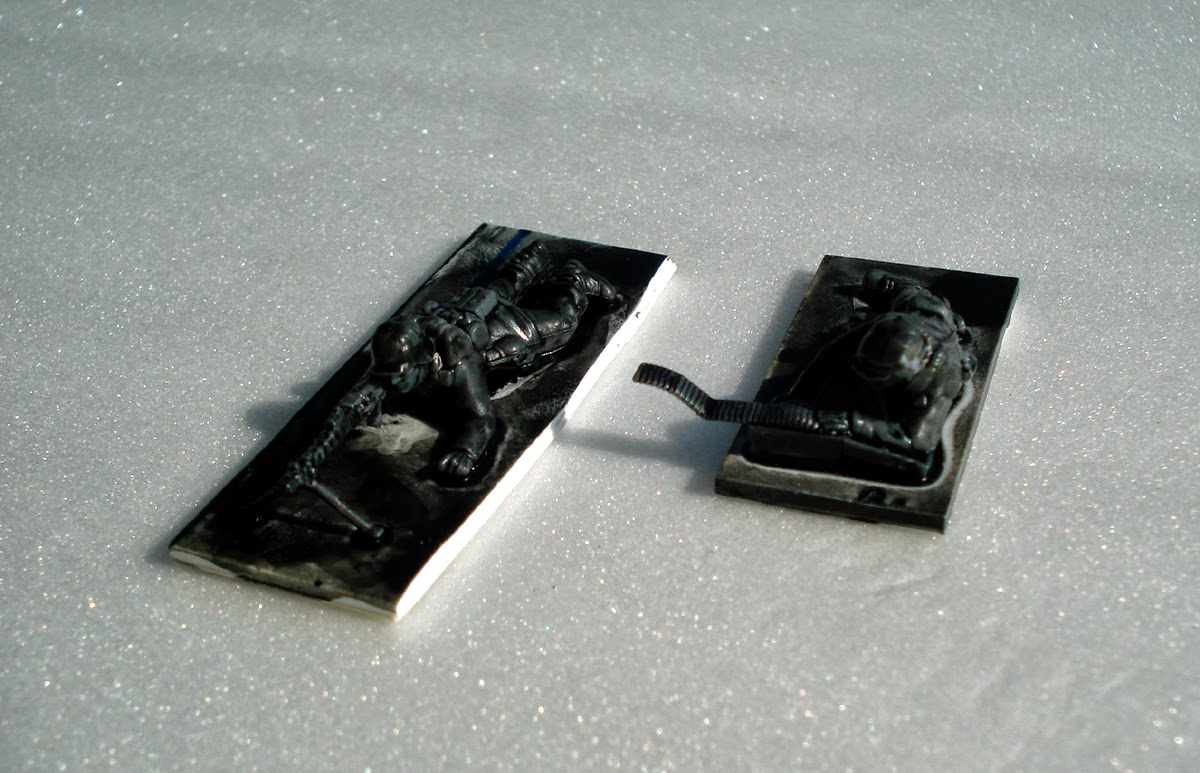
You get a rather large platoon with LMG teams, NCOs, figures with MP-40s, even medics. Plenty here to provide a core force for a Bolt Action platoon. It’s a great buy with nice figures making up the set. These figures here were given a thin coat of black primer wash.

Review: 5150 – Star Army
Two hour wargames has a slew of settings using their Chain Reaction rules (which are available free). Their sci-fi ruleset is 5150: Star Army which is designed for a variety of scales but works for best for 15-28 mm. Now Chain Reaction has been out a while now and this is not the first iteration of their sci-fi rules. Their latest version, which came out in 2011, shows that as it seems much more polished and refined as a dedicated ruleset of military style engagements.
The game is designed to handle small squad engagements up to a company in size. More rapid games usually run about a platoon size with some armor assets. It truly is a skirmish game however, with individual models taking actions and isn’t necessarily abstracted out to the squad level like some other games (ex. Bolt Action). Because of this, units have a lot of flexibility on the battlefield and can split and form up easily. This is especially nice as you could have a support team set up to cover the rest of the squad when it assaults, allowing for more interesting tactics.
The core aspect of Star Army (and all Chain Reaction games) is the reaction system using a couple of d6. When called upon to do something, the model rolls 2d6 and tries to score equal to, or under, a set value of its reputation or ‘rep’. It can either pass these tests with both dice, one, or none. Rep ranges from 2 (very poor, civilian type troops) to upwards of 6 (hero-like reputation) with most troops ranging from 3-4.
Initiative is randomly determined based on rep. Each player rolls a single d6 and all units/models that have a rep equal to or higher than the roll can activate for that turn. Leaders can utilize their leadership for units under their command, allowing a group of irregulars with a rep of 3 to likely activate with a well-trained leader’s rep of 5. Once a unit has activated and done their movement and firing it’s done for the turn.
This looks initially as a simple IGOUGO system, however it’s actually a very fluid action system where units can fire and react multiple times. Each time a unit sees an enemy pop into LOS, or is fired upon, they can attempt to react and return fire. So all units are consistently on overwatch and react to events around them. This is curbed by the requirement of passing checks to react.
The number of passed tests indicate what actions they can undertake. If they pass with 2 dice, then they’ll likely fire to full effect. If only one die passed, limited fire is an option, with no dice meaning the unit might actually scramble for cover instead. All of these tests are based on a chart broken up by the action the unit is reacting to. If it’s fired on it uses a specific row. If it suffers casualties, a different chart row is consulted. If it requires a cohesion test, another row is looked at to determine results, etc.
To explain the shooting steps further, each weapon has a number of dice rolled based on its target value (or effective firepower) with most rifles throwing 3 dice. The player rolls a d6 and adds their rep value trying to get over 7. This target number is increased upwards to 10, based on cover for the target or actions from the firing unit (like firing on the move, etc.). All rolls that hit are then rolled for damage, where a player needs to roll under the impact rating of the weapon. The impact rating will vary depending on the armor of the target. Soft armored troops have a higher impact rating for weapons compared to heavy, or exo-armored troops. Typically wounds are scored on a 1-2. It’s an easy system to resolve.
Close combat is a little more abstract. Units roll multiple d6 based on armor and weapons. Rolls of three or less are considered successes. The difference between the scores becomes the number of casualties for the losing side. This may also force a morale test where the losing side can break and run. Overall it’s a pretty simple, abstract system to run.
There are also rules for vehicles, however most revolve around armored fighting vehicles like tanks and APCs. Flyers are not really part of the rule system for on table models to use. Rather they are incorporated into scenario assets as air support, or for rapid insertions. As for these additional rules, there are a lot of options including snipers, artillery strikes, boobytraps and mines, even defensive ambushes from small teams.
There are a few simple scenarios presented as a patrol or a defensive/offensive actions, where the player can determine the objective for their units (ex. either to destroy as much of the enemy as possible, or get units off their opponent’s side of the board). And there is a rather interesting campaign mode detailing the attempt for invading a planet.
I’d be remiss to not mention that the rules also support solitaire play. As the game revolves around passing reaction checks, the authors were able to come up with some clever automated rules. Enemy units are represented by random tokens. When the player finally gets a token in sight, what it actually represents is randomly determined depending on the type of scenario played. Each unit has a scripted AI sequence and provides an engaging opponent. It works rather well as a solo game.
The background of the universe is paper thin. There are not any set rules for creating alien races. However there are unique abilities and characteristics for different races provided. Further the reaction tables for each race are somewhat unique. They can be tailored to fit a variety of unit types. There are also additional rules for ‘bugs’ or alien races that are more feral and primarily employ close assault attacks (for those folks wanting to try an Aliens or Starship Troopers type of game). The game also incorporates different armor and weapon systems. Combined with rep values, you can model a variety of troops with the default charts and tables. This could allow a disparity with tech values among alien races, to pitting battle-hardened veterans against green irregulars.
Another key aspect of the rules are the leaders or what the game calls, Stars. Models are split into either grunts or stars. The stars are larger than life heroes. Many of their reaction rules are ignored, allowing greater autonomy over how a star reacts in battle. Additionally there are rules for making them more resilient to damage.
What you should be able to take from this is how utterly flexible the rule system is. It can surprisingly incorporate a lot of different play styles and genres. If someone wanted to run a Star Wars type game with jedi and sith duking it out as stormtroopers and rebels fire away with blasters, it can be done. The base system is rather simple, but incorporating company assets you could get a variety of off-board support for a patrol scenario. Additionally there are rules to allow a simple firefight to roll into a larger engagement, with additional reinforcements coming into the fray.
There might be one detraction with this system. It is very much an old school wargame ruleset. There are no points. There isn’t really any guidelines for making a balanced fight. Instead the players are asked to use their judgement and try to make the game as fun and challenging as possible. The rules assume that the game is run through a gentlemanly agreement rather than a competitive tournament style.
The Good – How the turn progresses is very fluid. The chaotic escalation of a firefight where units either hit the dirt or return fire is engaging. Everything comes down to leadership, with poorly trained troops being unlikely to react to events unfolding around them, but occasionally they might show initiative and react accordingly. It’s very organic despite the apparent free flow of play and is a nice skirmish set of rules.
The Bad – It can take a bit to wrap your head around the rules. Things are broken up well and it encourages the slow digestion of rules followed up by play. Nonetheless it requires a lot of charts and condensed quick reference sheets for each force. You are rolling off on tables and there are differing results depending on the condition of the target unit.
Lastly, the game does commit one great sin in my eyes. Not all die rolls are interpreted as high or low. For most of the game rolling low is good except when it comes to shooting, where you want to roll high. This small difference can break up teaching the game and impedes the processing of rules some. Lastly the game does depend on players with a similar mentality for balance and fun. There is nothing stopping a side from going all out in a battle, bringing in tons of tanks and platoon assets, with troops armed (and armored) to the teeth, other than being a jerk. I find it refreshing to have rules adopt a more free attitude towards force construction but some might like a more concrete set of rules for platoon composition.
The Verdict – I really enjoy 5150: Star Army. It’s got dynamic play with unit activation and reaction. It handles military small unit action very well. It’s a surprisingly flexible system that can incorporate a lot of different genres, and can handle quite a few units on the table. It could easily be tinkered some to run a modern insurgent-type squad engagements, up to more cinematic, over-the-top heroic action. The sheer amount of layers of rules is fantastic. From campaign rules to solitaire or team based games (being run against an AI opponent), there is a lot of muscle with the rules to run a variety of skirmish games.
One slight detraction could be just that. It is very much an individual model skirmish game. Actions and reactions are based at times on individual models. This can slow down a game some with a lot of units. Especially when you have multiple units reacting to the same acting unit. However, this also means the game can accommodate a lot of different playstyles, where players could throw heroic type individuals into the mix of different squads and still have a fun game. Not all game systems could handle this well.
Overall I would recommend 5150: Star Army. It’s a solid set of rules for military skirmish wargaming. Turn progression and resolution of actions are dynamic allowing for each player to roll a lot of dice and (hopefully) react to their opponent. The solo rules alone could be a reason to pick this up. If you are looking for a sci-fi ruleset for platoon infantry combat, you’ll find this book a good buy and fun to play.
Secure the Sector: a Bolt Action alternate scenario for Maximum Attrition
I do love me some Bolt Action and the scenarios in the book cover some different tactical challenges. However one scenario that stands out for me is Maximum Attrition. The object is to kill as many of your opponent’s units as possible with your troops walking in on turn one. It’s a throwback to 40K where you are just out to kill the enemy army.
Now as a first game scenario, maximum attrition isn’t too bad. The objective is simple (pile up the bodies) and you get to see how everything works. However after playing it a couple of times, it’s become a re-roll for me when deciding what scenario to play.
Not to poop completely on 40K there is a fun scenario in the older editions called Cleanse. The object is to take and hold table quarters for victory points. Tinkering a bit more with that concept, I figured a similar victory condition could be worked up for Bolt Action.
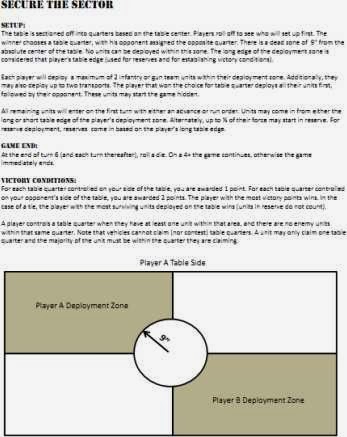
The end result is Secure the Sector. Players have a limited set up in a table quarter with reinforcements coming in on the edges of their deployment zone. The objective is to claim as many table quarters as possible by the end of the game. You get more points claiming quarters on your opponent’s side of the table. In the case of a tie for points, the victor is determined by the number of surviving units.
Secure the sector focuses on advancing and taking large sections of territory. You still have to eliminate units but it’s tagged with pushing forward and holding positions. In my experience, maximum attrition comes down to a waiting game. One player finally makes the advance and if they can’t come to grips with enough of the enemy quickly, they get chewed up with pins and counter assaults. I like how this scenario encourages you to capture areas outside your deployment zone, all the while trying to minimize your losses. Another big wildcard with how the scenario plays are reserves using flanking maneuvers. It can make those players that turtle up in their deployment zone, suddenly have units contesting their table quarter at the end of the game.
The couple of times I’ve playtested this, we’ve had a lot of fun. Hope folks enjoy this scenario at their tables and use it as a replacement for maximum attrition.
Review: SAGA
 I never really had the calling to get into ancients or medieval wargaming. A long while back I was into Warhammer which seemed to scratch my itch for medieval-type gaming. Big blocky units moving in formation, a crash of cavalry in a wedge charging a flank, rows of archers and siege weapons, it just was more fun for me to collect and paint minis for fantasy armies than a historical game. I dumped my Warhammer stuff years ago but lately I’ve considered getting into historical ancient gaming. However I really didn’t want to go the route of a huge army. Maybe something smaller scale. So along comes SAGA from Gripping Beast and Studio Tomahawk.
SAGA is a skirmish wargame set very loosely in the mid-11th century. Players form small warbands and battle it out over a small stretch of earth, pitting each warlord-led host against each other. True historical scenarios are somewhat thrown to the wayside and the game pretty much embraces a ‘what-if’ sort of vibe, which is just fine. You aren’t recreating historical battles here. It’s pretty much small unit action of a group of 30-60 men and mounted horses.
The scale is man-per-model and is about 20-28mm. Ranges are set increment range bands. So Very Short is 2″, Short is 4″, Medium is 6″, etc. with ranges maxing out at 12″. Movement is typically 6″ with shooting at maximum ranges of 12″. All references to distances use this nomenclature of range bands. What is particularly nice about this range system is its flexibility. If you wanted to run a 15mm game, just alter the range band scales from inches to cm. Simple.
A key component of the game is the battle boards. Each faction has its unique chart that describes the various actions and special abilities related to common tactics and characteristics of that group. Players roll saga dice, these special d6 (although a normal six-sided die could also be used) and allocate them to different sections on the battle board. The saga dice themselves are 3 symbols unevenly distributed. Effectively one symbol represents 1-3, another 4-5, and the last symbol is a ‘six’. During their turn they spend upwards of 6 order dice removing them from the board and activating certain abilities (some allow more dice to be used up to a maximum of 8). Once they spent the dice they care to, their turn ends and their opponent takes a turn doing the same.

I love it. Certain units will only activate on a particular die range, with the most trained units being able to always activate. You have special abilities that enhance attacks. You also have abilities that can be spent on defense during your opponent’s turn. So deciding what dice to use for activating units and attacking, while keeping a precious few in reserve for your opponent’s turn is a key part of the game. It’s a surprisingly dynamic system where you have to plan out attacks and be prepared for charges.
As lesser trained levy units don’t activate as much (50% of the time) and they share an activation die symbol with more powerful combat abilities, in effect you have leadership become part of order dice allocation. It’s an exceedingly clever system. It builds in that unknown of not being able to count on poorly disciplined units when you need to. To bypass this, you have a warlord for your warband that can order movement to units within range. So if you really need to move those peasant archers, you can bypass the die order allocation with judicious placement of your warlord.
Another nifty point is that units can activate multiple times. So you can take that elite unit of troops and go all out in a fight if needed. However each order beyond the first accumulates fatigue. Units also get a fatigue marker for shooting or being in melee. Fatigue can also be gained if nearby units are wiped out. If a unit has a certain amount of fatigue (which varies depending on the unit quality) it cannot do anything but rest, removing a fatigue token while it does so. If attacked while fatigued, the unit will also fight significantly less effectively. Essentially it incorporates some aspect of morale for units.
Fatigue can also be spent by your opponent. They can be used to decrease a unit’s combat effectiveness in a melee, or be spent to increase the likelihood an enemy will land a blow. This all adds a tactical layer to the game making it very engaging. If I push a unit to move and attack, I’m decreasing the chances I can use it again on later turns. Even worse, an opponent could use that accumulated fatigue against me if that unit is charged by the enemy. Meanwhile, my opponent seriously has to think about that decision of using my fatigue. If they can’t inflict significant casualties, my unit will be able to activate on future turns (as they’ve removed fatigue markers on my unit). This is a really cool feature of the game and allows both sides to be involved, despite it being one person’s ‘turn’ to activate their units.
Combat is a basic affair. Units roll a single d6 to hit with the number of dice depends on troop type, where elite warriors might roll two dice per man, to rolling a single die per 3 models for levies. Warlords are a force unto themselves generating 5 melee attack dice for a single model. Both shooting and melee work against equaling or exceeding a specific number (again more elite units are harder to hit, compared to easier, lesser-trained troops). For each successful hit, the dice are passed to the defender and they can try to make a save, either 4+ or 5+ depending on it being shooting or melee, respectively.
The composition of the force is points-based, with a typical warband ranging from 4-6 points and your warlord being free. Units range from a minimum of 4 models up to a maximum of 12. Units are bought in groups where elite trained warriors are in groups of 4, warriors as units of 8, and levies as a single group of 12. For each unit you have, you get one saga die. Your warlord automatically gives you 2 saga dice and levies offer no dice if you field them.
As force composition goes, it’s an elegant system to ensure a fair fight and something to carefully consider. As you lose units, you lose saga dice reducing your tactical options. Smaller units are cheaper and generate more dice compared to larger, well-trained units, but suffer from being more easily wiped out. Likewise the cheap, large units of levies might be able to soak up a lot of fire and casualties but don’t award any order dice.
The game details 6 simple scenarios, with a bonus multiplayer/faction one. Rules are provided for even larger engagements of up to 12 points. The scenarios range from simple battles for the field to others requiring the taking of terrain objectives. There is even a scenario where an attacker tries to steal a baggage train from the defender.
Out of the book there are 4 factions: Anglo-Danish, Normans, Vikings and Celts. Aside from each faction gaining a unique battle board, every group has special rules. Special heroic warlords can also be bought with rules for fielding these larger-than-life warrior leaders.
The Good – SAGA is an enjoyable skirmish medieval game. It moves and plays unit based, melee combat very well. The order allocation and fatigue mechanisms are interesting ideas and provide a dynamic experience on the tabletop. It provides just the right mix of varying leadership and uncertainty of executing orders through a different process from other games.
The book is well written with lots of examples. The photography of colored models is quite nice. The softback book is printed on quality, glossy paper with oversized pages. The battle boards themselves are decent cardstock and look like they can take some handling wear.
The Bad – Some might consider the special SAGA dice somewhat a gimmick. There are rules and charts for converting the die results to a normal d6. Still it’s a bit of a chore interpreting the symbol on the faction boards with a specific die roll, and the dice set themselves are pretty expensive.
Every faction revolves around a separate battle board. There is not a copy of the board within the rulebook so if you lose one, you’ve effectively lost the ability to play that faction. This relates somewhat to the overall expense of the book. You are paying about $40 for a 72 page softback book (with a fair amount of whitespace on the layout of each page) and a few special cardstock charts. Compared to something like the quality of Osprey’s Bolt Action rulebook, it’s pretty steep. I’m also put off a bit a little by the cheapness of Gripping Beast related to what is available for SAGA online.
Clearly piracy is on their minds, with no online resources for PDF versions of their battle boards (and none in the rulebook itself). There is also this adherence of using special dice for each faction (instead of offering pre-made charts that could work with regular d6). The rules are simple and sparse, with much of the meat of how a faction works parsed off to a single page. It seems that they want to push people buying a set of rules that are a tad overpriced for what you actually get, with limited online support like copies of the faction boards.
The Verdict – While I complain some on the relative cost of the book, and the push for using special order dice, SAGA is a good game. It offers a very engaging system for medieval skirmish wargame action. The order and fatigue system allows for play that’s surprisingly dynamic in action. Despite the limited number of factions in the book, each one has some truly unique abilities giving what would be simply a mob of armored men, some different tactical abilities on the battlefield.
I really like this game. It brings something different to the table in relation to historical skirmish games. The rules are simple and easy to grasp. All the while, choosing what abilities to assign to your troops and when to use them is a challenging tactical experience. Additionally, you may have to consider the limited orders and maneuvering you can accomplish during a single turn, meaning strategic planning is needed to execute complicated moves. It’s surprisingly deep for what appears to be a simple rule system.
If you’ve had a fancy of dabbling into historical wargaming, SAGA is a great system. There are some dings to how the rules are presented and the peripheral items needed for the tabletop. However with a little work they can be bypassed. It really is an enjoyable game with a pretty low model count to make for a fun afternoon on the table battlefield. Consider picking up these rules if you’ve got the itch to have men cry for Valhalla over the clash of steel and crashing of bodies into a shield wall.
Armourfast Cromwell Tanks
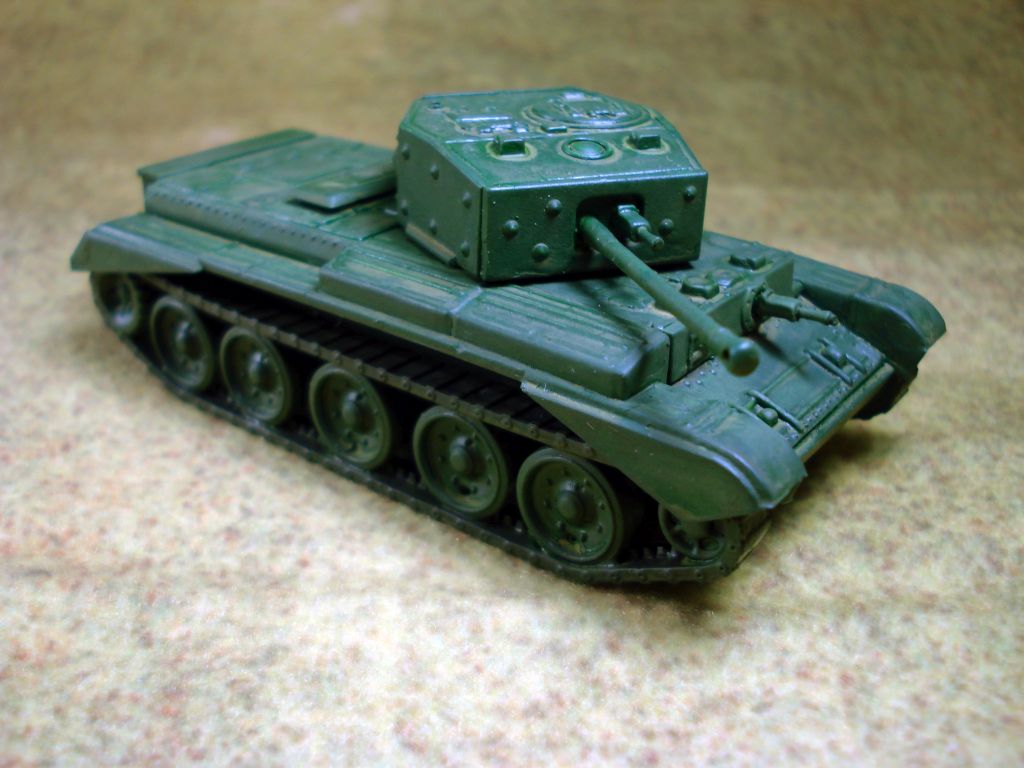
As I’ve been wrapping up my British platoon for Bolt Action, I wanted to get some armor to add to my force. For 1/72 scale there are a lot of options however I stumbled across Armourfast Cromwell kits and found them a nice buy. For a little over $12 you get two models in a single box.
The Cromwell tanks assemble pretty easily. It’s very much a wargame level of detail. The treads wheels are pretty simple in their representation on the tank. However the hull has a fair amount of detail for the hatches and such. The turret fits pretty snug and can be removed. For Bolt Action games I see this as a plus as destroyed tanks are kept on the table. As I’m working on some flame markers, might end up popping off the turret and placing a huge flame marker on it to represent a destroyed tank.
There is a small gap in the side where the main hull sits over the treads when looked at from an upwards angle, but the gap isn’t too noticeable looking at it from the side. Another gripe I’ll have is the hull machine gun. There’s a housing for it, but no modeled barrel (unlike the coaxial mg in the turret). So I had to model my own using a pin wire. Nothing too difficult but a little disappointing. 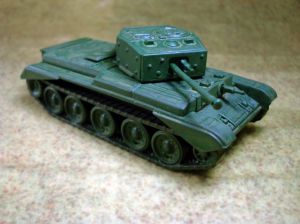
Another small bit is that the inside tread wheels are hollow. At a low rear angle, the rear treat wheel appears to be a free floating hollow cylinder.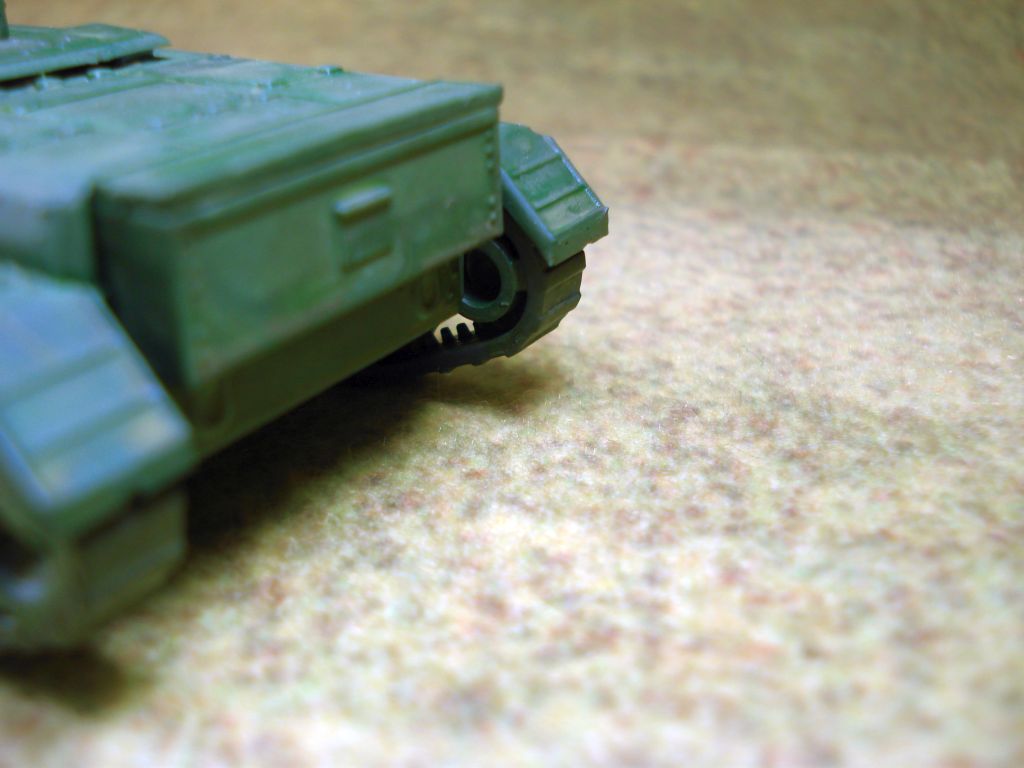
I’ve got a Plastic Soldier Co. British soldier as a side comparison for the dimensions of the tank. The Cromwell is nicely scaled (mind you the figure is on a pretty thick 2mm base) and looks appropriately bulky and menacing.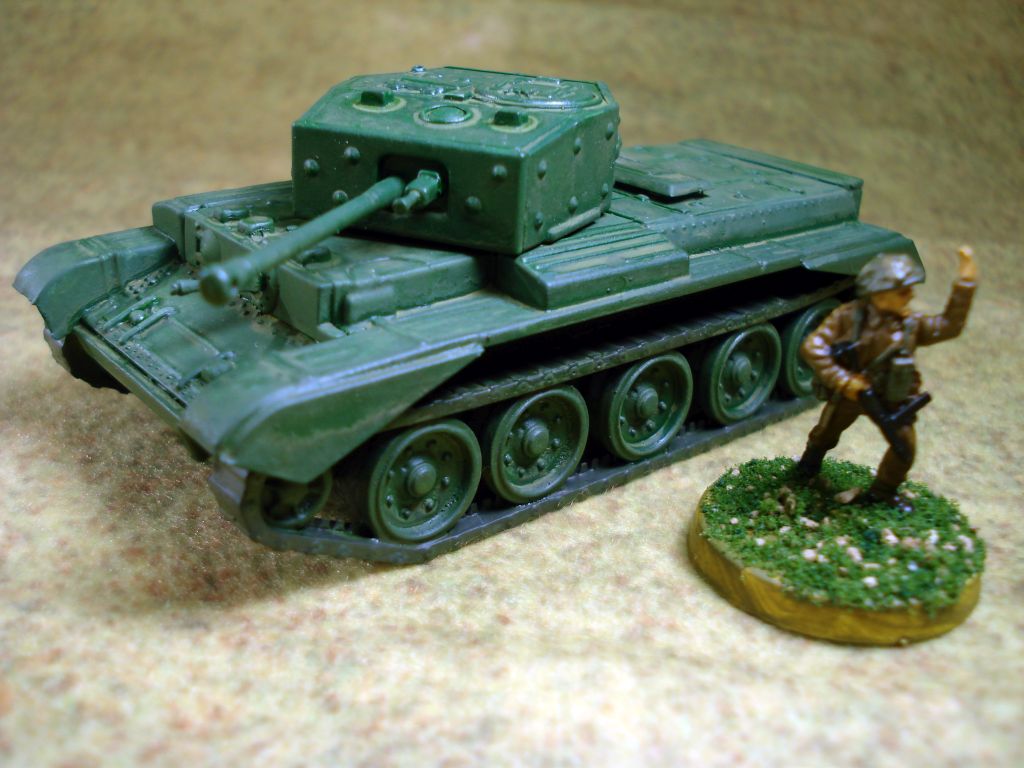
It’s been ages since I worked on tanks this scale. You can tell by the sparse detail I put on the tank markings. I might have to go back and touch up some more detail on the hull and treads. Here I gave it a wash and dry brush of mud on the treads which looks decent. For the price, you get a great set of tanks with good detail.
I will go on a rant here. I’ve noticed on a few of my photographs some white dots that would come out when I adjusted the contrast. With a large painted surface here, I definitely noticed white specks on the tank after I put Army Painter anti-shine varnish on it. Despite warming the can, spraying on a day with little humidity, and shaking the can well, I’d get these specs of white. Some could be brushed off, but some due to the matte spray were stuck on the model.
Now it looks like the matte spray is a clunker too. They seem to have nice paints, but I am not going to bother using their spray can products any more.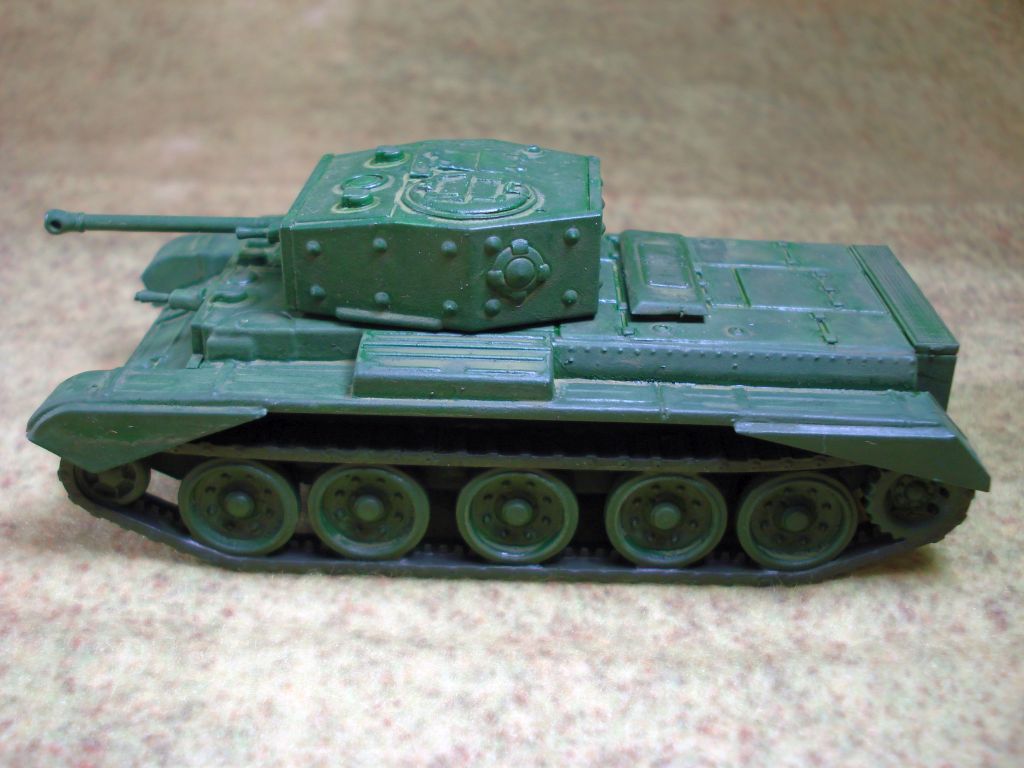
Firestorm Armada QRS
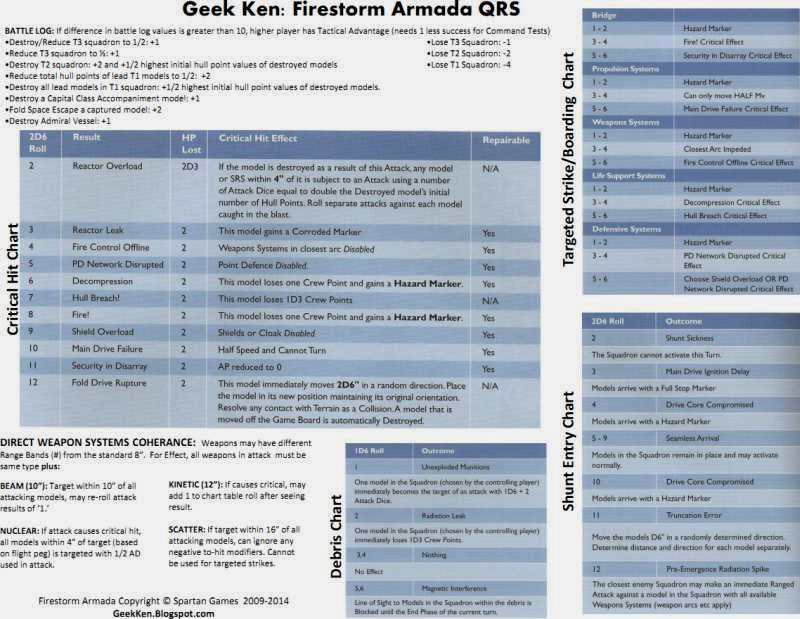
One nice thing about Firestorm Armada when it first released was the great quick reference sheets that were included in the rules. Sadly, when the hardback book rolled out there was no updated QRS. Now the second edition is out and no word if another reference sheet will be available.
I’m not too keen with the charts in the back of the current book. There are a lot of small details throughout the rules and it’d be great to have a summary of the various table charts. It just seems the ones in the rules are sort of sparse. I really enjoy having a good summary section when I get one (cough…Bolt Action…cough) and it makes me wonder why more rules don’t have them in their books.
I decided to whip up one myself. It’s not going to win any awards for layout but it’s functional and I tried to keep it on a single front and back sheet. Hopefully I made no glaring mistakes with the rules.
The new book presents the rules pretty well but I’ve always liked having a reference sheet to jog my memory. Plus having some critical charts handy (especially the battle log points/penalties table) is ideal when I play. Hope people get some use out of the sheet here.
Zvezda British MMG and mortar teams

Still slowly finishing up by Bolt Action British platoon. As I mentioned a while back I went the route of 20mm using minis from Plastic Soldier Co. which is a great buy. The downside is there are not many options for other specialty teams. Finding something at 1/72 scale was a bit of a challenge.
Fortunately for me Zvezda has a range of kits for their own wargame system. The models are nice hard plastic and assemble very easily as they are designed to be snap together kits. I still used plastic cement to keep them firmly assembled. The teams also are mounted on a larger plastic base. So I opted to have mine split up on individual bases.
Overall the models are more in line with an early war uniform scheme, including gas mask satchels. That is a slight problem as most of the Plastic Soldier Co. models I have are in late war gear. However it’s not too disconcerting. Overall as a comparison to Plastic Soldier Co. the models are of the same height, but they do have a slight build compared to the other miniatures.
The Vickers MMG comes with a gunshield on a tripod mount. Not quite sure if that was standard issue with the weapon. So that is a bit of an oddity. I also opted to use a more uniform color scheme for the gun itself. I used the plastic base that came with the kit and altered the mounting so the base would provide 45 degree firing arcs. Just an easier means to handle LOS issues in games.
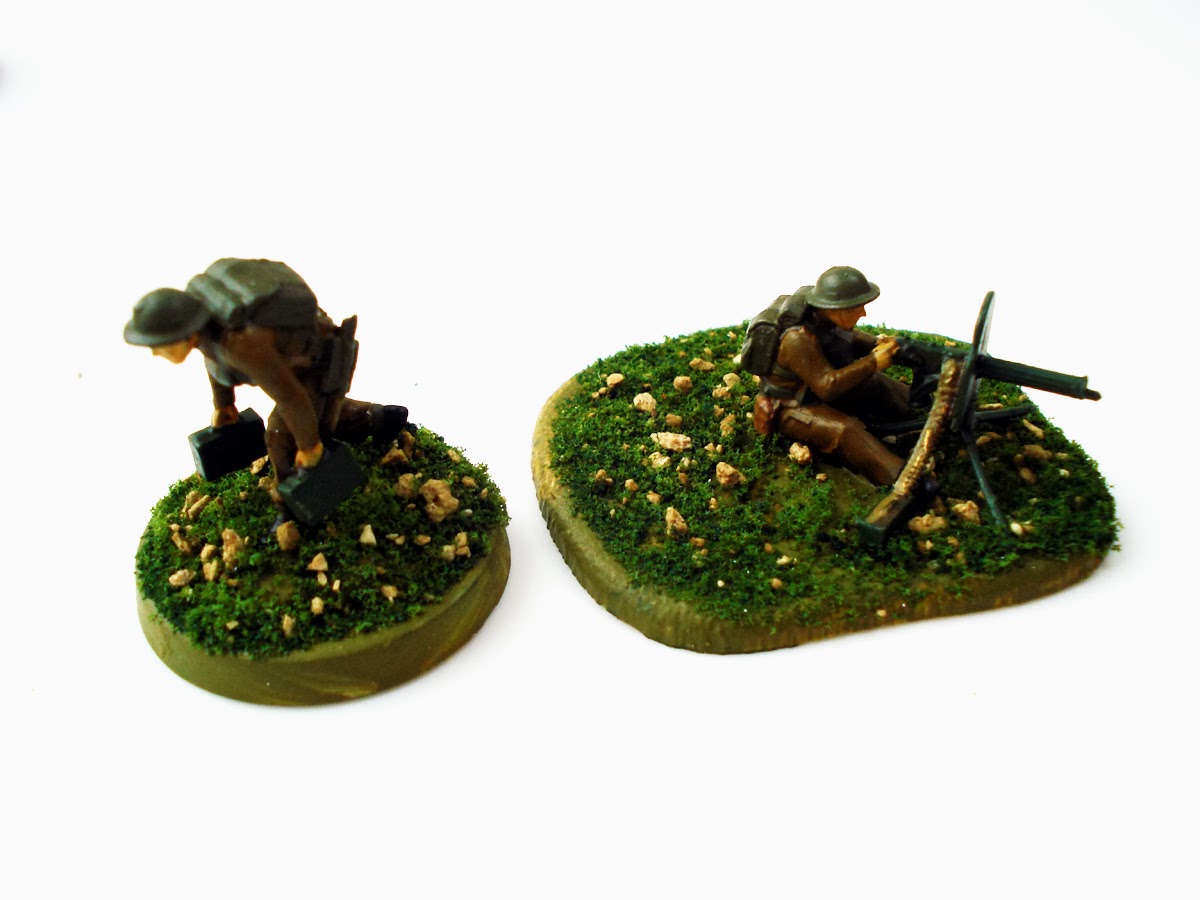
The mortar team depicts the 3 inch mortar. I might cheat and shed a team member to get some flexibility with the model, waffling between a light and medium mortar team as I toy around with my force list. It’s not quite proper, but I tend to have opponents that don’t might slight proxies with models.

They are nice models and pretty cheap. The detail of the main figures are a little muted. Additionally they are certainly geared more for an early war theater. As specialty teams it’s not much an issue, but I would be hesitant using their infantry sets to round out a force of other models (unless you wanted something like an engagement during Dunkirk).

Free Firestorm Armada Battle Log
So I have been absolutely inspired lately to do lots of Firestorm Armada-themed stuff. I’ve been working on fleet lists. Also I’m finally getting the itch to work on my Relthoza fleet (might still hold off though as my German platoon and British Bren carriers are giving me sad faces). Needless to say, the game has been on my mind a lot lately.
2E has introduced the battle log. As you destroy fleets, you earn points and lose points for losses you incur. For the most part it’s a form of tracking victory points. However you can also give up points for other strategic aspects of the game. Spending battle log points can improve the chances of calling in reserves. If the difference in points is over 10, command checks are easier. Overall it allows for more accurate tracking of victory conditions and I dig it.
The bum deal is I’ve got no way too keep track of points other than using pen and paper. I expect Spartan Games will release a super cool battle log tracker sometime. However I prefer to get something I can use now, rather than waiting a month or so. So I present here Geek Ken’s Battle Log Tracker, a simple version you can print, cut out, and get to the table right now. It’s simple, functional, and best of all absolutely free. Hope folks find it useful for your games.

Review: Firestorm Armada 2nd Edition

So the 2nd edition of Firestorm Armada (FA) has finally come my way and I’ve gotten a bit of time to go through the book. I enjoyed the previous edition and want to spend most of this post talking about what changes have come about. My impression of the first edition can be found elsewhere.
Overall it’s the same game with a few tweaks allowing for more tactical choices. A very big change is the introduction of MARs (Model Assigned Rules) to each race in addition to rules for specific ships. Also there are now some unique weapon systems that provide different game effects, again allowing for some variation in how the different races play. So let’s sort of go through some of the changes from the previous hardback edition.
Movement is relatively unchanged. However the drift maneuver is no longer an option. I’m somewhat miffed with this as ships are still required to move at least ½ their speed. This means smaller ships are still required to be moving 5″ or so every turn. While cutting engines is always an option, it’d be nice to have a tactical movement option allowing for some maneuverability but still keep it to 1-3″. I might have to house rule something. Hrmm…
[½ speed: A squadron can reduce their maximum speed to ½, allowing them to move at least ¼ their normal full movement rate (and at most, one half of their current maximum move rate). Doing so they gain a ½ move token. The player can remove this token at the beginning the squadron activation to resume normal speed. If a squadron had a ½ move token at the beginning of its activation, the highest speed the squadron can reach for this turn is its normal movement rate minus its turn rate in inches. This will also affect their ½ speed rating. In practice, players will find that smaller (or more agile) ships will not be hindered by reducing speed, while larger ships will take at least an additional turn to get up to full movement.]
Command distance is a big factor in the game now. While squadrons can break up, the entire squad becomes disorganized meaning they cannot combine or link fire. This also becomes a big factor for wings and fighters (more on that later) and can come into play regarding weapon systems too. So the gist is that keeping ships in command distance from each other is a bit more important than before. On one hand I like the idea of keeping ships as cohesive fighting units, on the other hand the tactical flexibility of peeling off a cruiser or two is no longer an option which is sort of meah.
The mechanics of shooting, LOS, damage, etc. for the most part is the same. There are a couple of big changes however. One is the concept of tactical strikes. On larger ships (those with hull points greater than 2), specific systems can be targeted. So players can try to take out the bridge, wipe out weapon systems, or potentially take security systems offline increasing the likelihood a boarding attempt will work. There is a penalty to hit rolls when attempting this but that option of cutting out key systems is interesting.
Another big change is that target ships have -1 damage and critical ratings from attacks landing in their rear arc. This certainly allows for smaller, more nimble ships to slip into the rear arc of larger capital ships and potentially do some damage. It translates into improved positioning of ships and being mindful that the direction of approach to a target is important (and trying to keep a defensive position so no one slips in behind you).
Lastly a huge change to the rules are the introduction of specific weapon systems. Firstly, the 8″ range bands are no longer uniform. Some weapon systems have range bands that increase to 10″ and 12″. Torpedoes now are based on 12″ range band increments also. This means you now have options for increasing tactical engagements at longer distances and disparity of range bands among systems and races can make for some deft maneuvering at further ranges. Additionally, certain weapon systems have bonus effects if they all fire as a single volley of similar weapon types (termed as coherency). This may mean rerolling any ‘1’ results as with beam weapons, or doing higher ranked critical hits with kinetic weapons.
Adding to this is a slew of MARs options that every race has. Further, capital ships have a number of hardpoints. Each hardpoint allows for buying certain systems or small tweaks to the ship profiles (like increasing its move or shield rating). Aside from hardpoints, almost every ship has the option of altering a few systems or incorporating MARs allowing for a lot of racial and fleet variation. To keep things manageable, every ship in a squadron must have similar technology and MARs so you don’t get this mishmash of different tech types in a single squadron.
Damage no longer takes assault teams into consideration, so crew hits only affect the crew rating. This eases some bookkeeping. Boarding actions are also cleaned up some. Every ship can launch at least one boarding action a game. What’s nice is that this no longer reduces your AP, so you can still defend from boarding actions as normal (you just can’t launch another attack). Most boarding assaults are set to destroy key systems in a ship, but can also be used to capture ships so that they fold space off the table. Lastly, instead of a round of point defense and then running the boarding action, the PD and AP of the target model are combined. The boarder makes their attack with the defender rolling this combined pool to ‘cancel’ hits. It’s a more streamlined than before.
Flights and fighters are lumped into a term called, Short Ranged Ships (SRS). Assault craft, bombers, interceptors, and fighters are still the varying wings that make up SRS. For the most part the composition and idea of them being a single unit is still retained from the hardback rules (using a d6 to represent the wings). SRS are now represented as either a small token or a large token but each represent a maximum of 6 wings. Up to two SRS tokens can be part of a single squadron. Overall the means of attacks and resolving them are unchanged, how they actually operate is very different though.
Rather than a unit individually zipping around, the SRS token must always remain in command distance of its parent carrier. If it starts its turn outside that distance they are immediately recalled back to their carrier. Alternately, you can give an order for the SRS to make an attack run where it will approach a ship and try to get within base contact of the flight stand. This makes fighter wings a bit more like an extension of a weapon system for the carrier. They support the carrier directly instead of running off as their own flight group. Further, once they make an attack run they are immediately placed back on the carrier (allowing for rearming and relaunching during later turns). I’ve yet to try them out but the simplicity of their use and the reduced management of not having to move fighters back to a carrier for rearming is nice. Additionally, flight stands that are run off return to the carrier, which can can later be relaunched giving some real teeth to fighters. As dogfighting is the best way to inflict damage on wings, interceptors certainly have an important role in countering enemy SRS.
Fleets are now partitioned off into patrol (up to 800 points), battle (800-1200), and grand fleet groups (1200-2000). Each fleet is further split into three tier groups, where battleships, carriers and such are tier 1, down to frigates and escorts being tier 3 (with cruisers being tier 2). Each fleet must have a certain number of squadrons from each tier. Additionally, up to 25% of the fleet points can be used for alliance vessels that can fit into the tier requirements. For the most part this allows fleet construction to be an easier process. Rather than working off a set percentage of points for fleet composition, the player now has model limits based on these tiers. One gripe I have is that these actual limits and information on squadron sizes are no where in the book. Instead they are available as separate PDFs.
The star admiral is still part of the game. Instead of granting specific bonuses to a particular ship, they allow for the use of tactical cards and improve the chances of making any command checks (ex. checks if a squadron is disordered). Tactical cards are also another feature of the game. For the most part each fleet has the same cards and may have 1-2 additional racial specific cards. These can be played once during a turn to allow for some special maneuvers and one shot abilities. It’d be nice to talk about them more in detail, but I have no idea what the cards do as there are no details on them other than how they are used (another gripe of mine).
A new mechanism for the game is introduced to allow for more tactical options through a battle log. For the most part, players start with a battle log total of zero (but some scenarios increase this). Battle log totals range from positive and negative integers. As players inflict damage on the opponent fleet, destroying ships, their total increases. As they receive losses, their battle log total decreases. For the most part it works as a victory point tracker with the larger the differences between the totals, the more pronounced the victory.
What is particularly interesting is that battle log points can be spent on certain game mechanisms. They can be used to alter die rolls for reinforcements. They can also be used to return spent tactical cards to your hand. This is a very clever system allowing you to essentially give up victory points to gain a needed edge (or recover from a flubbed reserve roll). As players gain points by defeating enemy ships, it further encourages players to be aggressive and inflict damage onto their opponent’s fleets. This really adds a neat layer of strategy to the game (especially the cycling of tactical cards).
The game has 6 scenarios within the book. They range from simple engagements to trying to capture objectives, or control sectors on the board. As a nice touch the book suggests that battles aren’t necessarily in deep space, but rather within key systems. Hence, the preponderance of terrain and close distances of engagement. You are fighting over key areas of control, rather than large ranges of territory, with the scenarios supporting that concept.

The Good – Firestorm Armada has not changed too much and is still an enjoyable naval-fleet-action-in-space type of game. The presentation of the rules and layout is well done. The additional weapon and MARs systems have given the game much needed flavor between the races. And it all works well without requiring a tremendous amount of bookkeeping and cluttered, simulation-type rules.
The book is very nice and well bound, with a pleasant matte finish on the pages. There is a surprising amount of whitespace on the pages so the text is not cluttered. Sections of the book are divided up with margin tags of a specific rule topic on each page making it well organized and easy to reference a part of the rules if needed (not to mention a simple table of contents and index). The book has lots of great color photographs of models, along with simple color graphics for particular rule situations, and also lots of written examples.
The Bad – There is a decent chunk of information missing from the book. Not having a list of the tactical cards is a hefty ding. Not detailing the major fleets and their composition is especially damning. There are no token sheets like in previous editions, and the lack of a template for SRS tokens are especially maddening. The quick reference is a list of charts and no where close to the usefulness of the previous QRS released with the first edition softback book.
The Verdict – If you are a brand new player, Firestorm Armada is a great game to jump into. The big boxed sets are especially nice as they give the player everything needed to play. It might be well worthwhile waiting to pick up the fleet boxes of races you’d like. It is still an enjoyable game that while not quite embracing aspects of physics with movement, still makes for a fun afternoon of space combat. If maneuvering in cruisers to an optimal range to fire full broadsides of anti-matter cannons is your thing, you will certainly enjoy FA.
If you are a long time player of FA, you will likely find a lot here to like. The game finally has some sprinkles and a bit of a swirl in the vanilla of previous racial fleets. The way fighters work are tightened up and make carriers more offensive-type vessels. I think the tactical cards will add some fun wrinkles in the game. All the while the concept of a battle log and spending victory points to have additional tactical options is a great concept. There is a lot here you will enjoy.
The rulebook seems to be missing chunks however. There are no tactical cards, no tokens, no specific rules on actual fleet composition limits (the rules cover how you build a fleet, but don’t have actual tables for the different races). Not having any idea what an acceptable token to represent SRS is another missing feature.
I entirely expect they will be available as downloadable files or separate products (the fleet composition sheets are already available). However it seems that the focus is for players to go pick up the boxed sets that have all of these items. Separate files and products that can be purchased individually are sort of an afterthought it seems. This gives me a bad taste in my mouth. Yes, all my cool models can still be used to play FA, but despite me picking up this rulebook there are still parts of the game missing. It’s not enough. I need to buy more, and not having the tactical cards is the most aggravating thing (where in the past the STAR cards were very much an optional component).
This gives me some hesitation in recommending the rules. If and when these other parts of the game are separately available, I think you’ll find an enjoyable game here. But it isn’t all within this rulebook, and that makes me less inclined to recommend it to current players of FA. There is a lot here that is amazing and really strengthens the game. But if you are just planning on buying the rulebook, then wait. See what else pops up on the website and then make your decision on converting to second edition.
[EDIT: Months have passed and some of the things I chided Spartan Games about that were missing from FA are available as download files now. SRS tokens are available as a separate product (which I still would have liked as a simple cutout token). However the TAC cards and other tokens can be printed out as color PDF files.
Additionally the V 2.0 rules are absolutely free so you really have no excuse not to take a peek at Firestorm Armada now. Enjoy!]
New fleet documents for Firestorm Armada

As the new version of Firestorm Armada is on the shelves, Spartan Games has put up new fleet files for the major races in the game. From their download section it appears that much of the older files will be slowly getting the 2.0 treatment. So if you are a fan of the game, you might want to keep an eye on the downloads section of their site.
Overall the fleet documents look pretty cool. It seems that games are codified into tiers and points depending on the type of fleet you want to play. For a specific point value game, you have a few choices for each tier. Tier 1 being your command battleship class vessels, tier 2 being the cruisers, and tier 3 being frigates and escorts. The higher point values, the more options you have and the bigger the squadrons. For most of the races there isn’t much difference but some allow for more squadrons of lower tier ships. It’s a bit more regimented than before which I like.
Looking over the ship stats the larger vessels have hard points. You can then pay for specific weapon and defensive systems up to that hard point value. It’s a nice way to tweak your forces and try out different weapon layouts. So not all carriers or battleships are alike.
Model assigned rules (MARs) seems codified now so that nearly every ship save for the smallest frigates have racial special rules. Another layer of variation is that weapon systems appear to have different keywords. There are still primary weapons and torpedoes, but also beam, scatter, kinetic weapons, etc. What is nice is that most frigate ships have the option of also having these special weapon systems. Again, another way to tweak and customize your fleet giving it some flavor.
The profiles for battle stations are also presented. Overall they look like floating masses of guns and hull points. They appear pretty immobile. It might make for some interesting scenarios representing a recon in force or a border skirmish.
I like Firestorm Armada but always felt that the rules didn’t allow for some more variety in the races. It was just little differences, or incorporating more flexibility with weapon arcs (one group had turrets, one had gun racks, etc.). While there were some unique technologies like cloaking, for the most part they were all the same. The optional MARs rules for the different races helped alleviate this but it wasn’t part of the official game. Now they have seemed to have really embraced that concept.
I’ll be blunt, I am a bit miffed that this follows on the heels of a new rule book so soon. Like they wanted to roll out a new book incorporating new ideas, but realized it didn’t go far enough. I understand the position they were in. Either they stick by a rule set that isn’t dynamic enough for the game they wanted, or just go for it and put better rules. For new players, I think this will be a great system. For older players, I can see why some feel a little burned. It’s almost treading on Games Workshop-rollover-of-product territory. But looking at these fleet rules, I am digging the direction they are going with FA. It seems worth getting behind this new book.
 Geek Ken