Category: Miniatures
Review: Beyond the Gates of Antares
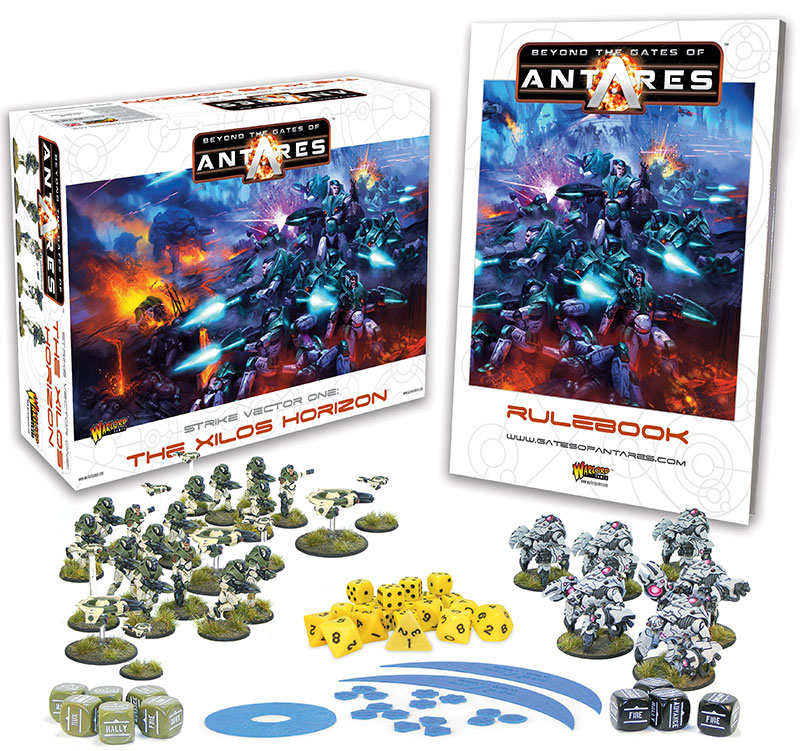 Rick Priestly a while back had a Kickstarter campaign going for a new sci-if wargame that he eventually pulled. It was out just about the time Bolt Action was hitting its stride and I expect he decided to throw his design talents into BA and let his sci-if game ferment a bit. I think that decision paid off as his new game, Beyond the Gates of Antares took some flaws in Bolt Action and improved on them to make for a great game.
Beyond the Gates of Antares (GoA) is a skirmish game for a force of several squads but could be expanded up to a few platoons if desired. It’s a one model-one man system in 28mm scale (although I can’t see any reason why it couldn’t be played in a smaller scale). It is a unit based system where commands are given to groups of 3-10 figures or single vehicle models.
The order system is lifted right from Bolt Action. Each unit is given a single, colored d6 die which is pulled individually for unit orders. If the color matches your force, you select a unit to activate giving it an order to run, move and shoot, hold position and fire, wait in ambush, hit the dirt, etc. It’s a system I like which is a little chaotic and random. Layered onto this is the effect of fire. Units which have been shot at take penalties (pins) to its leadership. This results in pinned units having to check and see if they can activate. If successful a pin marker is removed and the unit commits to its action, otherwise they hit the dirt and hold position (but a pin marker is still removed).
Units have a simple profile of a few stats for movement, effectiveness at shooting and melee, defense, leadership, and initiative. This last stat being representing how likely they can react to the enemy. This is one divergence from Bolt Action. Units not previously activated may potentially react to units within their line of sight either moving themselves or taking an opportunity to fire. Along with committed orders like ambush, this makes GoA a rather fluid game.
Shooting is a pretty simple affair. Depending on the type of weaponry a roll to hit is made with modifiers like for cover and range. Units hit then have a chance to shrug off casualties rolling to resist the attack (again modified by the type of weapon or being in heavy cover). If failed casualties are removed, while for vehicles and larger weapon systems a roll is made on a damage table. Some weapons have ranges that would cover the tabletop but most top out at 30” which seems enough for the typical game of a 4’ x 6’ table size
Regardless of any casualties, a pin maker is placed on a target unit if a hit is scored. Pins not only degrade combat effectiveness but also are markers to indicate penalties to leadership that’ll affect morale and command. As pins slowly accumulate if they ever exceed the command stat of a unit, the unit is destroyed outright.
Assaults are a little more involved. Units have to move into base to base contact. Afterwards each side has a round of simultaneous fire. This is followed up with a round of hand to hand combat that is resolved in a similar fashion except each casualty inflicts a pin. The side with the most pins loses the battle and will likely be destroyed outright. It’s worth noting that all die rolls are made using d10s. This allows for some more granularity in modifiers and troop stats that you might not see with using d6s. Also adopting some chaotic outcomes seen in engagements, GoA embraces the idea of a 1 succeeding (or offering a small bonus) while a 10 fails and usually these will trump the modifiers to a particular dice check.
Movement is a flat rate for models which are halved in rough terrain (with 5” typical for infantry troops). A nice wrinkle to GoA is that some units can push their movement up to 3 times their normal rate with a command check. So if needing to really get a heavy weapons team into position or advance onto an objective, you have that option. However the unit will take a pin after doing so.
A few rules are provided for vehicles and usually revolve around using a type of anti-gravity technology for movement. Additionally, most vehicles have multiple order dice allowing them to take several move and fire actions. This gives them a lot of opportunities to engage several units along with rapid movement and is a nice way of handling the improved mobility of vehicles.
An interesting concept with many of the troop units are the use of robot drones. There are several different types which provide additional defense, or improved modifiers for shooting, along with some that can act as a spotter for the unit. This is especially important as LOS and shooting are based on what models can see with intervening models and dense terrain blocking sight (and lines of fire). Coupled with this are quite a few special rules for ammunition and weapon types, along with varying armor equipment. All of this contributed to differentiating units and alien races that go beyond simply changing some base stats of troops.
Forces are composed of units based on point costs, along with limitations on troop options. A patrol force is required to have so many tactical options, and a limited number of support options. This offers some flexibility with creating your force but also provides some structure. However I do expect that people will dive into building lists to construct the ‘perfect’ army.
GoA comes with 6 generic scenarios where most revolve around capturing specific objectives or moving into sectors on the board with defined attackers and defenders (although 2 are essentially a ‘kill more of the enemy slog fest). Along with this are 6 narrative scenarios which are objective-based having a little more detailed table setup, deployment, and force composition. Having 12 scenarios along with rules for six different armies makes for a complete rule book. Throw into this a ton of background material on the game universe and you have the foundation for a pretty engaging wargame with room to grow.
The Good – This is a bit more than just Bolt Action in space. There are some tweaks to the rules permitting more flexible orders. The reaction system is great and allows for more dynamic play. Add to this the pinning system and you have a very fun skirmish wargame. There are several army options that embrace particular technologies. Using a d10 means you can layer on different modifiers for equipment and gear (along with troop types) which have some impact on how a unit performs.
The book has a lot of background material and having complete lists for different forces along with a lot of scenarios all mean the game has some legs with providing some system longevity. Coupled with this is a pleasant layout and presentation of the rules. Not to mention the lovely artwork, photographs, and oversized pages which makes the hardback quite an enjoyable game tome to read.
The Bad – I dig the d10 dice but leadership tests fall a little flat with me. In Bolt Action you rolled 2d6 on a leadership stat, while in GoA you roll a single d10. This means you will likely get some swings in both good and bad luck with a flat probability instead of playing with a distribution of outcomes using two dice.
Some of the mechanisms for shooting and combat are finicky. Hits are allocated individually to models, along with rolls to determine casualty outcomes. In practice this means rolling casualties one at a time. I’m working with a house rule to roll individually for special units, leaders, etc. while using a single roll casualty roll for multiple hits on troopers that share the same stats, then alternate between the defender and attacker removing casualties. LOS is also based on model bases and figure centers requiring open lines to targets, so expect some more rigid players considering breaking out the laser pointers. It’s not a big deal but it gluts up play some. Nothing that will ever crop up in friendly games but I expect to hear tales of player competitive friction with tourney play.
I am disappointed some with the vehicle rules. I do wish there were rules for air support and tank assaults. I get why this wasn’t done. You likely need another 4-5 pages to cover everything and defaulting to skimmer-type vehicles makes it easier to have condense vehicle rules. While you can get different flavor of movement types via special rules, the game loses some robustness. Lastly it’s a point based game. You are going to get those min-max force lists and some units underperforming for the points spent.
The Verdict – Beyond the Gates of Antares is a great sci-fi skirmish game. There’s a lot here people are going to like. I’ve been a fan of the random order mechanism and allowing units to react out of sequence is a pleasant addition to this. There are lots of options for gear and equipment to alter the base profiles of units to allow for variety in troops. Suppressing units with fire can be an effective means to remove or lock down units.
The game has quite a few scenarios and offering some special engagements means players have a framework to make their own. I can see players digging in, tweaking current ones and creating their own to make an entire campaign (and something I suspect will be in the pipe from Warlord Games). Along with this is quite a bit of fluff. There’s 55 pages of it, all revolving around several ages where humans expanded into space, reached an epoch, and declined. This resulted in humans evolving and diverging into almost different species despite the existence of faster than light travel via inter-dimensional gates. It’s interesting stuff that’s offers some meat to spark a player’s imagination.
I can’t seem to shake the feeling they are looking at being a serious contender to 40K. The cover art obviously takes some inspiration from the original Rogue Trader 40K book. Given it’s from Priestly, you can’t blame him for trying to produce a wargame that would offer an engaging alternative to that industry behemoth. No idea how that battle will shake out but Beyond the Gates of Antares is a fun sci-fi skirmish game that offers interesting tactical play using some simple, easy to run rules.

Priestly’s ‘other’ sci-fi wargame he worked on.
Tweaking Frostgrave campaign rules
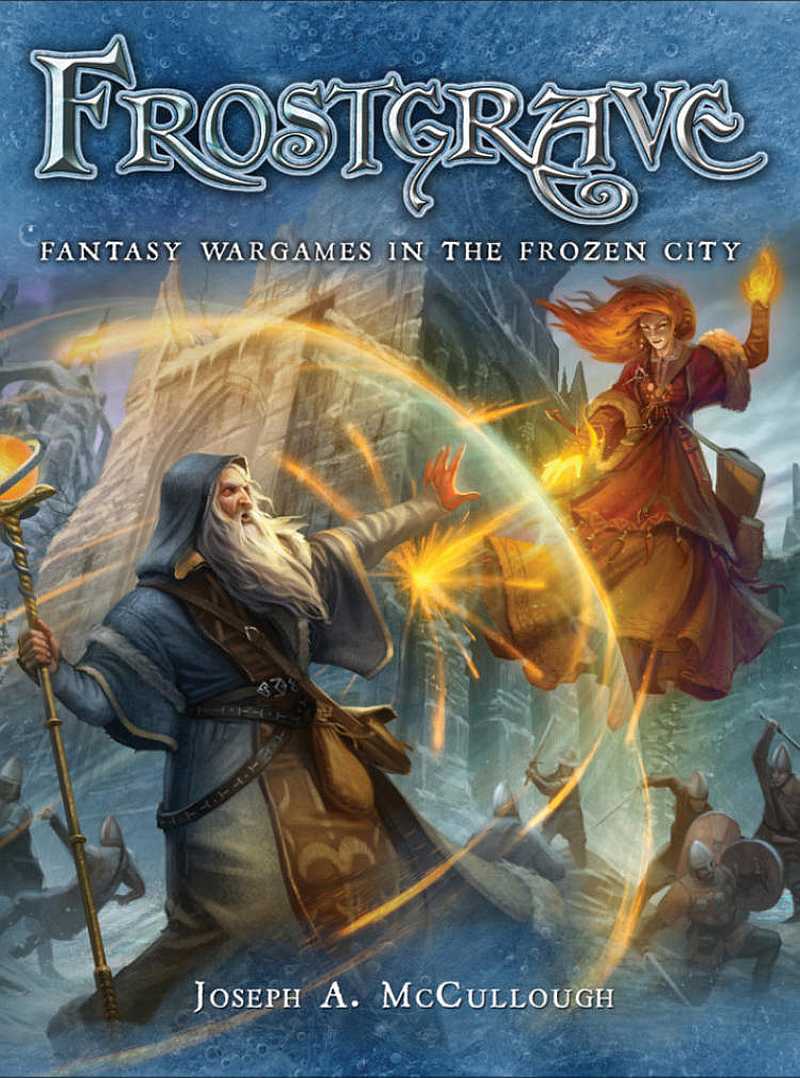 I’m on a bit of a Frostgrave kick as of late and it should be no surprise as I’m a fan of the game. One big draw is the campaign system and it really has that Mordheim feel of progression. You slowly accrue power and wealth, tricking out your wizard and warband. It’s fun.
But I think there are a few stumbling blocks with Frostgrave’s campaign game. The first is the focus on wiping out the enemy. Sure you can scramble to try and take off treasure, but you get more experience for your wizard personally wiping out enemy troops. Plus if you kill every soldier to the man, you get all the unclaimed treasure. Lastly, there is no turn limit. So you can take your damn sweet time hunting down the enemy rather than trying to scoop and scoot all the treasure in the field.
The other issue is the snowball effect with winning. You get to do a lot out of game. Open recruitment, buying any desired magical items, upgrading your base as you like, it all allows players to do so much which is great. But if you are slipping behind in gold and XP, you start trailing. Sure a few games it’s okay to lose some. But eventually if you’ve gotten the snot beat out of you for a few games, you aren’t ever going to catch up.
I’m certain other folks have noticed this. In fact a few people whipped up their own tweaks to the campaign system. Much of what has been circulated around is great stuff but sadly have gone the way of lost files and broken links. So I went ahead and compiled some changes I liked and added my own.
One big change was the experience system. Too much emphasis was on wiping out the other player. That’s been removed and instead casting XP for any in-game spell has been increased. I didn’t want to completely remove the impetus for killing troops though. You end up getting experience from your warband survivors. So while you no longer get experience for killing enemies, you can certainly curtail the XP your opponent gains after the battle putting their soldiers to the sword (or making them a smoldering pile of ashes).
The other big change was awarding treasure XP. Having limited game turns and XP only guaranteed for yourself by taking treasure off the table, now it’s more of an objective-driven game. Standing treasure on the board now awards XP to both players, so if wanting a bigger share of the booty you’ve got to haul that gold off the board.
Another small tweak was the loss of wizards. Now they can’t be permanently killed. They can be bloodied and saddled with permanent injuries, but they’ll always manage to crawl back to camp. With the game being so centered around your wizard, the option of them being wiped out due to some bad die rolls left a sour taste. Having a chance to let them redeem themselves just fits better.
Lastly, the out of game actions are better structured and curtailed some. Buying magical goods is no longer a free shopping experience and the stocks are limited. Even more so, you are limited to choosing a few actions out of game. This makes the whole campaign experience a little more strategic.
Much of these changes are from the community in general but I’ve added my own bits as well. You can find a complete document in the downloads section. Hope folks find some use from them for your games.
A wound system for Frostgrave
I like Frostgrave. There are some rough spots but as a fun skirmish game with a fantasy twist, it gets a lot more right than wrong. One really hangup for me though was the damage system. I just really hated the idea of recording actual health points.
For Wizards and Apprentices, I totally get it. You need that gradation of health point pools. There is so much that revolves around it and the entire system of casting spells requires you ticking off those individual points. If you try to break it up using tokens or markers, it just takes too much away from the game.
But for soldiers and followers, well they are meant to be cannon fodder. I just didn’t get the idea why some other method couldn’t be used to record damage. I feel I’m just too used to other systems that have easier record keeping. So I decided to work on something similar for Frostgrave.
I’ll freely admit this makes the game especially deadly. Most grunt soldiers are usually going to be dropping in 2 hits. Also, you’ll be losing some granularity with damage due to using wound tokens instead of health points. Folks might want to consider just using it for creatures instead, but I find the easier tracking of health totals worth it.
So here are a few things I adopted for my games. Spellcasters (Wizard and Apprentice) suffer damage and gain healing unchanged from the rule book. But for followers and creatures, they no longer have point totals for health. Instead damage is tracked by wounds and possibly marred conditions. The pool of wounds that soldiers and creatures have is their health total divided by 4, rounded down. So a Thug with 10 health points would have a wound pool total of 2 (10/4 and rounding down).
You determine damage normally from combat or casting spells. But for for every 4 points a model suffers in damage, they take a wound removing it from their health pool. For every fraction of 4 (i.e. 1-3 points damage), they receive a marred condition. If a model has 2 marred conditions, those conditions are removed and a wound is immediately taken from their pool of wounds instead. Note that healing works the same for spellcasters, but for soldiers they only restore one wound of damage.
As an example, a thug is hit for 5 damage. One wound would be removed from its pool and it gains a marred condition. On the next turn, the thug is hit again for only 2 damage, giving it another marred condition. As this is the 2nd marred condition it has, it immediately takes a wound, removing the marred condition markers. Further, since the thug has a health pool of 2 wounds, its health has dropped to zero and is removed from the game.
I also introduced a handful of characteristics for soldiers and some creatures. The idea was to cover the bases with creatures that have less than 4 points of health and also add some variety with soldiers that straddle the line of between health totals in increments of four. A more detailed list of these rules can be found in the downloads section. I think they work pretty well and allow for a little easier bookkeeping during the game, but still captures the flavor of Frostgrave combat.
Verdantia – an alternate setting for Frostgrave
I enjoy Frostgrave. Yet I’m not too keen on collecting a bunch of terrain and rebasing models to fit in the ice and snow setting of the game. One plus I found was that the background for Frostgrave was paper thin. As long as it was in decaying city ruins, you could plop that down anywhere. I embraced this and decided to create a different place. Another sprawling labyrinth of decaying city ruins… Verdantia.
Long ago were the Dragonborne, a reptilian race of people that were infused with the arcane powers of dragons. Their empire flourished in the hot lands of lush jungles and scorching deserts, with only tepid cities built skirting much of the colder lands to the north. It is said their reign was for 5,000 years and then overnight, their kind disappeared. Thousands of years since their demise many of their mysterious monuments still litter the landscape.
Some legends say that they fell into warring factions, wielding powerful magics that resulted in the destruction of their race. Other legends speak of a great religious movement which rebelled against their affinity of the arcane, choosing instead to worship primal gods. The winning faction of this war were the followers of primitive nature, resulting in the savage lizardmen seen in the world today. No one can claim the true reason for the fall of the Dragonborne. What cannot be refuted is that this grand civilization reached an epoch, and in the matter of years slid into obscurity, utterly wiped from existence.
However now many state that it was the great network of portals, created by the Dragonborne, which lead to their downfall. These portals weakened the normal boundaries of the physical world. They allowed primal, chaotic aberrations to slip in, and brought destruction to their great civilization. A statement which is supported in grave hindsight to the terrible fate that had befallen Verdantia.
Twelve standing portal gates scattered among the lands were remains of the Dragonborne and their enigmatic past. These portals were widely distributed not only among different regions in the southern lands, but also a few sparse regions to the north, as well as the western coast that lay beyond the great mountains. The portals themselves were made of thick stone etched with arcane script and large enough for a cart of oxen to pass through. Once one entering the glowing stone arch a traveler would instantly appear from another paired portal gate, safe but unable to enter another portal for a full day.

All of the 12 portals congregated at one location, a sprawling set ruins within a steaming jungle. The gates were arranged in a circle on a great stone platform within the center of a crumbling city. Even stranger, a 13th portal structure was at the center of these gates. This 13th portal appeared as a standing, empty stone ring yet much larger than the other portal gates. This last grand portal appeared to be non-functional however, either never completed or its paired portal location destroyed somehow.
This far off region soon became a nexus of trade. A small community sprung up as brave merchants were willing to travel through the portal gates, spend a day within the hazardous jungle and decaying city, only to travel through another shimmering stone arch and reach far off cities. Soon the community grew and adopted the name Verdantia, taken from the lush jungle surroundings. It was in the year 400 of the Imperial Calendar that Octavius VI endeavored to make Verdantia part of the grand human empire.
Octavius entered Verdantia with his great army and cleansed the decaying ruins of all manner of creatures that remained there. He oversaw the reconstruction of the city, and in many cases simply built anew over the carcass of the old foundations. The college of Imperial Wizards relocated to the recovering city, its members eager to scour the ancient ruins for long lost arcane knowledge. Coin flourished in Verdantia and it became the hub of world trade. Warehouses sprung up as brokers for staple and speculative goods haggled among the crowded streets of local merchants. Money lenders and currency changers of different regions also congregated within Verdantia. Yet despite the successful efforts to rebuild the city, Verdantia was far from peaceful. It was ever under threat from the surrounding jungle which held many horrible creatures, cunning goblin clans, and savage lizardmen tribes.
In Y700 IC, rumors were spread far and wide of an ancient chamber discovered within the labyrinth of catacombs that ran under Verdantia. Within this chamber was a tome of necrotic spells that held secrets of the undead. A treasure of knowledge for those seeking greater understanding of the dark arts. This tome became the unrelenting focus of the terrible lich, Ulaam the undying.
His great undead army sacked Nordia, the western coastal city of frigid waters, and using the portal gate located there Ulaam poured his legions of skeletal and ghoul warriors into Verdantia. For over a month humans and undead creatures openly fought within the city streets. Imperial wizards flung spells at undead lichs and other necromancers that had joined under Ulaam’s dark banner. While the city was in chaos, the palisades were no longer manned and goblins, gnolls, and lizardmen warbands struck deep within Verdantia, further inflaming this chaotic war.
In ensuing battles as the human forces were buffeted by these other newly arrived factions, Ulaam was finally able to make a decisive strike. He spearheaded an attack into the Imperial Wizard library and was able to capture the necrotic spell book he so prized. Within days, he was able to decipher a great spell that would turn the tide of the battle towards his favor. It is rumored he emerged from a tower, his gaunt form encircled with a clinging dark yellow mist that appeared to be billowing from his mouth which was constantly muttering an incantation.
This yellow mist flowed over the city seeping into the lower recesses of Verdantia. Living creatures within this poisonous cloud choked and died. To the horror of living creatures that managed to stay above this yellow haze perched atop buildings, comrades and creatures slain by the sorcerous fog shambled to life and began to shuffle towards any living being, eager to tear them apart or drag them down into the suffocating poison mist. Legends from survivors speak of the horrible visage of Ulaam cackling on the steps of the ring of portals, leering down at the undead havoc he had wrought. But this victory was fleeting. The doom that visited the Dragonborne empire so long ago came to Verdantia then.
The sky became dark and the sun was blotted out from an eclipse. The 13th portal, this dormant gate that was silent for millennia shimmered and forms became to pour forth. All manners of demons and elemental creatures spilled into the city. Chittering demons of chaos fluttered above, and huge lumbering golems and elementals ran amok unfazed by the poisonous fog. They tore into living and undead forces alike, imbued with primal magic. It was said the footsteps of some elementals appeared as roots seeping into the cobbled stone roads, breaking them apart, and leaving footprints of lush green plants.
As the darkness faded from above and the sun slowly seeped out, the central portal stone frame cracked, and exploded into a shower of fragments. Each gate in turn shattered and exploded, as if the elemental energy within the air was finally able to dispel the arcane power which enchanted the portal gates. Verdantia was lost, secluded from the world, and again a crumbling city deep within a foreboding jungle.
The decaying ruins are now home to all manners of venomous creatures and savage beasts. Cunning goblins, gnolls, and fierce lizardmen are rumored to reside there. Ulaam’s necrotic presence still taints it, as undead continue to shamble among the ruined streets (darker tales say that Ulaam still lives in undeath, hidden away within the bowels of the city). Along with these creatures are far greater threats of demons and great elementals which still can be seen lurking within Verdantia.
But the faded seclusion of fallen Verdantia was not to last. There are too many riches deep within those crumbling ruins. Too many magical treasures and arcane texts to ignore. Wizards which covet such great power gather soldiers and fledgling apprentices under their wing to undergo perilous expeditions into Verdantia. It is a lost city, but one with wealth and great arcane power for those steely enough to take it.
Bolt Action: Ostfront
Osprey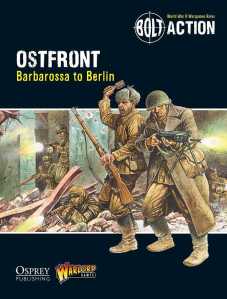 publishing has been continuing their releases for Bolt Action campaign specific books and Ostfront covers the broad Eastern European front from the Russian invasion of Finland, Operation Barbarossa, up to the final attack into Berlin. As with previous books, it covers special units and scenario specific rules, all along with some historical background text.
One particularly interesting section is the Japanese-Soviet conflicts between 1938-39. And the beginning of this book highlights a few key battles along with some special army lists and units, including Japanese cavalry. It’s a pleasant addition to shake up what you’d expect to be a typical Russian/German book. The book also dedicates some scenarios illustrating the Finnish-Russian conflict at the onset of WW2.
Both Russian and Germans get a few special units including Soviet partisans. At the beginning are some generic units for all periods in the manner of Japanese and Soviet flag bearers. These units allow for improved rally orders and can affect quite a few units (up to 12” from the model). Also rules for horse-drawn limbers are now available and a welcome addition as these artillery gun tows are more historically accurate for the time.
Similar to other campaign books, the material is sectioned into parts with historical information presented first, along with a few scenarios depicting that engagement. Some additional rules and terrain effects are also provided to reflect the conditions of these battles. One change is that there are some lists of generic Bolt Action scenarios from the original rulebook that are suggested as something which could be considered a typical combat engagement for that period. Combined with special rules for supply, terrain, and theater selector forces, you’d have a decent twist on your regular game of demolition or hold until relieved.
Rules for minefields and dug in units are presented again, along with some special rules for deep snow and other weather effects. Of course, you couldn’t have an Ostfront book without some rules for city fighting and there are plenty of additional rules to cover rubble and sewer fighting too. One aspect of city fighting is the lack of effective command. As fights progress, leadership gets bogged down and hinders orders given to units. This really can shake up your typical games especially if you are needing to move units up and capture objectives.
Overall 12 scenarios are provided. Most of them have victory conditions that revolve around capturing objectives, moving into enemy deployment zones, or destroying the most enemy units.
The Good – The book gives a decent overview of the Eastern Front from right before the onset of WW2 up to the Battle for Berlin. There are additional units and options to provide a theater selector feel that’s appropriate. The artwork and photos are plentiful and of good quality.
The Bad – As with some of the other campaign books, I really would have appreciated more maps and figures of a typical scenario terrain layout, or photographs of full table layouts. You get a written description that’s functional, but having some more details would have been better. Most of the scenarios still are firmly planted in the generic fight camp, and more detailed scenario objectives and force composition are absent. In the end it offers a representation of these types of battles instead of presenting lots of options for reenacting a historical battle or engagement.
The Verdict – Battleground Ostfront is a good book. Like it’s Normandy predecessor, it provides games that give a certain flavor over depicting a true historical battle. I still wish there were more detailed historical scenarios along with the generic battle options provided. However the layers of terrain and supply effects do offer a wrinkle in play. The presentation of the material is also much better. All the terrain and special scenario rules are off in a rear section, making it much easier to reference during a game.
It’s still a Russian/German heavy book. But the Finnish and Japanese campaigns are a great addition highlighting some more lesser-known parts of WW2. Of course what also stands out are the snow and city fighting rules. Easily something you could port over to mimic the Battle of the Bulge or Monte Cassino.
For a player that is interested in the Eastern front and a Bolt Action fan, they’ll find this book indispensable. If you aren’t there are still a few interesting rules and options that you could find some value (with a few caveats, say like running a Pacific game). Compared to some of the other Bolt Action campaign books, I’d consider this superior and worth picking up if you are looking to add a little spice to your games.
Airfix forward command post
In my continuing quest for Bolt Action terrain, I’ve been slowly accumulating different model kits. One that stood out for me was the 1/76 scale Airfix forward command post. It’s a nice kit with a lot of little extra bits including a cool looking bombed out house.
One sticking point for me is I wanted to stretch out the usage for the model. There was a second floor to the house model, however the roof section was a little cramped to the point I couldn’t place a miniature in it. I opted to move the roof section to the other side, opening the second floor up. Perfect position for an arty observer or a sniper.
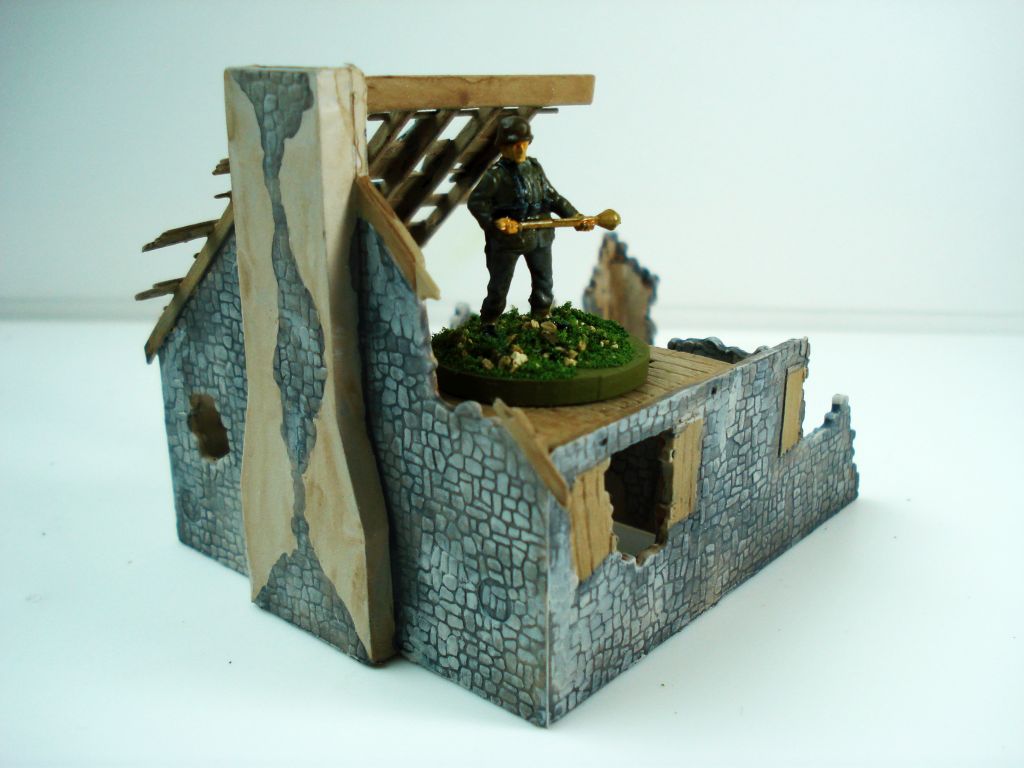
The kit assembles very well and paints up nicely. With a decent amount of detail and texture on the walls. It really is a diorama kit however. I had to shore up some of the wall angles with other bits of plastic.
As mentioned the kit comes with a fair amount of extra detail bits, including various signposts, wooden barricades, crates, fuel drums, coiled barbed wire. There are lots of nice details you can add to the house model, or throw them onto other figures for that extra touch.
One complaint I had was with the sandbag corner piece that was hollowed out and had no back section. I figure this was likely designed to go on a building corner, or be a detail part for a diorama (which would typically have a fixed point for viewing). So I had to plop mine onto some styrofoam and paint like it was built up earth.
The corrugated tin roof sections gave me a great idea using it as a possible objective. I placed mine on a section of styrofoam with it textured to look like an earth bunker of sorts. With a smattering of fuel drums and crates, it made for a nice little objective to plop down on the table.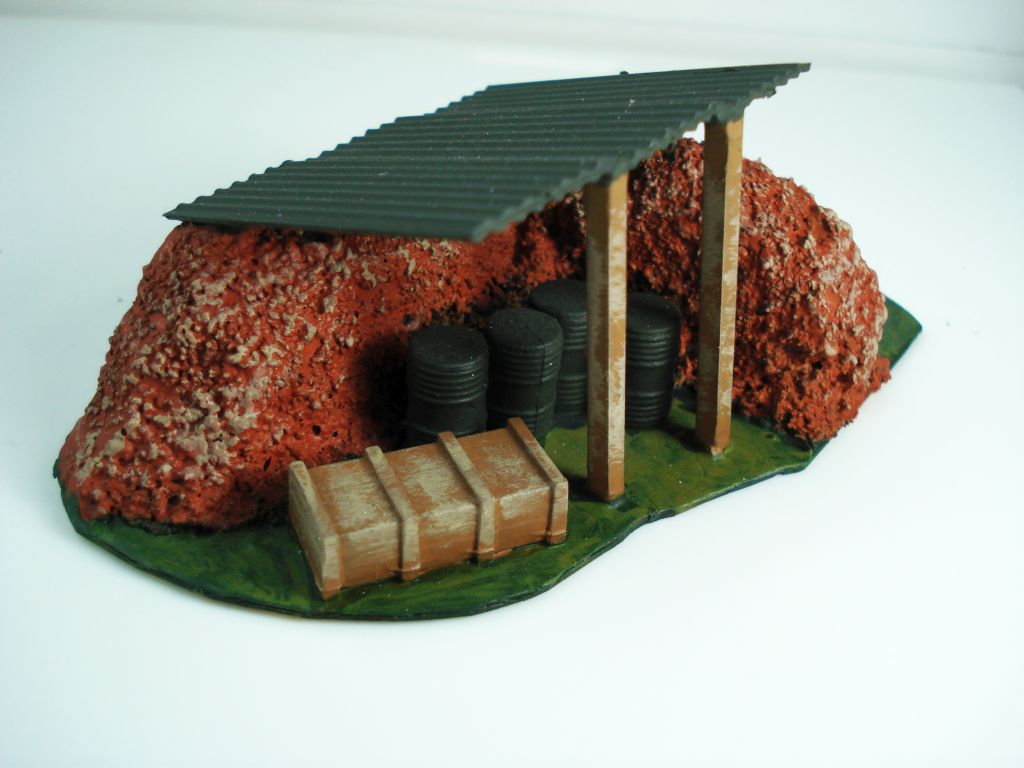
The kit is very good for 20mm troops, if being a little small for more bulkier figures like the Plastic Soldier Co. Germans I have pictured here. Unfortunately, unlike the Armourfast House I do not think this would work well with 1/48 figures. It’s simply too small. Airfix looks like it has the same model with less extra detail pieces at 1/32 scale which sadly might be a little too big for Warlord figures. However if you’ve got figures on a thicker plastic base, that’ll add about 3mm to the height and maybe not look too shabby compared to a larger scale house. It really is a nice model and might work well.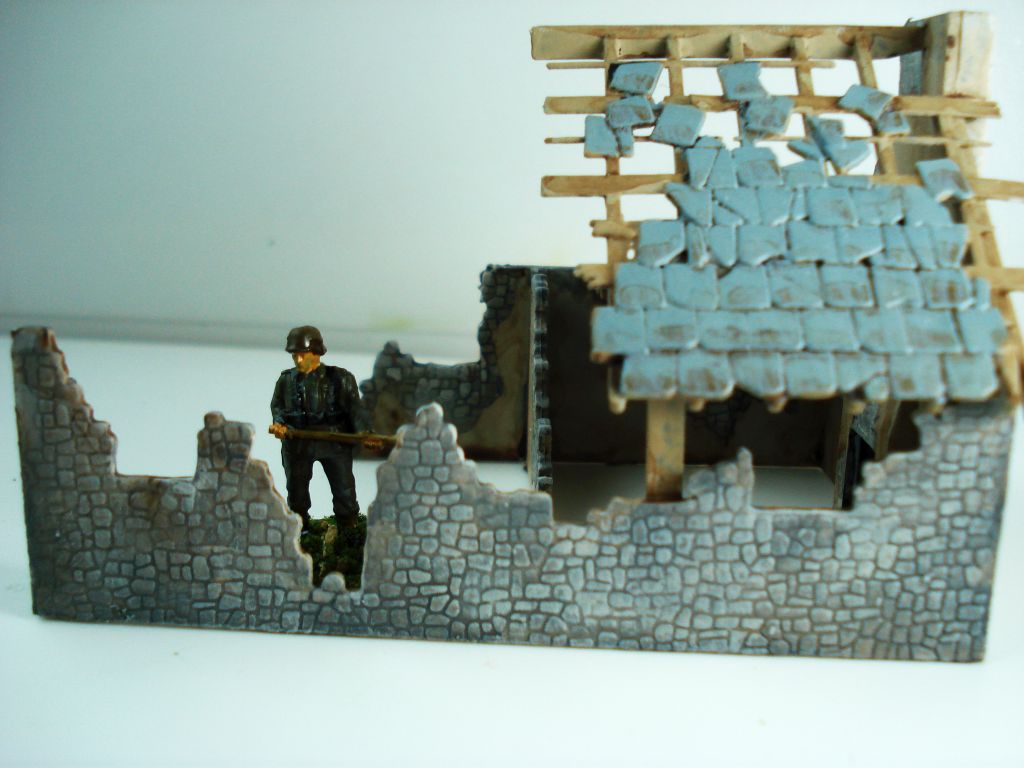
From a 20mm war gaming standpoint, while the kit is designed to serve as a centerpiece for a diorama, it can work very well as a terrain piece too. It’s got a lot of nice additional details you can add to flesh it out, or throw onto other models. All of which makes for a nice addition to add to your terrain collection.
Alleycon 2015 is coming…
I’ve been pretty fortunate over the past few years to get into a circle of local gamers. There seems to be a decent community behind a lot of them too. Alleycon will be running next month and what started out as an afternoon of gaming at a local expat restaurant has slowly morphed into a full fledged con. This year it’ll be 2 full days of gaming and geekery September 19 and 20, with a local meetup the night before for beer and trivia.
So if you are in Korea and keen to play some games, do some cosplay, or rub elbows with fellow geeks, be sure to check it out. From what they’ve got listed as events there’s lots to do (or plenty of space to run your own thing). Online registration is open now. Scoop up tickets before they sell out!

Review: Frostgrave
Swerving a bit off the beaten path of military and sci-fi war games, Osprey press has recently released Frostgrave. Set in a cursed city of ruins and perpetual ice and snow, players create a small warband headed by a fledgling wizard in search of powerful artifacts and treasure. It’s a small skirmish game of up to 10 figures per side and may have the occasional few neutral monsters thrown into the mix (that will attack anyone in sight). The game is designed around 28mm models on a small 3’ x 3’ table. It’s certainly not far in theme and concept from Games Workshop’s defunct game, Mordheim.
Each member of a player’s warband has a stat profile expressing armor, movement, fighting and shooting skills, their defense to ward off spells, and health pools. Turn order is a segmented IGOUGO. Players roll off for initiative and the winning player activates their wizard along with up to 3 followers within 3″. Afterwards, their opponent does the same. Then if a side has an apprentice, they can activate (with the same restrictions for followers) and alternately the opposing player activates their apprentice. Lastly, the sequence is repeated for any soldier followers that did not activate in the previous phases. A special end of turn phase occurs for any independent creatures on the table.
When a model activates, they can take up to two actions. If they take two actions, one of them must be a movement action. So no double attacks, but it allows for a little flexibility like a model shooting and then returning into cover. All rolls in the game are based on a d20. For melee attacks, players roll and add their fighting skill. Whoever rolls the highest wins the round and can then inflict damage. For shooting, it follows similar process but a player compares their shooting skill vs the target’s fighting skill with modifiers for cover benefiting the target. The difference is in shooting, the player simply misses with no repercussions unlike in hand to hand combat.
For scoring wounds, the same roll to hit is then compared to a target’s armor value. Most units will have an armor of 10-14. Players subtract a target’s armor from the attack roll and each positive number indicates points of damage the target suffers. Health point totals are also typically from 8-14 points. You’ll quickly find with some lucky die rolls followers in your warband will be dropping like flies.
Movement is a simple system based on inches with any terrain requiring double the rate. There are simple rules for scaling walls, jumping and falling damage. There are few weapon options with most being either small defensive weapons, run-of-the-mill weapons, or great weapons that do more damage. As missile weapons go, you can have bows or slower firing (but higher damage) crossbows. There are no individual armor options. In truth most of these slight variations in gear get wrapped up in the profile of specific followers. So you can have that high health, quick moving, heavy hitting, berserker barbarian. Or instead opt for a slower, hard-hitting but high armored heavy knight to add to your warband.
Of course what’s central about Frostgrave is your wizard. They start off with a selection of spells from a particular school of magic and a few other related schools. Each school of magic has 8 spells within them. Your apprentice has the same spells to access, they just aren’t as effective at casting the spells.
Each spell has a target number for casting ranging from 8 up to 14 for the more powerful spells. Roll equal or higher than the target number and the spell is successfully cast. If you fail, you’ll take 1-2 points health damage. Essentially this helps curb the amount of casting as botched spells slowly drain the health of your wizard and apprentice.
Tacked onto this are the different schools of spells and casting difficulty. Even casting spells aligned with your school incurs a +2 penalty to the target casting number. Neutral spells have a penalty of +4 and this penalty is greater for opposed spells. So even the easiest spell cast still has roughly a 50/50 chance of fizzling and damaging the caster. To get around this somewhat, the wizard can self inflict damage to boost the die roll ensuring a spell is successfully cast. So if you absolutely have to get a spell off, you’ve got that (dangerous) option.
What seems central to Frostgrave is encompassing a larger campaign. After each battle the wizard of a warband will earn experience and treasure. Treasure can be spent to alter the composition of the warband, while XP is used to improve the wizard’s abilities and expand their knowledge spells. They can even reduce the casting penalty for a spell, lowering the chance of any backlash for failure. Some treasure can be magical imparting bonuses to your wizard or soldiers if equipped. And if taken out of the game, each soldier has a chance to recover while wizards and apprentices might gain permanent injuries.
There are 10 scenarios listed in the book but basically all of them are smash and grab encounters. They suggest a general board layout and some unusual terrain feature, or add the appearance of a neutral monster type, but that’s about it. The campaign goals themselves are pretty sparse. This is a game about gaining as much fame, booty, and power as possible. That’s about it for the campaign game.
The Good – Frostgrave is a pretty enjoyable fantasy skirmish game. The mechanics themselves are simple to grasp and don’t get bogged down in a lot of simulation detail. There are enough situational modifiers and gradations of soldier followers to give each warband some flavor. But at the same time not so much there is an extensive list needing a multi-page quick reference sheet for play. Add to this the 10 different schools of magic with 8 spells each, and you’ve got a lot of list building toys to play with. It seems to capture enough chaotic action with a low figure count to make for a fun fantasy-themed skirmish game.
The book is hardbound and an easy set of rules to read through. Plenty of color artwork and photographs are liberally spread among the pages which effectively spark that excitement of sword melee and spell-slinging battles.
The Bad – It’s odd that for all the streamlined modifiers and gear, you seem to get bogged down in a lot of bookkeeping. What especially stands out is the way damage is inflicted. You compare a high attack roll to an armor value and take the difference off a model’s health total. Yes, you’ve got hit points. This is a hair’s breadth away from being something you’d see in a RPG rule book. I appreciate how casting spells are related to health totals. Unfortunately this seems to carry over to rank and file units. Yes, the game can be exceptionally lethal. But it can also end up with models having a lot of minor fleshwounds. Expect to have a warband roster sheet at the table with a pencil handy to keep track of health totals.
Sadly this also does not stay with just hit points… err.. health totals, but also with wizard XP. Experience is liberally gained during a fight which is cool. But you have situations where XP is gained for each successful spell and personal kills are made. Not to mention for each bit of treasure collected. Yes it’s fun to earn oodles of XP but the excessive bookkeeping can become a chore.
The longer campaign rules are nice but you begin to notice how hollow they are along with the scenarios. It’s truly similar to a kick-in-the-door-kill-the-monster-get-the-loot kind of game. The campaign is about gaining the most stuff and becoming the most powerful wizard. There really isn’t anything else besides that. There is an optional rule where a player can attempt to cast an instant campaign win spell. It requires the accumulation of several spells and even more advancement effort into casting the spell (which is essentially impossible until spending several experience points in reducing the casting penalty).
It’s a shame as so many out of combat spells and parts of the game revolve around campaign play. Clearly that is what the game is designed around. It’s just that an overall campaign (and the scenarios that support it) never provides anything more aside from the winning player having the warband with the most gold and XP.
Lastly, the game world is set in a labyrinth set of ruins covered in snow and ice. You might be able to get away from the arctic theme, but the game is designed around having tables with lots of high cover and isn’t that flexible in terrain layouts.
The Verdict – I was hopeful for Frostgrave and it got some things right. I like the relatively streamlined task resolution and the game doesn’t seem to get bogged down in movement, spell, and combat mechanisms. The idea of rolling off d20s against each other is quick and engaging. There is a little back and forth play as you’ve got some alternate unit activation and as enemies have limited reactionary movement, you can also take the initiative some forcing a melee combat out of turn. The tinkering of warbands and spells for your wizard is fun along with deciding how to spread out magic items and potions. That thrill of expanding your warband, spells, and allocating treasure after a successful battle is a fun concept.
What mars this a tad is the excessive bookkeeping for damage and XP gain. You are going to need a few sheets of paper handy to track everything. I’m certainly immediately thinking of tweaking the rules some for warband soldiers and using damage tokens instead. The same might be said for keeping track of XP gained during the game too. I’m considering some simple scenario rules where earned victory points translate into XP gains.
This bleeds over some to the overall game. If you aren’t running a campaign, you seem to be seriously hobbling the system. There are a plethora of spells that have the most function in campaign play. The overall goal of the campaign system is limited too. The impressive list of scenarios is really just a list of terrain effects and complications to sprinkle in the regular objective of getting loot and wiping out the enemy.
So I find Frostgrave a mixed bag. There are a lot of little things here to enjoy. The lists of different magic items, independent creatures, and various spell schools are great. Immediately off hand I’d consider this a better choice over Mordheim. Task resolution and play is a bit more streamlined, yet also more dynamic than Mordheim. The XP system is also geared primarily to improving your wizard, so you aren’t having to tweak every member in your warband. At the same time, you can figure out what combination of soldier followers would work best and there are a few spells that supplement your warband’s fighting abilities.
I guess I wish the idea of a quick skirmish game was embraced a bit more, especially with the bookkeeping of health totals. Frostgrave has those trappings but it’s still a bit further away from something like Songs of Blades and Heroes for ease of play. There’s a lot of potential here, but as a whole it seems to falter a little.
Granted, as a rule system for a fantasy skirmish game Frostgrave is successful. There is fun here. It’s just not as innovative or elegant as something like SAGA. Though, I can’t really fault it for that. Frostgrave has that feel of a fluid and magical Mordheim with much of the clunky bits of that older game shed off. It’s sleeker and far dynamic. While Frostgrave trips some, there are more solid parts making it definitely hold up as an enjoyable fantasy skirmish game.
Jumped off the deep end of miniature Kickstarters with Reaper Bones
 I’ve avoided the siren’s call of Reaper Kickstarter campaigns of past. But the temptation to pick up a slew of minis is just too much. Their current Kickstarter campaign wraps up in less than 3 days. As usual, you get a ton of plastic minis. The bonus for me is that you don’t need to prime them.
I prefer to use tokens for my RPG sessions over using minis. But I am pretty deep into miniature gaming and been taking a gander to some different systems as of late. Pulp Alley looks neat and Frostgrave is certainly on my radar for something to pick up. As a back up, there is always Chain Reaction which is generic enough for a variety of light arms skirmish games. Yet, I’ve heard some cool things about Songs of Blades and Heroes too for fantasy melee. Yeah…. guess I’ll have plenty of games to run with these KS goodies.
Bolt Action: Battleground Europe
 Osprey publishing has slowly been releasing a series of campaign specific books for Bolt Action. Battleground Europe takes the ambitious task of highlighting the Western European front from the invasion of Normandy all the way up to the end of the war. The book covers special units as well as more scenario specific rules and throws in some historical background sections to boot.
Like the theme, the material in the book is rather sprawling. The campaign is broken down into progressive sections where historical information is first presented, then any particular rules related to the battles, and finally a few scenarios depicting a historical engagement or a more generic type of skirmish that was fought in that battle.
Rules for special units are presented and can be chosen as selectors for particular scenarios. In addition there are a few hero type characters for Allied and Axis forces. A few special vehicles are also covered. There are some force selector lists that are also given for armored platoons of Allied and Axis flavors.
New scenario rules primarily cover minefields, night engagements, and amphibious landings. Each of the listed scenarios usually have some small additional rule regarding the composition or other tweak to give the battle some flavor like limited fuel or ammo. Hedgerow rules are also covered to add as a terrain feature for Normandy battles. All in all 15 scenarios are provided. Most of them have victory conditions that range from destroying the most enemy units, to having the attacker move into enemy deployment zones. Some scenarios like those for Normandy beach landings detail an expected table layout some, but most are fairly generic. They do cover a broad type of engagements fairly well with each having some small special rules, along with what would be considered atypical forces for the battle.
The good – The book gives a fair snapshot of the Western European theater at the end of the war with enough scenarios to visit. The additional units offer some fun choices to give a platoon a decent theater selector feel. The artwork and photos are also plentiful and along with the historical background, certainly helps convey information and evokes inspiration for playing the game.
The bad – Most of the scenarios don’t really stand out as anything new. While there are a fair amount of special rules for particular engagements, much of it is scattered throughout the book. And some key rules which would work in different types of battles (like amphibious landings, mines, and night fighting rules) would be better presented in one section rather than spread out and aligned with one scenario. I really would have appreciated a few more maps. Some actual aerial photographs or simple drawings of scenario tables would have been nice. You get a written description which is functional, but having some more details on a table layout would have been better.
The Verdict – Battleground Europe isn’t a bad book. It’s just not a completely stellar release. I was hoping for a more historical scenario book with more rigid force selector rules. There is some of that, but not quite enough. It seems to go more for providing games that give a certain flavor over depicting a true historical battle. I just wish it dabbled in both types of scenarios more.
Another ding is the presentation of the material. For the most part it’s sectioned off in the different stages of the conflict, which isn’t bad. However the special rules also are spread throughout the book. This becomes an issue as some rules (like for mines) are required for several missions throughout the book, but the actual rules are with one particular scenario. Having them collected in one section would have been better and easier to reference. There is some nice stuff here. Some interesting vehicles (ex. Hobart’s funnies) and units are depicted, like French resistance troops and the Einheit Stielau commando unit (English speaking German commandos that were in first days of the Battle of the Bulge).
While it is a European specific book detailing Axis vs. Allied engagements, some of the rules could be applied to other theaters. Amphibious landing rules could easily be used for the Pacific, or the Invasion of Sicily. And night fighting rules and mines could also be added to a regular game. Likewise, many of the scenarios could be used to depict some generic battle with a small twist on the composition or conditions of the game.
I guess that’s my main complaint for Battleground Europe. Too much effort was put into making the scenarios something that could be applied to a wide variety of forces, rather than trying to depict a specific engagement. I recognize that’s the nature of skirmish games. You really can’t mimic something unless going for a larger scale battle. These skirmish fights are a zoomed in, snapshot of the action. However it seems a missed opportunity. So for a player that wants to duke it out on the Western European front, and is a Bolt Action fanatic, they’ll find this book worth picking up. If you aren’t I’d be hard pressed to say it’s a must have. It is a decent book with a fair amount of scenarios that have slight tweaks to make for a different game. However it’s not enough to make it an essential book to have on your shelf.
 Geek Ken