Category: Netrunner
Netrunner Counter Trackers
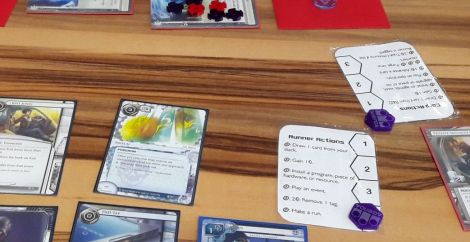
A while back I made some simple credit and click trackers for Netrunner. They weren’t going to win over anyone with how they looked but the cards were functional. I seem able to stretch my collection and get a few people playing but couldn’t say the same with tokens from one core set. I also wanted something a little more portable than lugging a bunch of cardboard counters around all the time.
One thing about netrunner is it uses a lot of tokens. I like keeping track of information using counters, but you can get an explosion of markers and tokens on the table with some decks. Because of this I wanted to expand the card trackers I made to try and also handle other card conditions.
I ended up making a universal counter tracker. You could use it for virus counters, tags, even advance tokens if needed. It is limited to being only able to track 12 counters however. Another smaller tracker I made was for recurring credits. Just a small card to slip under another indicating between 0 and 2 credits, helping keep track of what is spent during a turn.
The look and design are clunky, likely enough to make any serious graphic designer gag. However they are functional. You can find them in the downloads section. Hope folks get something out of them for their games.
Netrunner has a new player problem
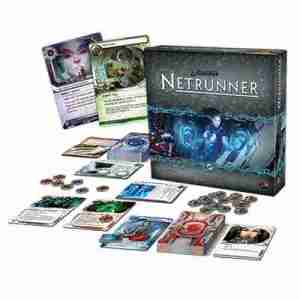 I enjoy Netrunner and have been teaching a slew of players for a while now. There is something that seems to hinder getting players into the game though. A key point is that despite it having a decent core set, it’s just not that approachable to new players. What is looming in the background is this wall of cards that almost seems insurmountable to decipher and break through. There is so much and the pool of cards so vast, it becomes a deterrent to trying to learn. Compounded with this perception is the requirement of having to purchase a big box set of cards to get into the game.
I like the base game. The core set gives a nice spread of different card factions and best of all, certain cards are still staples in competitive decks today. Also compared to Magic and other CCGs, Netrunner is a complete bargain to get into. But oddly Magic seems to have a smaller hump to get into the game.
It’s the draft events. For Magic, booster drafts are highly popular. Players throw in some cash to buy a few booster packs and then draft a deck from a combined set of cards. Some additional support is needed by having several basic land cards for players to add to their deck. However, for new players it’s a way to walk away from a tournament with a set of cards that comprise a playable deck. These are pretty newbie friendly tournaments that don’t require a large initial investment.
Netrunner could use something similar. There are some draft packs that are available, but the drafting environment isn’t that newbie friendly. Fantasy Flight also has dabbled with offering the 2015 Championship Decks. These are corp and runner decks that are pre-assembled. Offhand I think it’s a great product to get people into playing Netrunner but there are some hiccups. One is that the corp deck isn’t currently tournament legal. Secondly, (aside from an apparent misprint for the card cost) the runner deck offers an odd milling strategy. However the idea is pretty solid and leads into a concept of offering Core Deck packs.
Essentially these core deck packs are teaching decks focused on a single corp or runner faction. Ideally the agendas would be all in faction. New players could buy a pack and have everything they need to play. The deck might dabble some into the other factions and have a small spread of neutral cards (more on that later). The key would be to not stack 3 of a specific card type. Instead have two at the most. With cards bleeding over into other factions, the decks could serve as an incentive to pick up other starter packs aligned with that faction, or possibly get a core set. And if a new core set was available, even better.
The pickle of course would be the tokens. You might go the route of having 2-3 mini sheets of tokens for tags, brain damage, a few virus counters, 8 or so 1 credit makers, and another sheet of just 5 credit tokens. But an alternative might be to offer cards with slot trackers on them to keep track of tags, and credits, encouraging players to use coins, beads, and other tokens to push around on these cards to handle their resources. This leads into another point though of enticing new players to finally jump in for a Core Set 2.0.
Cards in the current core set are subject to errata, while some decks are simply illegal (and not just by tourney play). Combined with the encroaching rotation, it would be a great time to consider a new core set. Not everything needs to be changed. Just a sprinkling of some new cards possibly introducing ones with similar abilities to those being rotated out with the first two data pack cycles. This is something die hard Netrunner fans would be interested in picking up to round out decks. And if a player has nibbled by buying in though core deck packs, they can finally get a full set of tokens and expand their pool of cards. Having their hands on neutral agendas in the core set might also be an especially great draw.
Another plus is that they’ve got some redundant cards to allow for more people to play out of the box along with previously purchased decks packs. Along with these core decks, now you could easily have 4 to 6 people to jump into a new core box and play for a night. Mind that this is something you can’t really do now with the current box set.
There are some obstacles to these core deck packs, especially the hump of having a full set of rules and enough tokens to play. However it’s worth expanding on the idea of ready-to-play decks and offering alternatives to buying into Netrunner rather than just snagging a core set. Something to keep in mind, these core decks don’t have to be super competitive to the tournament scene in general, just competitive to other core deck packs.
You could have events where players just have to buy a runner and corp deck of their choice and still be able to play right off the bat. If wanting to participate in other similar events, they could pick up a deck or two of other factions to switch things up some if wanted. This would also allow them to lessen the initial learning curve with a smaller card pool, as they don’t have to jump into the game with a core box of 7 different factions. In the end something like this might make getting into Netrunner a little less formidable, and potentially more approachable to new players.
Netrunner Click-Credit Trackers
I dig Netrunner. While I have reservations recommending it to folks, I certainly enjoy it. Lately I’ve lamented some on how much it has dominated my free time gaming. I find I’ve fallen down the rabbit hole of deckbuilding and picking up cards for the LCG.
Even though Netrunner is rather portable, it does require a lot of tokens and markers. I also end up teaching players a lot and while I like the play aids that come with the game, I thought it could be better designed to incorporate both a click tracker and a reminder of player actions on one card.
In addition to that, I thought about using cards to also track credits. Splitting them up into single and 5 credit values on two different cards seemed acceptable. So I went to work and whipped some up on a single sheet.
They are ugly, amatuer designed aids, but functional. The trackers also don’t completely solve the token issue. You’ll still need tokens for bad publicity, tags, recurring credits, virus counters, and advancement markers. But with a little creativity and some different denominations of coins, you could likely cut down on the number of markers you need to lug around using the trackers.
You can print them up on cardstock, or use paper and laminate them if wanting something to take a bit more wear and tear (or just sleeve them like I did). I think they work pretty well. You can find them in the downloads section and I hope folks find a use for them around the table.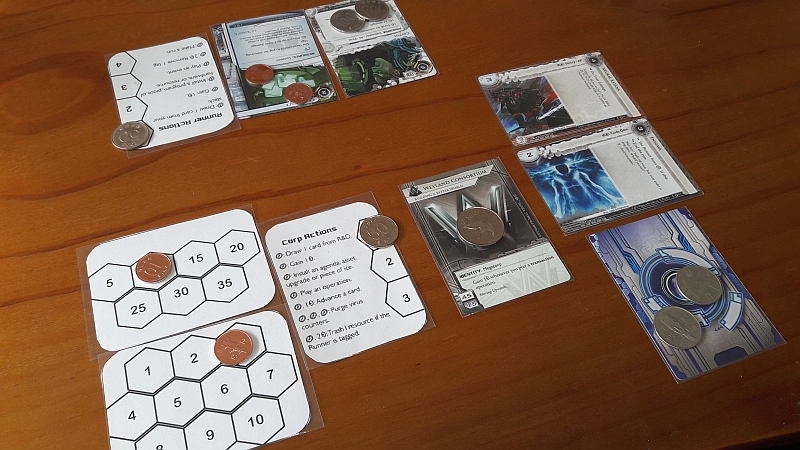

Review: Android – Netrunner
 In the mid 90s Richard Garfield put out a CCG than embraced the cyberpunk theme called Netrunner which petered out. Almost 15 years later Fantasy Flight picked up the rights and converted it to encompass their futuristic universe, hence the name, Android: Netrunner. It’s a dystopian future where megacorporations truly hold control over every aspect of human lives.
Colonization of the moon and Mars has begun, along with the development of sophisticated AI, androids, and human clones which serve as slave labor and are essentially products bought and sold. Beneath all of this are human beings that go about their daily lives, scraping by, and essentially are at most drones and corporate slaves to their employers just like the clones and androids they encounter regularly. A few choose to explore cyberspace instead fighting for either ideals or profit against the megacorporations as runners, hackers that steal data from corporate assets.
Android: Netrunner (or just Netrunner) is a two player, living card game. Fortunately FFG dumped the collectible aspect. Instead they opted to crank out expansions with fixed numbers of cards. Want to expand your card pool? No random booster packs. Just pick up a small set of cards and you’ve got everything in that expansion. The gotcha of course is through the constant roll out of expansions, you get that lure of the Pokemon gotta-catch-em-all urge to keep buying into the game. Combined with a healthy competitive tournament scene enticing players to keep up with their gaming opponent Joneses, there is definitely a draw to buy new sets as soon as they are released.
I avoided the siren’s call of Netrunner for a long time. But I was in the mood to pick up a new deck builder game and the theme and aspect of a LCG was attractive. I did Magic and was not keen trying to get back into that game. The collectible aspect of Magic just wasn’t something attractive to me any more. So I jumped into Netrunner feet first and now regret that decision immensely. It’s not that the game is bad. Far from it.
The basic rundown of Netrunner is that the corp player has agenda cards in their deck up to a specific total. Each card will commonly be worth between 1 and 3 points. To score them the corp player has to play them and spend actions (clicks) and money (credits) to advance them to a specific sum. Once they do so, they can immediately score it for points. The runner however just needs to access it. The runner isn’t limited to accessing agendas in play. They can also access agendas in the corp player’s hand, deck, and discard pile. To prevent that from happening, the corp player will lay out defensive ice cards to sap resources or stop the runner. The runner in turn slowly builds up a suite of equipment and resources to bypass ice and access those agenda cards. The first player to 7 points wins.
It’s actually a pretty easy game to learn. However once you begin to play, especially as the corp player, you begin to see the route of winning isn’t so easy. The corp player only has 3 actions per turn (or clicks). To play an agenda is one action and to advance it each time also takes an action. Most agendas take must be advanced 3 to 5 times to score. That means it will usually take at least 2 turns to score. All the while, you have to hope that your defensive ice is enough to ward off the runner trying to pick up that agenda. And to make matters worse, the runner has 4 actions during their turn. So they have plenty of opportunities to bolster up their resources and programs to make a successful run.
Now mind you, it’s not just agendas in play, but also agendas you have in your hand or possibly the top card laying in your draw deck. Forced to discard a lot of cards in your deck? Those juicy agendas might now be in your discard pile, just waiting for the runner to scoop them up. And that’s the kicker. While the corp player has to spend cash and actions, slowly and painfully advancing agendas for points, the runner just has to slip past that ice and steal them.
It’s not all roses for the runner though. Some ice is tough and can be one of four different kinds. If the runner doesn’t have an icebreaker program installed, actions on the ice card will execute if the runner bumps into them during a run. Most simply end the run action but some ice can destroy those icebreakers installed by the runner, or force them to discard cards from their hand. This leads into another way the corp player can win. If the runner player ever has to discard more cards than what they have in their hand, they lose immediately. Given each player can only have 5 cards in their hand at the end of their turn, the prospect of hitting horrible defensive ice or a trap card in the corp’s play area becomes a huge threat.
To add to this tension is a simple aspect of hidden information. The runner puts cards into play face up spending an action and paying cash up front. Pretty much everything they do is open to the corp player’s knowledge (save the cards they are holding in their hand). The corp player installs their cards face down simply by spending an action. They can rez (or activate) their cards later, spending the cash when they want to do so. Granted a runner might expect that card gathering up advance tokens is an agenda, but not always so. Sometimes it can be a trap to wipe out the runner’s installed cards (or even worse, force them to discard almost their entire hand). All those defensive ice are also installed face down. While the corp player still has to pay cash to activate them, the runner has no idea if that face down card protecting the corp’s draw pile is huge wall, effectively stopping them until they can install the right icebreaker, or something pretty easy they can bypass.
It’s the hidden information and aspects of bluffing that make the game enjoyable. Add to that the limited actions each player can take per turn, combined with constraints of available resources (credits), and you have a fun game with high player interaction. Layered onto this are the various factions for both the corp and runners. You end up with a game that has a lot of variety in gameplay which is engaging and entertaining.
The factions and aspects of deck building are also a huge draw. You are limited to 3 cards of one type and decks which must have a minimum number of cards affiliated with a particular runner or corp faction. Along with this are rules for influence when building your deck. Each card is worth between 0 to 5 influence points. If you want to dip into another faction you are welcome to do so, but that subtracts from your influence total. There are some powerful cards which can provide great combinations with other factions, but they dig into your influence pool meaning you can only tinker some with another faction. Fortunately there are also neutral cards for both the runner and corp that allow the player to freely add to their deck and don’t cost any influence points (save for a few exceptions)
I think one notable problem with Netrunner is that it can consume your free time so easily. It’s said people live Netrunner, and I can see that. I fear I might end up ditching time to play other games so I can explore Netrunner further. It’s made me keen to keep tinkering with decks and work up wicked combinations, with the added excitement of picking up another expansion, opening up more and varied card options.
The Good– Netrunner is immensely enjoyable, engaging, with lots of variety in play, and plenty of cards to expand the game further. Thrown into this is the asymmetrical play experience and win conditions. It truly is a wonderful 2 player card game. Not to mention a game plays pretty quick (where a longish match might be 30 minutes at the most). Add to this a bevy of lovely card art and you’ve got a great game.
The Bad – There is a huge game knowledge curve. Learning the game is actually pretty easy. However gaining understanding of all the nuances of play is not, and Netrunner can be brutally unforgiving with mistakes. There is a huge divide between dabblers and folks that play a lot. It’s a combination of both knowledge and cards.
If you play a lot, you know the combinations of cards out there. You are better informed, more prepared, and in turn likely able to construct a deck that is fluid enough to tackle whatever your opponent throws at you. Netrunner has a lot of trump cards and hard counters for them. If you don’t read what your opponent is telegraphing with how (and what) they are playing, you will get smashed. Lastly, it’s a two player game and the core set can’t effectively create decks that more people can mine from if you wanted to do a four player dust up for an evening.
The Verdict – My opinions are in this odd juxtaposition for reviewing Netrunner. If you want to dabble, get a core set and a few choice expansions or data packs. You will find so much to explore and get a thoroughly engaging game that will last you a long time. Add to this a plethora of existing card expansions and you can squeeze years of gaming out of your purchase.
But to jump into the competitive scene it will take effort. So much so it might not be worth doing. You will end up seeing this game divide between casual players that have a lot of fun, and experienced players that go for the deep, engaging, play experience. And if constantly teaching new players, fans of Netrunner will always seem to be struggling to keep within these two camps.
Even as a relative casual player, eventually you’ll be armed with a wealth of knowledge of card types and set strategies. You’ll be able to quickly recognize if an opponent is potentially laying out an agenda to score, or setting up a devious trap. For a brand new player, it’ll take a substantial amount of time to get on a similar level of play, and they might not feel it worth the effort to do so.
It is a niche game. If you have 2 or 3 friends that are adept at CCGs you can get some mileage out of Netrunner. Spend another $30-50 to buy 2-3 select data pack expansions and you’ll have a robust pool of cards to make a variety of decks, more than enough to keep a few casual players occupied for a really long time. But throw a knowledgeable player into the mix and even hobbled with a handicap deck, those experienced players are going to tough to beat. That chasm with familiarity of the cards can be that deep.
To me that’s the problem with Netrunner and something that keeps me from recommending it to all but a few select gamers. To get the most out of it and willing to encompass the larger player base, you need to be committed. If you have the time and players, that might be worth it. Otherwise you will end up just playing once in a while casually. In the end that enjoyment might not go that far, as there are too many other games out there that offer immersive play with less of a learning commitment.
UPDATE: Netrunner will be getting a new core set in Q4 of 2017. By then rotation will have hit (removing the first 2 expansion cycles from the game). More importantly, this new core set retires some card standards. It will have a big impact and already has shook up a lot of the conventional wisdom of the game. So much so I think new players will be on much more even footing as long time veterans. It’s still a deep game. There still needs to be that commitment to learn (and buy a few of) cards in the expansion cycles. However for a new player I consider it a great time to get into Netrunner at essentially the ground floor of a game reboot.
March 2021 UPDATE: Netrunner sadly went the way of the gaming dodo and is no longer in print. However Project NESEI, a fan collaboration, has been busy introducing a new set of cards to get people playing, System Gateway. It’s a slimmed down, 2 deck pack to allow folks to learn the game, matched with another small set to expand their card collection. Along with this is an existing expansion released a few years ago, and another set which re-released old classic Netrunner cards to broaden deck building potential even more.
With excellent card printing services out there, you can accumulate a good set of cards for a reasonable price. Plus it appears Project NESEI will release a small expansion every year and tweak the official card pool even more. It looks like a bright future for Netrunner (as much as it can be for a game officially out of print). If keen to give it a try, now’s a wonderful time to try the game out.
 Geek Ken