Category: Review
Jumped into the YouTube Pool
Welp, decided to go with the rising tide of streaming and videos. Enjoy blogging and still think I’ll be putting up written reviews for things that strike my gaming fancy. But I can’t deny that the days of the written blog are waning. I still enjoy making gaming content and likely focus more on documenting my bench and tabletop time with videos going forward. My first effort is linked below.
Review: 5 Leagues from the Borderlands
A long while back I picked up a solo sci-fi wargame, 5 Parsecs from Home. I later found out a new edition of a fantasy version was in the works and scooped it up as soon as I could. 5 Leagues from the Borderlands (5LB) is a solo skirmish wargame with RPG elements from Modiphius. You gather a warband of six adventurers, selecting one as your avatar, and seek to cleanse the land of evil.
The campaign has 3 main threats set at different thresholds, and you are tasked with removing them completely from a region. By gaining adventure points through encounters, you acquire enough to attempt various actions to find their hidden camps and eliminate them. A departure from 5 Parsecs from Home is that you start with an actual region map. You’ll sketch out some features, leave some areas as unexplored wilderness, add a few villages, and finally sprinkle some locations of interest throughout the map. This will define the region you’ll be adventuring in.
The campaign turn follows a sequence starting with preparation, upkeep, travel, and finally a potential encounter with enemies. Generally preparation allows for 2 actions providing opportunities to gather resources, rest up, buy or sell equipment, or seek out quest rumors. The type of actions will be dictated if you are in a village or out at remote home camp in the wilderness. You have to constantly keep money on hand to pay your troops. Skip out paying your hirelings too long, and eventually they will become disgruntled and leave.
You direct your warband to travel, investigating unexplored locations, strike out at an enemy camp, or patrol traveled roads. During your journey, you’ll have various random events with some being boons and others complicating your efforts. These events can also dictate the types of encounters you’ll have when engaging the enemy. While out on patrol, you might encounter a befuddled scholar that seems friendly enough, only to find they were a scout for a band of brigands that ambush you.
The types of encounters are split among a few scenarios, with some having defined defender and attacker positions. The enemies you encounter are determined randomly, rolling on different charts for the types of threats in the region. These threats broadly will align with particular enemy types such as undead, chanting cultists, ravenous beastmen, or even a spearhead of an invading army. Each encounter type will also have defined objectives. While it’s ideal to hold the field, a fair outcome can be to achieve the scenario objective and make a quick retreat. If things turn too sour on the battlefield, you can always call for the warband to retreat but expect more dire outcomes to your hirelings. Encounters can also encompass dungeon delves or attacks on monster lairs.
Scenarios run through several turns first starting with initiative. You will roll a d6 for each warband member, trying to not roll above their Agility score. You assign successful rolls to individual units that can undertake their full allotment of actions for the turn. Then enemy forces act next, and finally have your remaining forces act before the turn ends. A mode’s turn encompasses a movement action combined with an attack, some manner of a task action, or possibly a further dash of movement.
Ranged combat is rolling a d6 and trying to commonly roll over a 6+ or a 5+ (if the target is in the open). If the target is hit, a d6 roll is made to overcome armor and then an additional roll against the target’s toughness. If the total roll exceeds the toughness of the unit, it becomes a casualty. Rolls equal to, or less, result in the unit taking a wound and being stunned, with a second wound taking it out of the fight. Stunned models grant bonuses if in melee and are always treated as defending but the condition is removed at the end of the turn.
Melee combat is a little more involved and is fought over 3 rounds. Each model makes a combat roll trying to roll the highest adding their combat skill. After each round the defender moves back 1” and the attacker has the option to move in to continue the combat, or break off and end it. On ties, the attacker never follows up and the combat ends. If the attacker scores higher, they have a chance to inflict damage (resolved like ranged attacks). If the defender wins, the next round they become the attacker avoiding any damage for that exchange. Unlike ranged attacks, stuns only have an effect during that fight and are removed at the end of the exchange.
The player has as few tactical options when in combat, like whether to fight defensively or throw caution to the wind and fight wildly. Some weapons and positioning (such as being on higher ground) allow a model to counter attack, essentially being able to strike a hit while defending (instead of just being the attacker the following exchange). This special maneuver is avoided by selecting certain fighting tactics. So against particular enemies, or being at a disadvantage in positioning, you can overcome counter attack situations employing defensive tactics. Given you only need to exceed a model’s toughness to make it a casualty (with typical values between 3-4) being the attacker is ideal and combat can be deadly.
Movement is pretty simple, doing so up to a model’s rate in inches, with a second move as a dash action. Most difficult terrain uses 2” of the figure’s movement for every inch on the table. Models cannot pass through each other and there are simple rules for climbing and falling. Terrain is fairly abstract with line of sight based on drawing unimpeded lines of fire from the attacker to the target. Inverveining features, models, or beyond 3” in area cover will block line of sight. At the very least most features will offer some manner of cover to the target.
Your warband is always striving to gain adventure points. If you win an encounter against an enemy you gain d6 adventure points, and some simpler missions like patrols will only earn you one point. Once per campaign turn you can expend them and roll a d6, trying to roll less or equal to the number of spent points. If successful, you complete a major campaign milestone. This can be finding an enemy camp, finding a hidden location, further developing a settlement, or if you are lucky after being victorious in battle, reduce that faction threat to the region. Regardless if you are successful or not, the points are spent. The campaign becomes a balancing act between taking major risks to get high adventure point rewards, to doing more mundane campaign actions gaining resources, heal wounded members, and prepare for more dangerous fights.
Individual members of your warband will also slowly accrue experience. Earn a set number and they can advance, rolling to randomly increase a particular stat allowing them to fight more effectively, shrug off damage more easily, seize the initiative, or cover ground faster. They can also pick up skills that can help with particular campaign actions.
5LB does have magic and one of your heroes can be a mystic. However that model is limited to 3 spells per encounter using a resource called strands, and its entire action is used when casting. The spells are more for hindering your opponent, or providing a temporary boon to your warband, rather than all powerful spells, like hurling bolts of lightning and fireballs. Spells have a target number to cast, rolling 2d6 and expending a strand of energy doing so. Fortunately if you fail, the strands of mystical energy are not lost (and only happens if you make an abysmal roll).
You will find yourself trying to maintain funds to keep your warband together, repair and improve equipment, and do tasks to discover enemy camps during the game. All the while, random events during travel and end of campaign turns will be constantly throwing curveballs at you. Most will put an obstacle or hindrance in your way, but a few events will offer boons to your warband. As mentioned earlier, you are constantly seeking to gain adventure points that are expended to complete major campaign milestones. Given that faction threats commonly have values of 5-6, it can take a long time to eliminate an enemy from the region.
There are quite a few different factions to fight against and also unique foes and monsters that your warband will meet. Encounters fall into five general scenarios and some incorporate some type of combat at a location that requires exploration. While clearing the enemy from the table is always an option, usually you are tasked with completing an objective. Given that combat is deadly, with a chance of casualty becoming a corpse, you find yourself trying to complete what objectives you can and retreating before events on the battlefield become too dire.
At the end of each campaign turn after an encounter, surviving warband members gain experience. After gaining a certain number they can choose to randomly advance a trait or potentially gain a particular skill. Skills crop up when attempting to do certain actions during an encounter, or trying to do a campaign action. So that hero effective at crafting might be able to repair equipment or gain a few marks to ease the burden of upkeep. You’ll find yourself trying to maintain equipment, get better gear, and also purchase items to mitigate obstacles that get in your way during travel and after fights.
The Good – 5LB offers an enjoyable narrative experience that fits within a region, providing an ever evolving story. The melee combat can offer a dynamic swing back and forth, as each side gains advantage after a round of rolls. You have some choices during melee either fighting defensively or maybe go with all out attacks. Positioning can offer advantage and sometimes it’s worthwhile to gain the initiative in a combat round only to break it off so you can extract yourself the next turn. You’ll find yourself looking over a map, choosing to explore locations, and strive to seek out the enemy in hopes of delivering a decisive blow or to gain treasure.
The Bad – Combat is brutal and fast. At times almost too fast. You might find yourself painstakingly setting up a table with gobs of terrain, only to have a fight last a few turns before your warband has to turn tail and run which can veer towards being anti-climatic. It could also be considered there are simply too many random events which can result in detrimental effects for your warband. So much so that you are constantly in a hole of debt, injury, and poor equipment, with the campaign spiraling slowly towards a disastrous end.
Also, the accrue of adventure points can be ponderously slow where you can never seem to make any headway beating a foe. A typical campaign will have one threat with a level of 6 and the others with levels of 5. To lower a single threat by one level, you have to roll a d6 and score under a number of spent adventure points. Meaning to have a reasonable chance of defeating one threat, you’d need to get at about 8 campaign turns in. This can almost seem like an impossible task and is compounded some with outcomes of random events typically throwing even more problems at your warband.
The Verdict – I enjoy 5 Leagues from the Borderlands immensely. The combat is brutal and I do appreciate melee fights being a little more engaging over rounds of exchanges between figures. It can still provide some quick battles once things get going, almost to the point you spend more time setting up the table and combatants than running the fight itself. However the outcomes of travel, random warband events, and the push to achieve objectives in fights tends to offer a narrative tale for your warband. Losing a hero can hurt and there can be serious repercussions to fights. You are ever balancing maintaining enough resources to keep your warband afloat, and still try to make an impact on the region, dispatching enemies.
I’ve stated this before, but 5LB has vibes of the old microgame, Barbarian Prince. You have this goal to remove evil forces from the region and are always trying to explore the lands, take the fight to the enemy, and maintain resources and equipment to keep your warband together. But things happen. You commonly will have random events throw wrenches into your plans, and once in a while maybe get a boon to help. All of this helps weave together this story of your warband over the campaign turns. I really enjoy it. It helps immensely too having a wide variety of foes to fight, from nameless undead, wily fae, viscous goblins, to monsters like wyverns and trolls. Being a miniature agnostic system, you really get a chance to bust out your collection and play with different toys.
So if you fancy a solo wargame with a fantasy theme, and can embrace the occasional dip into light roleplaying, certainly give 5 Leagues from the Borderlands a look. You’ll find a game that’ll offer an epic adventure campaign wrapped around miniature wargaming rules.

Review: Zona Alfa
Occasionally I get a bug up my butt to try out odd skirmish genres. I was interested in painting up some modern military figures but wanted to steer away from historical/modern conflicts and Osprey Publishing’s, Zona Alfa popped up on my radar. It’s heavily laden with sci-fi trappings but wrapped up in primarily modern weaponry and technology. Taking some inspiration from the Stalker PC game (and in turn, the movie), it truly draws its theme from the sci-fi book, Roadside Picnic.
A classic russian sci-fi story, Roadside Picnic has an unusual premise. Aliens arrived on earth, poked around, and then left, leaving behind remnants of their technology. Humans can’t deduce their actual purpose with most items breaking the laws of physics and beyond human comprehension. To draw from the book title, we are like ants crawling over the leftovers from aliens that happen to stop by earth for a short “picnic.”
The site of the alien landing becomes a secluded area, heavily guarded by the military. Only select personnel and researchers can enter it. Even more odd, the Zone is littered with physical anomalies that twist time and space. Segmented off from the public, individuals (Stalkers) sneak into the Zone, seeking strange tech to snatch up and sell on the black market. Throw in the PC game theme, you also have the Zone hit with radiation and horrible mutants. It becomes a fun setting to game in.
The skirmish rules are for 2 players that draft up a squad of mercs and fight against each other within the Zone. Crews are commanded by one leader type and typically have 3 to 6 other figures. Each figure represents a single man of varying tactical experience. Troops are defined by a simple stat line to represent movement, combat ability, defense, and Will, a catch-all trait used for both morale and task resolution. A nice departure from most systems is that varying levels of troop quality are also reflected in the number of actions they can take during their turn. It’s not just simply a change in stat profiles. So that lowly rookie can only do one action during their turn, while a hardened veteran can undertake 3 actions at the same time.
Players roll off initiative and alternate activating figures of their choice. All actions can be repeated multiple times, making veterans able to maneuver and fire effectively, while that rookie (limited to just one action) needing more turns to do similar tasks on the battlefield. Actions cover a range of abilities, from movement, shooting, melee, aiming (to improve a following attack), and rally, to interacting with the environment (like filling gas into a vehicle, or opening a secured door). There is also a special action that allows models to go into overwatch/ambush. But this requires 2 actions meaning only more trained troops are able to hold off and interrupt the opponent’s turn if desired.
Gear and abilities are also reflected in troop quality. Every unit will be able to wield one ranged, one melee weapon, and at least one peice of gear. However, more trained units will be able to carry more gear (up to 3 items) and have abilities that can help with other specialized tasks or particular combat actions. Gear and weapons are based on WYSIWYG (what you see, is what you get) of the model.
Shooting is a pretty easy affair. A unit must be in range and LOS, with intervening cover affecting how easy they can be hit. Pistols top off at roughly a foot, while rifles reach up to 36” and given that most tables are 3 to 4 feet square, you can easily throw out a lot of effective fire. Rolls are made against the attacker’s combat ability, trying to roll equal to or under their value. This target number is adjusted due to cover, with each piece of intervening terrain lowering it. Successful hits then have the defender roll for saves, trying to roll equal to or less than their armor stat (which is adjusted by any weapon modifiers). The number of attacks are based on weapon profiles, with your typical rifle throwing out 3 shots. So expect a lot of dice for those automatic weapons.
Unsuccessful saves result in wounds which will drop your typical trooper. If saves are successful, the target makes a Will check (again trying to roll equal to or less than their stat). If successful, they are fine, otherwise they take a pin. Pins penalize initiative rolls for the following turn and lower the melee combat ability of the figure. Removing them is automatic, but requires expending an action per pin.
Melee combat is simultaneous and each figure can use their weapon of choice, even ranged weapons. The catch is that an attacker can use any additional successful hits to cancel strikes from a defending model. So it certainly pays to be the aggressor and initiate that assault, rather than be the defender in melee.
Additionally the game has critical hits and failures. Regardless of the target number and modifiers, a 1 is always successful while a 10 is an automatic failure. There’s a simple rule implemented that rolling simultaneous 1s and 10s for a particular action cancel out this effect, just using the die results as normal. This can throw a wrench into the game as that 1 will also allow a figure to take one additional free action. Conversely rolling that 10 adds a pin to the model.
The game revolves around a larger campaign goal of accumulating 10,000 rubles, enough to have your leader retire from the stalker business. The concept of actual missions are pretty loose and the emphasis is to strive for a narrative experience. There are a few random tables, but sadly this part of the book is rather sparse. Each scenario however needs to have some specific objective and commonly you’ll find yourself settling for looting from a particular location on the tabletop. In addition to mission objectives will be Hot Spots which can spawn enemies. Once any hostiles from a Hot Spot or mission objective are cleared out, the location can be looted.
Post mission, crew members will gain experience that can be used to improve their stats and pick up new abilities. Loot gathered up can be sold and rubles can be spent to recruit new squad members and/or buy more gear. When creating your squad you also align yourself with one of 6 factions which can result in having allies, neutral parties, and enemies. Paired off on the table, you find your faction having an impact on how to approach the scenario. Allied squads work together to eliminate any hostiles and split the loot found (or try to make a Will test to break the alliance). Enemy factions will throw the scenario objective to the wayside and killing the enemy becomes the primary objective. While neutral parties can tackle the scenario and interact with the opposing crew as they see fit. Tagged with this faction system are discounts when purchasing types of equipment or free gear. It’s a nice wrinkle in these types of games.
The game can be ported to be a solo game pretty easily too. And there are optional rules out there to create co-op and solo games if desired. However it still revolves around a long campaign goal of hoarding enough rubles to make that 10,000 mark and retire. So while you can certainly play a one off game, it seems to offer a more full experience running an actual campaign to allow for advancement, getting loot, and more gear.
The Good – It’s a pretty fast and easy modern skirmish game revolving around light arms. The setting is certainly different and has room for more weirder hostiles if wanted. I like there is some gradation of troop abilities and equipment, but it’s not mired down in a long list of stat lines. The turn flow is fluid with alternating activations, and pins are a thing to think about. I also like that it’s based on d10 rolls, so you can get modifiers having an impact but it’s not as pronounced as you’d see with d6s.
The Bad – The rules are serviceable. But there are sparse areas that could use some tightening up. It seems to default back to that relaxed, reach a compromise with your opponent or roll a die, for determining odd situations quite heavily. It’s also unfortunate there are not more scenarios and detailed campaign rules. Even rules for implementing odd Zone anomalies seem tacked on and not fully developed.
The Verdict – Zona Alfa is a pretty fun set of rules. There are lots of bits I like in a skirmish wargame. You get a nice potential distribution of results using a d10 that allows for modifiers and slight tweaks from weapons and gear. There’s a good implementation of trained troops being able to do more on their activations. So what’s offered has some variety but not saddled down with extensive lists of gear, weapons, and units that just simply offer a different stat modifier.
I also enjoy the critical hit and misses rule. I can see folks wanting a more structured range of outcomes, but for skirmish games I’ve grown to enjoy those occasional swings of fortune and disaster that lead to some memorable experiences. There is also room here to account for other actions models can take during their turn, opening up options for different scenarios. If you wanted to make the objective to retrieve a keycode, and in turn spend time trying to open a vault, while simultaneously disabling a bomb, the rules can account for this. That feels like what the designer was going for. To present a flexible ruleset that lets you play these fun scenarios while also offering a light arms skirmish engagement.
But this is also where the game falls flat. It’s a fun setting that strives for a narrative experience, but doesn’t have the meat in the rules to back up this design philosophy. I really wish there were another 6-8 pages for scenarios, expanded encounter tables, and/or hostile creature profiles. You have a slim number of pages with a few anemic tables, and most of the burden for creating scenarios is up to the player. I get having a simple campaign goal, but the lack of rules to offer diverse scenarios and a narrative campaign is glaringly absent. Especially as there are other games (5 Parsecs from Home) that have a wealth of tables to randomly make up a scenario that just feels like it’s telling a story and can lend itself to a longer, more engaging campaign.
What you get with Zona Alfa is a serviceable skirmish ruleset that’s a fun twist on modern combat settings. It is an interesting world that can provide a gritty, grounded merc experience, or lean more into fighting weird creatures, mutants, and radiation zombies. However it seems you’re expected to do all the heavy lifting to get into the world it describes. You get more of a framework of rules that will offer a few fun games, but not quite the breadth of material to build a string of missions and encounters for a fleshed out campaign, which seems a shame as the wargame parts are so enjoyable.

Review: Five Parsecs from Home
As I’ve gotten older and my schedule filling up with non-gaming activities, I’ve found my flexibility to game with other people waning. So over the past few years I’ve been leaning more towards games that have a solo component. It’s much easier to have a table set up where I can putter down to the basement for a few hours during the week, instead of trying to coordinate with folks on where and when to get a game in. For board games I’ve got loads of choices but for miniature wargames there hasn’t been many options. I stumbled on Modiphius Entertainment’s Five Parsec from Home and was eager to give this sci-fi skirmish game a shot.
It’s an interesting game as it leans heavily on roleplay elements. You create a crew of individuals, one of which will be the captain that much of the game revolves around. Each member will have a basic profile characterizing their movement, combat ability, how quick they react, and a general stat for non-combat events. There are options for different alien races and a bevy of gear and equipment, all of which is generated randomly on a series of charts and tables.
For the meat of the skirmish game itself, you play on a table somewhere between 2 to 3 feet square. A good amount of terrain will be needed to break up line of sight. You’ll have roughly 6 crew members matched against a random number of opponents (usually about 3-8). The game will have some manner of a win condition and is played over rounds.
Each round you will roll for reaction, assigning each die roll to a crew member. You are trying to score equal to or less than a crew’s value. This allows you to act before your opponent. You can also have a crew member hold an action, interrupting the opposition’s turn with fire, or even just hold off till the end of the round. After initial quick reactions (if any), the opponent acts. Every figure activates once. Finally the player’s crew will have a turn with any remaining members activating if they haven’t done so.
An activation is a move and shooting or melee, just attack, or go on a full out sprint getting a little extra movement for the round. Ranged combat is dead simple using d6 and true line of sight. Close up, without cover hits on a 3+, 5+ to hit targets in the open at range, with most rolls needing a 6 to hit while in some manner of cover. The number of dice will match a weapon profile, adding the unit’s combat ability. Simple.
If a unit is hit another d6 roll is made adding the weapon’s damage value that is compared to the target’s toughness. Rolls equal or greater than the toughness will essentially take the model out of the fight. Otherwise they take a stun marker. Units with stun markers have limits on the actions they can take the following round (and then the stun marker is removed). But if a model gets 3 or more stun markers, they are removed from combat. Basically they are knocked out and removed as a casualty. Melee combat is resolved similarly but the opponent will get a chance to exchange blows.
Combat is brutal, quick, and easy to resolve. You’ll find yourself jockeying to get into position, hoping to get that quick reaction roll so you can provide overwatch while other members of your crew maneuver towards the objective. The opponent’s actions are governed by a simple AI that will dictate how aggressive they advance, adhere to cover, and what formations they will use on the table. The tactical rules are pretty bare bones and simple. What pairs wonderfully with this are the campaign rules.
See the game has a strong story theme. You are managing a starship crew and the resources needed to keep them going. You define a rough goal for the campaign picking from a list. This might be to earn so many credits, or as simple as playing a certain number of campaign turns. You measure resources as abstract credits. Each campaign turn you have to pay upkeep for your crew which increases if over 6 members. Your starship has a sort of mortgage that will increase until the debt is paid off. Damaged equipment needs to be repaired (or dumped as a loss) and injured crew members will need treatment.
Each campaign turn you’ll have crew members undertake different tasks. This might be to try to barter for equipment, seek out information and opportunities for big scores, or recruit new crew members. Every campaign turn you will automatically get a job opportunity, but you really want to obtain patrons. Patrons offer more lucrative payouts and potentially other benefits for completing operations. Job opportunities dry up? Get too many local rivals? You can pack up and jump to another planet.
This leads to how the tactical game plays out. Each mission will have an outline of a random objective and forces you’ll be fighting. Objectives might be to obtain a specific item, get crew members across the opposite table edge, or simply eliminate the opposition. This is paired with a randomly determined group of enemies and other battlefield conditions.
Complete the mission objective and you get a decent payday along with some loot. Fail a mission, you’ll get a few credits but it’ll mean losing a patron and a tighter budget for the next campaign turn. Crew members that survive will earn experience which can be used to improve their stats. Over the game you’ll have crew members develop, get better gear and weapons, and sadly, some will be removed as casualties. All of this is done through random charts that results in an evolving, narrative experience that makes the game shine.
And the potential outcomes are so varied. You can gain rivals, suffer a planetary invasion, get information on a juicy job, or a snippet of data that leads to an extended quest where you’ll keep seeking out rumors until you get the MacGuffin, earning a big reward. Crew members can suffer a bout of PTSD and sit out a mission or two, gain a skill, or other noteworthy life event. There are a series of charts you’ll be rolling a d100 for, continually evolving the trials and tribulations for your crew.
It’s paired with light resource management. Aside from gear and equipment, you also have credits. This part reminds me some of the classic solo microgame, Barbarian Prince. You are ever striving to balance credits needed for maintaining your crew and ship, and spending them for better equipment and skills. A windfall job can help get you out of debt, paying off your ship. Or a mission can be disastrous, having crew members tied up in the medbay or with damaged gear, leaving the hard choice of either cutting them loose or spending more of your precious credits to get them on their feet again. As a solo experience, it’s a lot of fun. Best of all there are also other more narrative elements like luck and story points which can be spent to mitigate a bad die roll some. So if you think you’ve gotten hosed with a streak of bad luck, there are ways to counter it. But like credits, their supply is limited.
The Good – It offers a grand experience that borders on being a roleplaying game. There’s a lot of choices with a touch of resource management each turn of the campaign. It’s matched with a tactical wargame ruleset that is fast and engaging. With varied opposition, battlefield conditions, and objectives this randomness increases the replayability. Best of all the actual battles flow pretty quickly with just enough tactics to make it enjoyable without bogging the experience down with lots of simulationist rules. It’s great fun expanding the abilities and gear of your crew, ever on the hunt for that next big payout.
The book is colorful with pleasant art. While an index isn’t present, the rules are sectioned off in different colors making it easy to go through after some familiarity. Another huge plus is the game is miniature agnostic. Any figures will do and the game works well in 28mm or 15mm without having to turn rules into pretzels for ranges.
The Bad – The rules are pretty well laid out but it can take some time to fully grasp everything. There are a lot of procedural charts which are rolled on and the first few times can be difficult to navigate everything. You are going to have a fair amount of bookkeeping to keep track of gear, cash, and other game resources. Lastly, the actual rules for playing the wargame portion are pretty thin. Some fights can be blown through so quickly, it might border on being anticlimactic. I could see the argument that as a skirmish wargame ruleset, it would be too light for some tastes.
The Verdict – Five Parsecs from Home is a wonderful solo sci-fi game. You aren’t going to get a meaty tactical AI experience here like with Star Army 5150. But it’s enough for a quick, brutal gun fight with enough gear and abilities to keep it interesting. Plus I love the idea of units sticking to cover as much as possible, risking that mad dash across open ground to get to an objective. All the while hoping your mates can offer enough suppression to stave off any incoming fire.
It’s paired with an enjoyable campaign ruleset. You will have a few random events, but also each turn mull over the choices to send off crew members in hopes to achieve some task. Do you settle on taking the regular opportunity job? Or do you put time and resources into finding a patron that will offer more lucrative pay? Do you spend credits and time trying to repair equipment? Or let it go and see what a crew member can find on the local market? Lots of fun choices. Lastly, if you think you’ve garnered too many enemies and dried up your prospects, you can always fly to another planet to see what awaits.
The battles also have a fair number of core objectives you need to achieve to win. And on top of that are several profiles of enemies you’ll be fighting against. The variety is impressive for such a modest rulebook. For me that is the selling point. It’s not some deep story, but Five Parsecs from Home sells a narrative experience. Over time you’ll see your plucky crew of adventurers and mercs improve, get better gear, and slowly accrue riches and fame. I am pleasantly surprised how much is packed into the rules. Well worth checking out if you are looking for a solo, sci-fi, skirmish wargame.

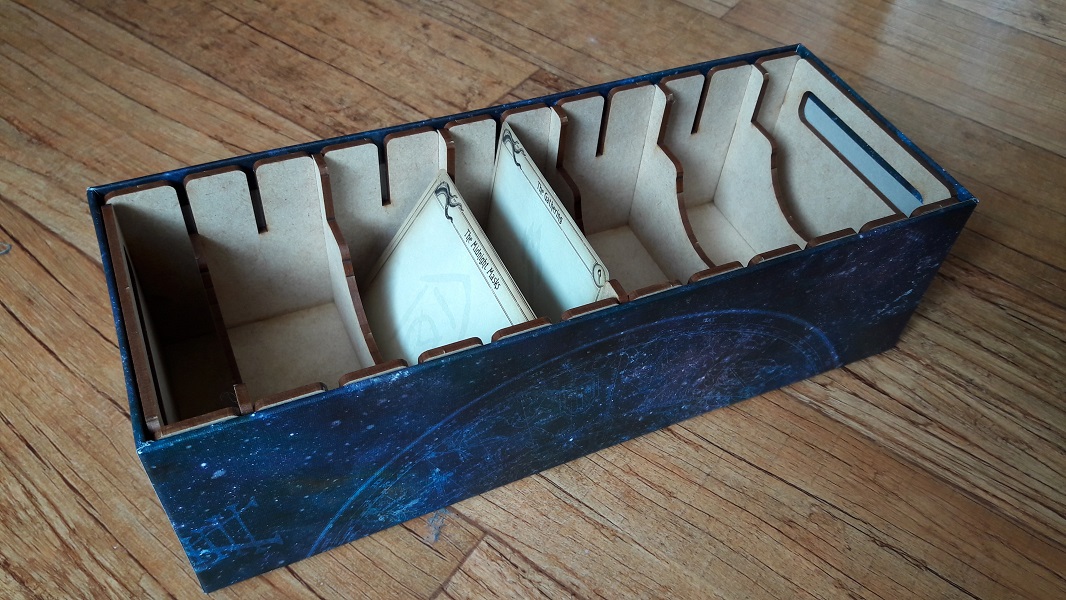
Return to Night of the Zealot: Go7 Box Insert
Mentioned a while back, FFG has released Return to Night of the Zealot which is a mini-expansion of sorts for the campaign in the original core set. I still haven’t had a chance to play through it. So no impressions yet on how the campaign is. However I do appreciate FFG looking at ways to stretch the first campaign out some.
It appears that this might be a popular direction for expansions as they’ve announced a similar product for some of the earlier campaigns. You get a decent size box and one thing I immediately thought was to whip up an insert for it. Fortunately Go7 Gaming has you covered as they offer a MDF insert of their own design.

It assembles pretty easily. The divider sleeves have a clever design with a higher edge tab being off center. This way you can alternate the dividers giving support to cards in the box and eek a little more organization into the layout (as you could write on the dividers if you wanted). I’ll admit I now have a little buyers remorse as the new design sports more dividers and tabs (now 14 compared to my box which has an early design of 7). Looks like they realized the variety of encounter cards required more slots and spacers.

The cards are well supported and you have enough dividers to break up cards so that you can take a few out and still support others upright in the box. The insert and dividers also work with the card dividers provided in the expansion. Overall a nice little product worth picking up to squeeze some more functionality out of the expansion packaging.
Terraforming Mars Mat Overlays
Terraforming Mars is a pretty fun game. Still need to noodle through it more to offer a decent review. While the card art is a little bleah, I love the tactile feel of all the resource bits the game has. The downside though is that they are fiddly. It’s so easy to jostle your play mat, scrambling your resources and status markers for everything.
Fortunately other folks have found solutions to this. Of some third party products, I went ahead and picked up clear acrylic overlay trays from Board Game Boost. These fit directly over the player mats.
They are quite nice. The cubes fit snugly and don’t move around. And it’s easy to pick them up and place them in other slots. Additionally there are slots to keep track of higher values if you happen to go over the initial printed tracks. And a nod to the designer, the extra slots can also hold a 5 value (silver cube), so it’s possible to indicate both 10s and 20s on the resource track if needed.
The person also offers another design with a back board, so that you can seal the entire player mat. However I opted to go with just the simple overlay. Something worth looking at if you wanted a functional way to bling out your Terraforming Mars game. One bit I’d mention, the vendor has an instructional video on how to peel off the paper backing and pop out some of the tabs. I would highly recommend watching it before you go to town with the inserts.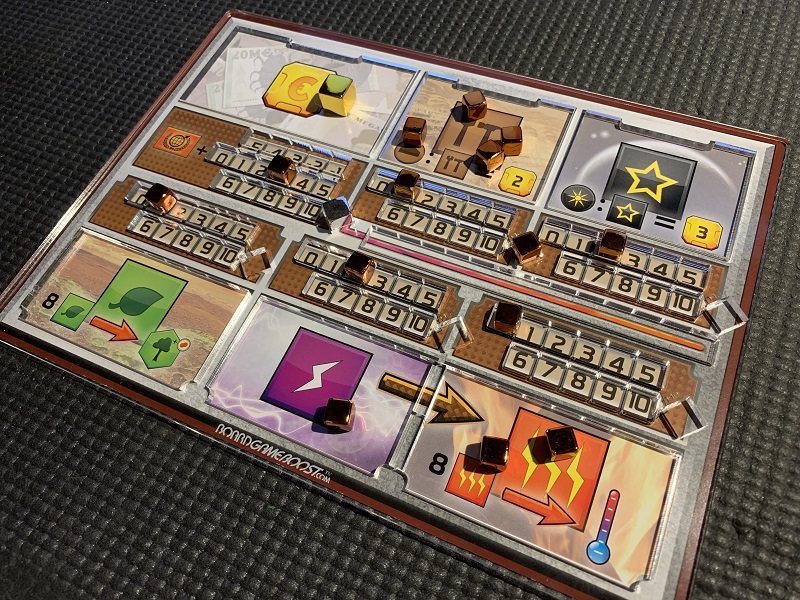
Review: Marvel Champions: The Card Game
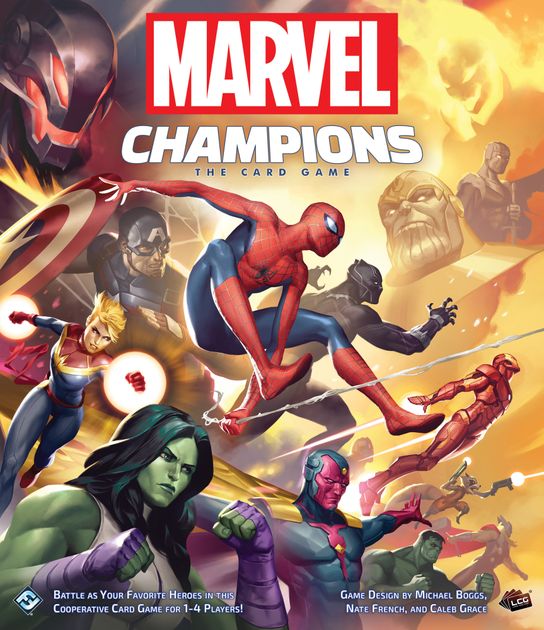 In the footsteps of other LCGs in the Fantasy Flight Games’ catalog notably, The Lord of the Rings and Arkham Horror, a new cooperative card game has emerged, Marvel Champions: The Card Game. For 1-4 players, each person controls a hero and works together to defeat a dastardly supervillain. Pulling from the Marvel comics and using a tried and true formula similar to other FFG Living Card Games, this cooperative deck construction game has a lot going for it.
All players represent a particular hero, each one having hand size limit and cards specific to their comic character. The superhero character cards comprise of about half your typical deck. In addition players can tinker with their deck composition using cards from one aspect (essentially sets of cards that have a particular flavor of game mechanics), along with more generic use neutral cards.
Each hero gets their full turn, starting with the first player that’ll rotate each round, before passing to another player. The hero can play cards from their hand that either does a one time action, has some long term effect, or potentially be an ally remaining in play to help in thwarting the villain. Lastly, the player can use their hero to either attack the supervillain directly or try and address the villain’s scheme. After playing all of their cards along with committing the actions they want, they can discard as many cards as they’d like and draw up to their hand size. This is where the fun part of the game comes in as the player can also do a special once-per-turn action, flip their hero card to an alter ego (or vice versa).
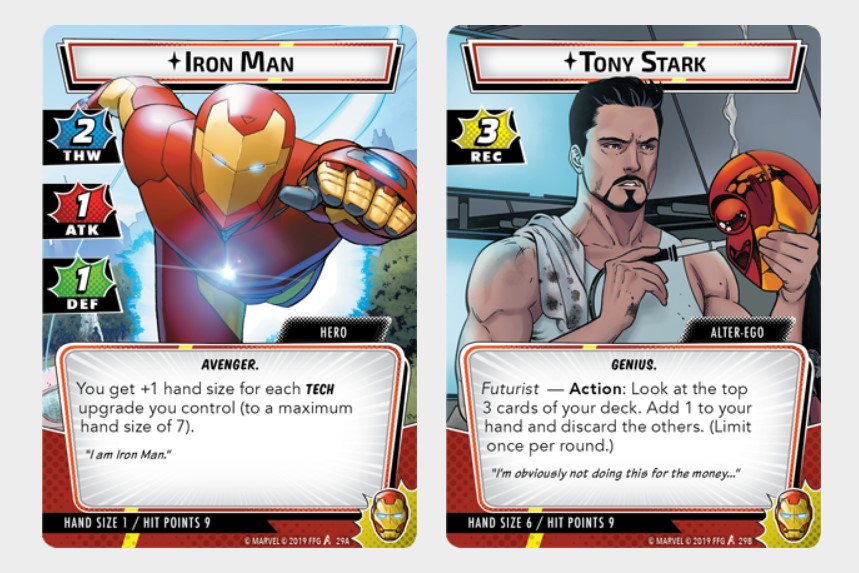
Each hero persona has an alter ego form. In the non-hero form the player commonly has a larger hand size and can heal damage taken by the villain. While in hero form the player can be more proactive taking on the villain or stopping their plans, but can potentially leave themselves open to being attacked. In addition to this, in hero form the player will also have a limited hand size. So usually they need to have a pretty solid board state with cards in play to provide resources or allies to help take the fight to the villain.
After all the players have had their turn, the villain will act. Threat, a means to indicate a timer of sorts, is added to the main villain scheme. If the threat equals or exceeds the threshold for the villain’s scheme, the players lose. Then the villain will attack each player one by one, doing damage equal to the villain’s stat plus a potential variable amount based on cards drawn from an encounter deck that can ‘boost’ the damage. If a player ever takes enough damage to equal or exceed their hero’s health, they are out of the game. If all the players are eliminated, they all lose.
A hero can attempt to defend against an attack, reducing the damage they take. However this will exhaust them. You can only ready your hero and cards in play at the end of your turn. So essentially you’re giving up your next turn when defending against a villain attack. If a player is in their alter ego form the villain doesn’t attack them, but instead adds threat to the main villain scheme. This all leads to some really interesting choices aside from playing cards for the player.
Do you settle on being in your alter ego during the villain turn? This will ensure you can get a larger hand size to help out the following one, and even potentially heal up if needed. However main scheme will get even more threat piled onto it, ramping up the end game condition for losing. Or instead do you settle on having less cards to throw down next round, but the flexibility of either attacking the main villain or addressing the villain’s main scheme? Or maybe if in hero form, you block an incoming attack essentially shrugging off the damage (yet that also means limiting your actions on the next turn). Fun choices to noodle through while you are playing.
This all gets compounded even more so during the villain turn. After the main villain attacks (or adds threat to the main scheme if a player is in their alter ego form), each player draws a card from the encounter deck. Like Arkham Horror, the villain has a special deck to add complications to the scenario. This might mean adding more dire schemes players have to take on, or minion villains that attack the players during the villain phase, or even cards to hinder future attacks against the main villain. This layers on challenges for the players, ratcheting up the difficulty as the game moves on.
All the while the players are in a desperate fight against time. They have to inflict enough combined damage to essentially enrage the villain further, transforming the foe to another form (or stage). If there are no further stages for that villain the players win. This is the only way the players can win the game. While they can try to address the main villain scheme, they can never stop it completely. They have to balance between keeping the main scheme in check and also chip away at the villain’s health, hoping to eventually hit their enemy hard enough over time to vanquish them.
Actually playing cards from your hand is easy. Every card will have a cost to put into play, and in addition they provide resources of certain types indicated with symbols. To play a card, a player discards cards from their hand with enough resource icons to match the cost. Resources spent this way can be of any symbol type, but commonly you’ll get a bonus if a specific resource is used.
Players will eventually have upgrades, resource cards, and allies in play to help out from turn to turn, reducing the need to have a large hand size. But note that while a player can have ally heroes in play, they are temporary. There are limited means to heal damage allies take after stopping a villain’s attack. Also most allies sort of damage themselves when used to stop a villain or reduce the threat on a scheme, so effectively it puts a turn limit on their use.
The Good – There are some immense pros as a cooperative game. Unlike many other LCG games from FFG, this offers a fair amount of deck construction options just using the core set alone. The game is challenging, with options to make each villain more difficult. The game play is flexible enough with resource costs that you can usually do something during your turn, reducing the downtime. But typically the game forces you into some challenging situations and critical decision making. The art is colorful with simple icons and symbols, the components are thick cardstock, and the box roomy enough to hold a few more expansions.
The Bad – There really isn’t much story akin to what you’d get in the Arkham Horror LCG. The game is pretty much about beating down the villain and there isn’t any real progression of the villain master plan as the game progresses. So there isn’t some rich, story telling happening when you play or a longer campaign to look forward to, and instead it’s pretty much a drawn out fight against a villain. The game is deceptively simple and some keywords and card interactions are going to have you grabbing the rules every once in a while to ensure play is moving along as intended. While much of the art is top notch, some of it is a little disappointing, which is odd considering you have such a wealth of Marvel source material to draw from.
The Verdict – Marvel Champions is an immensely enjoyable coop card game. While there is some card jargon and mechanisms to work through, it’s far more approachable than other similar coop LCGs from Fantasy Flight Games. I love Arkham Horror, but it can be so daunting with terminology, task resolution, and restrictive player actions, that Marvel Champions is a downright refreshing take. But don’t think there isn’t a lot of play here. You are going to make some agonizing choices and will have that same roller coaster feeling from turn to turn, with highs getting great draws and a player board that just ‘clicks’ with efficiency, to abysmal lows as you suddenly draw a dire villain encounter card. Fun stuff.
Yes, there isn’t much story to the villains and their minions, but every villain deck can choose from a particular subset to make up the encounter deck. This allows you to tailor the difficulty even more and also offer some change ups to the opposition and challenges you’ll face stretching out that replay value even more. Aside from this are the heroes. You’ve got 5 hero choices for a 1-4 player game, and every hero can dip into different aspects to give their decks some changes to play style. Mind you deck construction is still hobbled some but there is a fair amount to play around with just using the core set (and quite a departure from previous LCG offerings from FFG).
Lastly, as a coop game Marvel Champions is just a solid experience. You really get that feeling of working together to stop a supervillain, and mechanisms of the rules encourage this type of cooperation. With difficult choices, plenty of variable replay, room to tinker with deck construction, and an entire universe of untapped superheroes and villains to draw from, you’ll find a wonderful card game here.
Review: BattleLore 2ed
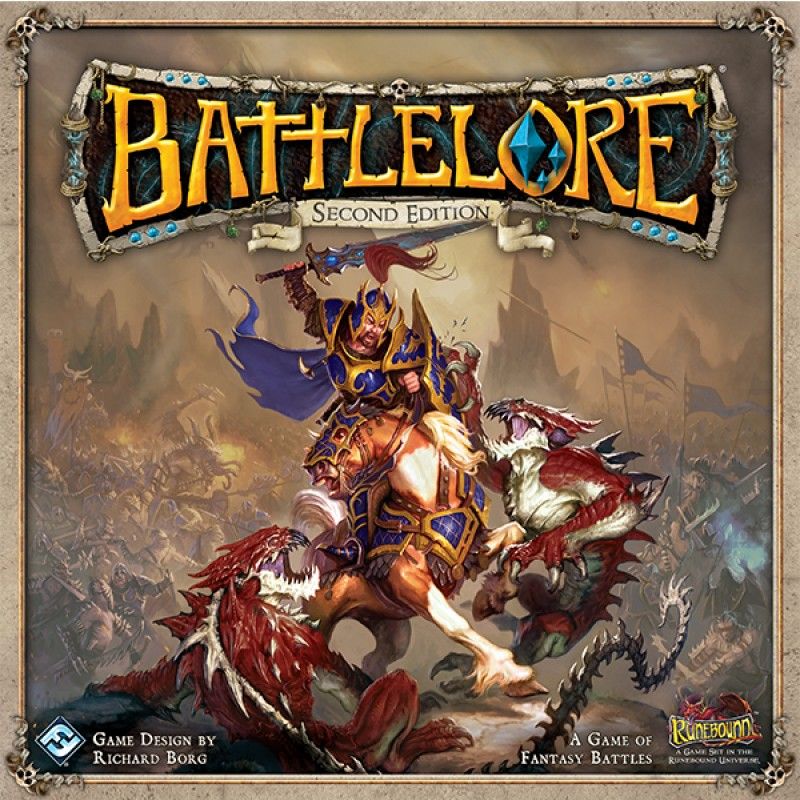 Fantasy Flight decided to roll out a new edition of their 2 player fantasy wargame, BattleLore. It uses the Command and Colors system where the board is split into 3 sections (center, and a right and left flank). Using a common deck, players alternate playing a single card to issue commands to units based on what is listed on that card. Sometimes you can get lucky issuing several commands to units throughout the board, but commonly you’ll have to stick with moving a few units in one or two sections of the board. It’s a fun little system that uses a simple idea to model the fog of war and limitations on command.
Players take command of either the Daqan (humans) or the demonic Uthuk armies. Each faction army is comprised of 5 units, including a single monstrous creature. Play is pretty simple. You play a command card activating units listed on the card that are in the appropriate board section. All units move. Then the same units can attack by either shooting at targets in LOS and range (if they can use ranged attacks), or adjacent units if only capable of melee attacks. Afterwards there is a special phase where lore cards and resources are obtained.
Each unit has a simple list of basic stats for movement, number of attack dice, and total number of casualties which can be taken before being eliminated. Units can’t be stacked within a hex and movement is limited by terrain and other units (even friendly units). Maneuvering into avenues of attack is critical though for combat which is also an affair.
For combat, you just roll dice equal to the unit’s combat stat. Shooting will inflict a casualty 1 out of 6, while a full strength melee unit has a 1 in 3 chance of inflicting a casualty. Added to this are retreat results. Each retreat result forces the target to move one hex directly away from the attacker. If they cannot move (say they are backed up against impassable terrain or would have to move into enemy units), the retreat results inflict casualties instead. If the unit is flanked by friendly units, they can ignore each retreat result for each adjacent supporting unit.
While casualties are a thing to go after, retreating units is also an important tactic. Especially as the attacking unit can move into the recently unoccupied hex. Players will soon find that you need to position units to attack swiftly, and be supported by friendly units if wanting to hold territory. Additionally, while units can counter attack commonly they are going to suffer a retreat instead. Having a unit to support them means they can take the fight to the enemy instead of just being trounced on and forced to flee. Along with hits for shooting and melee are results to add lore or potentially utilize special abilities for some units. While not every troop type has a die combat effect, they all have special characteristics to give them some interesting tactical uses.
Each army also has a deck of lore cards. These range from massively powerful abilities to useful tactical command orders. They require spending a certain amount of lore tokens and are played only once a turn during specific times (as stated on the cards). Players can gain lore tokens each turn or possibly from the result of combat. This is a fun facet of the game and allows for some flexibility in issuing commands. If a player can’t get the right command in his hand of 4 cards, then usually he can get a lore card to help in activating key units.
The game is won by the first player that gains 16 victory points (or the one that eliminates the enemy, whichever happens first). Board setups will commonly have 2-3 banner markers that indicate key terrain features. When you start your turn with a unit on these markers, you gain victory points. Additionally each army will have victory point conditions for specific scenarios. You’ll find yourself getting about 1-2 victory points a turn if things are going well. Meaning a game usually lasts about nine or ten turns in total.
There are 7 army-specific scenario cards which depict special terrain on their half of the board and victory conditions for that army. These are secretly chosen and revealed simultaneously. Players then go about buying units from a pool of 50 points (or use one of the 3 suggested, preselect armies provided). After setting up terrain on their half of the board, players then deploy cards representing army units face down in their deployment zone. Scattered among these unit cards are also decoys to fill out a total deck of 18. As players alternate placing one unit after another, maybe they are deploying a unit in their army, or possibly they are deploying nothing using a decoy card.
I’m convinced I haven’t gotten into this deployment step too deeply, that potentially using a lot of decoys first and seeing how strong your opponent deploys into a board section is something to consider when doing troop setup. However you end up with some decent variety between games. Between the combinations of each faction’s 7 scenarios and the choices of unit army selections, you can squeeze a lot of repeated game play out of BattleLore.
The Good – This is a fun, light little wargame. For its simplicity it offers some challenging choices in deciding what units to activate. Thrown into this are the lore cards which can be a huge boon, or chuck a monkey wrench into the opponent’s solid battle plan. You never seem to have enough command cards and are constantly trying to do the best you can with limited options. There is also a fair amount to variation with the scenarios and unit choices.
The components are very nice, with pleasant art on the cards, thick (and plenty of) tokens, and sturdy terrain tiles. The figures are great and made of a hard(ish) plastic. They allow for a pleasant tactile feel of pushing around units and indicating casualties by removing figures. Certainly a nice touch over just using tokens or wooden blocks.
The Bad – Combat is simple. Maybe too simple for some and certain tactics repeatedly creep in. The game awards those who strike first. However judicious use of terrain and supporting units in key locations seems a decent counter. Yet combined with the lore cards and limited command cards, some might be frustrated with the few options. Additionally, you aren’t quite rolling 6+ dice in attacks, so you can get that occasionally lucky streak of die rolls in combat (or exceedingly awful luck).
Lastly, there are some legs with the scenarios but the truncated number of available units cuts into the replay some. There are a decent amount of options but I suspect it being a 2 player game, certain well-trodden strategies for army composure and selected scenarios will begin to slip in. There is a fair amount of variation within Battlelore but with some limits in its long term replayability.
The Verdict – BattleLore is an enjoyable game. The rules and systems are not overwhelming. I certainly feel this would make a great introductory wargame for kids, and all the while offer enough to make it challenging for adults too. The command system offers opportunities to make shrewd choices in trying to make the best decision possible with limited choices. Along with this is that specter of lore cards potentially offering a huge boon or wreaking havoc into your plans in the background.
The game looks great on the table and offers an engaging experience that will allow you an evening of 2 to 3 games. It makes no bones about being a light, approachable wargame. Yes, this isn’t going to appease the crowd of ASL and Combat Commander: Europe fans with its simplistic combat and order system. But it will offer a fun evening as an occasional jaunt into playing a strategy game of lighter fare. BattleLore is a fun, light, family wargame and certainly worth picking up if looking for a 2 player, fantasy combat game.
Review: Tobago
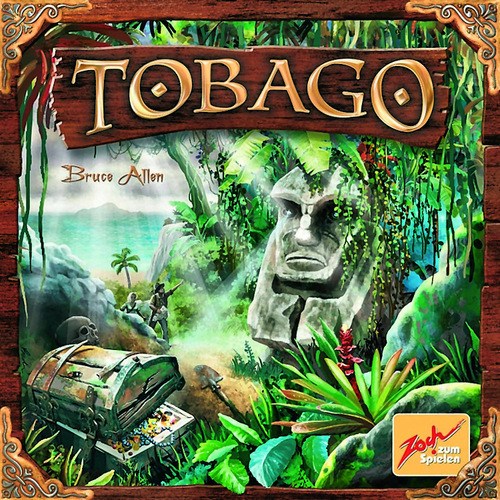 From Rio Grande Games, Tobago is a deduction game for 2 to 4 players. Each player is an adventurous explorer driving around a remote tropical island seeking to dig up buried treasure, while mysterious statues rotate and give clues to mystical amulets that can help with your task. At any time there are four potential buried treasures offering a random number of gold pieces. Once the deck of treasure cards is exhausted, each player totals their treasure and the player with the highest number wins.
Players have two options during their turn. They can move their piece around board segmented in hexes and terrain types, and try to dig up treasure, or play a clue card from their hand. Movement is very easy. A player has 3 ‘legs’ or movement actions. Switching to a different type of terrain is one movement action, while moving to a specific hex (while in the same terrain type) is also a movement action.
Clue cards give hints where treasure might be hidden. Players will have a hand of cards indicating what type of terrain it’s buried in, where it can’t be found, or possibly in the largest terrain area of that type. Aside from being on beaches, rivers, lakes, forests, mountains, or grassland, they might also be closer to other terrain landmarks. There are palm trees, huts, and the large stone statues. So treasure might be close to these other landmarks, or be well away from particular ones.
Each of the 4 treasures have several colored cubes. As a few clues are placed, the cubes will indicate where the treasure might be buried. The only rules for playing clue cards are that they can’t invalidate other clues and must limit the potential hexes where treasure is hidden. As you play a clue card you also put one of your markers on a card. Once there is one cube indicating the only possible location where the treasure is buried, then it’s a race to dig it up.
For each clue card, treasure cards are randomly distributed. Each player will get to see treasure cards equal to the number of clues they contributed. Treasure can vary from 1 to 6 coins. The treasure cards are returned, shuffled, and one extra treasure card is thrown into the pile. Then the first treasure card is flipped over. Starting with the player that dug it up, followed by each player in reverse order of the clues placed, they have a choice of taking that treasure card, or opting to pass and get another one. If no player takes the treasure card then it is discarded. If they choose to pick that treasure card, their clue card is taken out of the line. This continues until all the players have a chance to pick up a treasure card from the pile.
This becomes an interesting push your luck game. You might know there are high value treasure cards in the pile. Do you continue to pass or jump on a lower value card? If you wait too long, you might get stuck with a single coin card. In addition to this are two cursed treasure cards. If those are drawn the rest of the treasure cards in the pile are discarded. On top of that, all players that have clues in play must discard their highest value treasure they have scored.
Fortunately amulet tokens can be discarded to avoid having to give up any treasure you found. Amulets also allow for extra movement, playing additional clues, and even removing possible locations where treasure might be buried. As treasure is dug up, more tokens are randomly added to the map. You’ll find as you play gathering a few amulets along with some judicious use will be a key strategy.
The Good – The board design is very clever being three pieces and double sided, adding variety to how the board sets up. Landmark pieces can also be placed in different locations expanding the layout variation tremendously. The game is engaging and the side-game of the treasure auction also adds to the experience. The rulebook is well written and it includes an easy to understand setup guide as well as a clue icon summary. The components are wonderful with solid terrain pieces, especially the stone(!) statues.
The Bad – The cursed treasure might be a gotcha for some players, and can potentially really hurt your point total. This can also allow another player to slip ahead and steamroll towards a win. There is a little bit of a learning curve with interpreting some of the clue card icons (but this is mitigated due to the handy player aid included in the game).
The Verdict – Tobago is a fantastic deduction game. You have to cleverly plan out moves and play clues that can allow you to maneuver close to its final location if wanting the lion’s share of a treasure. The player has some interesting choices of either focusing on one or two treasures, or spreading yourself out to get a little of each pile, not to mention deciding whether to delay a move to pick up handy amulets.
I also like the treasure distribution minigame. It has some strategy in the clue order, rewarding players that really help narrow down the potential locations, but also allow any player to get a share by adding a clue card. The hidden information and deciding when to scoop up a treasure card, or pass for potentially a more rewarding share of coins, is a fun part of the game.
All in all, It’s a tremendous game and the components really help evoke that exploration theme despite using abstract mechanisms. Tobago seems to also be a great family game. If you can track it down, it’s a nice addition if looking for a light, deduction game for your collection.
Review: Rum and Pirates
 An import from Rio Grande Games, Rum and Pirates is an enjoyable set collection, worker placement game for 2 to 5 players. Each player represents a gang of pirates seeking to gain renown for their captain while visiting a local port town. They corral their captain to look into rumors of treasure, arrange a romantic rendezvous for the captain at a secret location, or get into brawls with the town guard. All the while they seek to gather up tokens worth points and after five rounds, the player with the most points wins.
The board is made up of nine pieces that are laid out in a 3 by 3 grid of twisting alleyways and intersections. The clever bit with the design of the board is that each section freely aligns with all of the other sections meaning you can get a wide variety of board layouts from game to game. The captain is represented by a single piece and always starts each round at a specific location.
Players take turns moving the captain by using their supply of pirates. For each segment of an alleyway path, they place a pirate. The player ends their move at an intersection moving the captain piece and completing the action at that intersection. They can then pass their turn or continue moving the captain paying a gold coin.
The trick when moving the captain is that each alleyway gets blocked off from their pirates as well as pirates from opponents. So as the round progresses, options for moving through particular intersections become limited. The captain can move off the board and enter from any other open alleyway path from another board edge. This can be a great means to move to a choice intersection, but is costly requiring a gold coin as well as an extra pirate.
As the captain goes through the town, they will pick up pieces of maps, collect pirate booty, or potentially find chests of treasure. Essentially it becomes a set collection game with various tiles. Some score points outright but most require a matching tile or a set number of tiles to award points. It becomes a challenge navigating to intersections to score a combination of tiles, as the player has to balance their supply of pirates for movement, and hope that a clear path can remain open. Having extra gold is very helpful too as you can guarantee being able to steer the captain to choice locations in order to complete tile sets.
To the backdrop of this is another mini game, where players retire their pirates at the ship to rest for the night. A player has an option to bow out of the round and remove any pirates in their supply to the docked ship. At the end of the round, all players with pirates at the ship go through rounds of tussling as they wrangle for the best sleeping spots either in the crow’s nest, the hammocks, or on the deck of the ship. They line up their pirates in a single row based on who entered the ship first and roll dice to see who is eliminated.
It’s a bit laborious to describe effectively, but essentially every player is rolling off for each individual pirate. If a player has 4 pirates and another has 3, then the player with 4 pirates moves one unchallenged pirate across the mast and it is automatically in the next round. The player that went to the ship first rolls a d6. The next player must roll equal to, or higher, to beat that roll. Every player rolls once and the winner advances to the next round, while the losers take their pirates back. In general, the more pirates, and the later you head back to the docked ship, the better you will do in the wrangle.
This continues until there is a first, second, and third place, with each scoring tile points accordingly. You can score a significant number of points and if at least three players are participating, then each one is guaranteed getting a tile for some points. It can be a viable strategy to opt out trying to move the captain to select intersections and instead shoot for getting the best bunk on the ship.
The Good – It’s a fun and different type of worker placement game. I like how you can effectively limit and cut off players moving towards specific intersections. But managing your total is a challenge. While some people might hate it, there is some variation in the point values for tokens. So you can expect a range of points rather than a set amount and this little bit of variation adds some unpredictability. Also gathered tokens are placed under a large tile, hiding it from other players, so this adds some tension to the final rounds as you don’t have precise point counts from other players.
I also like the small mini game with the bunk wrangle at the end of each round. If you get a poor turn, you can opt instead to heavily shift over to the wrangle and scoop up quite a few points. Having another option aside from getting tile sets maneuvering the captain through the city streets is great. The card stock for the tokens and map boards are thick and solid. The player pieces are also nice bits of chunky plastic. Lastly there is a fantastic plastic tray organizer which is wonderful as there are several different cardboard chits to keep organized.
The Bad – The game has a sort of take that mentality with the moving of the captain, and other players can wreck your turn at times. While there are ways to mitigate this, it might turn some players off. There is also somewhat of a gamble when picking up certain tokens. Sometimes getting a rendezvous token can be tricky as you might have to go across the map, or getting some pirate items might not quite fill out the sets you currently have. This lack of predictability might be frustrating for a few players.
The artwork is simple and a bit cartoon-looking, and some of the item icons can take a second look to ensure you have the proper matching sets.
The Verdict – Rum and Pirates is a great little game. The management of your pieces and shrewd use of gold to take extra turns is challenging. Also as you essentially block off routes, you can shrewdly plan out ways to cut off players working towards certain scoring tile sets as you push towards areas on the board that can help you out.
This alone would be pretty fun, but having the option to dabble in another side-game for additional points is also helpful for the player to have different paths to win. Added to this are rum barrels which allow for rerolls providing the player a chance to recover from a string of bad luck and alleviate it some. It’s a nice touch that the map boards are segmented and can be shifted around to add variety from game to game.
Overall it’s an enjoyable board game that is surprisingly challenging despite the light elements and theme. The look and feel isn’t as polished as some modern worker placement and set-building games. You could argue it’s likely dated some. But you’ll find a game that seems to appeal to a wide audience. Younger players will likely enjoy the tactile feel and play of shuttling their captain to pick up tokens for points, but it’s deceptive in how light it initially appears. You can dig a bit deeper and realize paying a little gold to take a second action, or snagging some rum to help with the wrangle in the end of the round, can make you ponder and plan out more during your turn. It’s that broader appeal which makes up for any shortcomings. Rum and Pirates is an enjoyable game, and likely would appease a wider age audience range that what you might initially expect.
 Geek Ken