Category: Review
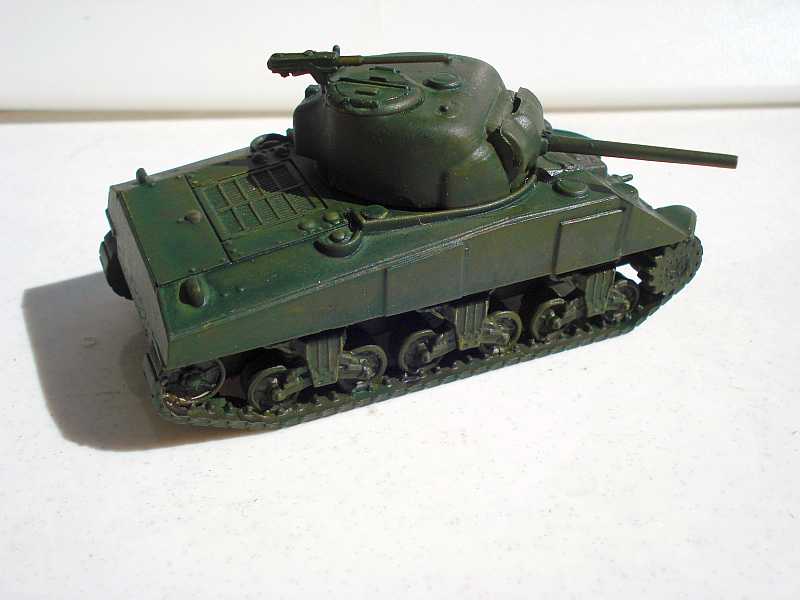
Armourfast Sherman M4A2 75mm
Anyone that’s been reading my blog for a while will know I am a fan of the 1/72 scale Armourfast kits. These are not high quality models. However for 20mm wargaming they are excellent. Cheap, pretty easy to put together, and they come 2 vehicles per kit. If you are going for building up an armor platoon, they are an especially a good buy.
I finally finished up my 20mm Pacific US Marines and wanted to get a tank for my list. I recognize that Stuarts are likely the most popular choice but I wanted something a bit more fearsome, so I went the M4 route.
The Armourfast Sherman kit was a snap to put together. I would say one hiccup was fitting the turret peg into the hull. The turret peg isn’t molded into the turret and instead you’ve got to assemble it. Not an issue, but I found the hull hole where the peg fit into was a bit tight. Filing it down and putting a tad too much pressure meant twisting the turret peg some. I pulled it apart quick enough, straightened everything out, and filed the hole some more for an easier fit. However fair warning and ensure that the peg fits well into the hull before assembling (rookie modeler mistake from me as usual).
The details of the tank are okay. The pintle mounted 50 cal fits well. As per other Armourfast kits the inside tread wheels are more to be desired and are empty molded plastic without any details whatsoever. The plus is that you can’t readily notice them unless looking at the tank from a lower angle. Another plus is that as a single model peice it’s easy to assemble the tread wheels to the hull.
There are no stowage options and if wanting to add some personality to the model, you’ll have to go the route of pillaging other model kits for that. There are also no decals for the kit, so that is another thing I’ll have to pilfer from other kits.
The details of the tank hull stand up to painting well enough. Yet I’m a bit miffed with my choice of a wash. My original base coat had a nice dark shade for the tank treads but the difference between the hull became quite muddled after a wash coat. Still it’s a serviceable tank model for tabletop wargaming and good enough for 20 mm Bolt Action.
Review: Space Hulk: Death Angel
 Space Hulk was always a favorite Ameritrash board game of mine. While it eventually got bloated with a lot of different expansions, the core game was a fun asymmetrical romp as one group were armored marines with big guns and the other a stealthy group of terrifying aliens seeking to surround and eventually overrun their opponent in hand to hand (or more aptly fangs and claws). It went out of print long ago but occasionally GW reintroduces it for a limited print run. It’s a fun game but not something I think worth picking up again especially as there are other options out there which are better games and just as fun (cough… Level 7: Omega Protocol… cough).
Nonetheless, Space Hulk has that draw and interestingly was something mined for a co-op strategy card game via Fantasy Flight Games. Space Hulk: Death Angel is a cooperative 1-5 player game, where players are teams of 40K space marines exploring a derelict spacecraft, seeking to purge it from genestealers during a salvage operation. They will either succeed in establishing the win condition at a final location (usually by eliminating all the genestealers), or die trying.
Players select a pair of combat teams, commonly one ‘regular Joe’ space marine and the other a special marine. They also get a specific deck of action cards that either allow the space marine team to move and activate a terrain card, support another marine, or attack. The special marine sometimes has different weaponry but will also have a particular ability associated with one of the action cards. So they might be able to do a cool attack with the attack action card, or shift around genestealers with a movement action card, etc.
After players select their combat teams, they line up in a random order in a straight line. The top group in the line facing one direction with the lower half facing the opposite direction. The players have to go through a series of locations represented by a deck. Depending on the number of players, there will always be a specific start location. However for the remaining deck, it will be randomly constructed from three possible cards for each location.
Players have to get through all four location cards and complete the end task on the final card (this doesn’t include the initial starting location for a total of 5 different areas). As a location card is revealed, additional terrain cards are placed in the line of marines representing doors, tight corners, or ventilation shafts. These terrain locations indicate potential spawn points for genestealers.
Players go through action cards in their hand and select one which both marines in their combat team will take for the turn. Each action card has a sequential number and turn order for actions occur based on them. After all the marines have completed their action, remaining genestealers in the area attack the space marines.
Finally, a random event is drawn to end out the turn. Sometimes it’s a boon for players but typically it is some added difficulty like genestealers shifting attack positions, or a marine’s weapon jamming up. The event cards also indicate where more genestealers will spill into the current area by drawing cards from specific piles. Lastly, some groups of aliens might also shift around based on having symbols that match with the drawn event card (more on that later).
Each marine has a range with their weapon showing the number of cards on either side in the formation line which they can shoot. They also have to be facing the direction of aliens they attack, rolling a d6 with special icons. The die has numbers ranging from 0 to 5, and half the faces have a skull icon. If the player rolls a skull icon they remove one genestealer card from the area (so a 50% chance).
When marines are attacked, they have to roll greater than the number of genestealer cards attacking them. So if they are facing five or more cards, they are dead. If a player loses both marines under their control, they are out of the game. Players can get around this by spending support tokens. They allow them to reroll either attack or defense rolls. However this can only be used on groups of genestealers that they are facing. If attacked from behind, they can’t get any rerolls.
Once a turn is over, players cannot use that action card for the next turn (and keep track using special tokens). Instead they have to choose one of the other two options in their hand. This restriction of actions, importance of orientation, and constant random shifting of genestealers means the limits of choices in marine actions lead to tough choices. You will be constantly wrangling your reduced options with other combat teams, trying to attack when you can, maneuver to offer support in future rounds, and pass off support tokens to other teams if needed.
Each location has a limited number of genestealer spawns. As cards are removed from their piles and added to the area (or are eliminated), the piles become exhausted and this becomes a condition to draw another location card. The marines essentially move deeper into the space hulk with new genestealer blip (spawn) piles created and new terrain cards added. The kicker is that all the genestealers from the previous location shift along in the same positions as the previous location. With more creatures constantly being added to the area, the threat of being overwhelmed ramps up. So the players are under constant pressure to keep destroying genestealers.
Not being able to freely select all your actions each turn is where Death Angel shines. Sometimes it can be agonizing to decide what to do and occasionally you have to sacrifice a marine so that others can fight on. It can be heroic and frustratingly challenging.
The Good – It’s a fun engaging game with some difficult choices. Despite being just a card game, it does manage to capture that feel of a group of marines exploring as you overturn new location cards, ever building up the tension as the hordes of genestealers keep coming, all the while ones from previous areas spill over into new sections of the ship.
The combat is brutally simple, but the positioning and management of limited actions adds to it. There is a small variety of location cards adding some replay value. Given that some locations have special abilities (like a means to teleport all creatures in play into space, or doors to cut off routes for the genestealers), this also adds some other key tasks for the players to focus on instead of just shooting genestealers. The cards are nice stock with the great, classic, gothic sci-fi artwork that you’d expect from the 40K universe. The designs and icons on the cards are also well done once you decipher what the particular symbols represent.
The Bad – Although it is a co-op game, there is still player elimination. Given that combat is so unforgiving, you can potentially see a team get eliminated early which sort of sucks for that player. While there are only 3 cards of each location type, given you have a total of 4 locations to go through, there is a decent variety in the box. The same however can’t be said for the space marines. After a few plays you’ll likely slip into using favorite teams with some having abilities that are more applicable in multiple situations compared to others (hence, you might consider them ‘better’ choices).
The game has a large amount of luck. Particularly with the position shifting of genestealer hordes at the end of each phase. You can have a great setup and support tokens to mitigate bad die rolls some, only to have it all fall apart as a horde of aliens have suddenly merged into another group and flanked a key marine. Along with this are some downright painful event cards (like some that can eliminate a marine instantly), all of which contributes to a game that might be too chaotic for some. While I like the randomness, you can indeed manage to get a series of bad draws of event cards that can pretty much tank your game.
The Verdict – I enjoy Space Hulk: Death Angel. It’s an enjoyable co-op strategy game that is light enough to get into quickly but still offers difficult choices. It has enough randomness in the setup and play to add replay which will break away from repeatedly using the same game to game strategies. The only stickler is that I wish there were a few more options for combat teams, or a variety of ability cards for existing marines.
This isn’t the same tactical experience of the original board game. However it’s still pretty fun and even in its abstract form of cards and piles of genestealers shifting around, you still get that experience a little of tense exploration, never quite knowing what the next section of the ship will hold. I think the limited action choice from turn to turn encourages you to talk with other players and try to get some synergy with tactics. Also, it provides a demanding solo play experience too. Given the small box and price, there is a lot of fun to be had inside. If wanting an abstract, tactical game with a sci-fi twist, this isn’t a bad choice.
[UPDATE: Some big news came out a few weeks ago regarding the licensing of GW IP and Fantasy Flight. Appears FF will not be continuing GW games. So it’ll be interesting to see if Death Angel gets picked up by someone else.]
Bolt Action: Empires in Flames
 Warlord games has been diligently releasing their theater specific books and I was able to finally snag a copy of Bolt Action: Empires in Flames, their Pacific campaign book. This details quite a few parts of the entire Pacific and East Asia conflict from the initial invasions of Japan into China during the second Sino-Japanese war, engagements in Burma, to the final allied island-hopping offensive to take back territory from Japan. As with many of the previous books it not only covers some scenarios, special troop types, and unique rules for these games, but also provides brief historical background overviews of the conflicts.
The book is broken down into sections first dealing with the 1937 outbreak of the Sino-Japanese war, then detailing the rapid conquests Japan had during the initial part of WW2, up to the final years of the war (with Burma and the other major allied offensives being their own section). There are only 8 scenarios listed in the book, but taking a page from Ostfront, there are lists of scenarios out of the main Bolt Action book that are recommended as ones that would be applicable for that period of the war.
Although the scenario count is limited, many have some unique layouts in terrain to give them a twist from your typical games. Additionally, they employ some special rules incorporating night fighting, mines, or amphibious assaults, or ones more specific to the stress troops had in a jungle environment (like exhaustion, monsoon rains, or deep mud). There are also quite a few suggestions for the density and type of terrain that should be on the table for these games. I’ll admit it’s a little disappointing more rules weren’t included but there is enough to add some wrinkles to your typical game which could capture that feel of jungle fighting.
One thing that stands out included in the book is a complete army force list for Chinese national forces. If hankering to duke it out during the initial Japanese invasion into China, this book has you covered with some Japanese theater specific lists. But along with that is a complete list of units and vehicles that would be thematic for the Chinese national army at the time. It certainly is a very niche force, but an interesting option if looking for something different in your typical Pacific theater games.
Along with this new force list are also some new units for both Japan and the allies (both US and Britain), including rules for Mongolian Russian troops. There are a sparse number of heroes and a few vehicles. Most of the new units are for infantry troop selections. Rules for horse limbers and mule-packed guns are also presented as troop options.
Amphibious rules are presented, as well as rules for night fighting, city fighting, and minefields. There are some additional rules that attempt to capture the challenges of fighting in the jungle (monsoon rains and deep mud). Another interesting rule tweak is exhaustion. This rule potentially strips away troops from infantry and artillery units. Exhaustion can also impeded Run orders (units must always check leadership, even with no pins) and units in reserve are more difficult to bring in. It’s a bit of a gamble if playing with the jungle specific rules for exhaustion as it can randomly effect just the attacker or just the defender (or possibly both sides).
The Good – The book provides a nice overview of the different types of engagements that typified warfare in WW2 for this region. Touching on the years up to the start of the war, along with the initial part of the Japanese military campaign is also welcomed, as it’s something not quite visited in typical WW2 rules.
The theater-specific rules are okay and having additional units are always welcomed. The detailed scenarios aren’t groundbreaking but do offer some different challenges from your standard Bolt Action game. It’s especially nice to have a complete army list and theater-selectors for a Chinese national force, which certainly stands out from your regular Pacific wargame book.
As with many other Osprey books, the art is great. It’s well organized and having the special rules dedicated in a single section at the end of the book is nice.
The Bad – There is a lot of ground and history to cover, but it would have been nice to provide some more scenarios. As with many of the other books, a fair number of scenarios are presented more as generic battles with a Pacific flavor rather than detailing a specific battle. Even though the horse limber rules are presented again, it’s a shame the rules for flag bearer units weren’t included.
The Verdict – Empires in Flames is a niche book. It certainly is for a player wanting to focus on the Pacific war. Most of the rules covered have been seen elsewhere in other campaign books (although it’s nice to have them collected in one book here again). So if looking for tons of new rules, some might be disappointed.
Additionally the number of scenarios provided might be considered a little sparse. However the ones provided offer a nice snapshot of the particular types of battles seen in the Pacific. There are quite a few suggestions for table layouts, special rules, and theater-selector lists to use too.
I think Osprey has hit their stride with putting these campaign books out. Empires in Flames manages to present a wide range of different conflicts in the Asian region well. I don’t consider this book a must have for everyone. But if war in the Pacific is your bag, you’d be remiss not to pick up this campaign book. It’s got a lot of meat in between its pages to keep a Bolt Action fan happy.
Review: Harbour
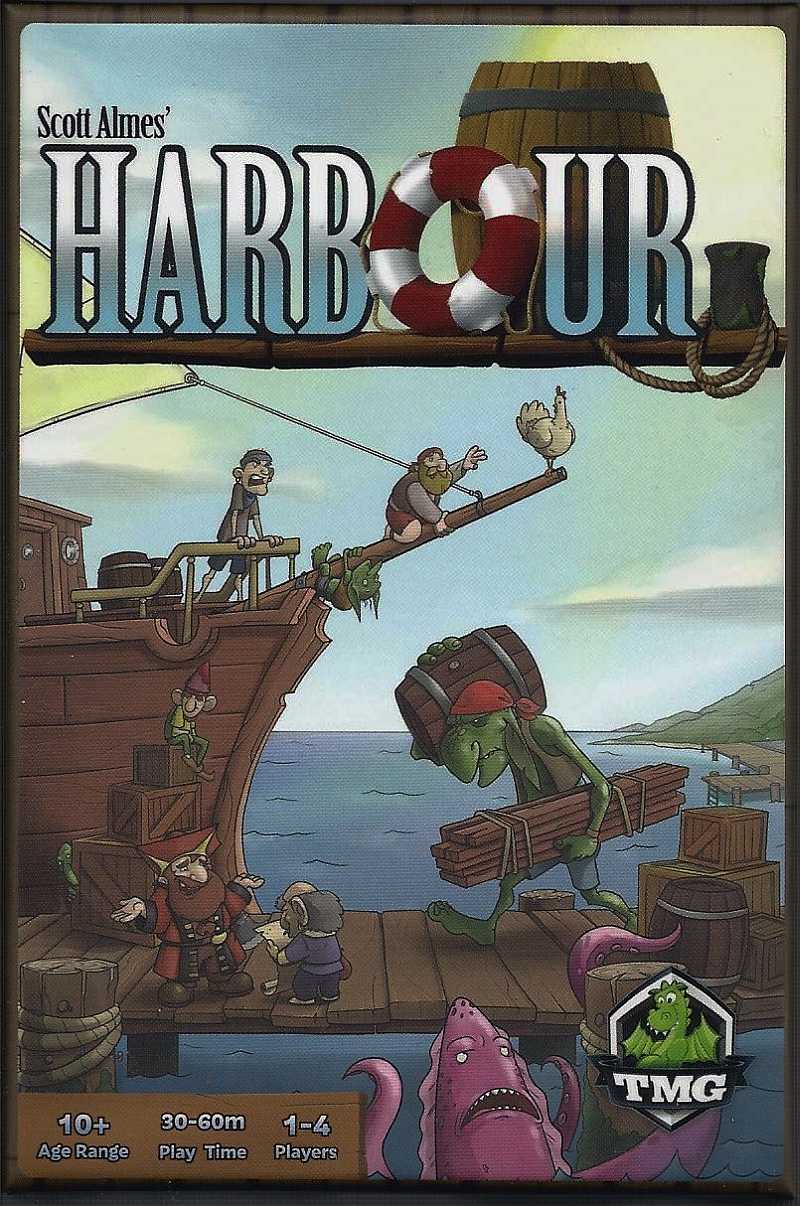
From Tasty Minstrel Games, Harbour is a 1-4 player game where players are competing trade brokers in a fantasy harbour. It is a compact game that will play in about 45 minutes or so, easily allowing you to get in a few games in one sitting. It revolves primarily around selling and producing goods, all the while trying to buy up special buildings for additional options during your turn and victory points. Once a player has a total of 5 buildings (including their starting warehouse building), the game ends.
Turns run pretty simple. A player moves their meeple to an unoccupied building, and then takes the action on the building to the best of their ability. If goods are sold, the market is adjusted to reflect new prices and the next player takes their turn. Simple.
Each player has an initial warehouse building which tracks the number of different goods that they hold. There are four types of goods (fish, stone, wood, and cattle) and the price of these goods range from $2-5 dollars. Paired with these prices is a required minimum number of goods for that particular type which must be in your warehouse if wanting to sell. As a mental cheat sheet, the price of a resource equals the minimum number of stored goods (so if stone was $3, you’d need at least 3 stone in your warehouse).
The catch to this is once you sell a good, you sell everything, regardless of the actual price of the goods. So if you’ve got 5 wood stored away and decide to sell it for a measly $2, you have to unload all of it. None of it can be saved for later sales (although certain building types allow you to bypass this restriction).
Added to this is a very fluctuating selling market. It’s hard to describe effectively without diagrams, but essentially goods that are sold move down a track and reenter the market at the lowest value. All unsold goods move up in cost (and the required number of stored goods needed to sell). Depending on the value of the good sold, you can really shake up the market. Low value resources won’t change the market much, but selling higher value goods can really alter the prices of everything else. What compounds this is that most buildings are $6-8 so you are always selling 2 or more resources to get the cash needed to purchase them.
Aside from a winning condition, owning buildings means that other players have to pay a good to use it. Buildings themselves have different abilities which typically allow for the gain of goods coupled with losing some others that are owned, or the shifting of the market. Some buildings also have other properties that allows for storage of more resources, cheaper building prices, or allowing a player to use an opponent’s building for free.
Players can purchase a limited choice of buildings out of a deck of 36 different kinds. Most abilities for buildings are shifting the loss of a few goods to get a small gain in another, or just adding one or two goods to your warehouse. There are a few buildings that allow for gaining of more resources depending on owning particular building icons. However these are few and far between.
Another layer of variation is that the game comes with different player abilities and starting buildings. You have the option of starting out with everyone having a generic player mat. But you can also choose from 14 different player mats with different abilities and matching building types. So out of the box there is quite a lot of variety making room for a different play experience from game to game. You also can play the game solo playing against an AI opponent, so you can stretch the game play even further
The Good – Harbour is a fun little game of worker placement and resource selling. There is a surprising amount of variation in building and player types that give the game a lot of replay. It plays pretty fast and the manipulation of market prices and gaining of select goods is engaging. It’s not overly complicated but certainly will make you think some in how to tangle out what goods to work on and the opportune time to sell and purchase buildings. The artwork is light and whimsical capturing a fun fantasy theme of a fictitious harbor. You get nice, thick, card stock building cards and chunky, wooden resource tokens too.
The Bad – While the market moves prices in an interesting way, it practice it becomes exceedingly difficult to predict. It’s almost too volatile in a 3-4 player game and certainly favors the player that can jump into selling goods early. While there is some room for having a combination of buildings to gain a lot of resources, typically you are only having a net gain of 1 to 2 goods a turn.
This leads into my major gripe with the game. It just seems to end too quickly. You really can’t construct an engine with owned buildings before the game ends. It also creeps into a snowball effect for the few players in the lead. Once they have an advantage of a building or two, it’s almost impossible to catch up.
The Verdict – Harbour is an okay game. Hands down for the price you are paying (less than $20) it’s an immense value. The small box offers a lot of replay and can even offer an engaging solo game. However, while there is room to explore different strategies there never seems enough time to fully develop them.
You’re in a frantic race to gain the right goods at the right time and if you miss out, you can really fall behind. If an opponent is in the lead and can capitalize on another market opportunity, you’ll find yourself in a deep hole that’s too hard to get out of for a victory. So you have to usually jump into buying what buildings you can afford right now, over planning a turn or two to try and pick up other buildings that could offer a deeper ability interaction with others you own.
In the end, I don’t find Harbour a bad game. For such a small package, there is a lot of enjoyable game in the box. But it’s not an amazing game. While the play is engaging and you have some interesting choices, the market is so volatile and the building types so limited in function, it doesn’t allow for a lot of strategic maneuvering. It’s an enjoyable game. But oddly for how much it allows for some careful planning and thoughtful choices during play, other bits like the constant market price swings just make that decision process squandered some.
I think the most saving grace is the price, box size, and card variety. It leaves a small footprint on your shelf and doesn’t sink deep into your wallet. If looking for a relatively light worker placement game with some market interaction, Harbour isn’t a horrible buy and you can squeeze a large amount of play out of it without it getting repetitive.
[House Rule: Players only get to use another player’s building for free if they own more top hat buildings than their opponent. Getting top hat buildings is pretty easy to do. This tweak allows for an advantage if a player delves into owning multiple top hat buildings allowing for a potential strategy. As RAW, it’s a little too to easy to counter by simply gaining one top hat building.]
Red Army – Wargames Factory
 For a long while now I’ve been pretty much sticking with 20mm for my Bolt Action platoons. I’ve accumulated quite a few different nations dabbling both in the Pacific and European theaters. Usually when I jump into a wargame I end up picking up enough models to fill out a couple of armies. It’s just so much easier for me to spark someone’s interest in playing when I’ve already got an army for them to try out. So for Bolt Action, going 20mm was not a problem at all for me.
However I realize that if I was dumped into a gaming scene where I’d be typically playing against folks with their own armies, well, I guess they might frown a little on me pushing around 1/72 scale troops and tanks. So I wanted to work on another nation army that would be a ‘proper’ 28mm scale and settled on fielding a Russian force. One aspect of my choice was that I’d be able to dig up some 1/48 scale armor and vehicles. I could have chosen some other smaller nation, but rounding that out would likely be difficult. The downside of course would be that I’d have to whip up a lot of models. Russian armies work with having lots of bodies so I certainly wanted to look into plastic kits.
There are a few options out there but in the end I decided to make the bulk of my troops from using the Red Army box sets from Wargames Factory. These are pretty nice sets of around 30 figures with a variety of small arms. Most weapon options are for Mosin Nagant rifles and PPSh-41 smgs, but there are quite a few DP-28 lmgs and various sniper rifles also. My complaint would be that I wish there were more rifles. You can get about 15 figures with rifles from a box set. From my 2 sets, I wanted to squeeze out a 3rd rifle squad but it looks like I might have to stick with making that a smg scout squad instead (was able to get a free 12 man rifle squad though for a total of 3 rifle heavy units).
The figures are pretty well sculpted with a fair amount of detail. It’s hard plastic that is a snap to assemble with cement and they don’t appear to have excessive mold lines (although there are some and you can see from the photos I still need to trim more). Another small bit I love about the box is that lipped bases are also provided. There are a couple of prone figures that don’t get any benefit from the bases, but it’s a nice touch.

There are a variety of heads but most are with helmets with a smaller proportion having caps. There are a some officer caps and a few female soldier heads also. As a nice touch, you have the option of making a couple of female troops which is cool. Something historically accurate and adds a little variety to how your force looks on the table. I made one of my sniper teams women and working on converting my field medic to be female.

As pistols and other accessories go, the sprues are a little lacking. They are present but in a limited number. However there are tons of ammo pouches and field kits. So certainly you can deck out your troops to have some additional details. I will grumble some that the entrenching tool and canteen are modeled as a single piece which somewhat limits options for attaching them.
Arms are modeled individually and at first I sort of groaned looking at this, worried how much of a chore it’d be to piece them together properly. However each arm is paired by letter along with a matching body figure making it a much easier process. Still, you’ve got individual arms, heads, and other gear kit bits to glue. Expect your assembly of troops to take a while.

Nonetheless the end product is fairly good. They are digital sculpts but they look like they can handle some detail rather well. I’ll complain about wanting more rifles, but there are enough different weapons between smgs, sniper rifles, and lmgs to provide lots of options. While most of the bodies are single sculpts, with movable arms and heads you can get enough dynamic poses to give the models variety. Adding more kit options and about 5 body figure types, you end up with enough to make your force look engaging with plenty of differences in poses. Hands down, the quality and price for these kits are hard to beat and are an exceptional value for wargaming. Well worth looking into to bulk up your Russian force.
Savage Worlds setting: The 6th Gun
 A long time back I was running a weird west game that was a lot of fun. I dig Deadlands but wanted to work on my own setting, an alternate history of sorts that dabbled in the supernatural. There were zombies and werewolves out west, just not quite dominating the setting like what you’d see in Deadlands.
I latched onto the 6th Gun comic as a theme and think it’s fitting that it got scooped up officially for a Savage Worlds treatment. Deadlands is solid, but there is so much material out there, it might be a little overwhelming trying to get into the world. The 6th Gun setting just seems to be an easier launching pad for a campaign and something a bit more ‘grounded’ of a setting.
The setting book takes that spirit to heart. There is a smattering of edges and hindrances. As rules go it highlights a few magical systems as either shamanism, sorcery, or voodoo with a few additional spell powers. There aren’t full fledged archetypes, rather a nice selection of character themes for players to mine for ideas.
You do get a pretty comprehensive list of equipment, gear, and weapons. Along with this is a small section of magical artifacts, a bestiary, and a roster of NPCs which are in both flavors of villains or allies. Mind you the allies might be a loose term for some of them, and might offer more complications than assistance to the players.
The book provides a brief description of some key locations, along with the town of Brimstone. Brimstone is a locale that offers a good start to a longer campaign. There are a lot of fleshed out town locations along with suggested adventure seeds and thumbnail sketches of key NPCs. It gives a good staging area for GMs that are looking to quickly get a game running.
Being a western setting with a bit of a supernatural twist means that it’s not saddled down with too much world information. There is a brief background of the campaign setting which revolves mainly around the presence of six magical pistols that grant the wielders powers. True to the setting name, each of the 6 guns and their effects are provided in detail.
There is an involved synopsis of the comic series at the beginning of the book. This provides a fair look into the world of the 6th gun. It might not give the most coherent means of a campaign background but it does provide a GM with a bunch of ideas on the types of adventures players would likely have in the setting, especially if the 6 guns are part of the main plot. Another plus is that it provides some more insight to how particular NPC characters might act (if lifted from the comic series as inspiration).
A decent adventure generator is included in the book. Along with this are five more detailed adventure offerings. They are presented as a series of encounters and trials for players to tackle along with brief descriptions of NPCs, villains, and locations.
As new rules go there are fortunately very few. They all seem to embrace pushing the game into epic tales of adventure quickly. Players can freely pick edges and aren’t limited to ones based on the current level of character advancement. Critical failures can’t be rerolled by spending a benny, giving the GM opportunities to really muck up a situation. Lastly whenever a Joker is drawn, all players get a bennie. This allows for even more boons of fortune and encourages players to take risks.
The Good – The setting offers a framework for running a supernatural western that matches well with the deluxe rules. There is a fair amount of creatures, NPCs, magical items, and lists of gear and weapons to allow a GM to run a game. The material is presented well and the layout and art of the book promotes the spooky western theme nicely (much of it taken from the excellent comic series).
The Bad – The setting is a bit light on background. While westerns are staples of adventures, the supernatural setting might offer some difficulty getting the right tone. The setting obviously can center around obtaining the 6 guns, but there really isn’t a structured plot point campaign to cover that. In that sense the book seems more a toolset than a fully fleshed out campaign setting. Rewarding the 6 guns might also be an issue. Not all of them are equal in power and as they can have such a central role to the setting, giving players one (or some) might ramp up the power curve of the game too much.
The Verdict – The 6th Gun campaign setting isn’t a bad book. I certainly feel that if you were looking for a western with an occult twist, this is a better choice over Deadlands. Fortunately the setting isn’t encumbered with tons of new rules and options for players.
I think what best sums it up is that overall the book provides tools for running a supernatural western. A GM has the option to delve into the mythology of the 6 guns deeply, or keep them peripheral to the game. At first glance the setting has a lot more going for it to provide for one shot or shorter campaign games. Long, epic campaigns might need more work, especially if seeking out the 6 guns won’t be a key part of the story. Regardless, if wanting a western that’s slightly off kilter with ghosts and supernatural creatures, the 6th Gun setting delivers.
Review: Cthulhu Realms
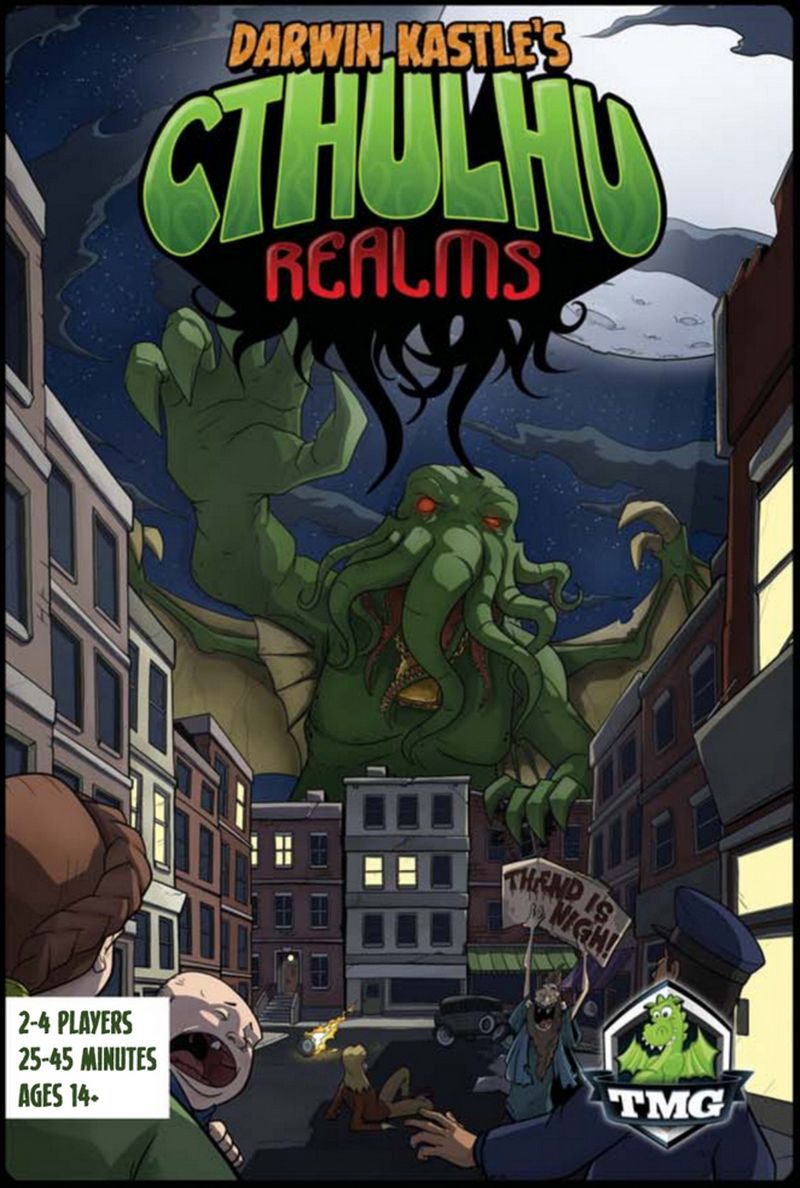 Tasty Minstrel Games offers Cthulhu Realms, a small deck building game for 2-4 players. This is a nod and a wink to Star Realms, which is another small deck builder game from a different company. Players are nefarious followers of Cthulhu trying to drive their opponents mad, inflicting damage to their sanity. It’s a game of player elimination where players try to reduce each of their opponent’s point total (sanity) to zero being the last cultist standing.
As mentioned it’s a deck building game. All players start with a standard deck of 10 cards and have common card supplies which are shared with other players. During their turn, a player will play as many cards as possible from their hand. Cards have a variety of powers which can be activated in any order (including switching back and forth between played cards). Generally cards offer conjuring power used to buy cards, gain/reduce sanity, or draw/discard cards. After playing cards, everything is discarded including their hand, 5 cards are drawn from their deck, and their turn ends.
An exception to removing all cards are locations, and these become important as they always remain in play. Further, many cards require a certain color type in play. So locations become great focal points to use in card combos. They can be removed and thrown into a player’s discard pile by being attacked directly (where sanity loss is applied to a particular location instead of a player). Additionally, some locations have a characteristic that forces their opponents to remove that location first, before attacks can be made against a player. Thrown into this is another location type that must be targeted and destroyed before other locations can be attacked. You’ll find out quickly adding locations to your deck a key strategy during play.
There are three types of cards (followers, locations, and artifacts) along with 3 color types of cards. Many card powers require combinations with other cards to utilize all of their abilities successfully. Another key ability of some cards is abjure, essentially a discard ability removing cards from the game entirely. This is a good way to thin out your deck or potentially get rid of a juicy card your opponent would likely pick up.
In a 2 player game, a supply pool of 5 cards is available for each to purchase. In a multiplayer game, between each player is a separate pool of three cards forming a pinwheel of sorts. For a 4 player game this becomes interesting as sanity loss can only be directed towards opponents to your left and right (ones you share card supplies with). There will be a 4th player essentially untouchable. This won’t last long though as sanity loss hits both your left and right opponents simultaneously. So no hemming and hawing about choosing who loses a few sanity points.
The Good – This is an enjoyable, light, deck building game. It moves pretty fast with some interesting card combinations to explore. There are a variety of approaches in play, either focusing heavily on one color of cards, or trying to spread the field and work up a deck of several card types. I enjoy the multiplayer setup making it a little structured in card supply pools rather than everyone using one card supply. The player point totals use a nifty card and counter system to easily track sanity (victory points) which also doubles as a card ability reference. The card artwork is whimsical and of thick stock. Fans of H.P. Lovecraft will likely get many of the inside jokes on the Cthulhu mythos.
The Bad – Not all the card icons are easily digested and deciphered. Expect a bit of a learning curve and having the rules handy to interpret some of them. While the rulebook is a tight document, the layout is a bit of a hassle as it’s spread out on a single, folded sheet of paper. The card artwork is cartoony and just might not work for some. Lastly there are a good number of card types, yet after several plays you might see some card combinations being to recur.
Once a card is purchased, another is immediately added to replace it. This can lead to buyer’s remorse if a powerful card is suddenly added to the supply pool. As there are some especially strong card combinations, it can be simply a matter of players scooping up the right cards first (and these combos can be difficult to break up if not in possession of the right card types). Another quibble is there are multiple powers on many of the cards, and as you can can switch back and forth between other cards in play during your turn, keeping track of used powers and conditions met for other abilities can sometimes be a chore (using pennies or glass beads covering up used powers helps).
The Verdict – I like Cthulhu Realms. It’s a fun, quick, deck builder game. The theme is light and certainly not serious, so I can give a pass on the card art style. It’s not meant to be a somber horror game despite dealing with the Cthulhu mythos. There is just enough variation in the cards and multiplayer layout to add a fair amount of replay. It’s a player elimination game, however it doesn’t quite drag out the process of players dropping out once massive sanity points are being lost left and right.
In the end, you have a compact 2-4 player game in a small box. It’s a surprisingly effective package that delivers a great little deck builder with a low price tag. If you can embrace the playful theme, you’ll find a pleasant gem in Cthulhu Realms.
Review: Frostgrave – Thaw of the Lich Lord
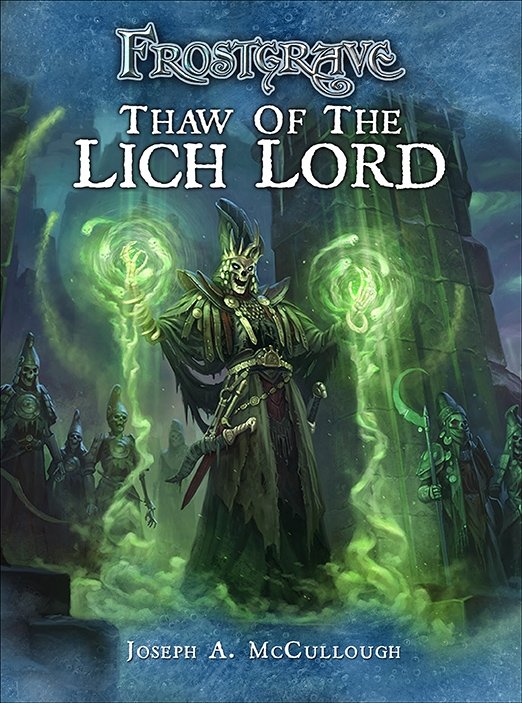 Frostgrave is a game I enjoy and really scratches that itch of a quick and dirty fantasy skirmish game with a smattering of D&D like progression. You command a wizard and their retinue of mercenary followers as they scour frozen city ruins seeking treasure. Osprey publishing has recently released Thaw of the Lich Lord, a campaign expansion which provides more scenarios and other bits for your Frostgrave games.
There are 10 scenarios which revolve around the awakening of a great undead wizard that was sealed away when the city was originally blasted with ice and snow. The scenarios are a pretty good mix of different locations and most have some special rules with terrain or hostile opposition that each wizard warband has to tackle with. The locations also for the most part strive for a narrative tale like a hall, a frozen river, or in a district section which has levitated above the frozen city.
However most scenarios are still pretty much a loot grab where gaining the most treasure is the primary objective. An interesting twist is that the final campaign scenario is somewhat a cooperative affair where each player tries to gain the fame and glory of personally defeating the lich lord themselves. In fact it’s recommended that a neutral player referee the final scenario, taking control of the lich directly, as it works best for the scenario (however rules are provided to give the lich an AI of sorts).
There are three new spells which primarily deal with the undead. One is a useful homunculus spell which decreases the stats of the wizard, but makes a duplication. If the wizard dies, the homunculus creation replaces them. Soldier followers that die can be revived as a revenant undead creature. Lastly there is a spell that can transform a player into a lich themselves if desired. It’s a tricky spell to cast that can incur permanent stat decrease on failure, but if successful makes the wizard a powerful spell caster adding +10 to their will. These spells are only gained through grimoires or the result of some particular scenarios.
Along with the scenarios and limited spells are new treasures, additional soldier followers, and more creatures to add to your game. The treasure and creatures have their own tables which can integrate into ones listed in the original rule book. Some magic items add bonuses to the campaign game, along with tactical benefits. A nice touch is that the table lists supplement the original (so no need to convert your own).
There are a few more soldier options also. A welcome addition are options like a falconeer and javelin thrower which are nice choices to round out more ranged troops. There is also a pack mule follower for hauling loot and gear (which is a fun choice). Also a bard is available for boosting other troops’ will, and some odd creature followers that can be gained through spells.
More of the creatures added to the game are primarily undead based. There are also rangifers which are reindeer man-type creatures of nature. They are relatively neutral, will attack any undead, and can be added as a warband follower through magic treasure.
The Good – I dig that Frostgrave is exploring different scenario setups. While most still revolve around getting as much loot as possible, there are some with objectives (like stopping a neutral unit from leaving the table, etc.) which is cool. I like how new treasure and monsters can be easily added to the game with new charts. The book is well organized and has great artwork and photos as usual.
The Bad – I’m disappointed with the campaign. There is no real outcome that carries over by winning or losing each scenario, or for the campaign itself overall. Much of scenario outcome rewards are tied into gaining specific magic item treasure. Also the campaign structure and rules are still unchanged and I’ve found some community suggestions are better (of which I stole and tweaked myself). The magic spells offer some cool choices but are still limited in scope. A branching campaign might have been better choice.
The Verdict – Thaw of the Lich Lord is an okay book. Rabid fans will certainly like it. Having new monsters, treasure, and soldiers are always good additions. The campaign scenarios overall are pretty cool and certainly offer something different. However there still is a glaring issue of that gap where some warbands potentially run away with victories while others get mired in a chain of defeats. Some optional campaign structure rules would have been a wonderful addition to curb that. In the end I find Thaw of the Lich Lord an okay expansion, just not quite the must have book I was hoping it would be.
Review: Beyond the Gates of Antares
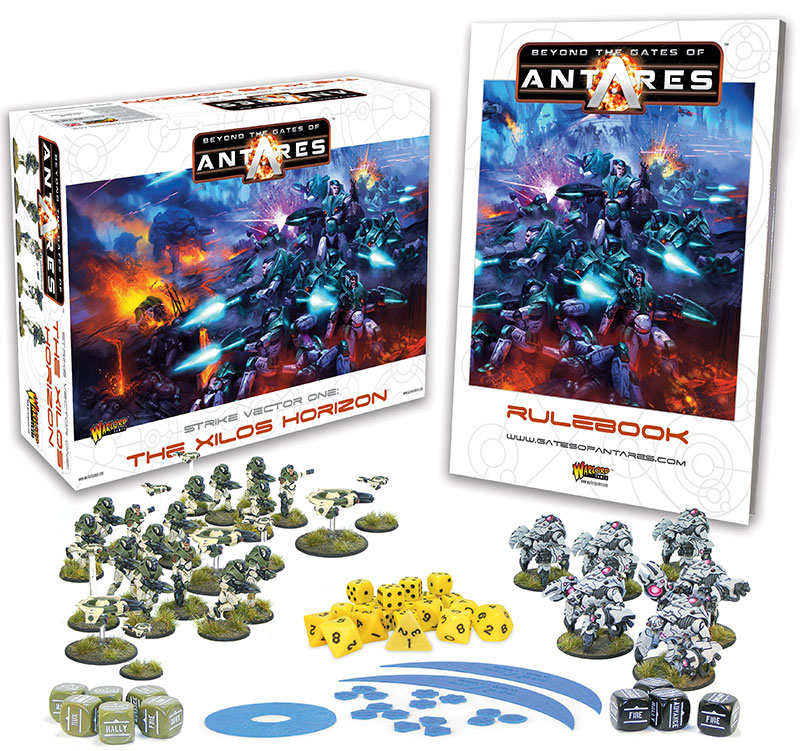 Rick Priestly a while back had a Kickstarter campaign going for a new sci-if wargame that he eventually pulled. It was out just about the time Bolt Action was hitting its stride and I expect he decided to throw his design talents into BA and let his sci-if game ferment a bit. I think that decision paid off as his new game, Beyond the Gates of Antares took some flaws in Bolt Action and improved on them to make for a great game.
Beyond the Gates of Antares (GoA) is a skirmish game for a force of several squads but could be expanded up to a few platoons if desired. It’s a one model-one man system in 28mm scale (although I can’t see any reason why it couldn’t be played in a smaller scale). It is a unit based system where commands are given to groups of 3-10 figures or single vehicle models.
The order system is lifted right from Bolt Action. Each unit is given a single, colored d6 die which is pulled individually for unit orders. If the color matches your force, you select a unit to activate giving it an order to run, move and shoot, hold position and fire, wait in ambush, hit the dirt, etc. It’s a system I like which is a little chaotic and random. Layered onto this is the effect of fire. Units which have been shot at take penalties (pins) to its leadership. This results in pinned units having to check and see if they can activate. If successful a pin marker is removed and the unit commits to its action, otherwise they hit the dirt and hold position (but a pin marker is still removed).
Units have a simple profile of a few stats for movement, effectiveness at shooting and melee, defense, leadership, and initiative. This last stat being representing how likely they can react to the enemy. This is one divergence from Bolt Action. Units not previously activated may potentially react to units within their line of sight either moving themselves or taking an opportunity to fire. Along with committed orders like ambush, this makes GoA a rather fluid game.
Shooting is a pretty simple affair. Depending on the type of weaponry a roll to hit is made with modifiers like for cover and range. Units hit then have a chance to shrug off casualties rolling to resist the attack (again modified by the type of weapon or being in heavy cover). If failed casualties are removed, while for vehicles and larger weapon systems a roll is made on a damage table. Some weapons have ranges that would cover the tabletop but most top out at 30” which seems enough for the typical game of a 4’ x 6’ table size
Regardless of any casualties, a pin maker is placed on a target unit if a hit is scored. Pins not only degrade combat effectiveness but also are markers to indicate penalties to leadership that’ll affect morale and command. As pins slowly accumulate if they ever exceed the command stat of a unit, the unit is destroyed outright.
Assaults are a little more involved. Units have to move into base to base contact. Afterwards each side has a round of simultaneous fire. This is followed up with a round of hand to hand combat that is resolved in a similar fashion except each casualty inflicts a pin. The side with the most pins loses the battle and will likely be destroyed outright. It’s worth noting that all die rolls are made using d10s. This allows for some more granularity in modifiers and troop stats that you might not see with using d6s. Also adopting some chaotic outcomes seen in engagements, GoA embraces the idea of a 1 succeeding (or offering a small bonus) while a 10 fails and usually these will trump the modifiers to a particular dice check.
Movement is a flat rate for models which are halved in rough terrain (with 5” typical for infantry troops). A nice wrinkle to GoA is that some units can push their movement up to 3 times their normal rate with a command check. So if needing to really get a heavy weapons team into position or advance onto an objective, you have that option. However the unit will take a pin after doing so.
A few rules are provided for vehicles and usually revolve around using a type of anti-gravity technology for movement. Additionally, most vehicles have multiple order dice allowing them to take several move and fire actions. This gives them a lot of opportunities to engage several units along with rapid movement and is a nice way of handling the improved mobility of vehicles.
An interesting concept with many of the troop units are the use of robot drones. There are several different types which provide additional defense, or improved modifiers for shooting, along with some that can act as a spotter for the unit. This is especially important as LOS and shooting are based on what models can see with intervening models and dense terrain blocking sight (and lines of fire). Coupled with this are quite a few special rules for ammunition and weapon types, along with varying armor equipment. All of this contributed to differentiating units and alien races that go beyond simply changing some base stats of troops.
Forces are composed of units based on point costs, along with limitations on troop options. A patrol force is required to have so many tactical options, and a limited number of support options. This offers some flexibility with creating your force but also provides some structure. However I do expect that people will dive into building lists to construct the ‘perfect’ army.
GoA comes with 6 generic scenarios where most revolve around capturing specific objectives or moving into sectors on the board with defined attackers and defenders (although 2 are essentially a ‘kill more of the enemy slog fest). Along with this are 6 narrative scenarios which are objective-based having a little more detailed table setup, deployment, and force composition. Having 12 scenarios along with rules for six different armies makes for a complete rule book. Throw into this a ton of background material on the game universe and you have the foundation for a pretty engaging wargame with room to grow.
The Good – This is a bit more than just Bolt Action in space. There are some tweaks to the rules permitting more flexible orders. The reaction system is great and allows for more dynamic play. Add to this the pinning system and you have a very fun skirmish wargame. There are several army options that embrace particular technologies. Using a d10 means you can layer on different modifiers for equipment and gear (along with troop types) which have some impact on how a unit performs.
The book has a lot of background material and having complete lists for different forces along with a lot of scenarios all mean the game has some legs with providing some system longevity. Coupled with this is a pleasant layout and presentation of the rules. Not to mention the lovely artwork, photographs, and oversized pages which makes the hardback quite an enjoyable game tome to read.
The Bad – I dig the d10 dice but leadership tests fall a little flat with me. In Bolt Action you rolled 2d6 on a leadership stat, while in GoA you roll a single d10. This means you will likely get some swings in both good and bad luck with a flat probability instead of playing with a distribution of outcomes using two dice.
Some of the mechanisms for shooting and combat are finicky. Hits are allocated individually to models, along with rolls to determine casualty outcomes. In practice this means rolling casualties one at a time. I’m working with a house rule to roll individually for special units, leaders, etc. while using a single roll casualty roll for multiple hits on troopers that share the same stats, then alternate between the defender and attacker removing casualties. LOS is also based on model bases and figure centers requiring open lines to targets, so expect some more rigid players considering breaking out the laser pointers. It’s not a big deal but it gluts up play some. Nothing that will ever crop up in friendly games but I expect to hear tales of player competitive friction with tourney play.
I am disappointed some with the vehicle rules. I do wish there were rules for air support and tank assaults. I get why this wasn’t done. You likely need another 4-5 pages to cover everything and defaulting to skimmer-type vehicles makes it easier to have condense vehicle rules. While you can get different flavor of movement types via special rules, the game loses some robustness. Lastly it’s a point based game. You are going to get those min-max force lists and some units underperforming for the points spent.
The Verdict – Beyond the Gates of Antares is a great sci-fi skirmish game. There’s a lot here people are going to like. I’ve been a fan of the random order mechanism and allowing units to react out of sequence is a pleasant addition to this. There are lots of options for gear and equipment to alter the base profiles of units to allow for variety in troops. Suppressing units with fire can be an effective means to remove or lock down units.
The game has quite a few scenarios and offering some special engagements means players have a framework to make their own. I can see players digging in, tweaking current ones and creating their own to make an entire campaign (and something I suspect will be in the pipe from Warlord Games). Along with this is quite a bit of fluff. There’s 55 pages of it, all revolving around several ages where humans expanded into space, reached an epoch, and declined. This resulted in humans evolving and diverging into almost different species despite the existence of faster than light travel via inter-dimensional gates. It’s interesting stuff that’s offers some meat to spark a player’s imagination.
I can’t seem to shake the feeling they are looking at being a serious contender to 40K. The cover art obviously takes some inspiration from the original Rogue Trader 40K book. Given it’s from Priestly, you can’t blame him for trying to produce a wargame that would offer an engaging alternative to that industry behemoth. No idea how that battle will shake out but Beyond the Gates of Antares is a fun sci-fi skirmish game that offers interesting tactical play using some simple, easy to run rules.

Priestly’s ‘other’ sci-fi wargame he worked on.
Review: Zombicide – Toxic City Mall
Zombicide has gotten quite a few different expansions out since it was first released, with many of them sufficient to work as a base game. I had a lot of reservations with Zombicide. While the quality of the components were great, aspects of the game play were lacking. Some parts were downright broken and needed house rules to fix (side note, totally feel vindicated on altering the shooting rules as an upcoming medieval version has something similar). However I have to grudgingly admit for a crazy zombie destroying experience akin to the video game, Left4Dead, Zombicide can be a lot of fun.
Toxic City Mall is another expansion to the game and closer to a true expansion unlike Prison Outbreak and Rue Morgue (which were stand-alone games). There are only 4 survivors and a pittance of special zombies in Toxic City Mall. It is more designed to work with the base Zombicide game, however there are a few missions in the rules that integrate with Prison Outbreak. While you can mix and match zombies, equipment, and map tiles with Rue Morgue, I don’t believe there are official scenarios in the rules of either book.
Toxic City Mall introduces a few interesting elements to the base game. The most notable are toxic zombies. These are special zombies that spray toxic goo onto their attackers. If killed in the same zone as their attacker, they essentially get a free zombie attack and can inflict a wound onto a survivor. They get higher priority for shooting compared to zombies of a similar type (i.e. toxic runners will get eliminated before regular runner zombies). Toxic zombies come in all types, even a toxic abomination. Toxic abominations have a special rule that convert regular zombies into toxic ones, making them a priority to tackle as they can end up converting a horde of zombies into more lethal versions.
The game also introduces some other small board effects like barricades and rubble. Rubble essentially are piles of debris that block line of sight and movement, allowing you to tinker with board layouts creating choke points and cutting off avenues of movement. Barricades are only used in select scenarios. Barricades require a whopping total of 6 actions to build. The plus is that all players involved in building one get 5 experience.
Barricades are interesting as they don’t block line of sight or shooting, only movement. Lastly, they will stay up until a zombie in an adjacent zone gets an extra activation (either due to splitting or specific spawn cards). They can be a very effective means to corral zombies and allow you to pick them off from shooting. However if a horde builds up and you are unlucky to get an extra activation, you could see that barricade crumble and a mob of zombies piling into survivors.
The likely biggest change to the game however is the addition of zombivors, zombiefied slain survivors that have resurrected as newly undead. Oddly they are still good guys and are allies to other survivors. Slain survivors are simply removed. The next turn their survivor character card is flipped over, carrying over any remaining equipment and experience their living version had, and finally switching out model figures. Toxic City Mall has player cards and zombie version of figures for the original Zombicide included.
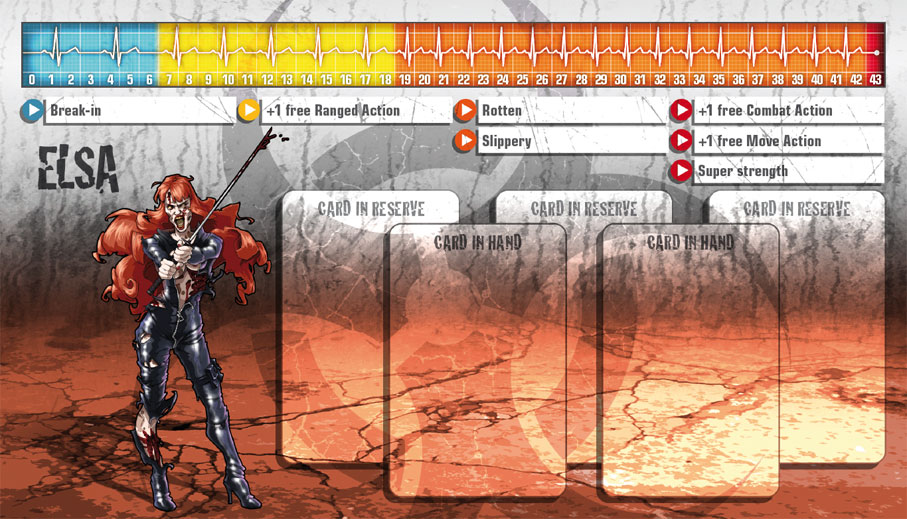
A zombie version of one of the new survivors.
The zombie versions have similar skills, except they lose the general extra action at the yellow level and instead gain a bonus specific action. Further, they are much tougher and require 5 wounds to be eliminated. I really love this about the expansion and it addresses one issue I had with the base game. It’s much more forgiving allowing a player to essentially get a do over if their survivor character becomes the main course in a zombie feast.
There are more goodies and equipment cards like assault rifles and hollow point rounds. Toxic City Mall also introduces an extra level red mode. Essentially your character just keeps leveling up gaining more skills by restarting the experience track. This also allows them to equip some special, vicious weapons if they are lucky to find them. It’s a minor addition but something some people might like in making their zombicide games ‘go up to eleven.’
The Good – The toxic zombie types are a good addition to the mix. They shake up the tactics some emphasizing ranged attacks in order to take them out. Adding barricades and rubble to regular maps is also something that can add a little variation to most scenarios. The zombie versions of survivors is likely the strongest addition and something I feel helps address the flaws in the original game.
The Bad – There is some excitement you might get picking up the expansion on the prospect of adding mall tiles, until you realize they pretty much are just additional buildings and special road sections. While there are a few tweaks with the toxic zombies in game effects, they don’t add much else to the game play and sadly abominations are still just huge bullet sponges.
Abominations lead into gear a bit. A fair number of cards are unusable for much of the game. Ultra red cards are only good if a player is in the red level (although they can be discarded for 5 experience). Also quite a bit of equipment comes down to combining it with other existing weapons to make them more effective, rather than just adding to players’ arsenal directly. Search actions are so limited, it can become a chore trying to find decent gear. This is compounded as some missions require creating molotovs, and being able to get all the correct combination of gear cards to make one can be frustrating.
The scenarios are alright but nothing stands out as tremendously innovative. You are still searching for certain gear or going after particular objectives in a set sequence. About a third of the ten missions require having the Prison Outbreak set (and bummer for you if that is your base set for the game). Missions are bigger and longer, however I do wish an additional 1-2 scenarios were provided that were smaller in scale and a little easier to tackle.
The Verdict – Toxic City Mall is a good expansion for Zombicide. The silly shooting rule is still an issue, but allowing players to pop right back into the game again as tougher versions is a great addition. The toxic zombies are a nice way to add some challenge and variation to the zombie horde without adding too much complexity. Plus it’s very modular. You can easily add more equipment and toxic zombies to the regular base game and breath some new life into old scenarios.
The same can be said for rubble and barricades. A difficult mission can be altered in layout to make it a little easier. At the same time, tried and true strategies can be shaken up some (like throwing a large chunk of rubble down in Y-Zone to make it a long gauntlet to run). Again, some small bits and pieces to add to your regular game.
There are more missions to play, different gear to equip, and weapons to tear into zombies with. I’d say if you wanted one expansion to buy for your Zombicide game, this is the one to pick up. There’s a lot here to really supplement the base set and breathe some new life into your frantic games of zombie destruction.
 Geek Ken