Category: Review
Review: Machi Koro
 From IDW games, in Machi Koro players are small village mayors trying to expand their community into a blossoming city. For 2-4 people, it plays in about 20-40 minutes. The goal of the game is to be the first to build all 4 key landmarks within their town, indicating they are the most prosperous community.
Turns of play are rather simple. Players roll a die (or 2 if they build a special location) and collect any income matching the die roll with any establishments they have. They then can build one location. This can be an establishment from a common supply of cards, or one of their 4 special landmarks.
As a twist, some locations will function during other player’s turns. Additionally, some locations force the player rolling the die to fork over cash, or potentially they’ll collect money from other players. Some establishments have a higher payout depending on other locations within your town. Lastly, bonuses and income for the cards are additive, so having multiple copies of the same location is beneficial.
There are a limited number of cards for each type of location. There are also some location types that can only have one copy per community. So when trying to work on income combinations, this can lead to a race to acquire desirable cards.
You end up with an interesting dynamic of trying to cover a decent spread of different die outcomes, all the while trying to minimize your opponent’s income. There are locations out there that can benefit everyone provided the right die roll is made. This adds a giddy gambling feel making it a pleasant, light engine building game with a bit of luck thrown in.
The Good – This is a filler type of game. Something light that doesn’t require a ton of explanation yet still has a smudge of strategy. You can opt for low cost cards that work on a single die, or spend more cash for establishments that give better payouts on two dice. Or you can try to dabble a bit in both and work the angle of getting income from just about any die roll. What works for the game is that players can collect income if anyone rolls a number that matches key establishments they own. It really keeps everyone engaged.
The design of the cards is well done, matching types of income conditions based on the card color, as well as through text. The icons are simple and the design of the cards has a cute cartoon feel which is colorful.
The Bad – There is a lot of luck here which might turn people off. Also, sadly the game can creep into having a repetitive nature. Setup and the available cards are always the same so you aren’t going to get the breadth of options in play. Players can easily find themselves slipping into set strategies.
The Verdict – I like Machi Koro. It’s a fun family game that’s light with enough choices to make it interesting. I think the major aspect of the game which makes it so much fun is how income can be earned. It’s not always based on what you roll during your turn. You can also get income on other player’s turns, and with the right combination of establishments you can get a huge payout. It allows you to grasp that gambling feel by the tail and revel in it, which does adds a sort of interaction at the table.
A big detraction however is the similar game setup and lack of card diversity. There are expansions floating around which would seem to alleviate this some. I’ve taken to using a modified setup, splitting the location cards into separate decks based on the die roll number needed to induce their effect. By limiting the pool of available cards to pick up and play to only 10 types of cards, you end up with just enough limits to make for hard choices, but not completely slow down the game.
However I guess I can forgive Machi Koro for being light. It doesn’t wallow in that pretentiousness of being anything more than a filler game. The mechanics are not groundbreaking but the idea of allowing resources to be gained on other player die rolls works wonders. It helps slip the game from a ho hum, engine building, resource acquisition game to something more exciting. The theme is light, matching the art on the cards and it works. Machi Koro isn’t a deep experience. It needs a little tweak to the game setup to add some variety after several plays. However it’s also something that provides great fun, especially if looking for a family game.
[EDIT: Figure I’d add my tweak to the base game from the Harbor expansion which introduces using a single deck for locations. Cards are drawn from the deck until there are 10 types available. Similar cards stack up in piles, and if a type is exhausted a new card is drawn and either added to existing piles or placed in the supply as a new location. So 10 different locations are always available and may be of varying numbers.
For my games, I split location cards into 3 decks. One deck is for locations of 1-5 , one deck for unique landmark locations (purple 6 cards that is made as per the rules. i.e. 1 card of each type for each player), and a third deck for the 7-12 locations. Four cards each are drawn from both the 1-5 and 7-12 location decks, while only 2 are drawn from the 6 location deck. As per the Harbor expansion, there must be 10 total different locations available and multiple copies are just added to existing draw piles.
You’ll end up with 10 different location cards that are always available (4-2-4). This adds just a little more challenge and using random (but limited) available locations allows for some different play strategies.]
Review: Splendor
 Splendor is a card game for 2-4 players. You purchase development point cards with gained resources and the first player to 15 points wins. During a player’s turn they have the option of picking up a limited number of gem tokens and on future turns, spend those tokens in certain combinations to pick up development cards in the center. Players can only pick up 3 tokens of different types, or 2 of a similar gem type with some restrictions. Alternately, players can pick up a gold token which works as a wild card gem.
Development cards come from 3 separate decks, each with increasing costs of needed gems, but offering more and more points. As an option, a player can pick up a development card and keep it in their hand (maximum of 3) so that no one else can scoop it up.
Players will spend gem tokens to match what is displayed on the development card. Further, purchased development cards can act as a single gem type which can be used to buy other development cards. So players can try to purchase cheap development cards that offer no points, yet they allow you to amass more gem types which can be used to spend on more expensive cards later. Also, unlike the gem tokens which are discarded back into the supply, development cards you obtain always stay with you.
In addition to the development cards there is also a random number of noble cards. Each noble offers points if players get particular combinations of development cards. While they aren’t a lot of points, they can offer a means to score with the low cost development cards (provided the developments are of the needed sets).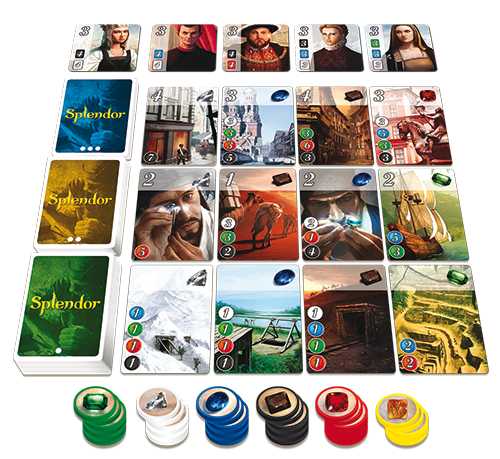
The Good – It’s an immensely enjoyable, light strategy card game. It’s a snap to learn yet offers just enough challenge in play. The collection of gem tokens from a limited supply and holding of key development cards adds a small facet of player interaction. The components are nice with cards of nice stock and hearty gem tokens. The artwork is tasteful and offers a colorful, classical look of the 15-16th century.
The Bad – Once a player lags behind, it can be hard to catch up. Some might also argue that the card strategy isn’t too deep either with a few considering it too light for their tastes. The box is rather roomy for the actual amount of components inside.
The Verdict – Splendor is an immensely enjoyable game. The 15 point total is just long enough to allow a player to amass enough developments to get that feel of a decent game engine going, while not lingering too long to make the play tiresome. There really aren’t any glaring faults to this game. It’s fast, simple, and engaging. It’s not pretentious. It’s just simple fun. Splendor is a wonderful family game and well worth picking up.
Review: Frostgrave
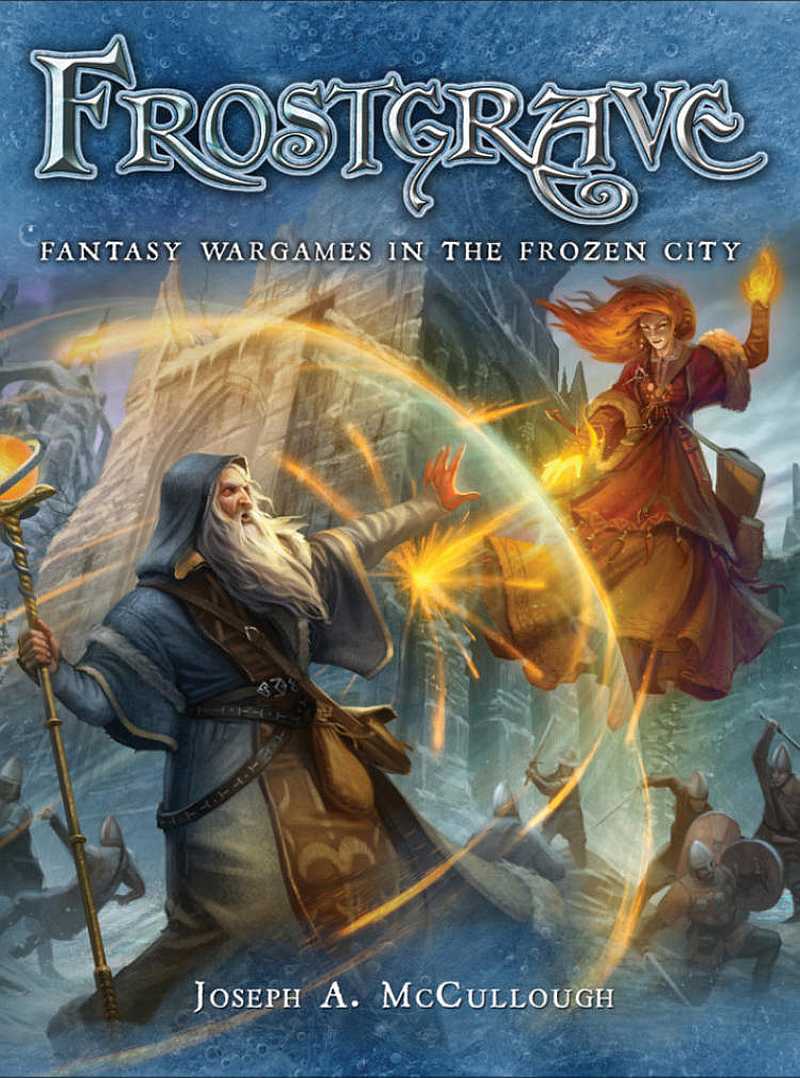 Swerving a bit off the beaten path of military and sci-fi war games, Osprey press has recently released Frostgrave. Set in a cursed city of ruins and perpetual ice and snow, players create a small warband headed by a fledgling wizard in search of powerful artifacts and treasure. It’s a small skirmish game of up to 10 figures per side and may have the occasional few neutral monsters thrown into the mix (that will attack anyone in sight). The game is designed around 28mm models on a small 3’ x 3’ table. It’s certainly not far in theme and concept from Games Workshop’s defunct game, Mordheim.
Each member of a player’s warband has a stat profile expressing armor, movement, fighting and shooting skills, their defense to ward off spells, and health pools. Turn order is a segmented IGOUGO. Players roll off for initiative and the winning player activates their wizard along with up to 3 followers within 3″. Afterwards, their opponent does the same. Then if a side has an apprentice, they can activate (with the same restrictions for followers) and alternately the opposing player activates their apprentice. Lastly, the sequence is repeated for any soldier followers that did not activate in the previous phases. A special end of turn phase occurs for any independent creatures on the table.
When a model activates, they can take up to two actions. If they take two actions, one of them must be a movement action. So no double attacks, but it allows for a little flexibility like a model shooting and then returning into cover. All rolls in the game are based on a d20. For melee attacks, players roll and add their fighting skill. Whoever rolls the highest wins the round and can then inflict damage. For shooting, it follows similar process but a player compares their shooting skill vs the target’s fighting skill with modifiers for cover benefiting the target. The difference is in shooting, the player simply misses with no repercussions unlike in hand to hand combat.
For scoring wounds, the same roll to hit is then compared to a target’s armor value. Most units will have an armor of 10-14. Players subtract a target’s armor from the attack roll and each positive number indicates points of damage the target suffers. Health point totals are also typically from 8-14 points. You’ll quickly find with some lucky die rolls followers in your warband will be dropping like flies.
Movement is a simple system based on inches with any terrain requiring double the rate. There are simple rules for scaling walls, jumping and falling damage. There are few weapon options with most being either small defensive weapons, run-of-the-mill weapons, or great weapons that do more damage. As missile weapons go, you can have bows or slower firing (but higher damage) crossbows. There are no individual armor options. In truth most of these slight variations in gear get wrapped up in the profile of specific followers. So you can have that high health, quick moving, heavy hitting, berserker barbarian. Or instead opt for a slower, hard-hitting but high armored heavy knight to add to your warband.
Of course what’s central about Frostgrave is your wizard. They start off with a selection of spells from a particular school of magic and a few other related schools. Each school of magic has 8 spells within them. Your apprentice has the same spells to access, they just aren’t as effective at casting the spells.
Each spell has a target number for casting ranging from 8 up to 14 for the more powerful spells. Roll equal or higher than the target number and the spell is successfully cast. If you fail, you’ll take 1-2 points health damage. Essentially this helps curb the amount of casting as botched spells slowly drain the health of your wizard and apprentice.
Tacked onto this are the different schools of spells and casting difficulty. Even casting spells aligned with your school incurs a +2 penalty to the target casting number. Neutral spells have a penalty of +4 and this penalty is greater for opposed spells. So even the easiest spell cast still has roughly a 50/50 chance of fizzling and damaging the caster. To get around this somewhat, the wizard can self inflict damage to boost the die roll ensuring a spell is successfully cast. So if you absolutely have to get a spell off, you’ve got that (dangerous) option.
What seems central to Frostgrave is encompassing a larger campaign. After each battle the wizard of a warband will earn experience and treasure. Treasure can be spent to alter the composition of the warband, while XP is used to improve the wizard’s abilities and expand their knowledge spells. They can even reduce the casting penalty for a spell, lowering the chance of any backlash for failure. Some treasure can be magical imparting bonuses to your wizard or soldiers if equipped. And if taken out of the game, each soldier has a chance to recover while wizards and apprentices might gain permanent injuries.
There are 10 scenarios listed in the book but basically all of them are smash and grab encounters. They suggest a general board layout and some unusual terrain feature, or add the appearance of a neutral monster type, but that’s about it. The campaign goals themselves are pretty sparse. This is a game about gaining as much fame, booty, and power as possible. That’s about it for the campaign game.
The Good – Frostgrave is a pretty enjoyable fantasy skirmish game. The mechanics themselves are simple to grasp and don’t get bogged down in a lot of simulation detail. There are enough situational modifiers and gradations of soldier followers to give each warband some flavor. But at the same time not so much there is an extensive list needing a multi-page quick reference sheet for play. Add to this the 10 different schools of magic with 8 spells each, and you’ve got a lot of list building toys to play with. It seems to capture enough chaotic action with a low figure count to make for a fun fantasy-themed skirmish game.
The book is hardbound and an easy set of rules to read through. Plenty of color artwork and photographs are liberally spread among the pages which effectively spark that excitement of sword melee and spell-slinging battles.
The Bad – It’s odd that for all the streamlined modifiers and gear, you seem to get bogged down in a lot of bookkeeping. What especially stands out is the way damage is inflicted. You compare a high attack roll to an armor value and take the difference off a model’s health total. Yes, you’ve got hit points. This is a hair’s breadth away from being something you’d see in a RPG rule book. I appreciate how casting spells are related to health totals. Unfortunately this seems to carry over to rank and file units. Yes, the game can be exceptionally lethal. But it can also end up with models having a lot of minor fleshwounds. Expect to have a warband roster sheet at the table with a pencil handy to keep track of health totals.
Sadly this also does not stay with just hit points… err.. health totals, but also with wizard XP. Experience is liberally gained during a fight which is cool. But you have situations where XP is gained for each successful spell and personal kills are made. Not to mention for each bit of treasure collected. Yes it’s fun to earn oodles of XP but the excessive bookkeeping can become a chore.
The longer campaign rules are nice but you begin to notice how hollow they are along with the scenarios. It’s truly similar to a kick-in-the-door-kill-the-monster-get-the-loot kind of game. The campaign is about gaining the most stuff and becoming the most powerful wizard. There really isn’t anything else besides that. There is an optional rule where a player can attempt to cast an instant campaign win spell. It requires the accumulation of several spells and even more advancement effort into casting the spell (which is essentially impossible until spending several experience points in reducing the casting penalty).
It’s a shame as so many out of combat spells and parts of the game revolve around campaign play. Clearly that is what the game is designed around. It’s just that an overall campaign (and the scenarios that support it) never provides anything more aside from the winning player having the warband with the most gold and XP.
Lastly, the game world is set in a labyrinth set of ruins covered in snow and ice. You might be able to get away from the arctic theme, but the game is designed around having tables with lots of high cover and isn’t that flexible in terrain layouts.
The Verdict – I was hopeful for Frostgrave and it got some things right. I like the relatively streamlined task resolution and the game doesn’t seem to get bogged down in movement, spell, and combat mechanisms. The idea of rolling off d20s against each other is quick and engaging. There is a little back and forth play as you’ve got some alternate unit activation and as enemies have limited reactionary movement, you can also take the initiative some forcing a melee combat out of turn. The tinkering of warbands and spells for your wizard is fun along with deciding how to spread out magic items and potions. That thrill of expanding your warband, spells, and allocating treasure after a successful battle is a fun concept.
What mars this a tad is the excessive bookkeeping for damage and XP gain. You are going to need a few sheets of paper handy to track everything. I’m certainly immediately thinking of tweaking the rules some for warband soldiers and using damage tokens instead. The same might be said for keeping track of XP gained during the game too. I’m considering some simple scenario rules where earned victory points translate into XP gains.
This bleeds over some to the overall game. If you aren’t running a campaign, you seem to be seriously hobbling the system. There are a plethora of spells that have the most function in campaign play. The overall goal of the campaign system is limited too. The impressive list of scenarios is really just a list of terrain effects and complications to sprinkle in the regular objective of getting loot and wiping out the enemy.
So I find Frostgrave a mixed bag. There are a lot of little things here to enjoy. The lists of different magic items, independent creatures, and various spell schools are great. Immediately off hand I’d consider this a better choice over Mordheim. Task resolution and play is a bit more streamlined, yet also more dynamic than Mordheim. The XP system is also geared primarily to improving your wizard, so you aren’t having to tweak every member in your warband. At the same time, you can figure out what combination of soldier followers would work best and there are a few spells that supplement your warband’s fighting abilities.
I guess I wish the idea of a quick skirmish game was embraced a bit more, especially with the bookkeeping of health totals. Frostgrave has those trappings but it’s still a bit further away from something like Songs of Blades and Heroes for ease of play. There’s a lot of potential here, but as a whole it seems to falter a little.
Granted, as a rule system for a fantasy skirmish game Frostgrave is successful. There is fun here. It’s just not as innovative or elegant as something like SAGA. Though, I can’t really fault it for that. Frostgrave has that feel of a fluid and magical Mordheim with much of the clunky bits of that older game shed off. It’s sleeker and far dynamic. While Frostgrave trips some, there are more solid parts making it definitely hold up as an enjoyable fantasy skirmish game.
Review: The Agents
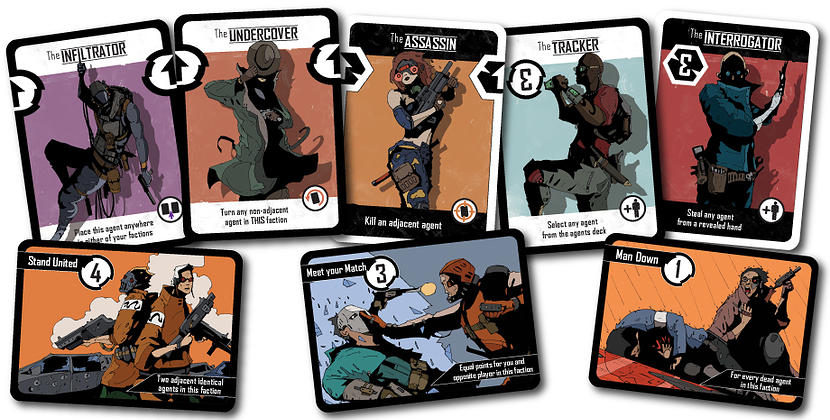
 The Agents is a card game where players represent a group of operatives that have gone rogue once their respective espionage agencies have disbanded. The game plays 2-5 players in about 30 minutes, with the game ending when a player earns 50 points. Players earn victory points (IP) by playing agent cards in specific directions that award points to either themselves, or their opponents. Additionally, players earn points by achieving specific layouts in their play area by assigning mission cards.
What’s rather clever about the game is that the orientation of agent cards either can award you points, or provide an action. Choose to gain points and your opponent now has access to that agent’s ability (or vice versa). To gain points you need to have a pair of agents lined up to link two halves of an IP icon shaped as an arrow. Additionally these half arrow icons are either black or white. If the colors match you gain 2 points, and if they are mixed the player earns 1 point.
A player has only two options when playing agent cards in their area. They either form up in one group (faction) to the player on their left, or the player on their right. Additionally each faction can be comprised of only 5 agent cards (7 in a two player game). You can only play cards on factions you share with other players. The agent actions allow cards to be rotated, shifted to other factions, pulled out of a faction (either into your hand or discarded) and manipulating these commands on the agent cards becomes a key part of the gameplay.
Players can also assign up to 2 mission cards per faction. These provide additional points if certain conditions are met in a faction. Once a player has done all their actions victory points (IP) are awarded based on the number and type of arrow icons facing them, and any additional points from assigned missions are also earned.
Playing agent cards becomes a tricky process though. Not only do other players score points on their turn for any pairs of IP icons that are facing them, they also have the option of using an agent command on their turn. If you get a nice layout of IP icons awarding you points each turn, expect your opponents to start activating agents that you set out to muck up the orientation of your shared agents.
Now a while back I gave a shout out for the original kickstarter campaign. After repeated plays I found there were some rough edges to it. So while the Agents was pretty fun, it just wasn’t something that I found to be a homerun at my gaming table. Since then the rules got a revamp and another kickstarter campaign was rolled out. The ‘Mark 2’ rules really make the Agents a much more enjoyable game.
The game now ends when a player reaches 50 points. No longer does it continue until all players get the same number of turns after a player reaches 40 points and this removes a finicky end game condition. In practice I found you actually had to plan on having more than 40 points, as inevitability other players would be able to maximize their layout in that last mad dash during their final turn. You also have much more flexible options for removing agents and missions from your factions, and picking up missions are cheaper. I appreciate the relaxed options for altering your agents and missions and it’s a welcome change from the more rigid turn actions of the first edition.
Likely the biggest change however is that players are no longer required to use an agent’s command action when it’s first played. Now players have the option of not activating the card powers when an agent is added to a faction. It does remove some bite to the game, as before you could really force a player to restructure their faction when you first placed an agent. However I also found this would inadvertently drag out the game as your opponents would sometime agonize how they would apply the command of an agent. With the new rules they have the option to just utilize it as an action later.
This change also bleeds over into special agents. Special agents are the only cards that can be played on other players that are not aligned with your 2 factions. Before it was a chore sometimes figuring out how to apply a command when they were played. Now, the IP points are still awarded immediately the turn they’re played. However the card is not discarded until the command on the agent is activated. This means that other players can keep those command actions for play in a future turn. This small change really adds to the value and decision process of special agents. Do you score the points now and risk an opponent trashing your built up factions on a later turn? Likewise having those special agent powers available may set up a nice mission condition, allowing you to work towards a specific strategy.
The Good – It’s an enjoyable strategy card game with an interesting mechanism for play based on the orientation of your cards. It has a good flow and offers interesting choices of spending victory points to try and get resources in order to score more points on future turns. There are a fair number of expansions out to provide alternate missions, free agents, and other small twists to the game. However even right out of the box there seems to be enough variation in the cards to offer plenty of replay.
The design of the cards is well done. The artwork captures an almost sci-fi feel, and some sweeping action poses that look more out of a comic book rather than what you’d expect for a game revolving around espionage. I like it and the art and design seems to capture that tone of a tug-of-war game where agents are flipping allegiances back and forth.
The Bad – There are a lot of improvements with the second edition rules, however the new rulebook will still have you getting some head scratching questions regarding agent abilities. The game can also depend on a fair bit of luck. If a player gets a good scoring combination set up, they only have to worry about their immediate neighbors mucking it up. If your opponents get a few poor draws with agents that can’t shake up your layout, well you can run away with the victory points making it very hard to catch up. It can be a little frustrating not being able to get a setup that will earn you points, especially as your opponent can trash your layout using agent abilities (or the alternate, not being able to break up an opponent’s efficient faction). While there is certainly an element of strategy to create these layouts, it can also rely on lucky card draws.
The Verdict – The Agents is an enjoyable game. It’s heavy enough to offer challenging choices, with some variety in the cards and play to provide replayability. But not so much that it gets mired down in lengthy turns with lots of intricate working parts that you might see in other board games. The game seems to run just long enough and teeters over that edge of being just a filler game. With fast play and some enjoyable bits of strategy, you’ll certainly want to play a few hands filling up an evening of gaming.
There are rough spots to the game. Some of the actions on the agents and how they resolve can be clunky at times. You can get stuck with poor draws for a few turns which can make catching up all the more difficult. But the faction layouts are very fragile and can be rapidly altered, making that ideal faction placement difficult to set up (and harder to maintain). This facet of play really captures the give and take of agent loyalties which allows for some interesting play.
I don’t feel the Agents is an absolute must have for a collection. However the point-or-action choice of card placement is different and makes it stand out compared to other games. The new version of the rules allow for a more flexible turn options and is a significant improvement over the original version. Additionally the point of entry for the game is low with enough card options that you don’t need to pick up expansions, but they are available if wanted. The player count and play length is just right too. So I would certainly recommend it if looking for a light, strategy card game.
Bolt Action: Battleground Europe
 Osprey publishing has slowly been releasing a series of campaign specific books for Bolt Action. Battleground Europe takes the ambitious task of highlighting the Western European front from the invasion of Normandy all the way up to the end of the war. The book covers special units as well as more scenario specific rules and throws in some historical background sections to boot.
Like the theme, the material in the book is rather sprawling. The campaign is broken down into progressive sections where historical information is first presented, then any particular rules related to the battles, and finally a few scenarios depicting a historical engagement or a more generic type of skirmish that was fought in that battle.
Rules for special units are presented and can be chosen as selectors for particular scenarios. In addition there are a few hero type characters for Allied and Axis forces. A few special vehicles are also covered. There are some force selector lists that are also given for armored platoons of Allied and Axis flavors.
New scenario rules primarily cover minefields, night engagements, and amphibious landings. Each of the listed scenarios usually have some small additional rule regarding the composition or other tweak to give the battle some flavor like limited fuel or ammo. Hedgerow rules are also covered to add as a terrain feature for Normandy battles. All in all 15 scenarios are provided. Most of them have victory conditions that range from destroying the most enemy units, to having the attacker move into enemy deployment zones. Some scenarios like those for Normandy beach landings detail an expected table layout some, but most are fairly generic. They do cover a broad type of engagements fairly well with each having some small special rules, along with what would be considered atypical forces for the battle.
The good – The book gives a fair snapshot of the Western European theater at the end of the war with enough scenarios to visit. The additional units offer some fun choices to give a platoon a decent theater selector feel. The artwork and photos are also plentiful and along with the historical background, certainly helps convey information and evokes inspiration for playing the game.
The bad – Most of the scenarios don’t really stand out as anything new. While there are a fair amount of special rules for particular engagements, much of it is scattered throughout the book. And some key rules which would work in different types of battles (like amphibious landings, mines, and night fighting rules) would be better presented in one section rather than spread out and aligned with one scenario. I really would have appreciated a few more maps. Some actual aerial photographs or simple drawings of scenario tables would have been nice. You get a written description which is functional, but having some more details on a table layout would have been better.
The Verdict – Battleground Europe isn’t a bad book. It’s just not a completely stellar release. I was hoping for a more historical scenario book with more rigid force selector rules. There is some of that, but not quite enough. It seems to go more for providing games that give a certain flavor over depicting a true historical battle. I just wish it dabbled in both types of scenarios more.
Another ding is the presentation of the material. For the most part it’s sectioned off in the different stages of the conflict, which isn’t bad. However the special rules also are spread throughout the book. This becomes an issue as some rules (like for mines) are required for several missions throughout the book, but the actual rules are with one particular scenario. Having them collected in one section would have been better and easier to reference. There is some nice stuff here. Some interesting vehicles (ex. Hobart’s funnies) and units are depicted, like French resistance troops and the Einheit Stielau commando unit (English speaking German commandos that were in first days of the Battle of the Bulge).
While it is a European specific book detailing Axis vs. Allied engagements, some of the rules could be applied to other theaters. Amphibious landing rules could easily be used for the Pacific, or the Invasion of Sicily. And night fighting rules and mines could also be added to a regular game. Likewise, many of the scenarios could be used to depict some generic battle with a small twist on the composition or conditions of the game.
I guess that’s my main complaint for Battleground Europe. Too much effort was put into making the scenarios something that could be applied to a wide variety of forces, rather than trying to depict a specific engagement. I recognize that’s the nature of skirmish games. You really can’t mimic something unless going for a larger scale battle. These skirmish fights are a zoomed in, snapshot of the action. However it seems a missed opportunity. So for a player that wants to duke it out on the Western European front, and is a Bolt Action fanatic, they’ll find this book worth picking up. If you aren’t I’d be hard pressed to say it’s a must have. It is a decent book with a fair amount of scenarios that have slight tweaks to make for a different game. However it’s not enough to make it an essential book to have on your shelf.
Review: Airlines Europe
I wanted to pick up a route economy game. Looking around, I saw one based on the expansion of airlines in Europe during the 30s and 40s and found the theme a bit different from your typical railroad expansion game. Airlines Europe is a 2-5 player game from Rio Grande Games. You are an investor seeking to help young airline companies blossom as they slowly expand their routes across Europe. Hopefully you’ll see your investment in certain companies come to fruition, picking up stocks and strengthening your portfolio in key airlines.
Players try to get as many points as possible. During the game, 3 scoring tiles are placed into a stock supply deck. When they will turn over is not known exactly. Instead players know about 1/3 and 2/3’s into the the stock deck a scoring opportunity will pop up, with the final scoring being randomly mixed in with the last 10 stock tiles of the deck.

As airlines are invested in, establishing new routes, they increase in value constantly moving up a victory point tracker. At set increments, they will be worth a certain amount of points. The player with the most stocks of a particular airline in their public portfolio earns the most points. If players have at least some stock in a company, they will earn some points, but it pays to own the majority of stock for a particular airline.
The game has a varying number of airlines which start in certain cities. Players have the option of taking one action during their turn. They can invest cash into expanding a route between cities for a certain airline. This in turn allows them to pick up a stock from a limited pile (or take one unseen draw from the deck). They can take accumulated stocks in their hand and place it into their portfolio as another action (which also allows you to get cash from the bank). In essence they publicly declare what airlines they are investing in. Instead, as an action they can get money from the bank (which they’ll turn around use for investing in airline routes). Or lastly, they can turn in stocks they possess to pick up stocks for a special airline that is rapidly expanding worldwide.
Picking routes becomes a tricky business. There is a limited number of routes between cities, planes of each airline, and their stocks too. Once you claim a route, you cannot get a similar airline on the same one. Additionally, you always buy the cheapest route. Once you establish a route, the value of that airline goes up in the point tracker. Picking up routes early allows you to expand an airline rather cheap. It also can force other airlines that want to expand, having to buy the same route at a more expensive price. So there is a chance you can cut off opponents (or limit their level of investment) by judicious establishment of routes.
Another key part of the games is setting up your portfolio. The stocks you have in hand are not used for scoring. You have to put those into play, showing all the other players what airlines are in your portfolio. This becomes a bit of a bluffing game. Building up an airline takes a lot of cash. Having other players help is ideal. However you want to be sure you have the majority of stock in a company. If players see they are a minority stockholder, they will get points for an airline, but not as much so they might decide to invest in other airlines. Or worse, they race for gaining more shares to snatch away the majority. This really becomes a large part of the game, deciding what airlines to invest in, what stocks to pick up, and when to publicly declare what airlines you are investing in.
This last bit is another huge part of the game. You only have 3 scoring opportunities. Further, only stocks that are in your public portfolio are used to determine scoring. Stocks hidden in your hand don’t count. As you have one one action for your turn, you have to decide when to ‘go public’ and when to keep that information hidden.
Maybe you want to string along an opponent and help them build an airline. Maybe you want to be sure no one else is getting stocks for an airline you are interested in. Once you add those stocks to your portfolio the word is out on your interests, but if you hold onto those stocks for too long, you might miss an opportunity to get victory points. It can be a challenging decision and is an immensely enjoyable part of the game.
The Good – This is a fun route building game. Although the routes and number of airlines are static, the initial stocks you hold and what are available in the stock market are random and limited. You really don’t know what airline to invest in until you see your hand. Additionally, there is a special airline where players gain their stock by exchanging ones they hold. This airline can be worth a lot of points at the end of the game. Making it a valid goal trying to gain a majority with this special airline. All of this makes for a variety of strategies, making each game a little different.
The components are very nice, with a colorful board, plenty of plastic airline markers, and thick tokens for the stocks and victory points. The rule book is well written with plenty of examples.
The Bad – The random stock assignment and market might put off some people. You are trying to make the best of what’s available and wanted key stocks might simply not come up when needed. So some players might be put off by the random distribution of the market. This is especially true for the scoring. You will not exactly know exactly when scoring will take place. Some might find this frustrating if they managed to miss out on a scoring opportunity, and it can be very difficult to make up for a missed scoring turn.
While the components are pretty nice, the game does have paper money. That isn’t a huge ding, but having tokens or other markers might have been better. Paper money always seems to get a lot more wear and tear through multiple plays.
The Verdict – Airlines Europe is an enjoyable game. It plays just the right amount of time (clocking in just a bit over an hour) and keeps everyone engaged throughout the game. The random stock assignment means you have to be flexible with your initial strategies. The hidden accumulation of stocks, along with the public declaration of your stock portfolio (and what companies you have a majority in), makes for a great bluffing game. Shrewd planning and investment of routes, coupled with grabbing up cheap routes and stocks to curtail an opponent’s expansion evokes that feeling you are an investor slowly helping expand airline service across Europe.
This really is a fun route economy game which veers away from your typical railroad theme. It also works very well as a family game too. There is a small twist to a 2 player game where discarded stocks are thrown into a dummy hand. This can shake up the shareholder leaders for certain airlines that adds some unknown factors to victory conditions for 2 players. All in all, it scales well with many players. I highly recommend Airlines Europe.
Review: No Stars in Sight
From Nordic Weasel Games, No Stars in Sight is a new sci-fi ruleset that expands on the conventional wargame from the same designer, No End in Sight. The game is designed for small unit action of a reinforced platoon with a vehicle or two at most. The scale is for 6-15mm individual models, but larger scales or infantry stands could also be utilized. One thing that stands out is the game is meant to have a very small footprint on the table, with 2 to 3 feet being enough space to duke it out.
The game is more geared towards near-future engagements. Some trappings are offered for more futuristic technology and aliens. However there is a foundation that troopers in the future will be armed with advanced weaponry that utilize some type of projectile. All the while the universe tends to be geared towards a generic setting of future conflicts that somewhat mimic what we have in the world today.
Player’s troops are organized into units or independent fire teams with assigned leaders. Coherency with the units are pretty tight, with each trooper required to be within 6 to 8 inches of their leader. This works out though as squads are designed to be 4-5 troops at most. Players activate a unit and alternate with their opponent until all unit leaders are exhausted. Victory conditions are assessed, stress removed from leaders, and the turn sequence is repeated until one side has a clear advantage (or victory).

Units activate based on rolling a d6 and retaining that many activation points for their squad. Individual troops firing, recovering from pins, movement, and other miscellaneous actions require an activation point. There are options for group fire and movement, allowing 2-3 models a chance to activate on one point. Models but can only move and fire once when they are activated. At the conclusion of the unit’s activation the leader gains a stress marker.
Movement is a simple affair keeping everything at a constant 3 inches provided they are in cover. If players move a unit out of cover into LOS of an enemy however, this becomes a random roll of d6 inches. If caught out in the open, their opponent has an opportunity to fire at them hitting a trooper on a 6 (with the poor grunt being pinned on any other result). So those dashes across open terrain become a very tricky proposition, and even more so as there are no cutoff for weapon ranges. Anything that can be seen on the table is fair game.
Directed fire is split into two types as shock or kill dice. All basic weaponry throw out shock dice. For every 2 shock dice thrown, 1 kill die is generated. Shock dice can pin a model on a 5 or 6, while kill dice hit a model on a 6. Hits are rolled again resulting in killing the model outright on a 6, or wounding them. Either way, hits with kill dice typically mean the target is out of the fight being wounded which can be rather deadly.
Close assaults are even deadlier. When units approach within 6” of each other shock dice are dropped and kill dice are rolled instead, having hits generated on a 5 or 6. Actual hand-to-hand fighting results in just rolling of a d6 between players, with the attacking player killing the enemy if they roll equal to or higher than the defender (and being killed in turn if they do not).
With all of these pins being thrown around and casualties, they all contribute to degradation of morale. If players cannot roll over this amount on a d6, they immediately fall back a random distance. Casualties also incur stress on the leader. For each excessive casualty, one point of stress is added to the leader. At the end of the turn when all units are exhausted, each leader can discard 3 points of stress. All excess stress becomes permanent, making it more difficult to activate on future turns.
What you end up with is this slow degradation of a unit’s ability to function. Pinned models cannot take any actions until an activation point is used to remove the pin. Casualties and activating a unit slowly accumulate leader stress. After a few turns, they begin to whittle down the ability of a leader to do anything but have their squad hunker down and remain in cover.
Different types of troops with varying equipment is offered, from elite troops in power armor to irregular, lightly armed forces. Vehicles are also presented with a variety of armaments although most are land-based as tracked or walker equivalents (with no real rules for flying units). There are several optional rules to mimic near-future battles, including rules for improved communication and command (along with hacking these aspects) and there are also rules for drones and simple automaton combatants.
There are a variety of scenario ideas and a simple campaign system to allow for a more role playing type of experience, following a single trooper or unit through a series of battles. Some more military-centric rules for off board ordinance, smoke, combat drops, and the like are also presented. There are several generic alien species offered with small tweaks to combat abilities along with suggested scenarios to play them as.
Finally suggestions on a point system for force construction is presented. While the numbers do not not necessarily ensure a balanced game, they can provide some guidance for a fair engagement if trying to figure out how best to match up power armored troops against regular militia. This is a nice feature of the game.
Don’t let a point system detract you however. This is very much a wargame ruleset based on players agreeing to have a fun game and tinker around with asymmetrical forces. There are a lot of optional equipment and rules to utilize. The game does require going through some set hoops for playing them however. You have to use a board with a certain amount of terrain density, or at least be willing to break up long alleys of open ground. You really can’t field larger forces more than a few squads of 4 or 5 troopers each.
The Good – Pinning and suppression are key. I really enjoy the whittling down of actions a unit can complete due to taking enemy fire, and it’s not dependent on killing troops (but it doesn’t hurt either). I also appreciate how task resolution uses a relatively streamlined system for determining outcomes.
There is a fair bit of optional rules and varying techs and equipment to give games a little variety. There are a few scenario tables offering a pretty diverse list of possible combat encounters as well as a more narrative campaign. As there are aliens and planetary environments, the game is not exhaustive in detailed rules but certainly provides a nice platter of choice sci-fi elements to try out.
I have the PDF version so I can’t speak on the quality of the printed book. You get a very spartan layout with a decent number of charts including a few summary sheets at the end of the book. It’s serviceable and plainly explains the rules.
The Bad – The game has some rough edges, especially with excessive bookkeeping. Troops typically are wounded which need to be indicated somehow. Effectively they are out of the battle however a unit needs to spend actions stabilizing them and getting them to an extraction point. While untreated wounded troops have an effect on morale, treated/stabilized figures don’t. Add to this individual units getting pins and you have a clutter of markers and tokens hovering around every unit. While a small engagement with 2 units and 8 figures total would not be much of an issue, adding more models into the mix seems to glut the game down some.
Another rule regards stressed leaders passing off leadership to another model in their unit. Effectively this can get rid of any permanent stress (as it stays with the original trooper and is not transferred to the new leader). While the vibe of the rulebook certainly rings of folks playing in an agreeable manner, this is something that could certainly be abused.
Overall I found the rules pretty well laid out. However a few topics seem to jump around some. It feels like a few sections could have been tightened up and reorganized in a better fashion. There are some critical rules that seem to get buried in other key topics. The rulebook is far from being difficult to go through, but it’s also far from being perfect.
The Verdict – I see No Stars in Sight as sort of a mixed bag. I really don’t like the wounding of troops and seems heavy on keeping track of fiddly conditions in the likes of pins, stress, and unstabilized wounded troopers. But the game has many more hits than misses. The random activation of units, the desperate dash of units out of cover, the accumulation of control stress on a unit, all are highlights to the game.
I also appreciate the abstract systems employed by the rules. Movement, cover, and weapon types are not mired down in detailed minutia. However there is certainly enough optional rules and suggestions to make the game have some unique flavor from unit to unit. It’s a decent set of rules that give a challenging feel of command for small, tense, engagements with a futuristic feel. Still, there are some rough edges to the game. I think No Stars in Sight is a fair set of rules and not a bad choice if looking for sci-fi skirmish action, just not quite the home run I was hoping for.
Review: Battlegroup ruleset
Plastic Soldier Co. and Iron Fist Publishing have teamed up to produce the Battlegroup series of books. From my understanding Battlegroup Kursk was the first set of rules released combined with supplementary material to describe that engagement in WW2. From there, a small ‘mini’ book was released with just the base rules. There are several other books released that detail different campaigns with various theater selector lists for forces and scenarios, but these only have special rules related to those campaigns. You need the small rulebook in order to play.
The scale for Battlegroup is set at 15mm to 20mm. Additionally it is a 1 man = 1 model system. There is no basing of units into fire teams. However as the game plays, actual basing isn’t really an issue. There are many examples of folks playing the game with multiple troops on single bases (like Flames of War). However, having a handful of single troops on lone bases is ideal to indicate casualties for a squad.
The rules themselves detail a pretty ambitious task of outlining a system that can be played at a variety of engagement sizes, from a squad up to an entire battalion. The squad level game is a bit of a misnomer as they expect you to take at least a platoon of troops, but it does give you varying levels of forces to play which can range from a few squads for an afternoon of fun, up to a full day of gaming at the battalion level. It’s a point system game, where you decide a point total and purchase units up to this limit. I picked up Battlegroup mainly for company level games.
The game utilizes a IGOUGO system of sorts. A player will roll a set number of dice to indicate the total units they can activate for that turn. For a platoon level this would be 2d6, while at the company level would be 3d6. I groaned a bit at this first but digging into the rules a bit more, I started to like it.
You roll to activate units, which really breaks down into teams. An entire platoon is really 4 individual units (a command team, plus three 8 man squads), and in addition you might have a few LMG teams that are also units. So that 3 platoon company suddenly mushrooms into 12-18 units, making that 3d6 activation roll a little more unpredictable. Add in additional MG teams, AT assets, field guns, artillery spotters, a few tanks, mortars, etc. You suddenly have a lot of things that may not be able to activate on your turn.
Each activated unit can be given one specific order; firing, maneuvering, a combination of the two, or just waiting in ambush to react to your opponent. Reaction orders also are a nice element, giving a chance to interrupt an opponent’s turn. This really allows for a fluid back and forth type of game making the turn progression more tense and engaging.
Movement is a flat rate for vehicles and infantry. Difficult ground will reduce movement to a d6 inch roll depending on the type of vehicle or terrain. Overall movement is a simple, easy system to execute.
There are maximum effective ranges for weapons, with small arms topping out at 30″. However this is tweaked some as there are two modes of fire. Area fire is a simpler affair where total firepower is determined and a single die is rolled to see an effect. If successful, they pin a unit.
The alternate is aimed fire which has a maximum range and individual die rolls for troop weapons, designated to inflicting casualties. Successful rolls to hit forces the target unit to roll for saves (6+ if in open ground, and much better if in cover). Failed saves result in casualties and morale tests, likely resulting in a unit either being pinned or forced to retreat. Combined with aimed fire is the need for spotting a target unit. Again a simple d6 roll test altered by different modifiers. If they can’t spot the unit, they can’t conduct aimed fire (area fire does not require a spotting check).
Vehicle fire mimics small arms fire some, however there is more gradation in target numbers to hit based on the type of gun and target armor. Also unlike infantry units, vehicles must keep track of the number of rounds fired. Close combat is more of an extension of aimed fire. When units come to within 5″ of each other, an intense firefight breaks out with both sides making attack rolls.
Morale is a pretty simple affair. If a unit is pinned they cannot be given an order until it is removed (more on that later). If a unit suffers a casualty, or is damaged, while pinned they roll on a d6 chart. On a 2 or less most units will break outright if they are pinned. The game is exceedingly dangerous to units in the open. Get them pinned and follow up with effective fire, you likely will have them break and run.
This leads into an interesting tweak to the the game, the Battle Rating (BR). Every platoon, tank, command team, etc. in your army has a value and the entire sum represents the overall morale and will of your force to fight. For each unit that is destroyed, you draw a random counter. These are also taken for other aspects of the game, such as your opponent having more scouts or when your opponent takes an objective. Effectively the only way to unpin units requires you also to draw a counter (unpinning d6 units while doing so).
The counters themselves are an uneven distribution of numbers ranging from 1 to 5 (with most being 2-4). As you draw counters you put these aside and secretly sum up the total. If the total of drawn counters ever exceeds your force’s Battle Rating, your entire group collapses and withdraws from the battle. This makes for some nail-biting decisions. Pinned units can do nothing and are exceedingly vulnerable to additional fire. If they break, you draw a BR counter. If you decide to rally some units, you draw a BR counter. So there is this fine line of deciding when to try and unpin units (or instead just let them keep hitting the dirt), as you never know how much pressure your force can take before they break.
There are rules for calling in off board artillery and air support. A series of rolls are made to simulate communication and firing priority. As off board artillery goes, there is a fair amount of randomness where rounds actually land, certainly allowing for the potential of friendly fire. Anti-air assets on the table also have a role which is a pleasant change from other systems.
The book comes with a handful of scenarios depicting typical engagements you might see, from patrols to withdrawing actions. Most scenarios also dictate the use of objectives. Given that holding objectives forces your opponent to draw BR counters, these alternate goals add some variety to the scenarios and provides for some differing victory conditions.
As mentioned earlier this is a point system game. You select units up to an agreed total. The actual force lists are rather structured however, with limited choices based on the core units you pick up. The game is very infantry-centric but armor heavy battlegroups can also be drafted up.
There are no force lists within the rules however. These are all provided separately in different campaign books which have battlegroup lists, special unit rules, unit profiles, etc. and are very much themed towards specific combat theaters. In this aspect, historical gamers will probably enjoy this as gradation in forces can be achieved to represent different parts of the war. With a universal force list for different nations, this would be harder to model. However, you are not getting a complete game just picking up the ruleset book. You also need to invest in a campaign book to play the game.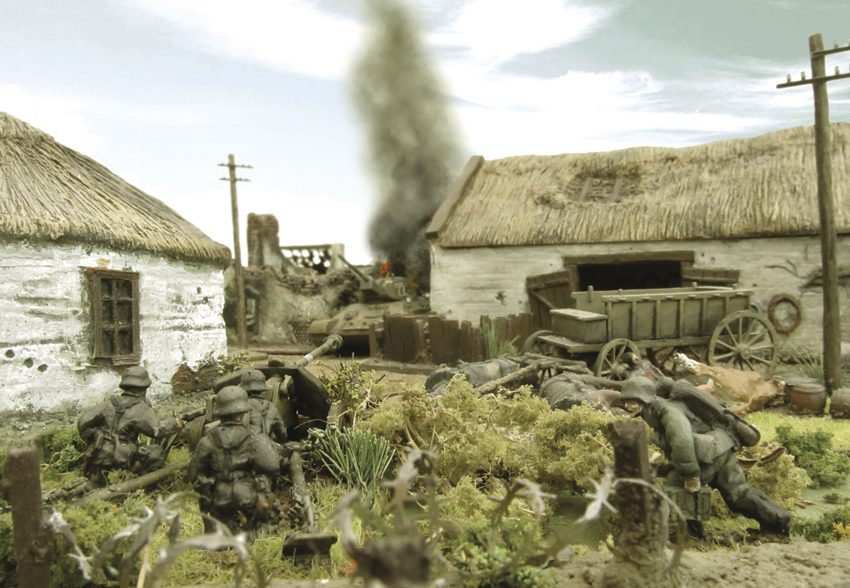
The Good – There is a lot here to like. Yes, it’s an IGOUGO system. However with the random die activation and a plethora of individual units representing a platoon, you aren’t going to be able to count on activating every model on the table during your turn. Further, the reaction orders also provide a means to make responses to your opponent’s actions making the game even more dynamic.
Pinning units matter and is an effective means to shut down your opponent. The splitting of fire modes into either suppression or trying to inflict casualties is also a nice touch via the area and aimed fire orders. Among this is the Battle Rating system. Pinned troops are effectively out of the fight. To reactivate them requires drawing a BR counter. If you let them sit pinned and they get hit by further fire, they will likely break forcing you to draw a BR counter as they are destroyed. Do you let them remained pinned and wait a few turns before opting to unpin d6 units? Or do you force your hand early and just unpin that one unit? It’s a challenging decision with slow degradation of your force’s morale, along with the unpredictability when it has had too much and will retreat, all of which makes for a fun game.
The rulebook itself is written fairly clearly and offers plenty of examples. There is a good amount of artwork and photographs to entice the reader. It’s a rather handy size and well bound. The addition of a solid quick reference sheet at the back of the book is an especially nice touch.
The Bad – The game does have its share of bookkeeping. Ammunition use for tanks is the most notable. For a tank or two this isn’t much of an issue, but running with a platoon of armor, it could bog down. I dig the concept as a means to balance out heavy hitting guns compared to the armor workhorses and also a way to mimic logistical problems, but it’s clunky. I wonder if using a d6 roll to determine if a unit was out of ammo would be better.
Another thing that crops up are past orders for opposing units. Spotting a target can also depend on whether it fired the previous turn. Get a big enough game going and it can get a little murky keeping track whether individual units fired on the previous turn or not, so you likely will need to use markers indicating given fire orders.
Some of the task resolutions require a lot of procedural die rolls. Artillery is especially damning as you need to make a fire mission request, a communications skill test, then determine how close the spotting round hits, the number of guns that are part of the strike, etc.. While all the die rolling allows for more predictable results due to probability, it can be a chore to go through.
The rules express a differing view of design also. Some parts are well detailed (like vehicle aimed fire and artillery) while other aspects of the rules are glossed over with abstract task resolution. There aren’t hard definitions of cover. Close combat is very streamlined under a general assault that takes place within 5″ of an enemy. There are some points in the rules suggesting resolution by player agreement as opposed to hard, defined rules. It just seems a bit of an odd match in how the rules are presented where some elements are highly detailed, while others are not.
The book would really be aided having an index. Some important rules are shuffled off into sidebars. It’s not incredibly difficult to find what you need, but tracking down a key rule can sometimes be a little bit of a chore. The book itself is a scaled down version of the larger campaign books. I appreciate the lower price of the rules, however the print is exceedingly small. This isn’t a comfortable font to read at all and it’s a shame a larger one wasn’t used.
The Verdict – Battlegroup is a solid WW2 miniature wargame. There are some rough spots and with larger games, bookkeeping can get to be somewhat clunky. Additionally, this isn’t the most innovate set of rules and you’ll likely be finding yourself treading over familiar game elements found in a myriad of other WW2 rules.
However it gets a lot of things right. One thing that stands out with me is the sheer unpredictability of unit activation and force morale. You can count on your plan of battle up to a point and then… well… things get interesting. It’s another game that emphasizes suppression and pinning of units. This has an important role in the game and you’ll find ordering units to cross open terrain will get either pinned to hell, ripped to shreds, or dispersing in a retreat. The utilization of cover and judicious use of ambush orders are needed.
Yes, it is a point based game. However taking a peek at some of the campaign books, it doesn’t feel like a tournament army list-of-the-month game. Battlegroup really seems to have it’s feet firmly in the historical camp. I’m certain that it’ll get some complaints on not having proper campaign TOEs, but there are far more hits than misses with the force lists.
I don’t think Battlegroup will quite replace my WW2 infantry skirmish game of choice. I need to get a few more games in, however I still feel that Bolt Action and Chain of Command both scratch that itch for me. However I wanted a ruleset I could use for 15mm and was looking for something different to Flames of War. Battlegroup does this quite well, and I totally expect it’ll be my go to rules for WW2 company action in the future. If folks are interested, an excellent overview of the rules as an intro report can be found in a list of PDF download links.
Review: Among the Stars
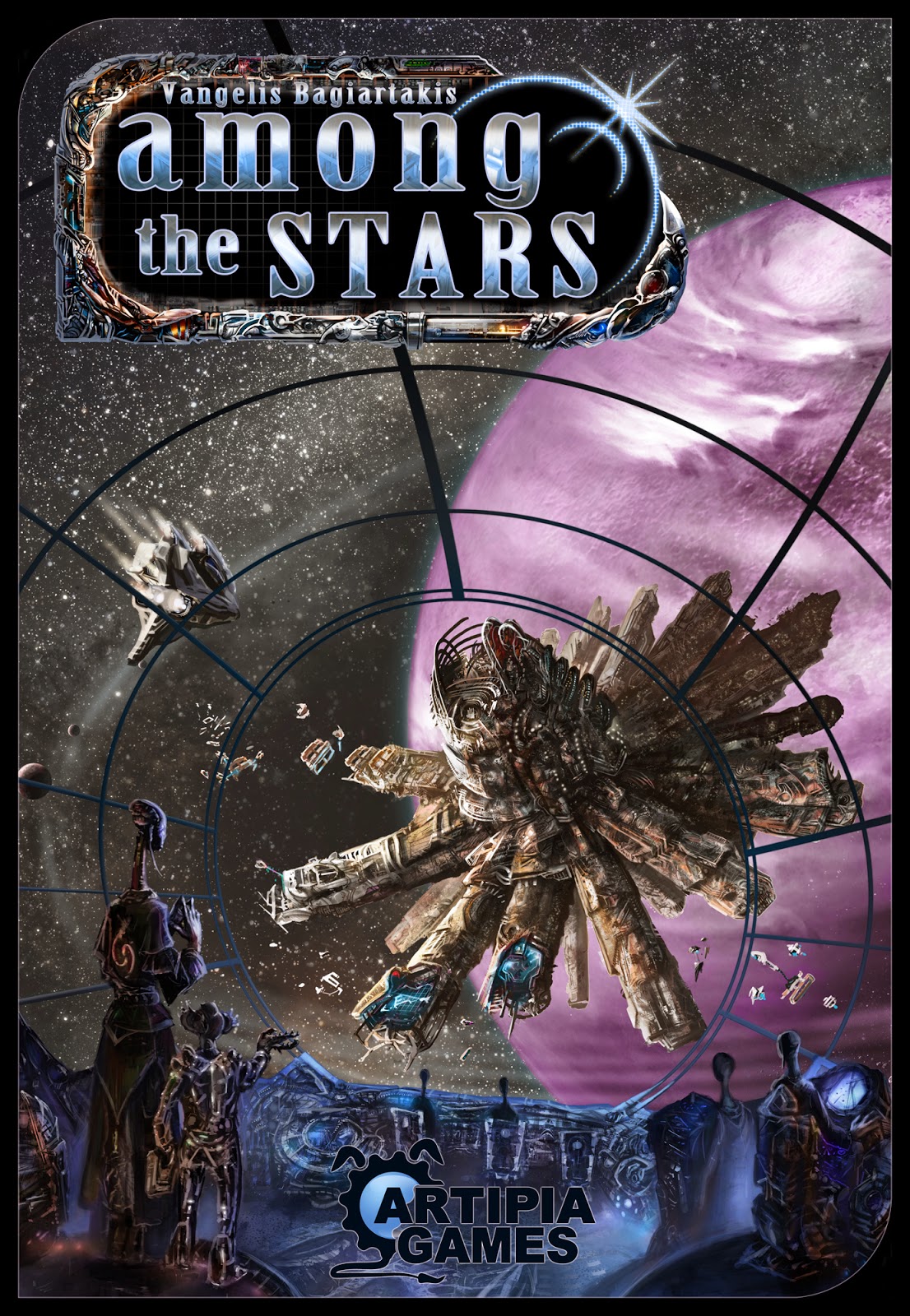 From Artipia Games (and also distributed by Stronghold Games) Among the Stars is a 2-4 player game. The players represent different alien races trying to build the most impressive space station, garnering intergalactic influence at the end of 4 years. As they build onto their space station, added locations award more victory points and the player at the end of 4 years with the most points win.
Among the Stars is a drafting game. Players get an initial hand of 6 cards. They select one and pass the remaining to either the player to the right or left (each game year the direction shifts). Then they play the card, adding it to their space station.
Cards must be placed orthogonally to existing locations (i.e. not diagonally) and are only considered adjacent to those cards. Players must pay for location cards with credits. Additionally some locations require power. So there must be a power plant within two locations and can provide enough energy to build that new section. Each card represents one of six location types (diplomatic, recreation, administration, etc.).
Once built the location typically awards victory points. Some cards have further victory point bonuses if certain conditions are met at the end of the game, such as extra points for each similar card in the station, additional points for being near other location types, the furthest away from the main reactor, etc. This provides interesting play having to account for the spatial layout of your station as you try to get the most points.
Every year you gain credits, however as an action you can discard a card and gain credits instead of adding it to their station. Or if wanting another power reactor, they discard their selected card, paying for a power reactor and placing it within their station.
The reactors themselves provide a limited resource of power. Each reactor has 2 energy cubes. These cubes are discarded when certain locations are added to the station. Further, they can only power locations that are up to two adjacent spots away (remember, a diagonal direction does not count). As many cards that require energy usually provide a good amount of points, it can be a challenge figuring out the optimal layout to provide enough power for expanding your station.
 Players continue selecting and playing one card, while passing the rest, until all the cards in players’ hands are played (or discarded for credits or power stations). Then a new year begins and the process is repeated until 4 years are completed.
Among the Stars at its core is a fun game. However there are other game elements which add a lot to the gameplay. Players can randomly select a starting race. Each race has a unique power, providing some special ability they can use during the game. There are also random objective cards equal to the number of players which provide bonus victory points if completed. Being placed face up during setup, each player can look them over and decide if they want to focus on a particular goal to earn those objective cards during the game.
Lastly, there are optional conflict cards which provide an additional type of player turn action. These cards typically award victory points if you have more particular location types within your station compared to another player. At the same time your opponent will also lose points equal to those that you gain. It’s a little way to add some back and forth tension mucking up another player’s victory point totals.
In all, it’s an enjoyable game. The slight hiccup is the two player version which requires dummy hands, but it manages to capture that feel of potentially having key cards drafted from other players. This point is what makes the game. You likely will only be able to get one additional card from the hand you are first dealt. Deciding which is the best draw can be a challenge. You really don’t get a feel for the other cards out there until about halfway into the round, making that decision to focus on a particular location type for your space station early in the game risky (but can be immensely rewarding).
The Good – Among the Stars comes with a lot of parts to the base game. The different player races and objectives offer a some variety, in addition to the location cards. This provides a little randomization in the game that goes beyond the deck of location cards, giving some differing play for each game. There aren’t a lot of rules to burden new players, but it certainly provides a lot opportunities to explore different strategies.
The components are done well with cards having a nice, thick backing. The counters are good cardstock and the energy markers represented as clear cubes are a nice touch. The design of the cards can be a little cluttered when figuring out setup (certain cards are added or dropped depending on the number of players), however for actual play they are easy to read and decipher. The artwork is pleasant and certainly helps capture the theme of adding sections onto a space station.
The Bad – It’s a drafting game and by design it will be difficult to plan too far ahead for future turns, which can be a little frustrating. You start each year with a 6 card deck, so you can only expect to use one other card by the end of that year. You only have 2-3 turns to potentially see what cards you might end up with later. In effect, it’s somewhat of a puzzle game where you simply make the best play you can with a new hand each turn.
Also even though some cards are labeled as conflict cards, you really don’t have much player interaction other than using (or discarding) a card that another player might have wanted. So you can slip into this mindset of just building up your station and ignore everyone else. Put simply, this might not be the most enjoyable game if you are looking for more a back-and-forth play experience.
The two player version is a little lackluster also, relying on dummy hands with your opponent likely discarding cards you’d want to use. If players alternated placing a single card for a dummy station using some simple automatic placement rules, it might be more enjoyable. That way you have to try to also beat a third point total and worry about another station layout, other than just your opponent.
Card resolution is done simultaneously and sometimes this can put a kink in the flow of the game for certain cards. Although there are rules to determine a player order in these cases, it can be a little clunky to resolve.
The Verdict – Among the Stars is solid. As a drafting mechanism type game, it’s especially enjoyable. The play is very streamlined and easy to grasp. Yet there are challenging choices you have to make. While scoring points is paramount, you also have to keep an eye on what your opponents are doing. Sometimes it might mean forgoing adding a juicy location and simply discarding a location for credits, as that same card would bring a ton of points to your opponent.
Another key thing that stands out is the variety of game options. You have the option of playing with and without races, objectives, or conflict cards. You can choose to keep a limit on station size layout and even another small variant for the 2 player game is offered. Along with this you get 8 different races and objectives. And on top of everything are the differing station locations and types, with a plethora of card combos that you can explore. All of these aspects contribute to giving the game some legs with play longevity.
Among the Stars is a great game. The drafting mechanic offers a slight tweak to the myriad of deck building games out there. And it also really captures the theme well of slowly constructing a sprawling space station. With nice components, a low entry bar to learning the rules, and solid gameplay, it’s certainly one to add to your game collection.
Cigar Box battle mats review
Ever on the quest to find some cool gaming mats I stumbled across Cigar Box Battle Mats and had to pick a few up. A while back I had gotten some Hotz mats for my Bolt Action and Firestorm Armada games. The star field mat was okay while the green mat was a little lackluster. Further, they were treated felt. The surface looked like it could handle pilling but it was stiff and kept wrinkles if folded up.
The battle mats from Cigar Box are made out of a thin fleece material. It’s very supple and has a sheen surface that will not snag on miniature bases. Most come in 4′ x 6′ with a few mats measuring 36″ x 36″. You can machine wash the mats and the surface appears to be screen printed making it look pretty resistant to your normal wear and tear.
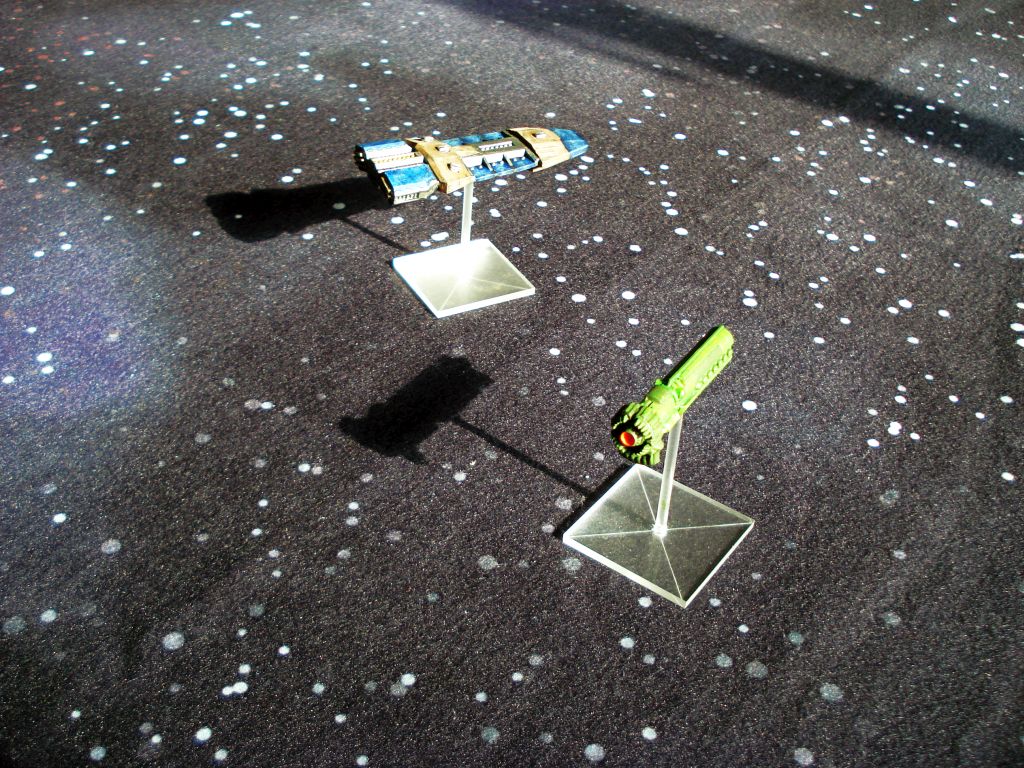
The star field mat is very muted, but has a nice generic look. All of which allows you to plop down whatever terrain you have and not look too out of place clashing with something printed on the mat itself.


The generic grass field has a nice textured look to it. As the material is so yielding, you can put hills under the mat. This is something I found an issue with the Hotz mats as the treated felt was rather stiff. For a basic open field, the Cigar Box mat looks good with just a little contrast to break up the entire surface.



Digging through the store, there are also more elaborate patterns which can highlight roads, fields, and forests. A few even are set up to portray classic civil war battles, but could work for different historical engagements too. There is a pretty impressive variety and fortunately some generic mats are also available.
I think one ding to the mats would be that you’d have to double up if needing a 4′ X 8′ mat as the size options are limited. The mats are also ideal for free miniature movement as there are no hex or grid options.
The service was quick and I got my order via international air mail about a week after it was shipped. They were also very quick to respond to any queries via email. I highly recommend these mats. They are durable, provide a good gaming surface, and look great. Well worth picking them up for your games.

 Geek Ken