Category: Review
Savage Space – A fan made Savage Worlds sci-fi supplement
A while back I covered a Borderlands-inspired setting for Savage Worlds. I wanted to take some time and bring attention to another wonderful fan-made sci-fi supplement, Savage Space. Folks that follow my blog might recall that I considered running Traveller for one of my games. I ended up using Savage Worlds making my own conversion rules but much of the game I lifted stuff from Marcus “Chaosmeister” Burggraf’s amazing sci-fi companion.
I feel dirty using it, as it’s such a great space opera set of rules. I am a huge fan of settings that don’t go hog wild with edges and skills, and instead just add a dollop to the base rules. Savage Worlds is flexible that can fit a lot of genres. So settings that embrace that and amend what is necessary is appreciated.
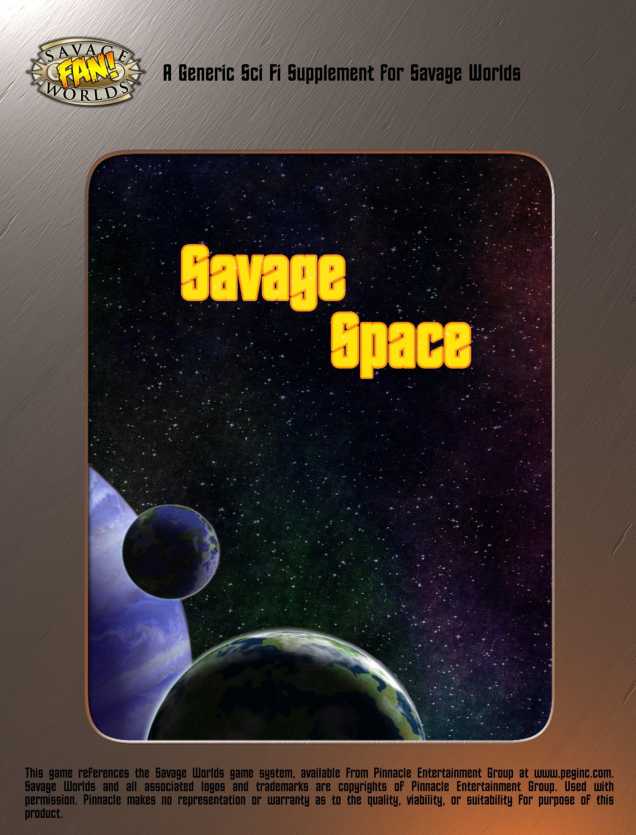 You get a surprisingly thorough treatment of sci-fi rules with Savage Space. There are a few select knowledge skills. There is a replacement of climbing and swimming with an all encompassing athletics skill, which is something I’ve sort of adopted for my other games as well. Alien creation rules are missing primarily as much of this is covered in the regular rules with racial backgrounds. Cyberware however is something that is covered a bit more, primarily as it can be acquired as equipment of sorts replacing natural limbs with cybernetic ones.
I like the approach done with starships, making them have characteristics like characters. Ship to ship combat is covered more of a general outline in the rules. I think the author admitted these are a little limited in scope, but they provide a good basis for a system. You might need to work a bit more to fit it into your game however in practice (or lift rules from another setting or game). One tremendously useful part of the rules is an adventure generator, providing seeds for some classic space opera missions as well as some more scoundrel, mercenary-type tasks.
It’s not a complete sci-fi setting, as there are no rules for creating systems or planets. However that’s something that can be lifted easily from other game systems. The equipment section is rather complete having a lot of your typical gear and equipment that aspiring star travelers would have for their adventures. As expected there are a variety of weapons with differing technology levels, as well as more mundane and exotic technological gear.
It really is a wonderful set of rules for running a classic space opera game. It may not be a complete setting with a larger campaign detailed out for the universe, but it does have some great bits that can be lifted out and plopped into your own hacked sci-fi campaign. The setting background they provide is brief and paper thin. However the theme of the companion rules is for a generic space opera, so not having a detailed universe setting is expected. Savage Space is a great fan-made set of rules for Savage Worlds, check it out if wanting to run a sci-fi game.
Review: Tank War
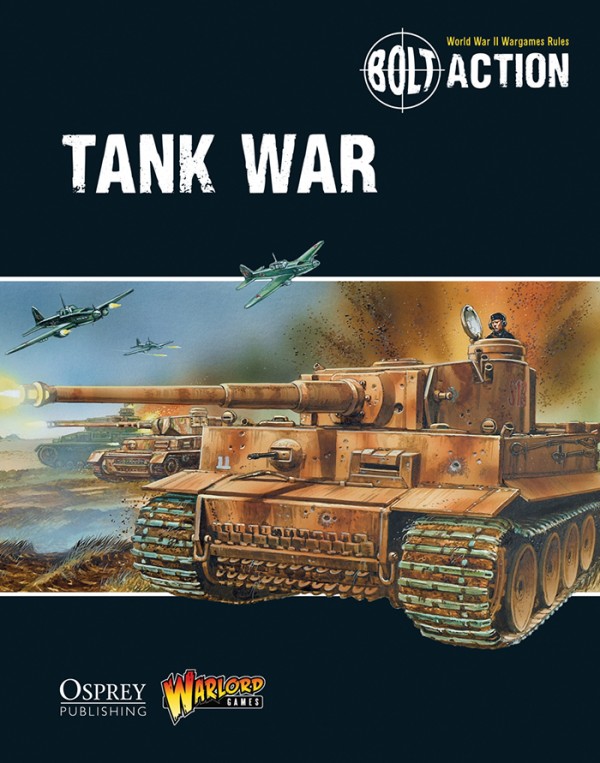
I’ve had my mitts now on the new Bolt Action supplement, Tank War, for a while now. For those living under a rock in the Bolt Action arena, Warlord Games has introduced an all armor supplement rulebook. The big bombshell was that this book would not just be alternate rules for players to dabble in armor, but rather a completely new way to field armor platoons in the game. It was meant as a rulebook to allow infantry to face off against tanks, opening up a lot of different tournament options.
The rule section itself is paper thin, with the core rules only being a few pages. A large section details the structure of the platoon and the requirement of a command tank. Further, there is a new rule where if all the tanks in the platoon are on the same chassis (EX they are all PzKpwf IV’s, even if there are variants among the platoon), then the command distance is increased to 12″. Some armies are still limited to 6″ due to lack of radios. But overall it seems a means to encourage players adopting a more uniform platoon makeup, rather than selecting all manner of armored options to build their force.
In addition, the new pin rules are now in print. Making their way from a recent FAQ, there are rules limiting what can actually pin a vehicle now. Rather than any heavy weapon being able to throw pins out, now you actually have to use a weapon that can potentially penetrate the armor.
Morale of the tank is a huge factor also. Inexperienced troops work as the original rules (any heavy weapon gives them a pin) while veteran tanks use the new rule. Regulars roll a die to see if they act as a veteran or inexperienced when they are hit. I dig the idea that there is an advantage to taking veteran troops, however I wish the probability for regulars was skewed some. I’d prefer on a 3+ they act as veterans instead of a 4+. As written it’s sort of a coin flip. I do feel sorry for all those US players that kitted out 50 cals on their transports, as the value of them throwing out pins on tanks is lessened.
Tank War also introduces an optional set of rules for crew experience. As crews survive they slowly accrue experience which can be used to purchase skills. Broadly they break down into command, driving, and gunnery skills. These give a one shot bonus to the player over the game. They also improve the morale of the tank unit, as all tanks start out as inexperienced crew and morale increases as they gain experience. It’s different and allows for players to explore a campaign game where troops improve over time. There are some point values that can be used instead for legendary crews if players want to dabble in fielding a tank ace on the table.
There is a new scenario that is armor-centric for the game, relying on players capturing 1-6 random objectives. Like your typical scenario, to claim an objective you must spend an entire turn within 6 inches of it and be clear of any enemy. However players can claim objectives and roll off it, allowing them to be recaptured on later turns. So having a mobile force claim objectives quickly (while contesting others later) can be a strategy.
The book also highlights a more fun scenario where players duke it out in a massive tank battle. The authors make no bones about it, this clearly goes into the imaginary battle category of historical wargaming. But I enjoy that they are opting to throw some more fun and frivolous type scenarios into an official book. Not to delve completely in the world of ‘what ifs’, there is also a rather lengthy section on theater specific lists and historical battles.
The Good – It’s a nice addition to the Bolt Action family. It doesn’t throw down a ton of new rules to make for an entirely new game. What really makes Tank War for me is the different theater specific lists and battlefields. There are a wide variety of WWII theaters and operations covered in the book, each with relatively historically accurate force composition rules, as well as some special table rules (terrain, air support, armor platoon command limitations, etc.). These certainly make for Bolt Action to adopt a more historical feel over your typical battle scenarios.
The artwork is classic Osprey publishing stuff with some nice model pics. There is also quite a bit of historical flavor for jargon and terms used by tankers at the time which is a nice touch.
The Bad – There aren’t any rules for mechanized infantry. You can certainly get some infantry squads in your armored platoon lists, however it’s squarely on the 3 tank foundation, with a smattering of other choices. I am a little disappointed that transports weren’t revisited, especially the rules regarding firing their mounted armaments. I was certainly hoping for a strong mechanized infantry list, with rules to support allowing transports to actually fire all those MGs. No dice. Which is sort of a shame.
There aren’t more tank-centric scenarios. The theater specific stuff is nice, but more tourney scenarios would be great. There is a lot of optional stuff in here which is good, but some like the legendary crews can border on being too gamey (and might lead to cheese lists).
The verdict – So is Tank War worth picking up? If you are looking to add a little chocolate sprinkles to your vanilla Bolt Action game, it’s a good buy. If you have been drooling over fielding a platoon of tanks, it’s certainly worth picking up. The optional crew experience rules can make for some fun engagements and allow players to explore a campaign game. The theater specific lists particularly stand out for me as a pleasant addition.
However, the actual core rules for armored platoons are rather thin. It could have been easily offered as a free PDF for players wanting to try them out. If you have no desire to play an armored platoon this is certainly a rulebook to pass on. There is a lot of interesting material inside but not a must have and certainly doesn’t need to be considered a core Bolt Action rulebook.
Review: A Touch of Evil
 To get into the spirit of Halloween I’ve been wanting a horror-themed board game for a while now, something that would capture that feeling of investigation some and have monsters to face off against. I’m a fan of the Lovecraft mythos but the games I’ve seen and played never really captured that feeling well. And face it, trying to get the essence of a person losing their sanity facing incomprehensible horrors isn’t really something that translates into a game mechanism easily.
Digging around I decided to pick up A Touch of Evil from Flying Frog. It’s a game that can handle up to 8 players with a variety of play modes from a winner take all, working in teams, cooperative, to even a solo game. Overall it’a something that seems to scratch the itch of a horror game for me.
Players are monster hunters in the 18th century, trying to rid a colonial town of a terrible supernatural threat. They can choose 1 of 8 characters each with varying characteristics among cunning, spirit, and combat abilities. Additionally, each has a special ability that allows them to bend the rules some. Checks and combat are a simple matter of rolling a number of dice and counting 5 and 6s as successes.
The players face off against one of four creatures, being either a werewolf, vampire, a locust-summoning scarecrow, or a spectral (headless) horseman. Each monster has unique minions and other game effects that can hamper the heroes. Some are rather interesting like the werewolf that can pass on its curse to other players or the spectral horseman that runs to town attacking all in his way, to more basic abilities that just increase their combat proficiency.
The player’s turn is broken down into 2 steps. They roll a die and move that number of spaces. If there is a monster in a space, they must fight to defeat it (or run away if they survive the initial attack). Afterwards the player has several options from investigating an area to hopefully find a powerful artifact, gather up clues, heal, or attempt to gain equipment within the village proper. All currency in the game is based off of investigation tokens. Players gain them by traveling around the woods outside the town or by beating villain minions. As a nice rule, if a player flubs and rolls a 1 for movement, they gain an events card to offset the low roll.
When players have enough allies and items, they can try and beat the monster in a showdown. They attempt to track the creature down to its lair and begin an epic fight trying to whittle down the creature’s wounds and survive. If they fail they are knocked out, returning to the center of town next turn minus some resources.
After each player has a turn, the monster gets to play a mystery card. This may initiate an event like adding one of its minions to the board, or it will undertake a special attack. Additionally the monster may be able to move the shadow track. This is a countdown of sorts. When it reaches zero everyone loses. Additionally the shadow track dictates the investigation cost to find the creature’s lair. Earlier in the game, it’s more expensive while the cost to investigate the lair decreases as the shadow track approaches 0.
 For the most part, that is the game. Players try to move around the board and successfully employ their skills with tests of cunning and spirit, or fighting lesser monsters at certain locations. They slowly accumulate special items, or buy equipment in town, gathering up allies until they feel they are powerful enough to fight the main villain. The tweak to this is the village elders.
The game starts with 6 village elders. Players can enlist up to 2 of them to help in the final battle with the monster. Most are immensely helpful, improving the combat abilities of the hero. More importantly, they can also soak up hits. The player has to be careful though as if the village elder is killed, the shadow track will move down. This isn’t as clear cut a choice selecting the village elders however. Each elder has a randomly assigned secret, some are beneficial or don’t significantly alter their abilities, however about a third of the secrets hides that the elders are actually evil. Pick the wrong one and you can suddenly find the monster has another minion in the fight.
To ensure you aren’t selecting an evil village elder, players can pay investigation to see where their heart lies. This information is useful, as opposing players can call out evil village elders during a showdown, allowing them to join the monster in the final battle. This entire portion of the game really makes it for me. You want to spend the time investigating the town elders to seek out potential allies, or find out which ones are best to turn on other player’s if needed.
The Good – What stands out are the variety of play modes for the game. You can play it as a coop (or solo), working as teams, or everyone out for themselves and this variety adds a lot of replay value to the game. It’s a fun experience gathering up resources to fight the monster. Additionally the shadow track an effective clock on ending the game which helps ramp up the tension. When village elders die, not only are the players potentially losing an ally but the shadow track drops down, ever closer to zero. This helps capture that feeling impending doom for the players and pushes them to act quickly.
The components are top notch. The cards are thick and coated in plastic. The counters are made of nice cardstock. There are several well sculpted plastic figures to represent the hero pawns, even an audio track CD is included in the game. The board has an antique map look to the layout of the village and surrounding areas. The card art is done rather differently using actual photographs of costumed characters. There are more hits than misses with the depicted photos and it portrays the gothic horror theme fair enough.
The Bad – The game is roll and move. Even with the event card bonus rule added for rolls of 1, it can be frustrating at times not getting to the location needed due to poor die rolls. The combat and task resolution is a little simplistic, where you simply want to roll as many dice as possible to get more successes. Games with high number of players when not working as teams can drag sometimes. And while there are plenty of heroes to try out, there are a limited number of villains which may not provide enough variety in how they interact with the rest of the game. Additionally the art overall is alright, yet some might find particular cards lackluster as the photographs can be a little campy.
The Verdict – A Touch of Evil is an enjoyable game. What really stands out are the variety of play styles, from a standard coop to a free-for-all where everyone tries to be the hero and take down the monster themselves. I feel what works best for the game is the competitive team mode. For me it captures that feeling of an old 60s-70s Hammer film in a colonial setting. The potentially twisted village elders, the snooping around particular locations, the slow accumulation of equipment and allies until you can have the final big fight against the creature, it all works well as a horror game and is great fun. If you’re looking for a horror board game that isn’t quite stuck in the Cthulhu-theme rut, this is a great one to pick up.
Coventry – A fan-made Savage Worlds Setting
Continually I do see some discussion or a person pondering writing up a fan-made setting, when someone will aptly point out there are already some excellent ones available. As someone mentioned over in the G+ Savage Worlds community there seems to be a lack of reviews and/or awareness that these great fan-made settings are out in the wild. I could mention some great sites that culminate a lot of different fan-made Savage Worlds content. However I think it worthwhile to spend a little time highlighting some particularly good ones that folks have written up.
Borderlands is a popular video game and quite frequently I see in my blog and social feeds about some wanting to visit that as a setting, and continually I point to John Robey’s Coventry. It’s a fantastic job at taking a stab at the Borderlands setting all the while adding some more flavor to make it stand apart.
In a nutshell, Coventry is a planet rich in a resource commonly referred to as Indigo. It’s an immense power source that is exceedingly rare and seems to be abundant on the quarantined world of Coventry. The planet is spoils of a sprawling interstellar war where a terran corporation, Indicorp, took control of the planet. Control is a very loose word though, as their presence is maintained only as large ships and satellite bases in high orbit over the planet.

Coventry has become a prison planet. It is typically a one way trip. Players might be able to garner enough favor with Indicorp to gain a pardon, but most enter into a 25 year contract of indentured servitude. Not all the human residents maintain an allegiance with Indicorp, and there are a few independent settlements on the planet. Unfortunately, they are stuck there as any attempts to launch a craft are thwarted by the defense net of Indicorp in high orbit. It’s like a space version Escape from New York and I love it.
Add to that weirdness, humans were not the only races that settled on Coventry. Rakashan (cat-like predator species) and Avion (winged humanoid lizard beings) also were early colonists that ended up being stuck on Coventry due to the war. Most have adopted to life on the planet and have decent relations to humans provided they keep to their borders, but among each other things are rather strained (seems Rakashan find Avions rather delicious). Add to this eccentric mix the mysterious fungal Mi-Go. The Mi-Go are truly space-traveling aliens modeled after the Cthulhu mythos. They are otherworldly and have their own unknown purpose and agendas.
Players can select any of these races, along with sentient robots, and all are fleshed out rather well. To jump start the character generation process, there are several pre-made archetypes that model the Borderlands characters, as well as incorporate some of the new races.
Like the video game, guns and gear are significant part of the setting. There are a few options for weapons and included are various types of ammunition for each, allowing for a lot of fun tricking out of firearms. Another interesting bit of protective equipment are personal shields.
These shields add a die type to your toughness and each hit reduces the shield defense by one step. Every turn the shield will recharge up a step to it’s maximum defense die. So you’ve got this constant yo-yo defensive boon that ebbs and flows as players are hit. Given that the standard damage for most firearms are 2d8, the PCs need some sort of protection as the game can be rather lethal. It’s a very clever system that matches the Borderlands gameplay pretty well.

Another key part of the game is transmat technology. This is a type of teleporter technology with a wrinkle, an object can be stored as digital data and retrieved remotely. This has led to GotJFree tech. Basically players can have a unit that monitors their lifesigns and upon termination, can store the user’s biological data for a limited time until it is derezzed later. In effect it’s a limited type of immortality (provided the GotJFree unit isn’t vaporized along with its wearer). Different types of units allow for longer storage times, as well as automatic pattern data transmission to central locations. I love it. It’s like a respawn system.
Some people might be put off by the shields and derezz technology, trivializing the lethality of the game. I actually feel that is part of the charm of the setting. It encourages a lot of balls-out crazy behavior as aside from bennies, players have a lot of means to effectively get a do-over. And this works, as the world itself is supposed to be a bit mad. Indigo warps the wildlife, the landscape, and people that are around it too long tend to go a little bonkers.
Some more comments about the setting rules, they are presented in a colorful manner and are professionally done. There are well-written tables, a broad atlas of the world, along with an index of lingo and terminology. What I particularly like is there aren’t tons and tons of new rules, edges, and hindrances. It’s all done very sparingly but at the same time offers something new. Coventry offers a fresh setting, with a wonderful take on the Borderlands world. Give it a try and at the very least, give it a look. There is a lot of interesting ideas and material that can be mined for your own game.
Review: Saboteur

For 3-10 players, Saboteur is a light card game that is part deception and part strategy. Players are dwarves seeking to mine a path to gold treasure. Unknown among the players is that some of them might actually be saboteurs, seeking to thwart the entire operation and keep the gold for themselves.
The game goes through 3 rounds, with the player having the most gold at the end being declared the winner. At the beginning of each round every player receives a role card indicating if they are a simple dwarven miner or a saboteur. An entrance card is put in play a defined distance from three face down goal cards which are randomly placed. Two of the goal cards lead to a lump of worthless ore, while one card is the gold treasure.
During a player’s turn they have the option of placing a card connecting the current paths, discarding a card, or to play an action card. Afterwards they draw one card. The action cards either hinder another player like breaking a mine cart or smashing a pick, or they repair that specific item. If a player has broken equipment cards in front of them, they can’t play any cards (except action cards to repair any broken cards on them). There are even map cards which allow the player to secretly see which of the 3 end goal cards is actually the treasure.
When a path leads to the treasure, special treasure cards equal to the number of players are drawn from a deck. Starting with the player that reached the treasure, they get their choice of treasure cards which have a varying number of gold nuggets. It’s entirely possible that some players will get more treasure cards than other fellow mining dwarves. If all the cards are exhausted and/or a legal path cannot be made to the treasure, each saboteur gets a set number of gold nuggets as treasure while the miners getting nothing. The role cards are shuffled and new cards are dealt to each player for the next round.

The game becomes a fun game of deception. You try to see which opponent might be throwing a wrench into the miner’s plans. If they feel someone is a saboteur, they can try to lock them out breaking their equipment. As a saboteur, you want to try and be subtle with subverting the path away from the treasure.
Not everything is a cooperative effort for the miners though. The player that reaches the treasure first gets their first choice of gold cards. The cards are an unequal distribution of 1 to 3 gold nuggets. Also if any players are saboteurs, the miner that gets to the treasure first will get an extra gold nugget card. So there is a big incentive to try and get to the treasure first (as you’ll likely get more victory points). This might even mean trying to stop other miners so you are the one successfully establishing a path on your turn.
The Good – This is a fun light game with a fair amount of strategy. The rules are very simple and easy to pick up. The game also plays rather quickly taking only 20-30 minutes. The cards are of sturdy stock and the illustrations are pleasant, colorful, playful depictions of dwarves and their mining equipment.
The Bad – While it’s simplicity has some charm, it can be somewhat of a repetitive game. You can get an very bad streak of drawn cards where it’s practically impossible to remove broken equipment played on you. This can be somewhat frustrating. If you are the lone saboteur (which is possible in a lower player count game) and are figured the likely traitor early in the game, it can be disheartening as everyone else keeps dumping broken equipment cards on you preventing you from doing anything.
The Verdict – Saboteur is an enjoyable light game, also a few things really add to the play experience. The role cards used will have one extra card over the total number of players. It’s entirely possible in a lower player count game to have no saboteurs, yet no one will know this until the end of the round. Also, having 3 rounds with new role cards given out at the beginning of each one means a player might not be stuck in a particular role for the entire game.
One really nice twist is that even though all the miners share the glory when a path reaches the treasure goal, the cards are not distributed equally and have different values. So while you do want to be sure and get to the gold with your fellow miners, you certainly don’t share the rewards evenly. This little twist adds some complexity in determining who the saboteurs are. If a player prevents another from reaching the treasure, are they a traitor or are they just a greedy miner trying to reach the gold first?
With a small box, light rules, and being able to accommodate up to 10 people, Saboteur makes for a fun evening. It’s a great filler game and a wonderful way to cap off a night of heavy board games, or make for an enjoyable hour or so by itself.
[Note: There is a slight variation I like using when there are potentially more than one saboteur (5-10 people). Like the Resistance, I add one extra step after the role cards are given out. Everyone closes their eyes and one person announces that the saboteurs open their eyes and find out who else might be a saboteur for that round. Everyone is then instructed to close their eyes again and open them all at once, with the game starting as normal. It can be difficult for the saboteurs to win a round unless they can somewhat work together. This little extra step allows for the saboteurs to strengthen their position when they bluff to the other miner players.]
Review: Broken Earth – a Savage Worlds adventure setting
 I sort of lean away from a lot of official Savage World adventure settings and stick with the companion books instead. While having material for a particular setting is great, usually the official settings are a bit much. I completely dig the idea that they take your typical genre and give it a hearty turn. So a setting like Necessary Evil isn’t just with superheroes, but has the PCs playing villains which are trying to fight against an alien invasion of Earth. The official campaign settings are fun twists of your typical genre, but I lean a little more vanilla for my world settings.
A favorite post-apocalypse setting out there for Savage Worlds is, “The Day After Ragnarok.” However it’s got some odd bits dealing with an aftermath closer to the end of WWII. It’s almost a bizarre alternate history setting rather than a futuristic post-apocalyptic one. Likewise, I could always mine Gamma World for stuff, but at times it’s a little too gonzo.
Enter Broken Earth from Sneak Attack Press. This SW campaign setting is a tad more muted with content compared to your typical Gamma World-type game. While it deals with trying to survive in a world altered after a nuclear war, it’s more aligned with the classic, Aftermath! RPG.
Think more along the lines of the Road Warrior and Book of Eli as a setting vibe. That’s not to go without saying mutations aren’t options in the game. They are there, along with more fantastic mutated creatures, but it’s toned down some. The campaign setting is within the northern midwest spilling a little into former Canada. However the major factions and locations could easily be plopped into any other location with little alteration.
Players have a few options for races aside from your typical human. They range from tough irradiated freaks, to non-tech but intelligent ape-beings. Androids and psychic mutants are also an option. Overall the races have small edges balanced with a few hindrances, but nothing is too extensive making me more inclined to include them in a game even if they are a little out there.
As for special backgrounds, mutants, super science, a variety of psychic disciplines, as well as a special alchemist type which make super drugs (akin to the stuff you’d find in a Fallout video game) are all possibilities. It’s a way of giving the game trappings of a stranger theme but not too over-the-top and you’ll find many of the mutation edges conferring small bonuses. A nice turnaround with this are hindrances that can also be related to mutations, so not everything has to give you superpowers.
There are not a lot of additional rules for the setting which is something I like. There’s some details on races and a handful of edges and hindrances. The arcane background types have a few options, but nothing overbearing. Gear and loot have an additional characteristic based on rarity. While lasers and futuristic weapons are given stats, they are exceedingly rare, as are conventional firearms. So by default rules players will likely be pressed to ever get their hands on one (and as such ‘mundane’ items would make for great rewards).
There are some interesting rules regarding communities. They are given basic characteristics along with edges. It’s a concept continually reinforced that players should have strong ties to certain communities, and that these communities can change over time. It’s a simple set of rules that really give life to the world and allow for each location to stand out more than being just a list of characteristics.
On the GM side of things you have a detailed location with several different communities and various NPC wild-cards. The players have an option of aligning themselves with 3 main political groups. One is a nomadic tribe of hunters and gatherers, another is a tech-loving survival group that has been locked away in an underground complex for decades, and the last is a free-wheeling merchant group that maintains its status by being the main trader for various communities.
The factions are interesting. Each one has room for PCs to grow, and include options for forcing them out into the world. Best of all, every faction has faults. The Iron Shelter group are tech-driven survivalists, but they could also be seen a xenophobic community fearing change and perfectly willing to stay hunkered down in their rigid, controlled society. The Wright family head up an immensely successful group of people that thrive on mutual trade, but only those in the extended Wright family really benefit while others in their community live in squalor. It’s these flaws that help inject some gray into what might be considered a black and white world.
There are other factions for the GM to play around with. Most notable is the Green Empire, being formally a small community of ecological protectors, that have slowly morphed into a slavery driven empire powered by biodiesel-fueled vehicles. The initial plot point adventure has the players facing off against representatives from this group. There is an additional plot point campaign more epic in scale, where players initially aid and fight against various sentient AI supercomputers. This plot point campaign involves PCs traveling and exploring lost technical complexes and facing off against robotic sentries. It very much has a Gamma World vibe.
These aren’t the only seeds for adventures, with plenty of smaller adventure plots also included in the book. Along with an extensive list of important NPCs for particular locales, a slim bestiary, and oodles of random encounter charts, there are a lot of tools here for your game. It’s a well put together setting with enough parts for a GM to take a kitchen sink approach, taking everything between the covers, to trimming some options and still having enough to make the setting stand out.
The Good – It’s a great post-apocalypse setting. There are enough rules and detail to give the world some flavor, but not be burdened down by a slog of new material. The setting itself takes an idea of a world about 20-30 years in the future that suddenly ends due to a cataclysmic nuclear war, and then adds another 80 years of recovery to the current day. So it allows some wiggle room for the fantastic with high-tech gadgets, but at the same time have many backdrop trappings of the world now. There are a lot of tables, NPCs, and information on locales and the various factions within them to give the GM plenty of material to easily run a game.
The hardback book is good thick stock with most of the art evocative of the theme. There is an index along with a table of contents which is always a plus. The pages are simple black and white with a comfortable font for reading.
The Bad – One big gripe I have are the maps. The hex scale is nice and the labels are clear, however it still requires a legend. I really wish a more general map with named locations was provided. The book clearly designed to go hand in hand with the SW core rules, yet having some more tables and details on environmental hazards would have been nice. The page stock is a tad thin, and some of the text is rather close to the binding. I wish they were a little more generous with the margin spacing.
The Verdict –Broken Earth is very much a niche campaign book. It isn’t quite a wild-weird setting that something like Gamma World would cover. It doesn’t have room for you to make up tons of bizarre mutants and lots of wild sci-fi tech. It does however provide a little more grounded post-apocalypse world. There is certainly some freedom in the setting to incorporate weird stuff. While the setting has androids, mutants, and psychics, all being a little fantastical, it’s still much closer to a world like a Canticle for Leibowitz, Aftermath!, or Twilight 2000. I think the Fallout video game series captures it the best. It’s a post-apocalyptic setting that is a little off-kilter from a ‘realistic’ world like the Road Warrior.
There are a couple of things I really like about the book. There are some new rules, edges, hindrances, but not so much so that it becomes an entirely different game. It really embraces the adventure setting philosophy of supplementing the Savage Worlds rulebook, not replacing it. The game has a lot of tools to help a GM run the game. There are lots of random encounter charts, random loot, and a ton of typical extras and wildcard NPC personalities.
Finally, does Broken Earth provide enough material to easily run a post-apocalypse game? That is a resounding yes. There are enough NPCs, critters, and detailed locations to seed a lot of adventures. Even better is that there are plenty of campaign plot points to tell a grander adventure (with plenty of opportunities to run a smaller games too). This is very much a pick up and play campaign setting and it’s all enclosed in a single book. If you wanted to take a stab at running a post-apocalyptic game using Savage Worlds, where players carefully explore dangerous ruins with a pitted, rusty metal spear in one hand and a prized, weathered, laser pistol in the other, this book will fit the bill.
Review: 5150 – Star Army
Two hour wargames has a slew of settings using their Chain Reaction rules (which are available free). Their sci-fi ruleset is 5150: Star Army which is designed for a variety of scales but works for best for 15-28 mm. Now Chain Reaction has been out a while now and this is not the first iteration of their sci-fi rules. Their latest version, which came out in 2011, shows that as it seems much more polished and refined as a dedicated ruleset of military style engagements.
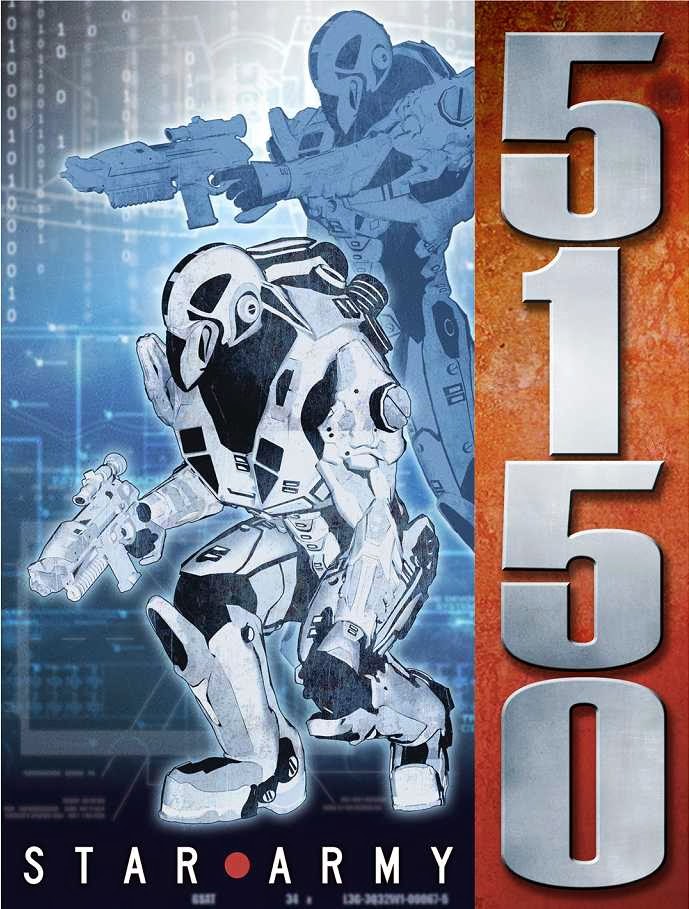
The game is designed to handle small squad engagements up to a company in size. More rapid games usually run about a platoon size with some armor assets. It truly is a skirmish game however, with individual models taking actions and isn’t necessarily abstracted out to the squad level like some other games (ex. Bolt Action). Because of this, units have a lot of flexibility on the battlefield and can split and form up easily. This is especially nice as you could have a support team set up to cover the rest of the squad when it assaults, allowing for more interesting tactics.
The core aspect of Star Army (and all Chain Reaction games) is the reaction system using a couple of d6. When called upon to do something, the model rolls 2d6 and tries to score equal to, or under, a set value of its reputation or ‘rep’. It can either pass these tests with both dice, one, or none. Rep ranges from 2 (very poor, civilian type troops) to upwards of 6 (hero-like reputation) with most troops ranging from 3-4.
Initiative is randomly determined based on rep. Each player rolls a single d6 and all units/models that have a rep equal to or higher than the roll can activate for that turn. Leaders can utilize their leadership for units under their command, allowing a group of irregulars with a rep of 3 to likely activate with a well-trained leader’s rep of 5. Once a unit has activated and done their movement and firing it’s done for the turn.
This looks initially as a simple IGOUGO system, however it’s actually a very fluid action system where units can fire and react multiple times. Each time a unit sees an enemy pop into LOS, or is fired upon, they can attempt to react and return fire. So all units are consistently on overwatch and react to events around them. This is curbed by the requirement of passing checks to react.
The number of passed tests indicate what actions they can undertake. If they pass with 2 dice, then they’ll likely fire to full effect. If only one die passed, limited fire is an option, with no dice meaning the unit might actually scramble for cover instead. All of these tests are based on a chart broken up by the action the unit is reacting to. If it’s fired on it uses a specific row. If it suffers casualties, a different chart row is consulted. If it requires a cohesion test, another row is looked at to determine results, etc.
To explain the shooting steps further, each weapon has a number of dice rolled based on its target value (or effective firepower) with most rifles throwing 3 dice. The player rolls a d6 and adds their rep value trying to get over 7. This target number is increased upwards to 10, based on cover for the target or actions from the firing unit (like firing on the move, etc.). All rolls that hit are then rolled for damage, where a player needs to roll under the impact rating of the weapon. The impact rating will vary depending on the armor of the target. Soft armored troops have a higher impact rating for weapons compared to heavy, or exo-armored troops. Typically wounds are scored on a 1-2. It’s an easy system to resolve.
Close combat is a little more abstract. Units roll multiple d6 based on armor and weapons. Rolls of three or less are considered successes. The difference between the scores becomes the number of casualties for the losing side. This may also force a morale test where the losing side can break and run. Overall it’s a pretty simple, abstract system to run.
There are also rules for vehicles, however most revolve around armored fighting vehicles like tanks and APCs. Flyers are not really part of the rule system for on table models to use. Rather they are incorporated into scenario assets as air support, or for rapid insertions. As for these additional rules, there are a lot of options including snipers, artillery strikes, boobytraps and mines, even defensive ambushes from small teams.
There are a few simple scenarios presented as a patrol or a defensive/offensive actions, where the player can determine the objective for their units (ex. either to destroy as much of the enemy as possible, or get units off their opponent’s side of the board). And there is a rather interesting campaign mode detailing the attempt for invading a planet.
I’d be remiss to not mention that the rules also support solitaire play. As the game revolves around passing reaction checks, the authors were able to come up with some clever automated rules. Enemy units are represented by random tokens. When the player finally gets a token in sight, what it actually represents is randomly determined depending on the type of scenario played. Each unit has a scripted AI sequence and provides an engaging opponent. It works rather well as a solo game.
The background of the universe is paper thin. There are not any set rules for creating alien races. However there are unique abilities and characteristics for different races provided. Further the reaction tables for each race are somewhat unique. They can be tailored to fit a variety of unit types. There are also additional rules for ‘bugs’ or alien races that are more feral and primarily employ close assault attacks (for those folks wanting to try an Aliens or Starship Troopers type of game). The game also incorporates different armor and weapon systems. Combined with rep values, you can model a variety of troops with the default charts and tables. This could allow a disparity with tech values among alien races, to pitting battle-hardened veterans against green irregulars.
Another key aspect of the rules are the leaders or what the game calls, Stars. Models are split into either grunts or stars. The stars are larger than life heroes. Many of their reaction rules are ignored, allowing greater autonomy over how a star reacts in battle. Additionally there are rules for making them more resilient to damage.
What you should be able to take from this is how utterly flexible the rule system is. It can surprisingly incorporate a lot of different play styles and genres. If someone wanted to run a Star Wars type game with jedi and sith duking it out as stormtroopers and rebels fire away with blasters, it can be done. The base system is rather simple, but incorporating company assets you could get a variety of off-board support for a patrol scenario. Additionally there are rules to allow a simple firefight to roll into a larger engagement, with additional reinforcements coming into the fray.
There might be one detraction with this system. It is very much an old school wargame ruleset. There are no points. There isn’t really any guidelines for making a balanced fight. Instead the players are asked to use their judgement and try to make the game as fun and challenging as possible. The rules assume that the game is run through a gentlemanly agreement rather than a competitive tournament style.
The Good – How the turn progresses is very fluid. The chaotic escalation of a firefight where units either hit the dirt or return fire is engaging. Everything comes down to leadership, with poorly trained troops being unlikely to react to events unfolding around them, but occasionally they might show initiative and react accordingly. It’s very organic despite the apparent free flow of play and is a nice skirmish set of rules.
The Bad – It can take a bit to wrap your head around the rules. Things are broken up well and it encourages the slow digestion of rules followed up by play. Nonetheless it requires a lot of charts and condensed quick reference sheets for each force. You are rolling off on tables and there are differing results depending on the condition of the target unit.
Lastly, the game does commit one great sin in my eyes. Not all die rolls are interpreted as high or low. For most of the game rolling low is good except when it comes to shooting, where you want to roll high. This small difference can break up teaching the game and impedes the processing of rules some. Lastly the game does depend on players with a similar mentality for balance and fun. There is nothing stopping a side from going all out in a battle, bringing in tons of tanks and platoon assets, with troops armed (and armored) to the teeth, other than being a jerk. I find it refreshing to have rules adopt a more free attitude towards force construction but some might like a more concrete set of rules for platoon composition.
The Verdict – I really enjoy 5150: Star Army. It’s got dynamic play with unit activation and reaction. It handles military small unit action very well. It’s a surprisingly flexible system that can incorporate a lot of different genres, and can handle quite a few units on the table. It could easily be tinkered some to run a modern insurgent-type squad engagements, up to more cinematic, over-the-top heroic action. The sheer amount of layers of rules is fantastic. From campaign rules to solitaire or team based games (being run against an AI opponent), there is a lot of muscle with the rules to run a variety of skirmish games.
One slight detraction could be just that. It is very much an individual model skirmish game. Actions and reactions are based at times on individual models. This can slow down a game some with a lot of units. Especially when you have multiple units reacting to the same acting unit. However, this also means the game can accommodate a lot of different playstyles, where players could throw heroic type individuals into the mix of different squads and still have a fun game. Not all game systems could handle this well.
Overall I would recommend 5150: Star Army. It’s a solid set of rules for military skirmish wargaming. Turn progression and resolution of actions are dynamic allowing for each player to roll a lot of dice and (hopefully) react to their opponent. The solo rules alone could be a reason to pick this up. If you are looking for a sci-fi ruleset for platoon infantry combat, you’ll find this book a good buy and fun to play.
Review: SAGA
 I never really had the calling to get into ancients or medieval wargaming. A long while back I was into Warhammer which seemed to scratch my itch for medieval-type gaming. Big blocky units moving in formation, a crash of cavalry in a wedge charging a flank, rows of archers and siege weapons, it just was more fun for me to collect and paint minis for fantasy armies than a historical game. I dumped my Warhammer stuff years ago but lately I’ve considered getting into historical ancient gaming. However I really didn’t want to go the route of a huge army. Maybe something smaller scale. So along comes SAGA from Gripping Beast and Studio Tomahawk.
SAGA is a skirmish wargame set very loosely in the mid-11th century. Players form small warbands and battle it out over a small stretch of earth, pitting each warlord-led host against each other. True historical scenarios are somewhat thrown to the wayside and the game pretty much embraces a ‘what-if’ sort of vibe, which is just fine. You aren’t recreating historical battles here. It’s pretty much small unit action of a group of 30-60 men and mounted horses.
The scale is man-per-model and is about 20-28mm. Ranges are set increment range bands. So Very Short is 2″, Short is 4″, Medium is 6″, etc. with ranges maxing out at 12″. Movement is typically 6″ with shooting at maximum ranges of 12″. All references to distances use this nomenclature of range bands. What is particularly nice about this range system is its flexibility. If you wanted to run a 15mm game, just alter the range band scales from inches to cm. Simple.
A key component of the game is the battle boards. Each faction has its unique chart that describes the various actions and special abilities related to common tactics and characteristics of that group. Players roll saga dice, these special d6 (although a normal six-sided die could also be used) and allocate them to different sections on the battle board. The saga dice themselves are 3 symbols unevenly distributed. Effectively one symbol represents 1-3, another 4-5, and the last symbol is a ‘six’. During their turn they spend upwards of 6 order dice removing them from the board and activating certain abilities (some allow more dice to be used up to a maximum of 8). Once they spent the dice they care to, their turn ends and their opponent takes a turn doing the same.

I love it. Certain units will only activate on a particular die range, with the most trained units being able to always activate. You have special abilities that enhance attacks. You also have abilities that can be spent on defense during your opponent’s turn. So deciding what dice to use for activating units and attacking, while keeping a precious few in reserve for your opponent’s turn is a key part of the game. It’s a surprisingly dynamic system where you have to plan out attacks and be prepared for charges.
As lesser trained levy units don’t activate as much (50% of the time) and they share an activation die symbol with more powerful combat abilities, in effect you have leadership become part of order dice allocation. It’s an exceedingly clever system. It builds in that unknown of not being able to count on poorly disciplined units when you need to. To bypass this, you have a warlord for your warband that can order movement to units within range. So if you really need to move those peasant archers, you can bypass the die order allocation with judicious placement of your warlord.
Another nifty point is that units can activate multiple times. So you can take that elite unit of troops and go all out in a fight if needed. However each order beyond the first accumulates fatigue. Units also get a fatigue marker for shooting or being in melee. Fatigue can also be gained if nearby units are wiped out. If a unit has a certain amount of fatigue (which varies depending on the unit quality) it cannot do anything but rest, removing a fatigue token while it does so. If attacked while fatigued, the unit will also fight significantly less effectively. Essentially it incorporates some aspect of morale for units.
Fatigue can also be spent by your opponent. They can be used to decrease a unit’s combat effectiveness in a melee, or be spent to increase the likelihood an enemy will land a blow. This all adds a tactical layer to the game making it very engaging. If I push a unit to move and attack, I’m decreasing the chances I can use it again on later turns. Even worse, an opponent could use that accumulated fatigue against me if that unit is charged by the enemy. Meanwhile, my opponent seriously has to think about that decision of using my fatigue. If they can’t inflict significant casualties, my unit will be able to activate on future turns (as they’ve removed fatigue markers on my unit). This is a really cool feature of the game and allows both sides to be involved, despite it being one person’s ‘turn’ to activate their units.
Combat is a basic affair. Units roll a single d6 to hit with the number of dice depends on troop type, where elite warriors might roll two dice per man, to rolling a single die per 3 models for levies. Warlords are a force unto themselves generating 5 melee attack dice for a single model. Both shooting and melee work against equaling or exceeding a specific number (again more elite units are harder to hit, compared to easier, lesser-trained troops). For each successful hit, the dice are passed to the defender and they can try to make a save, either 4+ or 5+ depending on it being shooting or melee, respectively.
The composition of the force is points-based, with a typical warband ranging from 4-6 points and your warlord being free. Units range from a minimum of 4 models up to a maximum of 12. Units are bought in groups where elite trained warriors are in groups of 4, warriors as units of 8, and levies as a single group of 12. For each unit you have, you get one saga die. Your warlord automatically gives you 2 saga dice and levies offer no dice if you field them.
As force composition goes, it’s an elegant system to ensure a fair fight and something to carefully consider. As you lose units, you lose saga dice reducing your tactical options. Smaller units are cheaper and generate more dice compared to larger, well-trained units, but suffer from being more easily wiped out. Likewise the cheap, large units of levies might be able to soak up a lot of fire and casualties but don’t award any order dice.
The game details 6 simple scenarios, with a bonus multiplayer/faction one. Rules are provided for even larger engagements of up to 12 points. The scenarios range from simple battles for the field to others requiring the taking of terrain objectives. There is even a scenario where an attacker tries to steal a baggage train from the defender.
Out of the book there are 4 factions: Anglo-Danish, Normans, Vikings and Celts. Aside from each faction gaining a unique battle board, every group has special rules. Special heroic warlords can also be bought with rules for fielding these larger-than-life warrior leaders.
The Good – SAGA is an enjoyable skirmish medieval game. It moves and plays unit based, melee combat very well. The order allocation and fatigue mechanisms are interesting ideas and provide a dynamic experience on the tabletop. It provides just the right mix of varying leadership and uncertainty of executing orders through a different process from other games.
The book is well written with lots of examples. The photography of colored models is quite nice. The softback book is printed on quality, glossy paper with oversized pages. The battle boards themselves are decent cardstock and look like they can take some handling wear.
The Bad – Some might consider the special SAGA dice somewhat a gimmick. There are rules and charts for converting the die results to a normal d6. Still it’s a bit of a chore interpreting the symbol on the faction boards with a specific die roll, and the dice set themselves are pretty expensive.
Every faction revolves around a separate battle board. There is not a copy of the board within the rulebook so if you lose one, you’ve effectively lost the ability to play that faction. This relates somewhat to the overall expense of the book. You are paying about $40 for a 72 page softback book (with a fair amount of whitespace on the layout of each page) and a few special cardstock charts. Compared to something like the quality of Osprey’s Bolt Action rulebook, it’s pretty steep. I’m also put off a bit a little by the cheapness of Gripping Beast related to what is available for SAGA online.
Clearly piracy is on their minds, with no online resources for PDF versions of their battle boards (and none in the rulebook itself). There is also this adherence of using special dice for each faction (instead of offering pre-made charts that could work with regular d6). The rules are simple and sparse, with much of the meat of how a faction works parsed off to a single page. It seems that they want to push people buying a set of rules that are a tad overpriced for what you actually get, with limited online support like copies of the faction boards.
The Verdict – While I complain some on the relative cost of the book, and the push for using special order dice, SAGA is a good game. It offers a very engaging system for medieval skirmish wargame action. The order and fatigue system allows for play that’s surprisingly dynamic in action. Despite the limited number of factions in the book, each one has some truly unique abilities giving what would be simply a mob of armored men, some different tactical abilities on the battlefield.
I really like this game. It brings something different to the table in relation to historical skirmish games. The rules are simple and easy to grasp. All the while, choosing what abilities to assign to your troops and when to use them is a challenging tactical experience. Additionally, you may have to consider the limited orders and maneuvering you can accomplish during a single turn, meaning strategic planning is needed to execute complicated moves. It’s surprisingly deep for what appears to be a simple rule system.
If you’ve had a fancy of dabbling into historical wargaming, SAGA is a great system. There are some dings to how the rules are presented and the peripheral items needed for the tabletop. However with a little work they can be bypassed. It really is an enjoyable game with a pretty low model count to make for a fun afternoon on the table battlefield. Consider picking up these rules if you’ve got the itch to have men cry for Valhalla over the clash of steel and crashing of bodies into a shield wall.
Review: Castle Panic
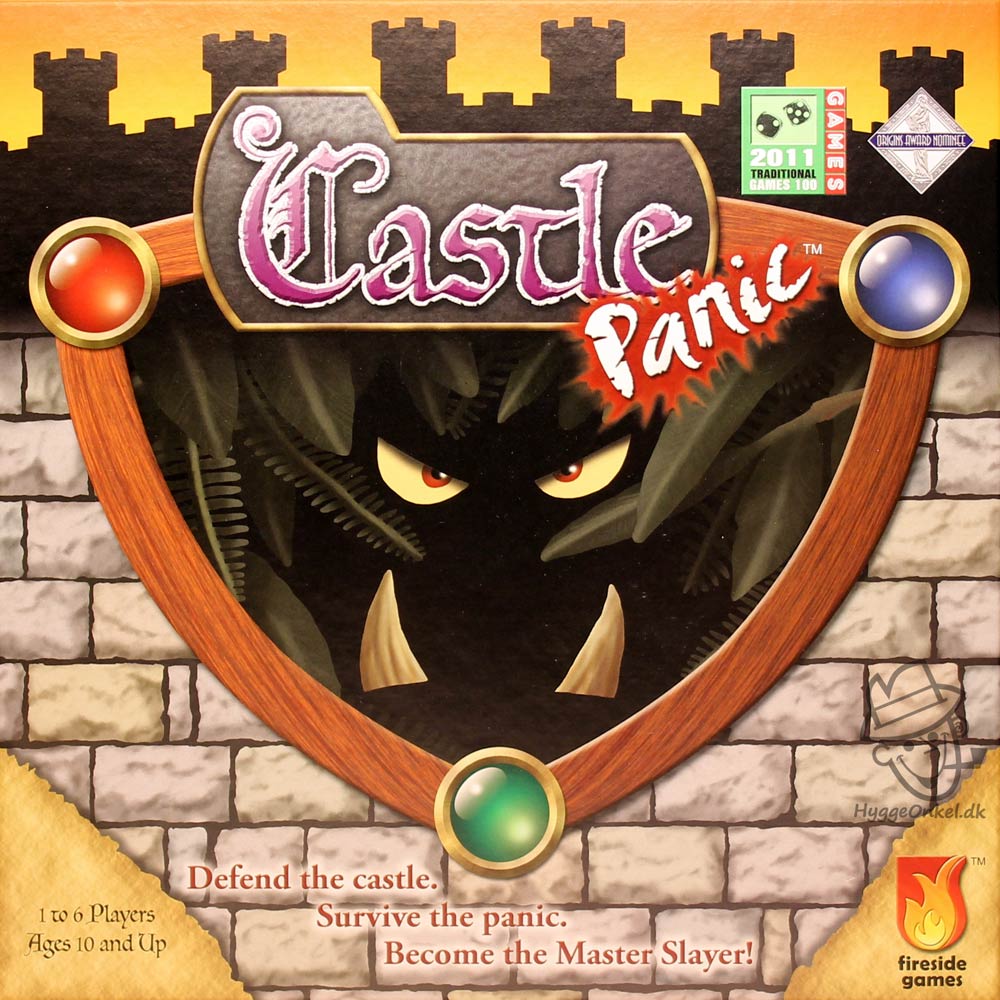
Castle Panic is a semi-cooperative game from Fireside Games for 1 to 6 players (yup, it can be played solo). You each play stalwart defenders of a castle trying to organize your defenses as goblins, trolls, and rampaging orcs lay siege to it.
Play revolves around a person drawing and trading cards, attacking monsters on the board, and then randomly adding additional monsters. The game ends in a victory with the players killing all the monsters, while a group loss results if all the inner tower sections are destroyed.
The game board has a series of concentric rings representing different range bands for specific cards (archers attack in the furthest, knights in the middle, and swordsmen in the innermost circle). Additionally the board is split into three different color sections. So a red archer can only attack the outer ring in the red section. Got a pesky goblin in the green section? Tough luck.
After drawing and trading a player attempts to destroy as many monsters as possible. Each card played will do one damage to a creature. While goblins are easily dispatched with one hit, orcs and trolls take a few more attacks to drop. If a monster is destroyed, it’s taken by the player that killed it.
After a player makes all their attacks, monsters on the board move closer by one space. Hitting an outer wall of the castle inflicts damage to the monster, but also removes that wall. If monsters are inside the castle courtyard, they destroy a tower section instead. If monsters remain alive inside the courtyard and are required to move, they move clockwise one section, destroying another tower section.
Players have very few options to destroy monsters once they reach the courtyard, relying solely on rare heroic cards that can dispatch these beasts. This makes for a frantic time as all the players are trying to wipe out as many as creatures as can and try to predict where monsters will be on future turns. Every player turn, monsters move closer in and more are added to the board. Throw in special monsters that heal creatures, ones that allow current baddies on the board a free move, to tokens that rotate each monster one section over, you end up with a frantic race against an ever encroaching horde of creatures.
As I mentioned the game is semi-cooperative. Players keep the monsters they killed. If they survive the onslaught, the player with the most monsters slain wins the game. This is a nifty aspect of the game as you are trying to ensure the survival of the tower so everyone doesn’t lose, all the while judiciously handing out cards to make sure you are slay the biggest creatures awarding the most points. It’s a very optional part of the game, but one I found enjoyable allowing for a little competition in what could also be a very cooperative game.
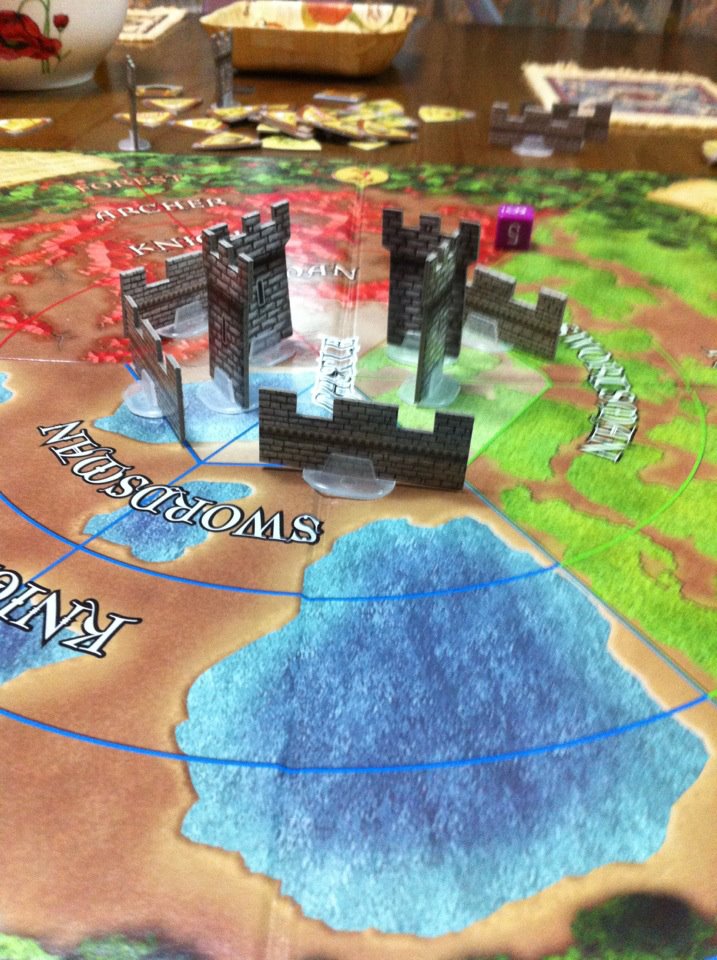
The Good –This is a fun and engaging game. There is plenty of player interaction as you are constantly bartering for cards. The mechanics are simple and easy to grasp, but still has an interesting puzzle aspect as you are continually seeing the optimal cards to play and trade as you tackle certain monsters and try to predict where others will be on later turns. The added individual victory condition of killing the most monsters is also a nice touch (which can be easily dropped if looking for a true cooperative game).
The components are colorful and the castle being represented by actual standing cardboard sections is a nice touch. The monster tokens are thick cardstock and the entire means of recording damage by simply rotating the triangular token is a great idea. All of this adds to a tactile experience playing the game, and allows for easy bookkeeping.
The Bad – The game can be very unforgiving if you get a bad turn and poor luck can be an issue. While there is strategy and a need to plan for future turns, there are enough wildcards in the game to throw everything into a chaotic mess. You can lose this game through bad luck which can rub some people the wrong way.
Also while the tokens and board were very sturdy, I found the card stock of the cards lacking. An accidental spill on the table for me resulted in some cards almost disintegrating. So the component quality is a bit of a mixed bag.
The Verdict – Castle Panic is great and doubles as a wonderful family game. It provides a frantic play experience as you continually go through a roller coaster where you think everyone has a handle on the incoming monsters, only to experience sheer panic as things suddenly spiral out of control. The rules provide some different variations to make the game easier or harder, including an option of pitting one player as an evil overlord fighting against everyone else.
It can accommodate quite a few players, and also be run as a light solo game. The turns move rather quickly and trading also helps in reducing downtime between turns, keeping everyone engaged in the game. It’s a light, family friendly game which can be challenging for adults. Definitely one to add to your collection and a keeper if you have kids (or plenty of pals in the mood for a beer and pretzel game).
Review: Eminent Domain

From Tasty Minstrel Games, Eminent Domain is a game of galactic expansion where you play fledgling space-faring races striving to expand your empire and become the most influential race in the galaxy. For 2-4 players this strategy game usually runs under 60 minutes. As players colonize planets, research technology, and produce and trade goods, they gain influence. The game ends when the supply of influence tokens runs out, or when two supply decks of action/role cards are exhausted. The player with the most influence at the end of the game wins.
Play is centered on choosing cards representing defined actions. Each player starts off with a deck of cards comprised of each action/role card. As they play the game, they will choose a role taking one from the central supply to add to their deck. So as the game progresses, you are slowly accumulating cards for certain actions (which results in your deck having a focus of specific cards). It’s a slight nod towards deck building, however the choices you have a somewhat limited and not quite the plethora of options in something like Dominion or Thunderstone.
When a player selects a role card, they have the option of taking that action as a leader or following it as a role. The leader option is usually a limited action. The follow role allows them to ‘boost’ or add to the action based on similar cards in their hand. So if a player chose to colonize a planet, they’d pick up a colonize card from the central supply and place it under one of their planets. Then they could add more colonize cards from their hand to that planet, boosting the effect of the role card they selected.
What is particularly enjoyable about role selection is that once a player chooses and resolves a particular card, each player in turn has the option to also take that role action (or they can decline and draw a card from their deck). This is an interesting play mechanic as one of the end game conditions is when two of the central supply decks are exhausted (or one with a 2 player game). So while you and an opponent might be focused on a similar action strategy, if you each keep drawing cards from that supply you are quickly advancing the game to end. You might instead want to hold off and try to follow that role when your opponent selects it, and choose a different role on your turn.
This makes for an interesting choice of either selecting the role you want to play, or possibly branch out in hopes one of your opponents takes a similar role that you can follow on their turn. You’ll find yourself looking at the number of cards they are holding, and the state of the planets in their respective empire. If a player has an uncontrolled planet with a large fleet, they likely will choose a warfare role on their turn. If they have lots of resources produced on their planets, they likely will choose to trade those resources in. Do you opt to follow their role choices, or just pick a similar action on your turn? It makes for some fun play around the table.
Another layer to this is the research technologies. Most are an improvement of the basic actions that players can choose. However some advanced technologies allow for very different strategies. The more advanced technologies not only require more research cards to obtain, but also require controlled planets of a certain type. This means you have to make an investment of several turns to build up towards a higher tier technology, and this can be a rewarding experience when a particular combination of cards plays out, making an efficient influence-gaining engine in your empire.
Another facet of the game is the inter-dependency of different roles. While you may want to focus on settling or attacking planets, you also need to survey planets to add undiscovered ones to your region. If you want to dive deep into research, you have to have certain planet types under control in your empire. You need to focus on a particular role and then be able to switch to another once that foundation is set. As you are adding more and more cards to your deck, you have to determine when is the best time to alter your focus (and possibly think about removing cards that don’t fit your overall strategy). To add another wrinkle in decisions, deciding when to jump onto a role chosen by another player is an engaging aspect of play. All of this accumulates to a fun, interactive player experience.

The Good – You have a fun strategy deck building game that has enough meat for interesting choices and a variety of strategies to try out. The interaction initially looks limited but in play, being able to benefit from another player’s choice leads to a lot of back and forth during turns.
The iconography and design of the cards are well done. The tokens and ships are nice pieces of cardboard and chunky plastic. The central game mat is a pleasantly thick board and not a flimsy paper. While the artwork for some cards might clock in as a bit cartoonish for some it highlights the theme well (having a light touch of humor with some).
The Bad – The game turn revolves around selecting role cards. As the exhaustion of role cards is an end game condition, your engine can take some time to build and only a few turns to utilize once it’s in place before the game ends. I’d also say that card combinations not as deep as other games like Race for the Galaxy. While you have some interesting technologies to incorporate in your deck, the unique ones are somewhat limited. Players might also tend to slip into set strategies depending on the starting homeworlds they draw (which are limited).
Also, direct player interaction is not part of the game. It’s all through a sort of proxy with the selection of role cards. While your opponent can take advantage of roles you select, you can’t really do anything about it. Some looking for a 4X type of game where direct warfare against other players as an option will be disappointed.
Lastly, while the components are good overall I did have some dings in some of the cards and cardboard pieces from the player summaries and starting planets. Nothing huge, but certainly expect to sleeve those cards.
The Verdict – I enjoy Eminent Domain immensely. While it may have what initially seem as flaws with the game, through practice you realize they aren’t really much as a major detraction. The initial feeling is one might find the game repetitive. However you realize much of your overall strategy depends on the first few initial planets you control which actually are quite varied.
Additionally, you really have to be fluid with your plans. If your 3 other opponents are going a heavy warfare route you are just adding to the ending the game faster jumping on the bandwagon (by exhausting the supply of warfare cards). It might be more prudent to shift into another strategic role that’s less focused on by others. At the same time, you really want to be able to jump in on the action of other players’ choices for roles. This all goes on under the backdrop of a deck building game, where you want to also try and keep a tightly refined deck of cards. Dabble into too many different things and you’ll have a hard time getting the right cards you need.
This has sort of become my space empire card game choice as of late, replacing Race for the Galaxy. RftG is a fantastic game and one of my favorites. However the learning curve for RftG is so high, I just can’t seem to justify getting it out to the table as much. Eminent Domain is much easier to teach, yet still has some surprising depth and a little more player interaction than RftG.
Eminent Domain is a good game that combines role selection with deck building elements. It’s got enough player interaction and strategy to make for a fun game. And keeping the game to just about an hour means you can easily get a few games in a single evening. It’s a great buy for an approachable, yet strategic, card game.

 Geek Ken