Category: Review
Review: Firestorm Armada 2nd Edition

So the 2nd edition of Firestorm Armada (FA) has finally come my way and I’ve gotten a bit of time to go through the book. I enjoyed the previous edition and want to spend most of this post talking about what changes have come about. My impression of the first edition can be found elsewhere.
Overall it’s the same game with a few tweaks allowing for more tactical choices. A very big change is the introduction of MARs (Model Assigned Rules) to each race in addition to rules for specific ships. Also there are now some unique weapon systems that provide different game effects, again allowing for some variation in how the different races play. So let’s sort of go through some of the changes from the previous hardback edition.
Movement is relatively unchanged. However the drift maneuver is no longer an option. I’m somewhat miffed with this as ships are still required to move at least ½ their speed. This means smaller ships are still required to be moving 5″ or so every turn. While cutting engines is always an option, it’d be nice to have a tactical movement option allowing for some maneuverability but still keep it to 1-3″. I might have to house rule something. Hrmm…
[½ speed: A squadron can reduce their maximum speed to ½, allowing them to move at least ¼ their normal full movement rate (and at most, one half of their current maximum move rate). Doing so they gain a ½ move token. The player can remove this token at the beginning the squadron activation to resume normal speed. If a squadron had a ½ move token at the beginning of its activation, the highest speed the squadron can reach for this turn is its normal movement rate minus its turn rate in inches. This will also affect their ½ speed rating. In practice, players will find that smaller (or more agile) ships will not be hindered by reducing speed, while larger ships will take at least an additional turn to get up to full movement.]
Command distance is a big factor in the game now. While squadrons can break up, the entire squad becomes disorganized meaning they cannot combine or link fire. This also becomes a big factor for wings and fighters (more on that later) and can come into play regarding weapon systems too. So the gist is that keeping ships in command distance from each other is a bit more important than before. On one hand I like the idea of keeping ships as cohesive fighting units, on the other hand the tactical flexibility of peeling off a cruiser or two is no longer an option which is sort of meah.
The mechanics of shooting, LOS, damage, etc. for the most part is the same. There are a couple of big changes however. One is the concept of tactical strikes. On larger ships (those with hull points greater than 2), specific systems can be targeted. So players can try to take out the bridge, wipe out weapon systems, or potentially take security systems offline increasing the likelihood a boarding attempt will work. There is a penalty to hit rolls when attempting this but that option of cutting out key systems is interesting.
Another big change is that target ships have -1 damage and critical ratings from attacks landing in their rear arc. This certainly allows for smaller, more nimble ships to slip into the rear arc of larger capital ships and potentially do some damage. It translates into improved positioning of ships and being mindful that the direction of approach to a target is important (and trying to keep a defensive position so no one slips in behind you).
Lastly a huge change to the rules are the introduction of specific weapon systems. Firstly, the 8″ range bands are no longer uniform. Some weapon systems have range bands that increase to 10″ and 12″. Torpedoes now are based on 12″ range band increments also. This means you now have options for increasing tactical engagements at longer distances and disparity of range bands among systems and races can make for some deft maneuvering at further ranges. Additionally, certain weapon systems have bonus effects if they all fire as a single volley of similar weapon types (termed as coherency). This may mean rerolling any ‘1’ results as with beam weapons, or doing higher ranked critical hits with kinetic weapons.
Adding to this is a slew of MARs options that every race has. Further, capital ships have a number of hardpoints. Each hardpoint allows for buying certain systems or small tweaks to the ship profiles (like increasing its move or shield rating). Aside from hardpoints, almost every ship has the option of altering a few systems or incorporating MARs allowing for a lot of racial and fleet variation. To keep things manageable, every ship in a squadron must have similar technology and MARs so you don’t get this mishmash of different tech types in a single squadron.
Damage no longer takes assault teams into consideration, so crew hits only affect the crew rating. This eases some bookkeeping. Boarding actions are also cleaned up some. Every ship can launch at least one boarding action a game. What’s nice is that this no longer reduces your AP, so you can still defend from boarding actions as normal (you just can’t launch another attack). Most boarding assaults are set to destroy key systems in a ship, but can also be used to capture ships so that they fold space off the table. Lastly, instead of a round of point defense and then running the boarding action, the PD and AP of the target model are combined. The boarder makes their attack with the defender rolling this combined pool to ‘cancel’ hits. It’s a more streamlined than before.
Flights and fighters are lumped into a term called, Short Ranged Ships (SRS). Assault craft, bombers, interceptors, and fighters are still the varying wings that make up SRS. For the most part the composition and idea of them being a single unit is still retained from the hardback rules (using a d6 to represent the wings). SRS are now represented as either a small token or a large token but each represent a maximum of 6 wings. Up to two SRS tokens can be part of a single squadron. Overall the means of attacks and resolving them are unchanged, how they actually operate is very different though.
Rather than a unit individually zipping around, the SRS token must always remain in command distance of its parent carrier. If it starts its turn outside that distance they are immediately recalled back to their carrier. Alternately, you can give an order for the SRS to make an attack run where it will approach a ship and try to get within base contact of the flight stand. This makes fighter wings a bit more like an extension of a weapon system for the carrier. They support the carrier directly instead of running off as their own flight group. Further, once they make an attack run they are immediately placed back on the carrier (allowing for rearming and relaunching during later turns). I’ve yet to try them out but the simplicity of their use and the reduced management of not having to move fighters back to a carrier for rearming is nice. Additionally, flight stands that are run off return to the carrier, which can can later be relaunched giving some real teeth to fighters. As dogfighting is the best way to inflict damage on wings, interceptors certainly have an important role in countering enemy SRS.
Fleets are now partitioned off into patrol (up to 800 points), battle (800-1200), and grand fleet groups (1200-2000). Each fleet is further split into three tier groups, where battleships, carriers and such are tier 1, down to frigates and escorts being tier 3 (with cruisers being tier 2). Each fleet must have a certain number of squadrons from each tier. Additionally, up to 25% of the fleet points can be used for alliance vessels that can fit into the tier requirements. For the most part this allows fleet construction to be an easier process. Rather than working off a set percentage of points for fleet composition, the player now has model limits based on these tiers. One gripe I have is that these actual limits and information on squadron sizes are no where in the book. Instead they are available as separate PDFs.
The star admiral is still part of the game. Instead of granting specific bonuses to a particular ship, they allow for the use of tactical cards and improve the chances of making any command checks (ex. checks if a squadron is disordered). Tactical cards are also another feature of the game. For the most part each fleet has the same cards and may have 1-2 additional racial specific cards. These can be played once during a turn to allow for some special maneuvers and one shot abilities. It’d be nice to talk about them more in detail, but I have no idea what the cards do as there are no details on them other than how they are used (another gripe of mine).
A new mechanism for the game is introduced to allow for more tactical options through a battle log. For the most part, players start with a battle log total of zero (but some scenarios increase this). Battle log totals range from positive and negative integers. As players inflict damage on the opponent fleet, destroying ships, their total increases. As they receive losses, their battle log total decreases. For the most part it works as a victory point tracker with the larger the differences between the totals, the more pronounced the victory.
What is particularly interesting is that battle log points can be spent on certain game mechanisms. They can be used to alter die rolls for reinforcements. They can also be used to return spent tactical cards to your hand. This is a very clever system allowing you to essentially give up victory points to gain a needed edge (or recover from a flubbed reserve roll). As players gain points by defeating enemy ships, it further encourages players to be aggressive and inflict damage onto their opponent’s fleets. This really adds a neat layer of strategy to the game (especially the cycling of tactical cards).
The game has 6 scenarios within the book. They range from simple engagements to trying to capture objectives, or control sectors on the board. As a nice touch the book suggests that battles aren’t necessarily in deep space, but rather within key systems. Hence, the preponderance of terrain and close distances of engagement. You are fighting over key areas of control, rather than large ranges of territory, with the scenarios supporting that concept.

The Good – Firestorm Armada has not changed too much and is still an enjoyable naval-fleet-action-in-space type of game. The presentation of the rules and layout is well done. The additional weapon and MARs systems have given the game much needed flavor between the races. And it all works well without requiring a tremendous amount of bookkeeping and cluttered, simulation-type rules.
The book is very nice and well bound, with a pleasant matte finish on the pages. There is a surprising amount of whitespace on the pages so the text is not cluttered. Sections of the book are divided up with margin tags of a specific rule topic on each page making it well organized and easy to reference a part of the rules if needed (not to mention a simple table of contents and index). The book has lots of great color photographs of models, along with simple color graphics for particular rule situations, and also lots of written examples.
The Bad – There is a decent chunk of information missing from the book. Not having a list of the tactical cards is a hefty ding. Not detailing the major fleets and their composition is especially damning. There are no token sheets like in previous editions, and the lack of a template for SRS tokens are especially maddening. The quick reference is a list of charts and no where close to the usefulness of the previous QRS released with the first edition softback book.
The Verdict – If you are a brand new player, Firestorm Armada is a great game to jump into. The big boxed sets are especially nice as they give the player everything needed to play. It might be well worthwhile waiting to pick up the fleet boxes of races you’d like. It is still an enjoyable game that while not quite embracing aspects of physics with movement, still makes for a fun afternoon of space combat. If maneuvering in cruisers to an optimal range to fire full broadsides of anti-matter cannons is your thing, you will certainly enjoy FA.
If you are a long time player of FA, you will likely find a lot here to like. The game finally has some sprinkles and a bit of a swirl in the vanilla of previous racial fleets. The way fighters work are tightened up and make carriers more offensive-type vessels. I think the tactical cards will add some fun wrinkles in the game. All the while the concept of a battle log and spending victory points to have additional tactical options is a great concept. There is a lot here you will enjoy.
The rulebook seems to be missing chunks however. There are no tactical cards, no tokens, no specific rules on actual fleet composition limits (the rules cover how you build a fleet, but don’t have actual tables for the different races). Not having any idea what an acceptable token to represent SRS is another missing feature.
I entirely expect they will be available as downloadable files or separate products (the fleet composition sheets are already available). However it seems that the focus is for players to go pick up the boxed sets that have all of these items. Separate files and products that can be purchased individually are sort of an afterthought it seems. This gives me a bad taste in my mouth. Yes, all my cool models can still be used to play FA, but despite me picking up this rulebook there are still parts of the game missing. It’s not enough. I need to buy more, and not having the tactical cards is the most aggravating thing (where in the past the STAR cards were very much an optional component).
This gives me some hesitation in recommending the rules. If and when these other parts of the game are separately available, I think you’ll find an enjoyable game here. But it isn’t all within this rulebook, and that makes me less inclined to recommend it to current players of FA. There is a lot here that is amazing and really strengthens the game. But if you are just planning on buying the rulebook, then wait. See what else pops up on the website and then make your decision on converting to second edition.
[EDIT: Months have passed and some of the things I chided Spartan Games about that were missing from FA are available as download files now. SRS tokens are available as a separate product (which I still would have liked as a simple cutout token). However the TAC cards and other tokens can be printed out as color PDF files.
Additionally the V 2.0 rules are absolutely free so you really have no excuse not to take a peek at Firestorm Armada now. Enjoy!]
Review: Expansions for Kingsburg and Race for the Galaxy
This month I thought I’d post a short review of a few expansions for some of the games I’ve reviewed. Normally I’m not keen on expansions. I’d rather put the money towards a new game. However occasionally I do make the effort to pick up one.
‘Kingsburg: To Forge a Realm’ is from Fantasy Flight and expands on the base game. What I particularly liked is this is a set of mini-expansions rather than one product, allowing you to pick and choose options to add to the game. A while back I reviewed Kingsburg and found it an excellent worker placement game. However one nagging bit with me after several plays with two people was that you could slip into familiar strategies with buildings. The game seemed to thrive more with at least a third person, where you had to be a little more flexible in your overall strategy due to spots on the king’s court being scooped up from other players.

This expansion throws that nagging bit out the window. KB:To Forge a Realm adds new playmats with two additional building rows. Another option is a set of random building rows that throw in small variations over existing ones. When playing with this mini-expansion, you have the option of taking 1, 2, or none, with these building rows entirely replacing ones on your player mat. Between the expanded player mats and the random building rows, you get a lot of variation with the core game.
This variety in play is further expanded with the governor and destiny cards. Players randomly draw a single governor card at the beginning of the game which provide a unique power. Like the random building roles, there are options to allow players to choose a governor (or building rows) by a draft system where victory points are offered as a penalty to their final score. The destiny cards are a new event that takes place every year, which can be a boon or a bane to everyone. These cards are the least enjoyable mini-expansion for me, but definitely adds some randomness to the game.
The last mini-expansion in the box are soldier tokens. All players are awarded 6 tokens with values ranging from 0 to 4 in an unequal distribution. Instead of rolling for reinforcements provided by the king, each player secretly chooses a token representing the reinforcements they get that year. Each player ends the game with one token left over and gets victory points based on its number value.
I have mixed views on this. I like it as it makes for some strategic planning. I can either try to build up my own military and not rely on reinforcements from the king, or push for resources in a few seasons to get victory points (hoping my choices of reinforcements are enough for the coming monsters). It can be a little tense as each player shows what reinforcement tokens they’ve picked (and likely what their victory point bonus will be at the end). However, some people I’ve played with really enjoy the swingy results from the die roll instead. While you always know you can count on at least one set of troops with the die roll, everyone might get a ton, adding some spice in deciding who has the largest standing army at the end of the year.
The Verdict – KB:To Forge a Realm is a tad pricey as an expansion. However it adds a lot and helps expand the variation of gameplay tremendously. The expanded building mats along with random building rows will likely be your new standard for the game. The other expansion parts also add some game variety. What I like is that each part is entirely optional and you can pick and choose which ones to play with. Further, many also allow for a drafting procedure, so that your choices can be even more strategic if you don’t like relying on random draws.
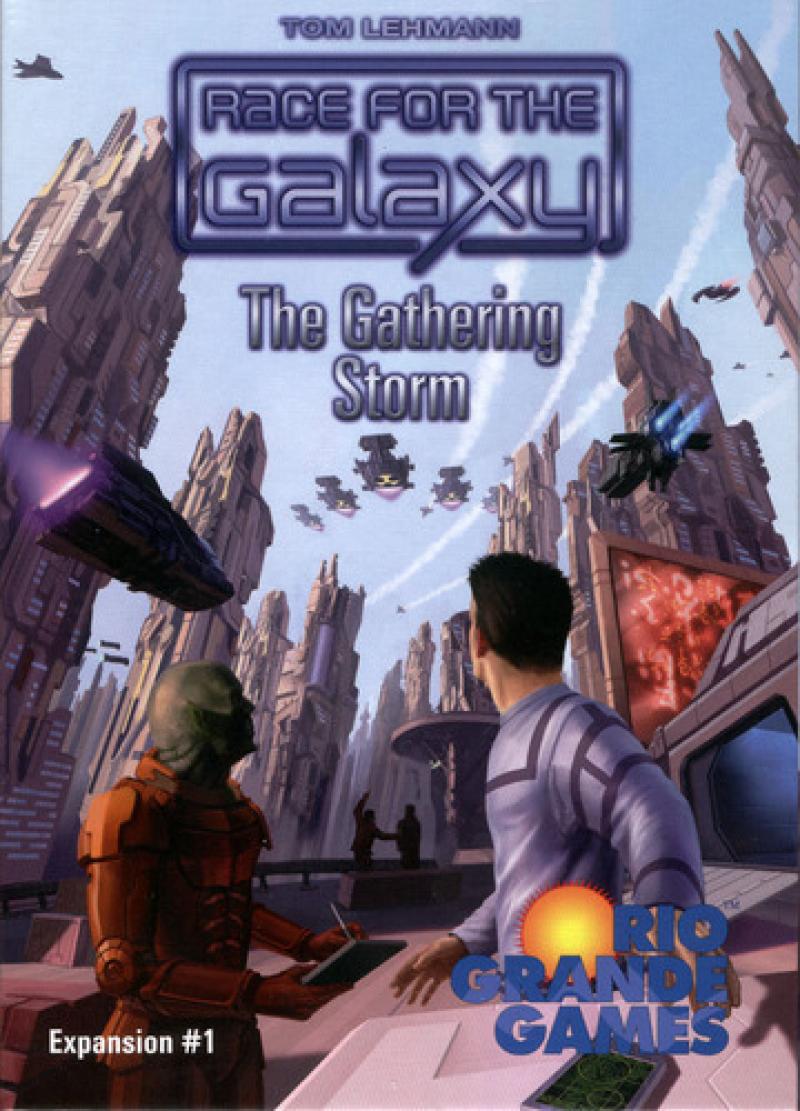
The second expansion I’ll talk about is ‘The Gathering Storm,’ an expansion for Race for the Galaxy from Rio Grande Games. RftG is a a favorite of mine however I felt at times having a limit of just 4 players could put a kink in my gaming plans on some evenings.
This is the primary reason why I picked this up, as it has action cards for a 5th player. However there are some other goodies in the expansion to add a few wrinkles to your typical game. There are new starting homeworlds with a few introducing some interesting properties, and handful of new development and planet cards. In this sense, the expansion is a tad lacking. While the new cards provide some different options and strategies, it’s not quite a mother load of new cards you’d expect in an expansion.
The other optional part of the expansion introduces special victory point conditions. Players randomly draw two 5 victory point tiles and four 3 victory point tiles. The 5 VP tiles are for players that have the ‘most’ for different game conditions (such as players with the greatest military, or the most developments). The other 3 VP tiles are for the first player that achieves that condition (like the first to get 5 VP, or build the first 6 point development). There are a few extra tiles, each being unique conditions, so there is a decent amount of variability with the point tiles where you aren’t always seeing the same bonus VP conditions. However the number of included tiles is not huge (6 of the 5 VP ones and 8 of the 3 VP ones) so you can expect to see similar tiles crop up with repeated play.
I see this part of the mini-expansion as mixed bag. Some might enjoy it while others may think it takes too much away from the core game mechanics. I like the victory point tokens, especially with 4-5 players. You can get a little muddled with your initial plans. As so many cards can get drawn and discarded by other players, you might find that specific card needed for a combo quickly lost in the discard pile. Having other smaller goals out there to give a boost to VP is a nice option. Even better, I like the ‘first player tiles’ as they can provide an incentive to quickly chose a direction for developments and planets to scoop them up. While the VP bonus is small, it does add up and can help repair a sagging 6 point development that isn’t getting the optimal synergies of other cards in your play space.
The last part of the expansion is likely the best reason to buy Gathering Storm, solitaire rules. I will admit the rules are a bit rough to wrap your head around as there are additional icons to decipher and the mechanics are not very intuitive. I had tried a few times and continually threw in the towel as I felt the mat icons and turn procedure could not be readily understood. Fortunately I stumbled upon this wonderful tutorial that really helped me grasp the concepts of the solitaire rules.

You pair off against an automated system where the ‘opponent’ chooses actions based on rolling special dice. You choose your actions and play normally, and the artificial opponent will play out its turn using specified actions based on a special playmat. Like the original game, you each have a tableau and starting homeworld. What is interesting is that based on the homeworld chosen, particular action options are altered to improve the play of the artificial opponent.
You get this semi-reactive play going. Where you settle a planet or place a development, and the artificial opponent likely does the same. As you are producing and consuming goods, the artificial opponent also racks up VP. You are in this constant race to maximize your actions as the clock to end the game is constantly ticking. The only complaint I have is that action selection is not as nuanced as in a regular game. While particular options are more likely to be selected by the artificial opponent, and some results will even mimic your choices, essentially it’s choosing its actions based on a die roll. Nonetheless, I found the solitaire rules very enjoyable and challenging.
The Verdict – I cannot recommend this expansion as a must have. The additional cards and homeworlds are nice (especially the new homeworlds which almost double the options in the base game). I like the VP tiles, but it’s very optional and does alter the theme of the core play somewhat. If you found yourself really needing a set of cards for adding a 5th player, this might nudge the expansion a bit more into the must buy column. This is nowhere near the value of KB: To Forge a Realm where I simply cannot see playing the base game without it. The Gathering Storm is very much a take it or leave it expansion.
Review: 13th Age
 While it’s been available as a pdf for some time, the hardback rules for 13th Age from Pelgrane Press are finally getting to folks. For a long time I was on the fence about this. I was happy with my 4E game but the more I played, the more flaws with the game came up especially as my group leveled up. PC power glut was a big issue and I thought up a few potential tweaks to trim the list down. I even considered consolidating at-will powers and altering the basic attack to make it more attractive as an alternative. It sort of was swept under the rug compared to other at-will attacks for PCs. Lastly, I really wanted some way to give players an option of pouring out the damage, and considered using healing surges as a means to do so.
So last week I decided to take the plunge and pick up 13th Age. As I glanced through the rules, what I found particularly interesting was that most of the beefs I had with 4E seemed to be addressed with 13th Age. It’s not entirely surprising as one of the designers was also involved in creating fourth edition D&D. But I particularly liked how much of the glut of temporary modifiers and ever-expanding power choices in 4E were removed, making the game seem much more fluid and engaging.
13th Age is a high fantasy rule set based on the d20 system. No bones about it, I’ve heard this described as a love letter to 4E and I can totally see the imprint of that in the rules. What makes this stand out however, is how many good things it took from 4E, while dumping the extraneous bits, making for a slimmer, fun ruleset. Those at home with 3.5 will also find some familiar territory here, but I think more of the roots with the game are with 4E.
The game relies on many standard choices for races (dark elves are an option) and classes from past editions of D&D (no monks, druids, or shaman). Multiclassing officially is not part of the ruleset, but certain classes can definitely dabble in other class abilities with feats or domains. There is a bevy of your typical high fantasy monsters and a decent list of magic items.
It’s still d20 D&D here. You have levels, 6 ability scores ranked from 3-18, AC, hit points. A nod to 3.5/4E much of the mechanics revolve around rolling a d20 over a set DC value. As with 4E, there are specific defenses for spells and effects where players roll against listed physical or mental defenses. There is initiative and everyone attacks in that order during a typical turn.
Healing is very loose and liberal. As with 4E (and DnDnext) each class has a number of recovery dice that they use to recover HP. And as an action one recovery can be used during combat. Characters have death saving throws, and ample means to heal themselves. Clerics aren’t required, but their abilities definitely supplement the party’s healing potential greatly.
Similar to DnDnext, there isn’t a formal list of skills. Checks are made in a similar fashion, rolling against static DC values for easy, hard, and difficult checks. There are different main tiers, from adventurer, to champion, to epic with resulting DC, defenses, and attack bonuses from monsters and hazards scaling upwards. These are spread out from levels 1-10 however. Correspondingly monsters also have defenses, HP, and attack bonuses that scale up. However you will see certain creature types plateau. So don’t expect to see a variety of kobolds that range from level 1 to 4 like in 4E.
Character progression and advancement are familiar. Players add a level bonus to attack dice, skill checks, and defenses. Hit points increase incrementally, as do ability modifiers (resulting in some changes to defenses). Also a regular advancement of feats and spells are rolled out, resulting in every level bringing something to the player gradually increasing power and abilities. One particular change I like is that many class options don’t necessarily mean a brand new ability, but rather can improve on those they already have. While wizards and clerics can expect a new spell or two as they advance, most other classes will get more utility out of their attacks and abilities.
I’ve covered some things that are similar, now onto things that make 13th Age stand out. There are many aspects of the game that allow for character customization. Skills are not present, rather a player has so many points for backgrounds instead. These PC backgrounds highlight past experiences and history. If the DM thinks it has an application to the task at hand, they provide a bonus. It’s very freeform and supplements the simple ability score checks of the game well. There are a wide variety of feats that confer small bonuses and little tweaks to abilities.
This ties in very well to the abilities (read powers) of the character classes themselves. Many of the game mechanics revolve around the d20 roll. Some situational bonuses come about on a miss, rolling 16+ on the to hit roll, to hits that are an even result. This gives some varying situational benefits to combats. Feats expand on these abilities, giving some even greater effects when they trigger, or possibly adding more predictability to when they do. Because characters start out with a fair number of feats and continually expand on them, they gain a lot of customization. You can end up with two level 3 fighters that have very different abilities.
Another key aspect of combat is the escalation die. After the first round of combat a simple d6 continually goes up from 1 to 6, with the current value granting players a bonus to attacks. Monster abilities also can interfere with this. It’s a nice tool in preventing fights from dragging on and keeping the action moving, encouraging the combatants to be proactive. Combined with situational powers related to attack results, you have combat that is engaging and less about just a hit or miss result with attacks.
Combats are also very much within the theater of the mind. Creatures are either engaged or not. They are either nearby (within a standard move) or far. They are in cover, or not. Attacks of opportunity are there, but with a simple check, players can slip away if needed. Likewise, unengaged creatures can intercept others trying to slip around them. So there is some tactical movement, but nothing rigid requiring a grid to run a melee.
Leveling up is also fast and loose. No experience points are awarded. Rather, GM’s are encouraged to level up the PCs when they feel appropriate. A rule of thumb is after three to four major resting points players should advance a level. Each resting point is after 4 major fights. So after about twelve to sixteen melees, the players should have enough under their belts to level up. The focus of the game is when it’s dramatically appropriate though. So after achieving a major quest is perfectly acceptable too.
Magic items are split into two camps. Your mundane consumables in the manner of oils, potions, and runes that provide a simple mechanical bonus, and that of permanent items. The consumables are made to be your typical one use, throw away items that are actually rather mundane. Magical permanent items however are meant to be special and wondrous, each with a personality. You aren’t going to run into a simple +1 dagger but you will have one that has some history or quirks to it that encourages more story effects in the game.
Two additional points make 13th Age stand out from other RPGs, a player’s one unique thing and icon relationships. Every character will have one unique characteristic that makes them stand out from others in the world. It’s geared towards a background-centric or plot device, rather than some game mechanic benefit. This is decided at character creation and can be a relatively simple concept (they are the 5 times grand world champion of dwarven ale drinking) to something grander in scope (they are the long lost child of the Elf Queen). How this affects the game is something played out as campaign unfolds with input from both PCs and the GM.
The other major point is the concept of icons and the relationships PCs have with them. There are 13 icons within the game, each being an actual individual in the game world. Consider them the movers and shakers of the world, main factions and seats of powers that employ many agents within the world to do their bidding, and this includes the characters. Players can decide on their relationship with certain icons as being positive, conflicted, or negative. They start with 3 d6 and can allocate them as they will among the many icons.
Some may want a more prominent role within the circles of a particular world power, while they may want to be the bane of a certain 13th Age icon. At the start of the session, each player rolls their relationship dice and results of 5 or 6 (5 means there are more complications along with the boon) ensures that at some point in the game, the player will have assets of that icon at their disposal. That at some point, the icon (or agents on their behalf) will seek out the player and impart some timely advice, offer some resources, or potentially some task or quest for the player. It’s an interesting idea and very much helps drag the players into the world, ensuring they have the ear (or the wrath) of major powers within the game.
The Good – It’s a nice package for D&D. The mechanics are uniform, with enough working parts and customization to make for a fun game. I think it would be very approachable to new players. Elements of the game are familiar with enough small situational conditions to make combats enjoyable and move well. I particularly enjoy how most of the fiddly bits for combats are swept aside and more emphasis is on the players pulling off big moves or big hits. The game encourages the players to engage the GM and be part of the overall story. Best of all, everything needed to play is in a single book.
The Bad – It’s D&D. You have HP, AC, attack bonuses, nothing here that is completely groundbreaking. The aspect of the 13 icons in the world are interesting, but that does add some limitations to the game fluff. Your default setting is high fantasy and revolving around these major world powers. You can totally go off the rails and make your own, but this will take some effort to ensure all the player options fit well with your custom icons.
The biggest damning aspect of the rules is while I think a new player could get the gist of the game very easily, it does require an experienced GM. The icon relationship dice mean as a GM you have to be willing to improvise and be flexible with the story you are telling. While some of the mechanical aspects (skill checks, level appropriate monsters and challenges) are well laid out and understandable, there is a lot more skill needed to running an effective session. This hurdle is recognized in the rules, but I think it also is a major detraction to the game. YMMV with this game as how well a GM can weave in the icon relationships during a session is key.
The Verdict – 13th Age is a good game. I think it’s very much a great introduction to fantasy RPGs and if someone wanted to play ‘D&D’ you could do well with pulling this book out instead. For fans of 4E and 3.5E, both will get a lot of enjoyment out of the rules. It has familiar aspects of play with enough wrinkles to make it enjoyable. If anything, this could certainly be considered for 4E fans a nail in the coffin for starting up another 4E game.
It’s not perfect. There are major default setting choices with the game. It’s one of high fantasy. You have established movers and shakers in the world. It is entirely a game of heroic adventurers (level 1 farmer peasants need not apply). But if you want to play a game where you are big damn heroes, destined for greater things, and well-connected to the pillars of power, 13th Age is for you.
There is a lot here that works. Play and options are streamlined enough to not be overwhelming, but still offer some customization. What I particularly enjoy is that there’s a balance between simple mechanical bonuses and others related more towards the story of the character. You don’t have a simple diplomacy skill, you have a strong background in the Emperor’s royal court. You don’t have a skill in tracking, you were a lead scout for a barbarian warband in the last goblin war. This stuff oozes with story and fodder for adventures. Along with the one unique thing about your character, you have something that stands out from other RPGs, giving a more interesting spin on character creation than what’s seen in other games.
One very strong point about 13th Age is that everything needed to play is covered in one single book. It’s a low entry into RPGs and something akin to Pathfinder. I will say it can be tough to justify buying 13th Age if you are heavily invested in other fantasy RPGs. Nothing here is absolutely groundbreaking and it falls heavily back on a very familiar d20 system. Between the different camps of D&D, I think 4E fans might enjoy this a tad more. As for people into Pathfinder and 3.5, they may very well like the more streamlined character creation, uniform mechanics, and opportunities for dynamic (at times chaotic) combats. There is a strong emphasis for story and weaving the PCs into the world, much more so than in some other systems. But like any RPG, it does come down to the DM and how much they can make the game fun for all involved.
My final take, 13th Age is a good buy. It has some interesting concepts you could lift for your own game, however it might tread a bit too much on the familiar for some. This is a d20 D&D game. For some it could be very well their ONLY D&D game. As a big 4E fan, if I were to jump back into D&D, this would certainly be my game of choice. It’s a tad rigid for the setting and requires a more dynamic approach to planning out your sessions, but there are some fun things in between the pages of the rules to make it worth your time.
Review: Tomorrow’s War
From Ambush Alley Games and Osprey Publishing, Tomorrow’s War is a sfi-fi skirmish ruleset detailing infantry warfare in the future. The system is designed for 15mm but could easily be bumped up to 28mm. As a squad-based force game, the scale is man to model and allows for the incorporation of individual armor units like tanks, APCs, and such ideal for platoon-sized engagements.
The setting of the game is rather concretely set with future nations extending conflicts both on Earth and on other colonized planets. So it is very much in the theater of mankind extending the battlefield along with imperialistic endeavors, further continuing warfare for resources and territory on a larger front of different planets. Corporations are also represented in the background, allowing for some flexibility in campaign themes. This is somewhat an interesting take on the game background, as there is room to explore non-symmetrical scenarios such as including untrained colonists, or poorly equipped but highly motivated insurgents.

The game revolves around a universal mechanic of rolling different polyhedral dice and trying to get a 4+. If rolling off against an opponent not only do you need to get a 4+, but also roll higher than the other person. Different troop and tech types use varying dice that range from d6 to d12. This makes for an interesting mechanic as everything is based around a static number (4+) with discrepancies in technologies, training, and troop morale using different dice. Additionally, some game conditions can temporarily alter the effectiveness of dice being used (such as one side being able to hack into the information network of an opponent).
Play revolves around one side gaining initiative for the turn through rolling off dice. They activate any of their units, and then the opposing player may activate units which were not utilized in a reaction. For every unit activated within LOS of the opponent, they have an opportunity to react to this activation. This can be a round of fire, to movement. All it takes is a troop quality test, trying to beat the rolled score of the opposing player.
Additionally, as long as the unit keeps passing reaction tests, it can can continually react to other units taking actions within their LOS. The catch is each activation reduces the firepower and movement of the reacting unit. You end up with these potentially large chains of events, where a unit moves, another reacts and moves out of LOS, only to stumble into sight of another unit, etc. It can get hectic, but there is a set order to resolving these actions.
What further compounds the chaotic feel of these actions and reaction fire is that there is no effective range for any weapons. Units can see and shoot over the entire board. LOS is blocked by terrain and other units. One particular aspect I like about the game is that models are in a relative position. Cover and units, while represented by individual models, are entirely based on where the majority of the models are. If more than half the models are in cover,the unit has its benefits. If most of the unit is behind a building, then the unit is out of sight. I appreciate the simplicity of this and getting away from relying too much on every single model in an entire squad needing to be in cover or behind a hill.
Another optional but random facet of play are the fog of war cards. Players continually draw and play special cards that introduce all sorts of random events to the game. Most are allow for a temporary condition to the battlefield or troops, while others might allow for a reroll or additional dice being added to a roll.
Combat is based entirely around rolling firepower dice verses defense dice. Get more successes than your target and you potentially inflict casualties. At first glance it looks very streamlined, however digging further you begin to see lots of different modifiers that can either add or remove dice from this pool. This is one refreshing approach to resolving tasks and fire. Rather than continually adding modifiers to an ever shifting target number, you just throw in (or remove) an extra die or two. Potential casualties are determined by rolling on a chart to see if the figure is simply wounded or out of the fight.
While the game is for infantry engagements, there are plenty of rules for armor also. I’ll say one plus for the game is the sheer amount of varying rules available for the game. From expected artillery and air support, to more futuristic information warfare superiority via a network grid. There are rules for drones, automatons, and other types of futuristic technology. As units have a variety of troop and technology characteristics, aliens can also be easily created with a detailed example of one within the rulebook. Even though units can adopt a variety of characteristics, it is not based on a point structure. However there are several troop and army types listed within the book.
The game has several basic scenarios scattered throughout the book and also has a campaign mode with a listing of various potential engagements. It’s an interesting ruleset as the initial impression is that it’s one of a very conventional theme, but there are additional rules to allow for more futuristic engagements adding on layers of technology.
The Good – I really appreciate the universal mechanic for resolving tasks. Keeping a static number and rolling different types of dice is a nifty idea. I also appreciate the breadth of ideas for futuristic engagements. There are a lot of interesting ideas and rules for different types of potential scenarios aside from the regular ‘wipe out the other person’s forces.’ The book itself is high production with colorful art, nice thick pages, all in a well bound hardback book.
The Bad – The layout of the rules is not ideal. While there are plenty of text examples, relying on photographs for some of the cover and LOS situations is a poor choice (wish they went with a cleaner graphic instead). There are too many charts spread out. Even worse, there is no quick summary sheet. Such critical information for playing the game and it’s scattered throughout the book.
For all the simplicity of the universal die mechanic, the game still gets bogged down with lots of book keeping. It’s small things that keep adding up, glutting the flow of the game. Like units taking multiple reaction tests which have to continually reduce their firepower and movement for future reactions.
The Verdict – This is not a ruleset I can recommend. While resolution of actions appears streamlined, in practice it’s ungainly. For contests, not only do you roll over the target number, but also have to roll higher than your opponent. This means a bucket of dice rolled in an attack have to be set aside and individually paired off as the defender rolls another bucket of dice.
For all the abstract positioning and LOS issues being based on an entire unit, you still get mired down in individual models needing various conditions being tracked. Models that are broken and surrender have to be under the watch of a lone opposing model and marched off the board. It seems that the game struggles with trying to have some quick, simple mechanics, but gets wrapped up in all of these other situational rules making it more like a simulation.
There is too much information in the rulebook, and it is poorly presented. There are a lot of examples, but critical charts are scattered throughout the book. It seems there is a good game buried in between the pages of the book, hidden away. Maybe if the game strove for a core set of mechanics, with layers of optional advanced rules it might work. Definitely having a better presentation and organization of critical rules and charts, including a good summary would help. Maybe if it had these things, this game would have some potential. As it is now, Tomorrow’s War has too many scattered ideas, too many situational rules, and needing too much effort to wade through the book to be a solid game.
Review: Gruntz
A long while ago I sort of sworn off any squad based rules and for a few years I jumped into larger, mixed forces WWII games. The smaller tactical stuff just didn’t keep my interest any more. However lately I’ve been having an itch to get back into squad-based infantry stuff. I’ve done the whole 40K bit before and had no desire to go that route, so I dipped my toe into the 15 mm sci-fi range and was looking for a few rule sets to try out.
Enter Gruntz, a 15 mm, man to model, skirmish game that can easily handle a platoon or more of minis. The game is a points based system where players try to field equivalent forces of an agreed value, see who can tackle a scenario, and come out the winner. Gruntz is a pretty simple system, with several layers of advanced rules to alter the play. At first glance the system is very pedestrian but by incorporating the advanced rules, there is enough there to give seasoned wargame fans a fun time.
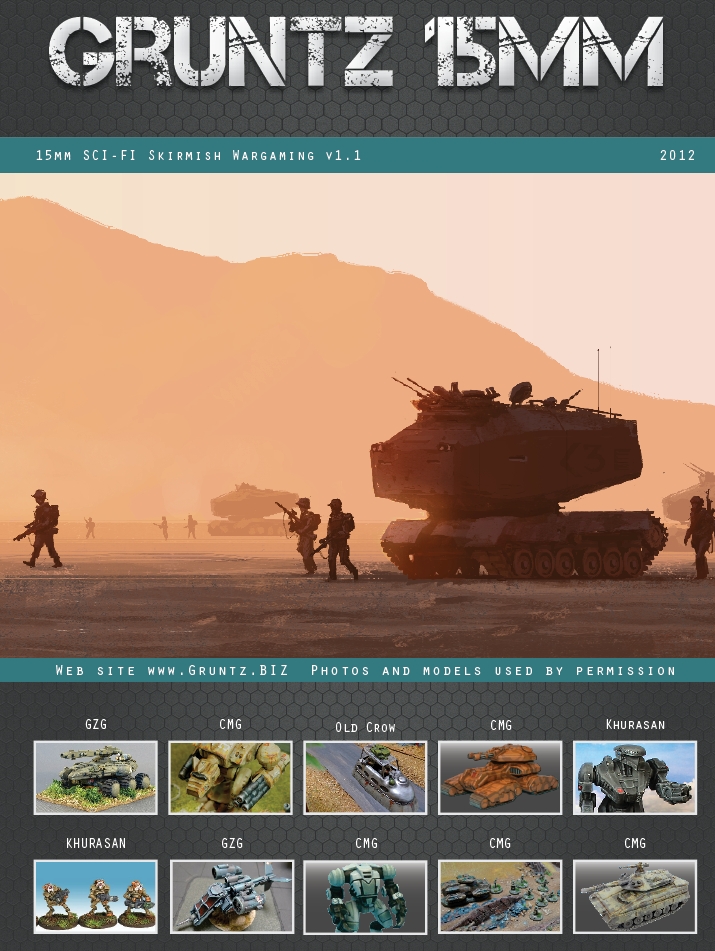
The base rules revolve around a player activating their entire force, with the opponent doing the same for their troops (simple IGOUGO). Each unit can perform two actions, typically being move then fire, fire twice, or assault. Players roll 2d6, adding their unit’s skill, and try to roll equal to or higher than a target number to hit, followed by rolling 2d6 against another target number to damage a unit. Casualties inflicted give units suppression markers which reduce the number of actions they can do on following turns.
There is a nice gradation of attribute stats, as units can have different relative levels of training, morale, and equipment to alter these values. So units could mimic very stealthy units that can’t take a hit, to slower, easier to hit targets that are tough as nails. Vehicles also operate very similarly, but have a few more options when shooting and usually can take much more damage (as typical infantry can only suffer one wound).
There are some wrinkles to play. A unit has a few options with shooting to either concentrate fire, or lay down suppressive fire into an area. And units can also place themselves on overwatch to interrupt opponent’s actions if needed. However for the most part the game uses very familiar and simplistic mechanics to resolve fire and morale situations.
The advanced rules here are a nice touch. They primarily cover alternate ways to activate units, using random initiative via a deck of playing cards, to even alternate activation between opponents. Rules for actions that the player can take can also be mixed up, to give some more flexibility in the 2 different actions a unit does. While the game is set up for single based figures, there are even rules to cover multiple figures per base. These rules certainly give the game some needed complexity while not overburdening the player with an overly complicated set of simulationist rules.
The point system for building units is a pretty strong aspect of the game. There is a lot of room to give units not only varying attributes, but also special abilities. Also the system seems flexible enough to work up statistics for a variety of vehicle models, from copters, tanks, and APCs, to walking mechanized units. What is nice is that you could easily work up different flavors for troops and equipment to give forces a completely different feel, making aliens have differing play styles.
The game has several basic scenarios which usually revolve around with attacking and defending forces and give the players concrete goals and objectives. A nice break from the simple objective of ‘kill the enemy army’ you might see in other sci-fi games.
The Good – You have a fun little set of rules, with just the right complexity to make for an enjoyable game. The point system for unit creation allows for a makeup of different forces, allowing for mixing in air and armor pretty easy. You have enough variation in unit abilities and the base attributes to give forces a different feel for the same point value, adding a lot of variation in the force makeup from game to game.
The Bad – While simplicity has it’s charm, sometimes the mechanics can be a little rigid. Infantry forces are required to cluster around a unit leader, and elements that split off from a squad have very limited options. There are some variety of options with unit activation, however it does slip into that territory of IGOUGO with a single unit’s activation. There is some room for reaction fire, especially with charges, but these options are limited. For smaller scale games, I’d like more flexibility in target reaction. Also, while the point system does allow for variation in unit makeup, that problem of the min/max lists can crop up.
The Verdict – I have the newest V1.1 and was happy to see not much changed compared to the original Gruntz. At its core is a very approachable skirmish-scale wargame that allows players to field a variety of forces. While infantry are what your troops are built around, it’s nice to have some other options in the force makeup.
The execution of the game may not be ideal for everyone. You very much have a unit undergoing different actions, without any response from the opponent. Infantry unit cohesion is also a little tight (3”) and inflexible (however with 6 man squad sizes very understandable). There are a lack of campaign rules, and options for setting up the board revolve around mutual player agreement.
Still the game sets out to give a basic ruleset for sci-fi infantry skirmishes and delivers. Where you can argue the unit activation and resolution of tasks is very simplistic, at the same time you can say they are streamlined and get the players involved. You throw buckets of dice and have quick, easy, resolutions to combat which is enjoyable. While there is a bit of bookkeeping required for managing troops in the manner of unit cards, the rules themselves are easy to remember.
It’s a fun ruleset. For squad-based infantry games folks might want something a bit more fluid and dynamic. However if you want a game that has a good set of basic mechanics, that is tactically challenging and enjoyable, with enough room to allow players to explore different force makeups for their troops, Gruntz is a great entry point into the 15 mm sci-fi wargaming realm.
Review: Bolt Action
Years ago I used to play Battleground: WW2 which was an infantry skirmish game. 40K was sort of getting boring for me and I wanted to dip my toe into historical wargames. I liked the rules and scale of the game so I jumped into BG pretty eagerly. I had accumulated a healthy collection of German and US 28mm troops. It was a pretty fun system with lots of charts and individual resolution of actions. They had tons of hit charts for tanks and all sorts of armor and support vehicles. Unfortunately the support for the game dwindled (rumor was one of the developers had health issues in the family) and eventually evaporated. I lost interest in small scale action and got pretty heavily involved in Flames of War. For a long time I never really liked painting the 15mm scale, but the idea of mixed forces at a company level (armor and infantry) was enticing.
Years later I’ve been hankering for getting back into squad tactical wargaming again. 40K is definitely not on my list and I’ve been slowly collecting various 15mm rulesets and models for the sci-fi genre. I think I’ve got a few solid entries for what will hit the tabletop soon. However between Firestorm Armada and my sci-fi skirmish gaming, I’ve got this hole for infantry-based wargames. There’s still this pull towards doing some historical gaming.
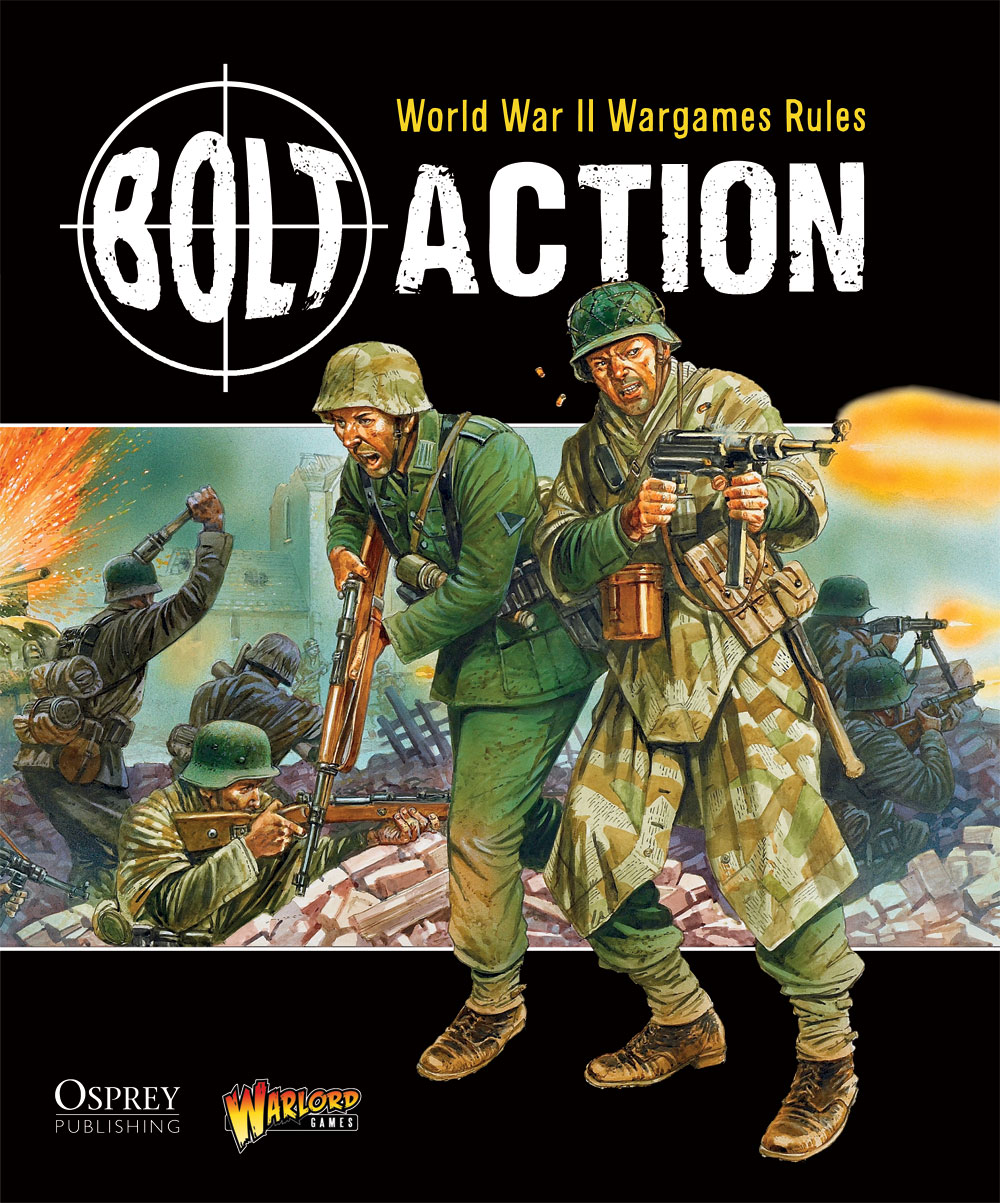
Enter Osprey Publishing and Warlord Game’s Bolt Action. It’s a fast paced man-to-model infantry game, with plenty of rules for tanks, artillery, transports and air support. I think I’ve found a set of rules that has drawn me back into wanting to paint, model, and play infantry WWII wargaming again.
The scale is set aside for 28mm. While Warlord Games are a likely supplier, there are plenty of other manufacturer’s for that scale. Also it seems that 1/48 scale model kits have become more commonplace than a decade ago. Still, I’m working on 1/72 scale troops (more options for tanks) and the default scale of ranges and table length seems to transition well. Table dimensions are based around 4′ x 6′ with most effective firing ranges for rifles at 24″.
The game is based on rolling a D6 or a pair of dice for resolution of most mechanics. What I enjoy immensely is the relatively streamlined approach to handling combat and morale. All the pertinent game rules can easily fit on a few sheets and some brief tables. I’ve become a fuddy-duddy with my wargaming. Simple works wonders for me and surprisingly there is a lot of tactical depth that can be drawn out of the game. As shooting and combat goes, players roll for individual models to hit against a set number with modifiers (most of them negative) applied to the roll. If hits are scored, players then roll for damage against a sliding scale based on the quality of the troops (poorer troops take more casualties than trained troops). Regardless if troops are killed, a pin marker is allocated to that unit.
Turn resolution is also done well. Rather than the IGOUGO system, or even alternate unit activation, players have a number of order dice equal to the units in thier force. A colored die is randomly drawn, and if it’s your color you get to activate a unit of your choice, otherwise your opponent goes. This random draw system is similar to Battleground WW2 and something I’ve always enjoyed. You might get a string of lucky (or unlucky) draws being able to activate several units, or sit aside while your opponent maneuvers around. Orders fall into typical ones like advance, move, fire, go to ground, rally, or set themselves on overwatch to react to any enemy. By default, units can always react to assaults too. All of this creates very fluid action with a decent dose of randomness. While you can activate a unit of your choice, you aren’t certain if you can activate a unit until that color die is drawn. If you have more individual units, you have more dice, increasing the likelihood you’ll get an order die when needed.
To add another layer onto the randomness of unit activation is leadership and the pin mechanic. As I mentioned, a unit taking fire gains a pin marker. If any unit has a pin marker, they have to pass a leadership test to successfully execute their turn order. Otherwise they stay in place and take cover. Additionally pin markers give a penalty to leadership checks which is cumulative. This adds a very important mechanic to the game. While you may not be able to eliminate a unit through casualties, you can effectively suppress a unit through volume of fire. As pins accumulate on the target, they can’t react as well and if casualties are inflicted, will likely result in the unit breaking.
It’s a simple, effective means to model the concept of suppression, and also reinforces the importance of unit training and leadership. Well trained, high morale troops can take more punishment. Poorly trained troops will likely panic, but under the wing of a good leader, press on despite being fired upon. Pin markers also are applied to armor units depending on the weapons fired. All in all I really enjoy this aspect of the game, where it’s not just the model kill count that matters (squints eyes over at 40k…).
There are rules for tanks, transports, gun teams, mortars, snipers, off board artillery and air support. Just about everything for a dynamic game. Bolt Action is point based, where players assemble a force based on an agreed total (usually 1000 points). Each force must have a compulsory headquarters (officer) and 2 infantry squads. Then they can fill their force out with other units. One particular part I enjoyed with the rules is that every special unit is limited to one slot. I can only support my platoon with either one tank or none. No taking minimal size infantry squads and then piling on 4 tanks to round out the force. You have to make a lot of hard choices, but have a lot of options available.
The rules detail 6 scenarios, one of which is a simple attrition-based game. Most of the others require maneuvering to specific areas on the table or holding objectives. A very nice rule to the scenario setup is that it can be decided randomly, further, players roll randomly to see if they are the attacker or defender. What I enjoy about this is the flexibility needed for your force composition. If you build your troops around being a static force, requiring ambush and defensive positioning, you may very well be attacking in a scenario where your objective is to exit as many units as possible across the opponent’s table edge. This encourages you to try an be adaptable to a variety of scenarios and roles.
By default there are several army lists for the major players (Germany, US, British, and Russia) right out of the book. There are more nation specific army books available and more in the pipeline (including the Pacific theater!). However all that is needed to play is the rulebook alone if desired.
The Good – It’s a solid WWII infantry ruleset. Task resolution is simple with enough variation on unit activation to make things challenging. There are enough rules to cover different infantry units, and also have rules for other non-infantry units. I’ll take a moment here to talk about the book quality. It is amazing. A nice thick bound book with plenty of color photos and diagrams. It’s well indexed with great rule reference sheets at the end. The book also has a decent amount of timeline summaries on major events within the entire historical period. It’s a professional job and shows the lovingly applied detail from Osprey Publishing.
The Bad – Some mechanics have wild variability and freaky luck can occasionally creep into the game. I see it more as its charm, and after giving a thorough reading of personal accounts of WWII combat, actually models events rather well. We like to approach these games as chess, where in reality things were much more chaotic. Still, there are some particular unit rules that can be a little ‘gamey.’ Folks might also be put off by the use of specialized order dice also (however a deck of black/red suit cards could be easily be used instead, and the rulebook allows for regular dice to serve as a proxy).
Another detraction can be the point lists. For competitive tournament play, I expect this is needed. However it does leave some room for min/max army lists where historical accuracy is dumped for that elite mixture of units. It’s a nature of point systems. I am particularly worried if power creep will come into the game with the future release of nation specific books. I can swallow these detractions for accepting the idea that each player has an opportunity to field a potentially equivalent force, but some players might be more happy with a gentlemen’s agreement on force composition.
The Verdict – Bolt Action is a fantastic WWII skirmish game. It’s not a simulationist game. Movement, terrain effects, and combat can be abstract but the resolution of these elements are simple and quick. Despite this simplicity, there is a surprisingly amount of tactical depth to the game. The random unit activation gives it just the right amount of unpredictability needed to make events which unfold during a turn more engaging than an IGOUGO system.
Most of all, the game is about maneuvering while other aspects of the game encourage holding position and firing. It’s a constant nail biting choice to either move your troops into a more advantageous position, or stick it out and hope you can inflict casualties with a fire order, or while on overwatch. The backdrop to this is the pinning mechanic. Throw enough fire on serious threats, and you can allow a unit to advance with some small measure of safety. It works and the streamlined mechanics for conducting all of this makes the game run well and be loads fun at the same time.
Review: Lords of Waterdeep
Lately I’ve been on a kick with worker placement games, especially with my reviews. I finally managed to snag a copy of Lords of Waterdeep and have gotten enough games under my belt to do a write up on it.
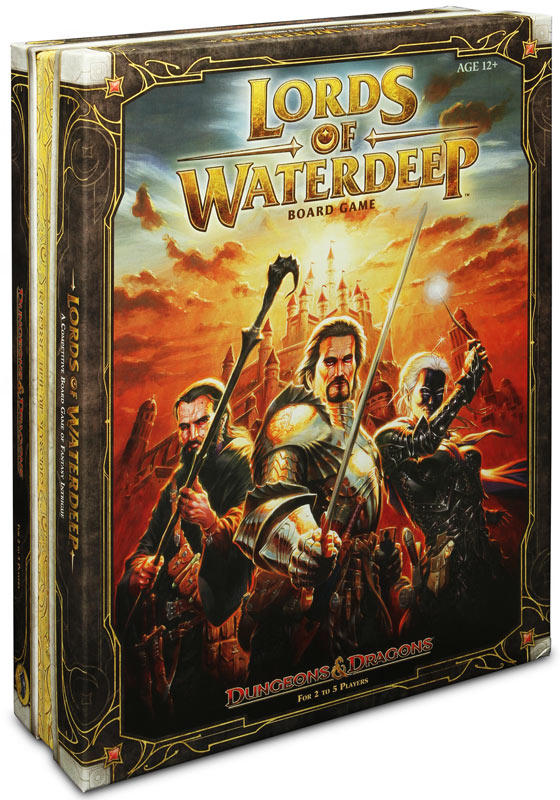
Lords of Waterdeep has 2-5 players acting as leaders of the many factions within this Forgotten Realms D&D city. Each player is seeking to gain influence and prominence within the city while undercutting their competitors. The goal is simple, gain the most victory points at the end of eight rounds.
Players gain victory points primarily through completing quests. Throughout a round they are constantly trying to gain different quests, and obtain the adventurers and gold needed to complete them. This is done by taking an agent from your pool and placing them at a key location within the city.
There are a variety of locations, and more buildings can be constructed to open up more areas in the city. Each location however can typically house only one agent. So players are constantly jockeying for the most ideal spot to gain gold and the right type of adventurers for completing quests.
A nice wrinkle to this are the constructed buildings. Each building constructed by a player is under their ownership. If another player assigns an agent to a building you own, you also get a small bonus. This sometimes makes for a difficult choice. Do they select to influence a building under control of another player? While they get the resources needed for a quest, they also are giving their opponent some reward too.
So far what I’ve explained is your typical worker placement game, where you try to squeeze out as many resources as possible and implement area denial for your opponent’s agents. A nice twist is the intrigue cards. These are cards that allow you to gain extra resources, or potentially force your opponent to complete a minor quest. This effectively bleeds off heroes recruited to tackle more profitable quests, messing with their plans. It’s a nice addition that introduces more direct player interaction.
There is one last change up to the game play. Each player at the beginning of the game secretly selects a lord they represent. These lords get bonus victory points for particular quests that are completed. At the end of the game, it’s quite possible for a player to get a huge bonus by completing a pile of specific quests. It can be a challenge to figure out what type of heroes are continually being sought, the types of quests slowly being accumulated, and deduce what lord your opponents are secretly playing.

The Good – It’s a very fun worker placement game. It’s just the right length, forcing players to try and get as much done as soon as possible. There is a fair amount of player interaction also using the intrigue cards. The artwork is well done and enough flavor text to give a bit of immersion to the game. It has great components with a nice linen finish on the cards, plenty of wooden pieces, and thick cardstock for building tiles and coins.
The Bad – While the secret lords are an interesting facet, for the most part it adds a ‘gotcha’ aspect of the game. It can allow for a truly huge endgame surge to a player’s victory point total. The assignment of the lords are secret and random with bonuses applied to two different quest types. Completed quests are stacked up in a pile (effectively being hidden), and can all make it more a guessing game to figure out what types of quests your opponents are working toward.
The theme is different and has that fantasy touch, but in reality you are collecting different colored cubes to complete work orders for points. The artwork and fluff text could be given a sci-fi theme and you’d have the same play experience. It just doesn’t capture that feeling of recruiting adventurers and undergoing heroic quests. It really could easily be some generic abstract economy worker placement game.
I’ll also quibble about the box. At first I thought the box insert was well designed, but after some use I drastically changed my mind. It’s just too finicky to put the pieces back in, needing to be ‘just so’ and worse of all, the box has to remain flat. If the box is propped up on it’s side, expect parts to fall out of the insert and shuffle around inside. I quickly threw my insert out and put everything into baggies.
The Verdict – Lords of Waterdeep is a great game. It’s the right game length and complexity to make it very approachable to a variety of gamers. There are a lot of subtle working parts to the game, especially acquiring and using the different buildings and their powers. It also has that interaction from intrigue cards that goes beyond your typical ‘grab a space before your opponent’ seen in most worker placement games. Like Kingsburg it has that depth of different building strategies and a little twist in game play to make it stand out.
To be honest, I shied away from LoW when I first heard about it. I just don’t get into WotC board games much. But the buzz around this was humming and I took the plunge to buy it. I was pleasantly surprised. I’ll also add you don’t need to have any knowledge of Dungeons and Dragons to enjoy this game, anyone can easily jump in and have a grand time. It’s a great, fun game and likely one of the better worker placement games out there.
Review: Zombicide
Likely one of the bigger splashes in the zombie board game craze came out the latter part of 2012, Zombicide, from Guillotine Games. It’s a 1-6 cooperative player game (yes, you can play it solo), where folks are survivors trying to keep alive in a zombie apocalypse.
The game itself revolves around 10 different scenarios (not including a simple tutorial) using different layouts and some variety in victory conditions. For the most part winning a scenario typically involves gaining specific objective tokens and/or getting to a specific location. However there are a few that mix it up, such as just getting one player to survive an escalated zombie danger level. Players can pick one of the 6 different survivors, that each have various starting abilities, and get access to different ones as they gain experience killing zombies.
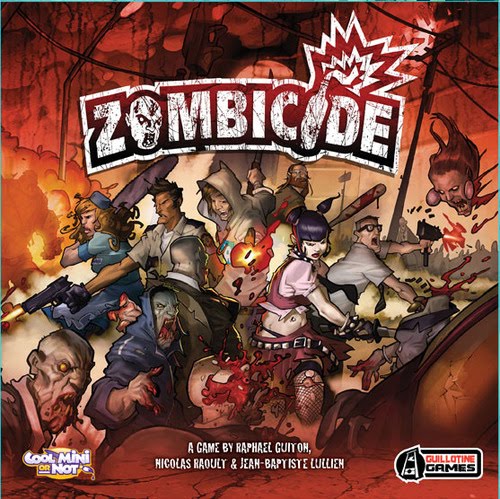
The play is divided in turns. All players get a specified number of actions for their survivor. Then the zombies take their actions with more spawning at the end of the turn. A neat little part of the turn order is that a first player token continually passes to the left at the end of each full turn, meaning the person that went first will go last on the next turn (and could take a while before being able to act first again in a 6 player game). This structured turn order can hamper the player’s plans, as you might want to move a player out of an area first before another player can shoot up zombies. However with the locked turn order, this might not be possible making some hard choices.
Combat against zombies is a simple affair. Roll a certain number of dice trying to roll over a particular value. Players are dependent on finding weapons and can’t attack with their fists. So typically each turn, they will be searching areas for better gear. Different gear can modify some weapons, and particular weapons can be dual-wielded (allowing for more attacks in a single action). There is also a smattering of non-weapon gear to help (like a handy flashlight). Players can always opt to move out of an area with zombies, but each zombie present requires an additional action. Too many zombies means the player is stuck huddled among the walking dead.
Another factor to consider when using a weapon is the noise it makes, with some being silent. Smash open a door with a fireaxe instead of a stealthy crowbar and you produce excessive noise. These noise tokens can have a huge impact on the game during the zombie turn causing them to migrate to areas with a lot of noise. As such, players can even spend actions making excess noise if needed.
Lastly, the game is very unforgiving with ranged attacks. If using a firearm in an area that has both survivors and zombies, hits are always taken against the survivors first. While it might be tempting to unload those dual submachine guns into a pack of zombies surrounding your buddy, you can pretty much guarantee wiping that survivor out (along with the zombies). Players also have access to cars that are fantastic zombie-killing machines, but are also very indiscriminate with taking out fellow players. This severe limitation on ranged combat means you either position yourself carefully, or just accept friendly fire is part of the natural order in a zombie apocalypse.
When the zombie turn rolls around, everything is done as a list of steps. Zombies attack players in their current area. If there are no players to attack, they shuffle off towards players they can see. If no players are present, they move towards the areas with the most noise. At the end of the turn, more zombies spawn and all the current noise tokens are picked up.
Zombie attacks are particularly vicious. Each attack will automatically cause a wound and force a player to lose a piece of equipment. Suffer 2 wounds and it’s zombie chow time with the unfortunate player being eliminated. That means if a player is stuck in an area with at least 2 zombies, they are toast. Compound that with particular runner zombies that take 2 actions instead of one (move and attack, move twice, or attack twice), and you’ve got some situations that are very deadly for survivors.
As zombies shuffle towards survivors, different paths may be possible of equal distance. When these situations arise, if the group can split evenly they do so. If not, more zombies are added to the mix to evenly divide the groups. This constant spawning of additional zombies means survivors are trying to prioritize a single route for the zombie horde.
Spawning of additional zombies are also done randomly using a deck of cards. If there are not enough zombies to bring on the board, each zombie of that type takes an additional action. This can create absolute havoc in the game. A player that might have had enough actions next turn to slip away from a group, could suddenly be zombie lunch due to that extra action, or switch from being a safe distance from a horde of walking dead, to being surrounded with no clear way out.
A cool aspect of the game is the various levels of danger for spawning zombies. As players kill zombies and complete objectives, they gain more experience. On the plus side, they gain more abilities and actions to take during their turn. The huge minus is that the danger level increases, adding more zombies to spawn areas. An important rule to this is that zombie danger levels are totally dependent on the player with the highest experience. Say the group has been cautious and trying to use stealth keeping everything in the blue level. It just takes that one crazed player with a submachine gun, quickly dispatching a horde of zombies, to suddenly ramp up the difficulty.
This creates a very powerful draw to the game. You can only hide and be stealthy for so long. As there is a limit to the different number of zombies, when there are not enough to put on the board that extra zombie action can rear its head. This can suddenly snowball with a survivor being overwhelmed, to players being forced to wipe out a horde. Have 2 players cut through a group, they’ve bumped up the danger level. While those 2 might be zombie-killing machines, the other survivors without many kills (and less experience) will be less able to handle the increased zombie spawns. Things build, and build, until it becomes this chaotic mess of crawling undead with players frantically trying to figure out what to do on their turn.

The Good – It’s a very fun zombie game where players find a decent balance of trying to be stealthy and hacking into zombies when needed. There is a fair number of scenarios in the book to give the game some replay. The rulebook explains the nuts and bolts of the game pretty well with lots of diagrams, examples, and there is a great, single sheet, quick overview of the rules included. I particularly like that everyone is working together and the zombies are handled without needing a player.
I’ll take a moment to also talk about the components. They are fantastic. The boards are double sided and, like the tokens, made of nice, thick cardstock. The cards are just the right size and seem thick enough to be handled without worrying about nicks and marks. The artwork in the rules, cards, and board pieces are very well done and evoke that feeling of being thrown into a zombie horror game, without being overly gory and avoids being too cartoony at the same time.
The game pieces are also amazing. Nice single plastic pieces with great detail and variety. Each of the survivor pieces are a different color, which is a nice touch (I’m looking at you Descent). The figures are also packed in plastic eggshell trays, meaning if you take the time to paint them up, you don’t have to fret about figuring out how to store them in the box. The sculptures of the figures are great and really capture the zombie theme with the survivor minis having a lot of character.
The Bad – Sadly, there are a fair amount of flaws with the game. It can be brutally unforgiving with how zombie combat, and player ranged combat, resolves. I think of the two, the ranged combat and friendly fire is particularly aggravating. The game also does not scale well with different number of players. Granted some scenarios state that they are best with a certain number, most still seem very difficult with less than 6 players
While the zombie turn is pretty well explained, as it is a step-wise automated turn, some odd situations can arise. This is compounded with the players having different abilities and gear. This can lead to some head scratching while flipping through the rules (expect to also print out the FAQ on the game). Not to mention one scenario being completely broke to the point of allowing survivors to cruise to an easy win (again, a revised version of the scenario is available online).
This last point sticks in my craw a bit, likely because some of the funding for the game was so public. Zombicide was an enormously successful Kickstarter project. You figure with all that money there was enough playtesting to make sure all the scenarios worked well. Or how about another 4 printed pages to further explain the rules and provide a few more explanations?
Player elimination can also be an issue. It’s possible with a bad draw and positioning to get a player eliminated early in the game. Some of the games can get a bit longish, especially if several objectives are to be picked up and survivors need to reach an exit. While the game can handle 6 players, I’ve found having less more ideal (with players handling multiple survivors), as that extra survivor can be shuffled off to a different player if needed.
The Verdict – I cannot recommend buying this game. There are many pluses, tremendous pluses, to this game. It is fun. It does capture that feeling of things slipping into absolute chaos being overwhelmed by zombies. There are meaningful choices and strategies players need to tackle in the game. The components and figures are fantastic. However out of the box, along with the $70+ price tag, I would hesitate recommending it. There are a limited number of survivors to play and with a set number of scenarios. I think a feeling of sameness can creep into the game.
The game has rule quirks, forcing players to slip into set tactics and strategies. You have to try and level everyone up equally. When a door is opened to a building, you have to resolve spawns of further zones first and work towards the doorway (otherwise if forced to take extra actions due to not having enough zombies, you can be overwhelmed instantly). The friendly fire from guns is particularly damning (we’ve opted to ignore it, instead all misses are rolled and a 1-2 hits a friendly).
Granted, Guillotine Games has done a lot to address these negatives. They have additional scenarios online. Not to mention a decent FAQ and reprinting of some rulebook scenarios fixing the broken victory conditions. There are additional survivors that can be printed out, allowing for some variation in player choices.
At the heart of it though, I think Zombicide slips into the same problems as Super Dungeon Explore. There is a great game at the core which is saddled down having too much of the price tag going towards the components, rather than the rules. The minis in Zombicide are great. They absolutely scream to be painted up. But I keep wondering if most of the zombies were cardboard tokens instead. If the price was dropped down to about $40 and a tad more tweaking with the rules (say an ‘easier’ variant regarding gun combat, and a ‘hardcore’ option as per the rules). Maybe another 2-3 more scenarios or survivor cards to boot. Would that bump this game from being a decent board game to being a must have? I think it would.
Zombicide is a fun board game. If you have a group that loves the idea of fighting off hordes of zombies, it is very much worth getting to the table. However if you are a group of players that want a game out of the box that doesn’t require a bit of house ruling, and are not particularly endeared to the walking dead, I would pass on this one. I am a miniature fanatic. I love to paint minis. However as a strict board games fan, Zombicide is a tad lacking, and likely the miniature components bump up the price to just nudge it into that category of a no buy.
Review: Descent – 2nd Edition
Fantasy Flight games has finally released the 2nd edition of Descent, their classic dungeon exploration board game. Players form a group of heroes to face off against a single player that acts as the evil Overlord. While it might pitch itself as an adventure game, in reality you have a pretty tactical skirmish game that captures that feeling of a fantasy dungeon crawl for up to 5 people.
The game revolves around several specific scenarios. Many of them form a two part quest, with the outcome of the first quest having some bearing on the second part. The heroes are helmed by up to 4 players. Each player has a choice of 8 heroes. Further, each hero can then select one of 2 different class types representing different starting equipment and abilities. The player in the Overlord role plays the opposition, running the various monsters that the other players will fight against.
Play moves around turns, with all the heroes taking two actions for their turn, followed by the Overlord taking two actions for the different monsters. Actions include opening/closing doors, moving, attacking, recovering fallen heroes, to even searching for treasure. All actions for the heroes can be repeated (allowing for 2 attacks if needed). While the Overlord has a similar turn structure with some limits (each monster can attack only once).
If players want to move further, they can gaining additional fatigue represented by counters. Many special abilities also utilize fatigue. This makes for a game currency that allows the player more flexibility during their turn. They might search a treasure chest gaining a healing potion, but be stuck not being able to use it on a fallen hero. Using fatigue, the player can now move those additional squares needed to get to a fallen comrade, and use their second action to offer that newly gained healing potion.
While the Overlord player cannot use fatigue, they have access to a deck which allows them temporary boons to the monsters, or other cards they can play during the heroes turn to hamper them. This gives the Overlord a chance to pull out a trick or twist to the usual predictive monster turn, and possibly muck up the heroes.
Combat is a simple affair rolling custom D6s pairing damage against defense dice of the target, with the attacker inflicting damage if exceeding the rolled defense score. Ranged attacks also require a certain number to be rolled depending on the distance. Meaning not only does enough squares in range need to be rolled, but also enough damage to overcome defense rolls of their opponent. What stands out is that one die has an ‘X’ on one face, indicating a miss regardless of the other dice. So attacks always have a slight chance of missing.
A small twist to the dice rolls is special surge icons. These can be spent to add small bonuses to damage or range. They are entirely dependent on the different equipment and powers wielded by the hero. Additionally the monsters have surge abilities too, including some special characteristics depending on the monster type.
What results is a nice mix of tactical play with just the right amount of luck. Players have a lot of meaningful choices, like deciding to gain those 2-3 counters of fatigue to get a bit closer to an enemy, almost ensuring an attack is in range. As with the Overlord player, heroes have a limited number of actions, so there is a fair amount of thinking and decision-making to optimize their actions from turn to turn.
Combined with the surge abilities and static powers (with both the monsters and heroes), combat is a fast and fun affair. Defeated heroes always have the opportunity to pop back up on their feet later, and the Overlord can continually respawn most minion-type creatures (or gain reinforcements), meaning everyone always has something to do on their turn. Also the different D6 dice have a disproportional number of pips for damage and defense. Some dice are more ideal than others for attacks or defense, and scrambles the probability a tad more than your usual 2D6 array of standard dice.
I have not played the first version of Descent. However I’ve heard chatter the game could slip towards the longish side and that heroes could either be completely overwhelmed, or once enough treasure was gained, completely roll over the Overlord player. This isn’t something I see much with the new version.
What I particularly like about the 2nd edition is that each scenario has specific endgame and victory conditions. It’s broken down into small chunks of gameplay that can be easily tackled during a night. Also my impression from a few games is that for the most part scenarios seem balanced, and I haven’t had the inclination to pull any punches as an Overlord. Also while the victory conditions and layout are set, the Overlord does have some wiggleroom for deciding some of the monster opposition the heroes will face off against.
One nice feature is that it can be played as a bunch of one-off scenarios, however the game also incorporates a campaign mode. There are 16 stand alone scenarios, and up to 20 missions for the campaign. Heroes and the Overlord both gain experience each mission, allowing for additional powers (or additional cards for the Overlord deck). Even gold can be earned searching for treasure that can be used to pick up more advanced armor and weapons for the heroes back in town. What I particularly like is that the outcome of each scenario has some impact on the following campaign missions, which can alter the path the heroes take towards completing the campaign arc.

The Good – Descent is a fun fantasy dungeon crawl. It has the right complexity to make it a challenge and still have enough streamlined play to get in a few sessions during a game night. The rulebook is well written with plenty of examples. There are a lot of different class combinations and the Overlord has some choices for their forces for a quest too. So even with the scenario limit, there is a lot of room for replay. The game scales very well with different number of players, allowing smaller groups of heroes to experience a challenge.
The components are gorgeous. Map tiles and counters are made of thick cardstock and colorful artwork that is very evocative of the theme. The figures that come with the game are very detailed and made out of stiff plastic, giving a very visual element to the gameplay (and simply cries out to be painted up).There is a plethora of cards for abilities, equipment, treasure and combat conditions. Allowing for bookkeeping at the table to be handled with the components alone and not require a pencil and paper.
The Bad – While the rules are well written, there are some times where you might need to look over the FAQ to clear up some muddied points. Additionally, this isn’t a simulationist game. It’s very much a board game and the rules ‘as written’ might occasionally hinder that player wanting to do something more heroic.
Also, the game is very much a gang up on a single player. You have that one person managing a lot of monsters as the Overlord, and the lopsided team might not sit well for everyone. A workaround however can easily be attained, as there are lots of different monsters to field for each quest and the Overlord role could be split between 2 players if desired.
The layout and opposition are fully realized for each quest, along with the victory conditions, meaning it doesn’t quite capture that feeling of dungeon exploration. Also while there are a lot of potential combinations for class abilities, equipment, and Overlord monsters, there is a limit to what is in the box. Eventually you may have that slight feeling of ‘sameness’ that creeps into the game.
There is a lot that comes in the box. While I applaud having bits to keep track of the game without the need for paper and pencil, at the same time you will have to make an effort to organize the game components. Plastic baggies are a must for the game, and card protectors wouldn’t hurt either.
The Verdict – The second edition of ‘Descent: Journeys into the the Dark’ is a great game. While you can easily pick it up and play out a single quest for the night, it cries out for more frequent play and the campaign format. There is a good chunk of variety in the class abilities and room for progression for both the Overlord and heroes, which gives the game some legs for replay. The quest victory conditions are varied, and usually have both players trying to achieve some objective. This means that each side has to be proactive and can’t just sit back in static attack or defense roles.
I would garner to say that Descent might be also an excellent entry point for non-RPG players into the hobby. At the core, there is that tactical combat relying on teamwork and character progression that gives a nod towards traditional fantasy RPGs. For someone completely unfamiliar with RPGs, this might be a decent stepping stone to getting them acquainted with the hobby.
For the rest of us, you have a deeply enjoyable dungeon delve board game. It hits on just about all cylinders, capturing the theme and feel of your typical fantasy adventure very well with lots of monsters to fight, treasure to find, and powerful abilities to acquire. The components and play are well thought out and all the moving pieces of game play work great. I highly recommend picking it up if you are itching for a dungeon crawl type of game.
Review: Stone Age

Stone Age is a worker placement game for 2-4 players from Rio Grande Games. It has an interesting theme as you are a chief during prehistoric times, trying to ensure your tribe’s survival and success over other neighboring groups within an expansive valley.
Players try to complete buildings and accumulate civilization cards, scoring points as they do so. When the supply of building or civilization cards is exhausted, the game ends with the player having the highest point total being the winner.
Play rotates with each player assigning various members of their tribe to different areas within the valley. It’s a worker placement game with limited open spots for each area and is competitive. Once all the spots are claimed, no one else can put workers in that area.
Some areas produce resources, some gain civilization or building cards (for victory points), and others allow you to gain extra workers. Some are open to having a few different tribes working an area, however most are painfully restricted to just a few workers from a single tribe. While each area can hold a finite number, the only exception is the hunting grounds where all excess tribe members can go hunt (at least allowing some potential food resources to be earned).
Resources are primarily gained by dice rolls, with the total divided by a specific number that varies depending on the goods being produced (the lower the number, the easier it is to produce). Players roll dice equivalent to the number of assigned workers, so the more people in an area, the more likely goods will be produced. The dice total is rounded down with excess numbers being ‘lost’.
The workaround for this is having a supply of tools. Tools can be used to add to the dice total, allowing for an extra good to be produced. Tools themselves need to be produced by assigning workers (which in turn take them away from producing goods, erecting buildings, or gathering food).
At the end of each turn, players must feed their tribe. Hopefully, between gaining civilization/building tiles, actively hunting, or by some farming there is enough food on hand to feed everyone. If not, resources are given up in place of food, and if that is not enough players are docked victory points. You must feed your people every turn and increases in population mean more food is required.
Farming is a slow process, and you are not guaranteed a spot to assign workers each turn to increase your food production. Hunting can earn food fairly easily, but that means you are diverting workers from other resource gathering tasks. Players soon find themselves in a balancing act trying to gain resources and points, all the while ensuring they have enough food from turn to turn.

The Good – It’s an entertaining worker placement game with a different theme. There are some hard choices to be made and players will always find themselves with not enough people to do what they want. The added wrinkle is that other players can easily lock out other players from prime tasks for a turn. All the while, food stocks are slowly being used up, creating another pressure of having enough food for everyone each turn.
The components are very nice, with thick card stock tiles and nice resource components. The artwork is colorful and captures the theme quite well. The overall design of many of the civilization and building cards are well done, with the use of symbols being a prominent feature over text.
The Bad – At the heart of Stone Ages is it can be worker placement game at it’s worst. Players can lock down locations or building/civilization cards without the resources needed to claim them (and no penalty if doing so), effectively cutting off other players just because they can.
My biggest complaint are the civilization cards. These are used for massive point scoring at the end of the game and need to be collected in sets. While I don’t mind the huge bonus victory points that can be earned during the endgame, the scoring conditions can be cryptic at times. Each civilization card has a lot of symbols and it can be difficult to easily decipher them. As they are so critical to scoring points, it can be frustrating for new players to figure them out.
The Verdict – A few years ago I would highly recommend this game. It’s challenging, requires a fair amount of planning, and has a different theme from most of the other worker placement games out there. However there have been quite a few releases over the years that are a bit more streamlined in play.
The ding in rating this game for me are the civilization cards. I don’t play this game frequently enough, and it is always a slight learning curve to work out the sets and determine how many victory points are awarded. As this can make or break your game, you really need to plan out what civilization card sets to work on early in the game. Since it is so important, it seems that it’s glossed over a bit in the rules. I really wish that Rio Grande bit the bullet and printed out a single color page, detailing how to score these cards more.
Despite this, Stone Age is a fun and challenging game. If you haven’t delved too deeply into worker placement games, it’s a nice buy and a great family game. However, if you have a few worker placement games in your collection, I would be hard pressed to suggest picking this up. It doesn’t have much that stands out from other games as most of it is about locking out other players and working on sets of cards for scoring. I think there are some other similar-mechanic games that do it a bit better and are more entertaining (Kingsburg as an example). Stone Age is a fun game, but think twice if you’ve got a few worker placement games on your shelf.
 Geek Ken