Category: Review
Review: Essentials Rules Compendium
 I’m thinking about what 4E books I’ll keep and what I’ll get rid off. I imagine that a lot of 4E stuff will start getting pretty cheap to pick up. I never did get into 4E essentials, but I have picked up the Rules Compendium for the new essentials line.
As a quick overview, the book is a hefty volume covering all the rules fit to print about 4E, updated and incorporating the various errata that has trickled out from WotC since the release of the new edition over 4 years ago. It is packed with text going into detail about just about any rules question that would likely pop up during a game, with plenty of examples and a fair amount of artwork. All in all, a fairly good volume for a ‘rules book’.
There are a few new tweaks to the existing rules buried in certain chapters. The skill DC values have been modified bumping up the values for most checks. Also higher level skill challenges utilize an advantage system. As players score successful checks, these are little perks to give the players a chance to get more successes as the challenge progresses.
Treasure now can be classified by rarity, with items having a flat bonus being common items. Most items with a daily ability fall within the uncommon to rare range. Again, a nice idea giving the DM a little more guidance on how items compare with each other, rather than just being based on the relative level. This rarity also translates to the value of an item, with more rare magic items fetching a greater price.
There are some other nice additions. Randomized treasure is a possibility now, with a DM rolling several times to determine the amount of coins, gems, artwork, or possibility of getting a magic item. Still not quite that definitive D100 chart, but passable. I also like that the standard arrays for ability scores have been expanded a bit. Two options of a specialized array (maxing out a key stat with an 18), or dual specialist are now choices (2 high stats of 16). Which is nice to give those looking for a quick build another option besides the point buy arrays listed.
I also really liked the skills section. Not only do they give a run down of each skill, but they also give a little summary of some out-of-the-box uses for skills. Some great information for both players and DMs to see how skills can be stretched and applied as unique solutions to problems.
However as I started to go through the book, I became to realize more and more what was missing. I figured this would be a comprehensive ‘go to’ book for just about any rules question. Instead I found some things to be what I consider as glaring omissions. This leads me to the problem I see with the Rules Compendium, a lack of focus for its audience.
This book was rolled out with the essentials line. I imagine it was marketed as the ultimate rules resource for players and DMs alike. At the same time, the book had been hyped as a great buy for the guy that’s been with 4E since launch, and this book finally has all the updated rules in one volume, all at their fingertips. Because of being tied in with the essentials line, I tend to think there are some critical parts of the book that have been left out, simply to be covered in other products. If you are an essentials player, no worries. But if you bought this book to serve as a one volume rulebook for older 4E material, you are out of luck.
This mixed bag also rears up with some of the material presented. The powers section covers a small explanation of augmentable powers, which is great. But then in the first chapter you find quite a few pages dedicated to explaining roleplaying games and what D&D is all about. Not to mention quite a few tips for new DMs running their game. Good info is there, but I tend to think shouldn’t the new DM material be presented in the essentials Dungeon Masters Kit?
Again, if the Rules Compendium is going to straddle that line between brand new players and folks very familiar with 4E, and also with both players and DMs alike, there is quite a few missing chunks of rules. This is a slight for a book that claims to be a definitive rules compendium.
No rules for rituals (a little information provided in a sidebar, but still missing some key points), and the same could be said for alchemy. Nothing on feats, especially those related to multiclassing. Nothing on class hybrids either.
Do we need a complete list of every feat or ritual? Nope. However just a summary of the nuts and bolts rules would have been great. How does a player obtain and master a ritual? How many rituals are in a PC book? How do choosing multiclass feats differ from regular feats?
This isn’t just the player side of things either. Why not provide rules for designing traps? At least have the chart for typical damage output for a given player level please. How about the monster design rules? Even a quick summary chart for creating a monster of a specific role (covering the attack bonus, damage output, and defenses per level), or typical minion damage per level would have been great. I’ll also take a moment to point out what I consider a glaring omission, no weapons table. Not even a typical equipment cost list. For a book trumpeted as a handy reference, I’m astounded this was not included.
This last part is also a quibble, but how about summarizing some of the more key tables and charts in the back of the book as another appendix. Yeah, I don’t have to flip through 4 different books to find something now, but I’m still flipping through pages with this book to find the right chart (I guess the deluxe DM screen that came out covered that).
The Good – There is a lot in this book. Much of it is well presented and the ease of reading it (avoiding a lot of rules heavy language) shows through. I’m a fan of the concise format and it encourages people to grab it, throw it in their backpack, and go game somewhere.
The Bad – I think it suffers from trying to be a book for both the essentials only crowd, longtime 4E players, and serve as a guide for DMs and players all at the same time. Trying to cover everything in a single manual likely meant something in the rules had to be left out. And I tend to think these omissions keep the book from really being a stellar product.
The Verdict – For a brand new essentials player, I’m unsure if this is something they would want. I think much of the material is in the red box and a lot more has trickled out in the player’s series of books (Heroes of the Fallen Land) and the Dungeon Master’s Kit. They have quite a bit of rules in only a few books, and much of it is not heavily modified by errata. For the longtime 4E player, I think they will get a bit more out of this book.
This book is at my gaming table when I play 4E. I like using it. I’m glad I bought it. If you hit the convention scene a lot (or need to haul around a lot for games at other people’s houses), the availability of a concise book of updated rules for 4E is nice. But the omissions from this book means I still have to crack open the occasional DMG and DMG2, even the PHB sometimes (or move to the online compendium which is likely going under). I think if portability is an issue, buy this book. Otherwise I think this is an optional buy. Nice to have, but not quite an ‘essential’ rulebook.
Review: King of Tokyo
Who doesn’t want to play a giant monster rampaging through a city, duking it out to be the King of Tokyo, and Iello games allows you to do just that.
A competitive game for 2-6 players, each person plays a giant monster laying waste to either the city before them or each other to claim victory. Play centers around a Yahtzee mechanic, where players spend their turn rolling a pool of dice, selecting those to keep and which to reroll. After three rolls players either score points, inflict damage to other monsters, heal themselves, or gain energy which they can spend on special abilities. The first to 20 victory points (or the last monster standing) wins the game.

Smashing other monsters requires a player to step up and become King of Tokyo. The lone monster inside Tokyo gains victory points for each turn they remain there. They cannot heal themselves, and all attacks from other players are directed towards them. On the flip side, all damage caused by the King of Tokyo monster is inflicted on all the other players.
The game plays out like a variant of king of the hill. It’s very tough to remain the King of Tokyo for long. However the constant earning of victory points and ability to do tons of damage to other players encourages people to push their luck, and try to stick it out for just one more turn. On the flipside, you become everyone’s beating post and can only heal up if you step down from Tokyo, lick your wounds, and try to take the spotlight again on a later turn.
Players can (and will) be eliminated. It’s a classic beatdown on the leader until a new monster steps up to take over. And each turn a player will typically juggle with either trying to eek out a few victory points, or smash the King of Tokyo (or other players if you are the current King). What works for this game is the extra twist of special abilities and the small economy mechanic of spending energy.
Players can also focus on gaining energy when they roll their dice. This allows them to buy special powers from a pool of face up cards which are either one shot powers, or permanent bonuses. They do a variety of abilities, from being able to heal while in Tokyo, to inflicting more damage, to even earning additional victory points. It’s this small addition of the power cards that gives the game an additional push from being a simplistic elimination game to allowing for room of some strategic choices.
The Good – It’s a fun, light-hearted, competitive game with simple rules. Surprisingly players have a lot of choices during their turn, with a lot of direct interaction and the ability to snag up particular power cards before their opponent. There are a variety of paths to victory. Allowing a player to focus on victory points, smashing other players to bits, or a little of each. The components are nice and bulky, and the artwork is colorful and whimsical.
The Bad – This is not a heavy strategy game. It’s a push your luck game that can be heavily influenced by good (or bad) dice rolls. While it has an interesting theme, it’s not too heavily draped in it with the mechanics. You aren’t really smashing through a section of the city and everything is represented as very abstract points earned through dice rolling. So it may not quite have that ‘Rampage’ feel that some might expect. While you can play with 2 players, the game can be lackluster with so few people.
The Verdict – King of Tokyo is a light, monster smash game that is short enough with just the right amount of complexity. You aren’t going to have a complete game night revolving around this game. You will however easily have 2-3 quick bouts to see who is the toughest monster on the block as you gleefully tear into each other, picking up special powers, and laying waste to the city of Tokyo.
It’s a great, light, filler game, that is quick and enjoyable. While some might be put off by the elimination aspect of the game, it’s has just the right game length to not make it an issue. The simplistic rules are also a plus. Highlighting the fun, quirky theme of the game, with surprisingly enough choices and interaction to make the game worthwhile playing. A great game to add to anyone’s collection and a decent family game to boot.
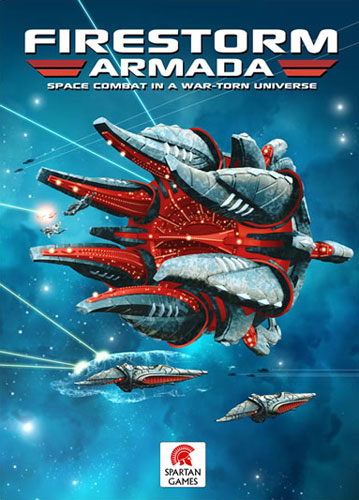
Review: Firestorm Armada
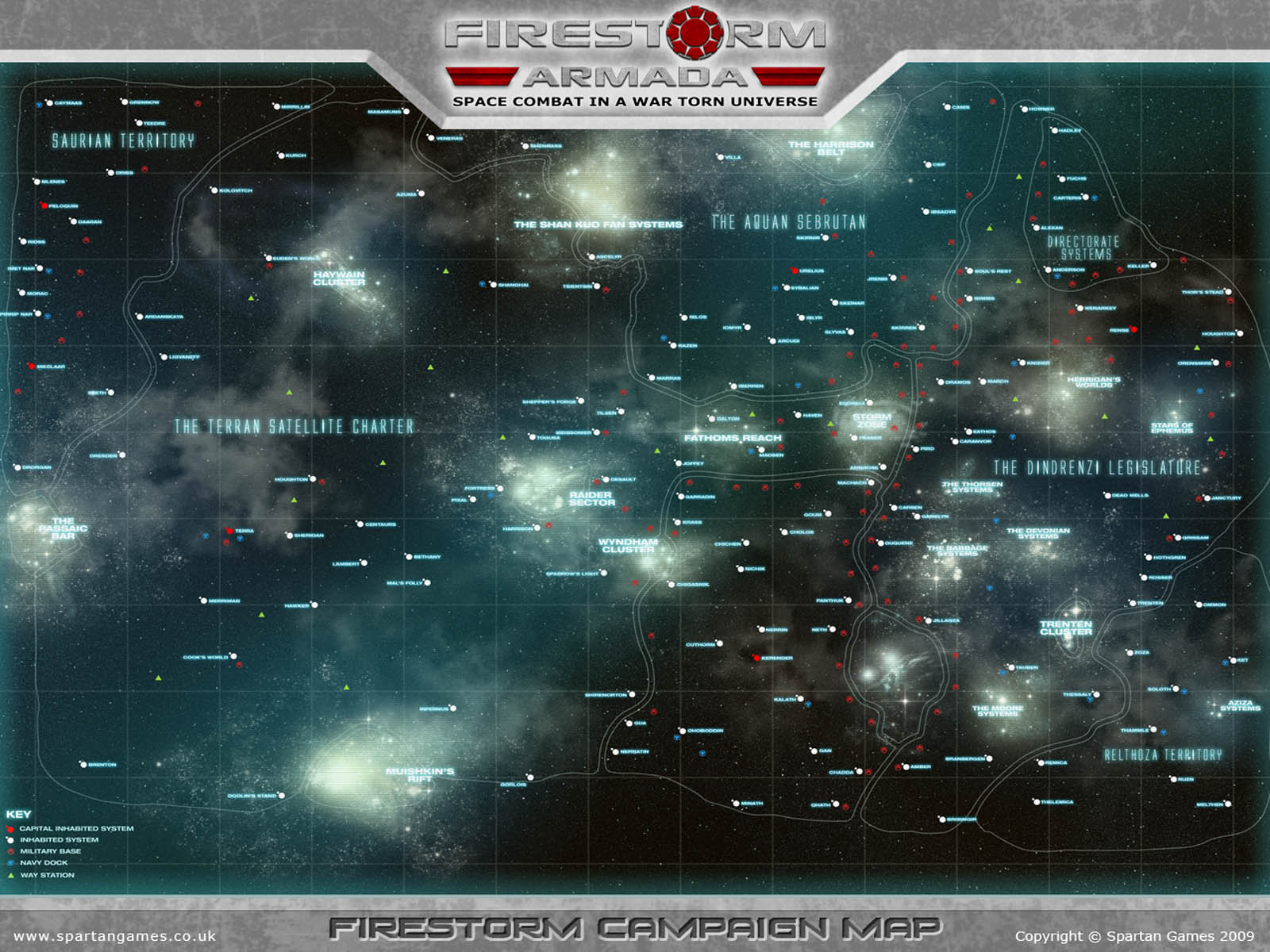
Firestorm Armada is a space naval combat game from Spartan Games. There is a hardback rulebook that has been recently released. I haven’t gone through it extensively, but for the most part, not much of the game mechanics have changed from the first softback edition.
A snapshot of the background for the game universe is that mankind has discovered FTL drives, explored the stars, established many colonies throughout the galaxy, and in the process have encountered a handful of alien races. On the periphery of human-controlled territory, a faction of mankind has sought for independence. These two political factions of humans have begun a civil war that has expanded into a larger interstellar conflict, with different alien races pledging allegiance to each of the respective factions.
In Firestorm Armada (FA) each player commands a fleet of ships based on a point total, with some hard limits on the % composition for certain ship types. Players roll for a turn initiative, and alternate turns activating one ship squadron at a time. Squadrons can be independent fighter wings, a group of frigates, up to a single battleship. Each activated squadron moves and then resolves their fire, with the opponent doing the same with their forces. I enjoy this as it adds some tactics to deciding which group to activate, much better than a typical I-go-you-go for your entire force seen in other games.
The focal point of ship firing and movement is the base stand. Nearly everything decided from firing arcs to turning is based on the square stand your model is propped on. Targets are deemed in certain arcs based on where the center of the base sits, not on where most of the target model is. I like this as adds some uniformity to the rules, especially when working out what firing arc a target is residing in. It’s a nice simple way to streamline play and quickly resolve any sticky issues.
Ships move at a relatively constant rate, and have a minimum move distance. Turns are hard-capped at 45 degree increments, interspaced with requirements for moving straight ahead. Generally, the smaller the ship, the tighter it can turn, with larger ships being required to lumber forward more before committing to turning. Ships are considered to be able to move through each other and use a concept of ‘vectoring’, where they can shift in small increments to avoid stacking bases on other models.
I’ll admit that it throws any concept of physics out the window for movement. Full Thrust had a much better system where ships could constantly accelerate, but had a more difficult time turning a higher speeds. In FA, doing a full stop requires a half turn of movement to do so. Yet, once they stop there are no directional changes that can be made. Ships can’t slowly rotate in their position, they have to couple turning with straight movement. Additionally, models must move at least half their speed. If they opt to do nothing (including not firing weapons), they are limited to drifting straight ahead 2″. The movement is clean and simple, but doesn’t effectively use a z axis. This is especially true with certain terrain types, as planets are considered impassable terrain.
Firing at other ships is based on uniform range band increments and firing arcs. Some ships have additional firing systems like turrets that are more flexible, to specific arc channels that are more restrictive than the typical 90 degree firing arcs. Each range band has a number of attack dice that can be rolled to see if they inflict hits. As expected, longer ranges have very little dice pools, and the closer the target, the more dice can be rolled. As a nice twist though, there is a sweet spot with the range bands. Get too close and there is a drop off in the damage that can be done.
In addition to firing arcs, ships can link up fire with other ships within their squadron. They can also split fire with different weapon systems on their ship. So it is possible for a ship to open full port broadsides into one target, and throw its turret weapons to support another weapon volley with other ships in its squadron (or unleash another volley of fire from another arc into a different ship). The larger the ship, the more diverse the weapon systems meaning those huge battleships can lay down an impressive amount of fire to different targets.
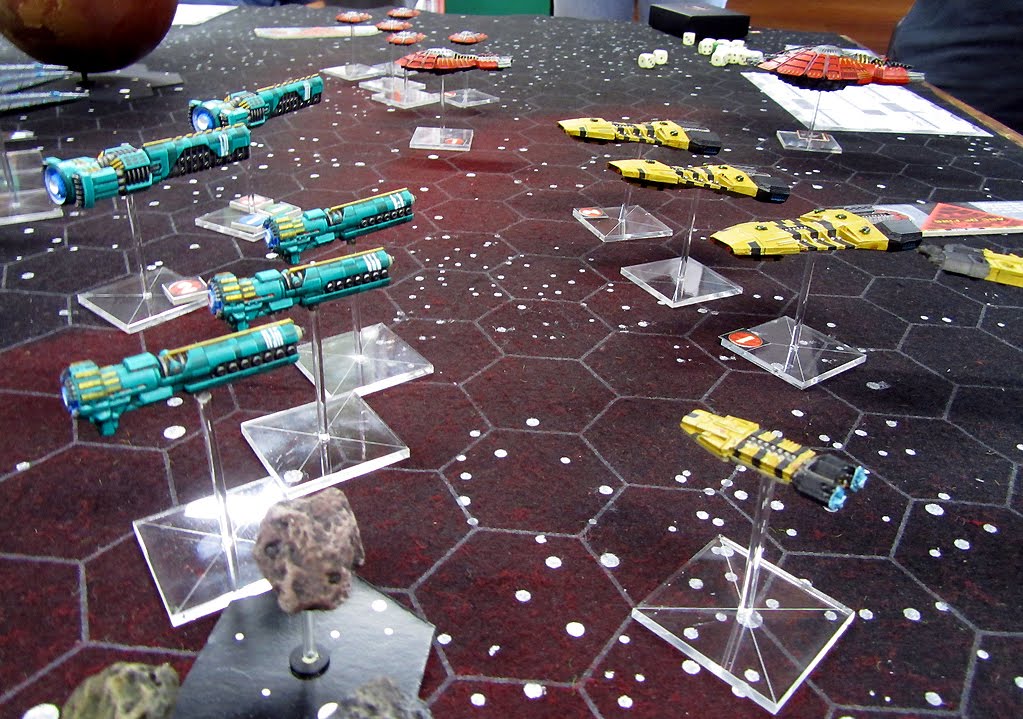
All dice incorporate ‘exploding’ rolls. Most hits are successful on a 4+, with a 6 inflicting 2 hits. Further, all 6s are re-rolled and can lead to further rerolls. Inflict enough hits over the ship’s damage rating and a point of hull damage is taken. Score even higher and the possibility of additional hull damage, along with a critical ship system going offline, can result. As damage is inflicted, it also reduces the attack dice of the target. Crew hits can also reduce the number of attack dice (however this is not a cumalitve penalty). To counter damage inflicted, some races have shield or cloaking technology to reduce the number of hits.
An entirely different weapon system is torpedoes. These weapon systems are never reduced through inflicted damage, even better they always have a constant number of attack dice at all ranges. However they can be countered with point defense systems (in addition to shields and other defensive technology). More importantly, as torpedoes follow a set path to the target, ships in the same squadron can add to the point defense of the target. This makes for some interesting fleet tactics, throwing in smaller ships and fighter groups to provide defensive support to larger ships.
Fighter groups, or wings, are also ships that can be deployed. There are far maneuverable and can throw out a fair amount of damage. However they can be countered effectively with point defense systems. Wings come in different flavors, from bomber groups that can roll more attack dice, to well-rounded fighters, to heavy point defense interceptors, even assault craft for boarding actions.
FA takes the route of having abstract weapon systems and resolves many game mechanics in a similar way. Boarding actions are fairly easy to resolve and done through simple resolution of hits by rounds, scoring wins by simple attrition. With this simplicity and abstract mechanics however, you can get some blandness in with the game.
Since weapon systems are based on either attack dice, or torpedoes, most differences with races are based on the varying fire arcs of ships. Some ships have more flexible weapon batteries using turrets, while others are based on specific weapon arcs (like mostly fore arc weapons, or no aft weapons).
However, with these limitations there are some plusses. Record keeping for hull and crew damage is easy to keep track of (as is the reduction of attack dice). The game uses unified mechanics for attacking and defensive systems. And while movement is maybe not as ‘realistic’ as other games, it captures that idea that smaller ships are more maneuverable than huge capital ships very well. Best of all, a player has to plot out their expected movement for themselves as well as their target. Coupled with ideal firing rates being within a specified range, and not simply parking next to a target and unloading, makes for an enjoyable game. A more freeform movement system with rapid acceleration and deceleration (along with quick facing changes) would hamper this aspect of gameplay.
The hardback edition has incorporated Model Assigned Rules (MARs) in with the current fleets. Now each race and certain ship types have specific rules that alter them slightly from others. I think this adds a layer of complexity to the game and gives even more flavor for certain fleets. Best of all it is entirely optional, so you can still play with the vanilla rules if wanted. However, I like the tweaks that have been made with the different ships. MARs really helped differentiate the races and ship types to make for a more robust game.
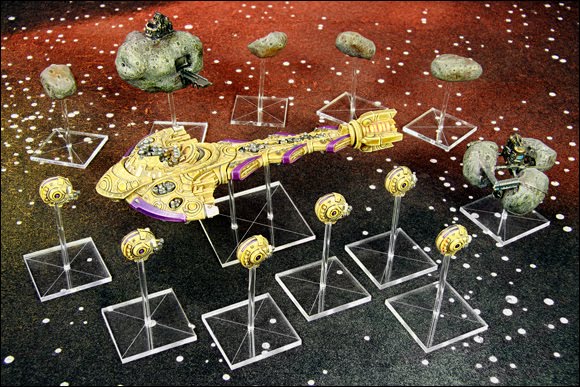
The Good – There is a nice fleet combat system within these rules. It has room for exploring different tactics that go beyond ‘move the biggest ship in as close as possible and unload.’ Maneuvering and trying to bring as many guns to bear, at the most ideal range, is a challenge and enjoyable. There are some differences in the race fleets, especially with the new MARs system. It’s not overly complex and has just the right amount of detail and weight for making a fun afternoon of wargaming.
The Bad – It’s not a hyper-realistic, super detailed treatment of spaceship combat. I’d go as far to say it really plays like a conventional sea naval wargame, with some trappings of science fiction. Some of the more abstract systems make for simplistic resolutions of actions, that might be too glossed over for some tastes. This is not a ramped up version of Star Fleet Battles. Also, luck can rear its head in some games. The exploding dice can make for some very ‘swingy’ turns.
The Verdict – I really enjoy this game. It has just enough detail and mechanics to make for an interesting wargame. I like the randomness of the dice that can lead to some spectacular outcomes, giving the game a few peaks and valleys with your morale during play that you might not get with other systems. FA has enough meat in the rules to make for a great space game, while not being too heavy and too clunky with having more simulationist rules.
There is enough variety of the races and fleets to make for different games, branching out with using varying tactics and experimenting with altering fleet compositions. There are a fair amount of scenarios and additional rules for civilian ships, space stations, and terrain, allowing you to create and play different situations other than your typical fleet battle engagement.
The models are reasonably priced and gorgeous. Also it seems the line is expanding with different ships and races, giving even more variety. However, the information of these new ships are not locked away and only available if you purchase the models. You can freely download the ship stats. Even if you have only the first edition rules, the MARs and fleet cards for the new ships are accessible.
I am however a bit torn about the different books. Some things I like about the hardback edition (cover pictured in this post) is that it cleans up a lot of things from the first softbound edition. Flights are no longer individual wing groups, but are consolidated into a single counter. Boarding actions now end with the target ship being destroyed, and not requiring to be fold-space traveled off table by the assaulting player.
What I do miss from the softback rules were tons of illustrated examples. They are there in the hardback edition, but more as simplified graphics rather than having figure legend explaining what is going on in more detail. I also think the layout of the rules were more organized in the 1st edition (not to mention a nice size font of the rules). It’s almost as if this book was written assuming players had the 1st softback edition already, rather than being for a completely new player. Fortunately, the game is not bogged down with tons of situational or convoluted rules, and are pretty easy to grasp.
If you’ve got a hankering to paint and deploy a fleet of starships. If you find the idea pleasing of deftly maneuvering cruisers to unload a broadside volley of mass driver cannons into an enemy capital ship. Then pick up these hardback rules. Firestorm Armada is well worth the investment.
Board Game Review: Kingsburg
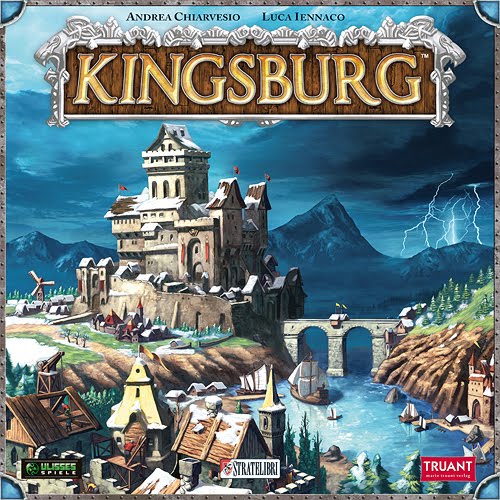
For the game night blog carnival this month I’ll be reviewing Kingsburg from Fantasy Flight games. It’s a 2-5 player worker placement game, with enough twists to set it apart from other games with a similar themed mechanic. It’s been seeing quite a bit on my table recently, mostly due to the engaging play and how it handles worker placement.
Players are governors for various towns under the command of a king. Their goal is to be the most prosperous governor, outshining the others after 5 years. This is typically done by completing the construction of different buildings within their respective towns.
Each turn players roll 3 dice and place them on various sections of the board, representing the king’s court. Once a section is claimed, that player has the ear of a specific advisor, and no one else that round can ask for favors from that member of the king’s court. Each member of the king’s court offers resources (or other bonuses like troops and victory points) that can be used to construct buildings.
Players take turns assigning their dice until either all available spots are claimed, or they have no dice left. This can make for some very cut throat play where you choose to shut out one player, and use your last die for a lower member of the king’s court. The conundrum is the higher die totals will yield more aid from the royal court. But this can mean you are allowing other players to get resources from lower ranking court members. So the player is constantly thinking whether to use all their influence for a single advisor, or try to block out other players. It’s a fun way to handle worker placement.
Resources gained (wood, stone, and gold) can be spent to build one construction for the town. Each type of building is on a progressive track, where previous buildings must be made first. All the town buildings have some special function and earn victory points. There are definitely some interesting combinations between them, and as players progress up the building tracks, more and more powerful abilities become available.
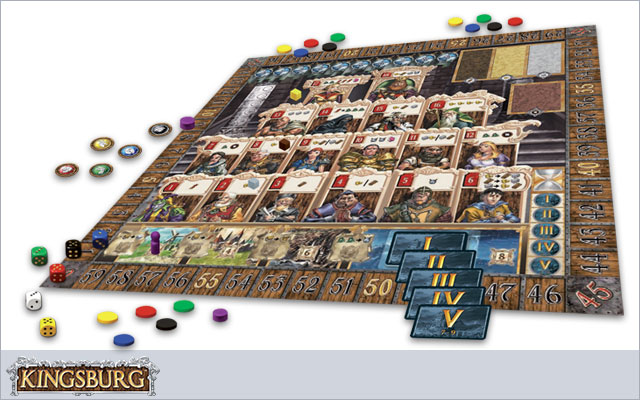
One particular element I like about Kingsburg is there are plenty of opportunities to catch up if you lag behind during a certain year. Small consolidations are given to the player with the least amount of resources and buildings. The player with the lowest number of buildings always gets to influence the court first. During the middle of the year, they can also get an opportunity to construct 2 buildings, or gain favor from a court advisor that has already been influenced from another player. Not to mention every member of the royal court can offer something useful to the player, even the lower ranking ones (just that higher numbered court advisors are more powerful). It’s a nice way to keep everyone in the game.
Now, what I’ve described is a pretty standard worker placement/building type game. It’s pretty fun, but ho hum as you’d expect this from just about a dozen other games. Fortunately Kingsburg has a twist to the game play. Monsters.
Each year, you have a random monster threatening to rampage through the realm. And every year the threats become more powerful. As governors for various towns, not only are you scrambling to construct more efficient buildings, you also have to worry about the town defense. While fortifications might help with defending the town, they don’t offer the larger game bonuses of other non-military buildings.
Players that soundly defeat the monsters, and have large standing militias at the end of the year do get victory points. But that is fleeting as those militia forces disperse at the year’s end and have to be recruited again. Doing nothing likely means the loss of resources, or the destruction of buildings. So that monster threat can’t be ignored completely.
Another tweak is you have a rough idea of the monster strength coming at the end of the year, but won’t know the exact amount or the type of threat until they attack. Some fortifications are ideal against certain monsters (like a palisade against goblins, or a chapel against zombies), while not offering much protection against others. There is a way to gain some divination and see the approaching threat, but that usually means diverting needed influence for resources towards a court member that offers less rewards/resources. Without that knowledge you’ll likely over defend yourself, further diverting needed resources from construction (or worse, not be able to muster enough defense against the rampaging creatures).
The Good – It’s a light, approachable worker placement game that has enough strategy to making it engaging. You have to balance a lot of things during the game year. You have to try and develop your town, at the same time making sure you have enough forces to defend it at the end of the year. And all of this makes for interesting choices on which royal court members you will influence. At the same time, other players are doing the same thing and may prevent you from gaining that ear of a particular court member. The components are nice with beefy counters and nice wooden blocks. The artwork is whimsical and captures the fun medieval theme well.
The Bad – With repeated play, I can see some set strategies creep in. This is especially prevalent with 2 players. It becomes a bit easier to work towards a winning town building combination. The random monster threat helps counter this a bit. However I think the game really shines with at least 3 players, as you really feel the bite of not being able to court the royal advisor you want. As the 2 player game does this by randomly removing particular advisors each season, it still doesn’t beat having a 3rd or 4th player actively selecting advisors.
While there are stopgaps in the game to prevent a player from falling too far behind, this can happen (especially with the victory points). It’s more of a problem mid-game. If a player gets hit by a monster, they can lose a lot. Combined with poor dice rolls for a few seasons, they can really fall behind and not be able to climb back up. It can be a bit of a downer of having the game effectively end for them in the middle of play.
I’ll also add that while I enjoy all the choices and strategic possibilities, this can lead to some serious analysis paralysis. Be prepared to offer lots of advice to players to keep the game moving.
The Verdict – Kingsburg is great and one of my favorite worker placement games. It avoids a lot of the fiddly, worker drone shuffling of other games, replacing it with a simple dice roll. You have that feeling of progression as you slowly build up your town. The interaction with other players is there, as your choices (and theirs) have a direct impact on the play from turn to turn. All of this construction is under the shadow of a looming threat that will come at the end of every year, with each creature being randomly chosen from a small set of cards (adding some game-to-game variation).
I highly recommend this game. It’s approachable for relatively new gamers and has enough meat in the rules and play to keep a more seasoned board gamer interested. It handles a broad number of players well, with the 2 player game being as much fun as a 5 player one. This is a great game to have in your collection.
Review: The Resistance
From Indie Boards and Cards, I would consider the Resistance as a somewhat heavier party game and a more structured version of Werewolf. 5-10 Players are members of an underground rebel group in some distopian future. Among them are several spies that are informers for the very government they are trying to topple. The object of the resistance is to successfully complete a series of missions, while the spies within the group are trying to stop them. The side with the most successes (in the spies case, failed missions) after 5 turns wins the game.
Each turn is split into 2 segments. The first is an open vote to determine which members will form a team to attempt a mission selected by a group leader. As a straight up majority vote, all players decide if it is a good team or not. If not, the next player acts as group leader suggesting a different team composition. This process keeps going until a team is decided.
After the team is selected, each team member secretly selects a mission outcome card. Resistance members must select a mission success, while spies have the choice to select either a success or failure. If at least one card is a failure, then the entire mission fails. The following turns, this procedure continues five more times.
What comes about each round is a rather tense situation. Spies are determined randomly and in secret before the game starts. Like in Werewolf, the spies have an opportunity to see who else are spies for the game (a simple manner of all players closing their eyes and only the spies opening them). None the less, if multiple spies are chosen for a mission, they don’t have an opportunity to coordinate how they will vote. If 2 spies for a 3 player mission team both vote for it to fail, they’ve tipped their hand.
The end result is constant accusations and negotiations to decide who will make up the team, and which members are likely spies. No one will know who the spies are until the end of the game. The spy players are constantly in the game and actively influencing decisions for mission team members. However, they are the minority. So if the resistance members are confident they have identified the spies, they can effectively shut them out for participating on future missions.

The spy players however can help sow dissent among members, voting down mission teams. As a nuanced rule to the game, if there is so much distrust that a consensus can never be reached to decide a mission team, the spy players immediately win. It’s highly unlikely, but the spy players might be able to repeatedly swing other players into voting down proposed mission teams. This puts some pressure on the group to eventually give in and select a mission team, allowing the spies an opportunity to corrupt the team with a spy or two for that mission.
Aside from the basic game, there are also expansion cards. These cards allow players to do extra abilities and give the game a slight twist. Typically they either telegraph voting choices, or allow the player to secretly look at either voting or player cards (seeing if they are indeed spies or not).
The Good – It’s an enjoyable party game. It moves and scales well for larger groups. There is a lot of open negotiation and deception, with players not knowing who to trust until the end of the game giving each round a lot of fun tension. The game scales well and can accommodate several people (up to 10). The box is compact, allowing you to easily throw it in a backpack making for a great convention downtime game. The components and artwork are very pleasing too.
The Bad – With larger groups, and repeated plays, it may be difficult to remember who was on past mission teams. The game can get somewhat repetitive also, however the expansion cards that come with the game really add enough variety to change up play some. Also the number of players needed is a little steep at 5.
The Verdict – This is one of my favorite party games. While the play is a bit structured, and there can be some confusion on what cards are for what votes, after a single turn everyone gets it. This has been very successful for me with groups of non-gamers, and they have all had a lot of fun. The expansion cards add a nice twist to the game play to give it a bit more life. It occupies a small section of the game shelf and is a very reasonably priced game for the fun you get out of it. Definitely pick this one up for your collection.
Board Game Review: Terra Prime
I’ve been on a bit of a kick of older games as of late. Terra Prime is a space exploration game for 2-5 players from Tasty Minstrel Games. Sadly it is out of print but you can still snag a copy from online retailers.
In Terra Prime you are a ship captain in a race to explore and colonize the galaxy from your home space station. Before you are a series of unexplored sectors that hide numerous systems ripe for colonization. As you get further away from Terra Prime the more dangerous uncharted space gets, with random encounters with hostile aliens and potential collisions of asteroids being threats. As you establish colonies, explore, and trade goods, you earn victory points. The player with the most victory points wins.
Each player will have a starship that can be retrofitted with different modules. Some allow for more cargo, shields, or weapons, while other modules allow you to make additional moves on your turn. In addition there are technologies that can also be added to your ship to improve its performance.
During a player’s turn they have 3 actions to decide on either moving, colonizing a system, transporting cargo, to fighting aliens (or bribing them with goods). Everything is limited by the capacity of your ship. You have space for only so much cargo, and only certain bays can hold certain goods. Haul around a colony module? It takes up precious cargo space. Cargo is very important as that is the primary means to earn credits needed for upgrading your ship, as well as potentially competing demands for goods by Terra Prime, earning you victory points.
Making cargo runs is one way of earning victory points, but players earn much more establishing colonies or exploring space. Typically the further you explore, the greater the points. Additionally, subduing aliens and colonizing sectors of space can also give you bonus random rewards. So heading out to explore a new sector might also score you an additional cargo module or goods if you can pacify any alien resistance.
Goods are produced from a player’s colony every turn. There is a nice twist too as players can pick up goods from an opponent’s colony. Doing so means the colony owner gets a victory point, however a particular good might be needed to meet the demands of Terra Prime (earning additional victory points once turned in). All of this makes for some fun choices as players shuttle back and forth between colonies, trying to complete demands before other players.
Fighting aliens is a simple affair, rolling six-sided dice and defeating an alien on a 4+. However aliens get several opportunities to attack. A player really needs to invest in ship technology and modules to defend itself, and possibly beef up the number of guns it can carry. Each hit beyond a ship’s shields means installed modules are destroyed, making for a potentially painful experience. This can make for a particularly tense moment as a player slips into an uncharted system, and possibly run smack into a large hostile alien force. As fights can be costly, it might be more worthwhile to offer up cargo goods instead, pacifying hostile aliens for victory points and rewards.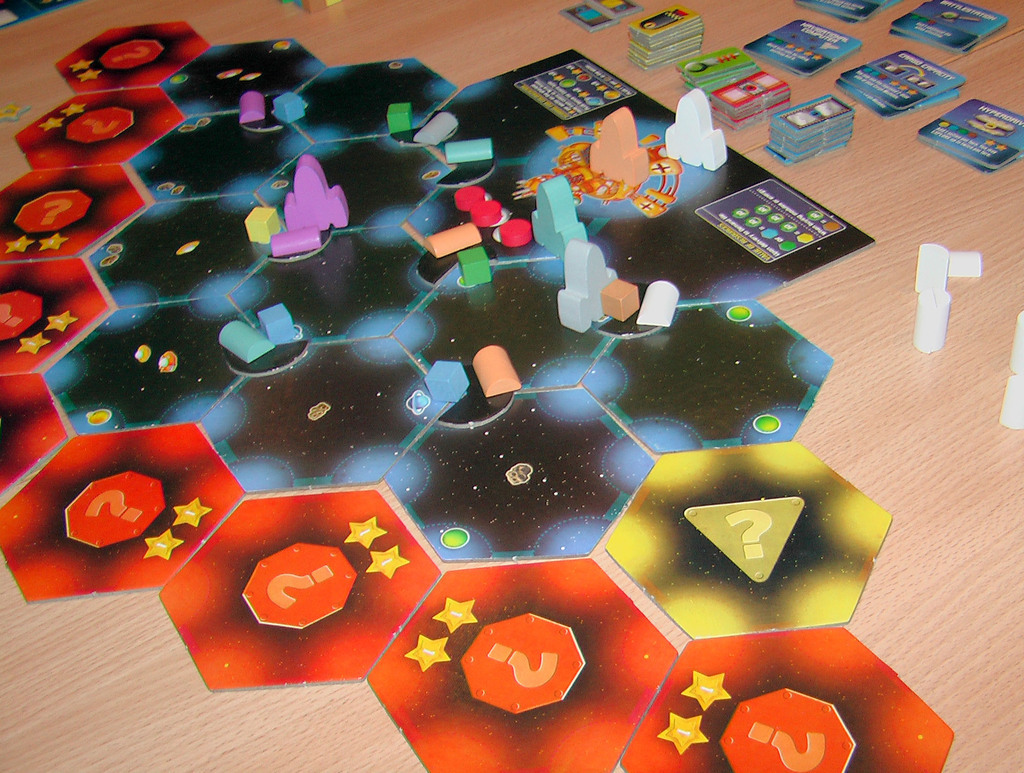
Asteroids can also inflict a fair amount of damage on a ship, making travel through them disastrous. As players explore, they can decide how to arrange the various planets and systems on the hex (with some limitations). So placing a field of asteroids in the path of an opponent’s route to one of their colonies can make for some hampering of ideal trade routes, effectively making players take longer routes.
The game ends under varying conditions. As players colonize sectors or defeat/pacify aliens, they gain rewards. Once a certain amount of rewards are earned the game ends. Alternately, there are different demand tiles for goods. As players complete these demands, further tiles are drawn. Once this supply ends, the game is over.
What I like about this is that there are two forms of a time clock ticking to end the game. One is based on establishing colonies and exploring (fighting aliens), while another is on transporting goods to complete the demand tiles from Terra Prime. Coupled with choices for how you customize your starship, you have a variety of paths to take to victory. All the while, you are in a race with other players to gain the most points. There are a lot of choices, with a bit of a random setup, really capturing that feeling of excitement (and potential dread) in exploring unknown sectors of space.
The Good – There are a lot of beefy components to the game and enough shuffling of board tiles and rewards to add game-to-game variation. It really captures that feeling of tense excitement exploring space. Players have to carefully think out routes and make decisions where and when to place colonies, and the choices for upgrading ships with different modules and technologies are fun. There are different paths to victory which players may have to alter depending on the actions of other players.
The Bad – There are a lot of components. While I like the hexagon boards, it can get a little fiddly trying to cover other uncolonized sector planets, such that you have to use a special board section chit just to do so. The ship cards are somewhat lackluster and some of the cuts of the board pieces are a tad non-uniform.
Some of the play can get a little clunky. You explore a new sector of space, and potentially run into a one-shot asteroid field, which in turn has to be covered up with another component bit. Not to mention the idea that the perimeter of the board pieces are where a player travels and colonizes, with the interior of the hexagon being empty space. All of which can make the graphic design somewhat non-intuitive for new players. I’ll also add between turn downtime can be an issue when other players are taking a long time to resolve their turn (especially with a large group of players).
The Verdict – I really enjoy this game. It fits the theme of space exploration, development, and trading just right. It’s not a deep strategy game, and has relatively simple mechanics for combat, production, and transport of goods. However that light theme works wonders making the game much more approachable for new players over something like Twilight Imperium.
There are a lot of meaningful choices, as players can scoop up goods, complete rewards, and explore sectors of space before their opponents. I particularly enjoy that there are multiple paths to victory. A captain can refit their ship to combat aliens and explore, work on trying to colonize explored sectors of space, haul cargo goods to complete resource demands, or do a bit of all three. There is a surprising amount to do and all of it runs on fairly light mechanics doing so. It’s a shame the game is out of print. Hopefully it’ll see a second print run sometime in the future.
Board Game Review: Blue Moon City
[2020 UPDATE: Cool Mini or Not has released a reprint! Looks like a lovely version of this classic. Nice to see it back in print.]
Blue Moon City is a release from Fantasy Flight Games which is still available from retailers despite being out of print. This is a fantasy game where players represent different factions attempting to rebuild the famed city of Blue Moon after a civil war. Players race from building to building, attempting to contribute the most repairs in order to gain resources that are offered to a central obelisk. Offer the most to the obelisk and your faction will gain the most favor from the city dragons, ensuring your prominence once the city is completely rebuilt.

Play revolves around a player moving from building to building. There they can attempt to make repairs, using sets of specific cards in their hands. Most buildings will take several turns to repair, and each player has a chance to contribute. Everyone that contributed to repairing a building gets a reward, but the player that contributed the most will gain the greatest share. Rewards are offered as crystals or dragon scales.
While players primarily are rebuilding the city to gain crystals, it is all in order to offer the most resources to the city’s central obelisk. A player must return to the central city and offer up a number of crystals. Successfully doing so means they get to add one of their markers to the obelisk. Like restoring the buildings, the earlier spaces require less resources and ramp up in costs as the obelisk slowly fills.
On the board are also several dragons. When a player makes a contribution to repairing a building in the presence of a dragon they gain a scale. There are a limited number of scales available. When the last scale is obtained, the player that has the most scales gains additional crystals. Players that tie get less, but an equal share. And the poor player that has only 1-2 scales gets nothing. The scales are set aside and the process is repeated until the city is completely rebuilt. Players will find that being able to complete buildings gets increasingly difficult. So shrewdly planning on making select repairs in the presence of dragons to gain the most scales, and in turn, be able to gain the most crystals for offerings, becomes a solid strategy.

When repairing buildings, players typically need a specific value of cards of a particular color. The cards have different suits of colors and values. Each color suit also has varying abilities. Some allow the movement of dragons, while others allow cards to change color or act as wildcards (being any possible color). This is a fun part of the game, where players try to figure out possible combinations of cards in their hand to maximize the amount of contributions they can make to repair buildings.
Players also have some interaction, as they can try to capitalize on others repairing different buildings, or by manipulating where dragons fly, not to mention picking up the last few scales to ensure they get the lion’s share of crystals. All the while though, players cannot forget that the object of the game is to make the most contributions to the obelisk. While they gain crystals needed for offerings by reconstructing buildings, they also have to balance taking time to visit the obelisk. If they delay doing this, they may find it increasingly difficult to offer crystals as other players have taken up easier slots on the obelisk.
The Good: The tiles around the periphery of the city layout are randomly placed, giving the game a bit of a random setup from game to game. The artwork is thematic and well done, with nice components. The game moves rather well and most games will take an hour at most.
The Bad: Interaction is primarily based on denial of access. It may not be everyone’s taste if they are looking for more direct interaction like the trading of cards. The theme is somewhat enigmatic, as it is based on the fantasy mythos of the two player game, Blue Moon.
The Verdict: Blue Moon City is a great game. There are enough choices requiring some strategy in planning your moves, and working out the varying card sets in your hand to obtain the right amount of resources is fun. Manipulating the dragons and being able to make the proper contribution at the right time and place is enjoyable. There is just enough interaction where players can try to capitalize on efforts made by other players, or try to limit their opponent’s options by acting first. It’s a great buy with enough strategy to be engaging and still act as a ‘light’ board game. It has mechanics and a theme that is just different enough from the other games out there to make it stand out.
Review: Eaten by Zombies
This month I’ve got a fairly new entry into the deck-building themed games, Eaten by Zombies. Players are regular Joes and Janes trying to survive in a zombie apocalypse periodically running out of their safe house to scavenge supplies, all the while either avoiding or fighting their undead neighbors. What results is a fairly competitive, cutthroat card game with a slight cooperative twist.
Play is rather simple beginning by turning over a card from the zombie deck. At that point a player can decide to either fight or flee from the zombie horde in front of them. Their hand will comprise of swag cards that help them run, fight, or draw cards to potentially add to their fight/flee ability. To beat off the zombie horde, or valiantly run away, they simply must match the values on the zombie cards for fighting or fleeing. Players will find that very tough zombies are easier to run away from, while zombies easy to kill are harder to run away from.
If they successfully kill all the zombies, or run away from the horde, players can then gather up swag (cards from a common pool) equal to value of the cards played. Note that this means that players can play far more cards needed to kill off a lone zombie, simply to increase their played card value so they can pick up that expensive shotgun as swag. These swag cards are immediately placed in the player’s hand. This is a very subtle mechanic. Players will begin to see that they can tailor their hand to plan out their actions for the following turn, focusing on gaining flee or fight cards. Killed zombies are added to the players discard pile (ending up in the player’s draw deck on future turns).
If players fail to fight off or run away from the horde, they can lose a lot of cards. These cards must be from their hand, or their draw deck. When fighting zombies, fortunately you can always take out a few, reducing the number of cards needed to discard. All of the swag cards discarded this way are returned to the common pool to be picked up by everyone on later turns. Players cannot discard zombies in their hand, but can discard them from their draw deck (if they are lucky enough to draw them off the top).
Even when players successfully run away, they must discard some cards. However they also have the option of losing cards from their discard deck (except those pesky zombie cards). Again, this becomes a subtle mechanic where players might select weak swag cards to gain in their hand, only to use those newly gained cards as a discard (or even replace cards lost running from the horde).
If a player is ever required to discard more cards than the combined total in their hand or draw deck (including cards in their discard pile), they lose the game. It will also be increasingly difficult to get rid of zombies cards that the player kills, so if they ever draw a hand with all six cards being zombies, they also lose the game.

Zombie cards are fairly tough to get rid of, but they can be played to increase the size of a horde that other players face. This is something that will usually throw a wrench into their opponent’s plans, as they realize the lone zombie they could have easily run away from now has become a huge group. Again, another subtle mechanic is that players cannot draw up to their full hand of 6 cards until the end of their turn. While they might gleefully throw zombies into fights for other players, they’ll be faced with a limited hand size on their own turn. It makes for an interesting choice during play.
Lastly, if a player is eliminated, it doesn’t mean they are out of the game. They instead become a zombie player. They gain a smaller hand solely of zombie cards which they use to turn other players into zombies (by forcing opponents to hold 6 zombie cards). This is exceedingly difficult to pull off, but possible. Avoiding complete elimination and including another means of winning the game is a nice touch.
Of course not everything has to be so cutthroat. All the players could also pull off a cooperative win, by killing all the zombies in the game. Like the zombie win condition, this is difficult to pull off, but might be enticing enough to encourage a few players to work together near the end of the game.
Surprisingly even with the amount of control due to building up your hand prior to your next turn, things can be deceptive as the zombies you face could mushroom to a huge group due to other players. Additionally, on later turns, more and more zombies are revealed each time the zombie deck runs out and is reshuffled. As there are varying toughness and speeds of zombies, it can become increasingly difficult to predict if you have enough cards to successfully fight or flee.
The game has an interesting flow. Things progress fairly slowly as players build up their hands and deck. But with a twist of fate it all can come crashing down as players might have to discard a third of their deck or more. When things go bad, they usually go really bad, and it can be almost impossible to crawl away from a dust up with a growing zombie horde. It captures this impending dread of being overwhelmed by the undead rather well.
The Good – The mechanics for a deck-building game are rather tight. You focus on building up your hand primarily, and adding to your deck as a secondary goal. This allows you to focus on the immediate game, rather than tuning your deck of cards in hopes of good draws in future turns. I also like how everyone stays in the game, even if they get devoured (although being able to win as a zombie is difficult). Also, interaction with other players becomes a key part of the game as people begin to kill off zombies.
The artwork is rather good and the overall design of the cards is sharp. The game comes with a series of dividers with additional clarifications of their effects which is a nice touch. I like how you can get a random assortment of different swag cards before each game, adding to the replayability.
The Bad – Even with a solid hand, you can get a raw deal with the zombies you are faced with. A game can quickly degenerate down to ‘let’s pick on the little guy’ with folks just piling on a player to wipe them out quickly. Getting crushed in one deal, losing half your deck, is difficult to come back from. So the vicious game play can rub some people the wrong way. Be prepared to be brutal playing this game.
I like the overall card design, but the color scheme can be a bit of an eyesore. I get the idea of using different backgrounds to represent weapons from other items, but a more subtle color pallet would have been nice.
The Verdict – Eaten by Zombies is an odd game. On one hand you have these nifty hand building elements, allowing to hone your cards and plan out your next turn. When you successfully kill a zombie or deftly flee, you craftily pick up or discard the cards needed for your next turn. This is an elegant mechanic for deck building games. Only it’s saddled with random zombie card draws, and with players being able to unexpectedly pile on more zombies. The outcome of a fight (or flee) gone bad can be particularly harsh, where a player can suddenly find themselves crippled for the game.
And this is what makes Eaten by Zombies hard to pin down. You’ve got this portion that has a solid strategy element, only it seems marred by this huge random part of the game. Even worse, a completely unexpected draw of cards can wipe a player out for the remainder (mind you I am not talking about elimination, but not having any options such that it becomes impossible to have any other outcome than being a zombie on later turns). It’s odd that for something that has so much strategic play, you have this wildly unpredictable aspect.
In the end it is a strange mix. You’ve got a game having this potential to unfold crazy events due to other players (throwing an army of zombies at an opponent). If it kept that theme throughout, I think folks would enjoy it more. No one complains about Munchkin as the theme of the game is telegraphed to everyone at the start. Munchkin is about screwing your friends over. However Eaten by Zombies has this other strategic aspect to the game and in the end I feel it gives very mixed messages to the player. Even with playing smart and planning out your moves, you can still get wiped out, so why bother? Why have this portion of a player’s turn dedicated to thoughtful decisions, if it can be countered so easily by a random draw of the zombie deck.
As a cheap game, for those that love zombie themes, I can see some enjoying this. It really does seem to capture that hopelessness of being surrounded by zombies. It is not a bad game and with the right crowd of friends that enjoy thwarting the plans of their buddies, this is something they will get a kick out of. However is this game fun with a variety of player styles? Would it be worth picking up on a limited budget (or trying to keep a limited game library)? I’d say in that case folks might want to pass on this. I like Eaten by Zombies, but I can’t rave about this game being a must have.
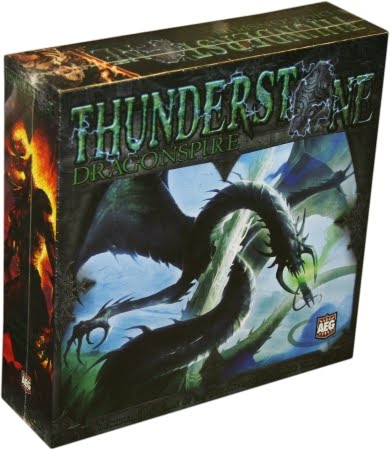
Review: Thunderstone – Dragonspire
This month I’ll be reviewing the fantasy card game, Thunderstone: Dragonspire from AEG games. This is a stand-alone expansion that can be added to the basic set of the game, but also has enough cards to play as a game on it’s own. The 2-5 player game falls into the deck building theme, where players try to pick up cards to fill out their hand. I’m approaching this review as a game, and avoiding talking about it as an expansion, as I haven’t had a chance to pick up the original game.
In a nutshell, the object is to secure as many victory points before a thunderstone relic card enters the last area of play (or ‘rank’) on the table, or gets picked up by a player. Each player represents a party, trying to head into a dungeon and defeat monsters for victory points, obtain treasure, or at the least gain experience to hone their combat skills. As a theme, it plays out very much like a basic hack and slash D&D game, low on story and high on action and hording loot.
Players all begin with the same cards and have the option during their turn to pick up new equipment or improve their heroes, discard their hand for a new one, or try their luck defeating a monster. Each player has their own deck and discard pile, so they will find themselves occasionally throwing in their current hand and drawing a new one if needed. A key point of the game is to try and pick up cards that will give them some fighting advantage to consistently enter the dungeon and win battles against monsters.
There are a couple of wrinkles to the game play. One that there is a limited number of resources. Once a pile of heroes or equipment is gone, that’s it for the rest of the game. So each player is typically in a race to pick up the best cards before they are gone. The second interesting portion of game play is that many special abilities and card functions require it to be destroyed. This can even happen if a hero is crippled in battle. Usually most cards are placed in the discard pile, which can be shuffled into a new deck that players continually draw from. However, destroyed cards are pulled from the game entirely. Combined with limited resources and heroes, this can make for some interesting game choices during a player’s turn.
Combat itself is pretty simple. Players add up their attack bonus and try to equal or beat the monster defense score. Additional card effects on the monsters, heroes, or weapons the heroes employ usually give modifiers. Monsters also line up in a queue, with increasing attack penalties for those deeper in the dungeon. This adds some tension to the game, as players that opt not to fight might find themselves up against even tougher foes if the other players manage to defeat that creature on their turn.
Another neat feature is that only a few types of cards for equipment, heroes, and monsters are used out of the entire game set. A special set of cards are used representing one of each card type. After shuffling, you then draw a particular number (4 heroes, 4 monsters, 8 village cards, etc.), ending up with a pretty decent way to make each game a bit random. As a nod to the other sets and expansions, these ‘randomizer’ cards have a different back to help distinguish them from other normal cards. Dragonspire has randomizer cards from all the previous sets so they all can be used interchangeably. It’s a nice touch and gives a new player an idea of what cards are in the other sets.
As gameplay goes, it is a bit low on direct interaction. Interestingly your actions typically limit your opponents as you might fight easier monsters, or pick up the last card of some spell or weapon. The game does feel like a bit of a race though to pick up the best heroes, fight the most monsters, and gain the most treasure. Slip behind and it can be a little difficult to catch up. Also, in some situations you might end up with a slew full of tough monsters, without the resources to take them on effectively. Having to opt out and redraw your hand in such cases can be a bit of a downer while other players forge ahead.
The Good – It’s a fun game that seems to capture feel a little bit of that classic, hack and slash, dungeon crawl. A fair amount of random setup allows for a slightly different game to reduce repetitiveness and there is a decent variety of cards out of the box. The artwork is nice and the card quality is good. I have to say the box is spacious enough to also accommodate cards from other sets which is a nice organizational touch.
The Bad – Direct player interaction is pretty much non-existent. At times a player might get a bad draw of cards against monsters in play, resulting in not much else to do but clear out their hand. With a lot of people downtime can creep in a tad. Even with the different cards, repeated play might start to encroach on the familiar. Something that likely would be alleviated picking up other expansions or the base Thunderstone game.
The Verdict – Thunderstone: Dragonspire is a fun game that has that feel of progression with a group of adventurers (through buying equipment and leveling up) fairly well. It is an abstract game and to say it captures that feeling of exploration and adventure in a dungeon crawl can be a bit of a stretch. The gameplay is pretty much a race to pick up the most effective heroes and equipment, all in the name of slaying the most vile and toughest monsters. While direct player interaction is low, your actions do have an effect on other players, and the mechanic of destroying and obtaining limited cards does put an interesting twist on this deck building game.
I found the game entertaining. It is a light, fantasy card game that revolves around killing monsters and looting stuff. Much of the strategy is trying to work out decent combinations with different heroes and equipment to become effective in combats, and in that sense, fits into the deck-building niche of games pretty snugly. While Thunderstone: Dragonspire is slated as an expansion, I would consider it a great buy if you wanted to initially get into Thunderstone. Be sure to pick it up if you’d like a fantasy-themed card game.
Gamma World is the Gateway RPG to D&D
 So Gamma World has been released for a while now. I’m certain a lot of folks since it’s release have taken some time to put down the sword and shield, and taken a swing at wielding a vibroblade and suiting up in Mk. 2 power armor. Something I have come to realize playing Gamma World a bit, it’s a great way to get folks into RPGs and I think works wonders as a quick tutorial for 4E D&D mechanics as well. There are a couple of reasons why…
Few character generation choices – Just about every thing when making up a character is done randomly. You roll on a table and this is what you get. Instead of having to figure out what at will and encounter powers you want, the choice is made for you. Unsure about how to assign ability scores? No worries! You get a bonus to some and just roll for the others.
Best of all everyone else is going through the same process. So that new guy is not stuck thinking he made a bad choice (or feeling lost as a more ‘knowledgeable’ player picks them out). Also as many of the additional powers and gear are random items represented as cards that are drawn and discarded, at most the player just has to decide whether to use a power during a fight. Which leaves more time to dwell on the…
Simplified mechanics – The core of the 4E game is there, but the math and book keeping is easier. No need to write down how many arrows you fired, you either have ammunition or you go hog wild and run out after a fight. No healing surges to muck around with during a rest. You heal up to full hit points. The bonus for hitting and dealing damage with a weapon is easier to calculate. The framework for D&D rules are there, things are just more simple.
Easier setting to grasp – I really think with TV shows and with movies, sci-fi is a little more easier for people to pick up compared to fantasy. Gamma World is envisioned to be 150 years after a sudden blending of alternate realities from a scientific experiment that went awry in 2012. The world is wild and crazy with all sorts of mutated creatures and technology, but the backdrop is a run down civilization taken from the vista of someone’s home city that they currently see around them.
Likely you’d have to explain to a new player what a glaive is. You most likely wouldn’t have to do the same talking about an automatic rifle. I think even the most fantastic futuristic artifact might be easier for a person to understand compared to many fantasy-centric items. When the GM talks of a fur covered beast wielding a stop sign and a trashcan lid for a shield, they get it. This helps with getting the player more relaxed and open to trying more creative ideas and actions.
Creativity is encouraged – How exactly is a player a pyrotechnic rat swarm? With all the random chart rolling, I think Gamma World really ends up pushing players from the start to think about their character. I feel the player has ample opportunity to describe their looks and how they utilize their powers. Much of the mechanics for abilities and powers are handled through such an abstract way, it gives the player a lot of freedom to describe how these abilities look and feel in the world. This freedom to envision what their character looks and acts like is further reinforced by the game philosophy…
Things are fun and temporary – You want loot and high quality gear, but you only get to use it a few times before you have to junk it. You might have this great mutant power, but shortly you will get something else to replace it. The game is made to be zany fun with things constantly being in flux.
Also, you don’t need to be mired down in some elaborate quest to save a kingdom. The game seems to work best as a few short sessions with a lot of action. You aren’t after a pile of gold pieces and gems, or to stop a ritual from being cast by an evil cult. You are after some weird technology hidden away in some ruins (being represented by drawing a card from a deck).
Your character is assembled quickly and randomly. If you get wiped out simply pull out another sheet, roll a few dice, and keep playing. The lethality of the game reinforces how disposable your character is. You don’t have this pressure to work up some elaborate past for your character, mostly because the next fight might result in him being only a pile of ash. I think this all reinforces how much the game should be a lighthearted stab at adventure and having a good time. No need for the heavy campaign story, just sit down, roll some dice, and pray that leaky fusion rifle doesn’t obliterate your character when it’s fired.
So the next time someone wants to know more about D&D, and possibly thinking about sitting in on a session, consider making that first jump with Gamma World. As I mentioned I think it’s a great game all in one box. It has a frivolous theme and a lot of crazy random mechanics to illustrate how much fun RPGs can be. That idea of fun is something every new gamer should take away from their first sitting, and I think Gamma World does that very well.
 Geek Ken