Category: Review
Review: Super Dungeon Explore
Soda Pop Miniatures are responsible for the adorable dungeon crawl board game, Super Dungeon Explore (SDE). This is a game for 2-6 players with a relatively odd theme. Despite the trappings of a fantasy game at first glance, it really is themed more like an over the top video game. It’s an odd choice, but if you jump into the game approaching it like an anime-themed version of Gauntlet rather than a serious dungeon exploration game, there is a lot of fun to be found.
Players form up into a team of heroes to face off against a single player (or Console) that runs the baddies. The goal for the heroes is to wipe out the final boss monster, while the Console tries to eliminate the heroes. There are 8 heroes to choose from, while the Console gets a choice of 2 enemy types to field and one epic boss, or up to 2 minor bosses. The progression of the number of heroes is a bit odd, being either 2, 3, or 5 heroes against the single Console player. But you can have players field more than one hero, giving some flexibility to the number of players. I’d even consider allowing 2 players to play the Console, splitting the number of models to control or take alternate turns controlling the final boss.

Each side activates a hero, or a set number of monsters, and play alternates back and forth until every model on the board gets an action, ending the turn. Each model has a number of action points that allow them to do things like move, attack, or open chests, in any combination. The Console gets to spawn monsters at specific points. The heroes can attempt to destroy these points to reduce the number of creatures that pop in each turn.
As heroes inflict wounds, there is a special loot track that moves along and resets once the turn is over. At set intervals, heroes can obtain special loot to help them out. Another track records the damage from all models (both heroes and monsters) that continually progresses over the game. As this damage meter moves on, more powerful monsters can be spawned. So those 8 bit monsters can be replaced by 16 bit baddies (I’m not kidding about the video game theme).
If the damage track progresses too far, a boss gets to spawn. This also happens when the heroes manage to destroy all the spawn points. This becomes a neat factor with game play as heroes easily can use more powerful items to equip their characters, gleefully killing anything in their path. However with each monster they drop not only does the loot meter move up, but also the damage meter, increasing the likelihood of more powerful monsters being able to spawn in later turns.
Combat is a relatively simple affair rolling certain colored dice, with the opponent doing the same. If the attacker scores more hits (indicated on the dice) compared to their opponent, they inflict a wound. Most monsters have a single wound so this removes them from play (allowing them to be respawned later). Inflict enough wounds and a hero can also be wiped out, only to be able to respawn if a fortunate relic or treasure is found.
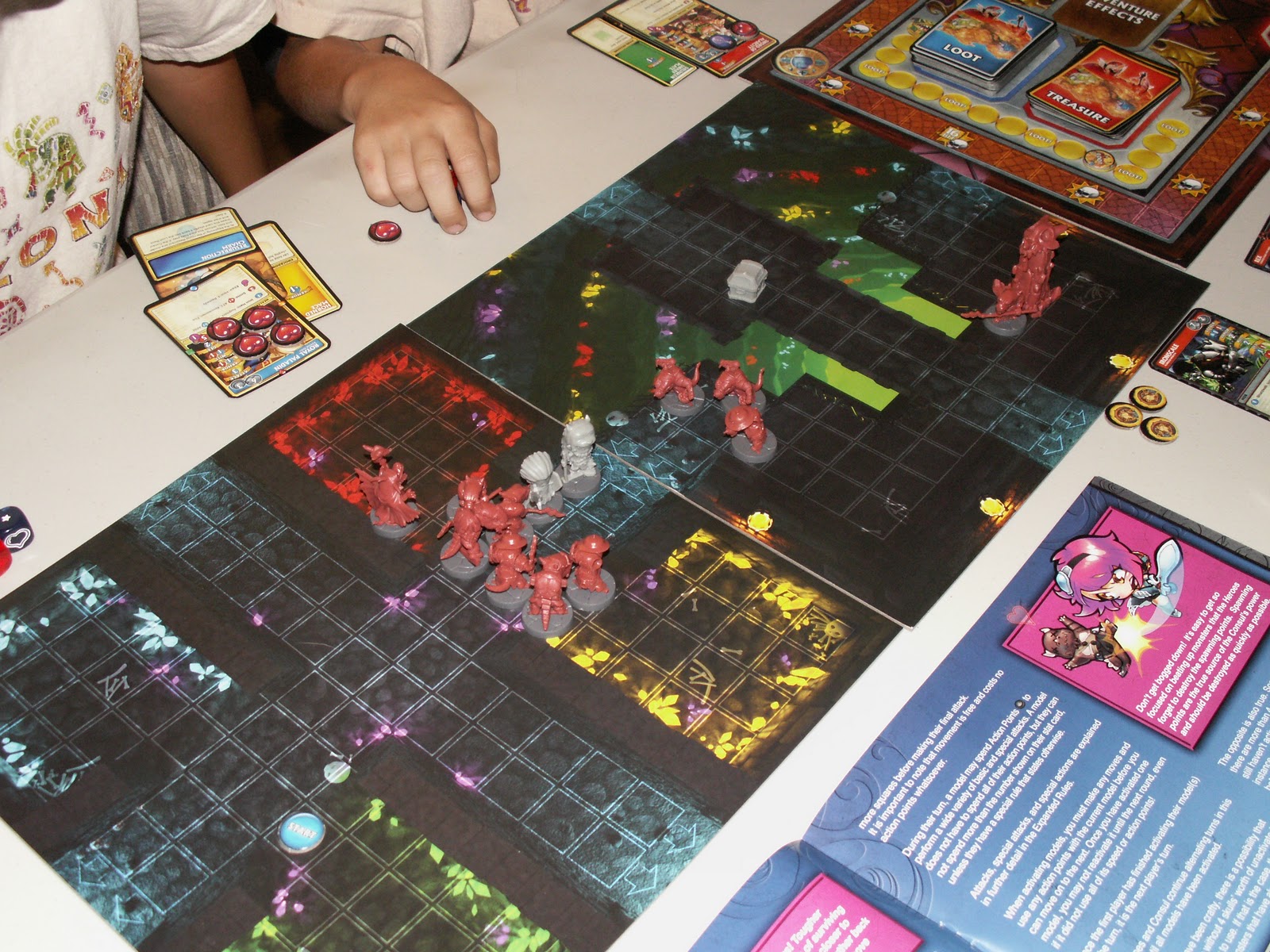
Monsters and heroes are not only represented by models, but also have a special card describing all their abilities and powers. There is quite a bunch too, from special moves, to different attacks. Additionally certain powers key off of certain abilities, that in turn may target particular defences. What you end up with is a surprisingly tactical game, with the heroes trying to maximize their actions during a turn to reduce the enemies on the board and what might pop back in later.
As the general artwork goes, it is very colorful and playful. The design of the loot cards is pretty neat, as they line up in particular orientations to the hero cards. The counters are also bright with several types indicating different status conditions. The figures are resin and surprisingly detailed. They assemble well, but expect to take some time gluing them together. I got mine done in a night, but I’d expect to take an afternoon or two to get them completed if working at a leisurely pace.
The models are quite a bit of pieces and fortunately there is a guide sheet you can now download to give you an idea how to assemble them. Most of the figures have wide slots and scored pegs that fit snugly into the main figure. Just about everything fit together without a hitch. Still, expect to fill some gaps with squadron putty and trim off a bit of flash. The only exception was the dragon boss model. That was a bit of a pain to assemble and I’d recommend tackling that first as it is easily the most frustrating to put together. After that, all the other pieces will be considered cake.
Sadly there are some negatives with the game. While the cards are pleasant to look at and colorful, they are printed on pretty flimsy stock. I opted to put mine in plastic sleeves, especially as they get handled so much. I seriously doubt they would stand up to typical wear and tear very well. Additionally the box is very cheap being corrugated cardboard. Expect to tape up the edges of that box also to reinforce it.
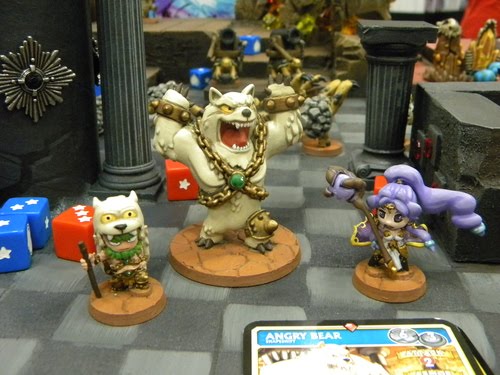
The rulebook does fairly satisfactory job explaining things, but I still ran into some hiccups determining how particular powers resolved. Also while there is a quick summary chart at the end of the rulebook, a play sheet or two would have been a welcome edition. Given the amount in the box, with color board sections, cards, and miniatures, I’m surprised they didn’t bother with a few sheets giving a quick summary of play and a short description of different status effects.
The game screams expansion, especially with the Console monsters. This leads to another detraction with the game, repetitiveness. While there are quite a few hero options, the Console is limited to two choices of monster factions. Even worse, there is one epic boss and limited mini-bosses. After a few plays, you are going to get the feeling of sameness, fighting through hordes of creatures to face the same end boss that has the same powers and the same game effects. I’m certain more content is in the pipe, it’s just a shame that different power cards for bosses weren’t initially included.
The Good – The models are nice and painted up I think would be gorgeous. The theme is light and playful. I think the mechanics move well and the game captures that feel of a frantic battle game, with hordes of minions being cut through until everyone has to gang up on the final boss creature. All the while, there are nuances to most of the models (both hero and monsters) with enough abilities and powers to keep things interesting. It also feels pretty balanced, so each player can give it their all and no one side has to pull any punches.
The Bad – Surprisingly the cards and game box are pretty flimsy. While there are enough heroes to mix things up and keep them fresh (8 out of the box), the Console forces are a bit limited. The greatest offender is the single epic boss monster. I can see keeping it limited based on the models, but no reason a few different cards could be introduced to give it different abilities. That is the biggest slight with the game and I think repeated play will have that feeling of ‘sameness’ creep in.
The Verdict – I’m a bit torn. As a miniature wargamer this is a good buy if the theme appeals to you. You get a pleasant little skirmish game with a ton of models that will be fun to paint up. The game is light and is a refreshing take on the typical dungeon crawl of other more serious games like Descent, or the recent WotC adventure board games.
However as a board game enthusiast I would tell folks to pass on this. I think the investment (both money and time assembling the figures) is simply not worth the asking price. You will end up with a game that will start to feel a little repetitive with frequent playthroughs although I’m certain more models and expansions are in the works.
In a way, I fall into the same bit of advice I give to folks that are interested in getting into Warhammer Fantasy or 40K, don’t buy it for the game unless you are planning on enjoying the modelling and painting aspect. That is the greatest flaw with Super Dungeon Explore. It seems more of a vehicle to sell miniatures than to sell a game. For folks that love miniature games and the painting hobby, you’ll get a lot of mileage out of the SDE. If you are a straight up board game fanatic, it will be much less so.
I’ll end this with a plea to Soda Pop Miniatures. Late next year when SDE has been out a while and hopefully you’ve rolled out an expansion or two, revisit the basic game. Rework the components and release a ‘game console’ version. Bump up the box and card quality. Throw in some summary play sheets. Add maybe another map board. Dump the miniatures and include all the heroes and monsters as cardboard counters. Throw in another monster faction, or at the least a few epic bosses and mini bosses. At a reduced price (say around $35 USD) I’m certain folks would pick this up. SDE is a fun game. It’s a good game. I think the inclusion of miniatures meant cutting some corners, not to mention bumping up the price, which ends up being factors that keep it from being a great board game.
Suggested gift RPGs in a single box
With last minute shopping or that potential gift certificate burning a hole in someone’s pocket by next week, what kind of RPG would be a good buy for getting a person into the hobby? Both Pathfinder and D&D have some nice boxed sets. However both also have a looming library of other books associated with them. Some potential RPG fans might be a little leery of getting into a game with so much out there. So what about other games that are a full ruleset right out of the box, or a complete game between the covers of a single book. I’ve got a few suggestions for folks then.
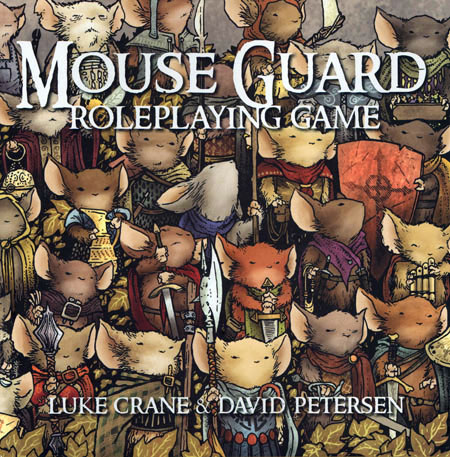
Mouse Guard – An adorable setting where mice have their own simple medieval society fighting for survival in the wild. This is the game for a group of storytellers. Using a simplified Burning Wheels mechanic, players select goals and traits rolling regular 6-sided dice to gain successes against the game master, or against each other. Failure usually means more complications and setbacks in achieving goals rather than simply not completing a task.
I feel this game works better with an experienced GM that is confident enough to lay out a framework for adventures and able to adjudicate fairly on the fly. However given the collaborative nature of the game, if you have a group full of imaginative players that burden of coming up with adventure ideas can be shared. Mouse Guard is a great buy for players that enjoy telling a story, although the setting might be a bit limited. I’d also heartily recommend passing one of the graphic novels around as inspired reading before running a game.

Savage Worlds Deluxe – The Explorer’s Edition was a steal at $10 USD. The price of the book has gone up but I still think this is a solid buy for a very flexible RPG game. The core mechanic is based on rolling a single polyhedral die to beat a fixed target number. The better the skill or ability, the bigger the die. PCs usually start out rolling a lowly D4 or D6, but with emphasis on select skills and improved natural ability, they can move up to rolling a D10 or D12. Of course all of these rolls are coupled with an extra D6, allowing a player to choose the best of either die roll.
It is a very quick and dirty mechanic that leads to fast gameplay and is a ton of fun. Best of all, you can play just about any adventurous setting imaginable. From pulp action, supernatural horror, fantasy, superhero, western, or sci-fi, Savage Worlds gives the GM tools to run just about anything. Better yet, it is able to do so with fluid rules that doesn’t get bogged down relying on a difficult, convoluted tome of a rulebook. The emphasis of the game is on imaginative, cinematic, over-the-top action. What results is a very fun game that encourages players to commit heroic acts, with a fair amount of uncertainty for success. Consider throwing in 3-4 sets of polyhedral dice for a complete gift.

Gamma World – The latest edition of Gamma World is a hoot. Just about everything needed to play is in the box. It is a lighter toned take on the radioactive post apocalypse setting compared to other games. The game offers a streamlined version of the 4E D&D rules that plays very fast and is surprisingly light. Combats can be a little regimented, but can be quite deadly adding some brutal tension to fights.
Fortunately character generation is a snap revolving around random die rolls for abilities and powers. I was a little skeptical at first about this. But somehow it just clicks and I’ve found my players loving this process which, oddly enough, seems to generate more character roleplaying ideas than expected. People have lamented quite a bit about the cards in the game. However if you really wanted to shoot for a personal alpha mutation deck, you could still get 6 PCs around the table and have a few extra (in a pinch you could do a draft and allow for up to 8 players with 5 cards each). Don’t buy into the hate rumors, you don’t need to continually buy more cards for the game. In fact you don’t need to ever pick up any cards other than what you get in the box set.
What you do need however for a complete gift is a few sets of polyhedral dice (blows my mind WotC didn’t throw in a cheap set). I’d add that you might want to consider a dry erase battlemap also, but a few printed blank 1” x 1” sheets does wonders too. It is a surprisingly fun game and light hearted enough to get even the most stiff-backed player into a roleplaying mood. Good fun there right out of the box.
So those are my picks for someone getting into RPGs. Each has something folks could likely pick up, start playing, and best of all comes in a single book (or box).
Thoughts: Mordenkainen’s Magnificent Emporium
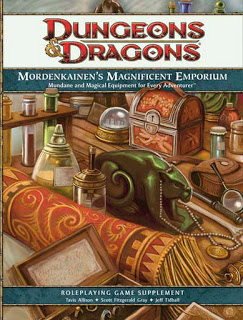
WotC released a new magic item book and I’ve had a month or so to finally read through it thoroughly. It’s an interesting departure from the previous adventure vault books, being pretty sparse on the number of items and having more emphasis on descriptions and providing a back story of the items themselves. Add to that additional mundane items, armor, weapons, and a bit of rules for henchmen, and you’ve pretty much have a concise rundown of the book content.
The magic items are a mixed bag. Some classic AD&D items return and get a 4E treatment. Just about each item entry has some details on the item’s history and lore. It seems they are making an effort to put some wonderment and flash back into magic items, and I think it’s a nice touch. There is a nice section on giving magic items story elements. I think there is a fairly good spread of items to cover just about any class or item slot, giving your PCs some new things to drool over.
Cursed items are also included. I really like the idea that curses are pretty much item properties that a DM can slap onto just about any existing item. The emphasis seems more on using cursed items as a vehicle for story elements, rather than befalling your players with a ‘gotcha’ situation. There are lots of suggestions for introducing cursed items and I especially enjoy the idea that item curses might be tied to a very beneficial item. So that awesome sword might make a PC an absolute monster in combat, but having this great power comes with a trade off. It’s a nice idea and gives the players tough choices.
There is also quite a few new equipment, armor types, and a few additional weapons. I expect much of the weapons were additions to the stock essentials books. There are also some neat superior implements to give them a unique twist. However these require a feat to use. I appreciate the option and allows a small work around with your min/max PCs (especially as there is a cap on the bonuses from feats). I expect that tying superior implements to feats also can curb some abuse, but it does give that ‘chicken or the egg’ conundrum for players. They can’t get the benefits of a superior implement unless they take the feat, but might not take the feat unless they have access to such an implement. This is something that will require some DM to PC communication for certain.
There are also some tables describing the value of certain trade good along with approximate costs for different housing. Combined with the additional equipment, I like having this handy. It allows me as a DM to explore other types of rewards aside from the normal magic item or gold option.
This is sort of an important book as it is the first jump into magic items post-essentials. This leads me to a bit of a sour taste with the book. A handful of items have been presented before in the adventurer’s vault books (AV). Granted some of the properties have been tweaked, but why they didn’t just stick to being in the errata I don’t know. It would have been nice to just present new, never seen before, items to the 4E game. I get the idea that WotC wants to abandon all the earlier books, and not saddle new DMs coming in through essentials with having to pick up the other AV books. I can see this simply besides a few older magic items being included, they also provided the rules for PCs making alchemical items. If this is the case however, I think they made a huge omission with the henchmen.
The lauded henchmen rules are also here. For the most part they give the DM an idea of how different hirelings could be introduced into the game (and most are very fragile with combat stats effectively like minions). There are examples of companion characters, which effectively give the players a chance to round out a party with another man-at-arms henchmen. But are there any rules for them? Nope. You’ve got to dig out the DMG2 to get those rules. I am very surprised with representing certain magic items and providing alchemical rules, the companion rules got left out. A quick and dirty version could take up one page. In the end, new DMs coming in from essentials are pretty much left to using examples in the book and will have to wing it if they wanted a higher level NPC.
Another huge beef with me is making this an independent game store only purchase. I get trying the throw some support back to the smaller retailers. And I think having an initial limited release for 6-8 months including only these retailers a nice gesture. But totally avoiding the larger book distributors is pretty harsh. Some folks just might not have the option to get this book at smaller retailer, and that is doing nothing towards some independent retailers taking advantage of this (last I checked some were selling this book at $70+ on Amazon). Next time, here’s to hoping WotC considers giving the FLGS a 6 month head start and then open up distribution to other retailers.
So is it worth your dollar? If I were a new DM and jumped in with essentials, I’d say an emphatic yes. Aside from the magic items, you have a lot of armor, weapon, and equipment options for the PCs. Otherwise I see the books as a very optional purchase. If your players want to explore other weapon focus feats or you wanted to dabble in curses, this is something you’d likely want to buy. As always, more magic items are nice to have but if you all ready have the adventurer’s vault books you likely have enough items all ready. For the DM that has much of the 4E material, I’d consider picking up Mordenkainen’s Magnificent Emporium as a nice stocking stuffer, but not that must have book.
Board Game Review: Jump Gate
Jump Gate is a sci-fi themed, 2-6 player game. From Matt Worden Games it revolves around space exploration and gathering of resources. I managed to pick it up from Fun Again Games which released their own version of the game with a bound color rulebook and a larger box for all the components.
The objective of the game is to claim resource cards in various sets. As players explore and claim cards, some resource cards are linked with a black hole. When these cards are claimed, a player drops one of his tokens onto the black hole tile. When a total of nine tokens are collected on the black hole tile the game ends.
It can also end when all the planets are claimed and the only unclaimed resource cards have black hole icons on them. Having a low amount of tokens on the black hole tile is important, as the player with the highest amount of chips there gets a large penalty to their final score. This adds an interesting twist to the game, as players might have to balance out picking up a specific resource to fill out a set, potentially getting a lot of points, while at the same time contributing to ending the game and possibly having too many markers on the black hole tile.
Players travel around different planets moving around in a circle in either direction. Additionally they have a set of navcomp cards. These cards do a lot of game functions. They allow a player to utilize the jump gate and travel to a planet of their choosing. They also allow a player to scan and claim a planet, all of which is done by matching up the symbols and numbers on the planet with the proper navcomp cards. Additionally, many navcomp cards can also allow the player to have special actions (basically allowing them to conduct game actions without paying required navcomp cards).
Each planet starts with most resource cards hidden. As players travel around the planets, they can scan them, adding a player token to the planet tile. When the planet is finally claimed, each scanning token allows them a choice of the revealed resource cards. This becomes an important strategy as players race around the table trying to scan planets, allowing them to gain resources later in the game. Bonus points are also awarded to players that scan or claim planets.
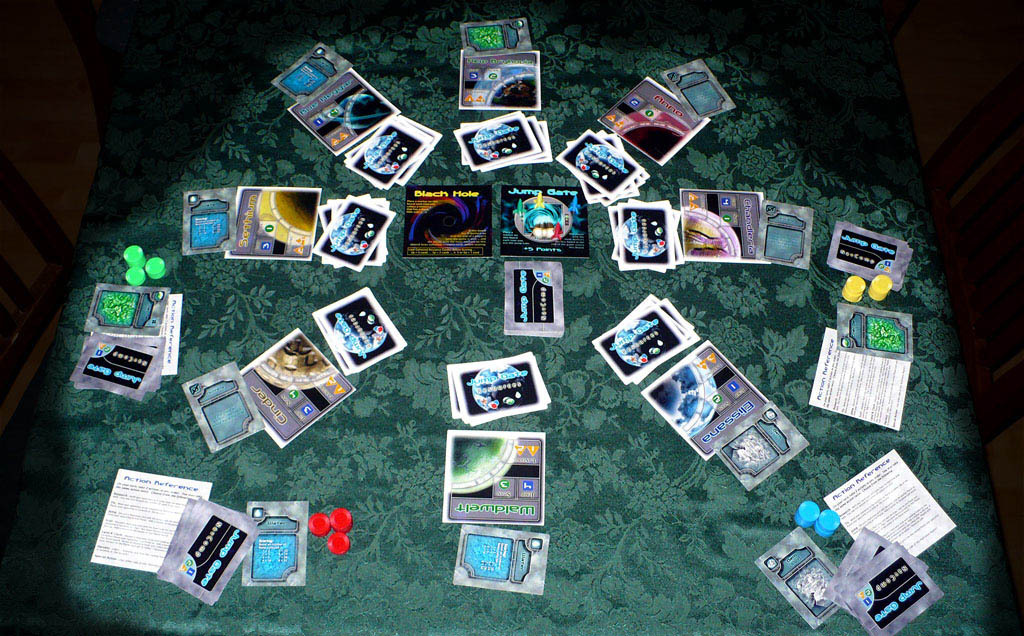 Once a planet is claimed (and after others that scanned the planet have claimed their choice of resources) the remaining resources are up for grabs. Anyone that orbits the planet has a chance to pick up a card with no restrictions. Again this adds an interesting choice for players. Discarding specific navcomp cards, if a player scans a planet they can ‘stake a claim’ on future resources and gain extra points, however to get these resources someone must also later claim the planet. At the same time, once the planet is claimed then anyone can swoop in to take up the remaining resources freely without having to use navcomp cards.
At the end of the game players score points for claiming and scanning planets. Also the player that has the most tokens on the jump gate tile get a bonus. However, most of the victory points are earned for collecting recourse cards in various sets. The meat and potatoes of these points are from gem resources. Not only do you want to claim a lot gem resource cards, but also try and focus on having one color to make up your total. Additionally many other resource cards offer more points making a pair (dark and white energy) or forming up a large set (water), while others just offer a high point bonus. As all this is being tallied, the player with the most tokens on the black hole tile gets a penalty to their score.
This scoring can make for some interesting gameplay. To get a lot of points you need to focus on specific card sets. Meanwhile you want to claim resource cards to prevent your opponents from doing the same. This sort of makes for some cut throat play as players race from planet to planet scanning and carefully picking up select resources, all the while watching your opponents and trying to see what resources they are trying to collect. If players are going for the same resource, this can be a a little hectic trying to pick up the right cards that will offer a large point bonus at the end of the game.
Recently Jump Gate has been picked up by a larger publisher and will be released as Space Mission. The German release offers much nicer components and the rules have been worked over a bit for more streamlined play. There is no black hole tile in the German Version, and play ends when a certain number of special resource cards are discovered. Another tweak is with the scanning action. In Space Mission, players can look through resource cards and actually ‘claim’ a resource that will be picked up later once the planet is developed. It’ll be interesting to see how folks enjoy the different games. I might even consider trying out the Space Mission rules with my version of Jump Gate (it’ll require modifying the resource cards though).
The Good – Jump Gate is a pretty fun set building game. It captures the theme pretty well as players try an race around the board scanning and claiming planets at the right time. There isn’t much direct interaction with other players, but picking up certain resources and claiming planets can impact other players. Additionally there are more planet tiles than what is used to play, allowing for a slightly random layout of worlds each game.
The Bad – There seems to be a scoring dump when the game ends. You have to parse out a lot of resource cards into various sets, and it can be a little difficult to know exactly how many points you have as you are playing (unless you take the time to re-tally your score each turn by yourself). Also as strategy goes, it really seems that players need to rush in and scan as many planets as possible initially. Even though there are other options, it seems to push players onto one strategy track if they want to score a lot of points. Also I will say the components are a bit spartan and simple, even with my boxed edition that is supposed to be the more ‘upscale’ version. However, it’s hard to knock the game for that given it is from a smaller publisher.
The Verdict – Overall I enjoy Jump Gate and found it much more engaging with more than 2 players. While direct player interaction is limited, you do get a feel that you are at times in a frantic exploration race with other players. Getting to scan worlds before your opponents allows an opportunity to get choice resources when it is claimed later, and also allows you to plan out what resources to collect. While this at times seems to be the best strategy, having other players in the mix can muck up things quite a bit, so you have to be flexible with your plans.
I feel adding up victory points at the very end can be a little convoluted to tally. This also means it’s somewhat nebulous to gauge how well certain players are doing during the game. The components are a tad simplistic and low quality, but I bought my copy for about $15 USD and consider it a bargain for the game inside. I think Jump Gate captures that feel of space exploration well enough and makes for a fun game.
Thoughts: Neverwinter Campaign Setting
I managed to pick up the new campaign setting out from WotC while on holiday and I think I will echo what many have said, this is an amazing book. It’s chock full of story hooks and adventure ideas all squeezed into a pretty small landscape within the Forgotten Realms. There is a lot going on here in the book and I think WotC has really set the bar high for other campaign books to follow.
Themes – Aside from the nuts and bolts of the setting and locales, I really like the inclusion of character themes. Immediately players have an option to include something in their background that can align them with particular factions in Neverwinter, and give them some motivation or goals. For the DM, they immediately can have some hooks and adventure ideas to reel in the players. I could easily see the first session being folks just rolling up their characters, seeing what themes they might pick up, brainstorming their background a bit, and giving the DM a checklist of ideas to take the campaign off in a certain direction. It really has the potential to effortlessly mesh the main adventure story with the characters.
Heroic Tier – Looks like WotC has been digging through the character builder a bit and come to realize that people like the heroic tier. Some might consider it limiting, but I think it was a great decision to put a cap on the expected levels for the region. I think it gives the DM a broad assortment of villains, movers, and shakers in Neverwinter and allow for a lot of possibilities right from the start. Honestly I like heroic tier. I’ve yet to dabble much in the paragon tier (and haven’t even tried epic). It just seems that the high end of PC levels makes for a very different type of D&D game, with truly epic threats becoming a bit too large in scale for me. Clawing up through the heroic tier seems more manageable and engaging.
Lots of Tidbit Info – Much of the book is scattered with sidebars giving more detail and ideas to the DM. It breaks up the main text well and is a great way to disperse some story ideas without overwhelming the DM. Clearly outlying the goals of a particular villain is a given, but having that additional sidebar on the same page giving suggestions and ideas for adventures is a huge plus.
Politics and Factions – There are a lot of different groups vying for power in Neverwinter and the book does a pretty decent job of laying out the different relationships each has with other groups. There are a lot of options with the potential of enemies becoming allies for PCs (and vice versa). It’s a shame something like this wasn’t done with the other campaign settings. It really gives the DM a foothold in the politics of the region and allows options for that kind of game. Of course all of this could be skipped if you wanted a traditional hack and slash campaign, but it’s nice to have this type accessible.
Another thing I enjoy is that much of Neverwinter is dynamic. There are guidelines for the DM if certain groups take control (or if particular villains get defeated), so the landscape of power can change. There are also a ton of different groups in the region. So much so, you could run 2-3 different campaigns focused on different factions, and still have a lot of territory to explore. I could easily see a dual campaign going with different groups running simultaneously in Neverwinter. Paths might cross and outcomes could have an effect on the story for other groups, but you could also have such intersections a rare event. Things are that broad with the factions in the region and it allows for a lot of replay.
Embracing Wild Fantasy The underdark, demons, abysmal creatures, and the Shadowfell, it’s all here. You can have that gritty explore the ruins and tame the wilds kind of campaign, but it also allows for some pretty unusual locales. I especially enjoy the inclusion of Evernight, effectively a shadow version of Neverwinter, which throws down the framework for a planar campaign. Pretty fun stuff here and I’m glad that the book gives out a ton of ideas breaking away from the more traditional fantasy themes of past books.
Revisiting Forgotten Realms – I think Forgotten Realms as a 4E campaign setting sort of got a bad rap. Granted a lot of the canon of previous editions was thrown under the bus, but I got what WotC was going for with the new Forgotten Realms. They really wanted to push the points of light theme and it works.
Still, it seemed that each additional campaign setting that came out got better and better in presentation and material. Forgotten Realms seemed to have been kicked to the curb. That’s really a shame as there’s a lot of flavor with the underdark, spellplague, and constant demon incursions. As a high fantasy setting, it invokes a lot of imagination and seems to pull the right strings for making a ‘classic’ D&D campaign. I’m happy to see WotC hasn’t abandoned this setting completely. Hopefully they’ll look at sketching out more regions and groups through DDI content and other books.
To wrap up, I think the Neverwinter Campaign Setting is a great book, especially if you are looking at delving into a Forgotten Realms campaign. There is a lot here, and a DM should expect not to try and digest the whole thing from the start. Rather, I feel it is better to work with small pieces of the game world and run with it. There are so many options and ideas, you can easily revisit Neverwinter and run a different campaign all together the second time around. A good buy if you are looking for some inspiration in your game too.
Board Game Review: Race for the Galaxy
Race for the Galaxy is a sci-fi themed resource card game for 2-4 people from Rio Grande Games,. The game portrays the player as a budding space-faring civilization attempting to expand its reach throughout space. On the whole I really enjoy the game, but there are a few reservations I’d have for certain gaming groups.
The object of the game is to gain the most victory points from a limited pool. The game ends when the victory points run out, or players have put 12 cards in play. Overall I like the effective time limits with the game. It really pushes players to try and make the most of each turn, as sitting back and biding your time won’t work. You have to be constantly trying to produce and sell goods, or continually make developments and claim planets. Players earn victory points primarily through building developments and colonizing planets. Another key means of earning victory points is through the selling of goods.
The cards are used for everything in the game (save for victory point chits). The cards themselves represent planets and developments (resources to allow the player to do special actions). However not only are they different cards what you actually play on the table, but they are also are used as a currency and as goods to produce and sell for victory points. As there is a hand size limit, it makes for some interesting choices to decide what cards you discard in order to ‘pay’ for colonizing a planet or building developments. Additionally, many cards have a synergy in effects so this discard choice can sometimes be a bit of a conundrum for players (as there are some really neat combinations you can make).
I actually like this idea. While it’s true that at times I enjoy having lots of components in games (ex. Terraforming Mars or Puerto Rico), it is refreshing to have a game that is a little more utilitarian with how goods and currencies are represented in game.

Each turn a player selects one action they like to take. Actions range from exploring (going through the deck and selecting a card to add to their hand), to placing developments and planets in their area, to producing goods to sell or gain victory points. If the player selects this action, typically there is a small bonus (say, paying one less resource to build a development). The twist is that all the other players also get to do the same action. So if you want to colonize a planet, everyone else around the table gets to do the same thing, save that small advantage you would get for selecting that action during your turn. It’s an interesting process. While you are rewarded with some bonus for taking a typical course of action, everyone else gets an opportunity to undertake the same activity.
There are some events that take a turn to two to develop, so it is not uncommon to try and produce and sell goods while other players have no resources available. So you are continually looking at the cards other people have in play, and trying to undertake actions that won’t be extremely beneficial to them. There is also a bit of gambling involved. As the bonus for selecting an action is not tremendous, sometimes you might opt to select another. All in hopes that the other player selects something that would help you, while you direct your limited choices to some other important action. Sometimes this works, and sometimes everyone focuses in on a particular course of action for the turn.
It plays rather well and moves at a fairly good pace. The only complaint I have (and it is a big one) is that there is a steep learning curve to the card symbols. While the game mechanics themselves aren’t too hard to grasp, each card has several icons on them relaying different characteristics and uses for the card. I find you really need about 2 games or so under your belt to recognize all the symbols and icons. This is further compounded with particular names and icons having nothing to do with the game, rather they relate to other expansions. Despite having large color icon cheat sheets in the game, it can still take a while for a new player to get up to speed.
As another quibble, I don’t think this might be everyone’s cup of tea as a strategy game. There is a lot of randomness with the initial draw of home planets and cards in your hand. Typically it takes a turn or three before you can cement a strategy. I like this aspect of the game, as it keeps your planning fluid and changes from game to game. I’d liken it to being a ‘puzzle’ game. You at first are unsure what route you need to take in setting up your empire. As things unfold, you get a clearer picture as you figure out a particular strategy. This might drive some players bonkers, as they want to sit down and try a particular strategy right from the start. In Race for the Galaxy you really can’t do this.
The Good – This is a fun strategy game. It’s random and deep enough to allow a player to explore a lot of strategies. While there are some really nice individual planets and developments, just about all the cards mesh with other particular cards, making for some interesting synergies in play. I also like the mechanic that has players select their turn actions that affect everyone. While it’s not quite involved as other games with trading of cards and such, it still requires you to take a look around at what other people are doing and think about your plan of action for the turn. You can play with 2 people which is always a plus.
The Bad – The learning curve is a bit steep on this one. As I stated, mechanics-wise it is not much however there are a ton of symbols, icons, and colors a player needs to process. It can be daunting at first and you really need to expect a new player to get a few games under thier belt to be able to grasp everything. Also, theme-wise there are a lot of neat little titles of cards with some fun artwork, but on the whole you could swap out just about any other symbols and names to mimic just about any other genre. So while it does has a sci-fi theme, the rules and actions are simply an abstract mechanic that don’t really seem to capture the feel of a space exploration and expansion game. Also, out of the box you can only play up to four people. I still like having a game that seat a few more around the table.
The Verdict – I really enjoy this game. I find it’s meaty enough with options and combinations to make for a fun strategy game, and just enough player interaction to make it interesting. There are several expansions for it, most of which add additional players (up to 6) and also add additional combinations and other variants to alter game play a little. I have found some of the expansions hit or miss, but I do appreciate allowing me to have additional players. Still, right out of the box you will find a great strategy game. I highly recommend having this on your game shelf.
Pathfinder – Inner Sea world guide as a 4E resource
I’ve gone round and round with pathfinder but I think I’m still in the camp for passing on it. At the heart of it is that I’ve got my 3.5 D&D books. I see pathfinder as a refinement of those rules. I think 4E really made changes to how D&D plays and I liked what WotC did. I just don’t see me going back to previous editions and I feel pathfinder goes in that direction.
For a lot of folks, I think pathfinder is a perfect fit for their D&D game. It tweaks and retools the stuff some might have found lacking in earlier D&D editions. I can completely understand the things they love about pathfinder and why it is their D&D game of choice nowadays. It’s just not my thing.
I will however step up and say that Paizo has some wonderful products in the pathfinder line. And I think for people that enjoy fantasy RPGs, you will be doing a disservice to your group if you don’t give some of them a try at your game table. I also feel that a lot of the material (with a little elbow grease) can work for your 4E game. One such product is the pathfinder campaign setting, the Inner Sea world guide (ISWG).
This is the default campaign setting for pathfinder. Don’t let that put you off. If you play any edition of D&D, you simply need to buy this book. It’s a wonderful setting and fleshed out world that is rife with inspiration for a high fantasy campaign.
The book is a meaty tome that gives details on 40+ countries and locations that make up one of the many continents within the world of Golarion. What I particularly like is the digest-size write up of each region. About 3-4 pages are provided listing a brief history, government and politics, along with some details on the major settlements and noteworthy locations in that region. It’s enough to give a DM a grasp of the country along with enough ideas to write up an adventure, without saddling you with pages and pages of fluff, background, and other ‘facts’ that can trip up your story.

The key element I enjoy about ISWG is the variety of the lands given. Humans are the most common and are of a variety of ethnicities and cultures. You have different governments and political ideologies. Some countries are stable, others constantly at war (both civil and external), while others are in a constant cycle of violent revolution with their ruling class. Add to this regions with heavy undead and demon influence, wasted lands devoid of magic, while others seem to be warped with bizarre creatures from a wizard’s imagination, you’ve got a lot on your plate as a DM to choose from.
The sheer variety of campaigns you could run in the ISWG is staggering. Obviously you could have the typical high fantasy world. However if you want a bit of steampunk, a Ravenloft-like setting, fighting in demon lands, or even a touch of Gamma World (one land having a mysterious ‘meteor’ crashing into it’s borders), there are options here for the DM. I think this alone makes for a wonderful product, as you could start your campaign in different regions of the same game world and get very different types of settings.
Making the transition from a pathfinder source book to 4E is not too difficult. Much of the core races are there (halfings, dwarves, gnomes, elves, etc.). I think the pathfinder elves are a bit closer to the 4E eladrin than your typical 4E elf, but I think you have enough room to encompass just about any 4E race into this world. Tieflings could obviously come about from the many demon controlled kingdoms, with goliaths being an easy shoe-in for the northern lands, and drow are all ready within the ISWG lore.
There is a full pantheon listed of the many gods and faiths within the Inner Seas that I think can be tooled around with if needed (particularly with the alignments). The ISWG has information listed in the traditional D&D 9 step alignments but aren’t that difficult to craft into the reduced alignments of 4E. While there is a simple creature bestiary listed, they are primarily based off stock entries in the pathfinder bestiary. Something a 4E DM should adopt, and simply re-skin the many creatures currently in the monster manuals if needed.
The campaign setting specific class options in the ISWG bring about exciting possibilities, especially with WotC’s new heroes of shadow book out. I can envision the Red Mantis easily as an assassin character option, as well as the Hellknights being a step away from a blackguard. I particularly like how the book details certain factions based on a philosophy that encompass more than those just driven by a nationalist agenda.
There is a lot of stuff in this book. It is well organized and I particularly like the sections that help detail normal life of most people within the world, covering mundane aspects of trade, state of current technological achievements, to the role of magic in the world. This book covers a lot, and best of all manages to distill things down to bite-sized chunks of information that can be easily processed.
You don’t need to have a complete grasp of the entire world geo-political layout to play. You can simply pick a land, skim through the neighboring regions, and have a complete historical and political handle (not to mention the major factions) on what is happening in that part of the campaign world. It’s a fantastic 4E resource, gorgeously presented in color with great art, not to mention a nice poster map of the entire place.
Do your group a favor and pick up this book. Even if you aren’t set on running a game in the Inner Seas, you’ll definitely find some ideas for your game.
Board game review: Forbidden Island
Normally I would pass on something like Forbidden Island if I saw it in a store. This is from Gamewright, a publisher of kid friendly games, and I think the packaging definitely echoes that feel. I’m glad that I went ahead with my purchase though as I would have missed out on a very fun cooperative game.
The game is for 2-4 players, each playing a specific team member on an expedition to a mysterious island. The island is sinking, and the players have a limited amount of time to explore the island, retrieve treasures, and get back to the awaiting helicopter to escape before the island is submerged for good.
This is all represented by tiles that are randomly placed at the beginning of the game. On a player’s turn they can take a number of actions. They then draw from an action card deck which could be treasure cards, special bonus actions, or a limited number of water rising cards. A player completes their turn playing flood cards. There is a tracker that represents the amount of flood cards that are drawn each turn. As each tile card is drawn, they flip that tile over to represent it flooding. If a flooded location is drawn again, that tile section of the island sinks and is removed from the game along with any players that happen to be stuck on it (and if this happens everybody loses).
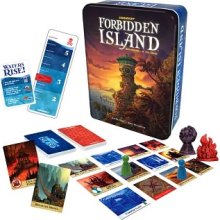
The objective is to obtain sets of cards for specific treasures and turn in those sets on the appropriate tile. After all 4 treasures are collected, the players have to return to the helicopter landing pad to escape safely. Each turn a player will find themselves trying to manage being on the right tile to trade away cards with other players, or shoring up key tile locations to keep them from sinking, all the while making sure they don’t end up on a location that will sink completely.
As the game plays players will draw water rising cards, increasing the number of cards drawn each turn as the tracker is moved up a notch. In addition the flood cards all ready drawn are shuffled back into the deck, increasing the likelihood that section of land will be subject to future flooding. This can make for some tense decisions as players balance making a run to get a treasure (or pass off cards to allow another to get it), while still keeping certain tiles from sinking.
This isn’t a deep strategy game. However it is fairly challenging and I like how it is an ‘everyone wins, or we all lose’ type of scenario. Everyone has to work together and most will find their turns being a bit of discussion with other players about the best plan of action. I like that each player gets a random team role that gives them a unique ability (effectively breaking some of the rules). As each player can do a special action, this adds a little difference to each game and gives players more options on their turn.
I also like that you can begin the game with a higher flood level. This in turn, ramps up the difficulty as you have less time and really have to plan out your turns efficiently. Combined with a fairly random island layout, and playing 1 of 5 different team roles, you can get a lot of replay out of the game.
The Good – Random layout, and different random player roles adds some variety to the game. Additionally, you can tailor the game to make it a bit easier or more difficult, allowing different groups to play and have fun. This is something refreshing when trying to play the same game with children or just adults. The components are very nice, with thick stock tiles, and solid-backed cards. The plastic treasure and player tokens are also beefy and can be handled easily (no little token bits here). The colored artwork is nice and plays to the theme well. The rules are well written and easy to follow.
The Bad – It is a random game. You won’t be able to plan out a grand strategy here. Basically your turn is a puzzle as you try to be the most efficient with your limited actions. Some of the player roles are situational and not all may be as useful as others (I’m looking at you Mr. Diver). While you can ramp up the difficulty, I’m sure with the right cards and groups that can quickly analyze and predict future sinking tiles, the game can be pretty easy to play. Additionally, it is a cooperative game. Some players might have more fun with griefing other players than with trying to contribute and win the game.
The Verdict – Forbidden Island is a fun, light strategy game. It captures the right amount of tension and player interaction. I think it would work with young children and still be a challenge to adults. It is packaged well with handsome components. Not to mention the price is just right for a game like this, being about $10-$15 USD. It is a fun cooperative game. Something I think would resonate very well with folks wanting to play games with their kids.
A very family friendly game, priced very reasonable. I’d say pick it up and look forward to exploring this mysterious island. Just don’t forget to ‘Get To Da Choppa!’
Review: Counter Collection Heroic Set
As I mentioned before I’m a big fan of using using some type of miniatures when playing D&D. I stumbled on Fiery Dragon which has some pretty neat RPG stuff. In particular I came across their counter collection series and picked up the heroic level monster set.

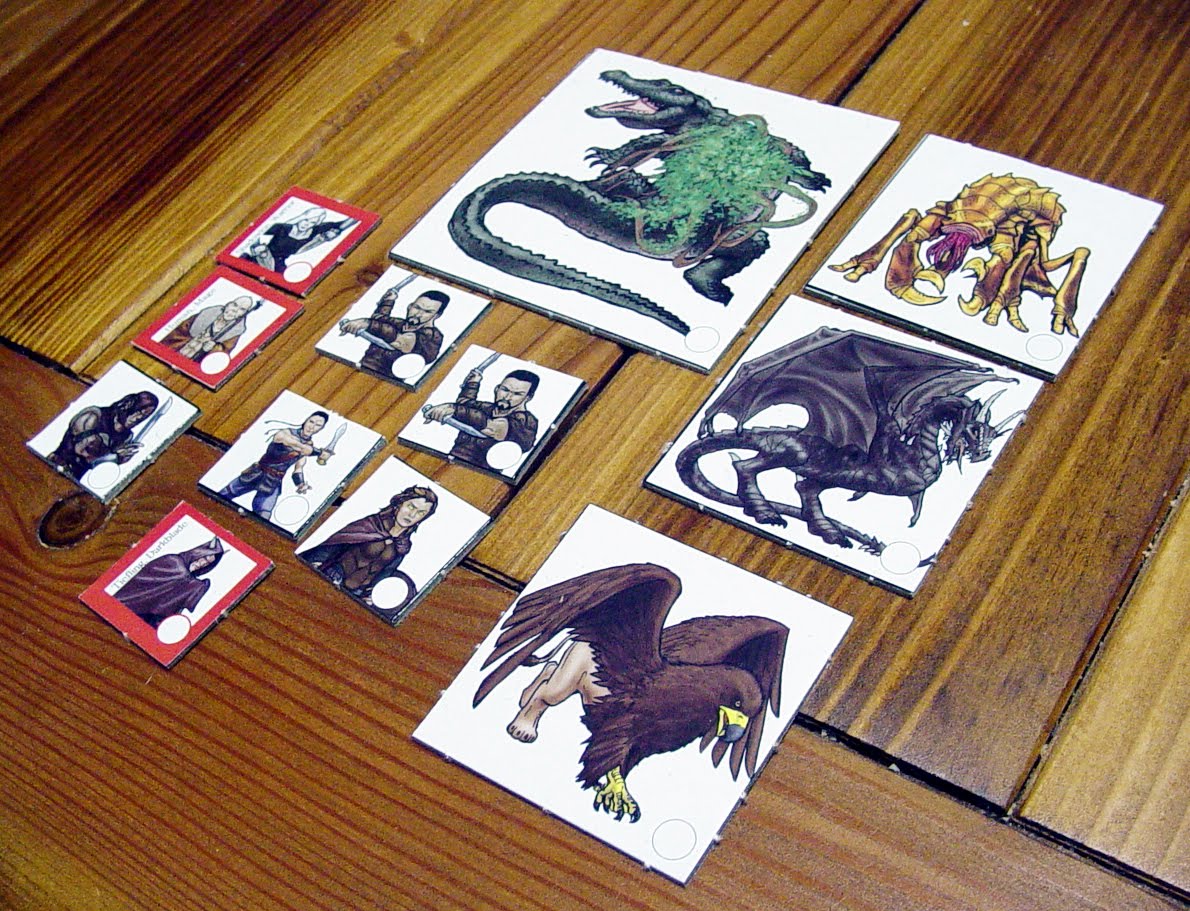
The set had sheets of cut counters with every creature in the 4E monster manual for the heroic level. Inside was quite a haul, hundreds of counters printed on thick card stock. Each was printed in color, most depicting a monster from the torso up. On the flip side was the same image with a red border, indicating it was bloodied.
There were several duplicates of each creature. Most were in sets of 3-4, with minion types up to 8 in number. Also each counter had a small white circle you could write on to give each counter a number, letter, or some color designation to set it apart from the others. Additionally, in small text was the name of the creature on the bloodied side. A nice feature to keep you from guessing what they should be, but still not be so obtrusive you couldn’t use them for a proxy for some other creature type.
The counters were cut to an appropriate base, 1 inch being for most of them. The stirges were the one exception where I had to trim them with a pair of scissors to their 1/4 inch size. Some of the largest creatures were a beefier 2″ x 2″ counter.

The artwork was rather nice, and offered a fairly good representation of what’s between the pages in the MM. They offer a pretty realistic image of the creatures (i.e. not your anime big eyes, small mouth monster).While the counters are duplicated, each creature type has different artwork. So that decrepit skeleton has a different image from a normal skeleton or a bone shard skeleton.
The Good – A nice selection of counters that are easy to pop out and use. Very utilitarian, especially the flip side of each counter being a bloodied version. They are properly based and, while being printed on cardboard, nice thick durable material. The artwork is rather good and seriously done. Best of all, for the set you have a haul of creature types, with enough to use as proxies for other monster types.
The Bad – While each creature type does have a different image, many are simply different profiles with some additional weapon, armor, or color type. You do get 8 goblin cutters, all of the same image. Having a few different poses might have been nice (but then again, might add to some confusion on what they represented). Also, while the card stock is nice, it is still card stock. A spilled drink might mean you have to put several tokens up for the night while they dry out.
The Verdict – An exceptionally good buy. You get a ton of monsters for a reasonable price. Punching them out of the sheets was easy to do, and required no printing or cutting (save for the stirges) unlike most PDF products. I think WotC will be offering something similar in future products from their essentials line. However I feel with the counter collection from Fiery Dragon out there, they’ll have to step up the production value as this one is pretty hard to beat.
Lack of fluff in 4E and MM3
Some folks have complained about the lack of fluff in many of the 4E books. For the most part I would have to agree. The 4E player’s handbook and DMG were a little sparse with flavor about WotC’s ‘world’ of D&D. However I can understand WotC’s stance on not dispensing out this material. You had a audience of rabid fans that ate and breathed just about every book. If WotC wanted to change the direction of a certain race, god, or monster, likely people would revolt (at least on the internet). Likewise, as a new DM or player, you would have all this additional material. What do you do with it? Is this canon? If I envision my orcs to act differently, am I playing wrong?
So I totally get WotC being a little sparse on the fluff and flavor. I think they took the attitude to just let people play the way they want. Offer a little background and some ideas, but ensure that nothing written was law. People should make this stuff fit their world. Having less fluff helped in that.

Now Monster Manual 3 has come out. I’ll pass on the official review bit. Just about every blog out there has done so. I’ll sum up my thoughts as a big thumbs up. It is a good book and I would recommend it.
Just about everyone has gushed over the monster stat blocks. WotC has updated them to make them easier to glance through based on the monsters actions and abilities. I like the new design and echo what many have said. However there is another tweak to the book which I think makes the material between the covers much stronger.
In past editions, you had a very simple list of suggested encounters for each entry. The idea was that a DM could lift this list out of the book, plop it down in their dungeon, and you would have an appropriate encounter with the normal allies of said monster. Very efficient, utilitarian, and I think a nice feature for new DMs.
MM3 has done completely away with that format. Instead they provide a short paragraph on the motivations of the creature. What are its goals. Who are its allies? How would a monster of this type typically be in the D&D world. I think it is a wonderful change in previous editions and glad WotC decided to add this bit of fluff to the book. What you end up with is a bit more detail on each creature that leads to a few more plot and encounter ideas.
They also adopted this for the tactics of each monster. Now ‘tactics’ is replaced with ‘in combat.’ Granted, a handful of entities follow the MM format of stating a monster would use ability X and power Y. However most entries are a much more general in terms and give a narration of how a monster acts in combat, over a simple list of powers they should use. Another small change with a little more fluff that makes the book better.
I think WotC finally gets it. See all that fluff and flavor adds a little more to the D&D world. For the new DM, it’s a nice tool for helping them run their game and think up new ideas. The veteran DMs either all ready have a firm grasp of the game fluff, or perfectly willing to change what they need. MM3 is a book that finally eeks out a little more fluff and I think is a stronger 4E book over the past editions because of it.
 Geek Ken