Category: RPGs
Throwing out the dungeon corridor
I grew up old school with AD&D. Scrawling out huge dungeons on graph paper was always an entertaining pastime, even if many of the lairs I drew never saw the game table. It was just a fun creative exercise to line up rooms and try to interconnect them all. This is something I have clung to over the years. Then of course I see some gorgeous freeform maps from Fearless DM and after picking my jaw up off the floor, come to the realization that trying to get something like this mapped out in its entirety would likely be an insurmountable task.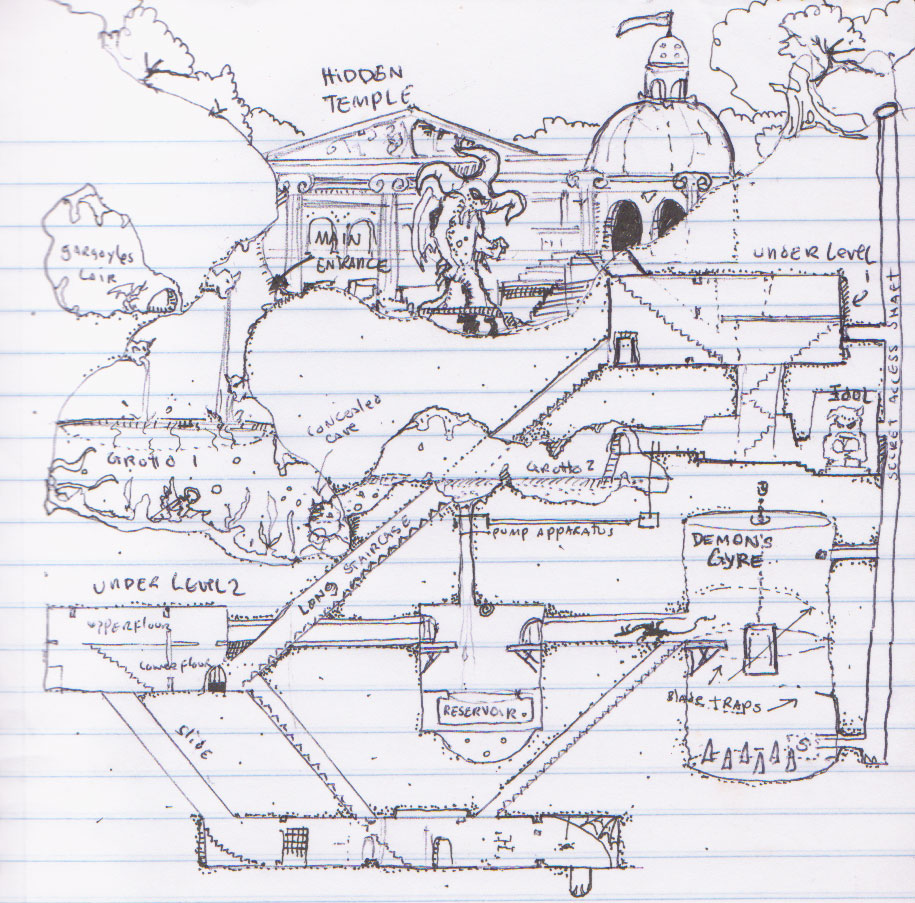
Something dawns on me, why bother mapping out the interconnecting bits? Why etch out on paper that you’ve got a hallway that goes 30’ and then branches into a T, heading east and west, each going another 40’ ending in at a set of doors? Why mess with all that detail?
Instead, just concentrate on mapping the rooms. The stuff with monsters in it. Where all the action is taking place. That is the meat and potatoes for just about any dungeon jaunt. Why bother trying to accurately get a layout for the entire network of corridors and hallways that interconnect everything? Why not just stick to getting the details set for where the players will be actively adventuring.
With that mindset, maps like these become more manageable and something easier to work with. In the past I occasionally would just handwave the layout of a dungeon. Now I’ve been doing it exclusively. I try to keep a framework of room connections through lines and intersections with a few notes, but it is all a rough sketch. I save the actual mapping for where encounters will be.
I’ve been liking this as it’s been making my adventure planning more modular and dynamic. So the group has been through a series of monster encounters. At the descriptive intersection they head left towards another combat, where heading right would lead them to a trapped room. I’m able to switch out the rooms and give my players something else to tackle aside from another hack and slash fight. Best of all, I don’t have to muddle around with trying to keep every interconnecting hallway accurately mapped out.

It gives me some options to make encounters more interesting also. Now I can throw monsters coming in from two directions when the party stumbles into a room (including from behind). Keeping the rooms networked together with a narrative description gives me some wiggle room. If I keep things general and tell the group they’ve gone through a series of corridors which head into a large chamber, that allows me to plop in monster reinforcements right in the direction they entered the room from. It helps keep the players from being complacent and too overconfident of their tactical situation in an encounter.
I’ve been liking this so much I’ve thrown out the idea of mapping out hallways. Just leaving things as a rough networked sketch has been great. It’s made it mentally easier for me to keep rooms dynamic and eased the ability of switching things around on the fly. Even better, when I see inspiring stuff like the maps here I’m more likely to use it and not worry about keeping in the corridors.
( Sadly, Fearless DM wrapped up his blog (where I snatched up these wonderful maps), but you can usually find him still dispensing RPG gems via twitter: @pseckler )
Obsidian Portal Kickstarter wrapping up
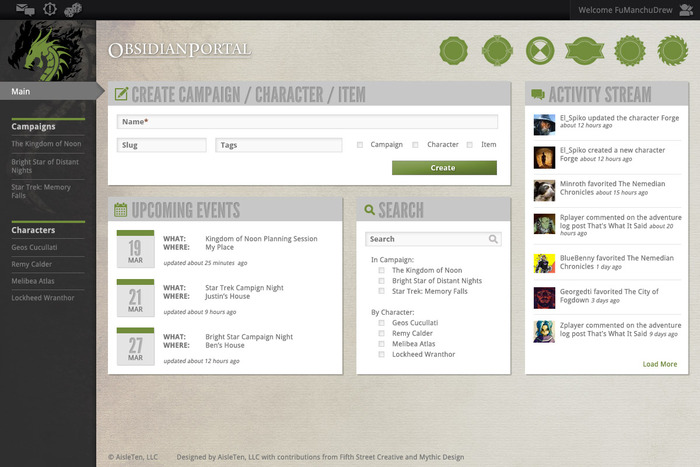 |
| A possible dashboard layout. Spiffy! |
I’ve frequently gushed on this blog how much I love Obsidian Portal. In fact, I’ve been a fan of the site for a long time. It’s been very functional over the years however I understand the people running it really want to give it a face lift.
A Kickstarter campaign is wrapping up in a few days. Fortunately, they’ve made their funding goals and then some. I’ve been a freebie user for a long time and I appreciate Obsidian Portal allowing that. If you aren’t a regular subscriber to their system this kickstarter is a great way to support the site.
So I hope folks are willing to send a few dollars their way. The project is funded. It’s a nice way to thank them for all the support they give to the gaming community. There are only 5 more days until the campaign ends, so if you are inclined be sure to support it soon.
Skill challenges revisited – Part 2
Last time I talked a little about how I design skill challenges for 4E, and this time I’d like to go through some things I do when running them. As a short summary from the last post I’d always consider what failure brings, and what a partial victory would bring. This partial victory is a step below a fully overcoming the challenge. Lastly I’d have 2-3 ideal skills that would grant a bonus or an easier DC to checks, but not have a hard list of skills required for the challenge.
Use markers for success and failure – I have a stack of black and white baduk (Go) game pieces handy. During a challenge while I describe the results of the PC’s actions, I also hand out either a white (success) or black (failure) bead. It’s a small hint to the players they are on the right track for completing a challenge, and they can quickly determine the relative amount of successes and failures they have.
This is also a decent way to keep track of a longer skill challenge. If you have a challenge that is interspersed with encounters and other events, it’s a nice means to record their progress. You can always keep this information hidden and simply give them some feedback for the task. However having this simple prop relays how poorly or how close they are to succeeding.
Don’t give out the hard numbers – Like in a combat with offering HP totals and AC values, I don’t tell players they need X amount of successes before Y number of failures. I also don’t give the players target DC values. I will offer players some description how difficult a potential action might be, especially for high DC checks (ex. ‘You could possibly make a running jump across the bridge, but it will be exceedingly difficult’).
If you approach challenges with hard numbers and set DC values relayed to the players they’ll pick up on this. Keeping things to a narrative curbs the metagaming. I don’t mind offering a tally of failures and successes, but the unknown variables of how to tackle the challenge should avoid set values given to the players. This way the group has to make that choice of going all in or deciding to cut their losses if things go sour.
Everyone participates – The PCs can’t sit idly by and let one player do all the heavy lifting. They all have to try and contribute to tackling the problem, even just by using the assist another action. Most challenges I run go through rounds. At the end of each round players either win (including a partial victory) or they fail. Note that time can stretch out for hours to days if needed between each ‘round’ but the important thing is (like a combat) that everyone has an opportunity to do something.
Say, then do – I get all the players to first tell me what they are doing, or trying to do, in the challenge. Once I get it all in my head I figure out applicable skills and checks needed. Then everyone rolls. I determine successes and failures, line up the action for the next round and repeat the process. Get your players to narrate what they want to do first. Frequently you’ll have one player initiate the action with other PCs sort of metagaming to see the outcome, and then adjust their plans. I like everyone talking about what they want to do first, and then see if things work out.
Be flexible – If a player thinks of a really clever way to use Athletics during a negotiation challenge, I’ll let them do it at least once. Be accommodating to cool ideas. You want to encourage players to think of creative solutions to the challenge and pigeonholing them to specific skills won’t help. As mentioned though, I usually will let them make a check with an oddly applied skill once, then rein in any repeats (or bump up the DC to a horrendous amount). Still if your PCs pull out a fantastic idea for using a skill in a way you haven’t thought of, at least allow them to try for a check.
Don’t be a slave to the challenge structure – Ideally there should be a certain number of successes or failures before the challenge resolves. If things progress to a closure earlier, don’t force more checks to be made. There may come a point where your players make some sound arguments to influence some NPC. If they nailed it, don’t drag out the challenge, just award them a victory and move on (partial victories work wonders in this case).
Sometimes you might have PCs do something amazing (or pull a bone-head move). If so, consider awarding more successes or failures to them for that check. Alternately you can think about giving the player a huge bonus (or a penalty if needed) for the next check. As mentioned in the previous post, consider skill challenge rules as guidelines. It’s applicable to both designing and running them.
I hope these tips help DMs run skill challenges. While clunky at times, with enough under your belt you get a feel for how flexible they can be. All the while skill challenges provide a framework for resolving and rewarding great roleplaying. Don’t be intimidated with them and try to use them in your game.
Skill challenges revisited – Part 1
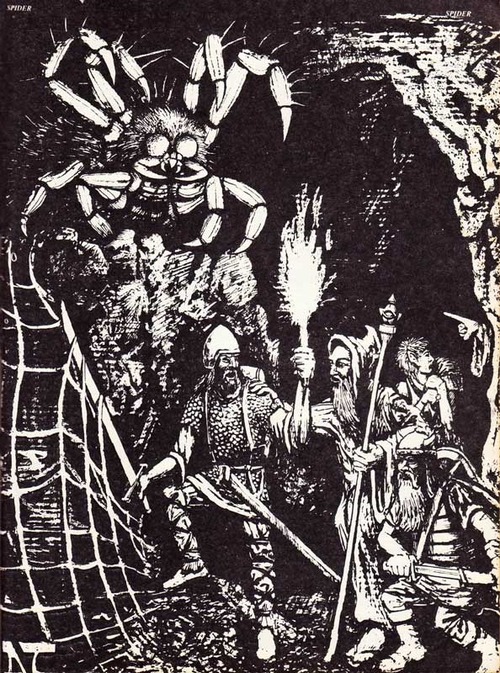 I’ve always been a fan of the concept of skill challenges. I like the idea of having some means of awarding XP for roleplaying and not just saddling it to some interpretive standard. Skill challenges in 4E really offered a DM some decent guidelines for doing that. Better yet, skill challenges laid out a way to offer XP to players for great roleplaying aside from your typical hacking up monsters and completing quests.
Skill challenges were far from perfect however. I think what stood out for me the most was how they were more a framework of rules when running them. In the past few years I began to tweak with designing skill challenges and altering how I ran them. After a while I sort of fell into a groove running them by getting input from all the players and keeping the challenge structure fluid.
It’s been awhile since I visited skill challenges, so I figured on posting a bit on some approaches I use with designing and running them. It can be tricky, but once you get some concepts down regarding them, they are a snap to make up and run. Onto some tips:
Rules are a framework, not set in stone – I think something important to remember at the onset is that skill challenges work best approaching their structure as a guideline rather than a hard set of rules. It’s easy to stick to difficulty labels and outcomes based on X successes before Y failures. It’s far better to be flexible with running them. You may get a stellar idea from a player. Why not offer them 2 successes (or even pass it immediately)? If you adhere to a set format unerringly, challenges can feel artificial and constrained.
Start with failure – When first thinking up a skill challenge, start with thinking about what happens when the PCs fail it. Do you have something interesting happen? Is there a way to keep the story moving? If the answer is no, then don’t make it a skill challenge. Failure should always be a possibility.
Say you decide players have to progress in some underground tomb by opening a sealed door. Sounds perfect for a skill challenge, right? If they open the door great! If not, then what happens? If the answer is the players turn around and go back to town, the adventure is over, rethink making it a skill challenge. In some cases you have situations that give the story a hard stop and moves everything off into another direction, but if that’s the case a skill challenge likely isn’t appropriate (you’ve got a major story branch instead). You should always consider what happens if the players fail a skill challenge and have an alternate plan.
In the above example failure might mean the players do bypass the door but one of the PCs gets severely injured. Maybe the door suddenly closes and the group is split up. Maybe they can’t open the door and instead have to go some other route that is longer or more dangerous. In each case the group can continue on with exploring the tomb, but have varying penalties and unfortunate circumstances due to failing the challenge. Make sure that failing the challenge doesn’t halt the adventure.
Have gradations of success – A partial success for a skill challenge should allow the players to squeak out a win. I typically set this as 1-2 less successes needed from the total to win the challenge. If they do this they are successful for the challenge but get ½ the experience reward. Think of this as a victory with some complications, or no clear advantage despite overcoming the challenge.
The alternate is a complete victory with the challenge. The players push themselves to get the required number of wins. Not only do they complete the challenge and get the full XP awarded but they will get some kind of advantage or benefit.
With the above door opening example, let’s say a failure means the party has to take a more difficult route. A complete victory means the players open the door and possibly can skip a potential encounter. A partial victory would then be in the middle of the two. Yes, the players get through the door but maybe they trigger the attention of some monsters. Maybe it’s a very difficult and taxing physically, so all the players lose a healing surge. While they complete the challenge, it’s not without some additional hardship.
Use preferred skills, not absolute ones – I think another trap to avoid is having a list of skills that are absolutely needed for the challenge. Instead you might want a short list of skills (2-3) that have an easier DC, or confer a small +1 bonus when utilized for the challenge. Additionally, I’d consider these as skills other players can utilize to assist another player. I’ll get a bit more into this with part 2, however giving a laundry list of checks for the players to select from is boring. Instead, you should be flexible with what skills can be used.
If players have to convince a Duke to release garrisoned troops to prevent a warband of orcs from heading through a pass, diplomacy might be a key skill for such a challenge. I’d figure that trying to reason with the Duke is a likely course of action and grant a +1 to using this skill for the challenge. But let’s say a player wants to use intimidation? If it’s not on the list of needed skills could it be used? Would intimidation be an automatic failure (after all I am seeing diplomacy as a key tactic)?
How about that player wanting to intimidate the Duke states they dig through a sack and produce the head of a slain orc. They throw it at the feet of the Duke and state this is what’s coming for the village. The orcs will likely do the same to him, his family, and all the common folk, hack off their heads and keep them as trophies. Locking yourself into a set list of skills required for a challenge will very likely also mean being inflexible when players give you a surprise like this. Give them some freedom to use different skills, and that starts by not demanding specific checks be made.
That’s it for now. In my next post I’ll go with some nuts and bolts with how I run challenges.
Who is the captain of this PC ship?
A long while back I ran a very short stint for Traveller using Savage Worlds. The group ran a freighter and while most important decisions came down to a vote, they opted to have one player always break a tie as the captain of the ship. Ultimately, that person had more say in what would be the next course of action, whether they took a job or not, would they try and pick up passengers, etc.
We might be doing a spin off occasionally with a game in the Star Trek universe where I’ll finally be able to sit at the table as a player (yay!). We haven’t sketched out too many details, but we are expecting to be Star Fleet enlisted (or officers). Something that’ll likely come about from this will be planning out how we all work together and who will be the ship captain.
This got me thinking about other campaigns, especially military campaign settings. If you have a somewhat formal chain of command, how could that work with most ‘democratic’ groups? I would expect your typical fantasy adventure company settles everything with a vote. If everyone decides to relinquish this to a single player, say a captain of a star ship, how well would this work in the long run?
Granted you could have plenty of opportunities to get feedback from the other players. Likely get their opinions on certain matters and then make a final plan of action. However some times I would expect you could have that burden of decision making shift to that one player, after all they are the captain. Other players might decide to let more tricky choices not be their responsibility.
You might end up with a player calling most of the shots for the group. Things go to pot, they might get more of the blame. Some players acting as the leader might not enjoy being the continual decision-maker for the group. Likewise it could be very easy for some players to slip into a passive role around the table, letting someone else think up solutions for tackling problems, i.e. ‘Hey, I’m just a grunt following orders.’
So how could this play dynamic be altered? Have the GM be the captain. You are the person that makes the final decisions. You are the one giving the orders. You can ensure that everyone gives you an opinion on a thorny situation, have them plead their case on a plan of action, and you choose the plan of action. Note that not all players have to be the same ‘rank’ as the others with the same weight. One might serve as the XO having a bit more pull with their say. Some might just be subordinates to other PCs.
A big plus for this is you can direct the flow of events for an adventure and give immediate tasks to the group. You can directly influence the general direction of an adventure. One major tripping stone with this is the danger of railroading. It could be very easy to slip into forcing the other players into a story they are not interested in. I think a key point of avoiding this is to provide plenty of opportunities for independent action and allowing players to offer opinions on tackling problems. Rather than telling players they need to beam down to a planet, find information on the situation, and negotiate with aliens to approve a trade agreement, a more open approach would be needed. Instead I might say that the Federation needs a trade agreement with these aliens. You all have to make this happen in 3 days, keep me informed and utilize any resource to make this task successful. This allows for players to be a little more creative with how they handle the problem rather than following a laundry list of tasks to complete.
Another alternative to this would be to run an antagonistic officer. This person is either incompetent or just does not like certain PCs and wants to continually put them into situations that will make them fail. Consider a classic WWII drama, The Caine Mutiny, as a potential source. What would the PCs do if continually given poor orders? Would they go through with a bad order that would put other people at risk? Or would they stand up to the captain and potentially incite a mutiny?
To muck things up even more, maybe you (as the captain) are a competent officer in peacetime, but freeze up in combat situations. Players might have to agonize over willfully disobeying poor orders, even though in other situations you make the right calls. What would be the potential fallout from that? Could that erode any confidence the captain had with PC crew members?
I’m pretty certain the next game I run that has room for one PC being the leader, I’m going to take over that role. I don’t think it would work for a long campaign (much better for short term runs). Certainly railroading could be an issue and something I’d have to have to watch out for. However having a little more control on the flow of events would be great, and having that not continually fall on one PC’s shoulders would be even better.

Encumbrance in SW Dark Sun
 So a while ago I posted about me stepping into Dark Sun using Savage Worlds and fortunately there is a ton of stuff out there to help with the conversion. One particular thing that has been sticking with me is some type of encumbrance system. SW handles it though a strict weight limit, and I just didn’t want to bother with keeping track of how heavy everything would be. However, I did want something. Dark Sun seems to be that kind of setting where you need to worry about how much water and supplies you can carry. It seems to thrive on having that kind of detail.
Enter Matt Rundle’s Anti-Hammerspace Item Tracker which is just genius. Basically characters have a finite number of slots to carry things in. All equipment and items are an abstraction of weight and space. The heavier the armor, the less slot space you have. While a spear may not be heavy, it is bulky, and likewise takes up more space than just considering the weight alone. I fell in love with it and had to use something similar in my game.
There were a few nagging details. One was I liked how Dark Sun had different types of coinage, something I wanted to reflect on the item sheet. Further, I needed to convert equipment and weapons into slots. In the end I created my own version of the anti-hammerspace tracker. Something that would also allow me to keep track of both metal and ceramic coins.
Lastly, I created my own weapons table including armor. I kept most of the stuff similar to the SW weapons in the rules but did make a few changes. All the prices are in silver (or pieces) and the weight is now listed as slots taken up.
The gang has really taken to this. Best of all, they know they can haul around only so many slots worth of water and supplies. Making it a trade off between having a lot of armor and gear, compared to being able to carry around enough food and water to last in the desert. Lastly, coinage is an issue and I’ve been able to bleed off some cash with poor exchange rates of silver to gold, or converting ceramic coins to metal. It’s a small thing, but helps add some realism to the setting, without being cluttered too much in simulation rules.
Give DnDnext dials that go up to 11… and ways to turn it down to 8
One aspect that seems to be common in the buzz surrounding DnDnext is modularity. It seems that lots of alternate rules are in the plans. I think that’s a good thing.
Other rule sets dabble in this and it’s something I’ve always appreciated. Granted, I think just about everyone home rules their game a little. Yet I think for new DMs having some guidance is especially beneficial. It’s great to have these core rules, with a few sidebars of suggestions and alternate rules to make the game more complicated (or make things easier).
One thing that stuck out for me with 4E was the lack of official nods towards tweaking the game. While I always got the DM philosophy with 4E being, ‘It’s your game, make it the way you want’, having some options in the books would have been helpful. And the rules that were there could have been emphasized a tad more (pg. 42 DMG). You had this whole debacle of skill check DCs being high, then being cut in half, then shifting up to being close to the original values. Having additional ways to fiddle with the game would have done wonders in addressing errata for these codified rules.
I’ve always liked having the developers provide some suggestions on ways to tinker with the game. It saves me time having to think up and test out my own ideas when I could be spending that playing games. Plus I think having rules that are more fluid to different play styles gives the game room to appeal to more people. For organized play this can be an issue, however it’s something that can be worked around (there is always that option of using a ‘vanilla’ set of rules if needed).
One thing I am hoping for however, are not just ideas and tweaks to add complexity and make the game more challenging to players. There should also be options to streamline the game more and beef up PC power. While the core base of the rules should provide a challenge to PCs by default, having some options to put on the kid’s gloves would be nice. Some groups may not be full of super-optimized character builds and having the game locked into that default setting for mechanics can be problematic.
4E had encounter building pretty solid, however as the game progressed with different player options I think it began to slide towards altering core monsters to provide a challenge. It seemed the game sort of straddled trying to cater to the needs of power gamers and other groups with less optimized characters. The math of the game grew into being built around PCs having defenses of X and attack bonuses of Y at level Z. If you opted to work on other stats, you sort of shot yourself in the leg with player advancement. So having options of turning down the game difficulty should not be overlooked.
Either way, it looks like the intention of DnDnext will be to cover a lot of different play styles over a core framework of rules. A sound decision over just creating one base set of rules that tries to cover everything.
Nerd Poker – a fun D&D podcast

Just a short post today. A while back I stumbled across Nerd Poker, a D&D actual play podcast that I’ve been really enjoying. Hosted by the comedian/actor/writer, Brian Posehn, we get to sit in on sessions of a 4E game he plays with fellow D&D folks. There is a real chemistry in the group with a fun banter of friends that is enjoyable to listen to. Getting to hear some laugh out loud comments and remarks from the crew is a bonus.
The setting is outlandish and definitely does not start with your typical, ‘You all are sitting in a tavern…’ One particular thing I love about the show is that the DM gleefully throws rules out the window and let’s fun take over the wheel. It’s refreshing to hear a group play D&D less focused on adhering to the rule book, and more about making fun (or at times agonizing) decisions on the fly.
So be sure to drop in and hear about the exploits of the goliath barbarian, Amarth Amon, and his companions. A fair warning the podcast encroaches on NSFW language at times. Give it a listen though. It’s a hoot and an enjoyable departure from most typical D&D session podcasts.
Free MMO soundtracks for your game
I never really was into having music in the background while I play RPGs. However it’s something I’ve begun to dabble in. I don’t go for making a specific playlist. Rather I started using soundtracks. I can typically just put it on a loop without having to worry about the music being a hindrance to play.
MMO soundtracks are pretty good sources for background music, and one of my favorites of late has been the Age of Conan Soundtrack. It just fits my Savage Worlds hack of Dark Sun very well. Just the right touch to give the session a little ambiance and not be too distracting.
Massively is a MMO news site that recently posted a gold mine of links for free MMO soundtracks. It’s a bit of a pain to go through as many are individual tracks. However I think you can easily have a ton of tunes to mix and match for your game. The links likely cover a pretty wide spread of ‘sci-fi’ themed stuff to your typical fantasy music. Hope folks find this useful for their games.
Creating dungeon tile maps with Pymapper
I’ve picked up dungeon tiles but haven’t been utilizing them much in my game. One of the nagging points was being able to effectively sketch out a map while planning an adventure. I’ve got a fair number of tiles, printed on both sides, and even if sorted into different containers I’d need to spread out almost the entire lot to fully see my options.
Additionally I’d need the tiles recorded somehow before playing to quickly get them on the table. It’d be best to have them put aside and be ready at a moment’s notice, but I don’t have the table space in my household to do that. Not to mention reusing some tiles as I don’t own multiple sets. I think a snapshot with a digital camera would work, but still somewat a convoluted solution.
Enter the free program, Pymapper. This handy mapping program allows me to easily move tile sets around on a gridded area. I can limit my selection to tiles I own, and even allow for duplicate sets. It keeps track of tiles I use (effectively removing them from the pool of tiles available). Best of all I can see all the tiles from each set I’ve chosen, improving my selection of tiles for an encounter map.

Finally, I can export the image in a few graphic formats (including your handy JPEG). So I can print out a hard copy if needed, or plop it down into a document file. There are some nice options to alter the background also if I want something a little more fancy. A neat feature if I wanted to hand out a player map as a prop.
There are some other nice features, including being able to add map icons representing monsters and other notable items. A fair way to record everyone’s position at the end of a night if you’ve got to wrap up a game in the middle of a fight. You can add simple annotations to a map (or link it to a text file for more detail if needed). You can stack tiles which is very nice for the more set piece tiles like pits and statues. Creating a group of tiles of a specific size, you can also make a set of geomorph tiles. Using this set you can quickly generate a random dungeon which is another very nice feature (plus they have some pre-made geomorph sets available).
Lastly, there are a group of tile set files that you can download. While I’ve messed around with some other encounter builder programs that allowed me to make maps, getting the tile sets was a bit of a chore. It’s nice that this program has them available.
Pymapper is not perfect. Moving tiles around once they are on the map can be a little clunky at times. However I’ve found the program very intuitive, and after learning 2-3 keystroke shortcuts and menu icons, I was able to select (and exclude) groups of tile sets, and whip up a few maps with stacked tiles very quickly. Best of all, I could export these maps and print them out, so I’d have a handy reference to help arrange the right tiles needed for an encounter during a game. Pymapper is a great little program and free of charge. Be sure to check it out.
 Geek Ken