Category: RPGs
No more +1s
So the gang is back together after an extended holiday and we’re discussing what to play next for our campaign. 4E is something still being considered. Think running with Savage Worlds will be the most popular choice, but 4E is still on the table. At the very least, it might be an occasional break from our regular game as a one-shot once in a while.
I’ve got some plans however to do some serious tweaking to the game. I’ve been thinking of some things to do for streamlining combat and speeding things up. I plan on still having a map, but throw out the grid. Also considering on really altering the number of powers players have in play and thinking of tinkering with the whole magic item power bit. More on that later.
One thing for certain, I want to get rid of the minor temporary bonuses that float around in the game. I want something with bigger effects. Static bonuses aren’t much of an issue, but all those little +1 bonuses seem rather fiddly. I’m thinking of a couple of options.
Make it all +2 – Not a groundbreaking change, but I’m liking the idea of making each bonus or penalty a +/- 2 and rounding things up. So that combat advantage with some temporary power boost might translate into a larger bonus to hit. That’s okay with me. I want the PCs to make those big rolls, the monsters are going to get the same thing.
Advantage/Disadvantage – The other idea I’ve had is using the advantage mechanic from DnDnext. Basically use simple color markers to indicate either a bonus or penalty to hitting a target. The marker with the highest total would grant either a disadvantage or an advantage.
This will likely make for some very chaotic combats, and I entirely expect my players to pummel the stuff I throw at them. However this might also put some hurt on them (given the proper circumstances), as I’ve just been able to double the chances of me critting my players. This might just make combats too wild and unpredictable, but of the two options I am leaning towards this more.
It’ll take a bit of playtesting. Fortunately I’ve got a patient group while I pull out the crazy houserule stuff. Honestly they haven’t been too keen on doing another fantasy campaign, but I might be able to get a one shot session in sometime. Certainly looking forward to trying this idea out.
Tips for teaching and playing Fiasco
 I’ve gotten a few games under my belt for Fiasco. It’s a fun game but I think it can be a little daunting for newcomers. Likewise, there is a structure to the game and folks wanting a pure story-telling experience might be taken back somewhat with the dice mechanics. It’s a different game from your typical RPG, but with a few pointers you can easily teach and run a game without any major speed bumps.
Start with the aftermath… – When teaching the game, I’ve found it best to start with how the aftermath works. While story is king, at the same time you want to guide yourself to one color or the other. It can be counterintuitive that you can make a ton of bad decisions, earning a ton of black dice, and still come out on top. So having that guideline of working towards a single color helps.
At the same time, I reinforce that you want to push other players into bad decisions. You want to hand out dice that will give them a low score, drifting towards an even mix of white and black dice. All of it feeds into the aftermath, and understanding how the endgame works sinks in this concept of awarding a mix of dice.
…and work backwards – Of course how do the players get dice? It leads naturally into the different acts and establishing or resolving scenes. When describing this I emphasize that act two works just as taught (example, if a player is resolving a scene, they pick the outcome die). Act one is similar, but you give away the dice earned, leading back to the concept how the aftermath plays out. You want to be sure that the people whom you want to manipulate are in a bad situation. They need to be holding a good mix of white and black dice after act one, so be sure to push them using the dice.
Gloss over describing the tilt – Honestly, once players get through the setup and relationships, getting the concept of the tilt is pretty easy. Additionally, only two players will be deciding what tilt results come into play. It’s enough just to say that a few random events will come about after act one, and leave it at that. Once you are ready to determine the tilt elements, you can spend a little time explaining how they work for the game.
Have a clear agenda for a scene – A player should know (or say) what they want out of the scene and what they expect the other person should be agreeing to. This helps gives some direction and allows a better way to determine how good or bad a scene goes for them. There is not a lot of face time for each player. While some character scenes can work, its better to have players being proactive with the story and continually working towards character goals.
Say, “Yes, but…” A staple of improv that also works for DMing is the concept of ‘say yes and…’ For Fiasco I tell the players to “Say yes, but…” Players at odds with the active player should avoid shutting them down. Instead think how they can one up the other player. So instead of flat out refusing to hold a stash of coke at their home, how about counter with a request to burn down a lagging business? In effect that conflict becomes a you-scratch-my-back, I-scratch-yours arrangement. This opens a lot more story opportunities, allows that active player to get what they want, but still have an undesirable outcome (by giving up or agreeing to more than what they wanted to).
Award (or take) scene outcome dice earlier, rather than later – The natural inclination is to wait for a scene to conclude before you hand out dice. I think it gives better direction to players involved in the scene if the dice are awarded earlier. It helps avoid that long, drawn out conversation where each player dances around with what they want, and what they are willing to give up. At the worst, you end up with this contest of wills where the scene doesn’t go anywhere (which shouldn’t be an issue if they are using ‘Say yes, but…’).
Handing out dice earlier gives each of the players involved a huge heads up on how the scene should end. It’s a great way to indicate that one side needs to concede, agree with the plan, and move on. This gets trickier when a player is resolving a scene, but if they think they’ve made a solid argument, or will likely manipulate the other player, it’s a good way to herd the developing conversation towards that desired conclusion.
Stick to an approachable playset – A slasher horror, wild west, or post-apocalypse setting sounds fun, but new players might struggle with ideas. As much as folks may claim to have an active imagination, drawing ideas from everyday life can sometimes be easier. This is especially true if all the players can easily latch onto unfolding plot elements. Not everyone may have the same idea what life on a space station is like. For new players it’s best to work with the familiar.
One person picks the type of relationship (or element), the other picks the detail – I really like using this method. Sometimes this might mean having to skip a player during the setup, but it allows for both players to establish relationships, elements, or needs that define it. I may have a hankering to have a romantic relationship, or attach some weapon object to my partner in crime, but it’s the other player that would get to fill in the details. It forces both sides to compromise and allows each player to have some say in the story of the relationship.
Don’t be a slave to story elements – As everything unfolds and plans are made, you might find a certain location or object just isn’t part of the main stage and becomes more of a minor prop. Don’t try and force it back in. If you’ve got this wacky idea of something completely new, don’t fret too much about making it part of the game. The selected objects and locations are there as idea fodder. They don’t have to be central elements and you can use something else entirely if it just flows into the game.
Forcing selected elements to be part of the story can be problematic. I made this mistake trying to bring up a chosen object late in a game, where the plot had moved completely away from it being a more prominent element. Establishing a scene to drag it back in made the entire exchange fall flat. It would have been better to had just let it go and run with the other new ideas that cropped up as we played.
Don’t ignore story elements either – While you don’t want the chosen story elements to strangle the game, you also don’t want to bust open the fence of ideas and scatter the herd all over the place. Before you start throwing those free-form ideas around the table, take a look over the elements picked in the setup. Think again about trying to weave them into the narration. These elements have input from several players and making them part the story is a game in itself.
Be flexible – Be adaptable. If you’ve nailed down your character in the first scene, take a step back and reconsider their goals and motivation. Listen to what is happening around the table and think how you can weave your story into theirs. Sometimes this might mean altering what you envision your character as. Let things ferment a bit at least until the tilt. Remember it’s a collaborative effort, don’t adhere strictly to ‘what my character would do’, instead be flexible and work with other players to make the game fun.
Hope folks find these tips useful for teaching the game. Have some downloads that might be useful for running your game too (including a new playset). I’d be reminisce to forget Wil Wheaton’s Tabletop episode on Fiasco. It’s an informative and entertaining way to learn about the game.
EDIT: Some kind folks have pointed out that Bully Pulpit Games have their own tip sheet for running Fiasco. A nice resource to have handy when teaching the game.
DMing a solo player party – Part 2
So for a while I tried DMing a single person and found you could run a fun 4E game. However changes are needed to how you typically run it. Last time I talked about the general ideas of DMing a single person for a D&D game. This time I’d like to get into some tips to make the game work mechanically.
Three is the magic number – Coming up with interesting encounters was a challenge, until I just decided to round out the party with a few NPCs. I originally used PC types with a limited power selection of one at-will, encounter, and daily power. After the DMG2 came out, using companion characters was another option. However, I found with a smaller group the use of a daily power was really needed over having a utility companion power.
With a trimmed down list of power choices, having the player helm another NPC in fights wasn’t a difficult task. I ended up running the other NPC in combats. Having 3 combatants gave me enough of an XP budget to provide interesting opposition for fights. I could field a fair mix of monsters with even some traps/hazards thrown in.
Spread the skills around – One critical thing was making sure the NPCs in the party complimented the player. I think with a larger group, you can have a lot of repetition with character roles. However with a smaller group you really need to cover a lot of different roles in the group. It gives the player enough resources with the abilities of the NPCs to help them get through fights, recover after them, and keep the action moving.
So I would really try to make sure different class roles are covered. My player was running a rogue, so I complimented them with a fighter (to maximize the player’s ability to get sneak attacks), and an artificer for a little healing and some controller abilities. If any class is needed, you should really try to make sure there is a leader-type with the group. Even if it is a secondary role, such as a paladin or druid, having that little bit of healing utility really helps out.
The player is still the star – Even with a few companion character/NPC types around to make fights more interesting, I kept the player the center of the action. The character is the leader of the party. The NPCs in the ‘group’ defer to his/her judgment and listen to the boss. Occasionally I’d feed the player some information via a group companion character, but very rarely. Once I kept this up the player realized that they were in charge and decided the plan of action. They never bothered to metagame and prod the party NPCs for info. I’d reply they had no idea and defer back to the player.
For skill challenges, the player was the one making the checks. I kept NPC skill checks to a minimum and made sure that the player was the one actively doing things in challenges. I would frequently limit the NPCs to just making aid another checks for skill challenges. It was a nice way to give a little help to the player, but not have NPCs dominate skill checks. I also made sure I made all the skill rolls for the NPCs, to reinforce the idea that the companion characters were there to support them and help out. They were simply a resource for the player, but not the ones driving the action.
Using these tips I kept things interesting for the player, with fun fights and just enough resources to allow them to have some heroic adventures. Even with the other NPCs, the player felt in charge of the action and was the center of the story. Having some companion NPCs also allowed me to slightly push the story a certain direction if needed. However they really added to the player’s game, rather than dominating their influence on the story.
To wrap things up, you can run a 4E D&D game with a single player as the party. It takes a little work and a willingness to have a few NPCs tag along. Yet in the end the player has enough resources and abilities at their disposal to strive for some exciting challenges. All the while they are the center of the story and can make for some engaging and interesting adventures.
DMing a solo player party – Part 1
 Two years ago I had a few players drop from my group. It’s typical given where I live. Many westerners that come through Korea are here temporarily, so it is difficult to keep a lot of players for more than a year. So I was at the position of having just one player and ready to wrap up my 4E D&D game until some other time when we could get more around the table.
Thing is the other person did not want to stop. They really enjoyed the game and were perfectly willing to do so as a solo player. I agreed and sat down to try and see if I could make it work. So we played for several months. At the end I can say with confidence that, yes, you can play 4E D&D with a single player party. However you definitely have to alter things to make it work.
Limit options – Here’s a thing about roleplaying major conflicts for players, typically most of it has little to do with the DM. Sure you get some of it as players face off against you through an NPC, but the bulk of the real choices players grapple with around the table has little to do with you. It’s all about the interaction with the other players.
I mean it. Folks don’t want to admit it, but the DM usually just sets the stage. They give the group that quandary to solve. It is the party going back and forth with each other that makes the bulk of your typical engaging RP in D&D. Do you go left or right? Do you go after the crazy wizard or warn the villagers about the goblin horde coming their way? When a group is noodling through a solution in character that is where you get a lot of meaningful RP.
With a single player that is thrown out the window. That person is in charge of where the game goes. Having a ton of options and possible choices might make up for an interesting session in a large group. With a solo player it can become daunting as they get saddled down with so many quests and potential adventures they get lost, or even worse, they feel choices they make have no impact on the world. This leads to a second point…
The story railroad ain’t so bad – Sometimes it isn’t too awful to pull out the story railroad. With a group, having players ride along from point A, to point B, to point C, can all get very tedious quickly. I think it’s a huge sin to have players get on the rails of a story. However with a single player this can be forgiven as the lack of clear direction on what to do next can be a little frustrating. It’s not something I would do all the time, but it is an option to fall back on when running a solo player game. Sometimes you really need to give the player a little direction and focus. Having sequential goals clearly lined up for a few adventures is not a bad way to DM (something I’d typically avoid with a full group).
There are no ‘bad’ choices – When that player makes a choice it is the DM’s responsibility to make sure it pushes the story forward. Setbacks are always an avenue for new opportunities (and quite possibly a chance to redeem the character in then end). In a group, the DM can really put them through the wringer if they go a poor route, primarily as the group made a collective decision to go that way. Making a bad decision with a solo party is amplified 10-fold.
Things can get extremely adversarial with a single player if every choice is considered a bonehead idea in the DM’s eyes. A DM has to let that go and run with it. Granted if a player continually pulls out a ‘I jump in the lava’ plan of action, you might have to throw in the towel and just kill the guy off (but if you are at that point, you’ve got bigger problems with your game). However, you have to put yourself in the player’s shoes. They have no one to bounce ideas off of. They are going completely on intuition what they feel is the right course of action. You have to adjust your play style to accommodate them and make sure that they feel the choices made aren’t ‘bad’ ones, just ones that lead to interesting consequences.
The player is the story – With a group sometimes the DM can get away with having a player or two not have a developed background. You can also allow those relationships with the NPCs ferment a little, to the point the player’s have a greater interest in helping them out when needed. Right from the get go with a single player you need to engage them. Just about everything needs to relate back to them somehow either drawing from old acquaintances to events from their past. They have to be the center point.
In a way, it helps move the action along. The DM has an easy time pulling the strings of the player. They know the people near and dear to the PC’s heart. The DM can find it an easy task to get the player moving in the direction needed. It can be a little self indulgent for the player having all this attention, however they have to be the focal point. If the player sees themselves as the driving force for the story, that their actions (or inaction) have consequences for future events, then you’ve got something that keeps the player engaged and having fun.
Next post I’ll go into some more practical advice along the lines of game mechanics for the single player party.
Likely the most succinct argument to keep playing 4E
WotC has recently put up a podcast of Acquisitions Inc. attempting to convert their 4E characters into a version compatible with DnDNext. A fairly decent way to promote the upcoming version and get players of 4E behind the latest edition being worked on. However, there is a short minute and a half (16:00 to 17:35) where Mike Krahulik brings up a question about needing to plunge into DnDnext.
“Like, I already felt like I could do with whatever I wanted with these rules. So I don’t understand why I need a new set of rules that I do with whatever I want with.”
It’s a straightforward question. The response is something I think the WotC staff feels wholeheartedly. They don’t want people to be marginalized for playing older editions, especially 4E. They want to make a very inclusive edition that can get everyone around the table. Yet, I still feel that trying to crank out another edition will mean pushing that product, and also mean trying to get as many players on board with it.
Support for 4E will likely evaporate. Players are going to have to decide to take the plunge with the new books or be lumped in the folks that are lovers of past editions. I am rather boggled why WotC is even bothering to release an new print version of 3.5 with DnDnext on the horizon. Especially as DnDnext is to be the great unifier of all editions.
So with one foot in developing a new game, and another shuffling around with releasing older rules and material, I wonder what role DnDnext will have on gamers tables. Will it be heralded as a new edition like 3.0 and 4E, or will it peter out like D&D Essentials?
Fiasco setup cards
I’ve always been a little intrigued by Fiasco but never quite got the gumption to pick it up. Catching the most recent Tabletop episode by Wil Wheaton definitely perked up my interest more. Once I get a few games under my belt I’ll likely throw up some thoughts. It’s taken me a few read throughs, but I’ve come to appreciate how elegant the game is.

Interestingly, getting folks from other cultures into the mix might be a bit of a challenge. My wife is a fan of many films by the Coen brothers and would likely get the vibe of Fiasco. However trying to describe your typical American small town suburb environments and inhabitants will likely garner some blank stares. I might have to tweak a playset to something with a hint of Asian trappings for it to be more recognizable if she wants in for a game.
One thing I wanted to do was speed up the setup a bit. I like the simplicity of using index cards, but I think having a few sheets of paper that could be filled in and quickly cut apart might be more serviceable. For some additional durability, I’ve been considering using self laminated sheets and dry erase markers too. I whipped up a PDF for some setup cards that can be printed out. There are 3 sheets, some name cards that can folded in half, a sheet for relationships (one too many for a standard game, but figured an extra wouldn’t hurt) and another covering a location, need, object, and 2 tilts. I also have some blank ones as wild cards for extra elements, just circle which one is represented (need, object, etc.).
Hope folks get some mileage out of them.
From WotC: Geek Ken, no board games for you
Folks have been gushing about Lords of Waterdeep. Stone Age just hasn’t been getting that much play time on my table, so I’ve considered investing into another worker placement game. It looks like there are some neat twists with Lords of Waterdeep, and the player interaction is a bit more complex than shutting out players from certain locations. Stone Age is a fun game. It has some minuses, but overall an enjoyable game with a neat theme. I just haven’t been playing it as much and Lords of Waterdeep is all sparkly.
So I eagerly placed an order from a fantastic board game store that ships internationally. I live in Asia. I’ve used this store for years. They are the cat’s pajamas for an online source of board games. Not going to name them as I don’t want any fallout with the email correspondence. I’ll call them ‘Awesome Board Game Store’ for this post. I eagerly placed an order for Lords of Waterdeep and a few other games. A couple of days later I get this…
Hi Geek Ken,
Unfortunately we are unable to send Wizards of the Coast products outside the United States so we’ll be unable to send Lords of Waterdeep on your order. I’m happy to replace it with another game, or just cancel it off the order all together. Please let me know what you’d like to do. Thanks.
— Awesome Board Game Store
Bummer. Now it kills me to do this, as I was really looking forward to having a bundle of board games. Taking one out makes the shipping expense a little harder to justify. I really hadn’t thought too much on getting an alternate. So I bite the bullet and cancel my order. My reply:
I have recently logged into my Awesome Board Game Store account and cancelled my order. My apologies for cancelling. If possible, could you please indicate why the board game could not be shipped internationally? I am curious as there are very few local retailers within [ASIAN COUNTRY] that handle Hasbro/WotC products exclusively.
Regards,
GK
I was curious why the sudden change in policy. I think I ordered Gamma World from this Awesome Board Game Store, along with dungeon tiles. This was sort of new for me. So I had prodded further to find out why. I get an interesting reply.
Hi Geek Ken,
We (and all US retailers) are unable to send any WotC items outside of the US as a condition for doing business with WotC. As they are a fairly large company they want to let their “local” businesses service their markets. I think most of this has to do with Magic but it’s a blanket condition. WotC is not very forgiving for businesses who break that agreement.
— Awesome Board Game Store

I sort of understand the policy for trying to bolster the brick and mortar store. But as international customers go, I’d bet most folks use these online stores as they are the only source for WotC products. I’m also figuring that it is to support Magic sales from local retailers, instead of people buying them in bulk from some online source. Maybe board games got lumped into this also.
Yet I get a bit worried. Is this for ‘all’ WotC products? What about the reprint editions for AD&D? Granted I could see WotC keeping huge book retailers like Amazon out of the loop, but I was counting on using places like Awesome Board Game Store to pick them up. I live in Asia. English is not the country’s native language. There really isn’t much demand for role playing games, especially enough for local retailers to spring forth. It’s just not in the culture. So being a bit worried, I prod further…
Completely understand. I am curious, does this include rulebooks from WotC? I am curious as some products such as the AD&D 1st Edition: Player’s Handbook is only available through smaller independent retailers as yourself (can’t order these books through Amazon or Barnes and Noble). If this is the case, please contact the sales representative you work through for WotC and express how restrictive their policy is. There are some customers (such as myself living as an expat in Asia) that have no other option but to purchase their products from international distributors like that of your store.
Regards,
GK
I get a response and I am floored by this.
Hi Geek Ken,
Yes it does. The rules apply to all WotC products including their out of print stuff, as we’ve specifically asked about that before.
Trust me we’d love nothing more than to sell WotC items to you, as you’re not the only non-US customer we’ve had to disappoint but their policy remains unchanged.
We can’t ship to any address outside the US.
— Awesome Board Game Store
WotC/Hasbro, you have a sliver of international customers that rely on online retailers for your products. Having this policy means I can’t buy any of your stuff set aside for local retailers, ever. Stuff like the new AD&D reprints, Mordenkainen’s Magnificent Emporium, all of it is a no go for me. There simply are no local retailers here interested in carrying these products (foreign country, with its own language, means stuff printed in english is a low priority).
However, I guess customers like me simply are not part of the business model your company executes. Sucktastic.
[EDIT: For full transparency, I’ve removed the names of the people on these emails and truncated the last email where the representative from the Awesome Board Game Store offered a solution by shipping the products to an address in the United States, where that private individual could then send it as a parcel to me. As I said, they are an Awesome Board Game Store.]
In defense of skills and training
I am a fan of skills in RPGs. More importantly, I’m a fan of being able to increase skill abilities as a part of character progression.
DnDnext is having skills take the backseat somewhat to primarily focus on ability scores. Skills are there, but associated with specific backgrounds, or tagged bonuses using certain equipment. I appreciate the simplicity of that concept. How high you can jump, how quickly you can diffuse a tense situation, or how well you can follow a trail in the woods, all of it primarily depends on the PC ability scores. It’s a very convenient way to express what situations a player can expect they will excel, or do poorly, in.
Yet, I like that added layer of training for particular skills to that concept. Yes, how quickly you can climb might well be determined on your strength, but having training and experience in athletics will give you an edge. I particularly like how 4E added a huge bonus from skill training that would nearly equal a max ability score bonus of the same skill (or exceed it). However having training and a high key ability bonus for particular skills would just about trivialize all but the most difficult skill checks.
One thing I didn’t like was the continual level bonus players got with skills in 4E. For my next game, I’m planning on throwing that out and just keep DC values at first level for everything. To me it was sort of silly to keep adding bonuses to skills when the DC values also went up proportionally. However I admit there was a concept there that never quite got much traction.
Given skill challenges and DC values were based on the level of players, I always felt relative level could have been a factor for determining DC values. Epic and paragon tiers had this somewhat for certain skills, where each respective tier would bump up DC values for stuff like knowledge checks. Yet the level bonus was ever really tweaked much. It all fell upon whether it was an easy, moderate, or hard check. However sometimes I think relative level might have added another gradient in resolving skill checks.
I could easily see a 1st level PC having a more difficult time interacting with lower-tier nobility compared to a mid-heroic PC. With both DC values based on the same difficult check, I could pick a single DC value for a level 4 NPC. That mid-heroic PC might likely have as much renown and recognition as the trivial lord, so their level bonus would come into play. Instead it seems that idea just never cemented and 4E fell back on using just the 3 types of DC values that continually shifted as the player leveled up.
Still with some of these shortfalls, I like the idea of skills. I think it gives players a way to further customize their character. I particularly liked how 4E allowed players to learn new skills through feats. Want to gain more training in religion? Just pick up a skill training feat. In the end if I wanted to play a fighter that was very educated and a learned scholar, I could do so getting training in select skills (or picking up feats to do so). While my PC might not be on par with that wizard’s trained knowledge of history, I could certainly pull my mental weight if needed. Having skills instead primarily based on ability scores, without a bonus due to skill training, sort of takes away that flexibility.
So I am a fan of skills. I’m a fan of being able to increase proficiency with them (or at least be able to pick up new skills). 4E wasn’t too bad handling skills. Yet, I sort of liked how 3.5 allowed for continual skill progression (not a fan of the expanded skill lists though and found it almost too specific for skill checks). I’ve been thinking of adding a flat bonus to trained skills every 4 levels as a house rule for my next game (ditching the continual level bonus in the rules). While I appreciate the trimmed down resolution of tasks based on ability scores in DnDnext, I sort miss having that skill list.
Who is DnDNext for?
There is a nice post up on A Walk in the Dark that has some thoughts on prioritizing concepts and rules for DnDnext. They look at the challenges of deciding what would go in (and stay out) of a RPG, and how that list of features might be drafted up. However I look at it through a different perspective. Who is the target audience for DnDnext and could you list those groups of players in priority?
Off the top of my head I’d list them as:
1. Pathfinder players
2. New players
3. Players of older D&D editions
You could lump 4E players in with the third bunch, personally I don’t think they are a target group. 4E is too recent and the play test rules seem a pretty far departure from those books. Someone has quipped that the edition wars are dead, and the old-school D&D guys have won. I tend to agree. 4E could use some refinement, but the play test rules pretty much indicate that DnDnext won’t be 4.5E (actually that already came out as D&D Essentials). Some 4E lovers will stick with their books, while others will gladly play the new edition. I’m not expecting DnDnext to be saddled down with mechanics to keep 4E players happy though.
So if folks from older editions and Pathfinder are a big chunk of potential players, what is going to draw them into playing DnDnext? What types of rules and degree of complexity will get them interested in playing this newest version? What are the key characteristics of this new game that are going to make them stop playing an older version of D&D (Pathfinder included)? Folks at WotC have put a lot of time into this. The concept of modular rules have been floated around, likely upping the complexity and realism if a group wanted that. All fine and good.
However I wonder how compatible those ideas, that are near and dear to fans of older D&D, will fly with new players. How many concepts of past editions, like saving throws, fire and forget spells, and negative hit points (hell, even hit points in general) are game mechanics that make for a fun game to the new player. Are we locked into ideas because that is the way it’s always been done? Or are they being used to make a fun game? More importantly, could these rules be used by a brand new DM to run a fair, and fun, game.
With so many folks that have a ton of experience both playing and running D&D, I think we tend to forget about the group of school kids that are playing it for their first time. Hell, maybe I’m totally off the mark and new players are not even part of the target audience for DnDnext. It’d be a shame if they aren’t.
This is a point where I likely diverge from others regarding DnDnext. I think it’s great to have all sorts of players of different editions and RPGs all under the banner of Dungeons and Dragons. However if it comes to keeping an older audience happy, and something that would really draw new players into the game, I’d go with the fresh blood every time.
It’s the new players that will keep the hobby alive. While some may have stopped, or moved onto other games, a player saying they cut their teeth on RPGs first by playing Dungeons and Dragons should be a major goal for DnDnext. That it becomes THE RPG that new players to the hobby are exposed to. It’s the fantasy adventure game that older folks will look fondly back on. Hopefully as rules and systems are tinkered with, and the game is further developed, new players creep up on that list of people that DnDnext is being made for. Having older fans of past editions will be great, but a priority should be towards making rules new players will love.
Big combats in 4E
For my game I wanted to try and have a pitched battle and struggled a bit to think about how I could run something like that on the tabletop. Some ideas were a combination of a skill challenge in tandem with a few fights. Successful (or failed) rounds for the skill challenge would result in advantages (or disadvantages) in the following fights of the battle. Although it still was a bit longer than I wanted, and I didn’t want to get bogged down in a massive combat with tons of participants on each side.
A long while back I touched on handling fights through an abstract way. Another past post of mine looked at randomizing attacks of opportunity. So looking at these ideas I whipped up some quick and dirty rules how I would handle a mass combat.
Players fight the leaders – Recreating a massive battle where players hacked through nameless throngs of minions would be boring. I wanted the PCs trading blows with the main villain as something heroic. The goal was simple, either they kill the lead baddies, or end up worm food themselves, or potentially so beaten and battered they surrendered and end up as captives.
In my game I had the players fighting against a wizard that had a huge golem in toe. These guys were the big threat. If the group took them out, the remaining forces would likely break and run. I think that is key to having this kind of engagement. Don’t just throw bodies at the players, give them a few personalities on the field. Maybe a general and a few commanders scattered about. If the players drop enough of them, morale for the opposing army will wane and eventually make them rout.
All sides suffer attacks of opportunity – I figured out the appropriate bonus for attack and typical minion damage for the player’s level and used this as a battle attack of opportunity. Then each turn, including for the villain NPC’s I employed the following rules:
1. At the beginning of the turn, they provoked a battle attack of opportunity.
2. If the players (or creatures) moved up to ½ their speed, each square of movement, ignoring shifts, would provoke a battle attack of opportunity on a 1 in 8 (using a d8).
3. If they moved greater than ½ their speed, they provoke a battle attack of opportunity for each square of movement on a 1 in 4 (using a d4).
4. Players make their move as normal, and then the battle attacks of opportunity are resolved.
All sides can suffer combat advantage – At the end of their turn players (or monsters) may be in a poor tactical position. On a 1 in 4 all opponents have combat advantage against them. If they moved less than half their speed (including shifts), they suffer combat advantage on a 1 in 8. Players offer combat advantage until the beginning of their turn.
Narration, Narration, Narration – The most important part of the fight is describing the scene. Players are going to see very few tokens and monsters on the map. Effectively, they are going to pair off against a handful of monsters at most representing the main villains and command elements of the enemy army. However it’s important to stress that there are others all around them. Every one of them are in a pitched battle, parrying attacks and making several attacks themselves, but all of these actions are never rolled.
It’s important to paint a picture that the players have fellow soldiers flanking them, and if they are lucky, find their opponents distracted by unnamed foot soldier giving them an opportunity to effectively land a powerful attack. Be graphic and try to paint a scene. If a player runs across the battlefield to engage an orc commander, quickly count the squares, roll all the dice and describe the action.
If a player gets suffers a few attacks and takes a bit of damage, describing how a brutish orc hurled a spear at them, catching them in the side as they bolted across the ground to face the orc leader, is engaging. Just telling the player they opened up three attacks of opportunity, with two hitting for 12 points of damage just doesn’t cut it. Frequently remind the players they are darting and weaving, parrying attacks and aiding fellow comrades, even if there is nothing on the map to show these other participants in the battle.
What comes out of this is that players are under constant threat of attack. It’s assumed that surrounding them are allies and enemies alike. If they are moving slowly, they maintain some form of rank with allies and suffer less attacks of opportunity. If they break ranks and whirl around the battlefield, they have less companions watching their back.
Finally, throughout the battle they could be dodging missile fire, or having their attention split among several attackers. The greater the movement their turn, the more likely they will allow opponents to have combat advantage against them. If they stand firm, or move little during their turn, it’s less likely that someone can flank them.
For my group it worked well. Constantly having an attack against them, right at the start of their turn, having the potential of offering combat advantage, all the while trying to take out the main villains made for an exciting fight. It takes a lot of handwaving and describing the action, but in the end I think my players had a memorable fight of a large battle that worked using a few additional rules and a lot of narrative action.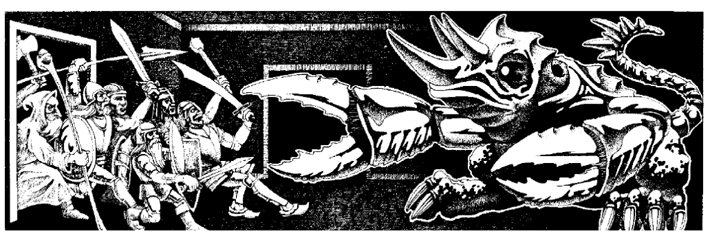
 Geek Ken