Category: RPGs
Tweaking 4E – Advantages and Disadvantages
I’ve yet to get a game of DnDNext in. I’m chugging along with my Savage World’s treatment of Traveller. A few folks will be out of town for a while. I might try to run the playtest with a smaller group. However, I’ve been wanting to get back into a 4E game again.
I’ve really been thinking about tweaking with 4E to streamline some parts of it. I’m also thinking on going gridless. So there have been some things rolling around in my head as of late that I might try out for a few sessions.
One thing I definitely like about DnDNext is the concept of advantages and disadvantages. In a nutshell, a player rolls two d20s and either takes the higher or lower roll, depending on their state. 4E has a lot of temporary modifiers floating around during combat. So rather than fiddling with temporary bonuses to hit and defences, I like the idea of the advantage/disadvantage mechanic in DnDNext.
I’ve got a set of beads for baduk (Go) that I’ve used as markers to keep track of successes and failures in skill challenges. My plan is to use these beads as a simple way to keep track of bonuses for having an advantage (or suffering from a disadvantage).
As players use powers that give them a temporary bonus to hit, they place white beads near their targets. If the target has a bonus to their defenses, they use the other color beads. If either side has a higher total of beads, then that would translate to either an advantage (more white) or disadvantage (more black) to the player. In case of a tie, the player rolls to hit as normal.
Additional temporary bonuses to hit, or for defenses, would just be another bead added to the total. This is going to result in huge bonuses and penalties, even for a minor +1 to hit. However I am liking the idea of the big swings to allow more attacks (or possibly really hamper the player).
For marking conditions, monsters would have a disadvantage hitting other targets, but an advantage against the player that marked them. Something that will definitely add a nice bonus to other players, but be a meaningful hindrance to that defender. Granting combat advantage will also become a larger issue, really granting the enemy a tactical advantage doing so.
I’ve already altered how I handle critical hits in my game. Players do max damage on a natural 20. If they crit on any other number, they do at least ½ damage. It does curb the output on extended crits, but at least they are guaranteed not to do a trivial amount of damage. I’ve been toying with the idea of maybe allowing a reroll of damage and taking the highest total for extended crits, but I think that’s something that might slow down the game.
I’ll see how this works. It’s a major shift from straight up bonuses to trying to stack different temporary conditions. I like the idea of players and monsters going back and forth with temporary bonuses using simple markers, and it’s the side that works together as a team which will likely get the greatest benefit. Combat advantage, having an additional cover bonus, all these little +1’s could add up to a big effect. It’s something that will take a few games to play out, but I’m liking the idea.
EDIT: Sly Flourish has also visited the concept of advantages and disadvantages in 4E. He of course adheres to a regular schedule of posts, methodically setting up weeks of content that rolls out every week in a timely fashion, so you are offered a great post every Monday with your morning coffee. While I am a spaz that is all over the place when I post. He had the idea first. Check out his blog. It offers some great thoughts on advantages in 4E I think are really good, and are far more robust than the simple idea I have here.
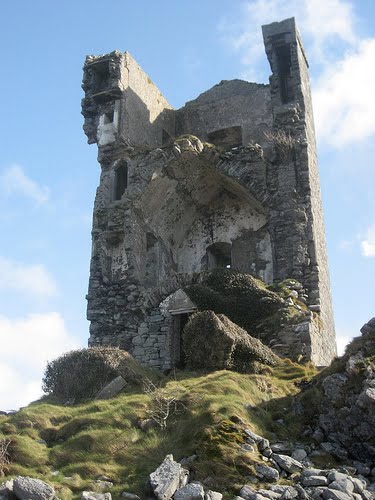
Expeditions of Amazing Adventure: The lone, obliterated tower of Ulaam of the One Eye
Few sorcerers of legend carry a name that both inspires awe and incites dread than that of Ulaam of the One Eye. The human spell practitioner is claimed to have hailed from the icy north, an outcast of the nomad tribes. Not much is known of his past. Some claim that he was a medicine man of prominence with his people, but vied for power and attempted to wrest it from the warrior chieftains of his tribe. Others state that his power and insight into the magics of the world set him at odds with the simple nomad warriors that revered the power of muscle and steel. Fewer still state that his lust for power caused him to look to gods of other beings. That it was his dabbling in the powers of Gruumsh which resulted in the loss of his eye, and his resulting banishment from his lands.
Rumors of his calling towards the darker arcane arts had always haunted Ulaam of the One Eye. His manner was always recorded as detached, distant, and sought little in the company of others. Even the more benevolent acts he had committed ridding strange beasts and vile monsters from the civilized lands were marred with whispers of him obtaining odd trophies from the slain creatures. His most revered act of defeating the evil wizard, Al’Khameed, still to this day have some claiming it was primarily jealousy and a desire of obtaining similar dark powers that drove Ulaam to battle him.
In his last years, Ulaam of the One Eye became more reclusive. He constructed a simple tower and created a force of golems to protect him and act as servants. He refused all that sought his counsel, and took to having his powerful golems ever patrol the fields that surrounded the tower to ward off visitors.
Some claim that these last years were when the sorcerer delved deeper into the mysteries of the black magics. Fewer even speak that powerful artifacts of the god, Vecna, were in his possession, that his final efforts were to decipher the arcane powers within these vile instruments of the evil god in an attempt to prolong his life. Such claims are supported by the rumors of cemeteries from neighboring villages being raided by golems of flesh and earth.
None really knew the direction of his arcane research, save that one black night under the new moon a tremendous explosion was heard. The lone tower where the reclusive sorcerer resided burst into a bright green configuration. Flaming chunks of stone and mortar were seen hurtling through the night sky in high, trailing arcs of embers and smoke.
The next day, a handful of brave souls had travelled to the remote tower to see what had happened. In the distance, they could see the sundered tower. The top shorn off and one side completely missing, with the remaining stonework a gutted, blackened, scaffold of the structure. Some wanted to inspect further, however the lumbering creatures Ulaam had created to secure his isolation were still seen patrolling the grounds, seemingly oblivious to what had become of their master.
The tower to this day draws adventurers. Many rival wizards have financed large companies of sellswords to breach the defenses of automatons and seek what became of Ulaam of the One Eye. Despite efforts to destroy the arcane constructs, their forms seemingly reassemble the following day, and begin their tireless duty walking around the tower.
The few that have managed to investigate the tower found nothing within the destroyed remains. Although some claim that beneath the tower’s foundations, some secret chambers are still intact. Within might be some powerful artifacts acting as a source of magical energy that seems to continually restore the golem guards. To obtain such a power, and study its secrets, is something that many spellcasters covet deeply.
But there are still greater mysteries of the tower. What happened that night long ago? What great calamity befell Ulaam? And what happened to the remains of the great sorcerer? Questions to this day remain unanswered, and what some scholars claim are key to unlocking the great mystery of the magics that remain in play around the tower ruins.
Is Save or Die even needed?
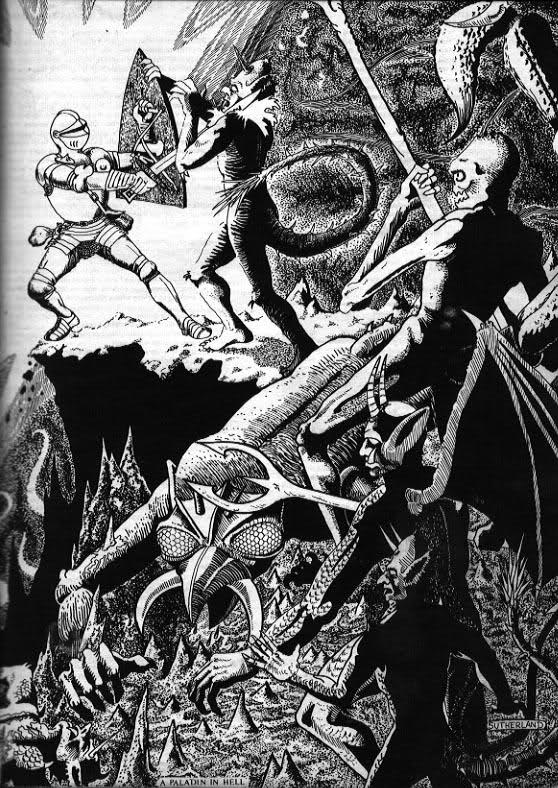 Posted last month, WotC’s Legends and Lore column mused a bit about the Save or Die mechanic throwing a few ideas about how they were part of the older game, and if they had a role in the newest edition. I’m not a fan of save or die, and was glad to see it go in 4E. However given the poll results that were provided the following week, it looks like I am in a minority.
I never got how some people felt 4E lacked the sense of danger of previous editions. Things were too balanced and players had too easy of a time. This got me because the DM always had the option to crank things up when making up an adventure. Throw a few trolls at that level 1 party and voila, you have a dangerous encounter where the PCs should have to run.
I’ll concede one point however. Heroic level games seemed to run just fine, but paragon and epic tier things likely would get a little wonky. Especially at higher level play, where out of the book battles could become a cakewalk with a fully rested party. Yet, even that could be overcome with some some tweaks and employing a different design philosophy that Fourthcore has explored.
Another point I’ll agree with is having a saving throw does engage a player a bit more. 4E effect mechanics were very streamlined and uniform, but did lack the interaction of previous editions. Rolling to hit against defence for spells are great when players were attacking, but being the target of these effects could become dull as all the action was in the DM’s hands. With saving throws, at least the PC could have some action in trying to counter a spell, rather than depending on a passive stat. However having something like that for everything could drag down the game, meaning you might have one way of resolving effects for players and another against monsters. In the end, with different systems to resolve spells and effects it could be a headache.
I’m just not a fan of wildly chaotic play that save or die encourages. It becomes harder to help maintain that story. With lots of checks built in 4E, I knew if I threw a high level encounter at the party, they would have a tough time and possibly a few might not make it. All of us could then craft the story around those big, momentous combats that telegraphed the idea that the players might have to make the ultimate sacrifice for the rest of the group.
Another problem I have with save or die is that with most adventures, the DM has control over everything. They are the ones that decide what the PCs will go up against. Having a random lethal outcome be layered on what I decide to throw at the players makes my job harder in trying to make a fun fight. If you were running a module that had been playtested extensively, this would be less of an issue. But most DMs are making their own game. It can be difficult to judge how much of a challenge fights will be using monsters with severe penalties if players don’t make their saving throw. Having one PC drop dead might make for an interesting side quest or push for roleplay, frequent TPKs however don’t seem to make for a fun time.
I don’t want save or die part of the core rules for DnDNext. I do however, want a little section in the next DMG to give advice on how they can ‘turn their game up to eleven.’ Having some suggestions on some stock abilities, or methods for putting save or die mechanics into your game would be great. So if a DM wanted to increase the lethality and danger of their games, they have some tried and true methods to do so.
An example might be to suggest encounter powers for creatures rely on saving throws instead of to hit rolls, and do max damage or ½ damage whether the player makes their appropriate save. For a more 4E-centric mechanic, how about a suggested disease track for level drain, and also add a condition that permanently removes 1 healing surge from a PC’s total? Fourthcore introduced the idea of a new power keyword, Kill. If a player did not have a particular amount of healing surges available, they’d die outright. Having a good 5-10 methods and suggestions for introducing save or die into the game, with some additional pointers on appropriate use would likely be a great addition to a new DM’s arsenal of information.
Someone like me? Likely I’d never use it in my game. Yet other DMs out there would have solid, play-tested means to add save or die aspects to their game. I want it out of the game, but as an optional rule, this could have a place in folk’s games. I’m hopeful, as a core mechanic, save or die simply stays dead.
Virtual tabletop roundup
I’ve not used virtual tabletop software in my games. I’m a sit-around-the-table kind of guy. However I have to admit the sheer connectivity via skype and google hangouts is drawing me towards possibly looking at running online games. I think for 4E tabletop software there are some kinks to work out. However stuff I have thought about before will likely never see the light of day given the edition change coming.
I’m curious how the development of the official DDI Virtual Tabletop will go. Sadly, I guess the 4E support for that will evaporate. But with a looser, gridless system possibly in the works for DnDNext, this might get more support. Dread gazebo put up a nice old beta tutorial on his blog.
There are some other paid versions out there like such as the one at Fantasy Grounds. I’ve heard some give the software positive reviews and it looks pretty nifty. Typically I shy away from trial versions, but I might give this a spin. They also seem pretty committed to updates for the program too.
While possibly not as full featured as others out there, you’ve got Map Tool which is free. A bonus in my book as you can try it out without having to worry about any hassle with a trial version. I understand quite a few folks have used and enjoy this for a while now.
Something else on my radar has been the Roll20 Virtual Tabletop. A few things I like is that it is web based. Also while the program is geared for 4E, it is also system neutral. A plus with the new D&D playtest on the horizon. They’re currently in closed beta, but I’ll be keeping an eye on how they progress. It seems to have some potential.
EDIT: As expected I just scratched the surface. There are a few other programs out there that folks have brought up. I’ll just provide a list of the links here:
Gametable Project – a java opensource program
Tabletop Forge – that utilizes Google+ hangout
d20 Pro – a paid program but has a 30 day free trial
Upcoming DnDNext playtest
I think the internet and twitter likely exploded among RPG fanatics last week with the announcement that Monte Cook left the DnDNext project. At first I was spouting off maybe he left due to differences in what direction the newest D&D would be going. Then the other shoe dropped and the public playtest of DnDNext would be coming out late May. After that I’m falling in the camp that maybe there was a division on how ready the ruleset was for public input between some of the designers and Hasbro/WotC.
All in all it’s sort of giving me a sinking feeling about the next version of DnDNext. At times I even wonder if it’s to get that chunk of 3E/Pathfinder consumers. I could have seen some fictitious conversation months ago like this:
Hasbro Suit: Hey, I was taking my kid to Barne’s and Nobles to spend this gift certificate. He bought this Pathfinder book. You’ve seen this thing?
WotC Designer: Yes.
Hasbro Suit: You have? Man, we gotta get our attorneys on this. I looked through this thing. It’s got wizards, sword guys, dwarves, it’s just like D&D. Those guys stole our IP!
WotC Designer: Actually, it’s closer to our older editions, published under OGL.
Hasbro Suit: OGL material? God don’t bring up that mistake again. So all this stuff in the book is under that massive screw up. Okay, no lawyers. What are we doing about getting these geeks back to our product?
WotC Designer: Well, a lot of people enjoy the older editions of D&D. Pathfinder sort of built on that rules-wise. Fourth edition has gone in a slightly different design direction. I mean it’s pretty much the same game, just utilizing some unique game mechanics.
Hasbro Suit: What do you mean different? There are wizards, spells, dragons, friggin’ orcs. This Pathfinder and our product are the same thing. They’re both Dungeons and Dragons. So why aren’t they playing our product?
WotC Designer: Again, they are fairly similar. However 4E has some interest-
Hasbro Suit: You aren’t listening to me. Why aren’t they playing our product? Fix it. Get these mama’s basement dwellers playing our game. And for God’s sake don’t put that OGL anywhere near it.
Okay, I’m actually sure something like that never really even came up but I’m certain folks have been looking over at the Pathfinder camp and wondering how they could get players back to ‘official’ D&D. I like the concept. Get just about everyone under the banner of D&D. I just don’t think it is going to happen.
First off you have the OGL of 3E/Pathfinder. Even with a newer edition out there that can incorporate older editions, I don’t expect for a minute it will have an open licensing scheme. I’m going to be massively unpopular stating this, DnDNext shouldn’t have an OGL. They should however, be very open to licensing the game. Whether it’s cash up front or an agreement to split profits, other publishers should be able to put out D&D products with an agreement that encourages this. I think that was one reason why support for 3/3.5 sort of evaporated. If WotC supported that edition it’d give it legs, and meant other companies could use that as a sign to keep putting out stuff WotC would never get a dime off of.
Lastly I think the community is split. Folks have set up tents in respective camps and are unwilling to get behind another product. In a way, I don’t blame them. If they love AD&D or Pathfinder is their edition, they have the rules they want to play. Why try something ‘new’ that is drawing them away from games they already enjoy? This point I think should give WotC pause about how much effort should go into calling back lovers of past editions. Which audience is really the future of D&D?
I’m hopeful they can pull it off. That they can make something with enough working parts to get everyone behind. But I’m unsure if players of older editions (including 4E) will be willing to make that jump. Just because the game worked one way in an earlier edition doesn’t mean it was better or ‘more true’ to D&D now. If something might not fly with new player expectations, but is some classic ruleframe from an older edition, new players should get the rule shift every time. The focus should be getting new players into playing the game. Getting lovers of the older editions, the fans of existing rules, may not be the best in the long run. Instead I’d be trying to make a game that future generations would want to play.
Expeditions of Amazing Adventure: the esoteric monasteries of the Etholician Monks
This religious order is a prominent player in the political structure of Etholita, and their various temples scatter the densely wooded region. The order comprises of followers of Sehanine and is known for their generosity. The Etholician monks open many of their grounds to the weary and needy, offering protection against the elements and their expertise in the medicinal arts if needed.
Their openness and willingness to offer aid has raised ire with some the ruling nobility of Etholita. The country has always had a strained relationship with its neighbors, especially the Kormerrian barbarian tribes that lead frequent raids. The order has offered aid to the wounded of both warring sides if asked, and many times have been requested by foreign parties to act as arbitrators in political disputes with Etholita. The monks are known for their fairness and impartiality, and at times have even ruled against the very state that houses their monasteries in legal disputes.
The monks themselves avoid bloodshed whenever possible. However, they do train with simple weapons favoring the club and staff. Their martial prowess in unarmed combat is renowned, and much of a monk’s daily routine is designed to focus their minds and bodies into formidable weapons.
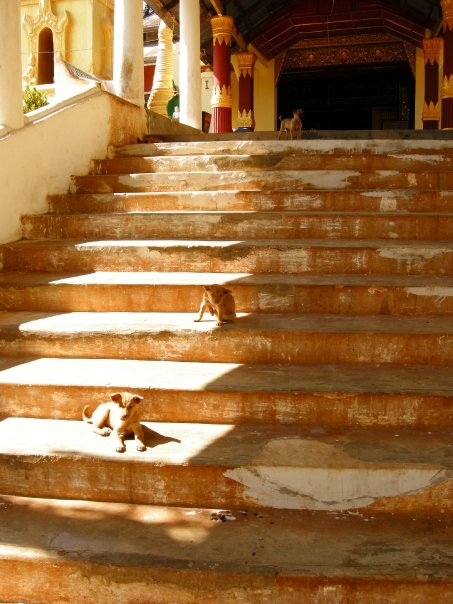
The constant accompaniment of dogs is another characteristic of their order. The common presence of large mastiffs can be observed as these dogs appear to have free reign within the monastery grounds. These are not spoiled beasts however, despite the occasional frolicking of young pups among the common halls. The dogs are well disciplined and follow their master’s command with resolute obedience. It is rumored that brigands or humanoids foolhardy enough to raid the order have not only met the martial might of the monks but also the savage fury of their beast companions.
From their deeds to their effective command of the martial arts, the monks have established themselves as a major player in the politics of Etholita. This brings some worry with the land’s nobles, while a few would even admit to desiring the order be abolished completely (such talk however is a topic of secret council).
It is such tension with the order that has likely lead to some of the more astounding rumors regarding the monks. Some claim that the order is cursed. Their oldest members are afflicted with a horrible disease that transforms them into beasts. The reverence of the moon is a secret admission of their affinity with lycanthropy.
It is immensely uncommon to come across werebeasts in Etholita, however it does not keep the circulation of such rumors falling among commoners. Some will swear the many dogs that are devout companions to the order are actually monks themselves which have succumbed to the long standing curse. The monks in their benevolence open their hearts and temples to these animals in hopes to bring them peace.
The Etholician monks respond to these rumors with much mirth and deny any truth to such astounding tales. Yet some nobles would clearly find such evidence immensely valuable to strengthening their position in Etholita. The order, while committing many charitable acts, would find their supporters wary of the practice of such magics, and likely erode the standing of their order from the very commoners they aid.
Fallcrest – where a new 4E DM should start
Cruising the WotC boards a while back I came across a new DM struggling with the notion of all the work they’d need creating a starting town for their players. Thinking up locations, inns, and NPCs all seemed like a daunting task. I was happy to point out however of a fantastic starting town right in the DMG, Fallcrest.
First off you have a decent starting delve to get the players going that is high on action and low on plot, Kobold Hall. There are a lot of resources online to help with running that adventure including a great starter kit from Newbie Dm. It’s a decent one shot adventure to allow the players to get a feel for their characters, gain a little wealth and notoriety around town, and give the DM a little time to formulate a more intricate campaign story.
But after they clear out Kobold Hall, what’s next? They won’t have to travel much out of Fallcrest to find excitement. The town has a ton of potential ideas and possible avenues for adventure right within the town walls.
Barstomun Strongbeard and Kelson – Both are unsavory guys with their hands in the underworld. Barstomun has the porter guild under his control. Kelson has his criminal gang in the lower quays. It’s only a matter of time before they butt heads. Clearly the elimination of one group is highly advantageous for the other (not to mention merchants that would be happy to see both go). Or maybe some sort of negotiation needs to be brokered between them before a gang war spirals out of control leading to open murder in the streets? A great opportunity to get your players into a gritty criminal underworld adventure for certain.
Armos Kamroth – Jerk noble? Check. Secret cult leader of Tiamat? Check. Guy for the players to handle? Absolutely.
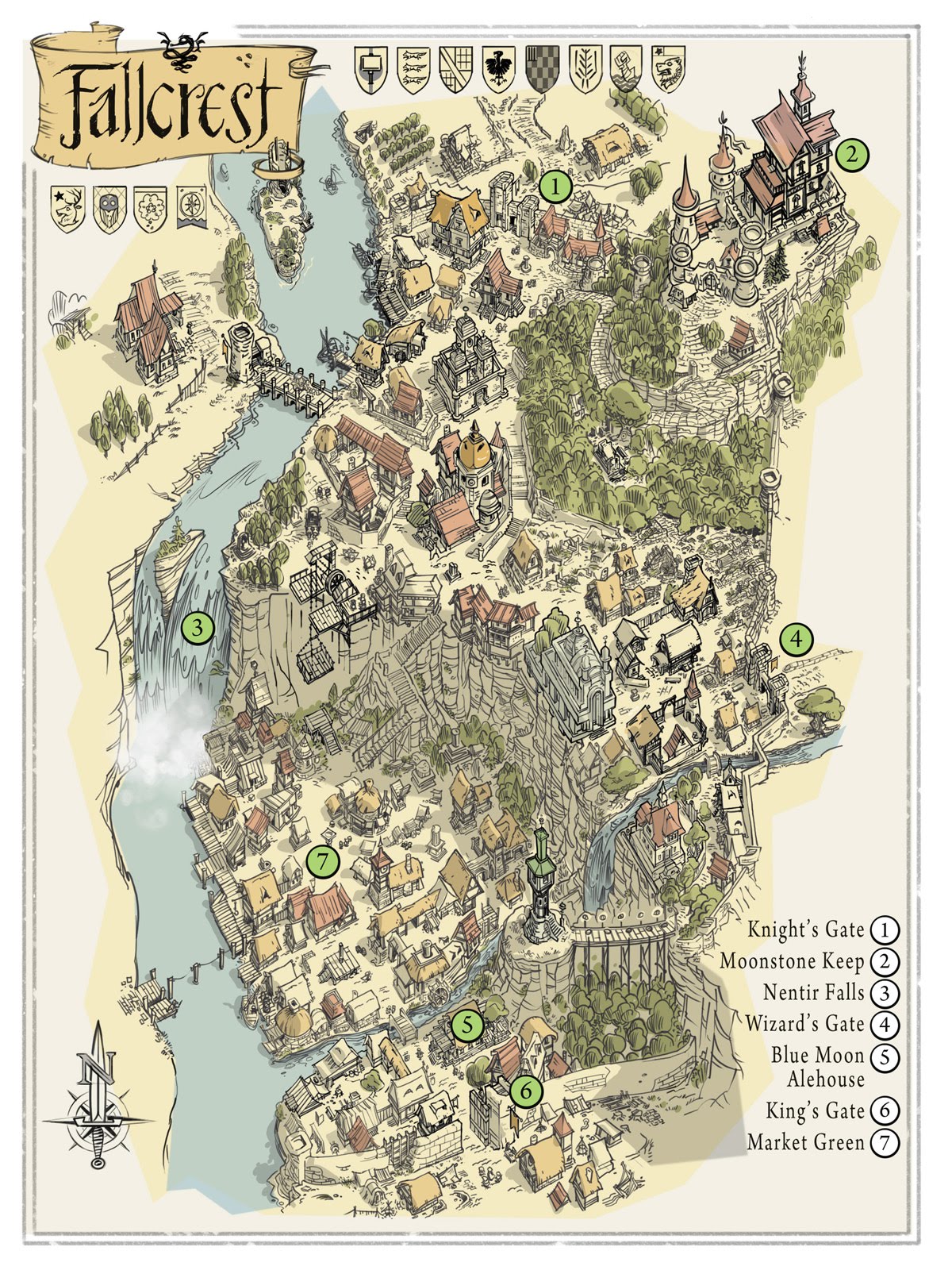
What makes this guy work wonders as an NPC is that he stays within the law and his suspicious activity is secret. This could easily be played as a noble with the political connections, wealth, and decent reputation in town to be a difficult adversary. A tough reputation to smear publicly, so the ‘he said/players said’ game can easily shift in Armos’s favor. A decent villain for the characters to face off with for sure. And where would his secret cult meet? Why in…
The Catacombs – Yup. A network of old tunnels running right under the bluff. Just what a DM needs for a little dungeon action. How else could the River Rat gang transport stolen goods through the city? Not to mention a few secret areas where some evil cultists could meet (and move some poor sacrificial peasant to a ritual chamber). Clearly some sections would be unexplored. Sealed off sections with secret passageways leading to unknown horrors and wealth. Fun stuff indeed.
Tombwood Cavern – A nice wooded location in the middle of town with a series of old crypts and entrances to Moonstone Caverns. Most have been explored, but there are rumors of some tunnels that lead to the caves. Who knows what lurks in there or what treasures might be found? Tombwood is a fair size (about 200 x 300 ft across) so you could easily have a decent dungeon jaunt right within the woods exploring a few old crypts or a network of caves.
The Tower of Waiting – Still not enough dungeon ideas for you? How about an old abandoned tower (spoiler alert at link). How about a cool looking map to serve as more inspiration. Yeah, another spooky abandoned place for the players to dig around in. This place might be haunted by ghosts. Or maybe the players could be employed to investigate and find some clues to a secret dark past of Lord Markelhay’s family. After all there is that dubious guy hanging out in the Nentir Inn…
Serim Selduzar – Maybe the tower of waiting might hold some evidence that the father of Lord Markelhay was really not quite that nice ruler everyone remembers. Evidence of torture and human remains locked away behind a secret wall might do a lot of damage to the public reputation of Lord Markelhay, something Selduzar would love to take advantage of. Could the players end up being duped into helping this evil tiefling? (insert soap opera music here)
Yeah, Fallcrest has a lot of neat NPCs, locations, and potential stories right within its walls. Not to mention if you dig around you can find a ton of material out there like this wonderful map I lifted from D&D Doodle. Did I mention he even has a DM friendly version?
Nentir Vale was going to get some support from WotC, but long ago that official campaign setting was dropped from the upcoming products listing. Still with the published adventures already available, not to mention the free Keep on the Shadowfell, there is a lot of potential for a long campaign in the area. With some wonderful maps of the area and specific regions over at D&D Doodle, you won’t be short on sources for inspiration.
All of this can be kicked off with a group spending a little time in Fallcrest, building up their chops at being local heroes. If you’re a new DM struggling to think of a place to start. Don’t turn your nose up at this great location right in the DMG.
Bring back the WotC D&D playcasts
I’ve enjoyed many of the videos and podcasts from WotC showcasing 4E. The Penny Arcade podcasts were very enjoyable. I expect with the next version of D&D rolling out there will be an entirely new set of play sessions released. Quite a few folks have used them to introduce the game to new players. However more effort should be put into a special series to introduce the game, especially for new DMs.
One format I have loved talking about adventure design is Return to Northmoore. Typically you have one podcast talking about the adventure in detail, then another session of the actual playthrough. What I particularly enjoyed was the DM commentary.
So let’s fast forward another year or so from now, with DnDNext out on the shelves. WotC, get a simple dungeon delve adventure up on the web. Something like a lighter version of Kobold Hall. Just use stock monsters out of the book. Don’t worry about any stats. Have a simple map up of the dungeon. Add a branch in the layout and avoid the linear room to room exploration (more on that later). Make sure to throw in a room that has a trap and possibly some puzzle element. Don’t forget to have a few stock level one characters too. Have that as a nice PDF file a fledgling DM can page through. Then get the podcasts up.
Podcast 1: The Adventure prep and dungeon design. Have the show DM talk about the dungeon a bit. Give out the nuts and bolts of the design philosophy. Talk about why the rooms and encounters progress the way they do. Give some DM tips on preparing an adventure, how to address some potential problems. Finally, give at least a good 10 minutes talking about the story of this dungeon and why the players are exploring it. Describe different adventure hooks for it.
Podcast 2: The party introduction. Describe the basic mechanics of the game and go through a quick rundown of abilities, AC, and HP. Have each player introduce themselves. Have them give a little background on their character. More importantly, insert some DM commentary on a few bullet points about key abilities as each party member is introduced.
Finally, the show DM should lay out the situation and cast a few adventure hooks, getting the players on board. Make sure to encourage that roleplaying. Get them lined up to explore the dungeon and as they enter the first room…
Podcast 3: The first combat. Give a complete overview of the fight. Present every die roll, every HP marked off, allow for plenty of questions and answers. In short, just like almost every existing WotC podcast for 4E.
Podcast 4+: Now for the other fights, have the lead up to the fight. Maybe play out the first round and then skip to the end. A blow by blow account is boring. You don’t have to focus on each die roll and listen in as each PC ponders their turn. Instead, focus in on presenting particular situations that come up with commentary by the show DM. Something like the following…
Show DM: The party is pretty much in the thick of it by now with the wizard suffering from poison by a giant spider bite. Let’s listen in on Fizzlelot’s turn.
DM: Okay, Fizzlelot. It’s your turn. You are poisoned. So you immediately take 5 points of poison damage.
Show DM: Ongoing damage is taken at the beginning of the player’s turn. They might have temporary hit points or some regenerative effect that can counter this. However if they drop to zero HP, they are down for the fight. Players can be pretty excited to do something on their turn and can forget any ongoing damage, so be sure to remember any ongoing effects.
Fizzlelot: Five points? Ouch. Okay, I’m down to 12 HP. I’m going to try something different and swing my staff at the creature.
DM: All right, make a basic attack rolling a d20.
Fizzlelot: Ack.. rolled a 4.
DM: Sorry not enough to hit it. That was your standard action. You have a minor and a move action.
Fizzlelot: This is pretty dicey right now where I am at. So I’ll use my move action to shift away from the giant spider. That’s about it. I’ll use my minor action to say some choice words to the beasty!
DM: Heh. Okay your turn is over. You get to make a saving throw to shake off the poison. Use a d20 roll and roll high.
Show DM: At the end of the player’s turn, they can attempt to make a saving throw for any effects that have a ‘save end’. The poison attack from giant spiders have such a condition. All the PC has to do is roll a 10 or more and they can shake off the effect.
Fizzlelot: Jeez. An 8. Can I get a break here?
DM: That’s too bad. You are still poisoned. Let’s move on to Sir Slays-Stuff.
Show DM: Since the wizard rolled less than a 10, he is still poisoned and will continue to take ongoing damage the next turn. As a tip you might want to curb the use of too many monsters that inflict ongoing damage with low level parties. Players can get into some bad die streaks and the cumulative damage can add up. Not to mention they don’t quite have the magical items to help out. So be sure to use these type of monsters sparingly in your adventures.
Now here is the important bit. Skim through the remaining fights. Possibly key in on a few important rolls. For the final boss fight, give a general overview of the situation and play out that last turn. Streamline the podcast to cover high points of the fights. For roleplaying however, you want to play every minute of dialog.
That is why it’s important to have a branching path (and be sure to have some clues telegraphing what might be in each direction). Have that room with only a trap and a puzzle. Give opportunities for the players to talk about the situation and cover all those exploration discussions. That is the stuff you want to cover in its entirety. While combat is a part of the game, it’s a better sell to capture the table chatter and excitement of exploration.
Final Podcast: The wrap up. Have the DM lay out a foundation for another adventure and tie up any loose story bits. Finally, go around the table and get feedback from the players. Throw in some final DM commentary and advice about how to seed further adventure ideas and the importance of talking with your players, and most importantly, just having fun.
I hope more effort is put into getting a short series of podcasts out that help explain the game and give some guidance to new DMs. I tend to think there are so many existing fans of the game now, we tend to forget about trying to get stuff out there to help the newer players. A short series of podcasts like these can be a great step in helping newer players learn about, and grow to love, D&D.
Making alpha mutation decks through a card draft
 The alpha mutation cards in Gamma World are a pretty fun. After every encounter, or if a player rolls a 1 on a d20, the player draws a new mutation card to replace the one in his hand (or had used). Other environmental effects can also cause a player to draw a new card. It can be a lot of fun using this mechanic, however the player is totally at the whim of cards in the GM deck. To get around this, a player could assemble his own personal deck of cards. This might be desired if a character is going after a certain theme of mutations for RP reasons, or just prefers powers that would work off a specific stat.
I imagine WotC would then love the player to go out and purchase several booster card packs to create their own personal deck of cards. Good marketing there. An optional part of the game, but the diehard player may just decide to jump in an buy a ton of cards to get a little more control on his mutation draws. A workaround for this however is using a mechanic in many boardgames and other card games, a card draft.
Out of the box, Gamma World has 44 mutation cards (40 in the deck and 4 from an included booster pack). Staying with the 7 card minimum deck, you can have 6 players each having their own personal alpha mutation deck without having buy any additional booster packs. You generate these decks by dealing out all the cards, each player selects a card they want, passing the excess to another player.
As a step by step example:
1. Deal out all the cards – Some players will end up with extra cards, don’t worry about this. However you could always have all the players roll off, with the highest roll (resolving ties) being the first player dealt.
2. Each player selects a single card – Each player goes through all the cards in their hand, and selects one card they want to keep. They set that card aside for their deck.
3. Pass the remaining cards – Each player then passes the remaining cards to the player on their left.
Repeat steps 2-3 until a deck of 7 cards is made for each player.
Each player will eventually have 7 cards they have set aside. This is their deck for the night’s game. The remaining cards are given to the GM as his mutation deck.
I like having the excess cards given to the GM to allow for alpha flux mutations from other weird sources. If a player runs out of alpha cards in his deck he can draw from the GM deck. If you want a little more structured game, when a player runs out of cards allow them to reshuffle their discard pile and place it face down to make a new draw deck.
You can do a card draft for omega tech cards, but I prefer keeping them as a single GM deck. Yet instead of handing out a specified card to each player individually, deal the cards in a single pile face up on the table. Allow the players to barter, argue, or agree (boooooorrrring) on which card they will take. This way there is a little control the players have in choosing what tech card they want, but it is still a random draw. I like this better than giving the players a chance to draw from their own stacked omega tech deck.
If you have players complaining about the wildness of alpha mutation cards, and want to give them a little more control with the types they get, consider using a card draft. You get a pretty good selection right out of the box and can accommodate quite a few players at the table.
Giving Savage Worlds a spin
 So last month I wrapped up my one and a half year D&D campaign and was looking for some new worlds to adventure in. I was clamping at the bit to get into Dark Sun and was pretty excited about DMing it. My players ranged from don’t-care-let’s-play-something, to I’m-not-too-big-into-fantasy. Given that the old campaign was a little dark, the idea of jumping into another bleak setting like Dark Sun was also a minus for some folks. So I had to think of other options.
I floated out an idea of playing the new version of Gamma World, possibly a 30s supernatural game using Savage Worlds, or maybe jump into the new version of Traveller. All were well received but Traveller was at the top of the list. I like the newest version from Mongoose Publishing and the rule system is pretty easy mechanic-wise, but I kept looking over my Savage Worlds books.
Traveller would be an entirely new system for everyone (including myself as a GM). So I’d have to go through the ropes of getting everyone into the mechanics of the game. If we wanted to take a break and jump into another genre, likely they’d have to learn an entirely new system. Gamma World wasn’t an issue for them on this point. As we had played it before and everyone knew 4E very well. So while I liked Traveller and was eager to give it a whirl, I didn’t want to get my group into a tailored system for just that game. If we wanted to jump into a superhero game, or maybe try out the 30s supernatural campaign for a few games, it would cut into our play time having to get everyone up to speed with different RPG systems.
So I decided to put work into making a Savage World (SW) conversion for Traveller. There are all ready quite a few conversions out there. Not to mention that SW all ready is pretty generic to run just about anything right out of the book. I’ve also decided to focus on a few key bits within Traveller to work with SW. That way for a good chunk of the game, like spaceship combat, buying and selling goods, etc. I can use the values in Traveller, just quickly port it over to SW.
The biggest hurdle was trying to distill the various skills from Traveller down to a more truncated list for SW. A tad daunting, but something I was able to do. Likely there will be some more changes and not everything fits perfectly. However I think it’s good enough and my players will likely not be too irked by some of the skill swapping.
I’m liking this as Savage Worlds is very modular. If we want to take a break from Sci-Fi opera and try something else out, both myself and the players can switch gears pretty easily and not have to worry about learning another completely new RPG system. I think with posts on the blog you can expect a few directed more to Savage Worlds in the future. Yet I’ll still be plenty focused on dispensing my opinionated, bloated ego and ideas on D&D topics too.
 Geek Ken