Category: RPGs
Tinkering with Call of Cthulhu: The Auction – Part 1
The Auction is a classic adventure for Call of Cthulhu taken out of the 1983 collection, The Asylum and other Tales. I dearly fell in love with the idea of the scenario and used it for my own Cthulhu Savage Worlds game. For folks not familiar with the scenario, players participate in an auction set in Vienna during the 30s for several rumored occult items. After the auction well…let’s just say things go a little pear-shaped.
It’s a great adventure full of intriguing theme and certainly one of the better scenario setups. For new fans of CoC, it’s one I highly recommend pleading with your keeper to take a peek at and consider running it themselves. I’ll leave it at that with the details. If you’ve got interest in playing it, go shoo and let the rest of this grumbling be for just the keepers and GMs. Spoilers ahead!

.
.
.
.
.
.
.
As I mentioned I’m a fan of the Auction. It works well as something to fold into an existing campaign or for a one shot. It’s not perfect however and seems there are some glaring hitches with the the adventure. One is the auction itself and the other is somewhat the greater mystery that presents later, of which seems to causes problems when running it. I’ve opted to break this up over into a couple of posts talking about how I handled it for my players and the changes made to make it a more engaging adventure.
The first issue I’ve got is the auction itself. For a continuing campaign, this is likely a decent adventure hook. It’s something to allow players to establish contacts in Europe and a means to pick up a few occult items. However I’d put money on most people playing the Auction as something of a one shot session. Most folks aren’t going to have an ongoing Cthulhu campaign.
There is a different draw to getting investigators to participate, and that as being cooperative bidders for a third party. For my game this is the route I took and felt it made a stronger hook. Players are asked to utilize their occult expertise to ascertain the authenticity of certain items and cunningly bid on lesser trinkets to drain the resources of other bidders. All in hopes that the group can eventually scoop up some items their patron is keen on obtaining. I loved this idea and recognized it could be a sort of mini-game within the game.
As written the Auction sounds enticing. The players themselves will likely be excited to participate in it. Who wouldn’t enjoy an evening soiree culminating in an auction for supernatural items? The problem is once you actually start running an auction, it gets old fast. If you dig around, there are some live play podcasts that painfully demonstrate this. There’s a lot of excitement for the first few items, but then PCs realize how repetitive the entire thing is. You can hear one player in a live play recording illustrate this tedium as they quipped something along the lines of, “Are we going to go through the bidding for all the items?”
What cements playing the auction out as a useless exercise is the twist in the middle of the event. There is a murder and the entire auction is halted. Half the items players likely have researched and pondered over won’t even be bid on. I loved the concept, but actually playing out an auction just seemed to mess with the pacing. It had some merit but a faster resolution was needed and players had to have a stake in all the auction lots, just not the ones they were interested in.
Firstly, I had their patron tell the PCs he was interested in about 6 different items from the auction list. He forwarded them a line of credit including a lengthy legal agreement. They would return all the funds placed in their accounts that were unspent and hand over any items successfully bid. I didn’t use actual numbers for cash though. Instead I gave every player 3 credit markers. These represented funds that would be used for the auction. NPCs had 3-4 markers themselves. If anyone was out of markers, they were out of the auction.
PCs got a list of wanted items from their patron. To sweeten the pot some, if a player got an item and had 2 credit markers remaining at the end of the night, they’d get a cash bonus. In game terms, I offered players a bennie if they won a bid for an item desired by their patron regardless of cash spent obtaining it. Thier objective was to try and gain as many items on the list, while carefully bidding on unwanted items to run through the NPC’s cash. If they blew all their cash and got items not wanted on the list, they were stuck with a bill and/or having an NPC they owed a big favor to.
Each auction bid round required players and NPCs to make trait test based on either persuasion or intimidation as primary checks. Secondary trait checks could be made with a -1 penalty for notice or smarts. I felt a -2 penalty for being unskilled would not apply and smarts could always be used. Intimidation and persuasion might be considered an odd choice, however they seemed good candidates in either goading NPCs to bid, or putting up such a strong front they could stare down competitive bidders. Gambling could also likely be a decent choice for a secondary skill.
Roughly half of the NPCs would be wild cards. Before each auction item, I randomly determined which NPCs would be actively bidding. At least half of the NPCs (rounding down) would bid on an item if they had 3 or more credit markers. If all NPCs had 2 or less credit markers, at least one NPC with some credit remaining would always bid, and this lone bidding NPC should be a wild card if possible.
Now winning or losing an item depended on what was being bid for. Players had to have at least 2 credit markers to bid on an item. NPCs needed at least 3, but would bid if they had less depending if any other NPCs weren’t bidding (as mentioned above).
For lots that the patron wanted, the PC or NPC that got got the highest check on their trait test won the item, and would spend their 2 credit markers. If a player or NPC aced their trait test they could take back one credit marker (multiple aces have no effect i.e. at least 1 credit marker was lost if they won a bid). Note that these were not trait challenge rolls or tests of will. Each player/NPC made the appropriate check and the highest roll won.
For auction items the patron didn’t want, the player/NPC with the lowest trait roll would ‘win’ the unwanted item paying 2 credit markers. For each ace that PCs or NPCs rolled beating the lowest trait score, that player/NPC put in an extra marker up to a maximum of 4 (or 3 if they were an PC). So not only had the others gotten the player/NPC to be the highest bidder for the unwanted the item but they had severely overbid for it.
In the case of a tie, players can put in an additional marker to automatically win over NPCs (or other players). If both players put in a marker, they make another check and keep rolling until one player wins. Players didn’t get this extra spent credit marker back if they won the bid, even with an ace.
This set up for a mini game. At the start there were several NPCs bidding for items. If players rolled well for unwanted items, they would slowly decrease the number of NPCs attempting to bid for future rounds. PCs also wanted to try and roll as high as possible for the patron lot items. If they got lucky and aced their rolls, they might win a bid and not spend as much cash. Plus there was always a bonus of getting a bennie if they won the item.
This worked great. It resolved fast. It kept everyone trying to roll high regardless if it was an item their patron wanted or not. Players wanted to gain items as it gave them bennies. They also were engaged and active in just about all the auction lot bids. I scrambled the lot list order some and made sure only half of the 16 items were bid on so only 8 items were bid for. Yet this moved pretty quickly and allowed me to get onto the second part, the murder mystery.
Alleycon 2015 is coming…
I’ve been pretty fortunate over the past few years to get into a circle of local gamers. There seems to be a decent community behind a lot of them too. Alleycon will be running next month and what started out as an afternoon of gaming at a local expat restaurant has slowly morphed into a full fledged con. This year it’ll be 2 full days of gaming and geekery September 19 and 20, with a local meetup the night before for beer and trivia.
So if you are in Korea and keen to play some games, do some cosplay, or rub elbows with fellow geeks, be sure to check it out. From what they’ve got listed as events there’s lots to do (or plenty of space to run your own thing). Online registration is open now. Scoop up tickets before they sell out!

Hindrances as PC motivations for Savage Worlds Demos
Savage Worlds for demos or one shot games works well. It’s a relatively streamlined RPG system and pretty easy to get into. One hiccup however are dealing with hindrances. For prep work you have to really make fleshed out pre-generated characters. Yet once a person sits down, they are somewhat locked into a persona as skills, edges, and their flaws for their character are set for them. When I run my demo games I shake this up a bit.
I don’t have hindrances for my Savage World pre-gen characters. Instead I prepare a bunch of cards with hindrances and tie them to motivations. Players pick a motivation early in the session and gain the hindrances associated with it.
To get the ball rolling quickly when they first sit down, I don’t have players bother with introducing their characters. Instead I hand wave things some and give a nod to the idea that they are all gathered under specific circumstances facing a particular situation together. Once they all get a firm grasp of the challenges ahead of them, I pass out several cards with general motivations on them.
Each card has one word that sums up something the PC would strive to achieve, a drive, or a core aspect of their persona. On the back of each card are more details along with specific hindrances. Once they’ve had a moment to digest all the information, I finally have them introduce their character to the others.
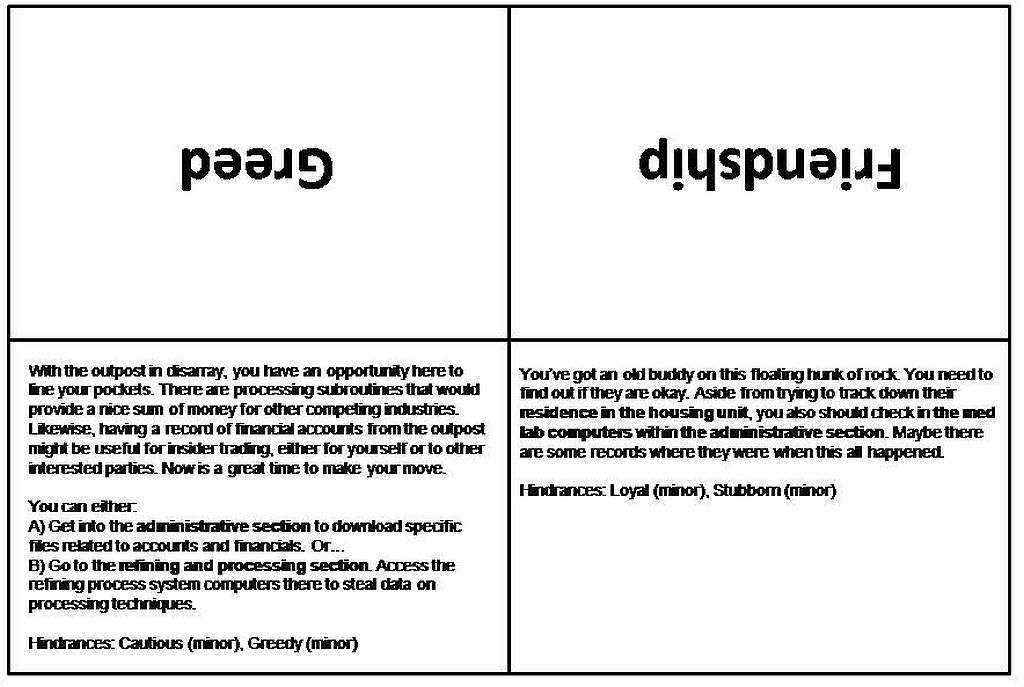
Another key point I bring up with this is if a player pushes the group or does actions that would fulfill their motivation, they get a bennie. Sometimes I have this associated with a particular location depending on the session. If they achieve the task of pushing the action so that they can satisfy their motivation, a bennie is rewarded.
This method does tend to work for more structured one-shots or demos. I’ve run a survival horror, sci-fi game and another weird WW2 game where exploration and investigation was warranted. Having the motivation cards linked to particular areas really drove players to discuss with (and at times connive) each other into exploring a particular area. This helped push the characters into being proactive which is especially helpful for a timed demo game.

Another benefit is that once a player understands the stakes involved and has an idea what would drive them to make certain decisions, they get a better feel for their character. Delaying that initial character introduction until they’ve selected their motivations and the scene is set, allows players some time to let their ideas ferment some. You can really see people get into their character, and they seem to embrace their hindrances more.
As I mentioned, I’ve done this for a few demo games. Most of the time I have people sit down that have never played Savage Worlds. One game I had a table full of 6 players with zero RPG experience. Using these motivation cards helped them jump into the game easily. They had time to get a better idea who was actually depicted on the character sheet. And I’m especially happy to say everyone had a blast while playing.
Sometime I need to formalize my adventure notes and post my past demo games. But I just didn’t want to wait on conveying this concept. It’s worked so well for me and also helps push the players into being proactive. The next time you are running a demo game or a one shot for Savage Worlds, consider using this idea.
Jumped off the deep end of miniature Kickstarters with Reaper Bones
 I’ve avoided the siren’s call of Reaper Kickstarter campaigns of past. But the temptation to pick up a slew of minis is just too much. Their current Kickstarter campaign wraps up in less than 3 days. As usual, you get a ton of plastic minis. The bonus for me is that you don’t need to prime them.
I prefer to use tokens for my RPG sessions over using minis. But I am pretty deep into miniature gaming and been taking a gander to some different systems as of late. Pulp Alley looks neat and Frostgrave is certainly on my radar for something to pick up. As a back up, there is always Chain Reaction which is generic enough for a variety of light arms skirmish games. Yet, I’ve heard some cool things about Songs of Blades and Heroes too for fantasy melee. Yeah…. guess I’ll have plenty of games to run with these KS goodies.
Hindrances, bennies, and Walter White
 Awarding bennies in Savage Worlds can sometimes be a pickle. A great rule of thumb for handing them out is whenever a player does something that moves the plot along. Another key suggestion is awarding bennies when PCs play up their hindrances. However you can get players at conflict with what would be a smart way of playing, and doing something rash that is more in line with their character’s persona.
Players want to be clever. They typically want to make the right decision and avoid doing a bonehead move. So this can sometimes be at odds with hindrances they’ve chosen for their character. On paper, taking something like Big Mouth might appeal to a character concept, but in actual play you might find a player avoiding situations where that hindrance would come into light (or at worse ignoring it completely).
An important thing a GM can do to encourage playing up personality hindrances is awarding bennies. If a player sticks to what their alter ego would do and complicate a situation, then hand out a bennie. Bennies offer this strange feedback loop with Savage Worlds. A PC will muck up a situation and get a bennie, however having more bennies means they can likely make a clutch roll when needed. It creates this dynamic cycle where ‘poor’ decisions create obstacles for the players, but they end up with more resources to overcome them.
How do you sell this concept to players though? Sadly, I think certain behavior is ground into a player’s head that they’ll be punished for a bad decision. If they initiate a plan of action closer to what is deemed prudent by the player than according to their character’s drive and motivations, it’s viewed as a better choice. As a GM, a lot of this can come down to the opposition and obstacles you put in their path resulting from what choices players make. Awarding bennies as previously mentioned is one way to entice them. However all of this seems to counter what likely a rational person would do in particular situations. That’s a key point you need to drill into players. They aren’t rational. They are big damn heroes with huge flaws.
One particularly great pop culture example of this idea is Walter White from the TV drama, Breaking Bad. Walter is a chemistry high school teacher and, for the uninitiated, he opts to start making crystal meth to help his family out after he’s diagnosed with cancer. His character is a smart guy, with a great analytical mind. However he has flaws. He has an ego and some could say he’s a bit greedy.
Continually in the show he takes courses of action that a man of his intelligence wouldn’t normally do. It’s his ego and emphasis of getting his ‘fair share’ of profits that drives him to make poor choices. Walter’s need to feed his ego is so great, that near the end of the show, it helps initiate a chain of horrendous events in his life. It’s a great character and an excellent example of how a smart, cunning persona can still make bad decisions based on flaws they have.
I’ve heard some complaints from GMs that mechanical hindrances like Lame or Anemic easier to run than personality hindrances in Savage Worlds. However I’d counter that with the bennie economy, it’s easier with personality hindrances. If players are really pushing events into interesting directions due to their hindrances, you can help them by awarding bennies. Otherwise, it’s up to you as a GM making a call if players have sufficiently driven the plot forward to hand them out. With personality hindrances, there can be more opportunities to award bennies.
That’s my take on bennies and hindrances for Savage Worlds. So next game you run, keep a list of your PC’s hindrances handy. Be on the lookout for chances where you can award bennies to players that do something aligned with their flawed motivations. Try to be flexible with obstacles and challenges that might pop up as players do crazy things dictated by their quirks. If anything, it’ll make for some memorable sessions.
6th Gun Savage Worlds Setting
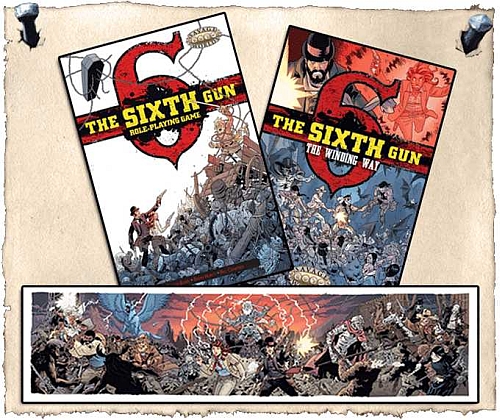 Those that check my blog out regularly know I love me some 6th gun. It’s a great comic and a setting I mined for my own Weird West game. Deadlands is cool but it’s a little too out there with spooky and steampunk stuff in the setting. I opted for an alternate history with some supernatural bits thrown in.
What I like about 6th gun is for the most part it’s the world today with a smattering of the supernatural. The players themselves are knee deep in it, but the world around them only occasionally steps into the boundaries of this alternate spiritual world. I see it as a little easier fit that Deadlands, which to me needs a bit more work conveying the setting. Deadlands is certainly the wild west, but there are a lot of changes to the landscape. 6th Gun doesn’t have this issue.
While people could dabble in the game setting, I expect it could serve as a great epic campaign too. For folks unfamiliar with the comic, the story revolves around the acquisition of 6 guns which give the wielders supernatural powers. I cant totally see a game where players focus on a single gun, or try to wrestle a larger story where all 6 come into the picture and the greater implications of their role in the fate of the world. There is a lot to toy around with here.
So the kickstarter campaign is running along and has reached it’s funding goal. It’s all extras from here on out and some look nice. I particularly like that there are add-ons that incorporate picking up the comic, and those minis look pretty cool too.
If you want to dabble in a supernatural western setting, this looks like a good fit. While not quite as gonzo as Deadlands, 6th Gun should still scratch that itch of the wild west with one foot firmly planted in creepy territory, and not sway too far into steampunk like Deadlands does. Might be worth a gander for folks.
Drawing villains from PC back stories
So you are sketching out a new campaign and drafting up a list of villains, trying to figure out their motivations and what drives them. Sometimes you will blank out on new ideas or potentially start recycling villains. To get around this consider looking over your character’s backgrounds and see if there is any synergy to incorporate their past with NPC villains you are making up.
For my weird west game I had a few general ideas of the villainous movers and shakers in the alternate 1870’s world I was crafting, including some evil organizations. As a first adventure, I set about the players being asked to deliver a holy artifact after being betrayed by a trail guide. However, I only had the barest of ideas though and needed to solidify a few main villains for the game. Tasked with this I scoured over the backgrounds of my players to get a few ideas for evil NPCs.
I fell in love with the 6th Gun comic and really dug the idea of a relentless group of undead soldiers. One of my players was a former soldier so I prodded him for a few more details. He saw himself from a long line of farmers that bred horses. His family and farm got wrapped up in the Civil War and he found himself fighting for more out of defending his home than for political reasons. At the conclusion of the war as it ground to a stalemate and eventual truce, he lost his family and land when it became territory for the other side. Losing everything he became a despondent snake oil salesman out west, more keen on drinking laudanum than selling his wares.
 Getting that background, I asked for more from him. Of course he was a former cavalry officer, so I asked for more details on his commanding officer during the war. The only bit of solid information I requested would be that officer was someone the PC despised and thought sadistic. The result from him was Major Clancy ‘Buck’ Futter. A gross glutton with an enormous gut that nearly buckled any horse he rode. Joking aside with the nickname, this got my mind running with ideas.
I latched onto that key characteristic of a fat glutton and the idea of someone with a ravenous hunger surfaced. I envisioned the unit near the end of the war getting caught up in a siege. Cut off, surrounded by an enemy army with winter set in, Major Clancy Futter ordered the horses to be eaten. Starving still for weeks, some rumors in the fort fell about that wounded soldiers were quietly disappearing. When the enemy finally stormed the fort, the player had escaped believing his commanding officer was killed in the battle. All of this back information the player knew about.
What my player didn’t know was that Major Clancy Futter survived. Aching with hunger and fearful of starving to death, he was enticed into invoking a ritual of dark magic with some of his men following suit. Culminating this foul ritual by eating human flesh, he would transform and be undying. It was successful but he was cursed with the wendigo. Forever alive, he would be driven with a ravenous hunger that could only be sated for a short time by consuming human flesh. His cadre of men around him were also cursed with this affliction.
That villain stuck out for the campaign. One of the first clashes the group was at a church, the group inside surrounded by men on horseback. Unable to enter the hallowed ground they called for the PCs to throw out a holy artifact they wanted. My snake oil salesman player quipped something back. I then described some of the men parting and a gaunt fellow riding slowly forward. Despite its emaciated frame covered with a tattered uniform and cavalry officer hat adorning its head, it still had a grotesque paunch of a gut. The villain called out the PC by name, ‘Cyrus McClintock! That you in there? So you made it out of Fort Bean alive.‘ Trust me, jaws dropped at the table as players realized someone in the group had dealings with this creature before.
A small idea from a player back story cemented into a foundation of being a major villain for the game. It became a driving, relentless evil force, ever pursuing the PCs. Additionally it was taken from a player’s past and was a way of drawing that PC into the world, as they had a shared history with the villain. Instead of me having to fill in the story, that player could step up around the table at that moment describing how they knew the NPC, and its likely intent.
So I encourage looking over your players’ back stories and try to mine it for adventure ideas. People and events of note in their past can easily become the villains for a campaign. Asking details from players on a name, description, and mannerisms all can help give the NPCs a life of their own. Best of all the players become part of the world building process for the campaign and become greater invested in the setting. So don’t try and force yourself to think up everything, allow the players to help carry that creative load.
Using a deck of cards for Dread
 Dread is a horror rpg from Impossible Dream Publishing. It’s a game with bare bones rules designed for one shot sessions. At the centerpiece of Dread is a tower of wooden blocks (Jenga) where players attempt to pull blocks and place them back on top of the tower for task resolution. If they can complete this manual exercise, the task in the game is successful. Knock over the tower and your player suffers some horrible fate, being removed from the game (they die, go mad, slip into a coma, etc.).
I love the idea, however I can see it getting a little clunky later in the game. Block pulls can take more time near the end as the tower gets more unstable. While that added tension is part of the charm for Dread, it can add some dissonance as you are switching from narrative tension to one revolving around a physical task. Lastly once a tower does fall, you’ve got this break in the game where the tower has to be assembled for the remaining players, further deflating the tension at the table.
Also as pacing goes you can get those crazy flubs of a pull (or the accidental table bump) which send the tower crashing. Everyone can always shrug this off and keep going, but it means additional downtime as the tower is reassembled.
Playing cards can be used as an alternate to the tower with a joker randomly placed in the deck (check in the downloads section). I wanted to give the game some more structure though. Dread is based on a normal assumption that a tower would fall between 35 and 55 pulls. Placing the joker randomly in the last 20 cards of a deck ensures there are some safe draws for about half of the deck.
Tension is in the game though, as players will see their safe options dwindle. Each draw of the card continually makes the deck smaller and smaller. With that joker card ever moving to the top draw of the deck. However this is a still a little too structured though as players can figure out exactly how many draws are needed before something bad could happen.
One way to work around this is having some suits and cards force additional pulls. I opted to have some require another draw from the deck, yet other cards would allow for an option. For those, players may choose to fail instead of making another draw from the deck. Both of these speed up the number of cards being drawn, pushing that joker to the top of the deck faster.
Another tweak was allowing aces for certain suits to be set aside and saved. They could be used instead of pulling from the deck, or offered to other players. The one exception would be for the last 10 cards of the deck. At that point players would be required to draw from the deck as the story scales tipped to the point of being out of control.
What I whipped up here certainly has my mind racing for applications in other games. I’m digging the idea of suits and ranks of cards trumping others allowing players for some options with altering task outcomes. I particularly see this being a means to remove a GM from the game, or potentially move it into being a shared activity. I think that is a big stumbling block for some RPGs. While a GM allows for amazing games they also are an entry barrier, and RPGs that could be played without the need for one likely might expand the hobby more. Hope folks get some use out of this Dread option at their game table.
Fiddling with the new Shaken rules
 A big announcement came out for Savage Worlds that the shaken rules were now being tweaked. Old rules were that if a shaken test was passed, the next turn they could act normally. On a raise they could act normal immediately. The new version gets rid of that with players (and extras) being able to act normal immediately if they pass a shaken test. Raises no longer matter.
I totally dig the new rules. It streamlines the process and reduces the fiddly bookkeeping of that extra passing their test and no longer being shaken, but not really as they still can’t act as normal until the following turn. Conditions now are truly either up, down, or off the table. I like that.
However it does hinder some tactics a little. Typical extras are now sitting on a 50-50 chance they’ll be unaffected by any shaken status players throw on them. Needing a raise to act normally really pushed making that shaken status a more lasting condition. Now it could be treated as a condition which can be ignored given recovery is instantaneous on a success passing a simple Spirit test.
I’m tweaking this some. For all tests to recover from shaken a -1 modifier is applied to the Spirit roll. This is a little nudge to the probabilities to make shaken last a bit longer, especially for extras. They effectively recover on a 5+ now.
What I like about this house rule is that leadership edges like Command and Inspire can have a place at the table. The importance of a D6 Spirit over a D4 for wildcards is lessened some, but there is still a slight advantage having a higher Spirit. Additionally putting a shaken condition on something still allows for a lasting penalty that can be taken advantage of by opponents.
So I’m adding this small house rule to my game. A quick -1 penalty to the check that allows for rapid resolution of a shaken condition and embraces the philosophy of Savage Worlds keeping it fast, furious, and fun.
Waygeek, a Korea-centric gaming blog is breathing again.
 A long while back Waygeek was a new blog set about trying to cover the gaming scene in Korea. It’s name was a playful take on the Korean word for foreigner (waegukin) and geekery. It petered out as a lot of blogs do. The original site shut down and it pretty much faded away.
That’s changed though and it appears a lot of the old content has migrated into a brand new site. Seems a group of folks have now committed to making it the gaming and geek central site for Korea. Dabbling in RPGs, board games, cosplay, shows, and other bits of geek culture, looks like they cover a lot of topics. If you are an expat looking for fellow gamers, shops, and getting the gaming pulse on this peninsula, you’d be remiss not to check them out regularly.
 Geek Ken