Category: Wargames
Firestorm Armada Free Rules
It just seems that Firestorm Armada news around the industry sites have been dropping off. If anything, Dystopian Wars/Legions seems to have captured a lot of folks’ imagination and has new products rolling out pretty regularly. Well it does indeed look like FA is DOA as the rules for the game are available for free online at the company web site.
Unfortunately the pdf does not have rules for the fleets and ships. Fortunately for fans the excellent site, Black Ocean, has got files for all the fleet ships available. Be sure to visit their site and snag them.
I liked FA. While it was more a naval war game with sci-fi trappings rather than a full out space simulation warship game, it captured that feel for me and used pretty simple mechanics. I liked the maneuvering for position and trying to move into ideal firing arcs. My only complaint was that many of the fleets felt a bit too similar, but the MARs rules somewhat addressed that. And for the life of me I never understood why they didn’t adopt a racial fleet system like an earlier version of the MARs rules that were floating around online.
Sad to see the game on the decline and for sure I expect that the line will evaporate in the next few years. It’s odd with the popularity of Battlestar Galactica and Star Trek, that space naval games seem too much a niche genre to get any traction with gamers. Well if you like free stuff (and a fun game to boot), be sure to pick up the FA rules.
Review: Tomorrow’s War
From Ambush Alley Games and Osprey Publishing, Tomorrow’s War is a sfi-fi skirmish ruleset detailing infantry warfare in the future. The system is designed for 15mm but could easily be bumped up to 28mm. As a squad-based force game, the scale is man to model and allows for the incorporation of individual armor units like tanks, APCs, and such ideal for platoon-sized engagements.
The setting of the game is rather concretely set with future nations extending conflicts both on Earth and on other colonized planets. So it is very much in the theater of mankind extending the battlefield along with imperialistic endeavors, further continuing warfare for resources and territory on a larger front of different planets. Corporations are also represented in the background, allowing for some flexibility in campaign themes. This is somewhat an interesting take on the game background, as there is room to explore non-symmetrical scenarios such as including untrained colonists, or poorly equipped but highly motivated insurgents.

The game revolves around a universal mechanic of rolling different polyhedral dice and trying to get a 4+. If rolling off against an opponent not only do you need to get a 4+, but also roll higher than the other person. Different troop and tech types use varying dice that range from d6 to d12. This makes for an interesting mechanic as everything is based around a static number (4+) with discrepancies in technologies, training, and troop morale using different dice. Additionally, some game conditions can temporarily alter the effectiveness of dice being used (such as one side being able to hack into the information network of an opponent).
Play revolves around one side gaining initiative for the turn through rolling off dice. They activate any of their units, and then the opposing player may activate units which were not utilized in a reaction. For every unit activated within LOS of the opponent, they have an opportunity to react to this activation. This can be a round of fire, to movement. All it takes is a troop quality test, trying to beat the rolled score of the opposing player.
Additionally, as long as the unit keeps passing reaction tests, it can can continually react to other units taking actions within their LOS. The catch is each activation reduces the firepower and movement of the reacting unit. You end up with these potentially large chains of events, where a unit moves, another reacts and moves out of LOS, only to stumble into sight of another unit, etc. It can get hectic, but there is a set order to resolving these actions.
What further compounds the chaotic feel of these actions and reaction fire is that there is no effective range for any weapons. Units can see and shoot over the entire board. LOS is blocked by terrain and other units. One particular aspect I like about the game is that models are in a relative position. Cover and units, while represented by individual models, are entirely based on where the majority of the models are. If more than half the models are in cover,the unit has its benefits. If most of the unit is behind a building, then the unit is out of sight. I appreciate the simplicity of this and getting away from relying too much on every single model in an entire squad needing to be in cover or behind a hill.
Another optional but random facet of play are the fog of war cards. Players continually draw and play special cards that introduce all sorts of random events to the game. Most are allow for a temporary condition to the battlefield or troops, while others might allow for a reroll or additional dice being added to a roll.
Combat is based entirely around rolling firepower dice verses defense dice. Get more successes than your target and you potentially inflict casualties. At first glance it looks very streamlined, however digging further you begin to see lots of different modifiers that can either add or remove dice from this pool. This is one refreshing approach to resolving tasks and fire. Rather than continually adding modifiers to an ever shifting target number, you just throw in (or remove) an extra die or two. Potential casualties are determined by rolling on a chart to see if the figure is simply wounded or out of the fight.
While the game is for infantry engagements, there are plenty of rules for armor also. I’ll say one plus for the game is the sheer amount of varying rules available for the game. From expected artillery and air support, to more futuristic information warfare superiority via a network grid. There are rules for drones, automatons, and other types of futuristic technology. As units have a variety of troop and technology characteristics, aliens can also be easily created with a detailed example of one within the rulebook. Even though units can adopt a variety of characteristics, it is not based on a point structure. However there are several troop and army types listed within the book.
The game has several basic scenarios scattered throughout the book and also has a campaign mode with a listing of various potential engagements. It’s an interesting ruleset as the initial impression is that it’s one of a very conventional theme, but there are additional rules to allow for more futuristic engagements adding on layers of technology.
The Good – I really appreciate the universal mechanic for resolving tasks. Keeping a static number and rolling different types of dice is a nifty idea. I also appreciate the breadth of ideas for futuristic engagements. There are a lot of interesting ideas and rules for different types of potential scenarios aside from the regular ‘wipe out the other person’s forces.’ The book itself is high production with colorful art, nice thick pages, all in a well bound hardback book.
The Bad – The layout of the rules is not ideal. While there are plenty of text examples, relying on photographs for some of the cover and LOS situations is a poor choice (wish they went with a cleaner graphic instead). There are too many charts spread out. Even worse, there is no quick summary sheet. Such critical information for playing the game and it’s scattered throughout the book.
For all the simplicity of the universal die mechanic, the game still gets bogged down with lots of book keeping. It’s small things that keep adding up, glutting the flow of the game. Like units taking multiple reaction tests which have to continually reduce their firepower and movement for future reactions.
The Verdict – This is not a ruleset I can recommend. While resolution of actions appears streamlined, in practice it’s ungainly. For contests, not only do you roll over the target number, but also have to roll higher than your opponent. This means a bucket of dice rolled in an attack have to be set aside and individually paired off as the defender rolls another bucket of dice.
For all the abstract positioning and LOS issues being based on an entire unit, you still get mired down in individual models needing various conditions being tracked. Models that are broken and surrender have to be under the watch of a lone opposing model and marched off the board. It seems that the game struggles with trying to have some quick, simple mechanics, but gets wrapped up in all of these other situational rules making it more like a simulation.
There is too much information in the rulebook, and it is poorly presented. There are a lot of examples, but critical charts are scattered throughout the book. It seems there is a good game buried in between the pages of the book, hidden away. Maybe if the game strove for a core set of mechanics, with layers of optional advanced rules it might work. Definitely having a better presentation and organization of critical rules and charts, including a good summary would help. Maybe if it had these things, this game would have some potential. As it is now, Tomorrow’s War has too many scattered ideas, too many situational rules, and needing too much effort to wade through the book to be a solid game.
Review: Gruntz
A long while ago I sort of sworn off any squad based rules and for a few years I jumped into larger, mixed forces WWII games. The smaller tactical stuff just didn’t keep my interest any more. However lately I’ve been having an itch to get back into squad-based infantry stuff. I’ve done the whole 40K bit before and had no desire to go that route, so I dipped my toe into the 15 mm sci-fi range and was looking for a few rule sets to try out.
Enter Gruntz, a 15 mm, man to model, skirmish game that can easily handle a platoon or more of minis. The game is a points based system where players try to field equivalent forces of an agreed value, see who can tackle a scenario, and come out the winner. Gruntz is a pretty simple system, with several layers of advanced rules to alter the play. At first glance the system is very pedestrian but by incorporating the advanced rules, there is enough there to give seasoned wargame fans a fun time.
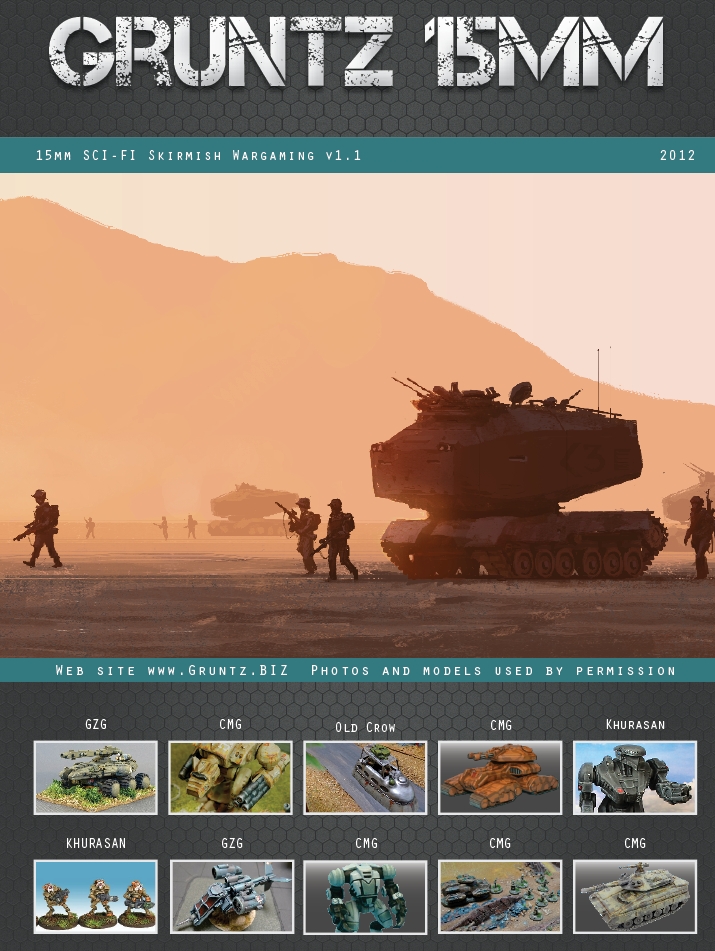
The base rules revolve around a player activating their entire force, with the opponent doing the same for their troops (simple IGOUGO). Each unit can perform two actions, typically being move then fire, fire twice, or assault. Players roll 2d6, adding their unit’s skill, and try to roll equal to or higher than a target number to hit, followed by rolling 2d6 against another target number to damage a unit. Casualties inflicted give units suppression markers which reduce the number of actions they can do on following turns.
There is a nice gradation of attribute stats, as units can have different relative levels of training, morale, and equipment to alter these values. So units could mimic very stealthy units that can’t take a hit, to slower, easier to hit targets that are tough as nails. Vehicles also operate very similarly, but have a few more options when shooting and usually can take much more damage (as typical infantry can only suffer one wound).
There are some wrinkles to play. A unit has a few options with shooting to either concentrate fire, or lay down suppressive fire into an area. And units can also place themselves on overwatch to interrupt opponent’s actions if needed. However for the most part the game uses very familiar and simplistic mechanics to resolve fire and morale situations.
The advanced rules here are a nice touch. They primarily cover alternate ways to activate units, using random initiative via a deck of playing cards, to even alternate activation between opponents. Rules for actions that the player can take can also be mixed up, to give some more flexibility in the 2 different actions a unit does. While the game is set up for single based figures, there are even rules to cover multiple figures per base. These rules certainly give the game some needed complexity while not overburdening the player with an overly complicated set of simulationist rules.
The point system for building units is a pretty strong aspect of the game. There is a lot of room to give units not only varying attributes, but also special abilities. Also the system seems flexible enough to work up statistics for a variety of vehicle models, from copters, tanks, and APCs, to walking mechanized units. What is nice is that you could easily work up different flavors for troops and equipment to give forces a completely different feel, making aliens have differing play styles.
The game has several basic scenarios which usually revolve around with attacking and defending forces and give the players concrete goals and objectives. A nice break from the simple objective of ‘kill the enemy army’ you might see in other sci-fi games.
The Good – You have a fun little set of rules, with just the right complexity to make for an enjoyable game. The point system for unit creation allows for a makeup of different forces, allowing for mixing in air and armor pretty easy. You have enough variation in unit abilities and the base attributes to give forces a different feel for the same point value, adding a lot of variation in the force makeup from game to game.
The Bad – While simplicity has it’s charm, sometimes the mechanics can be a little rigid. Infantry forces are required to cluster around a unit leader, and elements that split off from a squad have very limited options. There are some variety of options with unit activation, however it does slip into that territory of IGOUGO with a single unit’s activation. There is some room for reaction fire, especially with charges, but these options are limited. For smaller scale games, I’d like more flexibility in target reaction. Also, while the point system does allow for variation in unit makeup, that problem of the min/max lists can crop up.
The Verdict – I have the newest V1.1 and was happy to see not much changed compared to the original Gruntz. At its core is a very approachable skirmish-scale wargame that allows players to field a variety of forces. While infantry are what your troops are built around, it’s nice to have some other options in the force makeup.
The execution of the game may not be ideal for everyone. You very much have a unit undergoing different actions, without any response from the opponent. Infantry unit cohesion is also a little tight (3”) and inflexible (however with 6 man squad sizes very understandable). There are a lack of campaign rules, and options for setting up the board revolve around mutual player agreement.
Still the game sets out to give a basic ruleset for sci-fi infantry skirmishes and delivers. Where you can argue the unit activation and resolution of tasks is very simplistic, at the same time you can say they are streamlined and get the players involved. You throw buckets of dice and have quick, easy, resolutions to combat which is enjoyable. While there is a bit of bookkeeping required for managing troops in the manner of unit cards, the rules themselves are easy to remember.
It’s a fun ruleset. For squad-based infantry games folks might want something a bit more fluid and dynamic. However if you want a game that has a good set of basic mechanics, that is tactically challenging and enjoyable, with enough room to allow players to explore different force makeups for their troops, Gruntz is a great entry point into the 15 mm sci-fi wargaming realm.
Review: Bolt Action
Years ago I used to play Battleground: WW2 which was an infantry skirmish game. 40K was sort of getting boring for me and I wanted to dip my toe into historical wargames. I liked the rules and scale of the game so I jumped into BG pretty eagerly. I had accumulated a healthy collection of German and US 28mm troops. It was a pretty fun system with lots of charts and individual resolution of actions. They had tons of hit charts for tanks and all sorts of armor and support vehicles. Unfortunately the support for the game dwindled (rumor was one of the developers had health issues in the family) and eventually evaporated. I lost interest in small scale action and got pretty heavily involved in Flames of War. For a long time I never really liked painting the 15mm scale, but the idea of mixed forces at a company level (armor and infantry) was enticing.
Years later I’ve been hankering for getting back into squad tactical wargaming again. 40K is definitely not on my list and I’ve been slowly collecting various 15mm rulesets and models for the sci-fi genre. I think I’ve got a few solid entries for what will hit the tabletop soon. However between Firestorm Armada and my sci-fi skirmish gaming, I’ve got this hole for infantry-based wargames. There’s still this pull towards doing some historical gaming.
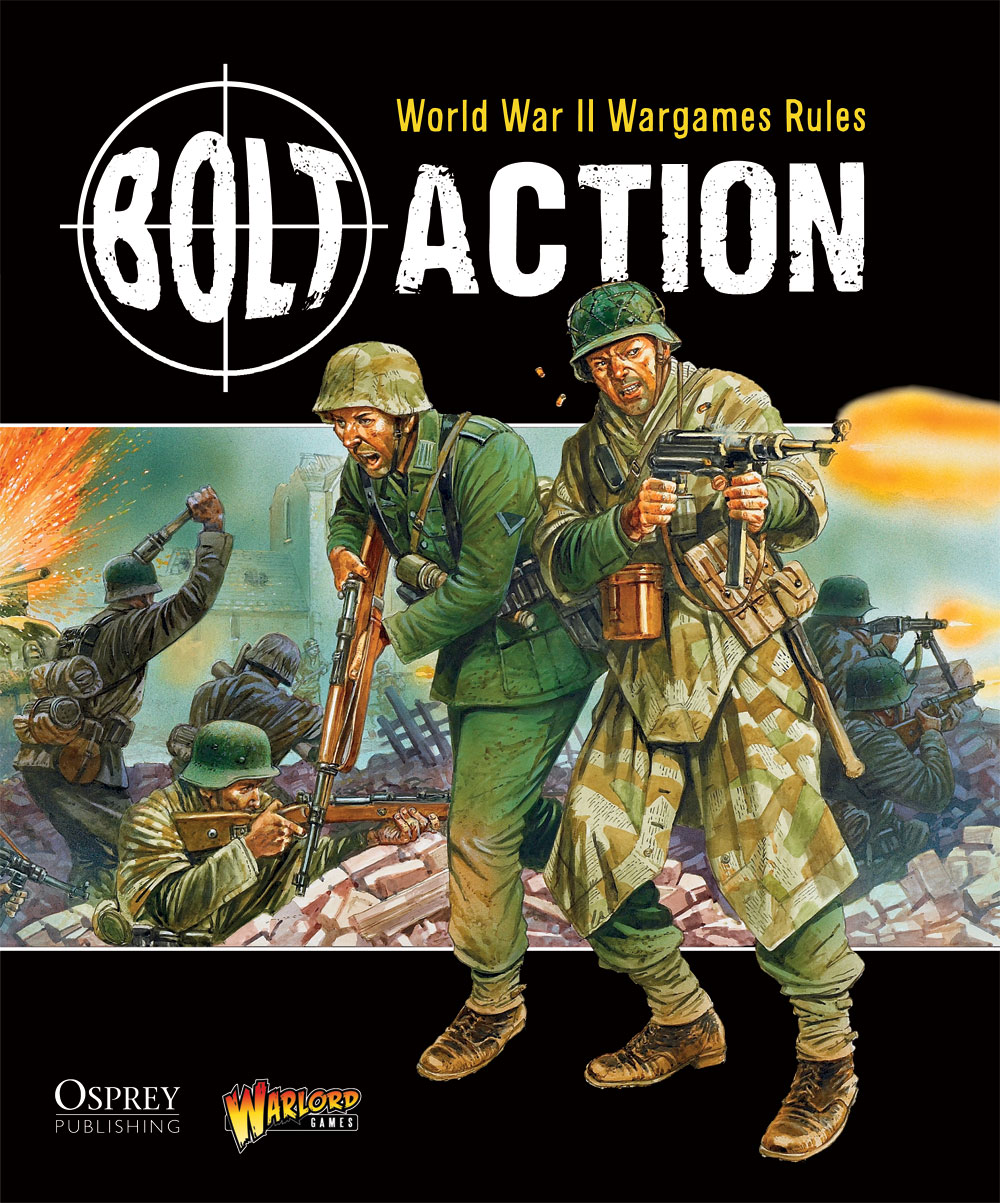
Enter Osprey Publishing and Warlord Game’s Bolt Action. It’s a fast paced man-to-model infantry game, with plenty of rules for tanks, artillery, transports and air support. I think I’ve found a set of rules that has drawn me back into wanting to paint, model, and play infantry WWII wargaming again.
The scale is set aside for 28mm. While Warlord Games are a likely supplier, there are plenty of other manufacturer’s for that scale. Also it seems that 1/48 scale model kits have become more commonplace than a decade ago. Still, I’m working on 1/72 scale troops (more options for tanks) and the default scale of ranges and table length seems to transition well. Table dimensions are based around 4′ x 6′ with most effective firing ranges for rifles at 24″.
The game is based on rolling a D6 or a pair of dice for resolution of most mechanics. What I enjoy immensely is the relatively streamlined approach to handling combat and morale. All the pertinent game rules can easily fit on a few sheets and some brief tables. I’ve become a fuddy-duddy with my wargaming. Simple works wonders for me and surprisingly there is a lot of tactical depth that can be drawn out of the game. As shooting and combat goes, players roll for individual models to hit against a set number with modifiers (most of them negative) applied to the roll. If hits are scored, players then roll for damage against a sliding scale based on the quality of the troops (poorer troops take more casualties than trained troops). Regardless if troops are killed, a pin marker is allocated to that unit.
Turn resolution is also done well. Rather than the IGOUGO system, or even alternate unit activation, players have a number of order dice equal to the units in thier force. A colored die is randomly drawn, and if it’s your color you get to activate a unit of your choice, otherwise your opponent goes. This random draw system is similar to Battleground WW2 and something I’ve always enjoyed. You might get a string of lucky (or unlucky) draws being able to activate several units, or sit aside while your opponent maneuvers around. Orders fall into typical ones like advance, move, fire, go to ground, rally, or set themselves on overwatch to react to any enemy. By default, units can always react to assaults too. All of this creates very fluid action with a decent dose of randomness. While you can activate a unit of your choice, you aren’t certain if you can activate a unit until that color die is drawn. If you have more individual units, you have more dice, increasing the likelihood you’ll get an order die when needed.
To add another layer onto the randomness of unit activation is leadership and the pin mechanic. As I mentioned, a unit taking fire gains a pin marker. If any unit has a pin marker, they have to pass a leadership test to successfully execute their turn order. Otherwise they stay in place and take cover. Additionally pin markers give a penalty to leadership checks which is cumulative. This adds a very important mechanic to the game. While you may not be able to eliminate a unit through casualties, you can effectively suppress a unit through volume of fire. As pins accumulate on the target, they can’t react as well and if casualties are inflicted, will likely result in the unit breaking.
It’s a simple, effective means to model the concept of suppression, and also reinforces the importance of unit training and leadership. Well trained, high morale troops can take more punishment. Poorly trained troops will likely panic, but under the wing of a good leader, press on despite being fired upon. Pin markers also are applied to armor units depending on the weapons fired. All in all I really enjoy this aspect of the game, where it’s not just the model kill count that matters (squints eyes over at 40k…).
There are rules for tanks, transports, gun teams, mortars, snipers, off board artillery and air support. Just about everything for a dynamic game. Bolt Action is point based, where players assemble a force based on an agreed total (usually 1000 points). Each force must have a compulsory headquarters (officer) and 2 infantry squads. Then they can fill their force out with other units. One particular part I enjoyed with the rules is that every special unit is limited to one slot. I can only support my platoon with either one tank or none. No taking minimal size infantry squads and then piling on 4 tanks to round out the force. You have to make a lot of hard choices, but have a lot of options available.
The rules detail 6 scenarios, one of which is a simple attrition-based game. Most of the others require maneuvering to specific areas on the table or holding objectives. A very nice rule to the scenario setup is that it can be decided randomly, further, players roll randomly to see if they are the attacker or defender. What I enjoy about this is the flexibility needed for your force composition. If you build your troops around being a static force, requiring ambush and defensive positioning, you may very well be attacking in a scenario where your objective is to exit as many units as possible across the opponent’s table edge. This encourages you to try an be adaptable to a variety of scenarios and roles.
By default there are several army lists for the major players (Germany, US, British, and Russia) right out of the book. There are more nation specific army books available and more in the pipeline (including the Pacific theater!). However all that is needed to play is the rulebook alone if desired.
The Good – It’s a solid WWII infantry ruleset. Task resolution is simple with enough variation on unit activation to make things challenging. There are enough rules to cover different infantry units, and also have rules for other non-infantry units. I’ll take a moment here to talk about the book quality. It is amazing. A nice thick bound book with plenty of color photos and diagrams. It’s well indexed with great rule reference sheets at the end. The book also has a decent amount of timeline summaries on major events within the entire historical period. It’s a professional job and shows the lovingly applied detail from Osprey Publishing.
The Bad – Some mechanics have wild variability and freaky luck can occasionally creep into the game. I see it more as its charm, and after giving a thorough reading of personal accounts of WWII combat, actually models events rather well. We like to approach these games as chess, where in reality things were much more chaotic. Still, there are some particular unit rules that can be a little ‘gamey.’ Folks might also be put off by the use of specialized order dice also (however a deck of black/red suit cards could be easily be used instead, and the rulebook allows for regular dice to serve as a proxy).
Another detraction can be the point lists. For competitive tournament play, I expect this is needed. However it does leave some room for min/max army lists where historical accuracy is dumped for that elite mixture of units. It’s a nature of point systems. I am particularly worried if power creep will come into the game with the future release of nation specific books. I can swallow these detractions for accepting the idea that each player has an opportunity to field a potentially equivalent force, but some players might be more happy with a gentlemen’s agreement on force composition.
The Verdict – Bolt Action is a fantastic WWII skirmish game. It’s not a simulationist game. Movement, terrain effects, and combat can be abstract but the resolution of these elements are simple and quick. Despite this simplicity, there is a surprisingly amount of tactical depth to the game. The random unit activation gives it just the right amount of unpredictability needed to make events which unfold during a turn more engaging than an IGOUGO system.
Most of all, the game is about maneuvering while other aspects of the game encourage holding position and firing. It’s a constant nail biting choice to either move your troops into a more advantageous position, or stick it out and hope you can inflict casualties with a fire order, or while on overwatch. The backdrop to this is the pinning mechanic. Throw enough fire on serious threats, and you can allow a unit to advance with some small measure of safety. It works and the streamlined mechanics for conducting all of this makes the game run well and be loads fun at the same time.
Terran battle cruiser and fleet complete
So a long while back I had assembled and primed my terran fleet for Firestorm Armada. It’s been slow going but I got around to completing them and thought I’d post some sequential photos of the battle cruiser as it was painted up.
For my terran fleet, I went with a 2 color scheme over a metallic base coat. I wanted a little contrast with these models compared to my sorylian fleet (which were effectively different shades of green).

I managed to pick up some inks finally and gave the entire model a black ink wash. This really added depth to the metal base coat. It’s been a while since I’ve worked with inks and some of the raised surfaces are a bit too expansive and flat. Took up as much excess as I could muster, but still got some pooling on the flat raised portions of the model.
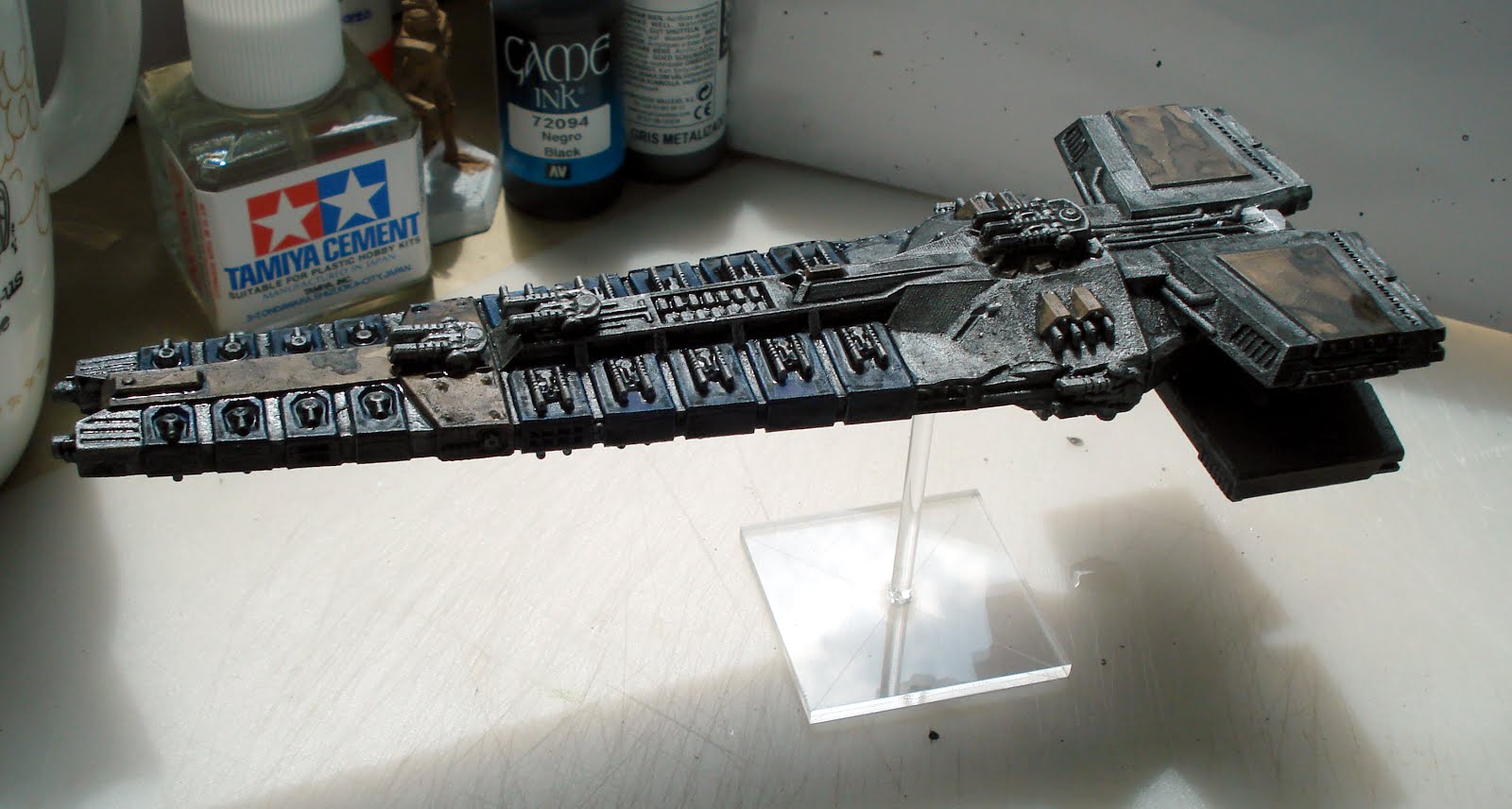
Wasn’t too worried about the ink pooling much as I intended to give the areas a thorough dry brushing. Usually I drybrush the base paint coat, or possibly a shade lighter in tone. This time (as with my cruisers) I opted for much lighter tint. It gave the ship a really weathered look and especially brought out the blue sections.

Here is my assembled fleet. You can notice a big difference in the shading with the three cruisers as I didn’t use inks with them (just a wash of black paint). I think the inks really carry a lot more intense pigment and add a fair amount of depth to the minis.
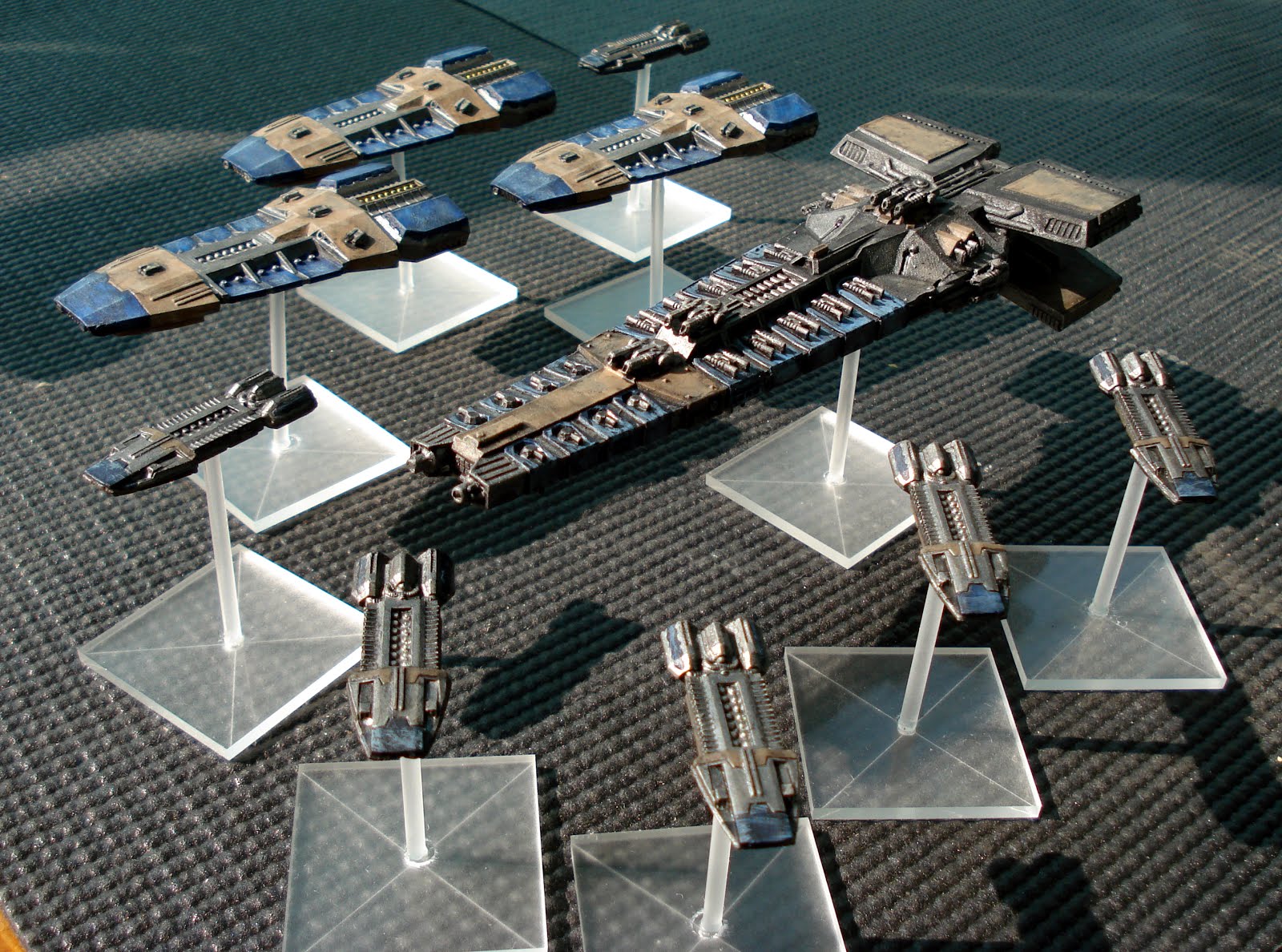
I’ve gotten a bit burned out with ships as I cranked out two complete fleets. Not to mention my Sorylians took forever as I painted the frigates a few different base coats to get the final paint scheme I wanted. The terran fleet has a more ragtag, battle-worn look compared to them. Overall though, I’m happy with how they all turned out. Now I need to get some game reports in sometime!
Review: Firestorm Armada
Firestorm Armada is a space naval combat game from Spartan Games. There is a hardback rulebook that has been recently released. I haven’t gone through it extensively, but for the most part, not much of the game mechanics have changed from the first softback edition.
A snapshot of the background for the game universe is that mankind has discovered FTL drives, explored the stars, established many colonies throughout the galaxy, and in the process have encountered a handful of alien races. On the periphery of human-controlled territory, a faction of mankind has sought for independence. These two political factions of humans have begun a civil war that has expanded into a larger interstellar conflict, with different alien races pledging allegiance to each of the respective factions.
In Firestorm Armada (FA) each player commands a fleet of ships based on a point total, with some hard limits on the % composition for certain ship types. Players roll for a turn initiative, and alternate turns activating one ship squadron at a time. Squadrons can be independent fighter wings, a group of frigates, up to a single battleship. Each activated squadron moves and then resolves their fire, with the opponent doing the same with their forces. I enjoy this as it adds some tactics to deciding which group to activate, much better than a typical I-go-you-go for your entire force seen in other games.
The focal point of ship firing and movement is the base stand. Nearly everything decided from firing arcs to turning is based on the square stand your model is propped on. Targets are deemed in certain arcs based on where the center of the base sits, not on where most of the target model is. I like this as adds some uniformity to the rules, especially when working out what firing arc a target is residing in. It’s a nice simple way to streamline play and quickly resolve any sticky issues.
Ships move at a relatively constant rate, and have a minimum move distance. Turns are hard-capped at 45 degree increments, interspaced with requirements for moving straight ahead. Generally, the smaller the ship, the tighter it can turn, with larger ships being required to lumber forward more before committing to turning. Ships are considered to be able to move through each other and use a concept of ‘vectoring’, where they can shift in small increments to avoid stacking bases on other models.
I’ll admit that it throws any concept of physics out the window for movement. Full Thrust had a much better system where ships could constantly accelerate, but had a more difficult time turning a higher speeds. In FA, doing a full stop requires a half turn of movement to do so. Yet, once they stop there are no directional changes that can be made. Ships can’t slowly rotate in their position, they have to couple turning with straight movement. Additionally, models must move at least half their speed. If they opt to do nothing (including not firing weapons), they are limited to drifting straight ahead 2″. The movement is clean and simple, but doesn’t effectively use a z axis. This is especially true with certain terrain types, as planets are considered impassable terrain.
Firing at other ships is based on uniform range band increments and firing arcs. Some ships have additional firing systems like turrets that are more flexible, to specific arc channels that are more restrictive than the typical 90 degree firing arcs. Each range band has a number of attack dice that can be rolled to see if they inflict hits. As expected, longer ranges have very little dice pools, and the closer the target, the more dice can be rolled. As a nice twist though, there is a sweet spot with the range bands. Get too close and there is a drop off in the damage that can be done.
In addition to firing arcs, ships can link up fire with other ships within their squadron. They can also split fire with different weapon systems on their ship. So it is possible for a ship to open full port broadsides into one target, and throw its turret weapons to support another weapon volley with other ships in its squadron (or unleash another volley of fire from another arc into a different ship). The larger the ship, the more diverse the weapon systems meaning those huge battleships can lay down an impressive amount of fire to different targets.
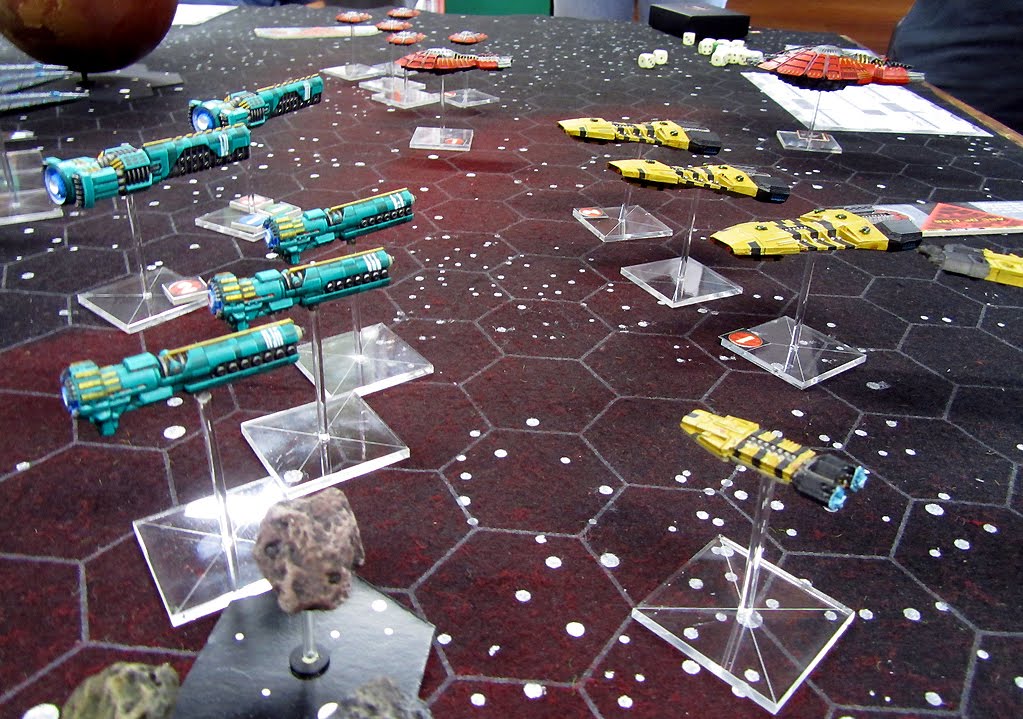
All dice incorporate ‘exploding’ rolls. Most hits are successful on a 4+, with a 6 inflicting 2 hits. Further, all 6s are re-rolled and can lead to further rerolls. Inflict enough hits over the ship’s damage rating and a point of hull damage is taken. Score even higher and the possibility of additional hull damage, along with a critical ship system going offline, can result. As damage is inflicted, it also reduces the attack dice of the target. Crew hits can also reduce the number of attack dice (however this is not a cumalitve penalty). To counter damage inflicted, some races have shield or cloaking technology to reduce the number of hits.
An entirely different weapon system is torpedoes. These weapon systems are never reduced through inflicted damage, even better they always have a constant number of attack dice at all ranges. However they can be countered with point defense systems (in addition to shields and other defensive technology). More importantly, as torpedoes follow a set path to the target, ships in the same squadron can add to the point defense of the target. This makes for some interesting fleet tactics, throwing in smaller ships and fighter groups to provide defensive support to larger ships.
Fighter groups, or wings, are also ships that can be deployed. There are far maneuverable and can throw out a fair amount of damage. However they can be countered effectively with point defense systems. Wings come in different flavors, from bomber groups that can roll more attack dice, to well-rounded fighters, to heavy point defense interceptors, even assault craft for boarding actions.
FA takes the route of having abstract weapon systems and resolves many game mechanics in a similar way. Boarding actions are fairly easy to resolve and done through simple resolution of hits by rounds, scoring wins by simple attrition. With this simplicity and abstract mechanics however, you can get some blandness in with the game.
Since weapon systems are based on either attack dice, or torpedoes, most differences with races are based on the varying fire arcs of ships. Some ships have more flexible weapon batteries using turrets, while others are based on specific weapon arcs (like mostly fore arc weapons, or no aft weapons).
However, with these limitations there are some plusses. Record keeping for hull and crew damage is easy to keep track of (as is the reduction of attack dice). The game uses unified mechanics for attacking and defensive systems. And while movement is maybe not as ‘realistic’ as other games, it captures that idea that smaller ships are more maneuverable than huge capital ships very well. Best of all, a player has to plot out their expected movement for themselves as well as their target. Coupled with ideal firing rates being within a specified range, and not simply parking next to a target and unloading, makes for an enjoyable game. A more freeform movement system with rapid acceleration and deceleration (along with quick facing changes) would hamper this aspect of gameplay.
The hardback edition has incorporated Model Assigned Rules (MARs) in with the current fleets. Now each race and certain ship types have specific rules that alter them slightly from others. I think this adds a layer of complexity to the game and gives even more flavor for certain fleets. Best of all it is entirely optional, so you can still play with the vanilla rules if wanted. However, I like the tweaks that have been made with the different ships. MARs really helped differentiate the races and ship types to make for a more robust game.
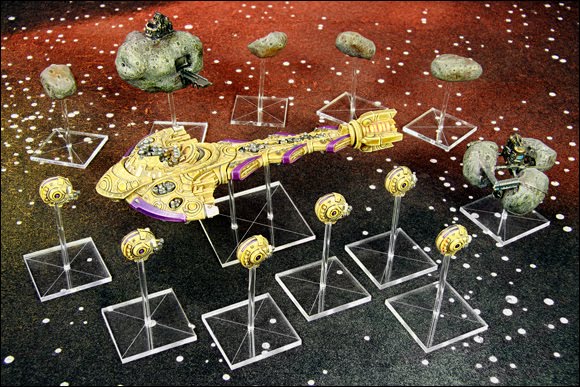
The Good – There is a nice fleet combat system within these rules. It has room for exploring different tactics that go beyond ‘move the biggest ship in as close as possible and unload.’ Maneuvering and trying to bring as many guns to bear, at the most ideal range, is a challenge and enjoyable. There are some differences in the race fleets, especially with the new MARs system. It’s not overly complex and has just the right amount of detail and weight for making a fun afternoon of wargaming.
The Bad – It’s not a hyper-realistic, super detailed treatment of spaceship combat. I’d go as far to say it really plays like a conventional sea naval wargame, with some trappings of science fiction. Some of the more abstract systems make for simplistic resolutions of actions, that might be too glossed over for some tastes. This is not a ramped up version of Star Fleet Battles. Also, luck can rear its head in some games. The exploding dice can make for some very ‘swingy’ turns.
The Verdict – I really enjoy this game. It has just enough detail and mechanics to make for an interesting wargame. I like the randomness of the dice that can lead to some spectacular outcomes, giving the game a few peaks and valleys with your morale during play that you might not get with other systems. FA has enough meat in the rules to make for a great space game, while not being too heavy and too clunky with having more simulationist rules.
There is enough variety of the races and fleets to make for different games, branching out with using varying tactics and experimenting with altering fleet compositions. There are a fair amount of scenarios and additional rules for civilian ships, space stations, and terrain, allowing you to create and play different situations other than your typical fleet battle engagement.
The models are reasonably priced and gorgeous. Also it seems the line is expanding with different ships and races, giving even more variety. However, the information of these new ships are not locked away and only available if you purchase the models. You can freely download the ship stats. Even if you have only the first edition rules, the MARs and fleet cards for the new ships are accessible.
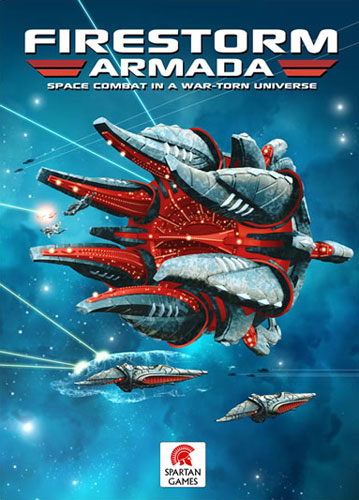
I am however a bit torn about the different books. Some things I like about the hardback edition (cover pictured in this post) is that it cleans up a lot of things from the first softbound edition. Flights are no longer individual wing groups, but are consolidated into a single counter. Boarding actions now end with the target ship being destroyed, and not requiring to be fold-space traveled off table by the assaulting player.
What I do miss from the softback rules were tons of illustrated examples. They are there in the hardback edition, but more as simplified graphics rather than having figure legend explaining what is going on in more detail. I also think the layout of the rules were more organized in the 1st edition (not to mention a nice size font of the rules). It’s almost as if this book was written assuming players had the 1st softback edition already, rather than being for a completely new player. Fortunately, the game is not bogged down with tons of situational or convoluted rules, and are pretty easy to grasp.
If you’ve got a hankering to paint and deploy a fleet of starships. If you find the idea pleasing of deftly maneuvering cruisers to unload a broadside volley of mass driver cannons into an enemy capital ship. Then pick up these hardback rules. Firestorm Armada is well worth the investment.
Firestorm Armada: Terran cruisers

For the most part unlike many of the other models I’ve gotten for Firestorm Armada, the Terran cruisers are kind of ‘blah.’ They really don’t have the detail of other models from the Terran fleet line (sadly I think the Terran carrier model is a little lacking too). Because of this, I opted to try a two color scheme.
To speed up the washes, I put down varying base coats for different parts of the mini and then applied a black wash to the entire model. For the metallic base coats this worked well, especially the gold portions near the engines. A little less so for the other sections of the ship, however. I really need to pick up some inks. I think they will likely have a much more uniform distribution of color compared to thinned out paint washes. I’ve tried gathering up much of the wash that pools on the upper parts of minis with another dry brush but I still get some spotting.
To get around the excess pigment from the black wash, I’ve done some liberal high contrast highlighting. It’s given the models a very weathered look. I like it, but I’m not sure how the entire fleet will look doing something similar. Likely it’ll look almost too much of a rag tag fleet. I might tone down the dry-brushing for the other ships a bit and stick to just the raised edges.
Announcement of Sparta Studios
A quick newsflash of sorts. Studio Starta has been annouced from the folks that make Uncharted Seas, Dystopian Wars, and a favorite of mine, Firestorm Armada. It looks like they will be working on various games in the Firestorm Armada universe with many different games and scales being released involving ground warfare. The concept is a series of games related to a planetary invasion, moving from 10 mm, 15 mm, up to 28 mm depiciting various types of scenarios (from mass combat of combined forces to small skirmish battles). It’s a pretty ambitious range of games and figures.
I do wonder about the competition though. 40K seems to be the 800 pound gorilla for futuristic skirmish-type mini games (not to mention a few others like infinity and alternate history settings like Dust: Warfare). As for sci-fi large scale battles with combined forces, Dropzone Commander has made a recent splash. Thier models do look gorgeous, although I’m balking a bit with the prices.
Seems a year or so ago, the 10-15 mm range was wide open for a major sci-fi game. Games Workshop dabbled in it a bit with different games, but the core following of that universe seems to enjoy the heroic scale and skirmish type battles. With Dropship Commander however, I think things have gotten a tad crowded for Spartan Games.
I do admit however that thier idea is pretty interesting on the different ranges and types of battles they want to mimic with various rulesets. I’m not too keen on the 10 mm armor combat but the 15 mm scale battles sound fun. I’ve been wanting a more sci-fi themed game for 15 mm stuff. Love Flames of War but dabbling in a different genre for that scale of minis would be a nice break. I guess time will tell. However, if they can link it to a larger campaign mode incorperating Firestorm Armada, they might have an interesting hook to draw in some players.
[HT to the Shell Case for passing this news along.]
Terran battlefleet primed
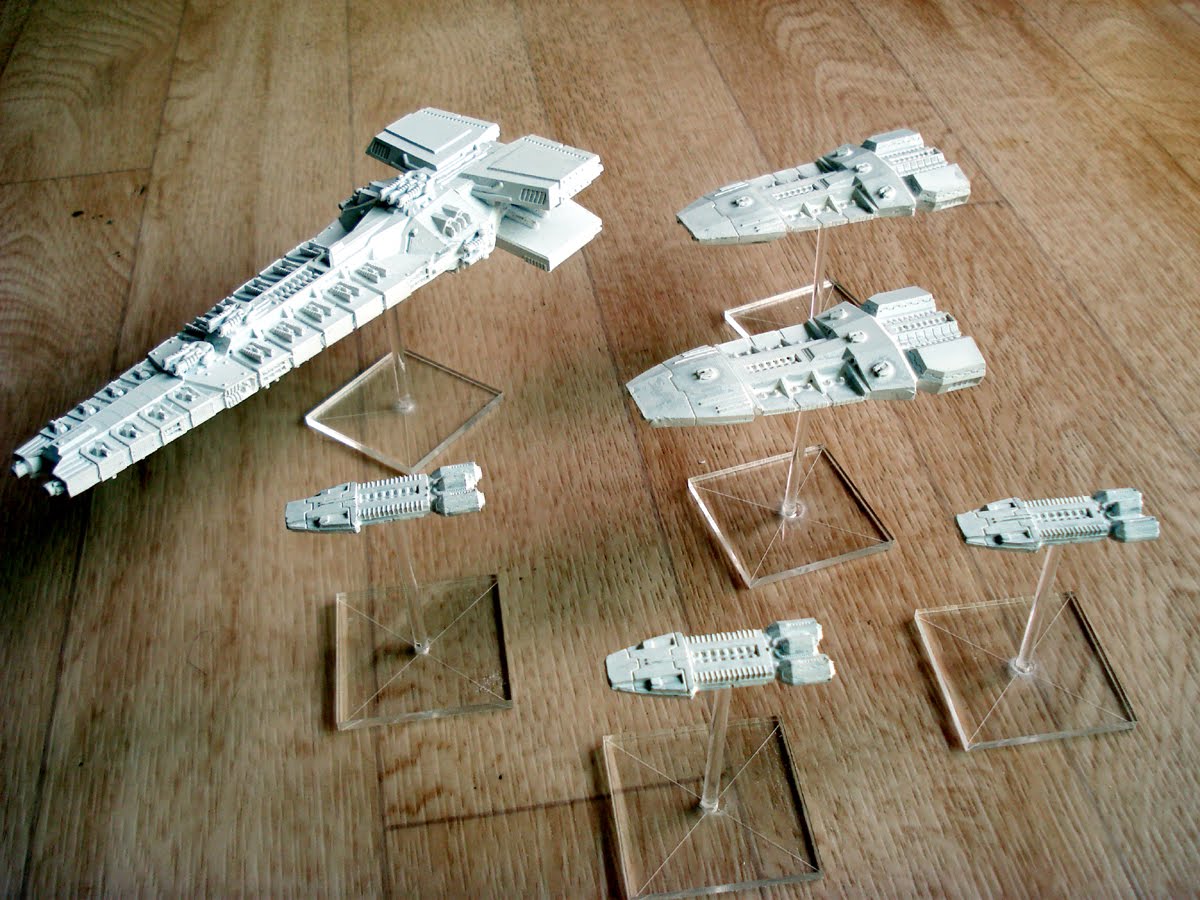
Slowly finishing off my Sorylian fleet so I got my next fleet prepped and primed. Usually when I pick up a minis game I work on two forces. I do this so in a pinch I have the models on hand to teach someone else how to play. Typically I’ll go a bit deeper in one force.
I had not gone through the rules of Firestorm Armada extensively and didn’t read up on the fluff of the game before picking up my forces. So I came to realize later that in the FA universe the Terrans and Sorylians are allies. Hee, looks like I might have to stick to the ‘first contact’ timeline if I wanted to play out truer scenarios to the official canon of the rules.
It’s not a big deal as you can easily play and fight how you want, however I do think that certain fleet doctrines and technologies are directed towards more traditional enemies. I’ve got a few games under my belt and don’t think it much of an issue, but I might try using one of my fleets as a proxy for another race to see how they match up. One nice thing I like about having 2 different fleets is that I can plop down anything and call em whatever race I want. Definitely some room to explore the different races and fleet types.
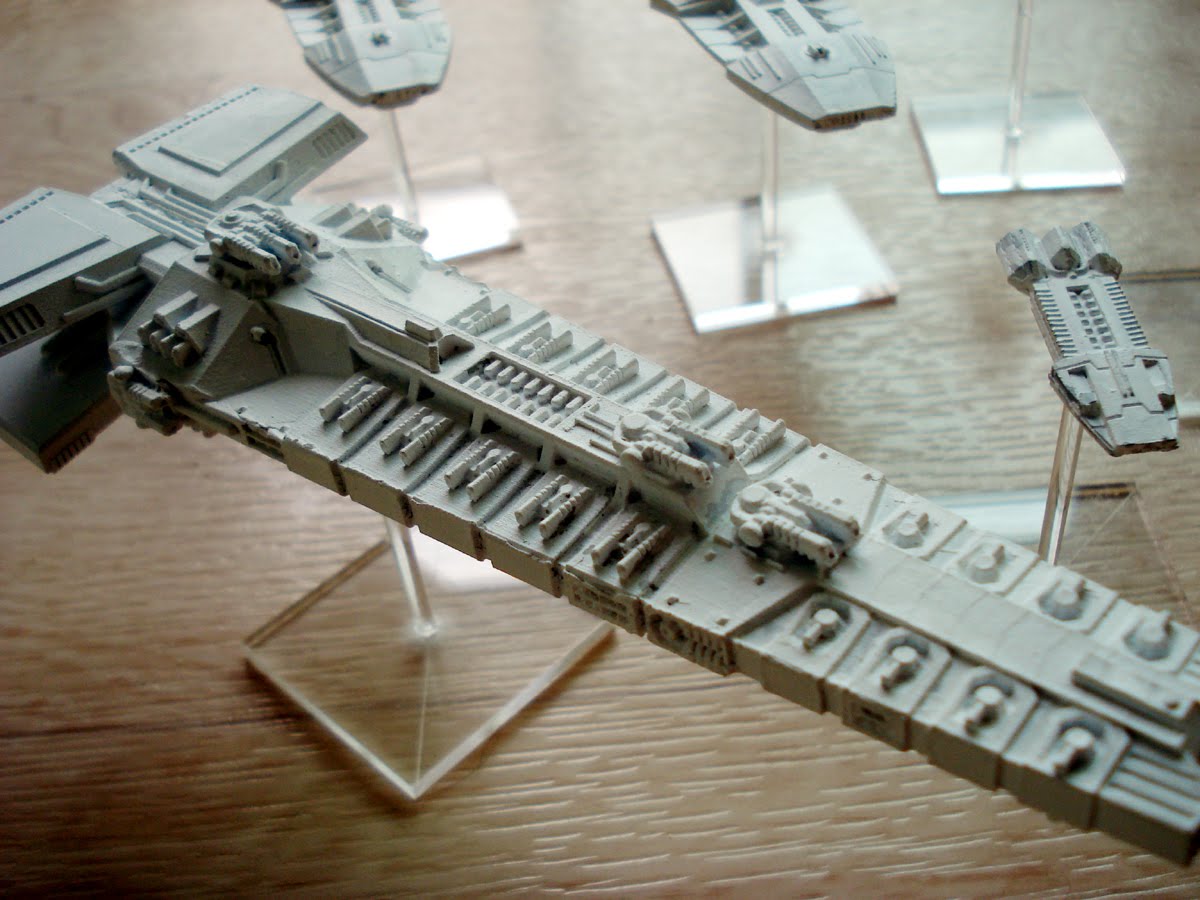
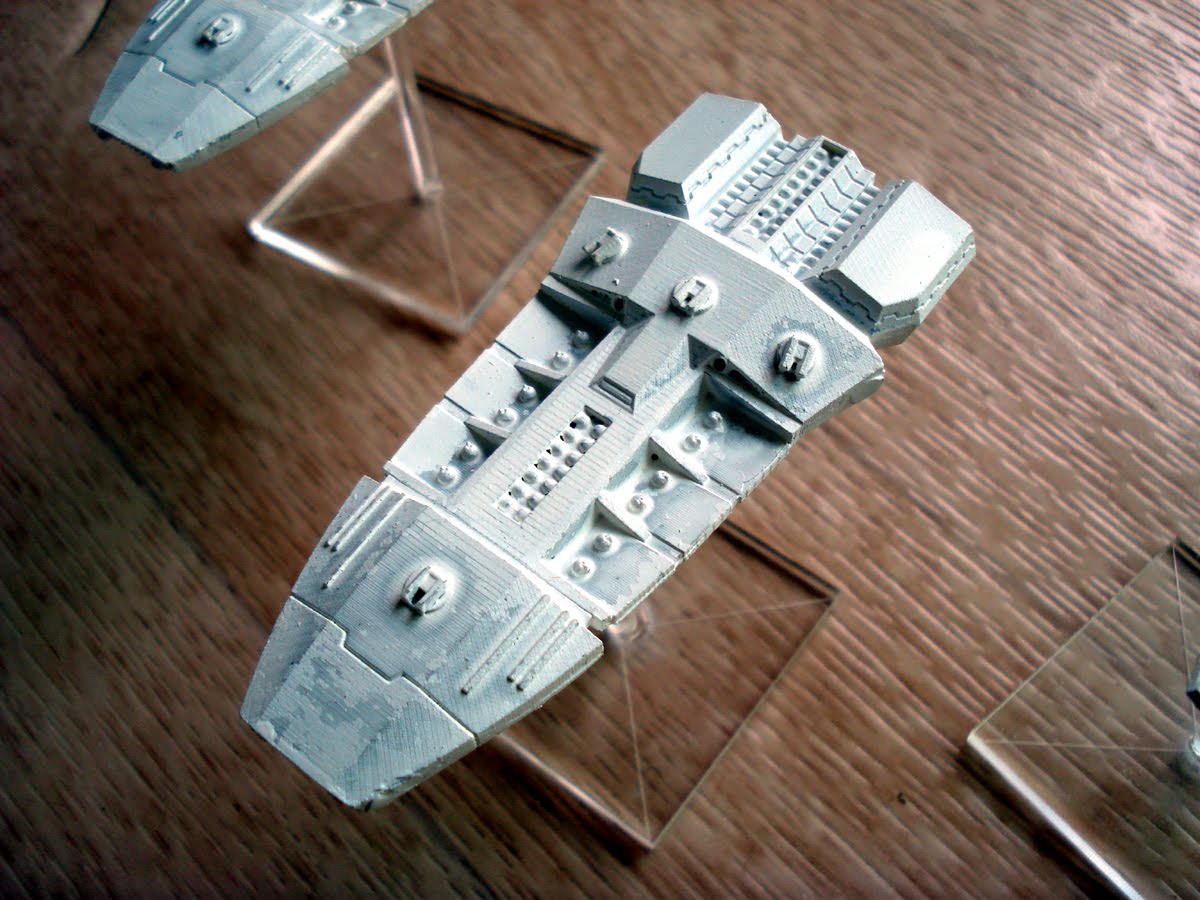
As for the Terran models, they are pretty nice. They have a fair amount of detail. I especially like the battlecruiser. It’s a nice model bristling with guns. The other ships are a bit blocky and I like the contrast to the Sorylian models. If I’m disappointed with anything, I’d say the cruisers are a bit weak-looking. They just don’t seem to have the detail of the others.
The frigates are pewter, so they can hold a lot of detail despite the small size. However I’m surprised for the resin cruiser models that they don’t hold similar detail to the battleship (which is also resin). I have a Terran carrier and have to say the model is also bit blocky and sort of bleah. Might have to consider doing some alterations for that mini.
Not quite decided on the color scheme, but likely try a simple 2 tone paint job. Some of the models will need a little extra to make them stand out. The Sorylians had a nice overall shape and enough details that a wash and dry brushing could bring out. So I was happy with using different shades of green as base coats and an overall single color wash. For the Terrans, I’ll have to mix it up for certain.
Sorylian fleet…done
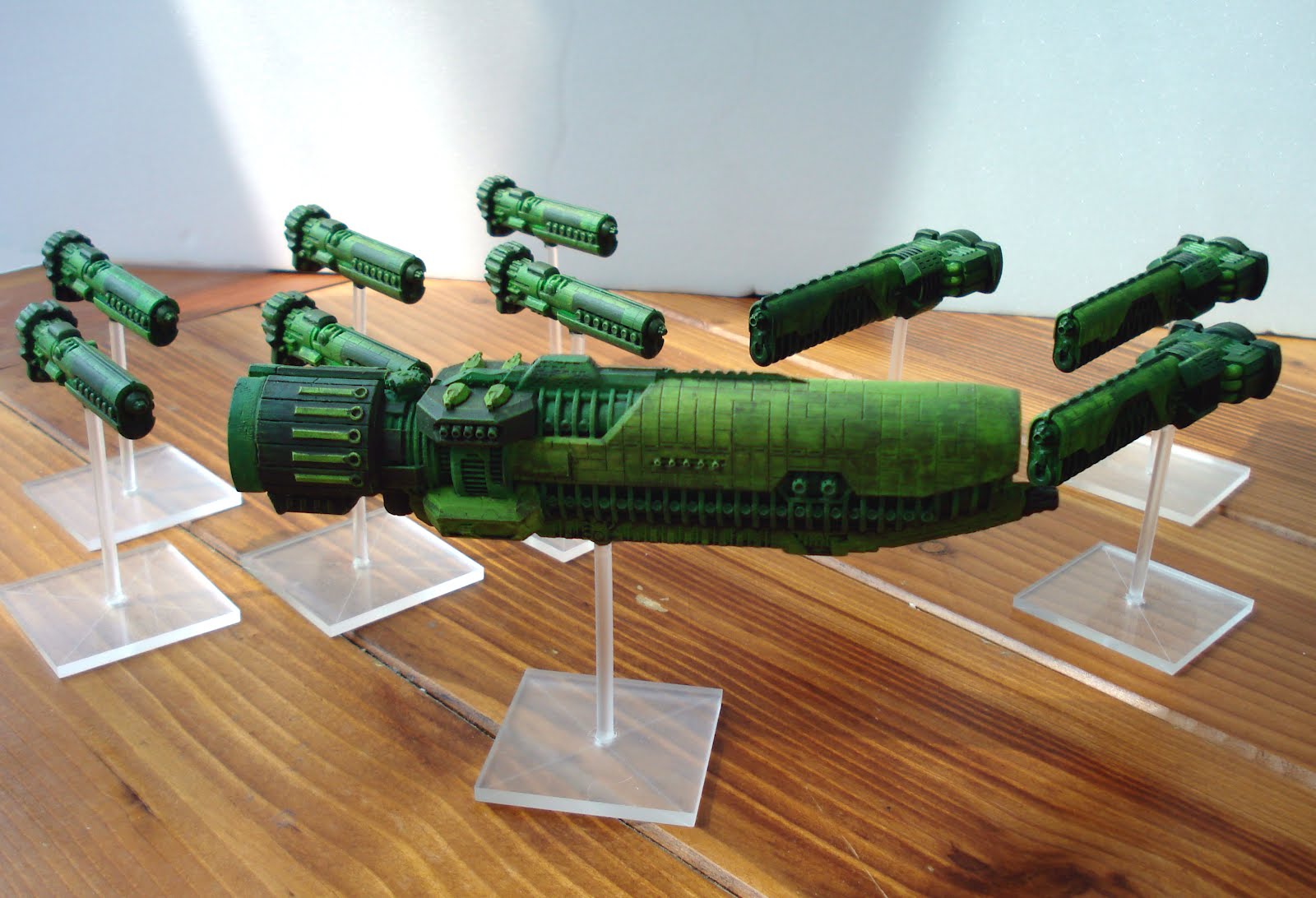 Got my Sorylians wrapped up finally. Overall I am pretty pleased with the models. I have to say I think I did not give the battleship justice though. It really is a lovely model.
It’s been a learning experience with vallejo acrylics. I’ve gotten down maintaining a good consistency for base coats. However, I’m still not working out the washes quite the way I like. Bit too much pigment adhering to the elevated parts of the model and a tad too much pooling. Trying to get the excess off just right. However the highlights from drybrushing manage to make for a good touch up.
I’m excited to get this on the table. Will have to try and get a game in sometime, but my regular wargame partner is off for a long holiday in the next few weeks. Till then, I’ll likely have to sit down and get around to writing up my thoughts on Firestorm Armada (short version, some kinks in the game but a lot to like). Looks like a second edition will be out soon, so I’ll have to make that a priority.
 Geek Ken