Category: Wargames
1/72 Armourfast StuG III
Deciding to field a German infantry platoon for my games I liked the idea of having more typical armor that would support them. Hence for my late war platoon I went with a Panzer IV. However I was keen to have some other options so I felt and assault gun would be ideal.

Armourfast offers some nice armor for 20mm and their Sturmgeschütz III (StuG III) certainly keeps in line with many of their other kits. It is an easy to assemble model with a fair amount of detail that is a great value for wargaming. The model sports a 75mm StuK 40 L/48 gun so it’s more of apt for mid-late war games. The assault gun also comes with separate schürzen side skirts that can be left off if desired.

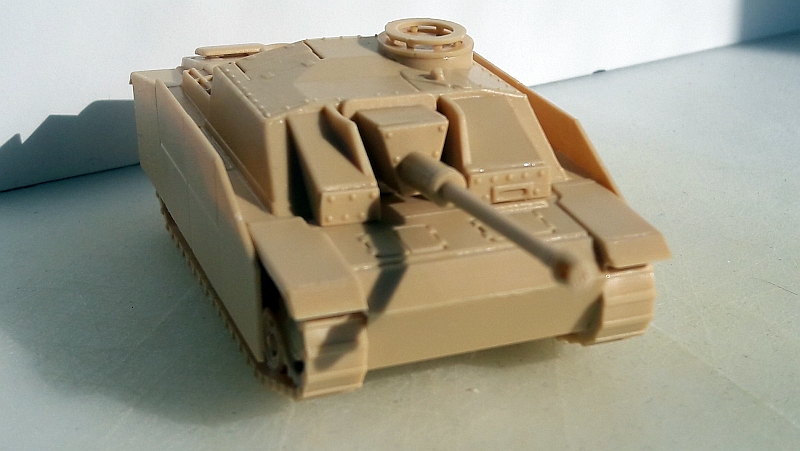
However if leaving off the skirts you should be forewarned that the hull has pretty large gaps even with the tracks mounted. You likely will have to fill them with some squadron putty as they are fairly noticeable. There isn’t much stowage bits but there are a few spare tread wheels.


Aside from the hull track sides, the parts of the kit fit well without excessive gaps, and is a snap to put together. All in all it’s a fairly good model. As most Armourfast kits you are not going to get a super detailed model fit for dioramas. Yes there is a decent amount of detail, yet certainly nothing stellar. But you get 2(!) tanks per kit and having the option to field a StuG with and without skirts is pretty nice (or on both if you wanted). They are an exceptional value and great for 20mm gaming that will look good on the table.

Desert bases using talus
Slowly been painting through my Perry WW2 British. I decided to work them up as the 8th Infantry Division from the British Indian Army. Partly as the 8th Division had action in the Middle East, North Africa, and a good chunk throughout the Italy campaign. And partly because for WW2 North Africa, it’d be cool to work on something different as UK commonwealth force instead of your typical British 8th Army.
I was in a pickle somewhat with how to model up my bases though. Typically I use a simple flock technique but wanted a different texture that would fit in with a desert theme. I decided to use some railroad modelling talus which I’ve used on my 15mm Sahadeen.
The problem is even though they look nice, the material is a bit fragile. Even with a good amount of PVA glue you can rub it off. For 28mm figures I’ll have more material on the larger bases and regular handling during gaming means more of the talus flaking off.
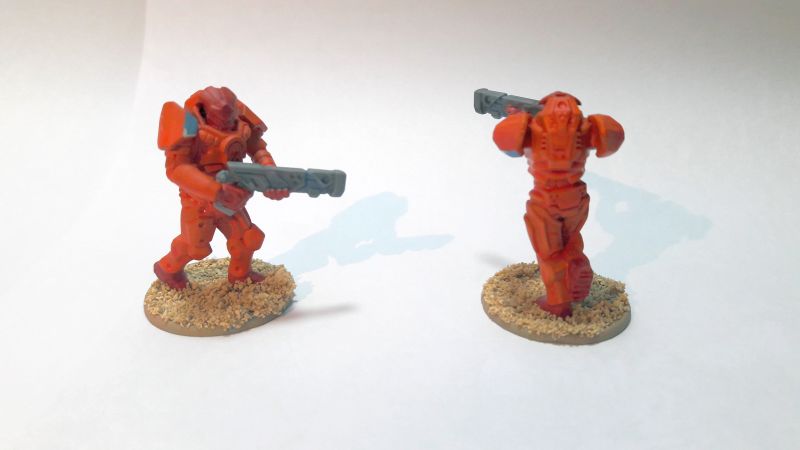
To work around this I decided to add some superglue to the talus. For my Algoryn this worked great as the modelling material easily adsorbed excess glue. For my Indian troops, I used a PVA mix to initially get them based, then gave the models a coat of primer and a base coat. I finally followed up with adding instant curing glue to the textured bases.
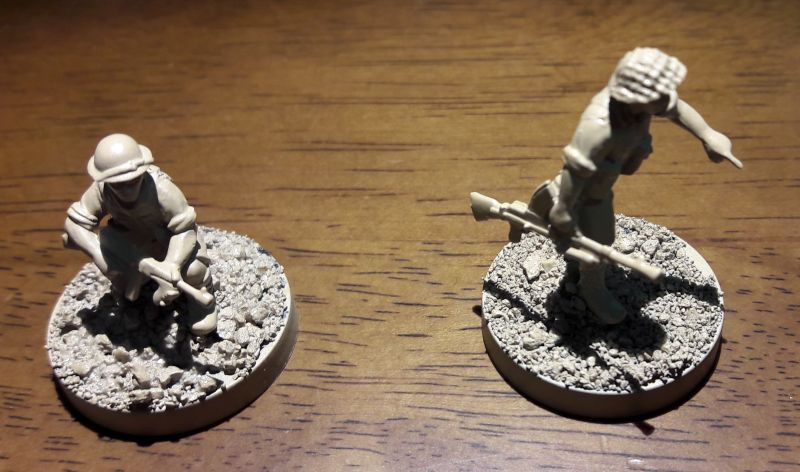
For the most part it looks okay. Above the figure on the right has the talus adhered to the base only using PVA glue (after a spray base coat of paint), while the one on the left has been coated with superglue. Comparing the figures above, you can see the base material for the left mini has some glossiness compared to the right. There’s also a subtle lack of texture compared to the right figure that just has PVA glue. It’s not too noticeable after a good drybrush and will be even more so after a layer of matte sealant. However if I were to do it again, I’d coat the talus with superglue first before priming.
Regardless they look pretty good. I’ll be sure to give a more step by step paint job post once I get through the platoon.

Lock n’ Load Tactical, the ignored wargame?
 Decades ago I played Squad Leader which was my first WW2 hex and counter wargame. A few years ago I wanted to get back into something tactical with a similar theme and started looking around. I knew Multi-man Publishing picked up the ASL banner, but I was looking for a more modern implementation of tactical games instead of retreading old designs.
I heard good things about Conflict of Heroes but it always seems out of print. Combat Commander was another game that seemed interesting. I did manage to snag that and enjoy the game immensely. But a sticking point for me is that there’s no armor.
CC:Europe is a wonderful game and it’s heavily geared towards capturing that infantry tactics feel. However I really wanted some rules which would allow me to throw in an APC, a lone tank, or a light AT gun. The rules just didn’t have anything for that. So I started looking around some more and stumbled onto the Lock n’ Load Tactical series.
It looks like a fun set of rules and allows a smattering of armor units to add to engagements which is a plus. Now I always had heard about LnL on the periphery but never really gave it a thoughtful look. Seems the online presence and chatter were heavily skewed towards CC: Europe or Conflict of Heroes. LnL Tactical just appeared to be ignored.
I probed around BGG some and the Combat Commander and Conflict of Heroes series have almost 5,000 and 3,000 owners, respectively. While the LnL Tactical library has only a little over 1,500. Note also this is a set of rules that has been out about as long as those other games too.
Yes LnL Tactical has gone through a few editions. However it blows my mind how the game seems to have such a small online community presence, despite it being heavily supported by the publisher. There are lots of expansions, supplementary products, and more importantly most of it is in print. The rules are online for free with a starter set of counters and a map for $15. That’s a pretty low bar of entry to check out how a game runs.
When peeking around for a WW2 tactical hex and counter wargame, one guy came out of the woodwork raving about the system. I think I’ve now become that guy. In a while I’ll be able to get my mitts on the game proper, and at the very least be able to take the solo rules for a spin. Yet, I expect in the near future I’ll be posting more about this game.
Painting Miniatures: Games Workshop Contrast paints
I am not a fan of Games Workshop paints. They are good quality paints but are overpriced. Additionally (and can say this after using a new set of paints recently at a convention) the design of the pots are poor. While the lids allow for applying paint to the brush, paint also pools up on the lip tab and it gets difficult to get a proper seal closing the pots. Seems after time you are either going to have to scrape out a bunch of paint from the lid seal or you’ll have problems with your paints drying out (who knows, maybe the pot design is intentional in that regard).
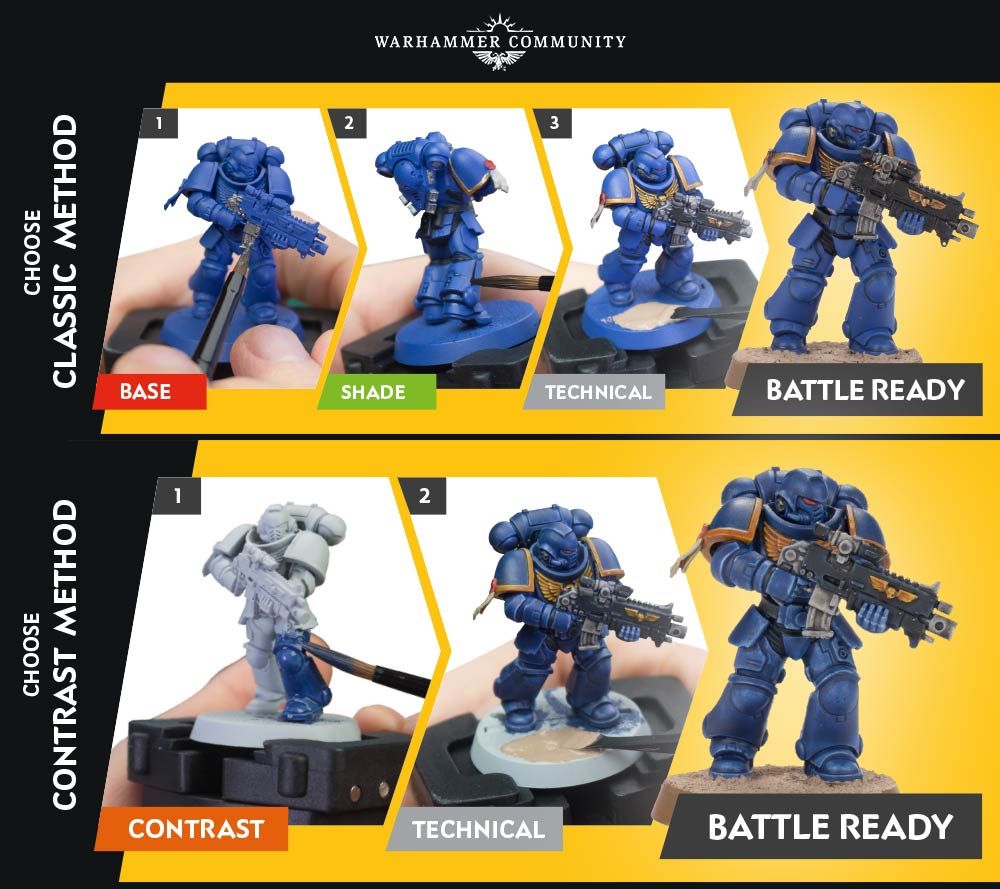
Nonetheless, GW has introduced a new paint line which has piqued my interest. For folks new to the hobby it might be worth checking out. It appears the paints have a glaze medium already mixed in. In effect you get a thinned coat of paint along with a wash all in one go.
I love this. New miniature painters should certainly be looking at these paints. There is a learning curve using them, one of which is using a specific type of primer. While I balked originally at this, I discovered not only are spray versions available but also primer that can be brushed on (providing a lot more functionality of the paint line).
There is some technique to working with them, applying darker colors, then prime and paint sections you want to have a lighter color. A good coat of varnish is needed. Lastly it looks like applying thicker, heavier coats for the contrast paints are the way to go.
You end up essentially applying both a base coat and a wash in one go. Throw in a light highlight or conventional drybrush, you’ve got a tabletop standard paint job. For a slew of rank and file models this looks like a great product. I’ve suddenly got a positive feeling about finally tackling all my Zombicide minis.
Honestly the results using these paints look promising. While it won’t give you a super fantastic paint job, with careful application you can get decent results and save a bit of time essentially cutting out steps to apply washes. I’m excited to see this out there and hope it opens up more people to taking a stab at painting minis.
Review: Runewars
 From Fantasy Flight Games, Runewars is a grand strategy conquest games for 2-4 players. Set in it’s own fantasy universe drawn from Terrinoth, the same world as Descent, each player is a race seeking to control several powerful dragon runes. The first person to obtain 6 runes (or have the most by the end of the game) wins.
The game plays over 7 years, or rounds, with each year split up into 4 seasons. Every season has a specific event. Spring allows units that retreated or were exhausted in the previous year to ready. Summer has a special hero turn (more on that later) allowing these characters to scout through the lands, begin a quest, or duel other heroes. Autumn allows players to earn influence or tactical cards, while Winter, an especially important season, requires the feeding of your troops.
There are stacking limits of 8 units per hex area. At the end of a player’s turn, if there are more than 8 units they must be eliminated. During the winter season each area containing armies from the player must match their food resources (which runs from 0-8). Any hexes containing more units than the player’s food resource value must have troops eliminated until they match. Woe is the player that doesn’t plan out maneuvers and troop movements to account for the bite of winter.
In addition to each major event associated with a season, there is a random event. Events somewhat follow a theme depending on the season. Spring and Summer typically have events that are beneficial, while Fall will have more obstacles and difficulties. Winter will have negative events but can also have events which allow a player to gain dragon runes through bids for influence.
As mentioned, the game is all about gaining dragon runes. When players set up the board, different tiles of various terrain hexes are placed together. Then players decide their home realms and place one dragon rune, along with a blank rune counter just outside their homelands. If a player moves one of their units into a land containing a rune, they can look at it. If it’s a rune token they secretly tally that to their total. If an opposing player attacks and controls the area, they control the rune token. The tokens can be shifted around as an action, including adding a blank token. Essentially you end up with a large shell game of rune tokens and dummy counters being scattered among the map.
Aside from huge armies, players can control up to 3 heroes. During the summer season these heroes can undertake quests offering a chance to earn rune tokens as rewards. They can also skirt through enemy territory acting as a scout, effectively snooping through rune tokens (learning which ones are dummy counters and which ones are the real thing), but watch out! While they can slip through enemy territory, opposing heroes can duel them in the summer season too, gaining all their rewards if they vanquish them in one-on-one combat.
What stands out for Runewars is the order system. All players have identical sets of cards representing various commands they can give to their troops, and each order has a numerical rank. Every season a player chooses one order that all of his troops can undertake for the season. The orders for the turn resolve from the lowest numbered command up in numerical order. If values of command orders are tied, the player with the highest influence (or if needed the most starting influence based on their race) acts first. Essentially there is always a set order for how commands resolve during a season.
This makes commanding your forces a great challenge. You effectively only have 4 ‘moves’ per year. And for many units if they are given a command to essentially attack, they are exhausted for the year. To add some flexibility to the order system, each command has an additional superiority bonus, or an extra order that can be given to your units during a season. The superiority bonus only takes effect if the value of the order is currently the highest among the other commands you’ve given during the year (ignoring opponent’s orders).
Most attack and maneuver orders are lower in value and commands to gain resources, build defenses, and recruit troops are higher in value. As you have tight limits on the number of commands you can give each turn, you really want to plan out the year so that each order played as the seasons progress have a higher value than the previous season commands. Another interesting bit is that the spring of each year will always get a superiority bonus. As there are no other orders played, it will always have the highest value of command orders.

This part of the game really shines. You can quickly amass large armies, but to maneuver them year after year gets unwieldy. Every time an army moves into an area containing a neutral or enemy unit, it stops the movement of the troops for the season. You cannot rapidly advance them across the board and have to slowly trundle them forward in short jaunts. This makes planning out attacks and movement to cut off avenues of attack important. You are constantly trying to ensure the current order has the highest command value compared to other played orders, so that you can gain those important bonus actions. It really is an enjoyable strategic part of the game.
Resources and recruitment of units are managed by special player boards. Resources are split between wood, ore, and food. Each are a track of numbers recorded using dials. When players give a harvest command order, they will gain all the resources their dial is set at, including all the units below it. In addition players have influence and tactical cards which are special resources.
Influence is essentially a currency resource used for bidding on special titles and other seasonal events. Many of these titles are paths to gaining dragon runes. Tactical cards are special bonuses and events that players can use to gain an advantage during combat, allow units to cross seemingly impassable mountain territories, or force a player to reduce their resource dials. Both tactical cards and influence can swing events to their fortune, adding a little unpredictability to the game.
Combat is a little unusual from what you might expect from this type of game. Instead of rolling buckets of dice, it is card driven. When units move into an area containing enemy troops or neutral forces, a battle ensues. All the unit pieces are removed and placed on their player board (or on a neutral player board for non-player forces). All units have an initiative order and are represented by a base symbol. Units of higher initiative resolve their actions first. Players draw a number of cards equal to the number of particular units in the battle and resolve them simultaneously for that initiative round.
The battle round is determined by the base symbol of the unit and matching results on the card. Each card has four outcomes for all four unit base types. There may be no effect, a rout result causing it to drop out of the battle, inflict a wound, or possibly execute a special attack. The distribution of the outcomes vary depending on the base symbol of the unit. Units that have a higher initiative and attack in earlier rounds of combat will have less of a chance to damage units outright. Conversely, lumbering units of slow initiative will attack in later rounds, but have more card results that match their base symbol.
After each unit has a chance to attack (provided they weren’t eliminated or routed in earlier initiative rounds), players total the number of standing units. The player with the highest total of standing forces wins the battle, with ties going to the attacker. The loser has their forces retreat to a friendly or unoccupied area and all of their forces are routed. They will recover automatically at the beginning of the next year, but are essentially out of action for the remainder of the current year. Further if they are attacked again, they are helpless (a player can’t draw cards for routed units). Lastly, if forced to retreat and there are no adjacent areas that are empty or have friendly units, the entire force is eliminated. The combat resolves relatively quickly and composition of forces have some bearing on the battle.
A player doesn’t necessarily have to fight neutral units when they are in the same hex. They might be willing to be recruited into a player’s army through diplomacy, but is difficult to pull off. Players draw cards (the same used for battles) which have additional icons to represent 3 outcomes. The card number is based on the amount of influence spent, and the player chooses one card to resolve the diplomacy action. A precious few cards will mean the diplomacy attempt is successful, while others can cause neutral units to retreat. However most will result in a combat breaking out. Diplomacy is risky but many neutral units are very powerful and can be a huge boon if a player can sway them to fight under their banner.
In addition to building up armies, players can take control of cities and build up strongholds. Cities are important for gaining resources while strongholds are key for recruiting new forces. Given that movement is so limited, being able to muster new forces closer to your fronts is important.
The Good – Runewars is an epic wargame that requires strategic planning. How orders are executed make the game for me. You have a limited number of orders to issue over the game, and need to judiciously deal them out over the seasons. The hero mini-game is also an enjoyable addition which adds some story moments to what could be considered a cut and dried wargame of armies clashing.
The random events of the seasons as well as the layout of the board adds replay to the game. I also appreciate that each army has a particular flavor and unit abilities, giving each a certain feel when you command them. This also opens up the means to try different strategies but up to a point. Clearly some armies are better at hoarding tactic cards or wielding influence over others. It doesn’t mean you can’t dabble in these options, but you’ll likely not be a natural fit compared to some other races.
The components are solid. The rulebook is well written. The art is well done and a ton of well sculpted plastic bits. It really does capture that feeling of seeing huge forces sweep across the landscape.
The Bad – Movement is not dynamic and may not mimic the grand sweeping hordes of what people would expect from a game like this. Battle resolution is also something people might not enjoy with the cards and trying to computate outcomes can be murky compared to rolling dice. The hero turn interspaced in the game can at times be jarring and breaks up the flow of play some.
Lastly, the game can suffer from a kingmaker syndrome while poor opening seasons can cripple a player (essentially trying to claw out of a hole and get a shot at victory almost impossible). There aren’t many opportunities for actions and losing one season can result in a chain of disasters.
Also the game can be long. Not Twilight Imperium long however getting new players up on the rules will take time which dampers the amount you’d realistically get this to the table.
The Verdict – I really enjoy this game. Runewars has a sweeping, epic feel. The season events and tactic cards throw just the right amount of wrenches into player’s plans. There is a thrill to taking advantage of a temporary boon, or thwarting an enemy’s attack. It allows for those peaks and valleys in the play experience that you might not typically see in other games of this kind.
Each season you have to make difficult choices. You are constantly balancing the plodding movement of forces across territories, with the end of season culling due to lack of food in the winter. You want to gather up huge forces to ensure victories, but then must be ready to scatter them before winter. Yes you can replenish forces, but it takes time which you never seem to have enough of as there are precious few orders you can give during each year.
This isn’t a game you are going to get to the table much. It easily will take up most of your afternoon. However it does provide a foundation to have grand, sweeping fantasy battles where you muster huge armies and have them clash against your opponents. I love how it’s all about securing dragon runes. It can lead to some swings of fate but it doesn’t just reward the person that has the most optimized kingdom engine, but instead rewards risks and subterfuge. Runewars isn’t for everyone. But if you want a sprawling, epic wargame with a fantasy theme, you certainly won’t be disappointed with this game.
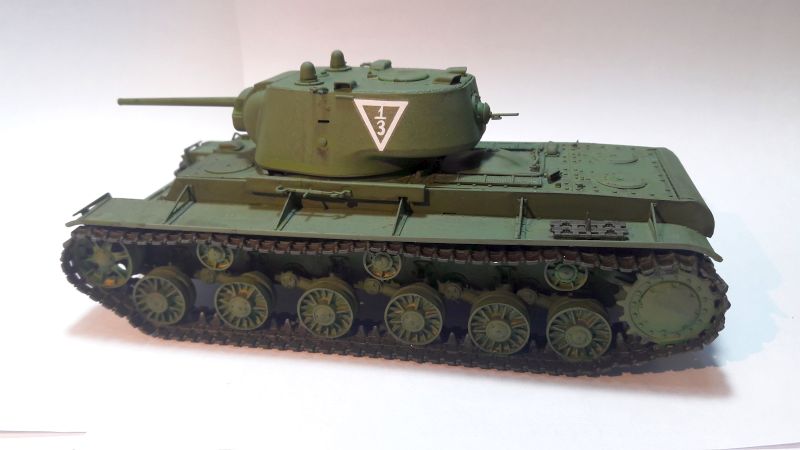
1/48 Hobby Boss 1942 KV-1
Now that my mid-war 28mm Russian platoon has been painted up, I figured I needed a tank to go along with it. The KV-1 was an obvious choice for historical reasons, however given Bolt Action is pretty much Hollywood history with the point platoons, I’d have to settle on fielding it for 1,200 point games. The KV-1 is a monster tank on the table, but it’s a chunk of points. For 1,000 point games I’m going to have to settle on a T-34 instead.
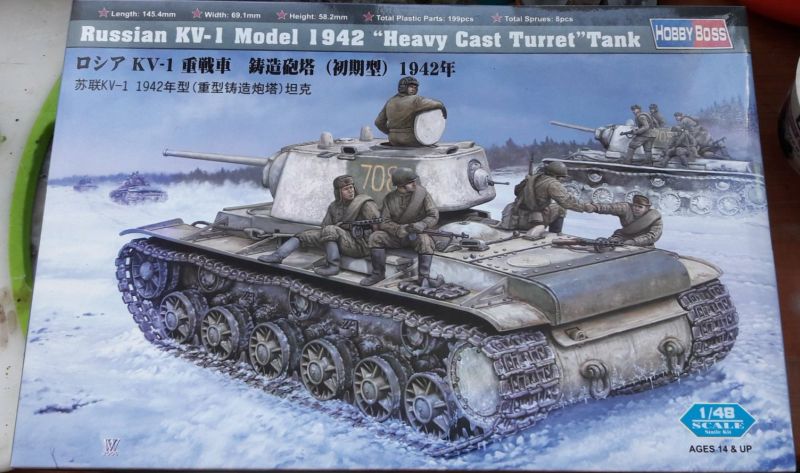
I picked up a 1/48 kit from Hobby Boss. It’s a really nice kit which I would garner needs a tad more modeling skill to assemble. I’m still pretty much a novice and some of the sections (especially the treads) were a bear to assemble. Nonetheless the instructions were clear and the parts labelled well. Some of the tread sections had individual links, but you had jigs included to help with assembly. Another fiddly part were the side struts over the track skirts. These were metal and I had to break out superglue to get them on.
I gave it a simple paint job using Tamiya spray Field Gray TS-78 and a wash with Vallejo Military Green. The treads I used a heavy wash of Tamiya Dark Green XF-61 and drybrushed with Vallejo Gunmetal Grey. I also gave the treads and some sections some weathering with Modelmates mud. I need to work on how to weather decals more. The color sections under the transfer didn’t quite seem to match up, even after a matte spray. Still it turned out pretty good and the model is a huge chunk of plastic on the tabletop. It’s a beast!

Algoryn AI Unit
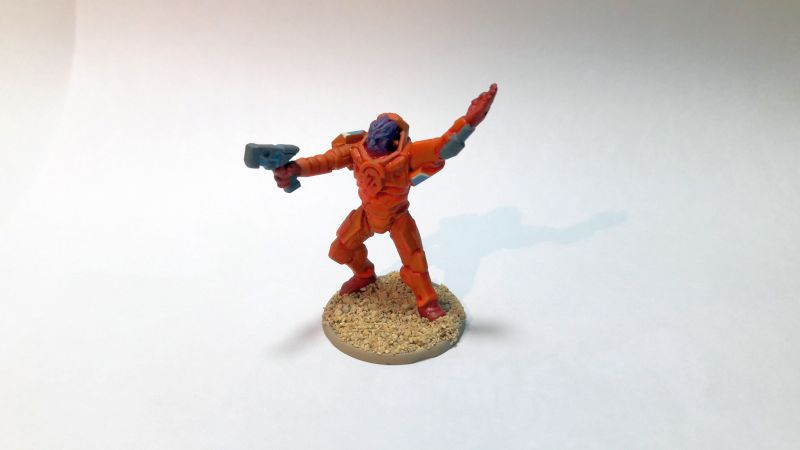
I’ve been making slow and steady progress on my Algoryns for GoA. Thankfully for my wallet, Warlord has released plastic kits for rank and file units. They offer quite a few poses and aren’t too difficult to assemble.
Out of the box you get a command unit with choices to arm them with a mag gun, mag repeater, or a mag pistol (with a X-sling option), while the rest of the sprue provides mag rifles and a couple of micro-X launchers. You also get a spotter drone along with bases for all the figures. Overall they piece together pretty well. My only complaint is that it can be a little tricky to figure out the ‘proper’ way to assemble the chest and back pieces, as the heads have a lot of play on the chest peice (and lack of assembly directions or pics of the figure’s rear).
I went with a super simple painting scheme. I’m still not too keen on it and likely will retouch the chest pieces some. I’m using a stark highlight of orange over base coat like what I used for my Russians, but even after drybrushing it doesn’t seem to pop much. It’s a very subtle effect which doesn’t photograph well (using a crappy phone camera doesn’t help much either).
I’m also on the fence some with the micro-X launchers. Likey retouch them up again with some OSL effects on the weapons to give them some life. Regardless, they’ve been languishing too long on sprues, packed away. Glad to finally get some of the figures assembled and a coat of paint on them.

28mm Plastic Soldier Co. Russian 45mm AT-gun teams
I’ve been a long time fan of playing Bolt Action in 20mm. However I figured if I ever jumped into a local gaming scene I might be in a bit of a pickle using minis at that scale. I had a hankering to field a Russian force and decided to do it in the ‘proper scale’ of Bolt Action using 28mm figures.
There are lots of choices out there for models and I went with some cheaper plastic sets. Looking to round out options I wanted to try and get some different unit choices. One of which was a small AT gun team. I’ve freely admitted my love of Plastic Soldier Co. before and used their models extensively for my British and German 20mm platoons. For Russians, PSC makes kits both in 15mm and 28mm, so I was in luck.
The 45mm AT-gun team kits have parts to make 2 guns and a total of 8 crew members. It’s a very flexible kit for light AT guns, as there are barrels to make a 43mm M-1937 and a 45mm M-42 AT gun. Yet, the box name is somewhat a misnomer as there are barrels to also make a 76mm M-1943 (OB-25) regimental gun which could be used as a light howitzer. 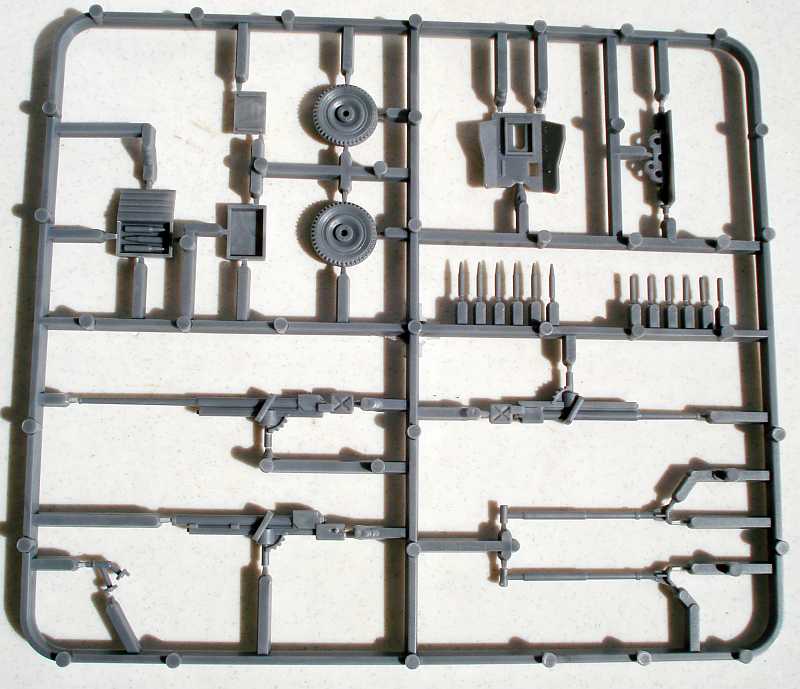
I went ahead and made a M-42 45mm AT gun (pictured left below) and a light howitzer (pictured right below). While the M-42 was made throughout the war, it was certainly phased out as German tank armor was improving. If going the min/max route most folks would likely spend the points for a ZiS-3. But if focusing on an early war platoon, this kit is a great resource.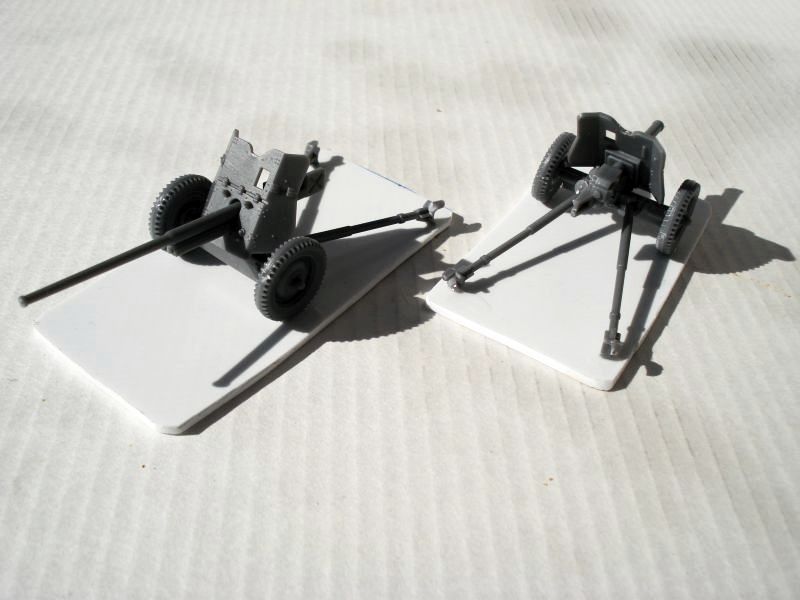
The details on troops are a little muddied but not bad for digital sculpts. Another small quibble is there is no instruction sheet/diagram for assembly of the guns (but not too difficult to work out). Assembly was pretty easy but the barrels and trail supports had to be sanded down some to fit within the gun frame.

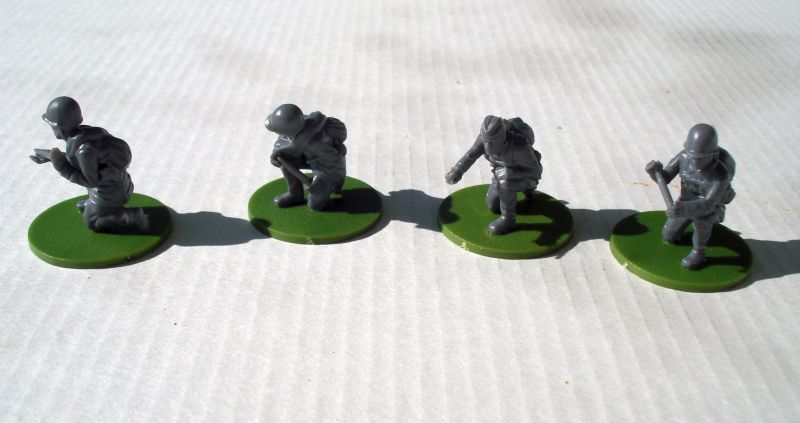
Despite my small niggles, overall it’s a great kit for the value and wonderful for wargaming. A good buy if looking for early-mid war AT options for Russians in 28mm.
Chain of Command – Making jump off points
I picked up Chain of Command and been digging it. Likely later I’ll get some thoughts on the rules written down. For now I’m busy modeling some 28mm Africa platoons and other bits I’ll likely use for the game.
CoC has a mini-game of sorts at the beginning where the table is cordoned off in areas allowing for forward deployment using markers. Some markers will end up becoming staples on the table once the battle starts. Right now I have some paper disks you can download for patrol markers. But I decided to whip up some simple markers to represent jump off points.
I picked up a 1/48 oil drum and jerry can set from Tamiya to use for modelling the markers. They have a lot of small bits which are well detailed (almost too much so for my purposes). A bonus is it also includes stowage for axis and allied vehicles which I’ll likely use on other kits. All in all, a decent spread of stuff to add to terrain and vehicles.
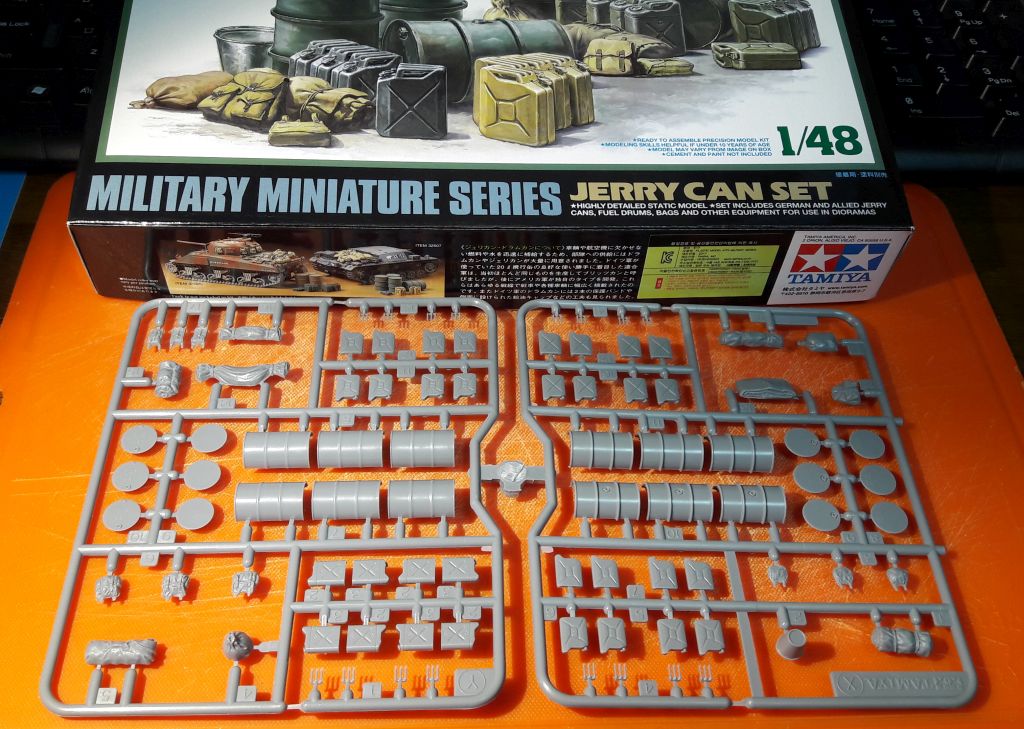
I traced out circles on plasticard and cut them out with scissors. Using some sandpaper, I buffed the rough edges to even them out some. Being plasticard, I could use model cement to glue oil drums and fuel cans directly to the card.
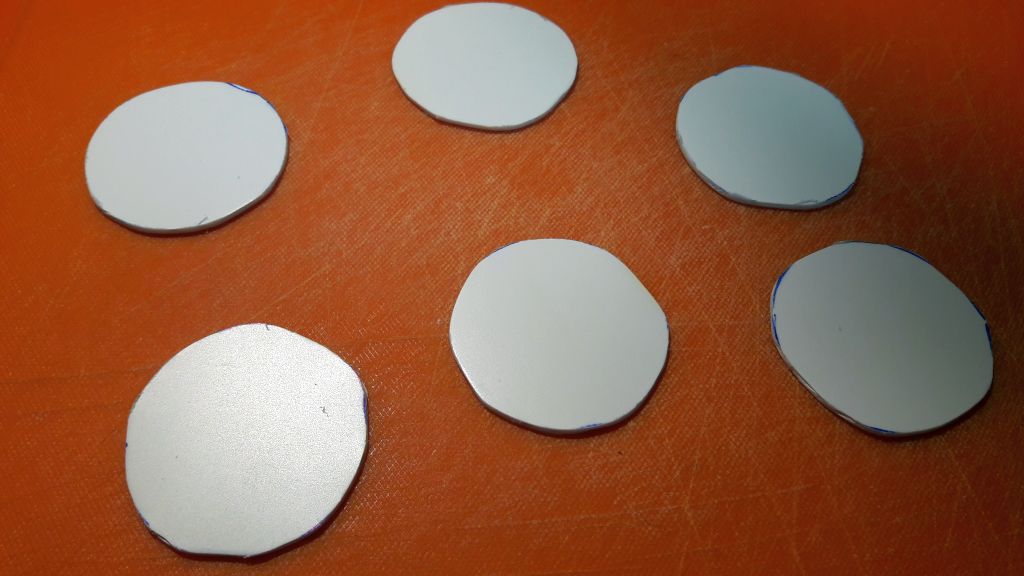

After priming, I used a base coat of gray and olive drab to the respective axis and allied jump off markers. A wash of sepia ink gave them a little more depth and all I had to do was dress up the bases a bit more. In addition to a flat green and a dabble of flock, I also painted the edges of the bases with different shades of brown. My intention is that each color will be used by one player, just in case there’s a little confusion as to which model drum represents which nation.

The end result looks pretty decent. I have lots of spare weapons and other bits I can add later if I want to. Likely I’ll chalk that up on my possible-but-not-likely list. I’d rather put more modelling effort into armies instead of terrain and markers. Still they look pretty nice and blend a little more into the battlefield over paper tokens. Now I need to try and get some CoC games in!
1/48 Tamiya Russian infantry and tank crew set
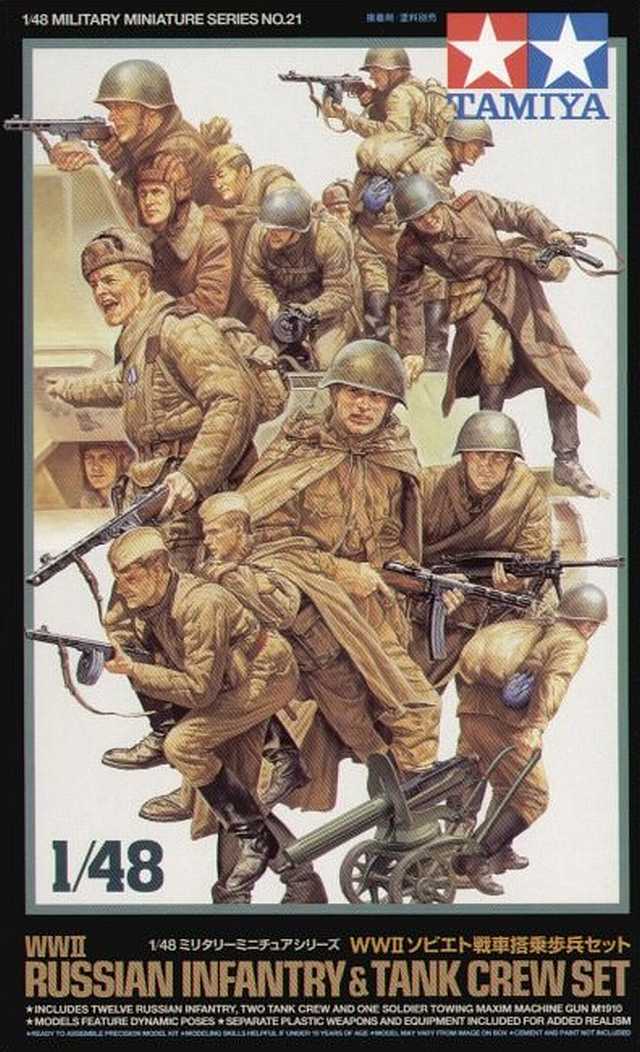 So a long, long, long while back I picked up a handful of 1/48 Germans and Russian infantry from Tamiya. I was thinking about having a couple of squads to do some quick and dirty skirmish gaming with some odd rule systems. This was long before Bolt Action was on my radar and they sort of languished in a pile of unopened model kits. As I started working on a full Russian platoon in 28mm scale and decided to add these models into the mix of my force.
I’ve got a metric ton of Wargames Factory Russians which are pretty good figures. So having some other miniatures from a different manufacturer would be cool to add a little variety. There are 13 figures in the kit including a couple of tank crew members. For the most part they are in light, cold weather garb with a few light cloaks and a couple in winter coats.
Most are armed with PPsh-41 smgs and a few have Mosin Nagants. One carries a DP lmg and there is also a soldier pulling a Maxim mmg. As functionality for independent models to push around on bases, there are a few in sitting positions, so it’d require some base modelling to make them work. However on the flip side it’s great to have a few sitting models as I can use them to indicate a tank is carrying tank rider troops.
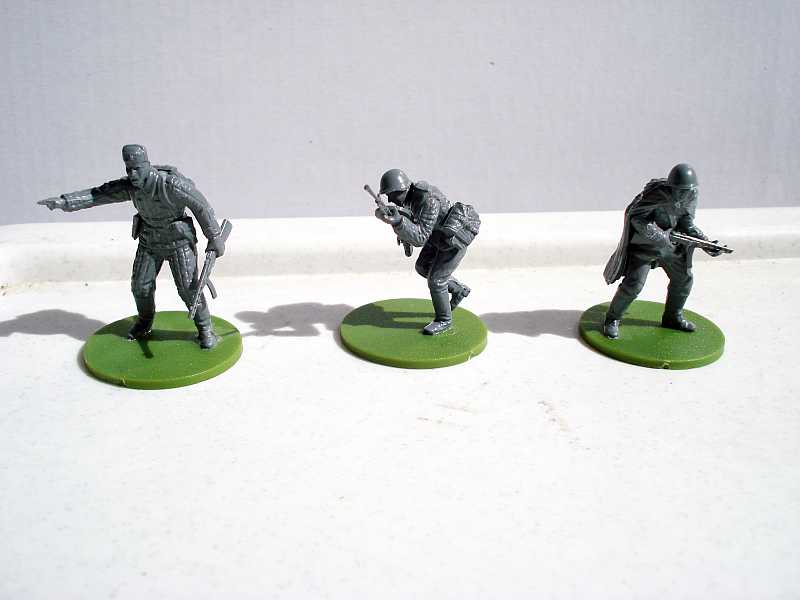

I ended up having 8 models including a soldier with a lmg to form just that, a tank rider squad. They have a lot of nice detail. Scale wise they match up pretty well with Wargames Factory figures (right) however against some 28mm Plastic Soldier figures (left), they are a little smaller in bulk.
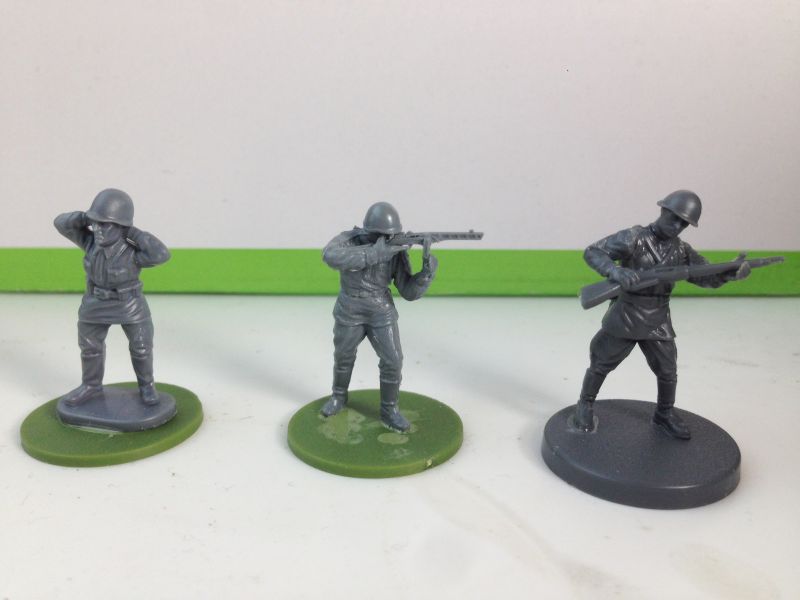
If you wanted to pick up a few figures that were smg-heavy, this is a nice kit to get. Also, if you wanted a few figures to represent tank riders, it’s certainly a great kit to buy. They have good detail and are pretty easy to put together. Mind however that you’ll also have to get a few bases though. If looking for a small squad in winter gear to supplement your force with a scout squad or tank riders, check these figures out.
 Geek Ken