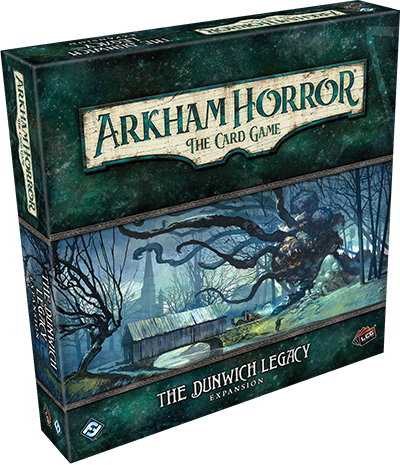
 I’ll peg this as more as a cumulation of thoughts rather than a proper review. This full campaign expansion for the Arkham Horror card game has since been released for a while now, and after a few playthroughs I decided to give The Dunwich Legacy a look over. This uses the classic Lovecraft story, The Dunwich Horror, as a backdrop for the expansion. I’m not going to go through much of the cards as you can dig through tons of other podcasts and such to get a rundown of individual reviews, or you can see them yourself. I will go over the highlights of the scenarios and talk a bit how the campaign was overall. I’m also going to try and give this a light spoiler treatment. I don’t want to dig too deep into the workings of the campaign to allow for people to have some fun if they haven’t played it yet. But fair warning that some of the story elements will be discussed.
The campaign itself consists of a big box expansion with 6 mythos packs (small deck expansions). In the Dunwich Legacy you’ll get 5 new investigators along with 2 scenarios that kick off the campaign. As deck building goes with the investigators, each of them have a little twist compared to the ones included in the core set. All investigators utilize one class and the neutral cards as primary sources for cards from level 0 to 5 experience. However they can have up to five level 0 cards from any other class. What’s refreshing about these investigators is that they seem to be designed with the intent to compliment core set investigators, and the limited card pool that comes along with it.
My biggest compliant with the core set that it was a deck construction game without much opportunity to actually build decks. Plus the more investigators you add, the more difficult (to downright impossible) it was to make decks. The Dunwich Legacy investigators address that (Note: the updated core also addresses this). I like that they broke away from investigator deck construction format that stuck with the main class plus one other, allowing you to stretch out using a single revised core set a little more.
The investigators themselves are fairly solid. I think of the lot maybe Jim Culver is the weakest of the bunch with the others being pretty formidable (and some might say broken in the case of Rex Murphy). This certainly adds a lot more re-play to even the base game. The investigators still adhere to their class archetypes for how they play. But each has a different feel that diverges from the core set investigators which is great. Now a bit more onto the campaign itself.
The campaign expansion opens near Miskatonic University in Arkham. The players are recruited to find individuals that assisted Dr. Henry Armitage in a strange incident that happened months ago in the remote village of Dunwich. Out of the box the campaign offers a branching story. You have two scenarios and can choose either to tackle first, with each having a minor wrinkle to how they play depending if you are playing it first or second. It’s a pleasant change from the linear paths and I hope it’s something that is explored more in future releases.
Extracurricular Activities – The players are trying to explore the sprawling Miskatonic University campus, looking to find one of Dr. Armitage’s colleagues. A tweak to this is that a few key locations are locked away and cannot be accessed. If players can eventually take control of an NPC (Non-player Character) ally, they can get to these locations. Once things are underway however, a clock to the scenario starts ticking down. The players have a choice how they tackle this new challenge. An interesting aspect is that players can ‘win’ this scenario but still ‘lose’ adding additional difficulty to the campaign.
The House Always Wins – A change of pace from the typical dreary locales, this scenario takes place in a speakeasy that also doubles as a gambling den. The players must investigate the area under the watchful eyes of various mobster types. If they discover clues while a mobster is at the same location, they can incur their wrath.
A wonderful twist to this scenario is that the initial investigation has the players discover clues through different means by either spending resources or discarding ally cards. This comes into play shortly as the scenario has a sudden-explosion-everything-in-chaos moment that ratchets up the tension. Players will be thrown into a situation where every action counts. So ditching resources to help move the act cards quickly can also mean less choices to handle more difficult obstacles that come up later. It’s a great balance of risk versus reward.
The Miskatonic Museum – This scenario has the players trying to search through a museum after hours in hopes of finding a translation of the Necronomicon. Rather than have an encounter deck filled with horrible monsters, there is a single phantom-like creature slowly stalking them. It’s a different take on the typical monsters in the game which I appreciate. However the results are a mixed bag. The monster is more of a harasser that builds up in power but never seems to be that much of a threat. It instead becomes more a monster that’s managed through evasion and damage mitigation.
Still the scenario has a nice feel of trying to search through sections of the museum. Also there are different ways to approach key challenges, including a choice right at the onset of the scenario. Lastly, if the players are successful they are offered a dangerous asset of the necronomicon itself. The card ability is tempting, especially for Daisy Walker, but there are unforeseen consequences for the players if they take it. A fun choice to make campaign playthroughs a little different each time.
The Essex County Express – This scenario takes entirely in a train traveling to the rural village of Dunwich and the investigators soon learn that things have gone horribly wrong. They are in a frantic race to move from car to car, ever trying to get to the engine of the train. With different train cars and engines, along with a variety of orientations of the locations, this scenario has a fair amount of replay. It can also lead to some wildly challenging games where some are horribly difficult, and others fairly easy.
Overall though I love the concept. Players soon learn to carefully glean clues from the agenda and act decks, as they can find out the hard way how the scenario agendas progress. I can totally see future scenarios where a similar progression and how locations are altered can be used in different environments (like a sinking ship, with investigators hurriedly traveling between ship compartments). The outcome sort of falls flat though. It’s more of a hard win/fail of sorts for them.
Blood on the Altar – The players have finally entered Dunwich where things seem awry. This is a wonderful scenario. Players are tasked with finding key locations and have a choice of either fighting or solving their way to a win. The outcomes of the scenario can be either crippling or a mild inconvenience. This scenario can result in unique allies being removed from the game, making the outcome have far reaching consequences for the campaign as a whole.
The scenario also introduces an interesting creature encounter card. Whippoorwills are aloof creatures that are more of a hindrance than a threat. Players have to spend a fair amount of actions to remove them. They add a clever mechanism to adding difficulty to the scenario over a static condition that a player accumulates.
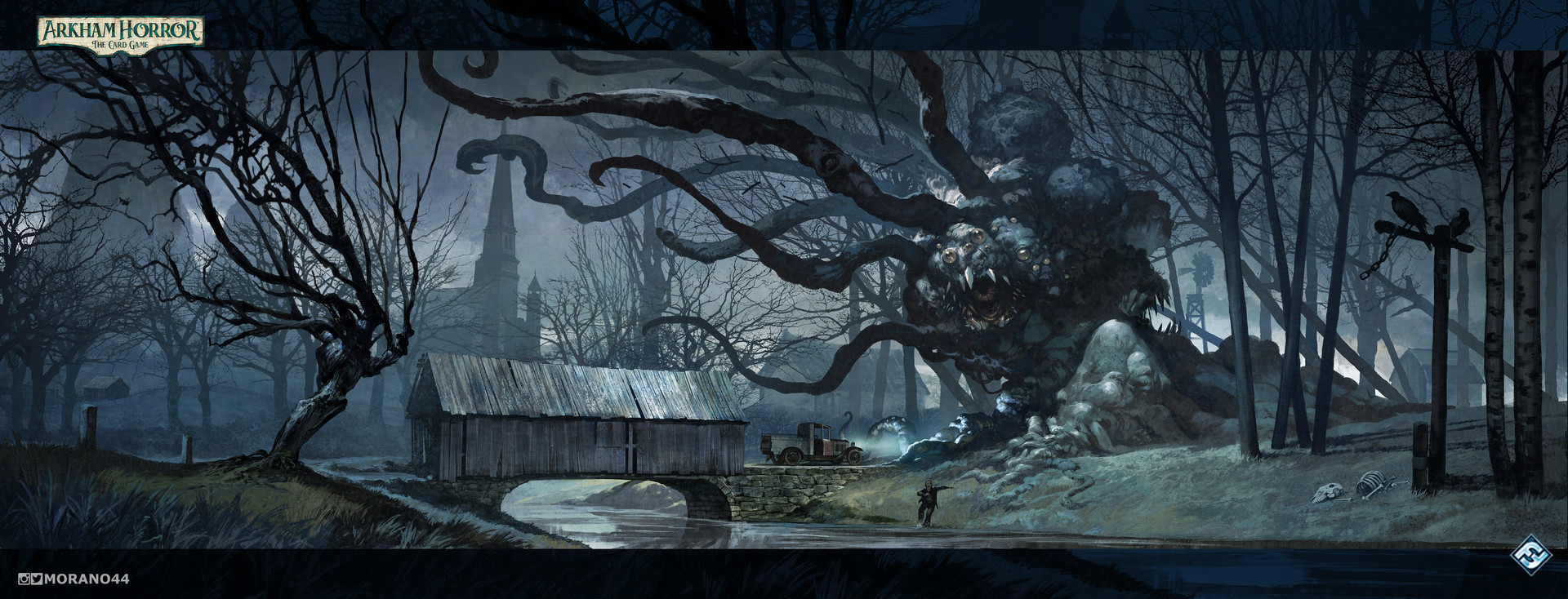
Undimensioned and Unseen – The Dunwich village is now under threat as several creatures rampage through it. What breaks up this monster battle is that players must first discover a key location and obtain items that will allow them to attack the creatures. One great aspect of this scenario is particular locations can also interact with the creatures. This gives the scenario a fun cat-and-mouse type of play, allowing the investigators to manipulate the creatures through judicious use of location abilities.
This scenario also has a similar vibe to Midnight Masks from the core set. Players are set with a practically impossible task. They have to try and do as well as they can and might have to just cut their losses and resign. It doesn’t mean the end of the campaign, but by not completing their objective in its entirety can make other scenarios far more challenging. It can be a difficult choice whether to soldier on and be eliminated, trying to fight to the last, or run for their lives. Used judiciously in a campaign I can appreciate this, and it works well here. However the scenario as a whole is pretty much a monster hunting battle.
Where Doom Awaits – First let me give some appreciation to the designers of the game regarding a decision how this scenario resolves. Throughout much of the campaign (rightly) if players fail they can still carry on. Metagaming, players realize there is another scenario pack to the campaign, and likely rest on that knowledge knowing if things get too difficult, they can lick their wounds and try again for the final scenario for the campaign. The designers went with a decision that might surprise some people. I dig it and appreciate the direction the campaign takes because of it.
Now onto the part where I piddle on this scenario. Throughout the campaign, players can build decks to get around having a poor lore skill to investigate for clues. This scenario dumps that on its head. There are specific location abilities that investigators must utilize to advance the act deck. If the players cannot do so, there may be negative outcomes with severe campaign consequences. What adds punishment to this game element is that the location abilities can only be attempted by an investigator once during their turn. If you have a low lore skill character, you will probably lose this scenario. I just feel it’s a poor design choice.
Now the scenario itself can be all over the place. The variety of locations along with an encounter deck that has a kitchen sink makeup, means you can have wildly different plays. Some games will be pretty easy. Some will be incredibly difficult. I like that you need investigators that can fight as well as others that can scoop up clues.
However it’s marred by the abilities on key location cards which require a once per turn attempt to investigate. If ever there were scenario errata needed, it would be for this one. Something needs to tweak how the game progresses (ex. if an investigator fails, they can attempt the location action again). However how the mechanics of the card function, even standards like flashlight are useless so something else more drastic might be needed. This effect sort of breaks the scenario and given the larger repercussions to the campaign as a whole, it can leave you with a sour taste in your mouth. Which is a shame as what follows this scenario is so great.
Lost in Time and Space – How this scenario plays out is interesting. There is a single location in play and players must go through the encounter deck to discover more. Further, the paths from the locations twist and turn about, where you find in order to proceed to key act locations you have to work through several already on the table. This process gets more difficult as locations can disappear, needing be be drawn again from the encounter deck. Further, players and creatures can find themselves teleporting from location to location. It can be a frustrating experience, but at the same time it captures that chaotic, warping sense of a constantly shifting landscape with ever degrading sanity hampering the investigators.
As a small bit on the agenda developments, as each agenda rolls out players make tests based on past events, even those from the first couple of missions. I really enjoyed that part. It wasn’t a perfect fit, but still a pleasant attempt at demonstrating the lasting consequences of past actions. Additionally I enjoyed the possible resolutions for the scenario and also for the campaign conclusion. You can potentially be lost forever and still manage a heroic win.
The final showdown can be avoided or be a slugfest with the elder god, Yog-Sothoth. Much of the encounter cards and locations chip away at the player’s sanity and this greater abomination does the same. You might consider the scenario a little too lopsided towards mental damage, but I feel it fits the theme of the final locations well.
Final Thoughts – A key theme for many encounter cards is running through a player’s deck by discarding undrawn cards. One particular encounter card will inflict immense physical damage if a player runs out their deck. This essentially adds a timer to the game as they’re unlikely to survive this effect. Fortunately the players are exposed to this early on and can try to mitigate it as they gain experience. However it does introduce a different time challenge for the player which I like.
I will admit some elements are hamfisted with how they are added to the campaign. I love outcomes with some scenarios that add a specific weakness to your deck. But there are also ones where you add a random weakness or chaos token for no real reason except to ramp up the difficulty. Similar effects based on outcomes and choices from the players just feels much more enjoyable.
Overall Dunwich Legacy has more hits than misses. Being the first big expansion campaign, I don’t think it strayed much from the core set experience which is good. Yet the designers still managed to get some mechanisms and scenario elements that add to the typical game you’d get from the core set. I bite my tongue a bit though with giving it a glowing recommendation because a critical end scenario (Where Doom Awaits) can certainly thrust the player into an unwinnable situation. The story environments also knit well, with only a few that feel out of place (Essex County Express). Overall it just seems to capture a more intimate experience with most of the scenarios revolving around Dunwich, which can potentially lead to this otherworldly environment. Maybe people wanted a globe trotting adventure, but I enjoyed the more rural locations it went for.
As of this review there is another complete expansion out, with a third being released in the next few months. Players will certainly be spoiled for choices and possibly these other expansions might eclipse the Dunwich Legacy. But if looking for an expansion with classic Lovecraft theme that builds on the core set, interesting investigators, useful player cards, and offers a full campaign experience, the Dunwich Legacy is a fun one.





















 Geek Ken