Frostgrave in Summer: Genie in a Bottle

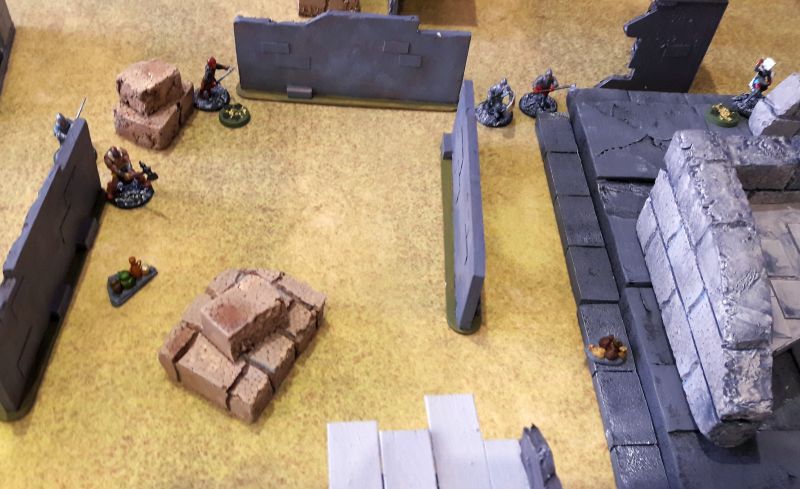
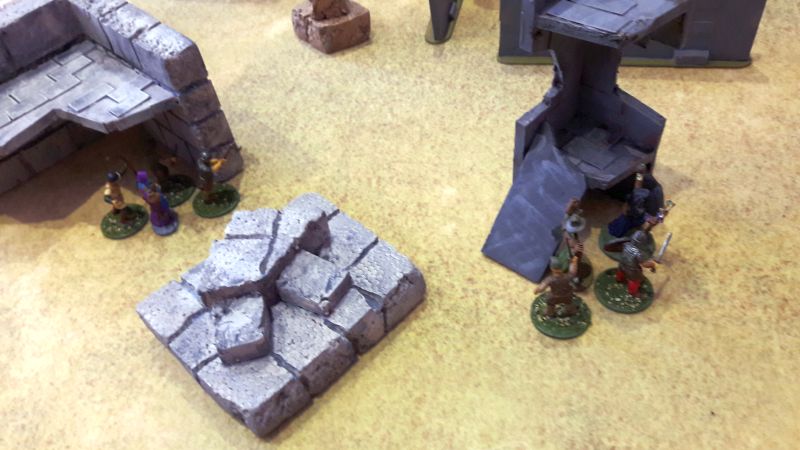
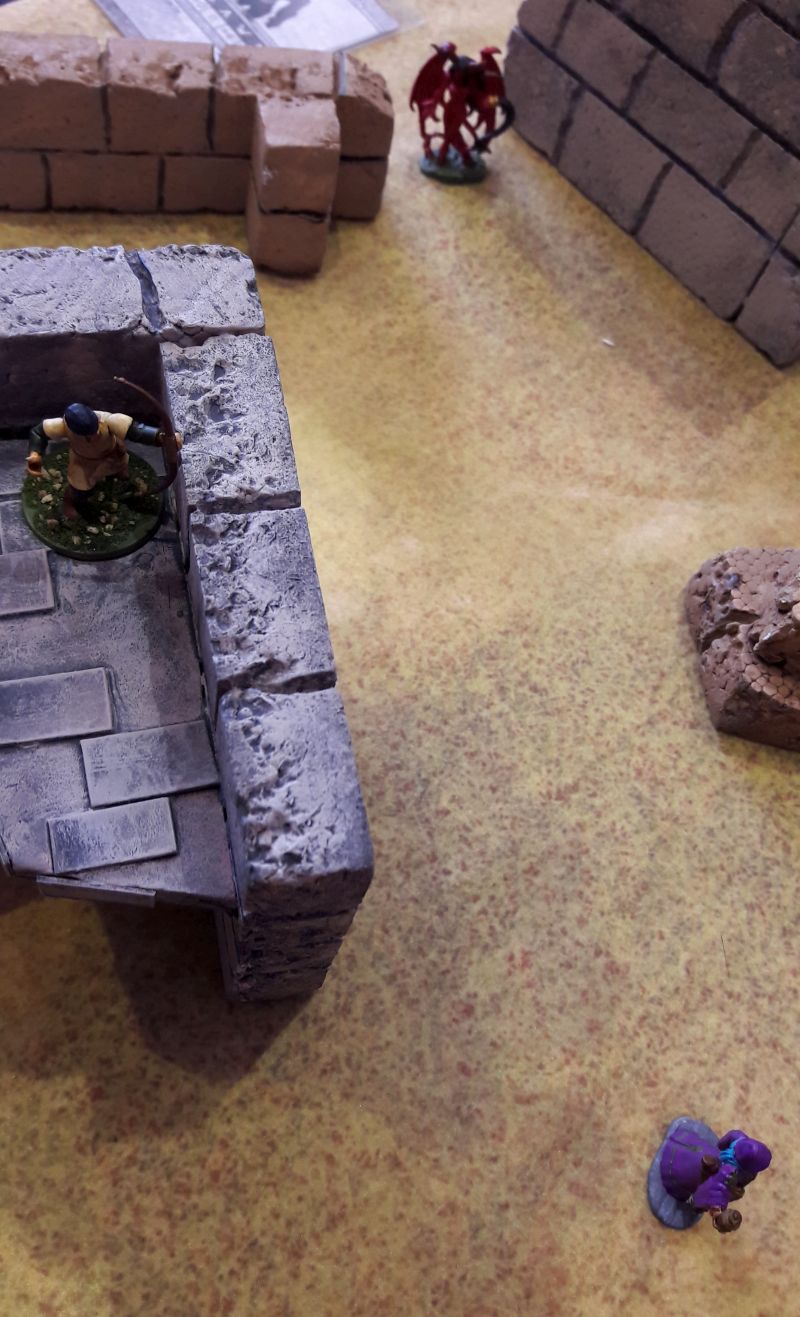
I had the gaming scheduling gods show me favor and was able to sneak in another game over the past few weeks. To break up the typical magic schools I faced throughout the campaign, my opponent would be a chronomancer this time. We were nearing the end of the league and I decided I needed every moving body I could get on the table. I opted to give my wounded man-at-arms the boot and hire an infantryman and barbarian as replacements to casualties I received from my last game.

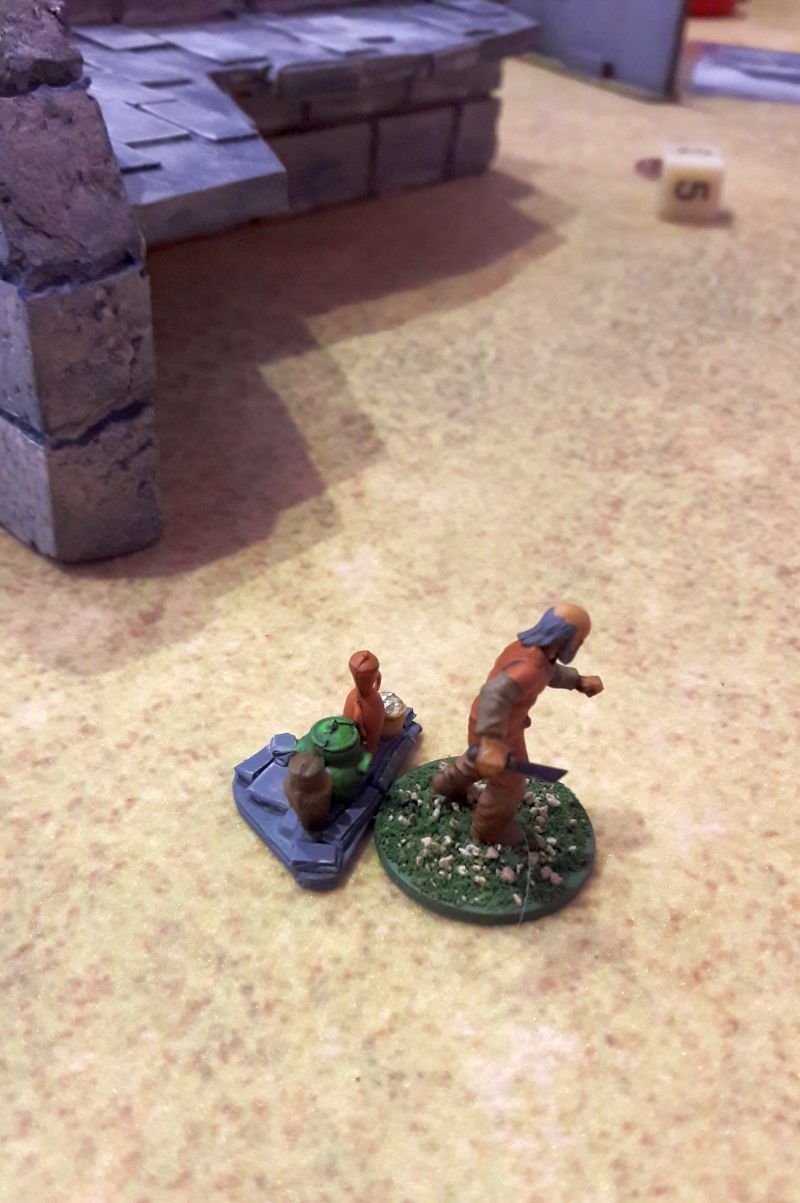
This battle would be a challenge. There was a 25% chance each treasure picked up might create a genie that would wreak havoc on the table before eventually wandering off. Not having any spells that would cause magic damage worried me. I did have a magic weapon though. I failed to notice Banish as a spell within my school tool. In retrospect after my last game, having a chance to destroy a demon outright would have been useful, especially as a genie is also considered one.

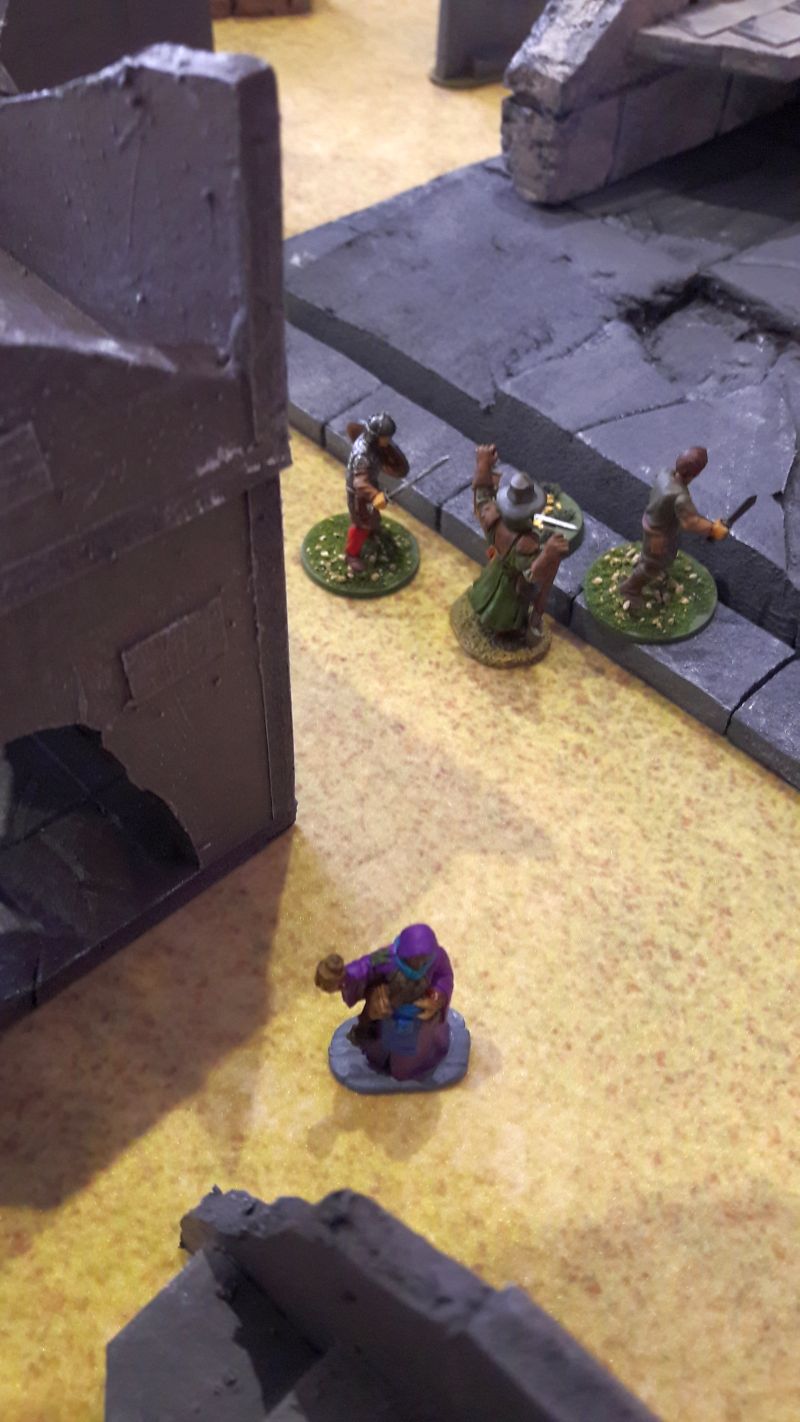
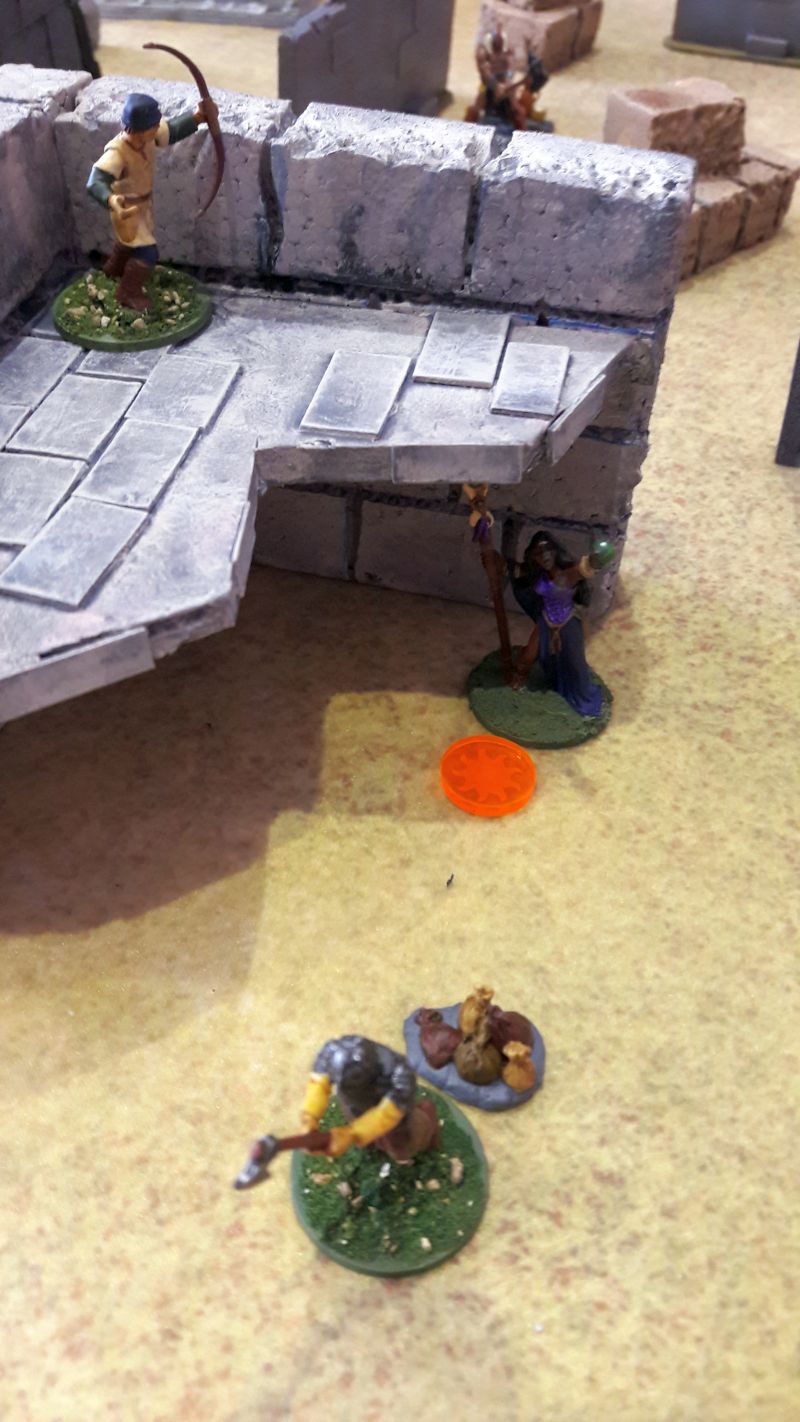
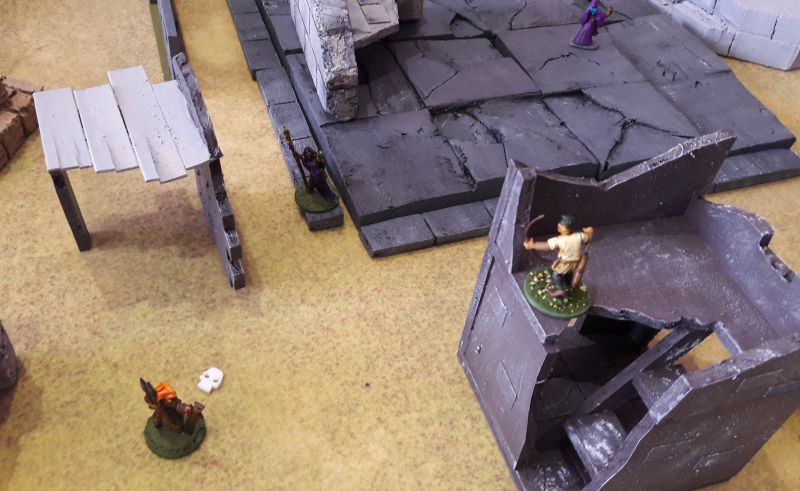
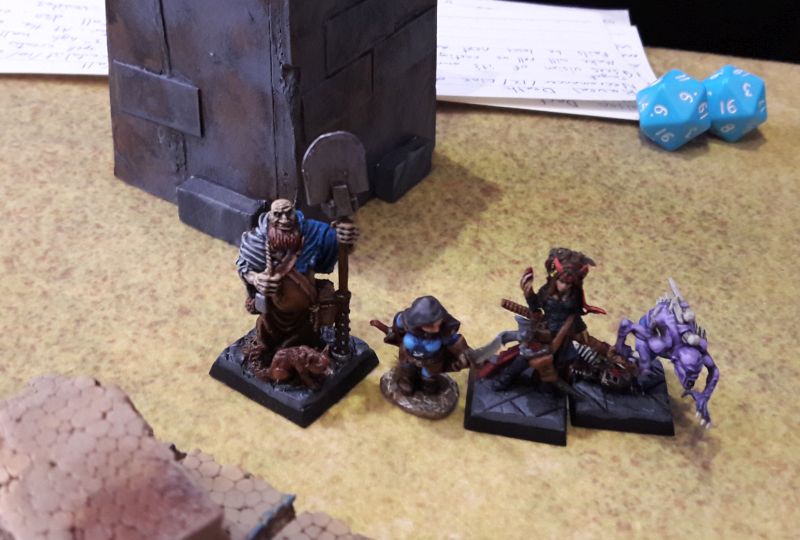
Nevertheless I pressed ahead. I was successful in casting Reveal Secrets and made it a point to ensure when I placed treasure that I’d get a chance to put a bonus pile close to my deployment zone. Other than that, I stuck by a standard with my setup. I had two groups with my wizard and apprentice each leading one with my archers ready to clamber up some terrain and provide covering fire.

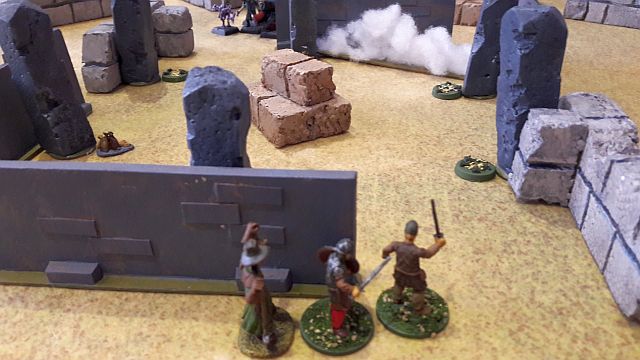
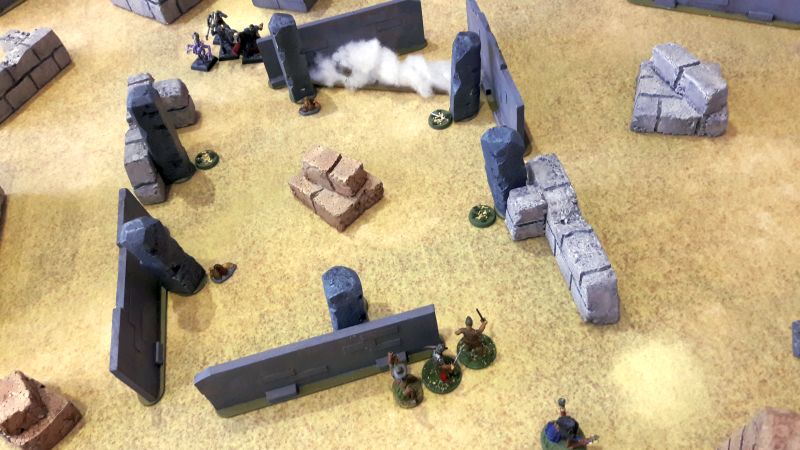
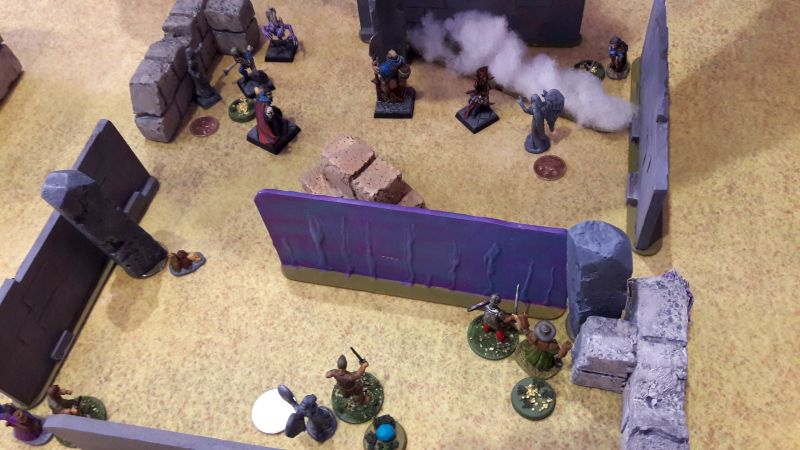
This pretty much was a repeat from last time regarding documenting the game. I just got caught up in the action and didn’t keep stringent notes. But it turned into an unusual game. Both of us were able to quickly get forces towards the middle and scoop up piles close to us. My opponent being an chronomancer was rapid firing Fleet Feet, giving his slower troops some additional movement each turn.

Being a crafty opponent, he was able to cast Wizard’s Eye at a perfect spot. That allowed him to fire off spells from a great vantage point over most of the treasure. It worried me enough to keep my casters out of direct sight. I could have tried to dispelled it but needed those precious initial actions to cast Push and other spells on my own warband.

The wizard’s eye went to great effect, as his boosted quick moving troops were able to gather treasure and then be targets of Leap, vaulting them off towards the table edge. I got my forces forward quickly with Push, but was unable to hamper any of his troops effectively. I easily was able to cast Blinding Light several times, including targeting his apprentice. But my opponent shook them off easily, practically maxing every willpower roll to dispel them.

My opponent made quick work of an infantryman that I rushed in towards the left. His soldiers cut him down and I tried to keep them at bay with archer fire. Meanwhile to my right I got a man-at-arms and treasure hunter up to take on one of his infantrymen. They were able to overwhelm him but then scattered as one of his trackers peppered my followers with arrows.

All the while my archers suffered the same fate of amazing defensive rolls from my opponent. In the end we managed to wound a soldier or two. But between ineffective hits and good shooting rolls that were shrugged off by high defensive rolls by my opponent, missile fire was ineffective the entire game. My opponent cast Elemental Wall to break up the table and get some cover for his men, however I was able to dispel it.

Between all the activity and melee at the middle of the table, I was able to scoot my thief forward and scramble off the table with some treasure. I also was able to manage a successful Transpose and a few more Push spells to get others carrying loot to away. For the battle overall, I did pretty decent getting 4 treasures, but overall for the league that wasn’t enough. I needed to prevent my opponent from gathering any treasure. They were able to get 3 treasures gathered, evading any arrows shot at them from my archer as they retreated towards their home camp.

What stood out from this game was that we had seven treasures on the table. Every single time we picked one up we were gritting our teeth waiting for the genie to appear… and it never did. Everytime we rolled under a 15. A couple of wolves and a skeleton roamed in but were quickly dispatched. Super strange that it never happened. We pretty much decided then on a new house rule for further games using this scenario. If the second to the last treasure does not spawn a genie, it will immediately appear near the figure closest to the last remaining treasure pile, ensuring that it spawns.

It was fortunate for us, but also a bit of a letdown as we were both expecting havok from the genie. I can’t complain too much though as I recovered 4 treasures and managed to get all my soldiers back alive. In the end I scored some nice scrolls of Summon Imp and Control Undead, two +1 staves, and a grimoire with Destructive Sphere. I decided not to invest in learning the spell as the elemental school wasn’t quite my strength. Instead I went about improving willpower, health, and my fight skill (which oddly enough doubles as a means to dodge arrows). I put my last level into Transpose hoping that with a roughly 50-50 chance of casting it now it might come into play.

One last game and our league will wrap up. Hee, have to see if I can manage to get out of my solid position of last place.

Alien vegetation terrain using straws

I dabble in 15mm sci-fi gaming and lately been using my models as proxies for Beyond the Gates of Antares. Getting terrain together can always be a bit of a chore and at times heavy on the wallet. You can get lots of railroad, medieval, and WW2 terrain easily, but sci-fi stuff is somewhat of a niche market. So inevitably I get to tinkering around making my own.

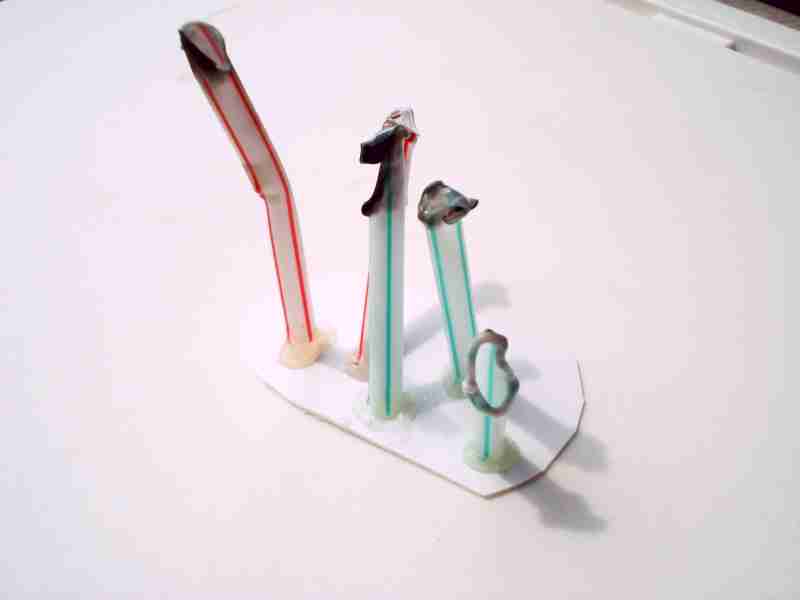
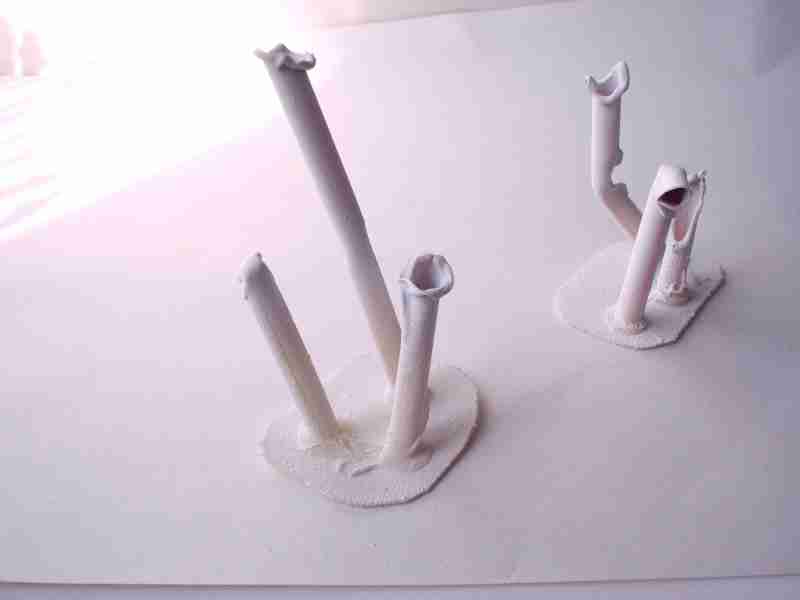
Vegetation is always something tricky. A really good source is simply aquarium plastic plants, but I decided to try and go the full craft route and thought of working with straws. By melting them partially, they fold open and get this weird pitcher plant type of look. I used a lighter and carefully melted the plastic passing it over the flame. I would also put a little heat on sections of the straw and carefully bend it some to give them a few kinks. Be mindful not to apply too much heat, otherwise you’ll end up burning another hole into the main section of the straw. StrawB

StrawA

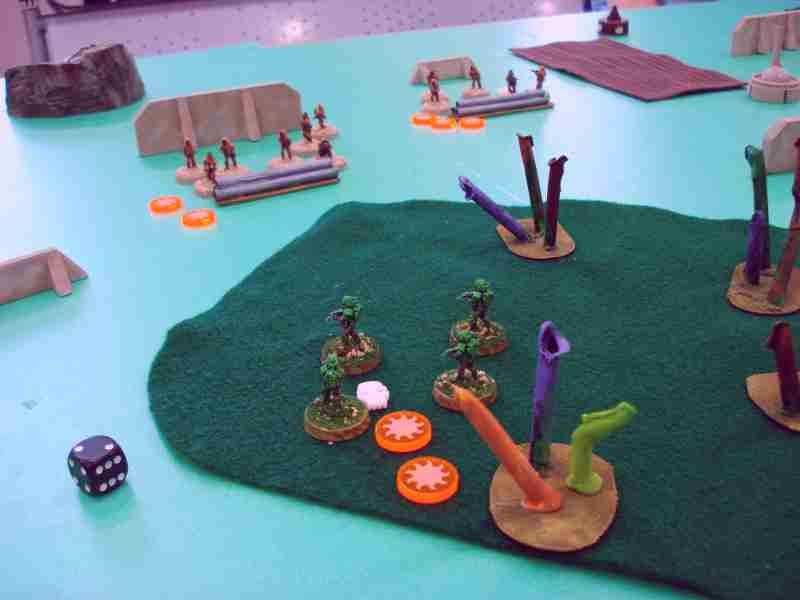
A word of warning, too much heat and your plastic straw will catch fire. Not to mention the fumes are toxic as hell, so do this in a well ventilated area (I also had a fan behind me blowing the air away). After melting the ends of the straws, I used hot glue to mount them to some plastic card as bases. I then gave them a coat of primer. I tend to have trees and the like on individual bases so I can move them around. When painting them up I used primarily a green base coat along with some highlights of bright colors to draw out a lot of contrast.

StrawC

Thrown on some felt, they make for some decent vegetation that is a little different from your typical plant foliage. A pretty easy project and if given a more diligent paint job (compared to what I did), you can get some great looking plants.

StrawE

StrawD

Side Note: For 15mm terrain, straws can make for some decent obstacles too. Stacked and lined up, they can serve as large metal or concrete culvert pipes.

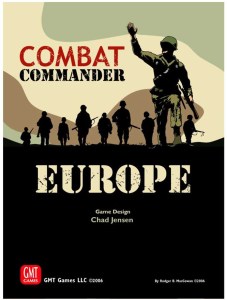
Review: Combat Commander – Europe

Looking for a classic hex and counter squad level game, I had heard great things about GMT’s Combat Commander series and eventually was able to snatch up the first release after a recent reprint. Combat Commander: Europe (CCE) is a two player WW2 infantry game. This offers engagements both from the eastern and western European front, with units from Germany, USA, and Russia included in the box. It’s a squad level game. You won’t find rules for tanks of vehicles. There are some rules for offboard artillery but most action depicted will be small arms supplemented with MMGs, mortars, field guns and the like.

The game offers 12 scenarios along with rules to generate random engagements. As mentioned, this is presented as a classic hex and counter game. Lots of double sided cardboard counters and hex maps representing various rural terrain (with an occasional group of farmhouses thrown in) will be what you get in the box.

It’s an IGOUGO game with alternating turns. Players will try to hold specific points on the map for victory points. The value of the locations for some will be revealed at the beginning of the game, while others will have their value secret, known only to your opponent. In addition players earn victory points for eliminating units. If a player finds they’ve lost their entire force, they lose the game regardless of the captured objectives.

Another means of earning points is to exit units off the opponent’s edge of the map. Eventually those units recycle on as fresh reserves, but they can award a fair amount of victory points getting them off the board. However you can’t guarantee exactly when you will get reinforcements, so it can be a gamble (but can really pay off).

A critical bit about the game is the tracking of game turns. Different conditions can cause time to advance in the game. Each situation where time advances, it moves up a record track. When it reaches the scenario threshold, a player will roll randomly and compare the result to the current time track’s value. If the roll is above the time track value, the game continues until the time marker moves again (and another roll is made). Otherwise the game ends immediately. This random game end condition means players have to do as much as they can within the limited time allotted.

A key element that stands out for CCE from other wargames of this type is that actions and their resolutions are card driven. A player will have a set hand size (depending on whether they are attacking or defending) and will be only able to play a few cards from their hand each turn. The cards played represent command orders given to units. You can only move or fire a unit if you play a matching card order. Further, each unit can only be activated once per turn. A notable exception are leaders as they can activate other units within their command range (usually 1 or 2 hexes). You begin to see that leaders are the backbone of your platoon allowing for effective execution of orders.

After playing a specified number of cards, players may discard additional cards and then draw up to their maximum hand size, ending their turn. Individual cards have 4 simultaneous functions associated with them. They represent orders given during your turn and also as actions which can be played during either players’ turn. Cards also represent random events, and can serve as die results too. Every card has the results from two six-sided dice, and each deck represents roughly twice the entire possible outcomes of rolling 2 dice (ex. there is a 1 in 36 chance of rolling two ones, so in the deck at most you’ll have two double 1 dice results). This allows a player to figure out dice probabilities up to a point.
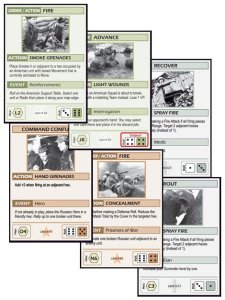
As mentioned you are limited in choices during your turn based on the orders in your hand. Actions are a little more flexible. A fair number of actions represent bonuses to movement, attacks, or defense, but some also allow firing opportunities. So yes, it’s IGOUGO but there is a chance for your opponent to interrupt your move order with an opportunity fire action, essentially simulating an ambush.

Mixed in with the 2D6 results are special events. These temporarily halt the resolution of an action and introduce some random event. You might have a weapon jam, or a unit get pinned down by a sniper, or a random hex might be engulfed in a fiery blaze. Fortunately they don’t chain event after event, however a decent number of cards in your deck will initiate them. So you can expect the unexpected playing and your plans might get a bit of fortune, but likely get a huge monkey wrench thrown into the works, as you execute orders.

Movement is done using a point system with each unit having a listed number of movement points. Equipment like MMGs or mortars are attached to units and typically hinder the total movement of a squad, while leaders will add to a unit’s movement. Various terrain will hinder movement costing a certain number of points per hex.

Firing is fairly simple to resolve. Line of sight is determined by terrain features passed through when lining up center hex points (which are well represented on the maps). Some terrain will reduce the total firepower of an attack while others block line of sight completely. A player can order individual units to fire, or use officers to select one unit as the base firepower of an attack, and then add one point of firepower per additional unit firing in the group. Eligible units for this group fire are those within the command range of leaders. Additionally leaders can add to the firepower of units within their hex, including adding to attack range.

To counter the effects of fire, the target has a base morale (usually ranging from 7-9) that can be increased if in cover. Each player draws a card to represent their 2D6 dice roll adding to their firepower or morale totals, respectively. If the target beats the attacker’s firepower result they are in good order. If the attacker’s firepower is greater than the defender’s morale total, the target breaks. On a tie the target is suppressed gaining a penalty to movement, firepower, range, and morale (or they break if the target unit was moving). If a broken unit gets another break result, they are eliminated. Simple.

Assaults are even easier to resolve. Units draw a card (i.e. ‘roll’ 2D6) and add their firepower. Whoever has the highest total wins with the other side is eliminated. On ties both sides are eliminated. Units have a chance to recover from being broken using a Rally order. However the enemy can also force breaking units to retreat with a Rout order themselves.

This challenge of deciding what cards to play and which ones to hold onto for future rounds makes the game. Do you discard most of your cards in hopes to get an order you need? Or do you hold onto actions to take during your opponent’s turn? Some orders like a Rout card can swing the tide on later turns, but do you keep it in your hand or discard it to increase the odds of getting a more flexible order that can be of more immediate use? These are the hard choices and managing your hand to commit effective orders is a central part of the game.

Units are limited to 7 ‘figures’ per hex. The unit counters are designated as single figure leaders, 2 man teams (which is really a 3-5 man fire team), or 4 figures representing a 10 man squad. This low number means you need to judiciously deploy and execute orders, and also emphasises the importance of your leaders. You can’t have huge stacks of units in a single hex and need to spread them out. However in order to effectively fire and maneuver them, you need oversight and leadership from nearby officers.

It can take some mental gymnastics to grok the idea of using cards for everything, including the ‘rolling of dice’ but once you grasp the concept you begin to appreciate the mechanic. Every draw of the card opens up a chance for random events, adding more havoc and obstacles to tackle. Actions representing flexible orders that can be played during your opponent’s turn are also a nice touch. This layers on the uncertainty of your turn. You can commit a large firegroup to suppress and potentially break a threatening unit, but your opponent might be able to counter with an action representing extra cover they have in their position. You might think you’ll be able to rapidly move up several units, only to find your opponent is able to play multiple opportunity fire orders which will break your units as they advance.

Another aspect of using a deck of cards is they serve as a marker for advancing time. When a player exhausts their deck, they reshuffle their discard pile and make a new draw deck. However this advances the time track, bringing the game closer to an end. There are also special event cards that initiate this reshuffle and time advancement. This small game element adds so much to the game.

Players will have a general idea of the turns expected in a game based on the amount of cards needed to go through their deck (especially if the Time! event card was already played for an order or action). But as the game progresses, this becomes more difficult to judge. Additionally while a player may want to frantically dig through cards to get the order they need, they are also rapidly increasing the chances of exhausting their deck, advancing the time track, and bringing the game closer to an end. They might want to work with cards in their hand, rather than trying to discard everything to draw a needed order (eventually forcing the game time to advance). It’s a great part of the game and ratchets up the pressure as turns progress.

CCE isn’t going to be everyone’s cup of tea. You won’t have a cut and dried tactical experience playing the game. Instead you’ll start out with a few turns of pretty well executed orders and then hit a snag. Maybe you have the initiative slip away, as you can’t find the needed order, so you spend turns discarding and drawing while your opponent maneuvers on the battlefield. You might get some random event that bogs down a critical assault, or a key MMG position is nullified due to a jam malfunction. Instead you find yourself scrambling to make the best decisions with limited resources. This results in a highly narrative experience, where you’ll see heroic moments and things go FUBAR. It’s wonderful.

The Good – The rulebook is well written with nice components. The random mission generator is a great addition allowing you to create some interesting battles and the scenarios offer a fair snapshot of different periods of WW2. There are a good number of expansions that provide new armies and scenarios in other theaters. The cards are of thick stock. The unit counters have simple profiles listing key information, and the indication of a broken unit is simply a flip of the counter to the opposite side. The oversized map hexes allow for some spreading of counters around during play rather than having tightly packed stacks of units. The art design for much of the cards are historical photographs and the color maps are simple depictions of terrain features. It won’t win any awards but they do dress up the game some.

The Bad – It’s a game with small counters. Some key elements (tracking turns, victory points, etc.) can be a little fiddly and woe is the person that accidentally knocks the table near the end of the game. This is small unit infantry action and if you wanted an opportunity to throw in some armor, you are out of luck with these rules. The random event mechanic can lead to the unfolding of odd moments and how they break up the resolution of orders can make play feel disjointed at times. The aspect of random events and issuing orders based on your hand might not click for everyone. If you are looking for tactical experience with predictable set pieces and resolutions based on narrow, strict probabilities, CCE is likely not for you.

The Verdict – Combat Commander: Europe is a solid wargame. If you want a WW2 tactical skirmish game, this is a fantastic choice. You have to make thoughtful choices and the card driven order system adds a lot of friction to play. It’s the constant pressure of having to adapt to blossoming difficult situations that makes CCE shine. I dare say if you wanted to experience a miniature skirmish game without all the painting, figures, and terrain, this would be a good substitute. I will say with certainty though if looking for a hex and counter game for small unit action, Combat Commander: Europe and other editions (notably CC: Pacific) are great buys and highly recommended.

NOTE: The rules are actually well written and play is straightforward. However it might be a little challenging getting through your first game. Harsh Rules has a tutorial video (along with a part 2) that walks through all the basic rules of the game and well worth checking out.
Frostgrave in Summer: The Living Museum

I should be calling this series Frostgrave in Winter now. It had been ages since our club was able to meet over the past few months but I finally managed to get a game in during January. I ended up going head to head with another Necromancer. I still was a little tepid to blow all my cash and kept a warband of thugs, archers, an infantry man, and a man-at-arms going. With my finances a little low, I felt it difficult to justify dumping it into heavy hitters. My opponent had a pretty fat treasury and fielded a barbarian, a few trackers, infantrymen, and a couple of thugs to round out his warband. I was pretty outclassed, and his figures were better painted to boot!

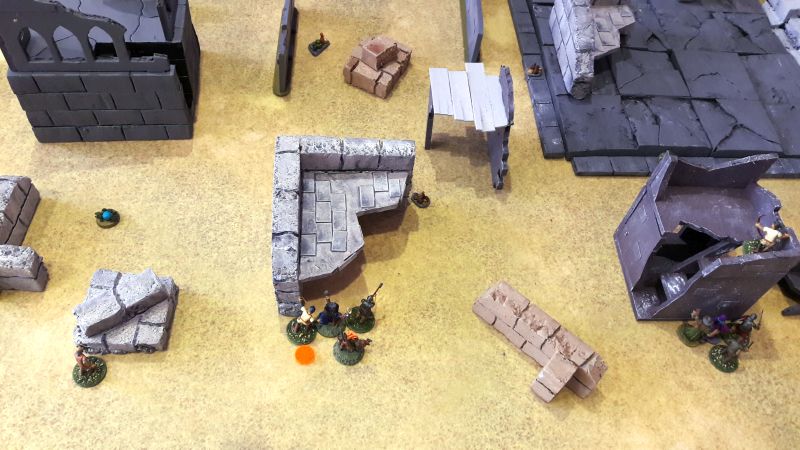
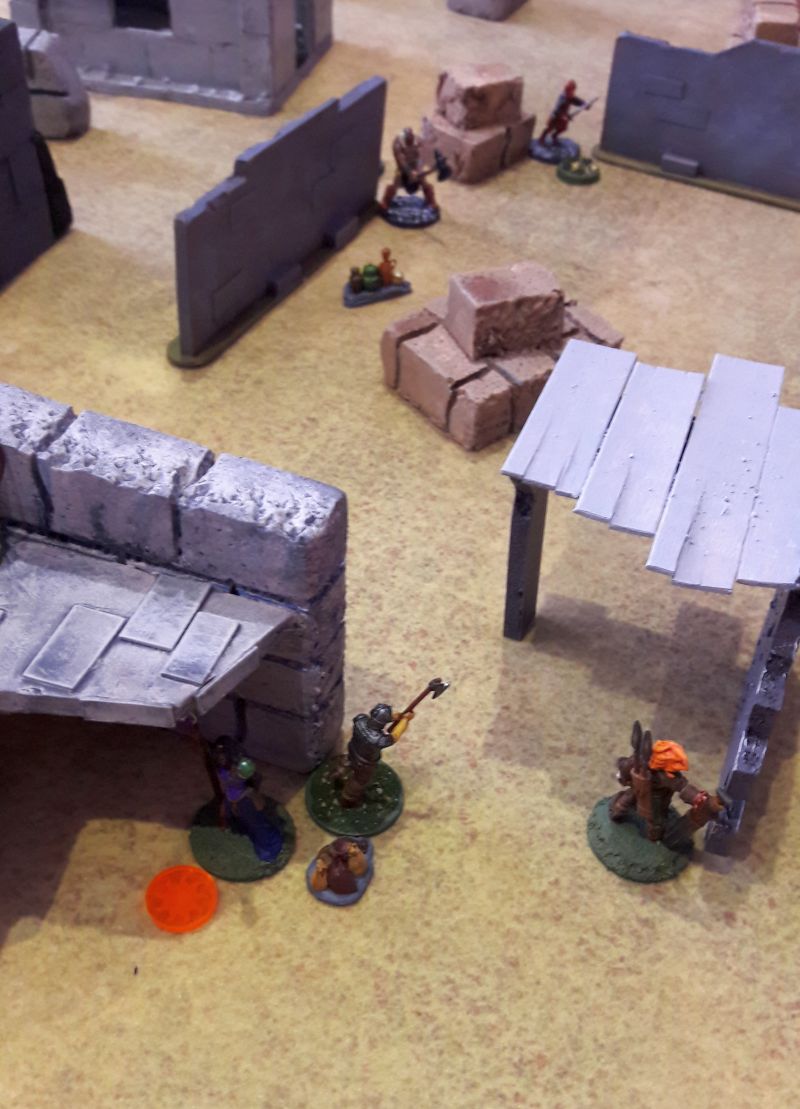
We had a pretty compact setup in the center of the table. Like the complex temple, treasure taken would randomly activate a statue creating a living construct. Surely we’d have a big scrum in the middle. I still didn’t want to risk a lucky shot with his trackers so I deployed in cover, broken up into two main forces. I had by archers and a thief stick at the periphery though. I lucked out and was able to successfully cast Reveal Secrets meaning I’d get one extra treasure close to my deployment area.


Fortunately I got the initiative and decided to move up and try for a spell. I successfully cast Fog which provided me a little cover from his ranged attackers and his apprentice. Those necromancers and their pesky Bone Dart was not a fun proposition to leave long avenues of open sight to my casters. I also successfully managed to cast Push from my apprentice and get an infantryman way forward in position near the statues.


My opponent moved in and slipped through the Fog, while his necromancer decided to throw a wrench into my advance and drop an Elemental Wall between our warbands. He began to scoop up treasure and unfortunately got the brunt of the medium constructs.

On the following turn I cast Blinding Light on his barbarian, making it susceptible to any nearby constructs. My opponent countered this getting his warband into the thick of the fight, tangling up the living statues before they could activate and cut down his barbarian. Your fight stat goes to zero and you cannot initiate any attacks making the barbarian an especially fragile target.

Honestly for the early part of the game, things were looking up for me. I got the initiative and managed to get off most of my spells, hitting his apprentice and his wizard once each with Blinding Light. They shook it off but losing the chance to cast LOS spells hurt. He flubbed a few spells and pumped up his casting rolls a few times too, meaning his necromancer was nearly at half health mid-game.

But things started to slip away for me. Most of the wandering creatures saw my warband as the more tasty morsels. I had to use my archers to dispatch skeletons and my apprentice to blind a minor demon that came onto the table. This alleviated a lot of pressure on my opponent that was able to take out several constructs, throw up another Elemental Wall, and start moving treasure off the board,


I turned around and Dispelled his walls and further decided to go all in with my warband, trying to take out his wizard. Sending in an infantry man and a man-at-arms, I figured round after round of attacks I’d eventually get a lucky blow in. Even if I could not kill him outright, I thought I’d be able to at least wound him. I was terribly mistaken. His necromancer pretty much aced all his fighting rolls and dispatched my followers. So much for my cunning plan.

That was enough to spook him a bit though, especially as my archers were essentially free to fire. I had lucked out on my Blinding Light casting roll for the minor demon and it wasn’t able to shake off the effects of the spell for several turns. My opponent was able to cast Leap on a few of his followers. Even a few peppered shots from my archers went wide and he was able to get his forces off the table. Meanwhile, a lone construct managed to take out a quarter of my warband, including my apprentice!

I was able to only get two treasures off. I got a good use of a Transpose spell and my thief scooped up an early acquisition that was found using Reveal Secrets. My opponent got 3 treasures to my two. I braced myself for the worst with my apprentice, but it appeared that Marsha was able to make it back to base camp in one piece.


I did lose a thug and my man-at-arms was severely wounded. I came away with a couple of potions and a paltry sum of gold. I also only was able to sneak out 3 levels of XP compared to my opponent that got 4 levels. A big chunk of this disparity in XP was my warband suffering so many casualties. With my newfound levels I buffed up my fight and health stat, and decided to throw a point into Transpose. It’s still a tricky spell for me to cast but I’m hopeful to be able to land it more consistently in the future.

The expedition was not quite suffering a drubbing, but not a rousing success either. I was really hoping for a third treasure and I found that the inflexibility of Push is a poor substitute to Leap. My opponents are able to clean up the board using that mobility spell. Regardless I am solidly in last place for the league. With only two more games left, I need a miracle match to hope in even going up a rank.

New mini-expansion for Arkham Horror LCG announced

One slight complaint I had with the base campaign for the Arkham Horror LCG was that after a few playthroughs things were going to get repetitive. You’d have the same location cards, the same agenda and act cards, nothing really would change and repetition would creep in. This is alleviated some in the 2nd and 3rd scenarios as there are excess location cards, throwing a little variety into the layouts for those scenarios. I mentioned a small expansion that could add some additional location cards would be great to stretch out the replay of the core set. Seems folks at Fantasy Flight had the same idea.

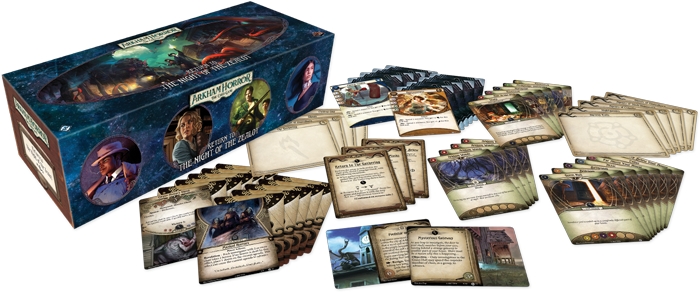
Return to Night of the Zealot is a new campaign that has just been announced. With roughly 60 cards, this mini-expansion supplements the original core set campaign, adding new agenda and location cards to provide a different experience. Additionally there are new monsters and encounter cards that ramp up the challenge. I’m happy to see this being explored for the core set. A small tweak like having additional location cards really opens up the replay potential for it.

In addition to the new scenario cards are new investigator cards. Most seems to be improved versions for those in the original box. Get a few XP and you can change out a couple of level 0 cards with better versions. On this point I am a little disappointed. It’s wonderful to have more investigator cards for the game, but I wish more were included to lessen the need for buying a 2nd core. Why not also include the full spread of neutral cards and a couple of key level 0 cards for every class? That could potentially allow 3 or 4 people to play and add a ton more value to this expansion.

It’s also alluded that there are challenges introduced into the game. Sort of some type of achievement which might offer additional rewards or player abilities. The details on that seem a bit murky, but might offer a fun side event to the main game. Lastly the packaging seems to allow for you to store all the core set encounter and scenario cards together inside this box, offering a better way to organize your cards. A nice touch to make the packaging more functional.

Despite my niggles, overall I am excited to see this. The jury is out, but I could see this as a solid ‘next step’ purchase for those wanting to get into the game a little more. I’m still working my way through the Dunwich Legacy expansion. Overall it’s great and the base expansion set adds a ton to the game, but I have a reservation with it.

The base expansion set only has 2 scenarios and essentially sets the stage for a full blown campaign. You really need to purchase all the mythos scenario packs to complete Dunwich Legacy. That is a huge buy in. Return of the Zealot offers additional play with just the core set and a smaller initial purchase. If you dig Arkham Horror but didn’t necessarily want to try out a long, extensive campaign, this product seems to be an ideal choice. Something to add to the core set experience, but not require you to purchase a ton of scenario packs to get an entire campaign.

We’ll see how it fares. Tad disappointed that more effort wasn’t made to expand the player count and open deck building options with this expansion. However I’m glad to see the campaign was revisited and some love given to it. Great to see cards added to offer a different play experience and stretch out the replay value of the core set.

EDIT: A small note. As of 2022, the expansions are changing to a new format of 2 products. One being the campaign cards, and the other being a full set of new investigator cards. The “Return to” expansions are more for squeezing more play out of the campaigns, by ramping up the difficulty, and variants of the original cards. If wanting to expand your card pool, the expansion campaigns are a great buy.


What’s next after the revised Netrunner core?

So you’ve picked up the new revised Netrunner core set and wondering what to get next. Or maybe you are itching to jump in and are thinking about making a big initial purchase. Where do you start expanding your card collection? What are some ideal buys to stretch out the value of your first purchases? I’ve got bit of advice.

First qualifier on this is that thankfully Netrunner is a LCG (Living Card Game). That means you don’t have to mess around with any collectable aspect. When you buy an expansion, all the cards will be there in an even distribution. The downside is that if you wanted to hunt down a specific card or two, you have to pretty much buy the entire expansion pack it comes with. Still, as there is no collection aspect you can expect sets and expansions to get reprinted. Rarity isn’t part of the card pool, so you can take your time getting what you want (a big caveat regarding rotation though…more on that later).

The second qualifier on this advice is that you’ll be wanting to dabble in tournaments. If you envision playing with the same small group in a relaxed atmosphere, you don’t need to get too many cards. Limitations like banned or restricted cards from the Most Wanted List or tournament formats like Cache Refresh won’t really impact your purchases. If you are considering playing tournaments however, it’s something to think about especially regarding buying data packs.

The third qualifier on this is that I’m assuming you want to limit your initial purchases. At best you are going for a slow trickle of acquiring cards. If you are a completionist and have to get everything then there’s nothing for you here. Just run off and buy everything starting with the first two data pack cycles. For the rest of you here’s a couple of tips…

Play the core set – You might have already played the hell out of the core set. In which case you can move along to the next points. But if you are holding the core set in your hands at a store right now and thinking about also picking up some other expansions, don’t. Just take that core set home with you and play.

Play each faction. At the very least play (and play against) each corporation. You want at least eight games going in. I would consider even trying different runner factions against each corp. There are some advantages doing this, and something you should strive for before picking up more cards.

I would try the tutorial decks maybe once, but understand that the decks they use are illegal regarding influence and regular deck construction. In fact I’m sort of baffled why they did this. Instead go by the old core standard of picking one faction and all the neutral cards for them, shuffle the cards, and just play. Hold off taking a stab at deck building quite yet.

You will learn a lot. You will get an idea how each faction plays, including advantages and shortcomings. Another plus is by just using decks of a single faction and neutral cards, it will significantly lower the learning curve. Eventually the neutral cards will be familiar, so you don’t get overwhelmed with lots of new information as you’re playing more games.

Once you have familiarity with the card pool, you can start swapping out cards you don’t like for others keeping within the influence limitations and… boom. You are now deck building. It’s not that intimidating. Yes, after a few games making your own decks, you’ll get the hankering to buy more cards but at least you’re doing it with a firm knowledge foundation of the core set.

Do you need a second core? – Eventually you might want to. One gripe I have with the revised core is there are a lot of single card copies compared to the first edition. Still you have a group of cards that are much more useful with less duds than in the original core set. If the Netrunner bug bites deep and you find yourself super serious about competitive deck building, you likely want to consider getting a second core soonish. However you can also work with one core, buying other expansions, and still enjoy a deep deck building experience. My advice is to hold off on a second core and focus on purchases for expansions first, then revisit the idea of a second (or third) core later.

The deluxe expansions – Also known as the big box expansions, most of these focus on a single corp and runner faction. Once you’ve played a lot, you will likely figure out the runner and corp factions you like. Picking up a box expansion that has cards for factions you enjoy playing is a solid choice.

One snag to this might be the Data and Destiny expansion. Be mindful it only has NBN corp cards. The runner cards in this expansion are 3 ‘mini-factions.’ They are interesting and can certainly open up more play options for you, but I’d consider them for more advanced players and trickier deck construction.

A new expansion is in the works, Reign and Reverie. This 58 unique card, big box expansion is likely the best purchase for growing your collection. It touches on all the factions for Netrunner. It has a new identity for all, including consoles for each runner faction (especially nice for anarch). More importantly, it adds a new agenda for all the corp factions. While corps can dabble in other factions for ice, assets, and operations, they have limited choices regarding agendas. They have to stick in faction or use neutral ones and having an additional choice makes this a strong buy. The first data pack in the Genesis cycle did the same. Clearly this is designed from the ground up to compliment the core set. Consider this strongly as your next collection buy.

Lumped in with these big box sets is a unique campaign expansion, Terminal Directive. Honestly for the value I would advise this to be near the top of your list (right after Reign and Reverie). You get 4 new IDs and a ton of good cards for 4 factions (rather than just focusing on a single corp and runner like the other deluxe expansions). As an aside, there is also an included legacy campaign game. The legacy campaign is lackluster, but as an expansion it’s a solid buy. I might only make Terminal Directive a fourth purchase if you are a diehard NBN, Jinteki, or Anarch player. Regardless, you certainly want this high up on your buy list.

Data Packs – Netrunner releases roughly every month small 60 card expansion packs, that have 3 copies of each card (so you’re getting about 20 unique cards per pack). These ‘data packs’ are released in a set of 6 and are considered an expansion cycle. Each cycle commonly has a theme among the cards, or introduces a new play concept. There are currently 6 full cycles that have been released, with a 7th on the way.

First point to be aware of is that rotation is in the game now. A while back FFG decided that it would eventually retire expansion cycles. Note however the deluxe, big-box expansions like Reign and Reverie are exempt from rotation. These cards will always be part of the pool.

Mind you this is only for players in the competitive scene. If you play with your pals around the kitchen table, this won’t affect you. However as some expansion cycles have rotated out, I don’t expect those old cycles to go back into print. It’s interesting to note that while some cards are being retired, other cards from the first two expansion cycles hit with rotation are now in the core set. So instead of going hog wild for getting all the data packs, consider planning out your purchases.

Start with Kitara – This is the newest expansion cycle for Netrunner. Not everything is out for it yet and because of this you can slowly expand your collection of cards at an easy pace. Another key point is Kitara is the first expansion cycle released with the new core set in mind. I highly suspect the cards in this cycle will complement the core set well. Previous cycles were tied to older core set cards and some of those are removed from the game entirely now. I’d put money on most of the cards in this upcoming expansion having a high amount of synergy with the revised core.

This cycle will also be valid for a long time. As it’s the newest cycle it won’t rotate out so soon. By 2019 the Lunar and Sansan cycle will be on the chopping block. If you wanted to squeeze as much money as you can out of your purchase, I’d consider jumping in with Kitara and maybe go back as far as the Red Sands cycle over delving heavily into older cycles. There are some exceptions though.

Data packs with specific cards – Going this route will be highly dependent on you wanting to play particular deck types. Scorched Earth was a mainstay for kill decks but is no longer in the game. Escalation released a similar heavy hitting meat damage card, Boom! Working a kill deck you might want to pick up that data pack. If you are super keen on playing specific deck types, just buying particular expansion packs can be done. I’d tread this road carefully though. Use online resources like Netrunner DB to pick apart decks you like and track down needed data packs.

2017 Championship Decks While not released yet, you can expect that by Q2/3 of 2018 these decks will be available. These are noteworthy as they are the first champion decks that are compatible with the revised core. You won’t find any cards that are currently out of the game (either due to rotation or being removed from the core set). As another small bonus, if you want to have multiple playable decks on hand these commonly have a solid choices for economy cards, breakers, ice, etc. that they’ll have staple cards used in just about every deck. So it might be possible to have a couple of constructed decks handy and not have to constantly take them apart just for a few cards by purchasing these.

These would be my general suggestions for buying into Netrunner. Focus on a few of the big box expansions first, particularly Reign and Reverie. Pick and choose the smaller data pack expansions, and consider holding off and buying into the newest data pack cycle first. Yes, you can jump in and buy everything. But I’d buy slowly, learning much of the cards as you go, rather than drowning in a sea of cards only using a fraction for your constructed decks.

Arkham Horror Card Game box insert from Go7 Gaming

So a while back I posted a custom box insert I did for the Arkham Horror card game. I sort of have fallen in love a bit more since I first reviewed it, mostly due to the complete release of the Dunwich Legacy expansion. Sure enough once more cards were available and allowed for a deeper deck building experience, the game got some legs in replayability.

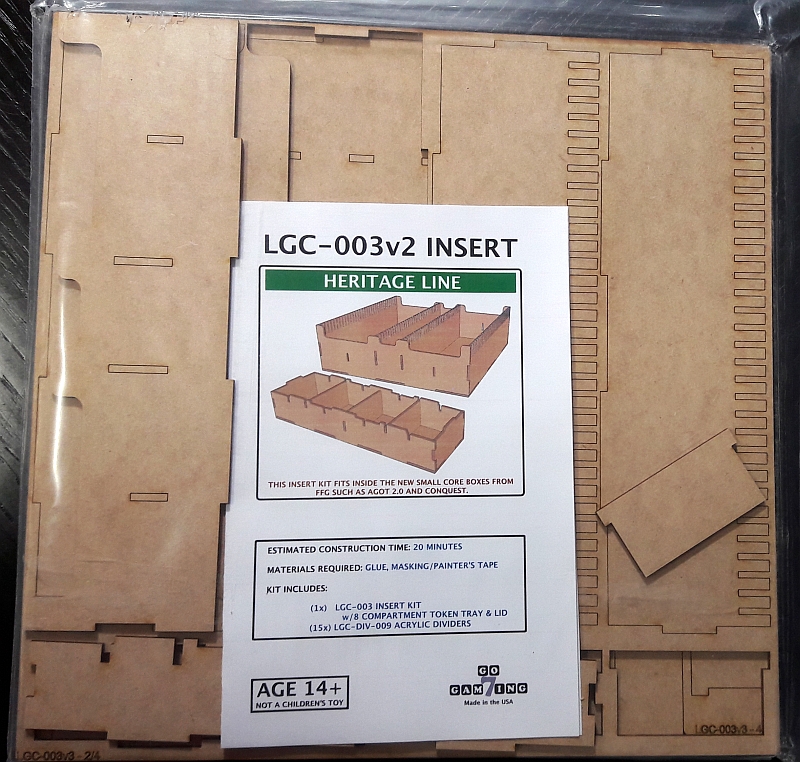
I also bit the bullet and picked up a 2nd core. My game group could regularly seat four players. While I found a single core and the Dunwich Legacy cards allowed us to craft decks for 3 players (with a little arm twisting), 4 players consistently was a little difficult. I also discovered with all the expansions and additional copies of the investigator cards, my little foam board box insert wasn’t going to cut it. Fortunately Go7 Gaming had just the product for me. They offer a box insert and dividers for the Arkham Horror LCG which is a great little card organizer.

I fell in love with their inserts, especially the one for Netrunner’s Terminal Directive expansion. That box insert was a snap to assemble and was cleverly designed. The question was would their Arkham Horror insert hold up to snuff?

Like all of their inserts the material is HDF board which is laser cut. The pieces pretty much just pop out of the mounting boards. Mind though that the longer sections that had teeth for the card dividers took a little more care to remove. Some laser cut products will have a lot of soot generated during the cutting process as the material is burned. I found even with areas that had intricate cuts, no excessive scorching or ash was on my hands as I handled the cut sections. But for extra peace of mind I would give the edges a quick run over with a damp cloth before assembly.

The instructions were clear and easy to follow. Take your time though. The box is well designed and pretty intuitive to assemble, however there are specific pieces that form the outside frame of the organizer and you can potentially muck up your insert assembling them improperly.

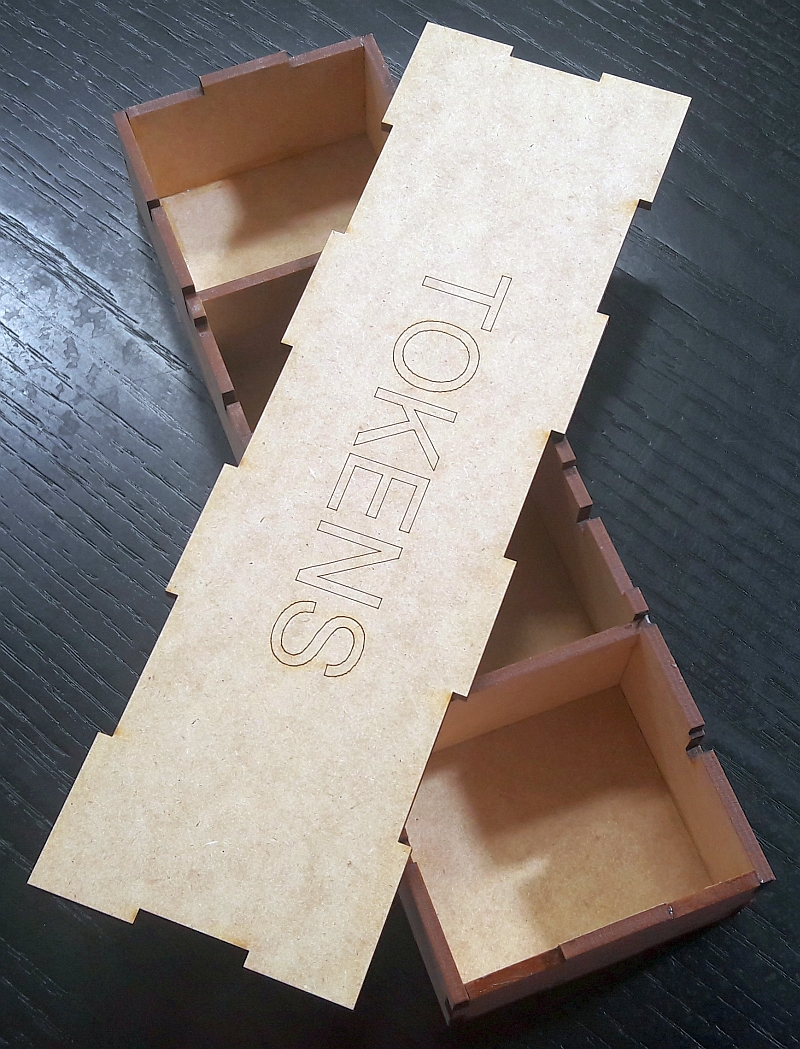
In addition to the box insert frame for the cards is an internal section and organizer for tokens. It forms a separate box that can be removed and has several individual dividers to customize it. The individual compartments are pretty spacious and I was able to easily store 2 full sets of player tokens from the core boxes. Sadly there wasn’t enough room to also keep the chaos tokens though. However if using a card divider, you could make an additional compartment to create one.

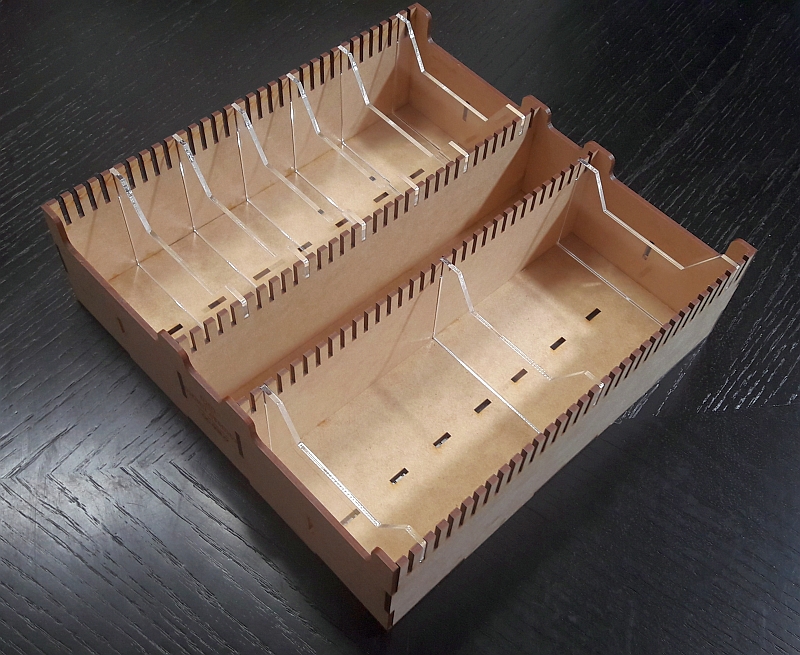
Speaking of the card dividers, these are a departure some in the material used for the box components. Rather than HDF board they are made of a clear acrylic. They are cut well and fit easily into the organizer frame without the need of any glue. All the while they sit securely in place without any loose play or rattling. One complaint though is it’s a bit of a pain to peel off the paper covering the individual dividers (but that might be due to short fingernails over anything else).

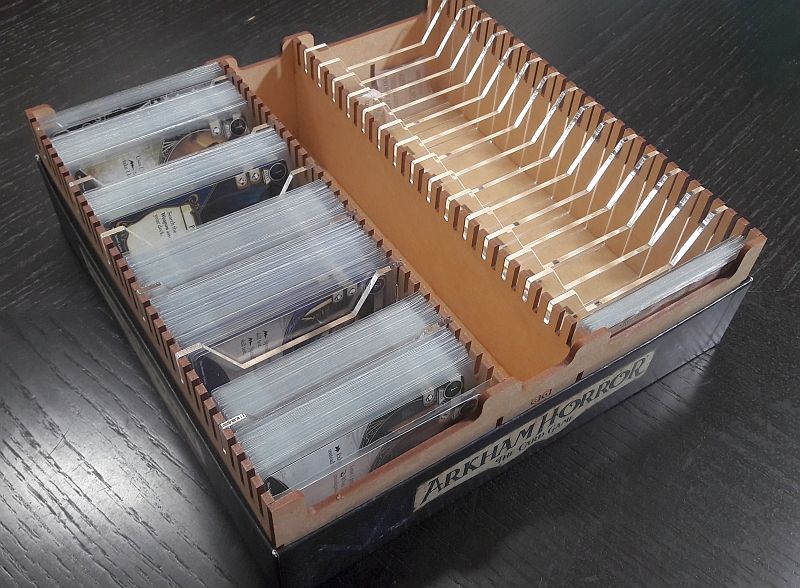
With the individual dividers assembled it was easy to add and remove cards. I found with penny sleeves I could comfortably hold 7 cards per individual section if the dividers were slotted back to back. Yet with more cards it was a little hard to remove and put back in. The dividers are also an interesting design as it creates a larger gap in the center of the box for space to hold the rule books, with an elevated side at the outer edge of the organizer.

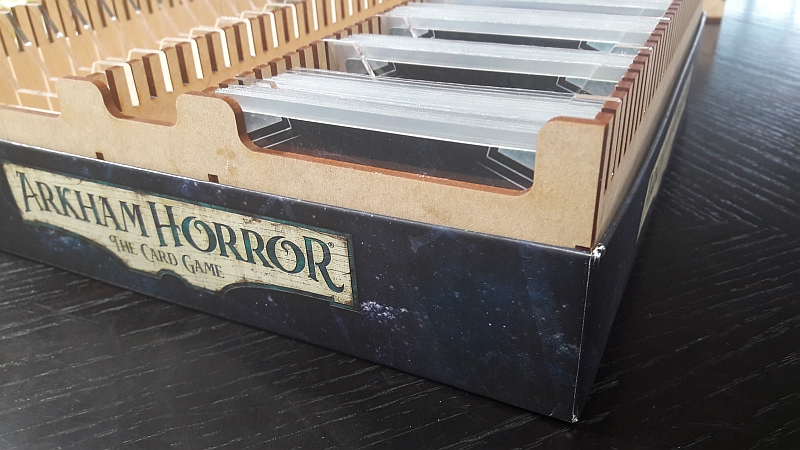
The box insert sits a little higher than the base of the box, but the cover still fits snugly. All in all it is a great card organizer with plenty of small features to ensure your cards stay put, even if the box is tilted on its side. I even understand there are optional pieces that can be added to store the miniature investigator cards if needed. It’s a great product and given that you need so many separated sets of encounter cards, something to consider using if looking for storage options.

Board game stores in Germany: Brave New World

I do a bit of travel with work. I’m considering regularly making it a go to see different games stores in countries I visit. As for a recent trip to Cologne in Germany, I happened to track down Brave New World as a happy accident. It is firmly a board game store but also caters to the entire analog gaming hobby as a whole, including a nod towards geek culture in the manner of collectibles.

They carry a smattering of different miniature war games. Most notably Flames of War, Warmachine, and Bolt Action. However a few other plastic boxed sets for ancients and black powder systems can be found on their shelves. They also carry Reaper Bones Miniatures and provide a fair amount of miniature accessories like custom bases. This isn’t quite the miniature wargamers stop off, but they carry a decent number of models and you’d likely find bread and butter units here.

One thing as a miniature wargamer you’d definitely appreciate is the paint selection. They have full stocked racks of Vallejo and Reaper paints. Certainly an ideal place to pick up key colors and hues for modelling. It doesn’t stop there as they also have a wide variety of Osprey books for painting and technical reference. If you are a miniature wargamer, don’t be put off by the Magic and D&D at the store front, it’s certainly worth a visit.

The store also has a well stocked selection of RPGs. They carry plenty of Pathfinder books, as well as a selection from smaller publishers. Lots of other RPG accessories like dice, minis, and battle mats can be found. Interestingly the variety of WotC products are a little slim but all the core books (both in English and German) can be found aplenty.

This is all an aside from what the store really caters to, the board gamer. The selection is immense. Collectable and LCG card games, party games, euro and family games, and I’d be remiss to mention the variety of classic (and new) hex and counter games. I snagged a copy of GMT’s Combat Commander: Mediterranean and had to stifle the urge to pick up a few more. They are also a distributor of Victory Point Games and it was interesting to see their bagged titles having some shelf space. Commonly their games are something you can pick up only online and it was nice have something you could actually hold and browse through.

The full stock of board games is among several shelves that are densely packed, organized by title and a broad classification. You’ll find card games set in their own sections as with a few titles like X-Wing Miniatures, Runewars, Zombicide, and Arcadia Quest. I don’t think I can accurately describe the amount and diversity of games here. It’s staggering with likely hundreds of titles spread among the cult of the new, old classics, and a choice number of limited print run games. Learning the store has been open for roughly 15 years, you quickly can understand how they managed to get such an immense number of games.

Be ready to spend a bit of time when you arrive. The store is split between two levels and a few side rooms. There are a couple of tables set up for in store gaming. While I was there on a late Saturday afternoon a group of people were having an enjoyable time playing party games. The staff were friendly and patiently handled my questions from a typical American that spoke only English. If you are into board games and a fan of gaming in general, Brave New World is certainly worth checking out while in Cologne. I’ll give a special nod towards the hex and counter war gamer. You’ll find some treasures and modern titles among those offered at the store.

Terminal Directive box insert from Go7 Gaming

While I found the legacy game in Terminal Directive sort of ‘blah’ I do feel it’s a great expansion to pick up. If anything just being a great value for your dollar for the number of factions it supports, adding a lot of quality cards to your pool. However a running joke from folks is the size of the box. It’s huge and the stuff inside takes up a miniscule amount of space.

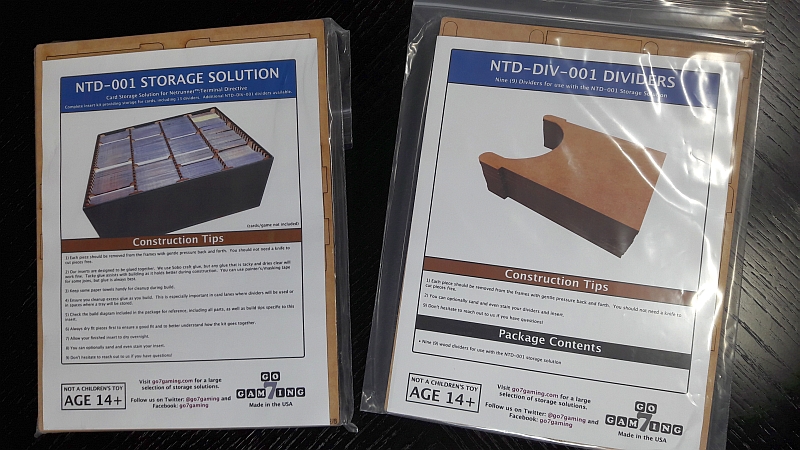
Another thing looming for Netrunner is that rotation has finally hit, and a new core set will be out in a few months. So I wanted to think about making an insert for my box keeping all my playable cards in one place, with rotated cards being stored in my old core set box. I was all set to make something out of foam board and then I ran across custom box insert for Terminal Directive from Go7 Gaming. They offer organizers that are laser cut into HDF board. The product itself is a series of cut sheets in a ziplock bag, with a nice diagram instruction sheet for assembly. I also picked up a set of additional dividers.

They are cut exceedingly well and for the most part pop out with minimal force (almost with just a tap of the finger). However I will say some extra care has to be taken when removing the larger sections for the card organizer pieces. These took a little more effort and care to separate but mostly due to the fine edge cuts for all the individual teeth of the organizer section. The edges are cut with minimal scorching and practically no soot. I’d still give each edge a one over with a damp towel to make sure, but I didn’t notice any black smudges on my fingers handling the pieces.


Assembly was easy. The pieces fit together tightly and held in place, even without any glue. Just a dab of white glue on some key joints and I was able to assemble it in no time. However be sure to be patient and let the organizer sit overnight before throwing in your cards. Take care to read the instructions also. They are easy to follow but the pieces are similar in shape and the organizer certainly has a specific order for assembly. Best to make sure most of the pieces stay in their board mounts, and separate only the ones you want to work with instead of punching out all of the pieces at once.

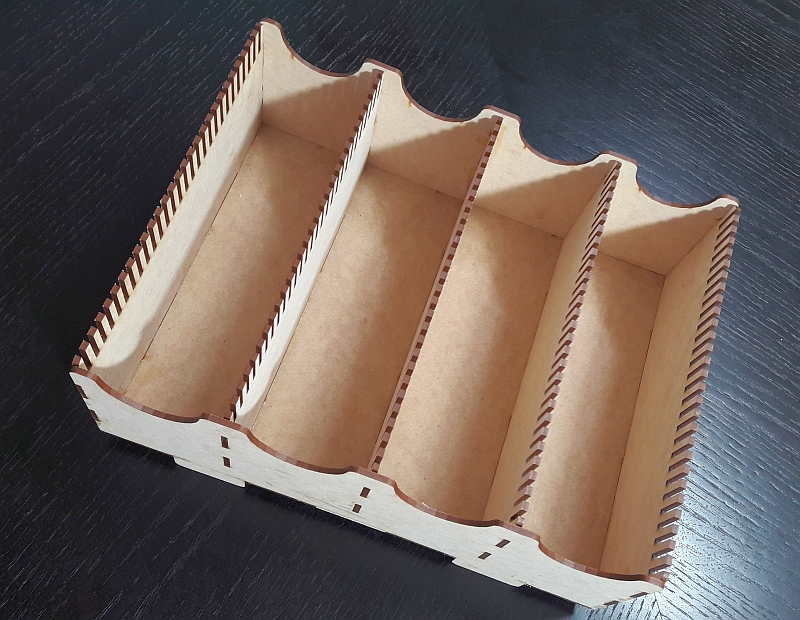
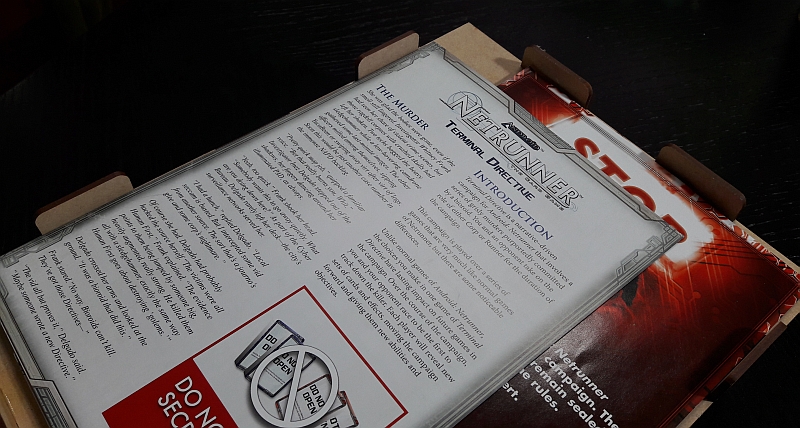
The divider offers four main sections, with individual divider pieces. The individual dividers don’t require any glue and hold in place fairly snugly. The organizer also sits elevated in the box to provide some storage space for the campaign rules. A nice touch for allowing you to keep everything in the box and still allow easy access to cards.

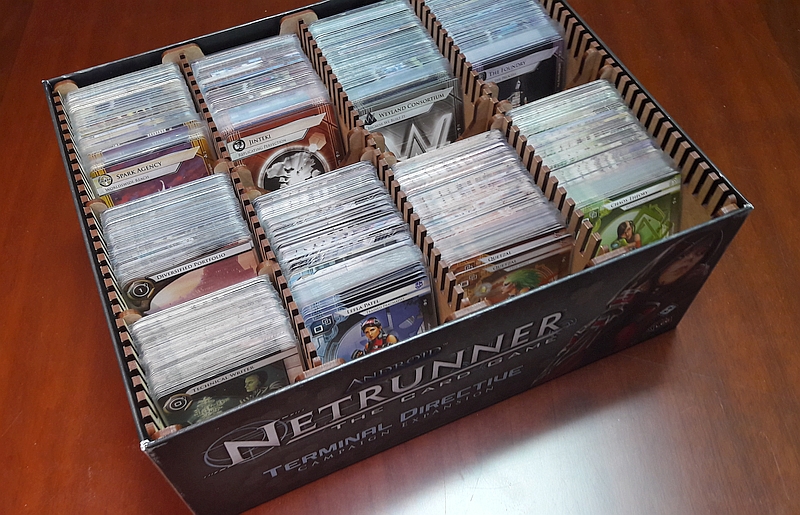
I have my cards in Pro-fit sleeves. The capacity for the organizer is very generous. I was able to keep all my runner and corp cards from a single core, the big box expansions, and a few additional copies from draft decks all together. The only downside is the material adds some heft to the box. Other than that for about $20 you get a nice little card organizer. Yes, you could build your own out of foamboard. However the ease of assembly, time saved on design and construction, and an end product that is very sturdy material makes the Terminal Directive Go7 Gaming box insert a wonderful buy.

Travel in Chult for 5E

Picked up Tomb of Annihilation and eager to get my group into the adventure. It really looks fun. One thing stood out for me though was that a decent chunk of the game is a hex crawl. I wanted to dabble some in exploration of the island, but didn’t want the hex-by-hex movement the book suggested. Instead I wanted to farm out the overland travel system I used for Savage Worlds.

It’s an abstract system using milestones and recording provision levels using markers. The journey to a location is divided up into milestones, where each milestone reduces the levels of supplies one by one. If players reach a milestone and are out of provisions they suffer fatigue.

Random encounters and challenges are based on drawing cards. If a face card is drawn, something happens with the suit dictating what event occurs. They can range from getting lost, losing supplies, to even encounters with creatures. I tweaked it some to make it more friendly for 5E D&D.

Nearly all of the obstacles and challenges players will face require group checks. One pickle of course, especially dealing with rations, is there are magical items and spells that would likely counter any effects of obstacles during travel. To take these spells and equipment into account, players get advantage on checks that they make if they use (or have access to) such abilities.

I stumbled across a player friendly map version of a Chult which I like far more than the default blank hex map in the module. In addition for exploring the jungles of Chult, I had some additional rules…

Speed of Travel: For each milestone players should determine their speed. Normal speeds will cover 10 miles per day (a single hex), while traveling by canoe allow for 20 miles per day (2 hexes). The DM should determine the total distance traveled for a single milestone of the trip and decide what likely terrain types will be common for potential events during the trip.

If traveling at a slow pace, roll a d12. A roll of 12 results in the group being able to make up the distance traveled as if they were moving at a normal pace. Otherwise the pace is much slower and the total distance expected to travel for the milestone is halved. There is a bonus of +4 to any checks however as the slow pace allows the group to be better prepared to overcome any challenges.

If travelling at a fast pace the party will travel 1 and ½ times the total distance they normally would cover traveling at a normal pace to reach a milestone. Any checks made during the trip are at a disadvantage. Note this means traveling at a fast pace will cancel any advantage players get due to spells, abilities, magic items, or special equipment for ability checks.

Guides: The guides are a fairly critical part of the initial adventure and I wanted to have them serve some importance here. If a Hearts suit is drawn as an event, the guide makes a difficult Wisdom check (DC 15). If successful they can allow up to two players to make their Wisdom check with advantage to avoid getting lost.

Gear and Equipment: Some equipment like rain catchers can allow players to supplement the provisions they carry. These items will allow players to have advantage on certain checks.

Terrain types: The jungles of Chult are exceedingly difficult to travel and navigate. The region is hot and humid, making one consume far more water than journeys through other lands. The high canopy of trees and foliage make conditions of the jungle almost similar to that of the Underdark. Combined with the dark jungles is hilly terrain crisscrossed with narrow streams, and lack of unique landmarks and direct sunlight make orienteering difficult. Additionally, some regions covered with swampy water attract even more aggressive wildlife. These conditions and lands alter the resolution of events seen in typical overland travel. The normal rules for travel are used however some events may have a greater chance of occurring.

Undead Territory: Areas of lesser and greater Undead Territory are more likely to have a chance to encounter undead. A draw of Spades (2-Ace) indicates that the players have stumbled into an encounter. This is regardless of the terrain type.

Jungle: Deep jungle terrain not broken up by river or coastline is hard to navigate and the rough ground and heat make it more likely provisions will be consumed faster. The jungle also is a refuge for all manners of creatures. A draw of Clubs (8-Ace) means that players may lose one rank of provisions. A draw of Hearts (5-Ace) indicates that the group might become lost and add another milestone to their journey. A draw of Spades (8-Ace) results in a random encounter for the party.

Swamp: The additional water in this terrain makes it more hospitable to wildlife and the fetid marches can be a source for disease. A draw of Spades (5-Ace) results in a random encounter for the party. A draw of Clubs (5-Ace) means that players may lose one rank of provisions.

An example of a travel milestone– A group decides to head south through the jungle of Chult to explore unknown regions and then return to Port Nyanzaru. The DM decides this will take a total of 4 milestones. Two to travel a certain distance out into unexplored land and 2 milestones returning to civilization. They are prepared and have a full complement of rations and water, so they are at the Stocked provision rank and also are taking canoes with them. The DM decides that for the first milestone the group will travel for 7 days, and the group tells the DM they will attempt this first leg of the journey at a normal pace. Note if the players were trying to reach a specific location, the DM would still say the trip would require 4 milestones (2 to reach the destination and 2 to return to Port Nyanzaru), but the actual number of days per milestone could be greater, or less, depending on the map distance.

Looking over the map, the party decides plots a course that will try to take advantage of a nearby river. The group will try to travel 4 hexes (40 miles) in 4 days through the jungle. On the final 3 days they can cover another 6 hexes (60 miles) by canoe rapidly navigating through a great river. This might change however depending on what events transpire during the first part of the journey. The DM expects that at the end of the first milestone the party will have traveled 10 hexes at most.

The DM decides for this initial milestone the party will have three potential challenges. Two will certainly occur when travelling in the jungle, while the third might take place as the group is on the river (or still occur in the jungle depending on what happens). A player draws one card getting a 2 of Spades indicating no major event happens during the first leg of the trip.

A second card is drawn indicating a 7 of Hearts. The group might possibly become lost. They have a guide and a Wisdom check (DC 15) is made for the NPC which fails. This means even the guide is turned around and cannot help the players get through the thick jungle (not allowing the players to make any checks at advantage). The DM decides that a medium DC Wisdom (Survival) is appropriate. One player is a Ranger with the Forest as their favored terrain, and another has a magical compass. The DM allows both of these players to make ability checks with advantage.

Despite this help, most of the party fails their Wisdom (Survival) checks. The entire journey will take another milestone. The DM decides that the players still keep on track direction-wise, but get turned around some or make a bad choice trying to go a certain path leading to an impassable area, adding time to the overall trip. Instead of taking 4 days to travel 40 miles, the party takes 6 days to travel the same distance.

The last check for this milestone the DM decides will be on the river for one additional day of travel. The players have made it through the jungle and are now seeing what event might unfold as they travel by canoe. An ace of Clubs is drawn. Players make another medium DC Wisdom (Survival) group check to determine if they manage to utilize their rations effectively. Again most of the group fails their checks. The DM describes a large portion of food and fresh water is lost as a canoe capsizes. The group loses one rank of provisions and are now at a High rank.

At the end of the first milestone, provisions decrease another rank with the party supplies at a Sufficient rank. At the end of 7 days, the group has traveled 6 hexes. Forty miles through jungle and another 20 miles along the river. As time was lost and another milestone added to the journey, they didn’t travel as far as expected. This is a little open ended as they are not trying to reach a specific destination but rather poke around in unexplored territory. However now the group has a difficult choice.

They can press further, but due to early difficulty navigating through the jungles they’ve severely cut down the territory they can explore. If they were trying to reach a specific location they would have an additional milestone to their journey. They could cut their losses and spend another milestone to return back to Port Nyanzaru, or push on and see if they can get some luck. If they choose to travel further, they can hope when low on provisions they are able to forage enough from the countryside to supplement dwindling supplies.

I’ve used this system with great success in my Savage Worlds games. I like it as it keeps everyone engaged and contributing to the success (or failure) of the group. For 5E I’d consider not allowing automatic successes due to spells and abilities but instead offer advantage on checks. I’d also consider using the ability checks as suggestions and feel free to allow players to pitch the use of other ability checks if they can effectively describe their actions. Strength (Athletics) and Constitution checks might be alternates depending on the conditions and situations the players are tackling.I hope folks find some use for this in their games.