Tweaking Frostgrave campaign rules

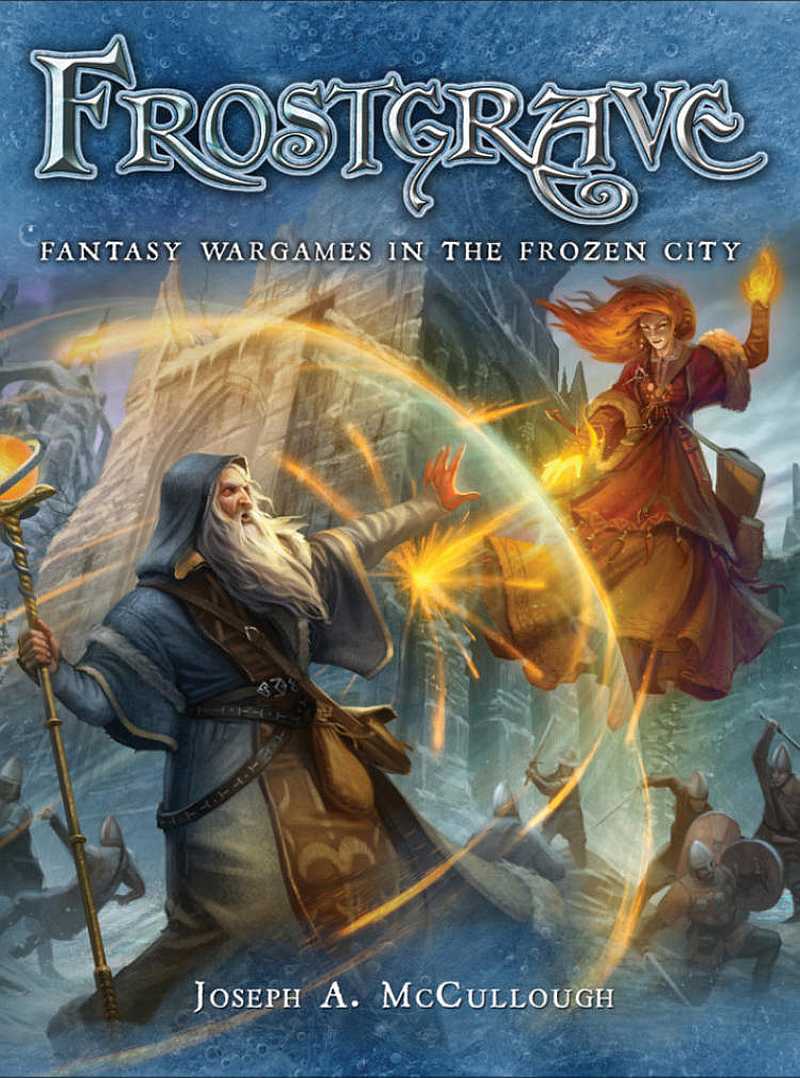
FrostgraveI’m on a bit of a Frostgrave kick as of late and it should be no surprise as I’m a fan of the game. One big draw is the campaign system and it really has that Mordheim feel of progression. You slowly accrue power and wealth, tricking out your wizard and warband. It’s fun.

But I think there are a few stumbling blocks with Frostgrave’s campaign game. The first is the focus on wiping out the enemy. Sure you can scramble to try and take off treasure, but you get more experience for your wizard personally wiping out enemy troops. Plus if you kill every soldier to the man, you get all the unclaimed treasure. Lastly, there is no turn limit. So you can take your damn sweet time hunting down the enemy rather than trying to scoop and scoot all the treasure in the field.

The other issue is the snowball effect with winning. You get to do a lot out of game. Open recruitment, buying any desired magical items, upgrading your base as you like, it all allows players to do so much which is great. But if you are slipping behind in gold and XP, you start trailing. Sure a few games it’s okay to lose some. But eventually if you’ve gotten the snot beat out of you for a few games, you aren’t ever going to catch up.

I’m certain other folks have noticed this. In fact a few people whipped up their own tweaks to the campaign system. Much of what has been circulated around is great stuff but sadly have gone the way of lost files and broken links. So I went ahead and compiled some changes I liked and added my own.

One big change was the experience system. Too much emphasis was on wiping out the other player. That’s been removed and instead casting XP for any in-game spell has been increased. I didn’t want to completely remove the impetus for killing troops though. You end up getting experience from your warband survivors. So while you no longer get experience for killing enemies, you can certainly curtail the XP your opponent gains after the battle putting their soldiers to the sword (or making them a smoldering pile of ashes).

The other big change was awarding treasure XP. Having limited game turns and XP only guaranteed for yourself by taking treasure off the table, now it’s more of an objective-driven game. Standing treasure on the board now awards XP to both players, so if wanting a bigger share of the booty you’ve got to haul that gold off the board.

Another small tweak was the loss of wizards. Now they can’t be permanently killed. They can be bloodied and saddled with permanent injuries, but they’ll always manage to crawl back to camp. With the game being so centered around your wizard, the option of them being wiped out due to some bad die rolls left a sour taste. Having a chance to let them redeem themselves just fits better.

Lastly, the out of game actions are better structured and curtailed some. Buying magical goods is no longer a free shopping experience and the stocks are limited. Even more so, you are limited to choosing a few actions out of game. This makes the whole campaign experience a little more strategic.

Much of these changes are from the community in general but I’ve added my own bits as well. You can find a complete document in the downloads section. Hope folks find some use from them for your games.

A wound system for Frostgrave

I like Frostgrave. There are some rough spots but as a fun skirmish game with a fantasy twist, it gets a lot more right than wrong. One really hangup for me though was the damage system. I just really hated the idea of recording actual health points.

For Wizards and Apprentices, I totally get it. You need that gradation of health point pools. There is so much that revolves around it and the entire system of casting spells requires you ticking off those individual points. If you try to break it up using tokens or markers, it just takes too much away from the game.

But for soldiers and followers, well they are meant to be cannon fodder. I just didn’t get the idea why some other method couldn’t be used to record damage. I feel I’m just too used to other systems that have easier record keeping. So I decided to work on something similar for Frostgrave.

I’ll freely admit this makes the game especially deadly. Most grunt soldiers are usually going to be dropping in 2 hits. Also, you’ll be losing some granularity with damage due to using wound tokens instead of health points. Folks might want to consider just using it for creatures instead, but I find the easier tracking of health totals worth it.
Frostgrave
So here are a few things I adopted for my games. Spellcasters (Wizard and Apprentice) suffer damage and gain healing unchanged from the rule book. But for followers and creatures, they no longer have point totals for health. Instead damage is tracked by wounds and possibly marred conditions. The pool of wounds that soldiers and creatures have is their health total divided by 4, rounded down. So a Thug with 10 health points would have a wound pool total of 2 (10/4 and rounding down).

You determine damage normally from combat or casting spells. But for for every 4 points a model suffers in damage, they take a wound removing it from their health pool. For every fraction of 4 (i.e. 1-3 points damage), they receive a marred condition. If a model has 2 marred conditions, those conditions are removed and a wound is immediately taken from their pool of wounds instead. Note that healing works the same for spellcasters, but for soldiers they only restore one wound of damage.

As an example, a thug is hit for 5 damage. One wound would be removed from its pool and it gains a marred condition. On the next turn, the thug is hit again for only 2 damage, giving it another marred condition. As this is the 2nd marred condition it has, it immediately takes a wound, removing the marred condition markers. Further, since the thug has a health pool of 2 wounds, its health has dropped to zero and is removed from the game.

I also introduced a handful of characteristics for soldiers and some creatures. The idea was to cover the bases with creatures that have less than 4 points of health and also add some variety with soldiers that straddle the line of between health totals in increments of four. A more detailed list of these rules can be found in the downloads section. I think they work pretty well and allow for a little easier bookkeeping during the game, but still captures the flavor of Frostgrave combat.

Tinkering with Call of Cthulhu: The Auction – Part 2

As I mentioned before I like the Auction from The Asylum and other Tales. It’s got some clunky parts though, notably how the auction plays out. The other is somewhat the greater mystery that presents itself later. For new fans of CoC, it’s a great adventure and one I highly recommend. If you’ve got interest in playing it, go shoo and let the rest of this grumbling be for just the keepers and GMs. Spoilers ahead.

cultist02
.
.
.
.
.
.
.
.
.
.
What trips up the scenario for me is you have this excellent set up with somewhat of a mystery. However you have 8 suspects that aren’t really suspects. It’s clear to the players some kind of creature took the Brass Head. And even after all the investigation the PCs do, it’ll rely on Ausperg stating three of the participants tried to buy it from him before the auction. That’s sort of a waste of session time.

I don’t have a complete fix for this. Even with my changes it’ll railroad the story some. But at the end of the auction night, at least players will have 2-3 suspects that they can track down based on clues they found themselves (allowing Ausperg’s information available as a backup if players miss out on key points). So there are two main aspects I changed. One was how the dumbwaiter operated. The other was how the auction progressed in the evening.

I had the dumbwaiter have call buttons on at the top floor, while in the basement there was only a button to close the door. The critical point was that for the dumbwaiter to reach the upper floor someone had to push the lift button calling it up. The second part was allowing a 6-8 minute break in the auction. At that time four of the participants would leave the room one at a time. PCs could ignore half of the auction guests and focus only on the ones that left during the break.

So the auction played out with about half of the items being bid on. Then a break was taken in the bidding where most of the guests stayed in the auction room. Some would leave and remaining guests would try and engage with as many of the players as possible in idle conversation. Everyone would return for the second round, with one of the lot items in tow. After bidding for the item, Ausberg would ring for the Brass Head. Time passes. Eventually one of his staff investigates and finds bloody remains and the item missing, just as the scenario describes. Now onto the clues for the investigators.

The Dumbwaiter As mentioned it only has call buttons on the second floor. The second floor has 3 buttons. One to close the door, one to send it down to the cellar, and one to call it back up. The basement only has a button to close the door. So the waiter could only have been called up from the basement from the second floor. The dumbwaiter will also only move between floors if the door is closed. However the door can be closed and opened from the inside by manually doing so (or being quick enough to push the button and draw back their hand inside the dumbwaiter). There is blood and gore in the dumbwaiter. It takes about 2 minutes for the waiter to move up or down to the cellar.

The Auction Prep-room The door to the room does not appear to have been forced open (it was never locked as a servant is supposed to be inside at all times). There is gore and blood everywhere, including in the dumbwaiter. One of the surviving prep-room servants will state when they retrieved the lot for the second round of bids, everything was in order. They will admit sheepishly they had stepped out for a smoke when they were supposed to be in the vault during the break. The other servant had slipped downstairs for a cup of coffee. The servant will state that his fellow servant was in the room when he returned from a smoke. He cannot recall if the dumbwaiter was in use then. So there was a time when the prep-room was unlocked and possibly no one was inside during the break. The dumbwaiter could have been activated during that time when no one was in the room.

Auction Break Only 4 people left during the break. They did so in a specific order with about 20-30 seconds in between each person leaving:

– Lesek Czernin was the first person to leave during the break.
– Klaus Hunderprest (the ‘murderer’) was the second person to leave the room.
– Margaret Jameson left the room third during the break.
– Sir Martin Murray was the last person to have left the room.

The important bit is that Hunderprest was the 2nd person to leave, openly claiming to needed to use the toilet. Sir Martin Murray was the last to leave during the break quietly planning on doing the same. Yet Sir Murray entered an empty bathroom, and saw Hunderprest enter when he left the toilet. This is a small clue that there was some lost time in the events described by Hunderprest (Hunderprest left first claiming the need to use the restroom. Sir Martin Murray enters an empty bathroom only to see Hunderprest enter as he was leaving it).

As players make their rounds of investigation of the four, some additional information is gleaned from each one.

– Lesek Czernin will be secretive on what he did during the break. He appeared agitated and tense once the break in bidding was called. Lesek actually leaves the house to approach a car parked outside. If tailed and observed by a PC, Lesek will have a conversation with a man in the back of the car (there are two others in the car, a driver and another person in the front seat). The car will drive off leaving Lesek to return to the house. If PCs are relying on statements from the house staff, a servant will only state that the Lesek was directed outside of the house and they saw them leave and return (but not see what they did outside). Lesek is a red herring. He was simply conversing with his patron on the status of the auction.

– Margaret Jameson (3rd person to leave the room during the break) will have claimed she needed to speak on the phone. Margaret went downstairs to make a call. When she returns, she will be rather agitated. If not observed by a PC, a servant will state she went inside a downstairs room. If players investigate further, sure enough in Ausperg’s office the telephone will have shifted from its proper place on the desk as if someone had used it. She will not initially freely speak of whom she was calling and be rather deflecting if pressed. In reality it was to her father to beg for more money for the auction and she was refused.

– Sir Martin Murray (the last person to leave during the auction break) will also claim they need to use the washroom. He will be rather defensive if asked what he did during the break, simply stating that he was answering nature’s call and be rather standoffish about any details. The truth was that the food during dinner was rather rich, he had a horrible bout of the runs and was exceedingly embarrassed to mention it. After some intensive questioning he will grudgingly admit he may have heard some footsteps in the hall while in the toilet but was unsure. After washing and stepping out of the toilet, he noticed Klaus Hunderprest entering the same bathroom.

– Klaus Hunderprest (the second person to leave during the break) will have announced to other guests as he leaves he need to visit the washroom. During the break, he will slip into the empty auction prep-room and activated the dumbwaiter. After calling up the dumbwaiter, Klaus will enter the bathroom and see Sir Martin Murray leaving. In the cellar, a ghoul will have broken in and be waiting inside the dumbwaiter. The ghoul will go up the waiter and wait for the commotion of people outside to go to a lull. It will stealthily exit the waiter, kill an assistant, take the Brass Head, and then take the dumbwaiter down to the cellar (pushing the buttons and closing the door while inside it).

Through conversation, Klaus Hunderprest’s story should not add up. If cornered in questioning, he will finally claim that he will no longer take part in any further investigation. He’ll stand by the notion that he surely did not rend the poor servant limb from limb and steal away the Brass Head. The incompetence of the police will back up this statement from Klaus. It’s a bit of railroading but at the end of the night, Hunderprest will be free to go. However players should have him as suspect number one in being involved with the murder.

If things fall short with the investigation, Ausperg can drop a hint that Margaret Jameson, Lesek Czernin, and Klaus Hunderprest were all people that approached him to buy the Brass Head. If another nudge is needed to guide players to Hunderprest, a confession from one of the house servants selling the floorplans of Ausperghaus and the staff assignments to Klaus can also be utilized.

At the same time, Klaus will likely know the players are suspicious of him. This can allow for Hunderprest to be more proactive hiring thugs to tackle with the PCs. This situation can then help kick more adventure into the investigation if needed (and interrogation of the thugs leading back to Hunderprest is also another clue if needed).

These changes in events really helped tighten up the entire murder investigation some. It’s apparent that something got into the house and stole off with the Brass Head, but the players will have a much more solid notion that Hunderprest was somehow involved. It also makes the follow up investigation to find him a more direct affair. Additionally by framing the events more as a murder mystery, it also allowed my group to work out their detective chops and stretch their investigative legs some.

Tinkering with Call of Cthulhu: The Auction – Part 1

The Auction is a classic adventure for Call of Cthulhu taken out of the 1983 collection, The Asylum and other Tales. I dearly fell in love with the idea of the scenario and used it for my own Cthulhu Savage Worlds game. For folks not familiar with the scenario, players participate in an auction set in Vienna during the 30s for several rumored occult items. After the auction well…let’s just say things go a little pear-shaped.

It’s a great adventure full of intriguing theme and certainly one of the better scenario setups. For new fans of CoC, it’s one I highly recommend pleading with your keeper to take a peek at and consider running it themselves. I’ll leave it at that with the details. If you’ve got interest in playing it, go shoo and let the rest of this grumbling be for just the keepers and GMs. Spoilers ahead!

laroche cthulhu idol
.
.
.
.
.
.
.
As I mentioned I’m a fan of the Auction. It works well as something to fold into an existing campaign or for a one shot. It’s not perfect however and seems there are some glaring hitches with the the adventure. One is the auction itself and the other is somewhat the greater mystery that presents later, of which seems to causes problems when running it. I’ve opted to break this up over into a couple of posts talking about how I handled it for my players and the changes made to make it a more engaging adventure.

The first issue I’ve got is the auction itself. For a continuing campaign, this is likely a decent adventure hook. It’s something to allow players to establish contacts in Europe and a means to pick up a few occult items. However I’d put money on most people playing the Auction as something of a one shot session. Most folks aren’t going to have an ongoing Cthulhu campaign.

There is a different draw to getting investigators to participate, and that as being cooperative bidders for a third party. For my game this is the route I took and felt it made a stronger hook. Players are asked to utilize their occult expertise to ascertain the authenticity of certain items and cunningly bid on lesser trinkets to drain the resources of other bidders. All in hopes that the group can eventually scoop up some items their patron is keen on obtaining. I loved this idea and recognized it could be a sort of mini-game within the game.

As written the Auction sounds enticing. The players themselves will likely be excited to participate in it. Who wouldn’t enjoy an evening soiree culminating in an auction for supernatural items? The problem is once you actually start running an auction, it gets old fast. If you dig around, there are some live play podcasts that painfully demonstrate this. There’s a lot of excitement for the first few items, but then PCs realize how repetitive the entire thing is. You can hear one player in a live play recording illustrate this tedium as they quipped something along the lines of, “Are we going to go through the bidding for all the items?”

What cements playing the auction out as a useless exercise is the twist in the middle of the event. There is a murder and the entire auction is halted. Half the items players likely have researched and pondered over won’t even be bid on. I loved the concept, but actually playing out an auction just seemed to mess with the pacing. It had some merit but a faster resolution was needed and players had to have a stake in all the auction lots, just not the ones they were interested in.

Firstly, I had their patron tell the PCs he was interested in about 6 different items from the auction list. He forwarded them a line of credit including a lengthy legal agreement. They would return all the funds placed in their accounts that were unspent and hand over any items successfully bid. I didn’t use actual numbers for cash though. Instead I gave every player 3 credit markers. These represented funds that would be used for the auction. NPCs had 3-4 markers themselves. If anyone was out of markers, they were out of the auction.

PCs got a list of wanted items from their patron. To sweeten the pot some, if a player got an item and had 2 credit markers remaining at the end of the night, they’d get a cash bonus. In game terms, I offered players a bennie if they won a bid for an item desired by their patron regardless of cash spent obtaining it. Thier objective was to try and gain as many items on the list, while carefully bidding on unwanted items to run through the NPC’s cash. If they blew all their cash and got items not wanted on the list, they were stuck with a bill and/or having an NPC they owed a big favor to.

Each auction bid round required players and NPCs to make trait test based on either persuasion or intimidation as primary checks. Secondary trait checks could be made with a -1 penalty for notice or smarts. I felt a -2 penalty for being unskilled would not apply and smarts could always be used. Intimidation and persuasion might be considered an odd choice, however they seemed good candidates in either goading NPCs to bid, or putting up such a strong front they could stare down competitive bidders. Gambling could also likely be a decent choice for a secondary skill.

Roughly half of the NPCs would be wild cards. Before each auction item, I randomly determined which NPCs would be actively bidding. At least half of the NPCs (rounding down) would bid on an item if they had 3 or more credit markers. If all NPCs had 2 or less credit markers, at least one NPC with some credit remaining would always bid, and this lone bidding NPC should be a wild card if possible.

Now winning or losing an item depended on what was being bid for. Players had to have at least 2 credit markers to bid on an item. NPCs needed at least 3, but would bid if they had less depending if any other NPCs weren’t bidding (as mentioned above).

For lots that the patron wanted, the PC or NPC that got got the highest check on their trait test won the item, and would spend their 2 credit markers. If a player or NPC aced their trait test they could take back one credit marker (multiple aces have no effect i.e. at least 1 credit marker was lost if they won a bid). Note that these were not trait challenge rolls or tests of will. Each player/NPC made the appropriate check and the highest roll won.

For auction items the patron didn’t want, the player/NPC with the lowest trait roll would ‘win’ the unwanted item paying 2 credit markers. For each ace that PCs or NPCs rolled beating the lowest trait score, that player/NPC put in an extra marker up to a maximum of 4 (or 3 if they were an PC). So not only had the others gotten the player/NPC to be the highest bidder for the unwanted the item but they had severely overbid for it.

In the case of a tie, players can put in an additional marker to automatically win over NPCs (or other players). If both players put in a marker, they make another check and keep rolling until one player wins. Players didn’t get this extra spent credit marker back if they won the bid, even with an ace.

This set up for a mini game. At the start there were several NPCs bidding for items. If players rolled well for unwanted items, they would slowly decrease the number of NPCs attempting to bid for future rounds. PCs also wanted to try and roll as high as possible for the patron lot items. If they got lucky and aced their rolls, they might win a bid and not spend as much cash. Plus there was always a bonus of getting a bennie if they won the item.

This worked great. It resolved fast. It kept everyone trying to roll high regardless if it was an item their patron wanted or not. Players wanted to gain items as it gave them bennies. They also were engaged and active in just about all the auction lot bids. I scrambled the lot list order some and made sure only half of the 16 items were bid on so only 8 items were bid for. Yet this moved pretty quickly and allowed me to get onto the second part, the murder mystery.

Verdantia – an alternate setting for Frostgrave

I enjoy Frostgrave. Yet I’m not too keen on collecting a bunch of terrain and rebasing models to fit in the ice and snow setting of the game. One plus I found was that the background for Frostgrave was paper thin. As long as it was in decaying city ruins, you could plop that down anywhere. I embraced this and decided to create a different place. Another sprawling labyrinth of decaying city ruins… Verdantia.

Long ago were the Dragonborne, a reptilian race of people that were infused with the arcane powers of dragons. Their empire flourished in the hot lands of lush jungles and scorching deserts, with only tepid cities built skirting much of the colder lands to the north. It is said their reign was for 5,000 years and then overnight, their kind disappeared. Thousands of years since their demise many of their mysterious monuments still litter the landscape.

Some legends say that they fell into warring factions, wielding powerful magics that resulted in the destruction of their race. Other legends speak of a great religious movement which rebelled against their affinity of the arcane, choosing instead to worship primal gods. The winning faction of this war were the followers of primitive nature, resulting in the savage lizardmen seen in the world today. No one can claim the true reason for the fall of the Dragonborne. What cannot be refuted is that this grand civilization reached an epoch, and in the matter of years slid into obscurity, utterly wiped from existence.

However now many state that it was the great network of portals, created by the Dragonborne, which lead to their downfall. These portals weakened the normal boundaries of the physical world. They allowed primal, chaotic aberrations to slip in, and brought destruction to their great civilization. A statement which is supported in grave hindsight to the terrible fate that had befallen Verdantia.

Twelve standing portal gates scattered among the lands were remains of the Dragonborne and their enigmatic past. These portals were widely distributed not only among different regions in the southern lands, but also a few sparse regions to the north, as well as the western coast that lay beyond the great mountains. The portals themselves were made of thick stone etched with arcane script and large enough for a cart of oxen to pass through. Once one entering the glowing stone arch a traveler would instantly appear from another paired portal gate, safe but unable to enter another portal for a full day.
Temple-Ruins
All of the 12 portals congregated at one location, a sprawling set ruins within a steaming jungle. The gates were arranged in a circle on a great stone platform within the center of a crumbling city. Even stranger, a 13th portal structure was at the center of these gates. This 13th portal appeared as a standing, empty stone ring yet much larger than the other portal gates. This last grand portal appeared to be non-functional however, either never completed or its paired portal location destroyed somehow.

This far off region soon became a nexus of trade. A small community sprung up as brave merchants were willing to travel through the portal gates, spend a day within the hazardous jungle and decaying city, only to travel through another shimmering stone arch and reach far off cities. Soon the community grew and adopted the name Verdantia, taken from the lush jungle surroundings. It was in the year 400 of the Imperial Calendar that Octavius VI endeavored to make Verdantia part of the grand human empire.

Octavius entered Verdantia with his great army and cleansed the decaying ruins of all manner of creatures that remained there. He oversaw the reconstruction of the city, and in many cases simply built anew over the carcass of the old foundations. The college of Imperial Wizards relocated to the recovering city, its members eager to scour the ancient ruins for long lost arcane knowledge. Coin flourished in Verdantia and it became the hub of world trade. Warehouses sprung up as brokers for staple and speculative goods haggled among the crowded streets of local merchants. Money lenders and currency changers of different regions also congregated within Verdantia. Yet despite the successful efforts to rebuild the city, Verdantia was far from peaceful. It was ever under threat from the surrounding jungle which held many horrible creatures, cunning goblin clans, and savage lizardmen tribes.

In Y700 IC, rumors were spread far and wide of an ancient chamber discovered within the labyrinth of catacombs that ran under Verdantia. Within this chamber was a tome of necrotic spells that held secrets of the undead. A treasure of knowledge for those seeking greater understanding of the dark arts. This tome became the unrelenting focus of the terrible lich, Ulaam the undying.

His great undead army sacked Nordia, the western coastal city of frigid waters, and using the portal gate located there Ulaam poured his legions of skeletal and ghoul warriors into Verdantia. For over a month humans and undead creatures openly fought within the city streets. Imperial wizards flung spells at undead lichs and other necromancers that had joined under Ulaam’s dark banner. While the city was in chaos, the palisades were no longer manned and goblins, gnolls, and lizardmen warbands struck deep within Verdantia, further inflaming this chaotic war.

In ensuing battles as the human forces were buffeted by these other newly arrived factions, Ulaam was finally able to make a decisive strike. He spearheaded an attack into the Imperial Wizard library and was able to capture the necrotic spell book he so prized. Within days, he was able to decipher a great spell that would turn the tide of the battle towards his favor. It is rumored he emerged from a tower, his gaunt form encircled with a clinging dark yellow mist that appeared to be billowing from his mouth which was constantly muttering an incantation.

This yellow mist flowed over the city seeping into the lower recesses of Verdantia. Living creatures within this poisonous cloud choked and died. To the horror of living creatures that managed to stay above this yellow haze perched atop buildings, comrades and creatures slain by the sorcerous fog shambled to life and began to shuffle towards any living being, eager to tear them apart or drag them down into the suffocating poison mist. Legends from survivors speak of the horrible visage of Ulaam cackling on the steps of the ring of portals, leering down at the undead havoc he had wrought. But this victory was fleeting. The doom that visited the Dragonborne empire so long ago came to Verdantia then.

The sky became dark and the sun was blotted out from an eclipse. The 13th portal, this dormant gate that was silent for millennia shimmered and forms became to pour forth. All manners of demons and elemental creatures spilled into the city. Chittering demons of chaos fluttered above, and huge lumbering golems and elementals ran amok unfazed by the poisonous fog. They tore into living and undead forces alike, imbued with primal magic. It was said the footsteps of some elementals appeared as roots seeping into the cobbled stone roads, breaking them apart, and leaving footprints of lush green plants.

As the darkness faded from above and the sun slowly seeped out, the central portal stone frame cracked, and exploded into a shower of fragments. Each gate in turn shattered and exploded, as if the elemental energy within the air was finally able to dispel the arcane power which enchanted the portal gates. Verdantia was lost, secluded from the world, and again a crumbling city deep within a foreboding jungle.

The decaying ruins are now home to all manners of venomous creatures and savage beasts. Cunning goblins, gnolls, and fierce lizardmen are rumored to reside there. Ulaam’s necrotic presence still taints it, as undead continue to shamble among the ruined streets (darker tales say that Ulaam still lives in undeath, hidden away within the bowels of the city). Along with these creatures are far greater threats of demons and great elementals which still can be seen lurking within Verdantia.

But the faded seclusion of fallen Verdantia was not to last. There are too many riches deep within those crumbling ruins. Too many magical treasures and arcane texts to ignore. Wizards which covet such great power gather soldiers and fledgling apprentices under their wing to undergo perilous expeditions into Verdantia. It is a lost city, but one with wealth and great arcane power for those steely enough to take it.
Bolt Action: Ostfront

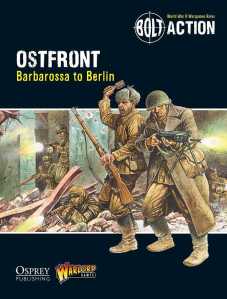
OspreyBA-Ostfront-cover publishing has been continuing their releases for Bolt Action campaign specific books and Ostfront covers the broad Eastern European front from the Russian invasion of Finland, Operation Barbarossa, up to the final attack into Berlin. As with previous books, it covers special units and scenario specific rules, all along with some historical background text.

One particularly interesting section is the Japanese-Soviet conflicts between 1938-39. And the beginning of this book highlights a few key battles along with some special army lists and units, including Japanese cavalry. It’s a pleasant addition to shake up what you’d expect to be a typical Russian/German book. The book also dedicates some scenarios illustrating the Finnish-Russian conflict at the onset of WW2.

Both Russian and Germans get a few special units including Soviet partisans. At the beginning are some generic units for all periods in the manner of Japanese and Soviet flag bearers. These units allow for improved rally orders and can affect quite a few units (up to 12” from the model). Also rules for horse-drawn limbers are now available and a welcome addition as these artillery gun tows are more historically accurate for the time.

Similar to other campaign books, the material is sectioned into parts with historical information presented first, along with a few scenarios depicting that engagement. Some additional rules and terrain effects are also provided to reflect the conditions of these battles. One change is that there are some lists of generic Bolt Action scenarios from the original rulebook that are suggested as something which could be considered a typical combat engagement for that period. Combined with special rules for supply, terrain, and theater selector forces, you’d have a decent twist on your regular game of demolition or hold until relieved.

Rules for minefields and dug in units are presented again, along with some special rules for deep snow and other weather effects. Of course, you couldn’t have an Ostfront book without some rules for city fighting and there are plenty of additional rules to cover rubble and sewer fighting too. One aspect of city fighting is the lack of effective command. As fights progress, leadership gets bogged down and hinders orders given to units. This really can shake up your typical games especially if you are needing to move units up and capture objectives.

Overall 12 scenarios are provided. Most of them have victory conditions that revolve around capturing objectives, moving into enemy deployment zones, or destroying the most enemy units.

The Good – The book gives a decent overview of the Eastern Front from right before the onset of WW2 up to the Battle for Berlin. There are additional units and options to provide a theater selector feel that’s appropriate. The artwork and photos are plentiful and of good quality.

The Bad – As with some of the other campaign books, I really would have appreciated more maps and figures of a typical scenario terrain layout, or photographs of full table layouts. You get a written description that’s functional, but having some more details would have been better. Most of the scenarios still are firmly planted in the generic fight camp, and more detailed scenario objectives and force composition are absent. In the end it offers a representation of these types of battles instead of presenting lots of options for reenacting a historical battle or engagement.

The Verdict – Battleground Ostfront is a good book. Like it’s Normandy predecessor, it provides games that give a certain flavor over depicting a true historical battle. I still wish there were more detailed historical scenarios along with the generic battle options provided. However the layers of terrain and supply effects do offer a wrinkle in play. The presentation of the material is also much better. All the terrain and special scenario rules are off in a rear section, making it much easier to reference during a game.

It’s still a Russian/German heavy book. But the Finnish and Japanese campaigns are a great addition highlighting some more lesser-known parts of WW2. Of course what also stands out are the snow and city fighting rules. Easily something you could port over to mimic the Battle of the Bulge or Monte Cassino.

For a player that is interested in the Eastern front and a Bolt Action fan, they’ll find this book indispensable. If you aren’t there are still a few interesting rules and options that you could find some value (with a few caveats, say like running a Pacific game). Compared to some of the other Bolt Action campaign books, I’d consider this superior and worth picking up if you are looking to add a little spice to your games.

Review: Splendor

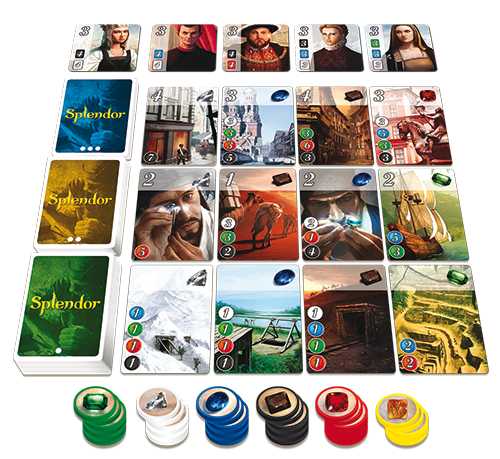
SplendorCoverSplendor is a card game for 2-4 players. You purchase development point cards with gained resources and the first player to 15 points wins. During a player’s turn they have the option of picking up a limited number of gem tokens and on future turns, spend those tokens in certain combinations to pick up development cards in the center. Players can only pick up 3 tokens of different types, or 2 of a similar gem type with some restrictions. Alternately, players can pick up a gold token which works as a wild card gem.

Development cards come from 3 separate decks, each with increasing costs of needed gems, but offering more and more points. As an option, a player can pick up a development card and keep it in their hand (maximum of 3) so that no one else can scoop it up.

Players will spend gem tokens to match what is displayed on the development card. Further, purchased development cards can act as a single gem type which can be used to buy other development cards. So players can try to purchase cheap development cards that offer no points, yet they allow you to amass more gem types which can be used to spend on more expensive cards later. Also, unlike the gem tokens which are discarded back into the supply, development cards you obtain always stay with you.

In addition to the development cards there is also a random number of noble cards. Each noble offers points if players get particular combinations of development cards. While they aren’t a lot of points, they can offer a means to score with the low cost development cards (provided the developments are of the needed sets).splendorplay

The Good – It’s an immensely enjoyable, light strategy card game. It’s a snap to learn yet offers just enough challenge in play. The collection of gem tokens from a limited supply and holding of key development cards adds a small facet of player interaction. The components are nice with cards of nice stock and hearty gem tokens. The artwork is tasteful and offers a colorful, classical look of the 15-16th century.

The Bad – Once a player lags behind, it can be hard to catch up. Some might also argue that the card strategy isn’t too deep either with a few considering it too light for their tastes. The box is rather roomy for the actual amount of components inside.

The Verdict – Splendor is an immensely enjoyable game. The 15 point total is just long enough to allow a player to amass enough developments to get that feel of a decent game engine going, while not lingering too long to make the play tiresome. There really aren’t any glaring faults to this game. It’s fast, simple, and engaging. It’s not pretentious. It’s just simple fun. Splendor is a wonderful family game and well worth picking up.

Airfix forward command post

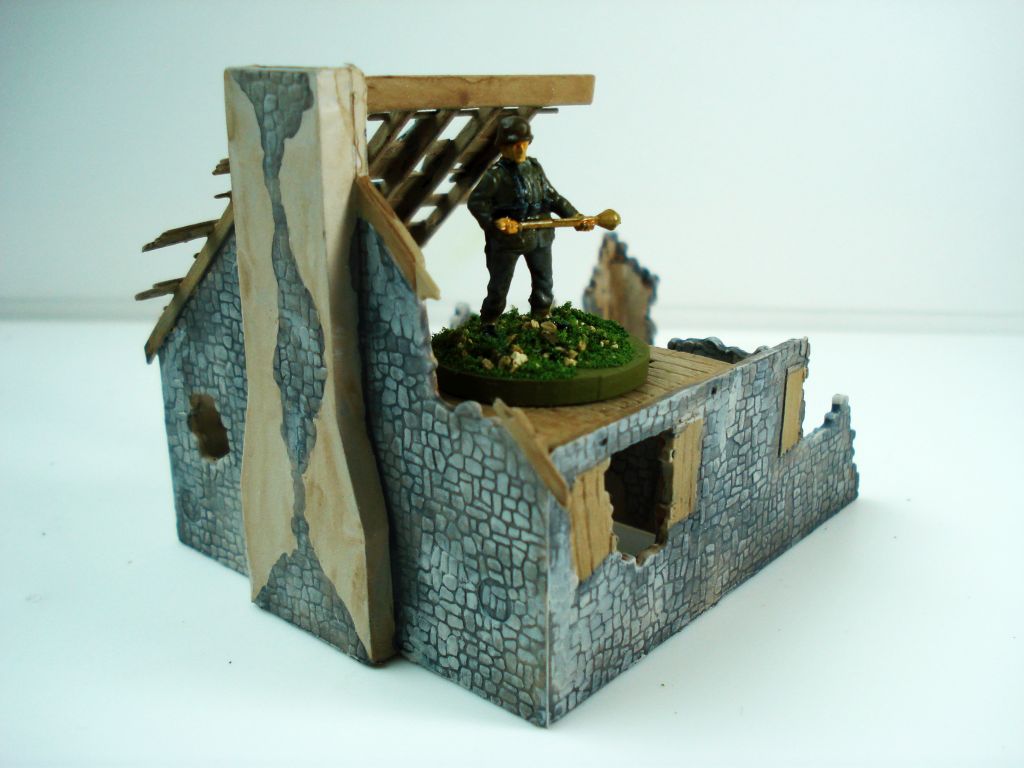
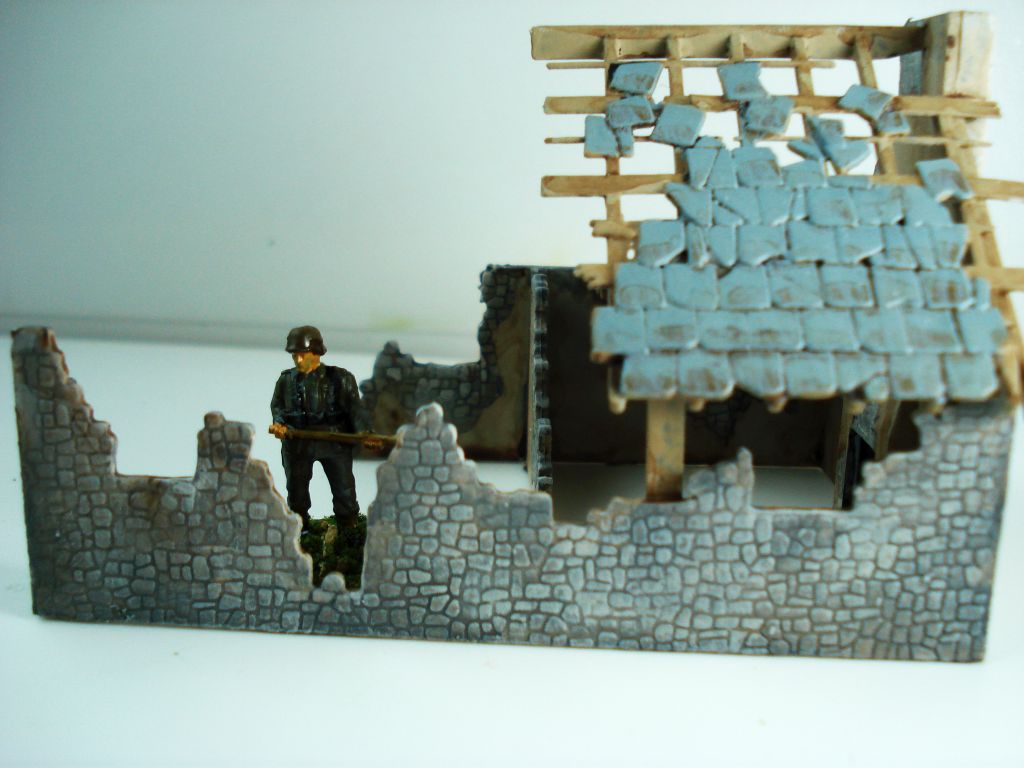
In my continuing quest for Bolt Action terrain, I’ve been slowly accumulating different model kits. One that stood out for me was the 1/76 scale Airfix forward command post. It’s a nice kit with a lot of little extra bits including a cool looking bombed out house.Italeri CommandA

One sticking point for me is I wanted to stretch out the usage for the model. There was a second floor to the house model, however the roof section was a little cramped to the point I couldn’t place a miniature in it. I opted to move the roof section to the other side, opening the second floor up. Perfect position for an arty observer or a sniper.Italeri CommandB

Italeri CommandD

The kit assembles very well and paints up nicely. With a decent amount of detail and texture on the walls. It really is a diorama kit however. I had to shore up some of the wall angles with other bits of plastic.

As mentioned the kit comes with a fair amount of extra detail bits, including various signposts, wooden barricades, crates, fuel drums, coiled barbed wire. There are lots of nice details you can add to the house model, or throw them onto other figures for that extra touch.

One complaint I had was with the sandbag corner piece that was hollowed out and had no back section. I figure this was likely designed to go on a building corner, or be a detail part for a diorama (which would typically have a fixed point for viewing). So I had to plop mine onto some styrofoam and paint like it was built up earth.

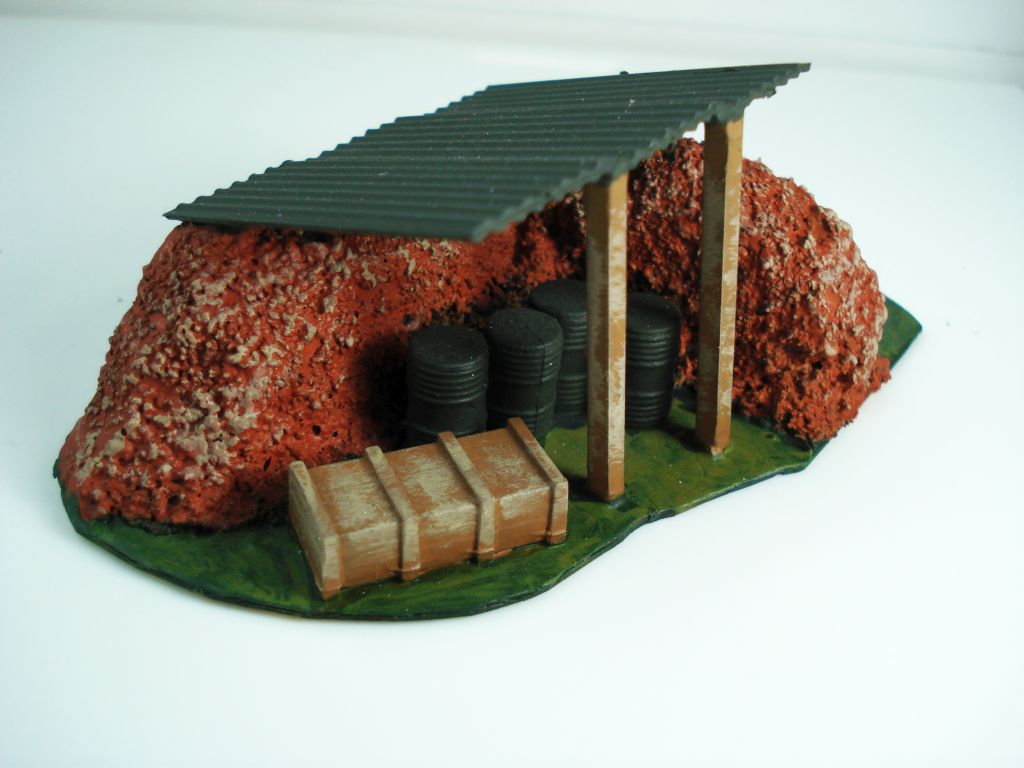
The corrugated tin roof sections gave me a great idea using it as a possible objective. I placed mine on a section of styrofoam with it textured to look like an earth bunker of sorts. With a smattering of fuel drums and crates, it made for a nice little objective to plop down on the table.Italeria Command Objective

The kit is very good for 20mm troops, if being a little small for more bulkier figures like the Plastic Soldier Co. Germans I have pictured here. Unfortunately, unlike the Armourfast House I do not think this would work well with 1/48 figures. It’s simply too small. Airfix looks like it has the same model with less extra detail pieces at 1/32 scale which sadly might be a little too big for Warlord figures. However if you’ve got figures on a thicker plastic base, that’ll add about 3mm to the height and maybe not look too shabby compared to a larger scale house. It really is a nice model and might work well.Italeri CommandC

From a 20mm war gaming standpoint, while the kit is designed to serve as a centerpiece for a diorama, it can work very well as a terrain piece too. It’s got a lot of nice additional details you can add to flesh it out, or throw onto other models. All of which makes for a nice addition to add to your terrain collection.

Board game stores in Seoul: Red Dice

RedDiceOutsideI’ve been continuing my trek to catch a few other board game stores in Seoul. Red Dice is a store located in Hyehwa and just a stop away from Dongdaemun, a popular shopping stop in central Seoul. The store is a bit out of the way tucked up on the third floor of a commercial building.

The store is really catered towards Korean board game versions. There are a handful of English versions but the pickings are few. So as an expat and wanting to pick up non-Korean versions of games, you are pretty much out of luck if visiting Red Dice.

Red Dice does shine for a place to play games however. There is a large section of the store set aside with plenty of tables and chairs. From what I’ve gathered it’s a popular venue for board game meetups. As the store offers coffee and snacks, likely they’d welcome people meeting and playing (as long as they made sure to get a few drinks in during the evening).

I visited in some off hours though and I expect it’s a hopping place on the weekend evenings. Red Dice seems to cater to the CCG crowd and given the number of tables, chairs, and wall of lockers people can rent out, playing games in the store is part of its business plan.

A rumor I’ve heard was that this was one half of Dive Dice. It’s sister store split off to be it’s own gaming presence, Rolling Dice. However from an expat’s perspective, BoardM is a better shopping stop though. Red Dice looks to cater more to the locals and the CCG crowd. I do think it’d be a great place to play however and would be fine to visit if there are any meetups scheduled there. However Dice Latte is still my top place to play board games.
ReddiceInside
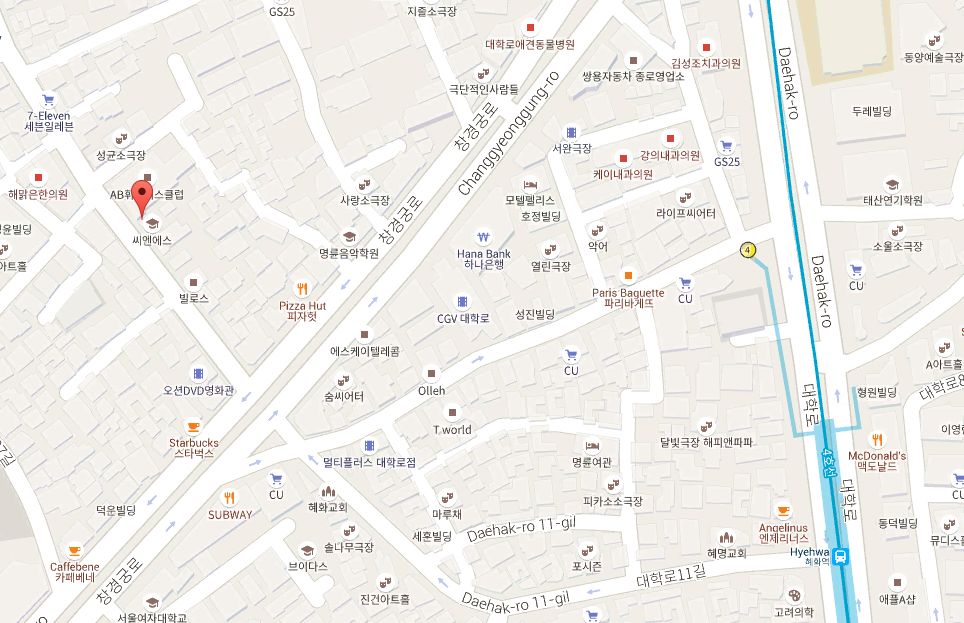
For general directions, take subway line 4 to Hyehwa and get out at exit 4. Take an immediate left and walk straight down the street. Eventually it’ll hit an intersection where it feeds into a main road. Cross the road and follow the side street some. Eventually it’ll be on your right. Look for a store sign on the third floor of a small commercial building (note the outside sign might read as Dive Dice).

RedDiceMap

UPDATE: Red Dice has moved location and is now a few blocks from where the previous store was. The above pic is good for the general location but the pic below has the new location.

new-red-dice

Alleycon 2015 is coming…

I’ve been pretty fortunate over the past few years to get into a circle of local gamers. There seems to be a decent community behind a lot of them too. Alleycon will be running next month and what started out as an afternoon of gaming at a local expat restaurant has slowly morphed into a full fledged con. This year it’ll be 2 full days of gaming and geekery September 19 and 20, with a local meetup the night before for beer and trivia.

So if you are in Korea and keen to play some games, do some cosplay, or rub elbows with fellow geeks, be sure to check it out. From what they’ve got listed as events there’s lots to do (or plenty of space to run your own thing). Online registration is open now. Scoop up tickets before they sell out!
Alleycon2015