Hindrances as PC motivations for Savage Worlds Demos

Savage Worlds for demos or one shot games works well. It’s a relatively streamlined RPG system and pretty easy to get into. One hiccup however are dealing with hindrances. For prep work you have to really make fleshed out pre-generated characters. Yet once a person sits down, they are somewhat locked into a persona as skills, edges, and their flaws for their character are set for them. When I run my demo games I shake this up a bit.

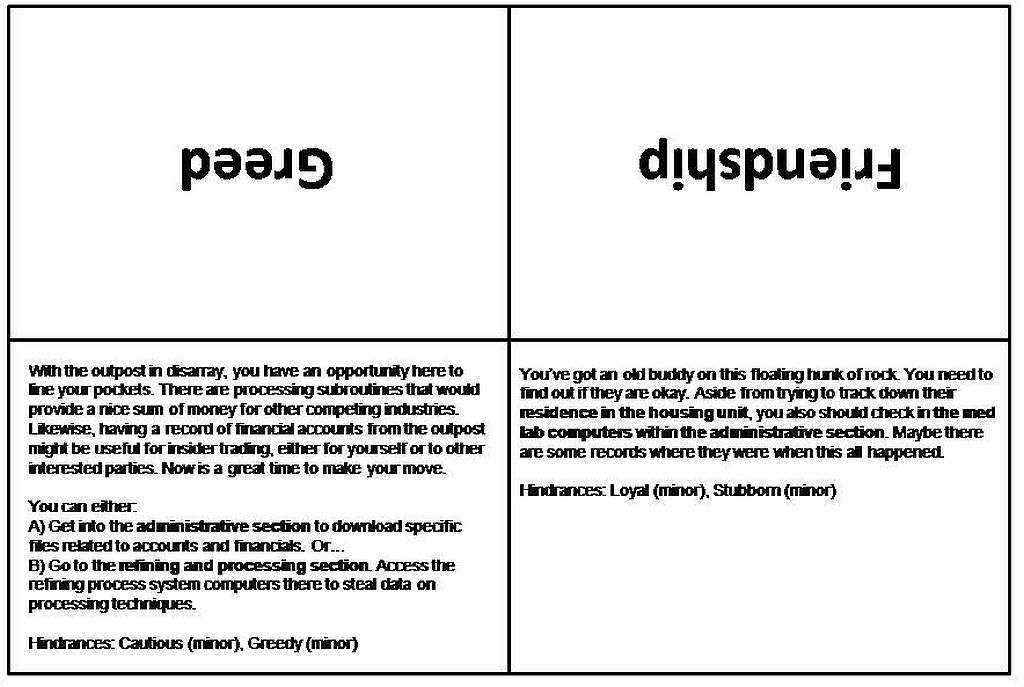
I don’t have hindrances for my Savage World pre-gen characters. Instead I prepare a bunch of cards with hindrances and tie them to motivations. Players pick a motivation early in the session and gain the hindrances associated with it.

To get the ball rolling quickly when they first sit down, I don’t have players bother with introducing their characters. Instead I hand wave things some and give a nod to the idea that they are all gathered under specific circumstances facing a particular situation together. Once they all get a firm grasp of the challenges ahead of them, I pass out several cards with general motivations on them.

Each card has one word that sums up something the PC would strive to achieve, a drive, or a core aspect of their persona. On the back of each card are more details along with specific hindrances. Once they’ve had a moment to digest all the information, I finally have them introduce their character to the others.

SWMotiveCards
Another key point I bring up with this is if a player pushes the group or does actions that would fulfill their motivation, they get a bennie. Sometimes I have this associated with a particular location depending on the session. If they achieve the task of pushing the action so that they can satisfy their motivation, a bennie is rewarded.

This method does tend to work for more structured one-shots or demos. I’ve run a survival horror, sci-fi game and another weird WW2 game where exploration and investigation was warranted. Having the motivation cards linked to particular areas really drove players to discuss with (and at times connive) each other into exploring a particular area. This helped push the characters into being proactive which is especially helpful for a timed demo game.

UMC Mine Outpost Layout
Another benefit is that once a player understands the stakes involved and has an idea what would drive them to make certain decisions, they get a better feel for their character. Delaying that initial character introduction until they’ve selected their motivations and the scene is set, allows players some time to let their ideas ferment some. You can really see people get into their character, and they seem to embrace their hindrances more.

As I mentioned, I’ve done this for a few demo games. Most of the time I have people sit down that have never played Savage Worlds. One game I had a table full of 6 players with zero RPG experience. Using these motivation cards helped them jump into the game easily. They had time to get a better idea who was actually depicted on the character sheet. And I’m especially happy to say everyone had a blast while playing.

Sometime I need to formalize my adventure notes and post my past demo games. But I just didn’t want to wait on conveying this concept. It’s worked so well for me and also helps push the players into being proactive. The next time you are running a demo game or a one shot for Savage Worlds, consider using this idea.

Review: Frostgrave

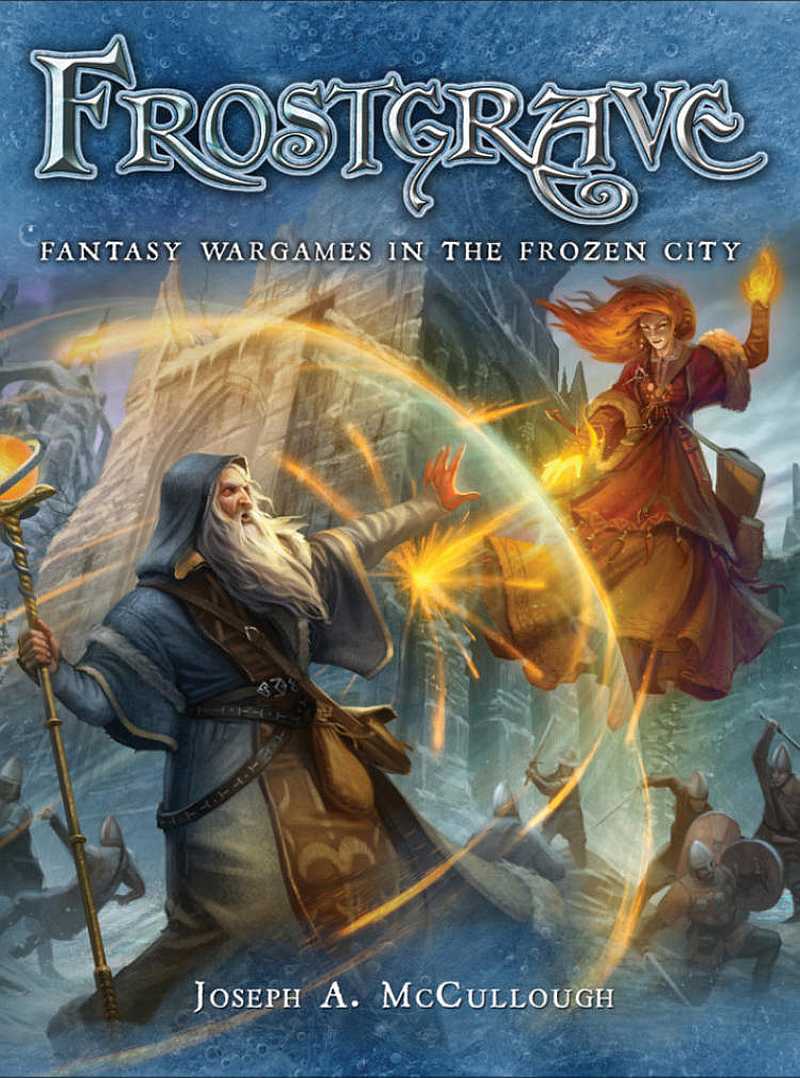
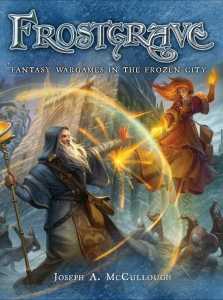
FrostgraveSwerving a bit off the beaten path of military and sci-fi war games, Osprey press has recently released Frostgrave. Set in a cursed city of ruins and perpetual ice and snow, players create a small warband headed by a fledgling wizard in search of powerful artifacts and treasure. It’s a small skirmish game of up to 10 figures per side and may have the occasional few neutral monsters thrown into the mix (that will attack anyone in sight). The game is designed around 28mm models on a small 3’ x 3’ table. It’s certainly not far in theme and concept from Games Workshop’s defunct game, Mordheim.

Each member of a player’s warband has a stat profile expressing armor, movement, fighting and shooting skills, their defense to ward off spells, and health pools. Turn order is a segmented IGOUGO. Players roll off for initiative and the winning player activates their wizard along with up to 3 followers within 3″. Afterwards, their opponent does the same. Then if a side has an apprentice, they can activate (with the same restrictions for followers) and alternately the opposing player activates their apprentice. Lastly, the sequence is repeated for any soldier followers that did not activate in the previous phases. A special end of turn phase occurs for any independent creatures on the table.

When a model activates, they can take up to two actions. If they take two actions, one of them must be a movement action. So no double attacks, but it allows for a little flexibility like a model shooting and then returning into cover. All rolls in the game are based on a d20. For melee attacks, players roll and add their fighting skill. Whoever rolls the highest wins the round and can then inflict damage. For shooting, it follows similar process but a player compares their shooting skill vs the target’s fighting skill with modifiers for cover benefiting the target. The difference is in shooting, the player simply misses with no repercussions unlike in hand to hand combat.

For scoring wounds, the same roll to hit is then compared to a target’s armor value. Most units will have an armor of 10-14. Players subtract a target’s armor from the attack roll and each positive number indicates points of damage the target suffers. Health point totals are also typically from 8-14 points. You’ll quickly find with some lucky die rolls followers in your warband will be dropping like flies.

Movement is a simple system based on inches with any terrain requiring double the rate. There are simple rules for scaling walls, jumping and falling damage. There are few weapon options with most being either small defensive weapons, run-of-the-mill weapons, or great weapons that do more damage. As missile weapons go, you can have bows or slower firing (but higher damage) crossbows. There are no individual armor options. In truth most of these slight variations in gear get wrapped up in the profile of specific followers. So you can have that high health, quick moving, heavy hitting, berserker barbarian. Or instead opt for a slower, hard-hitting but high armored heavy knight to add to your warband.

Of course what’s central about Frostgrave is your wizard. They start off with a selection of spells from a particular school of magic and a few other related schools. Each school of magic has 8 spells within them. Your apprentice has the same spells to access, they just aren’t as effective at casting the spells.

Each spell has a target number for casting ranging from 8 up to 14 for the more powerful spells. Roll equal or higher than the target number and the spell is successfully cast. If you fail, you’ll take 1-2 points health damage. Essentially this helps curb the amount of casting as botched spells slowly drain the health of your wizard and apprentice.

Tacked onto this are the different schools of spells and casting difficulty. Even casting spells aligned with your school incurs a +2 penalty to the target casting number. Neutral spells have a penalty of +4 and this penalty is greater for opposed spells. So even the easiest spell cast still has roughly a 50/50 chance of fizzling and damaging the caster. To get around this somewhat, the wizard can self inflict damage to boost the die roll ensuring a spell is successfully cast. So if you absolutely have to get a spell off, you’ve got that (dangerous) option.

What seems central to Frostgrave is encompassing a larger campaign. After each battle the wizard of a warband will earn experience and treasure. Treasure can be spent to alter the composition of the warband, while XP is used to improve the wizard’s abilities and expand their knowledge spells. They can even reduce the casting penalty for a spell, lowering the chance of any backlash for failure. Some treasure can be magical imparting bonuses to your wizard or soldiers if equipped. And if taken out of the game, each soldier has a chance to recover while wizards and apprentices might gain permanent injuries.

There are 10 scenarios listed in the book but basically all of them are smash and grab encounters. They suggest a general board layout and some unusual terrain feature, or add the appearance of a neutral monster type, but that’s about it. The campaign goals themselves are pretty sparse. This is a game about gaining as much fame, booty, and power as possible. That’s about it for the campaign game.

The Good – Frostgrave is a pretty enjoyable fantasy skirmish game. The mechanics themselves are simple to grasp and don’t get bogged down in a lot of simulation detail. There are enough situational modifiers and gradations of soldier followers to give each warband some flavor. But at the same time not so much there is an extensive list needing a multi-page quick reference sheet for play. Add to this the 10 different schools of magic with 8 spells each, and you’ve got a lot of list building toys to play with. It seems to capture enough chaotic action with a low figure count to make for a fun fantasy-themed skirmish game.

The book is hardbound and an easy set of rules to read through. Plenty of color artwork and photographs are liberally spread among the pages which effectively spark that excitement of sword melee and spell-slinging battles.

The Bad – It’s odd that for all the streamlined modifiers and gear, you seem to get bogged down in a lot of bookkeeping. What especially stands out is the way damage is inflicted. You compare a high attack roll to an armor value and take the difference off a model’s health total. Yes, you’ve got hit points. This is a hair’s breadth away from being something you’d see in a RPG rule book. I appreciate how casting spells are related to health totals. Unfortunately this seems to carry over to rank and file units. Yes, the game can be exceptionally lethal. But it can also end up with models having a lot of minor fleshwounds. Expect to have a warband roster sheet at the table with a pencil handy to keep track of health totals.

Sadly this also does not stay with just hit points… err.. health totals, but also with wizard XP. Experience is liberally gained during a fight which is cool. But you have situations where XP is gained for each successful spell and personal kills are made. Not to mention for each bit of treasure collected. Yes it’s fun to earn oodles of XP but the excessive bookkeeping can become a chore.

The longer campaign rules are nice but you begin to notice how hollow they are along with the scenarios. It’s truly similar to a kick-in-the-door-kill-the-monster-get-the-loot kind of game. The campaign is about gaining the most stuff and becoming the most powerful wizard. There really isn’t anything else besides that. There is an optional rule where a player can attempt to cast an instant campaign win spell. It requires the accumulation of several spells and even more advancement effort into casting the spell (which is essentially impossible until spending several experience points in reducing the casting penalty).

It’s a shame as so many out of combat spells and parts of the game revolve around campaign play. Clearly that is what the game is designed around. It’s just that an overall campaign (and the scenarios that support it) never provides anything more aside from the winning player having the warband with the most gold and XP.

Lastly, the game world is set in a labyrinth set of ruins covered in snow and ice. You might be able to get away from the arctic theme, but the game is designed around having tables with lots of high cover and isn’t that flexible in terrain layouts.

The Verdict – I was hopeful for Frostgrave and it got some things right. I like the relatively streamlined task resolution and the game doesn’t seem to get bogged down in movement, spell, and combat mechanisms. The idea of rolling off d20s against each other is quick and engaging. There is a little back and forth play as you’ve got some alternate unit activation and as enemies have limited reactionary movement, you can also take the initiative some forcing a melee combat out of turn. The tinkering of warbands and spells for your wizard is fun along with deciding how to spread out magic items and potions. That thrill of expanding your warband, spells, and allocating treasure after a successful battle is a fun concept.

What mars this a tad is the excessive bookkeeping for damage and XP gain. You are going to need a few sheets of paper handy to track everything. I’m certainly immediately thinking of tweaking the rules some for warband soldiers and using damage tokens instead. The same might be said for keeping track of XP gained during the game too. I’m considering some simple scenario rules where earned victory points translate into XP gains.

This bleeds over some to the overall game. If you aren’t running a campaign, you seem to be seriously hobbling the system. There are a plethora of spells that have the most function in campaign play. The overall goal of the campaign system is limited too. The impressive list of scenarios is really just a list of terrain effects and complications to sprinkle in the regular objective of getting loot and wiping out the enemy.

So I find Frostgrave a mixed bag. There are a lot of little things here to enjoy. The lists of different magic items, independent creatures, and various spell schools are great. Immediately off hand I’d consider this a better choice over Mordheim. Task resolution and play is a bit more streamlined, yet also more dynamic than Mordheim. The XP system is also geared primarily to improving your wizard, so you aren’t having to tweak every member in your warband. At the same time, you can figure out what combination of soldier followers would work best and there are a few spells that supplement your warband’s fighting abilities.

I guess I wish the idea of a quick skirmish game was embraced a bit more, especially with the bookkeeping of health totals. Frostgrave has those trappings but it’s still a bit further away from something like Songs of Blades and Heroes for ease of play. There’s a lot of potential here, but as a whole it seems to falter a little.

Granted, as a rule system for a fantasy skirmish game Frostgrave is successful. There is fun here. It’s just not as innovative or elegant as something like SAGA. Though, I can’t really fault it for that. Frostgrave has that feel of a fluid and magical Mordheim with much of the clunky bits of that older game shed off. It’s sleeker and far dynamic. While Frostgrave trips some, there are more solid parts making it definitely hold up as an enjoyable fantasy skirmish game.
Jumped off the deep end of miniature Kickstarters with Reaper Bones

ReaperBones3I’ve avoided the siren’s call of Reaper Kickstarter campaigns of past. But the temptation to pick up a slew of minis is just too much. Their current Kickstarter campaign wraps up in less than 3 days. As usual, you get a ton of plastic minis. The bonus for me is that you don’t need to prime them.

I prefer to use tokens for my RPG sessions over using minis. But I am pretty deep into miniature gaming and been taking a gander to some different systems as of late. Pulp Alley looks neat and Frostgrave is certainly on my radar for something to pick up. As a back up, there is always Chain Reaction which is generic enough for a variety of light arms skirmish games. Yet, I’ve heard some cool things about Songs of Blades and Heroes too for fantasy melee. Yeah…. guess I’ll have plenty of games to run with these KS goodies.

Board game shops in Seoul: The Dice Latte

DiceLatteSignEver on the prowl for board game shops in Seoul, I stumbled across the Dice Latte and was pleasantly surprised. This is mostly a game cafe and I seemed to have caught it about a week after it opened. So unfortunately the stock of games for sale was rather limited but after chatting with the owner, selling games is something certainly in the works.

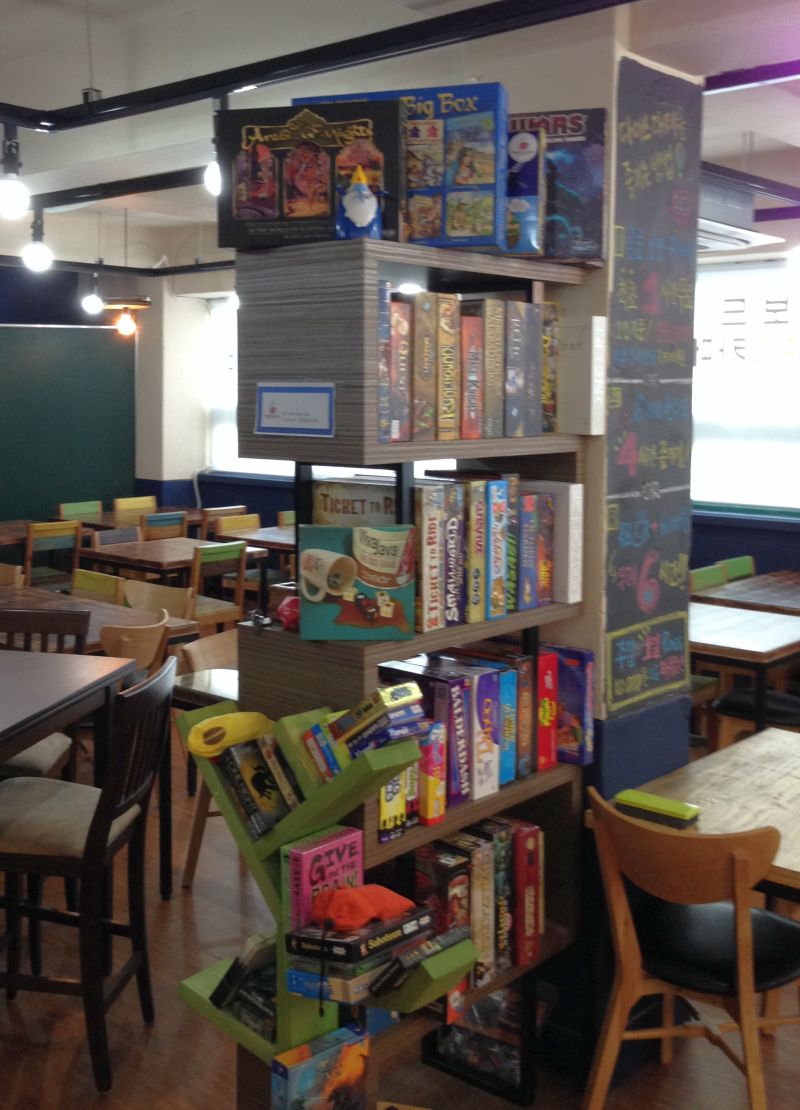
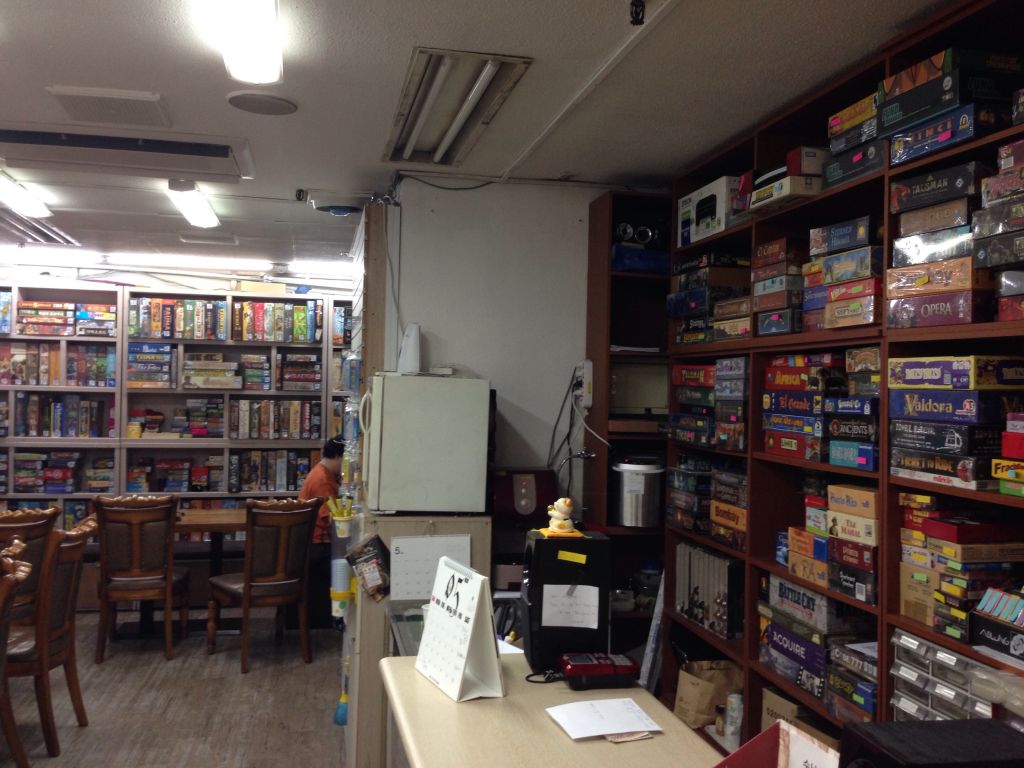
What stands out for the Dice Latte over other game cafes however is that it also caters towards the RPG crowd. Not only are there a great selection of board games to try, but also a shelf full of RPG books for people to read or pick up for running games on the premises.

The place is pretty spacious with nice tables and is well lit with plenty of windows for natural lighting. The menu and prices are geared towards your typical coffee shop fare. There is a tiny kitchen with muffins, cookies, and other baked sweets available. A simple sandwich set is also offered if looking for something more filling.

Paid game time in the shop seems to be pretty liberal. A cup of coffee will get you an hour, but longer play times will require a bit more cash. While there are hourly fee options, cheaper pricing falls into larger chunks of time at 4 hours on up. It’s is a decent option. You can either load up on a few coffees for a few hours, or simply buy a cup and pay a little extra for an afternoon (or evening) of gaming.

The stock of games was rather impressive for a newly opened shop with several classics as well as plenty of new Board Game Geek hotness. The RPG selection was very nice also between classics like AD&D up to 5E and even more smaller publisher fare like Dungeon World and Fiasco. What was a pleasant treat was there were a few Korean RPGs also, including translated versions of western RPGs. My understanding are there are a few Korean RPG groups that are regulars of the shop.
DiceLatteA

DiceLatteShelfA
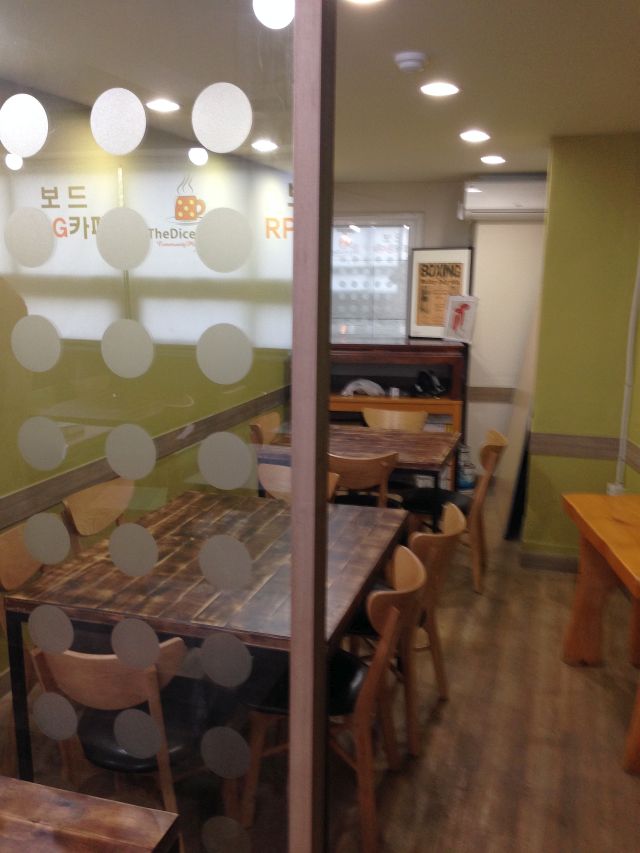
I noticed a smaller room in the back and after chatting with the owner, came to understand that it will be a special room for reservations. If people are wanting a regular place to play that is a bit more quiet from the open room, it’ll be available. Best of all it can be locked. So if folks wanted to step out for a beer and chicken break in the middle of an all night session, they could leave the room as is and not worry about anyone else messing with their things.
DiceLatteD
What immediately jumped to my mind when I heard that the cafe was seeking to expand it’s offerings to include selling some games was would any RPG dice be available. A constant point I seem to find in the expat crowd is how difficult it is to get a set of polyhedral dice in Korea. Seems that the Dice Latte will have that covered as they’ll be a Korean distributor for Chessex dice shortly.

DiceLatteB

The staff appeared friendly and willing to engage me when I came in which is always a plus. Something else stood out for me. Granted it was an early Saturday afternoon and the cafe was in a tad of a lull, but a table of folks noticed me walking around alone looking over the shelves of games. One of the chaps offered me a seat at their table as they were going to jump into a board game. I think that reflects a bit of the friendly vibe there.DiceLatteC

To get to the cafe, take subway line 1 to Hoegi. Take exit 1 from the subway and hang a left. Walk a bit until the street you are on runs into a main road. The shop will be catty corner on the third floor at the intersection. I noticed a big tree appears to cover much of the cafe’s sign front, but you can make out the RPG shop lettering that borders the third floor of the commercial building.
Dice Latte
All in all the Dice Latte seems like a great place to play board games and is very expat friendly. I’d certainly check it out and if you are in Seoul hankering for a place to play or meet up with other RPG players, the Dice Latte looks to be the spot to visit.

(EDIT: Things have moved along for the store swimmingly it seems. Not only are they a distributor for Chessex dice but also for Mayday Games card sleeves. RPG fanatics and pristine board game fans should take note.)
DiceLatteOutside

Review: The Agents

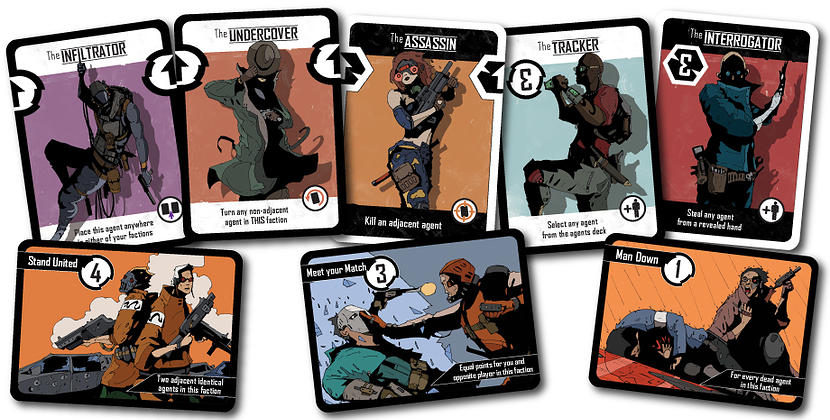
The-AgentsThe Agents is a card game where players represent a group of operatives that have gone rogue once their respective espionage agencies have disbanded. The game plays 2-5 players in about 30 minutes, with the game ending when a player earns 50 points. Players earn victory points (IP) by playing agent cards in specific directions that award points to either themselves, or their opponents. Additionally, players earn points by achieving specific layouts in their play area by assigning mission cards.

What’s rather clever about the game is that the orientation of agent cards either can award you points, or provide an action. Choose to gain points and your opponent now has access to that agent’s ability (or vice versa). To gain points you need to have a pair of agents lined up to link two halves of an IP icon shaped as an arrow. Additionally these half arrow icons are either black or white. If the colors match you gain 2 points, and if they are mixed the player earns 1 point.

A player has only two options when playing agent cards in their area. They either form up in one group (faction) to the player on their left, or the player on their right. Additionally each faction can be comprised of only 5 agent cards (7 in a two player game). You can only play cards on factions you share with other players. The agent actions allow cards to be rotated, shifted to other factions, pulled out of a faction (either into your hand or discarded) and manipulating these commands on the agent cards becomes a key part of the gameplay.

Players can also assign up to 2 mission cards per faction. These provide additional points if certain conditions are met in a faction. Once a player has done all their actions victory points (IP) are awarded based on the number and type of arrow icons facing them, and any additional points from assigned missions are also earned.

Playing agent cards becomes a tricky process though. Not only do other players score points on their turn for any pairs of IP icons that are facing them, they also have the option of using an agent command on their turn. If you get a nice layout of IP icons awarding you points each turn, expect your opponents to start activating agents that you set out to muck up the orientation of your shared agents.
Agents Cards 2
Now a while back I gave a shout out for the original kickstarter campaign. After repeated plays I found there were some rough edges to it. So while the Agents was pretty fun, it just wasn’t something that I found to be a homerun at my gaming table. Since then the rules got a revamp and another kickstarter campaign was rolled out. The ‘Mark 2’ rules really make the Agents a much more enjoyable game.

The game now ends when a player reaches 50 points. No longer does it continue until all players get the same number of turns after a player reaches 40 points and this removes a finicky end game condition. In practice I found you actually had to plan on having more than 40 points, as inevitability other players would be able to maximize their layout in that last mad dash during their final turn. You also have much more flexible options for removing agents and missions from your factions, and picking up missions are cheaper. I appreciate the relaxed options for altering your agents and missions and it’s a welcome change from the more rigid turn actions of the first edition.

Likely the biggest change however is that players are no longer required to use an agent’s command action when it’s first played. Now players have the option of not activating the card powers when an agent is added to a faction. It does remove some bite to the game, as before you could really force a player to restructure their faction when you first placed an agent. However I also found this would inadvertently drag out the game as your opponents would sometime agonize how they would apply the command of an agent. With the new rules they have the option to just utilize it as an action later.

This change also bleeds over into special agents. Special agents are the only cards that can be played on other players that are not aligned with your 2 factions. Before it was a chore sometimes figuring out how to apply a command when they were played. Now, the IP points are still awarded immediately the turn they’re played. However the card is not discarded until the command on the agent is activated. This means that other players can keep those command actions for play in a future turn. This small change really adds to the value and decision process of special agents. Do you score the points now and risk an opponent trashing your built up factions on a later turn? Likewise having those special agent powers available may set up a nice mission condition, allowing you to work towards a specific strategy.

The Good – It’s an enjoyable strategy card game with an interesting mechanism for play based on the orientation of your cards. It has a good flow and offers interesting choices of spending victory points to try and get resources in order to score more points on future turns. There are a fair number of expansions out to provide alternate missions, free agents, and other small twists to the game. However even right out of the box there seems to be enough variation in the cards to offer plenty of replay.

The design of the cards is well done. The artwork captures an almost sci-fi feel, and some sweeping action poses that look more out of a comic book rather than what you’d expect for a game revolving around espionage. I like it and the art and design seems to capture that tone of a tug-of-war game where agents are flipping allegiances back and forth.

The Bad – There are a lot of improvements with the second edition rules, however the new rulebook will still have you getting some head scratching questions regarding agent abilities. The game can also depend on a fair bit of luck. If a player gets a good scoring combination set up, they only have to worry about their immediate neighbors mucking it up. If your opponents get a few poor draws with agents that can’t shake up your layout, well you can run away with the victory points making it very hard to catch up. It can be a little frustrating not being able to get a setup that will earn you points, especially as your opponent can trash your layout using agent abilities (or the alternate, not being able to break up an opponent’s efficient faction). While there is certainly an element of strategy to create these layouts, it can also rely on lucky card draws.

The Verdict – The Agents is an enjoyable game. It’s heavy enough to offer challenging choices, with some variety in the cards and play to provide replayability. But not so much that it gets mired down in lengthy turns with lots of intricate working parts that you might see in other board games. The game seems to run just long enough and teeters over that edge of being just a filler game. With fast play and some enjoyable bits of strategy, you’ll certainly want to play a few hands filling up an evening of gaming.

There are rough spots to the game. Some of the actions on the agents and how they resolve can be clunky at times. You can get stuck with poor draws for a few turns which can make catching up all the more difficult. But the faction layouts are very fragile and can be rapidly altered, making that ideal faction placement difficult to set up (and harder to maintain). This facet of play really captures the give and take of agent loyalties which allows for some interesting play.

I don’t feel the Agents is an absolute must have for a collection. However the point-or-action choice of card placement is different and makes it stand out compared to other games. The new version of the rules allow for a more flexible turn options and is a significant improvement over the original version. Additionally the point of entry for the game is low with enough card options that you don’t need to pick up expansions, but they are available if wanted. The player count and play length is just right too. So I would certainly recommend it if looking for a light, strategy card game.

Bolt Action: Battleground Europe

Battleground-EuropeOsprey publishing has slowly been releasing a series of campaign specific books for Bolt Action. Battleground Europe takes the ambitious task of highlighting the Western European front from the invasion of Normandy all the way up to the end of the war. The book covers special units as well as more scenario specific rules and throws in some historical background sections to boot.

Like the theme, the material in the book is rather sprawling. The campaign is broken down into progressive sections where historical information is first presented, then any particular rules related to the battles, and finally a few scenarios depicting a historical engagement or a more generic type of skirmish that was fought in that battle.

Rules for special units are presented and can be chosen as selectors for particular scenarios. In addition there are a few hero type characters for Allied and Axis forces. A few special vehicles are also covered. There are some force selector lists that are also given for armored platoons of Allied and Axis flavors.

New scenario rules primarily cover minefields, night engagements, and amphibious landings. Each of the listed scenarios usually have some small additional rule regarding the composition or other tweak to give the battle some flavor like limited fuel or ammo. Hedgerow rules are also covered to add as a terrain feature for Normandy battles. All in all 15 scenarios are provided. Most of them have victory conditions that range from destroying the most enemy units, to having the attacker move into enemy deployment zones. Some scenarios like those for Normandy beach landings detail an expected table layout some, but most are fairly generic. They do cover a broad type of engagements fairly well with each having some small special rules, along with what would be considered atypical forces for the battle.

The good – The book gives a fair snapshot of the Western European theater at the end of the war with enough scenarios to visit. The additional units offer some fun choices to give a platoon a decent theater selector feel. The artwork and photos are also plentiful and along with the historical background, certainly helps convey information and evokes inspiration for playing the game.

The bad – Most of the scenarios don’t really stand out as anything new. While there are a fair amount of special rules for particular engagements, much of it is scattered throughout the book. And some key rules which would work in different types of battles (like amphibious landings, mines, and night fighting rules) would be better presented in one section rather than spread out and aligned with one scenario. I really would have appreciated a few more maps. Some actual aerial photographs or simple drawings of scenario tables would have been nice. You get a written description which is functional, but having some more details on a table layout would have been better.

The Verdict – Battleground Europe isn’t a bad book. It’s just not a completely stellar release. I was hoping for a more historical scenario book with more rigid force selector rules. There is some of that, but not quite enough. It seems to go more for providing games that give a certain flavor over depicting a true historical battle. I just wish it dabbled in both types of scenarios more.

Another ding is the presentation of the material. For the most part it’s sectioned off in the different stages of the conflict, which isn’t bad. However the special rules also are spread throughout the book. This becomes an issue as some rules (like for mines) are required for several missions throughout the book, but the actual rules are with one particular scenario. Having them collected in one section would have been better and easier to reference. There is some nice stuff here. Some interesting vehicles (ex. Hobart’s funnies) and units are depicted, like French resistance troops and the Einheit Stielau commando unit (English speaking German commandos that were in first days of the Battle of the Bulge).

While it is a European specific book detailing Axis vs. Allied engagements, some of the rules could be applied to other theaters. Amphibious landing rules could easily be used for the Pacific, or the Invasion of Sicily. And night fighting rules and mines could also be added to a regular game. Likewise, many of the scenarios could be used to depict some generic battle with a small twist on the composition or conditions of the game.

I guess that’s my main complaint for Battleground Europe. Too much effort was put into making the scenarios something that could be applied to a wide variety of forces, rather than trying to depict a specific engagement. I recognize that’s the nature of skirmish games. You really can’t mimic something unless going for a larger scale battle. These skirmish fights are a zoomed in, snapshot of the action. However it seems a missed opportunity. So for a player that wants to duke it out on the Western European front, and is a Bolt Action fanatic, they’ll find this book worth picking up. If you aren’t I’d be hard pressed to say it’s a must have. It is a decent book with a fair amount of scenarios that have slight tweaks to make for a different game. However it’s not enough to make it an essential book to have on your shelf.

Hindrances, bennies, and Walter White

heisenberg-breaking-badAwarding bennies in Savage Worlds can sometimes be a pickle. A great rule of thumb for handing them out is whenever a player does something that moves the plot along. Another key suggestion is awarding bennies when PCs play up their hindrances. However you can get players at conflict with what would be a smart way of playing, and doing something rash that is more in line with their character’s persona.

Players want to be clever. They typically want to make the right decision and avoid doing a bonehead move. So this can sometimes be at odds with hindrances they’ve chosen for their character. On paper, taking something like Big Mouth might appeal to a character concept, but in actual play you might find a player avoiding situations where that hindrance would come into light (or at worse ignoring it completely).

An important thing a GM can do to encourage playing up personality hindrances is awarding bennies. If a player sticks to what their alter ego would do and complicate a situation, then hand out a bennie. Bennies offer this strange feedback loop with Savage Worlds. A PC will muck up a situation and get a bennie, however having more bennies means they can likely make a clutch roll when needed. It creates this dynamic cycle where ‘poor’ decisions create obstacles for the players, but they end up with more resources to overcome them.

How do you sell this concept to players though? Sadly, I think certain behavior is ground into a player’s head that they’ll be punished for a bad decision. If they initiate a plan of action closer to what is deemed prudent by the player than according to their character’s drive and motivations, it’s viewed as a better choice. As a GM, a lot of this can come down to the opposition and obstacles you put in their path resulting from what choices players make. Awarding bennies as previously mentioned is one way to entice them. However all of this seems to counter what likely a rational person would do in particular situations. That’s a key point you need to drill into players. They aren’t rational. They are big damn heroes with huge flaws.

One particularly great pop culture example of this idea is Walter White from the TV drama, Breaking Bad. Walter is a chemistry high school teacher and, for the uninitiated, he opts to start making crystal meth to help his family out after he’s diagnosed with cancer. His character is a smart guy, with a great analytical mind. However he has flaws. He has an ego and some could say he’s a bit greedy.

Continually in the show he takes courses of action that a man of his intelligence wouldn’t normally do. It’s his ego and emphasis of getting his ‘fair share’ of profits that drives him to make poor choices. Walter’s need to feed his ego is so great, that near the end of the show, it helps initiate a chain of horrendous events in his life. It’s a great character and an excellent example of how a smart, cunning persona can still make bad decisions based on flaws they have.

I’ve heard some complaints from GMs that mechanical hindrances like Lame or Anemic easier to run than personality hindrances in Savage Worlds. However I’d counter that with the bennie economy, it’s easier with personality hindrances. If players are really pushing events into interesting directions due to their hindrances, you can help them by awarding bennies. Otherwise, it’s up to you as a GM making a call if players have sufficiently driven the plot forward to hand them out. With personality hindrances, there can be more opportunities to award bennies.

That’s my take on bennies and hindrances for Savage Worlds. So next game you run, keep a list of your PC’s hindrances handy. Be on the lookout for chances where you can award bennies to players that do something aligned with their flawed motivations. Try to be flexible with obstacles and challenges that might pop up as players do crazy things dictated by their quirks. If anything, it’ll make for some memorable sessions.

Armourfast Panzer IV G

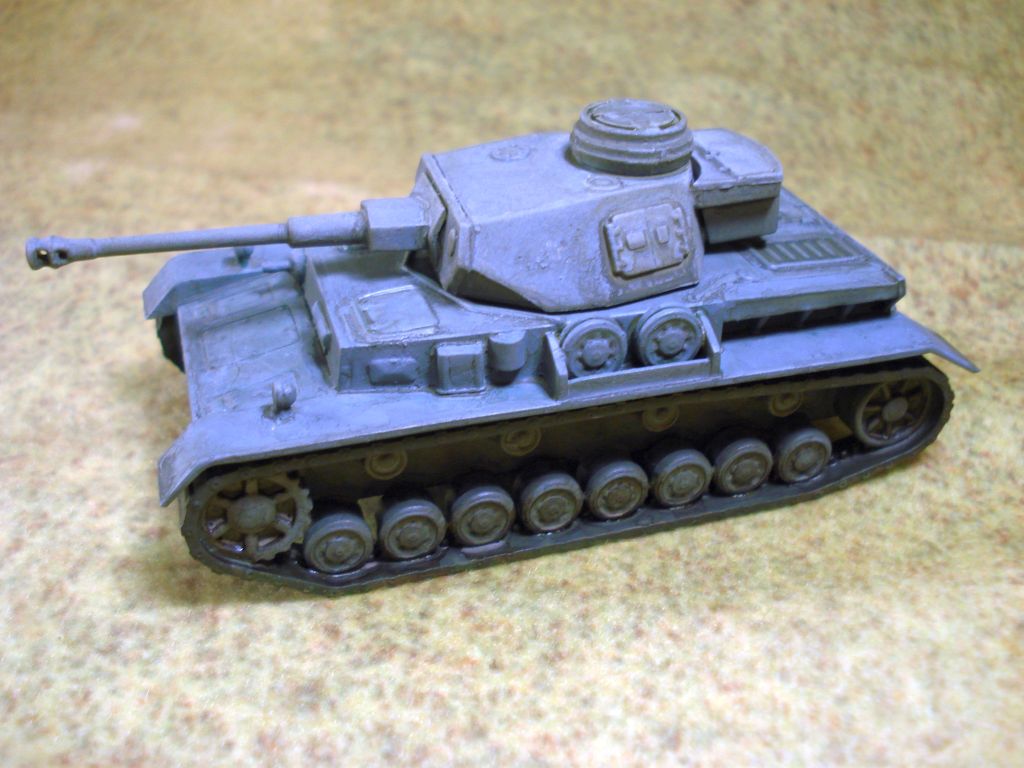
I’m a bit of a fan of the Armourfast kits. They offer a cheap price for a chunk of models suitable for the game table. Working with my German platoon for Bolt Action I wanted to have a few tank options and getting a Pz.Kpfw. IV was certainly on the list.PanzerA

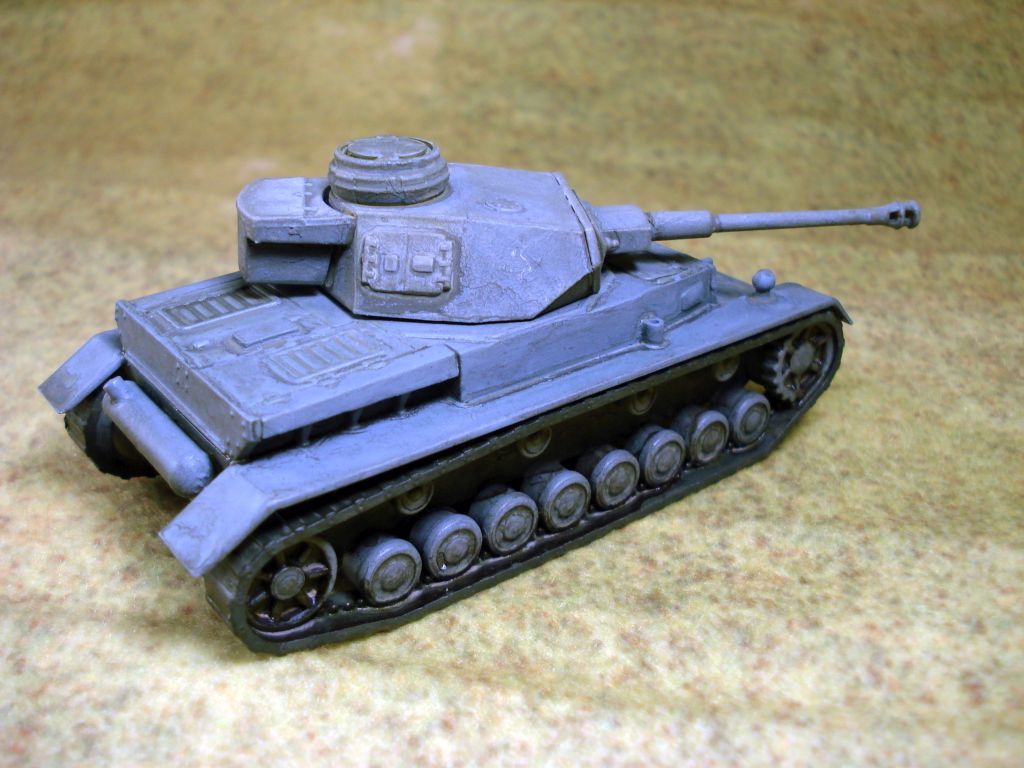
First off I will freely admit that the detail on these are pretty parsed down. The tracks and tread wheels are molded as one piece. Overall though, the detail of the kit is pretty decent. The turret hatches can be modeled open for a commander if wanted. The hull pieces are done well, with hatches shown in enough detail to stand out. The kit is also pretty easy to put together and fits well when fully assembled.PanzerD

What stands out some of the front tread wheels which stick out from the hull. They lack any central axle making it look like a free-floating disk. It’s not much of a detraction but can be spotted if looking at the right angle. Also, no armored skirts come with the kit.PanzerWheel

Still, you get 2 tanks of pretty accurate detail. As with other Armourfast kits they really are a wargamer’s model. You aren’t going to get a super accurate, highly detailed model in this kit. You will however get 2 tanks of nice quality plastic that paint up very well. I can’t piss and moan too much about the kit as I’ve got another tank on it’s sprues aching to get worked on. I might try my hand at a little converting and whip up a passable Panzer IV D or F1 for an early war tank.PanzerB

Board game stores in Seoul: Boardpia

So I’ve been on the hunt as of late to check out a few other board game stores in Seoul. Boardpia is a pretty small store located in Mapo which is central Seoul and conveniently just a few stops from the Yongsan KTX train station. From what I could see it looks as it also functions as an online store.

The store stock is pretty split between Korean and English versions of games with a limited collection. They certainly do cater to the cult of the new however. When I visited I noticed a nice selection of what would be considered the new hotness on Board Game Geek. The store also seems to gravitate towards board games and less so of collectible card games.

There also are a few tables for play. The staff of the store were friendly and I felt they genuinely enjoyed board games. I’m still more keen on Board M for their selection, however Boardpia is pretty easy to track down and not too out of the way from more central subway stops. If I were looking to track down a recent game, this is a store to put on the checklist for visiting.
BoardPiaInside
The store is in the 1st basement level of the Hansin Building. Take subway line 5 to Mapo and get out at exit 4. Walk straight down the street and you will run into the Hansin Building. Take a flight of stairs down into the basement and you’ll find it tucked away among a few other store fronts and offices.
BoardPiaOutside

Boardpia Map

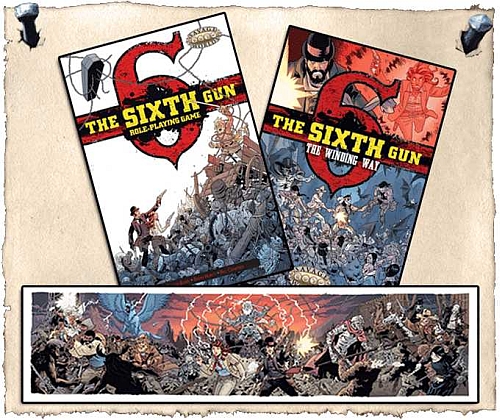
6th Gun Savage Worlds Setting

6thGunRPGThose that check my blog out regularly know I love me some 6th gun. It’s a great comic and a setting I mined for my own Weird West game. Deadlands is cool but it’s a little too out there with spooky and steampunk stuff in the setting. I opted for an alternate history with some supernatural bits thrown in.

What I like about 6th gun is for the most part it’s the world today with a smattering of the supernatural. The players themselves are knee deep in it, but the world around them only occasionally steps into the boundaries of this alternate spiritual world. I see it as a little easier fit that Deadlands, which to me needs a bit more work conveying the setting. Deadlands is certainly the wild west, but there are a lot of changes to the landscape. 6th Gun doesn’t have this issue.

While people could dabble in the game setting, I expect it could serve as a great epic campaign too. For folks unfamiliar with the comic, the story revolves around the acquisition of 6 guns which give the wielders supernatural powers. I cant totally see a game where players focus on a single gun, or try to wrestle a larger story where all 6 come into the picture and the greater implications of their role in the fate of the world. There is a lot to toy around with here.

So the kickstarter campaign is running along and has reached it’s funding goal. It’s all extras from here on out and some look nice. I particularly like that there are add-ons that incorporate picking up the comic, and those minis look pretty cool too.

If you want to dabble in a supernatural western setting, this looks like a good fit. While not quite as gonzo as Deadlands, 6th Gun should still scratch that itch of the wild west with one foot firmly planted in creepy territory, and not sway too far into steampunk like Deadlands does. Might be worth a gander for folks.