300 posts

If you’d asked me in 2009 if I’d still be blogging in five years, well I’d probably be shaking my head. RPGs and gaming are fun pastimes, but I figured I’d be running out of things to post and chat about. Seems I am a long-winded blowhard when it comes to gaming.

Now that the Lunar New Year is coming up, I’ve been reflecting a bit on my blog. While the focus of the blog has become more diverse from when I first started, it’s still very much a place where I get to talk about games. I like that and found blogging has actually has kept me engaged more in the hobby. I’ve gotten a chance to chat and interact with a lot of great people over the years and hope fans of my blog can still occasionally find something here worthwhile reading.

Thanks for being part of this. Here’s to another 300 posts.

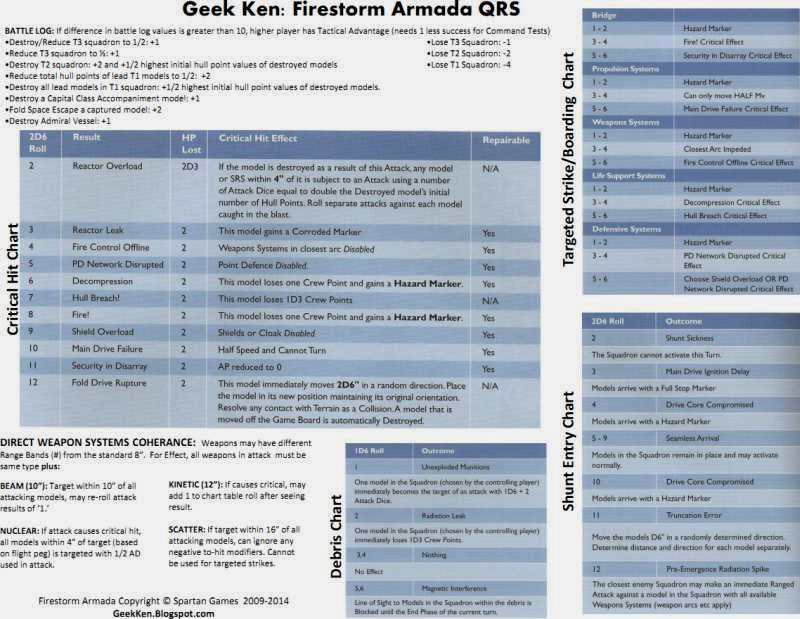
Firestorm Armada QRS

One nice thing about Firestorm Armada when it first released was the great quick reference sheets that were included in the rules. Sadly, when the hardback book rolled out there was no updated QRS. Now the second edition is out and no word if another reference sheet will be available.

I’m not too keen with the charts in the back of the current book. There are a lot of small details throughout the rules and it’d be great to have a summary of the various table charts. It just seems the ones in the rules are sort of sparse. I really enjoy having a good summary section when I get one (cough…Bolt Action…cough) and it makes me wonder why more rules don’t have them in their books.

I decided to whip up one myself. It’s not going to win any awards for layout but it’s functional and I tried to keep it on a single front and back sheet. Hopefully I made no glaring mistakes with the rules.

The new book presents the rules pretty well but I’ve always liked having a reference sheet to jog my memory. Plus having some critical charts handy (especially the battle log points/penalties table) is ideal when I play. Hope people get some use out of the sheet here.

Freesound.org – sounds for your game

A while back I linked a gaming site that had various MMO soundtracks you could download. They had a pretty nice selection and found a few tracks that would work well for some background music to my sessions. I used to shy away from having music for my games. However I found with a decent mix you could get something playing in the background on a loop adding a little flavor to the game, and still not make it a distraction to what was happening around the table.

A few months ago I ran a Savage Worlds game for a local con. Being a demo game with new people, I really wanted to add something to the session to make it stand out. Normally I’m not one for sound effects. However for a few key points in the game, I wanted to add something to make it more of an engaging experience. As it was a horror sci-fi game, I also wanted some type of ambient noise to get everyone in the mood. Having a MP3 player and a miniature speaker, I could easily get something portable up and be able to play some tracks without it being too fiddly and taking up a bunch of space on the table.

So I needed to try and pick up some sounds. I stumbled across Freesound.org and fell into the rabbit hole of creative commons sound files. A bit of digging and I was able to find that perfect space ship alarm. There were tons of industrial and factory sounds. You can really find some wonderful ambient stuff. As for my sci-fi horror game, I settled on a few and also threw in a particularly longer ambient music track that was perfect for setting the mood.

The tracks are free, but many require attribution if being used in other projects. Consider throwing a bit of money to the site also as a donation. There are some nice tracks folks have made available. As for me, I am certainly going to be mining this for certain games. I simply cannot see running a horror game taking place on a dark and stormy night without using this site for some needed atmosphere.

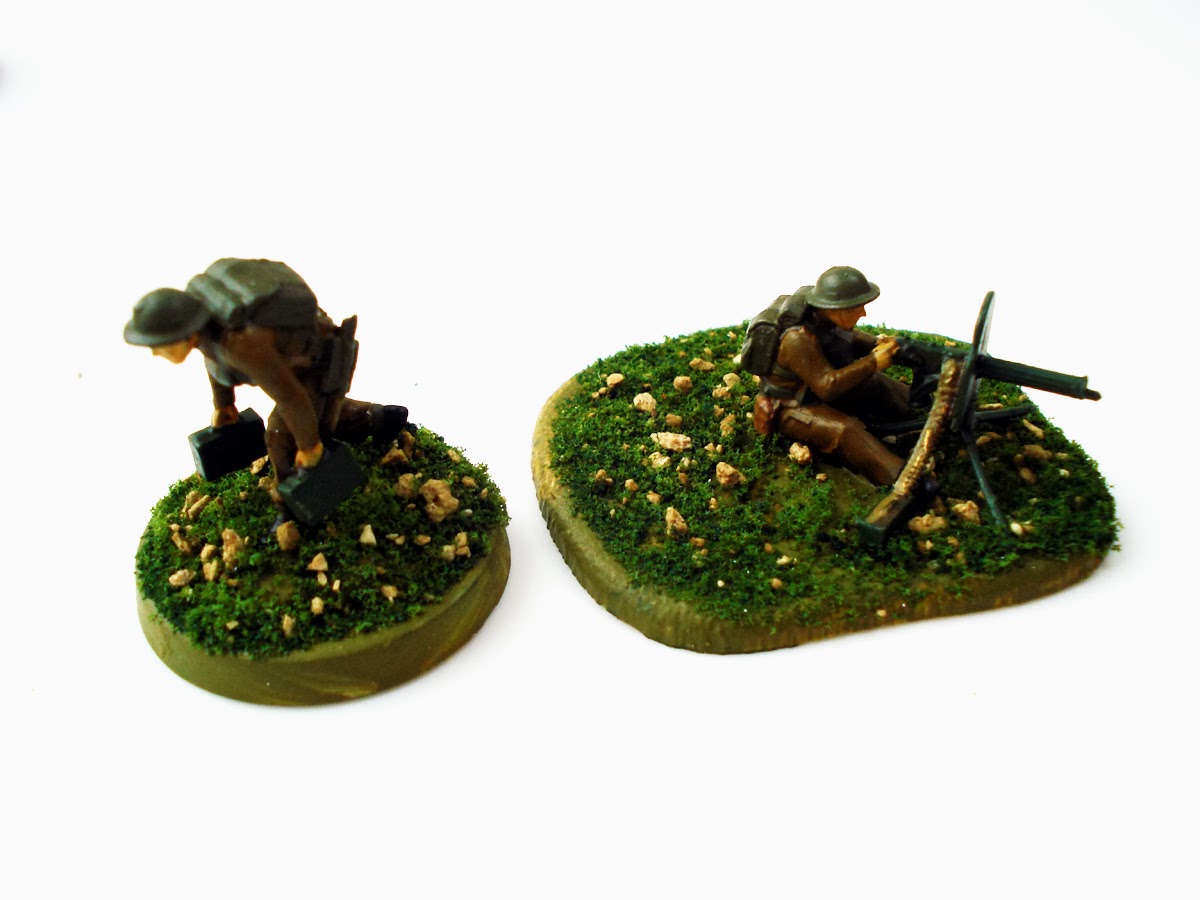
Zvezda British MMG and mortar teams

Still slowly finishing up by Bolt Action British platoon. As I mentioned a while back I went the route of 20mm using minis from Plastic Soldier Co. which is a great buy. The downside is there are not many options for other specialty teams. Finding something at 1/72 scale was a bit of a challenge.

Fortunately for me Zvezda has a range of kits for their own wargame system. The models are nice hard plastic and assemble very easily as they are designed to be snap together kits. I still used plastic cement to keep them firmly assembled. The teams also are mounted on a larger plastic base. So I opted to have mine split up on individual bases.

Overall the models are more in line with an early war uniform scheme, including gas mask satchels. That is a slight problem as most of the Plastic Soldier Co. models I have are in late war gear. However it’s not too disconcerting. Overall as a comparison to Plastic Soldier Co. the models are of the same height, but they do have a slight build compared to the other miniatures.

The Vickers MMG comes with a gunshield on a tripod mount. Not quite sure if that was standard issue with the weapon. So that is a bit of an oddity. I also opted to use a more uniform color scheme for the gun itself. I used the plastic base that came with the kit and altered the mounting so the base would provide 45 degree firing arcs. Just an easier means to handle LOS issues in games.

The mortar team depicts the 3 inch mortar. I might cheat and shed a team member to get some flexibility with the model, waffling between a light and medium mortar team as I toy around with my force list. It’s not quite proper, but I tend to have opponents that don’t might slight proxies with models.

They are nice models and pretty cheap. The detail of the main figures are a little muted. Additionally they are certainly geared more for an early war theater. As specialty teams it’s not much an issue, but I would be hesitant using their infantry sets to round out a force of other models (unless you wanted something like an engagement during Dunkirk).

Traveller homebrew conversion for Savage Worlds

A while back I wrapped up my 4E D&D campaign and we were thinking about our next round of gaming to try out. I had recently picked up the new Traveller RPG from Mongoose publishing and liked the rules and setting for a sci-fi universe. The downside was that it’d be another ruleset for our group to jump into. Also, I wasn’t sure how deeply the group would be vested in trying out Traveller. Some were thinking a few sessions would be fun and then maybe rotate to something else. Again the burden of getting everyone comfortable with another set of rules was hanging around there in the background. So doing something using Savage Worlds was rather enticing.

I decided to write up my own Savage Worlds treatment of Traveller. One thing right off was that I wanted to use the rules as much as I could out of the Mongoose book. The first bit was to convert much of the target numbers and penalties to an equivalent with SW. Another key point was to translate some of the characteristics to SW attributes. I ended up having a print out of those tables handy when I ran a game. So I could consistently scan any rule in the book for an equivalent in Savage Worlds. This made it immensely easy to use tables and charts in the Traveller book. Even starship combat was possible as I could just use the Traveller rules for checks, just translate them to SW die types and numbers.

Character generation was a challenge. I really liked the organic process and mini-game in Traveller. One of the major challenges was to work on converting the list of skills to something more manageable. I truncated a lot of different skills. At the same time, I want some gradation in combat skills. Shooting could encompass too many weapon types, so I opted for some carry over with weapons. Having a high skill level in ballistics weapons like a d8 meant you could also shoot well with energy weapons, just at one die type less (d6). It allowed characters a choice with their progression. They were freed up to consider using skills gained for a variety of other professions if they wanted to. Alternately they could try to focus on having as many fighting skills as possible be all at the same relative level.

Knowledge skills could get out of hand using this rule though. You could have a character gain some specialty in one field and be able to use that as a base for a lot of other skills. So for knowledge skills, I still allow some crossover with its application in other fields, but at two die types less. This for me made a bit more sense. Just because a character had a d10 in Astrophysics didn’t mean they were well versed in Biology. However, with all their training in science, they likely got some exposure to this field of science, so they could get a d6 with Biology checks.

Social standing was also not part of the game. To address this I have a temporary attribute that characters used during character generation. Having a high enough social standing at the end of their career meant they could gain some additional edges.

With this as a basis, you could then go through the charts and tables for character generation and basically get the same result. I truncated the careers somewhat to 3 year terms and capped the number of terms at 4 (or about 12 years). Beyond that you’d get characters getting upwards of 20 skill points which was a bit much starting out. This would cut out some hindrance choices (like the old age), but could be worked around just giving the character longer imagined times of career terms.

It’s far from perfect. You are going to get some divergence in the number of skill points between them, but overall I like how they run. They really match up pretty well with the theme and flavor of Traveller character generation. There is also room for establishing connections and picking up hindrances and edges as they go through the process. These are not very tight and rigid as your typical SW system. You are going to get characters with different skill sets and perks. I’d just run with it. By default I gave characters 3 bennies to reroll any trait or table roll during character generation. You might want to consider having only 2 for a more unpredictable career path.

Of course with all those skills, you needed a new table of weapons and equipment. For the most part it’s a port of the SW weapons with a few tweaks and nods to the technology in Traveller. As I mentioned, I really wanted to keep a lot of the material in the Traveller book relevant, so you can still use the equipment and items from that book for your game.

One small bit I added with starships was the concept of the 100 diameter gravitational threshold. I simplified it to a simple random amount of time that was adjusted by the thrust of the ship. I wanted to give something concrete but still have an easy ruling at the table so a GM could just spurt out a time needed and keep the action going. I like the concept that these routes are predictable. When you jump in (or jump out) to certain systems you will be traveling a common route within the system to minimize fuel use. The danger of this is that these sub-system routes are ripe for pirates (or for security patrols). It’s just a little ‘realism’ to back up why players might run into pirates as they jump into a system, or how security authorities know what route the players are taking when they break out of orbit from a local planet.

As trade and ship upkeep goes, I threw in the towel. I tried to use the freighter a base for figuring typical monthly costs for paying off the ship mortgage and upkeep costs and just gave up. The numbers don’t work out if running simple freight. For this I certainly took the spirit of SW with embracing a simple process over the convoluted rules in Traveller. Every two weeks players can run basic freight that will pay off half their monthly costs for upkeep and the ship mortgage. They keep doing this they can always pay the bills and potentially get a little more cash in thier pocket.

Alternately they can dabble in speculative trading, however they won’t get a windfall like they would in Traveller. Instead they will be able to sell goods at 10% over the base cost. For each raise they get on their Trader roll, they get an additional 5% increase in price. This allows the players to get a little extra money with trade goods, but it won’t be a huge amount like in Traveller. The good news is that players can always unload goods at 25% less the base cost for that planet type if they fail to get a buyer. So they will lose a bit of cash, but not be completely wiped out.

This conversion is far from perfect but it was serviceable for me. It allowed me to use the base rules in the Traveller book and quickly port much of it over to Savage Worlds. Feel free to give them a whirl at your own table.

Note: It’d be criminal not to mention Chaotic GM’s Space Savage Worlds rules. They are fantastic. Use them.

Review: Eminent Domain

From Tasty Minstrel Games, Eminent Domain is a game of galactic expansion where you play fledgling space-faring races striving to expand your empire and become the most influential race in the galaxy. For 2-4 players this strategy game usually runs under 60 minutes. As players colonize planets, research technology, and produce and trade goods, they gain influence. The game ends when the supply of influence tokens runs out, or when two supply decks of action/role cards are exhausted. The player with the most influence at the end of the game wins.

Play is centered on choosing cards representing defined actions. Each player starts off with a deck of cards comprised of each action/role card. As they play the game, they will choose a role taking one from the central supply to add to their deck. So as the game progresses, you are slowly accumulating cards for certain actions (which results in your deck having a focus of specific cards). It’s a slight nod towards deck building, however the choices you have a somewhat limited and not quite the plethora of options in something like Dominion or Thunderstone.

When a player selects a role card, they have the option of taking that action as a leader or following it as a role. The leader option is usually a limited action. The follow role allows them to ‘boost’ or add to the action based on similar cards in their hand. So if a player chose to colonize a planet, they’d pick up a colonize card from the central supply and place it under one of their planets. Then they could add more colonize cards from their hand to that planet, boosting the effect of the role card they selected.

What is particularly enjoyable about role selection is that once a player chooses and resolves a particular card, each player in turn has the option to also take that role action (or they can decline and draw a card from their deck). This is an interesting play mechanic as one of the end game conditions is when two of the central supply decks are exhausted (or one with a 2 player game). So while you and an opponent might be focused on a similar action strategy, if you each keep drawing cards from that supply you are quickly advancing the game to end. You might instead want to hold off and try to follow that role when your opponent selects it, and choose a different role on your turn.

This makes for an interesting choice of either selecting the role you want to play, or possibly branch out in hopes one of your opponents takes a similar role that you can follow on their turn. You’ll find yourself looking at the number of cards they are holding, and the state of the planets in their respective empire. If a player has an uncontrolled planet with a large fleet, they likely will choose a warfare role on their turn. If they have lots of resources produced on their planets, they likely will choose to trade those resources in. Do you opt to follow their role choices, or just pick a similar action on your turn? It makes for some fun play around the table.

Another layer to this is the research technologies. Most are an improvement of the basic actions that players can choose. However some advanced technologies allow for very different strategies. The more advanced technologies not only require more research cards to obtain, but also require controlled planets of a certain type. This means you have to make an investment of several turns to build up towards a higher tier technology, and this can be a rewarding experience when a particular combination of cards plays out, making an efficient influence-gaining engine in your empire.

Another facet of the game is the inter-dependency of different roles. While you may want to focus on settling or attacking planets, you also need to survey planets to add undiscovered ones to your region. If you want to dive deep into research, you have to have certain planet types under control in your empire. You need to focus on a particular role and then be able to switch to another once that foundation is set. As you are adding more and more cards to your deck, you have to determine when is the best time to alter your focus (and possibly think about removing cards that don’t fit your overall strategy). To add another wrinkle in decisions, deciding when to jump onto a role chosen by another player is an engaging aspect of play. All of this accumulates to a fun, interactive player experience.

The Good – You have a fun strategy deck building game that has enough meat for interesting choices and a variety of strategies to try out. The interaction initially looks limited but in play, being able to benefit from another player’s choice leads to a lot of back and forth during turns.

The iconography and design of the cards are well done. The tokens and ships are nice pieces of cardboard and chunky plastic. The central game mat is a pleasantly thick board and not a flimsy paper. While the artwork for some cards might clock in as a bit cartoonish for some it highlights the theme well (having a light touch of humor with some).

The Bad – The game turn revolves around selecting role cards. As the exhaustion of role cards is an end game condition, your engine can take some time to build and only a few turns to utilize once it’s in place before the game ends. I’d also say that card combinations not as deep as other games like Race for the Galaxy. While you have some interesting technologies to incorporate in your deck, the unique ones are somewhat limited. Players might also tend to slip into set strategies depending on the starting homeworlds they draw (which are limited).

Also, direct player interaction is not part of the game. It’s all through a sort of proxy with the selection of role cards. While your opponent can take advantage of roles you select, you can’t really do anything about it. Some looking for a 4X type of game where direct warfare against other players as an option will be disappointed.

Lastly, while the components are good overall I did have some dings in some of the cards and cardboard pieces from the player summaries and starting planets. Nothing huge, but certainly expect to sleeve those cards.

The Verdict – I enjoy Eminent Domain immensely. While it may have what initially seem as flaws with the game, through practice you realize they aren’t really much as a major detraction. The initial feeling is one might find the game repetitive. However you realize much of your overall strategy depends on the first few initial planets you control which actually are quite varied.

Additionally, you really have to be fluid with your plans. If your 3 other opponents are going a heavy warfare route you are just adding to the ending the game faster jumping on the bandwagon (by exhausting the supply of warfare cards). It might be more prudent to shift into another strategic role that’s less focused on by others. At the same time, you really want to be able to jump in on the action of other players’ choices for roles. This all goes on under the backdrop of a deck building game, where you want to also try and keep a tightly refined deck of cards. Dabble into too many different things and you’ll have a hard time getting the right cards you need.

This has sort of become my space empire card game choice as of late, replacing Race for the Galaxy. RftG is a fantastic game and one of my favorites. However the learning curve for RftG is so high, I just can’t seem to justify getting it out to the table as much. Eminent Domain is much easier to teach, yet still has some surprising depth and a little more player interaction than RftG.

Eminent Domain is a good game that combines role selection with deck building elements. It’s got enough player interaction and strategy to make for a fun game. And keeping the game to just about an hour means you can easily get a few games in a single evening. It’s a great buy for an approachable, yet strategic, card game.

Free Firestorm Armada Battle Log

So I have been absolutely inspired lately to do lots of Firestorm Armada-themed stuff. I’ve been working on fleet lists. Also I’m finally getting the itch to work on my Relthoza fleet (might still hold off though as my German platoon and British Bren carriers are giving me sad faces). Needless to say, the game has been on my mind a lot lately.

2E has introduced the battle log. As you destroy fleets, you earn points and lose points for losses you incur. For the most part it’s a form of tracking victory points. However you can also give up points for other strategic aspects of the game. Spending battle log points can improve the chances of calling in reserves. If the difference in points is over 10, command checks are easier. Overall it allows for more accurate tracking of victory conditions and I dig it.

The bum deal is I’ve got no way too keep track of points other than using pen and paper. I expect Spartan Games will release a super cool battle log tracker sometime. However I prefer to get something I can use now, rather than waiting a month or so. So I present here Geek Ken’s Battle Log Tracker, a simple version you can print, cut out, and get to the table right now. It’s simple, functional, and best of all absolutely free. Hope folks find it useful for your games.

Review: Firestorm Armada 2nd Edition

So the 2nd edition of Firestorm Armada (FA) has finally come my way and I’ve gotten a bit of time to go through the book. I enjoyed the previous edition and want to spend most of this post talking about what changes have come about. My impression of the first edition can be found elsewhere.

Overall it’s the same game with a few tweaks allowing for more tactical choices. A very big change is the introduction of MARs (Model Assigned Rules) to each race in addition to rules for specific ships. Also there are now some unique weapon systems that provide different game effects, again allowing for some variation in how the different races play. So let’s sort of go through some of the changes from the previous hardback edition.

Movement is relatively unchanged. However the drift maneuver is no longer an option. I’m somewhat miffed with this as ships are still required to move at least ½ their speed. This means smaller ships are still required to be moving 5″ or so every turn. While cutting engines is always an option, it’d be nice to have a tactical movement option allowing for some maneuverability but still keep it to 1-3″. I might have to house rule something. Hrmm…

[½ speed: A squadron can reduce their maximum speed to ½, allowing them to move at least ¼ their normal full movement rate (and at most, one half of their current maximum move rate). Doing so they gain a ½ move token. The player can remove this token at the beginning the squadron activation to resume normal speed. If a squadron had a ½ move token at the beginning of its activation, the highest speed the squadron can reach for this turn is its normal movement rate minus its turn rate in inches. This will also affect their ½ speed rating. In practice, players will find that smaller (or more agile) ships will not be hindered by reducing speed, while larger ships will take at least an additional turn to get up to full movement.]

Command distance is a big factor in the game now. While squadrons can break up, the entire squad becomes disorganized meaning they cannot combine or link fire. This also becomes a big factor for wings and fighters (more on that later) and can come into play regarding weapon systems too. So the gist is that keeping ships in command distance from each other is a bit more important than before. On one hand I like the idea of keeping ships as cohesive fighting units, on the other hand the tactical flexibility of peeling off a cruiser or two is no longer an option which is sort of meah.

The mechanics of shooting, LOS, damage, etc. for the most part is the same. There are a couple of big changes however. One is the concept of tactical strikes. On larger ships (those with hull points greater than 2), specific systems can be targeted. So players can try to take out the bridge, wipe out weapon systems, or potentially take security systems offline increasing the likelihood a boarding attempt will work. There is a penalty to hit rolls when attempting this but that option of cutting out key systems is interesting.

Another big change is that target ships have -1 damage and critical ratings from attacks landing in their rear arc. This certainly allows for smaller, more nimble ships to slip into the rear arc of larger capital ships and potentially do some damage. It translates into improved positioning of ships and being mindful that the direction of approach to a target is important (and trying to keep a defensive position so no one slips in behind you).

Lastly a huge change to the rules are the introduction of specific weapon systems. Firstly, the 8″ range bands are no longer uniform. Some weapon systems have range bands that increase to 10″ and 12″. Torpedoes now are based on 12″ range band increments also. This means you now have options for increasing tactical engagements at longer distances and disparity of range bands among systems and races can make for some deft maneuvering at further ranges. Additionally, certain weapon systems have bonus effects if they all fire as a single volley of similar weapon types (termed as coherency). This may mean rerolling any ‘1’ results as with beam weapons, or doing higher ranked critical hits with kinetic weapons.

Adding to this is a slew of MARs options that every race has. Further, capital ships have a number of hardpoints. Each hardpoint allows for buying certain systems or small tweaks to the ship profiles (like increasing its move or shield rating). Aside from hardpoints, almost every ship has the option of altering a few systems or incorporating MARs allowing for a lot of racial and fleet variation. To keep things manageable, every ship in a squadron must have similar technology and MARs so you don’t get this mishmash of different tech types in a single squadron.

Damage no longer takes assault teams into consideration, so crew hits only affect the crew rating. This eases some bookkeeping. Boarding actions are also cleaned up some. Every ship can launch at least one boarding action a game. What’s nice is that this no longer reduces your AP, so you can still defend from boarding actions as normal (you just can’t launch another attack). Most boarding assaults are set to destroy key systems in a ship, but can also be used to capture ships so that they fold space off the table. Lastly, instead of a round of point defense and then running the boarding action, the PD and AP of the target model are combined. The boarder makes their attack with the defender rolling this combined pool to ‘cancel’ hits. It’s a more streamlined than before.

Flights and fighters are lumped into a term called, Short Ranged Ships (SRS). Assault craft, bombers, interceptors, and fighters are still the varying wings that make up SRS. For the most part the composition and idea of them being a single unit is still retained from the hardback rules (using a d6 to represent the wings). SRS are now represented as either a small token or a large token but each represent a maximum of 6 wings. Up to two SRS tokens can be part of a single squadron. Overall the means of attacks and resolving them are unchanged, how they actually operate is very different though.

Rather than a unit individually zipping around, the SRS token must always remain in command distance of its parent carrier. If it starts its turn outside that distance they are immediately recalled back to their carrier. Alternately, you can give an order for the SRS to make an attack run where it will approach a ship and try to get within base contact of the flight stand. This makes fighter wings a bit more like an extension of a weapon system for the carrier. They support the carrier directly instead of running off as their own flight group. Further, once they make an attack run they are immediately placed back on the carrier (allowing for rearming and relaunching during later turns). I’ve yet to try them out but the simplicity of their use and the reduced management of not having to move fighters back to a carrier for rearming is nice. Additionally, flight stands that are run off return to the carrier, which can can later be relaunched giving some real teeth to fighters. As dogfighting is the best way to inflict damage on wings, interceptors certainly have an important role in countering enemy SRS.

Fleets are now partitioned off into patrol (up to 800 points), battle (800-1200), and grand fleet groups (1200-2000). Each fleet is further split into three tier groups, where battleships, carriers and such are tier 1, down to frigates and escorts being tier 3 (with cruisers being tier 2). Each fleet must have a certain number of squadrons from each tier. Additionally, up to 25% of the fleet points can be used for alliance vessels that can fit into the tier requirements. For the most part this allows fleet construction to be an easier process. Rather than working off a set percentage of points for fleet composition, the player now has model limits based on these tiers. One gripe I have is that these actual limits and information on squadron sizes are no where in the book. Instead they are available as separate PDFs.

The star admiral is still part of the game. Instead of granting specific bonuses to a particular ship, they allow for the use of tactical cards and improve the chances of making any command checks (ex. checks if a squadron is disordered). Tactical cards are also another feature of the game. For the most part each fleet has the same cards and may have 1-2 additional racial specific cards. These can be played once during a turn to allow for some special maneuvers and one shot abilities. It’d be nice to talk about them more in detail, but I have no idea what the cards do as there are no details on them other than how they are used (another gripe of mine).

A new mechanism for the game is introduced to allow for more tactical options through a battle log. For the most part, players start with a battle log total of zero (but some scenarios increase this). Battle log totals range from positive and negative integers. As players inflict damage on the opponent fleet, destroying ships, their total increases. As they receive losses, their battle log total decreases. For the most part it works as a victory point tracker with the larger the differences between the totals, the more pronounced the victory.

What is particularly interesting is that battle log points can be spent on certain game mechanisms. They can be used to alter die rolls for reinforcements. They can also be used to return spent tactical cards to your hand. This is a very clever system allowing you to essentially give up victory points to gain a needed edge (or recover from a flubbed reserve roll). As players gain points by defeating enemy ships, it further encourages players to be aggressive and inflict damage onto their opponent’s fleets. This really adds a neat layer of strategy to the game (especially the cycling of tactical cards).

The game has 6 scenarios within the book. They range from simple engagements to trying to capture objectives, or control sectors on the board. As a nice touch the book suggests that battles aren’t necessarily in deep space, but rather within key systems. Hence, the preponderance of terrain and close distances of engagement. You are fighting over key areas of control, rather than large ranges of territory, with the scenarios supporting that concept.

The Good – Firestorm Armada has not changed too much and is still an enjoyable naval-fleet-action-in-space type of game. The presentation of the rules and layout is well done. The additional weapon and MARs systems have given the game much needed flavor between the races. And it all works well without requiring a tremendous amount of bookkeeping and cluttered, simulation-type rules.

The book is very nice and well bound, with a pleasant matte finish on the pages. There is a surprising amount of whitespace on the pages so the text is not cluttered. Sections of the book are divided up with margin tags of a specific rule topic on each page making it well organized and easy to reference a part of the rules if needed (not to mention a simple table of contents and index). The book has lots of great color photographs of models, along with simple color graphics for particular rule situations, and also lots of written examples.

The Bad – There is a decent chunk of information missing from the book. Not having a list of the tactical cards is a hefty ding. Not detailing the major fleets and their composition is especially damning. There are no token sheets like in previous editions, and the lack of a template for SRS tokens are especially maddening. The quick reference is a list of charts and no where close to the usefulness of the previous QRS released with the first edition softback book.

The Verdict – If you are a brand new player, Firestorm Armada is a great game to jump into. The big boxed sets are especially nice as they give the player everything needed to play. It might be well worthwhile waiting to pick up the fleet boxes of races you’d like. It is still an enjoyable game that while not quite embracing aspects of physics with movement, still makes for a fun afternoon of space combat. If maneuvering in cruisers to an optimal range to fire full broadsides of anti-matter cannons is your thing, you will certainly enjoy FA.

If you are a long time player of FA, you will likely find a lot here to like. The game finally has some sprinkles and a bit of a swirl in the vanilla of previous racial fleets. The way fighters work are tightened up and make carriers more offensive-type vessels. I think the tactical cards will add some fun wrinkles in the game. All the while the concept of a battle log and spending victory points to have additional tactical options is a great concept. There is a lot here you will enjoy.

The rulebook seems to be missing chunks however. There are no tactical cards, no tokens, no specific rules on actual fleet composition limits (the rules cover how you build a fleet, but don’t have actual tables for the different races). Not having any idea what an acceptable token to represent SRS is another missing feature.

I entirely expect they will be available as downloadable files or separate products (the fleet composition sheets are already available). However it seems that the focus is for players to go pick up the boxed sets that have all of these items. Separate files and products that can be purchased individually are sort of an afterthought it seems. This gives me a bad taste in my mouth. Yes, all my cool models can still be used to play FA, but despite me picking up this rulebook there are still parts of the game missing. It’s not enough. I need to buy more, and not having the tactical cards is the most aggravating thing (where in the past the STAR cards were very much an optional component).

This gives me some hesitation in recommending the rules. If and when these other parts of the game are separately available, I think you’ll find an enjoyable game here. But it isn’t all within this rulebook, and that makes me less inclined to recommend it to current players of FA. There is a lot here that is amazing and really strengthens the game. But if you are just planning on buying the rulebook, then wait. See what else pops up on the website and then make your decision on converting to second edition.

[EDIT: Months have passed and some of the things I chided Spartan Games about that were missing from FA are available as download files now. SRS tokens are available as a separate product (which I still would have liked as a simple cutout token). However the TAC cards and other tokens can be printed out as color PDF files.

Additionally the V 2.0 rules are absolutely free so you really have no excuse not to take a peek at Firestorm Armada now. Enjoy!]
Expeditions of Amazing Adventure: The puzzling portals of Pomdaria

The Pomdarians were an ancient race of lizard folk that created a great empire of arcane marvels. Thousands of years since their demise many of their mysterious monuments still litter the southern jungles. Some legends say that they fell into warring factions, wielding powerful magics that resulted in the destruction of their race.

Other legends speak of a great religious movement which rebelled against their affinity of the arcane, choosing instead to worship primal gods. This divergence in philosophy was so pronounced it actually split the lineage of the Pomdarians into two races, the primal lizardmen and the magic-touched dragonborn (although few historians would be foolish enough to bring up such a topic in earshot of either race).

Still others claim that the great network of portals created by the Pomdarians lead to their downfall. Use of these portals weakened the normal boundaries of the physical world and that of the great beyond. Horrible aberrations slipped into the known world and brought down their great civilization, likely explaining the origins of many monstrous creatures in the world today.

No one can state the real reason for the fall of the Pomdarian empire. What cannot be refuted is that this grand civilization reached an epoch, and in the matter of a few years slid into obscurity, utterly wiped from world existence. One part that remains of their enigmatic past is the sparse number of standing portal gates scattered among the deep jungles.

Many times there have been attempts to map and categorize the portal doors by the League of Imperial Arcanists. Still to this day their efforts have been in vain. One simply knows that you enter the gateway, and emerge from another random portal gate. Most of the gates have been discovered and are within the boundaries of many towns or cities, however the discovery of another portal ruin is not unknown. What compounds the complexity of categorizing these portals is the inexplicable length of time one can enter another gateway. Once a person enters, they cannot reenter a portal gate for up to a week. And when they can do so, it inevitably will lead them to another location.

A few steely merchants are willing to make use of these portals. The gamble is that such merchants will not know where they land and what are the desires of their potential customers. Hence, usually they ply staple goods that will sell in just about any city. What makes this journey even of more risk is that some gates lead to ruins deep within the wilderness. Even darker tales circulate of merchants that enter the portals never to be seen again. Either they arrive at some other gate buried in some deep cavernous ruins, surrounded by foul monsters, or they slip out of this world entirely.

Such rumors are fodder for many companies of adventurers. Stout hearted heroes willing to step into the shimmering ruin gateways in hopes of landing at some undiscovered location. If one found lost ruins of the Pomdarians at some previously unknown destination, clearly there could be riches, or at least find the League of Imperial Arcanists willing to pay handsomely for any maps and proof of such ruins existing.

New fleet documents for Firestorm Armada

As the new version of Firestorm Armada is on the shelves, Spartan Games has put up new fleet files for the major races in the game. From their download section it appears that much of the older files will be slowly getting the 2.0 treatment. So if you are a fan of the game, you might want to keep an eye on the downloads section of their site.

Overall the fleet documents look pretty cool. It seems that games are codified into tiers and points depending on the type of fleet you want to play. For a specific point value game, you have a few choices for each tier. Tier 1 being your command battleship class vessels, tier 2 being the cruisers, and tier 3 being frigates and escorts. The higher point values, the more options you have and the bigger the squadrons. For most of the races there isn’t much difference but some allow for more squadrons of lower tier ships. It’s a bit more regimented than before which I like.

Looking over the ship stats the larger vessels have hard points. You can then pay for specific weapon and defensive systems up to that hard point value. It’s a nice way to tweak your forces and try out different weapon layouts. So not all carriers or battleships are alike.

Model assigned rules (MARs) seems codified now so that nearly every ship save for the smallest frigates have racial special rules. Another layer of variation is that weapon systems appear to have different keywords. There are still primary weapons and torpedoes, but also beam, scatter, kinetic weapons, etc. What is nice is that most frigate ships have the option of also having these special weapon systems. Again, another way to tweak and customize your fleet giving it some flavor.

The profiles for battle stations are also presented. Overall they look like floating masses of guns and hull points. They appear pretty immobile. It might make for some interesting scenarios representing a recon in force or a border skirmish.

I like Firestorm Armada but always felt that the rules didn’t allow for some more variety in the races. It was just little differences, or incorporating more flexibility with weapon arcs (one group had turrets, one had gun racks, etc.). While there were some unique technologies like cloaking, for the most part they were all the same. The optional MARs rules for the different races helped alleviate this but it wasn’t part of the official game. Now they have seemed to have really embraced that concept.

I’ll be blunt, I am a bit miffed that this follows on the heels of a new rule book so soon. Like they wanted to roll out a new book incorporating new ideas, but realized it didn’t go far enough. I understand the position they were in. Either they stick by a rule set that isn’t dynamic enough for the game they wanted, or just go for it and put better rules. For new players, I think this will be a great system. For older players, I can see why some feel a little burned. It’s almost treading on Games Workshop-rollover-of-product territory. But looking at these fleet rules, I am digging the direction they are going with FA. It seems worth getting behind this new book.