Review: Expansions for Kingsburg and Race for the Galaxy

This month I thought I’d post a short review of a few expansions for some of the games I’ve reviewed. Normally I’m not keen on expansions. I’d rather put the money towards a new game. However occasionally I do make the effort to pick up one.

‘Kingsburg: To Forge a Realm’ is from Fantasy Flight and expands on the base game. What I particularly liked is this is a set of mini-expansions rather than one product, allowing you to pick and choose options to add to the game. A while back I reviewed Kingsburg and found it an excellent worker placement game. However one nagging bit with me after several plays with two people was that you could slip into familiar strategies with buildings. The game seemed to thrive more with at least a third person, where you had to be a little more flexible in your overall strategy due to spots on the king’s court being scooped up from other players.

This expansion throws that nagging bit out the window. KB:To Forge a Realm adds new playmats with two additional building rows. Another option is a set of random building rows that throw in small variations over existing ones. When playing with this mini-expansion, you have the option of taking 1, 2, or none, with these building rows entirely replacing ones on your player mat. Between the expanded player mats and the random building rows, you get a lot of variation with the core game.

This variety in play is further expanded with the governor and destiny cards. Players randomly draw a single governor card at the beginning of the game which provide a unique power. Like the random building roles, there are options to allow players to choose a governor (or building rows) by a draft system where victory points are offered as a penalty to their final score. The destiny cards are a new event that takes place every year, which can be a boon or a bane to everyone. These cards are the least enjoyable mini-expansion for me, but definitely adds some randomness to the game.

The last mini-expansion in the box are soldier tokens. All players are awarded 6 tokens with values ranging from 0 to 4 in an unequal distribution. Instead of rolling for reinforcements provided by the king, each player secretly chooses a token representing the reinforcements they get that year. Each player ends the game with one token left over and gets victory points based on its number value.

I have mixed views on this. I like it as it makes for some strategic planning. I can either try to build up my own military and not rely on reinforcements from the king, or push for resources in a few seasons to get victory points (hoping my choices of reinforcements are enough for the coming monsters). It can be a little tense as each player shows what reinforcement tokens they’ve picked (and likely what their victory point bonus will be at the end). However, some people I’ve played with really enjoy the swingy results from the die roll instead. While you always know you can count on at least one set of troops with the die roll, everyone might get a ton, adding some spice in deciding who has the largest standing army at the end of the year.

The Verdict – KB:To Forge a Realm is a tad pricey as an expansion. However it adds a lot and helps expand the variation of gameplay tremendously. The expanded building mats along with random building rows will likely be your new standard for the game. The other expansion parts also add some game variety. What I like is that each part is entirely optional and you can pick and choose which ones to play with. Further, many also allow for a drafting procedure, so that your choices can be even more strategic if you don’t like relying on random draws.
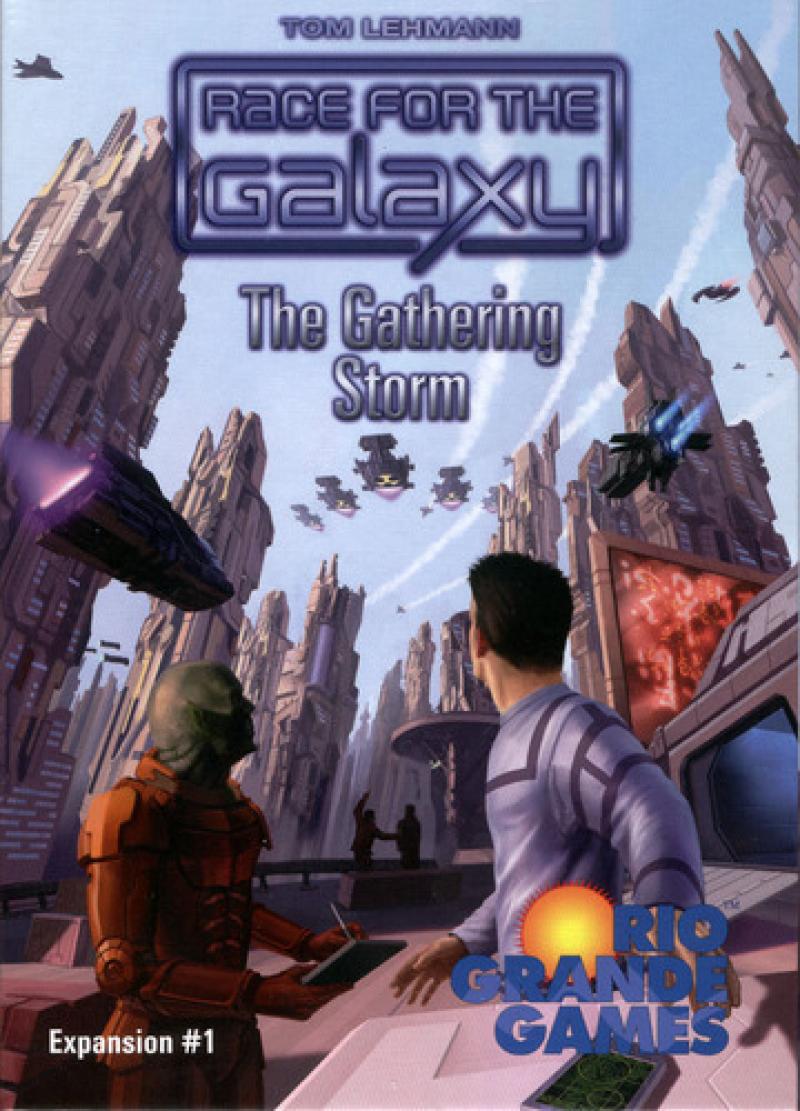
The second expansion I’ll talk about is ‘The Gathering Storm,’ an expansion for Race for the Galaxy from Rio Grande Games. RftG is a a favorite of mine however I felt at times having a limit of just 4 players could put a kink in my gaming plans on some evenings.

This is the primary reason why I picked this up, as it has action cards for a 5th player. However there are some other goodies in the expansion to add a few wrinkles to your typical game. There are new starting homeworlds with a few introducing some interesting properties, and handful of new development and planet cards. In this sense, the expansion is a tad lacking. While the new cards provide some different options and strategies, it’s not quite a mother load of new cards you’d expect in an expansion.

The other optional part of the expansion introduces special victory point conditions. Players randomly draw two 5 victory point tiles and four 3 victory point tiles. The 5 VP tiles are for players that have the ‘most’ for different game conditions (such as players with the greatest military, or the most developments). The other 3 VP tiles are for the first player that achieves that condition (like the first to get 5 VP, or build the first 6 point development). There are a few extra tiles, each being unique conditions, so there is a decent amount of variability with the point tiles where you aren’t always seeing the same bonus VP conditions. However the number of included tiles is not huge (6 of the 5 VP ones and 8 of the 3 VP ones) so you can expect to see similar tiles crop up with repeated play.

I see this part of the mini-expansion as mixed bag. Some might enjoy it while others may think it takes too much away from the core game mechanics. I like the victory point tokens, especially with 4-5 players. You can get a little muddled with your initial plans. As so many cards can get drawn and discarded by other players, you might find that specific card needed for a combo quickly lost in the discard pile. Having other smaller goals out there to give a boost to VP is a nice option. Even better, I like the ‘first player tiles’ as they can provide an incentive to quickly chose a direction for developments and planets to scoop them up. While the VP bonus is small, it does add up and can help repair a sagging 6 point development that isn’t getting the optimal synergies of other cards in your play space.

The last part of the expansion is likely the best reason to buy Gathering Storm, solitaire rules. I will admit the rules are a bit rough to wrap your head around as there are additional icons to decipher and the mechanics are not very intuitive. I had tried a few times and continually threw in the towel as I felt the mat icons and turn procedure could not be readily understood. Fortunately I stumbled upon this wonderful tutorial that really helped me grasp the concepts of the solitaire rules.

You pair off against an automated system where the ‘opponent’ chooses actions based on rolling special dice. You choose your actions and play normally, and the artificial opponent will play out its turn using specified actions based on a special playmat. Like the original game, you each have a tableau and starting homeworld. What is interesting is that based on the homeworld chosen, particular action options are altered to improve the play of the artificial opponent.

You get this semi-reactive play going. Where you settle a planet or place a development, and the artificial opponent likely does the same. As you are producing and consuming goods, the artificial opponent also racks up VP. You are in this constant race to maximize your actions as the clock to end the game is constantly ticking. The only complaint I have is that action selection is not as nuanced as in a regular game. While particular options are more likely to be selected by the artificial opponent, and some results will even mimic your choices, essentially it’s choosing its actions based on a die roll. Nonetheless, I found the solitaire rules very enjoyable and challenging.

The Verdict – I cannot recommend this expansion as a must have. The additional cards and homeworlds are nice (especially the new homeworlds which almost double the options in the base game). I like the VP tiles, but it’s very optional and does alter the theme of the core play somewhat. If you found yourself really needing a set of cards for adding a 5th player, this might nudge the expansion a bit more into the must buy column. This is nowhere near the value of KB: To Forge a Realm where I simply cannot see playing the base game without it. The Gathering Storm is very much a take it or leave it expansion.
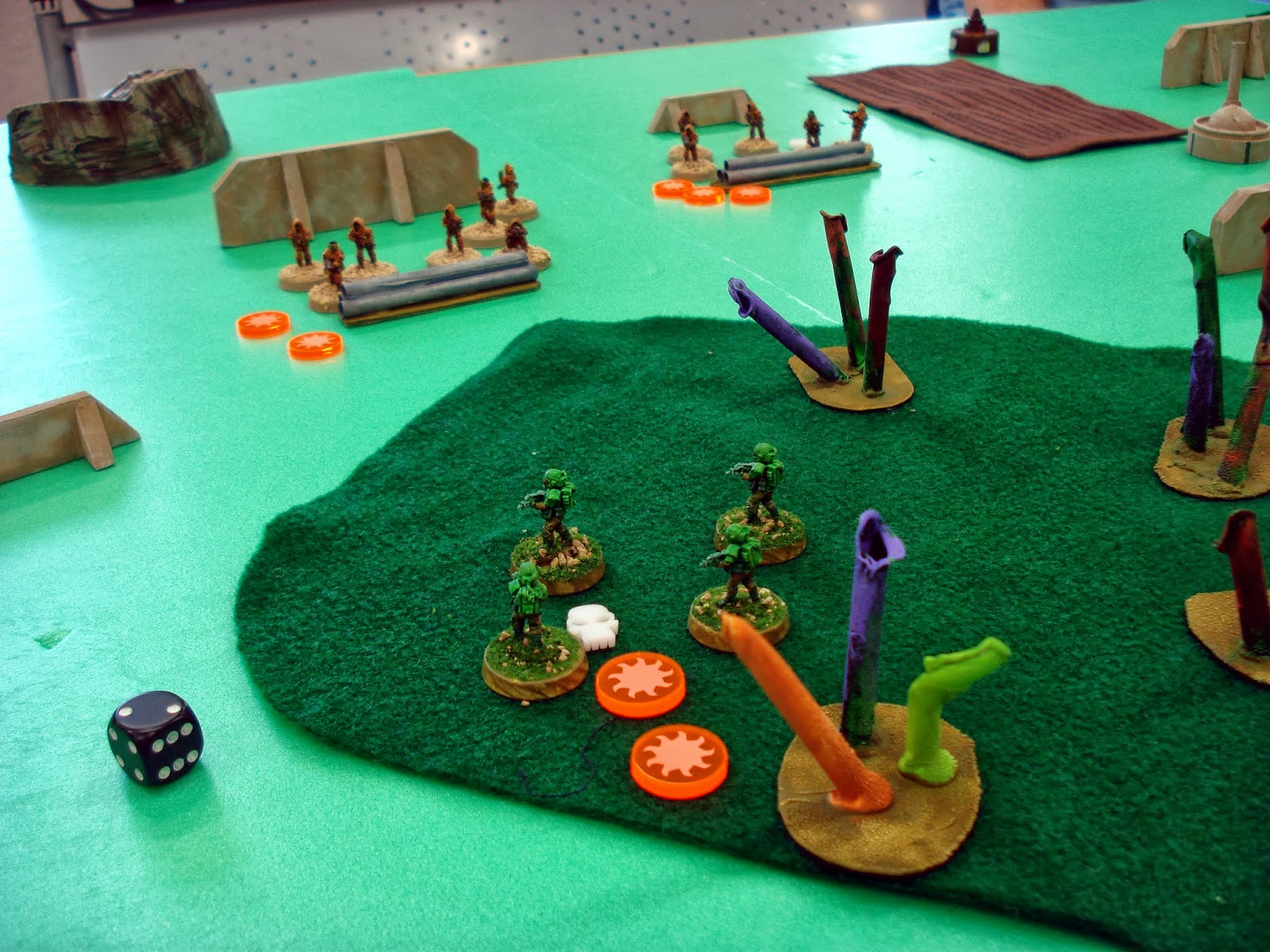
Bolt Gun Action: a sci-fi themed version of Bolt Action WWII rules

I’ve gushed quite a bit about Bolt Action and how it seems to scratch my itch for WWII skirmish gaming. The game can be well…. very gamey in handling combat. It isn’t a simulation rule set and it handles a lot of situations in an abstract way, not to mention a lot of wild mechanics. Also some can slip into min-max armies when crafting their force lists. Still it captures platoon-based action pretty well and also plays fairly quick without getting bogged down. It hits more high notes than flat ones, making it an enjoyable set of rules.

I’ve taken to it so much, it’s really spoiled me compared to other rules. I just haven’t found something that combines random dice order activation with a pinning mechanic quite like Bolt Action. So I figured why not just slap a sci-fi theme onto Bolt Action and see what comes out of it. The result is Bolt Gun Action. This isn’t a complete re-writing of the rules. Instead it’s pretty much the very same WWII game with some very small tweaks.

Rather than trying to get an entire point list together of new troops, I’ve defaulted to using a single army list as a baseline for points. Rifles are the normalized small arms. Basically it’s the game right out of the book with a smattering of new troops and added HQ options. I’ve also whipped up a quick reference sheet with the added rules included.

It’s pretty fun. Just your regular Bolt Action game with a few changes. I’ll likely give the rules another pass in a few months, but for now feel free to pilfer the links and I hope folks get some enjoyment out of these rules.

Stack and Attack Kickstarter Preview

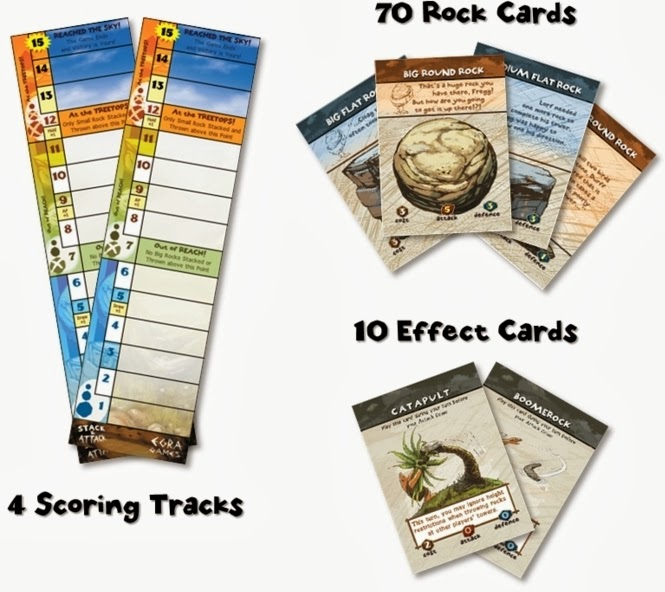
Currently on Kickstarter Stack and Attack is a small deck-building game from Egra Games. For 2-4 players, this game has the players as cavemen from the past trying to appease their primal gods by stacking the highest pile of rocks possible. Each tribe is trying to gain the favor over other tribes. So rather than just focusing on building the largest shrine, why not hurl a few rocks and knock theirs down instead? What results is an all out war of hurling rocks while trying to frantically build up your own tribe’s shrine.

Players each start out with a similar deck of cards representing rocks of different sizes and shapes. During their turn they have up to 4 action ‘points’ to spend on either stacking cards from their hand onto their pile, adding cards from a common pool into their deck, or attacking another opponent’s pile of rocks. Each task requires a number of actions with larger rock cards requiring more points. Each rock type has different defense and attack values. Further, rocks of a certain size can only be placed so high in the stack. The further you get your pile up, the less chance you can put the larger, more sturdy, rocks into your pile.

When attacking, a player picks a rock out from their hand and targets a specific rock in their opponent’s pile. The players then have the option to draw additional cards from their decks to add to attack or defense values. The player with the highest total (attack vs defense) wins the round. The defender not only counts the defense value of their targeted rock, but also all the rocks stacked on top of it. So as a player gets their rock pile stacked up, the base of their rock tower is much sturdier.

If the attack is successful, the thrown card and the targeted card are discarded from the game. That precarious pile of rocks above the targeted rock? Well they go tumbling down back into the defender’s deck. However, if the attack is not successful the attacker passes their thrown rock over and the defender gets to add it to their deck.

Aside from throwing rocks, about a quarter of the deck are various effect cards. They do relatively simple bonuses like add to attack/defense values, or allow more actions to be taken during a round, to even boomerang rocks that return to the player’s discard pile (regardless of the outcome of the attack). It’s a nice addition to give some variation to the basic rock types. At the end of the player’s turn, they shuffle their hand into their deck and draw a new hand of 3 cards, allowing them to pick up any rock cards they bought from the common pool for use on their future turn.

At the heart of the game is a choice of either attacking your opponent, or trying to build up your pile. As you pile up rocks, not only are you increasing your victory point score, but you also get bonuses action points and can have a larger hand. Heavier, more potent throwing rocks, can’t reach higher stacked rocks in a pile. Also as a player not only takes into account the defense of their targeted rock, but all the rocks stacked on top of it, you might very well get a foundation of immovable rocks. So each player is in a race to get their stack as high as possible and as quickly as possible.

Due to the stacked defense bonus, it can be exceedingly difficult to knock over a key rock in an opponent’s pile. To prevent that you might have to attack a certain rock in your opponent’s stack before it gets too big. All the while, you might end up with cards you can’t use (some big rocks cannot be thrown or stacked within a pile at a certain point). So you might have to try and either attack while you can, or even pick up needed rocks from the common pool. In the end, it’s pretty interesting management of actions during your turn.

When cards are purchased from a common pool, they are immediately replenished from the game supply. As rocks are being thrown about, they are discarded from the game. So eventually you will be running out of cards due to crushed rocks lost in attacks. When that happens the game ends. The player with the highest stack of rocks on their scoring track wins the game.

It seems a fun, light strategy game with a cute theme. There is a decent variety of cards, where not only are they small, medium, and big rocks, but also being either flat or round offering different attack and defensive values. It’s made their target funding for the game with a few weeks more until the campaign is over. You might want to check it out if looking for an enjoyable card game.

Awful controllers? It’s the DM’s fault.

It seemed that controllers always had a hard time finding a place around the 4E table for most folks. As an archetype, it was a bit at odds with the other combat roles. Defenders had tools to soak up damage. Leaders were able to crank out the buffs and heals. Strikers poured out the damage. All three of these roles worked in just about any combat encounter.

The controller required other factors to shine, unfortunately meaning certain environmental layouts and monsters were needed to show their effectiveness. Sure they could get a few heavy hitting attacks, but smaller bursts of AoE damage were more common. Even more so, with slows and obfuscating/hindering terrain effects, they needed the space and the right positioning of creatures to really strut their stuff.

I expect that was part of the reason wizards always seemed to under-perform. It’s just that other class types could do things in combat that would work in just about any type of fight. Meanwhile, the wizard was more situational. Sadly, that meant they were really dependent on the DM to provide opportunities to allow them a chance to fully express their abilities and powers. So what are a few things a DM could provide in a fight for a wizard in the party?

Lots of minions – A core aspect of many controller powers are area of effect attacks that do a small pip of damage. Having plenty of targets and more importantly, some clustered up a little, is a decent boon to your party controller. While I don’t use lots of minions in every fight, sometimes it’s good to really fill out the ranks and give that controller plenty of targets to pop.

I try to play the opposition smart, but having those minion types more keen on keeping ranks than spreading out is something I also employ once in awhile. Usually I’ll give that third minion a chance to stick with another creature when I move them around by rolling a d6, just a simple 2 in 6 chance to have a few cluster up. So a few encounters with lots of minions (and the occasional gang of baddies clumping up) is a decent way to give a nod to the party’s controller.

Foes coming in different directions – Having simple battle lines where players can close ranks can make for some solid tactics. But continually allowing this can quickly mean the players can easily manage the engagement and the use of a controller diminishes. When you’ve got multiple monsters piling in from different directions, it’s a great opportunity for that controller type to hinder movement of some targets, giving the other party members time to engage one side first.

Creatures needing to close in – I usually like to mix in ranged attackers in most of my combats. I like to ramp up the threat so that folks not in hand-to-hand still need to worry some. However I lean towards making the melee monsters the more resilient types. And when rolling out creatures in waves, I make sure it’s those melee monsters needing a turn or so to move into the fight. It’s a means to allow the controller to do their stuff and hinder movement of creatures charging in. By tying up one or two targets the group can focus on other monsters first. The group plays smart and everyone has a chance to do something cool.

Traps and hazards that affect both foes and friends – Layering on a wall effect, or some area power hindering movement can add to it’s effectiveness if plopped down next to a few squares of hazardous terrain. Effectively you are adding another 2-3 squares of area under a wizard’s control effects. Give them a chance to do so. A small burst area with flanked by a spiked pit now provides a larger area that’s been locked down.

Sometimes it might lead to monsters preferring to chance a hazard over a spell effect. Does the goblin jump off an elevated platform risking a serious injury? Or do they sit by and let a flaming sphere roll over them? Likely they’ll take the 20’ jump and take their chances. Either way it’s a win/win for the controller.

Take a peek at the PC’s character sheet – Give a look over their powers. Think of some environment that would show off that power. Knowing the abilities of your players can allow you to occasionally craft some fights that allow these powers to be used effectively.

Not every fight has to utilize there tips, but I’d seriously consider giving at least one encounter in a typical delve a few of these characteristics if you’ve got a controller-type in your group. Controllers really need a few wrinkles in your typical encounter makeup to shine. So once in awhile, try to oblige and allow them to enjoy that choice they made playing the wizard.

Firestorm Armada 2nd Edition Announced

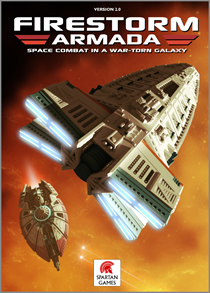
A while back I lamented the release of the rules for Firestorm Armada. I’m a fan of the game and figured with the free rules being released, that was pretty much a death toll for the game. Well it seems like FA is getting a second edition treatment of the rules. And much of it looks pretty good.

I am digging the options for altering ship systems on the fly, granting more power to movement or defensive systems. I am also really excited about the different alien race weapon systems. When Dystopian Wars was released, they really got into the model assigned rules giving units some flavor. FA screamed for this treatment and MAR stuff was released for the game, but not really developed. A racial MAR document was floating around, but never really was folded up officially in the revamp of the rules. Looks like the second edition will address that.

We’ll see how it pans out. On one hand, I’m happy to see the rules getting a revamp. On another, I feel a little burned that the turnover with the rule books were so rapid. Hopefully it won’t sour folks too much on giving FA a try. I really think the rules needed a revamp. The ‘reprint’ of the first edition cleaned up some rules, but didn’t add much to the game. It does look like you will get a much deeper, tactical treatment of space fleet combat. Hopefully Spartan Games can shed it’s image of rapid turn over of rules to give FA some legs.

Expeditions of Amazing Adventure: The grasping overgrowth of Gymynda

Deep within the western forests was the famed city of Gymynda. Carved from the wilderness from pioneering humans, it established itself as a trading hub for the many tribes of the forest elves. A wary peace was struck long ago from the great elven chiefdom of Aldarianna Moonlight. Her wisdom and patience with the human settlement fostered a long relationship of mutual benefit and trade. At times relationships were strained, especially when some industrious humans of Gymynda struck out too deep within the territories claimed by elves, but her steadfast resolve for peace usually silenced any voices of violent reprisals.

Many claim it was her passing which sealed the fate of Gymynda. For many generations of cityfolk, the elven tribes were seen as good neighbors, even allies in times of need. However the Grand Chief Aldarianna Moonlight’s health began to wane from a mysterious illness. Despite the efforts of elven shaman and learned human healers of Gymynda, she slid further and further into a drifting malaise, as if her very life was being siphoned away. Within years she eventually succumbed and fell into a deep sleep and in days she had slipped from her mortal husk.

The death of their great leader was a time of long mourning within the elven tribes. The lead council of Gymynda also decreed a month of mourning among its citizens, but while the Grand Chief was respected, many of the folk within Gymynda did not hold the same reverence for her as those of her elven followers. Within a week mourning dress among the city dwellers began to lift and in short time life went back to normal. After all, many felt there was still coin to be made with trade, trapping, and farming, and some even felt it an ideal time to claim untapped ranges of forest for logging.

No one knows what caused the great growth. Some would claim it was a wicked curse brought about by elven shaman, to inflict their wrath on the humans that failed to show proper respect during the passing of their leader. Others say it was great magics wielded by the elven tribes to stifle the further expansion of Gymynda. Some state these elves knew with Grand Chief Moonlight now gone, the city would begin rampant expansion within their borders.

However a far more sinister tale is sometimes spoken. One of dark magics brought on by avarice from some within Gymynda, quite possibly a dark pact with demons to inflict a curse on Moonlight that would sap her very life force. A horrible spell with terrifying unseen repercussions.

For over a decade Gymynda prospered. The city grew and industry thrived. Great logging guilds reached deep within the thick woods. As the city developed, so did their men-at-arms and militia. The elven chiefdom broke apart as individual tribes had squabbled among themselves. Some sought peace, while many were willing to aid Gymynda in expanding into the lands of rival tribes if it meant keeping their holdings untouched. The wealth and affluence of the trading merchants and craftsmen guilds swelled within Gymynda. Gone were the days of hearty pioneers as opulent ways were adopted among the more wealthier citizens.

Then, on the sixth full moon of a new year, the cursed growth sprung up within Gymynda. Its citizens woke in horror to find buildings overgrown in thick vines. Young trees and grasses burst forth among cobbled stone streets. More terrifying was that some were found entombed in thick vines, suffocated and serving as a morbid bed of blood red flowers which covered their corpses. Efforts to hack away at the vines and trees were a herculean task. A man would go through several steel axe heads and only manage to make a paltry clearing. On the next morn they would find their efforts worthless, as new verdant growth would replace any cleared areas.

However all of these events paled to what soon followed. The denizens of Gymynda soon found themselves to be growing like the land around them. Patches of skin became covered in thick moss. Blood red flowers emerged from ears, eyes, and mouths. Bodies stiffened as their very limbs began to sprout tendrils of thick roots and vines.

Panicked people fled from Gymynda. Those that sought refuge with the elves were turned away or slain, the elves burning the bodies that remained with ritualized magics. The forest elves knew that dark primal magic was at play. Those that were afflicted could spread the sickness to others and they had to be held at bay through any means. Word of this spread to neighboring kingdoms, and when similar afflictions were seen among villagers that interacted with the stricken people of Gymynda, these lords also decreed to slay any that appeared from the forest.

A century later, some say the ruins of Gymynda can still be made out among the clinging wild of vines and trees. Some have claimed to have explored such ruins, but few can be believed. As to this day a shambling figure can occasionally be seen shuffling out of the forest edge towards neighboring villages, horrid creatures bent on engulfing large animals and man alike in tendrils of writhing vines.

Some village leaders adopt a proactive stance, encouraging adventurers to make expeditions within the deep forests and clear out any cursed beings that they may find. Some are even willing to pay coin for those that do. All the while, one can always manage to hear tales spoken after several pints in these village taverns. Tales of how sudden was the overgrowth that choked the life out Gymynda and its wealth would likely still be there, hidden under a carpet of moss and vines. All of it just waiting to be plucked up by those brave enough to enter within the cursed ruins.

Review: 13th Age

While it’s been available as a pdf for some time, the hardback rules for 13th Age from Pelgrane Press are finally getting to folks. For a long time I was on the fence about this. I was happy with my 4E game but the more I played, the more flaws with the game came up especially as my group leveled up. PC power glut was a big issue and I thought up a few potential tweaks to trim the list down. I even considered consolidating at-will powers and altering the basic attack to make it more attractive as an alternative. It sort of was swept under the rug compared to other at-will attacks for PCs. Lastly, I really wanted some way to give players an option of pouring out the damage, and considered using healing surges as a means to do so.

So last week I decided to take the plunge and pick up 13th Age. As I glanced through the rules, what I found particularly interesting was that most of the beefs I had with 4E seemed to be addressed with 13th Age. It’s not entirely surprising as one of the designers was also involved in creating fourth edition D&D. But I particularly liked how much of the glut of temporary modifiers and ever-expanding power choices in 4E were removed, making the game seem much more fluid and engaging.

13th Age is a high fantasy rule set based on the d20 system. No bones about it, I’ve heard this described as a love letter to 4E and I can totally see the imprint of that in the rules. What makes this stand out however, is how many good things it took from 4E, while dumping the extraneous bits, making for a slimmer, fun ruleset. Those at home with 3.5 will also find some familiar territory here, but I think more of the roots with the game are with 4E.

The game relies on many standard choices for races (dark elves are an option) and classes from past editions of D&D (no monks, druids, or shaman). Multiclassing officially is not part of the ruleset, but certain classes can definitely dabble in other class abilities with feats or domains. There is a bevy of your typical high fantasy monsters and a decent list of magic items.

It’s still d20 D&D here. You have levels, 6 ability scores ranked from 3-18, AC, hit points. A nod to 3.5/4E much of the mechanics revolve around rolling a d20 over a set DC value. As with 4E, there are specific defenses for spells and effects where players roll against listed physical or mental defenses. There is initiative and everyone attacks in that order during a typical turn.

Healing is very loose and liberal. As with 4E (and DnDnext) each class has a number of recovery dice that they use to recover HP. And as an action one recovery can be used during combat. Characters have death saving throws, and ample means to heal themselves. Clerics aren’t required, but their abilities definitely supplement the party’s healing potential greatly.

Similar to DnDnext, there isn’t a formal list of skills. Checks are made in a similar fashion, rolling against static DC values for easy, hard, and difficult checks. There are different main tiers, from adventurer, to champion, to epic with resulting DC, defenses, and attack bonuses from monsters and hazards scaling upwards. These are spread out from levels 1-10 however. Correspondingly monsters also have defenses, HP, and attack bonuses that scale up. However you will see certain creature types plateau. So don’t expect to see a variety of kobolds that range from level 1 to 4 like in 4E.

Character progression and advancement are familiar. Players add a level bonus to attack dice, skill checks, and defenses. Hit points increase incrementally, as do ability modifiers (resulting in some changes to defenses). Also a regular advancement of feats and spells are rolled out, resulting in every level bringing something to the player gradually increasing power and abilities. One particular change I like is that many class options don’t necessarily mean a brand new ability, but rather can improve on those they already have. While wizards and clerics can expect a new spell or two as they advance, most other classes will get more utility out of their attacks and abilities.

I’ve covered some things that are similar, now onto things that make 13th Age stand out. There are many aspects of the game that allow for character customization. Skills are not present, rather a player has so many points for backgrounds instead. These PC backgrounds highlight past experiences and history. If the DM thinks it has an application to the task at hand, they provide a bonus. It’s very freeform and supplements the simple ability score checks of the game well. There are a wide variety of feats that confer small bonuses and little tweaks to abilities.

This ties in very well to the abilities (read powers) of the character classes themselves. Many of the game mechanics revolve around the d20 roll. Some situational bonuses come about on a miss, rolling 16+ on the to hit roll, to hits that are an even result. This gives some varying situational benefits to combats. Feats expand on these abilities, giving some even greater effects when they trigger, or possibly adding more predictability to when they do. Because characters start out with a fair number of feats and continually expand on them, they gain a lot of customization. You can end up with two level 3 fighters that have very different abilities.

Another key aspect of combat is the escalation die. After the first round of combat a simple d6 continually goes up from 1 to 6, with the current value granting players a bonus to attacks. Monster abilities also can interfere with this. It’s a nice tool in preventing fights from dragging on and keeping the action moving, encouraging the combatants to be proactive. Combined with situational powers related to attack results, you have combat that is engaging and less about just a hit or miss result with attacks.

Combats are also very much within the theater of the mind. Creatures are either engaged or not. They are either nearby (within a standard move) or far. They are in cover, or not. Attacks of opportunity are there, but with a simple check, players can slip away if needed. Likewise, unengaged creatures can intercept others trying to slip around them. So there is some tactical movement, but nothing rigid requiring a grid to run a melee.

Leveling up is also fast and loose. No experience points are awarded. Rather, GM’s are encouraged to level up the PCs when they feel appropriate. A rule of thumb is after three to four major resting points players should advance a level. Each resting point is after 4 major fights. So after about twelve to sixteen melees, the players should have enough under their belts to level up. The focus of the game is when it’s dramatically appropriate though. So after achieving a major quest is perfectly acceptable too.

Magic items are split into two camps. Your mundane consumables in the manner of oils, potions, and runes that provide a simple mechanical bonus, and that of permanent items. The consumables are made to be your typical one use, throw away items that are actually rather mundane. Magical permanent items however are meant to be special and wondrous, each with a personality. You aren’t going to run into a simple +1 dagger but you will have one that has some history or quirks to it that encourages more story effects in the game.

Two additional points make 13th Age stand out from other RPGs, a player’s one unique thing and icon relationships. Every character will have one unique characteristic that makes them stand out from others in the world. It’s geared towards a background-centric or plot device, rather than some game mechanic benefit. This is decided at character creation and can be a relatively simple concept (they are the 5 times grand world champion of dwarven ale drinking) to something grander in scope (they are the long lost child of the Elf Queen). How this affects the game is something played out as campaign unfolds with input from both PCs and the GM.

The other major point is the concept of icons and the relationships PCs have with them. There are 13 icons within the game, each being an actual individual in the game world. Consider them the movers and shakers of the world, main factions and seats of powers that employ many agents within the world to do their bidding, and this includes the characters. Players can decide on their relationship with certain icons as being positive, conflicted, or negative. They start with 3 d6 and can allocate them as they will among the many icons.

Some may want a more prominent role within the circles of a particular world power, while they may want to be the bane of a certain 13th Age icon. At the start of the session, each player rolls their relationship dice and results of 5 or 6 (5 means there are more complications along with the boon) ensures that at some point in the game, the player will have assets of that icon at their disposal. That at some point, the icon (or agents on their behalf) will seek out the player and impart some timely advice, offer some resources, or potentially some task or quest for the player. It’s an interesting idea and very much helps drag the players into the world, ensuring they have the ear (or the wrath) of major powers within the game.

The Good – It’s a nice package for D&D. The mechanics are uniform, with enough working parts and customization to make for a fun game. I think it would be very approachable to new players. Elements of the game are familiar with enough small situational conditions to make combats enjoyable and move well. I particularly enjoy how most of the fiddly bits for combats are swept aside and more emphasis is on the players pulling off big moves or big hits. The game encourages the players to engage the GM and be part of the overall story. Best of all, everything needed to play is in a single book.

The Bad – It’s D&D. You have HP, AC, attack bonuses, nothing here that is completely groundbreaking. The aspect of the 13 icons in the world are interesting, but that does add some limitations to the game fluff. Your default setting is high fantasy and revolving around these major world powers. You can totally go off the rails and make your own, but this will take some effort to ensure all the player options fit well with your custom icons.

The biggest damning aspect of the rules is while I think a new player could get the gist of the game very easily, it does require an experienced GM. The icon relationship dice mean as a GM you have to be willing to improvise and be flexible with the story you are telling. While some of the mechanical aspects (skill checks, level appropriate monsters and challenges) are well laid out and understandable, there is a lot more skill needed to running an effective session. This hurdle is recognized in the rules, but I think it also is a major detraction to the game. YMMV with this game as how well a GM can weave in the icon relationships during a session is key.

The Verdict – 13th Age is a good game. I think it’s very much a great introduction to fantasy RPGs and if someone wanted to play ‘D&D’ you could do well with pulling this book out instead. For fans of 4E and 3.5E, both will get a lot of enjoyment out of the rules. It has familiar aspects of play with enough wrinkles to make it enjoyable. If anything, this could certainly be considered for 4E fans a nail in the coffin for starting up another 4E game.

It’s not perfect. There are major default setting choices with the game. It’s one of high fantasy. You have established movers and shakers in the world. It is entirely a game of heroic adventurers (level 1 farmer peasants need not apply). But if you want to play a game where you are big damn heroes, destined for greater things, and well-connected to the pillars of power, 13th Age is for you.

There is a lot here that works. Play and options are streamlined enough to not be overwhelming, but still offer some customization. What I particularly enjoy is that there’s a balance between simple mechanical bonuses and others related more towards the story of the character. You don’t have a simple diplomacy skill, you have a strong background in the Emperor’s royal court. You don’t have a skill in tracking, you were a lead scout for a barbarian warband in the last goblin war. This stuff oozes with story and fodder for adventures. Along with the one unique thing about your character, you have something that stands out from other RPGs, giving a more interesting spin on character creation than what’s seen in other games.

One very strong point about 13th Age is that everything needed to play is covered in one single book. It’s a low entry into RPGs and something akin to Pathfinder. I will say it can be tough to justify buying 13th Age if you are heavily invested in other fantasy RPGs. Nothing here is absolutely groundbreaking and it falls heavily back on a very familiar d20 system. Between the different camps of D&D, I think 4E fans might enjoy this a tad more. As for people into Pathfinder and 3.5, they may very well like the more streamlined character creation, uniform mechanics, and opportunities for dynamic (at times chaotic) combats. There is a strong emphasis for story and weaving the PCs into the world, much more so than in some other systems. But like any RPG, it does come down to the DM and how much they can make the game fun for all involved.

My final take, 13th Age is a good buy. It has some interesting concepts you could lift for your own game, however it might tread a bit too much on the familiar for some. This is a d20 D&D game. For some it could be very well their ONLY D&D game. As a big 4E fan, if I were to jump back into D&D, this would certainly be my game of choice. It’s a tad rigid for the setting and requires a more dynamic approach to planning out your sessions, but there are some fun things in between the pages of the rules to make it worth your time.

The Agents: a Card Game on Kickstarter

I’m sometimes on the prowl for new games through Kickstarter and a recent campaign really got my interest. The Agents is a turn-based card game that has a great theme and looks to be an interesting take on card-based mechanics.

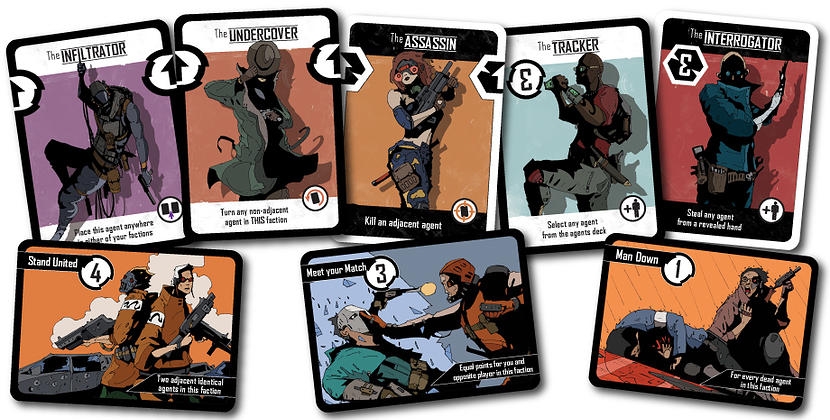
Developed by Saar Shai, players take the role of independent intelligence groups controlling recently disenfranchised agents. Without clear instructions, these agents try to navigate a new world where they go to the highest bidder in a world of secrets, deception, and treachery.

As a player in the game, you are trying to accrue a set number of points employing a group of agents that is shared among your opponents. A really neat feature of the game is that the orientation of the card dictates how it plays for both you and your opponent. Most agent cards have abilities tied in with a particular role. If you want to use that ability, you are offering your opponent points. If you choose instead to gather points, the ability of that agent is now under direction of your opponent.

Not only are points needed to win the game, but they are also used as a currency to buy more agents and missions. With constant swapping, removal, and addition of agents, you get this constant ebb and flow of points. It seems to have some interesting ideas and looks like a lot of fun.

I’d be remiss to mention the artwork from Danny Morison. It captures a gritty look with a touch of sci-fi, almost giving the game a near-future dystopian feel. The game rules and a print and play version are available. The Kickstarter campaign has a few weeks to go however they have already secured project funding. It might be a great time to pick up the game and maybe get a few additional stretch goal goodies. At $18 for the base game, it seems a nice deal for an engaging card game with a great theme.

[EDIT: So the kickstarter was successful and I picked it up. Elsewhere you can get my thoughts on the game.]

Savage Worlds player cheat sheet

SWcheatsheetJust a short post today. A long while back I prepared these cheat sheets for my players when we started up Savage Worlds. I just wanted a quick reference for them to cover much of the nuts and bolts of the game, without them having to rely on constantly looking stuff up in a book.

It’s a pretty simple sheet but my players have found them handy. I opted to print them out at half the size and laminated them for resisting your typical table of snacks and drinks. The text is a bit small but readable and the smaller page size helps keep less clutter around the game table. Enjoy!

Improvising 4E encounters

At first I was a bit hesitant about creating encounters on the fly for 4E. I slipped into this mindset about planning everything out. While I still feel combats in 4E worked much better as set pieces, at times PCs might go off into another completely different direction. When they did that, I felt combat likely shouldn’t be an option as I just wasn’t comfortable enough creating something up on a whim. I wasn’t sure if it would be challenging enough (or too difficult).

What I failed to notice was that the monster math in 4E was very open to DM. It just took some effort to sit down and work it out per level. It was deceptively hindering at first but when you really looked at it, you saw how simple and elegant it was.

Then there was the Sly Flourish DM sheet, where the guy did what we all should have done at the beginning, just create a spreadsheet that does the math and print it out. Granted this was using adjusted HP and damage with the ‘updated’ monster stats, but it laid out how simple creating monsters were.

The DMG did have a similar table but required a little calculation. Still if the effort was made, you could instantly create a challenge appropriate fight for PCs. All that was needed were a few keywords for damage types and you had the core of an interesting monster.

I really think one of the biggest flaws in presenting 4E was not including a fully sketched out table like this. Also not really providing more monster themes was another failed opportunity. Maybe they wanted to hide how easy this all was. That in a flash, you could make up custom monsters with damage, HP, attack bonuses, and defenses that would be level appropriate.

Honestly, I’ve found the openness of the entire nuts and bolts of the game refreshing. You could pull things apart, cram things together, and 9 times out of 10 it would work fine. The elegance in being able to quickly create encounters just worked so well. It’s something few folks are willing to admit, that 4E gave the DM a lot of tools and freedom to make really cool stuff. I don’t think I ever really bothered making up custom monsters with older editions like I did with 4E. Best of all was that it worked very well.

Sadly I don’t think this was ever really explored more, and I wish more emphasis was placed on the DM taking stuff like this and running with it. While it was great having pre-made monsters and traps the idea you could whip up your own in a snap should have been promoted more. It’s one of the elements of 4E that made it my favorite edition.