FoW: Russian scout platoon

I’ve been (very) slowly chipping away at my Russian Strelkovy division. Originally I had a company of infantry to support my Russian armor force. Having a ton of painted infantry stands made me want to work on an infantry army too but I figured I’d take that as a long ongoing project.

I had some leftovers of tankodesantniki figs set aside (just PPSh-41 armed Old Glory and Flames of War minis). Instead of plopping them on my tanks, I was planning on modeling a few on a thin base in single file so I could have them accompany my tanks and still give them some visual representation they were part of the platoon. Even with a few stands made up I still had a ton of figures so was sort of lost on what to do with them. Looking over the FoW lists, I decided to form them together as a Russian scout platoon for my infantry army.

One approach I was going to try with these minis was a single wash of ink. Before for a lot of my other minis I’d do separate washes, especially a flesh wash just for hands and faces. I figure for this group I’d try to speed that up a bit with one uniform wash for the entire stand. Another point I had was just saying no to having 4-5 models per stand. I opted to keep it to 3 or 4 tops instead. It’s just a crap ton of figures and keeping it 3-4 models per stand really made it easier to stretch out the models I had and cut down the work needed to fill out my infantry companies.

Of course it wouldn’t be my typical painting project without a hiccup. Living in Korea it’s immensely difficult getting my hands on proper DIY materials. And despite looking for a long time, spray primer seems non-existent (I just don’t think most folks bother using it for home improvement). So I spend some cash and bought some Army Painter primer online.

Some warning signs for this can should have came with the Firestorm Armada resin minis I originality primed with it. The primer flaked off and simply did not stick to the miniatures. Although I had washed and brushed the minis, I figured I still had some sort of residue on the models that prevented the primer from taking. Working with the same can I primed the metal minis pictured and was not too pleased with the results. The primer sprayed very unevenly, and seemed to leave clumps of primer flecking on the surface of the figures. Using the spray primer I did the recommended procedures, warmed up the can, gave a good minute plus of shaking, waited for a day of no humidity, and still got crappy results.

I’m not going to completely blast Army Painter. Fortunately, I ran out of primer and used another can of Army Painter primer for some 15 mm sci-fi minis. This new can gave a very even coat of primer. So I suspect I just happened to get a bum can. Might still have to chalk Army Painter up into the ‘questionable’ column (I have used their matte varnish and the results seem okay).

Looking over the Russian scout figures, I was going to go with an initial black wash to ease with detailing the miniatures. As the primer job was sort of botched, I opted instead to use thinned down Vallejo surface black primer. I’ve used similar waterbased primer for my FA ships with good results. It did seem to get into the cracks like I wanted, but the figures still had a bit of a ‘fuzzy’ look due to the primer. I powered on and went to using a few coats of base coats that evened out the surface a bit.

As I mentioned I have taken the route of different washes for the same figure before with my other 15 mm forces. However looking at the literal pile of figures I need to paint for my Russian infantry division, I needed a more rapid way of getting through the minis. So for these figures I went ahead and gave a single ink wash for the entire figure.
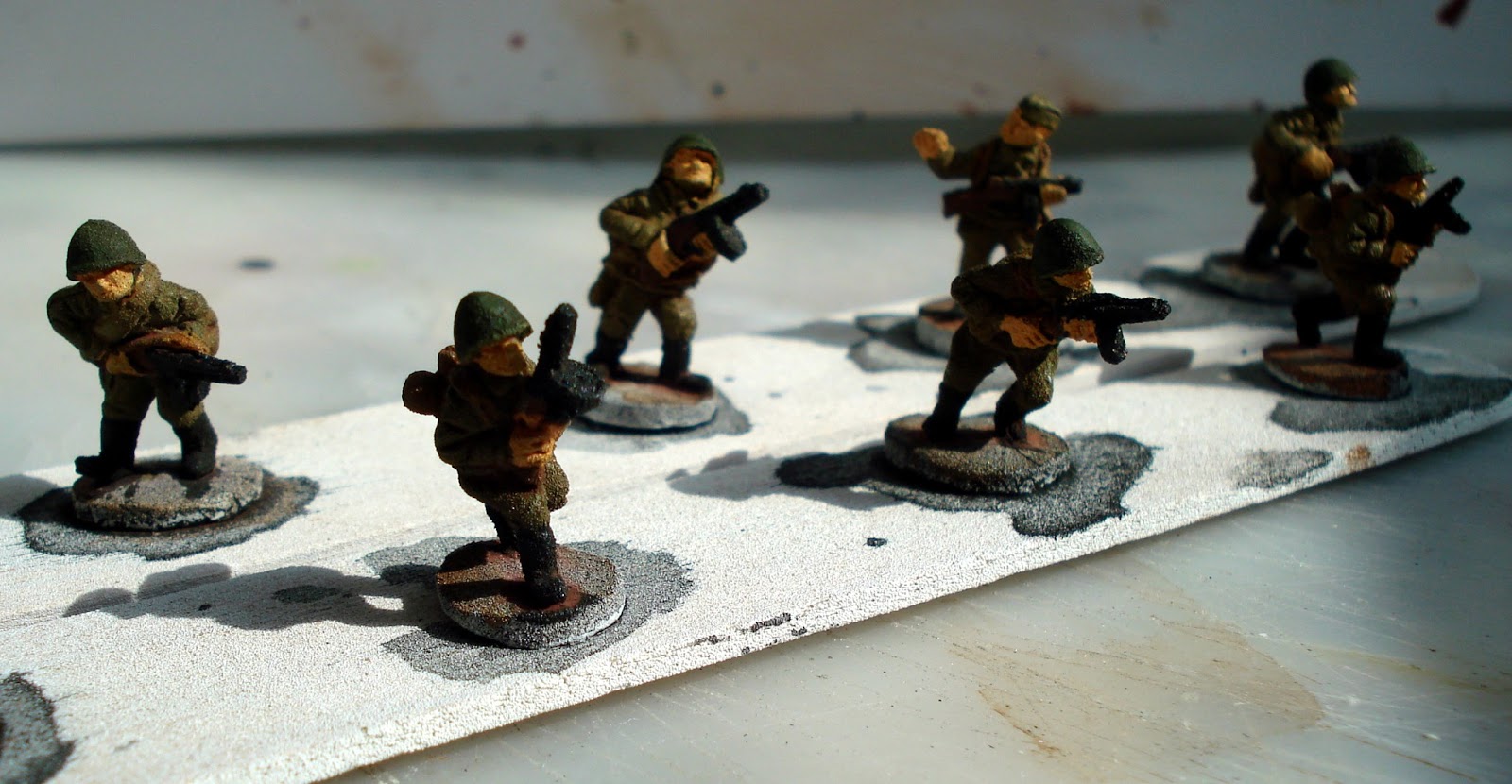
Getting them glued onto bases and flocked, overall I’m pretty satisfied with the results. I will likely give other miniatures a dry brush treatment to bring out the details. These are a bit subdued however I think with the uneven surface primer, it might bring out a weird texture look on the stands if I drybrushed these troops. As I mentioned, using another can of Army Painter primer gave me much better results for other figs. I expect I’d just gotten a bum can of primer. Fortunately, these scouts turned out pretty decent. I think having 3 or 4 to a base will also make the project more manageable. Now to get cracking on more stands.

Gambling in Savage Worlds

I’ve been having a lot of fun running Savage Worlds. Hee, I’d like to think my group is having a good time too. It’s got some kinks in the game and I still make some mistakes, but overall it’s a fun, streamlined system.

I had a player adopt a gambling scoundrel type. The default gambling rules for SW are decent. A player chooses a value of the stakes and folks make a gambling check. The highest and lowest are paired off, with the lower roll paying the difference times the stakes. Then the next highest and lowest are paired off, etc. Ties and odd players are considered to have broke even. It’s a fair way to resolve an hour or so game time of gambling.

The downside it’s a little swingy and doesn’t quite capture that night of gambling. A player can seriously flub a roll and be paired off against someone that got a raise or two. You can get into territory where a player wins 5-8 times the stakes bet. Even weirder, a player could actually lose several times over their initial stakes.

So I thought about tweaking the gambling checks a bit and resolve more around a capped amount players can potentially win. First a player chooses the stakes and ‘buy in’ at 2-3 times that amount. Each buy in is represented by a marker given to that player (say pennies, glass beads, poker chips, whatever). This marker abstractly reflects the cash brought to the table.

All gamblers in the game make a gambling check and it resolves as per the rules (highest and lowest paired off, etc.). However instead of paying the winner, the loser just hands over a marker. Any odd players out do not gain or lose any markers. Players keep rolling until there is a clear winner (getting all the markers), or other players drop out. The markers are then cashed in, each being one stake. So if the stakes were 5 silver, a player ending up with six markers would have 30 silver at the end of the night.

For it to work you need a few people playing, at least three with 4-5 being ideal (including the player that wants to gamble). I always have 2 or more PCs join in the game representing NPC extras at the table. I also try to have one extra have a similar skill to the player, with most having gambling at d6, and possibly one having a lower skill of d4. All participants would have the matching marker total of the player, with one possibly having 1-2 more (they simply are bringing more money to the table).

To speed up the gambling a bit, I have another rule that kicks in when an extra ‘drops out’ and loses all their markers. The next player/extra with the least amount of markers will also drop out of the game. Consider they have actually played a few hands and decide it best to cut out of the action early. At this point the player with the highest gambling skill makes a check. If they pass, they can choose to force that player to stay in the game if they wish. With a raise (not cumulative), they may also convince that player to buy in another marker.

This represents the gambler is able to string along a player having a losing streak, and may even convince them to throw more money into the game to stay at the table. Note this is entirely optional for the player making the check. They may want to have that player drop out. Even if doing so loses a chance at earning more cash, they are also cutting down the chance of having to pay markers.

Lastly, when it’s down to the last 2-3 players, I double the markers won and lost. It can drag out a bit just passing around a single marker over again and again. With multiple markers being won or lost, it tends to resolve the gambling a little faster.

An alternate to this could be that all players just throw their markers into one big pot. However I found actually exchanging markers gives players some gauge with how they are doing as the game progresses. Also they can utilize a large marker pile as a means to push other players into cashing in, wielding their winnings like a bludgeon to force others into calling the game early.

There are a couple of things I like about it. It represents cash in hand pretty well. You don’t have this phantom total of money pop out of nowhere, it’s all based on stakes at the table. The PC rolls a few times, which can average out that single lucky (or unlucky) roll. Having another extra drop out when one loses all their makers gives the player an opportunity to utilize their gambling skill in another fashion (potentially keeping a weaker player in the game for more money to be earned).

Lastly, there is some tension with the game and encourages a player to try and cheat on a particular roll. By default you don’t have this huge incentive to cheat. However if you really need a good roll to win a few markers off your opponent, cheating can be a decent way to get that edge. It’s all about that player flubbing their roll and getting caught, which can lead into more interesting situations.Trampier-Hommlet

I like dumbed down games

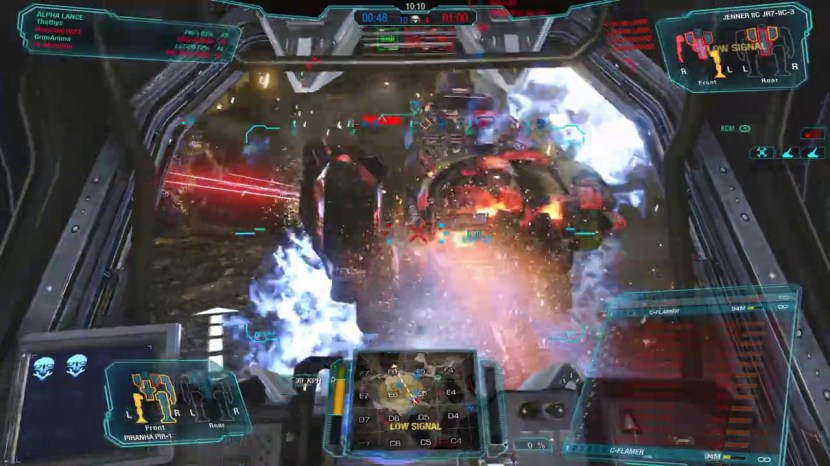
So for the past few weeks I’ve been puttering around with Mechwarrior Online. I think there is a great game there, but it has this steep learning curve. So much so I’m not sure if I’ll take the plunge.

I used to pooh-pooh simpler computer games. I’d revel in crunchy games with lots of working parts and huge manuals to go through. I mean it. I used to play Falcon on my old DOS 486. The manual was this thick technical bulky thing. Wolfenstein 3D had it’s place on my hard drive, but somehow I found it fun trying not just to master, but learn how to play these other simulation games. Mechwarrior online has a lot of crunchy bits to it. ECM, weapon groups, NARC beacons, it reminds me a lot of the old Mechwarrior computer games of past. Problem is now I’m just not that interested in making the effort to play these games. It’s just too much time to learn all the icons, commands, and understand the principles of the game. It’s just not that much fun any more.

I also regularly delve into World of Tanks. There is some meat with this game. There is a lot of background mechanics with how shell penetration works. Sighting the enemy, radio communication, and camouflage, not to mention how different the various armor plays, all take a bit of time to master. Still the game was very approachable initially with simple arcade controls for moving and shooting. And even if I didn’t do great in a match, I felt like I could contribute to a win.

MWO has a completely different feel. The learning curve for simple operation of your mech is pretty huge. Sadly, if one player is not pulling their weight, it can drag the entire team down. So this compounds the pressure for learning the ropes as quickly as possible. You need to get matches under your belt to learn the game, but at the same time hampering the fun of those that know what the hell they are doing. After scouring through online guides and watching training videos, I began to wonder if it’s worth the effort.

It dawned on me then that I’ve become that guy wanting simple games. I have limited free time and want to spend that having fun and playing, not spending all my time trying to learn new systems. This has also crept into my RPG habits. I used to love trying out all sorts of new systems, but lately I’ve gotten to this saturation point where I want to stick with things I know. I’ll branch out but only if the rules can be printed on a matchbook. Revisiting Champions and the Hero system or GURPS is not something I am so keen on, whereas something new like Dungeon World seems something right up my alley.

For game designers, I think this is a huge obstacle. How do you make a game approachable, as well as have enough meat in the mechanics to keep it interesting. Make it too simple and folks lose interest. Make the game too difficult and folks won’t even bother trying to learn how to play. For MWO, I think they’ve stuck to their guns and made a game for fans which like the crunchy technical stuff, that have the time and desire to learn how things work in the game. It’s not something I’m keen on, but my gaming tastes have changed. I’ve come to realize I’m starting to enjoy the dumbed down version of games more.

MWO

A summer of D&D fun

I expect some news will be trickling out about DnDnext come Gencon. Modularity with the rules seems to be the big theme. You have a core set of rules, with optional cogs of details and working gears to slip into the game. It also seems many of the core books will be pushed out sooner, rather than a long rollout of material. I expect other later releases will be more campaign setting-type material (like the Planes, Underdark, and such) rather than another PHB 2.

Still I fret a bit about the new player experience. Dumping 3 tomes of information onto a new person can be daunting. Having a boxed set of basic rules would be a great starting point.

I think that’s something which sort of killed 4E. Much of it seemed for existing D&D players and not much emphasis put towards the newly drafted group of brand new adventurers. You had a basic set, that was redone into an Essentials format, and then an entirely new line of new products (Essentials) that differed in presentation from the core books. It just exploded into this line of products that made things more confusing and diluted the new player experience even more.

I’ll go a bit more on this. I never quite got the focus group for the Red Box. It seemed packaged in a way to draw in the nostalgia of the older crowd that used to play D&D. Like it was to rekindle all those fond memories of gaming in the past. What about the 12 year old kid wandering through the store? Take a moment to track down a few pics and videos of the Pathfinder beginner box. Go ahead, I’ll wait…..

…THAT’S how you design and present an rpg. That is something to spark a kid’s interest to pick up a box and carry it out the store. WotC decided to go the whole retro 80’s deal. A poor decision there.

What would entail this new introductory boxed set? Aside from an introductory document (start here, what is an RPG, a step-by-step way to navigate a character sheet, introduce core game mechanics, etc.) a slimmed down rule set would be peachy. Give us your human, dwarf, elf, halfling races. Give us the fighter, wizard, cleric, and thief classes. Give us a trimmed list of specialties of two options. Give us rules for character generation, not just pre-gen characters to use. More importantly give us rules and material for the DM to get up to level 5.

That’s right, stop it at level 5. Figure a group playing every week, leveling every other week, and you’ve got 2+ months of D&D goodness. A summer of D&D fun. Wet the appetites of new players and get them playing D&D. If they want to take the plunge, there are 3 core books they can buy which open up the game fully.

Hands down, this should be the entry into the world of D&D. You’ve got a ‘basic’ set. A set that has everything you need to play, that allows for new adventures and characters to be created. A boxed set that has everything you ever need to play D&D.

But if that’s not enough, if you really want more options and the means to create a long term campaign with prolonged character progression, buy the ‘advanced’ rules. It’s the same core game just lots more options. And as a marketing strategy something very recognizable to older players. People that you might want to stroke up the fires of nostalgia, a group of folks that might get the desire to pick up the rules and share with their kids, having a ‘basic’ set and the option to pick up ‘advanced’ rules with 3 core books harkens back to AD&D of old.

So if you are a core book person, why buy the beginner boxed set? What would be in it for you? Aside from a decent adventure and a set of dice, how about some other nifty things that could be used? How about a fold out map of a campaign world (along with a simple gazette)? Even better, throw in a ton of monster tokens and character figure flats. While entirely optional, having stand up figure flats might encourage folks to pick up figures from the miniature line.

Notice I didn’t say a battlemat. It’s not needed. However tokens and figure flats go a long way in helping new players visualize the action. Without needing to be played out on a gridded map, it still can keep a firm foot in the ‘theater of the mind’ while still allowing players a way to better imagine what’s happening.

So give us that WotC. Have that beginner’s box ready to go at the launch of DnDnext. Don’t cheap out on the contents. Give it enough meat and goodies to provide a summer of D&D fun. Have it a product that anyone which regularly plays the game can unerringly say to new folks, ‘If you want to play D&D, start with this box.’

Firestorm Armada Free Rules

It just seems that Firestorm Armada news around the industry sites have been dropping off. If anything, Dystopian Wars/Legions seems to have captured a lot of folks’ imagination and has new products rolling out pretty regularly. Well it does indeed look like FA is DOA as the rules for the game are available for free online at the company web site.

Unfortunately the pdf does not have rules for the fleets and ships. Fortunately for fans the excellent site, Black Ocean, has got files for all the fleet ships available. Be sure to visit their site and snag them.

I liked FA. While it was more a naval war game with sci-fi trappings rather than a full out space simulation warship game, it captured that feel for me and used pretty simple mechanics. I liked the maneuvering for position and trying to move into ideal firing arcs. My only complaint was that many of the fleets felt a bit too similar, but the MARs rules somewhat addressed that. And for the life of me I never understood why they didn’t adopt a racial fleet system like an earlier version of the MARs rules that were floating around online.

Sad to see the game on the decline and for sure I expect that the line will evaporate in the next few years. It’s odd with the popularity of Battlestar Galactica and Star Trek, that space naval games seem too much a niche genre to get any traction with gamers. Well if you like free stuff (and a fun game to boot), be sure to pick up the FA rules.

4E must have books

I expect the footprint of 4E will be getting smaller and smaller in stores and in the convention scene. However I won’t be surprised to see some retailers trying to dump existing stock before DnDnext rolls out. If you were inclined to pick up some books for a 4E game, what would you get? There are a lot (over 30!) hardback books to choose from, not including adventures, some other smaller softback books, tiles, and such. So if you were to dip your toe into 4E and pick up some books on the cheap, what would be a short list of must buys?

As for myself, I may be potentially making a move and really need to consider what books to hang onto. Looking over my D&D library if I wanted to run a 4E game in the future what books can I dump and which ones should stay on the shelf? A while back I thought up a list of books needed to run a long term game, so what would I change given the newer releases since then?

Core Essential Buys – Immediately I would split off into 2 branches, and each I consider exclusive of the other. Either you go Essentials or go with the older core 4E books. Essentials and original 4E are the same game. You should be able to plug and play any of them into your game. However you might run into some subtle differences with character progression between the two. That’s why I’d consider if going the Essentials route, it’s best to stick to that entirely for core books.

So if going the Essentials route, I’d pick up Heroes of the Fallen Lands, Heroes of the Forgotten Kingdom, Dungeon Master’s Kit, and the Essentials Monster Vault. I have not gotten some of these books, however I consider them solid choices to easily gather core components of a 4E game together in a short stack. The are designed to complement each other with the rules. So having these you should have enough to run 4E.

The alternate is going the more traditional route of the older hardback books. I tend to think that if you wanted to expand your collection with a few additional books, this might be the better route. With that, I would pick up PHB 1 and 2, the DMG, and the Essentials Monster Vault.

You’ll notice I didn’t mention the original Monster Manual. Sadly, I think it is retired to the ‘stuff not to bother with’ list. The Essentials Monster Vault is a better product. The monster math is fixed and you have a book of core monsters that should be good for your campaign. Not to mention the loads of great monster tokens in the box.

With going either of these branches, you’ve got tons of material for your game and likely never need another book.

Solid Buys – If you wanted to add a little to this stack, there are 2 the additional books I would consider picking up:

Monster Manual 3 – It adds more monsters and even better fit in with the updated defenses, HP, and damage to challenge the players. I like the idea of no fuss monsters where I don’t have to spend a lot of time tweaking them. This book provides that.

Mordenkainen’s Magnificent Emporium – More magic items are a bonus and this book covers the gambit. It includes some adventure seed ideas (detailed magic item backgrounds and cursed items). Not to mention rounds out some much needed potions. It also fits well with either your original core 4E books or the Essentials line.

Good things to pick up later – There are a few books I would move into the stack of books to hang onto (or potentially pick up). These aren’t needed and some are more aligned with particular books, but they make for some good choices to expand your game:

Essentials Rules Compendium – It’s an extremely handy reference for your table. If you are one to regularly hit the convention scene or game on the go, even more so. However I tend to think that 4E will become more of a niche game in the future and likely not be seen too much in conventions. Still it is a decent, quick, go to reference to have at your table for rules.

AV vault 2 – I would only consider picking this up if you’ve got the Player’s Handbook 2. More magic items are always nice and the additional class specific items make it a decent addition to your collection.

Campaign specific player books – 4E went the route of having a player-centric and dm-centric book for both Eberron and Forgotten Realms. I’d consider getting these books if you were interested in jumping into these settings. Fortunately, Dark Sun went the route of packaging all of that into one book. While they are campaign setting specific, all 3 allow more player options to the game.

For a DM getting just the campaign setting material isn’t worthwhile. With enough digging on the internet, you can likely wrangle up enough information from online resources to run a game (maps, general location information, etc.). It’s the player rules specific to 4E that are lacking, and these books do the trick.

Stuff not to bother with – Everything else. Yup. You are now delving into territory that I consider either very campaign specific or stuff that’s peripheral to your game. Between PHB 1 and 2, you’ve got a ton of character options. Unless you were playing new campaign of the month, I seriously doubt that your players would want to dig into the options of the power source books. Some of the planes books and others like the Underdark are nice, but again very campaign specific. You can definitely mine these for adventure ideas however I would easily consider them not worth picking up. While it might be nice if you wanted to keep, or obtain, a collection of 4E books, I think it best to just let them go and keep your gaming library lean.

So this is a short list of books I think would be needed if you wanted to run a 4E game. Just about 4 books. Four books to give you enough for years of 4E enjoyment. So if you want to clear out your shelf space and make room for DnDnext, or are thinking about picking up some 4E books on the cheap, this isn’t a bad way to start.

4E essential

Review: Tomorrow’s War

From Ambush Alley Games and Osprey Publishing, Tomorrow’s War is a sfi-fi skirmish ruleset detailing  infantry warfare in the future. The system is designed for 15mm but could easily be bumped up to 28mm. As a squad-based force game, the scale is man to model and allows for the incorporation of individual armor units like tanks, APCs, and such ideal for platoon-sized engagements.

The setting of the game is rather concretely set with future nations extending conflicts both on Earth and on other colonized planets. So it is very much in the theater of mankind extending the battlefield along with imperialistic endeavors, further continuing warfare for resources and territory on a larger front of different planets. Corporations are also represented in the background, allowing for some flexibility in campaign themes. This is somewhat an interesting take on the game background, as there is room to explore non-symmetrical scenarios such as including untrained colonists, or poorly equipped but highly motivated insurgents.

The game revolves around a universal mechanic of rolling different polyhedral dice and trying to get a 4+. If rolling off against an opponent not only do you need to get a 4+, but also roll higher than the other person. Different troop and tech types use varying dice that range from d6 to d12. This makes for an interesting mechanic as everything is based around a static number (4+) with discrepancies in technologies, training, and troop morale using different dice. Additionally, some game conditions can temporarily alter the effectiveness of dice being used (such as one side being able to hack into the information network of an opponent).

Play revolves around one side gaining initiative for the turn through rolling off dice. They activate any of their units, and then the opposing player may activate units which were not utilized in a reaction. For every unit activated within LOS of the opponent, they have an opportunity to react to this activation. This can be a round of fire, to movement. All it takes is a troop quality test, trying to beat the rolled score of the opposing player.

Additionally, as long as the unit keeps passing reaction tests, it can can continually react to other units taking actions within their LOS. The catch is each activation reduces the firepower and movement of the reacting unit. You end up with these potentially large chains of events, where a unit moves, another reacts and moves out of LOS, only to stumble into sight of another unit, etc. It can get hectic, but there is a set order to resolving these actions.

What further compounds the chaotic feel of these actions and reaction fire is that there is no effective range for any weapons. Units can see and shoot over the entire board. LOS is blocked by terrain and other units. One particular aspect I like about the game is that models are in a relative position. Cover and units, while represented by individual models, are entirely based on where the majority of the models are. If more than half the models are in cover,the unit has its benefits. If most of the unit is behind a building, then the unit is out of sight. I appreciate the simplicity of this and getting away from relying too much on every single model in an entire squad needing to be in cover or behind a hill.

Another optional but random facet of play are the fog of war cards. Players continually draw and play special cards that introduce all sorts of random events to the game. Most are allow for a temporary condition to the battlefield or troops, while others might allow for a reroll or additional dice being added to a roll.

Combat is based entirely around rolling firepower dice verses defense dice. Get more successes than your target and you potentially inflict casualties. At first glance it looks very streamlined, however digging further you begin to see lots of different modifiers that can either add or remove dice from this pool. This is one refreshing approach to resolving tasks and fire. Rather than continually adding modifiers to an ever shifting target number, you just throw in (or remove) an extra die or two. Potential casualties are determined by rolling on a chart to see if the figure is simply wounded or out of the fight.

While the game is for infantry engagements, there are plenty of rules for armor also. I’ll say one plus for the game is the sheer amount of varying rules available for the game. From expected artillery and air support, to more futuristic information warfare superiority via a network grid. There are rules for drones, automatons, and other types of futuristic technology. As units have a variety of troop and technology characteristics, aliens can also be easily created with a detailed example of one within the rulebook. Even though units can adopt a variety of characteristics, it is not based on a point structure. However there are several troop and army types listed within the book.

The game has several basic scenarios scattered throughout the book and also has a campaign mode with a listing of various potential engagements. It’s an interesting ruleset as the initial impression is that it’s one of a very conventional theme, but there are additional rules to allow for more futuristic engagements adding on layers of technology.

The Good – I really appreciate the universal mechanic for resolving tasks. Keeping a static number and rolling different types of dice is a nifty idea. I also appreciate the breadth of ideas for futuristic engagements. There are a lot of interesting ideas and rules for different types of potential scenarios aside from the regular ‘wipe out the other person’s forces.’ The book itself is high production with colorful art, nice thick pages, all in a well bound hardback book.

The Bad – The layout of the rules is not ideal. While there are plenty of text examples, relying on photographs for some of the cover and LOS situations is a poor choice (wish they went with a cleaner graphic instead). There are too many charts spread out. Even worse, there is no quick summary sheet. Such critical information for playing the game and it’s scattered throughout the book.

For all the simplicity of the universal die mechanic, the game still gets bogged down with lots of book keeping. It’s small things that keep adding up, glutting the flow of the game. Like units taking multiple reaction tests which have to continually reduce their firepower and movement for future reactions.

The Verdict – This is not a ruleset I can recommend. While resolution of actions appears streamlined, in practice it’s ungainly. For contests, not only do you roll over the target number, but also have to roll higher than your opponent. This means a bucket of dice rolled in an attack have to be set aside and individually paired off as the defender rolls another bucket of dice.

For all the abstract positioning and LOS issues being based on an entire unit, you still get mired down in individual models needing various conditions being tracked. Models that are broken and surrender have to be under the watch of a lone opposing model and marched off the board. It seems that the game struggles with trying to have some quick, simple mechanics, but gets wrapped up in all of these other situational rules making it more like a simulation.

There is too much information in the rulebook, and it is poorly presented. There are a lot of examples, but critical charts are scattered throughout the book. It seems there is a good game buried in between the pages of the book, hidden away. Maybe if the game strove for a core set of mechanics, with layers of optional advanced rules it might work. Definitely having a better presentation and organization of critical rules and charts, including a good summary would help. Maybe if it had these things, this game would have some potential. As it is now, Tomorrow’s War has too many scattered ideas, too many situational rules, and needing too much effort to wade through the book to be a solid game.

Going the route of a comment-less blog

I’ve opted recently to remove comments from my blog. Long ago I felt it was a great way to drum up traffic and interact with people. I’ve tapered off the number of posts I’m putting up every month. In addition to that I was not really using tools to regularly keep up on new comments. Because of that, a few comments in the past got caught up in my spam filter.

How I interact with people online has changed and grown beyond my blog. I dabble regularly on twitter and G+ (click the buttons to the right). I’ve found as I frequent those more, and along with hashtags and communities I can promote posts and have a forum for more intensive discussion. Just utilizing comments here doesn’t cut it any more.

I have been exceedingly fortunate in never having any trolling comments for my blog. I’ve always gotten great comments from folks. Probably the most harsh one I had gotten was related to my city chase skill challenge post which I completely deserved (had to delete it due to foul language, but they very rightfully and succinctly pointed out my folly for depending on spell check too much and that ‘lose’ and ‘loose’ are not interchangeable).

I have had a problem with spam. Most get caught up with the captcha, yet I’ve had to resort to moderating comments over 30 days. My spam filters are pretty good, but I still get a fair clip of spam comments. Which makes me wonder about the effectiveness of keeping that up on my blog as a feature. I don’t think it is. Too much spam. Too infrequent with me checking up on my posts. I’d rather have discussion on my blog topics elsewhere. So I’ll stick to keeping this as a place to shout out my idiocy/thoughts on gaming. I encourage folks to add me on twitter and G+ and feel free to rant about this blog, especially on those social media venues.

Throwing out the dungeon corridor

I grew up old school with AD&D. Scrawling out huge dungeons on graph paper was always an entertaining pastime, even if many of the lairs I drew never saw the game table. It was just a fun creative exercise to line up rooms and try to interconnect them all. This is something I have clung to over the years. Then of course I see some gorgeous freeform maps from Fearless DM and after picking my jaw up off the floor, come to the realization that trying to get something like this mapped out in its entirety would likely be an insurmountable task.

Something dawns on me, why bother mapping out the interconnecting bits? Why etch out on paper that you’ve got a hallway that goes 30’ and then branches into a T, heading east and west, each going another 40’ ending in at a set of doors? Why mess with all that detail?

Instead, just concentrate on mapping the rooms. The stuff with monsters in it. Where all the action is taking place. That is the meat and potatoes for just about any dungeon jaunt. Why bother trying to accurately get a layout for the entire network of corridors and hallways that interconnect everything? Why not just stick to getting the details set for where the players will be actively adventuring.

With that mindset, maps like these become more manageable and something easier to work with. In the past I occasionally would just handwave the layout of a dungeon. Now I’ve been doing it exclusively. I try to keep a framework of room connections through lines and intersections with a few notes, but it is all a rough sketch. I save the actual mapping for where encounters will be.

I’ve been liking this as it’s been making my adventure planning more modular and dynamic. So the group has been through a series of monster encounters. At the descriptive intersection they head left towards another combat, where heading right would lead them to a trapped room. I’m able to switch out the rooms and give my players something else to tackle aside from another hack and slash fight. Best of all, I don’t have to muddle around with trying to keep every interconnecting hallway accurately mapped out.


It gives me some options to make encounters more interesting also. Now I can throw monsters coming in from two directions when the party stumbles into a room (including from behind). Keeping the rooms networked together with a narrative description gives me some wiggle room. If I keep things general and tell the group they’ve gone through a series of corridors which head into a large chamber, that allows me to plop in monster reinforcements right in the direction they entered the room from. It helps keep the players from being complacent and too overconfident of their tactical situation in an encounter.

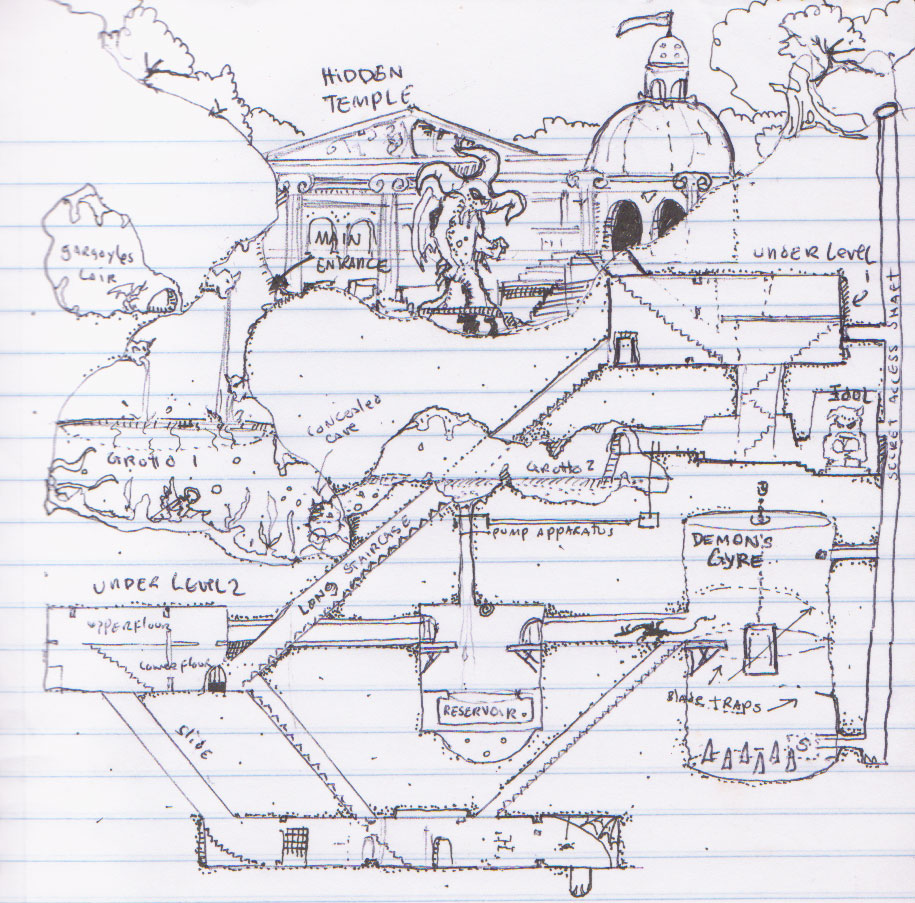
I’ve been liking this so much I’ve thrown out the idea of mapping out hallways. Just leaving things as a rough networked sketch has been great. It’s made it mentally easier for me to keep rooms dynamic and eased the ability of switching things around on the fly. Even better, when I see inspiring stuff like the maps here I’m more likely to use it and not worry about keeping in the corridors.

( Sadly, Fearless DM wrapped up his blog (where I snatched up these wonderful maps), but you can usually find him still dispensing RPG gems via twitter: @pseckler )